
Engelbrecht Andries P. Computational Intelligence: An Introduction
Подождите немного. Документ загружается.


258 13. Differential Evolution
with the worst global best solution is re-initialized. DynDE re-initializes the one sub-
population when
E(C
k
1
.
ˆ
x(t), C
k
2
.
ˆ
x(t)) <
X
2n
1/n
x
X
(13.32)
where E(C
k
1
.
ˆ
x(t), C
k
2
.
ˆ
x(t)) is the Euclidean distance between the best individuals of
sub-populations C
k
1
and C
k
2
, X represents the extent of the search space, n
X
is the
number of peaks, and n
x
is the search space dimension. It is this condition that
requires assumption 1, which suffers from obvious problems. For example, peaks are
not necessarily evenly distributed. It may also be the case that two peaks exist with a
distance less than
X
2n
1/n
x
X
from one another. Also, it is rarely the case that the number
of peaks is known.
After a change is detected, a strategy is followed to increase diversity. This is done by
assigning a different behavior to some of the individuals of the affected sub-population.
The following diversity increasing strategies have been proposed [577]:
• Re-initialize the sub-populations: While this strategy does maximize diversity,
it also leads to a severe loss of knowledge obtained about the search space.
• Use quantum individuals: Some of the individuals are re-initialized to random
points inside a ball centered at the global best individual,
ˆ
x(t), as outlined in
Algorithm 13.11. In this algorithm, R
max
is the maximum radius from
ˆ
x(t).
• Use Brownian individuals: Some positions are initialized to random positions
around
ˆ
x(t), where the random step sizes from
ˆ
x(t) are sampled from a Gaussian
distribution. That is,
x
i
(t)=
ˆ
x(t)+N(0,σ) (13.33)
• Introduce some form of entropy: Some individuals are simply added noise, sam-
pled from a Gaussian distribution. That is,
x
i
(t)=x
i
(t)+N(0,σ) (13.34)
Algorithm 13.11 Initialization of Quantum Individuals
for each individual, x
i
(t), to be re-initialized do
Generate a random vector, r
i
∼ N(0, 1);
Compute the distance of r
i
from the origin, i.e.
E(r
i
, 0)=
n
x
j=1
r
ij
(13.35)
Find the radius, R ∼ U(0,R
max
);
x
i
(t)=
ˆ
x(t)+Rr
i
/E(r
i
, 0);
end

13.6 Applications 259
13.6 Applications
Differential evolution has mostly been applied to optimize functions defined over
continuous-valued landscapes [695, 811, 813, 876]. Considering an unconstrained op-
timization problem, such as listed in Section A.5.3, each individual, x
i
, will be repre-
sented by an n
x
-dimensional vector where each x
ij
∈ R. For the initial population,
each individual is initialized using
x
ij
∼ U(x
min,j
,x
max,j
) (13.36)
The fitness function is simply the function to be optimized.
DE has also been applied to train neural networks (NN) (refer to Table 13.1 for
references). In this case an individual represents a complete NN. Each element of an
individual is one of the weights or biases of the NN, and the fitness function is, for
example, the sum-squared error (SSE).
Table 13.1 summarizes a number of real-world applications of DE. Please note that
this is not meant to be a complete list.
Table 13.1 Applications of Differential Evolution
Application Class Reference
Clustering [640, 667]
Controllers [112, 124, 164, 165, 394, 429, 438, 599]
Filter design [113, 810, 812, 883]
Image analysis [441, 521, 522, 640, 926]
Integer-Programming [390, 499, 500, 528, 530, 817]
Model selection [331, 354, 749]
NN training [1, 122, 550, 551, 598]
Scheduling [528, 531, 699, 748]
System design [36, 493, 496, 848, 839, 885]
13.7 Assignments
1. Show how DE can be used to train a FFNN.
2. Discuss the influence of different values for the population diversity tolerance,
1
, and the gene diversity tolerance,
2
, as used in equations (13.11) and (13.12)
for the hybrid DE.
3. Discuss the merits of the following two statements:
(a) If the probability of recombination is very low, then DE exhibits a high
probability of stagnation.
(b) For a small population size, it is sensible to have a high probability of
recombination.

260 13. Differential Evolution
4. For the DE/rand-to-best/y/z strategies, suggest an approach to balance explo-
ration and exploitation.
5. Discuss the consequences of too large and too small values of the standard devi-
ation, σ, used in Algorithm 13.6.
6. Explain in detail why the method for adding noise to trial vectors as given in
equation (13.15) may result in genetic drift.
7. With reference to the DynDE algorithm in Section 13.5.3, explain the effect of
very small and very large values of the standard deviation, σ.
8. Researchers in DE have suggested that the recombination probability should
be sampled from a Gaussian distribution, N (0, 1), while others have suggested
that N(0.5, 0.15) should be used. Compare these two suggestions and provide a
recommendation as to which approach is best.
9. Investigate the performance of a DE strategy if the scale factor is sampled from
a Cauchy distribution.

Chapter 14
Cultural Algorithms
Standard evolutionary algorithms (as discussed in previous chapters) have been suc-
cessful in solving diverse and complex problems in search and optimization. The search
process used by standard EAs is unbiased, using little or no domain knowledge to guide
the search process. However, the performance of EAs can be improved considerably if
domain knowledge is used to bias the search process. Domain knowledge then serves
as a mechanism to reduce the search space by pruning undesirable parts of the solution
space, and by promoting desirable parts. Cultural evolution (CE) [717], based on the
principles of human social evolution, was developed by Reynolds [716, 717, 724] in the
early 1990s as an approach to bias the search process with prior knowledge about the
domain as well as knowledge gained during the evolutionary process.
Evolutionary computation mimics biological evolution, which is based on the principle
of genetic inheritance. In natural systems, genetic evolution is a slow process. Cultural
evolution, on the other hand, enables societies to adapt to their changing environments
at rates that exceed that of biological evolution.
The rest of this chapter is organized as follows: A compact definition of culture and
artificial culture is given in Section 14.1. A general cultural algorithm (CA) framework
is given in Section 14.2, outlining the different components of CA implementations.
Section 14.3 describes the belief space component of CAs. A fuzzy CA approach is
described in Section 14.4. Advanced topics, including constrained environments are
covered in Section 14.5. Applications of CAs are summarized in Section 14.6.
14.1 Culture and Artificial Culture
A number of definitions of culture can be found, for example
1
:
• Culture is a system of symbolically encoded conceptual phenomena that are
socially and historically transmitted within and between social groups [223].
• Culture refers to the cumulative deposit of knowledge, experience, beliefs, val-
ues, attitudes, meanings, hierarchies, religion, notions of time, roles, spatial re-
lations, concepts of the universe, and material objects and possessions acquired
1
www.tamu.edu/classes/cosc/choudhury/culture.html
Computational Intelligence: An Introduction, Second Edition A.P. Engelbrecht
c
2007 John Wiley & Sons, Ltd
261

262 14. Cultural Algorithms
by a group of people in the course of generations through individual and group
striving.
• Culture is the sum total of the learned behavior of a group of people that is
generally considered to be the tradition of that people and is transmitted from
generation to generation.
• Culture is a collective programming of the mind that distinguishes the members
of one group or category of people from another.
In terms of evolutionary computation, culture is modeled as the source of data that
influences the behavior of all individuals within that population. This differs from EP
and ES where the behavioral characteristics of individuals – for the current generation
only – are modeled using phenotypes. Within cultural algorithms, culture stores the
general behavioral traits of the population. Cultural information is then accessible to
all the individuals of a population, and over many generations.
14.2 Basic Cultural Algorithm
A cultural algorithm (CA) is a dual-inheritance system, which maintains two search
spaces: the population space (to represent a genetic component based on Darwinian
principles), and a belief space (to represent a cultural component). It is the latter that
distinguishes CAs from other EAs.
The belief space models the cultural information about the population, while the
population space represents the individuals on a genotypic and/or phenotypic level.
Both the population and belief spaces evolve in parallel, with both influencing one
another. A communication protocol therefore forms an integral part of a CA. Such a
protocol defines two communication channels. One for a select group of individuals to
adapt the set of beliefs, and another defining the way that the beliefs influence all of
the individuals in the population space.
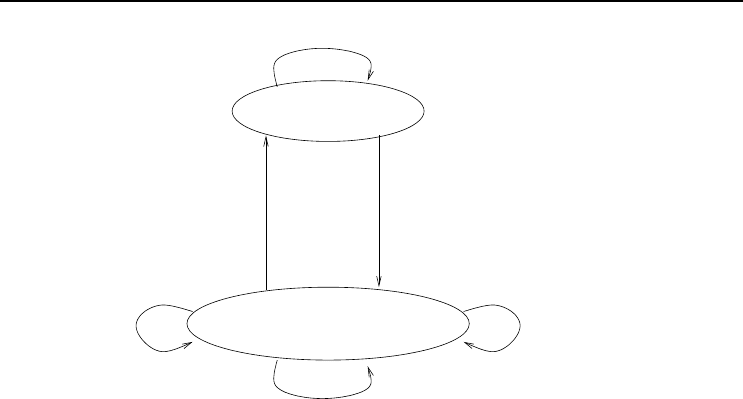
A pseudocode cultural algorithm is given in Algorithm 14.1, and illustrated in Fig-
ure 14.1.
Algorithm 14.1 Cultural Algorithm
Set the generation counter, t =0;
Create and initialize the population space, C(0);
Create and initialize the belief space, B(0);
while stopping condition(s) not true do
Evaluate the fitness of each x
i
(t) ∈C(t);
Adjust (B(t), Accept (C(t)));
Variate (C(t), Influence (B(t)));
t = t +1;
Select the new population;
end
14.3 Belief Space 263
Accept Influence population
Fitness evaluation
Variate population
Selection
Adjust beliefs
Figure 14.1 Illustration of Population and Belief Spaces of Cultural Algorithms
At each iteration (each generation), individuals are first evaluated using the fitness
function specified for the EA on the population level. An acceptance function is then
used to determine which individuals from the current population have an influence
on the current beliefs. The experience of the accepted individuals is then used to
adjust the beliefs (to simulate evolution of culture). The adjusted beliefs are then
used to influence the evolution of the population. The variation operators (crossover
and mutation) use the beliefs to control the changes in individuals. This is usually
achieved through self-adapting control parameters, as functions of the beliefs.
The population space is searched using any of the standard EAs, for example an EP
[720] or GA [716]. Recently, particle swarm optimization (PSO) has been used on
the population space level [219]. The next section discusses the belief space in more
detail.
14.3 Belief Space
The belief space serves as a knowledge repository, where the collective behaviors (or
beliefs) of the individuals in the population space are stored. The belief space is also
referred to as the meme pool,whereameme is a unit of information transmitted by
behavioral means. The belief space serves as a global knowledge repository of behav-
ioral traits. The memes within the belief space are generalizations of the experience
of individuals within the population space. These experiential generalizations are ac-
cumulated and shaped over several generations, and not just one generation. These
generalizations express the beliefs as to what the optimal behavior of individuals con-
stitutes.

264 14. Cultural Algorithms
The belief space can effectively be used to prune the population space. Each individual
represents a point in the population search space: the knowledge within the belief
space is used to move individuals away from undesirable areas in the population space
towards more promising areas.
Some form of communication protocol is implemented to transfer information between
the two search spaces. The communication protocol specifies operations that control
the influence individuals have on the structure of the belief space, as well as the
influence that the belief space has on the evolution process in the population level.
This allows individuals to dictate their culture, causing culture to also evolve. On
the other hand, the cultural information is used to direct the evolution on population
level towards promising areas in the search space. It has been shown that the use of
a belief space reduces computational effort substantially [717, 725].
Various CAs have been developed, which differ in the data structures used to model
the belief space, the EA used on the population level, and the implementation of the
communication protocol. Section 14.3.1 provides an overview of different knowledge
components within the belief space. Acceptance and influence functions are discussed
in Sections 14.3.2 and 14.3.4 respectively.
14.3.1 Knowledge Components
The belief space contains a number of knowledge components to represent the be-
havioral patterns of individuals from the population space. The types of knowledge
components and data structures used to represent the knowledge depends on the prob-
lem being solved. The first application of CAs used version spaces represented as a
lattice to store schemata [716]. For function optimization, vector representations are
used (discussed below) [720]. Other representations that have been used include fuzzy
systems [719, 725], ensemble structures [722], and hierarchical belief spaces [420].
In general, the belief space contains at least two knowledge components [720]:
• A situational knowledge component, which keeps track of the best solutions
found at each generation.
• A normative knowledge component, which provides standards for individual
behaviors, used as guidelines for mutational adjustments to individuals. In the
case of function optimization, the normative knowledge component maintains
a set of intervals, one for each dimension of the problem being solved. These
intervals characterize the range of what is believed to be good areas to search in
each dimension.
If only these two components are used, the belief space is represented as the tuple,
B(t)=(S(t), N(t)) (14.1)
where S(t) represents the situational knowledge component, and N(t)representsthe
normative knowledge component. The situational component is the set of best solu-
tions,
S(t)={
ˆ
y
l
(t):l =1,...,n
S
} (14.2)

14.3 Belief Space 265
and the normative component is represented as
N(t)=(X
1
(t), X
2
(t),...,X
n
x
(t)) (14.3)
where, for each dimension, the following information is stored:
X
j
(t)=(I
j
(t),L
j
(t),U
j
(t)) (14.4)
I
j
denotes the closed interval, I
j
(t)=[x
min,j
(t),x
max,j
(t)] = {x : x
min,j
≤ x ≤
x
max,j
}, L
j
(t) is the score for the lower bound, and U
j
(t) is the score for the upper
bound.
In addition to the above knowledge components, the following knowledge components
can be added [672, 752]:
• A domain knowledge component, which is similar to the situational knowledge
component in that it stores the best positions found. The domain knowledge
component differs from the situational knowledge component in that knowledge
is not re-initialized at each generation, but contains an archive of best solutions
since evolution started – very similar to the hall-of-fame used in coevolution.
• A history knowledge component, used in problems where search landscapes
may change. This component maintains information about sequences of envi-
ronmental changes. For each environmental change, the following information is
stored: the current best solution, the directional change for each dimension and
the current change distance.
• A topographical knowledge component, which maintains a multi-dimensional
grid representation of the search space. Information is kept about each cell of
the grid, e.g. frequency of individuals that occupy the cell. Such frequency
information can be used to improve exploration by forcing mutation direction
towards unexplored areas.
The type of knowledge components and the way that knowledge is represented have
an influence on the acceptance and influence functions, as discussed in the following
sections.
14.3.2 Acceptance Functions
The acceptance function determines which individuals from the current population will
be used to shape the beliefs for the entire population. Static methods use absolute
ranking, based on fitness values, to select the top n% individuals. Any of the selection
methods for EAs (refer to Section 8.5) can be used, for example elitism, tournament
selection, or roulette-wheel selection, provided that the number of individuals remains
the same.
Dynamic methods do not have a fixed number of individuals that adjust the belief
space. Instead, the number of individuals may change from generation to generation.
Relative ranking, for example, selects individuals with above average (or median)

266 14. Cultural Algorithms
performance [128]. Alternatively, the number of individuals is determined as
n
B
(t)=
n
s
γ
t
(14.5)
with γ ∈ [0, 1]. Using this approach, the number of individuals used to adjust the
belief space is initially large, with the number decreasing exponentially over time.
Other simulated-annealing based schedules can be used instead.
Adaptive methods use information about the search space and process to self-adjust
the number of individuals to be selected. Reynolds and Chung [719] proposed a fuzzy
acceptance function to determine the number of individuals based on generation num-
ber and individual success ratio. Membership functions are defined to implement the
rules given in Algorithm 14.2.
14.3.3 Adjusting the Belief Space
For the purpose of this section, it is assumed that the belief space maintains a situ-
ational and normative knowledge component, and that a continuous, unconstrained
function is minimized.
With the number of accepted individuals, n
B
(t), known, the two knowledge compo-
nents can be updated as follows [720]:
• Situational knowledge: Assuming that only one element is kept in the situa-
tional knowledge component,
S(t +1)={
ˆ
y(t +1)} (14.6)
where
ˆ
y(t +1)=
min
l=1,...,n
B
(t)
{x
l
(t)} if f (min
l=1,...,n
B
(t)
{x
l
(t)}) <f(
ˆ
y(t))
ˆ
y(t)otherwise
(14.7)
• Normative knowledge: In adjusting the normative knowledge component, a
conservative approach is followed when narrowing intervals, thereby delaying
too early exploration. Widening of intervals is applied more progressively. The
interval update rule is as follows:
x
min,j
(t +1)=
x
lj
(t)ifx
lj
(t) ≤ x
min,j
(t)orf(x
l
(t)) <L
j
(t)
x
min,j
(t)otherwise
(14.8)
x
max,j
(t +1)=
x
lj
(t)ifx
lj
(t) ≥ x
max,j
(t)orf(x
l
(t)) <U
j
(t)
x
max,j
(t)otherwise
(14.9)
L
j
(t +1)=
f(x
l
(t)) if x
lj
(t) ≤ x
min,j
(t)orf (x
l
(t)) <L
j
(t)
L
j
(t)otherwise
(14.10)

14.3 Belief Space 267
Algorithm 14.2 Fuzzy Rule-base for Cultural Algorithm Acceptance Function
if the current generation is early in the search then
if the success ratio is low then
Accept a medium number of individuals (30%);
end
if the success ratio is medium then
Accept a medium number of individuals;
end
if the success ratio is high then
Accept a larger number of individuals (40%);
end
end
if the current generation is in the middle stages of the search then
if the success ratio is low then
Accept a smaller number of individuals (20%);
end
if the success ratio is medium then
Accept a medium number of individuals;
end
if the success ratio is high then
Accept a medium number of individuals;
end
end
if the current generation is near the end of the search then
if the success ratio is low then
Accept a smaller number of individuals;
end
if the success ratio is medium then
Accept a smaller number of individuals;
end
if the success ratio is high then
Accept a medium number of individuals;
end
end
U
j
(t +1)=
f(x
lj
(t)) if x
lj
(t) ≥ x
max,j
(t)orf (x
l
(t)) <U
j
(t)
U
j
(t)otherwise
(14.11)
for each x
l
(t),l=1,...,n
B
(t).
14.3.4 Influence Functions
Beliefs are used to adjust individuals in the population space to conform closer to the
global beliefs. The adjustments are realized via influence functions. To illustrate this