
Engelbrecht Andries P. Computational Intelligence: An Introduction
Подождите немного. Документ загружается.


Preface to the Second Edition
Man has learned much from studies of natural systems, using what has been learned
to develop new algorithmic models to solve complex problems. This book presents an
introduction to some of these technological paradigms, under the umbrella of compu-
tational intelligence (CI). In this context, the book includes artificial neural networks,
evolutionary computation, swarm intelligence, artificial immune systems, and fuzzy
systems, which are respectively models of the following natural systems: biological
neural networks, evolution, swarm behavior of social organisms, natural immune sys-
tems, and human thinking processes.
Why this book on computational intelligence? Need arose from a graduate course,
where students did not have a deep background of artificial intelligence and mathe-
matics. Therefore the introductory perspective is essential, both in terms of the CI
paradigms and mathematical depth. While the material is introductory in nature, it
does not shy away from details, and does present the mathematical foundations to the
interested reader. The intention of the book is not to provide thorough attention to
all computational intelligence paradigms and algorithms, but to give an overview of
the most popular and frequently used models. For these models, detailed overviews
of different implementations are given. As such, the book is appropriate for beginners
in the CI field. The book is also applicable as prescribed material for a third year
undergraduate course.
In addition to providing an overview of CI paradigms, the book provides insights into
many new developments on the CI research front to tempt the interested reader. As
such, the material is useful to graduate students and researchers who want a broader
view of the different CI paradigms, also researchers from other fields who have no
knowledge of the power of CI techniques, e.g. bioinformaticians, biochemists, mechan-
ical and chemical engineers, economists, musicians and medical practitioners.
The book is organized in six parts. Part I provides a short introduction to the different
CI paradigms and a historical overview. Parts II to VI cover the different paradigms,
and can be reviewed in any order.
Part II deals with artificial neural networks (NN), including the following topics: Chap-
ter 2 introduces the artificial neuron as the fundamental part of a neural network,
including discussions on different activation functions, neuron geometry and learning
rules. Chapter 3 covers supervised learning, with an introduction to different types
of supervised networks. These include feedforward NNs, functional link NNs, product
unit NNs, cascade NNs, and recurrent NNs. Different supervised learning algorithms
are discussed, including gradient descent, conjugate gradient methods, LeapFrog and
Computational Intelligence: An Introduction, Second Edition A.P. Engelbrecht
c
2007 John Wiley & Sons, Ltd
xxix

xxx Preface
particle swarm optimization. Chapter 4 covers unsupervised learning. Different un-
supervised NN models are discussed, including the learning vector quantizer and self-
organizing feature maps. Chapter 5 discusses radial basis function NNs. Reinforce-
ment learning is dealt with in Chapter 6. Much attention is given to performance
issues of supervised networks in Chapter 7. The focus of the chapter is on accuracy
measures and ways to improve performance.
Part III introduces several evolutionary computation models. Topics covered include:
an overview of the computational evolution process and basic operators in Chapter 8.
Chapter 9 covers genetic algorithms, Chapter 10 genetic programming, Chapter 11
evolutionary programming, Chapter 12 evolution strategies, Chapter 13 differential
evolution, Chapter 14 cultural algorithms, and Chapter 15 covers coevolution, intro-
ducing both competitive and symbiotic coevolution.
Part IV presents an introduction to two types of swarm-based models: Chapter 16 dis-
cusses particle swarm optimization, while ant algorithms are discussed in Chapter 17.
Artificial immune systems are covered in Part V, with the natural immune system
being discussed in Chapter 18 and a number of artificial immune models in Chapter 19.
Part VI deals with fuzzy systems. Chapter 20 presents an introduction to fuzzy logic
with a discussion of membership functions. Fuzzy inferencing systems are explained
in Chapter 21, while fuzzy controllers are discussed in Chapter 22. An overview of
rough sets is given in Chapter 23.
Throughout the book, assignments are given to highlight certain aspects of the covered
material and to stimulate thought. Some example applications are given where they
seemed appropriate to better illustrate the theoretical concepts.
The accompanying website of this book, which can be located at http://ci.cs.up.ac.za,
provides algorithms to implement many of the CI models discussed in this book.
These algorithms are implemented in Java, and form part of an opensource library,
CIlib, developed by the Computational Intelligence Research Group in the Depart-
ment of Computer Science, University of Pretoria. CIlib (http://cilib.sourceforge.net)
is a generic framework for easy implementation of new CI algoithms, and currently
contains frameworks for particle swarm optimization, neural networks, and evolution-
ary computation. Lists with acronyms and symbols used in the book can also be
downloaded from the book’s website.
As a final remark, it is necessary to thank a number of people who have helped to
produce this book. First of all, thanks to my mother, Magriet Engelbrecht, who has
helped with typing and proofreading most of the text. Also, thanks to Anri Henning
who spent a number of nights proofreading the material. The part on artificial immune
systems was written by one of my PhD students, Attie Graaff. Without his help, this
book would not have been so complete. Lastly, I thank all of my postgraduate students
who have helped with the development of CIlib.
Pretoria, South Africa
Part I
INTRODUCTION
1

Chapter 1
Introduction to
Computational Intelligence
A major thrust in algorithmic development is the design of algorithmic models to
solve increasingly complex problems. Enormous successes have been achieved through
the modeling of biological and natural intelligence, resulting in so-called “intelligent
systems”. These intelligent algorithms include artificial neural networks, evolution-
ary computation, swarm intelligence, artificial immune systems, and fuzzy systems.
Together with logic, deductive reasoning, expert systems, case-based reasoning and
symbolic machine learning systems, these intelligent algorithms form part of the field
of Artificial Intelligence (AI). Just looking at this wide variety of AI techniques, AI
can be seen as a combination of several research disciplines, for example, computer
science, physiology, philosophy, sociology and biology.
But what is intelligence? Attempts to find definitions of intelligence still provoke heavy
debate. Dictionaries define intelligence as the ability to comprehend, to understand
and profit from experience, to interpret intelligence, having the capacity for thought
and reason (especially to a high degree). Other keywords that describe aspects of
intelligence include creativity, skill, consciousness, emotion and intuition.
Can computers be intelligent? This is a question that to this day causes more debate
than the definitions of intelligence. In the mid-1900s, Alan Turing gave much thought
to this question. He believed that machines could be created that would mimic the
processes of the human brain. Turing strongly believed that there was nothing the
brain could do that a well-designed computer could not. More than fifty years later
his statements are still visionary. While successes have been achieved in modeling
small parts of biological neural systems, there are still no solutions to the complex
problem of modeling intuition, consciousness and emotion – which form integral parts
of human intelligence.
In 1950 Turing published his test of computer intelligence, referred to as the Turing
test [858]. The test consisted of a person asking questions via a keyboard to both a
person and a computer. If the interrogator could not tell the computer apart from the
human, the computer could be perceived as being intelligent. Turing believed that it
would be possible for a computer with 10
9
bits of storage space to pass a 5-minute
version of the test with 70% probability by the year 2000. Has his belief come true?
The answer to this question is left to the reader, in fear of running head first into
Computational Intelligence: An Introduction, Second Edition A.P. Engelbrecht
c
2007 John Wiley & Sons, Ltd
3

4 1. Introduction to Computational Intelligence
another debate! However, the contents of this book may help to shed some light on
the answer to this question.
A more recent definition of artificial intelligence came from the IEEE Neural Networks
Council of 1996: the study of how to make computers do things at which people are
doing better. A definition that is flawed, but this is left to the reader to explore in
one of the assignments at the end of this chapter.
This book concentrates on a sub-branch of AI, namely Computational Intelligence
(CI) – the study of adaptive mechanisms to enable or facilitate intelligent behavior in
complex and changing environments. These mechanisms include those AI paradigms
that exhibit an ability to learn or adapt to new situations, to generalize, abstract,
discover and associate. The following CI paradigms are covered: artificial neural net-
works, evolutionary computation, swarm intelligence, artificial immune systems, and
fuzzy systems. While individual techniques from these CI paradigms have been ap-
plied successfully to solve real-world problems, the current trend is to develop hybrids
of paradigms, since no one paradigm is superior to the others in all situations. In
doing so, we capitalize on the respective strengths of the components of the hybrid CI
system, and eliminate weaknesses of individual components.
The rest of this chapter is organized as follows: Section 1.1 of this chapter presents a
short overview of the different CI paradigms, also discussing the biological motivation
for each paradigm. A short history of AI is presented in Section 1.2.
At this point it is necessary to state that there are different definitions of what con-
stitutes CI. This book reflects the opinion of the author, and may well cause some
debate. For example, swarm intelligence (SI) and artificial immune systems (AIS)
are classified as CI paradigms, while many researchers consider these paradigms to
belong only under Artificial Life. However, both particle swarm optimization (PSO)
and ant colony optimization (ACO), as treated under SI, satisfy the definition of CI
given above, and are therefore included in this book as being CI techniques. The same
applies to AISs.
1.1 Computational Intelligence Paradigms
This book considers five main paradigms of Computation Intelligence (CI), namely
artificial neural networks (NN), evolutionary computation (EC), swarm intelligence
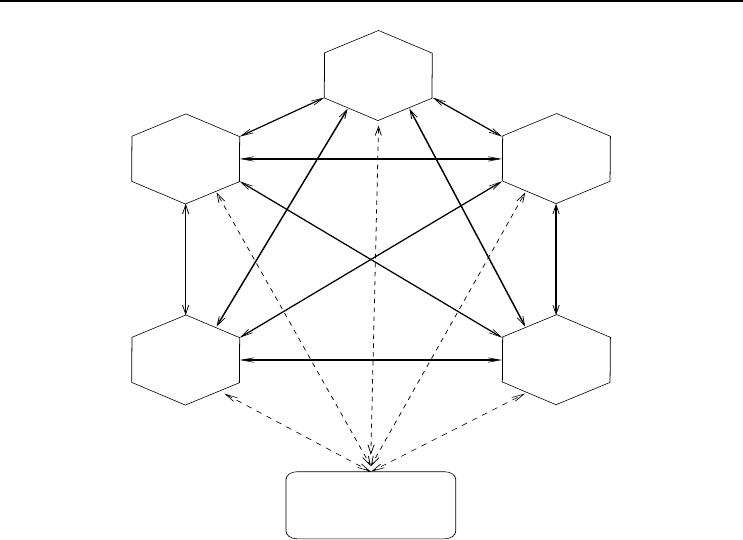
(SI), artificial immune systems (AIS), and fuzzy systems (FS). Figure 1.1 gives a
summary of the aim of the book. In addition to CI paradigms, probabilistic methods
are frequently used together with CI techniques, which is also shown in the figure.
Soft computing, a term coined by Lotfi Zadeh, is a different grouping of paradigms,
which usually refers to the collective set of CI paradigms and probabilistic methods.
The arrows indicate that techniques from different paradigms can be combined to form
hybrid systems.
Each of the CI paradigms has its origins in biological systems. NNs model biological
1.1 Computational Intelligence Paradigms 5
NN EC
SIFS
Probabilistic
Techniques
AIS
Figure 1.1 Computational Intelligence Paradigms
neural systems, EC models natural evolution (including genetic and behavioral evo-
lution), SI models the social behavior of organisms living in swarms or colonies, AIS
models the human immune system, and FS originated from studies of how organisms
interact with their environment.
1.1.1 Artificial Neural Networks
The brain is a complex, nonlinear and parallel computer. It has the ability to perform
tasks such as pattern recognition, perception and motor control much faster than any
computer – even though events occur in the nanosecond range for silicon gates, and
milliseconds for neural systems. In addition to these characteristics, others such as
the ability to learn, memorize and still generalize, prompted research in algorithmic
modeling of biological neural systems – referred to as artificial neural networks (NN).
It is estimated that there is in the order of 10-500 billion neurons in the human cortex,
with 60 trillion synapses. The neurons are arranged in approximately 1000 main
modules, each having about 500 neural networks. Will it then be possible to truly
model the human brain? Not now. Current successes in neural modeling are for small
artificial NNs aimed at solving a specific task. Problems with a single objective can
be solved quite easily with moderate-sized NNs as constrained by the capabilities of
modern computing power and storage space. The brain has, however, the ability to
solve several problems simultaneously using distributed parts of the brain. We still
6 1. Introduction to Computational Intelligence
have a long way to go ...
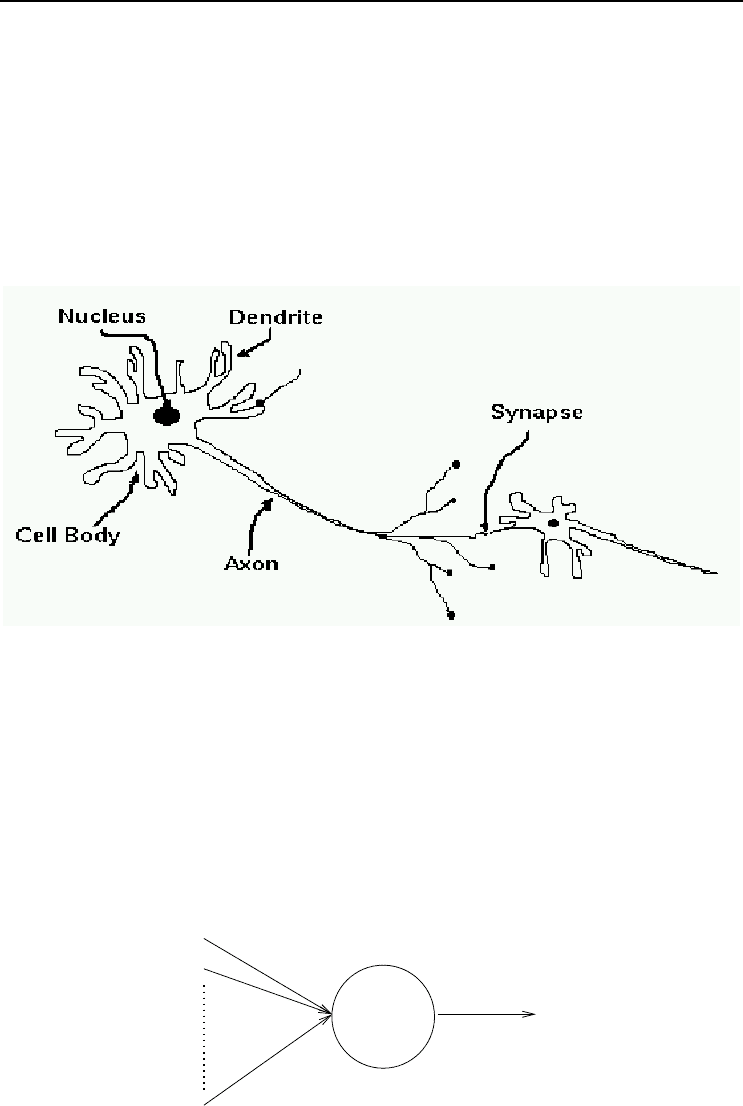
The basic building blocks of biological neural systems are nerve cells, referred to as
neurons. As illustrated in Figure 1.2, a neuron consists of a cell body, dendrites and
an axon. Neurons are massively interconnected, where an interconnection is between
the axon of one neuron and a dendrite of another neuron. This connection is referred
to as a synapse. Signals propagate from the dendrites, through the cell body to the
axon; from where the signals are propagated to all connected dendrites. A signal is
transmitted to the axon of a neuron only when the cell “fires”. A neuron can either
inhibit or excite a signal.
Figure 1.2 A Biological Neuron
An artificial neuron (AN) is a model of a biological neuron (BN). Each AN receives
signals from the environment, or other ANs, gathers these signals, and when fired,
transmits a signal to all connected ANs. Figure 1.3 is a representation of an artificial
neuron. Input signals are inhibited or excited through negative and positive numerical
weights associated with each connection to the AN. The firing of an AN and the
strength of the exiting signal are controlled via a function, referred to as the activation
function. The AN collects all incoming signals, and computes a net input signal as
a function of the respective weights. The net input signal serves as input to the
activation function which calculates the output signal of the AN.
output signalf(net)
weight
input signals
Figure 1.3 An Artificial Neuron
1.1 Computational Intelligence Paradigms 7
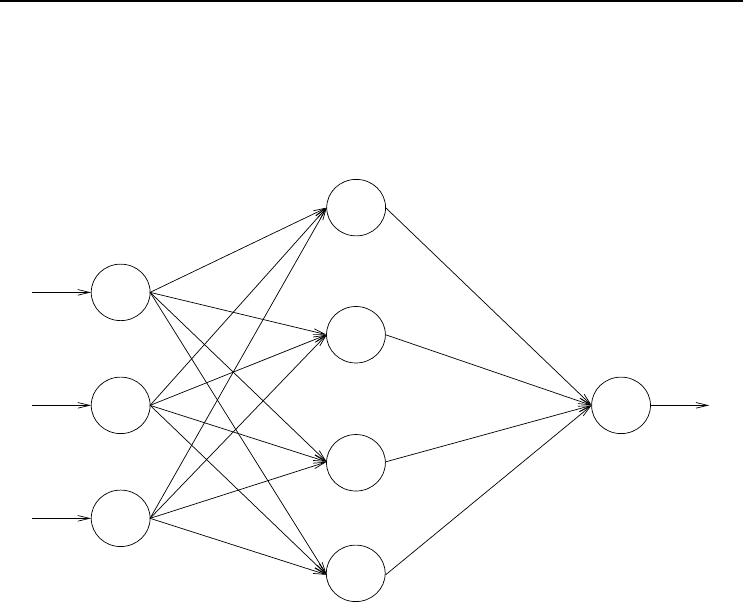
An artificial neural network (NN) is a layered network of ANs. An NN may consist
of an input layer, hidden layers and an output layer. ANs in one layer are connected,
fully or partially, to the ANs in the next layer. Feedback connections to previous layers
are also possible. A typical NN structure is depicted in Figure 1.4.
hidden layer
output layer
input layer
Figure 1.4 An Artificial Neural Network
Several different NN types have been developed, for example (the reader should note
that the list below is by no means complete):
• single-layer NNs, such as the Hopfield network;
• multilayer feedforward NNs, including, for example, standard backpropagation,
functional link and product unit networks;
• temporal NNs, such as the Elman and Jordan simple recurrent networks as well
as time-delay neural networks;
• self-organizing NNs, such as the Kohonen self-organizing feature maps and the
learning vector quantizer;
• combined supervised and unsupervised NNs, e.g. some radial basis function
networks.
These NN types have been used for a wide range of applications, including diagno-
sis of diseases, speech recognition, data mining, composing music, image processing,
forecasting, robot control, credit approval, classification, pattern recognition, planning
game strategies, compression, and many others.