
Engelbrecht Andries P. Computational Intelligence: An Introduction
Подождите немного. Документ загружается.

28 3. Supervised Learning Neural Networks
3.1.1 Feedforward Neural Networks
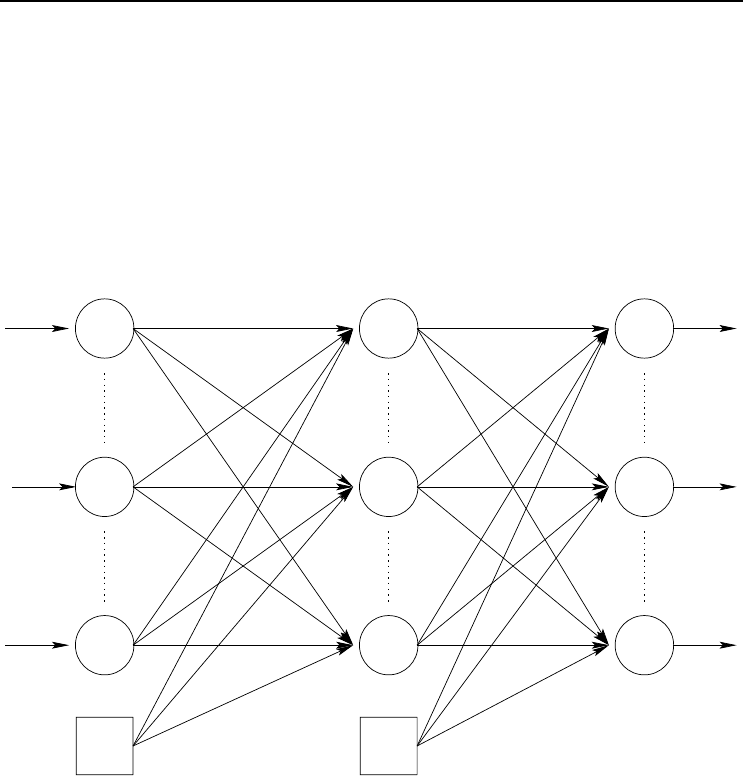
Figure 3.1 illustrates a standard feedforward neural network (FFNN), consisting of
three layers: an input layer (note that some literature on NNs do not count the input
layer as a layer), a hidden layer and an output layer. While this figure illustrates
only one hidden layer, a FFNN can have more than one hidden layer. However, it
has been proved that FFNNs with monotonically increasing differentiable functions
can approximate any continuous function with one hidden layer, provided that the
hidden layer has enough hidden neurons [383]. A FFNN can also have direct (linear)
connections between the input layer and the output layer.
−1−1
v
ji
v
JI
w
kj
z
I
z
i
z
I+1
z
1
y
J+1
y
J
y
j
y
1
v
11
w
11
o
1
o
k
o
K
v
J,I +1
w
K,J+1
v
1i
w
1j
w
J+1,k
w
KJ
v
I+1,j
Figure 3.1 Feedforward Neural Network
The output of a FFNN for any given input pattern z
p
is calculated with a single
forward pass through the network. For each output unit o
k
, we have (assuming no
direct connections between the input and output layers),
o
k,p
= f
o
k
(net
o
k,p
)
= f
o
k
J+1
j=1
w
kj
f
y
j
(net
y
j,p
)
= f
o
k
J+1
j=1
w
kj
f
y
j
I+1
i=1
v
ji
z
i,p
(3.1)
where f
o
k
and f
y
j
are respectively the activation function for output unit o
k
and
3.1 Neural Network Types 29
hidden unit y
j
; w
kj
is the weight between output unit o
k
and hidden unit y
j
; z
i,p
is the value of input unit z
i
of input pattern z
p
;the(I + 1)-th input unit and the
(J + 1)-th hidden unit are bias units representing the threshold values of neurons in
the next layer.
Note that each activation function can be a different function. It is not necessary that
all activation functions be the same. Also, each input unit can implement an activation
function. It is usually assumed that input units have linear activation functions.
z
I
z
i
z
1
−1
w
kj
y
J+1
y
J
y
j
y
1
w
11
o
1
o
k
o
K
w
K,J+1
w
1j
w
J+1,k
w
KJ
u
11
u
L2
v
jL
h
L−1
u
31
h
1
h
2
h
3
h
L
−1
v
J,L+1
v
11
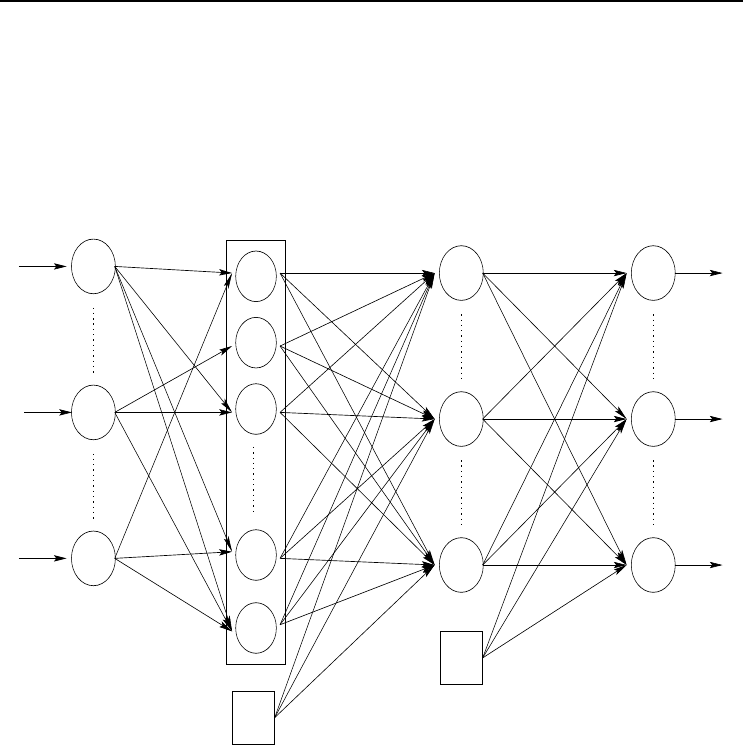
Figure 3.2 Functional Link Neural Network
3.1.2 Functional Link Neural Networks
In functional link neural networks (FLNN) input units do implement activation func-
tions (or rather, transformation functions). A FLNN is simply a FFNN with the input
layer expanded into a layer of functional higher-order units [314, 401]. The input layer,
with dimension I, is therefore expanded to functional units h
1
,h
2
, ···,h
L
, where L is
the total number of functional units, and each functional unit h
l
is a function of the
input parameter vector (z
1
, ···,z
I
), i.e. h
l
(z
1
, ···,z
I
) (see Figure 3.2). The weight
matrix U between the input layer and the layer of functional units is defined as
u
li
=
1 if functional unit h
l
is dependent of z
i
0otherwise
(3.2)
For FLNNs, v
jl
is the weight between hidden unit y
j
and functional link h
l
.

30 3. Supervised Learning Neural Networks
Calculation of the activation of each output unit o
k
occurs in the same manner as for
FFNNs, except that the additional layer of functional units is taken into account:
o
k,p
= f
o
k
J+1
j=1
w
kj
f
y
j
L
l=1
v
jl
h
l
(z
p
)
(3.3)
The use of higher-order combinations of input units may result in faster training times
and improved accuracy (see, for example, [314, 401]).
3.1.3 Product Unit Neural Networks
Product unit neural networks (PUNN) have neurons that compute the weighted prod-
uct of input signals, instead of a weighted sum [222, 412, 509]. For product units, the
net input is computed as given in equation (2.5).
Different PUNNs have been suggested. In one type each input unit is connected to
SUs, and to a dedicated group of PUs. Another PUNN type has alternating layers of
product and summation units. Due to the mathematical complexity of having PUs
in more than one hidden layer, this section only illustrates the case for which just
the hidden layer has PUs, and no SUs. The output layer has only SUs, and linear
activation functions are assumed for all neurons in the network. Then, for each hidden
unit y
j
, the net input to that hidden unit is (note that no bias is included)
net
y
j,p
=
I
i=1
z
v
ji
i,p
=
I
i=1
e
v
ji
ln(z
i,p
)
= e
i
v
ji
ln(z
i,p
)
(3.4)
where z
i,p
is the activation value of input unit z
i
,andv
ji
is the weight between input
z
i
and hidden unit y
j
.
An alternative to the above formulation of the net input signal for PUs is to include
a “distortion” factor within the product [406], such as
net
y
j,p
=
I+1
i=1
z
v
ji
i,p
(3.5)
where z
I+1,p
= −1 for all patterns; v
j,I+1
represents the distortion factor. The purpose
of the distortion factor is to dynamically shape the activation function during training
to more closely fit the shape of the true function represented by the training data.
If z
i,p
< 0, then z
i,p
can be written as the complex number z
i,p
= ı
2
|z
i,p
| (ı =
√
−1)
that, substituted in (3.4), yields
net
y
j,p
= e
i
v
ji
ln |z
i,p
|
e
i
v
ji
ln ı
2
(3.6)
3.1 Neural Network Types 31
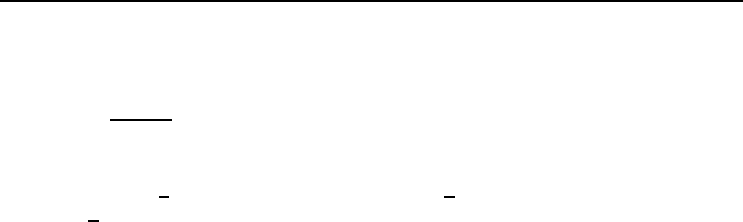
Let c =0+ı = a + bı be a complex number representing ı. Then,
ln c =lnre
ıθ
=lnr + ıθ +2πkı (3.7)
where r =
√
a
2
+ b
2
=1.
Considering only the main argument, arg(c), k = 0 which implies that 2πkı =0.
Furthermore, θ =
π
2
for ı =(0, 1). Therefore, ıθ = ı
π
2
, which simplifies equation (3.10)
to ln c = ı
π
2
, and consequently,
ln ı
2
= ıπ (3.8)
Substitution of (3.8) in (3.6) gives
net
y
j,p
= e
i
v
ji
ln |z
i,p
|
e
i
v
ji
πı
= e
i
v
ji
ln |z
i,p
|
cos(
I
i=1
v
ji
π)+ı sin
I
i=1
v
ji
π
(3.9)
Leaving out the imaginary part ([222] show that the added complexity of including
the imaginary part does not help with increasing performance),
net
y
j,p
= e
i
v
ji
ln |z
i,p
|
cos
π
I
i=1
v
ji
(3.10)
Now, let
ρ
j,p
=
I
i=1
v
ji
ln |z
i,p
| (3.11)
φ
j,p
=
I
i=1
v
ji
I
i
(3.12)
with
I
i
=
0ifz
i,p
> 0
1ifz
i,p
< 0
(3.13)
and z
i,p
=0.
Then,
net
y
j,p
= e
ρ
j,p
cos(πφ
j,p
) (3.14)
The output value for each output unit is then calculated as
o
k,p
= f
o
k
J+1
j=1
w
kj
f
y
j
(e
ρ
j,p
cos(πφ
j,p
))
(3.15)
Note that a bias is now included for each output unit.
32 3. Supervised Learning Neural Networks
3.1.4 Simple Recurrent Neural Networks
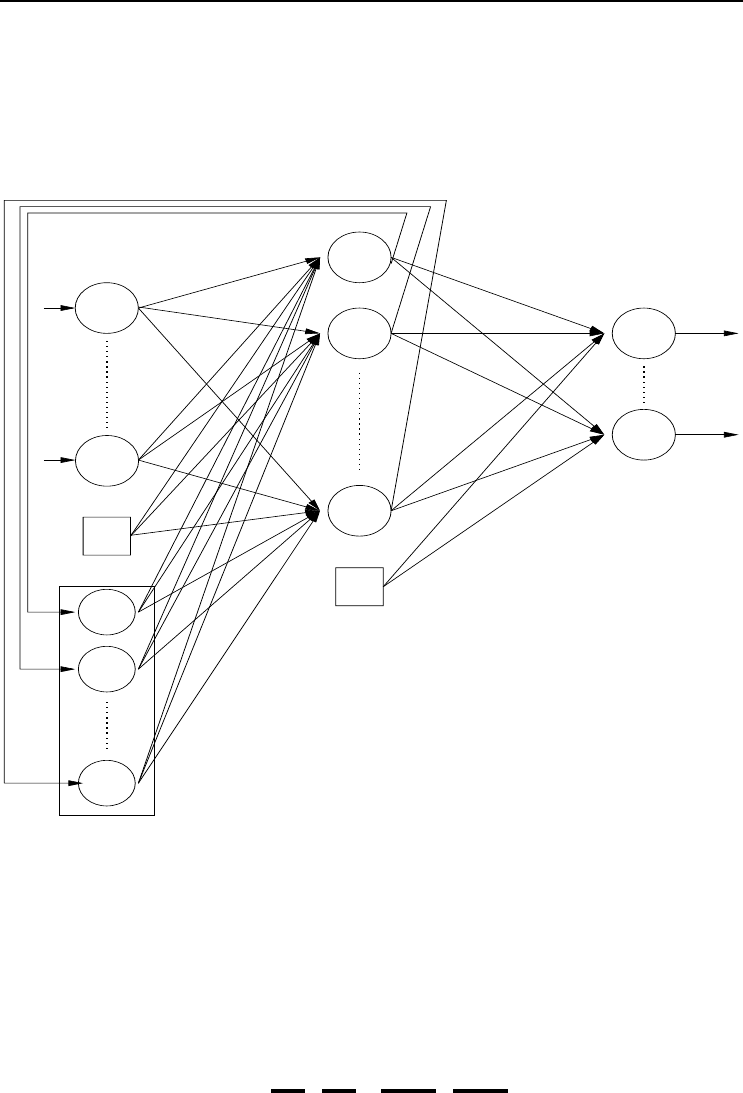
Simple recurrent neural networks (SRNN) have feedback connections which add the
ability to also learn the temporal characteristics of the data set. Several different types
of SRNNs have been developed, of which the Elman and Jordan SRNNs are simple
extensions of FFNNs.
Ŧ1
Ŧ1
Context layer
Figure 3.3 Elman Simple Recurrent Neural Network
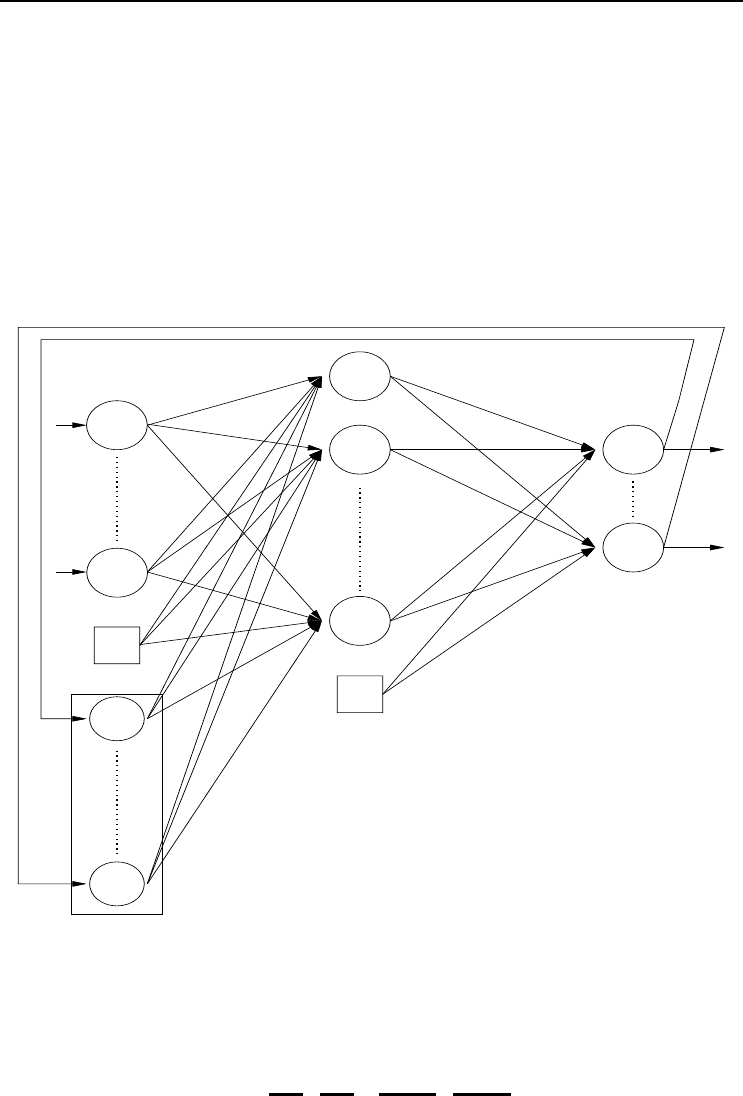
The Elman SRNN [236], as illustrated in Figure 3.3, makes a copy of the hidden
layer, which is referred to as the context layer. The purpose of the context layer is to
store the previous state of the hidden layer, i.e. the state of the hidden layer at the
previous pattern presentation. The context layer serves as an extension of the input
layer, feeding signals representing previous network states, to the hidden layer. The
input vector is therefore
z =(z
1
, ···,z
I+1
actual inputs
,z
I+2
, ···,z
I+1+J
context units
) (3.16)
Context units z
I+2
, ···,z
I+1+J
are fully interconnected with all hidden units. The
connections from each hidden unit y
j
(for j =1, ···,J) to its corresponding context
3.1 Neural Network Types 33
unit z
I+1+j
have a weight of 1. Hence, the activation value y
j
is simply copied to
z
I+1+j
. It is, however, possible to have weights not equal to 1, in which case the
influence of previous states is weighted. Determining such weights adds additional
complexity to the training step.
Each output unit’s activation is then calculated as
o
k,p
= f
o
k
J+1
j=1
w
kj
f
y
j
(
I+1+J
i=1
v
ji
z
i,p
)
(3.17)
where (z
I+2,p
, ···,z
I+1+J,p
)=(y
1,p
(t − 1), ···,y
J,p
(t − 1)).
Ŧ1
Ŧ1
State layer
Figure 3.4 Jordan Simple Recurrent Neural Network
Jordan SRNNs [428], on the other hand, make a copy of the output layer instead of
the hidden layer. The copy of the output layer, referred to as the state layer, extends
the input layer to
z =(z
1
, ···,z
I+1
actual inputs
,z
I+2
, ···,z
I+1+K
state units
) (3.18)
The previous state of the output layer then also serves as input to the network. For
34 3. Supervised Learning Neural Networks
each output unit,
o
k,p
= f
o
k
J+1
j=1
w
kj
f
y
j
I+1+K
i=1
v
ji
z
i,p
(3.19)
where (z
I+2,p
, ···,z
I+1+K,p
)=(o
1,p
(t − 1), ···,o
K,p
(t − 1)).
Ŧ1
z
I
(t)
z
2
(t)
z
1
(t)
y
j
v
j,1(t)
v
j,1(t−1)
v
j,1(t−2)
v
j,1(t−n
t
)
v
j,2(t)
v
j,2(t−1)
v
j,2(t−2)
v
j,2(t−n
t
)
v
j,I(t)
v
j,I(t−1)
v
j,I(t−2)
v
j,I(t−n
t
)
v
j,I+1
z
I
(t − 1)
z
I
(t − 2)
z
I
(t − n
t
)
z
2
(t − n
t
)
z
2
(t − 2)
z
2
(t − 1)
z
1
(t − n
t
)
z
1
(t − 2)
z
1
(t − 1)
Figure 3.5 A Single Time-Delay Neuron
3.1.5 Time-Delay Neural Networks
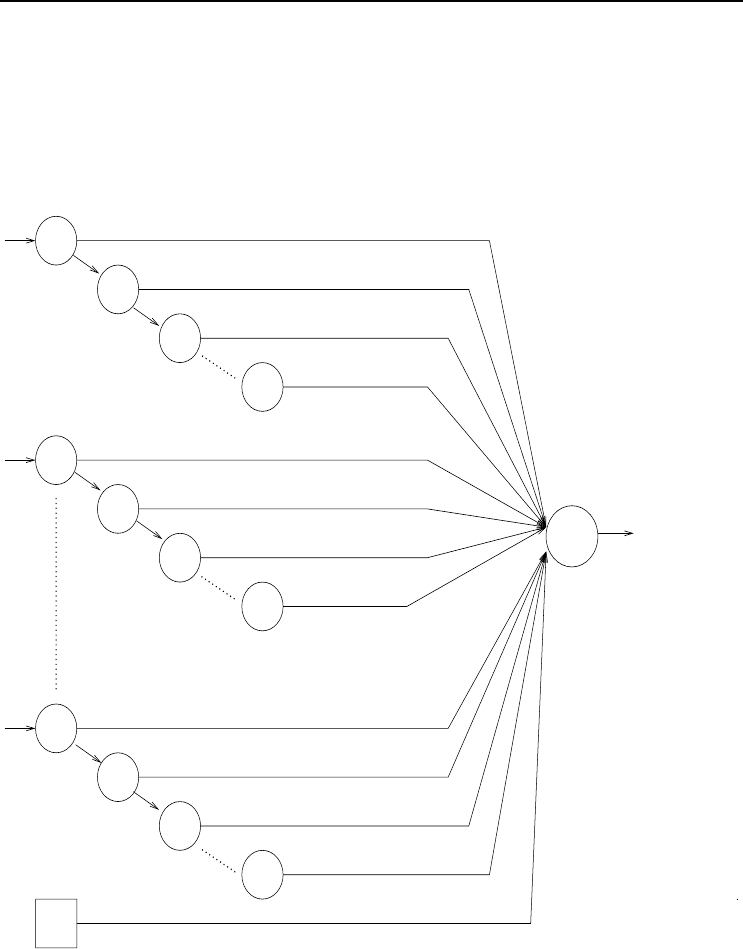
A time-delay neural network (TDNN) [501], also referred to as backpropagation-
through-time, is a temporal network with its input patterns successively delayed in

3.1 Neural Network Types 35
time. A single neuron with n
t
time delays for each input unit is illustrated in Fig-
ure 3.5. This type of neuron is then used as a building block to construct a complete
feedforward TDNN.
Initially, only z
i,p
(t), with t = 0, has a value and z
i,p
(t −t
) is zero for all i =1, ···,I
with time steps t
=1, ···,n
t
; n
t
is the total number of time steps, or number of delayed
patterns. Immediately after the first pattern is presented, and before presentation of
the second pattern,
z
i,p
(t − 1) = z
i,p
(t) (3.20)
After presentation of t
patterns and before the presentation of pattern t
+ 1, for all
t =1, ···,t
,
z
i,p
(t − t
)=z
i,p
(t − t
+ 1) (3.21)
This causes a total of n
t
patterns to influence the updates of weight values, thus
allowing the temporal characteristics to drive the shaping of the learned function.
Each connection between z
i,p
(t − t
)andz
i,p
(t − t
+ 1) has a value of 1.
The output of a TDNN is calculated as
o
k,p
= f
o
k
J+1
j=1
w
kj
f
y
j
I
i=1
n
t
t=0
v
j,i(t)
z
i,p
(t)+z
I+1
v
j,I+1
(3.22)
3.1.6 Cascade Networks
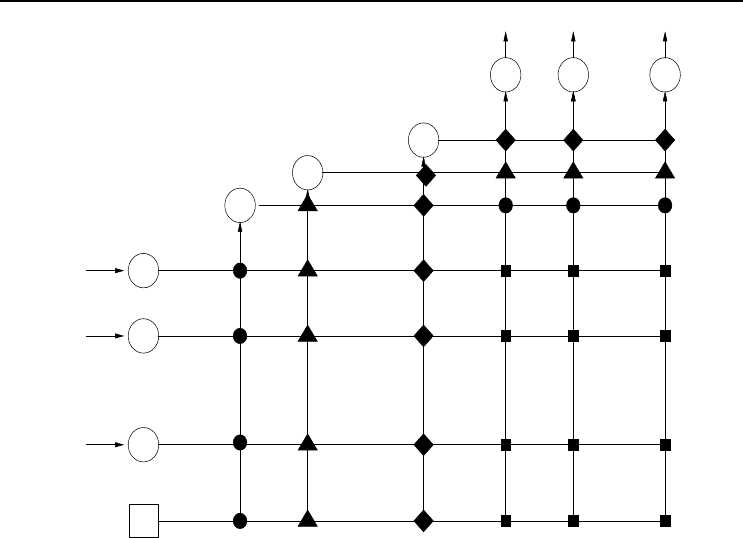
A cascade NN (CNN) [252, 688] is a multilayer FFNN where all input units have direct
connections to all hidden units and to all output units. Furthermore, the hidden units
are cascaded. That is, each hidden unit’s output serves as an input to all succeeding
hidden units and all output units. Figure 3.6 illustrates a CNN.
The output of a CNN is calculated is
o
k,p
= f
o
k
I+1
i=1
u
ki
z
i
+
J
j=1
w
kj
f
y
j
I+1
i=1
v
ji
z
i
+
j−1
l=1
s
jl
y
l
(3.23)
where u
ki
represents a weight between output unit k and input unit i, s
jl
is a weight
between hidden units j and l,andy
l
is the activation of hidden unit l.
At this point it is important to note that training of a CNN consists of finding weight
values and the size of the NN. Training starts with the simplest architecture containing
only the (I +1)K direct weights between input and output units (indicated by a solid
square in Figure 3.6). If the accuracy of the CNN is unacceptable one hidden unit
is added, which adds another (I +1)J +(J − 1) + JK weights to the network. If
J = 1, the network includes the weights indicated by the filled squares and circles in
Figure 3.6. When J = 2, the weights marked by filled triangles are added.
36 3. Supervised Learning Neural Networks
Ŧ1
z
1
z
2
z
I
z
I+1
y
1
y
2
y
J
o
2
o
1
o
K
Figure 3.6 Cascade Neural Network
3.2 Supervised Learning Rules
Up to this point it was shown how NNs can be used to calculate an output value given
an input pattern. This section explains approaches to train the NN such that the
output of the network is an accurate approximation of the target values. First, the
learning problem is explained, and then different training algorithms are described.
3.2.1 The Supervised Learning Problem
Consider a finite set of input-target pairs D = {d
p
=(z
p
, t
p
)|p =1, ···,P} sampled
from a stationary density Ω(D), with z
i,p
,t
k,p
∈ R for i =1, ···,I and k =1, ···,K;
z
i,p
is the value of input unit z
i
and t
k,p
is the target value of output unit o
k
for
pattern p. According to the signal-plus-noise model,
t
p
= µ(z
p
)+ζ
p
(3.24)
where µ(z) is the unknown function. The input values z
i,p
are sampled with probability
density ω(z), and the ζ
k,p
are independent, identically distributed noise sampled with
density φ(ζ), having zero mean. The objective of learning is then to approximate the
unknown function µ(z) using the information contained in the finite data set D.For
NN learning this is achieved by dividing the set D randomly into a training set D
T
,
a validation set D
V
, and a test set D
G
(all being dependent from one another). The

3.2 Supervised Learning Rules 37
approximation to µ(z) is found from the training set D
T
, memorization is determined
from D
V
(more about this later), and the generalization accuracy is estimated from
the test set D
G
(more about this later).
Since prior knowledge about Ω(D) is usually not known, a nonparametric regression
approach is used by the NN learner to search through its hypothesis space H for a
function f
NN
(D
T
, W) which gives a good estimation of the unknown function µ(z),
where f
NN
(D
T
, W) ∈H. For multilayer NNs, the hypothesis space consists of all
functions realizable from the given network architecture as described by the weight
vector W .
During learning, the function f
NN
: R
I
−→ R
K
is found which minimizes the empirical
error
E
T
(D
T
; W)=
1
P
T
P
T
p=1
(F
NN
(z
p
, W) − t
p
)
2
(3.25)
where P
T
is the total number of training patterns. The hope is that a small empirical
(training) error will also give a small true error, or generalization error, defined as
E
G
(Ω; W)=
(f
NN
(z, W) − t)
2
dΩ(z, t) (3.26)
For the purpose of NN learning, the empirical error in equation (3.25) is referred
to as the objective function to be optimized by the optimization method. Several
optimization algorithms for training NNs have been developed [51, 57, 221]. These
algorithms are grouped into two classes:
• Local optimization, where the algorithm may get stuck in a local optimum
without finding a global optimum. Gradient descent and scaled conjugate gra-
dient are examples of local optimizers.
• Global optimization, where the algorithm searches for the global optimum
by employing mechanisms to search larger parts of the search space. Global
optimizers include LeapFrog, simulated annealing, evolutionary algorithms and
swarm optimization.
Local and global optimization techniques can be combined to form hybrid training
algorithms.
Learning consists of adjusting weights until an acceptable empirical error has been
reached. Two types of supervised learning algorithms exist, based on when weights
are updated:
• Stochastic/online learning, where weights are adjusted after each pattern
presentation. In this case the next input pattern is selected randomly from
the training set, to prevent any bias that may occur due to the order in which
patterns occur in the training set.
• Batch/offline learning, where weight changes are accumulated and used to
adjust weights only after all training patterns have been presented.