
Engelbrecht Andries P. Computational Intelligence: An Introduction
Подождите немного. Документ загружается.


8 1. Introduction to Computational Intelligence
1.1.2 Evolutionary Computation
Evolutionary computation (EC) has as its objective to mimic processes from natural
evolution, where the main concept is survival of the fittest: the weak must die. In
natural evolution, survival is achieved through reproduction. Offspring, reproduced
from two parents (sometimes more than two), contain genetic material of both (or
all) parents – hopefully the best characteristics of each parent. Those individuals
that inherit bad characteristics are weak and lose the battle to survive. This is nicely
illustrated in some bird species where one hatchling manages to get more food, gets
stronger, and at the end kicks out all its siblings from the nest to die.
Evolutionary algorithms use a population of individuals, where an individual is re-
ferred to as a chromosome. A chromosome defines the characteristics of individuals in
the population. Each characteristic is referred to as a gene. The value of a gene is re-
ferred to as an allele. For each generation, individuals compete to reproduce offspring.
Those individuals with the best survival capabilities have the best chance to repro-
duce. Offspring are generated by combining parts of the parents, a process referred
to as crossover. Each individual in the population can also undergo mutation which
alters some of the allele of the chromosome. The survival strength of an individual
is measured using a fitness function which reflects the objectives and constraints of
the problem to be solved. After each generation, individuals may undergo culling,or
individuals may survive to the next generation (referred to as elitism). Additionally,
behavioral characteristics (as encapsulated in phenotypes) can be used to influence the
evolutionary process in two ways: phenotypes may influence genetic changes, and/or
behavioral characteristics evolve separately.
Different classes of evolutionary algorithms (EA) have been developed:
• Genetic algorithms which model genetic evolution.
• Genetic programming which is based on genetic algorithms, but individuals
are programs (represented as trees).
• Evolutionary programming which is derived from the simulation of adaptive
behavior in evolution (phenotypic evolution).
• Evolution strategies which are geared toward modeling the strategy parame-
ters that control variation in evolution, i.e. the evolution of evolution.
• Differential evolution, which is similar to genetic algorithms, differing in the
reproduction mechanism used.
• Cultural evolution which models the evolution of culture of a population and
how the culture influences the genetic and phenotypic evolution of individuals.
• Coevolution where initially “dumb” individuals evolve through cooperation,
or in competition with one another, acquiring the necessary characteristics to
survive.
Other aspects of natural evolution have also been modeled. For example, mass ex-
tinction, and distributed (island) genetic algorithms, where different populations are
maintained with genetic evolution taking place in each population. In addition, as-
pects such as migration among populations are modeled. The modeling of parasitic

1.1 Computational Intelligence Paradigms 9
behavior has also contributed to improved evolutionary techniques. In this case para-
sites infect individuals. Those individuals that are too weak die. On the other hand,
immunology has been used to study the evolution of viruses and how antibodies should
evolve to kill virus infections.
Evolutionary computation has been used successfully in real-world applications, for
example, data mining, combinatorial optimization, fault diagnosis, classification, clus-
tering, scheduling, and time series approximation.
1.1.3 Swarm Intelligence
Swarm intelligence (SI) originated from the study of colonies, or swarms of social or-
ganisms. Studies of the social behavior of organisms (individuals) in swarms prompted
the design of very efficient optimization and clustering algorithms. For example, sim-
ulation studies of the graceful, but unpredictable, choreography of bird flocks led to
the design of the particle swarm optimization algorithm, and studies of the foraging
behavior of ants resulted in ant colony optimization algorithms.
Particle swarm optimization (PSO) is a stochastic optimization approach, modeled on
the social behavior of bird flocks. PSO is a population-based search procedure where
the individuals, referred to as particles, are grouped into a swarm. Each particle in
the swarm represents a candidate solution to the optimization problem. In a PSO
system, each particle is “flown” through the multidimensional search space, adjusting
its position in search space according to its own experience and that of neighboring
particles. A particle therefore makes use of the best position encountered by itself
and the best position of its neighbors to position itself toward an optimum solution.
The effect is that particles “fly” toward an optimum, while still searching a wide area
around the current best solution. The performance of each particle (i.e. the “closeness”
of a particle to the global minimum) is measured according to a predefined fitness
function which is related to the problem being solved. Applications of PSO include
function approximation, clustering, optimization of mechanical structures, and solving
systems of equations.
Studies of ant colonies have contributed in abundance to the set of intelligent algo-
rithms. The modeling of pheromone depositing by ants in their search for the shortest
paths to food sources resulted in the development of shortest path optimization al-
gorithms. Other applications of ant colony optimization include routing optimization
in telecommunications networks, graph coloring, scheduling and solving the quadratic
assignment problem. Studies of the nest building of ants and bees resulted in the
development of clustering and structural optimization algorithms.
1.1.4 Artificial Immune Systems
The natural immune system (NIS) has an amazing pattern matching ability, used to
distinguish between foreign cells entering the body (referred to as non-self,orantigen)
and the cells belonging to the body (referred to as self). As the NIS encounters antigen,

10 1. Introduction to Computational Intelligence
the adaptive nature of the NIS is exhibited, with the NIS memorizing the structure of
these antigen for faster future response the antigen.
In NIS research, four models of the NIS can be found:
• The classical view of the immune system is that the immune system distin-
guishes between self and non-self, using lymphocytes produced in the lymphoid
organs. These lymphocytes “learn” to bind to antigen.
• Clonal selection theory, where an active B-Cell produces antibodies through
a cloning process. The produced clones are also mutated.
• Danger theory, where the immune system has the ability to distinguish be-
tween dangerous and non-dangerous antigen.
• Network theory, where it is assumed that B-Cells form a network. When a
B-Cell responds to an antigen, that B-Cell becomes activated and stimulates all
other B-Cells to which it is connected in the network.
An artificial immune system (AIS) models some of the aspects of a NIS, and is mainly
applied to solve pattern recognition problems, to perform classification tasks, and to
cluster data. One of the main application areas of AISs is in anomaly detection, such
as fraud detection, and computer virus detection.
1.1.5 Fuzzy Systems
Traditional set theory requires elements to be either part of a set or not. Similarly,
binary-valued logic requires the values of parameters to be either 0 or 1, with similar
constraints on the outcome of an inferencing process. Human reasoning is, however,
almost always not this exact. Our observations and reasoning usually include a mea-
sure of uncertainty. For example, humans are capable of understanding the sentence:
“Some Computer Science students can program in most languages”. But how can a
computer represent and reason with this fact?
Fuzzy sets and fuzzy logic allow what is referred to as approximate reasoning.With
fuzzy sets, an element belongs to a set to a certain degree of certainty. Fuzzy logic
allows reasoning with these uncertain facts to infer new facts, with a degree of certainty
associated with each fact. In a sense, fuzzy sets and logic allow the modeling of common
sense.
The uncertainty in fuzzy systems is referred to as nonstatistical uncertainty,andshould
not be confused with statistical uncertainty. Statistical uncertainty is based on the
laws of probability, whereas nonstatistical uncertainty is based on vagueness, impre-
cision and/or ambiguity. Statistical uncertainty is resolved through observations. For
example, when a coin is tossed we are certain what the outcome is, while before toss-
ing the coin, we know that the probability of each outcome is 50%. Nonstatistical
uncertainty, or fuzziness, is an inherent property of a system and cannot be altered or
resolved by observations.
Fuzzy systems have been applied successfully to control systems, gear transmission

1.2 Short History 11
and braking systems in vehicles, controlling lifts, home appliances, controlling traffic
signals, and many others.
1.2 Short History
Aristotle (384–322 bc) was possibly the first to move toward the concept of artificial
intelligence. His aim was to explain and codify styles of deductive reasoning, which
he referred to as syllogisms. Ramon Llull (1235–1316) developed the Ars Magna:
an optimistic attempt to build a machine, consisting of a set of wheels, which was
supposed to be able to answer all questions. Today this is still just a dream – or
rather, an illusion. The mathematician Gottfried Leibniz (1646–1716) reasoned about
the existence of a calculus philosophicus, a universal algebra that can be used to
represent all knowledge (including moral truths) in a deductive system.
The first major contribution was by George Boole in 1854, with his development of the
foundations of propositional logic. In 1879, Gottlieb Frege developed the foundations
of predicate calculus. Both propositional and predicate calculus formed part of the
first AI tools.
It was only in the 1950s that the first definition of artificial intelligence was established
by Alan Turing. Turing studied how machinery could be used to mimic processes of
the human brain. His studies resulted in one of the first publications of AI, entitled
Intelligent Machinery. In addition to his interest in intelligent machines, he had an
interest in how and why organisms developed particular shapes. In 1952 he published
a paper, entitled The Chemical Basis of Morphogenesis – possibly the first studies in
what is now known as artificial life.
The term artificial intelligence was first coined in 1956 at the Dartmouth conference,
organized by John MacCarthy – now regarded as the father of AI. From 1956 to 1969
much research was done in modeling biological neurons. Most notable was the work on
perceptrons by Rosenblatt, and the adaline by Widrow and Hoff. In 1969, Minsky and
Papert caused a major setback to artificial neural network research. With their book,
called Perceptrons, they concluded that, in their “intuitive judgment”, the extension
of simple perceptrons to multilayer perceptrons “is sterile”. This caused research in
NNs to go into hibernation until the mid-1980s. During this period of hibernation a
few researchers, most notably Grossberg, Carpenter, Amari, Kohonen and Fukushima,
continued their research efforts.
The resurrection of NN research came with landmark publications from Hopfield,
Hinton, and Rumelhart and McLelland in the early and mid-1980s. From the late
1980s research in NNs started to explode, and is today one of the largest research
areas in Computer Science.
The development of evolutionary computation (EC) started with genetic algorithms
in the 1950s with the work of Fraser, Bremermann and Reed. However, it is John
Holland who is generally viewed as the father of EC, most specifically of genetic algo-
rithms. In these works, elements of Darwin’s theory of evolution [173] were modeled

12 1. Introduction to Computational Intelligence
algorithmically. In the 1960s, Rechenberg developed evolutionary strategies (ES). In-
dependently from this work, Lawrence Fogel developed evolutionary programming as
an approach to evolve behavioral models. Other important contributions that shaped
the field were by De Jong, Schaffer, Goldberg, Koza, Schwefel, Storn, and Price.
Many people believe that the history of fuzzy logic started with Gautama Buddha
(563 bc) and Buddhism, which often described things in shades of gray. However, the
Western community considers the work of Aristotle on two-valued logic as the birth of
fuzzy logic. In 1920 Lukasiewicz published the first deviation from two-valued logic in
his work on three-valued logic – later expanded to an arbitrary number of values. The
quantum philosopher Max Black was the first to introduce quasi-fuzzy sets, wherein
degrees of membership to sets were assigned to elements. It was Lotfi Zadeh who
contributed most to the field of fuzzy logic, being the developer of fuzzy sets [944].
From then, until the 1980s fuzzy systems was an active field, producing names such
as Mamdani, Sugeno, Takagi and Bezdek. Then, fuzzy systems also experienced a
dark age in the 1980s, but was revived by Japanese researchers in the late 1980s.
Today it is a very active field with many successful applications, especially in control
systems. In 1991, Pawlak introduced rough set theory, where the fundamental concept
is that of finding a lower and upper approximation to input space. All elements within
the lower approximation have full membership, while the boundary elements (those
elements between the upper and lower approximation) belong to the set to a certain
degree.
Interestingly enough, it was an unacknowledged South African poet, Eugene N Marais
(1871-1936), who produced some of the first and most significant contributions to
swarm intelligence in his studies of the social behavior of both apes and ants. Two
books on his findings were published more than 30 years after his death, namely The
Soul of the White Ant [560] and The Soul of the Ape [559]. The algorithmic modeling
of swarms only gained momentum in the early 1990s with the work of Marco Dorigo on
the modeling of ant colonies. In 1995, Eberhart and Kennedy [224, 449] developed the
particle swarm optimization algorithm as a model of bird flocks. Swarm intelligence
is in its infancy, and is a promising field resulting in interesting applications.
The different theories in the science of immunology inspired different artificial immune
models (AISs), which are either based on a specific theory on immunology or a combi-
nation of the different theories. The initial classical view and theory of clonal selection
in the natural immune system was defined by Burnet [96] as B-Cells and Killer-T-Cells
with antigen-specific receptors. This view was enhanced by the definition of Bretscher
and Cohn [87] by introducing the concept of a helper T-Cell. Lafferty and Cunning-
ham [497] added a co-stimulatory signal to the helper T-Cell model of Bretscher and
Cohn [87].
The first work in AIS on the modeling of the discrimination between self and non-self
with mature T-Cells was introduced by Forrest et al. [281]. Forrest et al. introduced
a training technique known as the negative selection of T-Cells [281]. The model of
Mori et al [606] was the first to implement the clonal selection theory, which was
applied to optimization problems. The network theory of the natural immune system
was introduced and formulated by Jerne [416] and further developed by Perelson [677].
The theory of Jerne is that the B-Cells are interconnected to form a network of cells

1.3 Assignments 13
[416, 677]. The first mathematical model on the theory of Jerne was proposed by
Farmer et al. [255]. The network theory has been modeled into artificial immune
systems (AISs) for data mining and data analysis tasks. The earliest AIS research
based on the mathematical model of the network theory [255], was published by Hunt
and Cooke [398]. The model of Hunt and Cooke was applied to the recognition of DNA
sequences. The danger theory was introduced by Matzinger [567, 568] and is based
on the co-stimulated model of Lafferty and Cunningham [497]. The main idea of the
danger theory is that the immune system distinguishes between what is dangerous
and non-dangerous in the body. The first work on danger theory inspired AISs was
published by Aickelin and Cayzer [14].
1.3 Assignments
1. Comment on the eligibility of Turing’s test for computer intelligence, and his
belief that computers with 10
9
bits of storage would pass a 5-minute version of
his test with 70% probability.
2. Comment on the eligibility of the definition of artificial intelligence as given by
the 1996 IEEE Neural Networks Council.
3. Based on the definition of CI given in this chapter, show that each of the
paradigms (NN, EC, SI, AIS, and FS) does satisfy the definition.
Part II
ARTIFICIAL NEURAL
NETWORKS
Artificial neural networks (NN) were inspired from brain modeling studies. Chapter 1
illustrated the relationship between biological and artificial neural networks. But why
invest so much effort in modeling biological neural networks? Implementations in a
number of application fields have presented ample rewards in terms of efficiency and
ability to solve complex problems. Some of the classes of applications to which artificial
NNs have been applied include:
• classification, where the aim is to predict the class of an input vector;
• pattern matching, where the aim is to produce a pattern best associated with a
given input vector;
• pattern completion, where the aim is to complete the missing parts of a given
input vector;
• optimization, where the aim is to find the optimal values of parameters in an
optimization problem;
• control, where, given an input vector, an appropriate action is suggested;
• function approximation/times series modeling, indexfunction approximation
where the aim is to learn the functional relationships between input and de-
sired output vectors;
• data mining, with the aim of discovering hidden patterns from data – also referred
to as knowledge discovery.
15

16
A neural network is basically a realization of a nonlinear mapping from R
I
to R
K
, i.e.
f
NN
: R
I
→ R
K
(1.1)
where I and K are respectively the dimension of the input and target (desired output)
space. The function f
NN
is usually a complex function of a set of nonlinear functions,
one for each neuron in the network.
Neurons form the basic building blocks of NNs. Chapter 2 discusses the single neuron,
also referred to as the perceptron, in detail. Chapter 3 discusses NNs under the su-
pervised learning regime, while Chapter 4 covers unsupervised learning NNs. Hybrid
supervised and unsupervised learning paradigms are discussed in Chapter 5. Rein-
forcement learning is covered in Chapter 6. Part II is concluded by Chapter 7 which
discusses NN performance issues, with reference to supervised learning.
Chapter 2
The Artificial Neuron
An artificial neuron (AN), or neuron, implements a nonlinear mapping from R
I
usually
to [0, 1] or [−1, 1], depending on the activation function used. That is,
f
AN
: R
I
→ [0, 1] (2.1)
or
f
AN
: R
I
→ [−1, 1] (2.2)
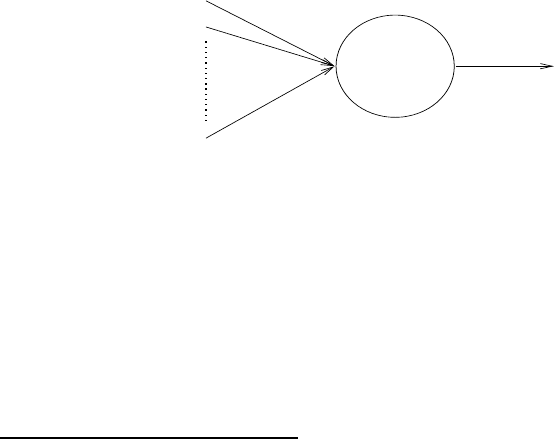
where I is the number of input signals to the AN. Figure 2.1 presents an illustration
of an AN with notational conventions that will be used throughout this text. An AN
receives a vector of I input signals,
z =(z
1
,z
2
, ···,z
I
) (2.3)
either from the environment or from other ANs. To each input signal, z
i
, is associated
aweight,v
i
, to strengthen or deplete the input signal. The AN computes the net input
signal, and uses an activation function f
AN
to compute the output signal, o,giventhe
net input. The strength of the output signal is further influenced by a threshold value,
θ,alsoreferredtoasthebias.
v
2
z
1
z
2
z
I
v
1
v
I
of(net − θ)
Figure 2.1 An Artificial Neuron
2.1 Calculating the Net Input Signal
The net input signal to an AN is usually computed as the weighted sum of all input
signals,
net =
I
i=1
z
i
v
i
(2.4)
Computational Intelligence: An Introduction, Second Edition A.P. Engelbrecht
c
2007 John Wiley & Sons, Ltd
17