
Engelbrecht Andries P. Computational Intelligence: An Introduction
Подождите немного. Документ загружается.


18 2. The Artificial Neuron
Artificial neurons that compute the net input signal as the weighted sum of input
signals are referred to as summation units (SU). An alternative to compute the net
input signal is to use product units (PU) [222], where
net =
I
i=1
z
v
i
i
(2.5)
Product units allow higher-order combinations of inputs, having the advantage of
increased information capacity.
2.2 Activation Functions
The function f
AN
receives the net input signal and bias, and determines the output (or
firing strength) of the neuron. This function is referred to as the activation function.
Different types of activation functions can be used. In general, activation functions
are monotonically increasing mappings, where (excluding the linear function)
f
AN
(−∞)=0 or f
AN
(−∞)=−1 (2.6)
and
f
AN
(∞) = 1 (2.7)
Frequently used activation functions are enumerated below:
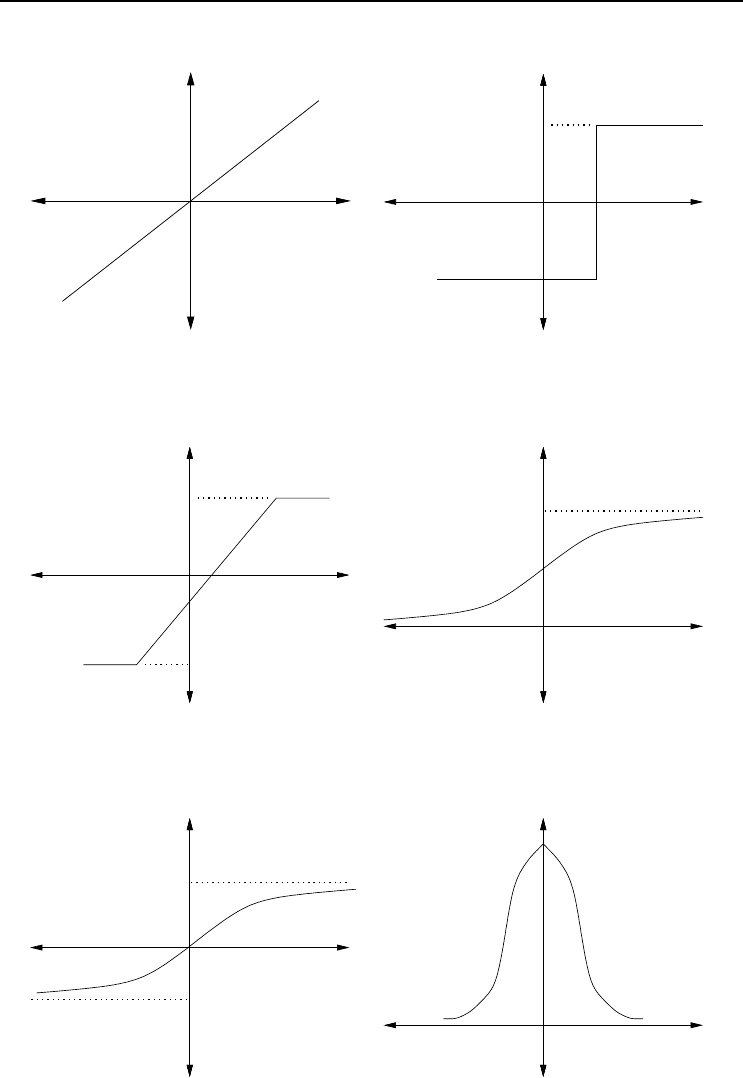
1. Linear function (see Figure 2.2(a) for θ =0):
f
AN
(net − θ)=λ(net − θ) (2.8)
where λ is the slope of the function. The linear function produces a linearly
modulated output, where λ is a constant.
2. Step function (see Figure 2.2(b) for θ>0):
f
AN
(net − θ)=
γ
1
if net ≥ θ
γ
2
if net < θ
(2.9)
The step function produces one of two scalar output values, depending on the
value of the threshold θ. Usually, a binary output is produced for which γ
1
=1
and γ
2
= 0; a bipolar output is also sometimes used where γ
1
=1andγ
2
= −1.
3. Ramp function (see Figure 2.2(c) for θ>0):
f
AN
(net − θ)=
γ if net − θ ≥
net − θ if −<net− θ<
−γ if net − θ ≤−
(2.10)
The ramp function is a combination of the linear and step functions.
2.2 Activation Functions 19
f
AN
(net − θ)
net −θ
(a) Linear function
γ
2
f
AN
(net − θ)
γ
1
θ
net − θ
(b) Step function
net − θθ
γ
f
AN
(net − θ)
−γ
(c) Ramp function
net − θ
θ =0
1
f
AN
(net − θ)
(d) Sigmoid function
net − θ
f
AN
(net − θ)
−1
1
θ =0
(e) Hyperbolic tangent function
net − θ
f
AN
(net − θ)
(f) Gaussian function
Figure 2.2 Activation Functions
20 2. The Artificial Neuron
4. Sigmoid function (see Figure 2.2(d) for θ =0):
f
AN
(net − θ)=
1
1+e
−λ(net−θ)
(2.11)
The sigmoid function is a continuous version of the ramp function, with
f
AN
(net) ∈ (0, 1). The parameter λ controls the steepness of the function.
Usually, λ =1.
5. Hyperbolic tangent (see Figure 2.2(e) for θ =0):
f
AN
(net − θ)=
e
λ(net−θ)
− e
−λ(net−θ)
e
λ(net−θ)
+ e
−λ(net−θ)
(2.12)
or also approximated as
f
AN
(net − θ)=
2
1+e
−λ(net−θ)
− 1 (2.13)
The output of the hyperbolic tangent is in the range (−1, 1).
6. Gaussian function (see Figure 2.2(f) for θ =0):
f
AN
(net − θ)=e
−(net−θ)
2
/σ
2
(2.14)
where net − θ is the mean and σ the standard deviation of the Gaussian distri-
bution.
2.3 Artificial Neuron Geometry
Single neurons can be used to realize linearly separable functions without any error.
Linear separability means that the neuron can separate the space of I-dimensional in-
put vectors yielding an above-threshold response from those having a below-threshold
response by an I-dimensional hyperplane. The hyperplane forms the boundary be-
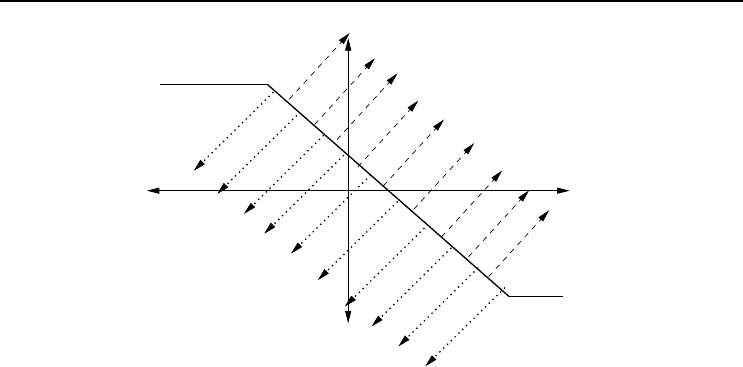
tween the input vectors associated with the two output values. Figure 2.3 illustrates
the decision boundary for a neuron with the ramp activation function. The hyperplane
separates the input vectors for which
i
z
i
v
i
−θ>0 from the input vectors for which
i
z
i
v
i
− θ<0.
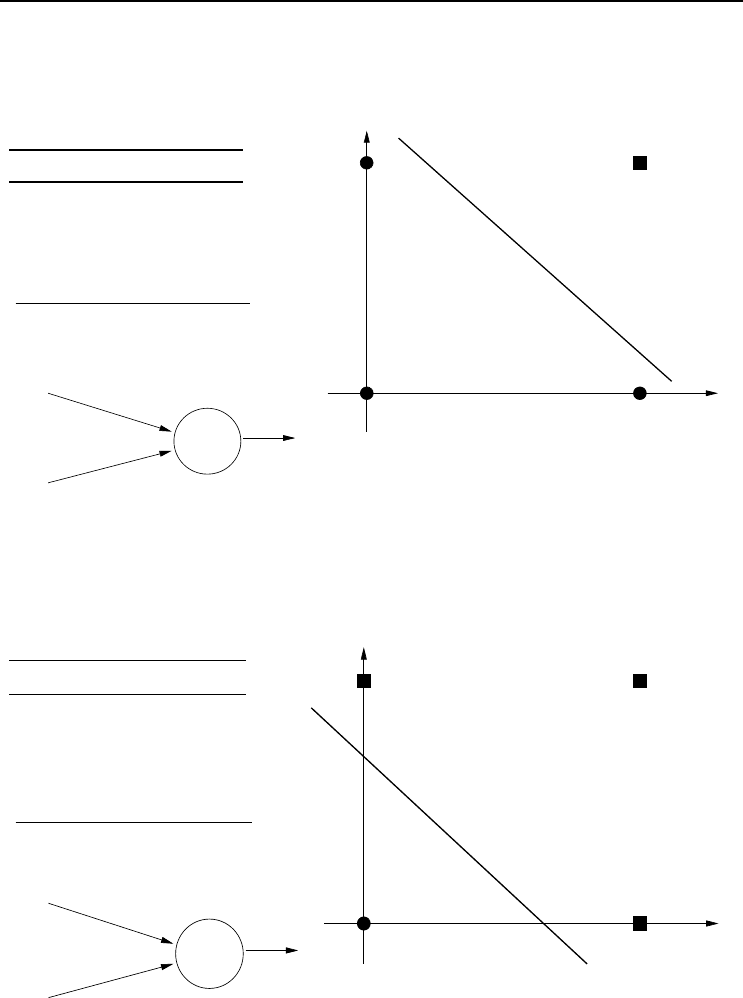
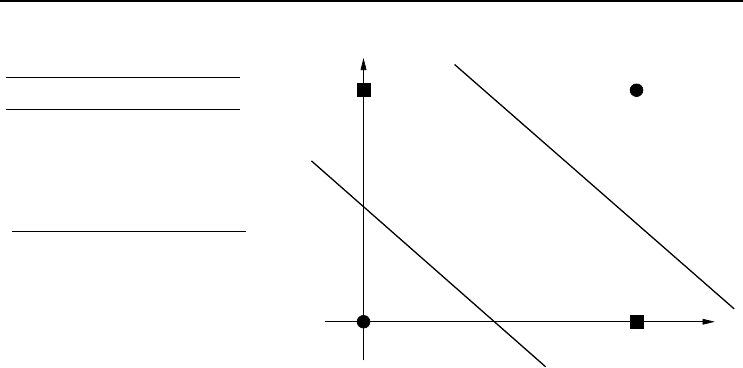
Figure 2.4 shows how two Boolean functions, AND and OR, can be implemented
using a single perceptron. These are examples of linearly separable functions. For
such simple functions, it is easy to manually determine values for the bias and the
weights. Alternatively, given the input signals and a value for θ, the weight values v
i
,
can easily be calculated by solving
vZ = θ (2.15)
where Z is the matrix of input patterns as given in the truth tables.
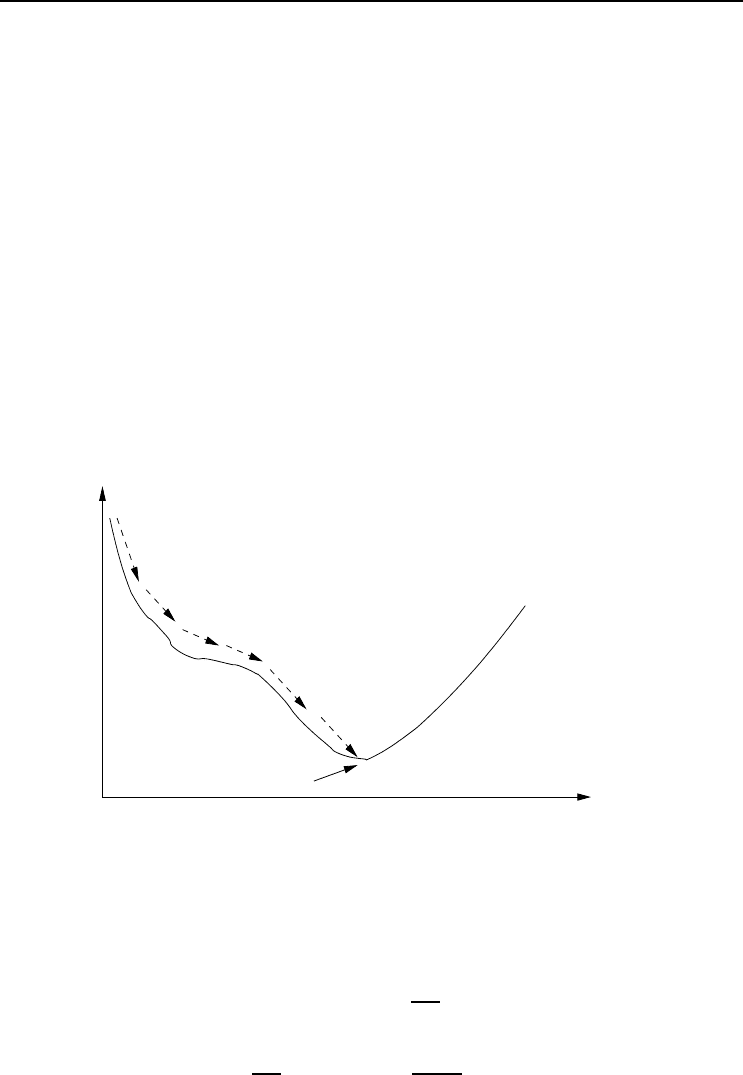
An example of a Boolean function that is not linearly separable is the XOR as illus-
trated in Figure 2.5. A single perceptron can not implement this function. If a single
2.4 Artificial Neuron Learning 21
net − θ =0
net −θ<0
θ
net −θ>0
Figure 2.3 Artificial Neuron Boundary
perceptron is used, then the best accuracy that can be obtained is 75%. To be able
to learn functions that are not linearly separable, a layered NN of several neurons is
required. For example, the XOR function requires two input units, two hidden units
and one output unit.
2.4 Artificial Neuron Learning
The question that now remains to be answered is whether an automated approach
exists for determining the values of the weights v
i
and the threshold θ? As illustrated
in the previous section, it is easy to calculate these values for simple problems. But
suppose that no prior knowledge exists about the function – except for data – how can
the v
i
and θ values be computed? The answer is through learning. The AN learns the
best values for the v
i
and θ from the given data. Learning consists of adjusting weight
and threshold values until a certain criterion (or several criteria) is (are) satisfied.
There are three main types of learning:
• Supervised learning, where the neuron (or NN) is provided with a data set
consisting of input vectors and a target (desired output) associated with each
input vector. This data set is referred to as the training set. The aim of super-
vised training is then to adjust the weight values such that the error between the
real output, o = f(net −θ), of the neuron and the target output, t, is minimized.
• Unsupervised learning, where the aim is to discover patterns or features in
the input data with no assistance from an external source. Many unsupervised
learning algorithms basically perform a clustering of the training patterns.
• Reinforcement learning, where the aim is to reward the neuron (or parts of
a NN) for good performance, and to penalize the neuron for bad performance.
22 2. The Artificial Neuron
The Artificial Neuron
Truth Table
Decision Boundary
z
2
v
2
=1
z
1
v
1
=1
θ =2
z
1
AND z
2
z
1
z
2
z
1
AND z
2
000
100
010
111
z
1
z
2
net − θ>0
net − θ<0
(a) AND Perceptron
Truth Table
The Artificial Neuron
Decision Boundary
z
2
z
1
OR z
2
00
10
10
111
0
1
1
z
1
z
2
v
2
=2
z
1
v
1
=2
θ =2
z
1
OR z
2
z
1
net − θ>0
net − θ<0
z
2
(b) OR Perceptron
Figure 2.4 Linear Separable Boolean Perceptrons
2.4 Artificial Neuron Learning 23
Truth Table Decision Boundary
z
1
z
2
z
1
z
2
z
1
XOR z
2
000
10
10
11
1
0
1
Figure 2.5 XOR Decision Boundaries
Several learning rules have been developed for the different learning types. Before con-
tinuing with these learning rules, we simplify our AN model by introducing augmented
vectors.
2.4.1 Augmented Vectors
An artificial neuron is characterized by its weight vector v, threshold θ and activation
function. During learning, both the weights and the threshold are adapted. To simplify
learning equations, the input vector is augmented to include an additional input unit,
z
I+1
, referred to as the bias unit.Thevalueofz
I+1
is always -1, and the weight v
I+1
serves as the value of the threshold. The net input signal to the AN (assuming SUs)
is then calculated as
net =
I
i=1
z
i
v
i
− θ
=
I
i=1
z
i
v
i
+ z
I+1
v
I+1
=
I+1
i=1
z
i
v
i
(2.16)
where θ = z
I+1
v
I+1
= −v
I+1
.
In the case of the step function, an input vector yields an output of 1 when
I+1
i=1
z
i
v
i
≥
0, and 0 when
I+1
i=1
z
i
v
i
< 0.
The rest of this chapter considers training rules for single neurons.
24 2. The Artificial Neuron
2.4.2 Gradient Descent Learning Rule
While gradient descent (GD) is not the first training rule for ANs, it is possibly the
approach that is used most to train neurons (and NNs for that matter). GD requires
the definition of an error (or objective) function to measure the neuron’s error in
approximating the target. The sum of squared errors
E =
P
T
p=1
(t
p
− o
p
)
2
(2.17)
is usually used, where t
p
and o
p
are respectively the target and actual output for the
p-th pattern, and P
T
is the total number of input-target vector pairs (patterns)inthe
training set.
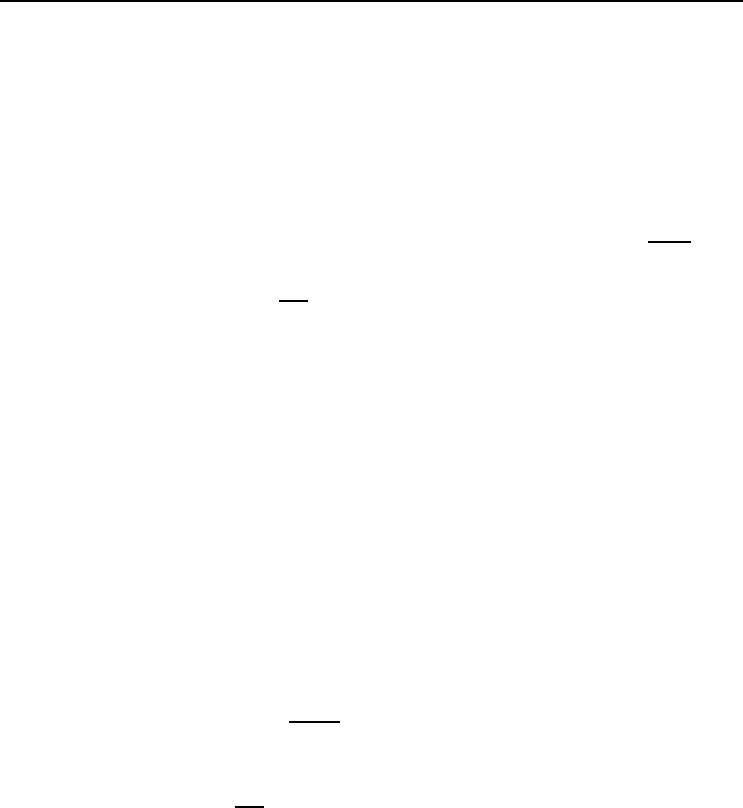
The aim of GD is to find the weight values that minimize E.Thisisachievedby
calculating the gradient of E in weight space, and to move the weight vector along the
negative gradient (as illustrated for a single weight in Figure 2.6).
Error
Minimum
Weight
Figure 2.6 Gradient Descent Illustrated
Given a single training pattern, weights are updated using
v
i
(t)=v
i
(t − 1) + ∆v
i
(t) (2.18)
with
∆v
i
(t)=η(−
∂E
∂v
i
) (2.19)
where
∂E
∂v
i
= −2(t
p
− o
p
)
∂f
∂net
p
z
i,p
(2.20)
and η is the learning rate (i.e. the size of the steps taken in the negative direction of
the gradient). The calculation of the partial derivative of f with respect to net
p
(the
net input for pattern p) presents a problem for all discontinuous activation functions,
2.5 Assignments 25
such as the step and ramp functions; z
i,p
is the i-th input signal corresponding to
pattern p. The Widrow-Hoff learning rule presents a solution for the step and ramp
functions, while the generalized delta learning rule assumes continuous functions that
are at least once differentiable.
2.4.3 Widrow-Hoff Learning Rule
For the Widrow-Hoff learning rule [907], assume that f = net
p
.Then
∂f
∂net
p
=1,
giving
∂E
∂v
i
= −2(t
p
− o
p
)z
i,p
(2.21)
Weights are then updated using
v
i
(t)=v
i
(t − 1) + 2η(t
p
− o
p
)z
i,p
(2.22)
The Widrow-Hoff learning rule, also referred to as the least-means-square (LMS) al-
gorithm, was one of the first algorithms used to train layered neural networks with
multiple adaptive linear neurons. This network was commonly referred to as the
Madaline [907, 908].
2.4.4 Generalized Delta Learning Rule
The generalized delta learning rule is a generalization of the Widrow-Hoff learning rule
that assumes differentiable activation functions. Assume that the sigmoid function
(from equation (2.11)) is used. Then,
∂f
∂net
p
= o
p
(1 − o
p
) (2.23)
giving
∂E
∂v
i
= −2(t
p
−o
p
)o
p
(1 − o
p
)z
i,p
(2.24)
2.4.5 Error-Correction Learning Rule
For the error-correction learning rule it is assumed that binary-valued activation func-
tions are used, for example, the step function. Weights are only adjusted when the
neuron responds in error. That is, only when (t
p
− o
p
)=1or(t
p
− o
p
)=−1, are
weights adjusted using equation (2.22).
2.5 Assignments
1. Explain why the threshold θ is necessary. What is the effect of θ, and what will
the consequences be of not having a threshold?
26 2. The Artificial Neuron
2. Explain what the effects of weight changes are on the separating hyperplane.
3. Explain the effect of changing θ on the hyperplane that forms the decision bound-
ary.
4. Which of the following Boolean functions can be realized with a single neuron
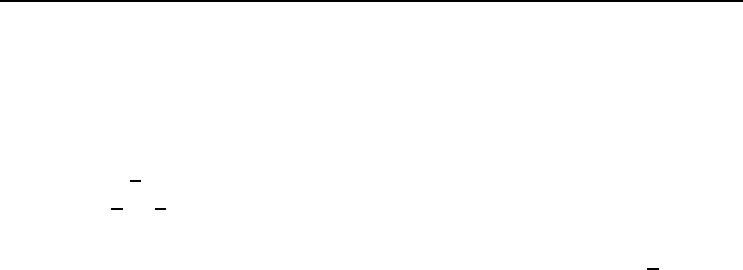
that implements a SU? Justify your answer by giving weight and threshold values.
(a) z
1
z
2
z
3
(b) z
1
z
2
+ z
1
z
2
(c) z
1
+ z
2
where z
1
z
2
denotes (z
1
AND z
2
); z
1
+ z
2
denotes (z
1
OR z
2
); z
1
denotes
(NOT z
1
).
5. Is it possible to use a single PU to learn problems that are not linearly separable?
6. In the calculation of error, why is the error per pattern squared?
7. Can errors be calculated as |t
p
− o
p
| instead of (t
p
− o
p
)
2
if gradient descent is
used to adjust weights?
8. Is the following statement true or false: A single neuron can be used to approx-
imate the function f(z)=z
2
? Justify your answer.
9. What are the advantages of using the hyperbolic tangent activation function
instead of the sigmoid activation function?

Chapter 3
Supervised Learning Neural
Networks
Single neurons have limitations in the type of functions they can learn. A single neuron
(implementing a SU) can be used to realize linearly separable functions only. As soon
as functions that are not linearly separable need to be learned, a layered network of
neurons is required. Training these layered networks is more complex than training a
single neuron, and training can be supervised, unsupervised or through reinforcement.
This chapter deals with supervised training.
Supervised learning requires a training set that consists of input vectors and a target
vector associated with each input vector. The NN learner uses the target vector
to determine how well it has learned, and to guide adjustments to weight values to
reduce its overall error. This chapter considers different NN types that learn under
supervision. These network types include standard multilayer NNs, functional link
NNs, simple recurrent NNs, time-delay NNs, product unit NNs, and cascade networks.
These different architectures are first described in Section 3.1. Different learning rules
for supervised training are then discussed in Section 3.2. The chapter ends with a
short discussion on ensemble NNs in Section 3.4.
3.1 Neural Network Types
Various multilayer NN types have been developed. Feedforward NNs such as the stan-
dard multilayer NN, functional link NN and product unit NN receive external signals
and simply propagate these signals through all the layers to obtain the result (output)
of the NN. There are no feedback connections to previous layers. Recurrent NNs, on
the other hand, have such feedback connections to model the temporal characteristics
of the problem being learned. Time-delay NNs, on the other hand, memorize a window
of previously observed patterns.
Computational Intelligence: An Introduction, Second Edition A.P. Engelbrecht
c
2007 John Wiley & Sons, Ltd
27