
Engelbrecht Andries P. Computational Intelligence: An Introduction
Подождите немного. Документ загружается.

38 3. Supervised Learning Neural Networks
3.2.2 Gradient Descent Optimization
Gradient descent (GD) optimization has led to one of the most popular learning al-
gorithms, namely backpropagation, popularized by Werbos [897]. Learning iterations
(one learning iteration is referred to as an epoch) consists of two phases:
1. Feedforward pass, which simply calculates the output value(s) of the NN for
each training pattern (as discussed in Section 3.1).
2. Backward propagation, which propagates an error signal back from the out-
put layer toward the input layer. Weights are adjusted as functions of the back-
propagated error signal.
Feedforward Neural Networks
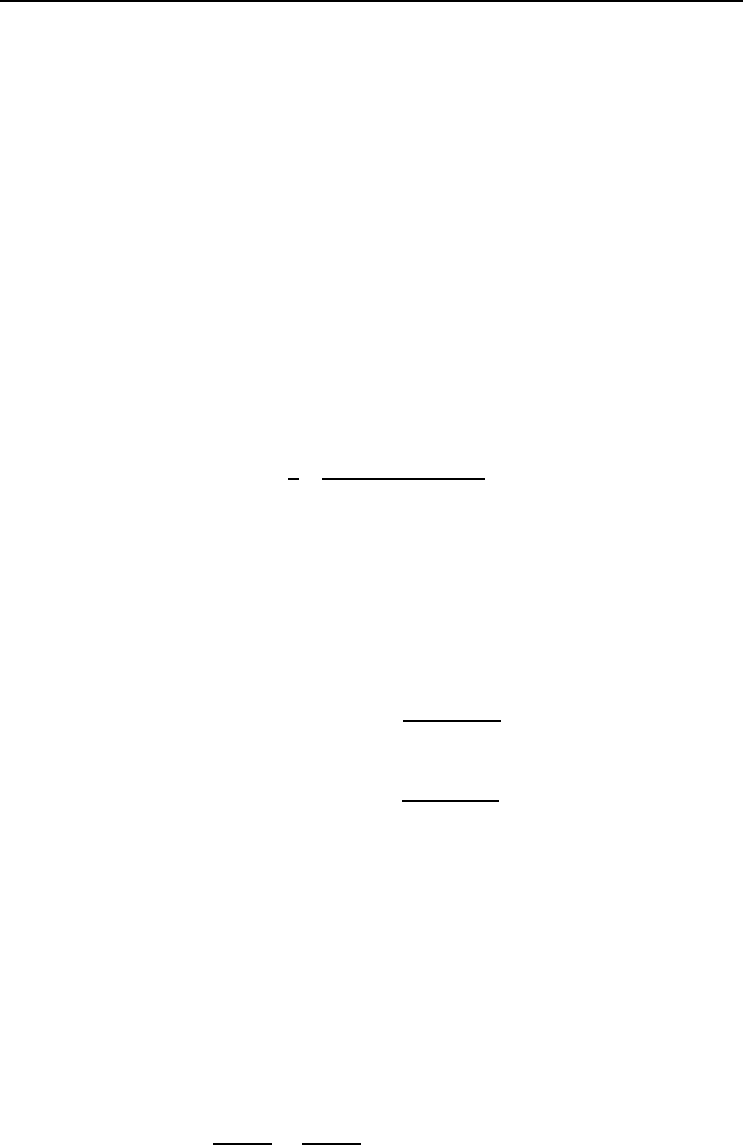
Assume that the sum squared error (SSE) is used as the objective function. Then, for
each pattern, z
p
,
E
p
=
1
2
K
k=1
(t
k,p
− o
k,p
)
2
K
(3.27)
where K is the number of output units, and t
k,p
and o
k,p
are respectively the target
and actual output values of the k-th output unit.
The rest of the derivations refer to an individual pattern. The pattern subscript,
p, is therefore omitted for notational convenience. Also assume sigmoid activation
functions in the hidden and output layers with augmented vectors. All hidden and
output units use SUs. Then,
o
k
= f
o
k
(net
o
k
)=
1
1+e
−net
o
k
(3.28)
and
y
j
= f
y
j
(net
y
j
)=
1
1+e
−net
y
j
(3.29)
Weights are updated, in the case of stochastic learning, according to the following
equations:
w
kj
(t)+=∆w
kj
(t)+α∆w
kj
(t − 1) (3.30)
v
ji
(t)+=∆v
ji
(t)+α∆v
ji
(t − 1) (3.31)
where α is the momentum (discussed later).
In the rest of this section the equations for calculating ∆w
kj
(t)and∆v
ji
(t) are derived.
The reference to time, t, is omitted for notational convenience.
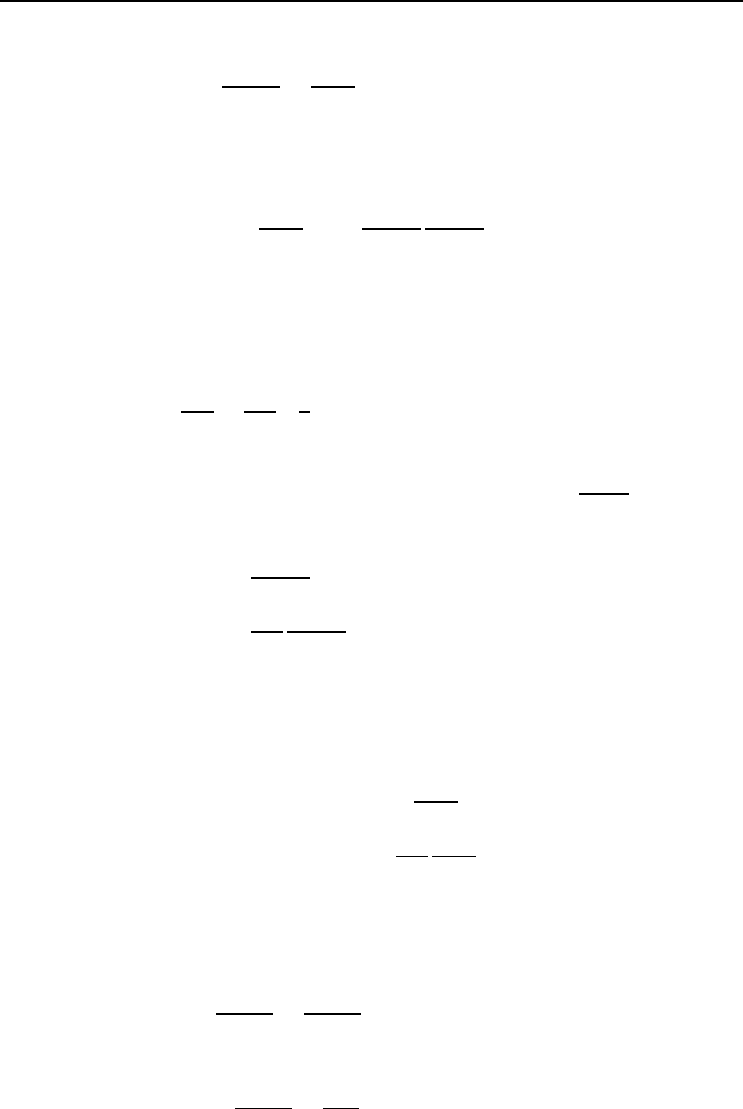
From (3.28),
∂o
k
∂net
o
k
=
∂f
o
k
∂net
o
k
=(1− o
k
)o
k
= f
o
k
(3.32)
3.2 Supervised Learning Rules 39
and
∂net
o
k
∂w
kj
=
∂
∂w
kj
J+1
j=1
w
kj
y
j
= y
j
(3.33)
where f
o
k
is the derivative of the corresponding activation function. From equations
(3.32) and (3.33),
∂o
k
∂w
kj
=
∂o
k
∂net
o
k
∂net
o
k
∂w
kj
=(1− o
k
)o
k
y
j
= f
o
k
y
j
(3.34)
From equation (3.27),
∂E
∂o
k
=
∂
∂o
k
1
2
K
k=1
(t
k
− o
k
)
2
= −(t
k
− o
k
) (3.35)
Define the output error that needs to be back-propagated as δ
o
k
=
∂E
∂net
o
k
. Then, from
equation (3.35) and (3.32),
δ
o
k
=
∂E
∂net
o
k
=
∂E
∂o
k
∂o
k
∂net
o
k
= −(t
k
− o
k
)(1 − o
k
)o
k
= −(t
k
− o
k
)f
o
k
(3.36)
Then, the changes in the hidden-to-output weights are computed from equations
(3.35), (3.34) and (3.36) as
∆w
kj
= η
−
∂E
∂w
kj
= −η
∂E
∂o
k
∂o
k
∂w
kj
= −ηδ
o
k
y
j
(3.37)
Continuing with the input-to-hidden weights,
∂y
j
∂net
y
j
=
∂f
y
j
∂net
y
j
=(1− y
j
)y
j
= f
y
j
(3.38)
and
∂net
y
j
∂v
ji
=
∂
∂v
ji
I+1
i=1
v
ji
z
i
= z
i
(3.39)
40 3. Supervised Learning Neural Networks
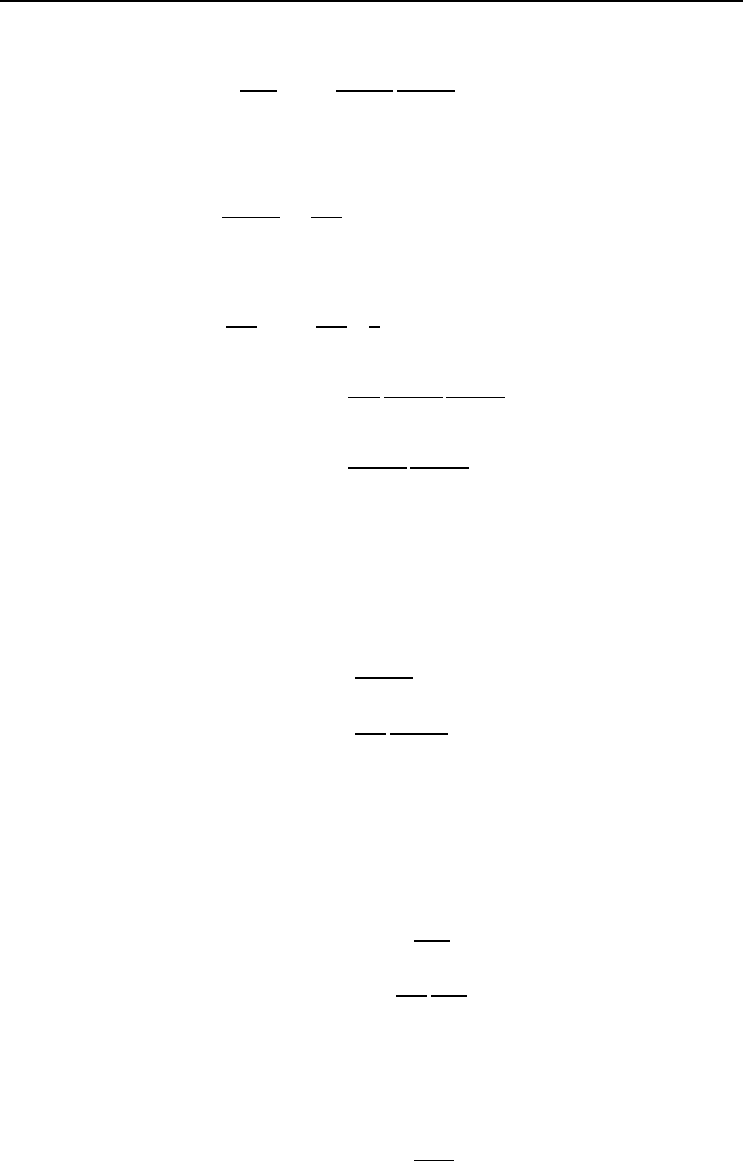
From equations (3.38) and (3.39),
∂y
j
∂v
ji
=
∂y
j
∂net
y
j
∂net
y
j
∂v
ji
=(1− y
j
)y
j
z
i
= f
y
j
z
i
(3.40)
and
∂net
o
k
∂y
j
=
∂
∂y
j
J+1
j=1
w
kj
y
j
= w
kj
(3.41)
From equations (3.36) and (3.41),
∂E
∂y
j
=
∂
∂y
j
1
2
K
k=1
(t
k
− o
k
)
2
=
K
k=1
∂E
∂o
k
∂o
k
∂net
o
k
∂net
o
k
∂y
j
=
K
k=1
∂E
∂net
o
k
∂net
o
k
∂y
j
=
K
k=1
δ
o
k
w
kj
(3.42)
Define the hidden layer error, which needs to be back-propagated, from equations
(3.42) and (3.38) as,
δ
y
j
=
∂E
∂net
y
j
=
∂E
∂y
j
∂y
j
∂net
y
j
=
K
k=1
δ
o
k
w
kj
f
y
j
(3.43)
Finally, the changes to input-to-hidden weights are calculated from equations (3.42),
(3.40) and (3.43) as
∆v
ji
= η
−
∂E
∂v
ji
= −η
∂E
∂y
j
∂y
j
∂v
ji
= −ηδ
y
j
z
i
(3.44)
If direct weights from the input to the output layer are included, the following addi-
tional weight updates are needed:
∆u
ki
= η
−
∂E
∂u
ki

3.2 Supervised Learning Rules 41
= −η
∂E
∂o
k
∂o
k
∂u
ki
= −ηδ
o
k
z
i
(3.45)
where u
ki
is a weight from the i-th input unit to the k-th output unit.
In the case of batch learning, weights are updated as given in equations (3.30) and
(3.31), but with
∆w
kj
(t)=
P
T
p=1
∆w
kj,p
(t) (3.46)
∆v
ji
(t)=
P
T
p=1
∆v
ji,p
(t) (3.47)
where ∆w
kj,p
(t)and∆v
ji,p
(t) are weight changes for individual patterns p,andP
T
is
the total number of patterns in the training set.
Stochastic learning is summarized in Algorithm 3.1.
Algorithm 3.1 Stochastic Gradient Descent Learning Algorithm
Initialize weights, η, α, and the number of epochs t =0;
while stopping condition(s) not true do
Let E
T
=0;
for each training pattern p do
Do the feedforward phase to calculate y
j,p
(∀ j =1, ···,J)ando
k,p
(∀ k =1, ···,K);
Compute output error signals δ
o
k,p
and hidden layer error signals δ
y
j,p
;
Adjust weights w
kj
and v
ji
(backpropagation of errors);
E
T
+=[E
p
=
K
k=1
(t
k,p
− o
k,p
)
2
];
end
t = t +1;
end
Stopping criteria usually includes:
• Stop when a maximum number of epochs has been exceeded.
• Stop when the mean squared error (MSE) on the training set,
E
T
=
P
T
p=1
K
k=1
(t
k,p
− o
k,p
)
2
P
T
K
(3.48)
is small enough (other error measures such as the root mean squared error can
also be used).
• Stop when overfitting is observed, i.e. when training data is being memorized.
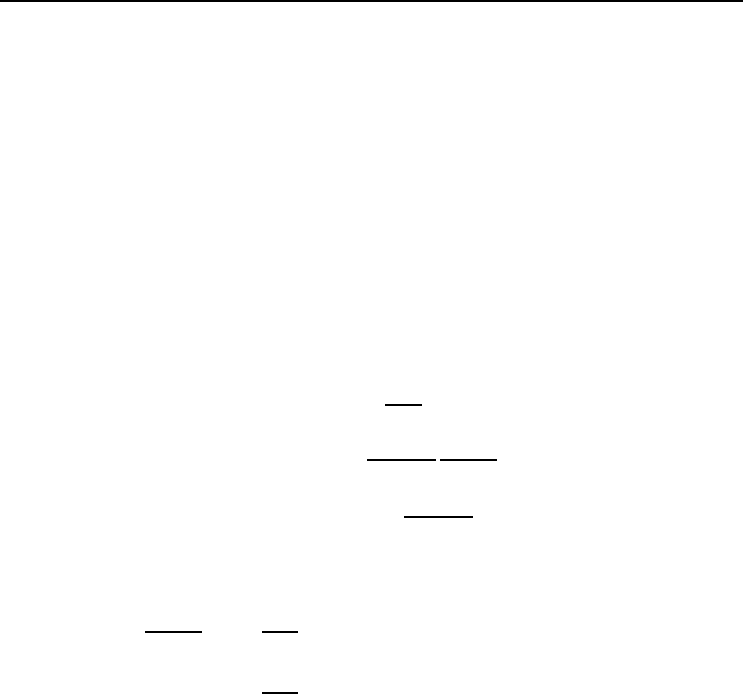
An indication of overfitting is when E
V
> E
V
+ σ
E
V
,whereE
V
is the average
42 3. Supervised Learning Neural Networks
validation error over the previous epochs, and σ
E
V
is the standard deviation in
validation error.
It is straightforward to apply GD optimization to the training of FLNNs, SRNNs and
TDNNs, so derivations of the weight update equations are left to the reader. GD
learning for PUNNs is given in the next section.
Product Unit Neural Networks
This section derives learning equations for PUs used in the hidden layer only, assuming
GD optimization and linear activation functions. Since only the equations for the
input-to-hidden weights change, only the derivations of these weight update equations
are given. The change ∆v
ji
in weight v
ji
is
∆v
ji
= η
−
∂E
∂v
ji
= −η
∂E
∂net
y
j,p
net
y
j,p
∂v
ji
= −ηδ
y
j,p
∂net
y
j,p
∂v
ji
(3.49)
where δ
y
j,p
is the error signal, computed in the same way as for SUs, and
net
y
j,p
∂v
ji
=
∂
∂v
ji
I
i=1
z
v
ji
i,p
=
∂
∂v
ji
(e
ρ
j,p
cos(πφ
j,p
))
= e
ρ
j,p
[ln |z
i,p
|cos(πφ
j,p
) −I
i
π sin(πφ
j,p
)] (3.50)
A major advantage of product units is an increased information capacity compared
to summation units [222, 509]. Durbin and Rumelhart showed that the information
capacity of a single PU (as measured by its capacity for learning random Boolean
patterns) is approximately 3I, compared to 2I for a single SU (I is the number of inputs
to the unit) [222]. The larger capacity means that functions approximated using PUs
will require less processing elements than required if SUs were used. This point can be
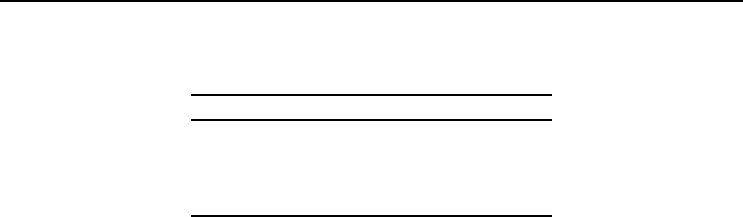
illustrated further by considering the minimum number of processing units required
for learning the simple polynomial functions in Table 3.1. The minimal number of
SUs were determined using a sensitivity analysis variance analysis pruning algorithm
[238, 246], while the minimal number of PUs is simply the number of different powers
in the expression (provided a polynomial expression).
While PUNNs provide the advantage of having smaller network architectures, a major
drawback of PUs is an increased number of local minima, deep ravines and valleys. The
search space for PUs is usually extremely convoluted. Gradient descent, which works
best when the search space is relatively smooth, therefore frequently gets trapped in
local minima or becomes paralyzed (which occurs when the gradient of the error with
3.2 Supervised Learning Rules 43
Table 3.1 SUs and PUs Needed for Simple Functions
Function SUs PUs
f(z)=z
2
21
f(z)=z
6
31
f(z)=z
2
+ z
5
32
f(z
1
,z
2
)=z
3
1
z
7
2
− 0.5z
6
1
82
respect to the current weight is close to zero). Leerink et al. [509] illustrated that
the 6-bit parity problem could not be trained using GD and PUs. Two reasons were
identified to explain why GD failed: (1) weight initialization and (2) the presence of
local minima. The initial weights of a network are usually computed as small random
numbers. Leerink et al. argued that this is the worst possible choice of initial weights,
and suggested that larger initial weights be used instead. But, large weights lead to
large weight updates due to the exponential term in the weight update equation (see
equation (3.50)), which consequently cause the network to overshoot the minimum.
Experience has shown that GD only manages to train PUNNs when the weights are
initialized in close proximity of the optimal weight values – the optimal weight values
are, however, usually not available.
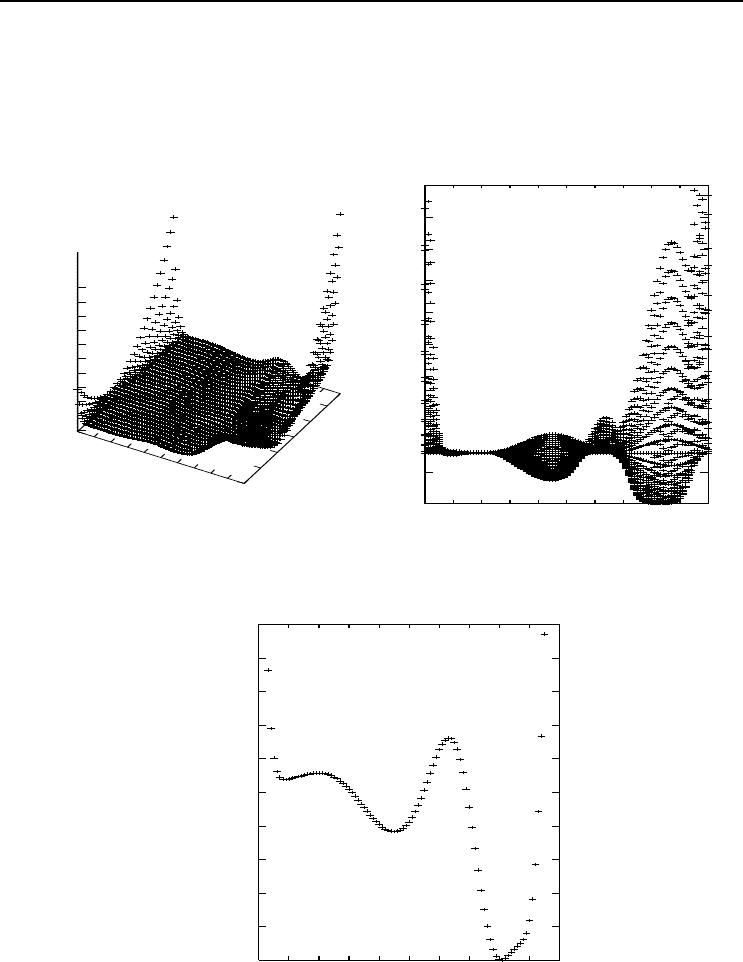
As an example to illustrate the complexity of the search space for PUs, consider the
approximation of the function f(z)=z
3
,withz ∈ [−1, 1]. Only one PU is needed,
resulting in a 1-1-1 NN architecture (that is, one input, one hidden and one output
unit). In this case the optimal weight values are v = 3 (the input-to-hidden weight)
and w = 1 (the hidden-to-output weight). Figures 3.7(a)-(b) present the search space
for v ∈ [−1, 4] and w ∈ [−1, 1.5]. The error is computed as the mean squared error over
500 randomly generated patterns. Figure 3.7(b) clearly illustrates 3 minima, with the
global minimum at v =3,w = 1. These minima are better illustrated in Figure 3.7(c)
where w is kept constant at its optimum value of 1. Initial small random weights will
cause the network to be trapped in one of the local minima (having very large MSE).
Large initial weights may also be a bad choice. Assume an initial weight v ≥ 4. The
derivative of the error with respect to v is extremely large due to the steep gradient of
the error surface. Consequently, a large weight update will be made which may cause
jumping over the global minimum. The neural network either becomes trapped in a
local minimum, or oscillates between the extreme points of the error surface.
A global stochastic optimization algorithm is needed to allow searching of larger parts
of the search space. The optimization algorithm should also not rely heavily on the
calculation of gradient information. Simulated annealing [509], genetic algorithms
[247, 412], particle swarm optimization [247, 866] and LeapFrog [247] have been used
successfully to train PUNNs.
44 3. Supervised Learning Neural Networks
-1
-0.5
0
0.5
1
1.5
2
2.5
3
3.5
4
v
-1
-0.5
0
0.5
1
1.5
w
0
200
400
600
800
1000
1200
1400
1600
1800
2000
(a)
0
70
140
210
280
350
420
490
560
630
700
-1 -0.5 0 0.5 1 1.5 2 2.5 3 3.5 4
MSE
v1
(b)
0
20
40
60
80
100
120
140
160
180
200
-1 -0.5 0 0.5 1 1.5 2 2.5 3 3.5 4
MSE
v
(c)
Figure 3.7 Product Unit Neural Network Search Space for f(z)=z
3

3.2 Supervised Learning Rules 45
3.2.3 Scaled Conjugate Gradient
Conjugate gradient optimization trades off the simplicity of GD and the fast quadratic
convergence of Newton’s method. Several conjugate gradient learning algorithms have
been developed (look at the survey in [51]), most of which are based on the assumption
that the error function of all weights in the region of the solution can be accurately
approximated by
E
T
(D
T
, w)=
1
2
w
T
Hw − θ
T
w
where H is the Hessian matrix. Since the dimension of the Hessian matrix is the total
number of weights in the network, the calculation of conjugate directions on the error
surface becomes computationally infeasible. Computationally feasible conjugate gra-
dient algorithms compute conjugate gradient directions without explicitly computing
the Hessian matrix, and perform weight updates along these directions.
Algorithm 3.2 Conjugate Gradient Neural Network Training Algorithm
Initialize the weight vector, w(0);
Define the initial direction vector as
p(0) = −E
(w(0)) = θ − Hw(0) (3.51)
for t =1,...,n
w
do
Calculate the step size,
η(t)=−
E
(w(t))
T
p(t)
p(t)
T
Hp(t)
(3.52)
Calculate a new weight vector,
w(t +1)=w(t)+η(t)p(t) (3.53)
Calculate scale factors,
β(t)=
E
(w(t +1))
T
E
(w(t +1)
E
(w(t))
T
E
(w(t))
(3.54)
Calculate a new direction vector,
p(t +1)=−E(w(t +1))+β(t)p(t) (3.55)
end
Return weight vector, w(t +1);
An important aspect in conjugate gradient methods is that of direction vectors,
{p(0), p(1),...,p(t − 1)}. These vectors are created to be conjugate with the weight
vector, w.Thatis,p
T
(t
1
)wp(t
2
)=0fort
1
= t
2
. A new conjugate direction vector
is generated at each iteration by adding to the calculated current negative gradient
vector of the error function a linear combination of the previous direction vectors. The
standard conjugate gradient algorithm is summarized in Algorithm 3.2. Note that this

46 3. Supervised Learning Neural Networks
algorithm assumes a quadratic error function, in which case the algorithm converges
in no more than n
w
steps, where n
w
is the total number of weights and biases.
Algorithm 3.3 Fletcher-Reeves Conjugate Gradient Algorithm
Initialize the weight vector, w(0);
Calculate the gradient, E
(w(0));
Compute the first direction vector as p(0) = −E
(w(0));
while stopping conditions(s) not true do
for t =0,...,n
w
− 1 do
Calculate the step size,
η(t)=min
η≥0
E(w(t)+ηp(t)) (3.56)
Calculate a new weight vector,
w(t +1)=w(t)+η(t)p(t) (3.57)
Calculate scale factors,
β(t)=
E
(w(t +1))
T
E
(w(t +1)
E
(w(t))
T
E
(w(t))
(3.58)
Calculate a new direction vector,
p(t +1)=−E
(w(t +1))+β(t)p(t) (3.59)
end
if stopping condition(s) not true then
w(0) = w(n
w
) (3.60)
end
end
Return w(n
w
) as the solution;
The Fletcher-Reeves conjugate gradient algorithm does not assume a quadratic error
function. The algorithm restarts after n
w
iterations if a solution has not yet been
found. The Fletcher-Reeves conjugate gradient algorithm is summarized in Algo-
rithm 3.3.
The scale factors in Algorithms 3.2 and 3.3 can also be calculated in the following
ways:
• Polak-Ribiere method:
β(t)=
(E
(w(t +1))−E
(w(t)))
T
E
(w(t +1))
E
(w(t))
T
E
(w(t))
(3.61)

3.2 Supervised Learning Rules 47
• Hestenes-Stiefer method:
β(t)=
(E
(w(t +1))−E
(w(t)))
T
E
(w(t +1))
p(t)
T
(E
(w(t +1))−E
(w(t)))
(3.62)
Algorithm 3.4 Scaled Conjugate Gradient Algorithm
Initialize the weight vector w(1) and the scalars σ>0,λ
1
> 0andλ =0;
Let p(1) = r(1) = −E
(w(1)),t=1andsuccess = true;
Label A: if success = true then
Calculate the second-order information;
end
Scale s(t);
if δ(t) ≤ 0 then
Make the Hessian matrix positive definite;
end
Calculate the step size;
Calculate the comparison parameter;
if ∆(t) ≥ 0 then
A successful reduction in error can be made, so adjust the weights;
λ(t)=0;
success = true;
if t mod n
w
=0then
Restart the algorithm, with p(t +1)=r(t +1)and go tolabelA;
end
else
Create a new conjugate direction;
end
if ∆(t) ≥ 0.75 then
Reduce the scale parameter with λ(t)=
1
2
λ(t);
end
end
else
A reduction in error is not possible, so let
λ(t)=λ(t)andsuccess = false;
end
if ∆(t) < 0.25 then
Increase the scale parameter to λ(t)=4λ(t);
end
if the steepest descent direction r(t) =0then
Set t = t + 1 and go to label A;
end
else
Terminate and return w(t + 1) as the desired minimum;
end
Møller [533] proposed the scaled conjugate gradient (SCG) algorithm as a batch learn-
ing algorithm. Step sizes are automatically determined, and the algorithm is restarted