
Floud R., Johnson P. The Cambridge Economic History of Modern Britain, Volume 1: Industrialisation, 1700-1860
Подождите немного. Документ загружается.


Consumption in Britain 381
supposition drawn mainly from literary analogy provides an edifice
of gendered representations, with emphasis on fictions, eroticism and
themale gaze (Bermingham and Brewer 1995; de Grazia and Furlough
1996; Kowaleski-Wallace 1997). Women’s possession of moveable con-
sumer goods has also been assumed to be an indication of their sub-
ordinate status within the family; their baubles a poor compensation
forlack of landed property and housing. Evidence on gender differences
in possessions and buying practices must be gathered in painstaking re-
search on household inventories, the study of the text of wills, household
accounts, family correspondence, diaries and autobiographies.
Lorna Weatherill’s classic studies of the middling orders based on
probate inventories from 1660–1760 identified few major differences in
possessions between men and women; certainly higher proportions of
women had new and decorative goods than did the men from similar
classes, but these differences were too small to warrant the suggestion
of a women’s subculture in the ownership of goods. She emphasised that
women’s possessions indicated that they saw themselves as part of a fam-
ily and household (Weatherill 1986b; Shammas 1990). Even the limited
evidence of meaning and motivation available from inventories can, how-
ever, indicate the special part played by the women of the household in
cooking and in the arrangement and serving of meals. Inventories pro-
vide insight into the use of space as well as the quantities, variety and
placement of material possessions. Such evidence reveals the symbolic as
well as practical importance of cooking, which was done by the wife or
housekeeper rather than servants until the later eighteenth century, oc-
cupying a central part of the household, and carried out with simple and
functional cooking equipment. A different material culture for the serv-
ing and eating of meals included decorated pottery and porcelain, knives
and forks, conduct and manners over serving, and rituals of tea drinking,
and all set in ‘front stage’ locations in the household (Weatherill 1993).
Evidence of bequests made in wills rather than indices of possessions at
death show sharp differences between men’s and women’s perceptions of
what they owned. The women of Sheffield and Birmingham left substan-
tially more bequests containing clothing, jewellery, linen and silver than
did men. The really striking differences in the wills, however, was in their
presentation of goods and the networks of legacies. Women provided very
detailed descriptions of their things: clothes, light furnishings, marked
and table linens, tea and china ware were personal and expressive goods,
conveying identity, personality and fashion. Their bequests presented a
carefully coded inventory of their things embedded in statements about
their networks of family and friends. The men left few details of their
clothing and furnishings, and generally passed these on to direct fam-
ily members. The women who left these wills added new commodities
to old inherited possessions; they cannot be easily categorised either as
fashionable conspicuous consumers or as simple bearers of household or
family well-being. For their wills indicate a whole range of clothing, light
Cambridge Histories Online © Cambridge University Press, 2008

382 Maxine Berg
furnishings and ornaments clearly perceived as personal possessions, and,
as such, richly described and sensitively distributed among friends and
family (Berg 1993c).
Women’s diaries such as that of Elizabeth Shackleton, a woman of the
lesser Lancashire gentry, provide insight into the day-to-day expenditure
of women and the meanings they attached to the goods they bought.
Much of this consumption was the skilled provisioning and servicing of
a household, based on the gathering and sharing of information with
other women on prices, quality and availability. A woman’s purchase of
fashionable clothing, furniture and china displayed her social status and
gave her personal pleasure, but it also expressed a wide range of other
motivations and meanings, from family history to individual memory
and sociability (Vickery 1993, 1998).
Our knowledge of the practices of women’s consumption from the
mundane and daily to the magnificent and episodic is still patchy, with
little on life-cycle, class and rural–urban differentiation. The evidence we
have does however challenge the gendered stereotype of the rapacious
female consumer. A corresponding picture of male consumer behaviour
is almost wholly lacking. Men have not featured with any significance
in histories of fashionable consumption, perhaps because of those same
stereotypes of separate spheres which so underpinned assumptions about
thefemale consumer (Breward 1999).
Men did much more of the shopping for new consumer goods than
we imagine. They were frequently delegated in trips to provincial towns
and the metropolis, or even abroad to buy for the household. Some took
the initiative, as in the case of Ben Franklin who sent a package of En-
glish cloths to his wife in 1758, describing them as: ‘156 yards of cotton,
printed curiously from copper plates, a new invention, to make bed and
window curtain. Also 7 yards of printed cottons blue ground, to make you
agown’ (Lemire 1991). Male dress in the eighteenth and early nineteenth
centuries was as laden with fashion as was women’s, and male diarists
reveal active and enthusiastic shopping activity among men, as well as
the full range of motivations and sensibilities over their possessions that
women did (Finn 2000). Their clothing provided access to respectability,
and was valued accordingly in their insurance policies (Berg 1993c, 1998a).
Specific articles of masculine dress such as wigs, and specific attributes of
masculine interiors such as dining rooms and their ornamentation with
fireplaces, tables and punch bowls, form only the beginnings of research
(Nenadic 1994; Harte 2001). Research is still very limited on masculinity
and consumption, hampered as it has been by a discourse of separate
spheres.
Women’s association with the buying of china, satirised in the eigh-
teenth century as a symbol of female superficiality and depraved at-
traction to things, had some basis in gendered consumption. Certainly
women were avid consumers of chinaware; they were of great importance
Cambridge Histories Online © Cambridge University Press, 2008

Consumption in Britain 383
to Wedgwood’s success. Their association with chinaware stems from their
place in tea drinking. Women occupied a central part in the rituals and
symbols of tea drinking. They shopped for chinaware, they ran many
of the china shops, and they became noted connoisseurs. But men too
played their part. There is widespread evidence in inventories, wills and
diaries of men collecting of chinaware. Men’s art and print collections
and vase mania also attest to this acquisitive consumerism (Weatherill
1986a; Kowaleski-Wallace 1997; Nenadic 1997; Clayton 1998; Richards
1999; Young 1999; Uglow 2002b).
Consumer aspirations across class and gender stimulated the rapid and
extensive proliferation of new commodities from the later seventeenth
century onwards. The supply-side responses to these aspirations were in
turn to generate wider and deeper demand for these goods, bought to sat-
isfy desires for fashion, respectability and sociability, or for convenience
and comfort. These new consumer goods were generated through tech-
nological change, but above all through product innovation.
PRODUCT INNOVATION, FASHION AND TASTE
As we have seen, qualitative characteristics underlay the rapid growth
in demand in Europe for particular imported luxury consumer goods,
notably Indian calicoes and Chinese porcelain. Product innovation based
in ‘imitative principles’ followed on from these imports, generating a
special range of British consumer goods particularly targeted at middling
class consumers.
Mercantilist policies throughout the eighteenth century, prohibiting
the importation of Indian calicoes and French silks and imposing heavy
duties on French chinaware and Chinese porcelain, certainly stimulated
import substitutes. New ‘imitative’ invention was to produce objects or
materials as good as Chinese, Venetian or French imports, but it was also
to produce an inventive combination or reinterpretation of traditional
principles. In the case of Britain, we can see that the new goods were
not just cheaper copies of goods already available to the aristocracy, but
were genuine novelties sought out initially by urban middling groups
(Weatherill 1988; Berg 2002).
We have seen how consuming these new commodities was connected
with specific cultural settings of taste, gentility, politeness and fashion.
Many of the new consumer goods, from clothing to furniture, from tea
and dinner services and punch bowls to silver plated cutlery and candle-
sticks, conveyed consumer sensibilities in dining, drinking and visiting
rituals. Taste, in a country which was not dominated by the court, was
developed as a science and an art. Consumers were educated in or initi-
ated into good taste, or they relied on intermediaries from milliners and
mercers to toymen and upholders.
Cambridge Histories Online © Cambridge University Press, 2008

384 Maxine Berg
Notjust taste but fashion was to drive forward product innovation
and consumerism. France is usually credited with a consumer market
based in luxury and fashion, and Britain with one based in substantial
simple goods and solid comforts. But British product innovation, based
in imitative principles, also followed fashion cycles, and in the second
half of the eighteenth century was to seize the initiative from France. A
fashion market for linen, emphasising variety, novelty and diversity, was
developed through a sophisticated and cosmopolitan mercantile network,
based in Dublin and Glasgow as well as London. The more rapid innova-
tion in Britain than France in the new calicoes and muslins prompted a
transfer in fashion initiative to Britain in the last quarter of the century
(Chapman and Chassagne 1981; Collins 1999).
Fashion markets prevailed not just in textiles and clothing, but in
furnishings and decorative ware, and Britain was also to take the ini-
tiative in these in the last half of the century. New British imitative
products – English lead glass crystal, Staffordshire earthenware and espe-
cially creamware, Sheffield plate, English light furnishings in mahogany
and veneers, and especially tea tables, Axminster and Kidderminster car-
pets, and a whole range of ornamental metalwares from japanned trays
to Birmingham buttons, buckles and brassware, tea and coffee urns – all
scooped home and foreign markets because they were fashion leaders.
SELLING, SHOPPING AND ADVERTISING
This proliferation of new goods also speeded up distribution and intensi-
fied and transformed retailing over the century. Local fairs and markets
were by no means anachronisms, but burgeoned over the period. There
were 3,200 fairs in England and Wales in 1756. Though most were spe-
cialised, and focused on agricultural goods, it was also common to sell
chinaware and glassware at them (Chartres 1985). Similarly, pedlars and
hawkers sold the full range of fashion goods. By no means a relic of the
past or of a poorly serviced countryside, the pedlars were innovative, ag-
gressive and pushing salesmen and women. They were the commercial
salesmen who used large-scale advertising in the towns they visited, and
wide use of trade catalogues and extended credit. They were most densely
concentrated in Britain in the Midlands and the Home Counties, areas
that also had the highest number of shops (Mui and Mui 1989; Fontaine
1996).
Shops were also ubiquitous in eighteenth-century Britain as well as
Holland and France. Excise records for 1759 show a ratio of population
to shops for England and Wales of 43:1; a later survey in 1785 indicated
an average of 55 persons per shop. Such shops ranged from the general
chandler to highly specialist shops such as booksellers, mercers, drapers
and china sellers which might be found in every small town. They were
Cambridge Histories Online © Cambridge University Press, 2008

Consumption in Britain 385
purveyors of the full range of colonial groceries to all parts of the country.
Shops meant fixed premises and fixed prices; they had the advantage of
reducing the price of information; as price takers they accepted a fixed
percentage above wholesale prices. For the innovative dealer in fashion
goods, they also meant an opportunity for new kinds of retailing, indeed
for making retailing and shopping themselves a fashion.
Shops became warehouses, galleries, auctions, emporia, bazaars, in-
deed a new leisure activity. The department store was no nineteenth-
century invention; it existed in the Royal Exchange from the seventeenth
century, and this centralisation of fashion shops was combined with shop
interiors furnished with mirrors and pictures, tables and chairs, and can-
dle lighting (Walsh 1995). Not just shops, but showrooms and galleries,
high-profile auctions, and private views of new lines were celebrated tac-
tics pursued by metropolitan and provincial retailers. One of the most
successful retailing innovations for new products was warehouse selling,
adifferent kind of fashion retailing. From the 1730s in London it conveyed
alargeshop, high turnover, bulk selling and low prices. Its principle was
deliberate low pricing to promote ready-made clothing, especially cotton
petticoats, caps and shirts as well as shoes and hats. The cotton boom of
the1780s and 1790s was the golden age of the drapery warehouses. Ware-
house selling complemented the East India Company sales and auctions,
and fast-paced selling targeted a price-conscious middling class market.
Concentrations of warehouses in spa towns such as Bath played the same
role as modern designer discount outlets and seasonal sales, in spreading
fashion buying across the middling classes (Robinson 1964; Lemire 1991).
The taste for shopping was spread further through advertising, which,
by the end of the eighteenth century, was highly developed in news-
papers, periodicals, almanacs, trade cards and trade catalogues. By the
1730s, daily news sheets and advertisers throughout England devoted 50
per cent of their space to advertisements. Highly illustrated trade cards
proliferated in Britain from the 1730s to the 1770s, advertising an enor-
mous range of goods, designs and ornamentation. Trade catalogues ap-
peared in numbers from the 1750s, frequently providing plates of groups
of commodities, especially brassware, silver plate, ornamental ironwork
and metalwork, and glassware and ceramics, demonstrating product com-
plementaries and designs. Series or collections of consumer goods were
thus actively constructed by merchants, factors and manufacturers. The
catalogues provide evidence of extensive selling by factors and agents,
and in international markets (Berg and Clifford 1998).
CONSUMER POLITICS
While this chapter has focused on the consumption of new and non-
necessary goods, consumption was, at its most basic level, a deeply
Cambridge Histories Online © Cambridge University Press, 2008

386 Maxine Berg
political issue expressed in long and intense conflict over the price
of bread. Food riots and the ‘moral economy’ of the crowd through-
out the eighteenth century, succeeded by agitation over the corn laws,
placed rights to subsistence and markets at the centre of political agen-
das throughout the eighteenth and nineteenth centuries. Luxuries, even
those that had become necessities, were not just moral, but political
issues. Anti-slavery agitation was galvanised around sugar consumption
and consumer boycotts; consumer boycotts so effectively developed in the
American Revolution continued into Chartist political tactics (Breen 1988;
E. P. Thompson 1991; Midgley 1992). Consumption formed a key focus for
theearly co-operative movement, from selling the output of producer co-
operatives, to alternative forms of retailing, and to the early formation of
the consumer co-operative movement itself (Webb and Webb 1921; Taylor
1983; Thompson 1988).
The state also represented consumption as integral to politics. The lux-
ury debates convey the longstanding ambivalence of states and particular
social groups towards the growth of consumption. Sumptuary legisla-
tion which attempted reinforcement of social hierarchies through dress
codes and other constraints on consumer behaviour was accompanied
by concerns over vice and corruption. Legislators feared loss of national
independence through excessive reliance on foreign luxuries, and social
commentators linked consumer trends with an increasing inequality in
the distribution of income. Taxation was a key manipulator. The bulk
of eighteenth-century taxation, at levels to support a military and im-
perial state, was raised through indirect taxation of commodities. Excise
duties on beer, malt, hops, soap, salt, candles, leather and glass were
complemented by customs duties on tea, sugar, spirits and tobacco. This
taxation was socially regressive; the middling and labouring classes bore
thebrunt of the tax burden. Excise duties rose from 26.1 per cent of to-
tal taxes in 1696–1700 to 50.6 per cent of taxes in 1751–5. The poor were
taxed on items that had become semi-necessities: tobacco, sugar and tea.
Taxeditems recorded by Eden in the household budgets of the poor –
coal, tea, sugar, candles, salt, soap and starch – represented 20 per cent
of a labouring-class family’s expenditure. Efforts to raise additional tax
revenue did not exclude the rich, and politicians expressed some pride in
singling out for assessed taxes items of ‘unnecessary’ expenditure: male
servants, hair powder, carriages and pleasure horses, but also houses,
windows and newspapers (O’Brien 1988).
CONCLUSION
An economic history of consumption in the transition from the early
modern period into the industrial revolution remains open-ended, and in
many ways barely begun. The questions asked by economic historians are
Cambridge Histories Online © Cambridge University Press, 2008

Consumption in Britain 387
frequently set within macroeconomic frameworks sharply constrained by
restrictive assumptions which diverge considerably from the issues of con-
sumer behaviour of interest to social and cultural historians. Economic
historians have, to a large extent, assumed the subject covered under the
mantle of incomes, wages and standards of living. Evidence gathered has
frequently been at a far remove from the lives of consumers at the time:
price series of one type of cotton textile based on export valuations, not
what people paid at shops and fairs and to pedlars for pieces of cloth and
ready-made and second hand clothing; food price series based on institu-
tions such as hospitals or colleges, and budgets based on poor law surveys
and policy proposals. What types of goods there were, their qualities and
fashion, what prices were paid, and how they were distributed need to be
integrated into an economic history of consumption. The fragmentation,
diversity and unevenness of consumer practices make it very difficult to
connect consumer behaviour to long-term trends.
Cambridge Histories Online © Cambridge University Press, 2008

14
Scotland
T. M. DEVINE
Contents
Introduction 388
Before industrialisation: Scotland c. 1700 389
After the Union, c. 1707–60 396
Transformation, c. 1760–1860 399
Explanations 401
Industrialisation and Scottish society 413
INTRODUCTION
Sustained investigation of the economy and society of early modern
Scotland has occurred only since the mid-1970s. Earlier generations were
content to focus almost exclusively on the developments of church and
state in the period before the Union of 1707. Out of this neglect came the
widespread acceptance of an influential stereotype. It became a common-
place in the textbook literature until the 1960s that the Scottish experi-
ence was exceptional in relation both to England and to other ‘advanced’
European economies. Scotland in c.1700 was said to be different, not
only in its poverty, the archaism of the social structures and the timeless
rigidity of the economic system, but also in its insecurity and instability,
adirectresultofweakcentral authority and the threat of baronial in-
surrection. In an article published in 1967 Hugh Trevor-Roper expressed
theorthodoxy in succinct terms: ‘at the end of the seventeenth century,
Scotland was a by-word for irredeemable poverty, social backwardness
[and] political faction’ (Trevor-Roper 1967: 1,636).
Since then, however, a more complex and subtle evaluation of the
national economic condition has emerged, as a growing army of Scottish
historical scholars has asked fresh questions and plundered the archives
in the search for answers. The corpus of published work has therefore
grownsignificantly, though it has to be acknowledged that the recent
Cambridge Histories Online © Cambridge University Press, 2008

Scotland 389
historiography still lacks the sheer richness and density of the work on
English economic and social history described at length throughout this
volume. Key areas, such as demographic history, are constrained by the
inadequacy of records. Not one Scottish parish register is suitable for
family reconstitution, while even extraction of baptism and burial totals
poses serious problems. At the same time, rigorous statistical studies, of
thekind which have forced reassessment of the nature and chronology
of English industrialisation, are notable by their absence. Indeed the new
economic history in general has had little impact on the study of Scottish
history. All that said, however, understanding of pre-Union Scotland has
been much advanced by recent work. The stereotypes of the past are no
longer tenable.
BEFORE INDUSTRIALISATION: SCOTLAND C .1700
In 1700 Scotland had an estimated population of little more than a mil-
lion, or about one-fifth that of England. The distribution of these in-
habitants reflected the natural endowment and topography of the coun-
try. Much of Scotland is dominated by mountain and moorland. Even
today, after nearly 300 years of improvement and drainage, around two-
thirds of the country is still only suitable for rough grazing. In the
later seventeenth century, therefore, the main concentrations of popu-
lation were in the more fertile areas of the lowlands of Aberdeen and
Angus, the coastlands of the Forth and Tay, the Solway plain, the Merse
of Berwickshire and the lower Clyde valley. Nevertheless, compared to
the nineteenth century, when massive migration decisively altered the
national demographic profile in favour of the Central Lowlands and the
cities of Glasgow, Edinburgh and Dundee, Scottish population was much
more widely dispersed in the early modern period. Perhaps as many as
half the people lived north of the River Tay.
There were many Scotlands. The country, though small in size and
population, was a veritable mosaic of regional societies. The familiar dis-
tinction between the Highlands and the Lowlands concealed more subtle
differences between the Hebrides on the one hand and the southern
and eastern Highlands on the other. Galloway in the south-west retained
strong particularist traditions while the Northern Isles had both a Norse
legal system and traces of the Norse language well into the seventeenth
century. Nevertheless, amid all this territorial complexity, some national
generalisations are still possible. Overwhelmingly Scotland was a rural-
based society with only around 12 per cent of the population living in
towns of over 2,000 inhabitants. The raw produce of the land – skins,
grain, wool and coal – were vital trading commodities, though linen and
woollen manufactures were also increasingly important. Even in this early
Cambridge Histories Online © Cambridge University Press, 2008
390 T. M. Devine
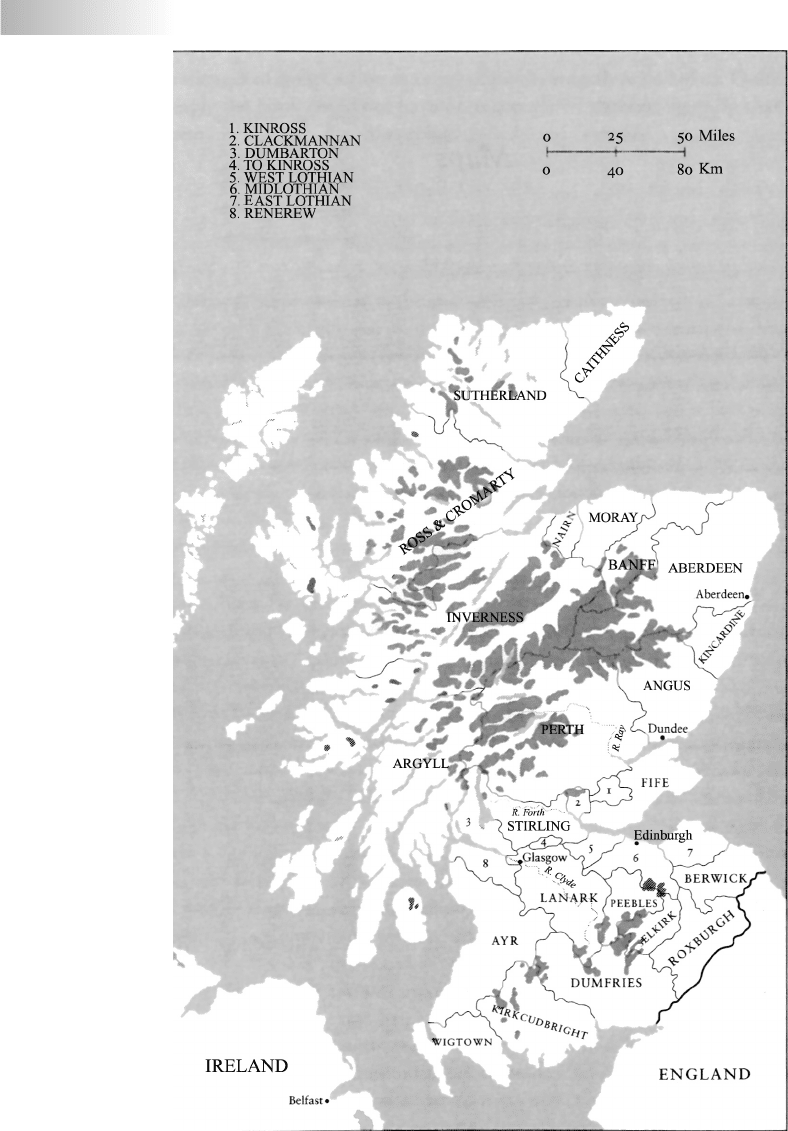
Figure 14.1 Scotland
Source: Devine 1999.
Cambridge Histories Online © Cambridge University Press, 2008