
Floud R., Johnson P. The Cambridge Economic History of Modern Britain, Volume 1: Industrialisation, 1700-1860
Подождите немного. Документ загружается.


Scotland 401
inhabitants had reached half a million by 1871), Glasgow was soon to be
dubbed ‘Second City of the Empire’.
Finally, the voracious demands for foods and raw materials of the ur-
ban and industrial areas helped to revolutionise agriculture and rural
society throughout Scotland. No part of the country was insulated from
the new power ofmarketforces, whether it be the Hebrides, Orkney and
Shetland to the north or the Border counties in the deep south. The
buoyant markets for kelp, fish, whisky, cattle and sheep commercialised
Highland society, dissolved the traditional communal townships, encour-
aged the division of land into individual crofts and subordinated ancient
landownership responsibilities to the new imperatives of profit. Similarly,
customary relationships and connections between clan elites and follow-
ers swiftly disintegrated as the entire fabric of society was recast in re-
sponse to the new rigour of landlord demands, ideological fashion and,
above all, the overwhelming market pressures emanating from the south.
In less than two generations Scottish Gaeldom was transformed from trib-
alism to capitalism. The most telling sign of the new order was the noto-
rious Clearances, when entire communities were removed from the land
to make room for more profitable activity and particularly for the cre-
ation of the new economy of sheep-farming.
The scale of the revolution was no less remarkable in the rural Low-
lands. There too the explosion in grain and meat prices after c. 1780 as a
result of urbanisation has been identified as the fundamental dynamic in
rapid commercialisation. It was in the two or three decades after c.1760
that a recognisably modern landscape of enclosed fields, trim farms and
separated holdings started to take shape in the Scottish countryside. The
single farm under one master became the norm as holdings were con-
solidated between 1760 and 1815. By 1830, most of those who worked in
Lowland agriculture were landless male and female servants whose lives
were often as much subject to the pressures of labour discipline and en-
hanced productivity as those who toiled in the workshops and factories
of the larger towns. Most remarkably, the cottar class, which in the old
world had comprised between a quarter and a third of the inhabitants of
many rural parishes, had virtually disappeared, and their smallholdings
had been consolidated into larger tenant farms. Significantly, the popu-
lations of all Lowland rural counties approached their peak levels at the
Census of 1851. By 1861 no Lowland region had a majority of workers
employed in agriculture. Scotland was now a different kind of society
from that of the early nineteenth century.
EXPLANATIONS
Space does not permit a detailed assessment of the complex range of in-
fluences which shaped Scottish economic development from the second
half of the eighteenth century. Here the aim is more modest: to move
Cambridge Histories Online © Cambridge University Press, 2008

402 T. M. Devine
back from the detail in order to bring into sharper relief the key ele-
ments in the overall process and, at the same time, to emphasise those
particular factors which appear to have been especially relevant to the
Scottish experience.
By the later eighteenth century internal market conditions were more
favourable to expanding industrial production. Population rose by about
20 per cent between c.1755 and 1801, real wages increased from the 1760s
to theearly 1790s (in the Central Lowlands at least), a higher population
of the Scottish people worked within a market environment than in ear-
lier decades, and there was notable evidence of the increasing size and
purchasing power of the urban trading and professional classes. However,
while these domestic influences clearly enhanced demand for manufac-
tures, they were much less decisive than external markets. From the 1740s
to the1780s, the new free-trade area created by the Union was crucial, as
can be seen from the two examples of the country’s principal eighteenth-
century industry, linen, and its most successful branch in overseas trade,
tobacco.
Linen experienced dynamic growth between 1740 and 1780, with out-
put of cloth stamped by the Board of Trustees for sale rising fourfold
over that period. In addition, linen was to play a key role in the early
stages of Scottish industrialisation as the most important source of cap-
ital, labour and business skills for the cotton manufacture, the ‘leading
sector’ of the industrial revolution. Linen’s success seemed to rest to a
large extent on the common market created by the Union. In the 1760s,
forinstance, as much as two-thirds of stamped linen output was sold in
theEnglish home market or the American and Caribbean colonies. In the
absence of the Union, this core manufacture would very likely have been
confronted with an English tariff wall in competition with aggressive
Dutch and German rivals. The Scots instead received protection within
theUnion and were also aided from 1742 by a series of bounties (financial
incentives offered by the government) to encourage exports. These, rather
than initiatives to improve efficiency, seem to have been the decisive influ-
ences on growth. Linen, therefore, was one case where the record shows
theimpact of Union to be clearly favourable in the long term (Durie 1979).
To some extent it was a similar story with tobacco. The ‘golden age’ of
theGlasgow tobacco trade dates from the 1740s. In 1741, 8 million pounds
in weight of colonial tobacco were landed from Virginia, Maryland and
NorthCarolina at the Clyde ports, a figure which had climbed to 13
million pounds in 1745 and, after a further dramatic spurt, to 21 million
pounds in 1752. Astonishingly, by 1758, Scottish tobacco imports were
greater than those of London and all the English outports combined.
In 1771 the highest ever volume of tobacco was landed, a staggering 47
million pounds (almost 21,000 tons). Glasgow had become the tobacco
metropolis of western Europe, and in the west of Scotland the profits
of the trade fed into a very wide range of industries, funded banks and
Cambridge Histories Online © Cambridge University Press, 2008

Scotland 403
financed agricultural improvement through merchant investment. It is
now acknowledged that the transatlantic trades played a key economic
role in the diversification within the Glasgow area, the region that was to
become the engine of Scottish industrialisation (Devine 1995b; Whatley
1997: 22–3).
The legitimacy afforded by the Union was crucial to this dazzling story
of commercial success. As already noted, Scots traders had been active in
thetobacco colonies before 1707, though on a relatively small scale, and
much commerce was clandestine in nature. Certainly no London govern-
ment would have allowed the enormous illegal growth in Scottish to-
bacco imports outside the Union. Indeed, it was English protests against
theboom in Scottish smuggling within the Union that led to the whole-
sale reorganisation of the customs service in 1723 and the formation of
amore professional customs bureaucracy (Price 1984). This reflected the
great political sensitivity of the issue, since it was widely recognised that
much of the Scottish success was at the expense of English merchants.
Smuggling before 1707 clearly had its limitations; the Union was there-
fore a necessary basis for the phenomenal Glaswegian performance in
theAmerican trades. Yet those successes were not inevitable. In the final
analysis they were won by the Scottish merchant houses adopting more
efficient business methods than many of their rivals. The big Glasgow
firms were able to drive down their costs by a number of innovations
in purchasing, marketing and shipping which made them formidable
competitors in American and European markets. So the union did not in-
evitably cause growth in the Atlantic trades; it simply provided a necessary
context in which growth might or might not take place. Nevertheless, one
reason for fast Scottish growth after c.1760was that the focus of external
trade had decisively moved from Europe to England, North America and
the Caribbean, the most rapidly developing marketplace in the world.
International markets remained crucial throughout the period of this
chapter, even if, after 1783, the protection of the Navigation Acts was less
significant and Scottish industry was able to penetrate non-imperial mar-
kets in the USA, South America and continental Europe on a significant
scale. From c.1830 pig iron production was sustained mainly by external
demand. In 1847, for instance, no less than two-thirds of Scottish-made
pig iron was exported. It was a similar story with jute manufacture which,
from the 1840s, became the cornerstone of Dundee’s economy.
In exploiting the global marketplace, the Scots had several advantages.
The Central Lowlands were almost fashioned by nature for industrialisa-
tion. By 1800 the region contained by far the largest proportion of urban
dwellers of any region, with fully 60 per cent of the total town and city
population of Scotland living in Glasgow and Edinburgh alone. Moreover,
several areas (and in particular Ayrshire, Lanarkshire and Fife) were rich
in coal and ironstone, the most important minerals for early industriali-
sation, and had the additional bonus of close location to ports, sources of
Cambridge Histories Online © Cambridge University Press, 2008

404 T. M. Devine
labour in the towns and water transport. The two estuaries of the Forth
and the Clyde penetrated deep into the narrow waist of the Lowlands, a
natural advantage which was then maximised by the building of three
great canals, Monkland (1790), Forth and Clyde (1790) and Union (1822),
all of them important for the carriage of coal and other goods low in
value but heavy in bulk. With the construction of more roads and the
continued expansion of the coastal trade, followed by the railways, the
Central Lowlands acquired a first-class transportation network capable
of large-scale exploitation of the very favourable geological advantages
of the region. Some question the strategic importance of coal and iron
in the first phase of industrialisation since they really came into their
ownascrucial assets only after 1830. However, steam power, and hence
theextensive use of coal as a fuel, was already widely employed in both
cotton and linen spinning in Scotland by the early nineteenth century.
While water power did continue to be used extensively in all sectors of
theeconomy, steam gave a new and decisive competitive advantage to
the export-orientated textile industries, not only by allowing unbroken
production in all weathers but also through relocation of the mills from
the countryside to the cities with their abundant supplies of low-wage
labour. The Belfast cotton industry did not possess such easy access to
rich sources of coal in the neighbourhood of the city, and so failed to
compete with Glasgow and Paisley in the age of steam and fell behind
from the 1820s.
The response of Scottish agriculture to industrial growth was equally
critical. At the heart of agrarian improvement was the ability of farmers
to produce more from a given area of land and also extend cultivation
to underutilised areas. Thus more people could move into sectors where
food was bought rather than grown, but without prices for essentials
going through the ceiling. Certainly oat prices did move upwards. In
south-east Scotland they were on average 56 per cent higher in 1765–70
than for the years 1725–50, and prices for 1805–10 showed a 300 per cent
increase over pre-1750 values. These price movements were sufficient to
generate confidence for rural investment but they did not undermine the
purchasing power of labour as money wages in a varied range of occu-
pations were rising even faster between the 1760s and early 1790s, the
classic period of agrarian improvement in Scotland. Essentially changes
in farm organisation, cultivation methods, land enclosure and new rota-
tions which had evolved over generations in most parts of England were
squeezed into a few decades in Lowland Scotland. One telling illustration
of the revolution was the trend of oat yields. By the 1790s, even in coun-
ties such as Angus and Lanark, which were by no means in the van of
agricultural progress, average seed-yields were 1:12 and 1:11 respectively.
These were around three times the average of the early eighteenth cen-
tury and on a par with several regions south of the Border. As William
Fullarton reported in some astonishment in the course of his survey of
Cambridge Histories Online © Cambridge University Press, 2008
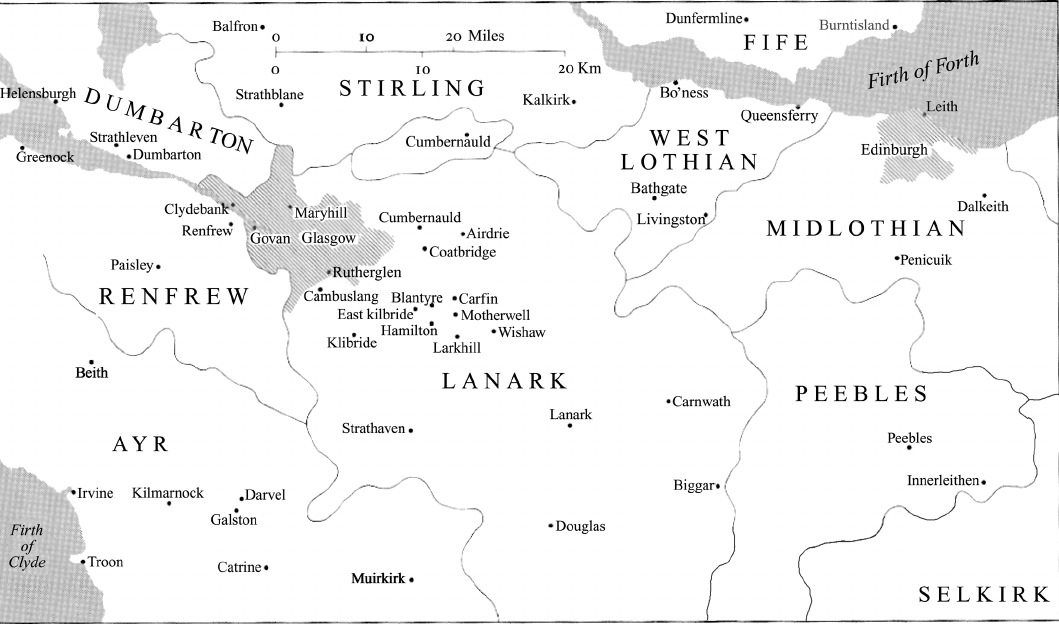
Figure 14.2
The Central Lowlands of Scotland
Source: Devine 1999.
Cambridge Histories Online © Cambridge University Press, 2008

406 T. M. Devine
Ayrshire in 1793, ‘the third of the farms in crop supplied double or triple
theyield formerly taken from the whole’ (Fullarton 1793: 21). It was the
more intensive application of traditional methods, such as fallowing and
thelavish application of lime, combined with the rapid diffusion of sown
grasses and turnip husbandry which enabled a heavier carry of stock and
hence more manure for the land.
Why market opportunities were grasped so eagerly and effectively is
less obvious. In England the current historical opinion is that the great
proprietors did not play a central role in the promotion of agricultural
change after c.1750 (Beckett 1989: 570–1). The main influences appar-
ently were the lesser gentry, enlightened tenants and land agents. In
Scotland the opposite seems to have been the case. In the Highlands, as
in the Lowlands, the landed class was at the heart of the process, not
necessarily through routine personal involvement but at a more strate-
gic level through the support they gave to their professional factors and
agents who actually enforced improvement. Scottish agriculture was less
advanced than English and so required a more interventionist approach.
The basic advantage of the proprietors was that most land was worked
through tenancies governed by leases. They therefore possessed full legal
rights of eviction at the end of a lease. This allowed them not only to
influence the size and composition of tenantry on their estates but also
to build into these contracts mandatory improving clauses enforceable at
law. Sheriff Court records demonstrate that landowners had little com-
punction in using legal muscle to ensure compliance with cropping reg-
ulations set out in leases.
Legal developments had added to the power of Scottish landowners to
promote improvement. First, as long ago as 1695, the ‘Act anent lands
lying run-rig’ and a second statute in the same year relating to the di-
vision of commonties (uninhabited lands with rights of use belonging
to adjacent estates) helped to facilitate the process. By the first, individ-
ual landlords could take the initiative to exchange and consolidate land
held by different proprietors. The second act allowed one landowner to
promote a division of commonty rather than wait for a majority to be in
agreement. The legislation put in place cheap and effective processes and
wasclearly designed to assist those lairds in the van of agrarian reform.
The rights of Scottish landowners were buttressed further by the develop-
ment of entail. Through the introduction of laws of entail in 1685 which
safeguarded ‘entailed’ land from forced sales through debts, the succes-
sion to an entailed estate was confined to a definite series of heirs. Any
proprietor who succeeded could not break this line and he was not per-
mitted to contract debts that would put the property at risk. By 1825 an
estimated half of the landed estates of the country were subject to strict
entail (Campbell 1988: 93). Entail’s great attraction and obvious popular-
ity was that it gave protection and security to the landed family over
several generations. But the restrictions made it difficult to raise loans
Cambridge Histories Online © Cambridge University Press, 2008

Scotland 407
forinvestment which would then be passed on to succeeding proprietors.
An act of 1770 gave some flexibility by allowing an improving landlord
of an entailed estate to invest in his property and become a creditor to
his heirs up to the value of four years’ rental.
But other influences were also significant. The costs of Scottish
landownership were rising steeply in the eighteenth century. This was
theera of competitive display, when social standing was increasingly
defined by material status. More elaborate country houses, interior deco-
ration and the adornment of estate policies became not only fashionable
but essential in order to maintain and demonstrate social position. It is
noteworthy how many of the great houses of Scotland were either built
or significantly renovated during this period. Inverary, Culzean, Hopeton
House and Mellerstain were only the most famous examples. This was the
era when the remarkable Adam family of architects did their best work,
much of which involved the comprehensive remodelling of castellated
houses and fortified dwellings of an earlier and more turbulent age. In
thelater eighteenth century the number of aristocratic and laird houses
built from scratch also multiplied. Nearly twice as many were constructed
in the 1790s (more than sixty) as between 1700 and 1720. Most of Robert
Adam’s commissions were for the laird class, even though his best-known
work was for the nobility. Also driving up costs was the revolution in
interior design and furnishings. At the time of the Union, the domes-
tic furnishings of a typical laird’s house were simple in the extreme. Less
than fifty years later, the aristocracy was aspiring to standards of unprece-
dented splendour, with gilded ornamentation, framed paintings, lavish
fabrics and elaborate ceiling mouldings. Mahogany furnishings, based on
thedesigns of Chippendale, Sheraton and Hepplewhite, enjoyed remark-
able popularity. Nor should it be forgotten that the assimilation of the
Scottish nobility into the wealthier English aristocracy subjected them to
special additional pressures of expenditure which increased the need to
extract more income from their lands.
Forall these reasons larger rent rolls became essential to service the
new levels of conspicuous consumption and elite material competition
of the landed classes. The ‘Revolution of Manners’ went hand in hand
with the popularity of Improvement. But the influences at work were not
simply material in origin. They also came from the world of ideas. The
Scottish philosophical revolution of the eighteenth century fed through
into agrarian reform. The rationalism of the Enlightenment helped to
change man’s relationship to his environment. No longer was nature ac-
cepted as given and preordained; instead, it could be altered for the better,
or ‘improved’ by systematic and planned intervention. In a sense, there-
fore, Enlightenment thought gave a new intellectual legitimacy to the tra-
ditional interventionist role of the landed classes in Scotland by clarifying
and systematising the objectives of agrarian reform. Not surprisingly in
asociety where it dominated the economy, the theorists were fascinated
Cambridge Histories Online © Cambridge University Press, 2008

408 T. M. Devine
by agriculture. Writers as varied as Lord Kames, James Anderson, Sir
John Sinclair and the numerous contributors to the Statistical Account
and General Views of Agriculture of the 1790s formulated ideas about the
meaning of Improvement which offered a fundamental critique of the old
order and a coherent approach to the development of the new. The cru-
cial links between the intellectuals and the practice of agriculture were
thefactors and agents who managed the actual routine of farming on
thegreat estates. These were educated men who had often attended a
Scottish university, and when they set out their schemes of improvement
they were in many instances simply putting into effect the new intel-
lectual orthodoxy that was widely disseminated in the books, pamphlets
and journals of the middle decades of the eighteenth century. There
wasremarkable unanimity about what was bad and had to be changed.
Lands ‘in a state of nature’ were no longer acceptable and had to be en-
closed and brought into regular cultivation. Farms held by more than
one tenant had to be divided and reorganised. The ‘unimproved’ regime
wasvigorously condemned as wasteful and ruinous. What was new was
good; the old was bad. This gave the improvers an extraordinary moral
and intellectual confidence as they vigorously went about the crusade of
thoroughgoing agrarian reformation.
The new imperial context was a basic influence on the momentum of
agrarian change. By the later eighteenth century, many Scots were grow-
ing rich from the profits of colonial commerce to North America and the
Caribbean, from service in the army, and from trade and office holding
in India and the East Indies. It was common for some who succeeded
to acquire a small landed estate and ‘improve’ their property from their
personal fortunes. By the last quarter of the eighteenth century, for in-
stance, the counties around Glasgow were ringed by the estates of the
city’s tobacco and sugar lords. At least sixty merchant families were in-
volved in these land purchases between 1760 and 1815 (Devine 1976: 7). It
is striking also that many of the architect Robert Adam’s clients were not
members of the ‘old’ landed class but men who had made their money
in law and commerce. The impact of empire on the land market and im-
provement comes through in the literature of the time. John Galt’s The
Last of the Lairds concerns the appropriately named Mr Rupees, a ‘Nawbob’
who ‘came hame from Indy and bought the Arunthrough property frae
theGlaikies, who, like sae mony ithers o’ the right stock o’ legitimate
gentry, hae been smothered out o’ sight by the weed and nettle over-
growthso’mechandise ane cotton-weavry’. Galt depicts Mr Rupees as a
man committed to conspicuous consumption on a lavish scale and the
generation of more and more profit from his lands.
Though profit-hungry proprietors might own the land, they did not
actually work it, and the tenant farmers who did were censured vigor-
ously by improving writers as conservative and hidebound. How then were
the new ideastobetransformedinto reality against this background of
Cambridge Histories Online © Cambridge University Press, 2008

Scotland 409
unyielding orthodoxy and traditionalism? Modern research has provided
some answers (Devine 1994: 66–70). For a start, not all tenants were as
backward as the critics suggested. Even before 1750, the steady emergence
of single tenancies and the decay of rentals paid mainly in kind meant
more and more had direct experience of serving the market. These enter-
prising farmers, like their landlords, gained from rising prices after the
1770s. The ‘latent’ farming bourgeoisie described earlier in this chapter
developed further in the new economic context. Nor should it be forgot-
tenthat many Scottish tenants were fully literate and that much of the
new agricultural knowledge was spread by books, pamphlets and jour-
nals. Typical of the standards prevailing in many parts of the Lowlands
wasthe pattern in St Ninian’s parish, Stirlingshire, in 1790s: ‘Some of
our farmers have been favoured with a liberal education. A few of them
have been instructed in the rudiments of the Latin tongue. Almost all
of them have been taught writing and arithmetic, as well as to read
theEnglish language with understanding and ease’ (Withrington 1988:
172). As has been argued, ‘an educated peasantry more readily turns its
back on immemorial tradition because it finds on the printed page an
alternative form of authority to custom’ (Cullen and Smout 1977: 15).
Moreover, improving landlords used a range of incentives to encourage
progressive practices. Some covered the costs of enclosure, liming and
new farm houses set against obtaining returns through raising rents in
thelong run. The risk was worth taking because of the huge increases
in rents after 1780. Contemporaries estimated that the general level was
fairly stable to about 1750, started to move up from the 1760s, doubled
between 1783 and 1793, and did so again from 1794 to 1815. Abatements
of rent were also allowed in order to permit the result of the new prac-
tices to filter through and gain acceptance. As the Earl of Morton advised,
rental should be kept at modest levels in the initial phase ‘and not so
high as to exceed the skill and industry of the tenants . . . as no General
can expect good success with a bad disciplined Army’ (Devine 1994: 74).
In order to attract able tenants, landowners also invested in new farm
houses. Some steadings, as in Fife in the early nineteenth century for
instance, remained in a ‘barbarous’ condition, but many others now had
substantial, two-storey, slate-covered farm houses, stables, cattle houses,
barns, milksheds and strawyards.
Coercion was also used widely and systematically. The approach was
based on the improving lease, which set out the detailed instructions
for the new cropping prescriptions and to which the tenant had to ad-
here. Landowners could ensure compliance in a variety of ways: by fin-
ing, marginal increases in rent or eviction. Both estate and Sheriff Court
records show that breaches of the lease were regarded as a serious of-
fence and could be punished by the loss of the tenancy. These new leases
were no longer conventional, generalised documents but contained sev-
eral pages of written obligations and mandatory instructions concerning
Cambridge Histories Online © Cambridge University Press, 2008

410T.M.Devine
fallowing, liming and cropping routines. Nor were they simply paper
contracts. On the great estates, bureaucracies of principal factor (estate
manager) and sub-factors allowed for careful and regular monitoring. The
Earl of Panmure was advised to appoint an inspectorate of three salaried
officers to supervise the progress of improvements on his Angus estate. If
necessary, they should be supplied with assistants to ‘take Inspection and
make report annually as said is: That those who do well may meet with
theApplause justly due them: That the Backward may be spurred on and
that the Obstinately Negligent and Deceitful may be Undone and turned
off asanExampleIn Terrorem of others’ (Devine 1994: 72). Here indeed
was a telling illustration of the threatened use of seigneurial authority
in the cause of improvement.
In agriculture the adoption of ‘English methods’ was important, but
they were also crucial in manufacturing. The early phase of Scottish in-
dustrialisation was based overwhelmingly on borrowed technology and
expertise. Ideas and skills were freely imported from Holland, France and
Ireland, but England was far and away the major source. ‘Technology
transfer’ on a remarkable scale took place from south to north, reflecting
Scotland’s relative backwardness and also the strategy of English business-
men who were on the lookout for cheaper labour and low-rented factory
sites. The spinning revolution in cotton was entirely based on the seminal
inventions of the Englishmen Kay, Hargreaves, Arkwright and Crompton.
Men with experience of English mill practice often became the managers
of the early factories. The best known of them was Archibald Buchanan
who, after serving an apprenticeship at Cromford in Derbyshire, became
thetechnical genius behind the rise of the great Scottish cotton empire
of James Finlay and Co. Sulphuric acid manufacture was pioneered at
Prestonpans in 1749 by Roebuck and Garbett after their earlier venture
in Birmingham. The blast furnace and the coke process of smelting were
both introduced from England, as was the coal-fired reverberating fur-
nace, which was central to technical progress in the brewing, chemical,
pottery and glass industries. Perhaps the most famous example of the
penetration of English know-how came with the foundation in 1759 of
Carron Company, Scotland’s largest manufacturing plant of the day, based
on the coke-smelting techniques pioneered at Coalbrookdale. The speed
of Scotland’s economic transformation also created technical bottlenecks
and recurrent shortages of skilled labour which were often relieved by a
steady trickle from England of experienced smelters, moulders, spinners
and malleable iron workers.
The above is far from being a definitive list but it is enough to demon-
strate that Scottish economic progress would surely have been impeded
without English technical expertise and skills and, to a lesser extent,
those of other countries. But these new processes were assimilated swiftly,
confirming that Scotland had the appropriate social, cultural and eco-
nomic environment to achieve fast industrialisation. Like a latter-day
Cambridge Histories Online © Cambridge University Press, 2008