
Francoise J.-P., Naber G.L., Tsun T.S. (editors) Encyclopedia of Mathematical Physics
Подождите немного. Документ загружается.


and the density of classical particles is
c
(!) = lim
N
c
(!)=jj. One can check that canoni-
cal and grand-canonical energies are related by
eð
e
;
c
;!Þ¼eð
e
ð
e
;!Þ;!Þ
e
e
ð
e
;!Þ
c
c
ð!Þ½5
Given (
e
,
c
), the ground-state energy density
e(
e
,
c
) is defined by
eð
e
;
c
Þ¼ inf
!2
per
eð
e
;
c
;!Þ
The set of periodic ground-state configurations
for given chemical potentials
e
,
c
is the grand-
canonical ground-state phase diagram:
G
gc
ð
e
;
c
Þ¼
n
! 2
per
: eð
e
;
c
;!Þ¼e ð
e
;
c
Þ
o
It may happen that no periodic configuration
minimizes e(
e
,
c
, !) and that G
gc
(
e
,
c
) = ;.
However, results suggest that G
gc
(
e
,
c
)is
nonempty for almost all
e
,
c
.
The situation simplifies for U > 4d and
e
2
(U þ 2d, 2d). Since
e
belongs to the gap of
h
(!), we have
e
(
e
, !) =
c
(!), and
eð
e
;
c
;!Þ¼eð
c
ð!Þ;!Þð
e
þ
c
Þ
c
ð!Þ
Thus, G
gc
(
e
,
c
) is invariant along the line
e
þ
c
=
const. (for
e
in the gap).
Symmetries of the Model
The Hamiltonian H
clearly has the symmetries of
the lattice (for a box with periodic boundary
conditions, there is invariance under translations,
rotations by 90
, and reflections through an axis).
More important, it also possesses particle–hole
symmetries and these are useful sinc e they allow us
to restrict investigations to positive U and to certain
domains of densities or chemical potentials
(see below).
The classical particle–hole transformation
!
x
7!!
x
= 1 !
x
results in
H
U
ð!Þ¼H
U
ð!ÞUN
and N
c
(!) = jjN
c
(!). It follows that
E
U
(N
e
, !) = E
U
(N
e
, !) UN
e
, and
G
U
can
ð
e
;
c
Þ¼
n
! : ! 2 G
U
can
ð
e
; 1
c
Þ
o
G
U
gc
ð
e
;
c
Þ¼
n
! : ! 2 G
U
gc
ð
e
U;
c
Þ
o
An electron–hole transformation can be defined
via the unitary transformation a
x
7!"
x
a
y
x
and
a
y
x
7!"
x
a
x
, where "
x
= 1onasublattice,and= 1
on the other sublattice. Then,
H
U
ð!Þ7!H
U
ð!ÞUN
c
ð!Þ
and N
7!jjN
. It follows that E
U
(jj
N
e
, !) = E
U
(N
e
, !) UN
c
(!), and
G
U
can
ð
e
;
c
Þ¼G
U
can
ð1
e
;
c
Þ
G
U
gc
ð
e
;
c
Þ¼G
U
gc
ð
e
;
c
UÞ
Finally, the particle–hole transformation for
both the classic al particles and the electrons
gives
H
U
ð!Þ7!H
U
ð!ÞþUN
þ UN
c
ð!ÞU jj
It follows that
E
U
ðjjN
e
; !Þ= E
U
ðN
e
;!ÞþUðN
e
þ N
c
ð!ÞjjÞ
and
G
U
can
ð
e
;
c
Þ¼
n
! : ! 2 G
U
can
ð1
e
; 1
c
Þ
o
G
U
gc
ð
e
;
c
Þ¼
n
! : ! 2 G
U
gc
ð
e
U;
c
UÞ
o
Any of the first two symmetries allow us to choose
the sign of U. We assume from now on that U 0. The
third symmetry indicates that the phase diagrams have
a point of central symmetry, given by
e
=
c
= 1=2in
the canonical ensemble and
e
=
c
= U= 2inthe
grand-canonical ensemble. Consequently, it is enough
to study densities satisfying
e
1=2andchemical
potentials satisfying
e
U=2.
These symmetries also have useful consequences at
positive temperatures. In particular, both species of
particles have average density 1/2 at
e
=
c
= U=2,
for all .
The Ground State – Arbitrary Dimensions
The Segregated State
What follows is best understood in the limit
U !1 and when
e
<
c
. In this case, the electrons
become localized in the domain D
(!) = {x 2
: w
x
= 1} and their energy per site is that of the
full configu ration, e ( , ! 1) (see the section
‘‘Cano nical ensemble ’’), wher e =
e
=
c
is the
effective electronic density. The presence of a
boundary for D
(!) raises the energy and the
correction is roughly proportional to
B
ð!Þ¼#
n
ðx; yÞ : x 2D
ð!Þ and y 2 Z
d
nD
ð!Þ
o
The following theorem was proposed by Freericks
et al. (2002).
286 Falicov–Kimball Model
Theorem 1
(i) Let Z
d
be a finite box, and U > 4d. Then
for all ! 2
, and all N
e
N
c
(!) = N
c
, we
have the following upper and lower bounds:
1
2d
e
N
e
N
c
;! 0
B
ð!ÞE
ðN
e
;!Þ
N
c
e
N
e
N
c
;! 1
a
N
e
N
c
ðUÞ
B
ð!Þ
Here, a() = a(1 ) is strictly positive for 0 <
<1. (U) behaves as 8d
2
=U for large U, in
the sense that U(U) ! 8d
2
as U !1.
(ii) For any
e
6¼
c
that differ from zero, the
segregated state is the unique ground state if
a(
e
=
c
) >(U), that is, if U is large enough.
The proof of (i) is rather lengthy and we only
show here that it implies (ii). Let b(!) =
lim
(B
(!)=jj), and notice that b(! ) = 0forthe
empty, the full, and the segregated configurations;
0 < b(!) < d for all other periodic configurations
or mixtures. Recall t hat
c
e(
e
=
c
, ! 1) is the
energy density of the segregated state. For all
densities such that a(
e
=
c
) >(U), and all config-
urations such that
c
(!) =
c
,wehave
eð
e
;!Þ
c
e
e
c
;! 1
and the inequality is strict for any periodic config-
uration. This sho ws that the segregated configura-
tion is the unique ground state.
General Properties of the Grand-Canonical
Phase Diagram
We have already seen that the grand-canonical
phase diagram is symmetric with respect to
( U=2, U=2). Other properties follow from
concavity of e(
e
,
c
).
Let ! 2 G
gc
(
e
,
c
)nG
gc
(
0
e
,
0
c
) and !
0
2 G
gc
(
0
e
,
0
c
)nG
gc
(
e
,
c
). Then,
(a)
e
=
0
e
and
0
c
>
c
imply
c
(!
0
) >
c
(!);
(b)
c
=
0
c
and
0
e
>
e
imply
e
(
0
e
, !
0
) >
e
(
e
, !),
and ! cann ot be obtained by adding some
classical particles to the configu ration !
0
.
It follows from (b) that if ! 1 2 G
gc
(
e
,
c
), then
! 1 2 G
gc
(
0
e
,
0
c
) for all
e
0
e
,
c
0
c
. A simi-
lar property holds for the empty configuration. To
establish these properties, we can start from
eð
e
;
c
;!
0
Þeð
e
;
c
;!Þ > 0
> eð
0
e
;
0
c
;!
0
Þeð
0
e
;
0
c
;!Þ½6
Since e(
e
,
c
, !) is concave with respect to
e
and
linear with respect to
c
, we have
eð
0
e
;
0
c
;!Þeð
e
;
c
;!Þ
þð
e
0
e
Þ
e
ð
e
;!Þþð
c
0
c
Þ
c
ð!Þ½7
Using this inequality for both terms on the right-
hand side of [6], we obtain the inequality
ð
0
e
e
Þ
e
ð
0
e
;!
0
Þ
e
ð
e
;!Þ
þð
0
c
c
Þ
c
ð!
0
Þ
c
ð!Þ½0
which proves (a) and the first part of (b). The second
part of (b) follows from
eð
e
;
c
;!Þ¼
Z
e
1
d
e
ð; !Þ
c
c
ð!Þ
Indeed, the minimax principle implies that eigenvalues
j
(!) are decreasing with respect to ! (if U 0), so
that
e
(
e
, !) is increasing (with respect to !). Then for
any !
00
>!and
0
e
>
e
,
eð
0
e
;
c
;!
00
Þeð
0
e
;
c
;!Þ
> eð
e
;
c
;!
00
Þeð
e
;
c
;!Þ
and !
00
=2G
gc
(
e
,
c
) implies !
00
=2G
gc
(
0
e
,
c
).
Next, we disc uss domains in the plane of
chemical potentials where the empty, full, and
chessboard configurations have minimum energy
(see, e.g., Gruber and Macris (1996), and references
therein). One easily sees that ! 1 is the unique
ground-state configuration if
c
> 0, or if
e
> 2d
and
c
> U . Similarly, ! 0 is the unique ground
state if
c
< U ,orif
e
< U 2d and
c
< 0.
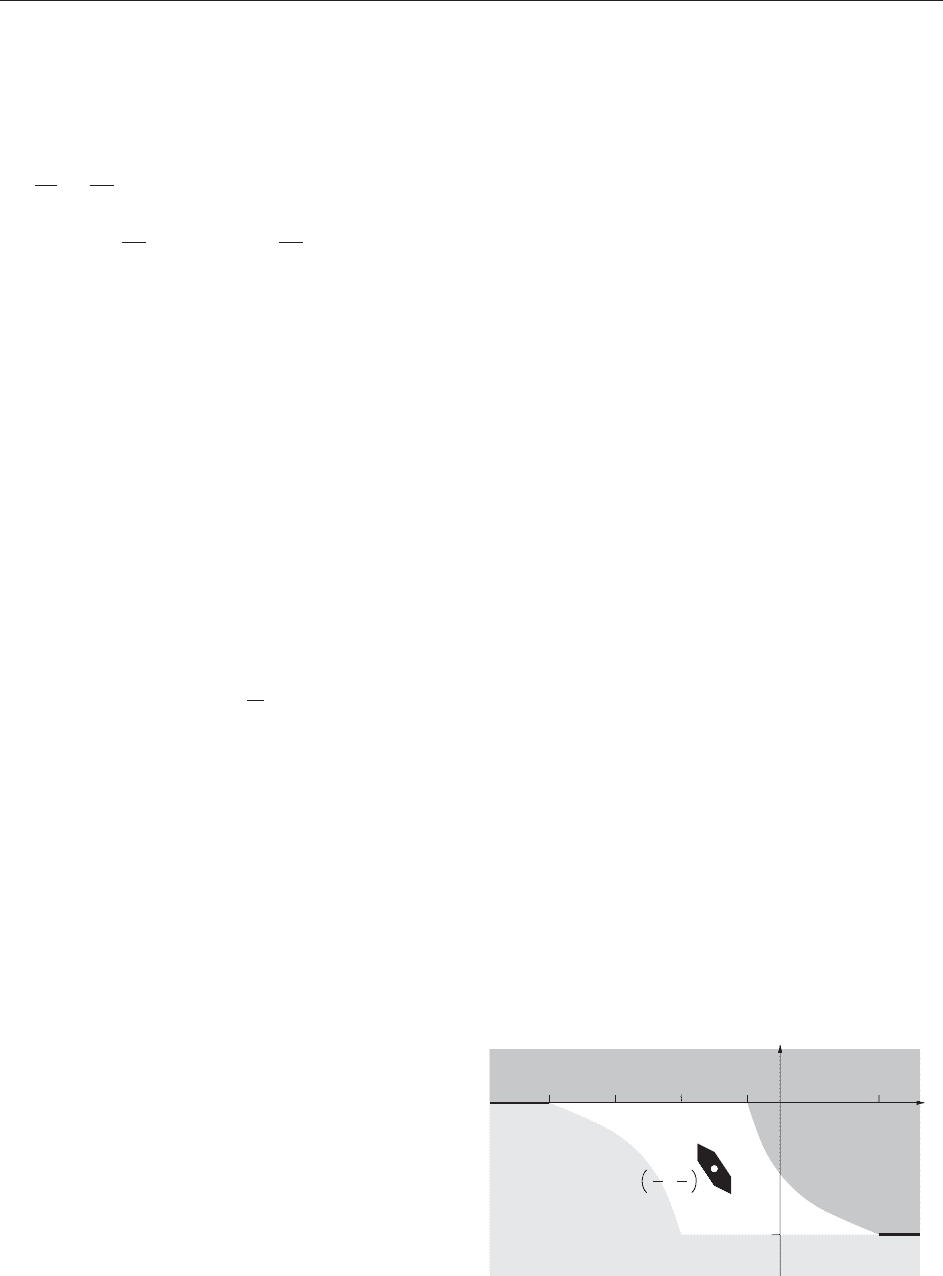
For U > 4d, it follows from the expansion [1] that
the full configuration is also ground state if U þ
2d <
e
< 2d and
e
þ
c
þ U > 4d=(U 4d).
These domains can be rigorously extended using
energy estimates that involve correlation functions
of classical particles. The results are illustrated in
Figures 2 (U < 4d) and 3 (U > 4d).
ω ≡ 0
ω
≡ 1
–U
–U
– 2d –U –U + 2d–2d 2d
–U, –U
2 2
μ
c
μ
e
Figure 2 Grand-canonica l ground-state phase diagram for
U < 4d. Domains for the empty, chessboard, and full configurations,
are denoted in light gray, black, and dark gray, respectively.
Falicov–Kimball Model 287
Finally, cano nical and grand-canonical phase
diagrams are related by the following properties:
(c) If ! 2 G
gc
(
e
,
c
), then ! 2 G
can
(
e
(
e
, !),
c
(!)).
(d) More generally, suppose that !
(1)
, ..., !
(n)
2
G
gc
(
e
,
c
), and consider a mixture with coeffi-
cients
1
, ...,
n
. The mixture belongs to
G
can
(
e
,
c
), with
e
=
P
i
i
e
(
e
, !
(i)
) and
c
=
P
i
i
c
(!
(i)
).
To establish (c), observe that any !
0
satisfies
e(
e
,
c
, !
0
) e(
e
,
c
, !)if! 2 G
gc
(
e
,
c
). Let
e
=
e
(
e
, !) and
c
=
c
(!), and let
0
e
be such that
e
(
0
e
, !
0
) =
e
.Byeqns [5] and [7],
eð
e
ð
0
e
;!
0
Þ;!
0
Þ
e
e
ð
0
e
;!
0
Þ
c
c
ð!
0
Þ
eð
e
ð
e
;!Þ;!Þ
e
e
ð
e
;!Þ
c
c
ð!Þ
Then, e(
e
, !
0
) e(
e
, !) for any configuration !
0
such that
c
(!
0
) =
c
. Property (d) follows from (c) by
a limiting argument, because a mixture can be
approximated by a sequence of periodic
configurations.
Next we describe further properties of the phase
diagrams that are specific to dimensions 1 and 2.
Ground-State Configurations – Dimension 1
A large number of investigations, either analytical or
numerical, have been devoted to the study of the
ground-state configurations in one dimension. One-
dimensional results also serve as guide to higher
dimensions. Recall that symmetries allow us to
restrict to U 0 and
e
1=2.
Most ground-state configurations that appear in
the canonic al phase diagram seem to be given by an
intriguing formula, which we now describe. Let
e
= p=q with p relatively prime to q. Then
corresponding periodic ground-state configurations
have period q and density
c
= r=q (r is an integer).
The occupied sites in the cell {0, 1, ..., q 1} are
given by the solutions k
0
, ..., k
r1
of
ðpk
j
Þ¼j mod q; 0 j r 1 ½8
Note that the first classical particle is located at
k
0
= 0, and k
0
, ..., k
p1
are not in increasing order. In
order to discuss the solutions of [8], we introduce
‘ = bq=pc (the integer part of q=p), and we write
q ¼ð‘ þ 1Þp s ½9
where 1 s p 1, and s is relatively prime to p.
Next, let L(x) denote the distance between the particle
at x and the one immediately preceding it (to the left).
Let us observe that if
c
=
e
, that is, if r = p, then
(a) L(k
j
) = ‘ for 0 j s 1 and k
j
‘ = k
jþps
.
(b) L(k
j
) = ‘ þ 1 for s j p 1 and k
j
(‘ þ 1) =
k
js
.
Indeed, for pk
j
= j þ nq, eqn [9] implies
pðk
j
‘Þ¼j þðn 1Þq þðp sÞ¼j þ p s mod q
and
pðk
j
‘ 1Þ¼j s mod q
Therefore, k
j
‘ is a solution of [8] if j þ p s
p 1, while k
j
(‘ þ 1) is a solution of [8] if
j s 0.
These two properties show that the configuration
defined by [8] is such that L(x) 2 {‘, ‘ þ 1} for all
occupied x. A periodic configuration such that all
distances between consecutive particles are either ‘
or ‘ þ 1 is called homogeneous. Let ! be a
homogeneous configuration with period q and
density
c
= r=q, and let x
0
< < x
p1
be the
occupied sit es in {0, 1, ..., q 1}. We introduce the
derivative !
0
of ! as the periodic configuration with
period r defined by (see Figure 4)
!
0
i
¼
1ifLðx
i
Þ¼‘
0ifLðx
i
Þ¼‘ þ 1
A configuration is most homo geneous if it can be
‘‘differentiated’’ repeatedly until the empty or the
full configuration is obtained.
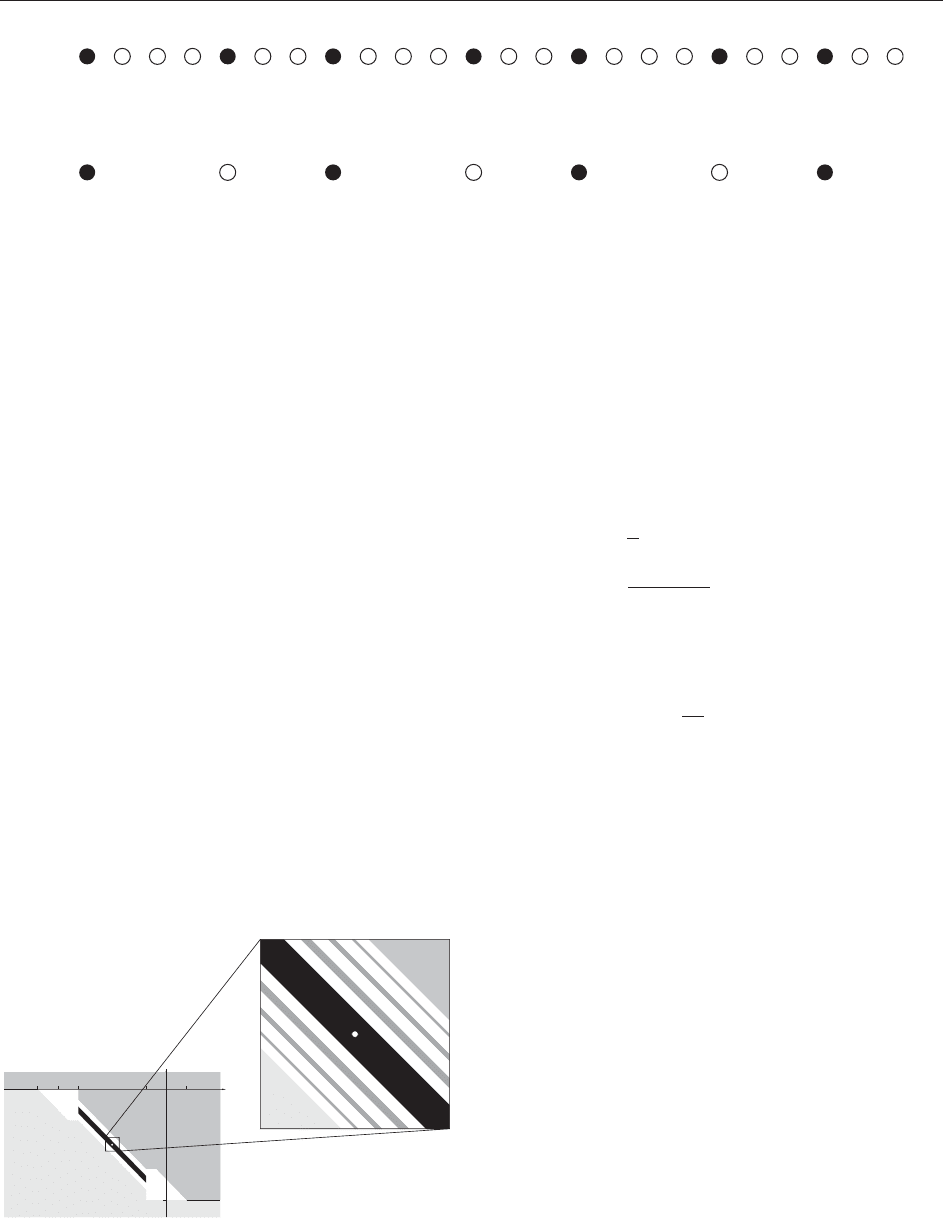
Let ! be the homogeneous configuration from [8]
and !
0
be its derivative. Using the same arguments as
for propert ies (a) and (b) above, and the fact that s is
relatively prime to p, we obtain
(c) Let k
0
0
, ..., k
0
p1
be the solutions of
ðsk
0
j
Þ¼j mod p
–U – 2d –U
ω
≡ 0
ω
≡ 1
–U
+ 2d
–U
–2d 2d
μ
e
μ
c
THE FALICOV–KIMBALL MODEL
–U, –U
2 2
Figure 3 Grand-canonical ground-state phase diagram
for U > 4d . Domains for the empty, chessboard, and full
configurations are denoted in light gray, black, and dark gray,
respectively.
288 Falicov–Kimball Model
Then (k
0
0
, ..., k
0
p1
) is a permutation of
(0, 1, ..., p 1). Further, k
0
j
1 = k
0
jþps
for 0
j s 1, and k
0
j
1 = k
0
js
for s j p 1.
Consider the periodic configuration with period p
where sites k
0
0
, ..., k
0
s1
are occupied and sites
k
0
s
, ..., k
0
p1
are empty. Since k
0
0
= 0, this configura-
tion is precisely the derivative !
0
of !. Iterating,
these properties prove that the solutions of [8] are
most homogeneous.
One of the most important results in one dimen-
sion is that only most homogeneous configurations
are present in the canonical phase diagram, for U
large enough and for equal densities
e
=
c
.
Theorem 2 Suppose that
e
=
c
= p=q. There
exists a constant c such that for U > c4
q
, the only
ground-state configuration is the most homogeneous
configuration, given by [8] (together with trans la-
tions and reflections).
This theorem was established using the expansion [1]
of E
(N
e
, !) in powers of U
1
. It suggests a devil’s
staircase structure with infinitely many domains.
However, the number of domains for fixed U could
still be finite. R esults from Theorem 2 are illu-
strated in Figure 5. Notice that
e
=
c
when
e
is in
the universal gap. These results have been extended
to positive temperatures by using ‘‘quantum
Pirogov–Sinai theory’’ (Datta et al. 1999).
For small U, on the other hand, one can use a
(nonrigorous) Wigner–Brillouin degenerate pertur-
bation theory (a standard tool in band theory).
Let
e
= p=q with p relatively prime to q, and ! be
a periodic configuration with period nq , n 2 N.
Then for U small enough (U 1=q), we obtain
the following expansion for the ground-state energy
(Freericks et al. 1996):
eð
e
;!Þ¼
2
sin
e
U
e
c
ð!Þ
j
b
!ð
e
Þj
2
4 sin
e
U
2
jlog UjþOðU
2
Þ½10
where
b
!(
e
) is the ‘‘structure factor’’ of the periodic
configuration !, namely
b
!ð
e
Þ¼
1
nq
X
nq1
j¼0
e
2i
e
j
w
j
This expansion suggests that the ground-state
configuration can be found by maximizing the
structure factor. The following theore m holds
independently of U.
Theorem 3 Let
e
= p=q. There exist r
1
q=4 and
r
2
3q=4 such that the configurations maximizing
the structure factor are given as follows:
(i) for
c
= r=q with r
1
r r
2
, use the
formula [8];
(ii) for
c
2 (r=q,(r þ 1=q)) with r
1
r r
2
1, the
configuration is a mixture of those for
c
= r=qand
c
= (r þ 1)=q; and
(iii) for
c
2 (0, r
1
=q), the configurations are mixtures
of ! 0 and that for
c
= r
1
=q. For
c
2
(r
2
=q, 1), the configurations are mixtures of !
1 and that for
c
= r
2
=q.
Some insight for low densities is provided by
computing the energy of just one classical particle
and one electron on the infinite line, and to compare
it with two consecutive classical particles and two
electrons. It turns out that the former is more
favorable than the latter for U > 2=
ffiffiffi
3
p
1.15,
while ‘‘molecules’’ of two particles are forming
ω ≡ 0
ω ≡
0
ω ≡
1
ω ≡
1
–U
–U
μ
e
μ
e
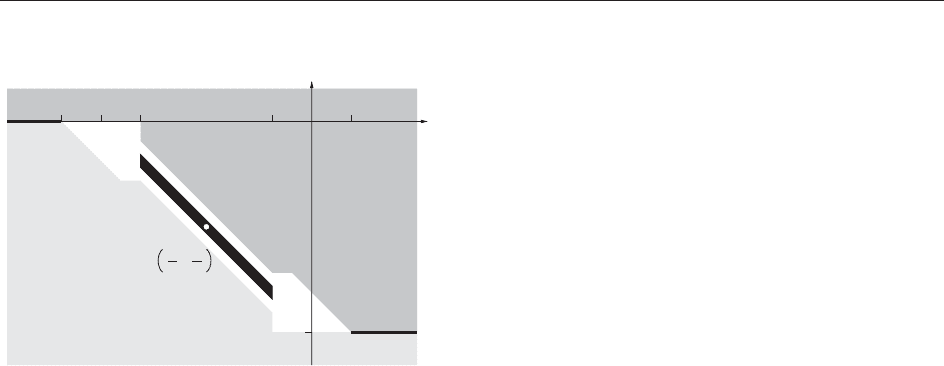
Figure 5 Grand-canonical ground-state phase diagram in one
dimension for U > 4 and
e
in the universal gap. Chessboard
configurations occur in the black domain. Dark gray oblique
domains correspond to densities 1/5, 1/4, 1/3, 2/3, 3/4, 4/5. Total
width of these domains is of order U
1
.
k
0
= 0 k
1
= 4 k
1
= 7 k
5
= 11 k
2
= 14 k
6
= 18 k
3
= 21
k
0
= 0
′
k
1
= 1
′
k
5
= 3
′
k
2
= 4
′
k
6
= 5
′
k
3
= 6
′
k
1
= 2
′
ω:
ω′:
Figure 4 The configuration ! given by the formula [8] with q = 24 and p = 7, and its derivative !
0
. Notice that ‘ = 3 and s = 4.
Falicov–Kimball Model 289
when U < 2=
ffiffiffi
3
p
. Smaller U shows even bigger
molecules for
c
= n
e
,andn-molecules are most
homogeneously distributed according to the for-
mula [8]. It should be stressed that the canonical
ground state cannot be periodic if U is small and
c
=2[1=4, 3=4], which is different from the case of
large U.
Only numerical results are available for
intermediate U. They suggest that configurations
occurring in the phase diagram are essentially given
by Theorem 3 (together with the segregated config-
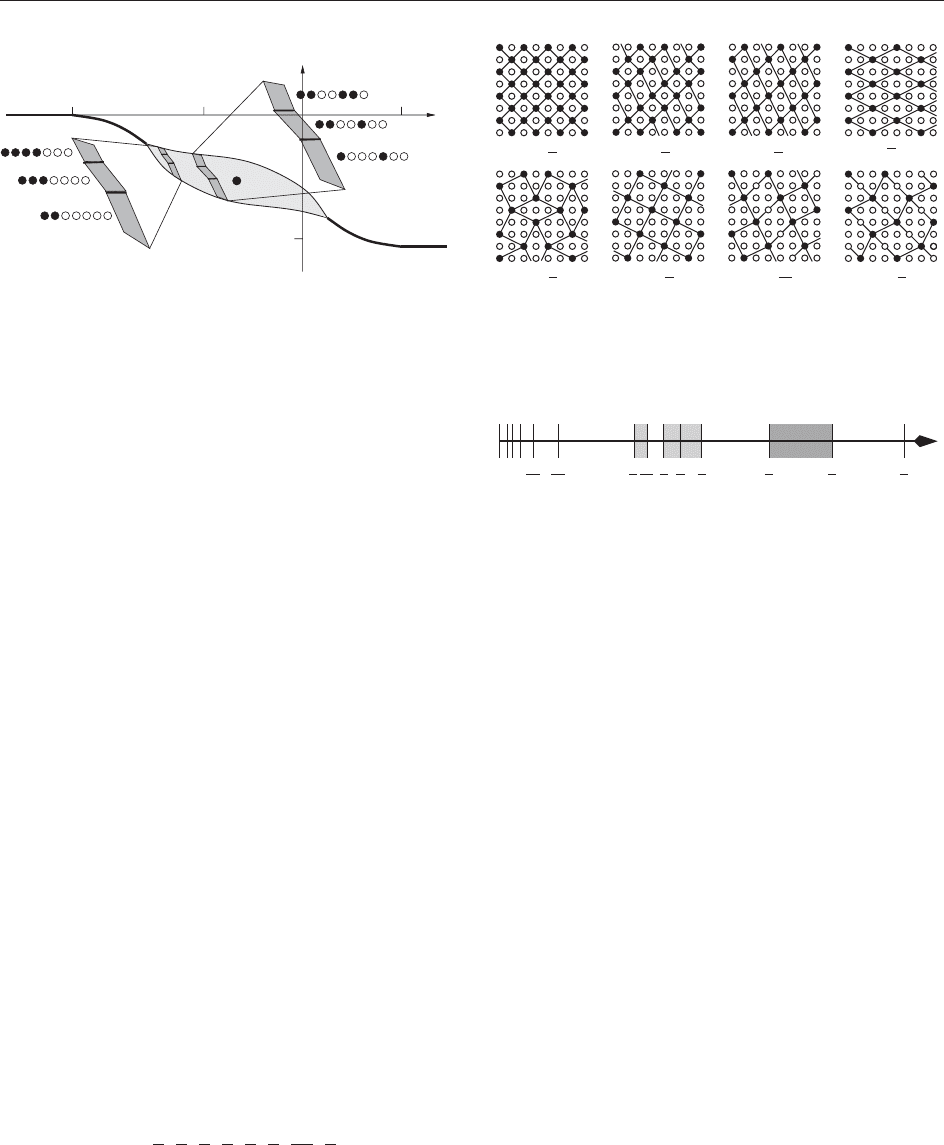
uration). This is sketched in Figure 6, where bold
coexistence lines for
e
> U 2 and
e
< 2 repre-
sent segregated states.
Ground-State Configurations – Dimension 2
We discuss the canonical ensemble only, but many
results extend to the grand-canonical ensemble.
Recall that G
can
(1=2, 1=2) consists of the two
chessboard configurations for any U > 0, and
that segregation takes place when
e
6¼
c
,provid-
ing U is large enough (Theorem 1). Other results
deal with the case of equal densities, and for U
large enough (see Haller and Kennedy (2001),and
references therein).
Theorem 4 Let
e
=
c
1=2.
(i) If
2
1
2
;
2
5
;
1
3
;
1
4
;
2
9
;
1
5
;
2
11
;
1
6
then for U large enough, the ground- state
configurations are those displayed in Figure 7.
If = 1=(n
2
þ (n þ 1)
2
) with integer n, then for
U large enough (depending on ), the ground-
state configurations are periodic.
(ii) If is a rational number between 1/3 and 2/5,
then for U large enough (depending on the
denominator of ), the ground-state configura-
tions are periodic. Further, the restriction to
any horizontal line is a one-dimensional peri-
odic confi guration given by [8], and the config-
uration is constant in either the direction
1
1
or
1
1
.
(iii) Suppose that U is large enough. If 2
(1=6, 2=11), the ground-state configurations are
mixtures of the configurations = 1=6 and
= 2=11 of Figure 7. If 2 (1=5, 2=9), the
ground-state configurations are mixtures of the
configurations = 1=5 and = 2= 9. If 2
(2=9, 1=4), the ground-state configurations are
mixtures of the configurations = 2=9 and
= 1=4.
The canonical phase diagram for
e
=
c
is presented
in Figure 8.
The situation for densities 1=2 that are not
mentioned in Theorem 4 is unknown. All these
periodic configurations are present in the grand-
canonical phase diagram as well. Theorem 4(ii)
suggests that the two-dimensional situation is similar
to the one-dimensional one where a devil’s staircase
structure may occur. Let us stress that no periodic
configurations occur for large U and densities
e
=
c
in the intervals (1/6, 2/11), (1/5, 2/9), and (2/9, 1/4).
This resembles the one-dimensional situation, but for
small U.
See also: Quantum Spin Systems; Quantum Statistical
Mechanics: Overview; Fermionic Systems; Hubbard
Model; Pirogov–Sinai Theory.
–U – 2
ω
≡ 0
ω
≡ 1
–U
–2 2
μ
c
μ
e
Figure 6 Grand-canonical ground-state phase diagram for
U 0.4. Enlarged are domains for
e
= 1=7 and 2=7, with the
same densities
c
= 2=7, 3=7, 4=7.
ρ =
1
2
ρ =
2
5
ρ =
2
9
ρ =
1
5
ρ =
2
11
ρ =
1
6
ρ =
1
3
ρ =
1
4
Figure 7 Ground-state configurations for several densities.
Occupied sites are denoted by black circles, empty sites by
white circles. Lines are present only to clarify the patterns.
0
1
25
1
13
1
6
1
5
2
9
1
4
1
3
2
5
1
2
ρ
e
2
11
Figure 8 Canonical ground-state phase diagram in two
dimensions for U > 8.
290 Falicov–Kimball Model

Further Reading
Brandt U and Schmidt T (1986) Ground state properties of
a spinless Falicov–Kimball model – additional features.
Zeitschrift fu¨ r Physik B 67: 43–51.
Datta N, Ferna´ndez R, and Fro¨ hlich J (1999) Effective
Hamiltonians and phase diagrams for tight-binding models.
Journal of Statistical Physics 96: 545–611.
Falicov LM and Kimball JC (1969) Simple model for semicon-
ductor–metal transitions: SmB
6
and transition-metal oxides.
Physical Review Letters 22: 997–999.
Freericks JK, Gruber Ch, and Macris N (1996) Phase separation
in the binary-alloy problem: the one-dimensional spinless
Falicov–Kimball. Physical Review B 53: 16189–16196.
Freericks JK, Lieb EH, and Ueltschi D (2002) Segregation in the
Falicov–Kimball model. Communications in Mathematical
Physics 227: 243–279.
Freericks JK and Zlatic
´
V (2003) Exact dynamical mean-field
theory of the Falicov–Kimball model. Reviews of Modern
Physics 75: 1333–1382.
Gruber Ch and Macris N (1996) The Falicov–Kimball model: a
review of exact results and extensions. Helvetica Physica Acta
69: 850–907.
Haller K and Kennedy T (2001) Periodic ground states in the
neutral Falicov–Kimball model in two dimensions. Journal of
Statistical Physics 102: 15–34.
Je¸ drzejewski J and Leman
´
ski R (2001) Falicov–Kimball models of
collective phenomena in solids (a concise guide). Acta Physica
Polonica 32: 3243–3251.
Kennedy T and Lieb EH (1986) An itinerant electron model with
crystalline or magnetic long range order. Physica A 138:
320–358.
Fedosov Quantization
N Neumaier, Albert-Ludwigs-University in Freiburg,
Freiburg, Germany
ª 2006 Elsevier Ltd. All rights reserved.
Introduction
On the one hand, quantum mechanics and classical
mechanics appear to be formulated within quite
different mathematical frameworks, that is, in terms
of Hilbert spaces and operators on Hilbert spaces on
the quantum side and in terms of phase spaces, that
is, symplectic, or more generally, Poisson manifolds,
and functions on these phase spaces on the classical
side. On the other hand, there is a strong structural
similarity between the algebras of observable quan-
tities in both theories which are associative
-algebras
over C. In the classical case, the algebra is commu-
tative the product being the pointwise product of
functions on the phase space and is endowed with the
additional structure of a Poisson bracket by means of
which the dynamics of the system can be formulated.
In the quantum case, the algebra is the noncommu-
tative composition of operators on a Hilbert space
and the dynamics is determined by the corresponding
commutator. The difference between functions on a
phase space and the operators on a Hilbert space
constitutes the main difficulty for the passage from a
classical theory to the corresponding quantum theory
which would be desirable, since a formulation of the
more fundamental but much less intuitive quantum
theory is often impossible. Even the consideration of
the classical limit leads to the same problem of
comparing quite different mathematical objects. One
possibility, which is the basic idea of deformation
quantization, to avoid these problems is to pass from
classical observables to quantum observables not by
changing the underlying vector space, but only by
deforming the algebraic structures namely the asso-
ciative product and possibly the
-involution.
This idea motivat es the following definition of a
star product by Bayen et al. (1978), which reassem-
bles the minimal demands made on a suitable
quantization:
Definition 1 A star product on a Poisson manifold
(M, )isanassociativeC[[]]-bilinear product ? on
C
1
(M)[[]] such that – writing f ? g =
P
1
r = 0
r
C
r
(f , g)
for f , g 2C
1
(M)withC-bilinear maps C
r
with values
in C
1
(M) – the following properties hold:
(i) C
0
(f , g) = fg,
(ii) C
1
(f , g) C
1
(g, f ) = {f , g}, and
(iii) 1 ? f = f = f ? 1.
In case the C-bilinear maps C
r
are differential
operators, the star product is called differential. If
f ? g = g ? f , then ? is called Hermitian.
The conditions (i) and (ii) express the correspon-
dence principle in deformation quantization and in
case the star product converges the formal para-
meter is to be identified with ih, whence we set
= considering the formal parameter as purely
imaginary. Since the Fedosov star products we are
going to study in the sequel are differential, we shall
drop stressing this property explicitly and refer to
differential star products as star products, merely.
One main advantage of deformation quantization
is that one has the following very general existence
result:
Theorem 1 On every Poisson manifold (M, )
there exist (even differential) star products.
This theorem was first shown by DeWilde and
Lecomte (1983) for the symplectic case and
Fedosov Quantization 291

independently by Fedosov (1985) who gave a
beautiful explicit construction using geometrical
structures on (M, !) to build a star product
recursively. Omori et al. (1991) gave yet another
existence proof of star products on a symplectic
manifold (M, !) that appears to combine
the methods of DeWilde and Lecomte (1983)
and Fedosov (1985). The general proof of existence
on general Poisson manifolds is due to Kontsevich
(2003) and is a consequence of Kontsevich’s
formality theorem.
If S = id þ
P
1
r = 1
r
S
r
is a formal series of differ-
ential operators on C
1
(M) with S
r
1 = 0 for r 1,
then
f ?
0
g :¼ S
1
ððSf Þ? ðSgÞÞ ½1
again defines a star product. Clearly, ?
0
is Hermitian
in case ? is Hermitian and
Sf = Sf for all
f 2C
1
(M)[[]]. The above observation of the shape
of certain isomorphisms between star product
algebras gives rise to the notion of equivalence of
star products:
Definition 2 Two star products ? and ?
0
on (M, )
are called equivalent in case there is a formal series
S = id þ
P
1
r = 1
r
S
r
of differential operators on
C
1
(M) with S
r
1 = 0 for r 1 such that eqn [1] is
satisfied for all f , g 2C
1
(M)[[]].
The full classification of star products up to
equivalence was first obtained in the symplectic case
by Nest and Tsygan (1995) and independently by
Deligne (1995) and Bertelson et al. (1997).The
general Poisson case again follows from Kontsevich’s
formality theorem. In particular, in the symplectic
case, star products are classified in a functorial way
by the characteristic class
c : ? 7!cð?Þ2
½!
þ H
2
deRham
ðMÞ½½ ½2
defined by Deligne that induces a bijection
between the equivalence classes of star products
and [!]= þ H
2
deRham
(M)[[]]. Moreover, it has been
shown (Bertelson et al. 1997, Deligne 1995, Nest
and Tsygan 1995) that every star product on a
symplectic manifold is equivalent to a Fedosov star
product. This fact can also be seen as a direct
consequence of the explicit computation of the
characteristic class of a Fedosov star product
(cf. Neumaier (2002)). The importance of Fedosov’s
construction for the general theory of deformation
quantization in the symplectic case is also shown by
the fact that in many proofs Fedosov’s star
products were used to have reference star products
to compare with a given star product. Moreover,
there is a great variety of modifications and
generalizations of Fedosov’s method and there are
many examples where additional structures on the
symplectic manifold suggest to look for star
products adapted to them, where modified
Fedosov constructions can be applied successfully.
Fedosov Star Products on (M, !)
The attempt to construct a star product step by step
in fact leads to a cohomological problem, where
a priori an obstruction in the third Hochschild
cohomology of C
1
(M) occurs. This problem results
from the demand for associativity which is the really
most restricting condition on a star product. There-
fore, additional arguments are necessary to show
that these obstructions can be circumvented, since
the concerning cohomology is isomorphic to
1
(
V
3
TM) and hence, for dim (M) 3, is not
trivial at all.
The basic strategy of Fedosov’s construction to
build in associativity of the resulting product is
to begin with a ‘‘very large’’ associative algebra
(W, ), where mimicks the well-known
Weyl–Moyal star product on a vector space with a
constant symplectic Poisson tensor, and to specify a
suitable subalgebra which is in bijection to
C
1
(M)[[]]. Pulling back the product to the sub-
algebra then clearly results in an associative product
on C
1
(M)[[]], but as we shall see later on, one has
to care for the bijection to be sufficiently nontrivial
in order to obtain in fact a nontrivial deformation of
the usual pointwise product on C
1
(M)[[]].
Defining
W:¼
1
s¼0
1
_
s
T
M
^
T
M
!
½½ ½3
W becomes in a natural way an associative,
supercommutative algebra using the symmetric
_-product in the first factor and the antisymmetric
^-product in the second factor. This product is
denoted by (a b) = ab for a, b 2W.By
W
k
we denote the elements of antisymmetric
degree k and set W:= W
0
. Besides this pointwise
product, the Poisson tensor corresponding to ! gives
rise to another associative product on W by
a b ¼ exp
2
ij
i
s
ð@
i
Þi
s
ð@
j
Þ
ða bÞ
½4
which is a deformation of . Here i
s
(Y) denotes the
symmetric insertion of a vector field Y 2
1
(TM)
and similarly i
a
(Y) shall be used to denote the
antisymmetric insertion of a vector field. We set
ad(a)b := [a, b], where the latter denotes the
292 Fedosov Quantization

deg
a
-graded supercommutator with respect to .
Denoting the obvious degree maps by deg
s
, deg
a
,
and deg
= @
, one observes that they all are
derivations with respect to but deg
s
and deg
fail
to be derivations with respect to . Instead,
Deg := deg
s
þ 2deg
is a derivation of and hence
(W, ) is formally Deg-graded and the corre-
sponding degree is referred to as the total degree.
Sometimes we write W
k
to denote the elements
of total degree k. The total degree can be used to
define an ultrametric d on W and it is known
that (W, d) is complete, which implies that
Banach’s fixed-point theorem can be applied in this
setting. This observation is important since all the
proofs of existence and uniqueness of certain
elements in W we shall construct in the sequel
can be reduced to the application of this theorem.
In local coordinates, we define the differential
:¼ð1 dx
i
Þi
s
ð@
i
Þ½5
which satisfies
2
= 0 and is a superderivation of .
Evaluated at a point m 2 M, the product a(m)b(m)
of two elements a, b 2W can be considered as
the ^-product of two differential forms with poly-
nomial coefficient functions on the vector space
T
m
M. Interpreted this way, the restriction of to the
fiber at m is nothing but the exterior derivative of
differential forms with polynomial coefficients.
Hence, it is clear that there is a homotopy operator
1
satisfying
1
þ
1
þ ¼ id ½6
where : W !C
1
(M)[[]] denotes the projec-
tion onto the part of symmetric and antisymmetric
degree 0. With the above view of , this is just the
Poincare´ Lemma for differential forms with poly-
nomial coefficients, which says that all the coho-
mology spaces vanish except for the one of degree 0
and the cohomology in degree 0 is just given by the
constant functions on the vector space T
m
M. This
means that the -cohomology on W is trivial
except for the space of degree 0, which is given by
the formal functions on M. For computational
purposes, it is useful to have a concrete formula of
the homotopy operator
1
which is given by
1
a :¼
1
k þ l
ðdx
i
1Þi
a
ð@
i
Þa for deg
s
a ¼ ka;
deg
a
a ¼ la with k þ l 6¼ 0
0 else
8
>
>
<
>
>
:
½7
Now ker() \W= C
1
(M)[[]] and one might
wonder whether this subalgebra of (W, )is
already suitable to induce a deformed product on
C
1
(M)[[]] by pulling back the product from W.
Evidently, the answer to the question is negative
since the resulting product just gives back the
undeformed pointwise product of formal functions
on M. Hence one has to find a less trivial
superderivation of the product the kernel of
which is still in bijection to C
1
(M)[[]]. The
essential new component of Fedosov’s construction
is a superderivation of (W, )thatisnot
C
1
(M)[[]]-linear and hence in a certain sense
generates derivatives along the base manifold M.
Using a torsion-free symplectic connection r on M
we define an endomorphism also denoted by r of
W by
r:¼ð1 dx
i
Þr
@
i
½8
which turns out to be a superderivation of due to
the fact that r! = r=0. The map r satisfies the
identities
½; r ¼ 0; since the connection is torsion-free ½9
r
2
¼
1
adðRÞ;
where R :¼
1
4
!
it
R
t
jkl
dx
i
_dx
j
dx
k
^dx
l
2W
2
½10
involves the curvature of the connection. Moreover,
we have
R ¼ 0 ¼rR ½11
by the Bianchi identities.
Now one could consider the superderivation þr
of (W, ) and try to define a mapping from
C
1
(M)[[]] to ker( þr) \Wsuch that ((f )) = f
for all f 2C
1
(M)[[]]. But in case the curvature of
the connection does not vanish, the necessary
condition for the solvability of the equation ( þr)
(f ) = 0 subject to the additional condition
((f )) = f is not satisfied. Only in case there is a
torsion-free symplectic connection on M with
vanishing curvature, this procedure can be carried
through and yields again the Weyl–Moyal star
product since the fact that r is symplectic in this
case implies that the components of the Poisson
tensor are constant. However, in general, the kernel
of þrdoes not have the desired properties to
specify a suitable subalgebra of (W , ) and one
makes the ansatz
D ¼ þr
1
adðrÞ½12
with an element r 2W
3
1
for a suitable super-
derivation. Now a direct computation yields that
D
2
¼
1
ad r rr þ
1
r r R
½13
Fedosov Quantization 293

which vanishes iff r rr þ (1=)r r R is a
central element in W
2
2
. This is the case iff
there is a formal series of 2-forms 2
1
(
V
2
T
M)[[]] with
r rr þ
1
r r R ¼ 1 ½14
After these preparations, one is in the position to
prove the following theorem:
Theorem 2 (Fedosov 1994, theorem 3.2; Fedosov
1996, theorem 5.2.2). For every formal series
2
1
(
V
2
T
M)[[]] of closed 2-forms there
exists a unique element r 2W
3
1
such that
r ¼rr
1
r r þR þ1 and
1
r ¼0 ½15
Moreover, r satisfies
r ¼
1
R þ 1 þrr
1
r r
½16
from which r can be determined recursively. In this
case the Fedosov derivation
D :¼ þr
1
adðrÞ½17
is a superderivation of antisymmetric degree 1 and
has square zero: D
2
= 0.
For obvious reasons Fedosov calls D a flat or
abelian connection for the bundle W and ! þ is
referred to as the central Weyl curvature of the
connection D . In some sense, the flatness property
D
2
= 0 guarantees that there are sufficiently many flat
sections. Before investigating the structure of
ker (D ) \Wwe note that the D -cohomology is trivial
on elements a with positive antisymmetric degree
since one has the following homotopy formula:
DD
1
a þ D
1
D a ¼ a
where
D
1
a :¼
1
1
id ½
1
; rð1=ÞadðrÞ
a
½18
(cf. Fedosov (1996, theorem 5.2.5)). The reason for
this fact, which is also the crucial point for the proof
of Theorem 1, is the property of the -cohomology
to vanish except for the cohomology space of
degree 0.
The next step in Fedosov’s construction now
consists in establishing a bijection between the flat
sections a 2W, that is, those elements of W with
D a = 0, and C
1
(M)[[]].
Theorem 3 (Fedosov 1994, theorem 3.3, Fedosov
1996, theorem 5.2.4). Let D = þr(1=)
ad(r):W !W be given as in [17] with r as
in [15].
(i) Then for any f 2C
1
(M)[[]] there exists a
unique element (f ) 2 ker (D ) \Wsuch that
ððf ÞÞ ¼ f ½19
and : C
1
(M)[[]] ! ker (D ) \Wis C[[]]-linear
and referred to as the Fedosov–Taylor series
corresponding to D .
(ii) In addition, (f ) can be obtained recursively for
f 2C
1
(M) from
ð f Þ¼f þ
1
rðf Þ
1
adðrÞðf Þ
½20
Using D
1
according to [18] one can also write
ðf Þ¼f D
1
ð1 df Þ
for all f 2C
1
ðMÞ½½ ½21
(iii) Since D as constructed above is a -superderivation,
ker (D ) \W is a -subalgebra and a new
associative product for C
1
(M)[[]], which
turns out to be a star product , is defined by
pullback of via :
f g :¼ððf ÞðgÞÞ ½22
In the following, we shall refer to the associative
product defined above as the Fedosov star product
corresponding to (r, ). The choice of the formal
series of closed 2-forms in fact has a crucial effect
on the equivalence class of the resulting star
product, whereas the choice of the torsion-free
symplectic connection, which in contrast to a
Riemannian connection is not unique, does not
affect this class. This observation has been the
main step in all the proofs of the classification
results in deformation quantization of symplectic
manifolds. Another way to prove this fact is to
compute the characteristic class c() introduced by
Deligne (1995) using the methods developed in Gutt
and Rawnsley (1999) directly which yields:
Theorem 4 (Neumaier 2002, theorem 2). Deligne’s
characteristic class c() of a Fedosov star product as
constructed above is given by
cðÞ ¼
1
½!þ
1
½½23
The properties of with respect to complex
conjugation also decide on whether is Hermitian
or not. In case is real, that is, satisfies
= it is
easy to show – observing that
a b = (1)
kl
b a for
a 2W
k
, b 2W
l
– that r solves the equa-
tions that uniquely determine r and hence
r = r. But
then D commutes with complex conjugation and
294 Fedosov Quantization

therefore the unique characterization of the Fedosov–
Taylor series yields (f ) = (f )forallf 2C
1
(M)[[]],
implying that is Hermitian.
Derivations, Automorphisms,
and Equivalence Transformations
Having defined the Fedosov star product correspond-
ing to (r, ), the next logical step is to investigate the
structure of its derivations and automorphisms and to
find out how they can be described in the framework of
Fedosov’s construction. In addition, one can ask for an
explicit construction of equivalence transformations
between two Fedosov star products and
0
obtained
from (r, )and(r
0
,
0
) that exist according to
Theorem 4 iff [] = [
0
].
Since the basic philosophy of Fedosov’s construc-
tion is to consider suitable operations on the algebra
(W, ) in order to obtain induced mappings on
the level of (C
1
(M)[[]], ), one may expect to be
able to define derivations of (C
1
(M)[[]], )by
considering appropriate fiberwise quasi-inner
derivations of (W, ) of the shape
D
h
¼
1
adðhÞ½24
where h 2W and without loss of generality we
assume (h) = 0. Our aim is to define C[[]]-linear
derivations of by C
1
(M)[[]] 3 f 7!(D
h
(f )), but
for an arbitrary element h 2W with (h) = 0 this
mapping fails to be a derivation as D
h
does not map
elements of ker (D ) \Wto elements of ker (D ) \W.
In order to achieve this, the supercommutator of D
and D
h
has to vanish. As D is a C[[]]-linear
-superderivation, we obviously have
½D ; D
h
¼
1
adðD hÞ½25
and hence obviously D h must be central, that is, D h
has to be of the shape 1 B with B 2
1
(T
M)[[]]
to have [D , D
h
] = 0. From D
2
= 0, we get that the
necessary condition for the solvability of the
equation D h = 1 B is the closedness of B since
D (1 B) = 1 dB. But as the D -cohomology is
trivial on elements with positive antisymmetric
degree, this condition is also sufficient for the
solvability of the equation D h = 1 B and we get
the following statement.
Lemma 1 (Mu¨ ller-Bahns and Neumaier 2004,
lemma 2.1).
(i) For all formal series B 2
1
(T
M)[[]] of closed
1-forms on M there is a uniquely determined
element h
B
2W such that D h
B
= 1 Band
(h
B
) = 0. Moreover, h
B
is explicitly given by
h
B
¼ D
1
ð1 BÞ½26
(ii) For all B 2 Z
1
deRham
(M)[[]] the mapping D
B
: C
1
(M)[[]] !C
1
(M)[[]], where
D
B
f :¼ ðD
h
B
ðf ÞÞ ¼
1
adðh
B
Þðf Þ
½27
for f 2C
1
(M)[[]] defines a C[[]]-linear derivation
of and hence this construction yields a mapping
Z
1
deRham
(M)[[]] 3 B 7!D
B
2 Der
C[[]]
(C
1
(M)[[]], ?).
Furthermore, one can show that one even obtains
all C[[]]-linear derivations of by varying B in the
derivations D
B
constructed above.
Proposition 1 (Mu¨ ller-Bahns and Neumaier 2004,
proposition 2.2). The mapping
Z
1
deRham
ðMÞ½½ 3 B 7!D
B
2 Der
C½½
ðC
1
ðMÞ½½; Þ
defined in Lemma 1 is a bijection. Moreover, D
df
is
a quasi-inner derivation for all f 2C
1
(M)[[]], that
is, D
df
= (1=)ad
(f ) and the induced mapping
[B] 7![D
B
] from H
1
deRham
(M)[[]] to Der
C[[]]
(C
1
(M)[[]], )=Der
qi
C[[]]
(C
1
(M)[[]], ) the space of
C[[]]-linear derivations of modulo the quasi-
inner derivations, also is bijective.
Actually, it is well known that for an arbitrary star
product ? on a symplectic manifold the space of C[[]]-
linear derivations is in bijection with Z
1
deRham
(M)[[]]
and that the quotient space of these derivations modulo
the quasi-inner derivations is in bijection with
H
1
deRham
(M)[[]] (cf. Bertelson et al. (1997),theorem
4.2), but the remarkable thing about Fedosov star
products is that these bijections can be explicitly
expressed in terms of D resp. D
1
inaverylucidway.
Now we turn to the consideration of C[[]]-linear
automorphisms of . For such automorphisms that
start with id, which are also called self-equivalences,
it is known (cf. Gutt and Rawnsley (1999), Proposi-
tion 3.3) for arbitrary star products ? on (M, !) that
they are of the form
A ¼ expðDÞ½28
with a C[[]]-linear derivation D of ?. Therefore, the
above result about the description of all the
derivations of directly yields a complete descrip-
tion of all self-equivalences of .
The description of C[[]]-linear automorphisms
that are not self-equivalences of is slightly more
involved and we first need some results about the
concrete structure of the equivalence transforma-
tions between two Fedosov star products and
0
.
To compare two Fedosov star products obtained
from different torsion-free symplectic connections
Fedosov Quantization 295