
Francoise J.-P., Naber G.L., Tsun T.S. (editors) Encyclopedia of Mathematical Physics
Подождите немного. Документ загружается.


on the possibility of mapping its Hamiltonian in a
system of fr ee bosons. Such a mapp ing is not
possible for the Hamiltonian [3], which is not
solvable; however, one can use renormalization
group methods and suitable Ward identities to
show that its behavior is similar to the Luttinger
model (in a sense, one makes perturbation theory
not around the free Fermi gas, but around the
Luttinger model).
If we take into account the interaction with an
external periodic potential with period a, that is,
consider u 6¼ 0, we find that if k
F
6¼ n=a, then the
Schwinger function behaves essentially like [8].On
the contrary, in the filled-band case, k
F
= n=a, one
finds that there is still an energy gap which becomes
O(u
1þ
1
) with
1
= O(); this means that the
renormalization of the gap is described by a critical
index; moreover, S( x) ’ O(e
juj
1þ
1
jxj
). A similar
behavior is also observed in the presence of qua si-
periodic potential. In the attractive case, <0,
u = 0, the behavior is much less understood; it is
believed that the inte raction produces a gap
in
the spectrum which is nonanalytic in , and S(x)
shows an exponential decay rather than a power-
law decay, and the interaction converts the system
from a metal to an insulator.
Finally, it is remarkable that a large variety of
models, like Heisenberg spin chains or bidimensional
classical statistical mechanics models, such as the
eight-vertex or the Ashkin–Teller model, can be
mapped into interacting d = 1 fermionic systems, and
consequently their critical behavior can be understood
by using fermionic techniques (see Gentile and
Mastropietro (2001), and references therein).
Superconductors
The theory up to T = 0 for d = 2, 3 systems with
dispersion relation jkj
2
=2m is based only on
approximate computations, predicting the phenom-
enon of superconductivity. According to the theory
of Bardeen, Cooper, and Schrieffer (BCS theory),
the interaction between fermions leads to the
formation of a gap in the energy spectrum, below
the critical temperature. There are many ways to
derive the BCS theory. One is based on the fact that
one verifies, by perturbative computations, that the
effective interaction is stronger when the four
momenta of the fermions are such that k
1
’k
3
and k
2
’k
4
. This suggests, heuristically, to
replace in [7] with
BCS
¼
1
L
3d
X
k;k
0
þ
k;
þ
k;
k
0
;
0
k
0
;
0
which is an interaction be tween p airs of electrons
with opposite spin and momenta, which a re called
Cooper pairs. R eplacing with
BCS
has the great
advantage that it makes the Schwinger functions
exactly computable and explains the mechanism
of superconductivity in many metals (but not in
the recently discovered high-T
c
superconductors).
On the other hand, proving that [7] with or
BCS
has a similar behavior is still an important open
problem. The two-point Schwinger function in the
model with
BCS
can be written, after the so-called
Hubbard–Stratonovitch transformation, as
^
Sk
0
; kðÞ¼L
d
R
ik
0
"ðkÞþ
k
2
0
þ"
2
ðkÞþu
2
e
L
d
ðuÞ
du
R
e
L
d
ðuÞ
du
½11
where (u) is a function with a global minimum in
u = 0 for repulsive interactions <0, whereas for
>0 and sufficiently small temperatures (for
T T
c
,withT
c
= O(e
a=jj
)), it has the form of a
double well with two minima at u =
with
= O(e
a=jj
); for T greater than T
c
, there is only
a global minimum at u = 0. By the saddle-point
theorem, we find, for T T
c
and <0,
lim
L!1
SðkÞ¼
ik
0
"ðkÞþ
k
2
0
þð"ðkÞÞ
2
þ
2
½12
The physical properties predicted by [12] are
completely different with respect to the free case:
the occupation number is continuous, there is an
energy gap in the spectrum , the specific heat is
O(e
T
) and the phenomenon of superconduc tivity
appears. The fact that the interaction generates a
gap is called mass generation; a similar mechanism
appears in particle theory.
Conclusions
Many other physical phenomena, observed experi-
mentally, can be essentially understood by studying
fermionic systems, but a clear mathematical com-
prehension is still lacking. We mention: the Kondo
effect, that is, the resistance minimum observed in
some metals due to magnetic impurities; Mott
transition, in which a strong interaction produces
an insula ting state in a system which should be
conductors; antiferromagnetism; fractional quantum
Hall effect, and many others. We can say that the
situation in this area of study reminds one of the
classical mechanics at the end of the nineteenth
century; there is agreement on the models to
consider, which are believed to be able to take into
306 Fermionic Systems

account the marvelous properties of the matter
experimentally found, but to extract information
from them requires deeper and compl ex analytical
and mathematical investigations.
See also: Falicov–Kimball Model; Fractional Quantum
Hall Effect; Quantum Statistical Mechanics: Overview;
Renormalization: Statistical Mechanics and Condensed
Matter.
Further Reading
Abrikosov AA, Gorkov LP, and Dzyaloshinskii IE (1965) Methods of
Quantum Field Theory in Statistical Physics. New York: Dover.
Anderson PW (1985) Basic Principles in Solid State Physics.
Menlo Park, CA: Benjamin Cummings.
Anderson PW (1997) The Theory of Superconductivity in High T
c
Cuprates. Princeton, NJ: Princeton University Press.
Bardeen J, Cooper LN, and Schrieffer JR (1957) Theory of
superconductivity. Physical Review 108: 1175–1204.
Benfatto G and Gallavotti G (1995) Renormalization Group.
Princeton: Princeton University Press.
Berezin FA (1966) The Method of Second Quantization.
New York: Academic Press.
Bratelli O and Robinson D (1979) Operator Algebras and
Quantum Statistical Mechanics. Berlin: Springer.
Feldman J, Knorrer H, and Trubowitz E (2002) Fermionic Functional
Integrals and Renormalization Group, CRM Monograph Series,
vol. 16. Providence: American Mathematical Society.
Gallavotti G (1985) Renormalization group and ultraviolet
stability for scalar fields via renormalziation group methods.
Reviews of Modern Physics 57: 471–562.
Gentile G and Mastropietro V (2001) Renormalization group for
one dimensional fermions. A review of mathematical results.
Physics Reports 352: 273–437.
Mahan GD (1990) Many-Particle Physics. New York: Plenum.
Mattis DC and Lieb E (1966) Mathematical Physics in One
Dimension. New York: Academic Press.
Negele JW and Orland H (1988) Quantum Many Particle
Systems. New York: Addison-Wesley.
Pastur L and Figotin A (1991) Spectra of Random and Almost
Periodic Operators. Berlin: Springer.
Pines D (1961) The Many Body Problem. New York: Addison-
Wesley.
Rivasseou V (1994) From Perturbative to Constructive Renorma-
lization. Princeton, NJ: Princeton University Press.
Feynman Path Integrals
S Mazzucchi, Universita
`
di Trento, Povo, Italy
ª 2006 Elsevier Ltd. All rights reserved.
Introduction
In nonrelativistic quantum mechanics, the state of
a d-dimensional particle is represented by a
unitary vector in the complex separable Hilbert
space L
2
(R
d
), the s o-called ‘‘wave function,’’ while
its time evolution is described by the Schro¨dinger
equation:
ih
@
@t
¼
h
2
2m
þ V
ð0; xÞ¼
0
ðxÞ
½1
where h is the reduced Planck constant, m > 0 is the
mass of the particle, and F = rV is an external
force.
In 1942 R P Feynman, following a suggestion by
Dirac, proposed an alternative (Lagrangian) formu-
lation of quantum mechanics, and a heuristic but
very suggestive representation for the solution of eqn
[1]. According to Feynman, the wave function of the
system at time t evaluated at the point x 2R
d
is
given as an ‘‘integral over histories,’’ or as an
integral over all possible paths in the configuration
space of the system with finite energy passing at the
point x at time t:
ðt ; xÞ¼
Z
fjðtÞ¼xg
e
ði=hÞS
t
ðÞ
D
!
1
Z
fjðtÞ¼xg
e
ði=hÞS
t
ðÞ
0
ðð0ÞÞD ½2
S
t
() is the classical action of the system evaluated
along the path
S
t
ðÞS
t
ðÞ
Z
t
0
VððsÞÞds ½3
S
t
ðÞ
m
2
Z
t
0
j
_
ðsÞj
2
ds ½4
D is a heuristic Lebesgue ‘‘flat’’ measure on the
space of paths and (
R
{j(t) = x}
e
(i=h)
S
t
()D)
1
is a
normalization constant.
Some time later, Feynman himself extended
formula [2] to more general quantum systems,
including the case of quantum fields.
The Feynman path-integral formulation of quan-
tum mechanics is particularly suggestive, as it
provides a spacetime visualization of quantum
dynamics, reintroducing in quantum mechanics the
concept of trajectory (which was banned in the
‘‘orthodox interpretation’’ of the theory) and creat-
ing a connection between the classical description of
Feynman Path Integrals 307

the physical world and the quantum one. Indeed, it
provides a quantization method, allowing, at least
heuristically, to associate a quantum evolution to
each classical Lagrangian. Moreover, the application
of the stationary-phase method for oscillatory
integrals allows the study of the semiclassical limit
of the Schro¨ dinger equation, that is, the study of the
detailed behavior of the solution when the Planck
constant is regarded as a parameter converging to 0.
Indeed, when h is small, the integrand in [2] is
strongly oscillating and the main contributions to
the integral should come from those paths that
make stationary the phase function S(). These, by
Hamilton’s least action principle, are exactly the
classical orbits of the system.
Feynman path integrals allow also a heuristic
calculus in path space, leading to variational
calculations of quantities of physical and mathe-
matical interest. An interesting application can be
found in topological field theories, as, for
instance, Chern–Simons models. In this case,
heuristic calculations based on the Feynman
path-integral formulation of the theory, where
the integration is performed on a space of
geometrical objects, lead to the computation of
topological invariants.
Even if from a physical point of view, formula [2]
is a source of important results, from a mathema-
tical point of view, it lacks rigor: indeed, neither the
‘‘infinite-dimensional Lebesgue measure,’’ nor the
normalization constant in front of the integral is
well defined. In this article, we shall describe the
main approaches to the rigorous mathematical
realization of Feynman path integrals, as well as
their most important applications.
Possible Mathematical Definitions
of Feynman’s Measure
In the rigorous mathematical definition of Feynman’s
complex measure
F
:¼
Z
fjðtÞ¼xg
e
ði=hÞS
t
ðÞ
D
!
1
e
ði=hÞS
t
ðÞ
D ½5
one has to face mainly two problems. First of all, the
integral is defined on a space of paths, that is, on an
infinite-dimensional space. The implementation of
an integration theory is nontrivial: for instance, it is
well known that a Lebesgue-type measure cannot be
defined on infinite-dimensional Hilbert spaces.
Indeed, the assumption of the existence of a
-additive measure which is invariant under
rotations and translations and assigns a positive
finite measure to all bounded open sets leads to a
contradiction. In fact, by taking an orthon ormal
system {e
i
}
i 2N
in an infinite-dimensional Hilbert
space H and by considering the open balls
B
i
= {x 2H, kx e
i
k< 1=2}, one has that they are
pairwise disjoint and their union is contained in the
open ball B(0, 2) = {x 2H, kxk< 2}. By the Euclidean
invariance of the Lebesgue-type measure , one can
deduce that (B
i
) = a,0< a < 1, for all i 2N. By the
-additivity, one has
ðBð0; 2 ÞÞ ð[
i
B
i
Þ¼
X
i
ðB
i
Þ¼1
but, on the other hand, (B(0, 2)) should be finite as
B(0, 2) is bounded. As a consequence, we can also
deduce that the term D in [2] does not make sense.
The second problem is the fact that the exponent
in the density e
(i=h)S
t
()
is imaginary, so that the
exponential oscillates. Even in finite dimensions,
integrals of the form
R
R
N
e
i(x)
f (x)dx, with
, f : R
N
!R are continuous functions and f is not
summable, have to be suitably defined, in order to
exploit the cancelations in the integral due to the
oscillatory behavior of the expon ential.
The study of the rigorous foundation of Feynman
path inte grals began in the 1960s, when Cameron
proved that Feynman’s heuristic complex measure
[5] cannot be realized as a complex bounded
variation -additive measure, even on very nice
subsets of the space (R
d
)
[0, t]
of paths, contrary to
the case of complex measures on R
n
of the form
e
(i=2)jxj
2
dx. In other words, it is not pos sible to
implement an integration theory in the traditional
(Lebesgue) sense. As a consequence, mathemati-
cians tried to realize [5] as a linear continuous
functional on a sufficiently rich Banach a lgebra of
functions, inspired by the fact that a bounded
measure can be regarded as a continuo us functional
on the space of bounded continuous functions.
In order to mirror the features of the heuristic
Feynman’s measure, such a functional should have
some properties:
1. it should behave in a simple way under ‘‘transla-
tions and rotations in path space,’’ as D denotes
a ‘‘flat’’ measure;
2. it should satisfy a Fubini-type theorem, concern-
ing iterated integrations in path space (allowing
the construction, in physical applications, of a
one-parameter group of unitary operators);
3. it should be approximable by finite-dimensional
oscillatory integrals, allowing a sequential approach
in the spirit of Feynman’s original work; and
4. it should be sufficiently flexible to allow a rigorous
mathematical implementation of an infinite-
dimensional version of the stationary-phase
308 Feynman Path Integrals

method and the corresponding study of the
semiclassical limit of quantum mechanics.
Nowadays, several implementations of this program
can be found in the literature of physics and mathe-
matics, for instance, by means of analytic continuation
of Wiener integrals, or as an infinite-dimensional
distribution in the framework of Hida calculus, or via
‘ ‘complex Poisson measures,’ ’ or via nonstandard
analysis, or as an infinite-dimensional oscillatory inte-
gral. The last of these methods is particularly interesting
as it allows the systematic implementation of an infinite-
dimensional version of the stationary-phase method,
whichcanbeappliedtothestudyofthesemiclassical
limit of the solution of the Schro¨dinger equation [1].
Analytic Continuation
In one of the first approaches in the definition of
Feynman path integrals, formula [2] was realized as
the analytic continuation in a suitable complex
parameter of a (nonoscillatory) Gaussian integral
on the space of paths.
In 1949, inspired by Feynman’s work, M Kac
observed that by considering the heat equation
@
@t
u ¼
1
2m
u þ VðxÞu
uð0; xÞ¼
0
ðxÞ
½6
instead of the Schro¨ dinger equation [1] and by
replacing the oscillatory term e
(i=h)S
0
()
in Feynman
complex measure with the fast decreasing one
e
(1=h)S
0
()
, it is possible to give a well-defined
mathematical meaning to Feynman’s heuristic for-
mula [2] in terms of a well-defined integral on the
space of continuous paths W
t, x
= {w 2C(0, t; R
d
):
w(0) = x} with respect to the Wiener Gaussian
measure P
t, x
:
uðt; xÞ¼
Z
W
t;x
e
R
t
0
Vð
ffiffiffiffiffiffiffi
1=m
p
wðÞÞd
0
ð
ffiffiffiffiffiffiffiffiffiffi
1=m
p
wðtÞÞdP
t;x
ðwÞ½7
The path-integral representation [7] for the solution of
the heat equation [6] is called Feynman–Kac formula.
The underlying idea of the analytic continuation
approach comes from the fact that by introducing in
[6] a suitable parameter , proportional, for
instance, to the time t as in the case =
1
,
1
h
@
@t
u ¼
1
2m
h
2
u þVðxÞu
uðt; xÞ¼
Z
W
t;x
e
ð1=
1
hÞ
R
t
0
Vð
ffiffiffiffiffiffiffiffiffiffiffiffiffi
h=ðm
1
Þ
p
wðÞÞd
0
ffiffiffiffiffiffiffiffiffiffiffiffiffiffiffiffiffiffi
h=ðm
1
Þ
q
wðtÞ
dP
t;x
ðwÞ
or to the Planck constant, as in the case =
2
,
2
@
@t
u ¼
1
2m
2
2
u þVðxÞu
uðt; xÞ¼
Z
W
t;x
e
ð1=
2
Þ
R
t
0
Vð
ffiffiffiffiffiffiffiffi
2
=m
p
wðÞÞd
0
ð
ffiffiffiffiffiffiffiffiffiffiffiffi
2
=m
p
wðtÞÞdP
t;x
ðwÞ
or to the mass, as in the case =
3
,
@
@t
u ¼
1
2
3
u iVðxÞu
uðt; xÞ¼
Z
W
t;x
e
i
R
t
0
V
ffiffiffiffiffiffiffiffi
1=
3
p
wðÞ
d
0
ð
ffiffiffiffiffiffiffiffiffiffi
1=
3
p
wðtÞÞdP
t;x
ðwÞ
and by allowing to assume complex values, then one
gets, at least heuristically, Schro¨ dinger equation and its
solution by substituting, respectively,
1
= i,
2
= ih,
or
3
= im. These procedures can be made com-
pletely rigorous under suitable conditions on the
potential V and initial datum
0
.
The Approach via Fourier Transform
This approach has its roots in a couple of papers
by K Ito in the 1960s and was extensively
developed by S Albeverio and R Høegh-Krohn in
the 1970s. The main idea is the definition of
oscillatory integrals with quadratic phase function
on a real separable Hilbert space (H, h, i), the
Fresnel integrals,
f
Z
H
e
ði=2hÞkxk
2
f ðxÞdx ½8
as the distributional pairing between e
(i=2h)kxk
2
and
a complex-valued function f belonging to the
space F(H) of functions that are Fourier trans-
forms of complex bounded variation measures on
H,thatis,
f ¼
^
f
; f ðxÞ¼
Z
H
e
ihx;yi
d
f
ðyÞ
F(H) is a Banach algebra, wher e the product is the
pointwise one and the identity is the function
f (x) = 1 8x 2H. The norm of an element f is the
total variation of the corresponding measure
f
, that
is, k
f
k= sup
P
i
j
f
(E
i
)j, where the supremum is
taken over all sequences { E
i
} of pairwise-disjoint
Borel subsets of H, such that [
i
E
i
= H.
Given a function f 2F(H), f =
^
f
, its Fr esnel
integral is defined by the Parseval formula:
f
Z
H
e
ði=2hÞkxk
2
f ðxÞdx :¼
Z
H
e
ðih=2Þkxk
2
d
f
ðxÞ½9
Feynman Path Integrals 309

where the right-hand side is a well-defined absolutely
convergent integral with respect to a -additive
measure on H.
It is important to recall that this approach
provides the implementation of a method of
stationary phase for the expansion of the integral
in powers of the small parameter h occurring in the
integrand. We postpone the discussion of these
results, as well as the application to the solution
of the Schro¨ dinger equation, to the next section
where a generalization of the present approach is
described.
Infinite-Dimensional Oscillatory Integrals
The main idea of this approach is the extension of
the definition of oscillatory integrals with quadratic
phase function [8] to infinite-dimensional Hilbert
spaces by means of a twofold limiting procedure.
The study of integrals of the form
IðhÞ:¼
Z
R
N
e
ði=hÞðxÞ
f ðxÞdx ½10
where (x):R
N
!R is the phase function and
f : R
N
!C a complex-valued continuous function,
is a classical topic, largely developed in connection
with various problems in mathematics (such as the
theory of pseudodifferential operators) and physics
(such as optics). Particular effort has been devoted
to the study of the detailed be havior of the above
integral in the limit of ‘‘strong oscillations,’’ that is,
when h !0, by means of the method of stationary
phase.
Thanks to the cancellations due to the oscillatory
term e
(i=2h)(x)
, the integral can still be defined, even if
the function f is not summable, as the limit of a
sequence of regularized, hence absolutely convergent,
integrals. According to a Ho¨ rmander’s proposal,
the oscillatory integral of a function f : R
N
!C is
well defined if, for each test function 2S(R
N
), such
that (0) = 1, the limit
lim
!0
Z
R
N
e
ði=2hÞðxÞ
ðxÞf ðxÞdx
exists and is independent of .
This definition has been generalized in the 1980s
by D Elworthy and A Truman to the case where the
underlying space R
N
is replaced by a real separable
infinite-dimensional Hilbert space (H, h, i), under
the assumption that the phase function is quadratic,
that is, (x) = kxk
2
=2. The ‘‘infinite-dimensional
oscillatory integral’’
f
Z
H
e
ði=2hÞkxk
2
f ðxÞdx
is defined as the limit of a sequence of finite-
dimensional approximations. More precisely, a
function f : H!C is ‘‘integrable’’ if, for each
increasing sequence {P
n
}
n 2N
of finite-dimensional
projector operators in H converging strongly to the
identity operator as n !1, the limit
lim
n!1
Z
P
n
H
e
ði=2hÞkP
n
xk
2
dP
n
x
1
Z
P
n
H
e
ði=2hÞkP
n
xk
2
f ðP
n
xÞdP
n
x ½11
exists and is independent of the sequence {P
n
}
n 2N
.
In this case, the limit is denoted by
f
Z
H
e
ði=2hÞkxk
2
f ðxÞdx
The description of the largest class of integrable
functions is still an open problem, even in finite
dimension, but it is possible to find some interesting
subsets of it. In particular, any function belonging
to F(H), the Banach algebra considered in the
approach by Fourier transform, is integrable. Indeed,
by assuming that the function f in [11] is of the type
f ðxÞ¼e
ði=hÞhx;Lxi
gðxÞ
where L : H!H is a linear self-adjoint trace-class
operator on H such that (I L) is invertible and
g 2F(H), that is, g(x) =
R
H
e
hx, yi
d
g
(y), then it is
possible to prove that f is integrable in the sense of
definition [11] and the corresponding infinite-
dimensional oscillatory integral can be explicitly
computed in terms of a well-defined integral with
respect to a bounded variation measure
f
by means
of the following Parseval’s type equality:
f
Z
H
e
ði=2hÞkxk
2
e
ði=hÞhx;Lxi
gðxÞdx
¼detðI LÞ
1=2
Z
H
e
ðih=2Þhx;ðILÞ
1
xi
d
f
ðxÞ½12
det (I L) being the Fredholm determinant of the
operator I L, that is, the product of its eigenvalues,
counted with their multiplicity. If L = 0, then we
obtain eqn [9], so that we can look at the infinite-
dimensional oscillatory integrals approach as a gen-
eralization of the Fourier transform approach, since it
allows at least in principle to integrate a class of
function larger than F(H). In fact, recently this feature
has been used by S Albeverio and S Mazzucchi in the
proof of a Parseval’s type equality similar to [12] for
infinite-dimensional oscillatory integrals with poly-
nomially growing phase functions.
Feynman’s heuristic formula [2] for the representa-
tion of the solution of the Schro¨dinger equation [1] can
310 Feynman Path Integrals

be realized as an infinite-dimensional oscillatory integral
on the Hilbert space H
t
of absolutely continuous paths
: [0, t] 2R
d
with fixed endpoint (t) = 0 and finite
kinetic energy
R
t
0
_
2
()d<1, endowed with the inner
product h
1
,
2
i=
R
t
0
_
1
()
_
2
()d. One has to take
an initial datum
0
2L
2
(R
d
) that is the Fourier trans-
form of a complex bounded variation measure on R
d
,
that is,
0
(x) =
R
R
d
e
ikx
d
0
(k). Moreover, one has to
assume that the potential V in [1] is the sum of a
harmonic oscillator part plus a bounded perturbation
V
1
that is the Fourier transform of a complex bounded
variation measure
v
on R
d
:
VðxÞ¼
1
2
x
2
x þ V
1
ðxÞ
V
1
ðxÞ¼
Z
R
d
e
ikx
d
v
ðkÞ
(
2
being a symmetric positive d d matrix).
In this case, it is possible to prove that the linear
operator L on H
t
defined by
ð; LÞ
Z
t
0
ðÞ
2
ðÞd
is self-adjoint and trace class, and (I L)isinvertible.
Moreover, by considering the function v : H
t
!C
vðÞ
Z
t
0
V
1
ððÞþxÞ d
þ 2x
2
Z
t
0
ðÞd; 2H
t
it is possible to prove that the function f : H
t
!C
given by
f ðÞ¼e
ði=hÞvðÞ
0
ðð0ÞþxÞ
is the Fourier transform of a complex bounded
variation measure
f
on H
t
and the infinite-
dimensional Fresnel integral of the function
g() = e
(i=2h)(, L)
f (), that is,:
Z
ðtÞ¼0
e
ði=2hÞ
R
t
0
_
2
ðÞd
e
ði=hÞ
R
t
0
VððÞþxÞd
0
ðð0ÞþxÞd
¼
g
Z
0
H
t
e
ði=2hÞð;ðILÞÞ
e
ði=hÞvðÞ
0
ðð0ÞþxÞd ½13
is well defined and it is equal to
detðI LÞ
1=2
Z
H
t
e
ðih=2Þð;ðILÞ
1
Þ
d
f
ðÞ
Moreover, it is a representation of the solution of
equation [1] evaluated at x 2R
d
at time t. Recently,
solutions of the Schro¨ dinger equation with quartic
anharmonic potential via infinite-dimensional oscil-
latory integrals have been provided by S Albeverio
and S Mazzucchi using a combination of Parseval
formula and a new analytic method (the inclusion of
such potentials had been a stumbling block for many
years).
In this framework, it is possible to implement an
infinite-dimensional version of the stationary-phase
method and study the asymptotic behavior of the
oscillatory integrals in the limit h !0.
The method of stationary phase was originally
proposed by Stokes, who noted that when h !0 the
oscillatory integral [10] is O(h
n
) for any n 2N,
provided that there are no critical points of the
phase function in the support of the function f.As
a consequence, one can deduce that the leading
contribution to the integral [10] should come from a
neighborhood of those points c 2R
N
, such that
r(c) = 0. More precisely, by assuming that the set
C of critical points is finite, that is, C = {c
1
, ..., c
k
}
and that every criti cal point is nondegenerate, that
is, det D
2
(c
i
) 6¼ 0 8c
i
2C, then one has
IðhÞ
X
c
i
2C
e
ði=hÞðc
i
Þ
I
i
ðhÞ½14
where I
i
: R !C are C
1
functions of R, such that
I
i
ð0Þ¼f ðc
i
Þð2ihÞ
N=2
ðdet D
2
ðc
i
ÞÞ
1=2
If some critical point is degenerate, the situation is
more complicated: one has to take into account the
type of degeneracy and apply the theory of unfold-
ings of singularities.
These results can be generalized to infinite-
dimensional oscillatory integrals of the form
IðhÞ¼
f
Z
H
e
ði=2hÞhx;ðILÞxi
e
ði=hÞvðxÞ
gðxÞdx ½15
with v(x) =
R
H
e
ihx, yi
d(y), g(x) =
R
H
e
ihx, yi
d(y), ,
being complex bounded variation measures on H
satisfying suitable assumptions and L : H!H is a
self-adjoint and trace-class linear operator, such that
(I L) is invertible. Under suitable growth condition on
the moments of the measures , and by assuming
that the phase function (x) = hx,(I L)xiv(x)
has a finite number of nondegenerate critical points
c
1
, ..., c
s
, it is possible to prove that the integral I(h)
in [15] is equal to
IðhÞ¼
X
s
k¼1
e
ði=hÞðc
k
Þ
I
k
ðhÞþI
0
ðhÞ
for some C
1
functions I
k
satisfying:
I
k
ð0Þ¼½detðI L D
2
Vðc
k
ÞÞ
1=2
gðc
k
Þ
k ¼ 1; ...; s
I
ðjÞ
0
ð0Þ¼0; j ¼ 0; 1; 2; ...
Feynman Path Integrals 311

Moreover, under some additional smallness assump-
tions on v, it has been proved that the phase function
has a unique stationary point c and as h !0
IðhÞe
ði=hÞðcÞ
I
ðhÞ
for some C
1
function I
. Each term of the
asymptotic expansion in powers of h of the function
I
can be explicitly computed, and it is possible to
prove that such an asymptotic expansion is Borel-
summable and determines I
uniquely.
The application of these results to the infinite-
dimensional oscillatory integral representation [13]
for the solution of the Schro¨ dinger equation allows
the study of its semiclassical limit. One has to
consider a potential V that is the Fourier transform
of a complex bounded variation measure on (R
d
),
such that
R
R
d
e
jj
djj() < 1 for some >0, and a
particular form for the initial wave function
0
(x) = e
(i=h)(x)
(x), where is real and
, 2C
1
0
(R
d
) are independent of h. This initial
datum corresponds to an initial particle distribution
0
(x) = jj
2
(x) and to a limiting value of the
probability current J
h = 0
= r(x)
0
(x)=m, giving an
initial particle flux associated to the velocity field
r(x)=m. One also has to assume that the Lagrange
manifold L
f
(y, rf) intersects transversally the
subset
V
of the phase space made of all points (y, p)
such that p is the momentum at y of a classi cal
particle that starts at time zero from x, moves under
the action of V, and ends at y at time t. In this case,
the Feynman path integral [13] has an asymptotic
expansion in powers of h for h !0, whose leading
term is the sum of the values of the function
det
@
ðjÞ
k
@y
ðjÞ
l
ðy
ðjÞ
; tÞ
! !
1=2
e
ði=2Þm
ðjÞ
e
ði=hÞS
e
ði=hÞ
taken at the points y
(j)
such that a classical particle
starting at y
(j)
at time zero with momentum r(y
(j)
)
is at x at time t. S is the classical action along this
classical path
(j)
and m
(j)
is the Maslov index of the
path
(j)
, that is, m
(j)
is the number of zeros of
det
@
ðjÞ
k
@y
ðjÞ
l
ðy
ðjÞ
;Þ
! !
as varies on the interval (0, t).
White-Noise Calculus
The leading idea of the present approach, which was
originally proposed by C DeWitt-Morette and
P Kre´e and presently realized in the framework of
white-noise calculus by T Hida, L Streit, and many
other authors, is the realization of the Feynman
integrand e
(i=h)S
t
()
as an infinite-dimensional distri-
bution. This idea is similar to the one of the
approach via Fourier transform, where the expres-
sion (2i)
d=2
R
R
d
e
(i=2)(x, x)
f (x)dx is realized as a
distributional pairing be tween e
(i=2)(x, x)
=(2i)
d=2
and
the function f 2F(R
d
) by means of the Parseval-type
equality [9] and generalized to infinite-dimensional
spaces. In white-noise calculus, the pairing is
realized in a different measure space. Indeed, by
manipulating the integrand in
ð2iÞ
d=2
Z
R
d
e
ði=2Þðx; xÞ
f ðxÞdx
one has
Z
R
d
e
ði=2Þðx;xÞ
ð2iÞ
d=2
f ðxÞdx
¼
Z
R
d
e
ði=2Þðx;xÞþð1=2Þðx;xÞ
i
d=2
f ðxÞ
e
ð1=2Þðx;xÞ
ð2Þ
d=2
dx ½16
where the latter line can be interpreted as the
distributional pairing of
e
ði=2Þðx;xÞþð1=2Þðx;xÞ
i
d=2
and f not with respect to Lebesgue measure but
rather with respect to the standard Gaussian
measure
e
ð1=2Þðx;xÞ
ð2Þ
d=2
dx
on R
d
. The RHS of [16] can be generalized to the
case in which R
d
is replaced by a path space, thanks
to the fact that on infinite-dimensional spaces, even
if Lebesgue measure is meaningless, Gaussia n
measures are well defined and can be used as
reference measures. The detailed realization of this
idea as well as its application to the mathematical
realization of the Feynman integrand are rather
technical and we certainly do not provide details
here. We recall that this approach has been success-
fully applied to the rigorous realization of Feynman
path-integral formulation of Chern–Simons models.
Other Possible Approaches
Another possible mathematical definition of Feyn-
man path integrals is based on Poisson measures. It
was originally proposed by A M Chebotarev and
V P Maslov and further developed by several
authors such as S Albeverio, Ph Blanchard,
Ph Com be, R Høegh-Krohn, M Sirugue, and
V Kolokol’tsov. It can be applied to ‘‘phase-space
integrals,’’ to the Dirac equation and in particular
algebraic settings, as well as to the Schro¨ dinger
312 Feynman Path Integrals

equation, with potentials of the same type ‘‘Fourier
transform of bounded measure’’ discussed in the
subsection ‘‘Infinite-dimensional oscillatory integrals.’’
Another possible definition of Feynman path
integrals is based on a ‘‘time-slicing’’ approximation
and a limiting procedure, rather closed to Feynman’s
original work based on Trotter product formula.
The ‘‘sequential approach’’ was proposed originally
by A Truman and further extensively developed by
D Fujiwara and N Kumano-go. The paths in
formula [2] are approximated by piecewise linear
paths and the Feynman path integral is correspond-
ingly approximated by a finite-dimensional integral.
In particular, D Fujiwara and N Kumano-go proved
that the integrals defined in this way have some
important properties, such as invariance under
translations and orthogonal transformations. It is
also possible to interchange the ord er of integration
with Riemann–Stieltjies integrals and study the
semiclassical approxim ation.
Finally, it is worthwhile to recall a very interesting
and intuitive approach to the Feynman integration
which is based on nonstandard analysis. It was
introduced by S Albeverio, J E Fenstad, R Høegh-
Krohn, and T Linstrøm in the 1980s, but it has not
been systematically developed yet.
Abbreviations
D Heuristic Lebesgue-type measure on the space
of paths
P
t, x
Wiener Gaussian measure on W
t, x
S
t
Action functional
S
t
Action functional for the free particle
V Potential
W
t, x
Space of continuous paths with fixed initial
point W
t, x
= {w 2C(0, t; R
d
):w(0) = x}
h Reduced Planck constant
Phase function
Path, : [0, t] !R
d
ˆ
Fourier transform of the measure
Wave function, solution of the Schro¨ dinger
equation
H Hilbert space
f
R
H
Fresnel integral on the Hilbert space H
f
R
H
Infinite-dimensional oscillatory integral on the
Hilbert space H
h,i inner product
kk norm
See also: Chern–Simons Models: Rigorous Results;
Euclidean Field Theory; Functional Integration in
Quantum Physics; Path Integrals in Noncommutative
Geometry; Quillen Determinant; Singularity and
Bifurcation Theory; Stationary Phase Approximation.
Further Reading
Albeverio S (1997) Wiener and Feynman – path integrals and
their applications. Proceedings of the Norbert Wiener Cen-
tenary Congress 1994 (East Lansing, MI, 1994), 163–194,
Proc. Sympos. Appl. Math., 52. Providence, RI: American
Mathematical Society.
Albeverio S and Høegh-Krohn R (1977) Oscillatory integrals and
the method of stationary phase in infinitely many dimensions,
with applications to the classical limit of quantum mechanics.
Inventiones Mathematicae 40(1): 59–106.
Albeverio S and Høegh-Krohn R (2005) Mathematical Theory of
Feynman Path Integrals, 2nd edn., with Mazzucchi S Lecture
Notes in Mathematics, vol. 523. Berlin: Springer.
Elworthy D and Truman A (1984) Feynman maps, Cameron–
Martin formulae and anharmonic oscillators. Annales de
l’Institut Henri Poincare Physique Theorique 41(2): 115–142.
Hida T, Kuo HH, Potthoff J, and Streit L (1995) White Noise.
Dordrecht: Kluwer.
Johnson GW and Lapidus ML (2000) The Feynman Integral and
Feynman’s Operational Calculus. New York: Oxford University
Press.
Special issue of Journal of Mathematical Physics on functional
integration, vol. 36, no. 5 (1995).
Finite-Dimensional Algebras and Quivers
A Savage, University of Toronto, Toronto, ON, Canada
ª 2006 A Savage. Published by Elsevier Ltd.
All rights reserved.
Introduction
Algebras and their representations are ubiquitous in
mathematics. It turns out that representations of
finite-dimensional algebras are intimately related to
quivers, which are simply oriented graphs. Quivers
arise naturally in many areas of mathematics,
including representation theory, algebraic and dif-
ferential geometry, Kac–Moody algebras, and quan-
tum groups. In this article, we give a brief overview
of some of these topics. We start by giving the basic
definitions of associative algebras and their repre-
sentations. We then introduce quivers and their
representation theory, mentioning the connection to
the representation theory of associative algebras. We
also discuss in some detail the relationship between
quivers and the theory of Lie algebras.
Finite-Dimensional Algebras and Quivers 313
Associative Algebras
An ‘‘algebra’’ is a vector space A over a field k
equipped with a multiplication which is distributive
and such that
aðxyÞ¼ðaxÞy ¼xðayÞ; 8a 2k; x; y 2A
When we wish to make the field explicit, we call A a
k-algebra. An algebra is ‘‘associative’’ if (xy)z = x(yz)
for all x, y, z 2A. A has a ‘‘unit,’’ or ‘‘multiplicative
identity,’’ if it contains an element 1
A
such that
1
A
x = x1
A
= x for all x 2A.Fromnowon,wewill
assume all algebras are associative with unit. A is said
to be ‘‘commutative’’ if xy = yx for all x, y 2A and
finite dimensional if the underlying vector space of A
is finite dimensional.
A vector subspace I of A is called a ‘‘left (resp.
right) ideal’’ if xy 2I for all x 2A, y 2I (resp.
x 2I, y 2A). If I is both a right and a left ideal, it
is called a two-sided ideal of A.IfI is a two-sided
ideal of A, then the factor space A=I is again an
algebra.
An algebra homomorphism is a linear map
f : A
1
!A
2
between two algebras such that
f ð1
A
1
Þ¼1
A
2
f ðxyÞ¼f ðxÞf ðyÞ; 8x; y 2A
A representation of an algebra A is an algebra
homomorphism : A !End
k
(V)forak-vector
space V.HereEnd
k
(V) is the space of endomorph-
isms of the vector space V with multiplication
given by composition. Given a representation of
an algebra A on a vector space V,wemayviewV
as an A-module with the action of A on V given
by
a v ¼ ðaÞv; a 2A; v 2V
A morphism : V !W of two A-modules (or
equivalently, representations of A) is a linear map
commuting with the action of A. That is, it is a
linear map satisfying
a ðvÞ¼ ða vÞ; 8a 2A; v 2V
Let G be a commutative monoid (a set with an
associative multiplication and a u nit element). A
G-graded k-algebra is a k-algebra which can be
expressed as a direct sum A =
g 2G
A
g
such that
aA
g
A
g
for all a 2k and A
g
1
A
g
2
A
g
1
þg
2
for all
g
1
, g
2
2G.Amorphism : A !B of G-graded
algebras is a k-algebra morphism respecting the
grading, that is, satisfying (A
g
) B
g
for all
g 2G.
Quivers and Path Algebras
A ‘‘quiver’’ is simply an oriented graph. More
precisely, a quiver is a pair Q = (Q
0
, Q
1
)whereQ
0
is a finite set of vertices and Q
1
is a finite set of
arrows (oriented edges) between them. For a 2Q
1
,
we let h(a) denote the ‘‘head’’ of a and t(a)denotethe
‘‘tail’’ of a.ApathinQ is a sequence x =
1
2
...
m
of arrows such that h(
iþ1
) = t(
i
)for1i m 1.
We let t(x) = t(
m
)andh(x) = h(
1
) denote the initial
and final vertices of the path x. For each vertex
i 2Q
0
,welete
i
denote the trivial path which starts
and ends at the vertex i.
Fix a field k. The path algebra kQ associated to a
quiver Q is the k-algebra whose underlying vector
space has basis the set of paths in Q, and with the
product of paths given by concatenation. Thus, if
x =
1
...
m
and y =
1
...
n
are two paths, then
xy =
1
...
m
1
...
n
if h(y) = t(x) and xy = 0 other-
wise. We also have
e
i
e
j
¼
e
i
if i ¼ j
0ifi 6¼j
(
e
i
x ¼
x if hðxÞ¼i
0ifhðxÞ 6¼ i
(
xe
i
¼
x if tðxÞ¼i
0iftðxÞ 6¼ i
(
for x 2kQ. This mul tiplication is associative. Note
that e
i
A and Ae
i
have bases given by the set of paths
ending and starting at i, respectively. The path
algebra has a unit given by
P
i 2Q
0
e
i
.
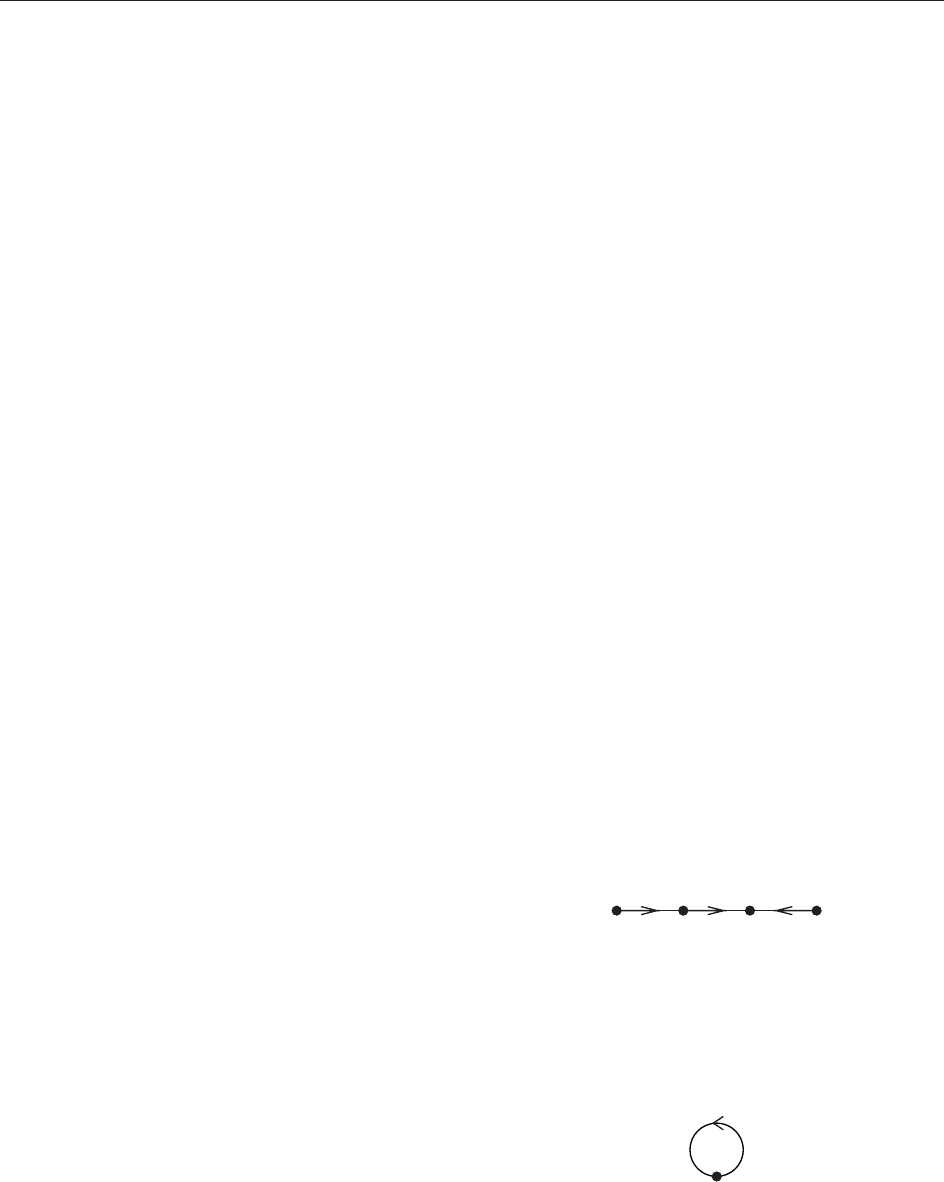
Example 1 Let Q be the following quiver:
1234
ρλσ
then kQ has a basis given by the set of paths
{e
1
, e
2
, e
3
, e
4
, , , , }. Some sample products are
= 0, = 0, = 0, e
3
= e
2
= , e
2
= 0.
Example 2 Let Q be the following quiver (the
so-called ‘‘Jordan quiver’’).
1
ρ
Then kQ ffik[t], the algebra of polynomials in one
variable.
Note that the path algebra kQ is finite dimen-
sional if and only if Q has no oriented cycles (paths
with the same head and tail vertex).
314 Finite-Dimensional Algebras and Quivers
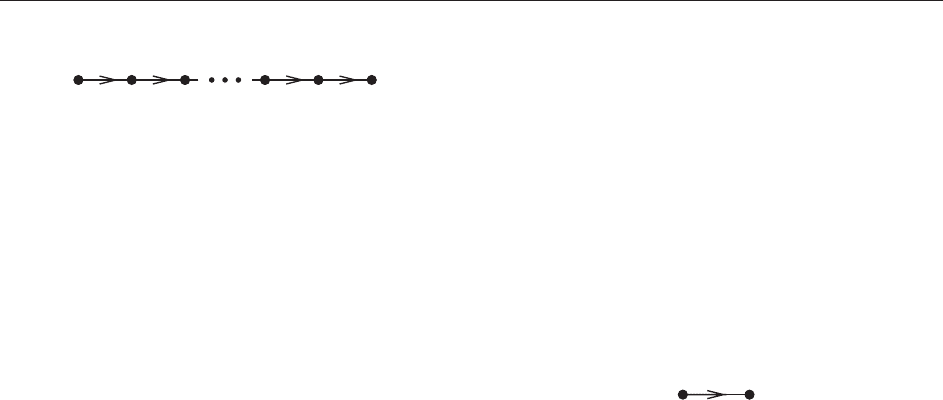
Example 3 Let Q be the following quiver:
123 n – 2 n – 1 n
Then for every 1 i j n, there is a uniqu e path
from i to j. Let f : kQ !M
n
(k) be the linear map from
the path algebra to the n n matrices with entries in
the field k that sends the unique path from i to j to the
matrix E
ji
with (j, i) entry 1 and all other entries zero.
Then one can show that f is an isomorphism onto the
algebra of lower triangular matrices.
Representations of Quivers
Fix a field k. A representation of a quiver Q is an
assignment of a vector space to each vertex and to
each arrow a linear map between the vector spaces
assigned to its tail and head. More precisely, a
representation V of Q is a collection
fV
i
ji 2Q
0
g
of finite-dimensional k-vector spaces together with a
collection
fV
: V
tðÞ
!V
hðÞ
j 2Q
1
g
of k-linear maps. Note that a representation V of a
quiver Q is equivalent to a represent ation of the
path algebra kQ. The dimension of V is the map
d
V
: Q
0
!Z
0
given by d
V
(i) = dim V
i
for i 2Q
0
.
If V and W are two representations of a quiver Q,
then a morphism : V !W is a collection of k-linear
maps
f
i
: V
i
!W
i
ji 2Q
0
g
such that
W
tðÞ
¼
hðÞ
V
; 8 2Q
1
Proposition 1 Let A be a finite-dimensional
k-algebra. Then the category of representations of
A is equivalent to the category of representations of
the algebra kQ/I for some quiver Q and some two-
sided ideal I of kQ.
It is for this reason that the study of finite-
dimensional associative algebras is intimately related
to the study of quivers.
We define the direct sum V W of two repre-
sentations V and W of a quiver Q by
ðV WÞ
i
¼ V
i
W
i
; i 2Q
0
and (V W)
: V
t()
W
t()
!V
h()
W
h()
by
ðV WÞ
ððv; wÞÞ ¼ ðV
ðvÞ; W
ðwÞÞ
for v 2V
t()
, w 2W
t()
, 2Q
1
. A representation V is
‘‘trivial’’ if V
i
= 0 for all i 2Q
0
and ‘‘simple’’ if its
only subrepresentations are the zero repre sentation
and V itself. We say that V is ‘‘decomposable’’ if it is
isomorphic to W U for some nontrivial represen-
tations W and U. Otherwise, we call V ‘‘indecom-
posable.’’ Every representation of a quiver has a
decomposition into indecomposable representations
that is unique up to isomorphism and permutation
of the components. Thus, to classify all representa-
tions of a quiver, it suffices to classify the indecom-
posable representations.
Example 4 Let Q be the following quiver:
12
ρ
Then Q has three indecomposable representations
U, V, and W given by:
U
1
¼k; U
2
¼0; U
¼0
V
1
¼0; V
2
¼k; V
¼0
W
1
¼k; W
2
¼k; W
¼1
Then any representation Z of Q is isomo rphic to
Z ffiU
d
1
r
V
d
2
r
W
r
where d
1
= dim Z
1
, d
2
= dim Z
2
, r = rank Z
.
Example 5 Let Q be the Jordan quiver. Then
representations V of Q are classified up to iso-
morphism by the Jordan normal form of V
where
is the single arrow of the quiver. Indecomposable
representations correspond to single Jordan blocks.
These are parametrized by a discrete parameter n
(the size of the block) and a continuous parameter
(the eigenvalue of the block).
A quiver is said to be of ‘‘finite type’’ if it has only
finitely many indecomposable representations (up to
isomorphism). If a quiver has infinitely many
isomorphism classes but they can be split into
families, each parametrize d by a single continuous
parameter, then we say the quiver is of ‘‘tame’’ (or
‘‘affine’’) type. If a quiver is of neither finite nor
tame type, it is of ‘‘wild type.’’ It turns out that there
is a rather remarkable relationship between the
classification of quivers and their representations
and the theory of Kac–Moody algebras.
The ‘‘Euler form’’ or ‘‘Ringel form’’ of a quiver Q
is defined to be the asymmetric bilinear form on Z
Q
0
given by
h; i¼
X
i 2Q
0
ðiÞðiÞ
X
2Q
1
ðtðÞÞðhðÞÞ
Finite-Dimensional Algebras and Quivers 315