
Francoise J.-P., Naber G.L., Tsun T.S. (editors) Encyclopedia of Mathematical Physics
Подождите немного. Документ загружается.

In the standard coordinate basis of Z
Q
0
, the Euler
form is represented by the matrix E = (a
ij
) where
a
ij
¼
ij
#f 2Q
1
j tðÞ¼i; hðÞ¼jg
Here
ij
is the Kronecker delta symbol. We define
the ‘‘Cartan form’’ of the quiver Q to be the
symmetric bilinear form given by
ð; Þ¼h; iþh; i
Note that the Cartan form is independent of the
orientation of the arrows in Q. In the standard
coordinate basis of Z
Q
0
, the Cartan form is represented
by the Cartan matrix C = (c
ij
)wherec
ij
= a
ij
þ a
ji
.
Example 6 For the quiver in Example 1, the Euler
matrix is
E ¼
1 100
0110
0010
0011
0
B
B
@
1
C
C
A
and the Cartan matrix is
C ¼
2 100
1210
0 121
0012
0
B
B
@
1
C
C
A
The ‘‘Tits form’’ q of a quiver Q is defined by
qðÞ¼h; i¼
1
2
ð; Þ
It is known that the number of continuous para-
meters describing representations of dimension for
6¼0 is greater than or equal to 1 q ().
Let g be the Kac–Moody algebra associated to
the Cartan matrix of a quiver Q. By forgetting the
orientation of the arrows of Q, we obtain the
underlying (undirected) graph. This is the Dynkin
graph of g . Associated to g is a root system and a set
of simple roots {
i
ji 2Q
0
} indexed by the vertices of
the Dynkin graph.
Theorem 1 (Gabriel’s theorem).
(i) A quiver is of finite type if and only if the
underlying graph is a union of Dynkin graphs
of type A, D, or E.
(ii) A quiver is of tame type if and only if the
underlying graph is a union of Dynkin graphs
of type A, D, or E and extended Dynkin graphs
of type
b
A,
b
D, or
b
E (with at least one extended
Dynkin graph).
(iii) The isomorphism classes of indecomposable
representations of a quiver Q of finite type are
in one-to-one correspondence with the positive
roots of the root system associated to the
underlying graph of Q. The correspondence is
given by
V 7!
X
i 2Q
0
d
V
ðiÞ
i
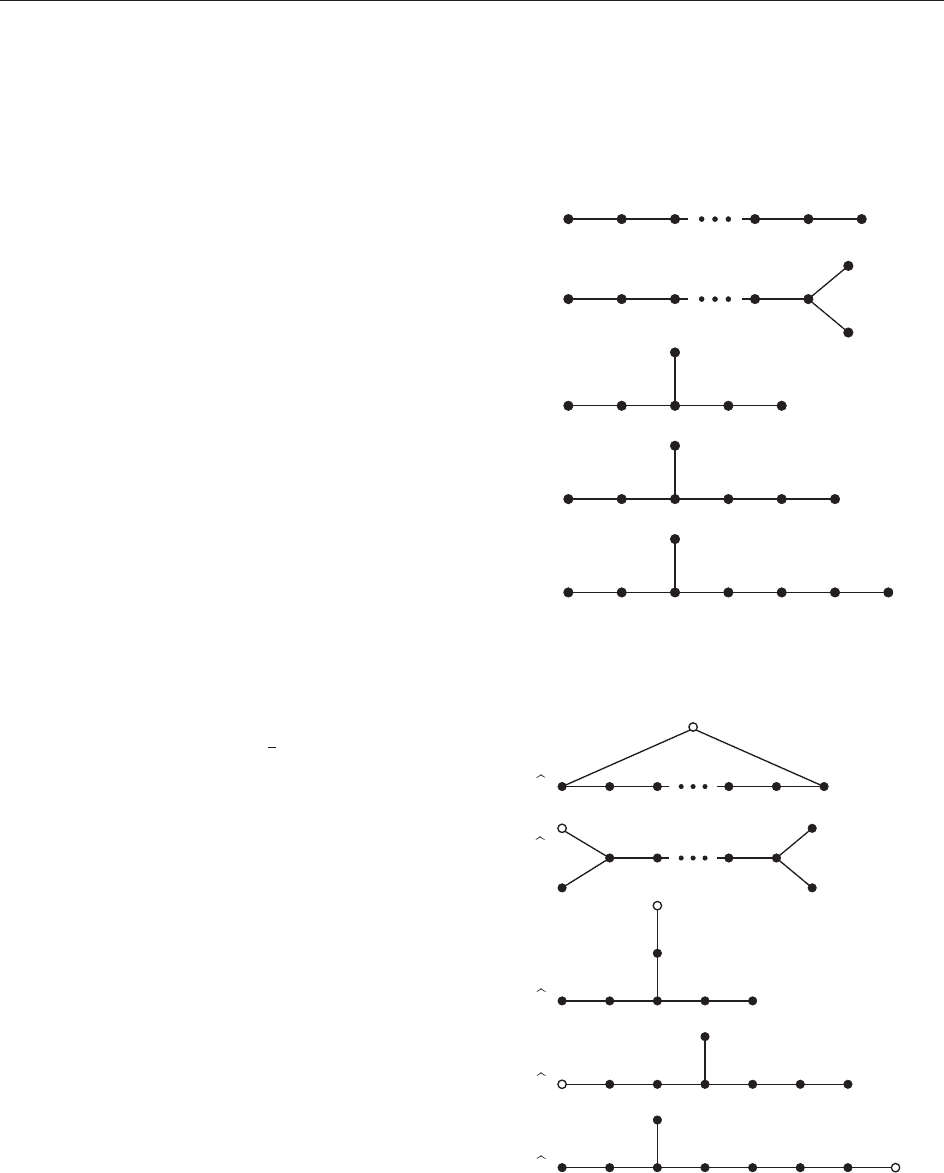
The Dynkin graphs of type A, D,andE are as follows.
A
n
D
n
E
6
E
7
E
8
Here the subscript indicates the number of vertices in the
graph.
The extended Dynkin graphs of type
b
A,
b
D, and
b
E
are as follows.
A
n
D
n
E
6
E
7
E
8
Here we have used an open dot to denote the vertex
that was added to the corresponding Dynkin graph
of type A, D,orE.
Theorem 2 (Kac’s theorem). Let Q be an arbitrary
quiver. The dimension vectors of indecomposable
representations of Q correspond to positive roots
316 Finite-Dimensional Algebras and Quivers
of the root system associated to the underlying graph
of Q (an d are thus independent of the orientation of
the arrows of Q). The correspondence is given by
d
V
7!
X
i 2Q
0
d
V
ðiÞ
i
Note that in Kac’s Theorem, it is not asserted that the
isomorphism classes are in one-to-one correspondence
with the roots as in the finite case considered in
Gabriel’s theorem. It turns out that in the general case,
dimension vectors for which there is exactly one
isomorphism class correspond to real roots while
imaginary roots correspond to dimension vectors for
which there are families of representations.
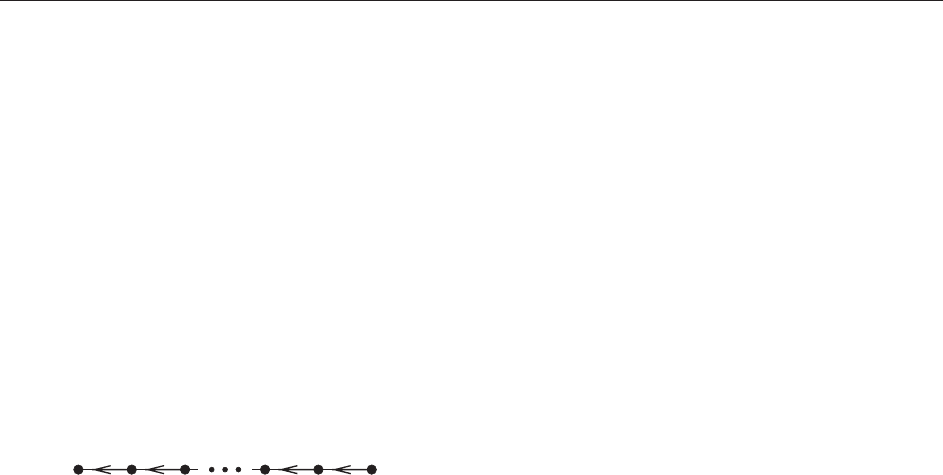
Example 7 Let Q be the quiver of type A
n
,
oriented as follows.
ρ
1
ρ
2
ρ
n – 2
ρ
n – 1
n n – 2 n – 1123
It is known that the set of positive roots of the
simple Lie algebra of type A
n
is
X
l
i¼j
i
1 j l n
()
tf0g
The zero root corresponds to the trivial representation.
The root
P
l
i = j
i
for some 1 j l n corresponds
to the unique (up to isomorphism) representation V
with
V
i
¼
kifj i l
0 otherwise
and
V
i
¼
1 if j i l 1
0 otherwise
Example 8 Let Q be the quiver of type
b
A
n
, with all
arrows oriented in the same direction (for instance,
counter-clockwise). The positive root
P
n
i = 0
i
(where {0, 1, 2, ..., n} are the vertices of the quiver)
is imaginary. There is a one-parameter family of
isomorphism classes of indecomposable representa-
tions where the maps assigned to each arrow are
nonzero. The parameter is the composition of the
maps around the loop.
If a quiver Q has no oriented cycles, then the only
simple kQ-modules are the modules S
i
for i 2Q
0
where
S
i
j
¼
k if i ¼ j
0ifi 6¼j
and S
i
= 0 for all 2Q
1
.
Ringel–Hall Algebras
Let k be the finite field F
q
with q elements and let
Q beaquiverwithnoorientedcycles.LetP be
the set of all isomorphism classes of kQ-modules
which are finite as sets (since k is finite dimen-
sional, these are just the quiver representations we
considered above). Let A be a commutative
integral domain containing Z and elements v, v
1
such that v
2
= q. The Ringel–Hall algebra
H = H
A, v
(kQ)isthefreeA-module with basis
{[V]} indexed by the isomorphism classes of
representations of the quiver Q,withanA-bilinear
multiplication defined by
½V
1
½V
2
¼v
hdim V
1
;dim V
2
i
X
V
g
V
V
1
;V
2
½V
Here hdim V
1
, dim V
2
i is the Euler form and g
V
V
1
, V
2
is the number of submodules W of V such that
V=W ffiV
1
and W ffiV
2
. H is an associative Z
Q
0
0
-
graded algebra, with identity element [0], the
isomorphism class of the trivial representation.
The grading H =
H
is given by letting H
be
the A-span of the set of isomorphism classes [V]
such that dim V = .
Let C = C
A, v
(kQ) be the A-subalgebra of H
generated by the isomorphism classes [S
i
] of the
simple kQ-modules. C is called the ‘‘composition
algebra.’’ If the underlying graph of Q is of finite
type, then C = H.
Now let K be a set of finite fields k such that the
set {jkjjk 2K} is infinite. Let A be an integral
domain containing Q and, for each k 2K,an
element v
k
such that v
2
k
= jkj. For each k 2K,we
have the corresponding composition algebra C
k
,
generated by the elements [
k
S
i
] (here we make the
field k explici t). Now let C be the subring of
Q
k 2K
C
k
generated by Q and the elements
t ¼ðt
k
Þ
k 2K
; t
k
¼ v
k
t
1
¼ðt
1
k
Þ
k 2K
; t
1
k
¼ðv
k
Þ
1
u
i
¼ðu
i
k
Þ
k 2K
; u
i
k
¼½
k
S
i
; i 2Q
0
Now, t lies in the center of C and if p(t) = 0 for some
polynomial p, then p must be the zero polynomial
since the set of v
k
is infinite. Thus, we may think
of C as the A-algebra generated by the u
i
, i 2Q
0
,
with A = Q[t, t
1
] and t an indeterminate. Let
C
= Q(t)
A
C. We call C
the ‘‘generic composi-
tion algebra.’’
Let g be the Kac–Moody algebra associated to the
Cartan matrix of the quiver Q and let U be the
quantum group associated by Drinfeld and Jimbo to g.
It has a triangular decomposition U = U
U
0
U
þ
.
Finite-Dimensional Algebras and Quivers 317

Specifically, U
þ
is the Q(t)-algebra with generators
E
i
, i 2Q
0
and relations
X
1c
ij
p¼0
ð1Þ
p
1 c
ij
p
E
p
i
E
j
E
1c
ij
p
i
; i 6¼j
where c
ij
are the entries of the Cartan matrix and
m
p
¼
½m!
½p!½m p!
½n¼
t
n
t
n
t t
1
; ½n! ¼½1½2...½n
Theorem 3 There is a Q(t)-algebra isomorphism
C
!U
þ
sending u
i
7!E
i
for all i 2Q
0
.
The proof of Theorem 3 is due to Ringel in the
case that the underlying graph of Q is of finite or
affine type. The more general case presented here is
due to Green.
All of the Kac–Moody algebras considered so
far have been simply-laced. That is, their Cartan
matrices are symmetric. There is a way to deal
with non-simply-laced Kac–Moody algebras using
species. We will not treat this subject in this
article.
Quiver Varieties
One can use varieties associated to quivers to yield a
geometric realization of the upper half of the
universal enveloping algebra of a Kac–Moody
algebra g and its irreducible highest-weight
representations.
Lusztig’s Quiver Varieties
We first introduce the quiver varieties, first
defined by L usztig, which yield a geometric
realization of the upper half U
þ
of the u niversal
enveloping algebra of a simply laced Kac–Moody
algebra g.LetQ = (Q
0
, Q
1
) be the quiver whose
vertices Q
0
are the vertices of the Dynkin
diagram of g andwhosesetofarrowsQ
1
consists
of all the edges of the Dynkin diagram with both
orientations. By definition, U
þ
is the Q-alge bra
defined by generators e
i
, i 2Q
0
, subject to the
Serre relations
X
1c
ij
p¼0
ð1Þ
p
1 c
ij
p
e
p
i
e
j
e
1c
ij
p
¼ 0
for all i 6¼j in Q
0
,wherec
ij
are the entries of the Cartan
matrix associated to Q. For any =
P
i 2Q
0
i
i,
i
2N,
let U
þ
be the subspace of U
þ
spanned by the
monomials e
i
1
e
i
2
...e
i
n
for various sequences
i
1
, i
2
, ..., i
n
in which i appears
i
times for each
i 2Q
0
.Thus,U
þ
=
U
þ
.LetU
þ
Z
be the subring of
U
þ
generated by the elements e
p
i
=p! for i 2Q
0
, p 2N.
Then U
þ
Z
=
U
þ
Z,
where U
þ
Z,
= U
þ
Z
\U
þ
.
We define the involution : Q
1
!Q
1
to be the
function which takes 2Q
1
to the element of Q
1
consisting of the same edge with opposite orienta-
tion. An orientation of our graph/quiver is a choice
of a subset Q
1
such that [
=Q
1
and
\
=;.
Let V be the category of finite-dimensional
Q
0
-graded vector spaces V =
i 2Q
0
V
i
over C
with morphisms being linear maps respecting
the grading. Then V 2V shall denote that V is an
object of V. The dimension of V 2V is given by
v = dim V = (dim V
0
, ...,dimV
n
).
Given V 2V,letE
V
be the space of representa-
tions of Q with underlying vector space V.That
is,
E
V
¼
M
2Q
1
HomðV
tðÞ
; V
hðÞ
Þ
For any subset Q
0
1
of Q
1
, let E
V, Q
0
1
be the subspace
of E
V
consisting of all vectors x = (x
) such that
x
= 0 whenev er 62Q
0
1
. The algebraic group
G
V
=
Q
i
Aut(V
i
) acts on E
V
and E
V, Q
0
1
by
ðg; xÞ¼ððg
i
Þ; ðx
ÞÞ7!gx
¼ðx
0
Þ¼ðg
hðÞ
x
g
1
tðÞ
Þ
Define the function " : Q
1
!{1, 1} by "() = 1 for
all 2 and "() = 1 for all 2
. Let h, ibe the
nondegenerate, G
V
-invariant, symplec tic form on
E
V
with values in C defined by
hx; yi¼
X
2Q
1
"ðÞtrðx
y
Þ
Note that E
V
can be considered as the cotangent
space of E
V,
under this form.
The moment map associated to the G
V
-action on
the symplectic vector space E
V
is the map
: E
V
!gl
V
=
Q
i
EndV
i
, the Lie algebra of GL
V
,
with i-component
i
: E
V
!EndV
i
given by
i
ðxÞ¼
X
2Q
1
;hðÞ¼i
"ðÞx
x
Definition 1 An element x 2E
V
is said to be
nilpotent if there exists an N 1 such that for any
sequence
1
,
2
, ...,
N
in H satisfying t(
1
) = h(
2
),
t(
2
) = h(
3
), ..., t(
N1
) = h(
N
), the composition
x
1
x
2
...x
N
: V
t(
N
)
!V
h(
1
)
is zero.
318 Finite-Dimensional Algebras and Quivers

Definition 2 Let
V
be the set of all nilpotent
elements x 2E
V
such that
i
(x) = 0 for all i 2I.
A subset of an algebraic variety is said to be
‘‘constructible’’ if it is obtained from subvarieties
from a finite number of the usual set-theoretic
operations. A function f : A !Q on an algebraic
variety A is said to be a constructible function if f
1
(a)
is a constructible set for all a 2Q and is empty for all
but finitely many a. Let M(
V
) denote the Q-vector
space of all constructible functions on
V
. Let
e
M(
V
)
denote the Q-subspace of M(
V
) consisting of those
functions that are constant on any G
V
-orbit in
V
.
Let V, V
0
, V
00
2V such that dim V = dim V
0
þ
dim V
00
. Now, suppose that S is an I-graded subspace
of V.Forx 2
V
we say that S is x-stable if x(S) S.
Let
V; V
0
, V
00
be the variety consisting of all pairs (x, S)
where x 2
V
and S is an I-graded x-stable subspace of
V such that dim S = dim V
00
. Now, if we fix some
isomorphisms V=S ffiV
0
, S ffiV
00
,thenx induces ele-
ments x
0
2
V
0
and x
00
2
V
00
. We then have the maps
V
0
V
00
p
1
V;V
0
;V
00
!
p
2
V
where p
1
(x, S) = (x
0
, x
00
), p
2
(x, S) = x.
For a holomorphic map between complex
varieties A and B, let
!
denote the map between
the spaces of constructible functions on A and B
given by
ð
!
f ÞðyÞ¼
X
a 2Q
að
1
ðyÞ\f
1
ðaÞÞ
Let
be the pullback map from functions on B to
functions on A acting as
f (y) = f ((y)). We then
define a map
e
Mð
V
0
Þ
e
Mð
V
00
Þ!
e
Mð
V
Þ½1
by (f
0
, f
00
) 7!f
0
f
00
where
f
0
f
00
¼ðp
2
Þ
!
p
1
ðf
0
f
00
Þ
Here f
0
f
00
2
e
M(
V
0
V
00
) is defined by
(f
0
f
00
)(x
0
, x
00
) = f
0
(x
0
)f
00
(x
00
). The map [1] is bilinear
and defines an associative Q-algebra structure on
e
M(
V
) where V
is the object of V defined by
V
i
= C
i
.
There is a unique algebra homomorphism
: U
þ
!
e
M(
V
) such that (e
i
) is the function
on the point
V
i with value 1. Then restricts to a
map
: U
þ
!
e
M(
V
). It can be shown that
pi
(e
p
i
=p!) is the function 1 on the point
V
pi
for
i 2Q
0
, p 2Z
0
.
Let
e
M
Z
(
V
) be the set of all functions in
e
M(
V
)that
take on only integer values. One can show that if
f
0
2
e
M
Z
(
V
0
)andf
00
2
e
M
Z
(
V
00
), then f
0
f
00
2
e
M
Z
(
V
)
in the setup of [1].Thus
(U
þ
Z,
)
e
M
Z
(
V
).
Let Irr
V
denote the set of irreducible compo-
nents of
V
. The following proposition was con-
jectured by Lusztig and proved by him in the affine
(and finite) case. The general case was proved by
Kashiwara and Saito.
Proposition 2 For any 2(Z
0
)
Q
0
, we have
dim U
þ
=#Irr
V
.
We then have the following important result due
to Lusztig.
Theorem 4 Let 2(Z
0
)
Q
0
. Then,
(i) For any Z 2Irr
V
, there exists a unique
f
Z
2
(U
þ
Z,
) such that f
Z
is equal to 1 on an
open dense subset of Z and equal to zero on an
open dense subset of Z
0
2Irr
V
for all Z
0
6¼Z.
(ii) {f
Z
jZ 2Irr
V
} is a Q-basis of
(U
þ
).
(iii)
: U
þ
!
(U
þ
) is an isomorphism.
(iv) Define [Z] 2U
þ
by
([Z]) = f
Z
. Then B
=
{[Z] jZ 2Irr
V
} is a Q-basis of U
þ
.
(v)
(U
þ
Z,
) =
(U
þ
) \
e
M
Z
(
V
).
(vi) B
is a Z-basis of U
þ
Z,
.
From this theorem, we see that B = t
B
is a
Q-basis of U
þ
, which is called the ‘‘semicanonical
basis.’’ This basis has many remarkable properties.
One of these properties is as follows. Via the algebra
involution of the entire universal enveloping algebra
U of g given on the Chevalley generators by
e
i
7!f
i
, f
i
7!e
i
and h 7!h for h in the Cartan
subalgebra of g , one obtains from the results of
this section a semicanonical basis of U
, the lower
half of the universal enveloping algebra of g . For any
irreducible highest-weight inte grable representation
V of U (or, equivalently, g ), let v 2V be a nonzero
highest-weight vector. Then the set
fbvjb 2B; bv 6¼0g
is a Q-basis of V, called the semicanonical basis of
V. Thus, the semicanonical basis of U
is simulta-
neously compatible with all irreducible highest-
weight integrable modules. There is also a way to
define the semicanonical basis of a representation
directly in a geometric way. This is the subject of the
next subsection.
One can also obtain a geome tric realization of the
upper part U
þ
of the quantum group in a similar
manner using perverse sheaves instead of construc-
tible functions. This construction yields the canoni-
cal basis of the associated quantum group (a
q-deformation of the universal enveloping algebra)
which also has many remarkable properties and is
closely related to the theory of cryst al bases.
Finite-Dimensional Algebras and Quivers 319

Nakajima’s Quiver Varieties
We introduce here a description of the quiver varieties
first presented by Nakajima. They yield a geometric
realization of the irreducible highest-weight represen-
tations of simply-laced Kac–Moody algebras. The
construction was motivated by the work of Kronhei-
mer and Nakajima on solutions to the anti-self-dual
Yang–Mills equations on ALE gravitational instantons
(see Instantons: Topological Aspects).
Definition 3 For v, w 2Z
I
0
, choose I-graded vec-
tor spaces V and W of graded dimensions v and w,
respectively. Then define
ðv; wÞ¼
V
M
i 2I
HomðV
i
; W
i
Þ
Definition 4 Let
st
=(v, w)
st
be the set of all
(x, t) 2(v, w) satisfying the following condition: if
S = (S
i
) with S
i
V
i
is x-stable and t
i
(S
i
) = 0 for
i 2I, then S
i
= 0 for i 2I.
The group G
V
acts on (v, w) via
ðg; ðx; tÞÞ7!ððg
hðÞ
x
g
1
tðÞ
Þ; ðt
i
g
1
i
ÞÞ
and the stabilizer of any point of (v, w)
st
in G
V
is
trivial. We then make the following definition.
Definition 5 Let LL(v, w) =(v, w)
st
=G
V
.
We should note that while the above definition
and other constructions in this article are algebraic,
there are also more geometric ways of looking at
quiver varieties. In particular, the space
Mðv; wÞ¼
M
2Q
1
HomðV
tðÞ
; V
hðÞ
Þ
!
M
i 2I
HomðW
i
; V
i
ÞHomðV
i
; W
i
Þ
!
has a natural hyper-Ka¨ hler metric and one can
consider a hyper-Ka¨ hler quotient by the group
Q
U(V
i
). The variety L(v, w) is a Lagrangian
subvariety of (and is homotopic to) this hyper-
Ka¨ hler quotient. In the case g = sl
n
, the varieties
involved are closely related to flag varieties.
Let w, v, v
0
, v
00
2Z
I
0
be such that v = v
0
þ v
00
.
Consider the maps
ðv
00
; 0Þðv
0
; wÞ
p
1
~
Fðv; w; v
00
Þ
!
p
2
Fðv; w; v
00
Þ!
p
3
ðv; wÞ½2
where the notation is as follows. A point of
F(v, w; v
00
) is a point (x, t) 2(v, w) together with
an I-graded, x-stable subspace S of V such that
dim S = v
0
= v v
00
. A point of
~
F(v, w; v
00
) is a point
(x, t, S)ofF(v, w; v
00
) together with a collection of
isomorphisms R
0
i
: V
0
i
ffiS
i
and R
00
i
: V
00
i
ffiV
i
=S
i
for
each i 2I.Thenwedefinep
2
(x, t, S, R
0
, R
00
) = (x, t, S),
p
3
(x, t, S) = (x, t)andp
1
(x, t, S, R
0
, R
00
) = (x
00
,x
0
, t
0
)
where x
00
, x
0
, t
0
are determined by
R
0
hðÞ
x
0
¼ x
R
0
tðÞ
: V
0
tðÞ
!S
hðÞ
t
0
i
¼ t
i
R
0
i
: V
0
i
!W
i
R
00
hðÞ
x
00
¼ x
R
00
tðÞ
: V
00
tðÞ
!V
hðÞ
=S
hðÞ
It follows that x
0
and x
00
are nilpotent.
Lemma 1 One has
ðp
3
p
2
Þ
1
ððv; wÞ
st
Þp
1
1
ððv
00
; 0Þðv
0
; wÞ
st
Þ
Thus, we can restrict [2] to
st
, forget the (v
00
, 0)-
factor and consider the quotient by G
V
and G
V
0
.
This yields the diagram
Lðv
0
; wÞ
1
Fðv; w; v v
0
Þ!
2
Lðv; wÞ½3
where
Fðv; w; v v
0
Þ
¼
def
fðx; t; SÞ2Fðv; w; v v
0
Þjðx; tÞ2ðv; wÞ
st
g=G
V
Let M(L(v, w)) be the vector space of all
constructible functions on L(v, w). Then define
maps
h
i
: MðLðv; wÞÞ!MðLðv; wÞÞ
e
i
: MðLðv; wÞÞ!MðLðv e
i
; wÞÞ
f
i
: MðLðv e
i
; wÞÞ!MðLðv; wÞÞ
by
h
i
f ¼ u
i
f
e
i
f ¼ð
1
Þ
!
ð
2
f Þ
f
i
g ¼ð
2
Þ
!
ð
1
gÞ
Here
u ¼
t
ðu
0
; ...; u
n
Þ¼w Cv
where C is the Cartan matrix of g and we are using
diagram 3 with v
0
= v e
i
where e
i
is the vector
whose components are given by e
i
j
=
ij
.
Now let ’ be the constant function on L(0, w)
with value 1. Let L(w) be the vector space of
functions generated by acting on ’ with all possible
combinations of the operators f
i
. Then let
L(v, w) = M(L(v, w)) \ L(w).
Proposition 3 The operators e
i
, f
i
, h
i
on L(w) provide
it with the structure of the irreducible highest-weight
320 Finite-Dimensional Algebras and Quivers

integrable representation of g with highest weight
P
i 2Q
0
w
i
!
i
. Each summand of the decomposition
L(w) =
L
v
L(v, w) is a weight space with weight
P
i 2Q
0
w
i
!
i
v
i
i
. Here the !
i
and
i
are the
fundamental weights and simple roots of g , respectively.
Let Z 2IrrL(v, w) and define a linear map
T
Z
: L(v, w) !C that associ ates to a constructible
function f 2L(v, w) the (constant) value of f on a
suitable open dense subset of Z. The fact that
L(v, w) is finite dimensional allows us to take such
an open set on which any f 2L(v, w) is constant. So
we have a linear map
:Lðv; wÞ!C
IrrLðv;wÞ
Then we have the following proposition.
Proposition 4 The map is an isomorphism; for
any Z 2IrrL(v, w), there is a unique function
g
Z
2L(v, w) such that for some open dense subset
O of Z we have g
Z
j
O
= 1 and for some closed
G
V
-invariant subset K L(v, w) of dimension <
dim L(v, w) we have g
Z
= 0 outside Z [ K. The
functions g
Z
for Z 2Irr(v, w) form a basis of
L(v, w).
Additional Topics
To conclude, we have given here a brief overview
of some topics related to finite-dimensional
algebras and quivers. There is much more to be
found in the literature. For basics on associative
algebras and t heir representat ions, the reader
may consult introductory texts on abstract alge-
bra such as Lang (2002). For further results (and
their proofs) on Ringel–Hall algebras see the
papers of Ringel (1990a, b, 1993, 1995, 1996)
and of Green (1995) and the references cite d
therein. The r eader interested in species, which
extend m any of these re sults to non-simply-laced
Lie algebras, should consult Dlab and Ringel
(1976).
The book by Lusztig (1993) covers the quiver
varieties of Lusztig and canonical bases. Canonical
bases are closely related to crystal bases and crystal
graphs (see Hong and Kang (2002) for an overview
of these topics). In fact, the set of irreducible
components of the quiver varieties of Lusztig and
Nakajima can be endowed with the structure of a
crystal graph in a purely geometric way (see
Kashiwara and Saito (1997) and Saito (2002)).
Many results on Nakajima’s quiver varieties can be
found in the original papers (Nakajima 1994,
1998). The overview article (Nakajima 1996)is
also useful.
Quiver vari eties can also be used to give geometric
realizations of tensor products of representations
(see Malkin (2002, 2003), Nakajima (2001), and
Savage (2003)) and finite-dimensional representa-
tions of quantum affine Lie algebras (see Nakajima
(2001)). This is just a select few of the many
applications of quiver vari eties. Much more can be
found in the literature.
Acknowledgments
This work was supported in part by the Natural
Sciences and Engineering Research Council
(NSERC) of Canada.
See also: Instantons: Topological Aspects.
Further Reading
Dlab V and Ringel CM (1976) Indecomposable representations of
graphs and algebras. Memoirs of the American Mathematical
Society 6(173): vþ57.
Green JA (1995) Hall algebras, hereditary algebras and
quantum groups. Inventiones Mathemati cae 120(2):
361–377.
Hong J and Kang S-J (2002) Introduction to Quantum Groups
and Crystal Bases, Graduate Studies in Mathematics, vol. 42.
Providence, RI: American Mathematical Society.
Kashiwara M an d Sait o Y (1997) Geometric con struction
of crystal bases. Duke Mathematical Journal 89(1):
9–36.
Lang S (2002) Algebra, Graduate Texts in Mathematics, vol. 211.
New York: Springer.
Lusztig G (1993) Introduction to Quantum Groups, Progress in
Mathematics, vol. 110. Boston MA: Birkha¨user.
Malkin A (2002) Tensor product varieties and crystals: GL case.
Transactions of the American Mathematical Society 354(2):
675–704 (electronic).
Malkin A (2003) Tensor product varieties and crystals: the ADE
case. Duke Mathematical Journal 116(3): 477–524.
Nakajima H (1994) Instantons on ALE spaces, quiver varieties,
and Kac–Moody algebras. Duke Mathematical Journal 76(2):
365–416.
Nakajima H (1996) Varieties associated with quivers. In:
Bautista R, Martinez-Villa R, and de la Pen
˜
aJA(eds.)
Representation Theory of Algebras and Related Topics
(Mexico City, 1994),CMSConf.Proc.,vol.19,
pp. 1 39–157. Provid ence, RI: American Mathemat ical
Society.
Nakajima H (1998) Quiver varieties and Kac–Moody algebras.
Duke Mathematical Journal 91(3): 515–560.
Nakajima H (2001a) Quiver varieties and finite-dimensional
representations of quantum affine algebras. Journal of the
American Mathematical Society 14(1): 145–238 (electronic).
Nakajima H (2001b) Quiver varieties and tensor products.
Inventiones Mathematicae 146(2): 399–449.
Ringel CM (1990a) Hall algebras. In: Balcerzyk S, Jo´zefiak T,
Krempa J, Simson D, and Vogel W (eds.) Topics in Algebra,
Part 1 (Warsaw, 1988), Banach Center Publ., vol. 26,
pp. 433–447. Warsaw: PWN.
Ringel CM (1990b) Hall algebras and quantum groups. Inven-
tiones Mathematicae 101(3): 583–591.
Finite-Dimensional Algebras and Quivers 321

Ringel CM (1993) Hall algebras revisited. In: Joseph A and
Shnider S (eds.) Quantum Deformations of Algebras and Their
Representations (Ramat-Gan, 1991/1992; Rehovot, 1991/
1992), Israel Math. Conf. Proc., vol. 7, pp. 171–176. Ramat
Gan: Bar-Ilan Univ.
Ringel CM (1995) The Hall algebra approach to quantum
groups. In: Gomez -Mont X , Montej ano L, de la Pen
˜
aJA,
and Seade J (eds.) XI La tin Ameri can Schoo l of
Mathematics (Spanish) (Mexico City, 1993),Aportaciones
Mat. Comu n., vol. 15, pp. 85–114. Me´xico: Soc. Mat.
Mexicana.
Ringel CM (1996) Green’s theorem on Hall algebras . In:
Bautista R, Martinez-Villa R, and de la Pen
˜
aJA(eds.)
Representation Theory of Algebras and Related Topics
(Mexico City, 1994),CMSConf.Proc.,vol.19,
pp. 1 85–245. Provid ence, RI: American Mathemat ical
Society.
Saito Y (2002) Crystal bases and quiver varieties. Mathematische
Annalen 324(4): 675–688.
Savage A (2003) The tensor product of representations of
U
q
ðsl
2
Þ via quivers. Advances in Mathematics 177(2):
297–340.
Finite Group Symmetry Breaking
G Gaeta, Universita
`
di Milano, Milan, Italy
ª 2006 Elsevier Ltd. All rights reserved.
Introduction
It is a commonplace situation that symmetric laws
of Nature give rise to physical states which are not
symmetric. States related by symmetry operations
are equivalent, but still nature selects one of them.
As an example, consider a ferromagnetic system
of interacting spins with no external magnetic field.
The ‘‘up’’ and ‘‘down’’ states are equivalent, but one
of the two is cho sen: the interaction makes states
with agreeing spin orientation (and therefore macro-
scopic magnetization) energetically preferred, and
fluctuations will decide which state is actually
chosen by a given sample.
Finite group symmetry is also commonplace in
physics, in particular through crystallographic
groups occurr ing in condensed matter physics – but
also through the inversions (C, P, T and their combi-
nations) occurring in high-energy physics and field
theory.
The breaking of f inite group symmetry has thus
been thoroughly studied, and general approaches
exist to investigate it in mathematically precise
terms with physical counterparts. In particular,
a widely applicable approach is provided by the
Landau theory of phase transitions – whose
mathematical counterpart resides in the realm
of equivariant singularity and bifurcation theory.
In Landau theory, the state of a system is
described by a finite-dimensional variable (the
‘‘order parameter’’), and physical states corre-
spond to minima of a potential, invariant under a
group.
In this article we describe the basics of
symmetry breaking analysis for systems d escribed
by a symmetric polynomia l; in particul ar, we
discuss generic symmetry breakings, that is, those
determined by the symmetry properties them-
selves and independent of the details of the
polynomial describing a concrete system. We
also discuss how the plethora of invariant poly-
nomials can be to some extent reduced by means
of changes of coordinates, that is, how one can
reduce to consider certain types of polynomials
with no loss of generality. Finally, we will give
some indic ations on e xtension of th is th eory, that
is, on how one deals with symmetry breakings for
more general groups and/or more general physical
systems.
Basic Notions
Finite Groups
A finite group (G, ) is a finite set G of elements
{g
0
, ..., g
N
} equ ipped with a composition law , and
such that the following conditions hold:
1. for all g, h 2 G the composition g h belongs to
G, that is, g h 2 G;
2. the composition is associative, that is, (g h)
k = g (h k) for all g, h, k 2 G ;
3. there is an element in G – which we will denote
as e – which is the identity for the action of on
G, that is, e g = g = g e for all g 2 G; and
4. for each g 2 G there is an element g
1
which is
the inverse of g, that is, g
1
g = e = g g
1
.
In the follow ing, we omit the symbol , that is, we
write gh to mean g h. Similarly, we usually write
simply G for the group, rather than (G, ).
Given a subset H G, this is a subgroup of (G, )
if (H, ) satisfies the group axioms (1)–(4) above.
Note that this implies that e 2 H whenever H is a
subgroup, and {e} is a subgroup. Subgroups not
coinciding with the whole G and with {e} are said to
be ‘‘proper.’’
322 Finite Group Symmetry Breaking

Given two elements g, h we say that ghg
1
is the
conjugate of h by g. The conjugate of a subgroup
H G by g 2 G is the subgroup of elements
conjugated to elements of H, gHg
1
= {(ghg
1
),
h 2 H}.
Group Action
In physics, one is usually interested in a realization
of an abstract group as a group of transformations
in some set X; in physical applications, this is
usually a (possibly, function) space or a manifold,
and we refer to elements of X as ‘‘points.’’ That is,
there is a map : G 7!End(X) from G to the group
of endomorphisms of X, such to preserve the
composition law:
ðgÞðhÞ¼ðg hÞ8g ; h 2 G
In this case, we say that we have a ‘‘representation’’
of the abstract group G acting in the ‘‘carrier’’ space
or manifold X; we also say that X is a G-space or
G-manifold. We often denote by the same letter the
abstract element and its represent ation, that is, write
simply g for (g) and G for (G). (In many
physically relevant cases, but not necessarily, X has
a linear structure and we consider linear endo-
morphisms. In this case, we sometimes write T
g
for
the linear operator representing g.)
If x 2 X is a point in X, the G-orbit G( x) is the set
of points to which x is mapped under G, that is,
GðxÞ¼fy 2 X: y ¼ gx; g 2 GgX
Belonging to the same orbit is obviously an
equivalence relation, and partitions X into equiva-
lence classes. The ‘‘orbit space’’ for the G action on
X, also denoted as =X=G, is the set of these
equivalence classes. It corresponds, in physical
terms, to considering X modulo identification of
elements related by the group action.
For any point x 2 X, the ‘‘isotropy (sub)group’’
G
x
is the set of elements leaving x fixed,
G
x
¼fg 2 G: gx ¼ xgG
Points on the same G-orbit have conjugated isotropy
subgroups: indeed, y = gx implies immediately that
G
y
= gG
x
g
1
.
When a topology is defined on X, the problem
arises if the G-action preserves it; if this is the case,
we say that the G-action is ‘‘regular.’’ In the case of
a compact Lie group (and a fortiori for a finite
group) we are guaranteed the action is regular.
(A physically relevant example of nonregular action
is provided by the irrational flow on a torus. In this
case G = R, realized as the time t irration al flow on
the torus X = T
k
.)
Spontaneous Symmetry Breaking
Let us now consi der the case of physical systems
whose state is described by a point x in the G-space
or G-manifold X, with G a group acting by smooth
mappings g : X ! X. In physical problems, G quite
often acts by linear and orthogonal transformations.
(If this is not the case, the Palais–Mostow theorem
guarantees that, for suitable groups (including in
particular the finite ones) we can reduce to this case
upon embedding X into a suitably larger carrier
space Y.)
Usually, G represents physical equivalence of
states, and G-orbits are collections of physically
equivalent states. A point which is G-invariant, that
is, such that G
x
= G, is called ‘‘symmetric’’ for short.
Let be a scalar function (potential) defined on
X, : X ! R, possibly depending on some para-
meter , such that the physical state corresponds to
critical points – usually the (local) mi nima – of .
A concrete example is provided by t he case
where is the Gibbs free energy; more generally,
this is the framework met in the Landau theory of
phase transitions (Landau 1937, Landau and
Lifshitz 1958).
We are interested in the case where is invariant
under the group action, or briefly G-invariant, that
is, where
ðgxÞ¼ðxÞ8x 2 X; 8g 2 G ½1
A critical point x such that G
x
= G is a symme-
trical critical point. If G
x
is strictly smaller than G,
then x is a symmetry-breaking critical point.
If a physical system corresponds to a nonsym-
metric critical point, we have a spontaneous
symmetry breaking: albeit the phy sical laws (the
potential function ) are symmetric, the physical
state (the critical point for ) breaks the symmetry
and chooses one of the G-equivalent critical points.
It follows from [1] that the gradient of is
covariant under G.Ify = g(x), then the differential
(Dg) of the map g : X ! X is a linear map between
the corresponding tangent spaces, (Dg):T
x
X ! T
y
X.
The covariance amounts, with the Riemannian
metric in X,to(
ij
@
j
)(gx) = [(Dg)
i
k
km
@
m
](x); this
is also writt en compactly, with obvious notation, as
ðrÞðgxÞ¼ðDgÞ½ðrÞðxÞ ½2
(in the case of euclidean spaces ( = ) and linear
actions described by matrices T
g
, the covariance
condition reduces to (r)
i
(T
g
x) = (T
g
)
i
j
[(r)
j
(x)]).
As (Dg) is a linear map, (r)(x) = 0 implies the
vanishing of r at all points on the G-orbit of x.
We conclude that critical points of a G-invariant
potential come in G-orbits: if x is a critical point for
Finite Group Symmetry Breaking 323

, then each y 2 G(x) is also a critical point for .
We speak therefore of critical orbits for .
It is thus possible (thanks to the regularity of the
G-action), and actually convenient, to study sponta-
neous symmetry breaking in the orbit space
=X=G rather than in the carrier manifold X
(Michel 1971).
If G describes physical equivalence, physical states
whose symmetries are G-conjugated should be seen
as physically equivalent. An equivalence class of
isotropy types under conjugation will be said to be a
symmetry type. We are thus interested, given a
G-invariant polynomial , to know the symmetry
types of its critical points. We denote symmetry
types as [H] = {gHg
1
}, and say that [H] < [K]ifa
group conjugated to H is strictly contained in
a group conjugated to K.
As we have seen, points on the same G-orbit have
the same symmetry type. On the other hand, points
on different G-orbits can have the same isotropy
type (e.g., for the standard action of O(n)inR
n
, all
collinear nonzero points will have the same isotropy
subgroup but will lie on distinct group orbits).
G-Invariant Polynomials
Consider a finite group G acting in X. (Many of the
notions and results mentioned in this section have a
much wider range of applicability.) We look at the
ring of G-invari ant scalar polynomials in x
1
, ..., x
n
.
By the Hilbert basis theorem, there is a set
{ J
1
(x), ..., J
k
(x)} of G-invariant homogeneous poly-
nomials of degrees {d
1
, ..., d
k
} such that any
G-invariant polynomial (x) can be written as a
polynomial in the { J
1
, ..., J
k
}, that is,
ðxÞ¼½J
1
ðxÞ; ...; J
k
ðxÞ ½3
with a polynomial. (A similar theorem holds for
smooth functions.)
The algebra of G-invariant polynomials is finitely
generated, that is, we can choose k finite. When the
J
a
are chosen so that none of them can be written as
a polynomial of the others and r has the small est
possible value (this value depends on G), we say that
they are a minimal integrity basis (MIB). (Note that
some of the J
a
could be written as nonpolynomial
functions of the others, and the J
could satisfy
polynomial relations. For example, consider the
group Z
2
acting in R
2
via g :(x, y) ! (x, y); an
MIB is made of J
1
(x, y) = x
2
, J
2
(x, y) = y
2
,and
J
3
(x, y) = xy. None of these can be written as a
polynomial function of the others, but J
1
J
2
= J
2
3
.) In
this case, we say that the { J
a
} are a set of basic
invariants for G. There is obviously some arbitrar-
ness in the choice of the J
a
in an MIB, but the
degrees {d
1
, ..., d
k
}of{J
1
, ..., J
k
} are fixed by G. (In
mathematical terms, they are determined through
the Poincare´ series of the graded algebra P
G
of
G-invariant polynomials.)
We will henceforth assume that we have chosen
an MIB, with elements { J
1
, ..., J
k
} of degrees
{d
1
, ..., d
k
}inx, say with d
1
d
2
d
k
.
When the elements of an MIB for G are
algebraically independent, we say that the MIB is
regular; if G admits a regular MIB we say that G is
coregular.
An algebraic relation between elements J
of the
MIB is said to be a relation of the first kind. The
algebraic relations among the J are a set of
polynomials in { J
1
, ..., J
r
}, which are identically
zero when seen as polynomials in x. If there are
algebraic relations among these, they are called
relations of the second kind, and so on. A theorem
by Hilbert guarantees that the chain of relations has
finite maximal length. (This is the homological
dimension of the graded algebra P
G
mentioned
above.)
In the following, we will consider a matrix built
with the gradients of basic invariants, the P-matrix
(Sartori). This is defined as
P
ih
ðxÞ:¼hrJ
i
ðxÞ; rJ
h
ðxÞi ½4
with h.,.i the scalar product in T
X.
The gradient of an invariant is necessarily a
covariant quantity; the scalar product of two
covariant quantities is an invariant one, and thus
can be expressed again in terms of the basic
invariants. Thus, the P-matrix can always be written
in terms of the basic invariants themselves.
Geometry of Group Action
The use of an MIB allows to introduce a map J: x !
{ J
1
(x), ..., J
k
(x)} from X to a subset P of R
k
.If
the MIB is regular, P = R
k
, while if the J
i
satisfy
some relation then P R
k
is the submanifold
satisfying the corresponding relatio ns. The manifold
P is isomorphic to the orbit space =X=G (the
isomorphism being realized by the J map) and
provides a more convenient framework to study .
As mentioned above, on physical terms we are
mainly interested in the orbit space up to equiva-
lence of symmetry type. The set of points in X (of
orbits in ) with the same symmetry type will be
called a G-stratum in X (a G-stratum in ); the
G-stratum of the point x will be denoted as (x) X
(the G-stratum of the orbit ! as (!) ). (The
notion of stratum was introduced by Whitney in
topology; a stratified manifold is a set which can
be decomposed as the disjoint union of smooth
324 Finite Group Symmetry Breaking

manifolds of different dimensions, the topological
(or Whitney) strata: M =
S
M
k
,withM
k
@M
j
for
all k < j.)
It results that the G-stratification is compatible
with the topological stratification. Indeed, P is a
semialgebraic (i.e., it is defined by algebraic equal-
ities and inequalities) stratified manifold in R
k
; the
image of any G-stratum in belongs to a single
topological stratum in P, and topological strata in P
are the union of images of G-strata in .
Moreover, the subgroup relations correspond to
bordering relations between G-strata: if [G
x
] <
[G
y
], then (y) 2 @(x) and (with !
x
the orbit of x)
(!
y
) 2 @(!
x
).
There is a stratum, called the principal stratum
0
,
which corresponds to minimal isotropy, open and
dense in X; similarly, the principal stratum
0
is
open and dense in .
Landau Polynomial
In the Landau (1937) theory of phase transitions,
the state of the system under study is described by a
G-invariant polynomial : X ! R having a critical
point in the origin, with at least some of its
coefficients – in particular those controlling the
stability of the zero critical point – depending on
external control parameters (usually, X = R
n
and
G O(n); in particular, in solid-state physics G is a
crystallographic group). This should be cho sen as
the most general G-invariant polynomial of the
lowest degree ‘ sufficient to ensure termodynamic
stability; in mathematical terms, this amounts to the
requirement that there is some open set B containing
the origin and such that – for all values of the
control parameters – r points inwards at all points
of @B (i.e., B is invariant under the gradient flow
of ). If the polynomials in the MIB are of degree
d
1
d
2
d
r
, then usually ‘ = 2d
r
.
The G-invariance of and the results recalled
above mean that we can always write it in terms of
the polynomials in an MIB for G as in [3],
(x) =[ J(x)].
The discussion of previous sections shows that we
can study symmetry breakings for : X ! R by
studying critical points of : P ! R; in other words,
Landau theory can be worked out in the G-orbit
space := M=G. The polynomial – providing
a representation of the Landau polynomial in the
orbit sp ace – will also be called Landau–Michel
polynomial. (Louis Michel (1923–1999) pioneered
the use of orbit space techniques in physics and
nonlinear dynamics, originally motivated by the
study of hadronic interactions.)
In this way, the evaluation of the map : X ! R
is, in principle, substituted by evaluation of two
maps, J : X ! P and : P ! R. However, if, as in
Landau theory, we have to consider the most
general G-invariant polynomial on X, we can just
consider the most general polynomial on P.
Critical Points of the Landau Polynomial
and Geometry of Orbit Space
The G-invariance has consequences on the critical
points of . We have already seen one such
consequence: critical points come in G-orbits.
However, this is not all. Indeed, G-invariance
enforces the presence of a certain set (G) 2 X of
critical points, and conversely if we look for points
which are critical under any G-invariant potential,
these are precisely the points in (G); the critical
points on (G) correspond to critical orbits which
we call principal critical orbits.
The set (G) can be determined on the basis
of the geometry of the G-action. (A trivial
ex ample is provided by X = R and G = Z
2
acting
via g : x !x; any even function has a critical point
in zero, and albeit even functions can, and in general
will, have nonzero critical points, this is the only
critical point common to all the even functions.)
Indeed (Michel 1971): an orbit ! is a principal
critical orbit if and only if it is isolated in its
stratum.
For the linear orthogonal group actions in R
n
often occurring in physics, no nonzero point or
orbit can be isolated in its stratum. However,
we can quotient out the radial degener acy and
work on X = S
n1
R
n
. In this case, a G-orbit !
1
in S
n1
which is isolated in its stratum corresponds
to a one-dimensional family {!
r
}ofG-orbits in
R
n
(call X
0
the corresponding submanifold in X);
the gradient of at x 2 X
0
points along T
x
X
0
.
We can thus reduce to consider the restriction
0
of the potential to X
0
. (See also the
reduction lemma of Golubitsky and Stewart in this
context.)
Correspondingly, if P
0
P is the submanifold in
P image of X
0
, that is, P
0
= J(X
0
), we can reduce to
consider the restriction
0
of to P
0
.
As these become one-dimensional problems,
general results are available. In particular, one
can provide general conditions ensuring the
existence of one-dimensional branches of symme-
try-breaking solutions bifurcating from zero along
any such X
0
or P
0
; this is also known as the
equivariant branching lemma of Cicogna and
Vanderbauwhede.
Finite Group Symmetry Breaking 325