
Francoise J.-P., Naber G.L., Tsun T.S. (editors) Encyclopedia of Mathematical Physics
Подождите немного. Документ загружается.


Further Reading
Akhmetshin AA, Krichever IM, and Volvovski YS (1999) Discrete
analogs of the Darboux–Egoroff metrics. Proceedings of the
Steklov Institute of Mathematics 225: 16–39.
Białecki M and Doliwa A (2005) Algebro-geometric solution of
the discrete KP equation over a finite field out of a
hyperelliptic curve. Communications in Mathematical Physics
253: 157–170.
Bobenko AI (2004) Discrete differential geometry. Integrability as
consistency. In: Grammaticos B, Kosmann–Schwarzbach Y,
and Tamizhmani T (eds.) Discrete Integrable Systems,
pp. 85–110. Berlin: Springer.
Bobenko AI and Seiler R (eds.) (1999) Discrete Integrable
Geometry and Physics. Oxford: Clarendon.
Bogdanov LV and Konopelchenko BG (1995) Lattice and
q-difference Darboux–Zakharov–Manakov systems via
@
method. Journal of Physics A 28: L173–L178.
Cies
´
lin
´
ski J (1997) The spectral interpretation of N-spaces of
constant negative curvature immersed in R
2N1
. Physics
Letters A 236: 425–430.
Doliwa A, Grinevich PG, Nieszporski M, and Santini PM (2004)
Integrable lattices and their sublattices: from the discrete
Moutard (discrete Cauchy–Riemann) 4-point equation to the
self-adjoint 5-point scheme, nlin.SI/0410046.
Doliwa A, Man˜ as M, Martı´nez Alonso L, Medina E, and Santini
PM (1999) Charged free fermions, vertex operators and
transformation theory of conjugate nets. Journal of Physics
A 32: 1197–1216.
Doliwa A, Nieszporski M, and Santini PM (2001) Asymptotic
lattices and their integrable reductions. I. The Bianchi and the
Fubini–Ragazzi lattices. Journal of Physics A 34:
10423–10439.
Doliwa A, Nieszporski M, and Santini PM (2004) Geometric
discretization of the Bianchi system. Journal of Geometry and
Physics 52: 217–240.
Doliwa A and Santini PM (2000) The symmetric, D-invariant and
Egorov reductions of the quadrilateral latice. Journal of
Geometry and Physics 36: 60–102.
Doliwa A, Santini PM, and Man˜ as M (2000) Transformations of
quadrilateral lattices. Journal of Mathematical Physics 41:
944–990.
Klimczewski P, Nieszporski M, and Sym A (2000) Luigi Bianchi,
Pasquale Calapso and solitons. Rend. Sem. Mat. Messina, Atti
del Congresso Internazionale in Onore di Pasquale Calapso,
Messina, 12–14 October 1998, pp. 223–240.
Man˜ as M (2001) Fundamental transformation for quadrilateral
lattices: first potentials and -functions, symmetric and
pseudo-Egorov reductions. Journal of Physics A 34:
10413–10421.
Matsuura N and Urakawa H (2003) Discrete improper affine
spheres. Journal of Geometry and Physics 45: 164–183.
Rogers C and Schief WK (2002) Ba¨ cklund and Darboux
Transformations. Geometry and Modern Applications in
Soliton Theory.Cambridge: Cambridge University Press.
Schief WK (2003a) Lattice geometry of the discrete Darboux, KP,
BKP and CKP equations. Menelaus’ and Carnot’s theorems.
Journal of Nonlinear Mathematical Physics 10(suppl. 2):
194–208.
Schief WK (2003b) On the unification of classical and novel
integrable surfaces. II. Difference geometry. Proceedings of the
Royal Society of London A 459: 373–391.
Integrable Systems and Recursion Operators on Symplectic
and Jacobi Manifolds
R Caseiro and J M Nunes da Costa, Universidade
de Coimbra, Coimbra, Portugal
ª 2006 Elsevier Ltd. All rights reserved.
Introduction
Let (M, !) be a symplectic manifold of dimension
2n. We denote by ] the natural isomorphism
between T
M and TM, defined by the equation
i
]
! ¼; 2 T
M ½1
We say that
]
df is the Hamiltonian vector field
defined by the Hamiltonian f : M ! R.
Associated with the nondegenerated closed 2-form !
there is also a Poisson bracket on C
1
(M), the space of
real differentiable functions on M, defined by
f:; :g
!
: C
1
ðMÞC
1
ðMÞ!C
1
ðMÞ
ðf ; gÞ7!ff ; gg
!
¼ !ð
]
df ;
]
dgÞ
We say that two smooth functions F, G : M ! R
are in involution if
fF; Gg
!
¼ 0 ½2
Suppose we have n independent smooth functions
in involution H
1
, ..., H
n
, such that the associated
Hamiltonian vector fields X
1
, ..., X
n
are complete
on the level manifold
M
a
¼fx 2 M : H
j
ðxÞ¼a
j
; j ¼ 1; ...; ng½3
The classical theorem of Arnol’d–Liouville states that
1. the submanifold M
a
is invariant with respect to
each one of the Hamiltonian commuting flows
generated by H
1
, ..., H
n
;
2. every connected component of M
a
is diffeo-
morphic to a product of a Euclidean space by a
torus, R
nk
T
k
;
3. there exist coordinates f
1
, ..., f
nk
, ’
1
, ..., ’
k
in
M
a
such that the Hamiltonian systems in M
a
,
associated with the Hamiltonians H
j
, have the form
_
f
s
¼ c
j
s
_
’
m
¼ !
j
m
ð! ! ðaÞ; c ¼ const:Þ½4
Integrable Systems and Recursion Operators on Symplectic and Jacobi Manifolds 87

4. if M
a
is compact then it is diffeomorphic to T
n
and there exists a neighborhood of M
a
on M,
symplectically diffeomorphic to B
n
T
n
.
A completely integrable Hamiltonian system is a
Hamiltonian vector field X, that admits n integrals
H
1
, ..., H
n
satisfying the hypothesis of Arnol’d–
Liouville theorem.
It may happen that a system has more than n
independent integrals of motion. In this case it is
called superintegrable and not all the integrals are in
involution. Supposing that
M
a
¼fx 2 M : H
j
ðxÞ¼a
j
; j ¼ 1; ...; n þ kg
is compact and connected and that H
1
, ..., H
nk
commute with all the n þ k integrals, then M
a
is
diffeomorphic to the torus T
n k
. In particular, if the
system is maximally superintegrable, that is,
k = n 1, M
a
is diffeomorphic to T
1
= S
1
and all
the trajectories are closed.
To prove that a system is completely integrable, we
have to find a sufficient number of integrals of the
system in involution. The Lax pair is an extremely
powerful tool in this task, although it does not
guarantee the involution of the integrals found.
A Lax pair of a vector field X on a smooth
manifold M is a pair of operators (L, M) such that
_
L ¼½M; L¼ML LM ½5
This equation is equivalent to
U
1
LU ¼ L
0
½6
where U is the solution operator of the Cauchy
problem
_
U ¼ MU; Uð0Þ¼I ½7
So, the eigenvalues of L are integrals of X. Notice
that all the pairs (L
k
, M), k 2 N, are Lax pairs of the
system and we may conclude that the functions
tr L
k
, k 2 N, are integrals of X.
The first goal of this article is to relate
integrable Hamiltonian systems and recursion
operators, where some of the most important
properties of the latter are exhibited. Very natu-
rally, the Poisson–Nijenhuis manifolds appear in
this context and the Toda lattice is the example
chosen in order to show the whole theory working
in practice. Also, we see how recursion operators
can help in the construction of quadratic algebras
of integrals of motion and, in the last section, we
present the generalization to Jacobi manifolds of
the Nijenhuis structures defined for Poisson
manifolds.
Integrable Systems on Poisson–Nijenhuis
Manifolds
Let X be a vector field on a smooth manifold M.
A recursion operator of X is a (1, 1)-tensor R
invariant of X:
L
X
R ¼ 0 ½8
The (1, 1)-tensors, and in particular the recursion
operators, may be regarded as fiber endomorphisms
of TM. So, given a (1, 1)-tensor R, we denote by
t
R : T
M ! T
M the transpose of R : TM ! TM,
that is,
h
t
RðÞ; Xi¼h; RðXÞi;2 T
M; X 2 TM ½9
where h.,.i denotes the canonical pairing between
T
M and TM.
Recursion operators also generate symmetries. If R
is a recursion operator and Y is a symmetry of X, that
is, [X, Y] = 0, then RY is also a symmetry of X. So,
given a recursion operator R of X, we may construct a
sequence of symmetries of X, R
k
Y, k 2 N.
The Nijenhuis torsion of a (1, 1)-tensor R is the
(1, 2)-tensor T (R) defined by
TðRÞðX; YÞ¼½RX; RYR ½X; RYþ½RX; Yð
R½X; YÞ; X; Y 2 XðMÞ½10
A Nijenhuis operator is a (1, 1)-tensor, R, with
vanishing Nijenhuis torsion, that is,
L
RX
R ¼ RL
X
R ½11
These operators can generate sequences of closed
1-forms. If R is a Nijenhuis operator and is a
closed 1-form such that d
t
R() = 0, then
d
t
R
k
() = 0, k 2 N. In the particular case of
being exact, that is, = df and the first cohomol-
ogy group being trivial, then we have a sequence of
local integrals of motion df
k
=
t
R
k
(df ).
A Nijenhuis recursion operator R and a symmetry
Y of a vector field X lead to a sequence of
commuting symmetries R
k
Y, k 2 N,
½R
i
Y; R
j
Y¼0; i; j 2 N ½12
To define the integrability in terms of a (1, 1)-
tensor is of special relevance when we try to extend
everything to the infinite-dimensional case.
Notice that in coordinates (q
1
, ..., q
n
), the condi-
tion [8] is equivalent to
_
R ¼½A; R½13
where A is the n n matrix defined by
A
ij
¼
@X
j
@q
i
88 Integrable Systems and Recursion Operators on Symplectic and Jacobi Manifolds

and X
j
= X(q
j
) =
_
q
j
, j = 1, ..., n. So, the pair
(R, A) is a local Lax pair of the system and the
eigenvalues of R are integrals of X.
If a recursion operator R of a vector field X on a
manifold M has vanishing Nijenhuis torsion and n
doubly degenerated eigenvalues
i
, with nowhere-
vanishing differentials, (d
i
)
p
6¼ 0, then X defines a
completely integrable Hamiltonian system.
Now suppose X defines a completely integrable
Hamiltonian system with Hamiltonian H on a
symplectic manifold (M, ! ). Let (I
1
, ..., I
n
, ’
1
,
..., ’
n
) be the action-angle variables in a neighbor-
hood of an invariant torus. Two cases may happen:
1. The Hamiltonian H is separable in the action
variable, that is,
H ¼
X
k
H
k
ðI
k
Þ½14
In this case, the (1, 1)-tensor
R ¼
X
k
k
ðI
k
Þ dI
k
@
@I
k
þ d’
k
@
@’
k
½15
where
k
are functions with nowhere-vanishing
differentials, is a recursion operator of X, and has
vanishing Nijenhuis torsion and doubly degener-
ated eigenvalues.
2. The Hamiltonian has nonvanishing Hessian
det
@
2
H
@I
k
@I
j
6¼ 0 ½16
In this case we may define new coordinates
k
¼
@H
@I
k
; k ¼ 1; ...; n ½17
and a new symplectic structure
!
1
¼
X
k
d
k
^ d’
k
¼
X
k;j
@
2
H
@I
k
@I
j
dI
k
^ d’
j
½18
The vector field X is Hamiltonian with respect to
!
1
, with Hamiltonian
H ¼
1
2
X
k
2
k
½19
and the (1, 1)-tensor
R ¼
X
k
k
ðI
k
Þ d
k
@
@
k
þ d’
k
@
@’
k
½20
is a recursion operator of X.
Nijenhuis operators also allow the construction of
master symmetries from conformal ones.
A conformal symmetry of a tensor field T is a
vector field Z such that
L
Z
T ¼ T; for some constant
A master symmetry of a vector field X is a vector
field Y such that
½X; ½X; Y ¼ 0; but ½X; Y 6¼ 0
Let R be a recursion operator of X
0
and Z
0
be a
conformal symmetry of X
0
and R such that
L
Z
0
X
0
¼ X
0
and L
Z
0
R ¼ R ½ 21
for some constants , .
If R is also a Nijenhuis operator, then defining the
sequences of commuting symmetries X
k
= R
k
X
0
and of conformal symmetries Z
k
= R
k
Z
0
, k 2 N,
we have, for all k, j 2 N
0
,
L
Z
k
R ¼ R
kþ1
½22
½Z
k
; Z
j
¼ðj kÞZ
jþk
½23
½Z
k
; X
j
¼ð þ jÞX
kþj
½24
A bi-Hamiltonian manifold is a smooth manifold
M endowed with two linearly independent Poisson
tensors
0
,
1
, compatible in the sense that their
Schouten bracket vanishes, [
0
,
1
] = 0.
A vector field is said to be bi-Hamiltonian if it is
Hamiltonian with respect to both Poisson structures.
The equation that rules the flow of this vector field
is said to be a bi-Hamiltonian system.
When one of the Poisson structures is obtained
from the other by means of a Nijenhuis operator, we
obtain a Poisson–Nijenhuis manifold. Hence, a
Poisson–Nijenhuis manifold is a differentiable mani-
fold M endowed with a Poisson tensor and a
(1, 1)-tensor R such that
R
]
¼
]t
R; ½R; ¼0 and ½R; R¼0
A classical example is the one of a bi-Hamiltonian
manifold (M,
0
,
1
) where
0
is nondegenerated. In
this case we may define the Nijenhuis operator
R =
]
1
]1
0
and the manifold M is a Poisson–
Nijenhuis one.
The characteristics of the Poisson–Nijenhuis
manifold guarantee that all the bivectors
k
= R
k
are compatible Poisson tensors and the manifold is
not just bi-Hamiltonian but multi-Hamiltonian.
From what we saw, a Hamiltonian system is
completely integrable if and only if it is bi-Hamiltonian
Integrable Systems and Recursion Operators on Symplectic and Jacobi Manifolds 89

in a neighborhood of an invariant torus with the
eigenvalues of the existing recursion operator provid-
ing its complete integrability. These Poisson–Nijenhuis
manifolds appear quite frequently in dynamics and
allow us to obtain some interesting properties easily.
We finish this section with the Toda lattice. This
system is a good illustration of what has been said until
now.
Consider R
2 n1
with coordinates (a
1
, ..., a
n1
,
b
1
, ..., b
n
) equipped with the following compatible
Poisson tensors:
0
¼
1
4
X
n1
i¼1
a
i
@
@a
i
^
@
@b
i
@
@b
iþ1
½25
1
¼
X
n1
i¼1
a
2
i
@
@b
iþ1
^
@
@b
i
1
4
X
n1
i¼1
a
i
@
@a
i
^ a
iþ1
@
@a
iþ1
þ 2b
iþ1
@
@b
iþ1
2b
i
@
@b
i
½26
Not only these two Poisson tensors are degener-
ated but also there is no Nijenhuis operator that
transforms
0
into
1
. This can be seen considering
the 1-form
P
n
i = 1
db
i
. This 1-form belongs to the
kernel of
0
but not to the kernel of
1
. So, the bi-
Hamiltonian manifold (R
2n1
,
0
,
1
) is not a
Poisson–Nijenhuis one.
The Toda lattice is the bi-Hamiltonian system in
R
2n1
:
X
1
¼
]
0
ðdH
1
Þ¼
]
1
ðdH
0
Þ½27
defined by the Hamiltonians
H
0
¼ 2
X
n
i¼1
b
i
H
1
¼ 4
X
n1
i¼1
a
2
i
þ 2
X
n
i¼1
b
2
i
½28
that is,
_
a
i
¼ a
i
ðb
iþ1
b
i
Þ; if 1 i n 1
_
b
1
¼ 2a
2
1
_
b
i
¼ 2 a
2
i
a
2
i1
; if 2 i n 1
_
b
n
¼2a
2
n1
Since we do not have a Nijenhuis operator in this
setting, we are going to consider a new system in
R
2n
that reduces to the Toda lattice, derive a
hierarchy of Hamiltonians, symmetries, Poisson
tensors, conformal symmetries and the associated
relations and then transport everything to R
2n1
by
reduction.
Consider the Flaschka transformation
: R
2n
! R
2n1
ðq
1
; ...; q
n
; p
1
; ...; p
n
Þ7!ða
1
; ...; a
n1
; b
1
; ...; b
n
Þ
where
a
i
¼
1
2
exp
q
i
q
iþ1
2
; b
j
¼
1
2
p
j
i ¼ 1; ...; n 1; j ¼ 1; ...; n ½29
This application is a Poisson morphism between
(R
2n
,
e
0
,
e
1
)and(R
2n1
,
0
,
1
), where
e
0
¼
X
n
i¼1
@
@p
i
^
@
@q
i
½30
e
1
¼
X
n1
i¼1
e
q
i
q
iþ1
@
@p
iþ1
^
@
@p
i
þ
X
n
i¼1
p
i
@
@q
i
^
@
@p
i
þ
X
i<j
@
@q
j
^
@
@q
i
!
½31
The Poisson tensor
e
0
is nondegenerated and we
may define the Nijenhuis operator R =
e
]
1
e
]1
0
. So,
(R
2n
,
e
0
,
e
1
) is a Poisson–Nijenhuis manifold and
the bivectors of the sequence (
e
k
= R
k
e
0
), k 2 N,
are compatible Poisson tensors.
The Toda lattice is the reduced bi-Hamiltonian
system, by means of the Flaschka transformation, of
the bi-Hamiltonian system
e
X
1
¼
e
]
0
ðd
e
H
1
Þ¼
e
]
1
ðd
e
H
0
Þ½32
where
e
H
0
¼
X
n
i¼1
p
i
e
H
1
¼
X
n
i¼1
p
2
i
2
þ
X
n1
i¼1
e
q
i
q
iþ1
½33
We may define the sequence of commuting
vector fields
e
X
k
= R
n1
e
X
1
, k 2 N, and the sequence
of Hamiltonians d
e
H
k
=
t
R
k
(d
e
H
0
), k 2 N, first inte-
grals of all the vector fields
e
X
j
and in involution
with respect to all the Poisson structures
e
j
.
Moreover, considering the conformal symmetry of
e
0
,
e
1
, and
e
H
0
defined by
e
Z
0
¼
X
n
i¼1
ðn þ 1 2iÞ
@
@q
i
þ
X
n
i¼1
p
i
@
@p
i
½34
we have the following relations on R
2n
:
L
e
Z
m
R ¼ R
mþ1
½35
90 Integrable Systems and Recursion Operators on Symplectic and Jacobi Manifolds

½
e
Z
m
;
e
Z
k
¼ðk mÞ
e
Z
kþm
½36
½
e
Z
k
;
e
X
mþ1
¼m
e
X
kþmþ1
½37
L
e
Z
k
e
m
¼ðm k 1Þ
e
kþm
½38
e
Z
k
:
e
H
m
¼ðm þ n þ 1Þ
e
H
kþm
½39
Although we do not have a Nijenhuis operator on
(R
2n1
,
0
,
1
), the deformation relations [35]–[39],
obtained for the Poisson–Nijenhuis manifold
(R
2n
,
e
0
,
e
1
), may be reduced to the bi-Hamiltonian
manifold (R
2n1
,
0
,
1
) by means of the Flaschka
transformation .
Recursion Operators and Algebras
of Integrals of Motion
A master integral of a vector field X is a differenti-
able function g such that
L
X
L
X
g ¼ 0 and L
X
g 6¼ 0 ½40
So, a master integral g generates an integral of
motion L
X
g of the system X. It is worth noticing that
if f and g are master integrals, then not only L
X
f and
L
X
g are integrals but also (L
X
f )g f (L
X
g)isan
integral of the system. This means that several master
integrals may lead to extra integrals of motion. This
procedure often leads to the construction of the
integrals which provide the superintegrability of the
system in consideration. This is the case of, for
instance, the generalized rational Calogero–Moser
system or the geodesic flow on the sphere.
Recursion operators are often used to construct
sequences of master symmetries of vector fields. The
obvious connection between master symmetries and
master integrals carries the recursion operators to
this level. In many cases, the integrals of motion
generated by the master integrals constructed on the
basis of the existence of a recursion operator close in
a quadratic algebra with respect to the Poisson
structure we are considering (by quadratic algebra
we mean that the brackets between the generators
are polynomials of degree 2 in the generators).
Let X be a vector field on a manifold M, R a
Nijenhuis operator which is also a recursion
operator of X,andP a (1, 1)-tensor such that
L
X
P ¼ aðRÞ
and
L
PX
R ¼ bðRÞ
where a and b are polynomials with constant
coefficients. The sequences X
i
= R
i
X, Y
i
= R
i
(PX),
i 2 N
0
, X
1
= Y
1
= 0 satisfy
½X
i
; X
j
¼0 ½41
½X
i
; Y
j
¼aðRÞX
iþj
ibðRÞX
iþj1
½42
½Y
i
; Y
j
¼ðj iÞbðRÞY
iþj1
½43
If (M, ) is a nondegenerated Poisson manifold
with trivial first cohomology group, R is a bivector
and X and Y are Hamiltonian vector fields with
respect to and R, that is, there exist functions
H
0
, H
1
, G
0
,andG
1
satisfying
X ¼
]
ðdH
1
Þ¼R
]
ðdH
0
Þ
Y ¼
]
ðdG
1
Þ¼R
]
ðdG
0
Þ
then the sequences of exact differentials
t
R
i
ðdH
1
Þ¼dH
i
and
t
R
i
ðdG
1
Þ¼dG
i
may be constructed. In this case, the functions G
j
are
master integrals of all the vector fields X
i
and the
integrals X
i
(G
j
)andL
i
k,j
= X
i
(G
k
)G
j
X
i
(G
j
)G
k
,
j, k 2 N
0
, close in a quadratic algebra with respect
to the Poisson bracket associated with .
If M is not a Poisson manifold but we can find a
master integral G of all the vector fields X
i
of the
sequence, then the functions G
j
= Y
j
(G) are also
master integrals of the same vector fields and the
functions X
i
(G
j
)andL
i
k,j
= X
i
(G
k
)G
j
X
i
(G
j
)G
k
are integrals of X
i
.
Now let us consider the completely integrable
bi-Hamiltonian system case. In a neighborhood of
an invariant torus, a completely integrable
bi-Hamiltonian system may be written in the form
e
Hðy
1
; ...; y
n
Þ¼y
1
þþy
n
½44
with
0
¼
X
n
i¼1
@
@y
i
^
@
@
i
1
¼
X
n
i¼1
y
i
@
@y
i
^
@
@
i
the compatible Poisson tensors that provide the
complete integrability of the bi-Hamiltonian system.
In this case, we may define the recursion operator
R ¼
X
n
i¼1
y
i
@
@y
i
dy
i
þ
@
@
i
d
i
Integrable Systems and Recursion Operators on Symplectic and Jacobi Manifolds 91

for which
1
= R
0
, and the bi-Hamiltonian vector
field
X ¼
]
0
ðd
e
HÞ¼
]
1
d
X
n
i¼1
lnðy
i
Þ
!"#
The (1, 1)-tensor
P ¼
X
n
i¼1
i
@
@
i
d
i
þ
@
@y
i
dy
i
satisfies L
X
P = Id and L
PX
R = 0. So, the vector fields
Y
k
¼ R
k
ðPXÞ¼
X
n
i¼1
y
k
i
i
@
@
i
and the function G =
P
n
i = 1
y
i
i
help defining the
functions G
i
= Y
i
(G), i 2 N
0
.
The integrals of X
k
X
k
ðG
j
Þ and L
k
i;j
¼ X
k
ðG
i
ÞG
j
G
i
X
k
ðG
j
Þ½45
happen to close in a quadratic algebra with respect
to the bracket defined by
0
.
Recursion Operators on Jacobi
Manifolds
In this section we extend the notion of Poisson–
Nijenhuis manifold to the Jacobi setting.
Let M be a smooth manifold with a bivector field
and a vector field E. We equip the space C
1
(M)
with the bracket
ff ; gg¼ðdf ; dgÞþfEðgÞgEðf Þ
which is bilinear and skew-symmetric, and satisfies
the Jacobi identity if and only if
½; ¼2E ^ and ½E; ¼0 ½46
When these conditions are satisfied, (M, , E)is
called a Jacobi manifold with Jacobi bracket { , }.
The pair (C
1
(M),{ , }) is a local Lie algebra in the
sense of Kirillov. If the vector field E identically
vanishes on M, eqns [46] reduce to [, ] = 0 and
(M, ) is just a Poisson manifold. But there are other
examples of Jacobi manifolds that are not Poisson,
for example, contact manifolds.
We denote by (, E)
#
: T
M R ! TM R the
vector bundle map associated with (, E), that is, for
all , sections of T
M and f 2 C
1
(M),
ð; EÞ
#
ð; f Þ¼ð
#
ðÞþfE; i
E
Þ
Let R: X(M ) C
1
(M) ! X(M) C
1
(M)bea
C
1
(M)-linear map defined by
RðX; f Þ¼ðNX þ fY; i
X
þ gf Þ½47
where N is a tensor field of type (1, 1) on M, Y 2
X(M), 2
1
(M) and g 2 C
1
(M). Let us denote by
T (R) the Nijenhuis torsion of R with respect to the
Lie bracket on X(M) C
1
(M) given by
½ðX; f Þ; ð Z; hÞ ¼ ð½X; Z; XðhÞZðf ÞÞ ½48
As in the case of Poisson manifolds, if R has a
vanishing Nijenhuis torsion, we call R a Nijenhuis
operator.
Suppose now that M is equipped with a Jacobi
structure (
0
, E
0
) and a Nijenhuis operator R. Then,
we may define a bivector field
1
and a vector field
E
1
on M, by setting
ð
1
; E
1
Þ
#
¼Rð
0
; E
0
Þ
#
If one looks for the conditions that imply that the
pair (
1
, E
1
) defines a new Jacobi structure on M
compatible with (
0
, E
0
), in the sense that (
0
þ
1
, E
0
þ E
1
) is again a Jacobi structure, one
finds that
1
is skew-symmetric if and only if
R(
0
, E
0
)
#
= (
0
, E
0
)
#
t
R.When
1
is skew-
symmetric, (
1
, E
1
) defines a Jacobi structure on
M if and only if, for all (, f ), (, h) 2
1
(M) C
1
(M),
T ðRÞ ð
0
; E
0
Þ
#
ð; f Þ; ð
0
; E
0
Þ
#
ð; hÞ
¼Rð
0
; E
0
Þ
#
Cð
0
; E
0
Þ; RðÞð; f Þ; ð; h ÞðÞðÞ
where C((
0
,E
0
),R) is the Magri concomitant of
(
0
, E
0
) and R. In the case where (
1
, E
1
) is a Jacobi
structure, it is compatible with (
0
, E
0
) if and only
if, for all (, f ),(, h) 2
1
(M) C
1
(M),
ð
0
; E
0
Þ
#
Cð
0
; E
0
Þ; RðÞð; f Þ; ð; hÞðÞðÞ¼0
A Jacobi–Nijenhuis manifold (M,(
0
, E
0
), R)isa
Jacobi manifold (M,
0
, E
0
) with a Nijenhuis opera-
tor R such that: (1) R(
0
, E
0
)
#
= (
0
, E
0
)
#
t
R
and (2) the map (
0
, E
0
)
#
C((
0
, E
0
),R) identically
vanishes. R is called the recursion operator of
(M,(
0
, E
0
), R).
A recursion operator on a Jacobi–Nijenhuis mani-
fold displays a hierarchy of Jacobi–Nijenhuis structures
on the manifold. In fact, if ((
0
, E
0
), R)isaJacobi–
Nijenhuis structure on M, there exists a hierarchy
((
k
, E
k
), k 2 N) of Jacobi structures on M, which are
pairwise compatible. For all k 2 N,(
k
, E
k
)isthe
Jacobi structure associated with the vector bundle map
(
k
, E
k
)
#
given by (
k
, E
k
)
#
= R
k
(
0
, E
0
)
#
.More-
over, for all k, l 2 N,thepair((
k
, E
k
), R
l
) defines a
Jacobi–Nijenhuis structure on M.
See also: Bi-Hamiltonian Methods in Soliton Theory;
Classical r-Matrices, Lie Bialgebras, and Poisson Lie
Groups; Contact Manifolds; Integrable Systems and
Algebraic Geometry; Integrable Systems: Overview;
92 Integrable Systems and Recursion Operators on Symplectic and Jacobi Manifolds

Multi-Hamiltonian Systems; Recursion Operators in
Classical Mechanics.
Further Reading
Abraham R and Marsden J (1978) Foundations of Mechanics,
2nd edn. Massachusetts: Benjamin-Cummings.
Kosmann-Schwarzbach Y and Magri F (1990) Poisson–Nijenhuis
structures. Annales de I’Institut Henri Poincare
´
, Physique
The
´
orique 53(1): 35–81.
Libermann P and Marle C-M (1987) Symplectic geometric and
analytic mechanics. In: (ed.) Mathematics and Its Applica-
tions. Dordrecht, Holland: D. Reidel.
Lichnerowicz A (1978) Les varie´te´s de Jacobi et leurs alge` bres de
Lie associe´es. Journal de Mathe
´
matiques Pures et Applique
´
es
Articles (9) 57(4): 453–488.
Magri F (1997) Eight lectures on integrable systems. In:
Kosmann-Schwarzbach Y et al. (eds.) Integrability of Non-
linear Systems, Proceedings of the CIMPA school, Pondicherry
University, India, January 8–26, 1996, Lecture Notes in
Physics, vol. 495, pp. 256–296. Berlin: Springer.
Magri F and Morosi C (1984) A geometric characterization of
integrable Hamiltonian systems through the theory of Poisson–
Nijenhuis manifolds. Quaderno S19, Universita
`
di Milano.
Oevel W (1987) A geometric approach to integrable systems
admitting time dependent invariants. In: Ablowitz M,
Fuchssteiner B, and Kruskal M (eds.) Topics in Soliton Theory
and Exactly Solvable Nonlinear Equations, pp. 108–124.
Singapore: World Scientific.
Perelomov A (1990) Integrable Systems of Classical Mechanics
and Lie Algebras, vol. I. Basel: Birkhauser.
Vilasi G (2001) Hamiltonian Dynamics. Singapore: World Scientific.
Integrable Systems and the Inverse Scattering Method
A S Fokas, University of Cambridge, Cambridge, UK
ª 2006 Elsevier Ltd. All rights reserved.
Introduction
A British experimentalist, J S Russell, first observed
a soliton in 1834 while riding on horseback beside a
narrow barge channel. He challenged the theoreti-
cians of the day ‘‘to predict the discovery after it
happened, that is to give an a priori demonstration
a posterori.’’ This work created a controversy
which, in fact, lasted almost 50 years, and which
involved such distinguished scientists as Stokes and
Airy. It was resolved by Korteweg and deVries in
1895, who derived the KdV equation as an
approximation to water waves,
@q
@t
þ 6q
@q
@x
þ
@
3
q
@x
3
¼ 0 ½1
This equation is a nonlinear partial differential
equation (PDE) of the evolution type, where t and
x are related to time and space respectively, and
q(x, t) is related to the height of the wave above the
mean water level. Korteweg and de Vries were able
to show that equation [1] supports a particular
solution that exhibits the behavior described by
Russell. This solution, which was later called
1-soliton solution, is given by
q
1
ðx p
2
tÞ=
p
2
=2
cosh
2
ðð1=2Þpðx p
2
tÞþcÞ
½2
where p, c are constants. The location of this soliton
at time t, that is, its maximum position, is given by
p
2
2c=p, its velocity is given by p
2
, and its
amplitude by p
2
=2. Thus, faster solitons are higher
and narrower. It should be noted that q
1
is a
traveling-wave solution, that is, q
1
depends only on
the variable X = x p
2
t , thus in this case the PDE [1]
reduces (after integration) to the second-order
ordinary differential equation (ODE)
p
2
q
1
ðXÞþ3q
2
1
ðXÞþ
d
2
q
1
dX
2
ðXÞ¼0
Under the assumption that q and dq=dX tend to
zero as jXj!1, this ODE yields the 1-soliton
solution [2].
The problem of finding a solution describing the
interaction of two 1-soliton solutions is much more
difficult and was not addressed by Korteweg and
deVries. This question was studied by M Kruskal
and N Zabusky in 1965. Studying numerically the
interaction of two solutions of the form [2] (i.e., two
solutions corresponding to two different p
1
and p
2
),
Kruskal and Zabusky discovered the defining prop-
erty of solitons: after interaction, these waves
regained exactly the shapes they had before. This
posed a new challenge to mathematicians, namely to
explain analytically the interaction properties of
such coherent waves. In order to resolve this
challenge one needs to develop a larger class of
solutions than the 1-soliton solution. We note that
eqn [1] is nonlinear and no effective method to solve
such nonlinear equations existed at that time.
Gardner et al. (1967) not only derived an explicit
solution describing the interaction of an arbitrary
number of solitons, but also discovered what was to
Integrable Systems and the Inverse Scattering Method 93
evolve into a new method of mathematical physics.
The 2-soliton solution is given by
q
2
ðx; tÞ=
2 p
2
1
e
1
þ p
2
2
e
2
þ4e
1
þ
2
ðp
1
p
2
Þ
2
þ2A
12
p
2
2
e
2
1
þ
2
þp
2
1
e
1
þ2
2
1 þe
1
þe
2
þA
12
e
1
þ
2
ðÞ
2
½3
where
j
¼ p
j
x p
3
j
t þ
0
j
; j ¼ 1; 2; A
12
¼
p
1
p
2
ðÞ
2
p
1
þ p
2
ðÞ
2
and p
j
,
0
j
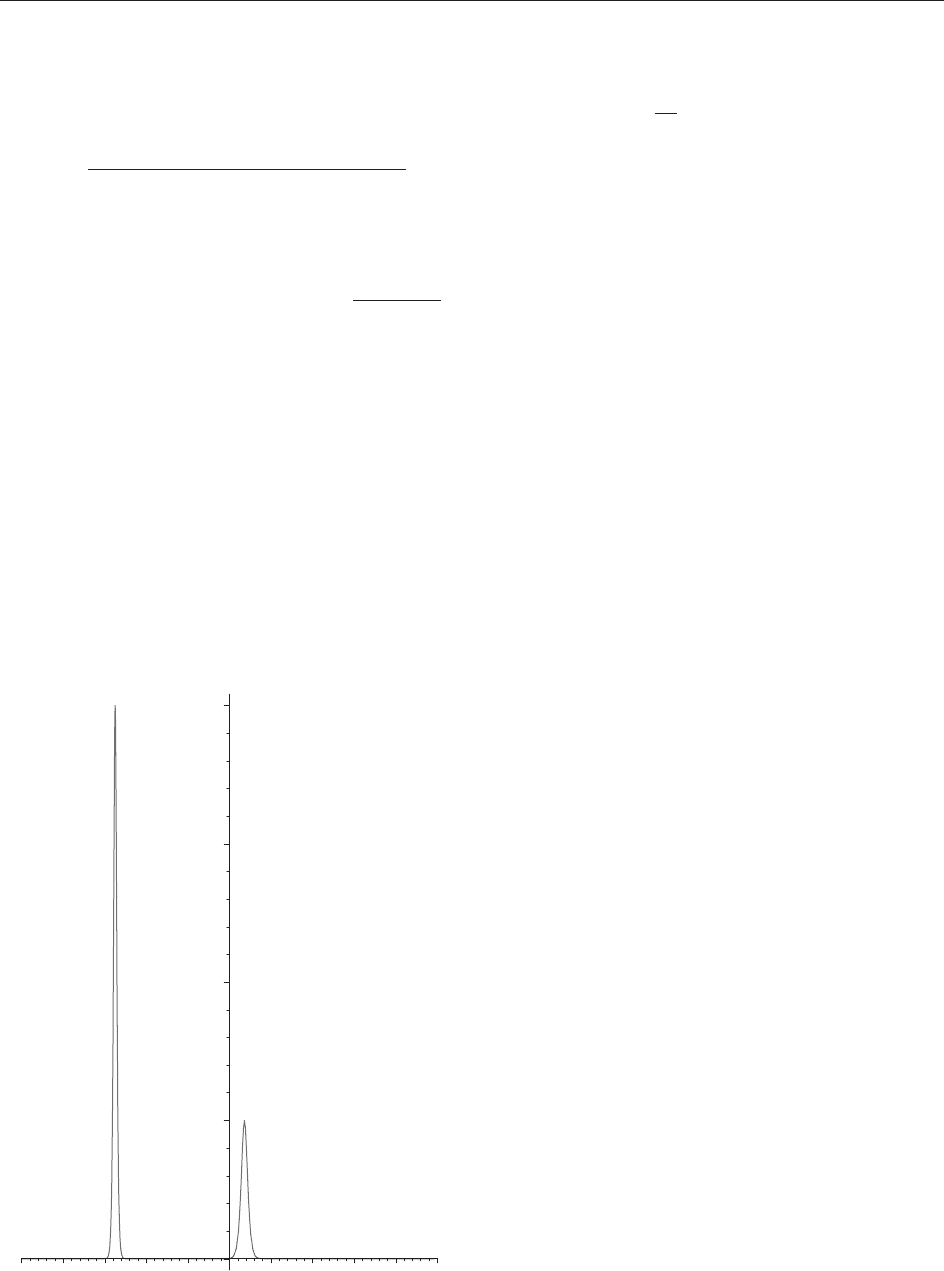
are constants. A snapshot of this solution
with p
1
= 1, p
2
= 2 is given in Figure 1. After some
time the taller soliton will overtake the shorter one
and the only effect of the interaction will be a ‘‘phase
shift,’’ that is, a change in the pos ition the two
solitons would have reached without interaction.
Regarding the general method introduced in
Gardner et al. (1967),wenotethatifeqn [1] is
formulated on the infinite line, then the most interest-
ing problem is the solution of the initial-value
problem: given initial data q(x,0)= q
0
(x) which
decay as jxj!1,findq(x, t). If q
0
is small and qq
x
can be neglected, then eqn [1] becomes linear and
q(x, t) can be found using the Fourier transform,
qðx; tÞ¼
1
2
Z
1
1
e
ikxþik
3
t
^
q
0
ðkÞdk ½4a
where
^
q
0
ðkÞ¼
Z
1
1
e
ikx
q
0
ðxÞdx ½4b
The remarkable discovery of Gardner et al. (1967)
is that for eqn [1] there exists a ‘‘nonlinear analog’’ of
the Fourier transform capable of solving the initial-
value problem even if q
0
is not small. Although this
nonlinear Fourier transform cannot in general be
written in closed form, q(x, t) can be expressed
through the solution of a linear integral equation, or
more precisely through the solution of a linear 2 2
matrix Riemann–Hilbert (RH) problem (see the
section ‘‘A nonlinear Fourier transform’’). This linear
integral equation is uniquely specified in terms of
q
0
(x). For particular initial data, q(x, t) can be written
explicitly. For example, if q
0
(x) = q
1
(x), where q
1
(x)is
obtained by evaluating eqn [2] at t = 0, then
q(x, t) = q
1
(x p
2
t). Similarly, if q
0
(x) = q
2
(x, 0),
where q
2
(x, 0) is obtained by evaluating eqn [3] at
t = 0, then q(x, t) = q
2
(x, t).
The most important question, both physically and
mathematically, is the description of the long-time
behavior of the solution of the initial-value problem
mentioned above. If the nonlinear term of eqn [1] can
be neglected, one finds a linear dispersive equation. In
this case different waves travel with different wave
speeds, these waves cancel each other out and the
solution decays to zero as t !1. Indeed, using
the stationary-phase method to compute the large
t behavior of the integral appearing in eqn [4a],
it can be shown that q(x, t) decays like 0(1=
ffiffi
t
p
)
as t !1, x=t = 0(1). The situation with the KdV
equation is more interesting: dispersion is balanced by
nonlinearity and q(x, t) has a ‘‘nontrivial’’ asymptotic
behavior as t !1. Indeed, using a nonlinear analog
of the steepest descent method discovered by Deift and
Zhou (1993) to analyze the RH problem mentioned
earlier, it can be shown that q( x, t) asymptotes to
q
N
(x, t), where q
N
(x, t) is the exact N-soliton solution.
This underlines the physical and mathematical sig-
nificance of solitons: they are the coherent structures
emerging from any initial data as t !1.This
implies that i f a nonlinear phenomenon is modeled
by the KdV equation on the infinite line, then one
can immediately predict the structure of the solution
as t !1, x=t = 0(1): it will consist of N ordered
single solitons, where the highest soliton occur s to
the right; t he number N and the parameters p
j
and
0
j
depend on the particular initial data q
0
(x). It should
0
0.5
1
1.5
2
–100 –80 –60 –40 –20 20 40 60 80 100
x
Figure 1 A snapshot of the 2-soliton solution of the KdV equation.
94 Integrable Systems and the Inverse Scattering Method

be noted that this result can be obtained only using
the machinery of the theory of integrability, and
until now cannot be obtained using standard PDE
techniques.
So far we have concentrated on the KdV equation.
However, there exist numerous other equations
which exhibit similar behavior. Such equations are
called ‘‘integrable’’ and the method of solving their
initial-value problem is called the ‘‘inverse-scattering’’
or ‘‘inverse-spectral’’ method.
The following section presents a brief historical
review of some of the important developments of
soliton theory. Next, typical solitons, lumps, and
dromions are given. The inverse-spectral method is
discussed in the penultimate section. Finally, the
extension of this method to boundary-value prob-
lems is briefly discussed.
Important Analytical Developments in
Soliton Theory
Lax (1968) introduced the so-called Lax pair
formulation of the KdV. In an example, he showed
that eqn [1] can be written as the compatibility
condition of the following pair of linear eigenvalue
equations for the eigenfunction (x, t, k):
xx
þðq þ k
2
Þ ¼ 0 ½5a
t
þð2q 4k
2
Þ
x
ðq
x
þ Þ ¼ 0; k 2 C ½5b
where is an arbitrary constant. The nonlinear
Fourier transform mentioned earlier can be obtained
by performing the spectral analysis of eqn [5a]. The
time evolution of the associated nonlinear Fourier
data, which are now called spectral data, is linear
and can be determined using eqn [5b]. Following
Lax’s formulation, Zakharov and Shabat (1972)
solved the nonlinear Schro¨ dinger (NLS) equation
iq
t
þ q
xx
2jqj
2
q ¼ 0;¼1 ½6
which has ubiquitous physical applications including
nonlinear optics. Soon thereafter the sine-Gordon
equation
q
xx
q
tt
¼ sin q ½7
and the modified KdV equation
q
t
þ 6q
2
q
x
þ q
xxx
¼ 0 ½8
were solved. Since then, numerous nonlinear equations
have been solved. Thus, the mathematical technique
introduced by Gardner et al. (1967) for the solution
of a particular physical equation gave rise to a new
method in mathematical physics, the so-called inverse-
scattering (spectral) method. Among the most
important equations solved by this method are a
particular two-dimensional reduction of Einstein’s
equation and the self-dual Yang–Mills equations.
The next important development in the analysis of
integrable equations was the study of the KdV with
space-periodic initial data. This occurred in the
mid-1970s in the USA and in the USSR. This method
involves algebraic-geometric techniques; in particular
there exists a periodic analog of the N-soliton
solution which can be expressed in terms of a certain
Riemann-theta function of genus N.
In the mid-1970s, it was also realized that there
exist integrable ODEs. For example, a stationar y
reduction of some of the equations introduced in
connection with the space-periodic problem men-
tioned above led to the integration of some classical
tops. Furthermore, the similarity reduction of some
of the integrable PDEs led to the classical Painleve´
equations. For example, letting q = t
1=3
u(),
= xt
1=3
in the modified KdV equation [8], and
integrating we find
d
2
d
2
þ 2u
3
1
3
u þ ¼ 0 ½9
where is a constant. This is Painleve´ II, that is, the
second equation in the list of six classical ODEs
introduced by Painleve´ and is his school around 1900.
These equations are nonlinear analogs of the linear
special functions such as Airy, Bessel, etc. The connec-
tion between integrable PDEs and ODEs of the Painleve´
type was established by Ablowitz and Segur (1977).
Their work marked a new era in the theory of these
equations. Indeed, soon thereafter Flaschka and Newell
(1980) introduced an extension of the inverse-spectral
method, the so-called isomonodromy method, capable
of integrating these equations. The most remarkable
achievement of this new development is the construction
of nonlinear analogs of the classical connection formulas
that exist for the linear special functions. These
formulas, although rather complicated, are as explicit
as the corresponding linear ones (Fokas et al. 2005).
It was mentioned earlier that the inverse-spectral
method gives rise to a matrix RH problem. An RH
problem involves the determination of a function
analytic in given sectors of the complex plane, from
the knowledge of the jumps of this function across the
boundaries of these sectors. The algebraic-geometric
method for solving the space-periodic initial-value
problem can be interpreted as formulating an RH
problem which can be analyzed using functions defined
on a Riemann surface. Also, it was noted by Fokas and
Ablowitz (1983a) and later rigorously established by
Fokas and Zhou (1992) that the isomonodromy
method also gives rise to a novel RH problem. This
Integrable Systems and the Inverse Scattering Method 95

implies the following interesting unification: Self-
similar, decaying, and periodic initial-value problems
for integrable evolution equations in one space variable
lead to the study of the same mathematical object,
namely to the RH problem.
Every integrable nonlinear evolution equation in
one spatial dimension has several integrable versions in
two spatial dimensions. Two such integrable physical
generalizations of the Korteweg–deVries equation are
the so-called Kadomtsev–Petviashvili I (KPI) and II
(KPII) equations. In the context of water waves, they
arise in the weakly nonlinear, weakly dispersive, weakly
two-dimensional limit, and in the case of KPI when
the surface tension is dominant. The NLS equation also
has two physical integrable versions known as the
Davey–Stewartson I (DSI), and II (DSII) equations. They
can be derived from the classical water-wave problem in
the shallow-water limit and govern the time evolution of
the free surface envelope in the weakly nonlinear,
weakly two-dimensional, nearly monochromatic limit.
The KP and DS equations have several other physical
applications.
A method for solving the Cauchy problem for
decaying initial data for integrable evolution equations
in two spatial dimensions emerged in the early 1980s.
This method is sometimes referred to as the
@ (d-bar)
method. We recall that the inverse-spectral method
for solving nonlinear evolution equations on the line
is based on a matrix RH problem. This problem
expresses the fact that there exist solutions of the
associated x-part of the Lax pair which are sectionally
analytic. Analyticity survives in some multidimen-
sional problems: it was shown formally by Fokas and
Ablowitz (1983b) that KPI gives rise to a nonlocal RH
problem. However, for other multidimensional pro-
blems, such as the KPII, the underlying eigenfunctions
are nowhere analytic and the RH problem must be
replaced by the
@ problem. Actually, a
@ problem had
already appeared in the work of Beals and Coifman
(1982) where the RH problem appearing in the analysis
of one-dimensional systems was considered as a special
case of a
@ problem. Soon thereafter, it was shown in
Ablowitz et al. (1983) that KPII required the essential
use of the
@ problem. The situation for the DS equations
is analogous to that of the KP equations.
Multidimensional integral PDEs can support
localized solutions. Actually there exist two types
of localized coherent structures associated with
integrable evolution equatio ns in two spatial vari-
ables: the ‘‘lumps’’ and the ‘‘dromions.’’ The spectral
meaning, and therefore the genericity of these
solutions was established by Fokas and Ablowitz
(1983b) and Fokas and Santini (1990).
The analysis of integrable singular integro-differential
equations and of integrable discrete equations, although
conceptually similar to the analysis reviewed above, has
certain novel features.
The fact that integrable nonlinear equations
appear in a wide range of phy sical applications is
not an accident but a consequence of the fact that
these equations express a cert ain physical coherence
which is natural, at least asymptotically, to a variety
of nonlinear phenomena. Indeed, Calogero (1991)
has emphasized that large classes of nonlinear
evolution PDEs, characterized by a dispersive linear
part and a largely arbitrary nonlinear part, after
rescaling yield asymptotically equations (for the
amplitude modulation) having a universal character.
These ‘‘universal’’ equations are, therefore, likely to
appear in many physical applications. Many integr-
able equations are precisely these ‘‘universal’’ models.
Solitons, Lumps, and Dromions
Solitons, lumps, and dromions, are important not
because they are exact solutions, but because they
characterize the long-time behavior of integrable
evolution equations in one and two space dimen-
sions. The question of solving the initial-value
problem of a given integrable PDE, and then
extracting the long-time behavior of the solution is
quite complicated. It involves spectral analysis, the
formulation of either an RH problem or of a
@
problem, and rigorous asymptotic techniques. On
the other hand, having established the importance of
solitons, lumps, and dromio ns, it is natural to
develop methods for obtaining these particular
solutions directly, avoiding the difficult approaches
of spectral theory. There exist several such direct
methods, including the so-called Ba¨ cklund transfor-
mations, the dressing method of Zakharov–Shabat,
the direct linearizing method of Fokas–Ablowitz,
and the bilinear approach of Hirota.
Solitons
Using the bilinear approach, multisoliton solutions
for a large class of integrable nonlinear PDEs in
one space dimension are given in Hi etarinta
(2002). Here we only note that the 1-soliton
solution of the N LS [6] , of t he sine-Gordon [7],
and of the modified KdV equation [8] are g iven,
respectively, by
qðx; tÞ=
p
R
e
iðp
I
xþ p
2
R
p
2
I
ðÞ
tþÞ
cosh½p
R
ðx 2p
I
tÞþ
½10
qðpx þ qtÞ= 4 arc tan½e
pxþqtþ
; p
2
¼ 1 þ q
2
½11
96 Integrable Systems and the Inverse Scattering Method