
Francoise J.-P., Naber G.L., Tsun T.S. (editors) Encyclopedia of Mathematical Physics
Подождите немного. Документ загружается.

qðx p
2
t Þ=
p
cosh½px p
2
t þ
½12
where p
R
, p
I
, , p, q are real constants.
Lumps
The KPI equation is
@
x
½q
t
þ 6qq
x
þ q
xxx
¼3q
yy
½13
The 1-lump solution of this equation is give n by
qðx; y; tÞ¼2@
2
x
ln jLðx; y; tÞj
2
þ
1
4
2
I
;
L ¼ x 2y þ 12
2
t þ a
¼
R
þ i
I
;
I
> 0
½14
where and a are complex constants.
The focusing DSII equation is
iq
t
þ q
zz
þ q
z
z
2q @
1
z
jqj
2
z
þ @
1
z
jqj
2
z
= 0 ½15
where z = x þ iy, and the operator @
1
z
is defined by
@
1
z
f
ðz;
zÞ¼
1
2i
Z
R
2
f ð;
Þ
z
d ^ d
The 1-lump solution of this equation is give n by
qðz;
z; tÞ¼
e
iðp
2
þ
p
2
Þtþpz
p
z
jz þ þ 2iptj
2
þjj
2
½16
where , , p are complex constants. A typical
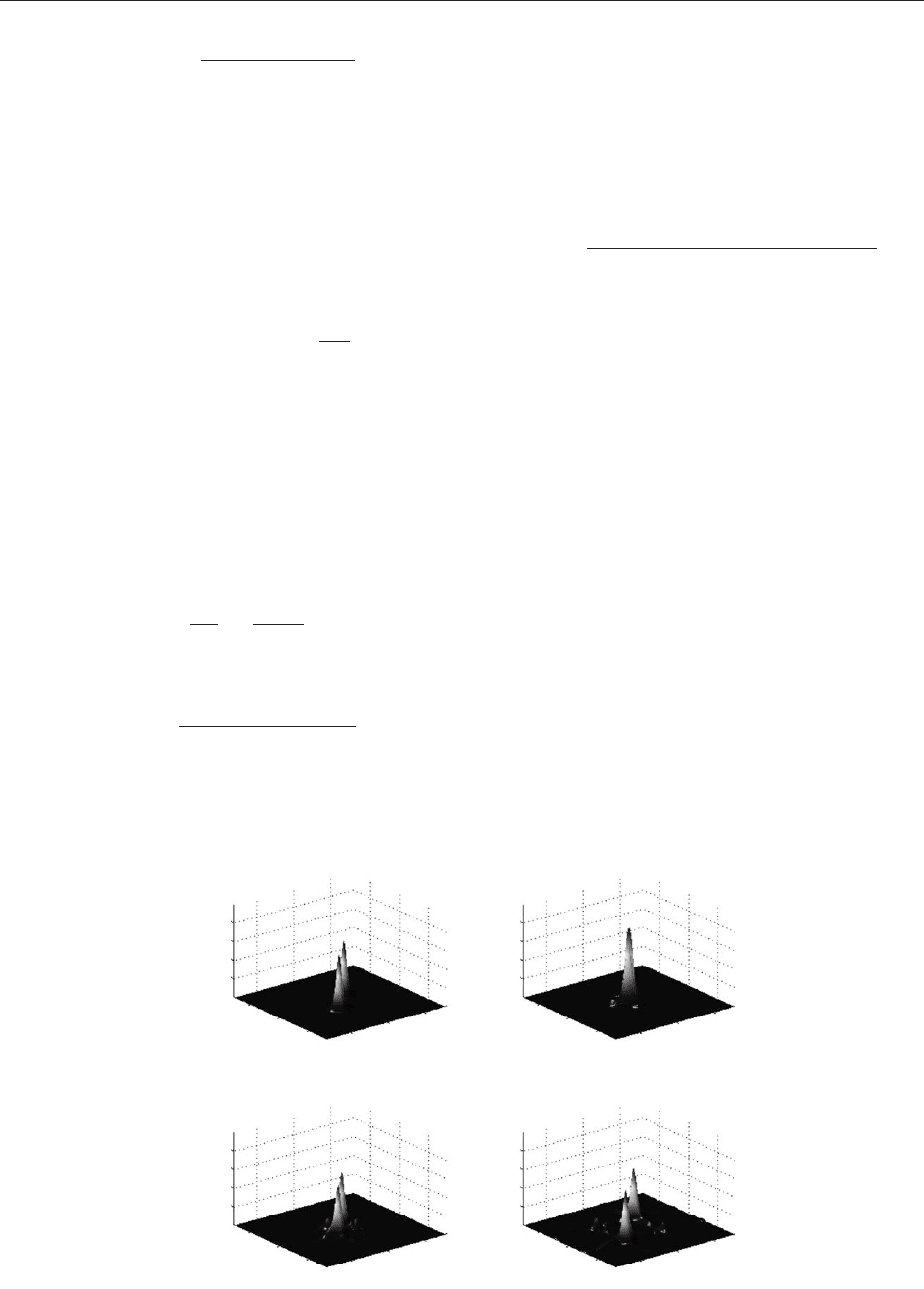
1-lump solution is depicted in Figure 2.
Dromions
The DSI equation is
iq
t
þ @
2
x
þ @
2
y
q þ qu ¼ 0
u
xy
¼ 2 @
2
x
þ @
2
y
jqj
2
½17
The 1-dromion solution of this equation is given by
qðx; y; tÞ¼
e
X
Y
e
Xþ
X
þ e
Y
Y
þ e
Xþ
XY
Y
þ
X ¼ px þ ip
2
t; Y ¼ qy þ iq
2
t
jj
2
¼ 4p
R
q
R
ð Þ
½18
where p, q are complex consta nts and , , , are
positive constants.
A Nonlinear Fourier Transform
The solution of the initial-value problem of an
integrable nonlinear evolution equation on the
infinite line is based on the spectral analysis of the
x-part of the Lax pair. Thus, for the KdV equation
one must analyze eqn [5a]. This equation is the
famous time-independent Schro¨ dinger equation. We
now give a physical interpretation of the relevant
spectral analysis. Let KdV describe the propagation
of a water wave and suppose that this wave is frozen
at a given instant of time. By bombarding this water
wave with quantum particles, one can reconstruct its
shape from knowledge of how these particles
scatter. In other words, the scattering data provide
an alternative description of the wave at fixed time.
abs u
abs u abs u
t
= –3
t
= 2.3
t
= 4.95
abs u
t
= –0.35
0.8
0.6
0.4
0.2
N
20
20
0
0
–20
–20
y
x
0.8
0.6
0.4
0.2
N
20
20
0
0
–20
–20
y
x
0.8
0.6
0.4
0.2
N
20
20
0
0
–20
–20
y
x
0.8
0.6
0.4
0.2
N
20
20
0
0
–20
–20
y
x
Figure 2 A typical 1-lump solution.
Integrable Systems and the Inverse Scattering Method 97

The mathematical expression of this description
takes the form of a linear integral equation found
by Faddeev (the so-called Gel’fand–Levitan–March-
enko equation) or equivalently the form of a 2 2
matrix RH problem uniquely specified by the
scattering data. This alternative description of the
shape of the wave will be useful if the evolution of
the scattering data is simple. This is indeed the case,
namely using eqn [5b], it can be shown that the
scattering data evolve linearly. Thus, this highly
nontrivial change of variables from the physical to
scattering space provides a linearization of the KdV
equation.
In what follows we will describe some of the
relevant mathematical formulas. We first
‘‘assume’’ that t here exists a real sol ution q(x, t)
of the initial-value problem which has sufficient
smoothness and which decays for all t as jxj!1.
We then discuss how this assumption can be
eliminated.
As it was mentioned earlier most of the analysis
of the inverse-scattering transform is carried out
on the x-part of the Lax pair, that is, on eqn [5a].
Hence, we first concentrate on eqn [5a] and for
convenience of notation we suppress the time
dependence.
The Direct Problem
As jxj!1, q ! 0, thus there exist solutions of eqn
[5a] which tend to exp[ ikx]asjxj!1. Let
(k, x)and
ˆ
(k, x) denote solutions of eqn [5a]
with the following asymptotic property:
! e
ikx
;
^
! e
ikx
; as x !1; k 2 R ½19
Under the transformation k !k, eqn [5a] remains
invariant and the bounda ry condition for is mapped
to the boundary condition for
ˆ
. Hence
^
ðk; xÞ¼ ðk; xÞ½20
We denote by (k, x) the solution of eqn [5a] which
tends to exp[ikx]asx !1,
! e
ikx
; as x !1; k 2 R ½21
It is more convenient to work with eigenfunctions
(i.e., solutions of [5a]) normalized to unity as x !1,
thus we introduce M(k, x)andN(k, x)asfollows:
M ¼ e
ikx
; N ¼ e
ikx
½22
The functions M and N can be expressed in terms of
q through the solution of linear Volterra integral
equations. Indeed, M satisfies
M
xx
2ikM
x
¼qM; k 2 R
M ! 1; x !1 ½23
The homogeneous version of [23] has solutions 1
and e
2ikx
. Thus,
M ¼ c
1
þ c
2
e
2ikx
þ M
p
½24
where c
1
, c
2
are constants and M
p
is given by
M
p
¼ u
1
ðxÞþu
2
ðxÞe
2ikx
½25
The functions u
1
, u
2
satisfy
u
0
1
þ e
2ikx
u
0
2
¼ 0; 2ike
2ikx
u
0
2
¼qM
Thus,
u
1
ðxÞ¼
1
2ik
Z
x
1
dqðÞMðk;Þ;
u
2
ðxÞ¼
1
2ik
Z
x
1
de
2ik
qðÞMðk;Þ
½26
Substituting [25] and [26] into [24] and using the
boundary condition [23], we find
Mðk; xÞ
¼ 1 þ
i
2k
Z
x
1
dð1 þ e
2ikðxÞ
ÞqðÞMðk;Þ½27
Similarly, one may establish that N sati sfied
Nðk; xÞ
¼ 1 þ
i
2k
Z
1
x
dð1 þ e
2ikðxÞ
ÞqðÞNðk;Þ½28
The kernel of eqn [27], as a function of k,is
bounded and analytic for Im k > 0. Thus, if q 2
L
1
, M(k, x) as a function of k is holomorphic for
Im k > 0. Similarly, N(k, x) as a function of k is
holomorphic for Im k > 0.
Thus, we have found particular solutions of eqn
[5a] which are holomorphic for Im k > 0. Further-
more, these solutions are simply related for k real.
Indeed, the linear independence of solutions of the
second-order ODE [5a] implies
ðk; xÞ¼aðkÞ
^
ðk; xÞþbðkÞ ðk; xÞ; k 2 R
Using [20] and replacing and in terms of M and
N, we find
Mðk; xÞ
aðkÞ
¼ Nðk; xÞþðkÞe
2ikx
Nðk; xÞ
ðkÞ¼
bðkÞ
aðkÞ
; k 2 R ½29
98 Integrable Systems and the Inverse Scattering Method

The functions a(k) and b(k) are given by
aðkÞ¼1
i
2k
Z
1
1
dqðÞMðk;Þ; k 2 R
bðkÞ¼
i
2k
Z
1
1
dqðÞMðk;Þe
2ik
; k 2 R
½30
Indeed as x !1, N ! 1, thus, eqn [29] implies
M ! aðkÞþbðkÞe
2ikx
as x !1 ½31
On the other hand, eqn [27] implies that
M ! 1 þ
i
2k
Z
1
1
dð1 þ e
2ikðxÞ
qðÞMðk;ÞÞ
x !1 ½32
Comparing eqns [31] and [32], we find eqns [30].
The expression for a(k) implies that this function
is also holomorphic for Im k > 0.
In summary, in the ‘‘direct pr oblem,’’ we have
found particular solutions of eqn [5a] which are
sectionally holomorphic :
Mðk; xÞ
Nðk; xÞ
and
Mðk; xÞ
Nðk; xÞ
are holomorphic for Im k > 0 and Im k < 0, respec-
tively. These solutions, which are characterized in
terms of q by eqns [27] and [28], are simply related
by eqn [29].
The Inverse Problem
Equation [28] expresses N in terms of q. Is it possible
to find an alternative expression for N in terms of
some appropriate ‘‘spectral data’’? The answer is
positive and is a direct consequence of the fact that
eqn [29] defines the ‘‘jump condition’’ of an RH
problem. Indeed, it can be shown that a(k) may have
simple zeros k
1
, ..., k
n
in the positive imaginary axis
of the k-complex plane. Hence, in general, M=a can
be expressed in the form
Mðk; xÞ
aðkÞ
¼Mðk; xÞþ
X
n
j¼1
A
j
ðxÞ
k ip
j
; p
j
> 0
where M(k, x) as a function of k is holomorphic for
Im k > 0. It can also be shown that A
j
(x) = C
j
exp[2p
j
, x]N(k
j
, x). Hence eqn [29] becomes
Mðk; xÞNðk; xÞ
¼
X
n
j¼1
C
j
e
2p
j
x
Nðip
j
; xÞ
k ip
j
þðkÞe
2ikx
Nðk; xÞ; k 2 R
Taking the () projection of this equation, and
using the fact that both M and N tend to 1 as k !1,
we find
Nðk; xÞ
1
2i
Z
1
1
dlðlÞe
2ilx
Nðl; xÞ
l þ k þ i0
¼ 1
X
n
j¼1
C
j
e
2p
j
x
k þ ip
j
Nðip
j
; xÞ½33
In summary, this equation expressed N(k, x)in
terms of the scattering data ((k), {C
j
, p
j
}
n
1
).
Since both eqns [28] and [33] are associated with
the same q, these equations can be used to obtain
the following expression for q:
q ¼2
@
@x
"
1
2
Z
1
1
dlðlÞe
2ilx
Nðl; xÞ
i
X
n
j¼1
C
j
e
2p
j
x
Nðip
j
; xÞ
#
½34
Indeed, eqn [28] implies
lim
k!1
Nðk; xÞ¼1
i
2k
Z
1
x
dqðÞ
Comparing this expression with the large-k behavi or
of eqn [33], we find [34].
Time Dependence of the Scattering Data
We now use eqn [5b] to compute the time
dependence of the scattering data by evaluating
eqn [5b] as x !1 we find = 4ik
3
. Then,
evaluating it as x !1and using
ae
ikx
þ be
ikx
; x !þ1
we find
a
t
¼ 0; b
t
¼ 8ik
3
b
Hence,
aðt; kÞ¼að0; kÞ;ðt; kÞ¼ð0; kÞe
8ik
3
t
½35
Thus,
p
j
ðtÞ¼p
j
ð0Þ; C
j
ðtÞ¼C
j
ð0Þe
8p
3
j
t
½36
The above formal results motivate the follow-
ing definitions (for simplicity, we assume that a(k)
has no zeros). Given a decaying real function
Integrable Systems and the Inverse Scattering Method 99

q
0
(x), x 2 R, define M
0
(k, x) as the solution of the
linear Volterra integral equation
M
0
ðk;xÞ¼1 þ
i
2k
Z
x
1
dð1 þe
2ikðxÞ
qðÞM
0
ðk;ÞÞ
Im k 0
Given M
0
(k, x), define a
0
(k) and b
0
(k)by
M
0
ðk; xÞ!a
0
ðkÞþb
0
ðkÞe
2ikx
; x !1; k 2 R
Given a
0
and b
0
, define N(k, x, t) by the solution of
the linear integral equation
Nðk; x; tÞ
1
2
Z
1
1
dl
b
0
ðlÞ
a
0
ðlÞ
e
8il
3
tþ2ilx
Nðl; x; tÞ
l þ k þ i0
¼ 1
A theorem of Gohberg and Krein implies that this
equation has a unique global solution. Given
a
0
, b
0
, N, define q(x, t)by
qðx; tÞ¼
1
@
@x
Z
1
1
dk
b
0
ðkÞ
a
0
ðkÞ
e
8ik
3
tþ2ikx
Nðk; x; tÞ
Then it can be shown that q(x, t) satisfies the KdV
equation and q(x,0)= q
0
(x).
A Unification
After the emergence of a method for solving the
initial-value problem for nonlinear integrable evolu-
tion equations in one and two space variables, the
most outstanding open problem in the analysis of
these equations became the solution of initial
boundary-value problems. A general approach for
solving such problems for evolution equations in one
space dim ension was provided by Foka s (1997).
This approach has already been used for the study of
nonlinear integrable evolution PDEs on the half-line
(Fokas 2002, 2005), on the interval, and in a time-
dependent domain. An important advantage of this
new method is that it yields the formulation of a
matrix RH problem (or a
@ problem in the case of a
convex time-dependent domain), which although has
more complicated jump matrices than the analogous
problem on the infinite line, it still has an explicit
exponential (x, t) dependence. This fact allows one to
describe effectively the asymptotic properties of the
solution, using the powerful Deift–Zhou method
(Deift and Zhou 1993). For example, the long-time
asymptotics of boundary-value problems on the half
line are discussed in Fokas and Its (1996).
It is remarkable that the above results have
motivated the discovery of a new method for solving
boundary-value problems, not only for linear evolu-
tion PDEs, but also for linear elliptic PDEs in two
dimensions. This includes the Laplace, the biharmonic
and the Helmholtz equations in a convex polygon
(Dassios and Fokas 2005). In a most recent develop-
ment, this method has also been applied to certain
classes of linear PDEs with variable coefficients. This
highly unexpected development unifies and extends
several classical branches of mathematics. In particu-
lar, it unifies the classical transform methods for
simple linear PDEs as well as the method of images,
the treatment of linear PDEs via certain ingenious
techniques such as the Wiener–Hopf technique, the
formulation of Ehrenpreis type integral representa-
tions, and the solution of integrable nonlinear PDEs
via the inverse-scattering transform. Furthermore, it
extends these results to arbitrary domains and to
certain classes of PDEs with variable coefficients.
Regarding linear equations we note the following:
Almost as soon as linear two-dimensional PDEs
made their appearance, d’Alembert and Euler discov-
ered a general approach for constructing large classes
of their solutions. This approach involved separating
variables and superimposing solutions of the resulting
ODEs. The method of separation of variables natu-
rally led to the solution of PDEs by a transform pair.
The prototypical such pair is the direct and the inverse
Fourier transforms; variations of this fundamental
transform include the Laplace, Mellin, sine, cosine
transforms, and their discrete analogs.
The proper transform for a given boundary-value
problem is specified by the PDE, by the domain, and
by the given boundary conditions. For some simple
boundary-value problems, there exists an algorithmic
procedure for deriving the associated transform. This
procedure involves constructing the Green’s function
of a single eigenvalue equation, and integrating this
Green’s function in the k-complex plane, where
k denotes the eigenvalue.
The transform method has been enormously
successful for solving a great variety of initial- and
boundary-value problems. However, for sufficiently
complicated problems the classical transform method
fails. For example, there does not exist a proper analog
of the sine transform for solving a third-order evolution
equation on the half-line. Similarly, there do not exist
proper transforms for solving boundary-value pro-
blems for elliptic equations even of second order and in
simple domains. The failure of the transform method
led to the development of several ingenious but
ad hoc techniques, which include: conformal mappings
for the Laplace and the biharmonic equations; the
Jones method and the formulation of the Wiener–Hop f
factorization problem; the use of some integral
representation, such as that of Sommerfeld; the
100 Integrable Systems and the Inverse Scattering Method

formulation of a difference equation, such as the
Malyuzhinet’s equation. The use of these techniques
has led to the solution of several classical problems in
acoustics, diffraction, electromagnetism, fluid
mechanics, etc. The Wiener–Hopf technique played a
central role in the solution of many of these problems.
A crucial role in the new method is played by the
global equation satisfied by the boundary values of q
and of its derivatives. For evolution equations and for
elliptic equations with simple boundary conditions, this
involves the solution of a system of algebraic equations,
while for elliptic equations with arbitrary boundary
conditions, it involves the solution of an RH problem.
For simple polygons, this RH problem is formulated on
the infinite line, thus it is equivalent to a Wiener–Hopf
problem. This explains the central role played by the
Wiener–Hopf technique in many earlier works.
For linear PDEs, the explicit x
1
, x
2
dependence of
q(x
1
, x
2
) is consistent with the Ehrenpreis formulation
of the solution. Thus, this method provides the
concrete implementation as well as the generalization
to concave domains of this fundamental principle. For
nonlinear equations, it provides the extension of the
Ehrenpreis principle to integrable nonlinear PDEs.
See also: Boundary value Problems for Integrable
Equations;
@-Approach to Integrable Systems; Integrable
Systems and Algebraic Geometry; Integrable Discrete
Systems; Integrable Systems and Discrete Geometry;
Integrable Systems in Random Matrix Theory; Integrable
Systems: Overview; Korteweg–de Vries Equation and
Other Modulation Equations; Partial Differential
Equations: Some Examples; Riemann–Hilbert Methods in
Integrable Systems; Sine-Gordon Equation; Toda
lattices; Twistor Theory: Some Applications [in Integrable
Systems, Complex Geometry and String Theory].
Further Reading
Ablowitz MJ and Segur H (1977) Exact linearization of a Painleve´
transcendent. Physical Review Letters 38: 1103–1106.
Ablowitz MJ, Yaakov DB, and Fokas AS (1983) On the inverse
scattering transform for the Kadomtsev–Petviashvili equation.
Studies in Applied Mathematics 69: 135–142.
Beals R and Coifman RR (1982) Scattering, transformations
spectrales, et equations d’evolution nonlineaire. I. In: Seminaire
Goulaouic–Meyer–Schwartz, Expose`21.E
´
cole Polytechnique,
Palaiseau.
Calogero F (1991) In: Zakharov VE (ed.) What Is Integrability?,
Springer.
Dassios G and Fokas AS (2005) The basic elliptic equations in an
equilateral triangle. Proceedings of the Royal Society of
London, Series A 461: 2721–2748.
Deift PA and Zhou X (1993) A steepest descent method for
oscillatory Riemann–Hilbert problems. Annals of Mathematics
137: 245–338.
Flaschka H and Newell AC (1980) Monodromy and spectrum-
preserving deformation I. Communications in Mathematical
Physics 76: 65–116.
Fokas AS (1997) A unified transform method for solving linear
and certain nonlinear PDE’s. Proceedings of the Royal Society
of London, Series A 453: 1411–1443.
Fokas AS (2002) Integrable nonlinear evolution equations on
the half-line. Communications in Mathematical Physics 230:
1–39.
Fokas AS (2005) A generalised Dirichlet to Neumann map for
certain nonlinear evolution PDEs. Communications on Pure
and Applied Mathematics 58: 639–670.
Fokas AS and Ablowitz MJ (1983a) On the initial value problem
of the second Painleve´ transcendent. Communications in
Mathematical Physics 91: 381–403.
Fokas AS and Ablowitz MJ (1983b) On the inverse scattering of
the time dependent Schro¨ dinger equation and the associated
KPI equation. Studies in Applied Mathematics 69: 211–228.
Fokas AS and Its AR (1996) The linearization of the initial-
boundary value problem of the nonlinear Schro¨ dinger equa-
tion. SIAM Journal on Mathematical Analysis 27: 738–764.
Fokas AS and Santini PM (1990) Dromions and a boundary value
problem for the Davey–Stewartson I equation. Physica D 44:
99–130.
Fokas AS and Zhou X (1992) On the solvability of Painleve´II
and IV. Communications in Mathematical Physics 144:
601–622.
Fokas AS, Its AR, Kapaev AA, and Novokshenov VY (2006)
Painleve´ Transcendents: The Riemann–Hilbert Approach.
Providence, RI: American Mathematical Society.
Gardner CS, Greene JM, Kruskal MD, and Miura RM (1967)
Method for solving the Korteweg–de Vries equation. Physical
Review Letters 19: 1095–1097.
Hietarinta J (2002) Scattering of solitons and dromions. In: Sabatier
P and Pike E (eds.) Scattering. San Diego: Academic Press.
Lax PD (1968) Integrals of nonlinear equations of evolution and
solitary waves. Communications on Pure and Applied Mathe-
matics 21: 467–490.
Zakharov V and Shabat A (1972) Exact theory of two-
dimensional self-focusing and one-dimensional self-modulation
of waves in nonlinear media. Soviet Physics – JEPT 34: 62–69.
Integrable Systems and the Inverse Scattering Method 101

Integrable Systems in Random Matrix Theory
C A Tracy, University of California at Davis, Davis,
CA, USA
H Widom, University of California at Santa Cruz,
Santa Cruz, CA, USA
ª 2006 Higher Education Press. Published by Elsevier Ltd.
All rights reserved.
An earlier version of this article was originally published as
‘‘Distribution functions for largest eigenvalues and their
applications’’. Proceedings of the International Congress of
Mathematics, Volume 1 (2002), pp. 587–596. Beijing, China:
Higher Education Press, with permission.
Random Matrix Models
A random matrix model is a probability space
(, P, F) where the sample space is a set of
matrices. There are three classic finite N random
matrix models (see, e.g., Mehta (1991)):
1. Gaussian orthogonal ensemble ( = 1):
(a) =N N real symmetric matrices;
(b) P= ‘‘unique’’ measure that is invariant under
orthogonal transformations and the matrix
elements are i.i.d. random vari ables; expli-
citly, the density is
c
N
exp trðA
2
Þ
dA ½1
where c
N
is a normalization constant and
dA =
Q
i
dA
ii
Q
i<j
dA
ij
, the product Lebesgue
measure on the independent matrix elements.
2. Gaussian unitary ensemble ( = 2):
(a) =N N Hermitian matrices;
(b) P= ‘‘unique’’ measure that is invariant
under unitary transformations and the (inde-
pendent) real and imaginary matrix elements
are i.i.d. random variables; and
3. Gaussian symplectic ensemble ( = 4) (see Mehta
(1991) for a definition).
Generally speaking, the interest lies in the
N !1limit of these models. Here we concentrate
on one aspect of this limit. In all three models the
eigenvalues, which are random variables, are real
and with probability 1 they are distinct. If
max
(A)
denotes the largest eigenvalue of the random
matrix A, then for each of the three Gaussian
ensembles we introduce the corresponding distri-
bution function
F
N;
ðtÞ :¼ P
ð
max
< tÞ;¼ 1; 2; 4
The basic limit laws (see Tracy and Widom
(1996) and references therein) state that
F
ðsÞ :¼ lim
N!1
F
N;
2
ffiffiffiffiffi
N
p
þ
s
N
1=6
;¼ 1; 2; 4 ½2
exist and are given explicitly by
F
2
ðsÞ¼det I K
Airy
¼ exp
Z
1
s
ðx sÞq
2
ðxÞdx
where
K
Airy
¼
:
AiðxÞAi
0
ðyÞAi
0
ðxÞAiðyÞ
x y
acting on L
2
ðs; 1ÞðAiry kernel Þ
and q is the unique solution to the Painleve´II
equation
q
00
¼ sq þ 2q
3
satisfying the condition
qðsÞAiðsÞ as s !1
in eqn [2] is the standard deviation of the
Gaussian distribution on the off-diagonal matrix
elements. For the normalization we have chosen
= 1=
ffiffiffi
2
p
; however, for subseque nt comparisons, the
normalization =
ffiffiffiffiffi
N
p
is perhaps more natural.
The orthogonal and symplectic distribution func-
tions are
F
1
ðsÞ¼exp
1
2
Z
1
s
qðxÞdx
ðF
2
ðsÞÞ
1=2
F
4
ðs=
ffiffiffi
2
p
Þ¼cosh
1
2
Z
1
s
qðxÞdx
ðF
2
ðsÞÞ
1=2
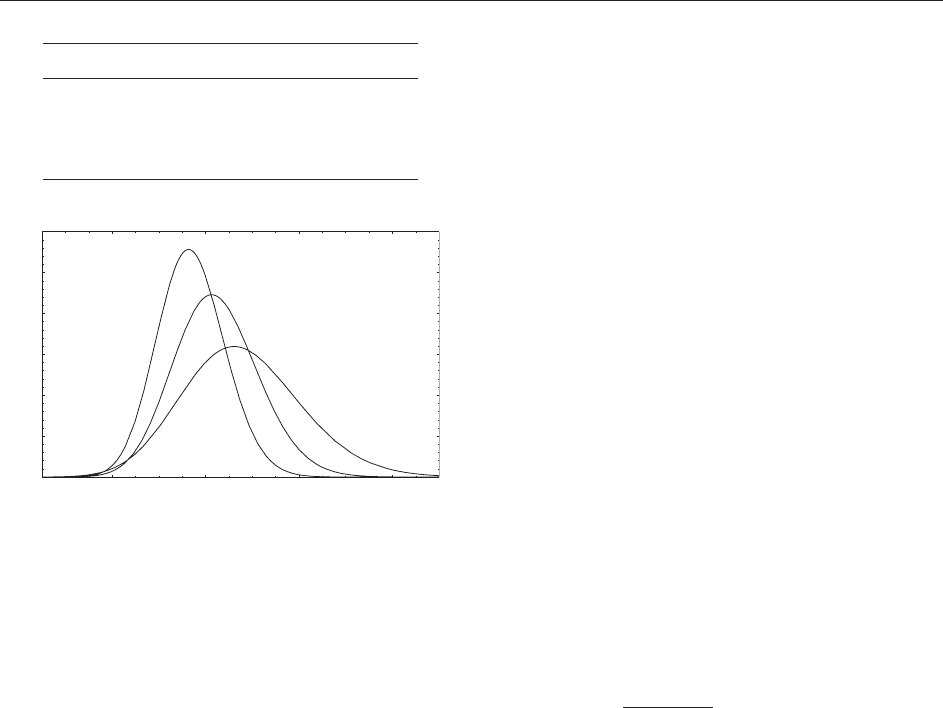
Graphs of the densi ties dF
=ds are in the adjacent
figure and some statistics of F
can be found in
Figure 1.
The Airy kernel is an example of an integrable
integral operator and a general theory is developed in
Tracy and Widom (1994). A vertex operator approach
to these distributions (and many other closely related
distribution functions in random matrix theory) was
initiated by Adler, Shiota, and van Moerbeke (see the
review article var Moerbeke (2001) for further
developments of this latter approach).
Historically, the discovery of the connection
between Painleve´ functions (P
III
in this case) and
Toeplitz/Fredholm determinants appears in work
of Wu et al. (1976) on the spin–spin correlation
functions of the two-dimensional Ising model. Painleve´
functions first appear in random matrix theory in
102 Integrable Systems in Random Matrix Theory
Jimbo et al. (1980) where they prove that the Fredholm
determinant of the sine kernel is expressible in terms of
P
V
. Gaudin (using Mehta’s then newly invented
method of orthogonal polynomials (Porter 1965))
was the first to discover the connection between
random matrix theory and Fredholm determinants.
Universality Theorems
A natural question is to ask whether the above limit
laws depend upon the underlying Gaussian assump-
tion on the probability measure. To investigate this for
unitarily invariant measures ( = 2), one replaces in [1]
exp trðA
2
Þ
! exp trðVðAÞÞðÞ
Bleher and Its (1999) choose
VðAÞ¼gA
4
A
2
; g > 0
and subsequently a large class of potentials V was
analyzed by Deift et al. (1999). These analyses
require proving new Plancherel–Rotach type formu-
las for nonclassical orthogon al polynomials. The
proofs use Rieman n–Hilbert methods. It was shown
that the generic behavior is GUE; hence, the limit
law for the largest eigenvalue is F
2
. However, by
finely tuning the potential new universality classes
will emerge at the edge of the spectrum . For = 1, 4
a universality theorem was proved by Stojanovic
(2000) for the quartic potential.
In the case of noninvariant measures, Soshnikov
(1999) proved that for real symmetric Wigner matrices
(complex Hermitian Wigner matrices), the limiting
distribution of the largest eigenvalue is F
1
(respectively,
F
2
). (A symmetric Wigner matrix is a random matrix
whose entries on and above the main diagonal are
independent and identically distributed random vari-
ables with distribution function F. Soshnikov assumes
that F is even and all moments are finite.) The
significance of this result is that non-Gaussian Wigner
measures lie outside the ‘‘integrable class’’ (e.g., there
are no Fredholm determinant representations for the
distribution functions) yet the limit laws are the same as
in the integrable cases.
Appearance of F
in Limit Theorems
In this section we briefly survey the appearances of
the limit laws F
in widely differing areas.
Combinatorics
A major breakthrough occurred with the work of
Baik, Deift, and Johansson (see Baik et al. (2000) and
references therein) when they proved that the limiting
distribution of the length of the longest increasing
subsequence in a rando m permutation is F
2
. Precisely,
if ‘
N
() is the length of the longest increasing
subsequence in the permutation 2 S
N
, then
P
‘
N
2
ffiffiffiffiffi
N
p
N
1=6
< s
!
! F
2
ðsÞ
as N !1. Here the probability measure on the
permutation group S
N
is the uniform measure.
Further discussion of this result can be found in
Johansson (2000b).
Baik and Rains (2001) showed by restricting the set
of permutations (and these restrictions have natural
symmetry interpretations) that F
1
and F
4
also appear.
Even the distributions F
2
1
and F
2
2
(Tracy and Widom
1999) arise. By the Robinson–Schensted–Knuth corre-
spondence, the Baik–Deift–Johansson result is equiva-
lent to the limiting distribution on the number of boxes
in the first row of random standard Young tableaux.
(The measure is the push-forward of the uniform
measure on S
N
.) These same authors conjectured that
the limiting distributions of the number of boxes in the
second, third, etc., rows were the same as the limiting
distributions of the next-largest, next-next-largest,
etc., eigenvalues in GUE. Since these eigenvalue
distributions were also found in Tracy and Widom
(1996), they were able to compare the then unpub-
lished numerical work of Odlyzko and Rains (2000)
with the predicted results of random matrix theory.
Subsequently, Baik et al. (2000) proved the conjecture
for the second row. The full conjecture was proved by
Okounkov (2000) using topological methods and by,
–4 –2 0 2
s
0.1
0.2
0.3
0.4
0.5
Probability densities
β
= 1
β
= 2
β
= 4
β
1
2
4
μ
β
–1.20653
–1.77109
–2.30688
σ
β
1.2680
0.9018
0.7195
S
β
0.293
0.224
0.166
K
β
0.165
0.093
0.050
Figure 1 The mean (
), standard deviation (
), skewness
(S
), and kurtosis (K
)ofF
.
Integrable Systems in Random Matrix Theory 103

among others, Johansson (2001) using analytical
methods. For an interpretation of the Baik–Deift–
Johansson result in terms of the card game patience
sorting, see the very readable review paper by Aldous
and Diaconis (1999).
Growth Processes
Growth processes have an extensive history both in
the probability literature and the physics literature
(see, e.g., Meakin (1998) and references therein), but
it was only recently that Johansson (2002b) proved
that the fluctuations about the limiting shape in a
certain growth model (‘‘corner growth model’’) are
F
2
. Johansson further pointed out that certain
symmetry constraints (inspired from the Baik and
Rains (2001) work) lead to F
1
fluctuations (see
Growth Processes in Random Matrix Theory).
Subsequently, Baik and Rains (2000) and Gravner
et al. (2002) have shown the same distribution
functions appearing in closely related lattice growth
models. Pra¨hofer and Spohn (2000) reinterpreted the
work of Baik et al. in terms of the physicists’ poly-
nuclear growth (PNG) model thereby clarifying the role
of the symmetry parameter . For example, = 2
describes growth from a single droplet, whereas = 1
describes growth from a flat substrate. They also
related the distribution functions F
to fluctuations of
the height function in the KPZ equation (Kardar et al.
1986, Meakin 1998). (The connection with the KPZ
equation is heuristic.) Thus, one expects on physical
grounds that the fluctuations of any growth process
falling into the 1 þ 1KPZ universality class will be
described by the distribution functions F
or one of the
generalizations by Baik and Rains (2000).Sucha
physical conjecture can be tested experimentally. Ear-
lier Myllys et al. established experimentally that a slow,
flameless burning process in a random medium (paper!)
is in the 1 þ 1KPZ universality class. This sequence of
events is a rare instance in which new results in
mathematics inspire new experiments in physics.
In the context of the PNG model, Pra¨hofer and
Spohn have given a process interpretation, the Airy
process, of F
2
.
There is an extension of the growth model in
Gravner et al. (2002) to growth in a random
environment. In Gravner et al. (2002) the following
model of interface growth in two dimensions is
considered by introducing a height function on the
sites of a one-di mensional integer lattice with the
following update rule: the height above the site x
increases to the height above x 1, if the latter
height is larger; otherwise, the height above x
increases by 1 with probability p
x
. It is assumed
that the p
x
are chosen independently at random with
a common distribution function F, and that the initial
state is such that the origin is far above the other sites.
In the pure regime, Gravner–Tracy–Widom identify
an asymptotic shape and prove that the fluctuations
about that shape, normalized by the square root of
the time, are asymptotically normal. This contrasts
with the quenched version: conditioned on the
environment and normalized by the cube root of
time, the fluctuations almost surely approach the
distribution function F
2
. We mention that these same
authors find, under some conditions on F at the right
edge, a composite regime where now the interface
fluctuations are governed by the extremal statistics of
p
x
in the annealed case while the fluctuations are
asymptotically normal in the quenched case.
Random Tilings
The Aztec diamond of order n is a tiling by dominoes of
the lattice squares [m, m þ 1] [‘, ‘ þ 1], m, n 2 Z,
that lie inside the region {(x, y):jxjþjyjn þ 1}. A
domino is a closed 1 2or2 1 rectangle in R
2
with
corners in Z
2
. A typical tiling is shown in Figure 2.One
observes that near the center the tiling appears random,
called the temperate zone, whereas near the edges the
tiling is frozen, called the polar zones. As n !1 the
boundary between the temperate zone and the polar
zones (appropriately scaled) converges to a circle
(‘ ‘arctic circle theorem’’). Johansson (2002a) proved
that the fluctuations about this limiting circle are F
2
.
Statistics
Johnstone (2001) considers the largest principal
component of the covariance matrix X
t
X where X
is an n p data matrix all of whose entries are
independent standard Gaussian variables and proves
that for appropriate centering and scaling, the
limiting distribution equals F
1
in the limit n, p !1
with n=p ! 2 R
þ
. Soshnikov has removed the
Gaussian assumption but requires that n p =
O(p
1=3
). Thus, we can anticipate applications of
the distributions F
(and particularly F
1
) to the
statistical analysis of large data sets.
Figure 2 Random tilings.
104 Integrable Systems in Random Matrix Theory

Queuing Theory
Glynn and Whitt (1991) consider a series of n single-
server queues each with unlimited waiting space
with a first-in and first-out service. Service times are
i.i.d. with mean one and variance
2
with distribu-
tion V. The quantity of interest is D(k, n), the
departure time of customer k (the last customer to
be served) from the last queue n. For a fixed number
of customers, k, they prove that
Dðk; nÞn
ffiffiffi
n
p
converges in distribution to a certain functional
^
D
k
of k-dimensional Brownian motion. They show that
^
D
k
is independent of the service time distribution V.
It was shown in, for example, Gravner et al. (2002)
that
^
D
k
is equal in distribution to the largest
eigenvalue of a k k GUE random matrix. This
fascinating connection has been greatly clarified in
recent work of O’Connell and Yor (2002).
From Johansson (2002), it follows for V Poisson that
P
Dðbxnc; nÞc
1
n
c
2
n
1=3
< s
! F
2
ðsÞ
as n !1 for some explicitly known constants c
1
and c
2
(depending upon x).
Superconductors
Vavilov et al. (2001) have conjectured (based upon
certain physical assumptions supported by numer-
ical work) that the fluctuation of the excitation gap
in a metal grain or quantum dot induced by the
proximity to a superconductor is described by F
1
for
zero magnetic field and by F
2
for nonzero magnetic
field. They conclude their paper with the remark:
The universality of our prediction should offer ample
opportunities for experimental observation.
Acknowledgments
This work was supported by the National Science
Foundation through grants DMS-9802122 and
DMS-9732687.
See also: Determinantal Random Fields; Growth
Processes in Random Matrix Theory; Integrable Systems
and Algebraic Geometry; Integrable Systems and the
Inverse Scattering Method; Integrable Systems:
Overview; Quantum Calogero–Moser Systems; Random
Partitions; Random Matrix Theory in Physics; Symmetry
Classes in Random Matrix Theory; Toeplitz Determinants
and Statistical Mechanics.
Further Reading
Aldous D and Diaconis P (1999) Longest increasing subsequences:
from patience sorting to the Baik–Deift–Johansson theory.
Bulletin of American Mathematical Society 36: 413–432.
Baik J, Deift P, and Johansson K (2000) On the distribution of the
length of the second row of a Young diagram under Plancherel
measure. Geometry of Functional Analysis 10: 702–731.
Baik J and Rains EM (2000) Limiting distributions for a polynuclear
growth model. Journal of Statistical Physics 100: 523–541.
Baik J and Rains EM (2001) Symmetrized random permutations.
In: Bleher P and Its A (eds.) Random Matrix Models and Their
Applications, Math. Sci. Res. Inst. Publications, vol. 40, pp.
1–19. Cambridge: Cambridge University Press.
Bleher P and Its A (1999) Semiclassical asymptotics of orthogonal
polynomials, Riemann–Hilbert problem, and universality in
the matrix model. Annals of Mathematics 150: 185–266.
Deift P, Kriecherbauer T, McLauglin K.T-R, Venakides S, and
Zhou X (1999) Uniform asymptotics for polynomials orthogo-
nal with respect to varying exponential weight and applications
to universality questions in random matrix theory. Commu-
nications on Pure and Applied Mathematics 52: 1335–1425.
Glynn PW and Whitt W (1991) Departure times from many
queues. Annals of Applied Probability 1: 546–572.
Gravner J, Tracy CA, and Widom H (2002) A growth model in a
random environment. Annals of Probability 30: 1340–1368.
Jimbo M, Miwa T, Moˆ ri Y, and Sato M (1980) Density matrix of
an impenetrable Bose gas and the fifth Painleve´ transcendent.
Physica D 1: 80–158.
Johansson K (2000) Shape fluctuations and random matrices.
Communications in Mathematical Physics 209: 437–476.
Johansson K (2001) Discrete orthogonal polynomial ensembles and
the Plancherel measure. Annals of Mathematics 153: 259–296.
Johansson K (2002a) Non-intersecting paths, random tilings and
random matrices. Probability Theory and Related Fields 123:
225–280.
Johansson K (2002b) Toeplitz determinants, random growth and
determinantal processes. In: Proceedings of the ICM, Beijing,
ICM vol. 3, pp. 53–62.
Johnstone I (2001) On the distribution of the largest principal
component. Annals of Statistics 29: 295–327.
Kardar M, Parisi G, and Zhang Y-C (1986) Dynamical scaling of
growing interfaces. Physical Review Letters 56: 889–892.
Meakin P (1998) Fractals, Scaling and Growth Far from
Equilibrium. Cambridge: Cambridge University Press.
Mehta ML (1991) Random Matrices, 2nd edn. Academic Press.
Myllys M, Maunuksela J, Alava M, Ala-Nissila T, Merikoski J,
and Timonen J Kinetic roughening in slow combustion of
paper. Physical Review E 64: 036101-1–036101-12.
Odlyzko AM and Rains EM On the longest increasing subse-
quences in random permutations. In: Grinberg EL, Berhanu S,
Knopp M, Mendoza G, and Quinto ET (eds.) Analysis,
Geometry, Number Theory: The Mathematics of Leon Ehren-
preis, American Mathematical Society. pp. 439–451.
O’Connell N and Yor M (2002) A representation for non-colliding
random walks. Electronic Communications in Probability 7: 1–12.
Okounkov A (2000) Random matrices and random permutations.
International Mathematics Research Notices 20: 1043–1095.
Porter CE (1965) Statistical Theories of Spectra: Fluctuations.
Academic Press.
Pra
¨hofer M and Spohn H (2000) Universal distributions for
growth processes in 1 þ 1 dimensions and random matrices.
Physical Review Letters 84: 4882–4885.
Soshnikov A (1999) Universality at the edge of the spectrum in
Wigner random matrices. Communications in Mathematical
Physics 207: 697–733.
Integrable Systems in Random Matrix Theory 105

Stojanovic A (2000) Universality in orthogonal and symplectic
invariant matrix models with quartic potential. Mathematical
Physics Analysis and Geometry 3: 339–373.
Tracy CA and Widom H (1994) Fredholm determinants,
differential equations and matrix models. Communications in
Mathematical Physics 163: 151–174.
Tracy CA and Widom H (1996) On orthogonal and symplectic
matrix ensembles. Communications in Mathematical Physics
177: 727–754.
Tracy CA and Widom H (1999) Random unitary matrices,
permutations and Painleve´. Communications in Mathematical
Physics 207: 665–685.
van Moerbeke P (2001) Integrable lattices: random matrices and
random permutations. In: Blcher P and Its A (eds.) Random
Matrix Models and Their Applications, Math. Sci. Res. Inst.
Publications vol. 40, pp. 321–406. Cambridge: Cambridge
Univ. Press.
Vavilov MG, Brouwer PW, Ambegaokar V, and Beenakker CWJ
(2001) Universal gap fluctuations in the superconductor
proximity effect. Physical Review Letters 86: 874–877.
Wu TT, McCoy BM, Tracy CA, and Barouch E (1976) Spin–spin
correlation functions of the two-dimensional Ising model:
exact theory in the scaling region. Physical Review B 13:
316–374.
Integrable Systems: Overview
Francesco Calogero, University of Rome, Rome, Italy
and Institute Nazionale di Fisica Nucleare, Rome, Italy
ª 2006 Elsevier Ltd. All rights reserved.
Introduction
This section introduces some elementary notions
and sets the (mathematically low brow) tone of this
presentation.
A dynamical system is characterized by an evolu-
tion equation the general structure of which reads
Q
t
¼ F ½1
Here Q Qðx, tÞ is the dependent variable, and it
might be a scalar, a vector, a matrix, you name it.
The focus of interest is on its evolution as function
of the (real, scalar) ‘‘time’’ variable t. The a priori
unknown quantity Q might moreover depend on
another independent ‘‘space’’ variable (scalar or
vector) x, Q Qðx, tÞ. The appended variab le t in
the left-hand side of the above equation denotes
partial diff erentiation, an d this notation will be used
throughout, although when t is the only independent
variable differentiation with respect to it might be
instead denoted by a superimposed dot:
Q
t
@Qx; tðÞ
@t
; Q
x
@Qx; tðÞ
@x
;
_
Q
dQ tðÞ
dt
The quantity in the right-hand side of the evolution
equation (1), which has of course the same (scalar,
vector, matrix) character as Q,isanassigned
function of t, x and Q, F ðx, t, QÞ (more generally,
its dependence on Q might be functional, see
below). A typical example of the dynamical systems
we shall consider is the N-body problem character-
ized by the Newtonian equations of motion
€
q
n
¼!
2
q
n
þ 2g
2
X
N
m¼1; m6¼n
q
n
q
m
ðÞ
3
; n ¼ 1; 2; ...N ½2
where the dependent variable is the N-vector
~
q
ðq
1
, ...q
N
Þ, the components of which are the ‘‘particle
coordinates’ ’ q
n
q
n
ðtÞ. Note however that these
equations of motion are of second-order in time
(contrary to (1)); but they can of course be reformulated
as first-order ODEs indeed their Hamiltonian version,
derived in the standard manner from the Hamiltonian
H ¼
1
2
X
N
n¼1
p
2
n
þ !
2
q
2
n
þ
g
2
2
X
N
m; n¼1;m6¼n
q
n
q
m
ðÞ
2
½3a
reads
_
q
n
¼ p
n
½3b
_
p
n
¼!
2
q
n
þ 2g
2
X
N
m¼1; m6¼n
q
n
q
m
ðÞ
3
; n ¼ 1; 2; ...N ½3c
Other typical examples are the (‘‘Korteweg-de
Vries’’, ‘‘Burgers’’, ‘‘Nonlinear Schro¨ dinger’’, ‘‘sine
Gordon’’) PDEs satisfied by the scalar dependent
variable q qðx, tÞ,
q
t
¼q
xxx
þ 2q
x
q ¼q
xx
þ q
2
x
½4
q
t
¼q
xx
þ 2q
x
q ¼q
x
þ q
2
x
½5
q
t
¼ iq
xx
þ sq
jj
2
q
hi
; s ¼ ½6
q
t
q
x
¼ s; s
t
þ s
x
¼ sin q ½7
106 Integrable Systems: Overview