
Francoise J.-P., Naber G.L., Tsun T.S. (editors) Encyclopedia of Mathematical Physics
Подождите немного. Документ загружается.


for every vector v in R
d
,
v DðÞv ¼
1
ð1 Þ
inf
f 2C
0
X
d
i¼1
v
i
w
i
Lf
2
½11
It can also be shown that the matrix D is continuous
and strictly elliptic.
We may now complete the proof of the hydro-
dynamic behavior. Recall that the main difficulty
was to express formula [8] in terms of the empirical
measure. Fix 1 i d and consider a sequence of
cylinder functions {f
i, k
: k 1} satisfying [10] asymp-
totically as k "1. Adding and subtracting the
expression
P
1kd
D
j, k
(
"N
(0)){
"N
(e
j
)
"N
(0)}
Lf
j, k
, [8] becomes the sum of three terms.
The first one is just the expression which appears
inside the expectation in [9] with G = (r
N
u
j
H) and
given by
w
j
þ
X
d
k¼1
D
j; k
ð
"N
ð0ÞÞf
"N
ðe
j
Þ
"N
ð0Þg Lf
j; k
Since the sequence of measure
N
satisfies the
assumptions of Theorem 2, a modification of the
proofofthistheorem,totakeintoaccount
the dependence of on N and ", shows that the limit
of the expectation of the absolute value of the first
term in the decomposition, as N "1and then " # 0,
is bounded by
C
0
Tk@
u
j
Hk
2
2
sup
01
k
j;
k
2
where
j;
¼ w
j
þ
X
d
k¼1
D
j; k
ðÞfðe
j
Þð0Þg Lf
j; k
By [10], the penultimate expression vanishes as k "1.
The second term in the decomposition is
Z
t
0
dsN
1d
X
d
j; k¼1
X
x2T
d
N
r
N
u
j
H
ðx=NÞ
x
Lf
j; k
ð
sN
2
Þ
The presence of the generator L and the diffusive
rescaling of time permit to show that the expecta-
tion of the absolute value of this expression is of
order N
1
for each fixed k.
Finally, the third term is equal to
Z
t
0
dsN
1d
X
d
j; k¼1
X
x2T
d
N
r
N
u
j
H
ðx=NÞD
j; k
"N
sN
2
ðxÞ
"N
sN
2
ðx þ e
k
Þ
"N
sN
2
ðxÞ
A second integration by parts is now possible and
one obtains that the previous expression is equal to
Z
t
0
dsN
d
X
d
j; k¼1
X
x2T
d
N
@
2
u
j
; u
k
H
ðx=NÞd
j; k
"N
sN
2
ðxÞ
þ o
N
ð1Þ
where d
0
j, k
= D
j, k
. We have already seen in the
derivation of the hydrodynamic equation for gradi-
ent systems that this sum can be expressed as a
function of the empirical measure. Since all limit
points are concentrated on paths
t
(du) which are
absolutely continuous, this integral converges to
X
d
j; k¼1
Z
t
0
ds
Z
T
d
du
@
2
u
j
; u
k
H
ðuÞd
j; k
ððs; uÞÞ
Since the martingale [5] vanishes, all limit points
are concentrated on trajectories
t
(du) = (t, u)du
which are weak solutions of
@
t
¼
X
d
j; k¼1
@
u
j
j; k
þ D
j; k
ðÞ
@
u
k
where D is the strictly elliptic and continuous matrix
given by the variational formula [11]. Here, the
identity matrix
j, k
comes from the first piece of the
current which permitted a second integration by
parts. A uniqueness result of weak solutions of the
Cauchy problem with initial condition
0
concludes
the proof of the hydrodynamic behavior of this
nongradient system.
Hyperbolic Equations
Consider the asymmetric simple exclusion process
obtained by setting c
j
() = (0)[1 (e
j
)] in formula
[1]. Notice that the current W
0, e
j
= (0)[1 (e
j
)]
has mean (1 ) with respect to the invariant state
N
, suggesting the Euler rescaling of time (N) = N.
Let be the partial order on E
N
defined by
if (x) (x) for every x in T
d
N
. The asymmetric
exclusion process is attractive: there exists a
stochastic evolution on E
N
E
N
with the following
two properties: (1) it preserves the order, in the
sense that
t
t
for all t 0if
0
0
and (2) each
coordinate evolves according to the original asym-
metric exclusion dynamics. This coupling, which
may be constructed by letting particles jump
together as much as possible, is the main tool in
the derivation of the hydrodynamic equation of
asymmetric processes.
Fix a smooth function G : T
d
! R and recall
definition [5] of the martingale M
G, N
t
. An elemen-
tary computation shows that the quadratic variation
of this martingale vanishes as N "1. On the other
Interacting Particle Systems and Hydrodynamic Equations 127

hand, after an integration by parts, the integral term
of the martingale becomes
Z
t
0
N
d
X
d
j¼1
X
x2T
d
N
r
N
u
j
H
ðx=NÞ
sN
ðxÞ
½1
sN
ðx þ e
j
Þds
Assume that the state of the process at any
macroscopic time s is close to a product measure
associated to some profile (s,). Since the martin-
gale vanishes asymptotically, taking expectations in
[5], we obtain that the density profile should be a
weak solution of the quasilinear hyperbolic
equation
@
t
þ
X
d
j¼1
@
u
j
FðÞ¼0 ½12
where F(a) = a(1 a).
It is well known that solutions of this equation
may develop shocks even if the initial profile
0
( )is
smooth and that there is no uniqueness of weak
solutions. Several criteria have been introduced to
select the relevant solution among the weak solu-
tions. Kruzˇkov (1970), for instance, in the case
where density profile
0
: T
d
! R is bounded,
proved that there exists a unique measurable
function which satisfies the entropy condition
@
t
c
jj
þ
X
d
i¼1
@
u
i
FðÞFðcÞ
jj
0 ½13
in the sense of distributions on (0, 1) T
d
, for
every c 2 R, and which converges to the initial
condition in L
1
(T
d
)ast #0: lim
t !0
k
t
0
k
1
= 0.
Fix T > 0 and a density profile
0
: T
d
![0, 1].
To couple the original process with another one
starting from a different initial sate, we need to
impose the initial distribution to be of product form.
Consider, therefore, a sequence of ‘‘product’’ prob-
ability measures
N
associated to
0
and recall the
definition of the sequence of measures Q
N given in
thesection‘‘Theentropymethod,’’assumedtobe
tight.
We have to prove that all limit points are
concentrated on entropy solutions of [12]. Coupling
the original process
t
with another one, denoted by
t
, starting from the Bernoulli product measure with
density , and examining the time evolution of
P
x2T
d
N
j
tN
(x)
tN
(x)j, we derive an entropy
inequality at the microscopic level: let
N
be a
sequence of probability measures on the product
space E
N
E
N
whose first coordinate is
N
.
Denote by P
N
N
the measure on the path space
D([0, T], E
N
E
N
) induced by
N
and the coupling
informally described at the beginning of this section.
Rezakhanlou (1991) proved the following theorem:
Theorem 5 For every smooth positive function H
with compact support in (0, 1) T
d
and every
">0,
lim
‘!1
lim
N!1
P
N
N
"
Z
1
0
dtN
d
X
x2T
d
N
@
t
Hðt;x=NÞ
‘
t
ðxÞ
‘
t
ðxÞ
þ
X
d
i¼1
ð@
u
i
HÞðt;x=NÞ F
‘
t
ðxÞ
F
‘
t
ðxÞ
)
"
#
¼1
If we now assume that the second coordinate
t
is
initially distributed according to the stationary state
N
, it is not difficult to replace
‘
t
in the above
formula by , obtaining a microscopic version of the
entropy inequality.
In the one-dimensional nearest-neighbor case, by
coupling arguments, we may replace the average
‘
(0) over a large microscopic box by an average
"N
(0) over a small macroscopic box, deriving the
entropy inequality [13]. To conclude the proof it
remains to show, by means of coupling argument
again, that the density profile at time t converges in
L
1
(T
d
) to the initial condition as t # 0.
In higher dimensions or in the one-dimensional
non-nearest-neighbor case, it has not been proved
that replacement of
‘
(0) by
"N
(0) is allowed. One
is thus forced to consider measure-valued solutions
of eqn [12]. Details can be found in Kipnis and
Landim (1999, chapter 8).
Relative Entropy Method
The relative entropy method, due to Yau (1991),is
based on the analysis of the time evolution of the
entropy of the state of the process with respect to
the product measure associated to the solution of the
hydrodynamic equation.
While the entropy method requires uniqueness of
weak solutions and proves the existence of weak
solutions, the relative entropy method requires the
existence of a smooth solution and proves the
uniqueness of such smooth solutions.
Consider the exclusion process with rates c
j
() =
1 þ [ ( e
j
) þ (2e
j
)]. We have seen that the hydro-
dynamic equation of this model is given by the
nonlinear parabolic equation
@
t
¼ f þ
2
g½14
Fix a profile
0
: T
d
! [0, 1] bounded away from
0 and 1: 0 <
0
(u) 1 . Let (t, u) be the
solution of the hydrodynamic equation [14] with
initial condition
0
and denote by
N
(t, )
the product
128 Interacting Particle Systems and Hydrodynamic Equations

measure with slowly varying parameter associated
to the profile (t, ):
N
ðt;Þ
f; ðxÞ¼1g¼ðt; x = NÞ; for x 2 T
d
N
Theorem 6 Let {
N
: N 1} be a sequence of
probability measures on E
N
whose entropy with
respect to
N
0
()
is of order o(N
d
):
H
N
N
j
N
0
ðÞ
¼ oðN
d
Þ
Then, the relative entropy of the state of the process
at the macroscopic time t with respect to
N
(t, )
is
also of order o(N
d
):
H
N
N
S
N
t
j
N
ðt;Þ
¼ oðN
d
Þ for every t 0
It is not difficult to deduce from this result a
strong version of the hydrodynamic limit behavior
of the interacting particle system:
Corollary 1 Under the assumptions of the theorem,
for every cylinder function and every continuous
function H : T
d
!R,
lim
N !1
E
N
S
N
N
d
X
x2T
d
N
Hðx=NÞ
x
ðÞ
Z
T
d
HðuÞ
~
ððt; uÞÞdu
¼ 0
The relative entropy method can be extended to
nongradient systems and to asymmetric processes,
whose macroscopic evolution is described by quasi-
linear hyperbolic equations, up to the first shock.
The hydrodynamic behavior of an interacting
particle system corresponds to a law of large
numbers for the empirical measure. The central
limit theorem is well understood in equilibrium, but
remains to this date an important open question in
nonequilibrium. The large deviations for diffusive
systems have also been investigated, as well as the
hydrodynamic behavior of systems in contact with
reservoirs. The Navier–Stokes equations have been
derived as a correction of the hydrodynamic
equation of asymmetric particle systems. We refer
to Kipnis and Landim (1999) for further details.
See also: Boltzmann Equation (Classical and Quantum);
Bose–Einstein Condensates; Breaking Water Waves;
Fourier Law; Interacting Stochastic Particle Systems;
Macroscopic Fluctuations and Thermodynamic
Functionals; Multi-Scale Approaches.
Further Reading
De Masi A and Presutti E (1991) Mathematical Methods for
Hydrodynamic Limits, Lecture Notes in Mathematics,
vol. 1501. New York: Springer.
Fritz J (2001) An Introduction to the Theory of Hydrodynamic
Limits, Lectures in Mathematical Sciences, vol. 18. Tokyo:
The University of Tokyo, ISSN 09198140.
Guo MZ, Papanicolaou GC, and Varadhan SRS (1988) Nonlinear
diffusion limit for a system with nearest neighbor interactions.
Communications in Mathematical Physics 118: 31–59.
Jensen L and Yau HT (1999) Hydrodynamical Scaling Limits of
Simple Exclusion Models, IAS/Park City Mathematical Series,
vol. 6, pp. 167–225. Providence, RI: American Mathematical
Society.
Kipnis C and Landim C (1999) Scaling Limits of Interacting Particle
Systems. Grundlheren der mathematischen Wissenschaften,
vol. 320. New York: Springer.
Kruzˇkov SN (1970) First order quasilinear equations in several
independent variables. Matematicheskii Sbornik 10: 217–243.
Landim C (2004) Hydrodynamic Limits of Interacting Particle
Systems, ICTP Lecture Notes, vol. 17, pp. 57–100. Trieste:
Abdus Salam International Centre for Theoretical Physics.
Lu SL and Yau HT (1993) Spectral gap and logarithmic Sobolev
inequality for Kawasaki and Glauber dynamics. Communica-
tions in Mathematical Physics 156: 399–433.
Quastel J (1992) Diffusion of color in the simple exclusion
process. Communications on Pure and Applied Mathematics
XLV: 623–679.
Rezakhanlou F (1991) Hydrodynamic limit for attractive particle
systems on Z
d
. Communications in Mathematical Physics 140:
417–448.
Spohn H (1991) Large Scale Dynamics of Interacting Particles.
Berlin: Springer.
Varadhan SRS (1994) Nonlinear diffusion limit for a system with
nearest neighbor interactions II. In: Elworthy KD and Ikeda N
(eds.) Asymptotic Problems in Probability Theory: Stochastic
Models and Diffusion on Fractals, Pitman Research Notes in
Mathematics, vol. 283, pp. 75–128. New York: Wiley.
Varadhan SRS (2000) Lectures on hydrodynamic scaling. Fields
Institute Communications 27: 3–40.
Yau HT (1991) Relative entropy and hydrodynamics of
Ginzburg–Landau models. Letters in Mathematical Physics
22: 63–80.
Yau HT (1997) Logarithmic Sobolev inequality for generalized
simple exclusion processes. Probability Theory and Related
Fields 109: 507–538.
Interacting Particle Systems and Hydrodynamic Equations 129

Interacting Stochastic Particle Systems
H Spohn, Technische Universita
¨
tMu
¨
nchen, Garching,
Germany
ª 2006 Elsevier Ltd. All rights reserved.
Introduction
According to the basic principles of mechanics, the
motion of atoms and molecules is governed, in the
semiclassical approximation, by the deterministic
Hamiltonian equations of motion. While all evi-
dence points in this direction, for many problems
this Hamiltonian approach is so compl icated that it
hardly yields any useful results. A simple example
are many (10
9
) polystyrene balls (size 1 mm)
immersed in water. The Hamiltonian description
would have to deal with the degrees of freedom of
all the fluid molecules and all the polystyrene balls.
Clearly, a more useful approach is to collect the
incessant bombardment of a polystyrene ball by
water molecules into a stochastic force acting on the
ball with postulated statistical properties. For
example, following Einstein, one could regard
successive collisions as independent and occurring
after an exponentially distributed waiting time. In
addition to such stochastic forces, the polystyrene
balls are charged and interact with each other
through the screened Coulomb force.
On the one-particle level, stochastic models have a
long tradition within statistical physics. Considerable
part of the classical theory of Markov processes is the
mathematical response to such type of description.
The aspect of interaction is more recent. Its origin can
be traced back to the Metropolis algorithm in early
computer simulations (ffi1953). It was recognized
that the Hamiltonian dynamics is a rather slow tool
to statistically sample the Gibbs equilibrium distribu-
tion Z
1
exp [H=k
B
T]. A more efficient route is to
devise a stochastic algorithm which has as its unique
stationary measure the Gibbs distribution. Such
schemes are now known as Markov Chain Monte
Carlo and of extremely wide use, not only in
statistical physics but also in quantum chromody-
namics (QCD) and other quantum field theories. The
time appearing in the stochastic algorithm has no
physical significance; it merely counts how often a
certain operation is performed.
The second clearly identifiable push toward the
use of interacting stochastic particle systems came
from the study of critical dynamics. Close to a point
of second-order phase transition, the equilibrium
properties are very effectively handled by means of
statistical field theories. Thus, it was natural to
search for an extension into the time domain, which
then led to time-dependent Ginzburg–Landau the-
ories, where now time refers to physical time. These
are interacting stochastic models, where one keeps
only a few basic fields, together with their behavior
under time reversal, their vector character, and
whether they are dynamically conserved or not.
In probability theory, interacting stochastic particle
systems date back to the seminal papers by M Kac in
1956 and independently by R L Dobrushin and by
F Spitzer in 1970. Spitzer was motivated by spin-flip
and spin-exchange dynamics, while Dobrushin had
the vision of many locally interacting components. In
the early days, one of the prime goals was the
construction of the stochastic process in infinite
volume, an enterprise which had important mathe-
matical spin-off, for example, the theory of Dirichlet
forms on function spaces. Physical models offer a rich
menu to the probabilist, but there is also considerable
input from other areas. To give just one example: in
queueing theory one considers queues in series, that
is, a customer served at one counter immediately
moves on to the next one. If one regards as field the
number of customers at each counter, one has an
interacting stochastic particle system, the interaction
being mediated through the servers.
This article is split into two sections. In the first
one, we list and explain a few prototypical interact-
ing stochastic particle systems. Of course, the list is
hardly exhaustive and we restrict ourselves from the
outset to models from statistical physics. In the
second part, we summarize prominent lines of recent
research. Again the wea lth of material is over-
whelming and we draw the line according to the
rules of mathematical physics.
Model Systems
Our list is determined by the intrinsic mathematical
properties of the stochastic particle system. Alter-
natively, a classification is possible according to the
physical system, which would, however, be less
transparent for our purposes. We restrict ourselves
to models with only position-li ke degrees of free-
dom, but if needed velocity-like fields may be
included. The most basic distinction is the behavior
under time reversal. A model is called (statistically)
‘‘time reversible’’ if a particular history and its time-
reversed image have the same probability. Techni-
cally, one imposes this through the condition of
detailed balance. Nonreversible systems are much
less explored, but currently a very active area of
research.
130 Interacting Stochastic Particle Systems

Reversible Models
1. Spin-flip, Glauber dynamics. O ne considers
spins attached to the sites of a regular lattice,
which for symplicity we take as the hypercubic
lattice Z
d
. The spin at site x 2 Z
d
is denoted by
x
= 1 and the whole spin configuration is
denoted by . Thus, the state space of the Markov
processs is {1, 1}
Z
d
=. Spin configurations
evolve in time through random spin flips, that is,
through a change from
x
to
x
according to
configuration-dependent rates c
x
(). c
x
()islocal,
in the sense that it depends only on the spins close
to x, and is translation i nvariant, that is, if
y
is
the shift by y,thenc
xþy
(
y
) = c
x
(). If the current
spin configuration is (t), then after a short
time dt
x
ðt þdtÞ¼
x
ðtÞ with probability 1c
x
ððt ÞÞdt
x
ðtÞ with probability c
x
ððt ÞÞdt
The update is performed independently at each
lattice site. Technically, it is more concise to specify
the generator, L, of the Markov process. It acts on
local functions f : ! R and is given by
Lf ðÞ¼
X
x2Z
d
c
x
ðÞ f ð
x
Þf ðÞðÞ½1
where
x
denotes the configuration with the spin
at site x reversed. The transition probability from
the configuration to the configuration
0
in time
t 0 is given by the matrix element (e
Lt
)
,
0
of the
Markov semigroup e
Lt
.
To impose time reversibility, one needs an energy
function H() constructed according to the rules of
equilibrium statistical mechanics. The condition of
detailed balance then reads
c
x
ðÞ¼c
x
ð
x
Þe
ðHð
x
ÞH ðÞÞ
½2
with = 1=k
B
T the inverse temperature. Note that
on the right only energ y di ffere nces appear, wh ich
are always well defined. In finite volume the
unique invariant measure is the Gibbs measure
Z
1
e
H
.
2. Spin-exchange, Kawasaki dynamics, stochastic
lattice gases. We model particles hopping on the
lattice Z
d
and switch to the occupation variables
x
,
where
x
= 0 stands for site x empty and
x
= 1
stands for site x occupied. The state space is
={0, 1}
Z
d
. Since the number of pa rticles is con-
served, the basic dynamical process is a random
jump of a particle from x to a nearby site y,
provided
y
= 0. Therefore, we specify the exchange
rates c
xy
( ) between x and y. They are local,
translation invariant and symmetric, that is,
c
xy
( ) = c
yx
(). The generator now reads
Lf ðÞ¼
1
2
X
x;y2Z
d
c
xy
ð Þ f ð
xy
Þf ðÞðÞ½3
where
xy
is the configuration with the occupan-
cies at sites x and y exchanged.
The condition of detailed balance refers to the
exchange and reads
c
xy
ðÞ¼c
xy
ð
xy
Þe
ðHð
xy
ÞH ðÞÞ
½4
In [4] we can freely add to H the chemical potential
P
x
x
. Thus for stochastic lattice gases there is a
one-parameter family of invariant measures, labeled
by the chemical potential .
3. Interacting Brownian motions. These motions
model, for example, susp ensions as mentioned in the
‘‘Introduction’’. One consi ders a box R
d
con-
taining N Brownian particles. The jth Brownian
particle has position x
j
2 . Thus, the state space of
the Markov process is
N
. We assume that the
Brownian particles interact through a (sufficiently
local) even pair potential U. Then the total potential
energy is
Hð
xÞ¼
1
2
X
N
i;j¼1
Uðx
i
x
j
Þ; x ¼ðx
1
; ...; x
N
Þ½5
The dynamics of the Brownian particles is given
through the stochastic differential equations
dx
j
ðtÞ¼
X
N
i¼1;i6¼j
rUðx
j
ðtÞx
i
ðtÞÞ dt
þ
ffiffiffiffiffiffiffiffiffi
2D
0
p
dW
j
ðtÞ; j ¼ 1; ...; N ½6
W
j
(t), j = 1, ..., N, are a collection of independent
Brownian motions and D
0
is the diffusion coeffi-
cient of a single Brownian particle. Equation [6] has
to be supplemented with suitable boundary condi-
tions at the surface @. Since the forces in [6] are the
gradient of a potential, time rever sibility is auto-
matically satisfied with the invariant measure being
Z
1
N
exp(H( x)=D
0
)dx
1
dx
N
.
4. Ginzburg–Landau models. Ginzburg–Landau
models should be viewed as discretized versions of
stochastic partial differential equations. At every
lattice site x 2 Z
d
, there is a real-valued field
x
2 R, a field configuration being denoted by .
Formally, the state space is R
Z
d
. Since the single-site
space is noncompact, some growth condition at
Interacting Stochastic Particle Systems 131

infinity must be imposed. Next we give ourselves an
energy, H(), one standard example being
HðÞ¼
X
x;y2Z
d
;jxyj¼1
ð
x
y
Þ
2
þ
X
x2Z
d
Vð
x
Þ½7
The on-site potential increases sufficiently rapidly, so as
to make large field values unlikely. The -field evolves
according to the set of stochastic differential equations
d
x
ðtÞ¼
@H
@
x
ððtÞÞdt þ
ffiffiffiffiffiffiffiffi
2=
p
dW
x
ðtÞ;
x 2 Z
d
½8
where {W
x
(t), x 2 Z
d
} is a collection of independent
Brownian motions. If V(
x
) =
2
x
,then(t)is
a Gaussian field theory. TohaveanIsing-typephase
transition, one would have to choose V(
x
) =
2
x
þ
4
x
.
It is rather simple to modify [8] as to incorporate
a conservation law. To each directed bond (x, y),
jx yj= 1, one associates the current j
xy
= j
yx
.If
e is a unit vector, jej= 1, then
d
x
ðtÞþ
X
e;jej¼1
j
xxþe
ðtÞdt ¼ 0; x 2 Z
d
½9
The current has bot h a deterministic part, given
through the gradient of a chemical potential, and a
random part:
j
xy
ðtÞdt ¼
@H
@
x
@H
@
y
ððtÞÞdt þ dW
xy
ðtÞ;
jx yj¼1
½10
where W
xy
(t) = W
yx
(t) is a collection of indepen-
dent Bro wnian motions labeled by nearest-neighbor
bonds. The conserved quantity is
P
x
x
. Again, the
dynamics has a one-parameter family of stationary
measures labeled by the ‘‘magnetic field’’. Since in
[8] and [10] the drift is the gradient of a potential,
Ginzburg–Landau models are reversible.
5. Interface dynamics. The scalar field describes
the location of an interface. The energy of an
interface does not depend on its absolute displace-
ments. Thus, interface models are sp ecial Ginzburg–
Landau models, which have an energy H()
invariant under the global shift
x
!
x
þ a for all
x 2 Z
d
. An example is
HðÞ¼
X
x;y2Z
d
;jxyj¼1
Vð
x
y
Þ½11
with even V. Note that in order to have a normal-
izable equilibrium measure, the interface must be
pinned somewhere.
6. Several components. For lattice gases, there may
be several components. In a Ginzburg–Landau theory
instead of a scalar, Ising-like field, one could consider a
vector-valued, Heisenberg-like, field and require the
energy to be invariant under global rotations of the field
variables. The construction is as before and we do not
have to repeat it.
7. Constrained, glassy dynamics. The constraint is
enforced by setting some of the rates equal to zero.
For example, in the case of standard Glauber
dynamics, one could allow for a spin-flip only if at
least two neighboring spins have the opposite sign.
The Gibbs measure is still invariant, but the approach
to equilibrium will be slowed down due to the
constraint. It may even happen that the configuration
space splits into several invariant subsets.
After this long and still incomplete list, let us turn
to the nonreversible models.
Nonreversible Models
Mathematically, one merely has to drop the condition
of detailed balance. To have a more concrete example,
let L
i
be the generator for the Glauber dynamics
satisfying detailed balance with inverse temperature
i
, i = 1, 2. Then L = L
1
þ L
2
generates a nonreversible
dynamics provided
1
6¼
2
. Physically, it corresponds
to coupling the spins to two bulk thermal reservoirs of
different temperatures. Our example leads to a general
point which should be noted: While reversible models
have a wide range of physical applicability, for
nonreversible models nonequilibrium conditions have
to be maintained over sufficiently long time spans,
which poses considerable difficulties experimentally.
Thus on a theoretical level, the efforts go into exploring
properties of, say, semirealistic models.
Very roughly there are two broad classes of
nonreversible models.
Boundary-driven models We consider a finite
volume .Inside thedynamicsisreversibleas
explained before. At the boundary @ the system is
coupled to particle, resp. energy, reservoirs. In case the
boundary chemical potential, resp. temperature, is not
uniform, the dynamics is nonreversible. To be more
concrete let us reconsider the lattice gas discussed in
item (2) (see the discussion following eqn [2]). Inside
the generator L
is given by [3] and satisfies
detailed balance [4]. The boundary generator is
L
@
f ðÞ¼
X
x2@
c
x
ðÞðf ð
x
Þf ðÞÞ ½12
where the notation is as in [1] with {1, 1}
substituted by {0, 1} . c
x
( ) satisfies [2] with the
same as in the bulk, but a chemical potential
x
depending on x 2 @.
x
controls the injection/
132 Interacting Stochastic Particle Systems

absorption of particles at x. The generator for the
nonreversible dynamics is then
L ¼ L
þ L
@
½13
Bulk-driven models A protot ype is the two-
temperature model mentioned above. More widely
studied is a nonconservative force acting globally.
Here the standard example are particles moving in
with periodic boundary conditions and subject to an
additional uniform force field of strength F, which
clearly cannot be written as the gradient of a
potential. In the case of Brownian particles, by
changing to a comoving frame of reference, one
would be back to the reversible case F = 0. For
lattice gases the lattice provides a fixed frame and
the driven model has properties very different from
the undriven one. This leads us to:
8. Driven lattice gases. The generator L is still
given by [3]. Formally, we insert in [4] instead of H
the Hamiltonian H()
P
x
(F x)
x
. The exchange
rates then satisfy the condition of ‘‘local’’ detailed
balance as
c
xy
ðÞ¼c
xy
ð
xy
Þe
ðHð
xy
ÞH ðÞÞ
e
ðFðxyÞÞð
x
y
Þ
½14
This means, particles preferentially jump in the
direction of F. On the infinite lattice the dynamics
admits two classes of stationary measures. First,
there is the Gibbs measure with particles piling up
along F and formally given by
Z
1
e
ðHðÞ
P
x
ðFxÞ
x
Þ
½15
With respect to this measure the dynamics is
reversible. Second, there are translation invariant
measures with nonzero steady-state current. This
cannot happen for reversible models. A very widely
studied particular case is the asymmetric simple
exclusion process for which d = 1, H() = 0, and
jumps are only to nearest-neighbor sites.
Items of Interest
As there are thousands of research papers in
mathematical physics alone, it is literally impossible
to provide any sort of summary. On the other hand,
the type of questions investigated are generic. Thus,
we just explain what one would like to understand
without paying much attention to the fractal
boundary between ‘‘proven’’ and ‘‘unproven.’’ For
the construction of the stochastic processes listed
above, there is a well-developed probabilistic theory
available. Thus, the main focus is on ‘‘qualitative
properties’’ of the stochastic particle system. As in
the previous section, we distinguish between rever-
sible and nonreversible models.
Reversible Models
1. Equilibrium state. The most basic question
concerns the classification of invariant measures in
infinite volume. By construction, they are the Gibbs
measures for the Hamiltonian appearing in the condi-
tion of detailed balance. In principle there could be
more, which so far has been excluded only in dimension
1 or 2. Properties of the invariant measure belong to the
domain of equilibrium statistical mechanics.
Thus we can turn directly to:
2. Spectral analysis of the generator L. We fix
some extreme Gibbs measure stationary for L.
By detailed balance, e
Lt
is a symmetric Markov
semigroup in L
2
(, ). Hence, L is self-adjoint and
L 0. Furthermore , it has a nondegenerate eigen-
value 0. The rate of approach to equilibrium is
determined by the spectral gap of L. Related are log-
Sobolev inequalities which serve as a stronger
notion. For mod els with a conservation law, there
is no spectral gap. Thus, the more appropriate
question is to study how fast the gap vanishes as
the volume increases. In the case of independent
components, the spectral subspaces for L are
organized as single excitation, double excitation
etc. Such a structure persists as the interaction is
turned on which, on a mathematical level, is similar
to the particle spectrum of a quantum field theory.
Physically more directly relevant are:
3. Spacetime correlations. To be concrete, let us
consider a Ginzburg–Landau field theory
x
(t)
starting with a translation invariant Gibbs measure
. Then
x
(t) is a spacet ime stationary process. The
two-point correlation function is the covariance
h
x
ðtÞ
0
ð0Þih
0
ð0Þi
2
½16
Its Fourier transform is directly linked to energy–
momentum resolved scattering intensity from a probe
which is modeled by the respective Ginzburg–Landau
theory. For t = 0, the expression [16] is the static
correlation, again belonging to the domain of equili-
brium statistical mechanics. The time decay depends
on whether the field is dynamically conserved or not.
Correlation functions do not always capture the
physics of the system well. This is certainly true for:
4. Dynamics at low temperatures. Let us con sider
the Glauber dynamics for the ferromagnetic Ising
model in the finite but large volume . Then there is
a very high free energy barrier between configura-
tions typical for the þ phase and those typical for the
phase. If one starts the spin system in the þ phase, one
Interacting Stochastic Particle Systems 133

may study through which configurations the system
moves to the phase and how much time such a
process will take. If the two phases are symmetric with
the external magnetic field h = 0, the spin system
tunnels, while for h < 0andsmalltheþ phase is
metastable. Another widely studied situation, also
experimentally, is the quenching from high to low
temperatures. In our context this means that the initial
measure is Bernoulli, while the Glauber dynamics runs
at low temperatures. Then spin clusters coarsen as time
proceeds developing well-defined interfaces which are
governed through motion by mean curvature.
Close to a point of second-order phase transition,
one has to deal with:
5. Critical dynamics. The usual Glauber dynamics
becomes very slow at the critical point and reliable
equilibrium is hard to achieve. It is thus a challenge
to design faster algorithms. One proposal is the
Swendsen–Wang algorithm which is based on the
Fortuin–Kasteleyn representation and flips a whole
cluster of spins simultaneously.
So far we concentrated on statistical properties.
Researchers have been fascinated by the observation
that for stochastic particle systems, the transition to a
deterministic macroscopic evolution can be handled
with full rigor. Such a program has been baptized:
6. Hydrodynamic limit, which is meaningful only
for particle systems with one or several conservation
laws. Let us discuss then a reversible lattice gas with
Hamiltonian H. We start the dynamics with a state
of local equlibrium which is Gibbs with a slowly
varying chemical potential, that is,
Z
1
exp HðÞ
X
x
ð"xÞ
x
!"#
;" 1 ½17
Such a measure is almost time invariant. For small ",
at least approximately, such a structure should
persist in the course of time at the expense of
properly regulating the chemical potential. For our
example, the correct timescale is "
2
t in microscopic
units, and the evolution equation for the density,
related thermodynamically to the chemical poten-
tial, is a nonlinear diffusion equation of the form
@
@t
t
¼rDð
t
Þr
t
½18
We turn to the nonreversible models.
Nonreversible Models
While for reversible models the study of the
stationary Gibbs measure is its own field of inquiry,
here the first entry must be:
7. Nonequilibrium steady state. This steady state is
determined through the dynamics, since the stationary
measure has to satisfy (Lf ) = 0 for a sufficiently
large class of functions f. As in equilibrium, phase
transitions may occur. In the nonconservative case it
would mean that the infinitely extended system has
several extreme stationary measures. In the conserva-
tive case, say with the density as locally conserved field,
it would mean that there is an interval of densities for
which there is no extreme stationary measure. Given
the nonequilibrium steady state, one may wonder
about its typical fluctuations and large deviations. In
contrast to thermal equilibrium, weak long-range
correlations are the rule.
8. Spacetime correlations in the steady state.
Through the bulk drive the power-law decay of time
correlations may change. For example for the sym-
metric and asymmetric exclusion process, the steady
states are Bernoulli with density , denoted by hi
. For
the on-site density–density correlation, one finds, for
large t,
h
0
ðtÞ
0
ð0Þi
1=2
1
4
ffi
t
1=2
for F ¼ 0
t
2=3
for F 6¼ 0
½19
9. Hydrodynamic limit. The concept of slowly
varying conserved fields remains valid; only local
equilibrium must be replaced by local stationarity.
Generically, there are nonzero currents in the steady
state. Therefore, the macroscopic fields change on
the timescale "
1
t (cf. item (5)) and are governed by
a hyperbolic conservation law of the form
@
@t
t
þ div jð
t
Þ¼0 ½20
in the case of a single conservation law. Here, j()is
the average steady state in the stationary measure at
density . Several conservation laws have an intri-
guing rich variety of solutions. Even on the level of
continuum partial differential equations, such sys-
tems of hyperbolic conservation laws still pose
unresolved basic problems.
See also: Ginzburg–Landau Equation; Glassy Disordered
Systems: Dynamical Evolution; Interacting Particle
Systems and Hydrodynamic Equations; Macroscopic
Fluctuations and Thermodynamic Functionals; Stochastic
Differential Equations.
Further Reading
Binder K and Heermann D (2002) Monte Carlo Simulations in
Statistical Physics. Berlin: Springer.
Kac M (1959) Probability and Related Topics in the Physical
Sciences. London: Interscience.
Kipnis C and Landim C (1999) Scaling Limits of Interacting
Particle Systems. Grundlehren, vol. 320. Berlin: Springer.
134 Interacting Stochastic Particle Systems

Liggett TM (1985) Interacting Particle Systems. Berlin: Springer.
Liggett TM (1999) Stochastic Interacting Systems: Contact, Voter
and Exclusion Processes. Grundlehren,vol.324.Berlin:Springer.
Marro J and Dickmann R (1999) Nonequilibrium Phase Transitions
in Lattice Models. Cambridge: Cambridge University Press.
Martinelli F (1999) Lecture on Glauber Dynamics for Discrete
Spin Models. Lecture Notes in Mathematics, vol. 1717. Berlin:
Springer.
Schmittmann B and Zia RKP (1995) In: Domb C and Lebowitz JL
(eds.) Statistical Mechanics of Driven Diffusive Systems,
Phase Transitions and Critical Phenomena, vol. 17, London:
Academic Press.
Spitzer F (1970) Interaction of Markov processes. Advances in
Mathematics 5: 246–290.
Spohn H (1991) Large Scale Dynamics of Interacting Particles.
Texts and Monographs in Physics. Heidelberg: Springer.
Interfaces and Multicomponent Fluids
J Kim and J Lowengrub, University of California at
Irvine, Irvine, USA
ª 2006 Elsevier Ltd. All rights reserved.
Introduction
Many important industrial problems involve flows
with multiple constitutive components. Examples
include extractors, separators, reactors, sprays, poly-
mer blends, and microfluidic applications such as DNA
analysis, and protein crystallization. Due to inherent
nonlinearities, topological changes, and the complexity
of dealing with unknown, active, and moving surfaces,
multiphase flows are challenging. Much effort has been
put into studying such flows through analysis, asymp-
totics, and numerical simulation. Here, we focus on
review on studies of multicomponent fluids using
continuum numerical methods.
There are many ways to characterize moving
interfaces. The two main approaches to simulating
multiphase and multicomponent flows are interface
tracking and interface capturing. In interface-tracking
methods (examples include boundary-integral,
volume-of-fluid, front-tracking, immersed-boundary,
and immersed-interface methods), Lagrangian (or
semi-Lagrangian) particles are used to track the
interfaces. In (BIMs), the flow equations are mapped
from the immiscible fluid domains to the sharp
interfaces separating them thus reducing the dimen-
sionality of the problem (the computational mesh
discretizes only the interface). In interface-capturing
methods such as level-set and phase-field methods,
the interface is implicitly captured by a contour of a
particular scalar function.
The equations governing the motion of an
unsteady, viscous, incompressible, immiscible two-
fluid system are the Navier–Stokes equations (the
subscript i denotes the ith flow component):
i
@u
i
@t
þ u
i
ru
i
¼r
i
þ
i
g; i ¼ 1; 2 ½1
i
¼p
i
I þ 2
i
D
i
½2
where
i
is the density, u
i
is the fluid velocity, p
i
is
the pressure,
i
is the viscosity, and g is the
gravitational acceleration vector. In eqn [2],
i
is
the stress tensor, I is the identity matrix, and D
i
is
the rate of deformation tensor and defined as
D
i
= (1=2)(ru
i
þru
T
i
). The velocity field is subject
to the incompressibility constraint,
ru
i
¼ 0 ½3
We let denote the fluid interface. The effect of
surface tension is to balance the jump of the normal
stress along the fluid interface. This gives rise to a
Laplace–Young condition for the discontinuity of
the normal stress across :
½n
¼ n ½4
where []
denotes the jump
2
1
across , is
the curvat ure of (positive for a spherical interface),
is the surface tension coefficient which is assumed
to be constant, and n is the unit normal vector along
directed toward fluid 2. The fluid velocity is
continuous across .
In order to circumvent the problems associat ed
with implementing the Laplace–Young calculation
at the exact interface boundary, Brackbill and
collaborators developed a method referred to as
the continuum surface force (CSF) method. See the
review by Scardovelli and Zaleski (1999). In this
method, the surfa ce tension jump condition is
converted into an equivalent singular volume force
that is added to the Navier–Stokes equations.
Typically, the singular force is smoothed and acts
only in a finite transition region across the interface.
The system of equations [1]–[2] and the boundary
condition, eqn [4] can be combined into the
following distrib ution formulation that holds in
both phases:
u
t
þ u ruð Þ¼rp þrð2DÞþg þ F
sing
;
ru ¼ 0 ½5
where the subscript i is dropp ed (i.e., it is under-
stood that u = u
i
in fluid i, etc.,) and F
sing
is singular
Interfaces and Multicomponent Fluids 135
surface tension force that is given by F
sing
=
n,
where
is the surface delta-functio n.
Numerical Methods for Multicomponent
Fluid Flows
Interface-Tracking Methods
Boundary-integral methods (BIMs) BIMs can be
highly accurate for modeling free surface flows
with relatively regular interface topologies. The
BIM was apparently first used by Rosenhead in
1932 to study vortex sheet roll-up. In this
approach, the interface is explicitly tracked, but
the f low solution in the entire domain is deduced
solely from information possessed by discrete
points along the interface.
BIMs have been used for both invi scid and Stokes
flows. For a review of Stokes flow computations, see
Pozrikidis (2001), and for a review of computations
of inviscid flows, see Hou et al. (2001). For flows
with both inertia and viscosity, volume integrals
must be incorporated into the form ulation.
When inertial forces are negligible (left-hand side
term of eqn [1] is dropped), the velocity u(x
0
)ata
given point x
0
on the interface can be obtained by
means of the boundary-integral formulation,
ð þ 1Þuðx
0
Þ¼2u
1
ðx
0
Þ
1
4
Z
f ðxÞGðx
0
; xÞ
nðxÞdsðxÞ½6
1
4
Z
uðxÞTðx
0
; xÞnðxÞdsðxÞ½7
where is the viscosity ratio, u
1
is an imposed
velocity prevailing in the absence of the interfaces, and
f (x) is the capillary force function f = . The tensors
G and T are the Stokeslet and stresslet, respectively:
Gðx
0
; xÞ¼
I
r
þ
^
x
^
x
r
3
Tðx
0
; xÞ¼
6
^
x
^
x
^
x
r
5
½8
where
^
x ¼ x x
0
; r ¼j
^
xj½9
The boundary conditions at the interface, that is, the
stress balance equation [4] and continuity of the
velocity across the interface, are automatically
satisfied by the boundary-integral formulation.
The normal velocity of the interface (x, t)is
given by
dx
dt
nðxÞ¼uðx; tÞnðxÞ½10
The shape of the interface does not depend on the
tangential velocity and there are many possible
choices that can be taken, see Hou et al. (2001).
The principal advantages gained by using BIMs
are the reduction of the flow problem by one
dimension since the formulation involves quantities
defined on the interface only and the potential for
highly accurate solutions if the flow has topologi-
cally regular interfaces. In addition, highly efficient
adaptive surface mesh refinement algorithms have
recently been developed to improve the performance
and accuracy of the methods (Cristini et al. 2001).
The main disadvantages are the development of
accurate quadratures of integrals with singular
kernels (particularly in 3D) and the need for local
surgery of the interface in the event of topological
changes.
BIMs have been successfully used for simulations
of complex multiphase flows: drop deformation and
breakup; jets; capillary waves; mixing; drop-to-drop
interaction; suspension of liquid drops in viscous
flow (e.g., see Cristini et al. (2001), Hou et al.
(2001), and Pozrikidis (2001) and the references
therein).
Volume-of-fluid (VOF) method In the VOF
method (see Scardovelli and Zaleski (1999) for a
recent review), the location of the interface is
determined by the volume fraction c
ij
of fluid 1 in
the computational cell,
ij
. In cells containing the
interface 0 < c
ij
< 1, c
ij
= 1 in cells containing fluid 1,
and c
ij
= 0 in cells containing fluid 2 as shown in
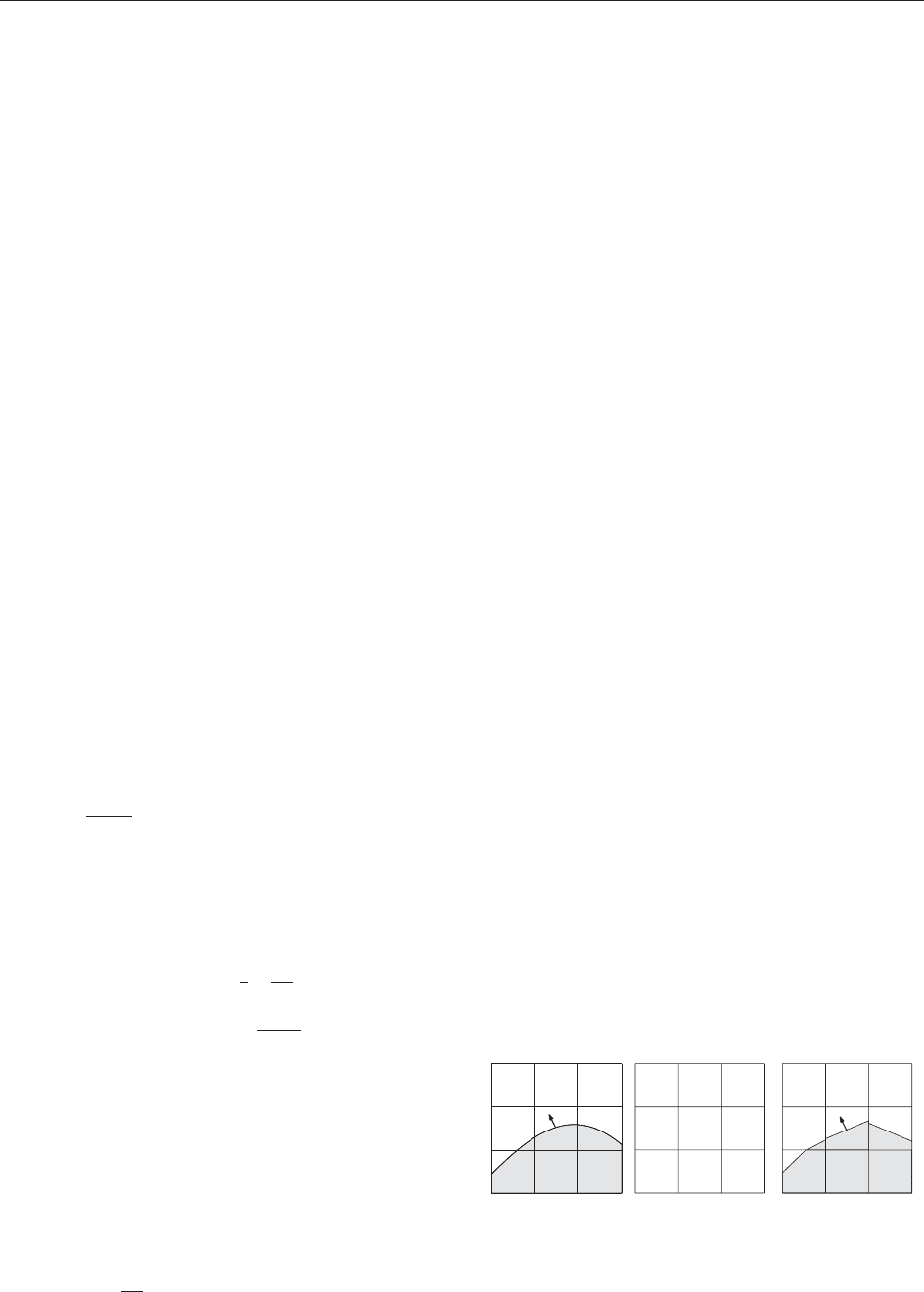
Figure 1b.
A VOF algorithm is divided into two parts: a
reconstruction step and a propagation step. A
typical interface reconstruction is shown in
Figure 1c. In the piecewise linear interface construc-
tion (PLIC) method, the true interface, as shown in
Figure 1a, is approximated by a straight line
perpendicular to an interface normal vector n
ij
in
each cell
ij
. The normal vector n
ij
is determined
from the volume fraction gradient using data from
neighboring cells. With given a volume fraction c
ij
Fluid 1
Fluid 2
c
ij
n
ij
c
ij
n
ij
000
0.1 0.5 0.4
0.9 1 1
(a) (b) (c)
Figure 1 VOF representation of an interface: (a) actual
interface, (b) volume fraction, and (c) an approximation to the
interface is produced using an interface reconstruction method
such as piecewise linear approximation as shown.
136 Interfaces and Multicomponent Fluids