
Francoise J.-P., Naber G.L., Tsun T.S. (editors) Encyclopedia of Mathematical Physics
Подождите немного. Документ загружается.

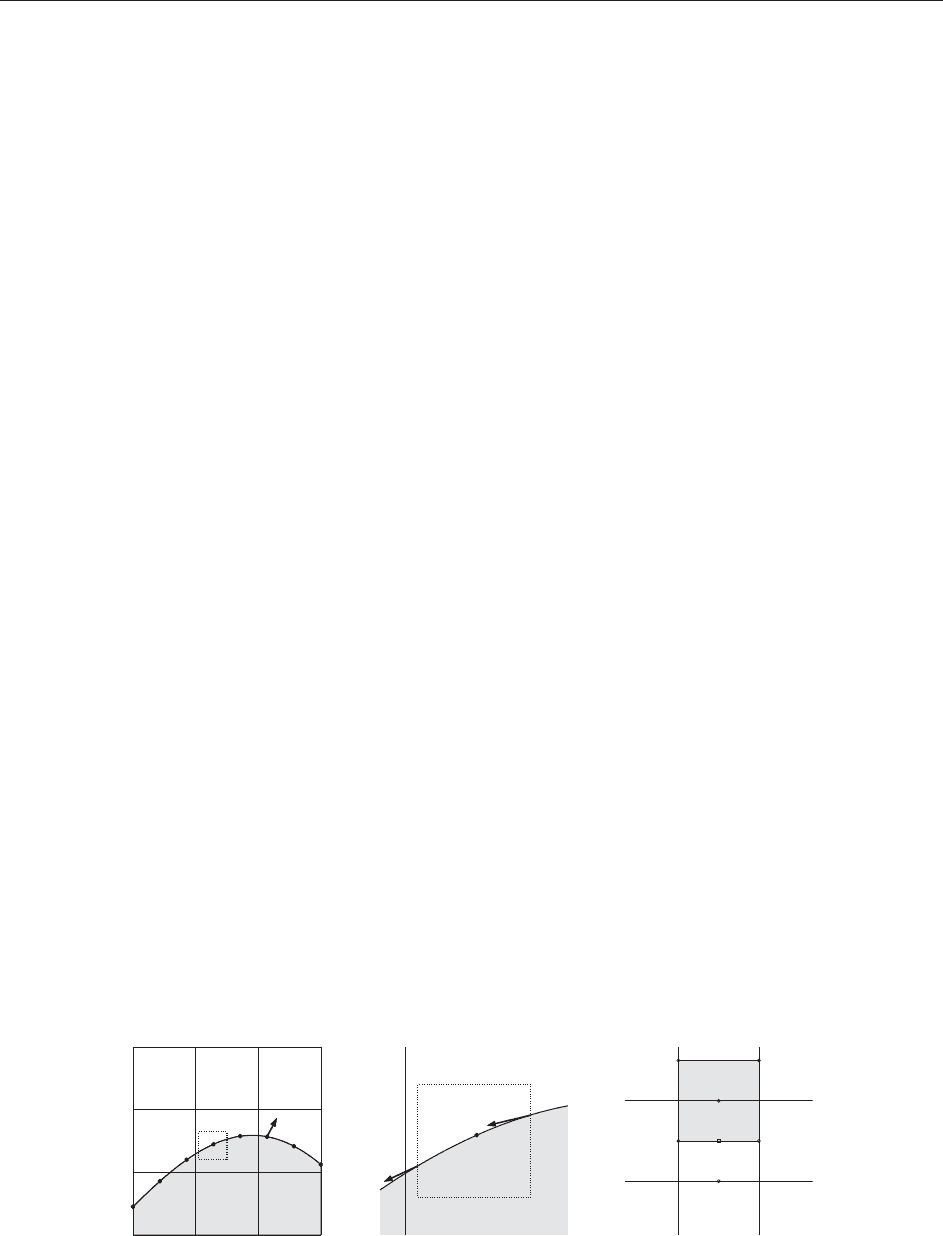
and a normal vector n
ij
, the interface is given by the
straight line with normal n
ij
such that area beneat h
the line in cell
ij
is equal to c
ij
. More recently,
parabolic reconstructions of the interface have been
used to gain higher-order accuracy for the surface
tension force (e.g., the ‘‘parabolic reconstruction of
surface tension’’ or PROST algorith m).
Once the interface has been reconstructed, its
motion by the underlying flow field must be
modeled by a suitable advection algorithm. The
key here is that the explicit interface reconstruction
enables fluxes to be developed that exactly conserve
mass and do not diffuse the interface.
Capillary effects may be represented by the
continuous surface stress (Scardovelli and Zaleski
1999),
T ¼ð I n nÞjr
~
cj; F
sing
¼rT ½11
where
~
c is a smoothed version of the volume
fraction. For the flows in which the capillary force
is the dominant physical mechanism, the PROST
algorithm discussed above can be used to signifi-
cantly reduce spurious currents due to inaccurate
representation of surface tension terms and asso-
ciated pressure jump in normal stress.
The distribution form of the fluid equations [5] is
typically solved using a variant of the projection
method for incompressible single phase flows.
VOF methods are popular and have been used in
commercial multiphase flow codes, in models of
inkjet printers, flows with surfactants and in many
other applications (e.g., see Scardovelli and Zaleski
(1999) and James and Lowengrub (2004) and the
references therein). The principal advantage of VOF
methods is their inherent volume-conserving prop-
erty. Nevertheless, spurious bubbles and drops may
be created. The reconstruction of the interface from
the volume fractions and the computation of
geometric quantities such as curvature are typically
less accurate than other methods discussed here
since the curvature and normal vectors are obtained
by differentiating a nearly discontinuous function
(volume fraction).
Front-tracking methods The basic idea behind the
original front-tracking method is the use of two
grids as illustrated in Figure 2. One is a standard,
Eulerian finite difference mesh that is used to so lve
the fluid equations. The other is a discretized
interface mesh that is used to explicitly track the
interface and compute surface tension force which is
then transferred to the finite difference mesh via a
discrete delta-function. Front tracking was first
proposed by Richtmyer and Morton and further
developed by Glimm and co-workers.
A similar approach was taken by Unverdi and
Tryggvason (see Tryggvason et al. (2001) and Peskin
(2002) for recent reviews), who combined a moving
grid description of the interface with flow computa-
tions on a fixed grid. In this immersed-boundary
approach, all the fluid phases are treated together by
solving a single set of governing equations. This
method has its roots in the original marker-and-cell
(MAC) method, where marker particles are used to
identify each fluid and the immersed-boundary
method of Peskin and McQueen, that was designed
to track moving elastic boundaries in homogeneous
fluids.
The interface is represented discretely by Lagran-
gian markers that are connected to form a front
which lies within and moves through a stationary
Eulerian mesh.
In Tryggvason’s original implementation, the
basic structural unit is a line segment. Since the
interface moves and deforms during the computa-
tion, interface elements must occasionally be added
or deleted to maintain regularity and stability. In the
event of merging/breakup, elements must be relinked
to effect a change in topology.
The interface is represented using an ordered list
of marker particles x
k
= ((x
1
)
k
,(x
2
)
k
), 1 k N.
Fluid 1
Fluid 2
n
f
AB
(a)
A
B
t
A
t
B
X
f,k
(b)
u
i – 1/2, j + 1
u
i – 1/2, j
v
i, j – 1/2
u
i – 1/2, j
u
i + 1/2, j + 1
v
i , j + 1/2
p
ij
(c)
Figure 2 (a) The basic idea in the front-tracking method is to use two grids – a stationary finite difference mesh and a moving
Lagrangian mesh, which is used to track the interface. (b). Blow-up of the subgrid control volume in (a). (c) Control volume for the
Eulerian mesh,
i, j þ(1=2)
.
Interfaces and Multicomponent Fluids 137

The first step in this algorithm is the advection of the
marker particles. A simple bilinear interpolation is
used to find the velocity inside each grid cell (indicated
in Figure 2c). The marker particles are then advected in
a Lagrangian manner. Once the points have been
advected, a list of connected polynomials (p
x
i
(s), p
y
i
(s))
is constructed using the marker particles. This gives a
parametric representation of the interface, with s
typically an approximation of the arclength. Both
lists are ordered and thus identify the topology of the
interface. In later works, higher-order polynomials
have been used (e.g., cubic splines) and semi-Lagran-
gian evolutions have been implemented where other
tangential velocities have been used.
As the interface evolves, the markers drift along
the interface following tangential velocities an d
more markers may be needed if the interface is
stretched by the flow. Typically, the markers are
redistributed along the interface to maintain an
accurate interface repre sentation.
Next, we compute the surface tension force,
F
sing
ðx; tÞ¼
Z
ðtÞ
f
ð x x
f
ðsÞÞn
f
ds ½12
where the subscript f means values evaluated at the
interface (t) and s is arclength. The discrete
numerical implementation of this distribution onto
the fixed grid is in the form of a sum over interface
elements, x
f , k
:
F
ij
ðxÞ¼
X
k
f
k
ð x x
f ;k
Þs
k
½13
where s
k
is the average of the straight line
distances from the point x
f , k
to the two neighboring
points x
f , kþ1
and x
f , k1
as indicated by the subgrid
control volume shown in Figures 2a and 2b. The
delta-function is typically taken to be Peskin’s
discrete Dirac delta-function:
ðx x
f ;k
Þ
¼
Q
2
i¼1
1
4h
1 þcos
½x
i
ðx
f ;i
Þ
k
2h
if jx x
f ;k
j2h
0 otherwise [14]
8
<
:
Other higher -order alternative forms of the regular-
ized delt a-function using the product formula have
recently been proposed.
Using the Frenet relation, the surface tension force
on a short segment of the front is given by
f
k
¼
Z
B
A
f
n
f
ds ¼
Z
B
A
@t
f
@s
ds ¼ ðt
B
t
A
Þ½15
where A and B are the segment endpoints that lie
on the boundary of the subgrid control volume
(Figures 2a and 2b), and t
f
is a tangent vector
computed by fitting a polynomial to the endpoints
of each element.
In the case of flows with varying density and/or
viscosity between the fluid components, there is a
need to calculate the phase indicator function I(x, t)
(defined by interface geometry and position), which
has the value 0 in fluid 1 and 1 in fluid 2. The
indication function can be determined via the
solution of the equation
Iðx; tÞ¼r
Z
ðtÞ
n
f
ð x x
f
ðs; tÞÞds ½16
This equation is discretized on the Eulerian mesh
and a discrete delta-function (e.g., eqn [14]) is used.
The fluid properties such as density and viscosity are
determined via the indicator function, that is,
(x, t) =
1
þ (
2
1
)I(x, t), etc.
As in the volume of fluid algorithm, the distribu-
tion form of the Navier–Stokes equations [5] are
typically solved using a version of Chorin’s projec-
tion method.
An alternative flow solver that can be used to
integrate the flow equations in the presence of an
interface is the immersed-interface method (IIM).
The IIM was developed by Leveque and Li (see the
review Li 2003), and can be used together with
front-tracking as well as level-set methods.
The IIM directly incorporates jump conditions for
the normal stress into the finite difference stencil. The
key idea of this method is to use the jump conditions
in Taylor series expansions of pressure and velocity
near interfaces to derive difference equations that
achieve pointwise second-order accuracy.
The principal advantage of front -tracking algo-
rithms is their inherent accuracy, due in part to the
ability to use a large number of grid points on the
interface. Front-tracking methods can be compli-
cated to implement, particularly in 3D, but give the
precise location and geometry of the interface. In
addition, explicit front tracking permit s more than
one interface to be present in a single computational
cell without coalescence, which can be important in
dense bubbly flows, emulsions, etc. One of major
handicaps of front-tracking methods is the difficulty
in modeling topolog ical changes of the interface
such as breakup and coalescence without ad hoc cut-
and-connect and reconnecting parameterized inter-
face (particularly, difficulties in 3D).
Interface-Capturing Methods
Level-set method Level-set methods, introduced by
Osher and Sethian (see the recent review papers
(Osher and Fedkiw 2001, Sethian and Smereka
138 Interfaces and Multicomponent Fluids
2003) and the recent texts (Osher and Fedkiw
2002, Sethian 1999)), are popular computational
techniques for tracking moving interfaces. These
methods rely on an implicit representation of the
interface as the zero set of an auxiliary function
(level-set function). The application of these meth-
ods to incompressible, multiphase flows started with
the work of Osher, M erriman, Sussman, Smereka,
Hou, and their collaborators.
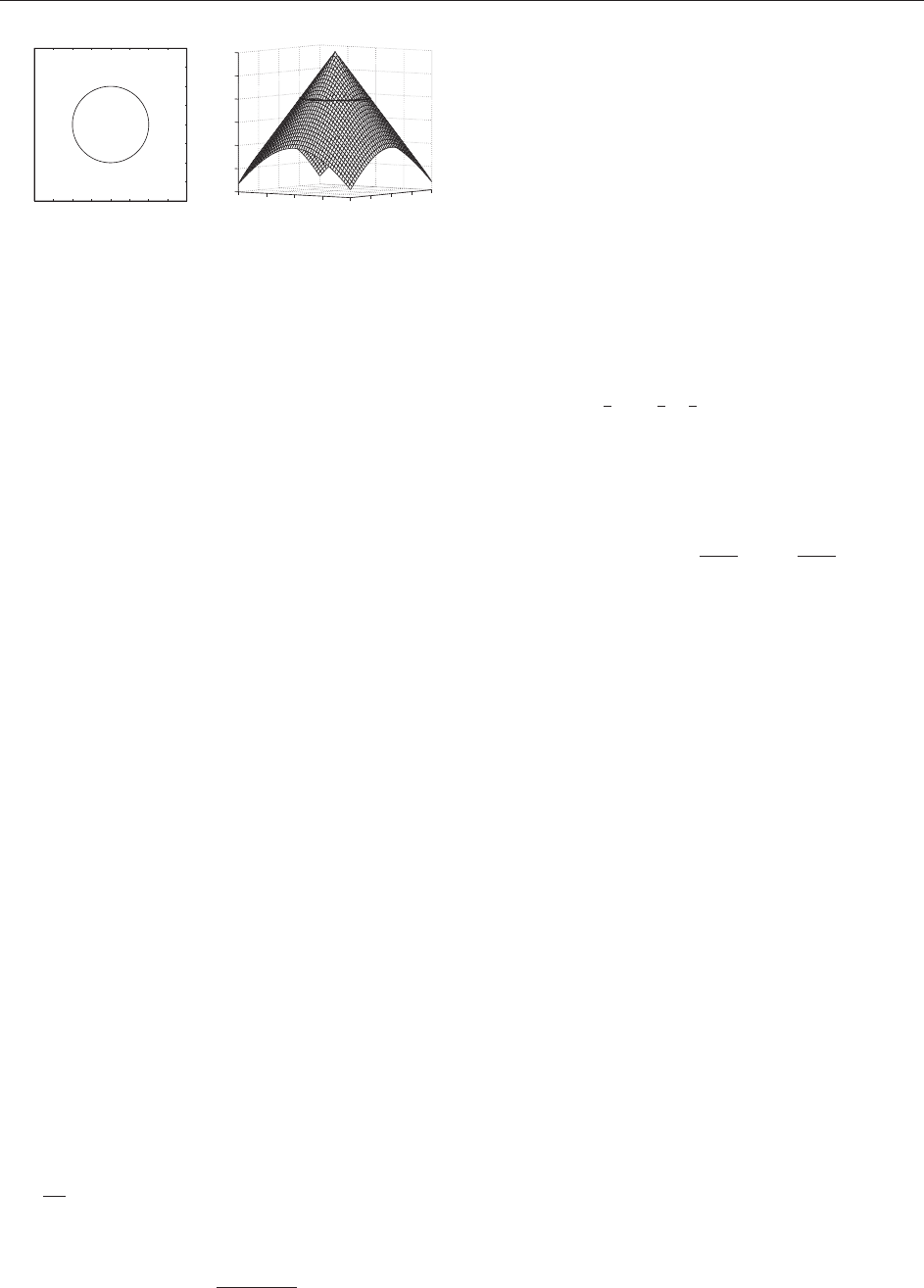
In the level-set method, the level-set function
(x, t) is defined as follows (see Figure 3):
ðx; tÞ
> 0ifx 2 fluid 1
¼ 0ifx 2 ðthe interface between fluidsÞ
< 0ifx 2 fluid 2
(
and the evolution of is given by
t
þ u r ¼ 0 ½17
which means that the interface moves with fluid.
To keep the interface geometry well resolved, the
level-set function should be a distance function near
the interface. However, under the evolution [17] it
will not necessarily remain as such. We note that
special velocity extensions v off the interface (i.e.,
v = u at the interface, v 6¼ u away from interface)
have been recently developed to better maintain as
a distance function (e.g., Sethian and Smereka (2003)
and Macklin and Lowengrub (2005)). Typically, a
reinitialization step (solving a Hamilton–Jacobi type
equation, eqn [18]) below, is performed to keep as
a distance function near the interface while keeping
original zero-level set unchanged. More specifically,
given a level-set function, , at time t, the contours
are redistributed according to the steady-state solu-
tion of the equation
@d
@
¼ S
ðÞð1 jrdjÞ; dðx; 0 Þ¼ðxÞ½18
where S
is the smoothed sign function defined as
S
ðÞ¼
ffiffiffiffiffiffiffiffiffiffiffiffiffiffiffi
2
þ
2
p
½19
where is usually is one or two grid lengths. After
solving eqn [18] to steady state (x, t) is then
replaced by d(x,
steady
). Note that d(x,
steady
)is
typically a good approximation of the signed
distance function.
The density and viscosity are defin ed as
ðÞ¼
2
þð
1
2
ÞH
ðÞ
and
ð Þ¼
2
þð
1
2
ÞH
ðÞ½20
where H
() is the smoothed Heaviside function
given by
H
ðÞ¼
0if<
1
2
1 þ
þ
1
sinð=Þ
if jj
1
if >
8
>
>
<
>
>
:
The mollified delta-function is
() = dH
=d. The
surface tension force is given as
F
sing
¼r
r
jrj
ðÞ
r
jrj
½21
The fluid equations [5] are solved using projecti on
methods, the IIM or the ghost-fluid (GF) method
(e.g., Osher and Fedkiw (2001, 2002) and Fedkiw
et al. (2003)). The GF method is similar to the IIM
in that jump discontinuities are incorporated in the
finite difference stencil. In the GF algorithm, subcell
resolution is used to mark the interface position and
the values of discontinuous quantities are artificially
extended to grid points neighboring the interface via
extrapolation. A fully second order accurate GF
method for moving interfaces has recently been
developed (Macklin and Lowengrub 2005).
Applications of the level-set method include
multiphase flows, viscoelastic fluid flows and fluid–
structure interactions (e.g., see the reviews Osher and
Fedkiw (2001, 2002), Sethian (1999),andSethian
and Smereka (2003)).
Advantages of the level-set algorithm include the
simplicity with which it can be implemented, the
ability to capture merging and breakup of interfaces
automatically, and the ease with which the interface
geometry can be described using the level-set
function. A disadvantage of the level-set method is
that mass is not conserved.
Accurate numer ical simulations of multiphase
flow and topology transitions require the computa-
tional mesh to resolve both the macroscales (e.g.,
droplet size, flow geometry) and the microscales to
accurately capture local interface geometries near
contact region, van der Waals forces, surfactant
distribution, and Marangoni stresses. Adaptive mesh
–2 –1.5 –1 –0.5 0 0.5 1 1.5 2
–2
–1.5
–1
–0.5
0
0.5
1
1.5
2
φ < 0
φ
> 0
φ = 0
Γ
Fluid 1
Fluid 2
–2
–1
0
1
2
–1
0
1
2
–2
–1.5
–1
–0.5
0
0.5
1
(a) (b)
Figure 3 (a) Zero contour of representing the interface .
(b) Surface of with zero contour.
Interfaces and Multicomponent Fluids 139
algorithms have recently been used greatly to
increase accuracy and computational efficiency in
level-set methods. Typically, the methods involve
Cartesian adaptive mesh refinement. Problems
tackled using this approach include droplet forma-
tion in inkjet printers and wake development behind
a ship. Another approach, recently developed, is to
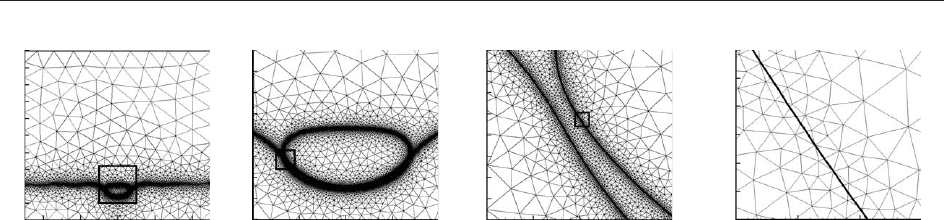
use adaptive unstructured mesh refinement (Zheng
et al. 2005), as shown in Figure 4, in which the
impact of a drop onto a fluid interface is captured.
Hybrid Methods
More recently, a number of hybrid methods, which
combine good featu res of each algorithm, have been
developed. These include coupled level-set volume-
of-fluid (CLSVOF) algorithms, particle level-set
methods, marker-VOF methods and level-contour
front-tracking methods.
Level-set and VOF methods have recently been
combined. The volume fraction is used to maintain
volume conservation, while the level-set function is
used to describe the interface geometry. After every
time step, the volume-fraction function and level-set
function are made compatible. The coupling
between the level-set function and the VOF
function c occurs through the normal of the
reconstructed interface and through the fact that
the level-set function is reset to the exact signed
normal distance to the reconstructed interface
(where the area below the reconstructed interface is
given by the volume-fraction function).
In the particle leve l-set method, Lagrangian
disconnected marker particles are rand omly posi-
tioned near the interface and are passively advected
by the flow in or der to rebuild the level-set function
in under-resolved zones, such as high-curvature
regions and near filaments. In these regions, the
standard nonadaptive level-set method regularizes
excessively the interface structure and mass is lost.
The use of marker particles significantly ameliorates
these difficulties.
Recently, a hybrid method has been developed,
which uses both marker particles, to reconstruct and
move the interface, and the volum e-fraction function
to conserve volume. In this approach, a smooth
motion of the interface, typical of marker methods is
obtained together with volume conservation, as in
standard VOF methods. This work improves both
the accuracy of interface tracking, when compared
to standard VOF methods, and the conservation of
mass, with respect to the original marker method.
Finally, a hybrid method that combines a level
contour reconstruction technique with front-tracking
methods has recently been developed to auto-
matically model the merging and breakup of inter-
faces in three-dimensional flows.
Phase-Field Method
Phase-field, or diffuse-interface, model s are an
increasingly popular choice for modeling the motion
of multiphase fluids (see Anderson et al. (1998) for a
recent review). In the phase-field model, sharp fluid
interfaces are replaced by thin but nonzero thickness
transition regions where the interfacial forces are
smoothly distributed. The basic idea is to introduce
a conserved order parameter (e.g., mass concentra-
tion) that varies continuously over thin interfacial
layers and is mostly uniform in the bulk phases (see
Figure 5).
For density-matched binary liquids (let = 1
for simplicity), the coupling of the convective
Cahn–Hilliard equation for the mass concentration
with a modified momentum equation that includes a
phase-field-dependent surface force is known as
Model H (Hohenberg and Halperin 1977). In the
case of fluids with different densities a phase-field
model has been proposed by Lowengrub and
Truskinovsky. Complex flow morphologies and
topological transitions such as coalescence and
interface breakup can be captured naturally and in
a mass-conservative and energy-dissipative fashion
since there is an associated free energy functional.
5
4
3
2
1
0
–1
–2
–3
–4
–5
–4 –2 0 2 4
–3.2
–3.25
–3.3
–3.35
–3.4
–
0.75 – 0.7 – 0.65 – 0.6 – 0.55
–1 –0.5 0 0.5 1
–2
–2.25
–2.5
–2.75
–3
–3.25
–3.5
–3.75
–4
–3.275
–3.28
–3.285
–3.29
–0.655 –
0.65 – 0.645 – 0.64
Figure 4 Each of the first three figures has a boxed region that is magnified in the next figure. The rates of magnification are 5, 10,
40/3, respectively. The meshes in the figure are used to simulate the drop-impacting interface problem. Source: Zheng X, Anderson A,
Lowengrub JS, and Cristini V (unpublished).
140 Interfaces and Multicomponent Fluids
The phase field is governed by the following
advective Cahn–Hilliard equation:
@c
@t
þ u rc ¼rðMðcÞrÞ½22
¼ F
0
ðcÞ
2
c ½23
where M(c) = c(1 c) is the mobility, F(c) =
(1=4)c
2
(1 c)
2
is a Hel mholtz free energy that
describe the coexistence of immiscible phases, and
is a measure of interface thickness and (see
Figure 5). It can be shown that in the sharp interface
limit !0, the classi cal Navier–Stokes system
equations and jump conditions are recovered.
The singular surface tension force is F
sing
=
6
ffiffiffi
2
p
r(rc rc), where is the surface ten-
sion coefficient. An alternative surface tension force
formulation based on the CSF is F
sing
= 6
ffiffiffi
2
p
r
(rc=jrcj)jrcjrc.
Recently, very efficient nonli near multigrid meth-
ods have been developed to solve implicit discretiza-
tions of the Cahn–Hilliard equation (e.g., Kim et al.
(2004)). These schemes have been combined with
projection methods to solve the Navier–Stokes
equations to perform simulations of multiphase
flows.
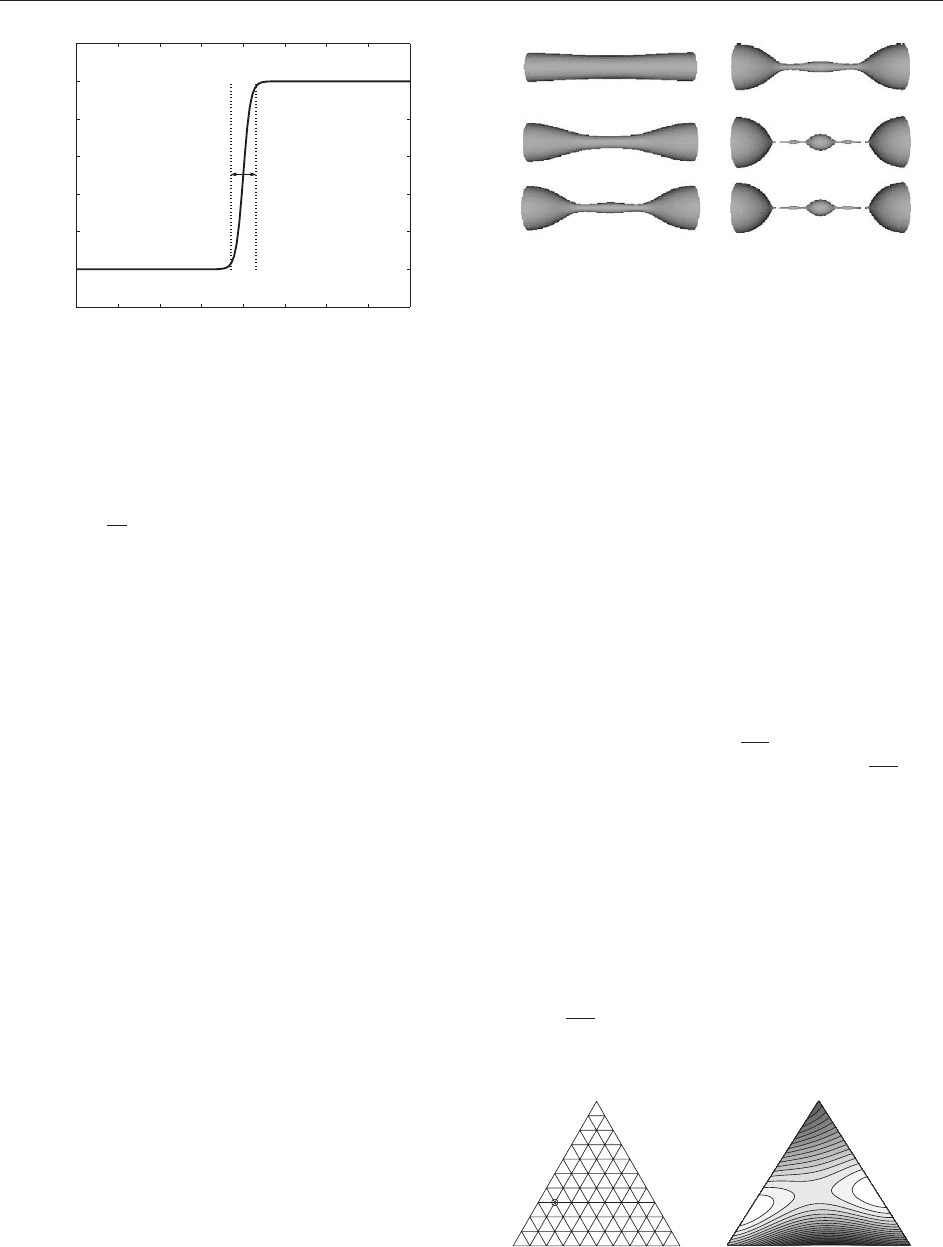
An example of simulation of liquid thread breakup
using a phase-field method is shown in Figure 6.
A long cylindrical thread of a viscous fluid 1 is in an
infinite mass of another viscous fluid 2. If the thread
becomes varicose with wavelength , the equilibrium
of the column is unstable, provided exceeds the
circumference of the cylinder. This is the Rayleigh
capillary instability that results in surface-tension-
driven breakup of the thread.
An advantage of the phase-field approach is that it
is straightforward to include more complex physical
effects. For example, the binary model can be
straightforwardly extended to describe three-
component flows as follows.
Consider a ternary mixture and denote the
composition of components 1, 2, and 3, expressed
as mass fractions, by c
1
, c
2
, and c
3
, respectively.
Therefore,
X
3
i¼1
c
i
¼ 1; 0 c
i
1 ½24
The composition of a ternary mixture (A, B, and C)
can be mapped onto an equilateral triangle (the
Gibbs triangle (Porter and Easterling 1993)) whose
corners represent 100% concentration of A, B, or C
as shown in Figure 7a. Mixtures with components
lying on lines parallel to
BC contain the same
percentage of A, those with lines parallel to
AC have
the same percentage of B concentration, and
analogously for the C concentration. In Figure 7a,
the mixture at the position marked ‘’ contains 60% A,
10% B, and 30% C. Because the concentrations sum
to unity, only two of them need to be determined,
say c
1
, c
2
.
The evolution of c
1
and c
2
is governed by the
following advective ternary Cahn–Hilliard equation:
@c
1
@t
þ u rc
1
¼rðMðc
1
; c
2
Þr
1
Þ½25
–2 –1.5 –1 –0.5 0 0.5 1 1.5 2
–0.2
0
0.2
0.4
0.6
0.8
1
ξ
Figure 5 A concentration prome across an interface with
interface thickness, .
Figure 6 Time evolution leading to multiple pinch-offs. The
evolution is from top to bottom and left to right. The domain is
axisymmetric, the initial velocities are zero everywhere, and the
concentration field is given by c(r, z) = 0.5(1 tanh ((r 0.5
0.05 cos ( z))=(2
ffiffiffi
2
p
))) on =(0, ) (0, 2). Densities are
matched and viscosity ratio is 0.5.
A
B
C
C
1
C
3
C
2
(a) (b)
Figure 7 (a) Gibbs triangle. (b) Contour plot of the free energy
F (c
1
, c
2
) on the Gibbs triangle.
Interfaces and Multicomponent Fluids 141
@c
2
@t
þ u rc
2
¼rðMðc
1
; c
2
Þr
2
Þ½26
1
¼
@Fðc
1
; c
2
Þ
@c
1
2
c
1
0:5
2
c
2
½27
2
¼
@Fðc
1
; c
2
Þ
@c
2
0:5
2
c
1
2
c
2
½28
where M(c
1
, c
2
) =
P
3
i<j
c
i
c
j
is the mobility and
F(c
1
, c
2
) is the Helmholtz free energy that can be
used to model the miscibility of the components. An
example of a free energy (used in the simulation
shown in Figure 8 below) for which fluids 1 and 3
are immiscible and fluid 2 is preferentially miscible
with fluid 3 is:
Fðc
1
; c
2
Þ¼2c
2
1
1 c
1
c
2
ðÞ
2
þ c
1
þ 0:2ðÞc
2
0:2ðÞ
2
þ 1:2 c
1
c
2
ðÞ
c
2
0:4
ðÞ
2
The contours of F on the Gibbs triangle are shown
in Figure 7b.
The singular surface tension force is F
sing
=
6
ffiffiffi
2
p
P
3
i = 1
i
r(rc
i
rc
i
), where the physical
surface tension coefficients
ij
between two fluids i
and j are decom posed into the phase-specific surface
tensions
i
such that
ij
=
i
þ
j
.
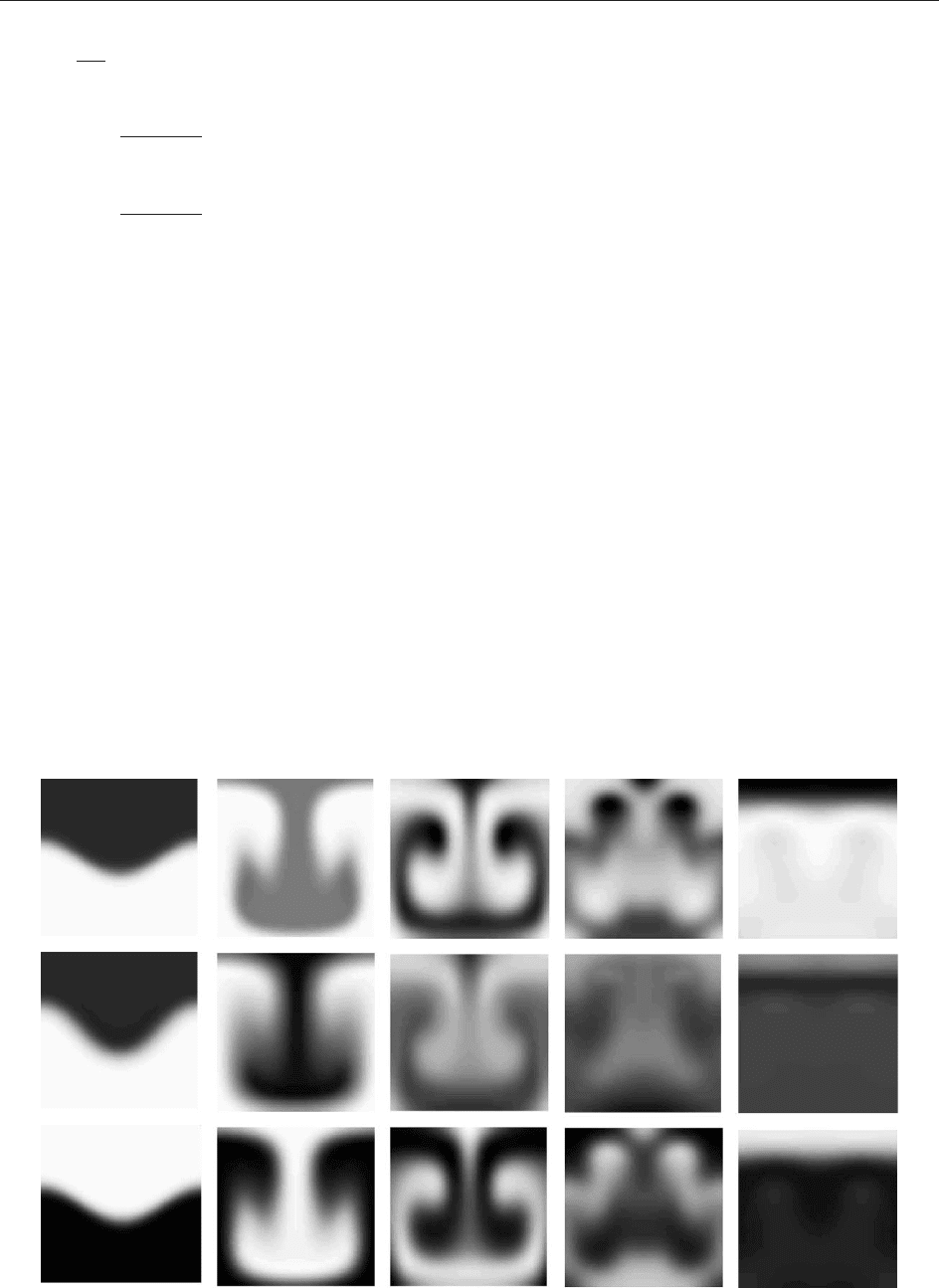
As a demonstration of the evolution possible in
partially miscible liquid systems, we present an
example in which there is a gravity-driven
(Rayleigh–Taylor) instability that enhances the
transfer of a preferentially miscible contaminant
from one immiscible fluid to another in 2D. In this
system, the ternary Cahn–Hilliard system is solved
using nonlinear multigrid methods and a projection
method (Kim and Lowengrub (in press)) is used to
solve the flow equations [5].
In Figure 8 (first column), the top half of the domain
initially consists of a mixture of fluids 1 and 2,
and the bottom half consists of fluid 3, which is
immiscible with fluid 1. The contours of c
1
, c
2
,andc
3
are visualized in gray-scale where darker regions
denote larger values of c
1
, c
2
,andc
3
,respectively.
In the top row, the contours of fluid 1 are shown, the
middle and bottom rows correspond to fluids 2 and 3,
respectively.
Fluid 2 is preferentially miscible with fluid 3.
Fluid 1 is assumed to be the lightest and fluid 2 the
heaviest. The density of the 1/2 mixture is heavier
than that of fluid 3, so the density gradient induces
the Rayleigh–Taylor instability.
The evolution of the three phases is shown in
Figure 8. As the simulation begins, the 1/2 mixture
falls and fluid 2 diffuses into fluid 3. A characteristic
Rayleigh–Taylor (inverted) mushroom forms, the
Figure 8 Evolution of concentration of fluid 1 (top row), 2 (middle row), and 3 (bottom row). The contours of c
1
, c
2
, and c
3
are
visualized in gray-scale where darker regions denote larger values of c
1
, c
2
, and c
3
, respectively.
142 Interfaces and Multicomponent Fluids

surface area of the 1/3 interface increases, and
vorticity is generated and shed into the bulk.
As fluid 2 is diffused from fluid 1, the pure fluid
1 rises to the top as shown in Figure 8. Imagining
that fluid 2 is a contaminant in fluid 1, this
configuration provides an efficient m eans of cleans-
ing fluid 1 since the buoyancy-driven flow enhances
the diffusional transfer of fluid 2 from fluid 1 to
fluid 3.
The advantages of the phase-field method are:
(1) topology changes are automatically described;
(2) the composition field c has a physical meaning
not only near interface but also in the bulk phases;
(3) complex physics can easily be incorporated into
the framework, the methods can be straightforwardly
extended to multicomponent systems, and miscible,
immiscible, partially miscible, and lamellar phases
can be modeled.
Associated with diffuse interfaces is a small scale
, proportional to the width of the interface. In real
physical systems describing immiscible fluids, can
be vanishingly small. However, for numerical
accuracy must be at least a few grid lengths in
size. This can make computations expensive. One
way of ameliorating this problem is to adaptively
refine the grid only near the transition layer. Such
methods are under development by various research
groups.
Phase-field methods have been used to model
viscoelastic flow, therm ocapillary flow, spinodal
decomposition, the mixing and inte rfac ial stret ch-
ing, in a shear flow, droplet breakup process,
wave-breaking and sloshing, the fluid motion near
a moving contact line, and the nucleation and
annihilation of an equilibrium droplet (see the
references in the review paper Anderson et al.
(1998)).
Conclusions and Future Directions
In this paper we have reviewed the basic ideas of
interface-tracking and interface-capturing methods
that are critical in simulating the motion of inter-
faces in multicomponent fluid flows. The differences
between these various formulations lie in the
representation and the reconstruction of interfaces.
The advantages and disadvantages of the algorithms
have been discussed. While there has been much
progress on the development of robust multifluid
solvers, there is much more work to be done.
Promising future directions for research include the
incorporation of adaptive mesh refinement into the
algorithms and the development of efficient hybrid
schemes that combine the best features of individual
methods.
See also: Breaking Water Waves; Capillary Surfaces;
Fluid Mechanics: Numerical Methods; Incompressible
Euler Equations: Mathematical Theory; Inviscid
Flows; Non-Newtonian Fluids; Partial Differential
Equations: Some Examples; Viscous Incompressible
Fluids: Mathematical Theory; Vortex Dynamics.
Further Reading
Anderson DM, McFadden GB, and Wheeler AA (1998) Diffuse-
interface methods in fluid mechanics. Ann. Rev. Fluid Mech.
30: 139–165.
Cristini V, Blawzdziewicz J, and Loewenberg M (2001) An
adaptive mesh algorithm for evolving surfaces: simulations of
drop breakup and coalescence. Journal of Computational
Physics 168: 445–463.
Fedkiw RP, Sapirop G, and Shu C-W (2003) Shock capturing,
level sets and PDE based methods in computer vision and
image processing: a review of Osher’s contributions. Journal
of Computational Physics 185: 309–341.
Hohenberg PC and Halperin BI (1977) Theory of dynamic critical
phenomena. Reviews of Modern Physics 49: 435–479.
Hou TY, Lowengrub JS, and Shelley MJ (2001) Boundary integral
methods for multicomponent fluids and multiphase materials.
Journal of Computational Physics 169: 302–362.
James AJ and Lowengr ub J (2004) A sur fa ctan t-c onse rving
volume-of-fluid method for interfacial flows with insoluble
surfactant. Journal of Computational Physics 201:
685–722.
Kim JS, Kang KK, and Lowengrub JS (2004) Conservative
multigrid methods for Cahn–Hilliard fluids. Journal of
Computational Physics 193: 511–543.
Kim JS and Lowengrub JS Phase field modeling and simulation of
three-phase flows, Int. Free Bound (in press).
Li Z (2003) An overview of the immersed interface method and
its applications. Taiwanese J. Math. 7: 1–49.
Macklin P and Lowengrub JS (2005) Evolving interfaces via
gradients of geometry-dependent interior Poisson problems:
application to tumor growth. Journal of Computational
Physics 203: 191–220.
Osher S and Fedkiw RP (2001) Level set methods: an overview
and some recent results. Journal of Computational Physics
169: 463–502.
Osher S and Fedkiw RP (2002) Level Set Methods and Dynamic
Implicit Surfaces. Springer.
Peskin CS (2002) The immersed boundary method. Acta
Numerica 1–39.
Porter DA and Easterling KE (1993) Phase Transformations in
Metals and Alloys. Van Nostrand Reinhold.
Pozrikidis C (2001) Interfacial dynamics for Stokes flow. Journal
of Computational Physics 169: 250–301.
Scardovelli R and Zaleski S (1999) Direct numerical simulation of
free-surface and interfacial flow. Annu. Rev. Fluid Mech. 31:
567–603.
Sethian JA (1999) Level-Set Methods and Fast Marching
Methods: Evolving Interfaces in Computational Geometry,
Fluid Mechanics, Computer Vision and Materials Science.
Cambridge, MA: Cambridge University Press.
Sethian JA and Smereka P (2003) Level set methods for fluid
interfaces. Annu. Rev. Fluid Mech. 35: 341–372.
Interfaces and Multicomponent Fluids 143
TryggvasonG,BunnerB,EsmaeeliA,JuricD,Al-RawahiN
et al. (2001) A front-tracking method for the computations
of multiphase flow. Journal of Computational Physics 169:
708–759.
Zheng X, Lowengrub J, Anderson A, and Cristini V (2005)
Adaptive unstructured volume remeshing II. Application to
two- and three-dimensional level-set simulations of multiphase
flow. Journal of Computational Physics 208: 626–650.
Intermittency in Turbulence
J Jime´ nez, Universidad Politecnica de Madrid,
Madrid, Spain
ª 2006 Elsevier Ltd. All rights reserved.
Introduction
Intermittency has several meanings in turbulence.
The oldest one, now most often label ed ‘‘external’’
or ‘‘large-scale’’ intermittency, refers to the coex-
istence of turbulent and laminar regions in inho-
mogeneous turbulent flows, such as in boundary
layers or in free shear layers. In those cases, the
interface between lami nar irrotational flow and
turbulent vortical fluid is typically sharp and
corrugated. An observer sitting near the edge of
the layer is immersed in turbulent fluid only part of
the time.
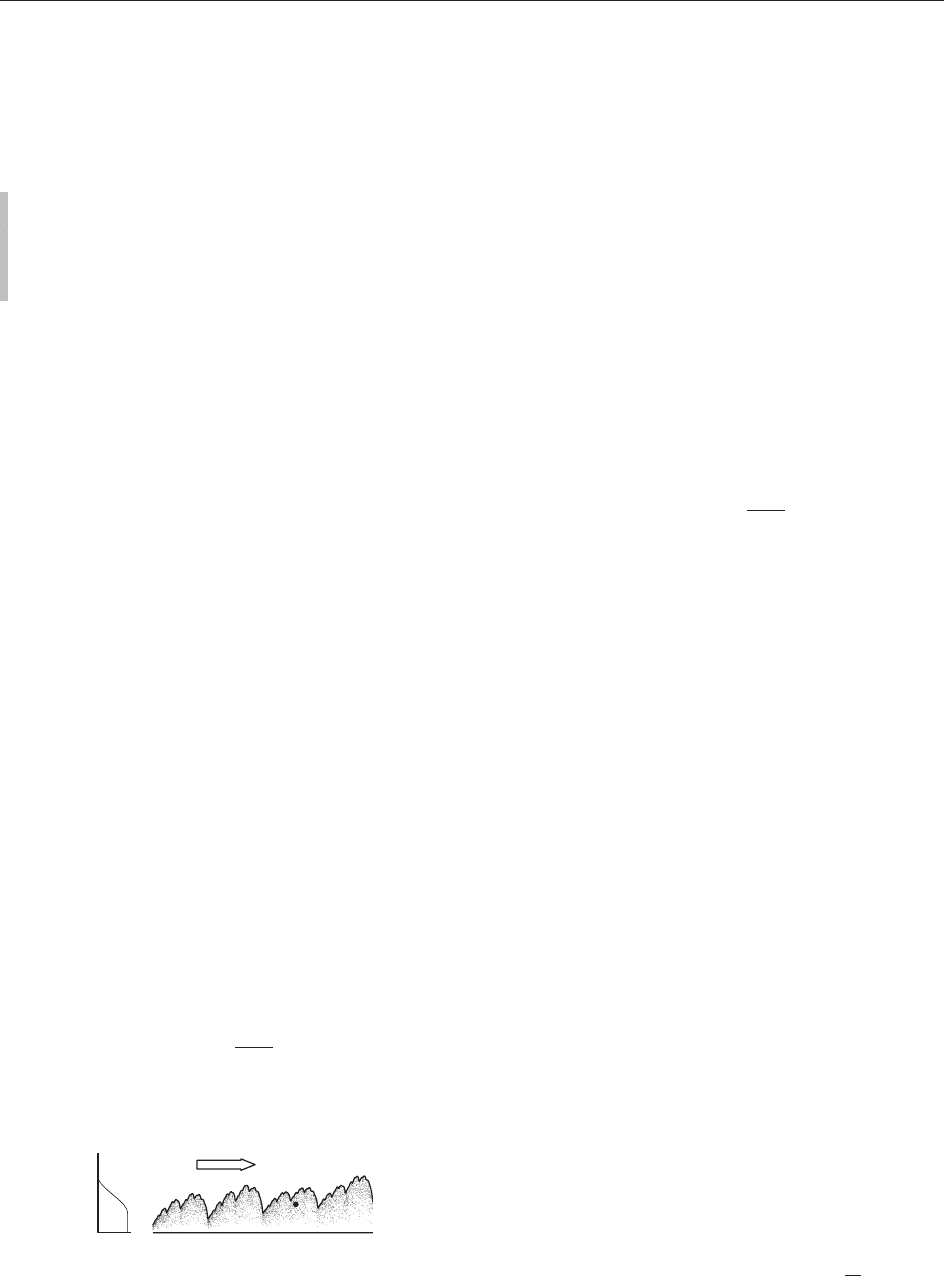
The intermittency coefficient measures the
fraction of turbulent fluid over the sampling
universe over which the statistics are taken. For
example, in a boundary layer such as that in
Figure 1, the intermittency coefficient as a function
of wall distance measures the fraction of turbulent
fluid at a given distance from the wall. External
intermittency is important in an y attempt to model
realistic turbulent flows, which are almost always
inhomogeneous. Consider, for example, the classical
homogeneous relation in eqn [1] between the mean
kinetic energy K of the turbulent fluctuations and
the energy dissipation rate " :
" ¼ C
K
3=2
L
½1
where L is the length scale of the largest eddies, and
C 0.1 is an experimentally determined constant.
Such relations are often implicit in turbulent models,
and they have to be modified to account for
intermittency. Equation [1] only holds within the
turbulent regions where the energy and the dissipa-
tion rates are K
T
and "
T
, while the overall mean
values used in the modeling conservation equations
are K = K
T
and " = "
T
. The true overall relation
should therefore be
" ¼ C
1=2
K
3=2
L
½2
which may differ substantially from eqn [1],
especially near the edge of the layer. Experimental
values and rough theoretical estimates for the
distribution of the intermittency coefficient are
available for most practical turbulent flows.
Internal Intermittency
While the external intermittency just described is
probably the most important one from the point of
view of applications, it is not the most interesting
from the theoretical point of view. Turbulence is a
multiscale phenomenon which is inhomogeneous
at all length scales, from the largest ones to the
inner viscous cutoff (see Turbulence Theories).
Moreover, this inhomogeneity goes beyond what
could be expected just from the s tatistics of a
random process. Consider, for example, the velo-
city difference u between two points separated
by a distance r. The original Kolmogorov formula-
tion of the energy c ascade assumes that the
probability density function (PDF), p(u), is a
universal function in the inertial range of scales,
whose only parameter is a velocity scale depending
on r. It then follows from Kolmogorov’s analysis
that
pðuÞ¼F u= ð
"rÞ
1=3
hi
½3
where
" is the average energy transfer rate across
scales per unit mass, and the average
( ) is taken
either over the whole flow or over a suitably designed
ensemble of experiments. In an equilibrium system,
Flow
A
y
γ
01
Figure 1 Sketch of a turbulent boundary layer, and of the
associated intermittency factor. An observer such as A, at a
distance y from the wall, only sees turbulent flow for a fraction
of the time.
144 Intermittency in Turbulence
global energy conservation implies that
" is equal to
the average viscous dissipation per unit mass:
" ¼
jruj
2
½4
In eqn [4], the kinematic viscosity of the fluid is , and
jruj is the L
2
-norm of the velocity gradient tensor.
Equation [3] is valid as long as the separation r is
much larger than the Kolmogorov viscous cutoff
= (
3
=
")
1=4
, and much smaller than the integral
scale of the largest eddies L
"
= u
03
=
", where u
0
is the
root-mean-square value of the fluctuations of one
velocity component. The extent of this iner tial range
is a function of the Reynolds number Re
L
= u
0
L
"
= :
L
"
= ¼ Re
3=4
L
½5
The strict similarity hypothesis in eqn [3] is not well
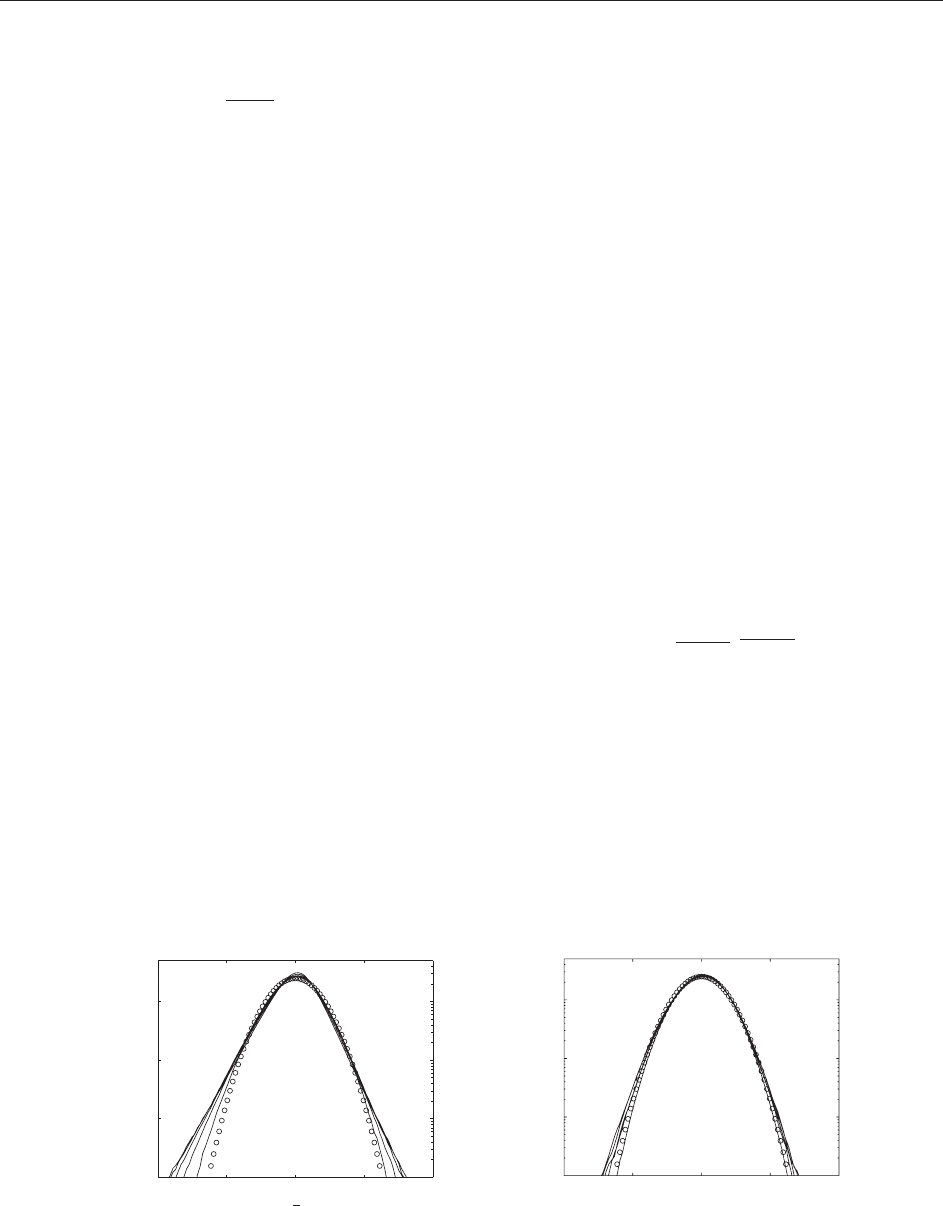
satisfied by experiments. While the velocity distribu-
tion at a given point is approximately Gaussian,
Figure 2a shows that the v elocity increments become
increasingly non-Gaussian as the spatial separation
is made much smaller than L
"
. It was also soon
noted that the dependence of eqn [3] on a single
parameter such as
" was theoretically suspect, since
it is difficult to see how the PDFs of a whole set of
local properties, such as the u for different
intervals, could depend only on a single global
property. Kolmogorov himself sought to bypass that
difficulty by substituting eqn [3] by a ‘‘refined
similarity’’ hypothesis,
pðuÞ¼F u= ð"
r
rÞ
1=3
hi
½6
where "
r
is no longer a global average, but the mean
value of the dissipation over a ball of radius of order
r centered at the midpoint of the interval. This
refined similarity is better sati sfied by experiments
(see Figure 2b), although, from the practical poin t of
view, it just transfers the problem of characterizing
u to that of characterizing the statistics of "
r
.
It has become customary to measure the behavior
of p(u) in terms of its structure funct ions,
SðnÞ¼
Z
1
1
u
n
pðuÞdu ½7
which can be normalized as generalized flatness
factors,
ðnÞ¼SðnÞ=Sð2Þ
n=2
½8
It follows from the strict similarity hypothesis [3] that
SðnÞr
n=3
½9
and that all the (n) should be independent of the
separation.
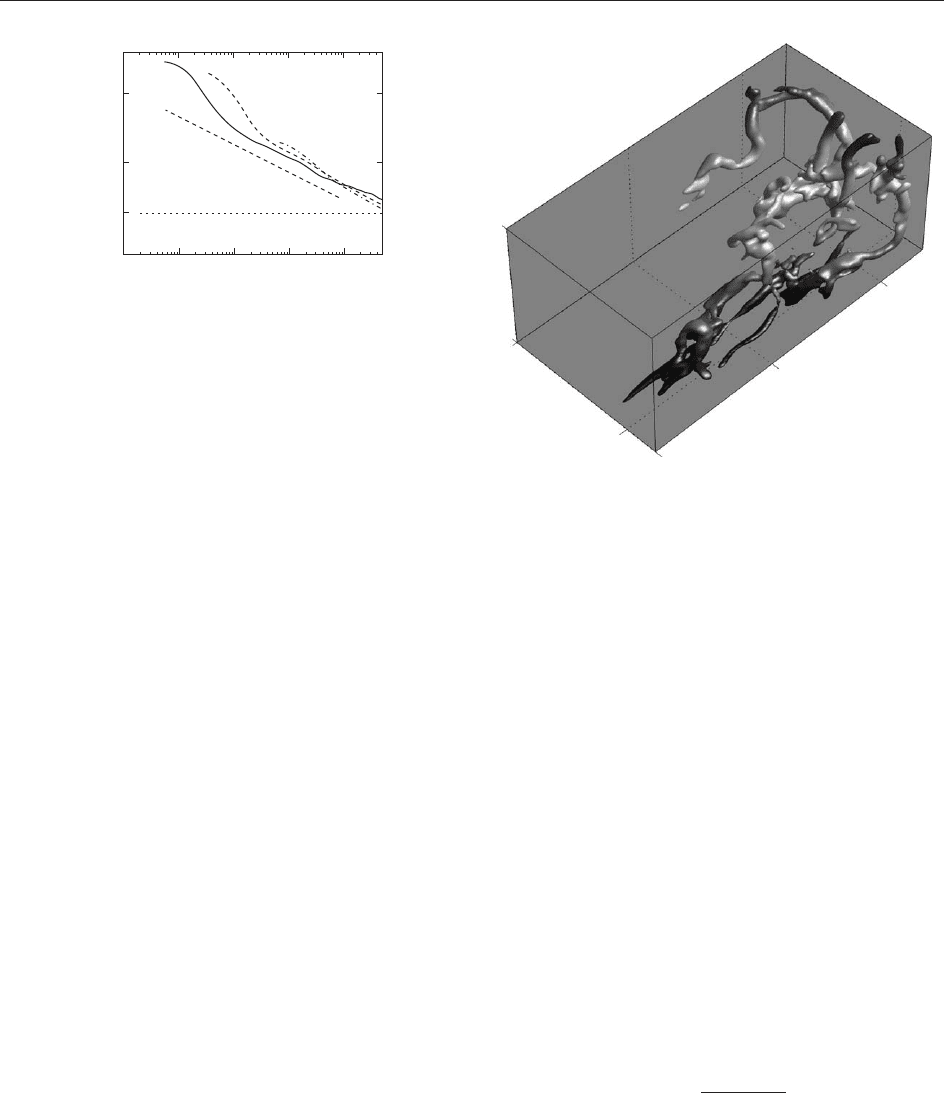
For example, the fourth-order flatness of a
Gaussian distribution is (4) = 3. Figure 3 shows
that this is not true. The flatness increases as the
separation decreases, and it only levels off at lengths
of the order of the Kolmogorov viscous scale. For
separations in that viscous range the flow is smooth,
u (@
x
u)r,and
ðnÞ
ð@
x
uÞ
n
=ð@
x
uÞ
2
n=2
½10
It follows from eqn [10] and from Figure 3 that the
velocity gradients become increasingly non-Gaussian
as L
"
and separate at high Reynolds numbers. The
velocity differences across intervals which are large
with respect to also become very non-Gaussian
when r L
"
.
Because the velocity difference between two
points which are not too close to each other can be
expressed as the sum of velocity differences over
subintervals, a loose application of the central limit
–10 –5
0
5 10
10
–1
10
–2
10
–3
10
–4
Δu/(εr )
1/3
PDF
(a)
–10
0510
10
–1
10
–2
10
–3
10
–4
Δu/(ε
r
r )
1/3
PDF
(b)
–5
Figure 2 PDFs of the differences of the velocity component in the direction of the separation (for separations in the inertial range of
scales). r =L
"
= 0:020:36, increasing by factors of 2; equivalent to r = = 1803000: Nominally isotropic turbulence at Reynolds
number Re
L
= 10
5
.. (a) u is normalized with the global energy dissipation rate
"; distributions are wider as the separation decreases.
(b) u is scaled with the locally averaged dissipation over the separation interval. Data courtesy of H Willaime and P Tabeling.
Intermittency in Turbulence 145
theorem would suggest that its PDF should be
roughly Gaussian. The key conditions for that to
happen are that the summands should be mutually
independent, that their magnitudes should be com-
parable, and that each of them has a probability
distribution with a finite variance. The first of those
three conditions is probably a good approximation
if the separation is much longer than the viscous
cutoff, but the second one depends on the structure
of the flow. The experimental non-Gaussian beha-
vior suggests the existence of occasional very strong
velocity jumps. In the viscous range of scales, those
structures have been identified both experimentally
and numerically as very strong linear vortices, in
whose neighborhoods the strongest gradients are
generated. An example of a tangle of such structures
is shown in Figure 4.
In another example, the vorticity in decaying
two-dimen sional turbulence concentrates very
quickly into relatively few strong compact vortices,
which are stable except when they interact with
each other. The velocity field is dominated by them,
and the flatness of the velocity increme nts reaches
values of the order of (4) 50–100, even at
moderate Reynolds numbers. That case is interest-
ing because somethi ng can be said about the
probability distribution of the velocity g radients.
We have noted that the PDF of a sum of mutually
comparabl e independent random variables with
finite variances tends to Gaussian when the number
of summands is la rge. This well-known theorem is a
particular case of a more general result about sums
of random variables whose incomplete second
moments diverge as
2
ðsÞ¼
Z
s
s
x
2
pðxÞdx s
2
when s !1 ½11
When 0 < 2, the sums of such variables tend
to a family of ‘‘stable’’ distributions parametrized by
. The Gaussian case is the limit of that family when
= 2. In the case of two-dimensional vortices with
very small cores, the velocity gradients at a distance
R from the center of the vortex behave as 1=R
2
.If
we take s in eqn [11] to be one of those velocity
derivatives, its probability distribution is propor-
tional to the area covered by gradients with a given
magnitude, and
2
ðsÞ
Z
s
1=2
0
R
4
2R dR s
1
½12
The velocity derivatives at any point, which are
the sums of the velocity derivatives induced by all
the randomly distributed neighboring vortices,
should therefore be distributed accordi ng to the
stable distribution with = 1, which is Cauchy’s
pðsÞ¼
c
ðc
2
þ s
2
Þ
½13
This distribution has no moments for n >1. Its
tails decay as s
2
, and the distribution of the
gradients e ssentially reflects the properties of the
closest vortex. In real two-dimensional turbulent
flows, the distribution [13] is followed fairly well,
but its e xtreme tails only reach to the maximum
values of the velocity gradient found within the
viscous vortex cores, which are not exactly point
vortices.
15
10
5
3
2
10
–5
10
–4
10
–3
10
–2
10
–1
r /L
ε
σ(4)
~r
–0.12
Gaussian
Figure 3 Fourth-order flatness of the differences of the
velocity component in the direction of the separation, for
separations in the inertial range of scales, r=L
"
= 0:5to
r= = 2.. The Reynolds numbers of the different flows range
from Re
L
= 1800 to 10
6
.. Data in part courtesy of H Willaime,
P Tabeling, and R A Antonia.
Figure 4 Intense vortex tangle in the logarithmic layer of a
turbulent channel. The vortex diameters are of the order of 10,
and the size of the bounding box is of the order of the channel
width. Reproduced with permission of J C del A
´
lamo.
146 Intermittency in Turbulence