
Francoise J.-P., Naber G.L., Tsun T.S. (editors) Encyclopedia of Mathematical Physics
Подождите немного. Документ загружается.


The Trick
We now show that, given a largely arbitrary
dynamical system, it is possible to introduce a
deformed version of it featuring a real constant !,
that has the following properties: for ! = 0, it
coincides with the original, undeformed system; for
!>0, it possesses an open region having full
dimensionality in its phase space such that all
solutions evolving from an initial datum in it are
completely periodic with a period
~
T which is a finite
integer multiple, or perhaps a simple fraction, of the
basic period
T ¼
2
!
½1
Let us indeed, consider a quite general dynamical
system which we write as follows:
0
¼ F ; ðÞ ½2
Here () is the dependent variable, which
might be a scalar, a vector, a tensor, a matrix, you
name it. The independent variable is , and the main
limitation on the dynamical system [2] is that it be
permissible to treat this variable as complex; this
requires that the derivative with respect to this
complex variable that appears in the left-hand side
of the evolution equation [2] make sense, namely
that this dynamical system be analytic, entailing that
the dependent variable be an analytic function of
the complex variable (but this does not require
() to be a holomorphic nor a meromorphic
function of ; () might feature all sorts of
singularities, including branch points, in the com-
plex -plane, indeed this will generally happen since
we generally assume the evolution equation (??) to
be nonlinear). The quantity F in the right-hand side
of [2] – which has of course the same scalar, vector,
matrix... character as – might depend (arbitrarily
but analytically) on as well as on . (Let us also
emphasize that this approach is as well applicable to
more general dynamical systems that also feature
other, ‘‘spacelike’’, independent variables, for
instance are a system of PDEs rather than ODEs;
the interested reader is referred to the literature cited
below).
In spite of the generality of this dynamical system,
[2], there generally holds a result (‘‘Theorem of
existence, uniqueness and analyticity’’) that charac-
terizes the solution () of its initial-value problem
determined by the assignment
ð0Þ¼
0
Here, for notational simplicity, we assign the initial
datum
0
at = 0; and we assume of course that the
right-hand side of [2] is not singular for = 0 and
=
0
. The relevant result guarantees, not only for
the initial datum
0
, but for a (sufficiently small but
open) set of initial data in its neighborhood, the
existence of a circular disk in the complex -plane,
centered at = 0 (where the initial data are assigned)
and having a nonvanishing radius , such that the
solutions () corresponding to these initial data are
holomorphic in it, namely for
jj
<(and note that
if () is a multicomponent object, the property to
be holomorphic is featured by each and everyone of
its components).
Let us now introduce the following changes of
dependent and independent variables:
zðtÞ¼exp i!tðÞðÞ ½3a
tðÞ¼
exp i!tðÞ1
i!
½3b
This transformation is called ‘‘the trick’’. The
essential part of it is the change of independent
variable [3b]: and let us re-emphasize that, here and
hereafter, the new independent variable t is con-
sidered as the real, ‘‘physical time’’ variable. Note
that [3b] entails
0ðÞ¼0; _ 0ðÞ¼1
and, most importantly, that (t) is a periodic
function of t with period T, see [1]. More specifi-
cally, as the time t increases from zero onwards, the
complex variable travels counterclockwise round
and round on the circle C the diameter of which, of
length 2/!, lies on the imaginary axis in the complex
-plane, with one extreme at the origin, = 0, and
the other at the point = 2i/!, making a full circle in
the time interval T. As for the prefactor exp(i!t)
that multiplies () in the right-hand side of [3a], its
purpose is to allow, via an appropriate choice of the
parameter , the deformed system, see below, to
have a neater look; however this choice is hereafter
restricted by the condition that be real and
rational, say
¼
p
q
with p and q two coprime integers and q > 0. This
restriction is essential to guarantee, via [3], that if
()isholomorphic in in the (closed) disk
encircled by the circle C, then z(t)iscompletely
periodic (namely, each and everyone of its compo-
nents is periodic) with the period
~
T ¼ qT ½4
Isochronous Systems 167

The deformed dynamical system is the one that
obtains from [2] via the trick [3]. It clearly reads as
follows:
_
z ¼i!z þ exp i þ 1ðÞ!t½
F exp i!tðÞz;
exp i!tðÞ1
i!
½5
And it is plain, on the basis of the arguments we just
gave, that this system is isochronous, a sufficient
condition for the complete periodicity with period
~
T, see [4], of its solutions being provided by the
inequality
2
!
<
which can clearly be satisfied by initial data situated
inside an open domain of such data, at least
provided ! is sufficiently large (actually, in all the
examples reported below no restriction on the value
of ! is required, namely such an open domain exists
for any arbitrary value of !>0).
Examples
In this subsection we report tersely several examples
of isochronous dynamical systems; in each case we
also provide the reference where more information
can be found. Except when explicitly otherwise
mentioned, these dynamical systems are to be
considered in the complex context.
The first example we report is a Hamiltonian
N-body problem which is a generalization of a well-
known integrable (indeed, superintegrable)system
(see Integrable Systems: Overview). It is characterized
by the (normal) Hamiltonian
Hð
z; pÞ¼
1
2
X
N
n¼1
p
2
n
þ !
2
z
2
n
þ
1
4
X
N
m;n¼1;m6¼n
X
K
k¼1
f
ðkÞ
nm
kz
n
z
m
ðÞ
2k
½6a
and correspondingly by the Newtonian equations of
motion
€
z
n
þ !
2
z
n
¼
X
N
m¼1;m6¼n
X
K
k¼1
f
ðkÞ
nm
z
n
z
m
ðÞ
1þ2k
½6b
Here the
1
2
N(N 1)K ‘‘coupling constants’’ f
(k)
nm
are
arbitrary, except for the symmetry restriction
f
(k)
nm
= f
(k)
mn
(see [6a]).
The next example we report is a real N-body
problem in the horizontal plane, characterized by
the Newtonian equations of motions
~
r
n
¼!
^
k ^
~
r
n
þ 2
X
N
m¼1;m6¼n
nm
þ
nm
^
k^
;
~
r
n
~
r
m
~
r
nm
þ
~
r
m
~
r
n
~
r
nm
~
r
nm
~
r
n
~
r
m
hi
r
2
nm
½7
Here
~
r
n
(x
n
, y
n
,0) is a real two-vector in the
horizontal plane,
ˆ
k (0, 0, 1) is the unit vector
orthogonal to the horizontal plane, the symbol ^
denotes the (three-dimensional) vector product so
that
ˆ
k ^
~
r
n
= (y
n
, x
n
, 0), and we use the short-hand
notation
~
r
nm
=
~
r
n
~
r
m
entailing r
2
nm
= r
2
n
þ r
2
m
2
~
r
n
~
r
m
. Note that these equations are translation-and
rotation-invariant;andtheyareHamiltonian,
although the corresponding Hamiltonian function
is not of normal type (kinetic plus potential
energy).
The N(N 1) ‘‘coupling constants’’
nm
and
nm
are of course real, but they are otherwise arbitrary
except for the symmetry restrictions
nm
=
mn
,
nm
=
mn
whicharerequiredinorderthatthis
system be Hamiltonian.Ifall these coupling
constants vanish, this dynamical system has a
clear physical interpretation: it describes the
motion of N equal, electrically charged, point
particles, moving in the horizontal plane under
the effect of a magnetic field orthogonal to that
plane (in the approximation in which the electro-
static interparticle interaction is neglected). In that
case each particle moves on a circle, the center and
radius of which depend on the initial data, while
the time taken to go round it is, in all cases, T,see
[1]. If the
1
2
N(N 1) coupling constants
nm
vanish,
nm
= 0, and the
1
2
N(N 1) coupling con-
stants
nm
all equal unity,
nm
= 1, the system is a
well-known integrable (indeed solvable)system;
andthisisaswellthecaseifthe
1
2
N(N 1)
coupling constants
nm
vanish,
nm
= 0, and the
1
2
N(N 1) coupling constants
nm
equal minus one
half, and only act among ‘‘nearest neighbors’’,
nm
=
1
2
(
m, nþ1
þ
m, n1
)(seetheentryIntegrable
systems in this Encyclopedia).
Because of its many interesting features as well as
the neatness of its equations of motion (especially in
their complex version, see below) the honorary title
of ‘‘goldfish’’ has been attributed to this model,
characterized by the Newtonian equations of motion
in the plane [7]. A more detailed discussion of it – in
particular of its behavior for initial data outside of
the region yielding isochronous motions – is made in
the next section.
Several interesting classes of isochronous dyna-
mical systems are reported in Calogero F. (2004b).
168 Isochronous Systems
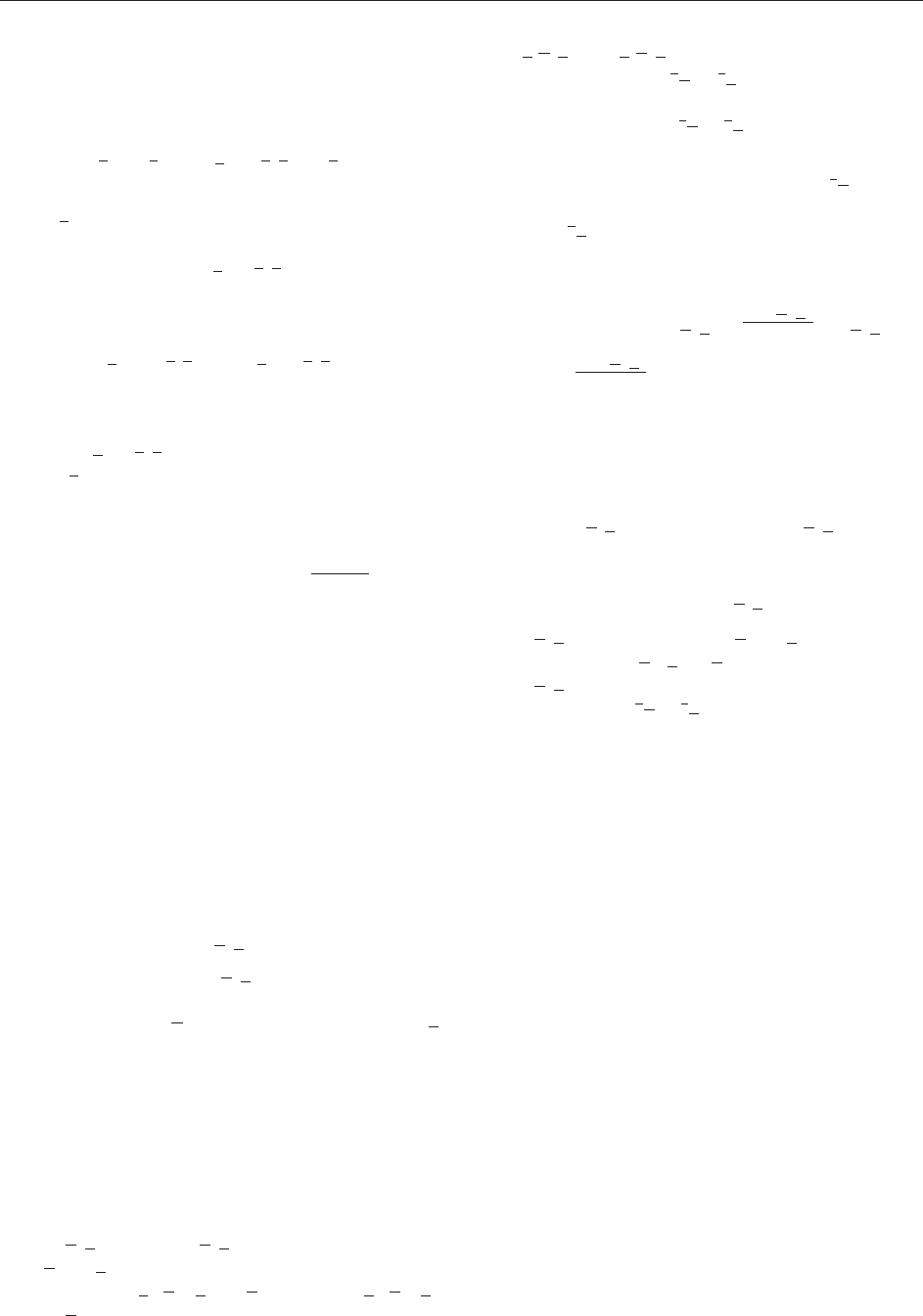
We only mention here a remarkably general
example, characterized by the Newtonian equa-
tions of motion
€
z þ i!
_
z ¼
X
K
k¼1
f
ðkÞ
z;
_
z þ i!
zðÞ
where
z (z
1
, ..., z
N
) is the N-vector whose com-
plex components z
n
z
n
(t) are the dependent vari-
ables, while the ‘‘forces’’
f
(k)
(z,
~
z) are required to be
analytic in all their arguments and to satisfy the
scaling properties
f
ðkÞ
ðz;
~
zÞ¼
k
f
ðkÞ
ðz;
~
zÞ
which however entail no restriction on the velocity-
dependence of these forces, namely on the depen-
dence of
f
(k)
(z,
~
z) on the (components of the)
second,
~
z, of its two N-vector arguments.
The next example we report is characterized by
the Newtonian equations of motion
~
r
n
þ i!
~
r
n
þ 2!
2
~
r
n
¼
X
N
m¼1;m6¼n
M
m
~
r
mn
r
3
mn
where we assume the N dependent variables
~
r
n
~
r
n
(t) to be three-vectors (although the property of
isochronicity of this deformed system would hold no
less if these were S-vectors, with S an arbitrary
positive integer) and we use the short-hand notation
~
r
mn
=
~
r
m
~
r
n
. This system is (perhaps) remarkable
inasmuch as it represents a (complex) deformation
of the classical N-body gravitational problem, to
which it clearly reduces for ! = 0.
The next example we report is characterized by
the following (first-order) equations of motion of
oscillator type:
_
x
n
ip
n
!x
n
¼ f
n
ðx; yÞ; n ¼ 1; ...; N
_
y
m
þ iq
m
!y
m
¼ g
m
ðx; yÞ; m ¼ 1; ...; M
½8
Here the N-vector
x, respectively the M-vector y,
have as components the N þMcomplexdependent
variables x
n
x
n
(t), y
m
y
m
(t); the N þM para-
meters p
n
, q
m
are all nonnegative integers (or they
could be nonnegative rational numbers); and the
N þ M complex functions f
n
, g
m
are restricted by
the following conditions (which are sufficient to
guarantee the isochronicity of this dynamical
system):
(1) f
n
(x, y) and g
m
(x, y) are holomorphic at
x = 0, y = 0;
(2) lim
" ! 0
["
1
f ("x, "y)] = 0, lim
" ! 0
["
1
g("x, "y)]
= 0;
(3)
f (x, y) and g(x, y) are polynomial in the y
m
;
(4a) lim
" !0
["
1p
n
f
n
("
p
x, "
q
y)] = nondivergent, n =
1, ..., N;
(4b) lim
"!0
["
1þq
m
g
m
("
p
x,"
q
y)]=nondivergent,m=
1,...,M.
In the conditions (4a) and (4b) the notation "
p
x indicates
of course the N-vector of components "
p
n
x
n
,and
likewise "
q
y is the M-vector of components "
q
m
y
m
.
Note that this dynamical system, [8], includes the
Hamiltonian case characterized by the restrictions
N ¼ M; p
n
¼ q
n
; f
n
ðx; yÞ¼
@Vðx; yÞ
@y
n
; g
n
ðx; yÞ
¼
@Vðx; yÞ
@x
n
which imply that the equations of motion [8] are
just the Hamiltonian equations entailed by the
Hamiltonian function
Hð
x; yÞ¼i!
X
N
n¼1
p
n
x
n
y
n
þ Vðx; yÞ
isochronicity being now guaranteed by the following
conditions on the function V(
x, y):
(1) V(
x, y)isholomorphic at x = 0, y = 0;
(2) lim
" !0
["
2
V("x, "y)] = 0;
(3) V(
x, y)ispolynomial in the y
n
;
(4) lim
" !0
["
1
V("
p
x, "
p
y)] = nondivergent.
The last two examples we report can be char-
acterized as assemblies of non-linear harmonic
oscillators, inasmuch as these two dynamical sys-
tems (which are actually special cases of more
general systems) have the remarkable property that
their generic solutions (namely, all their solutions,
except for a lower-dimensional set of singular
solutions in which one or more of the ‘‘moving
particles’’ shoot off to infinity at a finite time) are
completely periodic with the fixed period T, see [1].
Their Newtonian equations of motion read
~
z
nm
3i!
~
z
nm
2!
2
~
z
nm
¼ c
X
N
¼1
X
M
¼1
~
z
n
~
z
~
z
m
~
z
nm
3i!
~
z
nm
2!
2
~
z
nm
¼ c
X
N
¼1
X
M
¼1
~
z
~
z
~
z
nm
These are two (different) systems of NM Newtonian
equations of motion satisfied by the NM complex
S-vectors
~
z
nm
(with S an arbitrary positive integer);
hence here the index n runs from 1 to N, and the
index m runs from 1 to M, with N and M two
arbitrary positive integers, while c is of course an
arbitrary complex constant (which might actually be
rescaled away). The dot sandwiched between two
Isochronous Systems 169

S-vectors denotes the standard (Euclidian) scalar
product, entailing the rotation-invariant character,
in S-dimensional space, of these equations of
motion. Since these systems only feature linear and
cubic forces, these models are remarkably close to
physics; and they become even more applicable if
they are written in their real versions, that obtain in
an obvious manner by setting
~
z
nm
¼
~
x
nm
þ i
~
y
nm
; c ¼ a þ ib
In contrast to what we did for the previous examples,
let us outline here the derivation of these results.
Actually the two systems of Newtonian equations
written above are merely special subcases, corres-
ponding to appropriate parametrizations of a square
matrix M (of appropriate rank) in terms of S-vectors, of
the following nonlinear matrix evolution equation:
€
M 3i!
_
M 2!
2
M ¼ cM
3
½9
Hence the findings reported above are merely special
cases of the more general result according to which
the generic solution of this nonlinear matrix evolu-
tion equation – with M M(t) a square matrix of
arbitrary rank – is periodic with period T, see [1]:
Mðt þ TÞ¼MðtÞ
And this result is an immediate consequence, via the
following matrix version of the trick
MðtÞ¼expði!tÞðÞ; ¼
expði!tÞ1
i!
½10
of a previous result due to V. I. Inozemtsev,
according to which the matrix evolution equation
00
¼ c
3
which clearly corresponds to [9] via [10], is
integrable and all its solutions () are mero-
morphic functions of the independent variable .
The Transition to Deterministic Chaos
In this section we illustrate, using the real N-body
problem in the plane characterized by the New-
tonian equations of motion [7], the behavior of an
isochronous system of the kind described above
when the initial data fall outside of the region
yielding isochronous motions.
To do this it is convenient to use the complex
version of the equations of motion [7], that obtain
from [7] by setting
z
n
¼ x
n
þ iy
n
;
~
r
n
¼ x
n
; y
n
; 0ðÞ;
^
k ¼ð0; 0; 1Þ; a
nm
¼
nm
þ i
nm
½11
and read as follows:
€
z
n
¼ i!
_
z
n
þ 2
X
N
m¼1;m6¼n
a
nm
_
z
n
_
z
m
z
n
z
m
½12
The main tool of our analysis is the (particularly
simple) version of the trick appropriate to this
model,
z
n
ðtÞ¼
n
ðÞ; ¼
expði!tÞ1
i!
½13a
entailing
z
n
ð0 ¼
n
ð0Þ;
_
z
n
ð0Þ¼
0
n
ð0Þ½13b
that relates our equations of motion [12] to the
equations of motion
00
n
¼ 2
X
N
m¼1;m6¼n
a
nm
0
n
0
m
n
m
½14
These equations of motion, together with the initial
data
n
(0),
0
n
(0) (see [13b]) define the solutions
n
n
() in the complex -plane. The ‘‘physical’’
evolution of the points z
n
z
n
(t) as functions of
the real time variable t is then given by the evolution
of the corresponding coordinates
n
(), see [13a], as
the complex variable travels round and round on
the circle C in the complex -plane, the diameter of
which of length 2/!, has one extreme at the origin
= 0 and the other on the positive imaginary axis at
= 2i/!. It is therefore clear that the behavior of
z
n
(t) as a function of the real, ‘‘physical time’’
variable t depends on the analytic structure of
n
()
as function of the complex variable , in particular
of the singularities, if any, of this function
n
() that
fall in the disk D encircled by the circle C in the
complex -plane.
Let us tersely review the relevant analysis. We
recall first of all that (it can be proven that) there
exists in phase space an open region of initial data
z
n
(0),
˙
z
n
(0), characterized by large values of the
moduli jz
n
(0) z
m
(0)j of the initial interparticle
distances and by small values of the moduli of the
initial particle velocities j
˙
z
n
(0)j (see [14] and [13b]),
that guarantees (all components
n
() of) the
corresponding solution
()of[14]tobeholo-
morphic in (a disk of radius centered at the origin
= 0 of the complex -plane that includes) the circle
C, hence the corresponding solution
z(t)tobe
completely periodic with period T, see [13a] and
[1]. This result guarantees the isochronous character
of this model, [12], for any arbitrarily given assign-
ment of the coupling constants a
nm
.
170 Isochronous Systems

Next, let us restrict, for simplicity, our considera-
tion to models [12] in which the coupling constants
a
nm
are real and nonnegative,
a
nm
0 ½15
Then the singularities of the generic solution
()of
[14] – which occur at values
b
of where two
coordinates
n
() coincide, say
(
b
) =
(
b
) = b
(see the right-hand side of [14]) – are branch points
characterized by the exponent, say,
¼
¼
1
1 þ a
½16
so that in their neighborhood, namely for
b
,
s
ðÞ¼b c
b
ðÞ
þv
b
ðÞ
þ
X
1
k¼1
X
1
‘;m¼0‘þm1
’
ðsÞ
k‘m
b
ðÞ
kþ‘þmð1Þ
s ¼ ; ½17a
n
ðÞ¼b
n
þ v
n
b
ðÞ
þ
X
1
k¼1
X
1
‘¼
k1
X
1
m¼0
’
ðnÞ
k‘m
b
ðÞ
kþ‘þmð1Þ
n 6¼ ; ½17b
The sign in front of c in the right- hand side of the
first, [17a], of these formulas indicates that one sign
must be chosen for s = , the opposite for s = .
Note that here the 4 þ 2(N 2) = 2N constants
b
, b, c, v, b
n
, v
n
are a priori arbitrary – except for
the obvious restrictions b
n
6¼ b, b
n
6¼ b
m
– while the
coefficients ’
(s)
k‘m
, ’
(n)
k‘m
can be computed from these
constants, recursively, by inserting this ansatz, [17],
in the equations of motion [14]. The fact that the
number, 2N,ofa priori undetermined coupling
constants equals the number of arbitrary initial data
for this system of ODEs, [14], indicates that this
kind of branch points, characterized by the expo-
nents
nm
, see [16], is the typical singularity featured
by the generic solution
()of[14]. (Branch points
with different exponents may appear, but only in
nongeneric solutions
() which, at some value
b
of
, feature the coincidence of more than two
components, say
(
b
) =
(
b
) =
(
b
)).
We conclude therefore that the generic solution
()
of [14] features a, generally infinite, number of branch
points, that generally affect each of its components
n
(), and which are characterized, for the class of
models to which we are restricting attention here, see
[15]) by (real) exponents
nm
,see[16], which are then
clearly characterized by the inequalities
0 <
nm
1
What does this tell us about the generic solution
z(t)
of the equations of motions of primary interest to
us, [12], in particular about its evolution as function
of the real ‘‘time’’ variable t?
To the solution
() is associated a Riemann
surface the structure of which is determined by the
character and distribution of the branch points of
() in the complex -plane (each of which is
generally featured by each component
n
()of(),
although generally not in the same way: see [17]),
and we know from [13a] that the values taken by
z(t)ast evolves from t = 0 towards t = 1 coincide
with the values taken by
() as the independent
variable travels, on that Riemann surface asso-
ciated with
(), counterclockwise round and round
on the circle C defined above (the diameter of which
lies on the imaginary axis in the complex -plane,
with one end at = 0 and the other at = 2i/!),
employing a period T, see [1], to make each full
round. Hence the behavior of the solution
z(t)of
[12] depends on the structure of the Riemann
surface associated with the corresponding solution
()of[14], and specifically on the number of
different sheets of that surface that are visited as one
travels on it before returning, if ever, to the main
sheet from which the travel started at t = = 0.
If no other sheet is visited besides the main one,
the corresponding solution
z(t) is of course periodic
with period T, see [1]and[13a],
ztþ TðÞ¼ztðÞ ½18
This happens provided no branch point is featured
by
() on its main sheet inside the circle C; and, as
already indicated above, it has been proven (even in
the more general case with arbitrary coupling
constants a
nm
) that there is an open region having
full dimensionality in the phase space of initial data,
see [13b], that yields such an outcome, implying the
isochronicity of the model characterized by the
Newtonian equations of motion [12]. This region
R of initial data has a boundary – a lower-
dimensional domain in the phase space of initial
data – out of which emerge motions leading, at a
time t
b
smaller than T, to a ‘‘particle collision’’, say
z
(t
b
) = z
(t
b
).
The character of the solution
z(t) yielded by initial
data outside of the region R depends on the
structure of the Riemann surface associated with
the corresponding solution
(). This is mainly
determined by the values of the branch point
exponents
nm
, which are themselves determined by
the values of the coupling constants a
nm
, see [17]
and [16]. Let us focus on the (more interesting) case
in which these constants a
nm
are rational numbers,
entailing that the coefficients
nm
determining the
Isochronous Systems 171

character of the branch points are as well rational,
see [16], so that each of the cuts associated with
them opens the way, in the Riemann surface, to a
finite number of sheets. There are then two
possibilities, each generally characterized by open
regions of initial data having full dimensionality in
phase space, the boundaries of which always are
(lower-dimensional) domains out of which emerge
motions leading, in a time t
b
smaller than T,toa
‘‘particle collision’’.
One possibility is that the number B of sheets
visited before returning to the main sheet be finite,
B < 1; the corresponding solutions
z(t) are then
completely periodic with period
~
T = (B þ 1)T,
z(t þ
~
T) = z(t).
Another possibility is that the number of new
sheets visited be unlimited, namely that the structure
of the Riemann surface be such that, by traveling
round and round on it along the circle C one never
returns back to the main sheet. This can happen,
even if the exponents
nm
are all rational so that via
the cuts associated to each of them access is gained
to only a finite number of new sheets, because of the
possibility that an infinity of branch points be
located inside the circle C on the infinite sheets
associated to these branch points, via a never ending
mechanism of branch points nesting. Whenever this
happens the corresponding solution
z(t)isaperiodic;
and it is moreover likely that it then be chaotic,in
the sense of displaying a sensitive dependence on its
initial data. Indeed this will happen whenever some
ones out of this infinity of branch points fall
arbitrarily close to the contour C, because then a
minute change in the initial data, to which there will
correspond a minute change in the pattern of these
branch points of
() in the complex -plane, will
cause some relevant branch point to cross over from
outside the circle C to inside it, or viceversa, and this
will eventually affect quite significantly the time
evolution of
z(t), by causing a change in the
sequence of sheets that get visited by traveling
along the circle C on the Riemann surface associated
to the corresponding
().
This phenomenology has a clear ‘‘physical inter-
pretation’’, which can be qualitatively understood
as follows. The N-body problem characterized by
the Newtonian equations of motion [12] generally
yields confined motions, the trajectory of each
particle tending to wind round and round – it
would indeed reduce to a circle were it not for the
interaction with the other particles. A possibility, as
we know, is that this N-body motion be completely
periodic, with the same period T that characterizes
the circular motion of each particle when the two-
body interparticle interaction is altogether missing
(a
nm
= 0). Another possibility, in the case discussed
above with rational coupling constants, is that there
exist other motions which are as well completely
periodic, but with periods which are integer multi-
ples of T. A third possibility, which cannot a priori
be excluded, is that there also exist motions which
are aperiodic but in some way overall ordered,
perhaps featuring trajectories that eventually wind
up around limit cycles. And still another possibility
is that the motions described by the solution
z(t)be
aperiodic and disordered. In this case the physical
mechanism causing a sensitive dependence on the
initial data can be understood as follows. Such
disordered motions necessarily feature near misses,
in which, typically, two particles pass quite close to
each other (while the probability that an actual
collision occur among point particles moving in a
plane is of course a priori nil). Such a near miss in
the motion described by
z(t) corresponds – see the
discussion above – to a branch point of the
corresponding solution
() occurring quite close
to the circle C in the complex -plane (which is the
one-dimensional region of the two-dimensional
complex -plane in which the values of
()
correspond to the values z(t) describing the motion
of physical particles moving as functions of the
time t); and in the generic case of a two-body near
miss, there is a correspondence between the fact
that such a branch point occur just inside,orjust
outside, the circle C, and the way the particles pass,
on one or the other side, by each other. Likewise,
the tiny change in the initial data that causes, in the
context of the solutions
() – see the discussion
above – a branch point of
() to pass from inside
to outside the circle C, or viceversa, corresponds, in
the context of the ‘‘physical’’ solutions
z(t), to a
change occurring in the corresponding near miss,
from the case in which the two particles involved in
it slide by each other on one side to the case in
which they instead slide by each other on the other
side – entailing a significant change in the sub-
sequent motion (indeed, the closer a near miss, the
more it affects the motion, due to the singularity
of the two-body interaction at zero separation,
see [12]).
The phenomenology outlined here does indeed
occur in this goldfish model. It also occurs – rather
similarly if more simply, since in this case only
square-root branch points occur, irrespective of the
values of the coupling constants – in the model [6]
with K = 1. Indeed, it is clear that this phenomen-
ology provides a paradigm of rather general applic-
ability for the transition from isochronicity to
deterministic chaos, indeed perhaps for the generic
onset of deterministic chaos.
172 Isochronous Systems

See also: Bifurcations of Periodic Orbits;
Calogero–Moser–Sutherland Systems of Nonrelativistic
and Relativistic Type; Integrable Systems: Overview;
Quantum Calogero–Moser Systems; Synchronization of
Chaos.
Further Reading
Calogero F (2001) Classical Many-Body Problems Amenable to
Exact Treatments. Heidelberg: Springer.
Calogero F (2004a) Partially superintegrable (indeed isochronous)
systems are not rare. In: Shabat AB, Gonzalez-Lopez A,
Man˜ as M, Martinez Alonso L, and Rodriguez MA (eds.) New
Trends in Integrability and Partial Solvability, NATO Science
Series, II. Mathematics, Physics and Chemistry, Proceedings of
the NATO Advanced Research Workshop held in Cadiz,
Spain, 2–16 June 2002, vol. 132, pp. 49–77. Kluwer.
Calogero F (2004b) Isochronous dynamical systems. Applicable
Anal. (in press).
Calogero F (2004c) Isochronous systems. Proceedings of the VI
International Conference on Geometry, Integrability and
Quantization, Varna, June 2004. Edited by Mladenov IM
and Hirshfeld AC, Sofia, Bulgaria, 2005, pp. 11–61 (ISBN
954-84952-9-5).
Calogero F and Franc˛oise J-P (2002) Periodic motions galore:
how to modify nonlinear evolution equations so that they
feature a lot of periodic solutions. Nonlinear Math. Phys 9:
99–125.
Calogero F and Franc˛oise J-P (2003) Nonlinear evolution ODEs
featuring many periodic solutions. Theor. Mat. Fis 137:
1663–1675.
Calogero F and Franc˛oise J-P (2002) Isochronous motions galore:
nonlinearly coupled oscillators with lots of isochronous
solutions. In: Proceedings of the Workshop on Superintegrability
in Classical and Quantum Systems, Centre de Recherches
Mathe´matiques (CRM), Universite´deMontre´al, September
2002, CRM Proceedings and Lecture Notes, American Mathe-
matical Society, 2004, vol. 37, pp. 15–27.
Chavarriga J and Sabatini M (1999) A survey of isochronous
systems. Qualitative Theory Dyn. Syst 1: 1–70.
Mariani M and Calogero F (2005) Isochronous PDEs. Yader-
naya Fizika (Russian Journal of Nuclear Physics)68:
958–968.
Isomonodromic Deformations
V P Kostov, Universite
´
de Nice – Sophia Antipolis,
Nice, France
ª 2006 Elsevier Ltd. All rights reserved.
Introduction
In this article we consider families of linear
differential equations whose monodromy data do
not depend on the parameters. Such families are
called isomonodromic deformations of any of the
equations of the family (for the definitions of a
regular and Fuchsian linear system and of
their monodromy groups, see Riemann–Hilbert
Problem).
Schlesinger’s Equation
The best-studied example of an isomonodromic
deformation is the Fuchsian system on Riemann’s
sphere CP
1
= C [1considered by L Schlesinger:
dX
dt
¼
X
pþ1
j¼1
A
j
t a
j
!
X ½1
Here the poles a
j
2 C are free parameters and the
matrices-residua A
j
depend analytically on
a := (a
1
, ..., a
pþ1
); therefore, system [1] is in fact a
family of linear systems which is an analytic
deformation of the system obtained for a
j
= a
0
j
.
One can think of system [1] as defined by the
Pfaffian system
dX ¼ !
s
X;!
s
¼
X
pþ1
j¼1
A
j
t a
j
dðt a
j
Þ½2
Suppose first that the poles a
j
vary within
small nonintersecting disks of the points a
0
j
,so
small that the standard system of generators of
the monodromy group could be defined by one
and the same contours for all values of the
parameters a
j
(see Fig ure 1 from Riemann–Hilbert
Problem). Suppose also that one chooses 1 as
base point and that one has
Xj
t¼1
¼ I ½3
(where I is the identity matrix) for all values of the
parameters a
j
. Finally, suppose that all matrices A
j
are nonresonant, that is, without two eigenvalues
differing by a nonzero integer. Then the following
conditions are necessary and sufficient for system [1]
to be isomonodromic:
dA
i
ðaÞ¼
X
pþ1
j¼1;j6¼i
½A
i
ðaÞ; A
j
ðaÞ
a
i
a
j
dða
i
a
j
Þ
i ¼ 1; ...; p þ 1 ½4
This system (called Schlesinger’s equations) results
from the Frobenius integrability condition
d!
s
= !
s
^ !
s
of system [2].
Isomonodromic Deformations 173

Remarks 1
(i) To find the matrices-residua A
j
as functions of a
and given their values A
j
j
a=a
0
is a Cauchy
problem. It is solvable for a close to a
0
and
the matrices A
j
are analytic in a.
(ii) The differential of A
i
being a commutator
[A
i
, .], the matrix A
i
remains within its con-
jugacy class throughout the deformation.
(iii) Schlesinger’s equations are the necessary and
sufficient conditions for isomonodromy also in
the case when system [1] has a logarithmic
pole at 1 whose matrix-residuum does not
change throughout the deformation. In this
case the solution to system [1] in its Levelt’s
decomposition at 1 (see Riemann–Hilbert
Problem) equals U
1
(1=t)t
D
1
t
E
1
G, where
D
1
is a diagonal matrix with integer entries,
E
1
is an upper-triangular constant matrix, and
U
1
is holomorphic at 1 and such that
U
1
(0) = I.
Definition 2 The deformation satisfying condition
[4] with initial condition [3] for the solution to
system [1] is called the normalized Schlesinger
deformation.
Remark 3 When the matrices-residua A
j
are
nonresonant, then every isomonodromic deforma-
tion of system [1] with a
j
= a
0
j
is either the normal-
ized Schlesinger deformation or is a nonnormalized
Schlesinger deformation, that is, obtained from
the normalized one by a change of variables
X 7!C(a)X, C(a) 2 GL(n, C ). In this way, one has
Xj
t=1
= C(a) instead of [3] and the deformation is
described by a Pfaffian system with a form of the
kind !
n
= !
s
þ
P
pþ1
j=1
j
(a)da
j
.
Example 4 The following one-parameter Fuchsian
family is an isomonodromic Schlesinger deformation:
dX
dt
¼
X
pþ1
j¼1
A
j
t ba
0
j
!
X
Here the matrices A
j
are constant and the parameter
b takes nonzero values. Indeed, one either checks
directly that there holds condition [4] or one makes
the change of time (which does not change
monodromy) t 7!bt after which the parameter
b disappears.
A A Bolibrukh has shown that in the resonant
case every isomonodromic deformation of a Fuch-
sian system is described by an integrable Pfaffian
system with 1-form ! = !
n
þ !
m
, where the mero-
morphic 1-form !
m
vanishes at 1 and has poles of
orders r
j
along the hyperplanes {x a
j
= 0}; here r
j
is the largest nonzero integer difference between two
eigenvalues of the matrix A
j
.
Consider now Schlesinger’s equation in the global
situation, that is, when the poles a
j
belong to the
universal covering Z of the space C
n
n, where is
the ‘‘diagonal,’’ that is, the union of all sets
{a
i
= a
j
}, i 6¼ j. Suppose that the matrices A
j
are
nonresonant. There are values of a (their set is
denoted by ) for which some entries of some of the
matrices-residua A
j
tend to 1. Typically, at such
points the matrices A
j
have poles of second order;
this is a result due to Bolibrukh. Indeed, set
A
j
= Q
1
j
J
j
Q
j
, where J
j
is the Jordan normal form
of A
j
; hence, this is a constant matrix; we assume
that Q
j
2 SL(n, C). Typically, at points of the
matrices Q
j
and Q
1
j
have simple poles, which
makes a pole of second order for A
j
.
B Malgrange and, independently, T Miwa have
proved that system [4] is completely integrable and
that it has the Painleve´ property: ‘‘The only
movable singularities of its solutions are poles.’’
(The fixed singularities of the solutions are, by
definition, along the points of Z which are over .
The positions of the movable singularities depend
on the initial condition, that is, on the values of the
matrices A
j
for a = a
0
.) In other words, the
solutions to Schlesinger’s equation are matrices
meromorphic on Z.
Theorem 5 The set of movable singular points
of the Schlesinger equation is the set of zeros of a
function (the Miwa -function) holomorphic on Z
and such that
1
2
X
i;j;i6¼j
trðA
i
ðaÞA
j
ðaÞÞdða
i
a
j
Þ
a
i
a
j
¼ d logððaÞÞ
Some improvements of this result are due to
Malgrange and Bolibrukh.
Isomonodromy and Confluence
The idea to consider a linear system of ordinary
differential equations with a pole of order higher than
1 as embedded into a family of Fuchsian systems with
confluence of the poles has been proposed by V I
Arnol’d in 1984 and independently by J-P Ramis in
1988. The idea has been used by A Duval, B Khesin,
A A Glutsyuk, and other authors. In particular, it is
interesting to relate the Stokes multipliers (defined in
the next section) of the system obtained as a result of
a confluence to the monodromy groups of the
174 Isomonodromic Deformations

Fuchsian systems obtained for values of the para-
meters before the confluence occurs.
Example 6 Consider the one-parameter family of
linear systems:
ðt
2
ÞdX=dt ¼ðAðÞt þ BðÞÞX ½5
Here the matrices A, B,andX are n n.
Suppose that t 2 C (i.e., we do not consider
singularity at 1), 2 (C, 0). Then for 6¼ 0the
system is Fuchsian – it has two logarithmic poles at
1=2
whose confluence for = 0givesasaresulta
pole at 0 which might be of order 2 if B(0) 6¼ 0or1
if B(0) = 0.
In this section we consider only the situation
when the family producing the confluence is
isomonodromic for values of the parameters before
the confluence.
Example 7 This is the case of family [5] with B 0
and A being a constant nonresonant n n matrix.
Indeed, the change of time t 7!
1=2
t () transforms the
family into the family (t
2
1)dX=dt = tAX
(independent of ) which is a Fuchsian system (at 1
as well).
Suppose now that t 2 CP
1
(i.e., we consider the
singularity at 1 as well). Hence, the monodromy
operator M
1
around 1 is independent of up to
conjugacy (it is conjugate to exp(2iA)). On the
other hand, consider the monodromy operator M
0
defined by a contour circumventing counterclock-
wise both poles at
1=2
(one can choose as such
a contour a circumference centered at the origin
and of sufficiently large radius). It equals M
1
1
,
and it is well defined for = 0aswell.(Thisis
not the case of the monodromy operators defined
by contours circumventing only one of the poles
at
1=2
.) Hence, up to conjugacy M
0
is indepen-
dent of .AsM
0
is in a sense the only
monodromy operator that can be defined by
a contour depending continuously on for all
2 (C, 0) and not passing through a pole of the
system, one can say that the family is strongly
isomonodromic.
Example 8 Consider now family [5] with n = 2,
A ¼
d 0
0 d
; B ¼
0
00
where d 2 C.For 6¼ 0 the family is isomonodromic –
the change of time () followed by the change of
variables
X 7!
1=2
0
01
XðÞ
brings the family to the form
ðt
2
1Þ
dX
dt
¼
d 0
0 d
t þ
01
00
X
which is independent of , hence, isomonodromic.
However, the change of variables () is not defined
for = 0. The monodromy operator M
0
(defined as
above) is scalar for = 0 and conjugate to a Jordan
block of size 2 for 6¼ 0. Hence, the family is not
strongly isomonodromic.
The following example is closely connected
to singularity theory. It has been suggested by
F Pham.
Example 9 Consider the Abelian integrals
I
1
¼
Z
dx=ðx
3
þ sx þ tÞ and
I
2
¼
Z
x dx=ðx
3
þ sx þ tÞ
taken over a closed contour belonging to a
nonsingular fiber of the function f (x) = x
3
þ sx þ t.
Suppose that x
3
þ sx þ t 6¼ 0on. Obviously, I
1
and I
2
depend only on [], the class of homotopy
equivalence of . Set
x
3
þ sx þ t ¼ðx x
1
Þðx x
2
Þðx x
3
Þ;
x
j
¼ x
j
ðs; tÞ
Then one has
I
k
¼ 2i
X
3
j¼1
k;j
x
k1
j
= 3x
2
j
þ s
; k ¼ 1; 2
where the integers
k, j
depend only on [] (the
contour is homotopy equivalent to a linear
combination with integer coefficients of small
loops around the roots of f; the integral along such
a loop is computed using residua). Note that
_
x
j
:¼ dx
j
=dt ¼1= 3x
2
j
þ s
An easy computation shows that the integrals I
1
, I
2
satisfy the following Picard–Fuchs system of differ-
ential equations:
t
_
I
1
2s
_
I
2
=3 ¼ 2I
1
=3
2s
2
_
I
1
=9 t
_
I
2
¼ I
2
=3
The system admits also a presentation of the form
t
2
þ
4s
3
27
_
I
1
_
I
2
¼
2t=32s=9
4s
2
=27 t = 3
I
1
I
2
Here the unknown variables form a vector column
of length 2; to obtain a 2 2 matrix, one has to
choose another contour
0
(linearly independent
Isomonodromic Deformations 175

with as a linear combination of the loops around
the roots x
i
) which gives the second column of the
matrix. The system is strongly isomonodromic – its
matrix-residuum at 1 equals diag(2=3, 1=3); hence,
the monodromy operator M
0
up to conjugacy equals
diag(exp(4i=3), exp(2i=3)).
A A Bolibrukh has considered the possibility of
confluence of poles in Schlesinger’s equation
(i.e., the possibility to have equalities of the form
a
i
= a
j
in system [1]). He has considered the so-called
normalized isomonodromic confluences, that
is, isomonodromic confluences defined by Pfaffian
systems with coefficient forms ! = !
s
þ !
m
alone
(see the previous section). He has shown that
a normalized isomonodromic confluence of singular
points of Fuchsian systems of linear differential
equations on Riemann’s sphere can only lead to
a system with regular singular points. This is a
partial answer to a problem stated by V I Arnol’d:
how to express a system with regular singular
points as a limit of Fuchsian systems?
Other Results
In the case of a linear system with irregular singular
point, isomonodromy means that the formal mono-
dromy and the Stokes multipliers do not change
throughout the deformation. The formal mono-
dromy can be computed from the formal normal
form (the latter can be found algorithmically; this is
due to H Turrittin). Consider, for simplicity, the
nonresonant case, that is, the case when the leading
matrix in the Laurent series of the system at the
singular point has distinct eigenvalues (this defini-
tion differs from the one in the case of a Fuchsian
singular point). The Stokes multipliers are linear
operators acting on the solution space. They are
defined as follows: there exist sectors of maximal
opening centered at the singular point on each of
which the solution is uniquely defined by its
asymptotic development. Two solutions X
1
, X
2
having one and the same asymptotic development
in two overlapping sectors are related by X
1
= X
2
C,
where C is a Stokes multiplier. The monodromy
operator is expressed as a product of the operator
of formal monodromy and the Stokes multipliers.
Isomonodromic deformations of systems with irregu-
lar singular points have been constructed by B
Malgrange. Isomonodromic deformations have been
usedbyYSibuyaandCHLinandbyYSibuyaand
T J Tabara to investigate Stokes multipliers.
At the beginning of the twentieth century,
P Painleve´ and B Gambier have classified the
differential equations of second order,
u
xx
¼ Rðx; u; u
x
Þ½6
(where R is analytic in x and rational in u and u
x
)
whose solutions do not have branch-type movable
singularities. From the 50 equations (up to local
transformation) discovered by them only six are not
reduced to linear ones. These are the so-called
Painleve´ equations. They appear often as isomo-
nodromy conditions for families of linear differen-
tial equations and this has given the idea to
develop the isomonodromic deformation method. It
consists in associating with eqn [6] a linear system
d=d ¼ Að; x; u; u
x
Þ ½7
with matrix-valued coefficients rational in .
The deformation of the coefficients in x is described
by eqn [6] in such a way that the monodromy data of
system [7] remain the same. Thus, the monodromy
data of system [7] are first integrals of eqn [6].
Example 10 The Painleve´ II equation
u
xx
xu 2u
3
¼
is associated with the system
d
d
¼
4i
2
ix 2iu
2
4iu 2u
x
i
4iu 2u
x
þ
i
4i
2
þ ix þ 2iu
2
0
B
@
1
C
A
The idea to present the Painleve´ equations as
isomonodromy conditions originate from the works
of Fuchs (1907) and Garnier (1912). It has been
used, for example, in the papers of Flaschka and
Newell (1980), Jimbo and Miwa (1981),andIts and
Novokshenov (1986).
See also: Holonomic Quantum Fields; Integrable
Systems: Overview; Painleve
´
Equations;
Riemann–Hilbert Problem; WDVV Equations and
Frobenius Manifolds.
Further Reading
Arnol’d VI and Ilyashenko YuS (1988) Ordinary differential
equations. In: Dynamical Systems I, Encyclopedia of Mathe-
matical Sciences, t. 1. Berlin: Springer.
Bolibrukh AA (1997) On isomonodromic deformations of
Fuchsian systems. Journal of Dynamical and Control Systems
3(4): 589–604.
Bolibrukh AA (1998) On isomonodromic confluences of Fuchsian
singularities. Proceedings of the Steklov Institute of Mathematics
221: 117–132 (translation from Trudy Matematicheskogo
Instituta Imeni Steklova 221: 127–142 (1998)).
Bolibrukh AA (2000) On orders of movable poles in Schlesinger’s
equation. Journal of Dynamical and Control Systems 6(1):
57–73.
Bolibrukh AA (2001) Regular singular points as isomonodromic
confluences of Fuchsian singular points. Russian Mathematical
176 Isomonodromic Deformations