
Francoise J.-P., Naber G.L., Tsun T.S. (editors) Encyclopedia of Mathematical Physics
Подождите немного. Документ загружается.


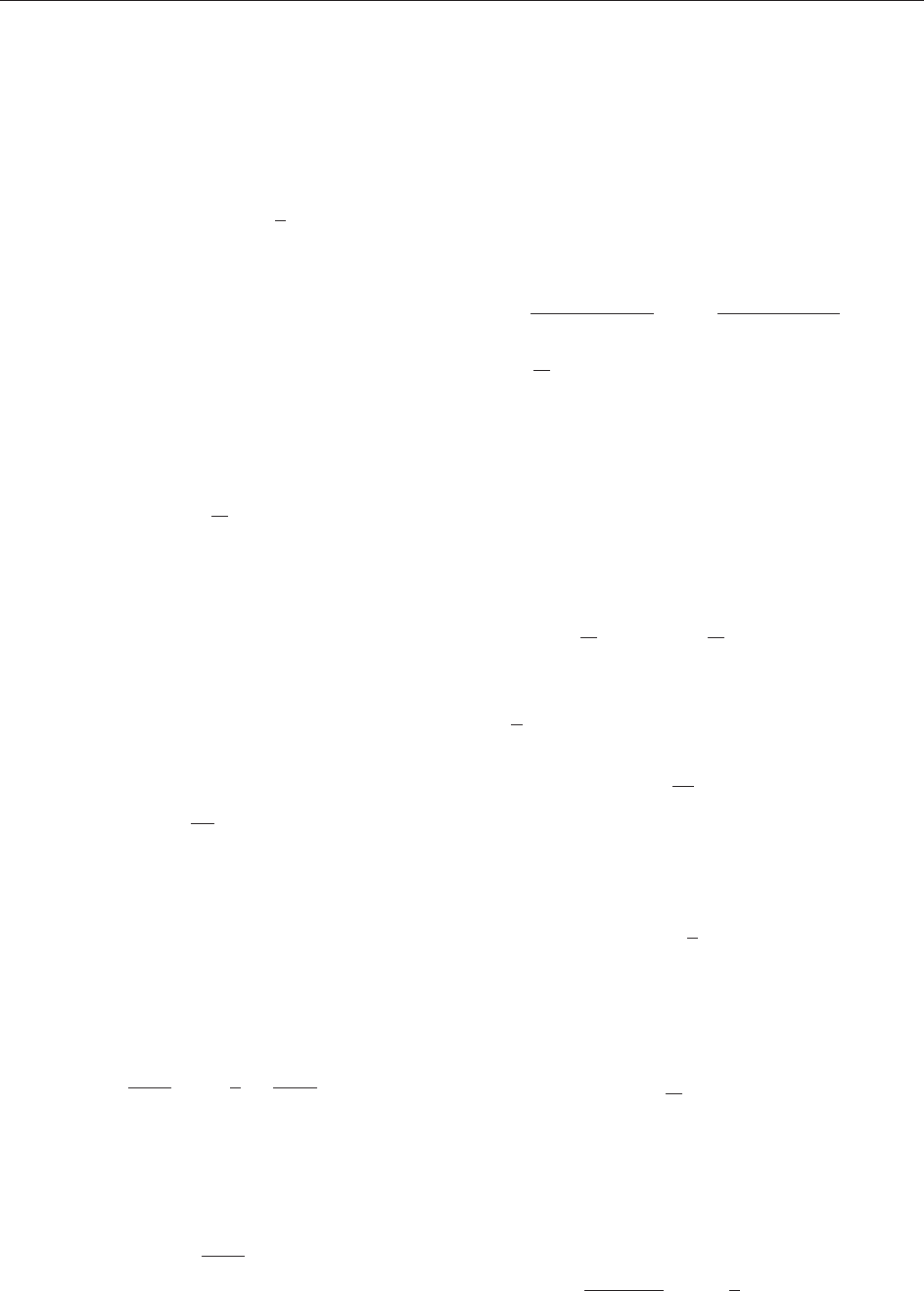
frame in this framework is provided by Itoˆ stochastic
parallel transport. Nevertheless, a new difficulty
arises: the parallel transport will not be differentiable
in the Cameron–Martin sense described before.
Recall that a frame above m is a Euclidean
isometry r : R
d
! T
m
(M) onto the tangent space.
O(M) deno tes the collection of all frames above M
and (r) = m the canonical projection. O( M) can be
viewed as a parallelized manifold for there exist
canonical differential forms (, !) realizing for every r
an isomorphism between T
r
(O(M)) and R
d
so(d).
If A
, = 1, ..., d, denote the horizontal vector
fields, which are defined by <, A
> = "
, <!,
A
> = 0, where "
are the vectors of the canonical
basis of R
d
, then the horizontal Laplacian in O(M)
is the operator
OðMÞ
¼
X
d
¼1
A
2
and we have
O(M)
(fo) = (
M
f )o. With the
Laplacians on M and on O(M) inducing two
probability measures, the canonical projection rea-
lizes an isomorphism between the corresponding
probability spaces.
The Stratonovich SDE
dr
!
¼
X
A
ðr
!
Þo d!
; r
!
ð0Þ¼r
0
with (r
0
) = m
0
defines the lifting to O(M) of the Itoˆ
parallel transport along the Brownian curve and we
write t
p
0
r
0
= r
!
(). Itoˆ map was defined by
Malliavin as the map I : X ! P(M) given by
Ið!ÞðÞ¼ðr
!
ðÞÞ
This map is a.s. bijective and we have = I
1
;
therefore, it provides an isomorphism of measures
from the curved path space to the ‘‘flat ’’ Wiener
space.
For a cylindrical functional F = f (p(
1
), ..., p(
m
))
on P(M), the derivatives are defined by
D
;
FðpÞ¼
X
m
k¼1
1
<
k
ðt
p
0
k
ð@
k
FÞj"
Þ
The derivative operator is closable in a suitable
Sobolev space.
It would be reasonable to think that the differ-
entiable structure considered in the Wiener space
would be conserved through the isomorphism I and
that the tangent space of P(M) would consist of
transported vectors from the tangent space to X,
namely Cameron–Mart in vectors. Let us take a map
Z
p
() 2 T
p()
(M) such that z() = t
p
0
Z
p
() belongs
to the Cameron–Martin space H.
In order to transfer derivatives to the Wiener
space, we need to differentiate the Itoˆ map. We have
(Cruzeiro and Malliavin (1996 )):
Theorem The Jacobian matrix of the flow r
0
!
r
!
() is given by the linear map J
!,
= (J
1
!,
, J
2
!,
) 2
GL(R
d
so(d)) defined by the system of Stratonovich
SDE’s
d
J
1
!;
¼
X
d
¼1
J
1
!;
o d!
ðÞ
d
J
2
!;
¼
X
d
¼1
J
1
!;
;"
o d!
ðÞ
where denotes the curvature tensor of the under-
lying manifold read on the frame bundle.
From this result we can deduce the behavior of the
derivatives transferred to the Wiener space, a result
whose origin is due to B Driver. We have, for a
‘‘vector field’’ Z
p
()onP(M) as above,
ðD
Z
FÞoI ¼ D
ðFoIÞ
with solving
dðÞ¼
_
zðÞd þ o d!ðÞ
dðÞ¼ðo d!ðÞ; zðÞÞ
The process is no longer Cameron–Martin space
valued. Nevertheless, it satisfies an SDE with an
antisymmetric diffusion coefficient (given by the
curvature) and therefore, by Levy’s theorem, it still
corresponds to a transformation of the Wien er space
that leaves the measure quasi-invariant. We extend,
accordingly, the notion of tangent space in the
Wiener space to include processes of the form
d
= a
d!
þ c
d, with a
þ a
= 0. These
were called ‘‘tangent processes’’ in Cruzeiro and
Malliavin (1996).
Another important consequence of the last theo-
rem is the integration-by-parts formula in the curved
setting, initially proved by Bismut (1984):
E
ðD
Z
FÞ¼E
ðFoIÞ
Z
1
0
½
_
z þ
1
2
RicciðzÞd!ðÞ
where Ricci is the Ricci tensor of M read on the
frame bundle.
Some Applications
We already mentioned that Malliavin calculus has
been applied to various domai ns connected with
physics. We shall describe here some of its relations
with elementary quantum mec hanics.
Malliavin Calculus 387
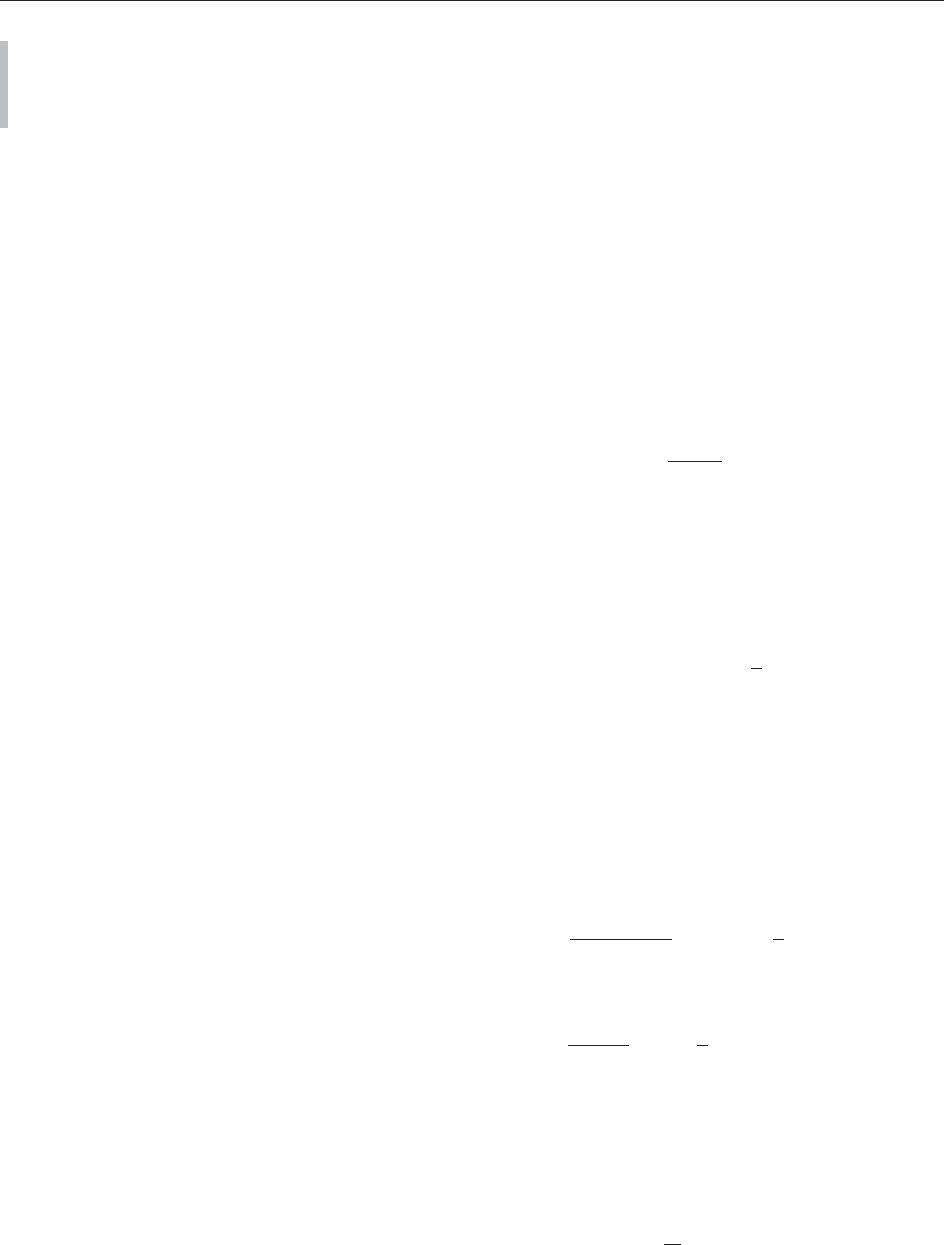
Feynman gave a path space formulation of
quantum theory whose fundamental tool is the
concept of transition element of a functional F(!)
between any two L
2
-states
s
and
u
, for paths !
defined on a time interval [s, u]:
<F >
S
<jFj >
S
¼
ZZZ
s
ðxÞexp
i
h
S
L
ð!; u sÞ
Fð!Þ
u
ðzÞD! dx dz ½6
This is a shorthand for the t ime discretization
version along broken paths ! interpolating
linearly between point x
j
= !(t
j
), t
j
= j(u s )=N,
j = 0, 1, ..., N.In[6] h is Planck’s constant and
S = S
L
denotes the action functional with Lagran-
gian L of the underlying classical system. For a
particle with mass m in a scalar potential V on the
real line,
S
L
ð!; u sÞ¼
Z
u
s
m
2
_
!
2
ðÞVð!ðÞ
d ½7
The ‘‘D!’’ of [6] is used as a Lebesgue measure,
although there is no such thing in infinite dimen-
sions. More genera lly, the constructio n of measures
or integrals on the various path spaces required for
general quantum systems is still nowadays a field of
investigation.
When F = 1and
u
(the complex conjugate of
u
)
reduces to a Dirac mass at z, [6] is the path-integral
representation of the solution (x, u) of the initial-
value problem in L
2
:
ih
@
@u
¼ H
ðx; sÞ¼
s
ðxÞ
½8
where H = (h
2
=2) þ V and when S
L
is as in [7].
Feynman’s framework is time symmetric on I: when
s
=
x
(still for F = 1), [6] provides a path-inte gral
representation of the solution of the final-value
problem for
(z, s).
According to Feynman, ‘‘it would be possib le to
use the integration-by-parts formula
F
!ðsÞ
¼
i
h
F
S
!ðsÞ
½9
as a starting point to define the laws of quantum
mechanics’’ (Feynman and Hibbs 1965, p. 173) . The
functional derivative corresponds to variations of
the underlying paths in directions ! and
F ¼
Z
F
!ðsÞ
!ðsÞds
to an L
2
analog of [4].
Its first consequence, when F = 1, is the path
space counterpart of Newton’s law, in the elemen-
tary case [7],
<m
€
!>
S
L
¼<rVð!Þ>
S
L
½10
where the left-hand side involves a time discretiza-
tion of the second derivative. When F(!) = !(t),
Feynman obtains the path space version of
Heisenberg commutation relation between position
and momentum observables:
!ðtÞ
!ðtÞ!ðt Þ
S
L
!ðt þ Þ!ðtÞ
!ðtÞ
¼ i
h
m
½11
and from this the crucial fact that ‘‘quantum
mechanical paths are very irregular. However, these
irregularities average out over a reasonable length of
time to produce a reasonable drift or average
velocity’’ (Feynman and Hibbs 1965, p. 177).
A probabilistic interpretation (cf. Cruzeiro
and Zambrini (1991)) of Feyn man’s calculus uses
(Bernstein) diffusion processes solving the SDE
dzðtÞ¼
h
m
1=2
dWðtÞþ
h
m
rlog ðzðtÞ; tÞdt ½12
where the drift stems from a positive solution of the
Euclidean version of the above final-value problem
for
,
h
@
@t
¼ H
ðx; uÞ¼
u
ðxÞ
½13
For any regular function f, we can make sense of
the ‘‘continuous limit’’
Df ðzðtÞ; tÞ¼lim
!0
1
E
t
½f ðzðt þ Þ; t þ Þ
f ðzðtÞ; tÞÞ ½14
where E
t
denotes conditional expectation with
respect to the past P
t
and check, indeed, that
DzðtÞ¼
h
m
rlog ðzðtÞ; tÞ
is Feynman’s ‘‘reasonable drift.’’ Using Feynman–
Kac formula, one shows that the diffusions [12]
have laws which are absolutely continuous with
respect to the Wiener measure of parameter h=m,
with Radon–Nikodym density given by
ðzÞ¼
ðzðuÞ; uÞ
ðzðsÞ; sÞ
exp
1
h
Z
1
0
VðzðÞÞd
388 Malliavin Calculus

We can, therefore, use Malliavin calculus on the
path space of these diffusions and the associated
integration-by-parts formula to make sense of [9]
and all its consequences.
The probabilistic counterpart of the time symme-
try of Feynman’s framework is interesting: Heisen-
berg’s original argument to deny the existence of
quantum trajectories (1927) was that any position
can be associated with two velocities. Feynman’s
interpretation [11] and the definition [14] suggest
that this has to do with a past or future conditioning
at time t. Indeed, there is another description of
diffusions z(t) with respect to a family of future
-fields, using the Euclidean version of the initial-
value problem for , underlying [6]. Another drift
built on the model of the drift in [12] results, and
Feynman’s commutation relation [11] becomes
rigorous (without, of course, the factor i).
We refer to Cruzeiro and Zambrini (1991) for a
development of this approach using Malliavin
calculus.
See also: Euclidean Field Theory; Functional Integration
in Quantum Physics; Measure on Loop Spaces;
Stochastic Differential Equations; Stochastic
Hydrodynamics.
Further Reading
Airault H and Malliavin P (1988) Inte´gration ge´ometrique sur l’
espace de Wiener. Bulletin des Sciences Mathe´matiques
112(2): 3–52.
Bismut JM (1984) Large Deviations and the Malliavin Calculus.
Birkha¨user Progress in Mathematics 45.
Cipriano F (1999) The two-dimensional Euler equation: a
statistical study. Communications in Mathematical Physics
201(1): 139–154.
Cruzeiro AB and Malliavin P (1996) Renormalized differential
geometry on path space: structural equation, curvature.
Journal of Functional Analysis 139: 119–181.
Cruzeiro AB and Zambrini JC (1991) Malliavin calculus and
Euclidean quantum mechanics. I. Functional Calculus. Journal
of Functional Analysis 96: 62–95.
Feynman RP and Hibbs AR (1965) Quantum Mechanics and Path
Integrals. International Series in Pure and Applied Physics.
New York: McGraw-Hill.
Ikeda N and Watanabe S (1989) Stochastic Differential Equations
and Diffusion Processes. North-Holland Mathematical Library,
vol. 24. Amsterdam–New York–Oxford: North-Holland.
Imkeller P (1998) The smoothness of laws of random flags and
Oseledets spaces of linear stochastic differential equations.
Potential Analysis 9: 321–349.
Malliavin P (1978) Stochastic calculus of variations and hypoellip-
tic operators. Proceedings of the International Symposium on
Stochastic Differential Equations, Kyoto 1976, pp. 195–263.
Wiley.
Malliavin P (1997) Stochastic Analysis. Springer Verlag Grund.
der Math. Wissen. vol. 313. Berlin: Springer.
Malliavin MP and Malliavin P (1990) Integration on loop groups.
I. Quasi-invariant measures. Journal of Functional Analysis
93: 207–237.
Malliavin P and Taniguchi S (1997) Analytic functions, Cauchy
formula, and stationary phase on a real abstract Wiener space.
Journal of Functional Analysis 143: 470–528.
Malliavin P and Thalmaier A (2005) Stochastic Calculus of
Variations in Mathematical Finance. Berlin: Springer.
Nualart D (1995) The Malliavin Calculus and Related Topics,
Springer Verlag Problem and Its Applications. New York–
Berlin–Heidelberg: Springer.
Stroock DW (1981) The Malliavin Calculus and its application to
second order parabolic differential equations I (II). Mathema-
tical Systems Theory 14: 25–65 and 141–171.
Marsden–Weinstein Reduction see Cotangent Bundle Reduction; Poisson Reduction; Symmetry and Symplectic
Reduction
Maslov Index see Optical Caustics; Semiclassical Spectra and Closed Orbits; Stationary Phase Approximation
Malliavin Calculus 389
Mathai–Quillen Formalism
SWu, University of Colorado, Boulder, CO, USA
ª 2006 Elsevier Ltd. All rights reserved.
Introduction
Characteristic classes play an essential role in the
study of global properties of vector bundles.
Particularly important is the Euler class of real
orientable vector bundles. A de Rham representative
of the Euler class (for tangent bundles) first
appeared in Chern’s generalization of the Gauss–
Bonnet theorem to higher dimensions. The repre-
sentative is the Pfaffian of the curvature, whose
cohomology class does not depend on the choice of
connections. The Euler class of a vector bundle is
also the obstruction to the existence of a nowhere-
vanishing section. In fact, it is the Poincare´ dual of
the zero set of any section which intersects the zero
section transversely. In the case of tangent bundles,
it counts (algebraically) the zeros of a vector field on
the manifold. That this is equal to the Euler
characteristic num ber is known as the Hopf theo-
rem. Also significant is the Thom class of a vector
bundle: it is the Poincare´ dual of the zero section in
the total space. It induces, by a cup product, the
Thom isomorphism between the cohomology of the
base space and that of the total space with compact
vertical support. Thom isomorphism also exists and
plays an important role in K-theory.
Mathai and Q uillen (1986) obtained a represen-
tative of the Thom class by a differential form on
the total space of a vector bundle. Instead of
having a compact support, the form has a nice
Gaussian peak near the zero section and exponen-
tially decays along the fiber directions. The pull-
back of Mathai–Quillen’s Thom form by any
section is a representative of the Euler class. By
scaling the section, one obtains an interpolation
between the Pfaffian of the curvature, which
distributes smoothly on the manifold, and the
Poincare´ dual of the zero set, which localizes on
the latter. This elegant construction proves to be
extremely useful in m any situations, from the
study of Morse theory, analytic torsion in mathe-
matics to the understanding of topological (coho-
mological) field theories in physics.
In this article, we begin with the construction of
Mathai–Quillen’s Thom form. We also consider the
case with group actions, with a review of equivar-
iant cohomology and then Mathai–Quillen’s con-
struction in this setting. Next, we show that much of
the above can be formu lated as a ‘‘field theory’ on a
superspace of one fermionic dimension. Finally,
we present the interpretation of topological field
theories using the Mathai–Quillen formalism.
Mathai–Quillen’s Construction
Berezin Integral and Supertrace
Let V be an oriented real vector space of dimension n
with a volume element 2^
n
V compatible with
the orientation. The ‘‘Berezin integral’’ of a form
! 2^
V
on V, denoted by
R
B
!,isthepairingh, !i.
Clearly, only the top degree component of !
contributes. For example, if 2^
2
V
is a 2-form, then
Z
B
e
¼
;
^ðn=2Þ
ðn=2Þ!
; if n is even
0; if n is odd
8
>
<
>
:
If V has a Euclidean metric ( , ), then is chosen to
be of unit norm. If 2 End(V) is skew-symmetric,
then (1=2)( , ) is a 2-form and, if n is even, the
Pfaffian of is
PfðÞ¼
Z
B
exp
1
2
ð; Þ
The Berezin integral can be defined on elements in
a graded tensor product ^
V
^
A, where A is any
Z
2
-graded commutative algebra. For example, if we
consider the identity operator x = id
V
as a V-valued
function on V, then dx is a 1-form on V valued in V,
and (dx, ) is a 1-form valued in V
. Let {e
1
, ..., e
n
}
be an orthonormal basis of V and write x = x
i
e
i
,
where x
i
are the coordinate functions on V. We let
uðxÞ¼
ð1Þ
nðnþ1Þ=2
ð2Þ
n=2
Z
B
exp
1
2
ðx; xÞðdx; Þ
The integrand is in
(V)
^
^
V
. The result is
uðxÞ¼
1
ð2Þ
n=2
exp
1
2
ðx; xÞ
dx
1
^^ dx
n
½1
a Gaussian n-form whose (usual) integration on V is 1.
Let Cl(V) be the Clifford algebra of V. For any
orthonormal basis {e
i
}, let
i
be the corresponding
generators of Cl(V) and let = e
i
i
2 V Cl(V).
For any ! 2^
k
V
, we have
!ð; ...;Þ¼
1
k!
!
i
1
i
k
i
1
i
k
2 Clð VÞ
If n is even, the Clifford algebra has a unique
Z
2
-graded irreducible spinor representation S(V) =
S
þ
(V) S
(V). For any element a 2 Cl(V), the
390 Mathai–Quillen Formalism
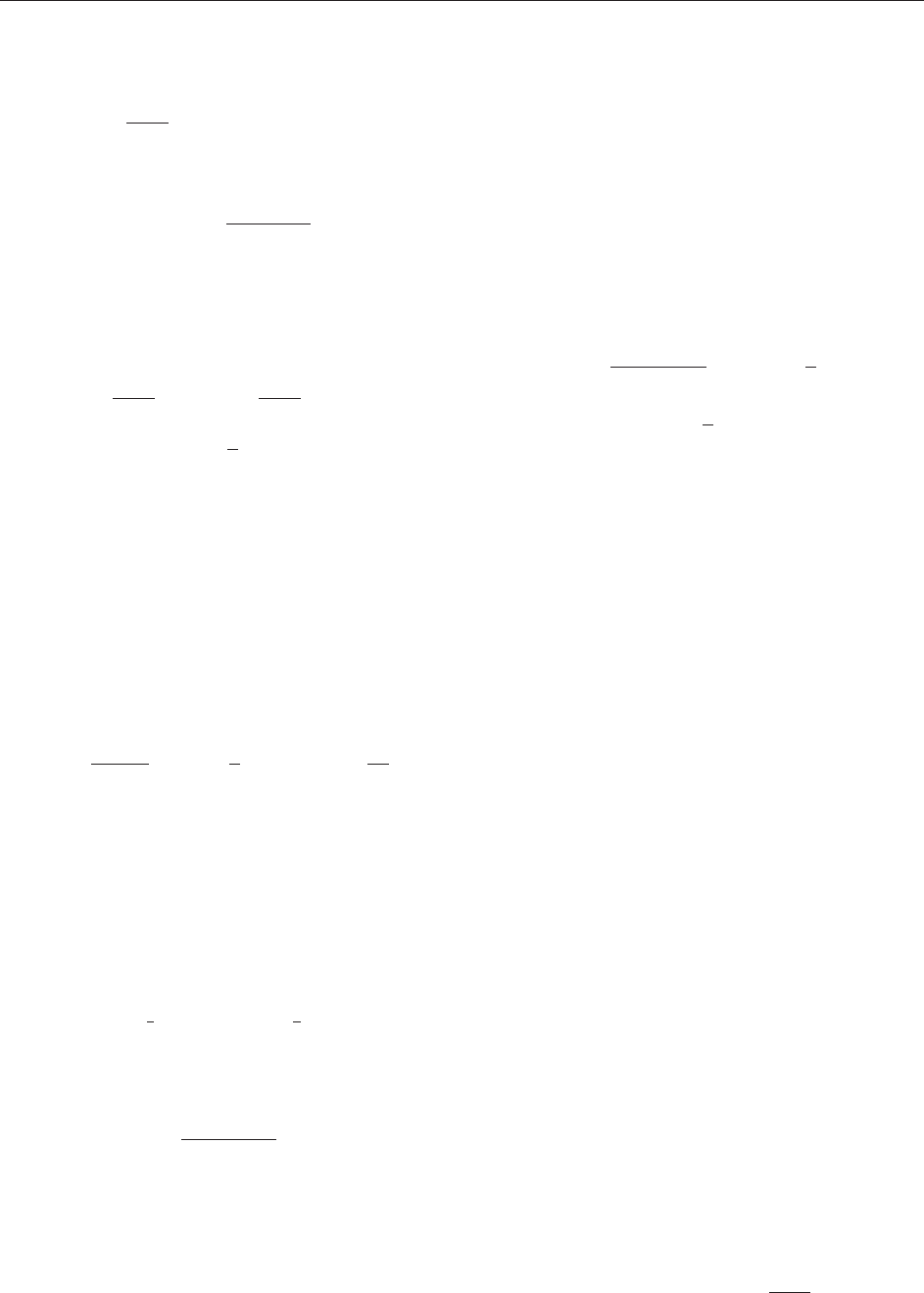
supertrace is str a = tr
S
þ
(V)
a tr
S
(V)
a.If 2 End(V)
is skew-symmetric, then
str exp
ffiffiffiffiffiffiffi
1
p
4
ð;Þ
¼
^
AðÞ
1=2
PfðÞ
where
^
AðÞ¼det
=2
sinhð=2Þ
More generally, supertrace can be defined on
Cl(V)
^
A for any Z
2
-graded commutative algebra
A = A
þ
A
.If is skew-symmetric and 2 V
A
, then
str exp
ffiffiffiffiffiffiffi
1
p
4
ð; Þþ
ffiffiffiffiffiffiffi
1
p
2
1=2
ðÞ
¼
^
AðÞ
1=2
Z
B
exp
1
2
ð; Þ þ
½2
Representatives of the Euler and Thom Classes
Let M be a smooth manifold and let : E ! M
be an oriented real vector bundle of rank r. Suppose
E has a Euclidean structure ( , )andr is a
compatible connection. The curvature R 2
2
(M,End(E)) is skew-symmetric, and hence ( , R ) 2
2
(M, ^
2
E
).AdeRhamrepresentativeoftheEuler
class of E is
e
r
ðEÞ¼
1
ð2Þ
r=2
Z
B
exp
1
2
ð; R Þ
¼ Pf
R
2
½3
Here, the Berezin integration is fiberwise in E:itis
the pairing between the integrand and the unit
section of the trivial line bundle ^
r
E that is
consistent with the orientation of E. The de Rham
cohomology class of [3] is independent of the choice
of ( , )orr.
Let s be a section of E. Following Berline et al.
(1992) and Zhang (2001), we consider
s
r; s
¼
1
2
ðs; sÞþðrs; Þþ
1
2
ð; R Þ ½4
a differential form on M valued in ^
E
. Mathai–
Quillen’s representative of the Euler class is
e
r; s
ðEÞ¼
ð1Þ
rðrþ1Þ=2
ð2Þ
r=2
Z
B
e
r; s
½5
One can show that e
r, s
(E) is closed and that as
varies, the cohomology class of e
r, s
(E) does not
change. By taking ! 0, the de Rham class of
e
r, s
(E) is equal to that of e
r
(E) when r is even. The
form e
r, s
(E) provides a continuous interpolation
between [3] and the limit as !1, when the form
is concentrated on the zero locus of the section s .In
fact, the Euler class is the Poincare´ dual to the
homology class represented by s
1
(0). Hence, if
n m and if ! 2
nm
(M) is closed, we have
Z
M
! ^ e
r;s
ðEÞ¼
Z
s
1
ð0Þ
! ½6
when s intersects the zero section transversely.
To obtain Mathai–Quillen’s representative of the
Thom class, we consider the pullback of E to E itself.
The bundle
E ! E has a tautological section x.
Applying [5] to this setting, we get
r
ðEÞ¼
ð1Þ
rðrþ1Þ=2
ð2Þ
r=2
Z
B
exp
1
2
ðx; xÞ
ðrx; Þ
1
2
ð; R Þ
½7
where ( , ), r,andR are understood to be the
pullbacks to
E. This is a closed form on the total
space of E . Moreover, its restric tion to each fiber
is the Gaussian form [1]. The cohomology groups
of differential forms with exponential decay along
the f ibers are isomorphic to those with compact
vertical support or the relative cohomology groups
H
(E, EnM). Here M is identified with its image
under the inclusion i : M ! E by the zer o s ecti on.
Under the above isomorphism, the cohomology
class represented by
r
(E) coincides with the
Thom class (E) = i
1 2 H
r
(E, EnM) defined topo-
logically. For any section s 2 (E), we have
e
r, s
(E) = s
r
(E).
Character Form of the Thom Class in K-Theory
Let E = E
þ
E
be a Z
2
-graded vector bundle over
M. The spaces
(M, E), (End(E)) and
(M)
^
(End(E)) are also Z
2
-graded. The action of
^
T 2
(M)
^
(End( E)) on s 2
(M, E)is
^
T : s 7!ð1Þ
jTjjj
ð ^ ÞðTsÞ
The supertrace of A 2 (End(E)) is str A = tr
E
þ
A
tr
E
A; it extends
(M)-linearly to str :
(M)
^
(End(E)) !
(M). Let r be a connection on E
preserving the grading. r is an odd operator on
(M, E). If L 2 (End(E)
) is odd, then D = rþL
is called a ‘‘superconnection’’ on E; the ‘‘curvature’’
D
2
= R þrL þ L
2
2 (
(M) (End(E)))
þ
is even.
With the superconnection, the Chern character of
the virtual vector bundle E
þ
E
can be repre-
sented by
ch
r; L
ðE
þ
; E
Þ¼str exp
ffiffiffiffiffiffiffi
1
p
2
D
2
½8
Mathai–Quillen Formalism 391
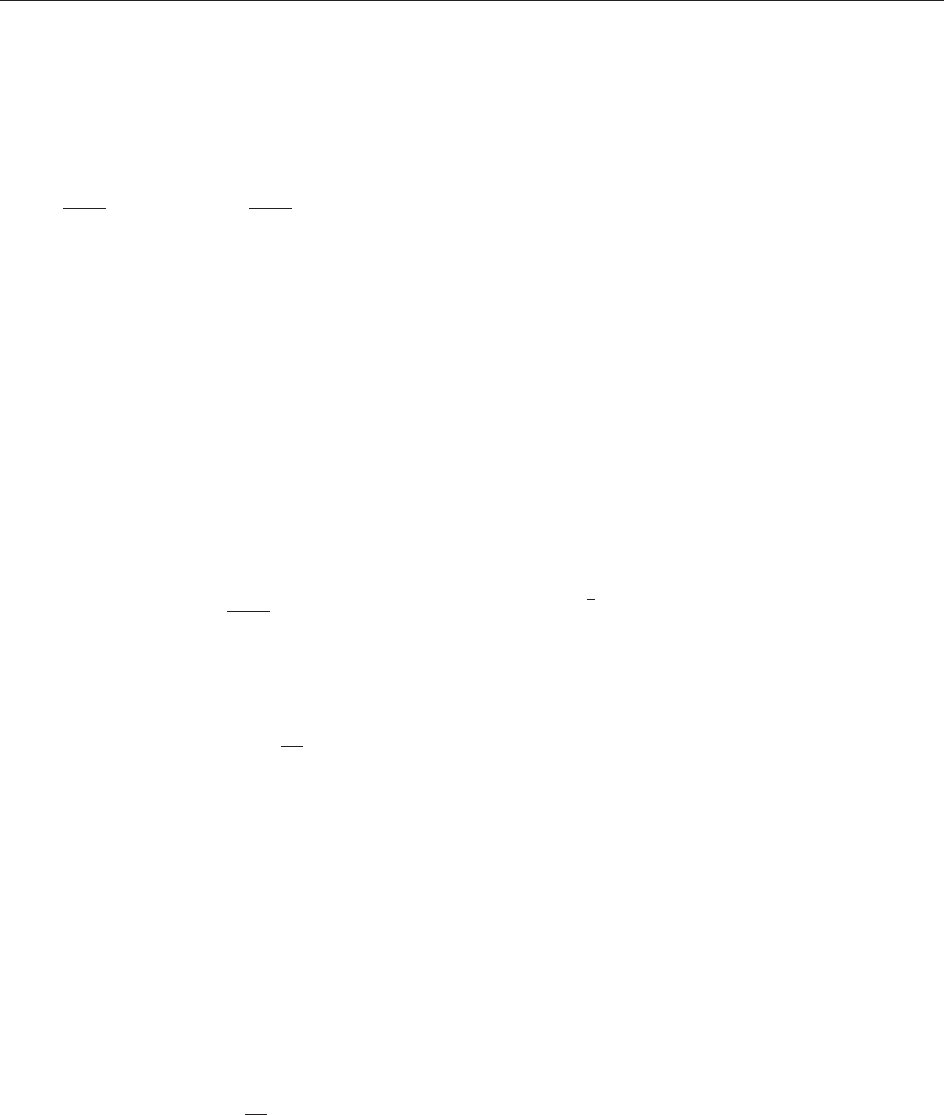
It is a closed form on M and its de Rham
cohomology class is independent of the choice of
r or L.IfL is invertible everywhere on M and the
eigenvalues of
ffiffiffiffiffiffi
1
p
L
2
are negative, then [8] is exact:
ch
r;L
ðE
þ
; E
Þ
¼
ffiffiffiffiffiffiffi
1
p
2
d
Z
1
1
str exp
ffiffiffiffiffiffiffi
1
p
2
ðrþLÞ
2
!
L
!
d
Now let E be an oriented real vector bundle of
rank r = 2m over M with a Euclidean structure (, ).
Suppose further that E has a spin structure. The
associated spinor bundle S(E) = S
þ
(E) S
(E)isa
graded complex vector bundle over M. For any
section s 2 (E), let c(s) 2 (End(E)
)betheClifford
multiplication on E. Then for any s, s
0
2 (E),
we have {c(s), c(s
0
)} = 2(s, s
0
). Given a connection r
on E preserving (, ), the induced spinor connection
r
S
on S(E) preserves the grading. If R is the curvature
of r,thatofr
S
is R
S
= (1=4) (, R), where is now
asectionofE Cl(E). For any s 2 (E), consider the
superconnection
D
s
¼r
S
þ
ffiffiffiffiffiffiffi
1
p
1=2
cðsÞ
The Chern character form [8] of S
þ
(E) S
(E) is,
using [2],
ch
r; s
ðS
þ
ðEÞ; S
ðEÞÞ ¼ ð1Þ
m
^
A
R
2
1=2
e
r; s
ðEÞ½9
where e
r, s
(E) is given by [5]. In cohomology groups,
[9] reduces to
chðS
þ
ðEÞÞ chðS
ðEÞÞ ¼ ð1Þ
m
^
AðEÞ
1=2
eðEÞ
If M is noncompact and the norm of s increases
rapidly away from s
1
(0), then both sides of [9] are
differential forms that decay rapidly away from
s
1
(0) and can represent cohomology classes of such.
As before, we take the pullback
E with the
tautological section x. Then [9] becomes
ch
r
ð
S
þ
ðEÞ;
S
ðEÞÞ
¼ð1Þ
m
^
A
R
2
1=2
r
ðEÞ½10
where
r
(E) is given by [7]. Both sides of [10] are
forms on E that decays exponentially in the fiber
directions; hence, it descends to an equality in
H
(E, EnM). In the relative K-group K(E, EnM),
the pair
S
(E) with the isomorphism c(x) away
form the zero section is, up to a factor of (1)
m
, the
K-theoretic Thom class i
!
1 2 K(E, EnM). Therefore,
[10] reduces to the well-known formula
chði
!
1Þ¼
^
AðEÞ
1=2
i
1
in cohomology groups H
(E, EnM). The refinement
[10] as an equality of differential forms is
due to Mathai and Quillen (1986). In fact, this is
how [7] was derived originally.
Equivariant Cohomology and Equivariant
Vector Bundles
Equivariant Cohomology
Let G be a compact Lie group with Lie algebra g.
Fixing a basis {e
a
}ofg, the structure constants are
given by [e
a
, e
b
] = t
c
ab
e
c
. Let {#
a
}and{’
a
} be the dual
bases of g
generating the exterior algebra ^(g
) and
the symmetric algebra S(g
), respectively. The Weil
algebra is W(g) = ^ (g
)
^
S(g
). We define a grading
on W(g) by specifying deg #
a
= 1, deg ’
a
= 2. The
contraction
a
and the exterior derivative d are two
odd derivations on W(g) defined by
a
#
b
¼
b
a
;
a
’
b
¼ 0
d#
a
¼
1
2
t
a
bc
#
b
#
c
þ ’
a
; d’
a
¼t
a
bc
#
b
’
c
½11
The Lie derivative is L
a
= {
a
, d}. These operators
satisfy the usual (anti-)commutation relations
d
2
¼ 0; L
a
¼f
a
; dg; ½L
a
; d¼0 ½12
f
a
;
b
g¼0; ½L
a
;
b
¼t
c
ab
c
;
½L
a
; L
b
¼t
c
ab
L
c
½13
The cohomology of (W(g), d) is trivial.
If G acts smoothly on a manifold M on the left, let
V
a
be the vector field generated by the Lie algebra
element e
a
2 g. Then, [V
a
, V
b
] = t
c
ab
V
c
.Denote
a
=
V
a
and L
a
= L
V
a
,actingon
(M). In the Weil
model of equivariant cohomology, one considers the
graded tensor product W(g)
^
(M), on which the
operators
~
a
¼
a
^
1 þ 1
^
a
~
d ¼ d
^
1 þ 1
^
d
~
L
a
¼ L
a
^
1 þ 1
^
L
a
act and satisfy the same relations [12] and [13].
An elem ent ! 2 W(g)
^
(M) is ‘‘basic’’ if it
satisfies
a
! = 0, L
a
! = 0 for all indices a.Let
G
(M) = (W(g)
^
(M))
bas
be the set of such.
Elements of
G
(M) are equivariant differential
forms on M. The operator
˜
d preserves
G
(M)
and its cohomology groups H
G
(M) are the equiv-
ariant cohomology groups of M.Theyare
392 Mathai–Quillen Formalism

isomorphic to the singular cohomology groups of
EG
G
M w ith real coefficie nts.
The BRST model of Kalkman (1993) is obtained
by applying an isomorphism = e
#
a
a
of W(g)
^
(M). The operators become
~
a
1
¼
a
^
1
~
d
1
¼
~
d ’
a
^
a
þ #
a
^
L
a
~
L
a
1
¼
~
L
a
The subspace of basic forms in the Weil model
becomes
ð
G
ðMÞÞ ¼ ðSðg
Þ
ðMÞÞ
G
This is precisely the Cartan model of equiva riant
cohomology, in which the exterior differential is
~
d
0
¼ 1 d ’
a
a
If P is a principal G-bundle over a base space B,
we can form an associated bundle P
G
M ! B.
Choose a connection on P and let =
a
e
a
2
1
(P) g, =
a
e
a
2
2
(P) g be the connection
and curvature forms, respectively. The components
a
,
a
satisfy the same relations [11]. Replacing
#
a
, ’
a
by
a
,
a
, we have a homomorphism that
maps ! 2 W(g)
(M)to
ˆ
! 2
(P M). If ! is
basic, then so is
ˆ
!, and the latter descends to a form
! on P
G
M. Furthermore, the operator
~
d on
G
(M)
descends to d on
(P
G
M). Thus, we get the
Chern–Weil homomorphisms
G
(M) !
(P
G
M)
and H
G
(M) ! H
(P
G
M). For example, the vector
space R
r
has an obvious SO(r) action. The Gaussian
r-form [1] is invariant under SO(r) and can be
extended to an SO(r)-equivariant closed r-form,
called the ‘‘universal Thom form.’’ Let E be an
orientable real vector bundle E of rank r with a
Euclidean structure. E determines a principal SO(r)-
bundle P; the associated bundle P
SO(r)
R
r
is E itself.
By applying the Chern–Weil homomorphism to this
setting, we get a closed r-form on E.Thisisanother
construction of the Thom form [7] by Mathai and
Quillen (1986). Further information of equivariant
cohomology can be found there, and in Berline et al.
(1992) and Guillemin and Sternberg (1999).
Equivariant Vector Bundles
Recall that a connection on a vector bundle E ! M
determines, for any k 0, a differential operator
r :
k
ðM; EÞ!
kþ1
ðM; EÞ
The curvature R = r
2
2
2
(M,End(E)) satisfies the
Bianchi identity rR = 0. If the connection preserves a
Euclidean structure on E,thenR is skew-symmetric.
If a Lie group G acts on M and the action can be
lifted to E, then G also acts on the spaces (E) and
(M, E). As before, the Lie derivatives L
a
on these
spaces are the infinitesimal actions of e
a
2 g.We
choose a G-invarian t connection on E. The
‘‘moment’’ of the connection r under the G-action
is
a
= L
a
r
V
a
acting on (E). In fact,
a
is a
section of End( E), or 2 (End(E)) g
.Ifa
Euclidean structure on E is preserved by both the
connection and the G-action, then
a
is skew-
symmetric. On
(M, E), we have
L
a
¼f
a
; rg þ
a
a
R ¼r
a
; L
a
b
¼ t
c
ab
c
½
a
;
b
¼t
c
ab
c
þ R
ab
where R
ab
= R(V
a
, V
b
) 2 (End(E)).
On the graded tensor product W(g)
^
(M, E),
the contraction ~
a
and the Lie derivative
~
L
a
act and
satisfy [13]. In the Weil model, equivariant differ-
ential forms on M with values in E are the basic
elements in W(g)
^
(M, E), which form a subspace
G
(M, E) = (W(g)
^
(M, E))
bas
. The ‘‘equivariant
covariant derivative’’ is
~
r¼d
^
1 þ 1
^
rþ#
a
^
a
½14
One checks that {
a
,
~
r} =
~
L
a
and hence
~
r preserves
the basic subspace
G
(M, E). The equivariant curva-
ture
~
R =
~
r
2
is
~
R ¼ R #
a
r
a
þ ’
a
a
þ
1
2
#
a
#
b
R
ab
½15
It satisfies the equivaria nt Bianchi identity
~
r
~
R = 0.
Equivariant characteristic forms are invariant poly-
nomials of
~
R. They are equivariantly closed and
their equivariant cohomology classes do not depend
on the choice of the G-invariant connect ion. Hence,
they represent the equivariant characteristic classes
of E in H
G
(M).
For the BRST model, we use a similar isomorph-
ism = e
#
a
a
on W(g)
^
(M, E). The operators
become
~
a
1
¼
a
^
1
~
r
1
¼
~
r’
a
^
a
þ #
a
^
L
a
~
L
a
1
¼
~
L
a
and the basic subspace turns into
ð
G
ðM; EÞÞ ¼ ðSðg
Þ
ðM; EÞÞ
G
This is the Cartan model, which can be found in
Berline et al. (1992). The equivariant covariant
derivative is
~
r
0
¼ 1 r’
a
a
Mathai–Quillen Formalism 393
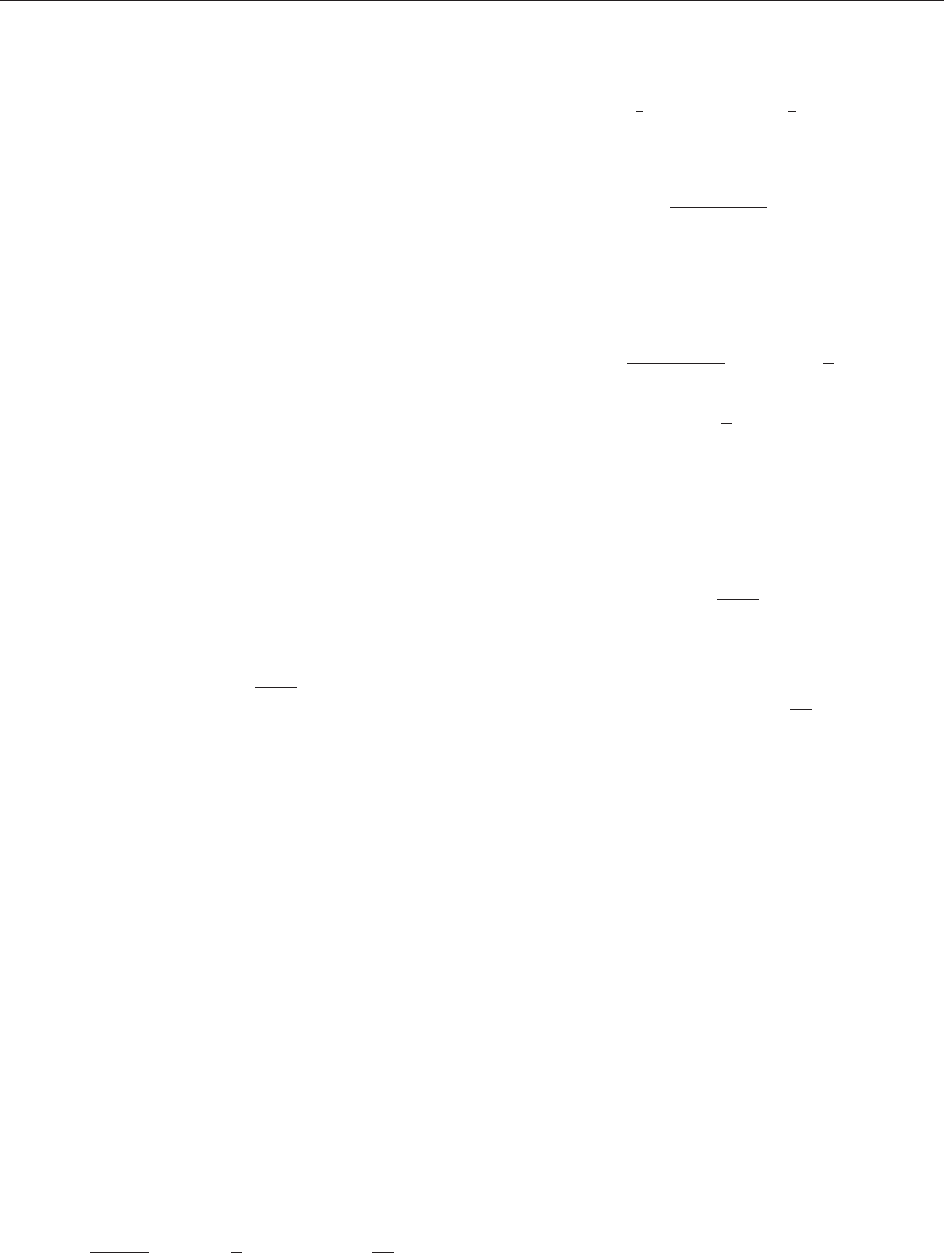
The equivariant curvature is
~
R
0
= (
~
r
0
)
2
= R þ ’
a
a
and the characteristic forms are defined similarly.
Let P ! B be a principal G-bundle with a
connection . Following [14], the bundle P E !
P M has a connection
^
r¼d 1 þ 1 rþ
a
a
It descends to a connection
r on the vector bundle
P
G
E ! P
G
M. The map
~
r7!
r can be consid-
ered as the analog of the Chern–Weil homomorphism
for connections. There is also a homomorphism
G
(M, E) !
(P
G
M, P
G
E), which commutes
with the covariant derivatives
~
r,
r. The curvature
R =
r
2
is the image of the equivariant curvature
~
R.
Consequently, the equivariant characteristic forms
descend to those of P
G
E ! P
G
M by the usual
Chern–Weil homomorphism.
Now let E = E
þ
E
be a graded vect or bundle
over M with a G-action preserving all the structures.
We have the
G
(M)-linear supertrace map str:
G
(M)
^
(End( E)) !
G
(M). If r is a G-invariant
connection on E preserving the grading and if
L 2 (End(E)
)
G
is odd and G-invariant, then
~
D =
~
rþL is an ‘‘equivariant superconnection.’’
The equivariant counterpart of [8] is
ch
~
r; L
ðE
þ
; E
Þ¼str exp
ffiffiffiffiffiffiffi
1
p
2
~
D
2
2
G
ðMÞ
representing the equivariant Chern character of
E
þ
E
in H
G
(M).
Representatives of the Equivariant Euler
and Thom Classes
Consider an oriented real vector bundle E ! M of
rank r with a Euclidean structure ( , ). Choose a
connection r on E preserving ( , ). We assume that
a Lie group G acts on M and that the action can be
lifted to E preserving all the structures on E.We
use the Weil model; the constructions in the Cartan
model are similar. For any 2
k
G
(M, E)and
2
l
G
(M, E), we obtain (, ^) 2
kþl
G
(M)by
taking the wedge product of forms as well as the
pairing in E. The Berezin integral of ! 2
G
(M, ^
E
)
along the fibers of E is
R
B
! = h, !i2
G
(M). Here,
is the unit section of the canonically trivial
determinant line bundle ^
r
E,compatiblewiththe
orientation of E. The equivariant Euler form
e
~
r
ðEÞ¼
1
ð2Þ
r=2
Z
B
exp
1
2
ð;
˜
R Þ
¼ Pf
˜
R
2
½16
is equivariantly closed. It represents the equiva riant
Euler class e
G
(E) 2 H
G
(M).
Given a G-invariant section s 2 (E)
G
, the equiv-
ariant counterpart of [4] is
S
~
r;s
¼
1
2
ðs; sÞþð
~
rs; Þ þ
1
2
ð;
~
R Þ ½17
and that of Mathai–Quillen’s Euler form [5] is
e
~
r;s
ðEÞ¼
ð1Þ
rðrþ1Þ=2
ð2Þ
r=2
Z
B
e
S
~
r;s
½18
It is also equivariantly closed, and its equivariant
cohomology class is e
G
(E). The equivariant exten-
sion of Mathai–Quillen’s Thom form [7] is
~
r
ðEÞ¼
ð1Þ
rðrþ1Þ=2
ð2Þ
r=2
Z
B
exp
1
2
ðx; xÞ
ð
~
rx; Þ
1
2
ð;
~
R Þ
½19
where x is the (G-invariant) tautological section of
E ! E.
Finally, G acts on the (graded) spinor bundle S(E ).
Using the equivariant superco nnection
~
D
s
¼
~
r
S
þ
ffiffiffiffiffiffiffi
1
p
1=2
cðsÞ
[9] generalizes to
ch
~
r;s
ðS
þ
ðEÞ; S
ðEÞÞ ¼ ð1Þ
m
^
A
~
R
2
!
1=2
e
~
r;s
ðEÞ
Now apply the construction to the bundle
E ! E
and its tautological section x. The pair
S
(E) with
an odd bundle map c(x) determines, up to a factor
of (1)
m
, the Thom class i
!
1
G
in the equivariant
K-group K
G
(E, EnM). The equivariant analog of
[10] descends to
ch
G
ði
!
1
G
Þ¼
^
A
G
ðEÞ
1=2
i
1
G
in equivariant cohomology.
Superspace Formulation
Mathai–Quillen Formalism and the
Superspace R
0 j1
Let R
0 j1
be the superspace with one fermion ic
coordinate but no bosonic coordinates. The
translation on R
0 j1
is generated by D = @=@,
which satisfies {D, D} = 0. We consider a sigma
model on R
0 j1
whose target space is an (ordinary)
smooth manifold M of dimension n. A map
X : R
0 j1
! M can be written as X() = x þ
ffiffiffiffiffiffi
1
p
.
Here, x = Xj
= 0
2 M and =
ffiffiffiffiffiffi
1
p
DXj
= 0
2 T
x
M;
the latter is fermionic. Under the translation
394 Mathai–Quillen Formalism
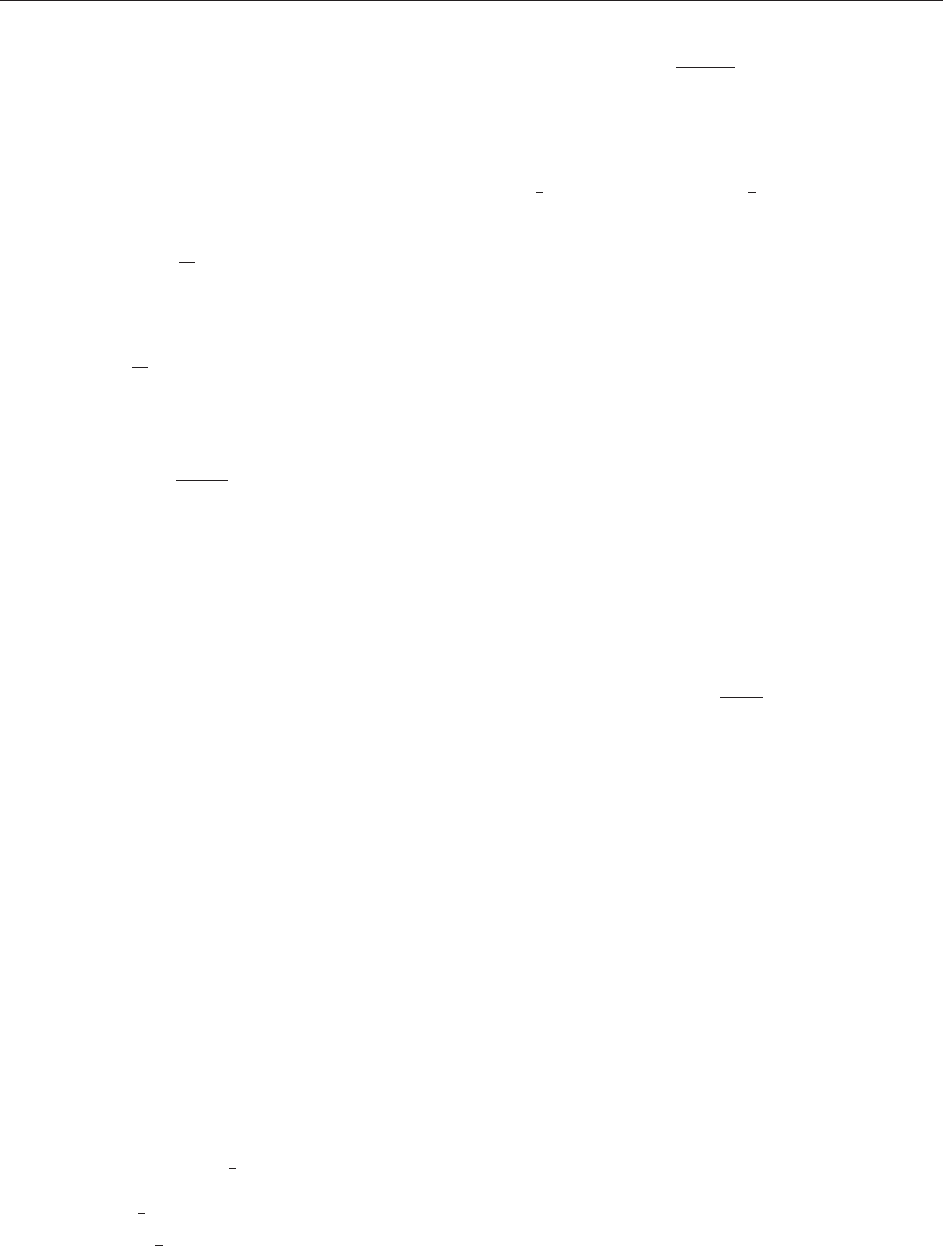
7! þ , x and vary according to the super-
symmetry transformations
x ¼ DXj
¼0
¼
ffiffiffiffiffiffiffi
1
p
¼ D ðDXÞj
¼0
¼ 0
½20
Clearly,
2
= 0, which is also a consequence of D
2
= 0.
For a ny p-form ! 2
p
(M), we have an observable
O
!
ðXÞ¼
1
p!
X
!ðD; ...; DÞj
¼0
In local coordinates,
! ¼
1
p!
!
i
1
i
p
ðxÞdx
i
1
^^dx
i
p
and
O
!
ðx; Þ¼
ffiffiffiffiffiffiffi
1
p
p
p!
!
i
1
i
p
ðxÞ
i
1
i
p
Using C( ) to denote the set of function(al)s on a
space, we can identify C(Map(R
0 j1
, M)) with
(M).
Under [20], O
!
(X) = O
d!
(X). So, O
!
(X) is invar-
iant under supersymmetry if and only if ! is closed.
The cohomology of is the de Rham cohomology of
M. Consider the measure [dX] = [dx][d ]. In local
coordinates, [dx] = dx
1
dx
n
is the standard (boso-
nic) measure and [d ] = d
1
d
n
is a fermionic
measure such that
Z
½d ð1Þ
nðn1Þ=2
1
n
¼ 1
For any ! 2
n
(M), the superfield integral
R
[dX]O
!
(X) is equal to the usual integral
R
M
! if
the latter exists.
Let E ! M be a real vector bundle of rank r with
an inner product ( , ), and let r be a compatible
connection whose curvature is R. Consider a theory
whose fields are X 2 Map(R
0 j1
, M) and a fermionic
section 2 (X
E). Let D= (X
r)
D
be the covar-
iant derivative along D in the pullback bundle
X
E ! R
0 j1
. Then, =j
= 0
2 E
x
is fermionic
and f = Dj
= 0
2 E
x
is bosonic.
Given a fixed section s 2 (E), we write a super-
space action
S
MQ
½X; ¼
Z
R
0j1
dð;
1
2
D þ
ffiffiffiffiffiffiffi
1
p
s XÞ
¼
1
2
ðf ; f Þþ
ffiffiffiffiffiffiffi
1
p
ðf ; sÞðr
s;Þ
þ
1
4
ð; R ð ; ÞÞ½21
It is automatically supersymmetric. Performing the
Gaussian integral over f and replacing by
ffiffiffiffiffiffi
1
p
,
we get
Z
½de
S
MQ
½X;
¼
ffiffiffiffiffiffiffi
1
p
r
ð2Þ
r=2
Z
½de
S
MQ
½x; ;
½22
where
S
MQ
½x; ;
¼
1
2
ðs; sÞ
ffiffiffiffiffiffiffi
1
p
ð; r
sÞ
1
4
ð; R ð ; ÞÞ½23
When r is even, [22] is equal to O
e(r, s)(E)
(X), where
e(r, s)(E) is given by [5]. Furthermore, for any
closed form ! on M, the expectation value
hO
!
ðXÞi ¼
Z
½dX½dO
!
ðXÞe
S
MQ
½X;
½24
is equal to [6].
Equivariant Cohomology and Gauged Sigma
Model on R
0 j1
Suppose G is a Lie group and P is a principal G-bundle
over R
0 j1
.Since is nilpotent, we can choose a
‘ ‘trivialization’’ of P such that the connection and
curvature are A 2
1
(R
0 j1
) g and F 2
2
(R
0 j1
)
g,respectively.(g is the Lie algebra of G.) In
components, c =
ffiffiffiffiffiffi
1
p
D
A 2 g is fermionic and =
(
ffiffiffiffiffiffi
1
p
=2)
2
D
F 2 g is bosonic. The space of connec-
tions A is the set of pairs (c, ). Under 7! þ ,
c ¼ þ
ffiffiffiffiffiffiffi
1
p
2
½c; c
!
¼
ffiffiffiffiffiffiffi
1
p
½c;
½25
Thus, the algebra C(A) is isomorphic to the Weil
algebra W(g) and corresponds to the differential d
in [11]. This relation between gauge theory on a
fermionic space and the Weil algebra can be found
in Blau and Thompson (1997).
With a trivialization of P, the group of gauge
transformation G can be identified with
Map(R
0 j1
, G). Any group element is of the form
^
g=ge
ffiffiffiffiffi
1
p
, with g=
^
gj
=0
2G and =
ffiffiffiffiffiffi
1
p
D
^
g
$ 2g
(fermionic), where $ is the Maurer–Cartan form on
G. The action of
^
g is A7!A
0
=Ad
^
g
(A
^
g
$), or
c7!c
0
=Ad
g
(c ) and 7!
0
=Ad
g
. By choosing
=c, we obtained a new trivialization, called the
‘‘Wess–Zumino gauge,’’ in which c
0
=0. The residual
gauge redundancy is G, and A=G=g=Ad
G
. The
Wess–Zumino gauge is not preserved by the transla-
tion on R
0j1
unless we define
0
by composing with
a suitable (infinitesimal) gauge transformation. If so,
then
0
= 0.
Suppose M is a manifold with a left G-action. As
before, let {e
a
}beabasisofg and let the vector field V
a
be the infinitesimal action of e
a
. In the gauged sigma
model, we include another field X 2 (P
G
M). With
a trivialization of P, we can identify X with a map
Mathai–Quillen Formalism 395
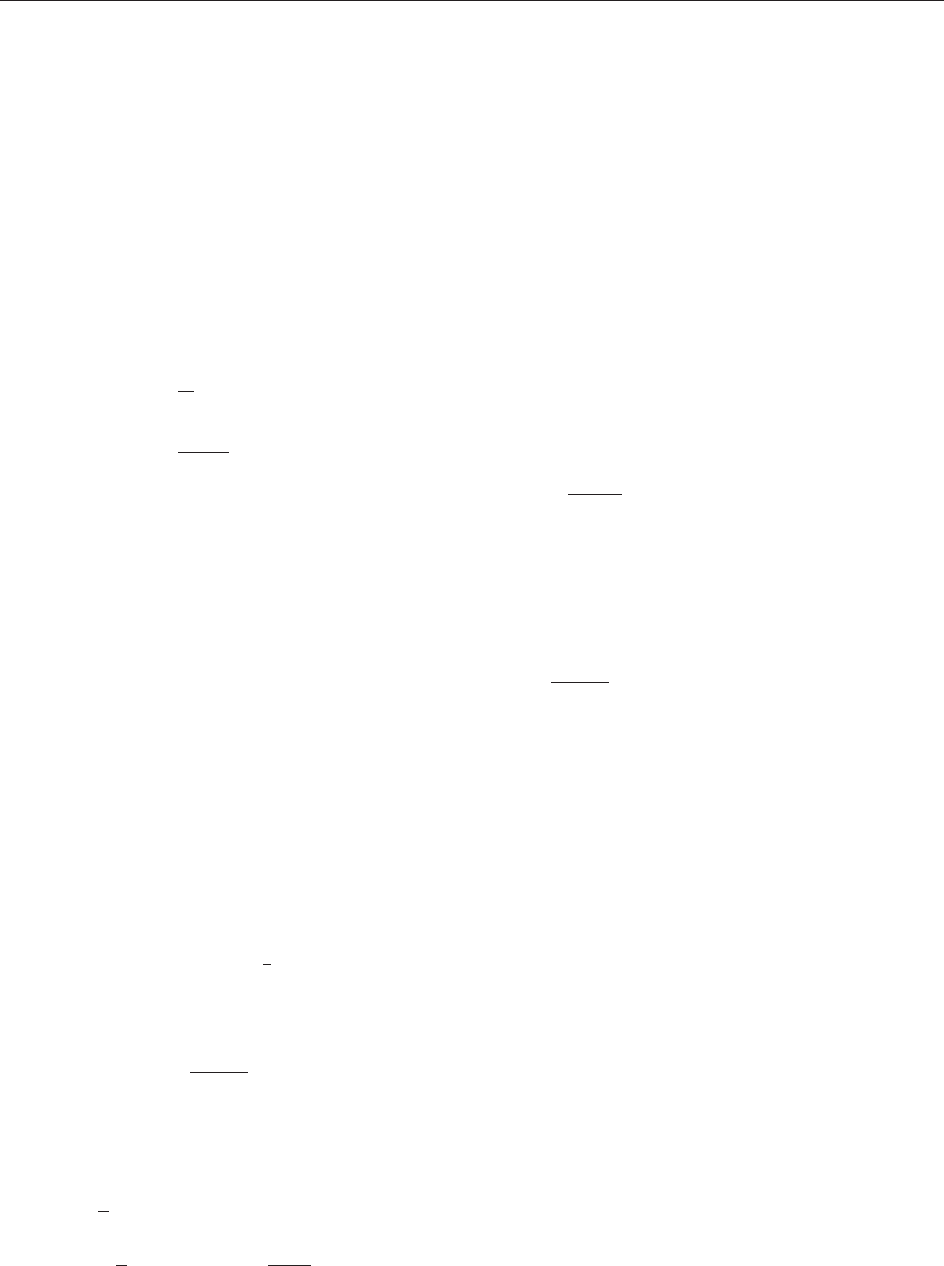
X : R
0 j1
! M. The covariant derivative is given by
rX = dX A
a
V
a
, DX = r
D
X.Letx = Xj
= 0
2 M
and =
ffiffiffiffiffiffi
1
p
DXj
= 0
2 T
x
M. Then the supersym-
metric transformations are
x
i
¼
ffiffiffiffiffiffiffi
1
p
i
c
a
V
i
a
i
¼
a
V
i
a
þ
ffiffiffiffiffiffiffi
1
p
c
j
V
i
a;j
½26
In the Wess–Zumino gauge, the transformations
simplify to
0
x =
ffiffiffiffiffiffi
1
p
,
0
=
a
V
a
.
The observables form the G-invariant part of the
space C(AMap(R
0 j1
, M)). For any ! 2
p
(M),
we have
O
!
ðX; AÞ¼
1
p!
!ðDX; ...; DXÞj
¼0
¼
ffiffiffiffiffiffiffi
1
p
p
p!
!
i
1
i
p
ðxÞ
i
1
i
p
½27
O
!
(X, A) is gauge covariant: O
!
(X, A) 7!O
g
!
(X, A),
and the set of gauge-invariant observables is thus
identified with (S(g
)
(M))
G
. Moreover, since
O
!
ðX; AÞ¼ðO
d!
ðX; AÞ
ffiffiffiffiffiffiffi
1
p
c
a
O
L
a
!
ðX; AÞ
ffiffiffiffiffiffiffi
1
p
a
O
a
!
ðX; AÞÞ
corresponds to the differential
~
d
0
in BRST model.
Let E ! M be an equivariant vector bundle and
let r be a G-invariant connection with curvatu re R
and moment . Any s 2 (E)
G
defines a section of
P
G
E ! P
G
M, still denoted by s. Consider a
theory with superfields X 2 (P
G
M) and
2 (X
(P
G
E)) (fermionic). Let D be the covar-
iant derivative of the pullback connection. With a
trivialization of P, we put =j
= 0
2 E
x
(fermio-
nic) and f = Dj
= 0
2 E
x
(bosonic). The equivariant
extension of [21] is
S
MQ
½X; ; A¼
Z
R
0j1
dð;
1
2
D þ
ffiffiffiffiffiffiffi
1
p
s XÞ
Similar to [22], we get, in the Wess–Zumino gauge,
Z
½de
S
MQ
½X;;A
¼
ffiffiffiffiffiffiffi
1
p
r
ð2Þ
r=2
Z
½de
S
MQ
½x; ;;
½28
where
S
MQ
½x; ;;
¼
1
2
ðs; sÞ
ffiffiffiffiffiffiffi
1
p
ð; r
sÞ
1
4
ð; Rð ; ÞÞ
ffiffiffiffiffiffiffi
1
p
2
ð;
a
a
Þ½29
When r is even, [28] is equal to O
~
e(r, s)
(X, A), where
~
e(r, s) is given by [18].
The Atiyah–Jeffrey Formula
Given the G-action on M, for any x 2 M, there is a
linear map C
x
: g ! T
x
M defined by C
x
(e
a
) = V
a
(x).
With an invariant inner product ( , )ong and an
invariant Riemannian metric on M, the adjoint of
C
x
is C
y
x
: T
x
M ! g, that is, C
y
2
1
(M) g.IfG
acts on M freely, then C
x
is injective and (C
y
C)
x
is
invertible for all x 2 M. The projection M !
M = M=G is a principal G-bundle. It has a connection
such that the horizontal subspace is the orthogonal
complimentoftheG-orbits. The connection 1-form is
=(C
y
C)
1
C
y
, whereas the curvature is =(C
y
C)
1
dC
y
on horizontal vectors.
Let ! be an equivariant form on M. Suppose G
acts on M freely, then ! descends to a form !
on
M.
We look for a gauge-invariant, supersy mmetric
quantity (X, A) such that
1
volðGÞ
Z
½dX½dAO
!
ðX; AÞðX; AÞ
¼
Z
½d
XO
!
ð
XÞ½30
Mathematically, corresponds to a closed equivar-
iant form on M such that
1
volðGÞ
Z
2g
½d
Z
M
!ðÞ^ðÞ¼
Z
M
!
which is [30] in the Wess–Zumino gauge. In fact, is
distribution valued in the sense of Kumar and Vergne
(1993) and can be understood as an equivariant
homology cycle, as in Austin and Braam (1995).
Let P be a G-bundle over R
0 j1
with a connection
and let Ad P = P
G
g ! R
0 j1
be the adjoint bundle.
Consider a (bosonic) superfield 2 (A dP ). Set =
j
= 0
(bosonic) and =
ffiffiffiffiffiffi
1
p
Dj
= 0
(fermionic).
Choosing a trivialization of P, and are both in g.
Under 7! þ , they transform as
¼
ffiffiffiffiffiffiffi
1
p
ð þ½c;Þ
¼ ð½;
ffiffiffiffiffiffiffi
1
p
½c;Þ
½31
The superspace action
S
CMR
½X; ; A¼
ffiffiffiffiffiffiffi
1
p
Z
R
0j1
dð; C
y
DXÞ
is invariant under [25], [26], and [31] and, under the
Wess–Zumino gauge, it is
S
CMR
½x; ;;;
¼
ffiffiffiffiffiffiffi
1
p
ð; C
y
Þ
ffiffiffiffiffiffiffi
1
p
ð; dC
y
ð ; ÞÞ
þð; C
y
CÞ½32
396 Mathai–Quillen Formalism