
Francoise J.-P., Naber G.L., Tsun T.S. (editors) Encyclopedia of Mathematical Physics
Подождите немного. Документ загружается.


Magnetic Resonance Imaging
C L Epstein, University of Pennsylvania,
Philadelphia, PA, USA
F W Wehrli, University of Pennsylvania,
Philadelphia, PA, USA
ª 2006 Elsevier Ltd. All rights reserved.
Introduction
Nuclear magnetic resonance (NMR) is a subtle
quantum-mechanical phenomenon that, through
magnetic resonance imaging (MRI), has played a
major role in the revolution in medical imaging over
the last 30 years. Before being conceived for use in
imaging, NMR was employed by chemists to do
spectroscopy, and it remains a very important tech-
nique for determining the structure of complex
chemical compounds like proteins. In this article we
explain how NMR is used to create an image of a
three-dimensional object. Scant attention is paid to
both NMR spectroscopy, and the quantum descrip-
tion of NMR. Those seeking a more complete
introduction to these subjects should consult the
article Nuclear Magnetic Resonance in this Encyclo-
pedia, as well as the monographs of Abragam (1983)
or Ernst et al. (1987), for spectroscopy, and that of
Callaghan (1993) for imaging. All three books
consider the quantum-mechanical description of
these phenomena. Comprehensive discussions of
MRI can be found in Bernstein et al. (2004) and
Haacke et al. (1999), and a historical apprecia tion of
the development of MRI is given in Wehrli (1995).
The Bloch Equation
We begin with the Bloch phenomenological equa-
tion, which provides a model for the interactions
between applied magnetic fields and the nuclear
spins in the objects under consideration. This is a
macroscopic averaged model that describes the
interaction of aggregates of spins, called isochro-
mats, with applied magnetic fields. An isoc hromat is
a collection of ‘‘like’’ spins, which is spatially large
on the atomic scale, but very small on the scale of
the variations present in the applied magnetic fields.
Spins are alike if they belong to the same species and
are in the same chemical environment . There may be
several different classes of spins , but, in this article,
it is assum ed that they are noninteracting and so it
suffices to consider each separately. Heretofore, we
suppose that there is a single class of like spins. The
distribution of isochromats for these spins is
described macroscopically by the spin density
function, which we denote by (x, y, z). In most
medical applications, one is imaging the distribution
of spins arising from hydrogen protons in water
molecules.
The state of the isochromat at spatial location
(x, y, z) is given by a 3-vector:
Mðx; y; zÞ¼ðm
1
ðx; y; zÞ; m
2
ðx; y; zÞ; m
3
ðx; y; zÞÞ
which is interpreted as the magnetic moment per
unit volume. It is an ensemble mean of the quantum
dipoles caused by the spins within the isochromat. In
most applications of NMR to imaging, the applied
magnetic field is descr ibed as the sum of a large,
time-independent field, B
0
(x, y, z), and smaller time-
dependent fields, B
0
(x, y, z; t). In the presence of a
static field, thermal fluctuations cause the nuclear
spins to slightly prefer an orien tation aligned with
the field. Using the Boltzmann distribution, one
obtains that the nuclear paramagnetic susceptibility
of water protons is given by
¼
h
2
2
4k
B
T
½1
here h is Planck’s constant, k
B
the Boltzmann’s
constant, and T the absolute temperature, (see Levitt
(2001)). The constant is called the gyromagnetic
(or magnetogyric) ratio. For a proton ,
2 42:5764 10
6
rad s
1
T
1
½2
For water molecules at room temperature,
3.6 10
9
.
If the sample is held stationar y in the field B
0
for a
sufficiently long time, then the spins become
polarized and a bulk magnetic moment appears;
this is called the equilibrium magnetization:
M
0
ðx; y; zÞ¼ðx; y; zÞB
0
ðx; y; zÞ½3
The Bloch equation describes the evolution of M
under the influence of the applied field B = B
0
þ B
0
:
dMðx; y; z; tÞ
dt
¼Mðx; y; z; tÞBðx; y; z; tÞ
1
T
2
M
?
ðx; y; z; tÞþ
1
T
1
ðM
0
ðx; y; zÞ
M
k
ðx; y; z; tÞÞ ½4
Here is the vector cross-product, M
?
(x, y, z; t)
the compone nt of M(x, y, z; t) perpendicular to
B
0
(x, y, z) (called the transverse component), and
M
k
the component of M parallel to B
0
(called the
longitudinal component). For hydrogen protons in
other molecules, the gyromagnetic ratio is expressed
in the form (1 ). The coefficient is called the
Magnetic Resonance Imaging 367

nuclear shielding; it is typically between 10
4
and
þ10
4
. The difference in the nuc lear shielding causes
a shift in the resonance frequency by .
The second and third terms in eqn [4] are
relaxation terms. They provide a phenomenologi-
cal model for the averaged i nteractions of the spins
with one another and their environment. The
coefficient 1=T
1
(x, y, z) is the spin lattice relaxation
rate;itdescribestherateatwhichthemagnetiza-
tion returns to equilibrium. The c oeffi cient
1=T
2
(x, y, z) is the spin–spin relaxation rate; it
describes the rate at which the transverse compo-
nents of M decay. The physical processes causing
these relaxation phenomena are different and so
are the rates themselves, with T
2
less than T
1
.The
relaxation rates largely depend on the localized
thermal fluctuations of the molecules and provide
a useful contrast mechanism in MR imaging.
Spin–spin relaxation occurs very rapidly in s olids
(<1 ms) and, therefore, we usually assume that we
are imaging liquid-like materials such as water
protons in soft mammalian tissues. In this case, T
2
takes values in the 40 ms to 4 s range. Notice that
this model does not include any explicit interac-
tion betwee n i sochromats at diff erent s patial
locations. A variety of such interactions exist,
but, at least in liquid-like materials, they lead only
to small c orrections in the Bloch equation model.
A derivation of the Bloch equation from the
Schro¨ dinger equation can be found in Abragam
(1983) and Slichter (1990). For coupled systems,
the Bloch equation formalism breaks down and a
full quantum-mechanical treatment is necessary
(see Nuclear Magnetic Resonance and Ernst et al.
(1983)).
Much of the analysis in NMR imaging amounts to
understanding the behavior of solutions to eqn [4]
with different choices of B. We now consider some
important special cases. The simplest case occurs if
B has no time-dependent component; then this
equation predicts that the sample becomes polarized
with the transverse part of M decaying as e
t=T
2
,
and the longitudinal component app roaching the
equilibrium magnetization, M
0
,as1 e
t=T
1
.To
simplify the subsequent discussion, we assume that
the field B
0
is homogeneous with B
0
= (0, 0, b
0
). If
B = B
0
and we omit the relaxation terms (set
T
1
= T
2
= 1 in [4]), then an initial magnetization
M(x, y, z; 0) simply precesses about B
0
at angular
frequency !
0
= b
0
: M(x, y, z; t) = U (t) M(x, y, z; 0),
with
UðtÞ¼
cos !
0
t sin !
0
t 0
sin !
0
t cos !
0
t 0
001
2
4
3
5
½5
The frequency !
0
is called the Larmor frequency;
this precession of M about the axis of B
0
is the
resonance phenomenon referred to as NMR. In
typical medical imaging systems, b
0
is between 1
and 3 T and the corresponding resonance frequency
is between 40 and 120 MHz.
Typically, the field B takes the form
B ¼ B
0
þ
~
G þ B
1
½6
where
~
G is a gradient field and B
1
is a radio-
frequency (RF) field. Usually, the gradient fields are
‘‘piecewise time-independent’’ fields, small relative
to B
0
. By piecewise time-independent field, we
mean a collection of static fields that, in the course
of the experiment, are turned on and off. The B
1
component is a time-dependent RF field, nominally
at right angles to B
0
. It is usu ally taken to be
spatially homogeneous, with time dependence of
the form
B
1
ðtÞ¼UðtÞ
ðtÞ
ðtÞ
0
0
@
1
A
½7
The functions and define an envelope that
modulates the time-harmonic field, [ cos !
0
t,
sin !
0
t , 0]. They are supported in a finite interval
[t
0
, t
1
], that is, the B
1
field is ‘‘turned on’’ for a finite
period of time. The change in the state of the
magnetization between t
0
and t
1
is called the RF
excitation. It may be spatially dependent.
In light of [5] it is convenient to introduce the
rotating reference frame. We replace M with m,
where m(x, y, z; t) = U(t)
1
M(x, y, z; t). It is a classi-
cal result of Larmor, that if M satisfies [4], then m
satisfies
dmðx; y; z; tÞ
dt
¼mðx; y; z; tÞB
eff
ðx; y; z; tÞ
1
T
2
m
?
ðx; y; z; tÞþ
1
T
1
ðM
0
ðx; y; zÞ
m
k
ðx; y; z; tÞÞ ½8
where
B
eff
¼UðtÞ
1
B 0; 0;
!
0
As
~
G is much smaller than B and quasistatic, it turns
out that one can ignore the components of
~
G
orthogonal to B
0
. Indeed, in imaging applications,
one usually assumes that the components of
~
G
depend linearly on (x, y, z) with the
^
z-component
given by h( x, y, z), (g
1
, g
2
, g
3
)i. The constant vector
G = (g
1
, g
2
, g
3
) is called the gradient vector. With
B
0
= (0, 0,b
0
)andB
1
given by [7], we see that B
eff
can be taken to equal (0, 0, h(x, y, z), Gi) þ (, , 0).
368 Magnetic Resonance Imaging

In the remainder of this article, we assume that B
eff
takes this form.
If G = 0 and 0, then the solution operator for
Bloch’s equation, without relaxation terms, is
VðtÞ¼
10 0
0 cos ðtÞ sin ðtÞ
0 sin ðtÞ cos ðtÞ
2
4
3
5
½9
where
ðtÞ¼
Z
t
0
ðsÞds ½10
This is simply a rotation about the x-axis through
the angle (t). If B
1
6¼ 0 for t 2 [0, ], then the
magnetization is rotated through the angle ().
Thus, RF excitation can be used to move the
magnetization out of its equilibrium state. As we
shall soon see, this is crucial for obtaining a
measurable signal. Note that the equilibrium mag-
netization is a tiny perturbation of the very large
field B
0
and is, therefore, in practice not directly
measurable. Only the precessional motion of the
transverse components of M produces a measurable
signal. More general B
1
fields, that is, with both
and nonzero, have more complicated effects on the
magnetization. In general, the angle between M and
M
0
at the con clusion of the RF excitation is called
the flip angle.
If, on the other hand, B
1
= 0andG
l
= (0, 0,
l(x, y, z)), where l() is a function, then V depends on
(x, y, z), and is given by
Vðx; y; z; tÞ
¼
cos lðx; y; zÞt sin lðx; y; zÞt 0
sin lðx; y; zÞt cos lðx; y; zÞt 0
001
2
6
4
3
7
5
½11
This is precession about B
0
at an angular
frequency that depends on the local field strength
b
0
þ l(x, y, z). If both B
1
and
~
G are simultaneously
nonzero, then, starting from equilibrium, the
solution of the Bloch equation, at the conclusion
of the RF pulse, has a nontrivial spatial depen-
dence. In other words, the flip angle becomes a
function of the spatial variables. We return to this
in a later section.
A Basic Imaging Experiment
With these preliminaries, we can describe the basic
measurements in magnetic resonance imaging. When
exposed to B
0
, the sample becomes polarized at a
rate determined by T
1
. Once the sample is polarized,
a B
1
-field, of the form given in [7] (with 0), is
turned on for a finite time . This is called an RF
excitation. For the purposes of this discussion, we
suppose that the time is chosen so that () = 90
,see
eqn [10].AsB
0
and B
1
are spatially homogeneous,
the magnetization vectors within the object remain
parallel throughout the RF excitation. At the conclu-
sion of the RF excitation, M is orthogonal to B
0
.
After the RF is turned off, the vector field
M(x, y, z; t) precesses abou t B
0
, in phase with the
angular velocity !
0
. The transverse component of M
decays exponentially. If we normalize the time so
that t = 0 corresponds to the conclusion of the RF
pulse, then, in the laboratory frame,
Mðx; y; z; tÞ¼
!
0
ðx; y; zÞ
e
t=T
2
cos !
0
t;
h
e
t=T
2
sin !
0
t; ð1 e
t=T
1
Þ
i
½12
Recall Faraday’s law: a changing magne tic field
induces an electromotive force (EMF) in a loop of
wire according to the relation
EMF
loop
/
d
loop
dt
½13
Here
loop
denotes the flux of the field through the
loop of wire (see Introductory Articles: Electromag-
netism). The transverse components of M are a
rapidly varying magnetic field, which, according to
Faraday’s law, induce a current in a loop of wire. In
fact, by placing several such loops clos e to the sample
we can measure a signal of the form
S
0
ðtÞ¼
!
2
0
e
i!
0
t
Z
sample
ðx; y; zÞe
t=T
2
ðx;y;zÞ
b
1rec
ðx; y; zÞdx dy dz ½14
Here b
1rec
(x, y, z) quantifies the sensitivity of the
detector to the precessing magnetization located at
(x, y, z). From S
0
(t) we easily obtain a measurement
of the integral of the function b
1rec
. By using a
carefully designed detector, b
1rec
can be taken to be
a constant, and therefore we can determine the total
spin den sity within the object of interest. For the rest
of this article, we assume that b
1rec
is a constant.
Note that the size of the measured signal is
proportional to !
2
0
, which is, in turn, proportional
to kB
0
k
2
. This explains, in part, why it is so useful to
have a very strong B
0
-field. Though even with a
1.5 T magnet, the measured signal is only in the
microwatt range (see Hoult and Lauterbur (1979)
and Edelstein et al. (2004)).
Suppose that, at the end of the RF excitation, we
turn on the gradient
~
G. As the magnetic field
B = B
0
þ
~
G now has a nontrivial spatial dependence,
the precessional frequency of the spins, which equals
Magnetic Resonance Imaging 369

kBk, also has a spatial dependence. In fact,
assuming that T
2
is spatially indepe ndent, it follows
from [11] that the measured signal would now be
given by
S
G
ðtÞ
b
1rec
!
2
0
e
t=T
2
e
i!
0
t
Z
sample
ðx; y; zÞe
2ihðx;y;zÞ;ki
dx dy dz ½15
Up to a constant, e
i!
0
t
e
t=T
2
S
G
(t) is simply the
Fourier transform of at k = tG=2. By sam-
pling in time and using a variety of different gradient
vectors, we can sample the three-dimensional Fourier
transform of in a neighborhood of 0. This suffices
to reconstruct an approximation to . In medical
applications, T
2
is spatially dependent, which, as
described later in the section ‘‘Contrast and resolu-
tion,’’ provides a useful contrast mechanism.
Imagine that we collect samples of
^
(k)ona
rectangular grid
ðj
x
k
x
; j
y
k
y
; j
z
k
z
Þ:
N
x
2
j
x
N
x
2
;
N
y
2
j
y
N
y
2
;
N
z
2
j
z
N
z
2
Since we are sampling in the Fourier domain, the
Nyquist sampling theorem implies that the sample
spacing determines the spatial field of view from which
we can reconstruct an artifact-free image: in order to
avoid aliasing artifacts, the support of must lie in a
rectangular region with side lengths [k
1
x
, k
1
y
,
k
1
z
], see Haacke et al. (1999), Epstein (2003),and
Barrett and Myers (2004). In typical medical applica-
tions, the support of is much larger in one dimension
than the others, and so it turns out to be impractical to
use the simple data collection technique described
above. Instead, the RF excitation takes place in the
presence of nontrivial gradient fields, which allows for
a spatially selective excitation: the magnetization in
one region of space obtains a transverse component,
while that in the complementary region is left in the
equilibrium state. In this way, we can collect data from
an essentially two-dimensional slice. This is described
in the next section.
Selective Excitation
As remarked above, practical imaging techniques do
not excite all the spins in an object and directly
measure samples of the three-dimensional Four ier
transform. Rather, the spins lying in a slice are
excited and samples of the two-dimensional Fourier
transform are then measured. This process is called
selective excitation and may be accomplished by
applying the RF excitation with a gradient field
turned on. With this arrangement, the strength of
the static field, B
0
þ
~
G, varies with spatial position,
hence the response to the RF excitation does as
well. Suppose that
~
G = (0, 0, h(x, y, z),Gi) and set
f = [2]
1
h(x, y, z), Gi. This is called the offset
frequency, as it is the amount by which the local
resonance frequency differs from the resonance
frequency !
0
of the B
0
-field. The result of a selective
RF excitation is described by a magnetization profile
m
pr
(f ), which is a unit 3-vector-valued function of
the offset frequency. A typical case would be
m
pr
ðf Þ¼
½0; 0; 1 for f =2½f
0
; f
1
½sin ; 0; cos for f 2½f
0
; f
1
½16
The magnetization is flipped through an angle ,in
regions of space where the offset frequency lies in
the inte rval [ f
0
, f
1
] and is left in the equilibrium state
otherwise.
Typically, the excitation step takes a few milli-
seconds and is much shorter than either T
1
or T
2
;
therefore, one generally uses the Bloch equation,
without relaxation, in the discussion of selective
excitation. In the rotating reference frame, the Bloch
equation, without relaxation , takes the form
dmðf ; tÞ
dt
¼
02f
2f 0
0
2
4
3
5
mðf ; tÞ½17
The problem of designing a selective pulse is
nonlinear. Indeed, the selective excitation problem
can be rephrased as a classical inverse-scattering
problem: one seeks a function (t ) þ i(t) with
support in an interval [t
0
, t
1
] so that, if m(f ; t)is
the solution to (17) with m(f ; t
0
) = [0, 0, 1], then
m(f ; t
1
) = m
pr
(f ). If one restricts attention to flip
angles close to 0, then there is a simple linear model
that can be used to find approximate solutions.
If the flip angle is close to zero, then m
3
1
throughout the excitation. Using this approxima-
tion, we derive the low -flip-angle approximation to
the Bloch equation, without relaxation:
dðm
1
þ im
2
Þ
dt
¼2if ðm
1
þ im
2
Þþið þ iÞ½18
From this approximation, we see that
ðtÞþiðtÞ
F ðm
pr
1
þ im
pr
2
ÞðtÞ
i
where F ðhÞðtÞ¼
Z
1
1
hðf Þe
2ift
df ½19
370 Magnetic Resonance Imaging
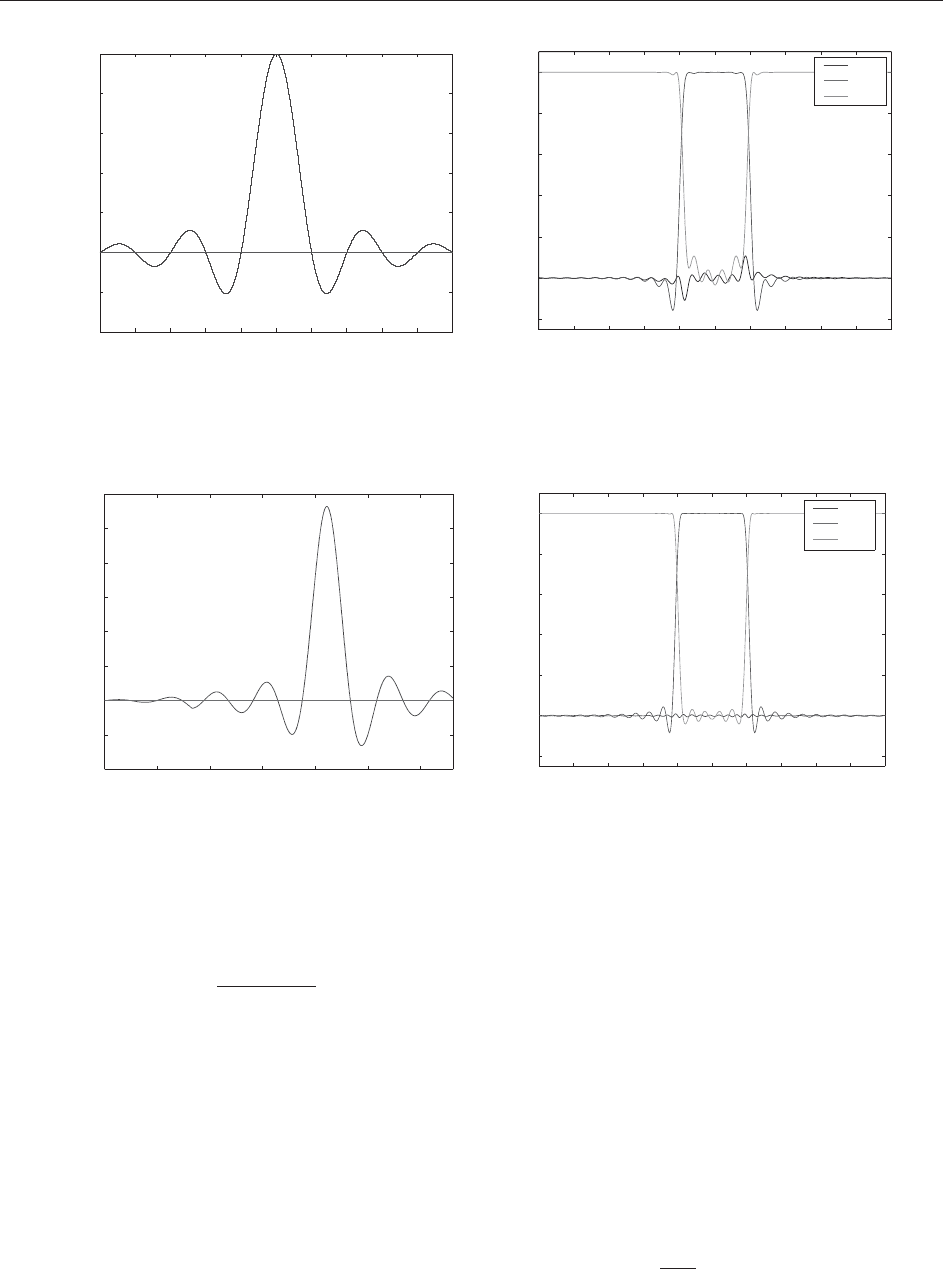
For an example such as in [16], close to zero, and
f
0
= f
1
, we obtain
þ i
i sin sin f
1
t
t
½20
A pulse of this sort is called a sinc-pulse. A
sinc-pulse is shown in Figure 1a, the result of
applying it in Figure 1b. A more accurate pulse can
be de signed using the Shinnar–Le Roux algorithm
(see Pauly et al. (1991) and Shinnar and Leigh
(1989)), or the inverse scattering approach (see
Epstein (2004)). An inverse-scattering 90
-pulse is
shown in Figure 2a and the response in Figure 2b.
Spin-Warp Imaging
In an earlier section we showed how NMR
measurements could be used to measure the three-
dimensional Fourier transform of . In this section,
we consider a more practical technique, that of
measuring the two-dimensional Fourier transform of
a ‘‘slice’’ of . Applying a selective RF pulse, as
described in the previous section, we can flip the
magnetization in a region of space z
0
z < z <
z
0
þ z, while leaving it in the equilibrium state
outside a slightly larger region. Observing that a
signal near the resonance frequency is only produced
by isochromats whose magnetization has a nonzero
transverse component, we can now measure samples
of the two-dimensional Fourier transform of the
function
z
0
ðx; y Þ¼
1
2z
Z
z
0
þz
0
z
0
z
ðx; y; zÞdz ½21
If z is sufficiently small then
z
0
(x, y) (x, y, z
0
).
0 0.5
(a) (b)
1 1.5 2 2.5 3 3.5 4 4.5 5
–0.2
–0.1
0
0.1
0.2
0.3
0.4
0.5
ms
RF pulse KHz
–5 –4 –3 –2 –1 0 1 2 3 4 5
–0.2
0
0.2
0.4
0.6
0.8
1
KHz
magnetization
m
1
m
2
m
3
Figure 1 A selective 90
pulse and profile designed using the linear approximation. (a) Profile of a 90
sinc-pulse. (b) The
magnetization profile produced by the pulse in (a).
0
(a) (b)
1 2 3 4 5 6
–0.2
–0.1
0
0.1
0.2
0.3
0.4
0.5
0.6
ms
RF pulse KHz
–5
–4 –3 –2 –1 0 1 2 3 4 5
–0.2
0
0.2
0.4
0.6
0.8
1
KHz
magnetization
m
1
m
2
m
3
Figure 2 A selective 90
pulse and profile designed using the inverse scattering approach. (a) Profile of a 90
inverse-scattering
pulse. (b) The magnetization profile produced by the pulse in (a).
Magnetic Resonance Imaging 371
In order to be able to use the fast Fourier
transform (FFT) algorithm to do the recons truction,
it is very useful to sample
b
z
0
on a uniform grid. To
that end, we use the gradient fields as follows: after
the RF excitation we apply a gradient field of the
form G
ph
= (0, 0, g
2
y þ g
1
x) for a certain peri od of
time T
ph
. This is called a phase encoding gradient.
At the conclusion of the phase encoding gradient,
the transverse components of the magnetization
from the excited spins has the form
m
k
ðx; yÞ/e
2iðk
y
yk
x
xÞ
z
0
ðx; yÞ½22
where (k
x
, k
y
) = [2]
1
T
ph
(g
1
, g
2
). At time T
ph
,
we turn off the y-component of G
ph
and reverse the
polarity of the x-component. At this point, we begin
to measure the signal. We get samples of
b
(k, k
y
)
where k varies from k
x max
to k
x max
. By repeating
this process with the strength of the y-phase
encoding gradient being stepped through a sequence
of uniformly spaced values, g
2
2 {ng
y
}, and col-
lecting samples at a uniformly spaced set of times,
we collect the set of samples
b
z
0
ðmk
x
; nk
y
Þ:
N
x
2
m
N
x
2
;
N
y
2
n
N
y
2
½23
The gradient G
fr
= (0, 0, g
1
x), left ‘‘on’’ during
signal acquisition, is called a frequency encoding
gradient. While there is no difference, mathemati-
cally, between the phase encoding and frequency
encoding steps, there are significant practical differ-
ences. This app roach to sampling is known as spin-
warp imaging; it was introduced in Edelstein et al.
(1980). The steps of this experiment are summarized
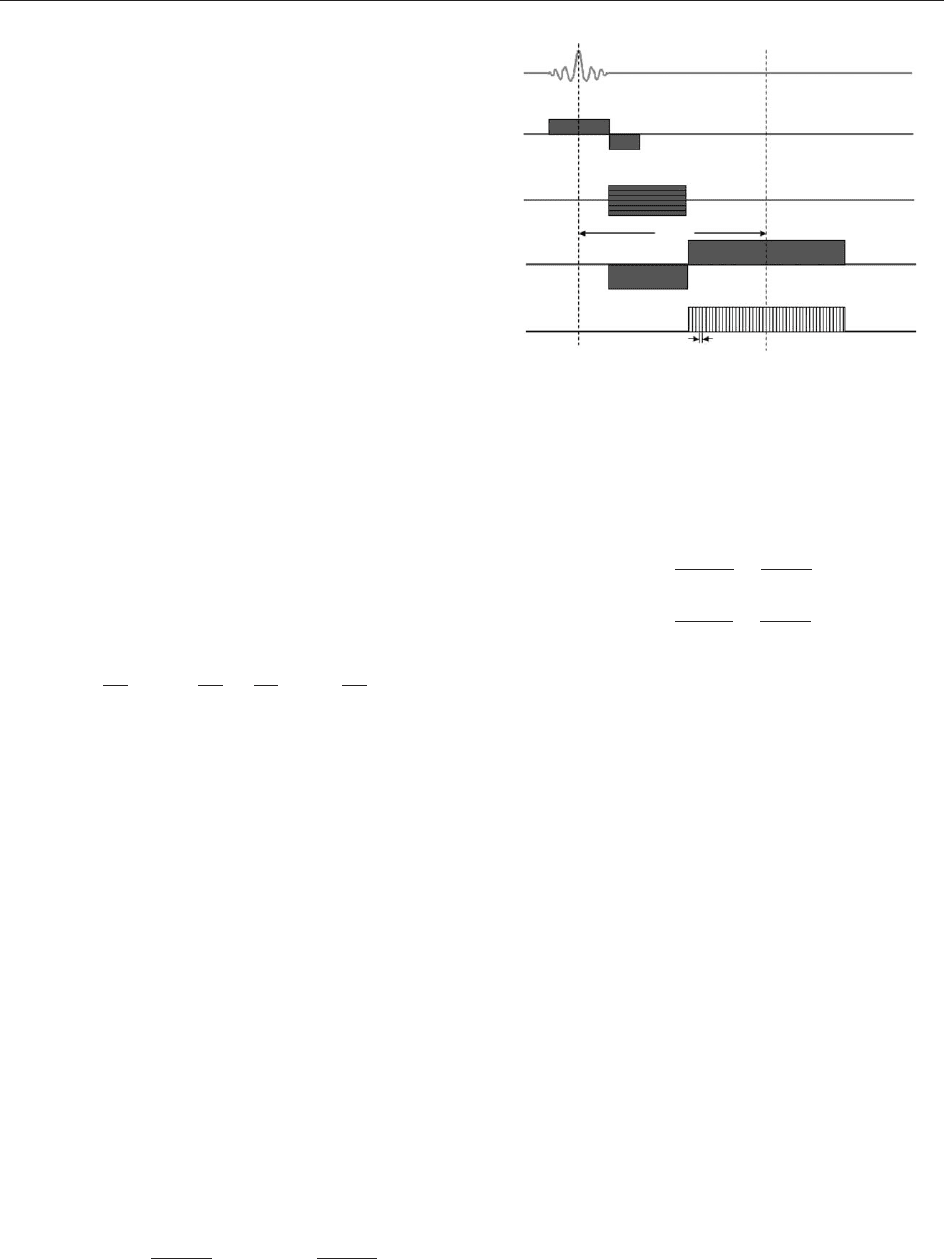
in a pulse sequence timing diagram, shown in
Figure 3. This graphical representation for the
steps followed in a magnetic resonance imaging
experiment is ubiquitous in the literature.
To avoid aliasing artifacts, the sample spacings
k
x
and k
y
must be chosen so that the excited
portion of the sample is contained in a region of size
k
1
x
k
1
y
. This is called the field of view or
FOV. Since we can only collect the signal for a finite
period of time, the Fourier transform
b
(k
x
, k
y
)is
sampled at frequencies lying in a rectangle with
vertices (k
x max
, k
y max
), where
k
x max
¼
N
x
k
x
2
; k
y max
¼
N
y
k
y
2
½24
The maximum frequencies sampled effectively deter-
mine the resolution available in the reconstructed
image. Heuristically, this resolution limit equals half
the shortest measured wavelength:
x
1
2k
x max
¼
FOV
x
N
x
y
1
2k
y max
¼
FOV
y
N
y
½25
Whether one can actually resolve objects of this size in
the reconstructed image depends on other factors such
as the available contrast and the signal-to-noise ratio
(SNR). We consider these factors in the final sections.
Signal-to-Noise Ratio
At a given spatial resolution, image quality is largely
determined by SNR and the contrast between the
different materials making up the imaging object. SNR
in MRI is defined as the voxel signal amplitude divided
by the noise standard deviation. The noise in the NMR
signal, in general, is Gaussian distributed with zero
mean. Ignoring contributions from quantization, for
example, due to limitations of the analog-to-digital
converter, the noise voltage of the signal can be
ascribed to random thermal fluctuations in the receive
circuit (see Edelstein (1986)). The variance is given by
2
thermal
¼ 4k
B
TR ½26
where k
B
is Boltzmann’s constant, T the absolute
temperature, R the effective resistance (resulting from
both receive coil, R
c
and object, R
o
), and the
receive bandwidth. Both R
c
and R
o
are frequency
dependent, with R
c
/ !
1=2
,andR
o
/ !. Their relative
contributions to overall circuit resistance depend in
a complicated manner on coil geometry, and
the imaging object’s shape, size, and conductivity
RF
g
3
g
2
g
1
ADC
T
E
Slice selection gradient
Phase encoding gradient
Frequency encoding gradient
Signal acquisition
Δt
Figure 3 Pulse timing diagram for spin-warp imaging. During
the positive lobe of the frequency encoding gradient, the analog-
to-digital converter (ADC) collects samples of the signal
produced by the rotating transverse magnetization.
372 Magnetic Resonance Imaging
(see Chen and Hoult (1989)). Hence, at high magnetic
field, and for large objects, as in most medical
applications, the resistance from the object dominates
and the noise scales linearly with frequency. Since the
signal is proportional to !
2
,inMRI,theSNRincreases
in proportion to the field strength.
As the reconstructed image is complex valued, it is
customary to display the magnitude rather than the
real component. This, however, has some conse-
quences on the noise properties. In regions where the
signal is much larger than the noise, the Gaussian
approximation is valid. However, in regions where the
signal is low, rectification causes the noise to assume a
Raleigh distribution. Mean and standard deviation can
be calculated from the joint probability distribution:
PðN
r
; N
i
Þ¼
1
2
2
e
ðN
2
r
þN
2
i
Þ=2
2
½27
where N
r
and N
i
are the noise in the real and
imaginary channels, respectively. When the signal is
large compared to noise, one finds that the variance
2
m
=
2
. In the other extreme of nearly zero signal,
one obtains for the mean:
b
S ¼
ffiffiffiffiffiffiffiffi
=2
p
ffi 1:253 ½28
and, for the variance:
2
m
¼2
2
ð1 =4Þffi0:655
2
½29
Of particular practical significance is the SNR
dependence on the imaging parameters. The voxel
noise variance is reduced by the total number of
samples collected during the data acquisition pro-
cess, that is,
2
m
¼
2
thermal
=N ½30
where N = N
x
N
y
in a two-dimensional spin-warp
experiment. Incorporating the contributions to
thermal noise variance, other than bandwidth, into
a constant
u ¼ 4k
B
TR ½31
we obtain for the noise variance:
2
m
¼
u
N
x
N
y
N
avg
½32
Here N
avg
is the number of signal averages collected
at each phase enco ding step. We obtain a simple
formula for SNR per voxel of volume V:
SNR ¼C
~
V
ffiffiffiffiffiffiffiffiffiffiffiffiffiffiffiffiffiffiffiffiffiffi
N
x
N
y
N
avg
u
r
¼C
~
x yd
z
ffiffiffiffiffiffiffiffiffiffiffiffiffiffiffiffiffiffiffiffiffiffi
N
x
N
y
N
avg
u
r
½33
where x, y are defined in [25], d
z
is the thickness
of the slab selected by the slice-selective RF pulse,
and
~
denotes the spin density weighted by effects
determined by the (spatially varying) relaxation
times T
1
and T
2
and the pulse sequence timing
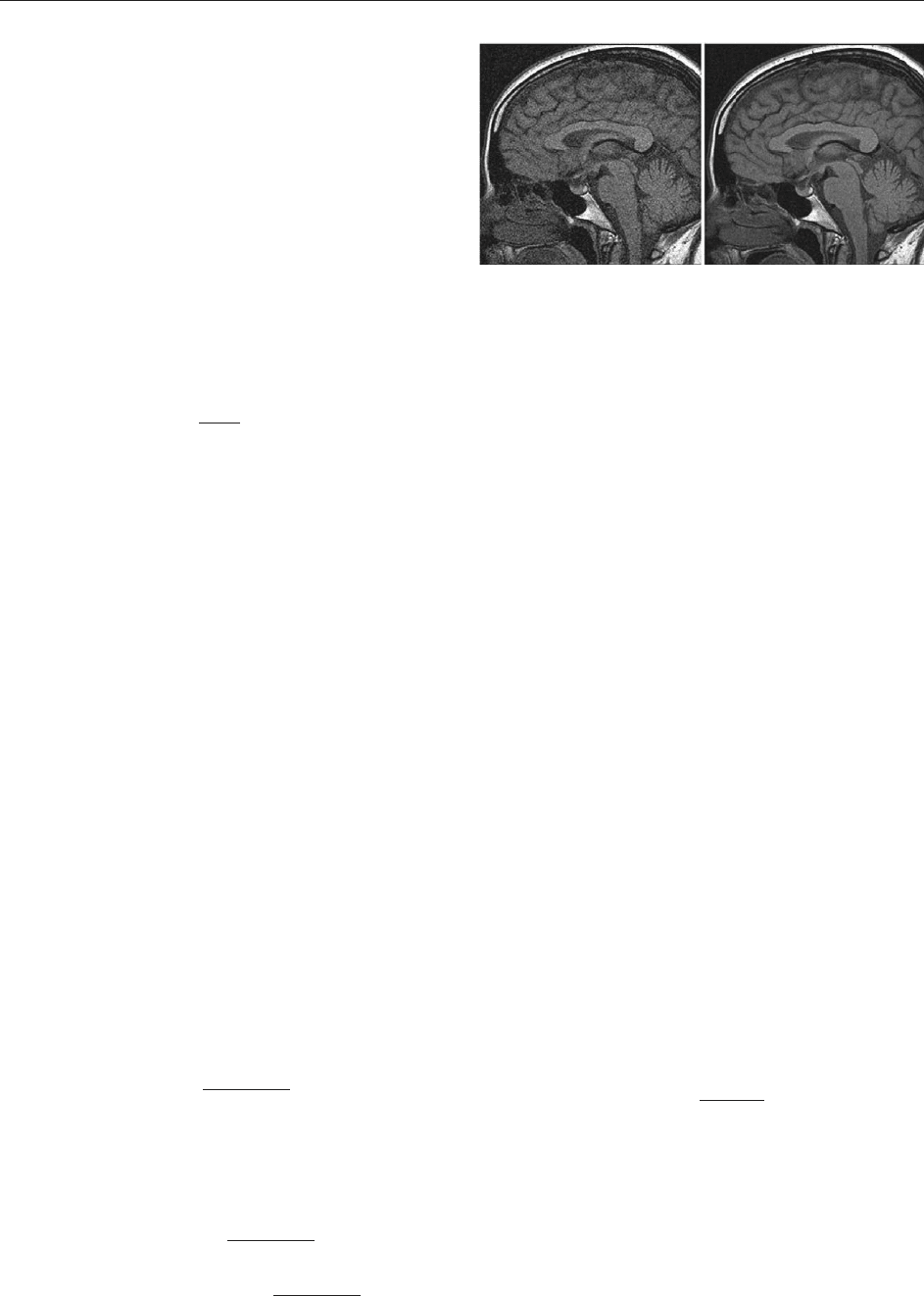
parameters. Figure 4 shows two images of the
human brain obtained from the same anatomic
location but differing in SNR.
Contrast and Resolution
The single most distinc tive feature of MRI is its
extraordinarily large innate contrast. For two soft
tissues, it can be on the order of several hundred
percent. By comparison, contrast in X-ray imaging is
a consequence of differences in the attenuation
coefficients for two adjacent structures and is
typically on the order of a few percent.
We have seen in the prece ding sections that the
physical principles underlying MRI are radically
different from those of X-ray computed tomogra-
phy, in that the signal elicited is generated by the
spins themselves in response to an external pertur-
bation. The contrast between two regions, A and B,
with signals S
A
and S
B
, respectively, is defined as
C
AB
¼
S
A
S
B
S
A
½34
If the only contrast mechanism were differences in
the proton spin density of various tissues, then
contrast would be on the order of 5–20%. In reality,
it can be several hundred percent. The reason for
this discrepancy is that the MR signal is acquired
under nonequilibrium conditions. At the time of
excitation, the spins have typically not recovered
from the effect of the previous cycle’s RF pulses, nor
(a) (b)
Figure 4 T
1
-weighted sagittal images through the midline of
the brain: Image (b) has twice the SNR of image (a), showing
improved conspicuity of small anatomic and low-contrast detail.
The two images were acquired at 1.5 T field strength using two-
dimensional spin-warp acquisition and identical scan para-
meters, except for N
avg
, which was 1 in (a) and 4 in (b).
Magnetic Resonance Imaging 373
is the signal usually detected immedi ately after its
creation.
Typically, in spin-warp imaging, a spin-echo is
detected as a means to alleviate spin coherence
losses from static field inhomogeneity. A spin-echo
is the result of applying an RF pulse that has the
effect of taking (m
1
, m
2
, m
3
)to(m
1
, m
2
, m
3
). As
such a pulse effects a 180
rotation of the
^
z-axis, it is
also called a -pulse. If, after such a pulse, the spins
continue to evolve in the same environment then,
following a certain peri od of time, the transverse
components of the magnetization vectors through-
out the sample become aligned. Hence a pulse of
this type is also called a refocusing pulse. The time
when all the transverse components are rephased is
called the echo time, T
E
.
The spin-echo signal amplitude for an RF pulse
sequence =2 , repeated every T
R
sec-
onds, is approximately given by
Sðt ¼ 2Þð1 e
T
R
=T
1
Þe
T
E
=T
2
½35
This is a good approximation as long as T
E
<< T
R
and T
2
<< T
R
, in which case the transverse magne-
tization decays essentially to zero between successive
pulse sequ ence cycles. In eqn [35], is voxel spin
density and the echo time T
E
= 2. Empirically, it
is known that tissues differ in at least one of
the intrinsic quantities, T
1
, T
2
,or. It, therefore,
suffices to acquire images in such a manner that
contrast is sensitive to one particular parameter. For
example, a ‘‘T
2
-weighted’’ image would be acquired
with T
E
T
2
and T
R
>> T
1
and, similarly, a
‘‘T
1
-weighted’’ image with T
R
< T
1
and T
E
<< T
2
,
with T
1
, T
2
representing typical tissue proton relaxa-
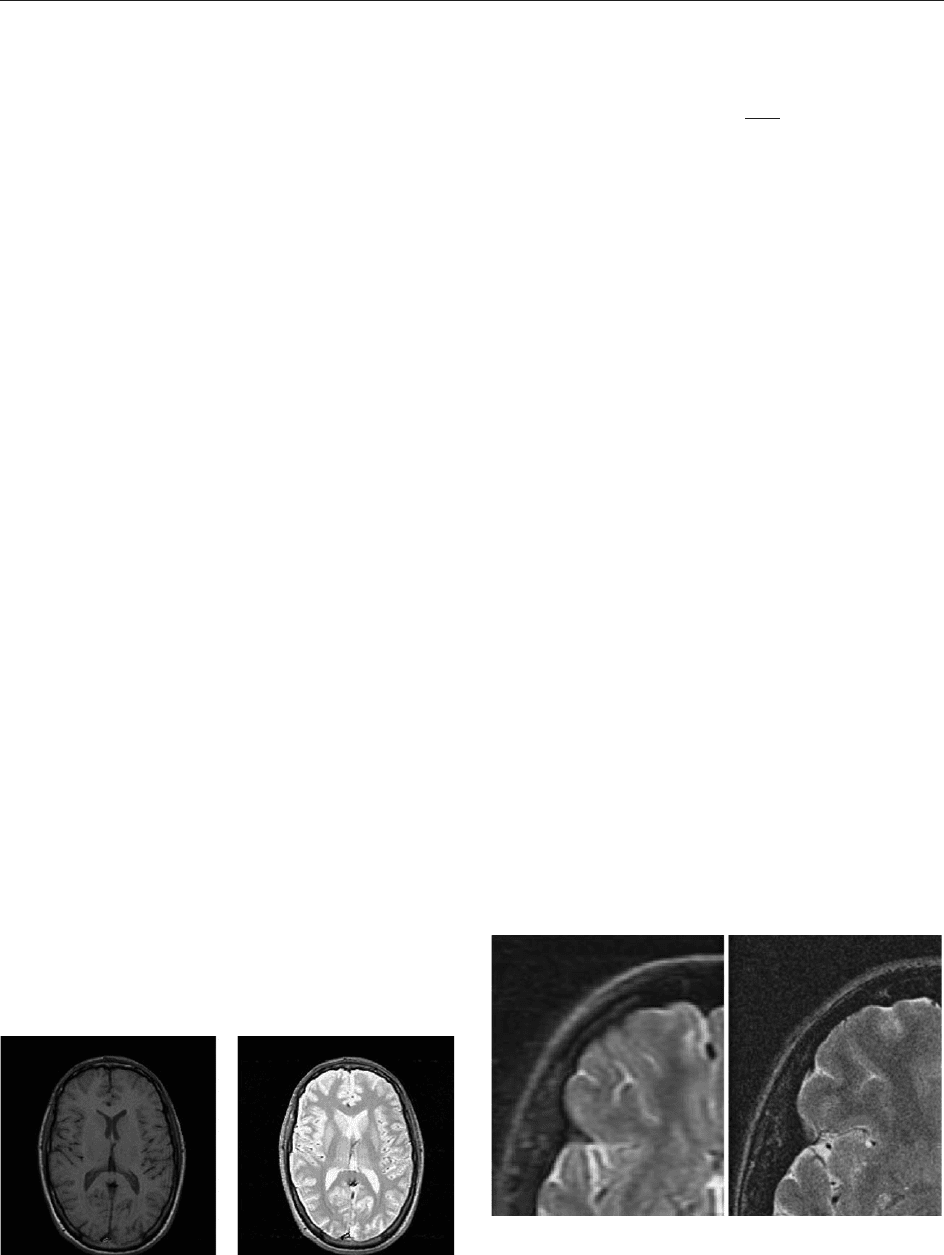
tion times. Figure 5 shows two images obtained with
the same scan parameters except for T
R
and T
E
illustrating the fundamentally different image con-
trasts that are achievable.
It is noteworthy that object visibility is not just
determined by the contrast between adjacent
structures but is also a function of the noise. It is,
therefore, useful to define the contrast-to-noise ratio as
CNR
AB
¼
C
AB
eff
½36
where
eff
is the effective standard deviation of the
signal. Finally, it may be useful to reconstruct
parametric images in which the pixel signal values
represent any one of the intrinsic parameters. A
T
2
-image can be computed from eqn [35],for
example, either analytically from two image data
sets acquired with two different echo times, or from a
series of T
E
values, obtained from a Carr–Purcell spin-
echo train, using regression techniques (see Nuclear
Magnetic Resonance and Haacke et al. (1999)).
We have previously shown that the limiting
resolution is given by k
max
, the largest spatial
frequency sampled, see [25]. In reality, howev er,
the actual resolution is always lower. For example,
spin–spin (T
2
) relaxation causes the signal to decay
during the acquisition. In spin-warp imaging, this
causes the high spatial frequencies to be further
attenuated.
A further consequence of finite sampling is a
ringing or Gibbs artifact that is most prominent at
sharp intensity discontinuities. In practice, these
artifacts are mitigated by applying an appropriate
apodizing filter to the data. Figure 6 shows a portion
of a brain image obtained at two different resolu-
tions. In Figure 6b , the total k-space area covered
was 16 times larger than for the acquisition of the
image in a). Artifacts from finite sampling and
blurring of fine detail such as cortical blood vessels
are clearly visible in the low-resolution image. SNR,
according to eqn [33], is reduced in the latter image
by a factor of 4.
(a) (b)
Figure 5 Dependence of image contrast on pulse sequence
timing parameters: (a) T
1
-weighted; (b) proton density-weighted.
(a) (b)
Figure 6 Effect of k-space coverage on spatial resolution in
axial image of the brain: the field of view in both images was
20 cm and all scan parameters were the same except that (a)
was acquired with N
x
= N
y
= 128 and (b) with N
x
= N
y
= 512.
374 Magnetic Resonance Imaging

See also: Nuclear Magnetic Resonance; Stochastic
Resonance.
Further Reading
Abragam A (1983) Principles of Nuclear Magnetism. Oxford:
Clarendon.
Barrett HH and Myers KJ (2004) Foundations of Image Science.
Hoboken: Wiley.
Bernstein MA, King KF, and Zhou XJ (2004) Handbook of MRI
Pulse Sequences. London: Elsevier Academic Press.
Callaghan PT (1993) Principles of Nuclear Magnetic Resonance
Microscopy. Oxford: Clarendon.
Chen C-N and Hoult DI (1989) Biomedical Magnetic Resonance
Technology. Bristol: Adam Hilger.
Edelstein WA, Glover GH, Hardy C, and Redington R (1986)
The intrinsic signal-to-noise ratio in NMR imaging. Magnetic
Resonance in Medicine 3: 604–618.
Edelstein WA, Hutchinson JM, Johnson JM, and Redpath T (1980)
Spin warp NMR imaging and applications to human whole-
body imaging. Physics in Medicine and Biology 25: 751–756.
Epstein CL (2003) Introduction to the Mathematics of Medical
Imaging. Upper Saddle River, NJ: Prentice-Hall.
Epstein CL (2004) Minimum power pulse synthesis via the inverse
scattering transform. Journal of Magnetic Resonance 167:
185–210.
Ernst R, Bodenhausen G, and Wokaun A (1987) Principles of
Nuclear Magnetic Resonance in One and Two Dimensions.
Oxford: Clarendon.
Haacke EM, Brown RW, Thompson MR, and Venkatesan R
(1999) Magnetic Resonance Imaging. New York: Wiley-Liss.
Hoult D and Lauterbur PC (1979) The sensitivity of the
zeugmatographic experiment involving human samples.
Journal of Magnetic Resonance 34: 425–433.
Levitt MH (2001) Spin Dynamics, Basics of Nuclear Magnetic
Resonance. Chichester: Wiley.
Pauly J, Le Roux P, Nishimura D, and Macovski A (1991)
Parameter relations for the Shinnar–Le Roux selective excita-
tion pulse design algorithm. IEEE Transactions on Medical
Imaging 10: 53–65.
Shinnar M and Leigh J (1989) The application of spinors to pulse
synthesis and analysis. Magnetic Resonance in Medicine 12:
93–98.
Slichter CP (1990) Principles of Magnetic Resonance, 3rd enl. and
upd. ed., Springer Series in Solid-State Sciences, vol. 1. Berlin–
New York: Springer.
Wehrli FW (1995) From NMR diffraction and zeugmatography
to modern imaging and beyond. In: Progress in Nuclear
Magnetic Resonance Spectroscopy 28: 87–135.
Magnetohydrodynamics
C Le Bris, CERMICS – ENPC, Champs Sur Marne,
France
ª 2006 Elsevier Ltd. All rights reserved.
The Basic Modeling
Magnetohydrodynamics (MHD) is the study of the
interaction of (electro-) magne tic fields and con-
ducting fluids. When a conducting fluid (e.g., a
liquid metal, a weakly ionized gas, or a plasma) is
placed within a magnetic field, two coupling
phenomena appear: the electric currents modify the
magnetic field, and the Lorentz forces due to the
magnetic field modify the motion of the fluid. At the
mathematical level, two sets of equations, very
different in nature, are involved. The usual descrip-
tion of the hydrodynamics phenomena is most often
that provided by the continuum mechanics for
fluids, while the description of electromagnetic
phenomena essentially proceeds from the Maxwell
equations.
Either category of equations can be declined in a
variety of models. The coupling between the two
categories might also be accounted for at different
levels of accuracy. For the sake of conciseness in
such an expository survey, it is neither desirable nor
doable to present all the possible set of equations
and their possi ble coupling. The difficulty stems
from the incredibly large spectrum of physical
phenomena where MHD plays a role. A list of
such phenomena includes
astrophysical and geophysical applications (mod-
eling of stars in the galactic field, of pulsar s, of
solar spots, of the flows in the earth’s core, ...),
advanced ‘‘terrestrial’’ applications such as the
magnetic confinement of plasmas in controlled
fusion, MHD propulsion engines for rockets, and
industrial applications in the engineering world
(electromagnetic pumping, metal forming, alumi-
num electrolysis, and many other metallurgical
applications).
Due to this variety of physical situations, no
unified setting can be presented with a satisfactory
degree of details. We therefore mostly concentrate
throughout this article on the MHD of conducting
fluids that are homogeneous, incompressible, vis-
cous, and Newtonian. This is often the case of
liquid metals in many industrial processes. The
equations manipulated will first be given in their
most general f orm and then immediately adapted to
the above context. For other contexts, the modeling
follows the same pattern, but other variants of the
general equations must be employed. The biblio-
graphy of this article contains such general
information.
Magnetohydrodynamics 375

The Hydrodynamics Description
The usual description for fluids follows from
continuum mechanics. In this setting, the governing
equation is the equation for the conservation of
momentum
@ðuÞ
@t
þ divðu uÞdiv ¼f ½1
where denotes the densi ty of the fluid, u its
velocity, the stress tensor, and f the density of
volumic (or per unit volume) body forces applied to
the fluid. For incompressible viscous Newtonian
fluids, the stress/velocity relation reads
¼ðru þðruÞ
T
ÞpId ½2
together with the constraint
div u ¼0 ½3
on the velocity. Here, denotes the viscosity of the
fluid, p the pressure, and A
T
denotes the transpose
matrix of the matrix A. A third usual assumption is
that the incompressible fluid is in addition homo-
geneous, that is,
¼
¼constant ½4
Equations [1]–[4] lead to the equations for
conservation of momentum in the case of incom-
pressible homogeneous viscous Newtonian fluid,
that is, the incompressible Navier–Stokes equations
@u
@t
þ
u ru u þrp ¼f
div u ¼0
½5
These equations are supplied with initial and
boundary conditions on the velocity u. At initial
time, the velocity is assumed to be known
u(t = 0,) = u
0
on the whole domain occupied by
the fluid , a domain that is supposed here not to
vary in time (see , neverthel ess, the sect ion ‘‘The
indust rial pr oduction of alum inum’’ for a differe nt
setting). On the other hand, the boundary conditions
on the boundary @ of can be of various forms.
For simplicity, the boundary is supposed regular, so
that its unitary outward normal n
@
can be
unambiguously defined. The standard choice is to
set Dirichlet conditions on the velocity u = u
given
.In
the following, we will assume for simplicity that the
boundary condition is the homogeneous Dirichlet
boundary condition u = 0, as a superposition of the
nonpenetration condition u n
@
= 0 and the no-slip
boundary condition u n
@
= 0. One can also
impose alternative boundary conditions, for exam-
ple, involving the pressure.
The Electromagnetic Description
Classical electromagnetism is described by the
Maxwell equations. For the sake of consistency, we
recall here that these are:
The Maxwell–Ampe`re equation
@D
@t
þ curl H ¼ j ½6
The Maxwell–Coulomb equation
divD ¼
c
½7
The Maxwell–Faraday equation
@B
@t
þ curl E ¼ 0 ½8
The Maxwell–Gauss equation
divB ¼ 0 ½9
In the above equations, the three-dimensional vector
fields D, B, E, H denote the electric and magnetic
inductions, and the electric and magnetic fields,
respectively. On the other hand, the three-dimensional
vector field j denotes the current density, and the scalar
field
c
denotes the charge density. Inside an elec-
trically conducting medium, the standard assumption
of perfect medium consists in assuming the following
relations:
D ¼"E
H ¼
1
B
½10
often called ‘‘constitutive laws,’’ where " and ,
respectively, denote the (electric) permittivity and
the (ma gnetic) permeability of the medium. In the
simple isotropic homogeneous case, both these
parameters are scalar and constant. They are often
expressed as
" ¼"
r
"
0
¼
r
0
½11
where "
0
,
0
are the permittivity and the perme-
ability of the vaccum (that satisfy "
0
0
= 1=c
2
, with
c denoting the speed of light), and "
r
,
r
are the
permittivity and the permeability relative to vaccum,
or relative permittivity and relative permeability.
When collecting [6]–[9], together with [10], [11],
one obtains the following general system of
376 Magnetohydrodynamics