
Francoise J.-P., Naber G.L., Tsun T.S. (editors) Encyclopedia of Mathematical Physics
Подождите немного. Документ загружается.


with respect to
t
. For a connected compact Lie
group G, consider the path and loop groups on G.
The pinned Wiener measure on the loop group is
definedasthelawofaG-valued Brownian motion
starting at e and conditioned to end at e, and the heat
kernel measure is the endpoint distribution of
Brownian motion on the loop group.
It has been shown (Driver and Srimurthy 2001)
that the heat kernel measure is absolutely continuous
with respect to the pinned Wiener measure, and that
the Radon–Nikodym derivative is bounded. This
proof relies on the heat formula with a potential
[3], which is satisfied by the heat kernel measure.
They give a new proof of this heat formula. When the
group G is simply connected, Aida and Driver (2000)
prove that the heat kernel measure over a based loop
group, constructed by using the Brownian motion is
equivalent to the Brownian bridge measure over a
based loop group. When G is the circle, the Radon–
Nikodym derivative of the heat kernel measure with
respect to the pinned Wiener measure can be
calculated in terms of the Jacobi theta function
(Driver and Srimurthy 2001). On the loop space of
R
n
,attimet, the two measures, ‘‘heat kernel’’ and
‘‘pinned Wiener’’ are the same.
See also: Abelian and Nonabelian Gauge Theories Using
Differential Forms; Lie Groups: General Theory; Malliavin
Calculus; Path Integrals in Noncommutative Geometry.
Further Reading
Aida S and Driver BK (2000) Equivalence of heat kernel measure
and pinned Wiener measure on loop groups. Comptes Rendus
de l’Academie des Sciences, Paris, I 331: 709–712.
Aida, Shigeki, Elworthy, and David (1995) Differential calculus
on path and loop spaces. Logarithmic Sobolev inequalities on
path spaces. Comptes Rendus de l’Academie des Sciences Paris
Serie I Mathematics 321(1): 97–102.
Airault H and Malliavin P (1996) Integration by parts formulas
and dilatation vector fields on elliptic probability spaces.
Probability Theory and Related Fields 106: 447–494.
Bowick MJ and Rajeev SG (1987) The holomorphic geometry of
closed bosonic string theory and DiffS
1
=S
1
. Nuclear Physics B
293: 348–384.
Cruzeiro AB and Malliavin P (1996) Renormalized differential
geometry on path space: structural equation, curvature.
Journal of Functional Analysis 139: 119–181.
Driver BK (2003) Heat Kernels Measures and Infinite Dimen-
sional Analysis. Heat Kernels and Analysis on Manifolds,
Graphs, and Metric Spaces, Paris, Contemp. Math. vol. 338,
pp. 101–141. Providence, RI: American Mathematical Society.
Driver BK and Srimurthy VK (2001) Absolute continuity of heat
kernel measure with pinned Wiener measure on loop groups.
Ann. Probab. 29(2): 691–723.
Fang S (1999) Integration by parts for heat measures over loop
groups. J. Math. Pures Appl. 78(9): 877–894.
Freed DS (1988) The geometry of loop groups. Journal of
Differential Geometry 28: 223–276.
Gaveau B and Mazet E (1979) Diffusions sur des varie´te´s de
chemins. Comptes Rendus de l’Academie des Sciences, Paris
289: 643–645.
Gross L (1998) Harmonic functions on loop groups, Se´minaire
Bourbaki, vol. 1997–1998, Aste´risque No 252, Exp. No. 846,
5, 271–286.
Hsu EP (1997) Analysis on path and loop spaces. In: Hsu EP and
Varadhan SRS (eds.) IAS/Park City Mathematics Series 5.
Princeton: American Mathematical Society and Institute for
Advanced Study.
Jones V (1995) Fusion en alge`bres de von Neumann et groupes de
lacets (A. Wassermann). Se´minaire Bourbaki, vol. 1994/95.
Aste´risque No. 237 (1996), Exp. No. 800, 5, 251–273.
Levy T (2003) Yang–Mills measures on compact surfaces. Mem.
Amer Math. Soc. 166: 790.
Malliavin P (1989) Hypoellipticity in infinite dimensions. In:
Pinsky M (ed.) Diffusion Process and Related Problems in
Analysis. Chicago: Birkhauser.
Malliavin MP and Malliavin P (1992) Integration on loop groups
III. Asymptotic Peter–Weyl orthogonality. Journal of Func-
tional Analysis 108: 13–46.
Mancino ME (1999) Dilatation vector fields on the loop group.
Journal of Functional Analysis 166(1): 130–147.
Neretin Y (1994) Some remarks of quasi-invariant actions of loop
groups and the group of the diffeomorphisms of the circle.
Communication in Mathematical Physics 164: 599–626.
Norris JR (1995) Twisted sheets. Journal of Functional Analysis
132: 273–334.
Pickrell D (1987) Measures on infinite-dimensional Grassmann
manifolds. Journal of Functional Analysis 70(2): 323–356.
Metastable States
SShlosman, Universite
´
de Marseille, Marseille, France
ª 2006 Elsevier Ltd. All rights reserved.
Introduction
The theory of metastability studies the states of
the matter which ‘‘should not be there,’’ but which
still can be observed, albeit for only a short time.
One example is water, cooled below the zero
temperature. This supercool water can stay liquid,
but not for a long time, and it then freezes abruptly.
Such states are called metastable. They are not
equilibrium states; at negative temperatures the only
equilibrium state of water is ice. Physically, these
metastable states are produced from the equilibrium
states by slowly changing the external parameters,
such as the temperature (or magnetic field): one
takes, for example, water (extremely purified) at low
positive temperature, T > 0, and then lowers the
Metastable States 417

temperature slowly to negative values T < 0. Thus,
the family of metastable states, s
T
, T < 0, should
be thought as a continuation of the fam ily s
T
, T > 0
of equilibrium states through the point of phase
transition T
c
= 0, at which critical temperature these
states cease to exist as equilibrium states.
Below we will present rigorous results, which
validate the above picture for the case of the 2D
Ising model. They are contained in Schonmann and
Shlosman (1998). The relevant external parameter
in this case will be the magnetic field, h.
It turns out that the lifetime of metast able states is
determined by the quantities given by the Wulff
construction.
Equilibrium States and Dynamics
Let us denote the set {1, þ1}
Z
2
of the Ising model
configurations by . Two configurations are
specially relevant, the one with all spins 1 and the
one with all spins þ1. We will use the simple
notation and þ to denote them.
Observables are just functions on . Local observ-
ables are those which depend only on the values of
finitely many spins.
We will consider the formal Hamiltonian
H
h
ðÞ¼
X
x;y n:n:
ðxÞðyÞh
X
x
ðxÞ½1
where h 2 R
1
is the external field and 2 is a generic
configuration. We define, for each set Z
2
and
each boundary condition 2 ,
H
;;h
ðÞ¼
X
x;y n:n:
x;y2
ðxÞðyÞ
X
x;y n:n:
x2;y62
ðxÞðyÞ
h
X
x2
ðxÞ
The ‘‘grand canonical Gibbs measure’’ in with
boundary condition under external field h and at
temperature T is defined on
as
;;T; h
ðÞ¼Z
1
;;T; h
expðH
;;h
ðÞÞ
where = T
1
, and the partition function Z
, , T, h
is
a normalization, chosen such that
, , T, h
(
) = 1.
The equilibrium states are obtained by taking the
thermodynamic limit lim
!Z
2
, , T, h
. We will be
interested in the states
; T; h
¼ lim
!Z
2
;;T;h
corresponding to ()-boundary conditions. If h 6¼ 0,
then
, T, h
=
þ, T, h
, so it will be denoted simply by
T, h
.Ifh = 0, the same is true if the temperature
is larger than or equal to a critical value T
c
= T
c
, and
is false for T < T
c
, in which case one says that there is
phase coexistence. The measure
þ, T,0
þ, T
is
called the (þ)-phase, and
, T
the ()-phase.
For an observable f we will denote by hf i
its
expected value in the state
, that is, the integral
R
f d
. In particular, the spontaneous magnetization
m
(T) equals by definition to h(0)i
þ, T
.
Next, we need to supply the Ising model with the
time evolution. For this we will use the Glauber
dynamics. It is a Markov process on , whose
generator, L, acts on a generic local observable f as
ðLf ÞðÞ¼
X
x2Z
2
cðx;Þðf ð
x
Þf ðÞÞ
where
x
is the configuration obtained from by
flipping the spin at the site x to the opposite value,
and c(x, ) is the rate of the flip of the spin at the site
x when the system is in the state . In words, one
can say that the dynamics proceeds as follows: at
every site x the spin (x) is flipped randomly,
independently of all others, with the rate c(x, ),
where is the current configuration. Common
examples are ‘‘metropolis dynamics’’:
c
h
ðx;Þ¼expðð
x
H
h
ðÞÞ
þ
Þ
or ‘‘heat bath dynamics’’:
c
h
ðx;Þ¼ 1 þ expð
x
H
h
ðÞÞ½
1
Here (a)
þ
= max {a, 0}, and
x
H
h
() = H
h
(
x
)
H
h
(). The spin flip system thus obtained will be
denoted by (
T, h; t
)
t0
, where is the initial con-
figuration at time t = 0. If this initial configuration
is selected at random according to a probability
measure , then the resulting process is denoted by
(
T, h; t
)
t0
. It is known that the Gibbs measures are
invariant with respect to the stochastic Ising models.
Moreover,
T;h;t
!
;T;h
;
þ
T;h;t
!
þ;T;h
; as t !1
We will be interested in the case when h is
positive, though small. Then there is only one
invariant state,
þ, T, h
,sothestate
, T, h
is equal
to
þ, T, h
,and
T, h; t
!
þ, T, h
,ast !1.(One
should intuitively t hink about the state
T, h; t
for
t small as the supercooled but liquid water,
thinking about the state
þ, T, h
to be ice.) We
want to control the convergence of the temporal
state
T, h; t
to the equilibrium,
þ, T, h
,andtosee,if
possible, that during some (long) initial time the
state
T, h; t
looks very similar to the ()-phase
, T
, while after some time threshold it c hanges
suddenly and looks quite similar to the state
þ, T, h
. It turns out that all the above features
can indeed be established rigorously.
418 Metastable States
If one starts to simulate the above dynamics
on a computer, then the picture observed would
be the following: one would see that droplets of
the (þ)-phase are created in the midst of ()-phase
droplets, which are there for a while, and then
disappear. That process goes on for a while, until
a big enough (þ)-droplet is born; this one then
starts to grow and eventually fills up all the
display.
The Life Span of Metastable States
Let us define the ‘ ‘critical time exponent’’
c
=
c
(T)by
c
¼
w
12m
ðTÞT
½2
where w
= w
T
is the value of the surface energy
of the Wulff curve of our 2D Ising model at the
temperature T:
w
¼W
W
ðÞ
Suppose now that T < T
c
, h > 0. Let be either the
()-phase
, T
or
{ = }
. (In fact, any ‘‘between’’
these two states would go.) Then the following
happens.
1. If 0 <<
c
, then for each n 2 {1, 2, ...} and for
each local observable f,
E f
T;h;t ¼expf=hg
¼
X
n1
j¼0
b
j
ðf Þh
j
þ Oh
n
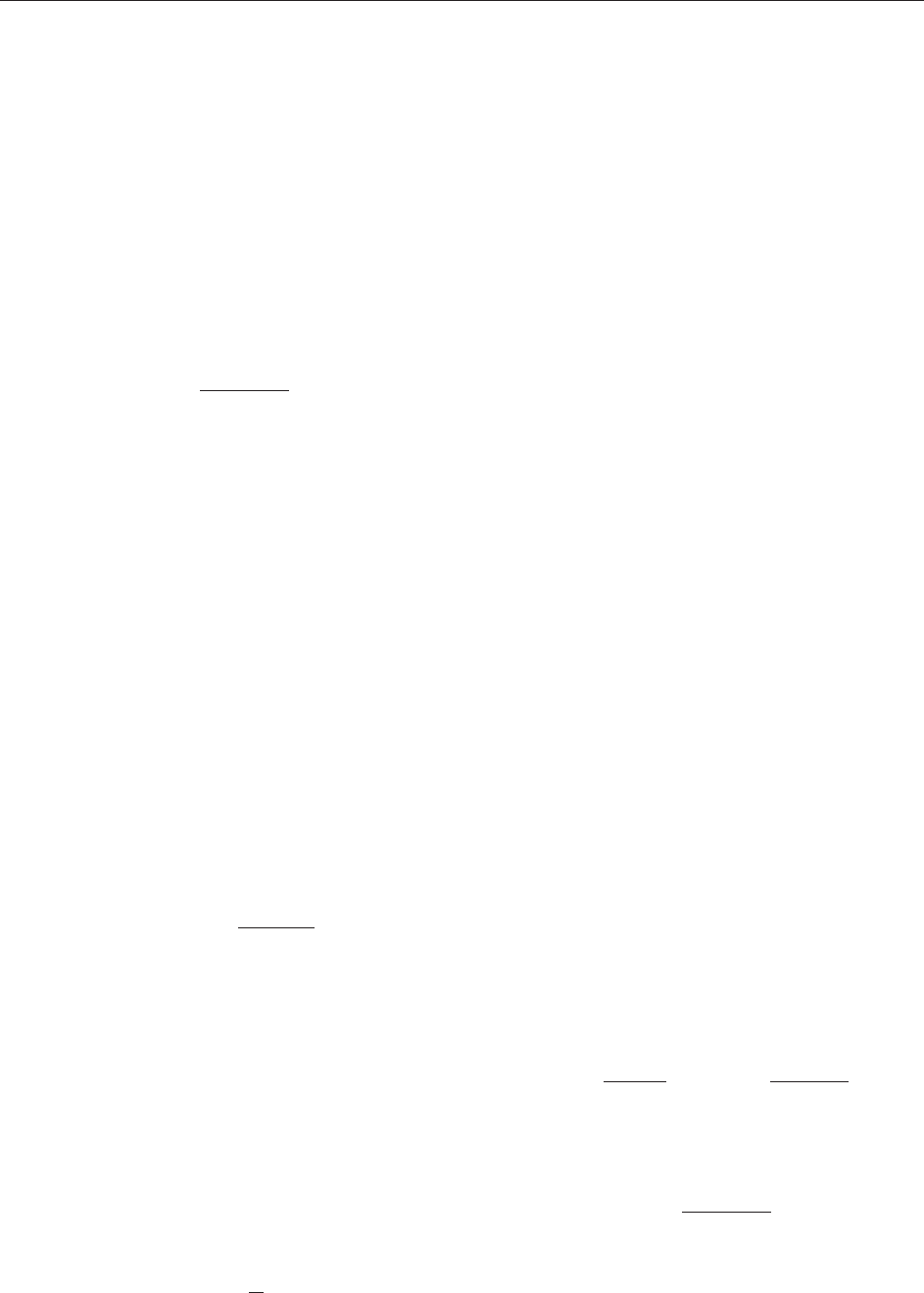
ðÞ ½3
where
b
j
ðf Þ¼ lim
h!0
d
j
hf i
;T;h
dh
j
(We stress that in the last relation we are using
the Gibbs states corresponding to the negative
values of the magnetic field.) In particular,
E
T;h;t ¼exp f=h g
0ðÞ
¼m
ðTÞþOhðÞ ½4
2. If >
c
, then for any finite positive C there is a
finite positive C
1
such that for every local
observable f,
E f
T;h;t ¼expf=hg
hf i
T;h
C
1
kf kexp
C
h
½5
The relation [3] implies that the family of
nonequilibrium states
hi
T, h;
, h > 0, defined for
every local observable f by
f
hi
T;h;
¼E f
T;h;t ¼expf=hg
is a C
1
-continuation of the curve {hi
, T, h
, h 0} of
equilibrium states. This is true for every 0 <<
c
and every as above. The states
hi
T, h;
are the
‘‘metastable states’’ we are looking for. The relations
[3] and [4] should be interpreted in the sense that
before the time exp{
c
=h} our temporal state is still
‘‘liquid,’’ while [5] means that after the time
exp{
c
=h} freezing happens. So one can think about
the quantity exp{
c
=h} as being the life span of the
metastable state.
This theorem was obtained in Schonmann and
Shlosman (1998). Let us explai n the heuristics
behind it. It has two ingredients. The first one is
that the transition to the equilibrium is going via
creation of droplets of the (þ)-phase. The second
one is that once such a droplet is created by a
thermal fluctuation, with the size exceeding a certain
critical value, it does not die out, but grows further,
with a speed v of the order of h. (This second belief
can be expected to be correct only in dimension 2.)
Let us see how these two hypotheses can give us the
right answer. To get to the equilibrium we have to
overcome the energy barrier, by creating a large
droplet of the (þ)-phase. Subcritical droplets
are constantly created by thermal fluctuations in the
metastable phase, but they tend to shrink . On the
other hand, once a supercritical droplet is created
due to a larger fluctuation, it will grow and drive the
system to the stable phase. Indeed, the energy (m )
of an m -shaped droplet of the (þ)-phase in the sea of
()-phase equals W
(m ) 2m
(T)h vol(m ). For
small m the functional (m ) decreases as m shrinks,
while for large m the functional (m ) decreases as m
grows. Its saddle point m
sdl
is preci sely the Wulff
shape. Since the minimal height of the barrier is
(m
sdl
), one predicts the rate of creation of a critical
droplet with center at a given place to be
exp
m
sdl
ðÞ
T
¼ exp
w
4m
ðTÞT
Comparing with [2], we see that we miss the
correct answer
exp
w
12m
ðTÞT
by a factor of 1/3. The reason for that is the
following. Note that we are concerned with an
infinite system, and we are observing it through a
Metastable States 419

local function f, which depends on the spins in a
finite set supp (f ). For us, the system will have
relaxed to e quilibrium once supp (f )iscoveredby
a big droplet of the (þ)-phase, which appeared
spontaneously somewhere and then grew, as
discussed above. We want to estimate how long
we have to wait for the probability of such an
event to be close to 1. If we suppose that the
radius of the supercritical droplet grows with a
speed v, then we can see that the region in
spacetime, where a droplet which covers supp ( f )
at time t could have appeared, is, roughly speak-
ing, a cone with vertex in supp (f )andwhichhas
as base the set of points which have time
coordinate 0 and are at most at distance tv from
supp (f ). The volume of such a cone is of the order
of (vt)
2
t. The order of magnitude of the relaxation
time, t
rel
, at which the region supp (f )startstobe
covered by a large droplet can now be obtained by
solving the equation
ðvt
rel
Þ
2
t
rel
exp
m
sdl
ðÞ
T
1
This gives us what we want:
t
rel
v
2=3
exp
1
3
m
sdl
ðÞ
T
See also: Dynamical Systems in Mathematical Physics:
An Illustration from Water Waves; Large Deviations in
Equilibrium Statistical Mechanics; Wulff Droplets.
Further Reading
Schonmann RH and Shlosman S (1998) Wulff droplets and the
metastable relaxation of the kinetic Ising models. Communi-
cations in Mathematical Physics 194: 389–462.
Minimal Submanifolds
T H Colding and W P Minicozzi II, University of
New York, New York, NY, USA
ª 2006 Elsevier Ltd. All rights reserved.
Introduction
Soap films, soap bubbles, and surface tension were
extensively studied by the Belgian physicist and
inventor (the inventor of the stroboscope) Joseph
Plateau in the first half of the nineteenth century. At
least since his studies, it has been known that the
right mathematical model for soap films are minimal
surfaces – the soap film is in a state of minimum
energy when it is covering the least possible amount
of area. Minimal surfaces and equations like the
minimal surface equation have served as mathemat-
ical models for many physical proble ms.
The field of minimal surfaces dates back to the
publication in 1762 of Lagrange’s famous memoir
‘‘Essai d’une nouvelle me´thode pour de´terminer les
maxima et les minima des formules inte´grales
inde´finies.’’ Euler had already, in a paper published
in 1744, discussed minimizing properties of the
surface now known as the catenoid, but he only
considered variations within a certain class of
surfaces. In the almost one-quarter of a millennium
that has past since Lagrange’s memoir, the sub ject of
minimal surfaces has remained a vibra nt area of
research and there are many reasons why. The study
of minimal surfaces was the birthplace of regularity
theory. It lies on the intersection of nonli near elliptic
PDE, geometry, topology, and genera l relativity.
In what follows we give a quick tour through
many of the classical results in the field of minimal
submanifolds, starting at the definition.
The field of minimal surfaces remains extremely
active and has very recently seen major develop-
ments that have solved many longstanding open
problems and conjectures; for more on this, see the
expanded version of this survey (Colding and
Minicozzi II, 2005). See also the recent surveys
(Meeks III and Perez 2004, Perez 2005), and the
expository article (Colding an d Minicozzi II 2003).
Throughout this survey, we refer to Colding and
Minicozzi II (1999) for references unless otherwise
noted.
Part 1. Classical and Almost
Classical Results
Let R
n
be a smooth k-dimensional submanifold
(possibly with boundary) and C
1
0
(N) the space of
all infinitely differentiable, compactly supported,
normal vector fields on . Given in C
1
0
(N),
consider the one-parameter variation
t;
¼fx þ t ðxÞjx 2 g½1
The so-called first variation formula of volum e is the
equation (integration is with respect to d(vol)
d
dt
t¼0
Volð
t;
Þ¼
Z
h; Hi½2
where H is the mean curvature (vector) of . (When
is noncompact, then
t,
in [2] is replaced by
420 Minimal Submanifolds

t,
, where is any compact set containing the
support of .) The submanifold is said to be a
‘‘minimal’’ submanifold (or just minimal) if
d
dt
t¼0
Volð
t;
Þ¼0 for a ll 2 C
1
0
ðNÞ½3
or, equivalently by [2], if the mean curvature H is
identically zero. Thus, is minimal if and only if it
is a critical point for the volume functional. (Since a
critical point is not necessarily a minimum, the term
‘‘minimal’’ is misleading, but it is time honored. The
equation for a critical point is also sometimes called
the Euler–Lagrange equation.)
Suppose now, for simplicity, that is an oriented
hypersurface with unit normal n
. We can then
write a normal vector field 2 C
1
0
(N)as=n
,
where function is in the space C
1
0
() of infinitely
differentiable, compactl y supported functions on .
Using this, a computation shows that if is
minimal, then
d
2
dt
2
t¼0
Volð
t;n
Þ¼
Z
L
½4
where
L
¼
þjAj
2
½5
is the second variational (or Jacobi) operator. Here,
is the Laplacian on and A is the second
fundamental form. So jAj
2
=
2
1
þ
2
2
þþ
2
n1
,
where
1
, ...,
n1
are the principal curvatures of
and H = (
1
þþ
n1
) n
. A minimal submani-
fold is said to be stable if
d
2
dt
2
t¼0
Volð
t;
Þ0 for all 2 C
1
0
ðNÞ½6
Integrating by parts in [4], we see that stability is
equivalent to the so-called stability inequality
Z
jAj
2
2
Z
jrj
2
½7
More generally, the ‘‘Morse index’’ of a minimal
submanifold is defined to be the number of negative
eigenvalues of the operator L. Thus, a stable
submanifold has Morse index zero.
The Gauss Map
Let
2
R
3
be a surface (not nec essarily mini-
mal). The Gauss map is a continuous choice of a
unit normal n: !S
2
R
3
. Observe that there
are two choices of such a map n and n
corresponding to a choice of orie ntation of .If
is minimal, then the Gauss map is an (anti)
conformal map since the eigenvalues of the
Weingarten map are
1
and
2
=
1
.Moreover,
for a minimal surface
jAj
2
¼
2
1
þ
2
2
¼2
1
2
¼2 K
½8
where K
is the Gauss curvature. It follows that the
area of the Gauss map is a multiple of the total
curvature.
Minimal Graphs
Suppose that u : R
2
!R is a C
2
function. The
graph of u
Graph
u
¼fðx; y; uðx; yÞÞjðx; yÞ2g½9
has area
AreaðGraph
u
Þ¼
Z
jð1; 0; u
x
Þð0; 1; u
y
Þj
¼
Z
ffiffiffiffiffiffiffiffiffiffiffiffiffiffiffiffiffiffiffiffiffiffiffiffi
1 þ u
2
x
þ u
2
y
q
¼
Z
ffiffiffiffiffiffiffiffiffiffiffiffiffiffiffiffiffiffiffiffi
1 þjruj
2
q
½10
and the (upward pointing) unit normal is
n ¼
ð1; 0 ; u
x
Þð0; 1; u
y
Þ
jð1; 0; u
x
Þð0; 1; u
y
Þj
¼
ðu
x
; u
y
; 1Þ
ffiffiffiffiffiffiffiffiffiffiffiffiffiffiffiffiffiffiffiffi
1 þjruj
2
q
½11
Therefore, for the graphs Graph
uþt
where j@=0,
we get that
AreaðGraph
uþt
Þ¼
Z
ffiffiffiffiffiffiffiffiffiffiffiffiffiffiffiffiffiffiffiffiffiffiffiffiffiffiffiffiffiffiffiffiffiffiffi
1 þjru þ t rj
2
q
½12
Hence
d
dt
t¼0
AreaðGraph
uþt
Þ
¼
Z
hru;ri
ffiffiffiffiffiffiffiffiffiffiffiffiffiffiffiffiffiffiffi
1þjruj
2
q
¼
Z
div
ru
ffiffiffiffiffiffiffiffiffiffiffiffiffiffiffiffiffiffiffi
1þjruj
2
q
0
B
@
1
C
A
½13
It follows that the graph of u is a critical point for
the area functional if and only if u satisfies the
divergence form equation
div
ru
ffiffiffiffiffiffiffiffiffiffiffiffiffiffiffiffiffiffiffiffi
1 þjruj
2
q
0
B
@
1
C
A
¼0 ½14
Next we want to show that the graph of a
function on satisfying the minimal surface
equation, that is, satisfying [14], is not just a critical
point for the area functional but is actually
area minimizing amongst surfa ces in the cylinder
R R
3
. To show this, extend first the unit
normal n of the graph in [11] to a vector field, still
Minimal Submanifolds 421

denoted by n, on the entire cylinder R.Let! be
the 2-form on R given that for X, Y 2 R
3
!ðX; YÞ¼detðX; Y; nÞ½15
An easy calculation shows that
d! ¼
@
@x
u
x
ffiffiffiffiffiffiffiffiffiffiffiffiffiffiffiffiffiffiffiffi
1 þjruj
2
q
0
B
@
1
C
A
þ
@
@y
u
y
ffiffiffiffiffiffiffiffiffiffiffiffiffiffiffiffiffiffiffiffi
1 þjruj
2
q
0
B
@
1
C
A
¼0 ½16
since u satisfies the minimal surfa ce equation. In
sum, the form ! is closed and, given any X and Y at
a point (x, y, z),
j!ðX; YÞj jX Yj½17
where equality holds if and only if
X; Y T
ðx;y;uðx;yÞÞ
Graph
u
½18
Such a form ! is called a ‘‘calibration.’’ From this,
we have that if R is any other surface with
@=@ Graph
u
, then by Stokes’ theorem since ! is
closed,
AreaðGraph
u
Þ¼
Z
Graph
u
! ¼
Z
! AreaðÞ½19
This shows that Graph
u
is area minimizing among
all surfaces in the cylinder and with the same
boundary. If the domain is convex, the minimal
graph is absolutely area minimizing. To see this,
observe first that if is convex, then so is R and
hence the nearest point projection P : R
3
! R is
a distance nonincreasing Lipschitz map that is equal
to the identity on R.If R
3
is any other
surface with @=@ Graph
u
,then
0
= P()has
Area(
0
) Area(). Applying [19] to
0
,wesee
that Area(Graph
u
) Area(
0
) and the claim
follows.
If R
2
contains a ball of radius r, then, since
@B
r
\ Grap h
u
divides @B
r
into two components at
least one of which has area at most equal to
(Area(S
2
)=2)r
2
, we get from [19] the crude estimate
AreaðB
r
\ Graph
u
Þ
AreaðS
2
Þ
2
r
2
½20
When the domain is convex, it is not hard to see
that the minimal graph is absolutely area minimizing.
Very similar calculations to the ones above show
that if R
n1
and u : !R is a C
2
function, then
the graph of u is a critical point for the area
functional if and only if u satisfies [14]. Moreover,
as in [19], the graph of u is actually area
minimizing. Consequently, as in [20],if contains
a ball of radius r, then
VolðB
r
\ Graph
u
Þ
VolðS
n1
Þ
2
r
n1
½21
The Maximum Principle
The first variation formula, [2], showed that a smooth
submanifold is a critical point for area if and only if
the mean curvature vanishes. We will next derive the
weak form of the first variation formula which is the
basic tool for working with ‘ ‘weak solutions’ ’ (typi-
cally, stationary varifolds). Let X be a vector field on
R
n
. We can write the divergence div
X of X on as
div
X ¼ div
X
T
þ div
X
N
¼ div
X
T
þhX; Hi½22
where X
T
and X
N
are the tangential and normal
projections of X. In particular, we get that, for a
minimal submanifold,
div
X ¼ div
X
T
½23
Moreover, from [22] and Stokes’ theorem, we see that
is minimal if and only if for all vector fields X with
compact support and vanishing on the boundary of ,
Z
div
X ¼ 0 ½24
The key point is that [24] makes sense as long as we
can define the divergence on . As a consequence of
[24], we will show the following proposition:
Proposition 1
k
R
n
is minimal if and only if the
restrictions of the coordinate functions of R
n
to
are harmonic functions.
Proof Let be a smooth function on with
compact support and j@=0, then
Z
hr
; r
x
i
i¼
Z
hr
; e
i
i
¼
Z
div
ð e
i
Þ½25
From this, the claim follows easily. h
Recall that if R
n
is a compact subset, then the
smallest convex set containing (the convex hull,
Conv()) is the intersection of all half-spaces
containing . The maximum princ iple forces a
compact minimal submanifold to lie in the convex
hull of its boundary (this is the ‘‘convex hull
property’’):
Proposition 2 If
k
R
n
is a compact minimal
submanifold, then Conv(@).
422 Minimal Submanifolds

Proof A half-space H R
n
can be written as
H ¼fx 2 R
n
jhx; e iag½26
for a vector e 2 S
n1
and constant a 2 R.By
Proposition 1, the function u(x) = he, xi is harmonic
on and hence a ttains its maximum on @ by the
maximum principle. h
Another application of [23], with a different
choice of vector field X, gives that for a
k-dimensional minimal submanifold
jx x
0
j
2
¼ 2 div
ðx x
0
Þ¼2k ½27
Later, we will see that this formula plays a crucial
role in the monotonicity formula for minimal
submanifolds.
The argument in the proof of the convex hull
property can be rephrased as sayi ng that as we
translate a hy perplane towards a minimal surface,
the first point of contact must be on the boundary.
When is a hypersurface, this is a special case of
the strong maximum principle for minimal surfaces:
Lemma 1 Let R
n1
be an open connected
neighborhood of the origin. If u
1
, u
2
: !R are
solutions of the minimal surface equation with u
1
u
2
and u
1
(0) = u
2
(0), then u
1
u
2
.
Since any smooth hypersurface is locally a graph
over a hyperplane, Lemma 1 gives a maximum
principle for smooth minimal hypersurfaces.
Thus far, the examples of minimal submanifolds
have all been smooth. The simplest nonsmooth
example is given by a pair of planes intersecting
transversely along a line. To get an example that is
not even immersed, one can take three half-planes
meeting along a line with an angle of 2=3 between
each adjacent pair.
Monotonicity and the Mean-Value
Inequality
Monotonicity form ulas and mean-value inequalities
play a fundamental role in many areas of geometric
analysis.
Proposition 3 Suppose that
k
R
n
is a minimal
submanifold and x
0
2 R
n
; then for all 0 < s < t,
t
k
VolðB
t
ðx
0
Þ\Þs
k
VolðB
s
ðx
0
Þ\Þ
¼
Z
ðB
t
ðx
0
ÞnB
s
ðx
0
ÞÞ\
jðx x
0
Þ
N
j
2
jx x
0
j
kþ2
½28
Notice that (x x
0
)
N
vanishes precisely when is
conical about x
0
, that is, when is invariant under
dilations about x
0
. As a corollary, we get the
following:
Corollary 1 Suppose that
k
R
n
is a minimal
submanifold and x
0
2 R
n
; then the function
x
0
ðsÞ¼
VolðB
s
ðx
0
Þ\Þ
VolðB
s
R
k
Þ
½29
is a nondecreasing function of s. Moreover,
x
0
(s) is constant in s if and only if is conical
about x
0
.
Of course, if x
0
is a smooth point of , then
lim
s !0
x
0
(s) = 1. We will later see that the converse
is also true; this will be a consequence of the Allard
regularity theorem.
The monotonicity of area is a very useful tool in
the regularity theory for minimal surfaces – at least
when there is some aprioriarea bound. For
instance, this monotonicity and a compactness
argument allow one to reduce many regularity
questions to questions about minimal cones (this
was a key observation of W F leming in his work on
the Bernstein problem; see the s ection ‘‘The
theorems of Bernst ein and Be rs’’ ).
Arguing as in Proposition 3, we get a weighted
monotonicity:
Proposition 4 If
k
R
n
is a minimal submani-
fold, x
0
2 R
n
, and f is a function on , then
t
k
Z
B
t
ðx
0
Þ\
f s
k
Z
B
s
ðx
0
Þ\
f
¼
Z
ðB
t
ðx
0
ÞnB
s
ðx
0
ÞÞ\
f
jðx x
0
Þ
N
j
2
jx x
0
j
kþ2
þ
1
2
Z
t
s
k1
Z
B
ðx
0
Þ\
ð
2
jx x
0
j
2
Þ
f d ½30
We get immediately the following mean-value
inequality for the special case of non-negative
subharmonic functions:
Corollary 2 Suppose that
k
R
n
is a minimal
submanifold, x
0
2 R
n
, and f is a non-negative
subharmonic function on ; then
s
k
Z
B
s
ðx
0
Þ\
f ½31
is a nondecreasing function of s. In particular, if
x
0
2 , then for all s > 0,
f ðx
0
Þ
R
B
s
ðx
0
Þ\
f
VolðB
s
R
k
Þ
½32
Minimal Submanifolds 423

Rado’s Theorem
One of the most basic questions is what does the
boundary @ tell us about a compact minimal
submanifold ? We have already seen that must
lie in the convex hull of @, but there are many
other theorems of this nature. One of the first
theorems is a beautiful result of Rado which says
that if @ is a graph over the boundary of a convex
set in R
2
, then is also graph (and hence
embedded). The proof of this uses basic properties
of nodal lines for harmonic functions.
Theorem 1 Suppose that R
2
is a convex subset
and R
3
is a simple closed curve whi ch is
graphical over @. Then any minimal disk R
3
with @= must be graphical over and hence
unique by the maximum principle.
Proof (Sketch). The proof is by contradiction, so
suppose that is such a minimal disk and x 2 is a
point where the tangent plane to is vertical.
Consequently, there exists ( a , b) 6¼ (0, 0) such that
r
ðax
1
þ bx
2
ÞðxÞ¼0 ½33
By Proposition 1, ax
1
þ bx
2
is harmonic on (since
it is a linear combination of coordinate functions).
The local structure of nodal sets of harmonic
functions (see, e.g., Colding and Minicozzi II
(1999)) then gives that the level set
fy 2 jax
1
þ bx
2
ðyÞ¼ax
1
þ bx
2
ðxÞg ½34
has a singularity at x where at least four different
curves meet. If two of these nodal curves were to
meet again, then there would be a closed nodal
curve which must bound a disk (since is a d isk).
By the maximum principle, ax
1
þ bx
2
would have
to be constant on this disk and hence constant on
by unique continuation. This would imply that
= @ is contained in the plane given by [34].
Since this is impossible, we conclude that all of
these curves go to the boundary without intersect-
ing again.
In other words, the plane in R
3
given b y [34]
intersects in at least four points. However, since
R
2
is convex, @ intersects the line given by
[34] in exactly two points. Finally, since is
graphical over @, intersects the plane in R
3
given by [34] in exactly two points, which gives
the desired contradiction. h
The Theorems of Bernstein and Bers
A classical theorem of S Bernstein from 1916 says
that entire (i.e., defined over all of R
2
) minimal
graphs are planes. This remarkable theorem of
Bernstein was one of the first illustrations of the
fact that the solutions to a nonlinear PDE, like the
minimal surface equation, can behave quite differ-
ently from solutions to a linear equation.
Theorem 2 If u : R
2
!R is an entire solution to the
minimal surface equation, then u is an affine
function.
Proof (Sketch). We will show that the curvature of
the graph vanishes identically; this implies that the
unit normal is constant and, hence, the graph must
be a plane. The proof follows by combining two
facts. First, the area estimate for graphs [20] gives
AreaðB
r
\ Graph
u
Þ2r
2
½35
This quadratic area growth allows one to construct
a sequence of non-negative logarithmic cutoff func-
tions
j
defined on the graph with
j
!1 every-
where and
lim
j!1
Z
Graph
u
jr
j
j
2
¼ 0 ½36
Moreover, since graphs are area minimizing, they
must be stable. We can therefore use
j
in the
stability inequality [7] to get
Z
Graph
u
2
j
jAj
2
Z
Graph
u
jr
j
j
2
½37
Combining these gives that jAj
2
is zero, as
desired. h
Rather surprisingly, this result very much
depended on the dimension. The combined efforts
of E De Giorgi, F J Almgren Jr., and J Simons finally
gave:
Theorem 3 If u : R
n1
!R is an entire solution to
the minimal surface equation and n 8, then u is an
affine function.
However, in 1969, E Bombieri, De Gio rgi, and
E Giusti constructed entire nonaffine solutions to
the minimal surface equation on R
8
and an area-
minimizing singular cone in R
8
. In fact, they showed
that for m 4, the cones
C
m
¼fðx
1
; ...; x
2m
Þjx
2
1
þþx
2
m
¼ x
2
mþ1
þþx
2
2m
gR
2m
½38
are area minimizing (and obviously singular at the
origin).
In contrast to the entire case, exterior solutions
of the minimal graph equation, that is, solutions
424 Minimal Submanifolds

on R
2
nB
1
, are much more plentiful. In this case, L
Bers proved that ru actually has an asymptotic
limit:
Theorem 4 If u is a C
2
solution to the minimal
surface equation on R
2
nB
1
, then ru has a limit at
infinity (i.e., there is an asymptotic tangent plane).
Bers’ theorem was extended to higher dimensions
by L Simon:
Theorem 5 If u is a C
2
solution to the minimal
surface equation on R
n
nB
1
, then either
(i) jruj is bounded and ru has a limit at infinity or
(ii) all tangent cones at infinity are of the form R
where is singular.
Bernstein’s theorem has had many other interest-
ing generalizations, some of which will be discussed
later.
Simons Inequality
In this section, we recall a very useful differential
inequality for the Laplacian of the norm squared of
the second fundamental form of a minimal hypersur-
face in R
n
and illustrate its role in a priori
estimates. This inequality, originally due to J
Simons, is:
Lemma 2 If
n1
R
n
is a minimal hypersurface,
then
jAj
2
¼2jAj
4
þ 2jr
Aj
2
2jAj
4
½39
An inequality of the type [39] on its own does not
lead to pointwise bounds on jAj
2
because of the
nonlinearity. However, it does lead to estimates if a
‘‘scale-invariant energy’’ is small. For example,
H Choi and Schoen used [39] to prove:
Theorem 6 There exists >0 so that if 0 2
B
r
(0) with @ @B
r
(0) is a minimal surface with
Z
jAj
2
½40
then
jAj
2
ð0Þr
2
½41
Heinz’s Curvature Estimate for Graphs
One of the key themes in minimal surface theory is
the usefulness of a priori estimates. A basic example
is the curvature estimate of E Heinz for graphs.
Heinz’s estimate gives an effective version of the
Bernstein’s theorem; namely, letting the radius r
0
go
to infinity in [42] implies that jAj vanishes, thus
giving Bernstein’s theorem.
Theorem 7 If D
r
0
R
2
and u : D
r
0
! R satisfies
the minimal surface equation, then for =Graph
u
and 0 < r
0
2
sup
D
r
0
jAj
2
C ½42
Proof (Sketch). Observe first that it suffices to
prove the estimate for = r
0
, that is, to show that
jAj
2
ð0; uð0ÞÞ Cr
2
0
½43
Recall that minimal graphs are automatical ly stable.
As in the proof of Theorem 2, the area estim ate for
graphs [20] allows us to use a logarithmic cutoff
function in the stability inequality [7] to get that
Z
B
r
1
\Graph
u
jAj
2
C
logðr
0
=r
1
Þ
½44
Taking r
0
=r
1
sufficiently large, we can then apply
Theorem 6 to get [43]. h
Embedded Minimal Disks
with Area Bounds
In the early 1980s, Schoen and Simon extended the
theorem of Bernstein to complete simply connected
embedded minimal surfaces in R
3
with quadratic
area growth. A surface is said to have quadratic
area growth if for all r > 0, the intersection of the
surface with the ball in R
3
of radius r and center at
the origin is bounded by Cr
2
for a fixed constant C
independent of r.
Theorem 8 Let 0 2
2
B
r
0
= B
r
0
(x) R
3
be an
embedded simply connected minimal surface with
@ @B
r
0
.If>0 and either
AreaðÞr
2
0
or
Z
jAj
2
½45
then for the connected component
0
of B
r
0
=2
(x
0
) \
with 0 2
0
we have
sup
0
jAj
2
Cr
2
0
½46
for some C = C().
The result of Schoen–Simon was generalized by
Colding–Minicozzi to quadratic area growth for
intrinsic balls (this generalization played an impor-
tant role in analyzing the local structure of
embedded minimal surfaces):
Theorem 9 Given a constant C
I
, there exists C
P
so
that if B
2r
0
R
3
is an embedded minimal disk
satisfying either
AreaðB
2r
0
ÞC
I
r
2
0
or
Z
B
2r
0
jAj
2
C
I
½47
Minimal Submanifolds 425
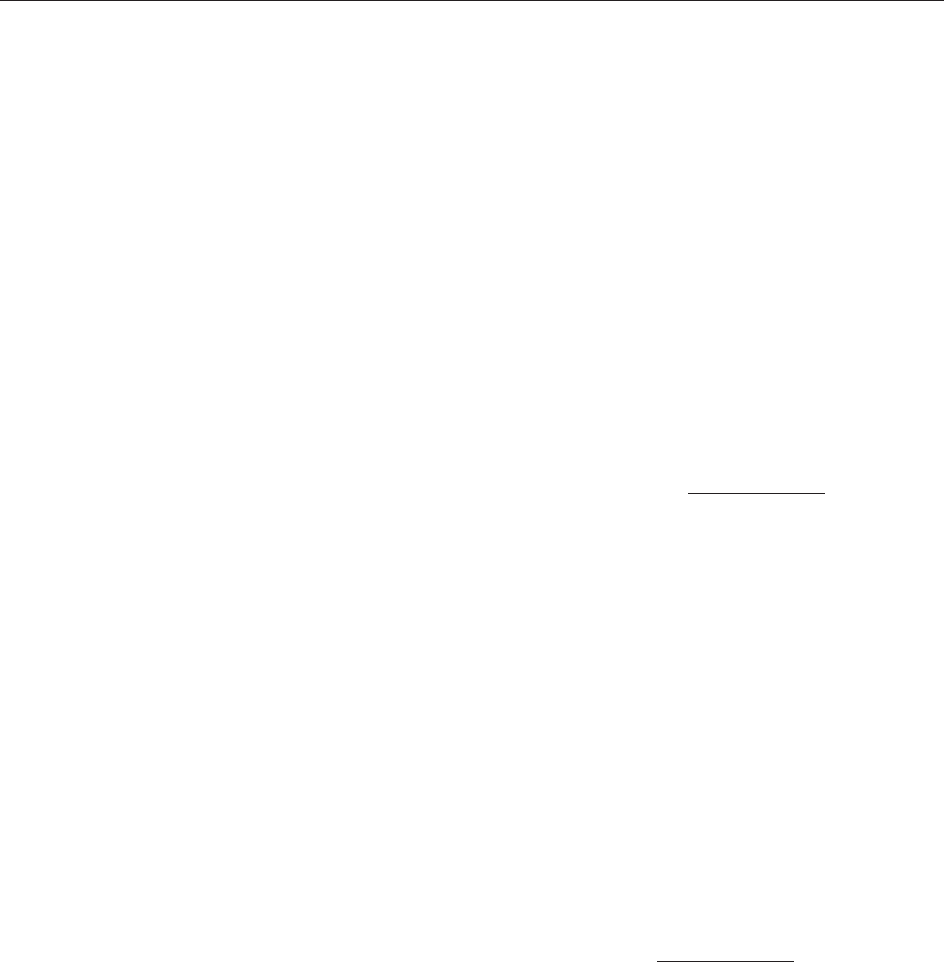
then
sup
B
s
jAj
2
C
P
s
2
½48
As an immediate consequence, letting r
0
!1
gives Bernstein-type theorems for embedded simply
connected minimal surfaces with either bounded
density or finite total curvature. Note that Enneper’s
surface is simply connected but neither flat nor
embedded; this shows that embeddedness is essential
for these estimates. Sim ilarly, the catenoid shows
that the surface being simply connected is essential.
The catenoid is the minimal surface in R
3
given by
fðcosh s cos t; cosh s sin t; sÞjs; t 2 Rg½49
Stable Minimal Surfaces
It turns out that stable minimal surfaces have a
priori estimates. Since minimal graphs are stable, the
estimates for stable surfaces can be thought of as
generalizations of the earlier estimates for graphs.
These estimates have been widely applied and are
particularly useful when combined with existence
results for stable surfaces (such as the solution of the
Plateau problem). The starting point for these
estimates is that, as we saw in [4], stable minimal
surfaces satisfy the stability inequality
Z
jAj
2
2
Z
jrj
2
½50
We will mention two such estimates. The first is
R Schoen’s curvature estimate for stable surfaces:
Theorem 10 There exists a constant C so that if
R
3
is an immersed stable minimal surface with
trivial normal bundle and B
r
0
n@, then
sup
B
r
0
jAj
2
C
2
½51
The second is an estimate for the area and total
curvature of a stabl e surface is due to Colding–
Minicozzi; for simplicity, we will state only the area
estimate:
Theorem 11 If R
3
is an immersed stable
minimal surface with trivial normal bundle and
B
r
0
n@, then
AreaðB
r
0
Þ4r
2
0
=3 ½ 52
As mentioned, we can use [52] to bound the
energy of a cutoff function in the stability inequality
and, thus, bound the total curvature of sub-balls.
Combining this with the curvature estimate of
Theorem 6 gives Theorem 10. Note that the bound
[53] is surprisingly sharp; even when is a plane,
the area is r
2
0
.
Regularity Theory
In this section, we survey some of the key ideas in
classical regularity theory, such as the role of
monotonicity, scaling, -regular ity theorems (such
as Allard’s theorem) and tangent cone analys is (such
as Almgren’s refinement of Federer’s dimension
reducing). We refer to the book by Morgan (1995)
for a more detailed overview and a general
introduction to geometric measure theory.
The starting point for all of this is the mono-
tonicity of volume for a minimal k-dimensional
submanifold . Namely, Corollary [1] gives that the
density
x
0
ðsÞ¼
VolðB
s
ðx
0
Þ\Þ
VolðB
s
R
k
Þ
½53
is a monotone nondecreasing function of s. Conse-
quently, we can define the density
x
0
at the point
x
0
to be the limit as s !0of
x
0
(s). It also follows
easily from monotonicity that the density is semi-
continuous as a function of x
0
.
-Regularity and the Singular Set
An -regularity theorem is a theorem giving that a
weak (or generalized) solution is actually smooth at
a point if a scale-invariant energy is small enough
there. The standard example is the Allard regularity
theorem:
Theorem 12 There exists (k, n) > 0 such that if
R
n
is a k-rectifiable stationary varifold (with
density at least one a.e.), x
0
2 , and
x
0
¼ lim
r!0
VolðB
r
ðx
0
Þ\Þ
VolðB
r
R
k
Þ
< 1 þ ½54
then is smooth in a neighborhood of x
0
.
Similarly, the small total curvature estimate of
Theorem 6 may be thought of as an -regularity
theorem; in this case, the scal e-invariant energy is
R
jAj
2
.
As an application of the -regularity theorem,
Theorem [12], we can define the singular set S of by
S¼fx 2 j
x
1 þ g½55
It follows immediately from the semicontinuity of
the density that S is closed. In order to bound the
size of the singular set (e.g., the Hausdorff measure),
one combines the -regularity with simple covering
arguments.
426 Minimal Submanifolds