
Francoise J.-P., Naber G.L., Tsun T.S. (editors) Encyclopedia of Mathematical Physics
Подождите немного. Документ загружается.


the theory of parabolic equations either, the type of
the system being composite.
Problems of interes t for rheologists, as well as for
mathematicians, include in particular the high
Weissenberg asymptotics, the high Weissenberg
boundary layers, the singularity of flows near a
reentrant corner, and the stability of flows.
We give a few details about stability questions.
Instabilities are seen in experimental extrusion of
melted polymers from a pipe: melt fracture designates
different phenomena appearing at different stages of
the experiment, when the speed of the extrusion is
increased, such as sharkskin instability, slight distor-
tions of the extrudate, large distortions and wavyness
of the extrudate. One may distinguish two kinds of
instabilities. First, constitutive instabilities are asso-
ciated with nonmonotonicity of constitutive functions
and loss of evolutionary property of the equations of
motion. Other kinds of instabilities are close to
classical hydrodynamic instabilities at increasing Re.
Note that in viscoelastic flows the Re is usually very
small, and might even be set to zero in some studies.
Other mathematical questions for system [10]
include existence of weak solutions (for the very
special case of Oldroyd model with the Jaumann
derivative where (a = 0) in [5]), existence of regular
solutions defined on some time interval, depending
on the magnitude of the data, and existence of
regular solutions for all times. Other studies concern
the existence, uniqueness, and stability of steady
solutions. Another field of study is the numerical
simulation of such flows.
In summary, there have been numerous computa-
tions made in the field of steady or unsteady viscoelastic
fluids, and especially models using continuum
mechanics. Standard test problems include the cavity-
driven flow, flows inside a 4 : 1 contraction, extrusion
flows, flows between eccentric cylinders, and flows in
‘‘wiggly’’ pipes. As mentioned already, the type of the
sytem of partial differential equations is composite,
neither elliptic nor hyperbolic. The numerical codes
have to take into account the precise nature of the set of
partial differential equations, so as to be able to obtain
noncatastrophic results. One of the main challenges has
been to deal with the high-We problem: with increasing
We, the results would become totally incoherent, and
the numerical algorithms would diverge.
Nowadays, with the power of computers increasing,
molecular simulations of flows are proposed, using the
macro–micro modeling mentioned above. Also, simula-
tions of flows of colloidal suspensions and reacting
flows have been undertaken with success.
See also: Compressible Flows: Mathematical Theory;
Fluid Mechanics: Numerical Methods; Incompressible
Euler Equations: Mathematical Theory; Interfaces and
Multicomponent Fluids; Inviscid Flows; Liquid Crystals;
Newtonian Fluids and Thermohydraulics; Partial
Differential Equations: Some Examples; Stability of
Flows; Stochastic Hydrodynamics; Viscous
Incompressible Fluids: Mathematical Theory.
Further Reading
Baranger J, Guillope´ C, and Saut J-C (1996) Mathematical
analysis of differential models for viscoelastic fluids. In: Piau
J-M and Agassant J-F (eds.) Rheology for Polymer Melt
Processing, pp. 199–236. Amsterdam: Elsevier.
Bird RB, Armstrong RC, and Hassager O (1987a) Dynamics of
Polymeric Liquids. Volume 1: Fluid Mechanics, 2nd edn.
New York: Wiley-Interscience.
Bird RB, Curtiss CF, Armstrong RC, and Hassager O (1987b)
Dynamics of Polymeric Liquids. Volume 2. Kinetic Theory,
2nd edn. New York: Wiley-Interscience.
Coron J-M, Ghidaglia J-M, and He´lein F (eds.) (1991) Nematics:
Mathematical and Physical Aspects, NATO Series, Series C
Mathematical and Physical Sciences, Dordrecht: Kluwer.
de Gennes P-G and Prost P (1995) The Physics of Liquid Crystals,
The International Series of Monographs on Physics, vol. 83,
2nd edn. Oxford: Oxford University Press.
Doi M and Edwards SF (1988) The Theory of Polymer Dynamics,
The International Series of Monographs on Physics, vol. 73.
Oxford: Oxford University Press.
Duvaut G and Lions J-L (1976) Inequalities in Mechanics and
Physics, Springer Grundlehren, vol. 219. Berlin: Springer.
Joseph DD (1990) Fluid Dynamics of Viscoelastic Liquids,
Applied Math Sciences, vol. 84. Berlin: Springer.
Keunings R (2004) Micro–macro methods for the multiscale
simulation of viscoelastic flow using molecular models of
kinetic theory. In: Binding DM and Walters K (eds.) Rheology
Reviews 2004. British Society of Rheology, pp. 67–98.
Malek J and Rajagopal KR (2005) Mathematical issues concern-
ing the Navier–Stokes equations and some of their general-
izations. In: Dafermos C and Feireisl E (eds.) Handbook of
Differential Equations. Evolutionary Equations: Volume 2.
Amsterdam: North-Holland.
O
¨
ttinger HC (1996) Stochastic Processes in Polymeric Fluids.
Berlin: Springer.
Renardy M (2000) Current issues in non-Newtonian flows: a
mathematical perspective. Journal of Non-Newtonian Fluid
Mechanics 90: 243–259.
Renardy M, Hrusa WJ, and Nohel JA (1987) Mathematical
Problems in Viscoelasticity, Pitman Monographs and Surveys
in Pure and Applied Mathematics, vol. 35. Harlow: Longman
Scientific and Technical.
Suen JKC, Joo YL, and Armstrong RC (2002) Molecular
orientation effects in viscoelasticity. Annual Review of Fluid
Mechanics 34: 417–444.
Tanner RI and Walters K (1998) Rheology: An Historical
Perspective, Rheology Series, vol. 9. Amsterdam: Elsevier.
Non-Newtonian Fluids 567

Nonperturbative and Topological Aspects of Gauge Theory
R W Jackiw, Massachusetts Institute of Technology,
Cambridge, MA, USA
ª 2006 Elsevier Ltd. All rights reserved.
Introduction
Classical fields that enter a classical field theory
provide a mapping from the ‘‘base’’ manifold on
which they are defined (space or spacetime) to a
‘‘target’’ space over which they range. The base and
target spaces, as well as the map, may possess
nontrivial topological features, which affect the
fixed-time description and the temporal evolution of
the fields, thereby influencing the physical reality that
these fields describe. Quantum fields of a quantum
field theory are operator-valued distributions whose
relevant topological properties are obscure. Never-
theless, topological features of the corresponding
classical fields are important in the quantum theory
for a variety of reasons: (1) Quantized fields can
undergo local (spacetime-dependent) transformations
(gauge transformations, coordinate diffeomorphisms)
that involve classical functions whose topological
properties determine the allowed quantum field
theoretic structures. (2) One formulation of the
quantum field theory uses a functional integral over
classical fields, and classical topological features
become relevant. (3) Semiclassical (WKB) approxi-
mations to the quantum theory rely on classical
dynamics, and again classical topology plays a role in
the analysis.
Topological effects of gauge fields in quantum
theory were first appreciat ed by Dirac in his study of
the quantum mechanics for (hypothetical) magnetic
point monopoles. Although here one is not dealing
with a field theory, the consequences of his analysis
contain many features that were later encountered in
field theory models.
The Lorentz equations of motion for a charged (e)
massive (M) particle in a monopole magnetic field
(B = mr=r
3
) are unexceptional,
_
r ¼
p
M
½1a
_
p ¼
e
M
p B ðc ¼ 1Þ½1b
and completely determine classical dynamics. But
knowledge of the Lagrangian L and of the action
I – the time integral of L: I =
R
dtL – is further
needed for quantum mechanics, either in its func-
tional integral formulation or in its Hamiltonian
formulation, which requires the canonical momen-
tum p @L=@
_
r. The Lorentz-force action
is expressed in terms of the vector potential
A, B = Ñ A: I
Lorentz
= e
R
dt
_
r A = e
R
dr A. The
magnetic monopole vector potential is necessarily
singular because Ñ B = 4m
3
(r) 6¼ 0. The singular-
ity (Dirac string) can be moved, but not removed, by
gauge transformations, which also are singular, and
do not leave the Lorentz action invariant. Noninvar-
iance of the action can be tolerated provided its
change is an integral multiple of 2, since the
functional integrand involves exp (iI) (with h = 1).
The quantal requirement, which is not seen in the
equations of motion, is met when
eg ¼ N=2 ½2
The topological background to this (Dirac) quanti-
zation condition is the fact that
1
(U(1)) is the
group of integers, that is, the map of the unit circle
into the ga uge group, here U(1), is classified by
integers.
Further analysis shows that only point magnetic
sources can be incorporated in particle quantum
mechanics, which is governed by the particle
Hamiltonian H = p
2
=2M (magnetic fields do no
work and are not seen in H). Quantum Lorentz
equations are regained by commutation with
H:
_
r = i[H, r],
_
p = i[H, p], provided
i½r
i
; r
j
¼0 ½3a
i½p
i
; r
j
¼
ij
½3b
i½p
i
; p
j
¼e"
ijk
B
k
½3c
But [3c] implies that the Jacobi identity is obstructed
by magnetic sources Ñ B 6¼ 0.
1
2
"
ijk
½p
i
; ½p
j
; p
k
¼ e Ñ B ½4
This obstruction is better understood by examin-
ing the unitary operator U(a) exp (ia p), which
according to [3b] implements finite translations
of r by a. The commutator algebra [3] and
the fa ilure of the Jacobi ide ntity [4] imply
that these operators do not associate. Rather one
finds
Uða
1
ÞðUða
2
ÞUða
3
ÞÞ ¼ e
i
ðUð a
1
ÞUð a
2
ÞÞU ða
3
Þ½5
where =e
R
d
3
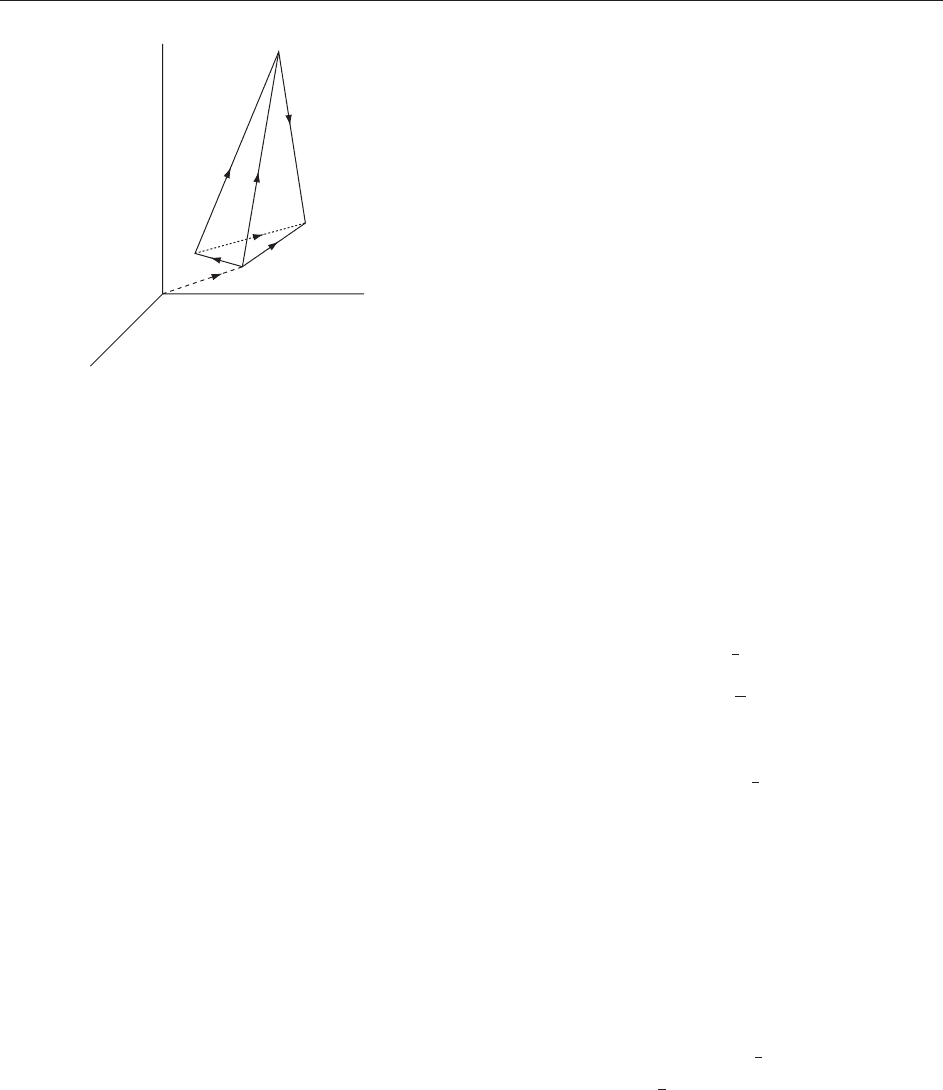
x Ñ B is the total flux emerging
from the tetrahedron formed from the three vectors
a
i
with vertex at r (see Figure 1). But quantum
mechanics realized by linear operators acting on a
Hilbert space requires that operator multiplication
568 Nonperturbative and Topological Aspects of Gauge Theory
be associative. This can be achieved, in spite of [5],
provided is an integral multiple of 2,hence
invisible in the exponent. This then needs that (1)
Ñ B be localized a t points, so that the volume
integral of Ñ B retain integrality for arbitrary a
i
and (2) the strengths of the localized poles obey
Dirac quantization. The points at which Ñ B is
localized can now be removed from the manifold
and the Jacobi identity is regained. The above
argument, which rederives Dirac’s quantization,
makes n o reference to gauge variance of magnetic
potentials.
In the remainder we shall discuss related phenom-
ena for selected gauge field theories in four, three,
and two dimensions that describe actual physical
events occurring in nature. We shall encounter in
generalized form, analogs to the above quantum
mechanical system.
Some definitions and notational conventions:
Nonabelian gauge potentials A
a
carry a spacetime
index () (metric tensor g
= diag(1, 1, ...)) and
an adjoint group index (a). When contracted with
anti-Hermitian matrices T
a
that represent the
group’s Lie algebra (structure constants f
ab
c
)
½T
a
; T
b
¼f
ab
c
T
c
½6
they become Lie algebra-valued.
A
A
a
T
a
½7
Gauge transformations transform A
by group
elements U:
A
! A
U
U
1
A
U þ U
1
@
U ½8a
For infinitesimal gauge transformations, U I þ ,
a
T
a
; this leads to the covariant derivative D
:
A
! A
þ @
þ½A
;A
þ D
A
a
! A
a
þ @
a
þ f
bc
a
A
b
c
A
a
þðD
Þ
a
½8b
(In a quantum field theory, A
becomes an operator
but the gauge transformations U , remain c-number
functions.) The field strength F
given by
F
¼ @
A
@
A
þ½A
; A
½9a
is also given by
½D
; D
... ¼½F
; ...½9b
(coupling strength g has been scaled to unity). The
definition [9] implies the Bianchi identity
D
F
!
þ D
!
F
þ D
F
!
¼ 0 ½10
Here F
is gauge covariant
F
! F
U
¼ U
1
F
U ½11a
or, infinitesimally,
F
! F
þ½F
;½11b
In the gauge invariant Yang–Mills action I
YM
, the
Yang–Mills Lagrange density L
YM
is integrated over
the base space,
L
YM
¼
1
2
tr F
F
I
YM
¼
Z
L
YM
¼
1
2
Z
tr F
F
½12
The trace is evaluated with the convention
tr T
a
T
b
¼
1
2
ab
½13
and henceforth there is no distinction between upper
and lower group indices. The Euler–Lagrange condition
for stationarizing I
YM
gives the Yang–Mills equation
D
F
¼ 0 ½14a
Should sources J
be present, [14a] becomes
D
F
¼ J
½14b
and J
must be covariantly conserved:
D
J
¼D
D
F
¼
1
2
½D
; D
F
¼
1
2
½F
; F
¼0 ½15
All this is a nonabelian generalization of familiar
Maxwell electrodynamics.
Gauge Theories in Four Dimensions
Gauge theories in four-dimensional spacetime are at
the heart of the standard particle phy sics model.
Their topological features have physical conse-
quences and merit careful study.
r
a
1
a
2
a
3
Figure 1 Tetrahedron pierced by magnetic flux that obstructs
associativity.
Nonperturbative and Topological Aspects of Gauge Theory 569

Yang–Mills Theory
In four dimensions, we define nonabelian electric E
a
and magnetic B
a
fields,
E
ia
¼ F
a
0i
; B
ia
¼
1
2
"
ijk
F
a
jk
½16
Canonical analysis and quantization is carried out in
the Weyl gauge (A
a
0
= 0), where the Lagrangian and
Hamiltonian (energy) densities read
L
YM
¼
1
2
ðE
a
E
a
B
a
B
a
Þ½17
H
YM
¼
1
2
ðE
a
E
a
þ B
a
B
a
Þ½18
The first term is kinetic, with E
a
= @
t
A
a
also
functioning as the (negative) canonical momentum
p
a
, conjugate to the canonical variable A
a
; the
second magnetic term gives the potential. In the
Weyl gauge, the theory remains invariant against
time-independent gauge transformations. The time
component of equation [14] (Gauss law) is absent
(because there is no A
a
0
to vary); rather it is imposed
as a fixed-time constraint on the canonical variables
E
a
and A
a
. This regains the Gauss law:
ðD EÞ
a
¼ 0 ðin the absence of sourcesÞ½19a
In the quantum theory D E annihilates ‘‘physical’’
states. Explicitly, in a functional Schro¨ dinger repre-
sentation, where states are functionals of the canonical
fixed-time variable Aji!(A), [19a] requires
D
A
a
ðAÞ¼0 ½19b
that is, physical states must be invariant against
infinitesimal gauge transformati on, or equiva lently,
against gauge transformations that are homotopic
(continuously deformable) to the identity (the so-called
‘ ‘ small’’ gauge transformations)
ðA þ DÞ¼ðAÞ½20
But homotopically nontrivial gauge transformation
functions that cannot be deformed to the identity
(the so-ca lled ‘‘large’’ gauge transformations) may
be present. Their effect is not controlled by Gauss’
law, and must be discussed separately.
Fixed-time gauge transformation functions
depend on the spatial variable r : U(r). For a
topological classification, we require that U tend to
a constant at large r. Equivalently, we compactify
the base space R
3
to S
3
. Thus, the gauge functions
provide a mapping from S
3
into the relevant gauge
group G, and for nonabelian compact gauge groups
such mappings fall into disjoint homotopy classes
labeled by an integer winding number
n:
3
(G) = Z. Gauge functions U
n
belonging to
different classes cannot be deformed into each
other; only those in the ‘‘zero’’ class are deformable
to the identity. An analytic expression for the
winding number !( U)is
!ðUÞ
¼
1
24
2
Z
d
3
x "
ijk
trðU
1
@
i
UU
1
@
j
UU
1
@
k
UÞ½21
This is a most important topological entity for
gauge theories in four-dimensional spacetime, that is,
in 3-space, and we shall meet it again in a description
of gauge theories in three-dimensional spacetime,
that is, on a plane. Various features of ! expose its
topological character: (1) ! (U) does not involve a
metric tensor, yet it is diffeomorphism invariant.
(2) !(U) does not change under local varia tions of U:
!ðUÞ¼
1
8
2
Z
d
3
x @
i
"
ijk
trðU
1
UU
1
@
j
UU
1
@
k
UÞ
¼
1
8
2
Z
dS
i
"
ijk
trðU
1
UU
1
@
j
UU
1
@
k
UÞ
¼0 ½22
The last integral is over the surface (at infinity)
bounding the base space and vanishes for localized
variations U. In fact, the entire ! (U), not only its
variation, can be presented as a surface integral, but
this requires parametrizing the group element U on
R
3
. For example, for SU(2),
U ¼ exp ; ¼
a
a
=2i ðs Pauli matricesÞ
! ðUÞ¼
1
16
2
Z
dS
i
"
ijk
"
abc
^
a
@
j
^
b
@
k
^
c
ðsin jjjjÞ
jj
ffiffiffiffiffiffiffiffiffiffi
a
a
p
;
^
a
a
=jj½23
Specifically, with jj
!
r !1
2n (so that U
!
r !1
I),
!(U) = n. As befits a topological entity, !(U)is
determined by global (here large distance) properties
of U.
Since all gauge transformations, small and large,
are symmetry operations for the theory, [20] should
be generalized to
ðA
U
n
Þ¼e
in
ðAÞ½24
where is an universal constant. Thus, Yang–Mills
quantum states behave as Bloch waves in a periodic
lattice, with large gauge transformations playing the
role of lattice translations and the Yang–Mills vacuum
angle playing the role of the Bloch momentum. This
is further understood by noting that the profile of the
potential energy density,
1
2
B
a
B
a
possesses a periodic
structure symbolically depicted in Figure 2.
570 Nonperturbative and Topological Aspects of Gauge Theory
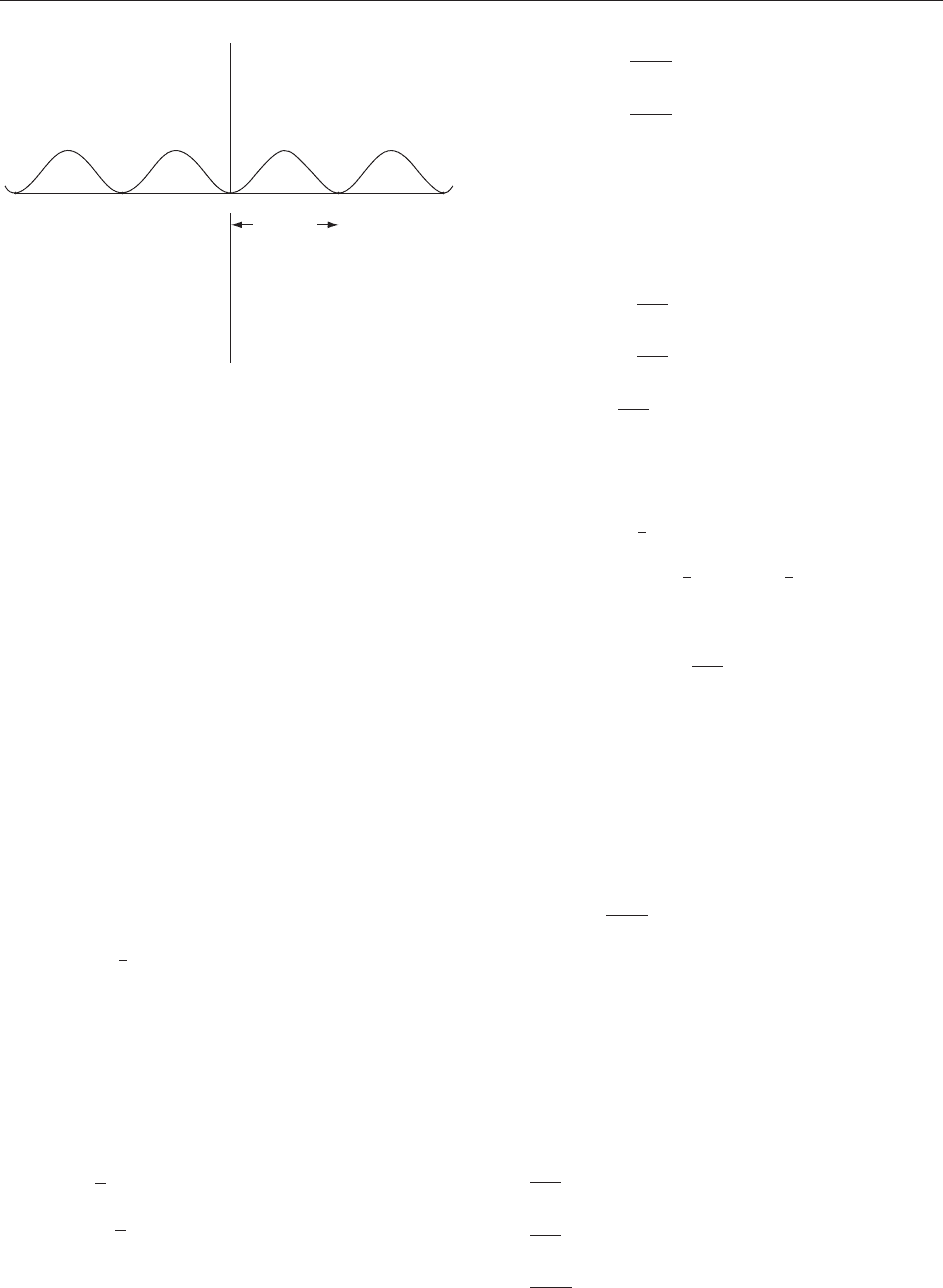
Thanks to Gauss’ law, potentials A that differ by
small gauge transformations are identified, while
those differing by large gauge transformations give
rise to the periodicity. Zero energy troughs corre-
spond to pure gauge vector potentials in different
homotopy classes n: A = U
1
n
ÑU
n
.
The angle (Bloch momentum) arises from
quantum tunneling in A space. Usually, in field
theory tunneling is suppressed by infinite energy
barriers. (This gives rise to spontaneous symmetry
breaking.) However, in Yang–Mills theory there are
paths in field space that avoid such barriers.
Quantum tunneling paths are exhibited in a semi-
classical approximation by identifying classical
motion in imaginary time (Euclidean space) that
interpolates between classically degenerate vacua
and possesses finite action.
In Yang–Mills theory, continuation to imaginary
time, x
0
!ix
4
, places a factor of i on E
a
. Zero
(Euclidean) energy is maintained when E
a
= B
a
,or
with covariant notation in Euclidean space,
1
2
"
F
F
¼F
½25
Euclidean finite action field configurations that
satisfy [25] are called self-dual or anti-self-dual
instantons. By virtue of the Bianchi identity [10],
instantons also solve the field equation [14a] in
Euclidean space. Since the Euclidean action may also
be written as
I
YM
¼
1
4
Z
d
4
x trðF
F
ÞðF
F
Þ
1
2
Z
d
4
x tr
F
F
½26
and the first term vanishes for instantons, we see
that instantons are characterized by the last term,
the Chern–Pontryagin index,
P
1
16
2
Z
d
4
x trð
F
F
Þ
¼
1
32
2
Z
d
4
x "
trðF
F
Þ½27
This again is an important topological entity:
1. The diffeomorphism invariant P does not involve
the metric tensor.
2. P is insensitive to local variations of A
,
P¼
1
8
2
Z
d
4
x trð
F
F
Þ
¼
1
4
2
Z
d
4
x trð
F
D
A
Þ
¼
1
4
2
Z
d
4
x trðD
F
A
Þ¼0 ½28
3. P may be presented as a surface integral owing to
the formula
1
4
tr
F
F
¼ @
K
½29
K
"
tr
1
2
A
@
A
þ
1
3
A
A
A
½30
where K
is the Chern–Simons current,
P¼
1
4
2
Z
dS
K
½31
The integral [31] is over the base space boundary,
S
3
. The Chern–Pontryag in index of any gauge field
configuration with finite (Euclidean) action (not
only instantons) is quantized. This is because finite
action requires F
to vanish at large distances;
equivalently, A
!U
1
@
U. Using this in [30]
renders [31] as
P¼
1
24
2
Z
dS
"
trðU
1
@
UU
1
@
UU
1
@
UÞ½32
which is the same as [20] and, for the same reason,
is given by an integer [
3
(G) = Z]. Alternatively, for
instantons in the (Euclidean) Weyl gauge (A
4
= 0),
which interpolate as x
4
passes from 1 to þ1
between degenerate, classical vacua A
i
= 0and
A
i
= U
1
r
i
U, P becomes
P¼
1
4
2
Z
dx
4
d
3
x ð@
4
K
4
þ Ñ KÞ
¼
1
4
2
Z
d
3
xK
4
j
x
4
¼1
¼
1
24
2
Z
d
3
x "
ijk
trðU
1
@
i
UU
1
@
j
UU
1
@UÞ
¼ !ðUÞ½33
Energy density
+1 +2–1–2
A
Instanton
0
Figure 2 Schematic for energy periodicity of Yang–Mills fields.
Nonperturbative and Topological Aspects of Gauge Theory 571

We have assumed that the potentials decrease at
large arguments sufficiently rapidly so that the
gradient term in the first integrand does not
contribute. This rederivation of [32] relies on the
‘‘motion’’ of an instanton between vacuum config-
urations of different winding numbers.
An explicit 1-instanton SU(2) solution (P = 1) is
A
¼
2i
ðx Þ
2
þ
2
x
½34
(Upon reinserting the coupling constant g , which
has been scaled to unity, the field profiles acquire
the factor g
1
.) In [34],
(1/4i )(
y
y
),
(i, I). is the ‘‘location’’ of the
instanton, is its ‘‘size,’’ and there are three more
implicit parameters fixing the gauge, for a total of
eight parameters that are needed to specify a single
SU(2) instanton. One can show that there exist N
instanton/anti-instanto n solutions (P = N=N) and
in SU(2) they depend on 8N parameters. From [26]
we see that at fixed N, instantons minimize the
(Euclidean) action. Explicit formulas exist for the
most general N = 2 solution, while for N 3
explicit formulas exhibit only 5N þ 7 parameters.
But algorithms have been found that construct
the most genera l 8N-parameter instantons. The
1-instanton solution is unchanged by SO(5)
rotations, the maximal compact subgroup of the
SO(5, 1) conformal invariance group for the
Euclidean 4-space Yang–Mills equation [14a].
The Chern–Pontryagin index also appears in the
Yang–Mills quantum action, for the following
reason. Since all physical states r espond to gauge
transformations U
n
with the universal phase n
[24], physical states may be presented in factorized
form,
ðAÞ¼e
iWðAÞ
ðAÞ½35
where (A) is invar iant against all gauge transfor-
mations, small and large, while the phase response is
carried by W(A),
WðA
U
n
Þ¼WðAÞþn ½36
An explicit expression for W(A) is given by
(1/4
2
)
R
d
3
xK
0
, where K
0
is the time (fourth)
component of K
, with dependence on the fourth
variable suppressed, that is, K
0
is defined on 3-space,
WðAÞ¼
1
4
2
Z
d
3
x "
ijk
tr
1
2
A
i
@
j
A
k
þ
1
3
A
i
A
j
A
k
½37
The gauge transformation properties of W(A) are
WðA
U
Þ
¼ WðAÞþ
1
8
2
Z
d
3
x "
ijk
@
i
trð@
j
UU
1
A
k
Þ
þ
1
24
2
Z
d
3
x "
ijk
trðU
1
@
i
UU
1
@
j
UU
1
@
k
UÞ
½38
The middle surface term does not contribute for
well-behaved A; the last term is again !(U), the
winding number of the gauge transform ation U.
Thus, [36] is verified.
The universal gauge-varying phase e
iW(A)
, which
multiplies all gauge-invariant functional states, may
be removed at the expense of subtracting from the
action
Z
d
4
x @
t
WðAÞ¼
4
2
Z
d
4
x @
t
K
0
¼ P
(as in [33]). Thus, the Yang–Mills quantum action
extends [12] to
I
YM
quantum
¼
Z
d
4
x tr
1
2
F
F
þ
16
2
F
F
½39
The additional Chern–Pontryagin term in [35]
does not contribute to equations of motion, but it is
needed to render all physical states invariant against
all gauge transformations, large and small. With this
transformation, one sees that the -angle is a
Lorentz invariant, but CP noninvariant effect.
Evidently, specifying a classical gauge theory
requires fixing a group; a quantized gauge theory is
specified by a group and a -angle, which arises
from topological properties of the gauge theory. The
energy eigenvalues depend on , and distinct ’s
correspond to distinct theori es.
Note that the reasoning leading to [24] and [39]
relies on exact quantum-mechanical arguments,
while the instanton-based tunneling discussion is
semiclassical.
Adding Fermions
When fermions couple to the gauge fields, the
previously described topological effects are modified
by action of the chiral anomaly. Dirac fields, either
noninteracting but quantized, or unquantized but
interacting with a gauge potential through a
covariantly conserved current J
a
, L
I
= J
a
A
a
, also
possess a chiral current j
5
=
5
, which satisfies
@
j
5
¼ 2m i
5
½40
572 Nonperturbative and Topological Aspects of Gauge Theory

Here m is the mass, if any, of the fermions. j
5
is
conserved for massless fermions, which therefore
enjoy a chiral symmetry: ! e
i
5
. How ever,
when the interacting fermions are quantized, there
arises correction to [40]; this is the chiral anomaly:
@
j
5
A
¼ 2imh
5
i
A
þ C
F
a
F
a
½41
C is determined by the fermion quantum numbers
and coupling strengths. (For a single charged (e)
fermion and a U(1) gauge potential, C = e
2
=8
2
.)
hji
A
signifies the fermionic vacuum matrix element
in the presence of A
. The modified equation [41]
indicates that even in the mass less limit chiral
symmetry remains broken due to the anomaly,
which arises with quantized fermions.
j
5
A
may also be presented as
j
5
A
¼ tr
5
h
i
A
½42
In Euclidean space h
i
A
is the coincident-point
limit of the resolvent R(x, y; ) for the Dirac
equation,
Rðx; y; Þ¼
X
ðxÞ
y
ðyÞ
þ i
½43
Here
is an eigenfunction of the massless,
Euclidean Dirac operator in the presence of the
gauge field A
,
i
ð@
þ A
Þ
¼
½44
The coincident -point limit is singular, so R must be
regulated: R ! R R
Reg
(we do not specify the
regularization procedure). It then follows that
@
hj
5
i¼2i
X
y
ðxÞ
5
ðxÞ
þ i
tr
5
@
R
Reg
¼2i
X
y
ðxÞ
5
ðxÞ
þ i
þ C
F
a
F
a
½45
The first term on the right-hand side is the (Euclidean
space) analog of the mass term in [40] or [41],while
the second survives even after the regulators are
removed, giving the anomaly tr
F
F
.
The anomaly formula [41], or more explicitly
[45], is also the local form of the Atiyah–Singer
index theorem, which follows after [45] is integrat ed
over all space: The left-hand side integrates to zero.
The integral of the first term on the right-hand side,
R
dx
5
, vanishes for 6¼ 0 by orthogonality,
because
5
is an eigenfunction of [44] with
eigenvalue . Only zero modes contribute to the
sum since these can be chosen to be eigenfunctions
of
5
, n
of them satisfying
0
=
5
0
. For a single
multiplet, the normalizatio ns work out so that
n
þ
n
¼
1
16
2
Z
d
4
x tr
F
F
½46
The result that the (signed) number of zero modes is the
Chern–Pontryagin index is an instance of the Atiyah–
Singer theorem. (In specific applications, one can
frequently show that n
þ
or n
vanishes.) It, therefore,
follows that in the background field of instantons, the
Euclidean Dirac equation possesses zero modes.
Another viewpoint on the chiral anomaly arises
within the functional integral formulation, where the
exponentiated action is constructed from unquantized
fields, over which the functional integration is
performed. Here the classical action retains chiral
symmetry ! e
i
5
, but the Grassmann fermion
measure d d
, once it is properly regularized, looses
chiral invariance and acquires the anomaly,
d d
! d d
exp iC
Z
d
4
x tr
F
F
½47
Evidently, the chiral anomaly involves the gauge-
theoretic topological entity, the Chern–Pontryagin
density. Not unexpectantly, the anomaly phenom-
enon affects significan tly the topological properties
of the gauge theory that are connected to P and
were described previously.
When there is (at least) one massless fermion
coupling to the Yang–Mills fields, the Yang–Mills
-angle looses physical relevance. This is because a
chiral transformation that redefines the massless
Dirac field does not modify the classical action, but
owing to the chiral noninvariance of the functional
measure, [47], an anomaly term is induced in the
(effective) quantum action. The strength of this
induced term can be fixed so that it cancels the
-term in [39]. Since field redefinition cannot affect
physics, the elimination of the -term indicates that it
had no physical relevance in the first place. In
particular, energy eigenvalues no longer depend on .
An alternat e argument for the same conclusion is
based on the functional determinant that arises
when the fun ctional integral is performed over the
massless Dirac field: det [
(@
þ A
)]. The semi-
classical tunneling ana lysis of the -angle is based on
instantons, but in the presence of instantons the
Dirac equation has a zero mode [46]. Consequently
the determinant vanishes, tunneling is suppres sed
and so is the -angle.
However, in the standard model for particle
physics, there are no massless fermions, so the
presence of the -angle entails the following physical
consequences. The tunneling amplitude in leading
semiclassical approximation is determined by the
Euclidean action, namely the continuation of iI
YM
in
Nonperturbative and Topological Aspects of Gauge Theory 573

[39] to imaginary time. This results in the same
expression except that the topological -term
acquires a factor of i. Only the 1-instanton and
anti-instanton give the dominant contribution,
/ cos e
8
2
=g
2
½48
where the coupling constraint g has been reinserted;
the proportionality constant has not been computed,
owing to infrared divergences. (Higher-instanton-
number configurations contribute at an exponen-
tially subdominant order and have thus far played
no role in physics.) The tunneling leads to baryon
decay, but fortunately at an exponentially small
rate. More useful is the fact that instanton tunneling
gives semiclassical evidence for the removal of an
unwanted chiral U(1) Goldstone symmetry, which
would be present in the standard model if the chiral
anomaly did not interfere. Furthermore, the chiral
anomaly facilitates the decay of the neutral pion to
two photons; a process forbidden by other apparent
chiral symmetries of the standard model, which in
fact are modified by the chiral anomaly. Gauge
fields in four dimensions must interact with anomaly
free currents. This necessitates a pr ecise adjustment
of fermion content and charge s so that the anomaly
coefficients (analogs of ‘‘C’’ in [41]) vanish for
currents coupled to gauge fields. Finally,
provides a tantalizing source of CP violation in the
strong-interaction sector of the standard model. But
no experimental signal (e.g., neutron electric dipole
moment) for this effect has been seen. At present, we
do not know what mechanism is responsible for
keeping vanishingly small.
These are the physical consequences of topologi-
cal effects in four-dimensional gauge theories.
Although they have provided experimentalists with
only a few numbers to measure (e.g.,
0
!2 decay
amplitude, prediction of anomaly-free arrangements
of quarks and leptons in families), they have added
enormously to our appreciation of the complexities
of quantized gauge theories.
That chiral anomalies are an obstruction to
consistent gauge interactions can be established
within perturb ation theory. A similar, but nonper-
turbative effect is seen in an SU(2) gauge theory with
N Weyl fermion (
5
= ) SU(2) doublets, which
lead upon functional integration to det [
(@
þ
A
)]
N=2
. But because
4
(SU(2)) = Z
2
, there exists a
single homotopy class of gauge transformations
which are not deformable to the identity. One
shows that the determinant changes sign when
such a gauge transformation is performed. Thus,
the theory is ill-defined for odd N. Consistent SU(2)
gauge theories must possess an even number of Weyl
fermion doublets, but such models have not found a
place in physical theory.
Adding Bosons
Instantons are finite-action solutions to classical
equations continued to imaginary time; they provide
a semiclassical description of quantum-mechanical
tunneling. A field theory may also possess finite-
energy, time-independent (static) solutions to the
real-time equations of motion. When these solutions
are stable for topological reasons, they are called
‘‘solitons.’’ Solitons give semiclassical evidence for
the existence in the quantum field theory of a
particle sector disjoint from the particles obtained
by quantizing field fluctuations around the vacuum
state. The soliton particles are heavy for weak
coupling g. (Their energy is O(1=g
2
); the field
profiles are O(1=g).) They do not decay owing to
the conservation of ‘‘charges’’ that do not arise from
Noether’s theorem but are topolog ical.
Yang–Mills theory does not possess soliton solu-
tions (except in five-dimensional spacetime, where
the static solitons are just the four-dimensional
instantons discussed previously). However, when a
gauge theory, based on a simple group is coupled to
a scalar field that undergoes symmetry breaking to
U(1), soliton solutions exist. The se are the ‘t Hooft–
Polyakov magnetic monopoles, found in a SU(2)
gauge theory with scalar fields in the adjoint
representation, as well as various generalizations.
The topological consideration that arises here con-
cerns finite energy of the static, scalar field multiplet
’, which in the Weyl gauge is
Eð’Þ¼
Z
d
3
x jðD’Þ
a
ðD’Þ
a
j
2
þ Vð’Þ
½49
V is non-negative and possesses non trivial symmetry
breaking zeroes. On the sphere S
2
at spatial infinity,
’ must tend to such a zero. Thus, the fields belong
to G=H,whereG is the gauge group and H the
unbroken subgroup. For the ‘t Hooft–Polyakov
monopole these are SU(2) and U(1), respectively,
and the scalar field provides a mapping of the sphere
at infinity S
2
to S
2
SU(2)=U(1).
One now considers
2
(S
2
) =
2
(SU(2)=U(1)) =
1
(U(1)) = Z, and one shows that the magnetic
flux is determined by the winding number. Hence,
the magnetic charge is quantized. Explicitly, the
electromagnetic U(1) gauge field is given by
f
^
’
a
F
a
"
abc
^
’
a
ðD
^
’Þ
b
ðD
^
’Þ
c
¼@
a
@
a
a
^
’
a
A
a
cos @
½50
574 Nonperturbative and Topological Aspects of Gauge Theory

where
^
’
a
is the unit isovector, parametrized as
^
’
a
= ( sin cos , sin sin , cos ). The manifestly
conserved magnetic current
j
m
¼ @
f
½51a
is rearranged to read
j
m
¼
1
2
"
"
abc
@
^
’
a
@
^
’
b
@
^
’
c
½51b
and is nonvanishing because ’
a
possesses zeroes,
where @
ˆ
’
a
acquires localized singularities. The
magnetic charge
m ¼
1
4
Z
d
3
xj
0
m
¼
1
4
Z
d
3
x Ñ b ½52
(b
i
= U(1) magnetic field:
1
2
"
ijk
f
jk
=
f
i0
) is given by
the topological entity (Kronecker index of the
mapping)
m ¼
1
8
Z
d
3
x "
ijk
"
abc
@
i
^
’
a
@
j
^
’
b
@
k
^
’
c
¼
1
8
Z
dS
i
"
ijk
"
abc
^
’
a
@
j
^
’
b
@
k
^
’
c
¼
1
4
Z
dS
i
"
ijk
@
j
cos @
k
½53
which readily evaluates the integer winding number.
The theory also supports charged magnetic mono-
pole solutions called ‘‘dyons.’’ Here the profiles
involve time-periodic gauge potentials, where the
time variation is just a gauge transformation
@
t
A
= D
. (Gauge-equivalent, static expressions
have slow large-distance fall-off, which is removed
by the time-dependent gauge function.) For dyons,
the integer valued Chern–Pontryagin index, with the
integration taken over all space and in time over the
dyon period, reproduces the magnetic monopole
strength.
Regrettably, these fascinating struc tures are not
found in nature. Nor do they arise in the standard
model, whose structure group is not simple,
although speculative grand unified models, with
simple G and H = SU(3) U(1), would support
magnetic monopoles and dyons. While challenged
physically, the magnetic monopole phenomena have
produced extensive and interesting mathematical
analysis.
Gauge Theories in Two Dimensions
Two-dimensional gauge theories have only a few
physical applications; edge states of the planar
quantum Hall effect can be described by excitations
moving on a line. However, the abelian model with
fermions is useful in that it provides a very accurate
reflection of topological behavior in the physically
important four-dimensional theory.
Abelian Gauge Theory
Take the spatial interval to be [L, L]. Homotopi-
cally nontrivial gauge transformations satisfy (L)
(L) = 2n (
1
Uð1Þ = Z). States (A) of the free
gauge theory that satisfy Gauss’ law and respond
with a -angle are
ðAÞ¼exp
i
2
Z
dxA
ðA þ @Þ¼e
in
ðAÞ
½54
In this model, has the interpretation of a constant
background electric field E = =2,
EðAÞ¼EðAÞ; E F
01
i
A
ðAÞ¼
2
ðAÞ
½55
This also gives the energy eigenvalue:
1
2
Z
dxE
2
ðAÞ¼
1
2
Z
dx E
2
ðAÞ½56
The phase may be removed by adding to the
Lagrangian (=2)
R
dx @
t
A; equivalently, the
action becomes
I
quantum
EM
¼
Z
d
2
x
1
4
F
F
þ
4
"
F
½57a
which apart from a constant is also given by a
formula with the background field:
I
quantum
EM
¼
1
2
Z
dxðE þEÞ
2
½57b
Because of gauge invariance, there is only one state,
annihilated by E and carrying energy
1
2
R
dx E
2
.
Distinct (different E) correspond to distinct
theories.
We recognize in [57a] the two-dimensional
Chern–Pontryagin density, contributing a total
derivative to the action,
P¼
1
4
Z
d
2
x "
F
½58
the Chern–Simons current, whose divergence is P,
K
¼
1
2
"
A
½59
and the Chern–Simons term, which carries the phase
of
Z
dxK
0
¼
1
2
Z
dxA ½60
Nonperturbative and Topological Aspects of Gauge Theory 575

For Euclidean-space gauge potentials, which are
given at large distance by the pure gauge
2n tan
1
y=x, P= n. All this is just as in the four-
dimensional theory, except there are no instantons
and no tunneling.
Adding Fermions
The addition of massless fermions to the U(1) gauge
theory results in the Schwinger model of massless
quantum electrodynamics in two-dimensional space-
time. The equation of motion becomes
@
F
¼ J
½61
with the vector current constructed from the Dirac
fields as J
=
. This current remains conserved
in the quantized version because it couples to the
gauge field. But the axial vector current j
5
=
5
acquires an anomaly that involves the Cher n–
Pontryagin density in [58],
@
j
5
¼
1
2
"
F
½62
The model is readily solved, and shows no -angle
(background field) dependence in physical quanti-
ties. The solut ion is directly obtained by combining
[61] with [62] into a second-order differential
equation and using the matrix identity of two-
dimensional Dirac (= Pauli) matrices: "
5
=
.
It follows that
& þ
1
E ¼ 0 ½63
So the theory describes a free massive photon (mass
squared = 1= in units of h and the coupling
constant, which have been scaled to unity), with no
sign of a -angle (background field).
However, in parallel with four-dimensional beha-
vior, the model with massive fermions regains a
dependence in the particles’ energy spectrum; a
result that is established perturbatively, because a
complete solution is not available.
Note that in the Schwinger model, the gauge
particle (‘‘photon’’) acquires a mass, even though
local gauge invariance is preserved. This happens
essentially for topological/anomaly reasons. Such
topological mass generation is met again in three
dimensions.
Adding Bosons
Scalar electrodynamics with a negative mass squared
term in (3 þ 1)-dime nsional spacet ime leads to the
Higgs mechanism and short-range interactions due
to the massive photons. In (1 þ 1) spacetime dimen-
sions, the model possesses instantons – scalar and
gauge field profiles that solve the imaginary-time
equations of motion – labeled by
1
(U(1)) = Z.
These disorder the Higgs condensate so that the
force between charged particles remains long-range,
like in the positive mass-squared case. This is a vivid
example of how excitations arising from nontrivial
topological issues significantly effect physical
content.
Gauge Theories in Three Dimensions
Gauge theories on three-dimensional spacetime, that
is, evolving on a plane, have physical application to
planar phenomena, like the quantum Hall effect.
Also, the high-temperature limit of four-dimen sional
field theories is governed by the corresponding field
theory in three Euclidean dimensions.
In three (mor e generally, odd) dimensions, there
are no Chern–Pontryagin quantities, no Chern–
Simon currents, no axial vector currents or anoma-
lies (there is no
5
matrix). These are replaced by
odd-dimensional entities that can modify Yang–
Mills dynamics.
Yang–Mills and Other Gauge Theories
Using the three-index Levi-Civita tensor, one can
construct a gauge-covariant, covariantly conserved
vector, which can be added to the Yang–Mills
equation. Thus, [14] can be modified to
D
F
þ
m
2
"
F
¼ J
½64a
or, equivalently, in terms of the dual-field strength
F
1
2
"
F
,
"
D
F
þ m
F
¼ J
½64b
For dimensional balance, m carries dimension of
mass. Indeed, in the source-free case [64] implies
ðD
D
þ m
2
Þ
F
¼ "
½
F
;
F
½65
This shows that excitations are massive, even
though local gauge invariance is preserved. Other-
wise, as in the Di rac monopole case, the equations
of motion are unexceptional.
However, for the quantum theory we need the
action, whose variation produces the mass term in
[64]. This is just the Chern–Simons term W(A)in
[37], multiplied by 8
2
m and now defined on
(2 þ 1)-dimensional spacetime:
I
CS
¼ 2m
Z
d
3
x "
tr
1
2
A
@
A
þ
1
3
A
A
A
½66
Everything holds also in the abelian theory ; the last
term in [66] is then absent.
576 Nonperturbative and Topological Aspects of Gauge Theory