
Francoise J.-P., Naber G.L., Tsun T.S. (editors) Encyclopedia of Mathematical Physics
Подождите немного. Документ загружается.


binomial relationship to m, allowing one to ‘‘read’’
this number directly. The combination of chemical
shift and scalar coupling informat ion is of profound
importance in identifying molecular structure in
chemistry.
The terms
P
j
I
i
.D
¼
.I
j
and I
i
.Q
¼
.I
i
are, respectively,
the through-space dipolar interaction, H
D
, and the
nuclear quadrupole interaction, H
Q
, the latter being
nonzero only for nuclear spin quantum numbers I
1=2, for exampl e,
2
H. These interactions, projected
into the zeroth-order Zeeman frame, for the dipole–
dipole interaction, are
H
D
¼
0
h
4
X
j>i
i
j
r
3
ij
1
2
1 3cos
2
ij
3I
iz
I
jz
I
i
:I
j
½13
where r
ij
is the internuclear distance and
ij
is the
angle made by the internuclear vector with the
magnetic field direction; while, for the quadrupole
interaction
H
Q
¼
3eV
ZZ
Q
4Ið2I 1Þh
1
2
1 3cos
ZZ
ðÞ
3I
2
z
IðI þ 1Þ
½14
where Q is the nuclear quadrupole moment, V
ZZ
is
the electric field gradient (assuming axial symmetry)
and
ZZ
is the angle made by the principal axis of
that gradient with the magnetic field direction. For
protons in organic matter, the internuclear dipole
interaction strength is on the order of 100 kHz, a
similar strength being found for the quadrupole
interaction of deuterons. However, in the liquid
state, these orientation-dependent interactions fluc-
tuate so rapidly that they are typically motionally
averaged to zero. Nonetheless, their fluctuations do
contribute to the relaxation process.
Liquid-state NMR can result in exceptionally
high-resolution (sub-Hz) spectra, if care is taken to
adjust the magnetic field harmonics (shims) to
produce a highly uniform Zeeman field across the
sample. The last contribution of residual inhomo-
geneities to line broadening can often be removed by
gently spinning the sample about its axis at a rate of
a few tens of hertz.
The Evolution Domain, Multiple RF
Pulses, and Multidimensional NMR
Having seen the complexity of the spin Hamilto-
nian, one may envisage experiments where the spin
coherences evolve in a much more complicated
manner. To this end, consider the case of a
molecular liquid two-spin (AX) system coupled via
the scalar spin–spin interaction. In first-order per-
turbation theory , we may represent the simp le two-
spin Hamiltonian (in the rotating frame of the
averaged Larmor frequency) as
H
rot
¼
1
B
0
I
1z
2
B
0
I
2z
þ JI
1z
I
2z
¼!
1
I
1z
!
2
I
2z
þ JI
1z
I
2z
½15
We now write down t he density matrix i n
the rotating frame following a single 90
x
RF
pulse (I
x
),
ðtÞ¼expði!
1
tI
1z
þi!
2
tI
2z
þiJI
1z
I
2z
tÞ
exp i
2
I
x
a
eqbm
ðI
1z
þI
2z
Þexp i
2
I
x
expði!
1
tI
1z
i!
2
tI
2z
iJI
1z
I
2z
tÞ
¼expði!
1
tI
1z
þi!
2
tI
2z
þiJI
1z
I
2z
tÞa
eqbm
ðI
1y
þI
2y
Þ
expði!
1
tI
1z
i!
2
tI
2z
iJI
1z
I
2z
tÞ
¼expði!
1
tI
1z
þi!
2
tI
2z
Þa
eqbm
I
1y
þI
2y
cos
1
2
Jt
þ2 I
1z
I
2x
þI
1x
I
2z
ðÞ
sin
1
2
Jt
expði!
1
tI
1z
i!
2
tI
2z
Þ
¼a
eqbm
I
1y
cos!
1
t þI
2y
cos!
2
t
þI
1x
sin!
1
t þI
2x
sin!
2
t
cos
1
2
Jt
þ2 I
1z
I
2x
cos!
2
t I
1z
I
2y
sin!
2
t
þI
1x
I
2z
cos!
1
t I
1y
I
2z
sin!
1
tÞ
sin
1
2
Jt
0
B
B
B
B
B
B
B
B
B
@
1
C
C
C
C
C
C
C
C
C
A
½16
Detection in the rotating frame with I
x
þiI
y
gives a
signal
SðtÞa
eqbm
ðexpði!
1
tÞþexpði!
2
t ÞÞcos
1
2
Jt
½17
Fourier transformation with respect to t yields a
spectrum corresponding to two spectral lines at !
1
and !
2
, each split into a doublet of two sidebands
separated by J.
Notice that it is easier to follow the evolution of
the density matrix by simply writing down a time
sequence of behaviors under the influence of the
successive Hamiltonians. Where simultaneous terms
in the Hamiltonians commute, the order of their
operation may be set at will. Thus, the above
example becomes
I
1z
þI
2z
!
2
I
x
I
1y
þI
2y
!
JI
1z
I
2z
t
I
1y
þI
2y
cos
1
2
Jt
þ2 I
1z
I
2x
þI
1x
I
2z
ðÞsin
1
2
Jt
!
!
1
tI
1z
þ!
2
tI
2z
I
1y
cos!
1
t þI
2y
cos!
2
t
þiI
1x
sin!
1
t þiI
2x
sin!
2
tÞcos
1
2
Jt
þ2 I
1z
I
2x
cos!
2
t iI
1z
I
2y
sin!
2
t
þI
1x
I
2z
cos!
1
t iI
1y
I
2z
sin!
1
t
sin
1
2
Jt
½18
Nuclear Magnetic Resonance 597
Now consider a two RF pulse scheme as shown in
Figure 4, each RF pulse being 90
x
. The evolution is
I
1z
þ I
2z
!
2
I
x
I
1y
þ I
2y
^
!
1
t
1
I
1z
þ!
2
t
1
I
2z
JI
1z
I
2z
t
1
I
1y
cos !
1
t
1
þ I
2y
cos !
2
t
1
þ I
1x
sin !
1
t
1
þI
2x
sin !
2
t
1
Þcos
1
2
Jt
1
þ 2 I
1z
I
2x
cos !
2
t
1
ð
I
1z
I
2y
sin !
2
t
1
þ I
1x
I
2z
cos !
1
t
1
I
1y
I
2z
sin !
1
t
1
sin
1
2
Jt
1
!
2
I
x
I
1z
cos !
1
t
1
I
2z
cos !
2
t
1
þ I
1x
sin !
1
t
1
ð
þI
2x
sin !
2
t
1
Þcos
1
2
Jt
1
þ 2 I
1y
I
2x
cos !
2
t
1
þ I
1y
I
2z
sin !
2
t
1
þI
1x
I
2y
cos !
1
t
1
þ I
1z
I
2y
sin !
1
t
1
sin
1
2
Jt
1
^
Keeping only observable magnetization
!
1
t
2
I
1z
þ!
2
t
2
I
2z
þJI
1z
I
2z
t
2
ðI
1x
sin !
1
t
1
cos !
1
t
2
þ I
2x
sin !
2
t
1
cos !
2
t
2
Þ
cos
1
2
Jt
1
cos
1
2
Jt
2
þðI
1x
sin !
2
t
1
sin !
1
t
2
þ I
2x
sin !
1
t
1
sin !
2
t
2
Þsin
1
2
Jt
1
sin
1
2
Jt
2
½19
If the idealized experiment is performed with two
independent time dimensions t
1
and t
2
, then detec-
tion in the rotating frame over the t
2
period with
I
x
þ iI
y
gives a signal (restricting our attention to the
quadrant of positive frequencies)
Sðt
1
; t
2
Þa
eqbm
ðexpði!
1
t
1
Þexpði!
1
t
2
Þþexpði!
2
t
1
Þ
expði!
2
t
2
ÞÞcos
1
2
Jt
1
cos
1
2
Jt
2
þa
eqbm
ðexpði!
2
t
1
Þexpði!
1
t
2
Þ
þexpði!
1
t
1
Þexpði!
2
t
2
ÞÞ
sin
1
2
Jt
1
sin
1
2
Jt
2
½20
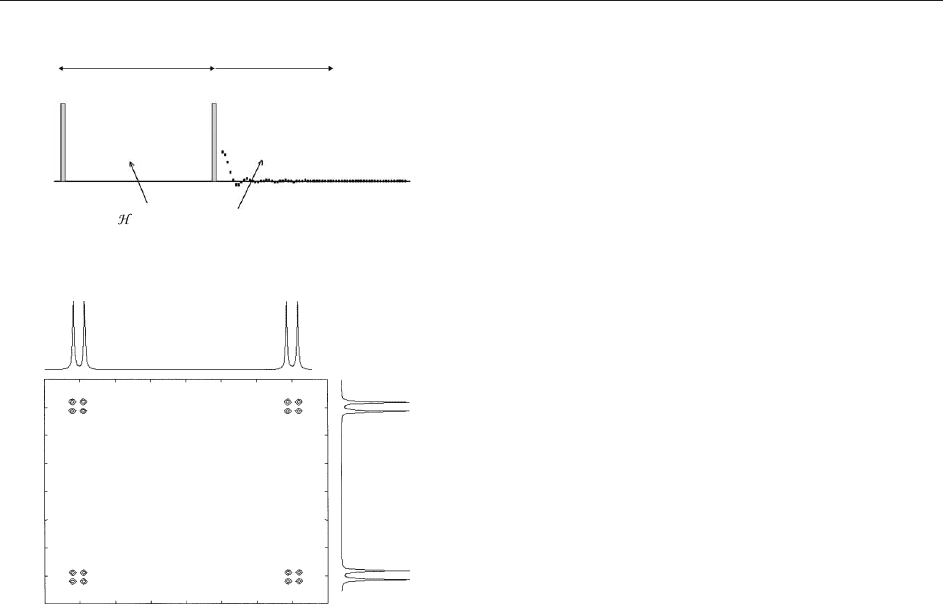
When Fourier transformed in two dimensions with
respect to t
1
and t
2
,thepatternshowninFigure 5
results. Remarkably, while the diagonal spectrum
is the same pair of doublets seen in the figure,
this two-dimensional spectrum contains off-diagonal
antiphase peaks for scalar-coupled sites where magnet-
ization transfer has occurred.
The idea of performing NMR in two or more
dimensions was first proposed by Jean Jeener in
1971. The example outlined above, correlation
spectroscopy (COSY), is just one of an array of
coherence transfer experiments using multiple RF
pulse trains and time domain evolution of the spin
ensemble. Notice that in the COSY experiment, t
1
is
an evolution dimension during which no detection of
NMR signal occurs, while t
2
is the detection domain.
Indirect (scalar)
spin–spin coupling
via electron
Local chemical shift
diamagnetic shielding
ppm
3.7
3.6 3.0
ppm 6.5 6.4 6.3
ppm 6 5 4
ppm 1.4 1.2 1.0
ppm 1.4 1.2 1.0
321
J coupling
σ
σ
A
A
A
A
A
A
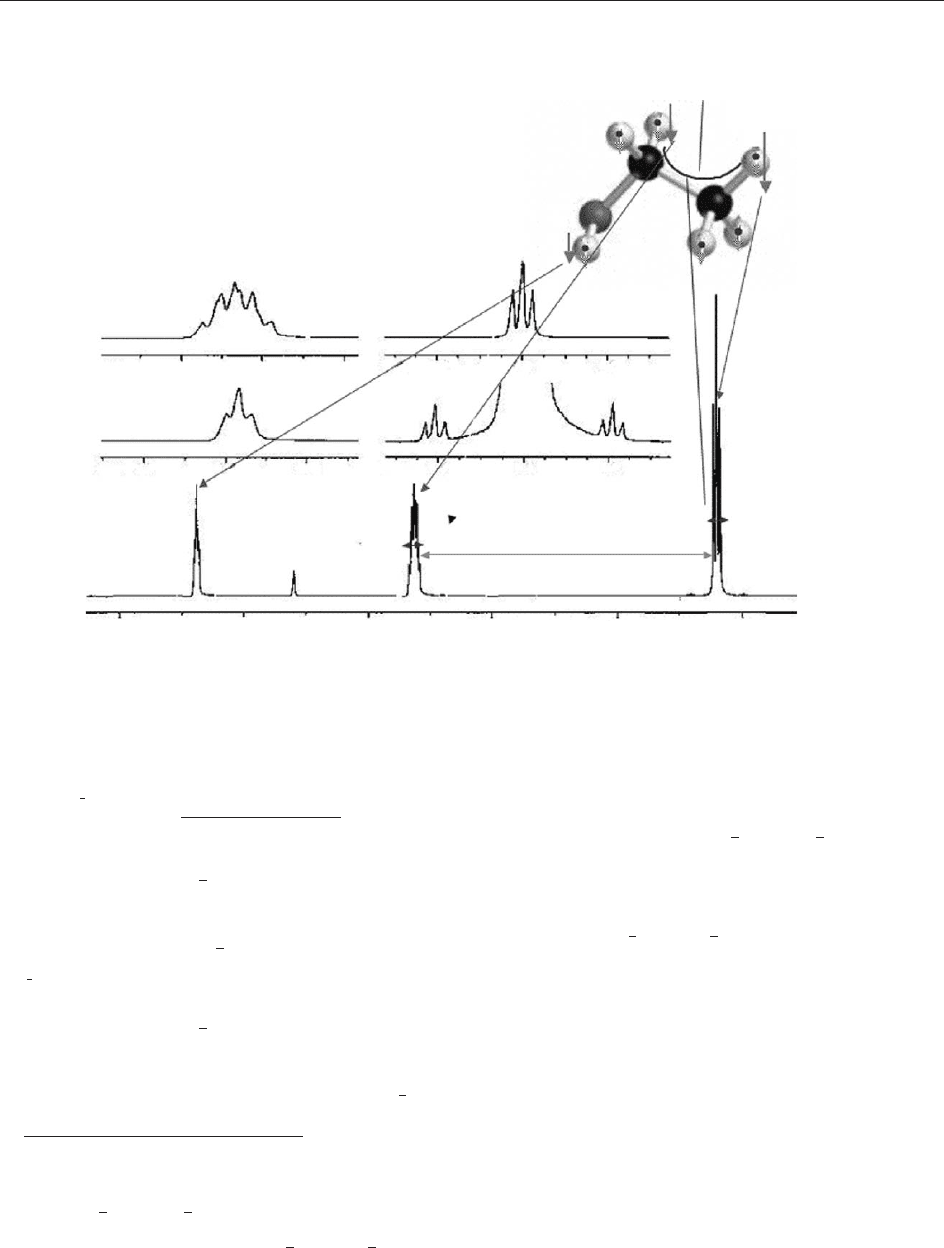
Figure 3 The proton NMR spectrum of ethanol showing three major peaks, separated by chemical shift, each split into multiplets
arising from nearby protons via the scalar coupling.
598 Nuclear Magnetic Resonance
The effect of the evolution is indelibly imprinted in
the spin system density matrix allowing later recall of
vital information concerning the interactions present
in the spin Hamiltonian. The COSY experiment
allows one to determine which spins are coupled via
their molecular orbital electrons. Other multidimen-
sional methods that rely on dipole–dipole relaxation
effects, such as NOESY, determine which spin sites
have ‘‘through-space’’ proximity.
The use of two- and higher-dimensional methods
has allowed the NMR spectra of biological macro-
molecules to be unraveled, with COSY methods used
for spectral assignment of amino acid units, and
NOESY methods used to determine any close proxi-
mities of amino acids otherwise well separated in the
sequence. Such distance information has allowed the
reconstruction of protein conformations by NMR.
The second RF pulse of Figure 4 also generates a
state of the density matrix, I
1y
I
2x
known as a double
quantum coherence, and, in the simple COSY
experiment, lost to observable magnetization. Other
RF pulse schemes can take advantage of this state,
converting it via suitable ‘‘coherence pathways’’ into
an observable. For a detailed summary of these
various NMR phenomena, readers are referred to the
book by Ernst et al. (1987).
Solid-State NMR
As with J couplings, dipolar interactions an d
quadrupole interactions (I > 1=2) are bilinear in
the spin operat ors and can be used to generate
various higher-order coh erence pathways in NMR
experiments. Unlike the simple spin–spin coupling,
they have an angular dependence. In solids, these
interactions may broaden the NMR resonance line
by tens to hundreds of kilohertz. In the case where a
probe nucleus is located at a known site in the
material (often achieved by deuteron labeling), these
Hamiltonian terms may contribute important infor-
mation about structure, and especially orientational
anisotropy. For example, the quadrupole interaction
for the spin-1 deuteron (see eqns [11] and [14])
depends as P
2
( cos
ZZ
) = (1=2)(3 cos
ZZ
1) on the
angle between the external magnetic field and
the electric field gradient (generally associated with
the local molecular orbital or bond direction, and taken
here to be axially symmetric). Note that the first-order
contribution of the quadrupole interaction leads to an
unequal separation of the m = 1, 0, 1Zeeman
energy levels, resulting in a doublet NMR spectrum,
for any particular orientation,
ZZ
. Such a unique
orientation might be found in a single crystal, or in a
nematic liquid crystalline state. For a polycrystalline
material, however, the NMR spectrum has a con-
tribution from all orientations, leading to a character-
istic powder pattern. The details of
2
H spectral
distributions may be used to characterize the degree
of orientational order in solids and soft, anisotropic
matter.
For
1
H,
13
C, and other spin-1/2 nuclei, dipolar
interactions (with a wide distribution of spin
spacings and internuclear vector orientation) may
severely broaden the NMR spectrum in the solid
state (see eqns [11] and [13]). Such interact ions,
along with quadrupole interactions for nucle i with
I >1=2, may be significantly reduced by modulating
the effective dipolar Hamiltonian at a rate faster
than its strength in frequency units. Two methods
are available, one (magic angle spinning or MAS)
relying on the angular terms in eqns [13] and [14],
and the other (multiple pulse line narrowing) on the
spin terms. The MAS techniq ue relies on spinning
the sample rapidly about at angle oriented at 54.4
to the magnetic field, such that the average value of
P
2
(cos
ij
) becomes its projection along this spinning
axis, while the projection of the spinning axis
residual is P
2
(cos 54.4
) 0. Multiple pulse meth-
ods rely on a successive reorientation of the spin
system such that the effective dipol ar Hamiltonian
that results from the application of the neste d
evolution operators is rendered close to zero.
90°
x
90°
x
= – ω
1
I
1z
–
ω
2
I
2z
+
JI
1z
I
2z
rot
t
1
t
2
Figure 4 RF pulse scheme used for COSY experiment.
Figure 5 Schematic COSY (modulus) spectrum for an AX spin
system. Not that the (antiphase) off-diagonal peaks indicate
J-couplings between chemical-shift-separated spins.
Nuclear Magnetic Resonance 599

In practice, MAS techniques work best with
13
C
NMR where the moderate
1
H–
13
C dipolar interactions
may be removed with achievable spinning speeds (a
few tens of kilohertz). Furthermore, the larger proton
magnetization (
1
H
=
13
C
4) can be transferred to the
13
C nuclei via Hartman–Hahn cross-polarization thus
significantly enhancing sensitivity. Such methodology
is referred to as CPMAS NMR.
The real art of solid-state NMR is in removing the
unwanted dipolar or quadrupolar interactions, but
leaving specific interactions of interest. This may be
achieved by including in the MAS experiment,
specific combinations of pulses which recouple
selected spins. Some of the most sophisticated
experiments in modern NMR are to be found in
this domain of application.
Conclusion
NMR provides exceptional structural information
concerning molecules, biomolecules as well as
molecular assemblies, liquid crystal s, soft solids,
and solids. In addition, the method provides unique
information concerning molecular dynamics,
through both relaxation methods and the direct
measurement of diffusion or flow. One spectacular
application of NMR concerns its use in imaging,
achieved by giving the Larmor frequency a spatial
tag through the use of deliberately inhomogeneous
magnetic fields. This topic is covered in the article
on Magnetic Resonance Imaging.
See also: Magnetic Resonance Imaging.
Further Reading
Abragam A (1961) Principles of Nuclear Magnetism. Oxford:
Clarendon.
Bloch F, Hansen WW, and Packard M (1946) Nuclear induction.
Physical Review 70: 474.
Ernst RR, Bodenhausen G, and Wokaun A (1987) Principles of
Nuclear Magnetic Resonance in One and Two Dimensions.
Oxford: Clarendon.
Goldman M (1991) Quantum Description of High-Resolution
NMR in Liquids. New York: Oxford University Press.
Hahn EL (1950) Spin echoes. Physical Review 80: 580.
Jeener J (1971) Ampere International Summer School. Yugoslavia:
Basko Polje.
McNeil EB, Slichter CP, and Gutowsky HS (1951) Slow beats in
19F nuclear spin echoes. Physical Review 84: 1245.
Mehring M (1983) Principles of High Resolution NMR in Solids.
Berlin: Springer.
Purcell EM, Torrey HC, and Pound RV (1946) Resonance
absorption by nuclear magnetic moments in a solid. In:
Physical Review 69: 37.
Rabi II and Cohen VW (1933) Measurement of nuclear spin by
the method of molecular beams: the nuclear spin of sodium.
Physical Review 46: 707.
Schmidt-Rohr K and Spiess H-W (1994) Multi-Dimensional Solid
State NMR and Polymers. London: Academic Press.
Slichter CP (1963) Principles of Magnetic Resonance. New York:
Harper and Row.
Number Theory in Physics
M Marcolli, Max-Planck-Institut fu
¨
r Mathematik, Bonn,
Germany
ª 2006 Elsevier Ltd. All rights reserved.
Several fields of mathematics have closely been
associated to physics: this has always been the case
for the theory of differe ntial equations. In the early
twentieth century, with the advent of general
relativity and quantum mechanics, topics such as
differential and Riem annian geometry, operator
algebras, and functional analysis, or group theory
also developed a close relation to physics. In the
1990s, mostly through the influence of string theory,
algebraic geometry also began to play a major role
in this interaction. Recent years have seen an
increasing number of results suggesting that number
theory also is beginning to play an essential part on
the scene of contemporary theoretical and mathe-
matical physics. Conversely, ideas from physics,
mostly from quantum field theory and string theory,
have started to influence work in number theory.
In describing significant occurrences of number
theory in physics, we will, on the one hand, restrict
our attention to quantum physics, while, on the other,
we will assume a somewhat extensive definition of
number theory that will allow us to include arithmetic
algebraic geometry. The territory is vast and an
extensive treatment would go beyond the size limits
imposed by the encyclopedia. The choice of topics
represented here inevitably reflects the limited knowl-
edge, particular interests, and bias of the author. Very
useful references, collecting a lot of material on number
theory and physics, are the proceedings of the Les
Houches conference in 2003 (Beilinson and Manin
1986), as well as the two volumes of a previous Les
Houches conference on number theory and physics,
which took place in 1989, published by Springer in
1990 and 1992. A number theory and physics database
is presently maintained online by M R Watkins.
600 Number Theory in Physics

In the following, we have organized the material
by topics in number theory that have so far made an
appearance in physics, and for each we briefly
describe the relevant context and results. This
singles out many themes. We first discuss a class of
functions that occur in physics and their special
values that are of great number-theoretic impor-
tance. This includes the dilogarithm, the polyloga-
rithms and multiple polylogarithms, and the
multiple zeta values. We also discuss the most
important symmetry groups of number theory, the
Galois groups, and occurrences in physics of some
forms of Galois theory. We then discuss how
techniques from the arithmetic geometry of alge-
braic varieties, especially Arakelov geometry, play a
role in string theory. Finally, we discuss briefly the
theory of motives and outline its possible relation to
quantum physics. From the physics point of view, it
seems that the most promising directions in which
number-theoretic tools have come to play a crucial
role are to be found mostly in the realm of rational
conformal field theories and of noncommutative
geometry, as well as in certain aspects of string
theory.
Among the topics that are very relevant to this
theme, but that will not be touched upon in this
article, there are important sub jects such as the
theory of ‘‘arithmetic quantum chaos,’’ the use of
methods of random matrix theory applied to the
study of zeros of zeta funct ions, or mirror symmetry
and its connection to modular forms. The interested
reader can find such topics treated in other articles
of this encyclopedia and in the references mentioned
above (see Quantum Ergodicity and Mixing of
Eigenfunctions; Random Matrix Theory in Physics;
Mirror Symmetry: a Geometric Survey).
Dilogarithm, Multiple Polylogarithms,
Multiple Zeta Values
The dilogarithm is defined as
Li
2
ðzÞ¼
Z
0
z
logð1 t Þ
t
dt ¼
X
1
n¼1
z
n
n
2
It satisfies the functional equation Li
2
(z) þ Li
2
(1 z) =
Li
2
(1) log (z)log(1 z), where Li
2
(1) = (2), for (s)
the Riemann zeta function. A variant is given by
the Rogers dilogarithm L(x) = Li
2
(x) þ (1=2) log (x)
log (1 x). For more details, see Zagier’s paper
(Julia et al. 2005, vol. II).
The polylogarithms are similarly defined by the
series Li
k
(z) =
P
n1
z
n
=n
k
. In quantum electrody-
namics, there are corrections to the value of the
gyromagnetic ratio, in powers of the fine structure
constant. The correction terms that are known
exactly involve special values of the zeta function
such as (3), (5) and values of polylogarithms such
as Li
4
(1=2). The series defining the polylogarithm
function Li
s
(z) =
P
n1
z
n
=n
s
converges absolutely
for all s 2 C and jz j < 1 and has analytic continua-
tion to z 2 C n [1, 1). The Fermi–Dirac and
Bose–Einstein distributions are expressed in terms
of the polylogarithm function as
Z
1
0
x
s
e
x
1
dx ¼ðs þ 1ÞLi
1þs
ðe
Þ
The multiple polylogarithms are functions defined
by the expressions
Li
s
1
;...;s
r
ðz
1
; z
2
; ...; z
r
Þ
¼
X
n
1
>n
2
>>n
r
>0
z
n
1
1
z
n
2
2
z
n
r
r
n
s
1
1
n
s
2
2
n
s
r
r
½1
By analytic continuation, the functions
Li
s
1
,..., s
r
(z
1
, z
2
, ..., z
r
) are defined for all complex s
i
and for z
i
in the complement of the cut [1, 1) in the
complex plane. Multiple zeta values of weight k and
depth r are given by the expressions
ðk
1
; ...; k
r
Þ¼
X
n
1
>n
2
>>n
r
>0
1
n
k
1
1
n
k
r
r
½2
with k
i
2 N and k
1
2. These satisfy many combi-
natorial identities and nontrivial relations over Q.
For an informative overview on the subject, see
Cartier (2002). Notice that, for the sums in [1] and
[2], a different summation convention can also be
found in the literature.
Conformal Field Theories and the Dilogarithm
There is a relation between the torsion elements in
the algebraic K-theory group K
3
(C) and rational
conformally invariant quantum field theories in two
dimensions (see Nahm (2005)). There is, in fact, a
map, given by the dilogarithm, from torsion
elements in the Bloch group (closely related to the
algebraic K-theory) to the central charges and
scaling dimensions of the conformal field theories.
This correspondence arises by considering sums of
the form
X
m2N
r
q
QðmÞ
ðqÞ
m
½3
where (q)
m
= (q)
m
1
(q)
m
r
,(q)
m
i
= (1 q)(1 q
2
)
(1 q
m
i
)andQ(m) = m
t
Am=2 þ bm þ h has rational
coefficients. Such sums are naturally obtained from
considerations involving the partition function of a
bosonic rational conformal field theory (CFT). In
Number Theory in Physics 601

particular, [3] can define a modular function only if all
the solutions of the equation
X
j
A
ij
logðx
j
Þ¼logð1 x
i
Þ½4
determine elements of finite order in an extension
^
B(C) of the Bloch group, which accounts for the fact
that the logarithm is multivalued. The Rogers
dilogarithm gives a natural group homomorphism
(2i)
2
L :
^
B(C) ! C=Z, which takes values in Q=Z
on the torsion elements. These values give the
conformal dimensions of the fields in the theory.
Feynman Graphs
Multiple zeta values appear in perturbative quantum
field theory. D Kreimer (2000) developed a connec-
tion between knot theory and a class of transcen-
dental numbers, such as multiple zeta values,
obtained by quantum field-theoretic calculations as
counterterms generated by corresponding Feynman
graphs. Broadhurst and Kreimer (1997) identified
Feynman diagrams with up to nine loops whose
corresponding counterterms give multiple zeta
values up to weight 15. Recently, Kreimer showe d
some deep analogies between residues of quantum
fields and variations of mixed Hodge–Tate struc-
tures associated to polylogarithms.
Testing predictions about the standard model of
elementary particles, in the hope of detecting new
physics, requires developing effective computational
methods handling the huge number of terms involved
in any such calculation, that is, efficient algorithms for
the expansion of higher transcendental functions to a
very high order. The interesting fact is that abstract
number-theoretic objects, such as multiple zeta values
and multiple polylogarithms, appear naturally in this
context (cf., e.g., Moch et al. (2002)). The explicit
recursive algorithms are based on Hopf algebras and
produce expansions of nested finite or infinite sums
involving ratios of gamma functions and Z-sums
(Euler–Zagier sums), which naturally generalize multi-
ple polylogarithms and multiple zeta values. Such
sums typically arise in the calculation of multiscale
multiloop integrals. The algorithms are designed to
recursively reduce the Z-sums involved to simpler ones
with lower weight or depth.
Galois Theory
Given a number field K, which is an algebraic
extension of Q of some degree [K : Q] = n, there is
an associated fundamental symmetry group, given
by the absolute Galois group Gal(
K=K), where
K is
an algebraic closure of K. Even in the case of Q, the
absolute Galois group Gal(
Q=Q) is a very compli-
cated object, far from being fully understood.
One can consider an easier symmetry group,
which is the abelianization of the absolute Galois
group. This corresponds to considering the field K
ab
,
the ‘‘maximal abelian extension’’ of K, which has
the property that
GalðK
ab
=KÞ¼Galð
K=KÞ
ab
The Kronecker–Weber theorem shows that for
K = Q the maximal abelian extension can be
identified with the cyclotomic field (generated by
all roots of unity), Q
ab
= Q
cycl
, and the Galois
group is identified with Gal(Q
ab
=Q) ffi
^
Z
, where
^
Z
= A
f
=Q
þ
. In general, for other number fields,
one has the ‘‘class field theory isomorphism’’
: GalðK
ab
=KÞ!
’
C
K
=D
K
where C
K
= A
K
=K
is the group of idele classes and
D
K
the connected component of the identity in C
K
.In
general, however, one does not have an explicit
description of the generators of the maximal abelian
extension K
ab
and the action of the Galois group. This
is the content of the explicit class field theory problem,
Hilbert’s 12th problem. In addition to the Kronecker–
Weber case, a complete answer is known in the case of
imaginary quadratic fields K = Q(
ffiffiffiffiffiffiffi
d
p
), with d > 1a
positive integer. In this case generators are obtained by
evaluating modular functions at a point in the
upper-half plane such that K = Q( ) and the Galois
action is described explicitly through the group of
automorphisms of the modular field, through Shimura
reciprocity. For a survey of the explicit class field
theory problem and the case of imaginary quadratic
fields, see Stevenhagen (2001).
As we mentioned above, understanding the
structure of the absolute Galois group Gal(
Q=Q)is
a fundamental question in number theory. Grothen-
dieck described, in his famous proposal ‘‘Esquisse
d’un programme,’’ how to obtain an action of
Gal(
Q=Q) on an essentially combinatorial object,
the set of ‘‘dessins d’enfants.’’ These are connected
graphs (on a surface) such that the complement of
the graph is a union of open cells and the vertices
have two different markings, with the properties
that adjacent vertices have opposite markings. Such
objects arise by considering the projective line P
1
minus three points. Any finite cover of P
1
branched
only over {0, 1, 1} gives an algebraic curve defined
over
Q. The dessin is the inverse image under the
covering map of the segment [0, 1] in P
1
. The
absolute Galois group Gal(
Q=Q) acts on the data of
the curve and the covering map, hence on the set of
602 Number Theory in Physics

dessins. A theorem of Bielyi sho ws that, in fact, all
algebraic curves defined over
Q are obtained as
coverings of the projective line ramified only over
the points {0, 1, 1}. This has the effect of realizing
the absolute Galois group as a subgroup of outer
automorphisms of the profinite fundamental group
of the projective line minus three points. For a
general reference on the subject, see Schneps (1994).
A different type of Galois symmetry of great
arithmetic signi ficance is ‘‘motivic’’ Galois theory.
This will be discussed later in the section dedicated
to motives, where we discuss a surpri sing occurrence
in the context of pertur bative quantum field theory
and renormalization.
Quantum Statistical Mechanics and Class
Field Theory
In quantum statistical mechanics, one considers an
algebra of observables, which is a unital C
-algebra
A with a time evolution
t
. States are given by linear
functionals ’ : A!C satisfying ’(1) = 1 and posi-
tivity ’(x
x) 0. Equilibrium states ’ at inverse
temperature satisfy the Kubo–Martin–Schwinger
(KMS) condition, namely, for all x, y 2A there
exists a bounded holomorphic function F
x, y
(z)on
the strip 0 < =(z) <, which extends continuously
to the boundary, such that for all t 2 R
F
x;y
ðtÞ¼’ðx
t
ðyÞÞ
and
F
x;y
ðt þ i Þ¼’ð
t
ðyÞxÞ½5
Cases of number-theoretic interest arise when one
considers the noncommutative space of commensur-
ability classes of Q-lattices up to scaling as algebra of
observables, with a natural time evolution determined
by the covolume, as shown in the paper Quantum
Statistical Mechanics of Q-Lattices of Connes–Marcolli
(Julia et al. 2005,vol.I). A Q-lattice in R
n
consists of a
pair (, ) of a lattice R
n
together with a
homomorp hism of abelian groups : Q
n
=Z
n
!
Q=.TwoQ-lattices are commensurable, (
1
,
1
)
(
2
,
2
), iff Q
1
= Q
2
and
1
=
2
mod
1
þ
2
.
The Bost–Connes system The quantum statistical
mechanical system considered by Bost and Connes
(1995) corresponds to the case of one-dimensional
Q-lattices. The partition function of the system is
the Riemann zeta function (). The system has
spontaneous symmetry breaking at = 1, with a
single KMS state for all 0 < 1. For >1, the
extremal equilibrium states are parametrized by the
embeddings of Q
cycl
in C with a free transitive
action of the idele class group C
Q
=D
Q
=
^
Z
. At zero
temperature, the evaluation of KMS
1
states on
elements of a rational subalgebra intertwines the
action of
^
Z
by automorphisms of (A,
t
) with the
action of Gal(Q
ab
=Q) on the values of the states.
This recovers the explicit class field theory of Q
from a physical perspective.
Noncommutative space of adele classes The alge bra
A of the Bost–Connes system is the noncommutative
algebra of functions f (r, ), for 2
^
Z and r 2 Q
such that r 2
^
Z, with the convolution product
f
1
f
2
ðr;Þ¼
X
s2Q
:s2
^
Z
f
1
ðrs
1
; sÞf
2
ðs;Þ½6
and the adjoint f
(r, ) = f (r
1
, r). According to the
general philosophy of Connes style noncommutative
geometry, it is the algebra of coordinates of the
noncommutative space defined by the ‘‘bad quoti-
ent’’ GL
1
(Q) n (A
f
{1}) – a noncommutative
version of the zero- dimensional Shimura variety
Sh(GL
1
,{1})= GL
1
(Q) n(GL
1
(A
f
) {1}). Its ‘‘dual
system’’ (in the sense of Connes’s duality of type III
and type II factors) is obtained by taking the crossed
product by the time evolution. It gives the algebra of
coordinates of the nonc ommutative space defined by
the quotient A=Q
. This is the noncommutative
space of ‘‘adele classes’’ used by Connes in his
spectral realization of the zeros of the Riemann zeta
function.
The GL
2
-system A generalization of the Bost–
Connes system was introduced by Connes and
Marcolli in the paper Quantum Statistical
Mechanics of Q-Lattices (Julia et al. 2005). This
corresponds to the case of two-dimensional
Q-lattices. The partition function is the product
()( 1). The system in this case has two phase
transitions, with no KMS states for 1. For >2,
the extremal KMS states are parametrized by the
invertible Q-lattices, namely, those for which is an
isomorphism. The algebra A has an arithmetic
structure given by a rational algebra of unbounded
multipliers. This rational algebra contains modular
functions and Hecke operators. At zero temperature,
extremal KMS states can be evaluated on these
multipliers. Symmetries of (A,
t
) are realized in part
by endomorphisms (as in the theory of superselec-
tion sectors) and the symmetry group acting on
low-temperature KMS states is the group of auto-
morphisms of the modular field GL
2
(A
f
)=Q
. For a
generic set of extremal KMS
1
states, evaluation at
the rational algebra intertwines this action with the
action on the values of an embedding of the modular
field as a subfield of C.
Number Theory in Physics 603

The complex multiplication system In the case of an
imaginary quadratic field K = Q(), an analogous
construction is possible. A one-dimensional K-lattice is
apair(, ) of a finitely generated O-submodule of
C,withK = K, and a homomorphism of O-modules
: K=O!K=.TwoK-lattices are commensurable
iff K
1
= K
2
and
1
=
2
mod
1
þ
2
. Connes et al.
(Preprint 2005) constructed a quantum statistical
mechanical system describing the noncommutative
space of commensurability classes of one-dimensional
K-lattices up to scale. The partition function is the
Dedekind zeta function
K
(). The system has a phase
transition at = 1 with a unique KMS state for higher
temperatures and extremal KMS states parametrized by
the invertible K-lattices at lower temperatures. There is
a rational subalgebra induced by the rational structure
of the GL
2
-system (one-dimensional K-lattices are also
two-dimensional Q-lattices with compatible notions of
commensurability). The symmetries of the system are
given by the idele class group A
K, f
=K
.Theactionis
partly realized by endomorphisms corresponding to the
possible presence of a nontrivial class group (for class
number > 1). The values of extremal KMS
1
states on
the rational subalgebra intertwine the action of the idele
class group with the Galois action on the values. This
fully recovers the explicit class field theory for
imaginary quadratic fields.
Conformal Field Theory and the Absolute
Galois Group
Moore and Seiberg considered data associated to any
rational conformal field theory, consisting of matrices,
obtained as monodromies of some holomorphic multi-
valued functions on the relevant moduli spaces,
satisfying polynomial equations. Under reasonable
hypotheses, the coefficients of the Moore–Seiberg
matrices are algebraic numbers. This allows for the
presence of interesting arithmetic phenomena. Through
the Chern–Simons/Wess–Zumino–Witten correspon-
dence, it is possible to construct three-dimensional
topological field theories from solutions to the Moore–
Seiberg equations.
On the arithmetic side, Grothendieck proposed in
his ‘‘Esquisse d’un programme’’ the existence of a
Teichmu¨ ller tower given by the moduli spaces M
g, n
of Riemann surfaces of arbitrary genus g and number
of marked points n, with maps defined by operations
such as cutting and pasting of surfaces and forgetting
marked points, all encoded in a family of funda-
mental groupoids. He conjectured that the whole
tower can be reconstructed from the first two levels,
providing, respectively, generators and relations. He
called this a ‘‘game of Lego–Teichmu¨ ller.’’ He also
conjectured that the absolute Galois group acts by
outer automorphisms on the profinite completion of
the tower. The basic building blocks of the tower are
provided by ‘‘pairs of pants,’’ that is, by projective
lines minus three points.
This leads to a conjectural relation between the
Moore–Seiberg equations and this Grothendieck–
Teichmu¨ ller setting (cf. Degiovanni 1994) according
to which solutions of the Moore–Seiberg equations
provide projective representations of the Teichmu¨ller
tower, and the action of the absolute Galois group
Gal(
Q=Q) corresponds to the action on the coeffi-
cients of the Moore–Seiberg matrices.
Rational conformal field theories are, in general,
one of the most promising sources of interactions
between number theory and physics, involving
interesting Galois actions, modular forms, Brauer
groups, and complex multiplication. Some funda-
mental work in this direction was done by, for
example, Borcherds and Gannon.
Arithmetic Algebraic Geometry
In this sect ion we describe occurrences in physics of
various aspects of the arithmetic geometry of
algebraic varieties.
Arithmetic Calabi–Yau
In the context of type II string theory, compactified
on Calabi–Yau 3-folds, Greg Moore considered
certain black hole solutions and a resulting dynami-
cal system given by a differential equation in the
corresponding moduli. The fixed points of these
equations determine certain ‘‘black hole attractor
varieties.’’ In the case of varieties obtained from a
product of elliptic curves or of a K3 surface and an
elliptic curve, the attractor equation singles out
an arithmetic property: the elliptic curves have
complex multiplication. The class number of the
corresponding imaginary quadratic field counts
U-duality classes of black holes with the same area.
Other results point to a relation between the
arithmetic properties of Calabi–Yau 3-folds and
conformal field theory. For insta nce, it was shown
by Schimmrigk that, in certain cases, the algebraic
number field defined via the fusion rules of a
conformal field theory as the field defined by the
eigenvalues of the integer-valued fusion matrices
i
j
¼ðN
i
Þ
k
j
k
can be recovered from the Hasse–Weil L-function of
the Calabi–Yau. An interesting case is provided by
the Gepner model associated with the Fermat
quintic Calabi–Yau 3-fold.
604 Number Theory in Physics

Arakelov Geometry
For K a number field and O
K
its ring of integers, a
smooth proper algebraic curve X ov er K determines
a smooth minimal model X
O
K
, which defines an
arithmetic surface X
O
K
over Spec(O
K
). The closed
fiber X
}
of X
O
K
over a prime } 2 O
K
is given by the
reduction mod }.
When Spec(O
K
) is ‘‘compactified’’ by adding the
Archimedean primes, one can correspondingly
enlarge the group of divisors on the arithmetic
surface by adding formal real linear combinations of
irreducible ‘‘closed vertical fibers at infinity.’’ Such
fibers are only treated as formal objects. The main
idea of Arakelov geometry is that it is sufficient to
work with ‘‘infinitesimal neighborhood’’ X
(C)of
these fibers, given by the Riemann surfaces obtained
from the equation defining X over K under the
embeddings : K ,!C that constitute the Archime-
dean primes. Arakelov developed a consistent inter-
section theory on arithmetic surfaces, by computing
the contribution of the Archimedean primes to the
intersection indices using Hermitian metrics on these
Riemann surfaces and the Green function of the
Laplacian.
A general introduction to the subject of Arakelov
geometry can be found in Lang (1988). Manin
(1991) showed that these Green functions can be
computed in terms of geodesics in a hyperbolic
3-manifold that has the Riemann surfa ce X
(C)as
its conformal boundary at infinity.
The Polyakov measure A first application to
physics of methods of Arakelov geometry was an
explicit formula obtained by Beilins on and Manin
(1986) for the Polyakov bosonic string measure in
terms of Faltings’s height funct ion at algebraic
points of the moduli space of curves.
The partition function for the closed bosonic
string has a perturbative expansion Z =
P
g0
Z
g
,
with
Z
g
¼ e
ð22g Þ
Z
e
Sðx;Þ
DxD ½7
written in terms of a compact Riemann surface of
genus g, maps x : ! R
d
, and metrics on . The
classical action is of the form
Sðx;Þ¼
Z
d
2
z
ffiffiffiffiffiffi
jj
p
ab
@
a
x
@
b
x
½8
Using the invariance of the classical action with
respect to the semidirect product of diffeomorphisms
of and the conformal group, the integral is reduced
(in the critical dimension d = 26 where the con-
formal anomaly cancels) to a zeta regularized
determinant of the Laplacian for the metric on
and an integration over the moduli space M
g
of genus
g algebraic curves. Beilinson and Manin gave an
explicit formula for the resulting Polyakov measure
on M
g
using results of Faltings on Arakelov geometry
of arithmetic surfaces. In particular, their argument
uses essentially the properties of the Faltings metrics
on the invertible sheaves d(L) given by the ‘‘multi-
plicative Euler characteristics’’ of sheaves L of
relative 1-forms. For a suitable choice of bases {
j
}
and {w
j
} of differentials and quadratic differentials,
the formula for the Polyakov measure is then of the
form (up to a multiplicative constant)
d
g
¼jdet Bj
18
ðdet =Þ
13
W
1
^
W
1
^^
W
3g3
^
W
3g3
½9
with in the Siegel upper-half space, B
ij
=
R
a
i
j
,
and the W
j
given by the images of the basis w
j
under
the Kodaira–Spencer isomorphism.
Holography In the case of the elliptic curve
X
q
(C) = C
=q
Z
, a formula of Alvarez-Gaume,
Moore, and Vafa gives the operator product expan-
sion of the path integral for bosonic field theory as
gðz; 1Þ¼log
jqj
B
2
ðlog jzj= log jqjÞ=2
j1 zj
Y
1
n¼1
j1 q
n
zjj1 q
n
z
1
j
!
½10
where B
2
is the second Bernoulli polynomial.
Expression [8] is in fact the Arakelov Green function
on X
q
(C) (cf. Lang (1988)).
Using this and analogous results for higher genus
Riemann surfaces, Manin and Marcolli (2001)
showed that the result of Manin (1991) on Arakelov
and hyperbolic geometry can be rephrased in terms
of the AdS/CFT correspondence, or holography
principle. Expression [8] can then be written as a
combination of terms involving geodesic lengths in
the Euclidean BTZ black hole.
In the case of higher genus curves, the Arakelov
Green function on a compact Riemann surface,
which is related to the two-point correlation func-
tion for bosonic field theory, can be expressed in
terms of the semiclassical limit of gravity (the
geodesic propagator) on the bulk space of Euclidean
versions of asymptotically AdS
2þ1
black holes
introduced by K Krasnov.
Motives
There are several cohomology theories for algebraic
varieties: de Rham, Betti, e´tale cohomology. de Rham
Number Theory in Physics 605

and Betti are related by the period isomorphism, and
comparison isomorphisms relate E
´
tale and Betti
cohomology. In the smooth projective case, they
have the expected properties of Poincare´ duality,
Ku¨ nneth isomorphisms, etc. Moreover, E
´
tale coho-
mology provides interesting ‘-adic representations of
Gal(
k=k). In order to understand what type of
information, such as maps or operations can be
transferred from one to another cohomology,
Grothendieck introduced the idea of the existence of
a ‘‘universal cohomology theory’’ with realization
functors to all the known cohomology theories for
algebraic varieties. He called this the theory of
‘‘motives.’’ Properties that can be transferred between
different cohomology theories are those that exist at
the motivic level. A short introduction to motives can
be found in Serre (1992).
The first constru ctions of a category of motives
proposed by Grothendieck covers the case of smooth
projective varieties. The corresponding motives form
a Q-linear abelian category of ‘‘pure motives.’’
Roughly, objects are varieties and morphisms are
‘‘correspondences’’ given by algebraic cycles in the
product, modulo a suitable equivalence relation. The
category also contains Tate objects generated by
Q(1), which is the inver se of the pur e motive
H
2
(P
1
). Grothendieck’s standard conjectures imply
that the category of pure motives is equivalent to the
category of representations Rep
G
of a ‘‘motivic
Galois group,’’ which in the case of pure motives is
proreductive. The subcategory of pure Tate motives
has as motivic Galois group the multi plicative group
G
m
. The situation is more complicated for ‘‘mixed
motives,’’ for which constructions were only very
recently proposed (e.g., in the work of Voevodsky).
These provide a universal cohomology theory for
more general classes of algebraic varieties. Mixed
Tate motives are the subcategory generated by the
Tate objects. There is again a motivic Galois group.
For mixed motives it is an extension of a proreduc-
tive group by a prounipotent group, with the
proreductive part coming from pure motives and
the prounipotent part from the presence of a weight
filtration on mixed motives. The multiple zeta values
appear as periods of mixed Tate motives .
Renormalization and Motivic Galois Theory
A manifestation of motivic Galois groups in physics
arises in the context of the Connes–Kreimer theory of
perturbative renormalization (for an introduction to
this topic, see Hopf Algebra Structure of Renormaliz-
able Quantum Field Theory). In fact, according to the
Connes–Kreimer theory, the Bogoliubov–Parasiuk–
Hepp–Zimmerman (BPHZ) renormalization scheme
with dimensional regularization and minimal subtrac-
tion can be formulated mathematically in terms of the
Birkhoff factorization
ðzÞ¼
ðzÞ
1
þ
ðzÞ½11
of loops in a prounipotent Lie group G, which is the
group of characters of the Hopf algebra of Feynman
graphs. Here, the loop is defined on a small
punctured disk around the critical dimension D,
þ
is holomorphic in a neighborhood of D, and
is
holomorphic in the complement of D in P
1
(C). The
renormalized value is given by
þ
(D) and the
counterterms by
(z).
The pa per of Connes and Marcolli Renormaliza-
tion, the Riemann–Hilbert Correspondence,and
Motivic Galois Theory in volume II of Julia et al.
(2005) shows that the data of the Birkhoff factor-
ization are equivalently described in terms of
solutions to a certain class of differential systems
with irregular singularities. This is obtained by
writing the terms in the Birkhoff factorization as
time-ordered exponentials, and then using the fact
that
Te
R
b
a
ðtÞdt
:¼ 1 þ
X
1
n¼1
Z
as
1
s
n
b
ðs
1
Þðs
n
Þds
1
ds
n
is the value g(b)atb of the unique solution g (t) 2 G
with value g( a ) = 1 of the differential equation
dg(t) = g(t)(t)dt.
The singularity types are specified by physical
conditions, such as the independence of the counter-
terms on the mass scale. These conditions are
expressed geometrically throu gh the notion of
G-valued ‘‘equisingular connections’’ on a principal
C
-bundle B over a disk , wher e G is the
prounipotent Lie group of characters of the
Connes–Kreimer Hopf algebra of Feynman graphs.
The ‘‘equisingularity’’ condition is the property that
such a connection ! is C
-invariant and that its
restrictions to sections of the principal bundle that
agree at 0 2 are mutually equivalent, in the sense
that they are related by a gauge transformation by a
G-valued C
-invariant map regular in B; hence, they
have the same type of (irregular) singularity at the
origin.
The classification of equivalence classes of these
differential systems via the Riemann–Hilbert corre-
spondence and differential Galois theory yields a
Galois group U
= Uo G
m
, where U is prounipotent,
with Lie algebra the free graded Lie algebra with
one generator e
n
in each degree n 2 N. The group
U
is identified with the motivic Galois group of
mixed Tate motives over the cyclotomic ring
Z[e
2i=N
], for N = 3orN = 4, localized at N.
606 Number Theory in Physics