
Francoise J.-P., Naber G.L., Tsun T.S. (editors) Encyclopedia of Mathematical Physics
Подождите немного. Документ загружается.


optics, solid-state physics, quantum information
theory, etc. (Alicki and Lendi 1987, Sewell 2002).
Ergodic Properties
Dynamical semigroups which possess stationary
states satisfying L
0
= 0 are of particular interest,
for example, in the description of relaxation
processes toward equilibrium states (Frigerio 1977,
Spohn 1980, Alicki and Lendi 1987). The dynamical
semigroup {(t)} with a stationary state
0
is called
ergodic if
lim
t !1
ðtÞ ¼
0
; for any initial ½29
For the case of finite-dimensional H at least one
stationary state always exists. If, moreover, it is
strictly positive,
0
> 0, then we have the following
sufficient condition of ergodicity:
fV
j
; j 2 Ig
0
fA; A 2 BðHÞ; ½A; V
j
¼0; j 2 Ig
¼ C1
½30
Open systems interacting with heat baths at the
temperature T are described by the semigroups with
generators [4] of the special form
d
dt
ðtÞ¼i½H;ðtÞþ
1
2
X
!
j
0
½V
j
;ðtÞV
j
n
þ½V
j
ðtÞ; V
j
þ e
!
j
½V
j
;ðtÞV
j
þ½V
j
ðtÞ ; V
j
o
½31
where
¼
1
k
B
T
; ½H; V
j
¼!
j
V
j
½32
The Gibbs state
= Z
1
e
H
is a stat ionary state
for eqn [31] and the con dition {V
j
, V
j
; j 2 I}
0
= C1
implies ergodicity (return to equilibrium). Moreover,
the matrix elements of diagonal in H-eigenbasis
transform independently of the off-diagonal ones
and satisfy the Pauli master equation
dp
k
dt
¼
X
l
ða
kl
p
l
a
lk
p
k
Þ½33
with the detailed balance condition a
kl
e
E
l
=
a
lk
e
E
k
, where E
k
are eigenvalues of H.
Define the new Hilbert space L
2
(H,
)asa
completion of B(H) with respect to the scalar
product (A, B)
tr(
A
B). The semigroup’s gen-
erators in the Heisenberg picture corresponding to
eqn [31] are normal operators in L
2
(H,
) with the
Hamiltonian part i[H, ] being the anti-Hermitian
one (automatically for bounded L
, and for
unbounded one under technical conditions concern-
ing domains). This allows spectral decomposition of
L
and a proper definition of damping rates for the
obtained eigenvectors. The normality condition is
one of the possible definitions of quantum detailed
balance. The other, based on the time-reversal
operation, often coinc ides with the previous one
for important examples.
Interesting examples of nonergodic dynamical
semigroups are given for open systems consisting of
N identical particles with Hamiltonians H
(N)
and
operators V
(N)
j
invariant with respec t to parti cles
permutations. Then the commutant {H
(N)
, V
(N)
j
,
j 2 I}
0
contains an abelian algebra generated by
projections on irreducible tensors corresponding to
Young tables.
From Hamiltonian Dynamics to
Semigroups
One of the main tasks in the quantum theory of open
systems is to derive master equations [4] from the
model of a ‘‘small’’ open system S interacting with a
‘ ‘large’ ’ reservoir R at a certain reference state !
R
(Davies 1976, Spohn 1980, Alicki and Lendi 1987,
Breurer and Petruccione 2002, Garbaczewski and
Olkiewicz 2002). Starting with the total Hamiltonian
H
= H
S
1
R
þ1
S
H
R
þ
P
S
R
,whereS
=
S
, R
= R
, tr(!
R
R
) = 0, and isacouplingcon-
stant, we define the reduced dynamics of S by
ðtÞ¼
ðÞ
ðtÞ ¼ tr
R
U
ðtÞ !
R
U
ðtÞ
½34
with U
(t) = exp (itH
). Here tr
R
denotes a partial
trace over R defined in terms of an arbitrary basis
{e
k
}ofR by the formula <, (tr
R
A)> =
P
k
<
e
k
, A e
k
>. Generally,
()
(t þ s) 6¼
()
(t)
()
(s),
but dynamical semigroups can provide good approx-
imations in important cases.
Weak-Coupling Limit
Under the condit ions of sufficiently fast decay of
multitime correlation functions constructed from the
observables R
at the state !
R
, one can prove that
for small coupling constant the exact dynamical
map
()
(t) can be approximated by the dynamical
semigroup corresponding to the following master
equation:
d
dt
ðtÞ¼i½H;ðtÞþ
2
2
X
X
!2Sp
C
ð!Þ
½V
!
;ðtÞV
!
þ½V
!
ðtÞ; V
!
½35
162 Quantum Dynamical Semigroups

where H = H
S
þ
2
P
P
!2Sp
K
(!)V
!
V
!
is a
renormalized Hamiltonian,
P
!2Sp
denotes the sum
over eigenfrequencies of [H, ], e
itH
S
e
itH
=
P
!2Sp
V
!
e
i!t
and
Z
1
0
e
i!t
tr !
R
e
itH
R
R
e
itH
R
R
dt
¼
1
2
C
ð!ÞþiK
ð!Þ½36
The rigorous derivation involves van Hove or weak
coupling limit, !0, with =
2
t kept fixed.
It follows from t he Bochner theorem that the
matrix [C
(!)] is positively defined and therefore
by its diagonalization we can convert eqn [35]
into the standard form [4]. If the reservoir’s state
!
R
is an equilibrium state (Kubo–Martin–Schwinger
state) then C
(!) = e
!=k
B
T
C
(!) and therefore
eqn [35] can be written in a form [31].Moreover,
transition probabilities a
kl
from eqn [33] coincide
with those obtained using the ‘‘Fermi golden
rule.’’
Low-Density Limit
If the reservoir can be modeled by a gas of
noninteracting particles (bosons or fermions) at
low density , we can derive the following master
equation which approxim ates an exact dynamics
[34] in the low-density limit ( !0, with = t kept
fixed)
d
dt
ðtÞ¼i½H;ðtÞþ
X
!2S
Z
R
6
d
3
pd
3
p
0
GðpÞ
E
p
0
E
p
þ !
½T
!
ðp; p
0
Þ;ðtÞT
!
ðp; p
0
Þ
ð
þ½T
!
ðp; p
0
Þðt Þ; T
!
ðp; p
0
Þ
Þ ½37
Here H is a renormalized Hamiltonian of the system
S, e
itH
Te
itH
=
P
!2S
T
!
e
i!t
, T is a T-matrix
describing the scattering process involving S and a
single particle, T = V
þ
, where V is a particle-
system potential and
þ
is a Møller operator.
T
!
(p, p
0
) denotes the integral kernel corresponding
to T
!
expressed in terms of momenta of the bath
particle, E
p
the kinetic energy of a particle, and G(p)
its probability distribution in the momentum space.
If G(p) exp(E
p
=k
B
T) and microreversibility con-
ditions, E
p
= E
p
and T
!
(p, p
0
) = T
!
(p
0
, p), hold,
then eqn [37] satisfies the quantum detailed-balance
condition with the stationary Gibbs state
, = 1=k
B
T.
Entropy and Purity
The relative entropy S( j) = tr( ln ln )is
monotone with respect to any trace-preserving
completely positive map ,thatis,S(j) S(j).
Hence, for the quantum dynamical semigroup (t)with
the stationary state
0
we obtain the following relation
for the von Neumann entropy S() = tr( ln ):
d
dt
SððtÞÞ ¼
d
dt
SððtÞj
0
Þ
d
dt
trððtÞln
0
Þ½38
where (d=dt)S((t) j
0
) 0 is an entropy produc-
tion and the second term describes entropy exchange
with environment (Spohn 1980, Alicki and Lendi
1987).
Bistochastic dynamical semigroups preserve the
maximally mixed state, that is, L(1) = 0. For them,
the von Neumann entropy does not decrease and the
purity tr
2
never increases (Streater 1995). Two
important classes of master equations, used to
describe decoherence, yield bistochastic dynamical
semigroups:
d
dt
ðtÞ¼i½H;ðtÞ
X
j
½A
j
; ½A
j
;ðtÞ; A
j
¼ A
j
½39
d
dt
ðtÞ¼i½H;ðtÞ
þ
Z
M
ðdÞ UðÞðtÞU
ðÞðtÞðÞ½40
where U() are unitary and () is a (positive)
measure on M.
Itoˆ –Schro¨ dinger Equations
Up to technical problems in the case of unbounded
operators, the master equation [4] is completely
equivalent to the following stochastic differential
equation (in Itoˆ form):
d ðt Þ¼iH ðtÞdt
1
2
X
j2I
V
j
V
j
ðtÞdt
i
X
j2I
V
j
ðt ÞdX
j
ðtÞ½41
where X
j
(t) are arbitrary statistically independent
stochastic processes with independent increments
(continuous or jump processes) such that the
expectation E(dX
j
(t)dX
k
(t)) =
jk
dt. Equation [41]
should be understood as an integral equation
involving stochastic Itoˆ integrals with respect to
{X
j
(t)} computed according to the Itoˆ rule:
dX
j
(t)dX
k
(t) =
jk
dt . Taking the average (t) =
E(j (t) >< (t)j) one can show, using the Itoˆ rule,
that (t) satisf ies eqn [4]. For numerical
Quantum Dynamical Semigroups 163

applications, it is convenient to use the nonlinear
version of eqn [41] for the normalized stochastic
vector (t) = (t)=k (t)k, which can be easily
derived from eqn [41] (Breurer and Petruccione
2002).
Introducing quantum noises, for example, quan-
tum Brownian motions defined in terms of bosonic
or fermionic fields and satisfying suitable quantum
Itoˆ rules one can develop the theory of noncommu-
tative stochastic differential equations (NSDE)
(Hudson and Parthasarathy 1984). Both, eqn [41]
and NSDE, provide examples of unitary dilations –
(physically singular) mathematical constructions of
the environment R and the R–S coupling which
exactly reproduce dynamical semigroups as reduced
dynamics [34].
Algebraic Formalism
In order to describe open systems in thermodyna-
mical limit (e.g., infinite spin systems) or systems
in the quantum field theory one needs the
formalism base d on C
or von Neumann algebras.
In the C
-algebraic language, by dynami cal semi-
group (in the Heisenberg picture) we mean a
family {T(t); t 0} of linear maps on the unital
C
-algebra A satisfying the f ollowing conditions:
(1) complete positivity, (2) T(t)T(s) = T(t þ s ),
(3) weak (or strong) c ontinuity, and (4) T(t )1 = 1.
Assuming the existence of a faithful stationary
state ! = ! T(t)onA , one can use a Gelfand–
Naimark–Segal (GNS) representation
!
(A)ofA
in terms of bounded operators on the suitable
Hilbert s pace H
!
with the cyclic and separating
vector satisfying !(A) = <,
!
(A)> for all
A 2A. Then the dynamical semigroup can be
defined on the von Neumann algebra M (obtained
by a w eak closure of
!
(A)) as
^
T(t)
!
(A)
!
(T(t)A). The Kadison inequality valid even for
2-positive bounded maps on A
ðAA
ÞðAÞð1ÞðA
Þ½42
implies that !([T(t)A]
T(t)A ) !(A
A), which
allows one to extend the dynamical semigroup
to the contracting semigroup
~
T(t)[
!
(A)]
[
!
(T(t)A)] on the GNS Hilbert space H
!
. Typi-
cally, one tries to de fine the semigroup in terms of
the proper limiting procedures T(t) = lim
n !1
T
n
(t),
where T
n
(t) is well defined on A. However, the limit
may not exist as an operator on A but can be well
defined on the von Neumann algebra M. If not, the
contracting semigroup on H
!
may still be a useful
object.
Although there exists a rich ergodic theory
of dynamical s emigroups for the special types of
von Neumann algebras, the most difficult problem
of constructing physically relevant semigroups
for generic infinite systems remains unsolved
(Majewski and Zegarlin
´
ski 1996, Garbaczewski
and Olkiewicz 2002).
Nonlinear Dynamical Semigroups
The reduced description of many-body classical or
quantum systems in terms of single-particle states
(probability distribu tions, wave functions, or density
matrices) leads to nonlinear dynamics (e.g., Boltz-
mann, Vlasov, Hartree, or Hartree–Fock equations)
(Spohn 1980, Garbaczewski and Olkiewicz 2002). A
large class of nonlinear evolution equations for
single-particle density matrices can be written as
Alicki and Lendi (1987)
d
dt
¼L½ ½43
where 7!L[] is a map from density matrices to
semigroup generators of the type [4].Under
certain technical conditions the solution of eqn
[43] exists and defines a nonlinear d ynamical
semigroup – a family {(t); t 0} of maps on the
set of density matrices satisfying the composition
law (t þ s) =(t)(s).
A simple example is provided by an open N-
particle system with the total Hamiltonian invariant
with respect to particle permutations. The Marko-
vian approximation combined with the mean-field
method leads to a nonlinear dynamical semigroup
which preserves purity and for initial pure states is
governed by the nonlinear Schro¨ dinger equation
with the following structure:
d
dt
¼i h þ NUð Þ
ðÞ
þ
N
2
X
j
< ;V
j
>V
j
< ;V
j
>V
j
½44
Here h is a single-particle Hamiltonian, U ( )a
Hartree potential, and V
j
are single-particle opera-
tors describing collective dissipation.
See also: Boltzmann Equation (Classical and Quantum);
Channels in Quantum Information Theory; Evolution
Equations: Linear and Nonlinear; Kinetic Equations;
Nonequilibrium Statistical Mechanics (Stationary):
Overview; Positive Maps on C*-Algebras; Quantum
Error Correction and Fault Tolerance; Quantum
164 Quantum Dynamical Semigroups

Mechanical Scattering Theory; Stochastic Differential
Equations.
Further Reading
Alicki R and Fannes M (2001) Quantum Dynamical Systems.
Oxford: Oxford University Press.
Alicki R and Lendi K (1987) Quantum Dynamical Semigroups
and Applications. LNP, vol. 286. Berlin: Springer.
Breurer H-P and Petruccione F (2002) Theory of Open Quantum
Systems. Oxford: Oxford University Press.
Chebotarev AM and Fagnola F (1998) Sufficient conditions for
conservativity of quantum dynamical semigroups. Journal of
Functional Analysis 153: 382–404.
Davies EB (1976) Quantum Theory of Open Systems. London:
Academic Press.
Frigerio A (1977) Quantum dynamical semigroups and approach
to equilibrium. Letters in Mathematical Physics 2: 79–87.
Garbaczewski P and Olkiewicz R (eds.) (2002) Dynamics of
Dissipation. LNP, vol. 597. Berlin: Springer.
Gorini V, Kossakowski A, and Sudarshan ECG (1976) Comple-
tely positive dynamical semigroups of n-level systems. Journal
of Mathematical Physics 17: 821–825.
Hudson R and Parthasarathy KR (1984) Quantum Itoˆ ’s formula
and stochastic evolutions. Communications in Mathematical
Physics 93: 301–323.
Ingarden RS, Kossakowski A, and Ohya M (1997) Information
Dynamics and Open Systems. Dordrecht: Kluwer.
Lindblad G (1976) On the generators of quantum dynamical
semigroups. Communications in Mathematical Physics 48:
119–130.
Majewski WA and Zegarlin
´
ski B (1996) Quantum stochastic
dynamics II. Reviews in Mathematical Physics 8: 689–713.
Sewell G (2002) Quantum Mechanics and Its Emergent Macro-
physics. Princeton: Princeton University Press.
Spohn H (1980) Kinetic equations from Hamiltonian dynamics.
Review of Modern Physics 52: 569–616.
Streater RF (1995) Statistical Dynamics. London: Imperial
College Press.
Quantum Dynamics in Loop Quantum Gravity
H Sahlmann, Universiteit Utrecht, Utrecht,
The Netherlands
ª 2006 Elsevier Ltd. All rights reserved.
Introduction
In general relativity, the metric is a dynamic entity,
there is no preferred notion of time, and the theory
is invariant under diffeomorphisms. Therefore, one
expects the concept of dynamics to be very different
from that in mechanical or special relativistic
systems. Indeed, in a canonical formulation, the
diffeomorphism symmetry manifests itself through
the appearance of constraints (see Constrained
Systems). In particular, in the absence of boundaries,
the Hamiltonian turns out to be a linear combina-
tion of them. Thus, the dynamics is completely
encoded in the constraints.
To quantize such a system following Dirac, one
has to define operators corresponding to the
constraints on an auxiliary Hilbert space. Solutions
to the quantum dynamics are then vectors that are
annihilated by all the constraint operators. Techni-
cal complications can arise, and the solutions might
not lie in the auxiliary Hilbert space but in an
appropriately chosen dual.
Physical observables on the other hand are
associated with operators on the auxiliary space
that commute with the constraints or, equivalently,
operators that act within the space of solutions.
Since the solutions of the quantum dynamics will
not depend on any sort of time parameter in an
explicit way, they cannot be readily interpreted as a
(quantum) spacetime history. The conceptual ques-
tions related to this are known as the ‘‘problem of
time’’ in quantum gravity.
We should mention that there is a proposal –
consistent discretizations – that allows us to elimi-
nate constraints, at the expense of a discretization
of the classical theory and dynamical specification of
Lagrange multipliers. Application of this technique
to gravity is currently under study.
Loop quantum gravity (LQG) (see Loop Quantum
Gravity) is based on the choice of a canonical pair
(A
a
, E
b
) of an SU(2) connection and an su(2)-valued
vector density. The constraints come in three classes:
G
i
½A; EðxÞ¼0; V
a
½A; EðxÞ¼0;
C½A; EðxÞ¼0
the Gauss, vector, and scalar constraints, respectively.
Before giving some detail about the quantization
of the constraints and their solutions, we should
mention that there exists an analogous classical
formulation in terms of complex (self-dual) vari-
ables. The quantization in that formulation faces
serious technical obstacles, but in the case of
positive cosmological constant an elegant formal
solution to all the constraints – the Kodama state –
is known. It is related to the Chern–Simons action
on the spatial slice.
Quantum Dynamics in Loop Quantum Gravity 165
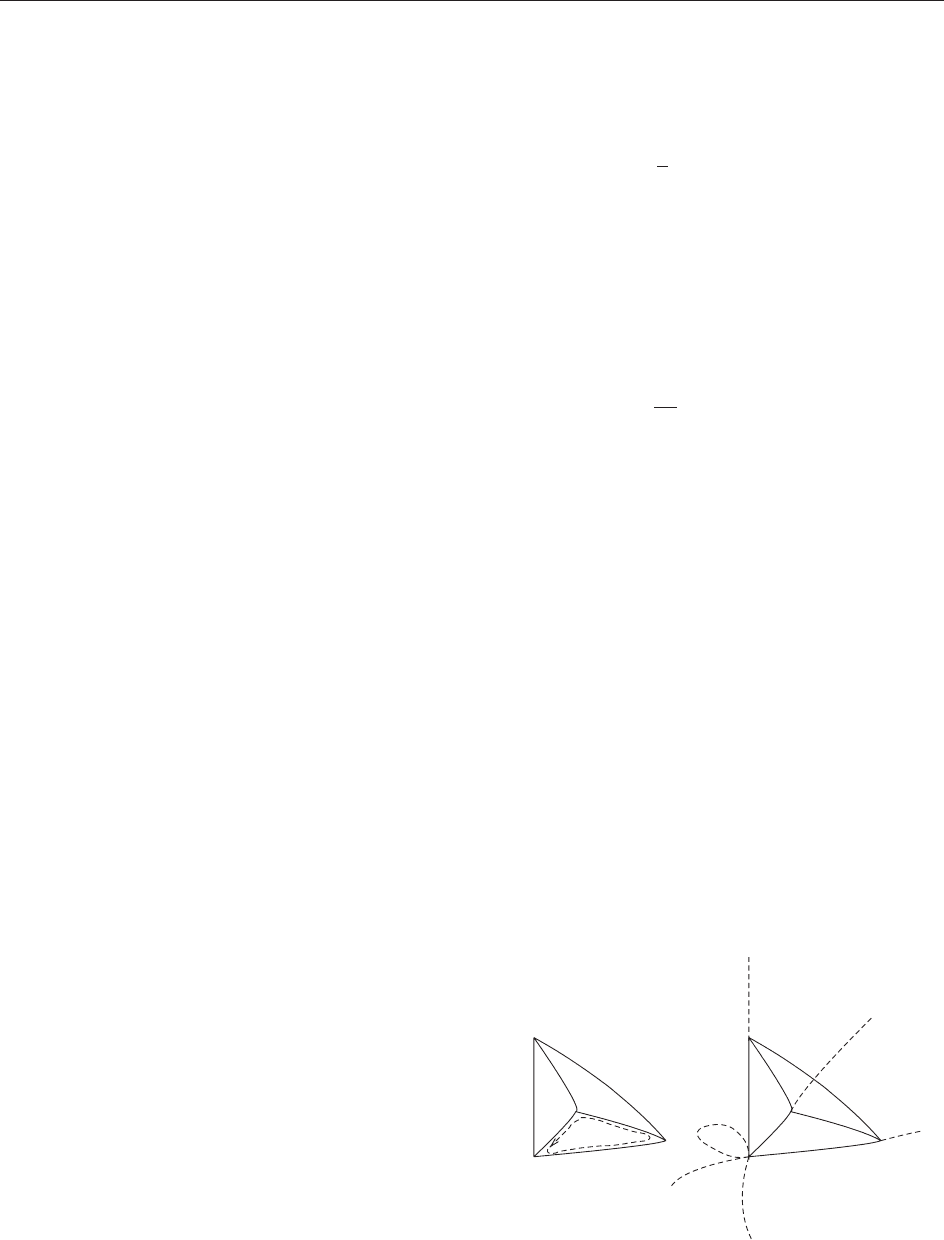
As said before, strictly speaking, implementing the
dynamics comprises quantizing and satisfying all the
constraints. Here we will however focus on C since
it is the most challenging, and most closely related
to standard dynamics in that it genera tes changes
under timelike deformations of the Cauchy surface
on which the canonical formulation is based.
The quantum solutions of the other constraints,
linear combinations of s-knots, lie in a Hilbert space
K
diff
which is part of the dual of the kinematical
Hilbert space K of the theory. For details on these
solutions as well as some basic definitions that will
be used without comment below (see Loop Quan-
tum Gravity). Since s-knots are labeled, among other
things, by a diffeomorphism equivalence class of a
graph, relations to knot theory are emerging at this
level (see Knot Invariants and Quantum Gravity).
It is important to note that C does not Poisson-
commute with the diffeomorphism constraints.
Therefore, in the quantum theory it does matter in
which order the constraints are solve d. It turns out
that on the quantum solutions to the other con-
straints, the scalar constraint can be defined by
introducing a regulator, and stays well defined even
when the regulator is removed. This ultraviolet
finiteness on K
diff
can be intuitively understood
from the diffeomorphism invarianc e of its elements:
There is no problematic short-distance regime since
the states do not contain any scale at all.
In the following we will briefly review the imple-
mentation of the scalar constraint in LQG and
comment on some ramifications and open questions.
The Scalar Constraint Operator
In the Lorentzian theory the scalar constraint C is
the sum of the scalar con straint C
E
of the Euclidean
theory:
C
E
¼ðdet qÞ
1=2
trðF
ab
½E
a
; E
b
Þ
a second term of a similar form, but with the
curvature F of the connection A replaced by the
curvature associated to a certain triad e,and
possibly matter terms. In the following we will just
discuss C
E
, the other terms can be handled in a
similar fashion.
There appear to be a number of obstacles to the
quantization of C
E
: for one, the inverse of
the determinant would likely be ill defined, as
the volume operator – essentially a quantization of
R
(det q)
1=2
– has a large kernel. In addition, there
are no well-defined operators corresponding to F
and E evaluated at points. Rather, only holonomies
h
e
[A]ofA along curves e and certain functionals of
E are well defined as operators. These issues can
however be dealt with in an elegant way as follows.
The first step is to absorb the determinant factor
into a Poisson bracket,
C
E
¼
2
abc
trðF
ab
fA
c
; VgÞ
where V is the volume of the spatial slice . Then
one approximates the curvature by (identity minus)
the holonomy around a small loop. In the present
case one finds that for a small tetrahedron with
base point v, one can approximate
C
E
ðNÞ:¼ 2
1
Z
N trð F ^fA; VgÞ
2
3
NðvÞ
ijk
trðh
ij
h
s
k
fh
1
s
k
; VgÞ ½1
where (see Figure 1a)) the s
i
are edges of incident
at v and the
ij
loops around the faces of incident
at v.
This suggests how to define an operator
b
C
E
that
acts on cylindrical functions on a given graph : one
chooses a triangulation adapted to the graph and
quantizes the C
E
(N) (where is a tetrahedron of
this triangulation) using the right-hand side of [1] –
holonomies are quantized by the holonomy opera-
tors of the quantum theory, V by the volume
operator
b
V, and the Poisson bracket by the
corresponding commutator divided by ih.Tobe
more precise, the triangulation is chosen such that
the s
k
in [1] are part of , and the operators
corresponding to the h
are creating new edges that
connect the endpoints of the s
k
(see Figure 1b).
Still this is not sufficient, since the definition of
b
C
E
depends quite heavily on the choice of the triangula-
tion, and there is no natural way to choose one.
Furthermore, there is no choice that would guarantee
s
3
s
2
s
1
α
12
v
(a) (b)
Figure 1 (a) A tetrahedron and its labeling of edges and
loops. (b) A tetrahedron adapted to the edges (dashed lines)
of a graph .
166 Quantum Dynamics in Loop Quantum Gravity
that the
b
C
E
for different are consistent in the sense
that they correspond to the action of the same
operator
b
C
E
on two different cylindrical subspaces.
Here, the diffeomorphism invariance of the theory
comes to the rescue: a well-defined operator largely
free of ambiguities can be obtained by letting the
operators above act (by duality) on K
diff
to give
elements in K
. When acting on diffeomorphism-
invariant states, the ambiguities in the definition of
the triangulations can be eliminated, and the opera-
tors
b
C
E
for different are consistent and together
define an operator
b
C
E
(N). Roughly speaking, for a
diffeomorphism-invariant state, it does not matter
anymore where on the graph the endpoints of the s
k
lie and how they are connected to form the loops .
The final picture looks as follows: for each s-knot s,
the operator gives a sum of contributions, one for
each vertex of s,thatis,
b
C
E
(N)s =
P
v
c
C
v
(N)s.The
terms in this sum are not diffeomorphism invariant.
Their evaluation on a spin network S is of the form
ð
c
C
v
sÞ½S¼
X
s
0
cðs
0
ÞNðxðvÞÞs
0
½S½2
where the s
0
are s-knots that differ from s by the
addition or deletion of certain edges, and correspond-
ing changes in coloring (by 1=2) and intertwiners. As
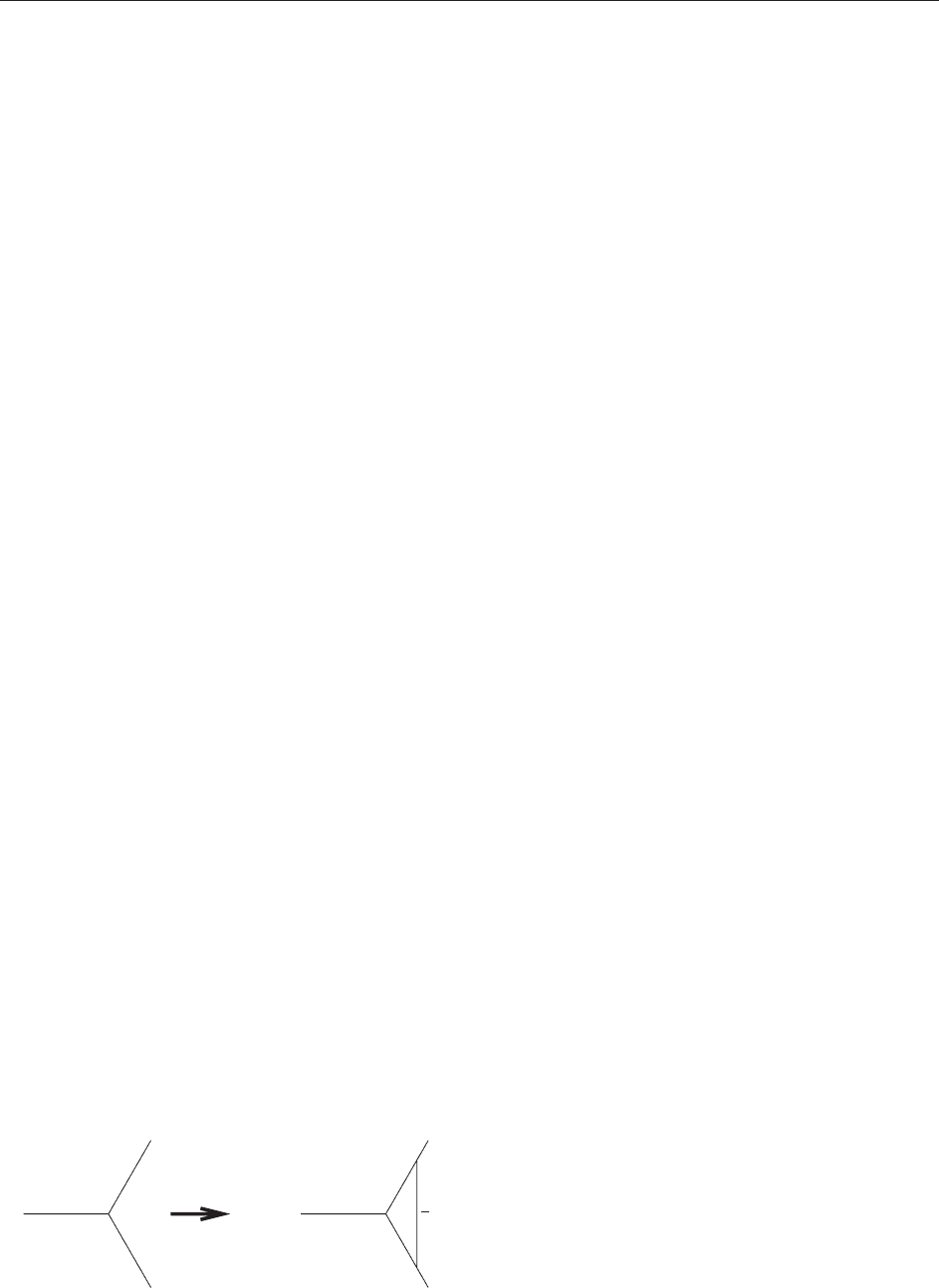
an example, Figure 2 schematically depicts the action
on a trivalent vertex. The point x(v)onwhichN is
evaluated in the above formula gets determined as
follows: the evaluation s
0
[S] is zero unless the graph
on which S is based is an element in the diffeomorph-
ism equivalence class on which s
0
is based. x(v)isthe
position of the vertex v in this element of the
equivalence class. Because of this x(v), the action of
b
C
E
(N) is not diffeomorphism invariant.
Similar techniques give a quantization
b
C of the
full constraint. The solutions to the constraint can
be determined as the vectors 2K
diff
that are
annihilated by
b
C in the sense that (
b
C(N) )[f ] = 0
for all functions N and elements f of K. The
solutions are more or less explicitly known; how-
ever, the task of interpreting them is a hard one and
remains an object of current research.
It should be mentioned that, strictly speaking, one
can arrive at several slightly different versions of the
constraint operator along the lines sketched above.
The quantization ambiguities include changes in the
power of the volume operator and the spin quantum
number that the constraint creates or annihilates. An
interesting check on these quantizations would be to
inspect the algebra of constraint operators for anoma-
lies. In the present situation, this can only be carried
out to a certain extent, because
b
C is defined on
diffeomorphism-invariant states. The Poisson bracket
between two scalar constraints is proportional to a
diffeomorphism constraint, and indeed it turns out
that in the quantum theory the commutator of two
scalar constraint operators vanishes for quantizations
as described above. In that sense they are ambiguity
free; however, this criterion is not strong enough to
distinguish between the candidates.
Recently, a slightly different strategy has been
proposed, which, if successfully implemented, would
eliminate some of the questions regarding the
constraint algebra. The idea is to combine the
constraints C(N) for different lapse functions N
into one master constraint
M ¼
Z
ðdet qÞ
1=2
C
2
d
3
x
M is manifestly diffeomorphism invariant and could
replace all the noncommuting constraints C(N),
hence simplifying the constraint algebra considerably.
The interpretation of the solutions of all the
constraints hinges on the construction of observables
for the theory. This is already a difficult task in the
classical theory, and thus even more so after quantiza-
tion. Though there is no general solution to this problem
available, interesting proposals are being studied.
Finally, it should be said that the quantization of
the scalar constr aint can be used to obtain a picture
that resembles more the standard time evolution in
quantum field theory. The (formal) power series
expansion of the projector
P ¼
Y
x2
ð
b
CðxÞÞ ¼
Z
D½N exp i
Z
NðxÞ
b
CðxÞ
onto the kernel of
b
C can be described by a spin foam
model (see Spin Foams).
For further information on the subject of this article
see the references: Thiemann (to appear), Rovelli
(2004),andAshtekar and Lewandowski (2004) for
general reviews on LQG (with a systematic exposition
of a large class of quantizations of the scalar constraint
and their solutions in Ashtekar and Lewandowski
(2004)); Thiemann (1998) for a seminal work on the
quantization of the scalar constraint; Rovelli (1999)
and Reisenberger and Rovelli (1997) on the connec-
tion to spin foam models; Di Bartolo et al. (2002) on
k
j
∑
1
2
j, k
Figure 2 A schematic rendering of the action of the operator
b
C
v
for a trivalent vertex.
Quantum Dynamics in Loop Quantum Gravity 167

consistent discretizations; Kodama (1990) and Freidel
and Smolin (2004) on the Kodama state; and
Thiemann (2003) on the master constraint program.
See also: Constrained Systems; Knot Invariants and
Quantum Gravity; Loop Quantum Gravity; Quantum
Geometry and its Applications; Spin Foams; Wheeler–De
Witt Theory.
Further Reading
Ashtekar A and Lewandowski J (2004) Background independent
quantum gravity: a status report. Classical and Quantum
Gravity 21: R53.
Di Bartolo C, Gambini R, and Pullin J (2002) Canonical
quantization of constrained theories on discrete space-time
lattices. Classical Quantum Gravity 19: 5275.
Freidel L and Smolin L (2004) The linearization of the Kodama
state. Classical and Quantum Gravity 21: 3831.
Kodama H (1990) Holomorphic wave function of the universe.
Physical Review D 42: 2548.
Reisenberger MP and Rovelli C (1997) ‘‘Sum over surfaces’’ form
of loop quantum gravity. Physical Review D 56: 3490.
Rovelli C (1999) The projector on physical states in loop
quantum gravity. Physical Review D 59: 104015.
Rovelli C (2004) Quantum Gravity, Cambridge Monographs
in Mathematical Physics. Cambridge: Cambridge University
Press.
Thiemann T (1998) Quantum spin dynamics (QSD). Classical and
Quantum Gravity 15: 839.
Thiemann T (2003) The Phoenix project: master constraint
programme for loop quantum gravity, arXiv:gr-qc/0305080.
Thiemann T (2006) Modern Canonical Quantum General
Relativity, Cambridge University Press (to appear).
Quantum Electrodynamics and Its Precision Tests
S Laporta, Universita
`
di Parma, Parma, Italy
E Remiddi, Universita
`
di Bologna, Bologna, Italy
ª 2006 Elsevier Ltd. All rights reserved.
Introduction
Quantum electrodynamics (QED) describes the
interaction of the elec tromagnetic field (EMF)
with charged particles. Any physical particle
interacts, directly or indirectly, with any other
particle (including itself); in the case of the
electron, however, at low and medium energy
(say, up to a few GeV) the interaction with the
EMF is by and far the most important, so that
QED describes with great precision the dynamics
of the electron, and at the same time the electron
provides with the most stringent tests of QED
currently available.
In the various sections of this article we will
discuss, in the following order, the origin of QED,
the structure of the radiative corrections, the
application of QED to various bound states pro-
blems (the hydrogen- like atoms, the muonium, and
positronium) and the anomalous magnetic moments
of the leptons (the muon and the electro n).
Origin of QED
The origin of QED can ideally be traced back to the
very beginning of quantum mechanics, the black-
body formula by M Planck (1900), which was soon
understood as pointing to a discretization of the
energy and momentum associated to the EMF into
quanta of light or photons (Einstein 1905).
The quantization of the EMF was first worked out
by P Jordan, within the article (1926) by M Born,
W Heisenberg, and P Jordan (usually referred to as
the Dreima¨ nnerarbeit) and then in the paper ‘‘The
quantum theory of emission and absorption of
radiation’’ by PAM Dirac, commonly considered
the beginning of the so-called second quantization
formalism.
In the subsequent year (1928) Dirac published the
famous equation for the relativistic electron, from
which it was immediately deduced, on a firmer
basis, that the electron has spin 1/2, that its spin
gyromagnetic ratio (the ratio between spin and
associated magnetic mom ent in suitable dimension-
less units; see below for more details) is twice the
value predicted by classical physics (a result
expressed as g
e
= 2) and that the levels of atomic
hydrogen with the same principal quantum number
n are not fully degenerate, as in the nonrelativistic
limit, but do possess the so-called fine structure
splitting. In particular, the energy of the n = 2 levels
splits into two values, one value for 2P
3=2
states
with total angular momentum J = 3=2 and another
value for the states 2S
1=2
and 2P
1=2
, which have
J = 1=2; note that the 2S
1=2
and 2P
1=2
states are still
degenerate.
Very soon it was realized that Dirac’s equation
also requi res that each particle must be accompanied
by its antiparticle, with exactly the same mass and
opposite charge. The antiparticle of the electron, the
positron, was indeed discovered by C Anderson
168 Quantum Electrodynamics and Its Precision Tests

(1932), establishing Dirac’s equation as one of the
cornerstones of theoretical physics.
All the ingredients needed for the evaluation of
the perturbative corrections to the QED theory
(usually called radiative corrections) were already
present at that moment, but radiative corrections
were not systematically investigated for several
years, due perhaps to the length and difficulty of
the calculations and the absence of important
disagreements between theoretical predictions and
experimental results.
The situation changed in 1947, when two experi-
ments were carried out, measuring the energy
difference between the 2
2
S
1=2
and 2
2
P
1=2
levels of
the hydrogen atom and the gyromagnetic ratios of
the electron.
Lamb and Retherford (1947), by using the ‘‘great
wartime advances in microwaves techniques,’’ suc-
ceeded in establishing that in the hydrogen atom
‘‘the 2
2
S
1=2
state is higher than the 2
2
P
1=2
by about
1000 Mc/sec.,’’ while (as observed above) according
to the Dirac theory the two states are expected to
have exactly the same energy . Subsequent refine-
ments of the experiment (Triebwasser et al. 1953)
gave for the difference (now referred to as Lamb
shift) the value 1057.77 0.10 MHz, with a relative
error 1 10
4
.
The authors of the second 1947 experiment
(Kusch and Foley 1947) measured the frequencies
associated with the Zeeman splitting of two differ-
ent states of gallium, finding an inconsistency with
the theoretical values of the gyromagnetic ratios of
the electro n. More exactly, write the magnetic
moments m
L
, m
S
associated to the (dimensionless)
orbital and spin angular momenta L, S of the
electron as
m
L
¼g
L
eh
2m
e
c
L; m
S
¼g
S
eh
2m
e
c
S ½1
where (e) is the charge of the electron (e > 0), m
e
its mass, c the speed of light and g
L
, g
S
, respectively,
the orbital and spin gyromagnetic ratios; the Dirac
theory then predicts g
L
= 1 and g
S
= 2, while the
results of Kusch and Foley (1947) gave a discre-
pancy which could be accounted for by taking
g
S
= 2.00229 0.00008 and g
L
= 1, or alternatively
g
S
= 2andg
L
= 0.99886 0.00004. In modern
notation the first conjecture can be rewritten as
g
S
¼ g
e
¼ 2ð1 þ a
e
Þ; a
e
¼ 0:001145 0:00004 ½2
where a
e
is the anomalous magnetic moment (or
magnetic anomaly) of the electr on.
The need of explaining the two experimental
results gave rise to a rapid development of covariant
perturbation theory (which replaced the previous
noncovariant ‘‘old fashioned’’ perturbation theory)
and of the renormalization theory, which liberated
the perturbative expansi on from the divergences
plaguing the older approach, opening the path to the
evaluation of radiative corrections and to the great
success of precision predictions of QED.
The formalism improved quickly, evolving in
the more general quantum field theory (QFT)
approach; three of the main contributors were
Sin-Itiro Tomonaga, Julian Schwinger, and Richard
P Feynman, awarded a few years later (1965) the
Nobel price ‘‘for their fundamental work in quantum
electrodynamics, with deep-ploughing consequences
for the physics of elementary particles.’’ QFT was then
successfully used for describing the weak interactions
in the electroweak model and later on also for the
strong interactions theory, dubbed quantum chromo-
dynamics (or QCD, in analogy with the popular QED
acronym). For more details and references to original
works, the reader is invited to look at any treatise on
QED or QFT, such as, for instance, Weinberg (1995).
Initially, the Lamb shift was perhaps more
important than the electron magnetic anomaly both
for the establishment of renormalization theory and
as a test of QED, but in the following years it was
supplanted by the latter as a precision test of QED.
In 1947 the ‘‘best value s’’ for some fundamental
constants were indeed
c ¼ð2:99776 0:00004Þ10
10
cm s
1
R
1
¼
m
e
c
2
2
2hc
¼ 109737:303 0:017 cm
1
1= ¼ 137:030 0:016
½3
where R
1
is the Rydberg constant for infinite mass,
h the Planck constant, and the fine structure
constant (let us observe here in passing that R
1
was
and is still known much better than the separate
values of m
e
, , and h entering in its definition); for
comparison, the curren t (2005) values for c and R
1
are
c ¼ 299792458 m s
1
R
1
¼ 109737:31568525ð73Þcm
1
½4
where the value of c is exact (it is in fact the
definition of the meter), and the relative error in R
1
is 6.6 10
12
(the value of will be discussed later).
The measurement of the Lamb shift, repeated
several times, gave results in nice agreement with
the original value, and for several years it was
providing either a test of QED or a precise value for
. But the Lamb shift is the energy difference
between the metastable level 2S
1=2
(whose lifetime
Quantum Electrodynamics and Its Precision Tests 169

is about 1/7 s) and the 2P
1=2
level, which has a
lifetime of about 1.596 ns or a natural linew idth of
99.7 MHz. Such a large linewidth poses a strong
intrinsic limitation to the precision attainable in the
measure of the Lamb shift, which is just ten times
larger; as a matter of fact, that precision co uld never
reach the 1 10
6
relative error level, while in the
meantime the relative precision in a
e
reached the
10
9
range, replacing the Lamb shift in the role of
the leading quantity in high-precision QED.
The Structure of Radiative Corrections
For obvious space problems we can only super-
ficially sketc h here the lines along which the
perturbative expansion of QED leading to the
evaluation of radiative corrections can be built,
considering for simplicity only the photon and the
electron. One can start from a QED Lagrangian,
formally similar to the classical Lagrangian, invol-
ving the electron field and the vector potentials of
the electromagnetic (or photon) field. The theory is
a gauge theory (its physical content should not
change if a gradient is added to the vector
potentials); it is further an abelian gauge theory as
the EMF does not interact directly with itself.
The QED Lagrangian is separated into a free part
and an interaction part. From the free part, one
derives the wave functions of the free-particle states
and the corresponding time-evolution operators
(free Green’s functions or propagators; let us just
recall here that to obtain a convenient photon
propagator one has to break the gauge invariance
by adding to the Lagrangian a suitable gauge-
breaking term), while the interaction part of the
Lagrangian gives the ‘‘interaction vertices’’ of the
theory.
Aim of the theory is to build the Green’s function
for the various processes in the presence of the
interaction; from these Green’s functions, one then
derives all the physical quantities of interest.
With the free propagators and the interaction
vertices, one generates the perturbative expansion of
the Green’s functions. The result, namely the
contributions to the perturbative expansion (or
radiative corrections), can be depicted in terms of
Feynman graphs: they consist of various particle
lines joined in the interaction vertices, with external
lines corresponding to the initial and final particles
and internal lines corresponding to intermediate or
virtual particle states. Each graph stands for an
integral on the momenta of all the intermediate
states, each vertex implying among other things an
interaction constant, which is (e) in the case of
electron QED, and a -function imposing the
conservation of the momenta at that vertex. For
each process, the Feynman graphs are naturally
classified by the total number of the interaction
vertices they contain. In the simplest graphs for a
given process (the so-called tree graphs) the
-functions at the vertices make the integrations
trivial; but when the number of vertices increases,
closed loops of virtual particle states appear, whose
evaluation quickly becomes extremely demanding.
In QED, each loop gives an extra factor (e)
2
with
respect to the tree graph; it is customary to express it
in terms of (=) = (e=2)
2
, so that the resulting
power of (=) corresponds to the number of
internal loops. The typical QED prediction for a
physical quantity is then expressed as a series of
powers of the fine structure con stant (and of its
logarithm in bound-state problems). As is small
( ’ 1=137), and the first coefficients of the expan-
sions are usually of the order of 1, a small number
of terms in the expansion is in general sufficient to
match the precision of the available experimental
data.
But the number of different graphs for a given
number of loops grows quickly with the number of
the loops; in turn, each graph consists in general of a
great number of terms and the loop integrations
become prohibitively difficult when the number of
loops increases, so that the eval uation of radiative
corrections proved to be one of the major computa-
tional challenges of theoretical physics. As a matter
of fact, it prompted the development of computer
programs (Veltman 1999) for processing the huge
algebraic expressions usually encountered, and of
many sophisticated numerical and analytical techni-
ques for performing the loop integrations.
It should be further mentioned here that Feynman
graphs written by naively following the above
sketched rules are ofte n mathematically ill-defined,
taking the form of nonconvergent integrals on the
loop momenta. A regularization procedure is needed
to give an unambiguo us meaning to all the integrals;
currently the most powerful regularization is the
continuous dimensional regularization scheme, in
which the loop integrations are carried out in d
continuous dimensions, with d unspecified; renor-
malization counter-terms are also evaluated in the
same scheme, and the physical quantities are
recovered in the d !4 limit (unrenormalized loop
integrals and renormalization counterterms are
usually singular as powers of 1=(d 4) in the
d !4 limit, but all those divergences cancel out in
the physical combinations of interest).
QED describes the main interaction of the
charged leptons (e, ,and) which have, however,
weak interactions as well. Strictly speaking, pure
170 Quantum Electrodynamics and Its Precision Tests

QED processes do not exist; it is an essential feature
of QFT that any existing particle can contribute to
the Feynman graphs for any process, when the
approximation is pushed to a sufficiently high
degree. In particular the photon, which is the main
carrier of the QED interaction, is directly coupled
also to the strongly interacting particles (the result-
ing contributions are referred to as ‘‘hadronic
vacuum polarization’’ effects).
The precision tests of QED are then to be
necessarily searched for in those phenomena where
non-QED contribu tions are presumably small and
which involve quantities already well known inde-
pendently of QED itself. But such high-precision
quantities are not alw ays available, and as QED is
known better than the rest of physics, very ofte n it is
taken to be correct by assumption, and used as a
tool for extracting or measuring some of the non-
QED quantities relevant to various physical
processes.
In any case, as QED predictions are expressed in
terms of the fine structure constant , a determina-
tion of independent of QED is needed; without it,
the most precise predictions of QED would simply
become measures of and not tests of the theory.
Finally, it is to be recalled that, ironically, the
problem of the convergence of the expansion in
powers of is still open, even if it is commonly
accepted that convergence problems will matter only
for precisions and corresponding perturbative orders
(say at order 1= ’ 137) absolutely out of reach of
present experimental and computational possibili-
ties, involving further extremely high energies,
where the other fundamental interactions are
expected to be as important as QED, so that it
would be meaningless to consider only QED.
In the following we will discuss only the QED
predictions for bound states and the anomalous
magnetic moments of and e.
The Bound States
A very good review of the current status of the theory
of hydrogen-like atoms can be found in Eides et al.
(2001), to which we refer for more details and
citation of the original papers. The starting point for
studying the bound-state problem in QED is the
scattering amplitude of two charged particles, pre-
dicted by perturbative QED (pQED) as a (formal)
series expansion in powers of . In the static limit
v !0, where v is the relative velocity of the two
particles, some of the pQED terms behave as =v ,so
that the naive expansion in becomes meaningless.
Fortunately, it is relatively easy to identify the origin
of those terms (which are essentially due to the
Coulomb interaction between the two charges) and
to devise techniques for their resummation. Among
them, one can quote the Bethe–Salpeter equation,
formally very elegant and complete but difficult to
use in practice. A great progress has been achieved by
the NRQED (nonrelativistic QED) approach, which
is a nonrelativistic theory designed to reproduce the
full QED scattering amplitude in the nonrelativistic
limit by the ad hoc definition, aposteriori,ofa
suitable effective Hamiltonian. The Hamiltonian is
then divided into a part containing the Coulomb
interaction, which is treated exactly and which gives
rise to the bound states, and all the rest, to be treated
perturbatively. The power of the NRQED approach
was further boosted by the continuous dimensional
regularization technique of Feynman graph integrals.
Traditionally, the results are expressed in terms of
the energies of the bound states, but as in practice
the precise measurements concern the transition
frequencies between various levels, it is customary
to express any energy contribution to some level, say
E, also in terms of the associated frequency
= (E)=h, where h is the Planck constant.
The Hydrogen-Like Atoms
Quite in general, a hydrogen-like atom consists of a
single electron bound to a positively charge particle,
which is a proton for the hydrogen atom, a deuteron
nucleus for deuterium, a Helium nucleus for an He
þ
ion, a
þ
meson for muonium, or a positron for
positronium. Even if QED alone is not sufficient to
treat the dynamical properties of the nuclei, their
strong interactions can be described by introducing
suitable form factors and a few phenomenological
parameters; weak interactions could be treated
perturbatively, but are not yet required at the
precision levels achieved so far.
The QED results for the hydrogen-like atoms can
be expressed in terms of the mass M of the posit ive
particle and of its charge Ze (of course Z = 1 for
hydrogen). When the electron mass m
e
is smaller
then M (which is always the case, except the
positronium case) one can take as a starting point
the QED electron moving in the external field of the
positive particle, and treat all the other aspects of
the relativis tic two-body problem (the so-called
recoil effects) perturbatively in m
e
=M.
Neglecting the spin of the positive particle, the
energy levels of the hydrogen-like atom are identi-
fied by the usual principal quantum number n, the
orbital angular momentum l (with the convention of
writing S, P, D, ... instead of l = 0, l = 1, l = 2, ...)
and j, the total angular momentum including the
spin of the electron. It turns out that the bound
Quantum Electrodynamics and Its Precision Tests 171