
Francoise J.-P., Naber G.L., Tsun T.S. (editors) Encyclopedia of Mathematical Physics
Подождите немного. Документ загружается.


descr ibed in the su bsection ‘‘Conn ections and con-
nection forms’’ is strong (and every strong conn ection
in a trivial bundle is of this form). Assuming
invertibility of the antipode in A, a canonical
connection in a qua ntum homogeneous bundle
described in that subsection is strong provided Ad-
covariance (3) is replaced by conditions (id )
i = (i id)
A
(right covariance) and ( id)
i = (id i)
A
(left covariance), where is a
coproduct in P,and
A
is a coproduct in A.
In the universal calculus case, the map D can
be extended to a map D :
1
P !
2
P via the
formula D( ) = dþ
P
(0 )
! (
(1)
). Then D D( p) =
P
p
(0)
F
!
( p
(1)
), where F
!
is the curvature of ! (cf. the
subsection ‘‘Connections and connection forms’’). This
explains the relationship between a curvature under-
stood as the square of a covariant derivative and F
!
.
Bundle Automorphisms and Gauge
Transformations
A quantum bundle automorphism is a left B-linear
right A-covariant (i.e., colinear) automorphism
F : P !P such that F(1) = 1. Bundle automorphisms
form a group with operation FG = G F. This group
is isomorphic to the group G(P) of gaug e transfor-
mations, that is, maps f : A !P that satisfy the
following conditions:
1. f (1
A
) = 1
P
(unitality);
2.
P
f = (f id) Ad (Ad-covariance); and
3. f is convolution invertible (cf. the subsection
‘‘Hop f algebra prelim inaries’’).
The product in G ( P) is the convolut ion product
(cf. the subsec tion ‘‘Hop f algebra preliminar ies’’).
The group of gauge transformations acts on the
space of (strong) connection forms ! via the formula
f .!¼ f ! f
1
þ f df
1
; 8f 2GðPÞ
This resembles the gauge transformation law of a
gauge field in the standard gauge theory. The curvature
transforms covariantly as F
f .!
= f F
!
f
1
.
In the case of a trivial principal bundle, gauge
transformations correspond to a change of the
trivialization and can be identified with convolution-
invertible maps : A !B such that (1) = 1. A map
: A !
1
B that induces a connection as in the
subsection ‘‘Connections and connection forms’’ is
transformed to
1
þ d
1
,andthecurva-
ture F
7! F
1
.
Associated Bundles: Matter Fields
Given a right A-comodule (corepresentation)
% : V !V A one defines a quantum vector bundle
associated to P as
E ¼
n
X
i
v
i
p
i
2V P
X
i
v
i
ð0Þ
p
i
ð0Þ
v
i
ð1Þ
p
i
ð1Þ
¼
X
i
v
i
p
i
1
o
V P
E is a right B-module with product (
P
i
v
i
p
i
)b =
P
i
v
i
p
i
b. A right B-linear map s : E !B is called a
section of E. The space of sections (E) is a left B-
module via (bs)(p) = bs(p).
The theory of associated bundles is particularly rich
when A has a bijective antipode and P has a strong
connection form !.Inthiscase,(E) is isomorphic to
the left B-module
%
of maps : V !P such that
P
= ( id) %.IfV is finite dimensional, then
%
is a
finite projective B-module, that is, it is a module of
sections of a noncommutative vector bundle in the
sense of Connes. The strong connection induces a map
r:
%
!
1
B
B
%
,givenbyr()(v) = d(v) þ
P
(v
(0)
)!(v
(1)
). r is a connection in the sense of
Connes (in a projective left B-module), that is, for all
b 2B, 2
%
, r(b) = db
B
þ br().
In the case of a trivial bundle,
%
can be identified
with the space of linear maps V !B. Thus, sections
of an associated bundle correspond to pullbacks of
matter fields, as in the classical local gauge theory
matter fields are defined as functions on a spacetime
with values in a representation (vector) space of the
gauge group.
The Dirac q-Monopole
This is an example of a strong connection in a
quantum homogeneous bundle (cf. the subsection
‘‘Qu antum homo geneous bundles ’’). P = SU
q
(2) is a
matrix Hopf -algebra with matrix of generators
a qc
ca
and relations
ac ¼ qca; ac
¼ qc
a; cc
¼ c
c
a
a þ c
c ¼ 1; aa
þ q
2
cc
¼ 1
where q is a real parameter. A = C[U(1)] is a Hopf
-algebra generated by unitary and group-like u
(i.e., uu
= u
u = 1, (u) = u u). The -projection
: P !A is defined by (a) = u. The coinvariant
subalgebra B is generated by x = cc
, z = ac
,
z
= ca
. The elements x and z satisfy relations
x
¼ x; zx ¼ q
2
xz;
zz
¼ q
2
xð1 q
2
xÞ; z
z ¼ xð1 xÞ
242 Quantum Group Differentials, Bundles and Gauge Theory

Thus, B is the algebra of functions on the standard
quantum 2-sphere. A strong connection is obtained
from a bicovariant -map i : A !P given by
i (u
n
) = a
n
(cf. the subsec tions ‘‘Quan tum homoge-
neous bundles ,’’ ‘‘Co nnections an d connect ion
forms, ’’ and ‘‘Covari ant deri vative: strong conn ec-
tions’’). Explicitly, the connection form reads
!ðu
n
Þ¼
X
n
k¼0
n
k
q
2
c
k
a
nk
dða
nk
c
k
Þ
!ðu
n
Þ¼
X
n
k¼0
q
2k
n
k
q
2
a
nk
c
k
dðc
k
a
nk
Þ
where the deformed bino mial coefficients are
defined for any number x by
n
k
x
¼
ðx
n
1Þðx
n1
1Þðx
kþ1
1Þ
ðx
nk
1Þðx
nk1
1Þðx 1Þ
There is a family V
n
, n 2Z of one-dimensional
corepresentations of C[U(1)] with V
n
= C and
%
n
(1) = 1 u
n
, n 0and%
n
(1) = 1 u
n
, n < 0. This
leads to the family of finite projective modules
n
=
%
n
as descr ibed in the subsecti on ‘‘Assoc iated
bundles : matter fields.’’ The Hermitian proje ctors
e(n) of these modules come out as, for n > 0,
eðnÞ
ij
¼
ffiffiffiffiffiffiffiffiffiffiffiffiffiffiffiffiffiffiffiffiffiffiffiffiffiffiffiffiffiffi
n
i
q
2
n
j
q
2
s
a
ni
c
i
c
j
a
nj
;
i; j ¼ 0; 1; ...; n
eðnÞ
ij
¼ q
iþj
ffiffiffiffiffiffiffiffiffiffiffiffiffiffiffiffiffiffiffiffiffiffiffiffiffiffiffiffiffiffi
n
i
q
2
n
j
q
2
s
c
i
a
ni
a
nj
c
j
;
i; j ¼ 0; 1; ...; n
The e(n) describe q-monopoles of magnetic charge
n. For example, the charge-1 projector explicitly
reads
1 xz
zq
2
x
and reduces to the usual charge-1 Dirac monopole
projector when q = 1. The covariant derivatives r
are Levi-Civita or Grassmann connections in mod-
ules
n
corresponding to projectors e(n).
The q-Instanton
This is an example of a coalgebra bundle and the
associated vector bundle, which is a deformation of
an instanton (with instanton number 1). P = C[S
7
q
]is
the -algebra of polynomial functions on the
quantum 7-sphere. As a -algebra it is defined by
generators z
1
, z
2
, z
3
, z
4
and relations
z
i
z
j
¼ qz
j
z
i
ðfor i < jÞ
z
j
z
i
¼ qz
i
z
j
ðfor i 6¼ jÞ
z
k
z
k
¼ z
k
z
k
þð1 q
2
Þ
X
j<k
z
j
z
j
;
X
k¼1
z
k
z
k
¼ 1
where q 2R. The coaction of the -Hopf algebra
A = SU
q
(2) (cf. the previous subsection) on P is
constructed as follows. Start with the quantum group
U
q
(4), generated by a matrix t = (t
ij
)
4
i, j = 1
and view
C[S
7
q
] as a right quantum homogeneous space of U
q
(4)
generated by the bottom row in t.Thus,thereisaright
coaction of U
q
(4) on C[S
7
q
] obtained by the restriction of
the coproduct in U
q
(4). Next, project U
q
(4) to SU
q
(2)
by a suitable coideal and a right ideal in U
q
(4). The
corresponding canonical surjection r :U
q
(4) !SU
q
(2)
is a coalgebra map, characterized as a right U
q
(4)-
module map by r(t
11
t
22
qt
12
t
21
) = 1and
rðtÞ¼
u 0
0 u
;
u ¼
u
22
u
21
u
12
u
11
where u = (u
ij
)
2
i, j = 1
is the matrix of generators
of SU
q
(2) (cf. the previous subsection). When
applied to the coaction of U
q
(4) on C[S
7
q
], r induces
the required coaction
P
: C[S
7
q
] !C[S
7
q
] SU
q
(2).
Explicitly, the coaction comes out on generators
as
P
(z
j
) =
P
i
z
i
r(t
ij
). The coaction
P
is not
an algebra map. The coinvariant subalgebra B is a
-algebra generated by
a ¼ z
1
z
4
z
2
z
3
b ¼ z
1
z
3
þ q
1
z
2
z
4
R ¼ z
1
z
1
þ z
2
z
2
The elements a, a
, b, b
, R satisfy the following
relations:
Ra ¼ q
2
aR; Rb ¼ q
2
bR
ab ¼ q
3
ba; ab
¼q
1
b
a
aa
þ q
2
bb
¼ Rð1 q
2
RÞ
aa
¼ q
2
a
a þð1 q
2
ÞR
2
b
b ¼ q
4
bb
þð1 q
2
ÞR
Hence B can be understood as a deformation of the
algebra of functions on the 4-sphere and is denoted
by C[
4
q
]. One can show that the map ‘‘can’’ in the
subsec tion ‘‘Gener alizations of quantum princ ipal
bundles ’’ is bijective , hence there is an SU
q
(2)-
coalgebra principal bundle with the total space the
quantum 7-sphere C[S
7
q
] and the base space the
Quantum Group Differentials, Bundles and Gauge Theory 243

quantum 4-sphere C[
4
q
]. By abstract arguments
that involve cosemisimplicity of SU
q
(2), one can
prove that there exists a strong connection in this
bundle; this is the q-deformed instanton field. At the
time of writing this article, however, the explicit
form of this connection is not known.
On the other hand, following the classical con-
struction of an instanton, one can take the funda-
mental two -dimensional corepresentation V = C
2
of
SU
q
(2) and explicitly construct q-instanton projection
with instanton number 1. Writing e
1
, e
2
for the basis
of V, the coaction % : V !V SU
q
(2) is given by
ðe
j
Þ¼
X
i
e
i
u
ij
The associ ated bundl e (cf . the subsec tion ‘‘Asso-
ciated bundl es: matter fields ’’) is a finite pro jective
left module over C[
4
q
]. The corresponding q-instan-
ton projector comes out as
q
2
R 0 qa q
2
b
0 q
2
Rqb
q
3
a
qa
qb 1 R 0
q
2
b
q
3
a 01 q
4
R
0
B
B
@
1
C
C
A
See also: Bicrossproduct Hopf Algebras and
Noncommutative Spacetime; Hopf Algebras and
q-Deformation Quantum Groups; Noncommutative Tori,
Yang–Mills, and String Theory.
Further Reading
Bonechi F, Ciccoli N, and Tarlini M (2003) Noncommutative
instantons and the 4-sphere from quantum groups. Commu-
nications in Mathematical Physics 226: 419–432.
Bonechi F, Ciccoli N, Da
¸
browski L, and Tarlini M (2004)
Bijectivity of the canonical map for the noncommutative
instanton bundle. Journal of Geometry and Physics 51: 71–81.
Brzezin
´
ski T and Majid S (1993) Quantum group gauge theory on
quantum spaces. Communications in Mathematical Physics
157: 591–638.
Brzezin
´
ski T and Majid S (1995) Quantum group gauge theory on
quantum spaces – Erratum. Communications in Mathematical
Physics 167: 235.
Brzezin
´
ski T and Majid S (2000) Quantum geometry of algebra
factorisations and coalgebra bundles. Communications in
Mathematical Physics 213: 491–521.
Calow D and Matthes R (2002) Connections on locally trivial
quantum principal fibre bundles. Journal of Geometry and
Physics 41: 114–165.
Da
¸
browski L, Grosse H, and Hajac PM (2001) Strong connec-
tions and Chern–Connes pairing in the Hopf–Galois theory.
Communications in Mathematical Physics 220: 301–331.
Hajac PM and Majid S (1999) Projective module description of
the q-monopole. Communications in Mathematical Physics
206: 247–264.
Heckenberger I and Schmu¨ dgen K (1998) Classification
of bicovariant differential calculi on the quantum groups
SL
q
(n þ 1) and Sp
q
(2n). Journal fu¨ r die Reine und
Angewandte Mathematik 502: 141–162.
Klimyk A and Schmu¨ dgen K (1997) Quantum Groups and Their
Representations. Berlin: Springer.
Majid S (1998) Classification of bicovariant differential calculi.
Journal of Geometry and Physics 25: 119–140.
Majid S (1999) Quantum and braided Riemannian geometry.
Journal of Geometry and Physics 30: 113–146.
Majid S (2000) Foundations of Quantum Group Theory, 1st pbk.
edn. Cambridge: Cambridge University Press.
Wess J and Zumino B (1990) Covariant differential calculus on
the quantum hyperplane, Nuclear Physics B. Proceedings
Supplement 18B: 302–312.
Woronowicz SL (1989) Differential calculus on compact matrix
pseudogroups (quantum groups). Communications in Mathe-
matical Physics 122: 125–170.
Quantum Hall Effect
K Hannabuss, University of Oxford, Oxford, UK
ª 2006 Elsevier Ltd. All rights reserved.
Introduction
When a current flows in a thin sample with a
transverse magne tic field B, the Lorentz force
deflects the trajectories of the charge carriers,
producing an excess charge on one side and a
charge deficiency on the other, and creating a
potential difference across the conductor perpendi-
cular to both the direct current and the magnetic
field. This is known as the Hall effect, in honour of
E H Hall, who, inspired by a remark of Maxwell,
first demonstrated it in thin samples of gold foil in
October 1879 (Hall’s subsequent measurements of
the potential difference showed that the carriers
could be positively or negatively charged for
different materials). A schematic diagram of Hall’s
experiment and the lateral separation of charges is
shown in Figure 1.
Equilibrium is reache d when the magnetic force
balances that from the potential difference E due to
the displaced charge. When the charge carriers are
electrons, with the electron density n, and the
electron current J, this gives neE = JB. Comparison
with Ohm’s law, J = E, gives conductance (the
reciprocal of resistance) to be = ne=B. More
generally, considering the currents and fields as
244 Quantum Hall Effect
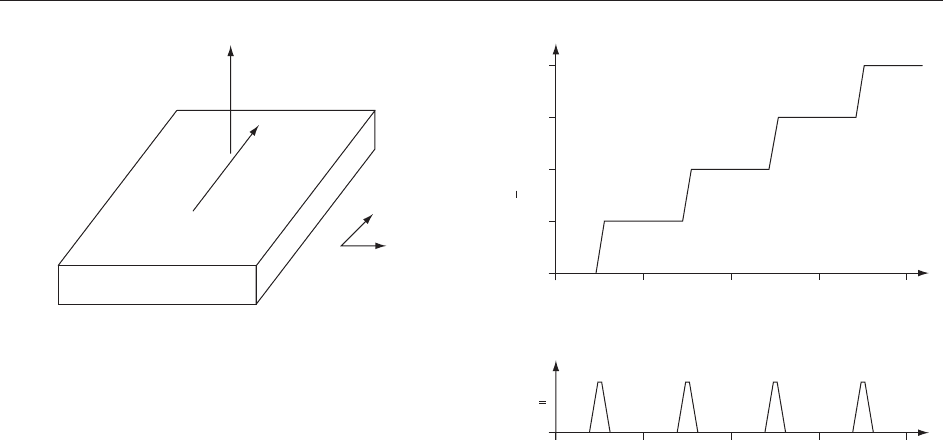
vectors, is represented by a matrix. Rescaling by
the sample thickness , the diagonal components of
give the direct conductivity
k
and its off-
diagonal elements give the Hall conductivity:
H
=
21
. (For systems symmetric under 90
rota-
tions,
11
=
22
and
12
=
21
.) In quantum
theory, one usually works in terms of the filling
fraction = nh=eB and then
H
= e
2
=h.
In 1980 von Klitzing, Dorda , and Pepper dis-
covered that at very low temperatures in very high
magnetic fields, the Hall conductivity
H
is quan-
tized as integral multiples of e
2
=h, a fact known as
the integer quantum hall effect (IQHE). The integer
multiples were accurate to 1 part in 10
8
, and the
effect was exceptionally robust against changes in
the geometry of the samples and in the experimental
parameters. Indeed, the unprecedented accuracy of
the effect led to its adoption as the international
standard for resistance in 1990.
More precisely, the Hall conductivity was no
longer proportional to the filling fraction , but the
graph of
H
against displayed a sequence of jumps,
as shown in Figure 2. In this figure, the conductivity
has plateau at the integer multiples of e
2
=h, and
jumps between them within fairly small ranges of
the filling fraction. Moreover, the direct conductiv-
ity vanishes where the Hall conductivity takes its
constant integral values.
These results raise numerous questions.
1. Why does the conductivity take such precise
integer values, and why are they so stable under
changes of the geometry and physical
parameters?
2. Why does the direct conductivity vanish, except
in regions where the Hall conductivity jumps
between integer values, and how are such jum ps
possible?
Moreover, any theory must also explain why
these features are not present under the more normal
conditions of the classical Hall effect. The following
features seem to play a role, and in the case of the
first three, even in the classical effect.
1. As Hall discovered, the samples must be very thin
to exhibit even the classical effect. (Nowadays
they are often a surface layer between two
semiconductors.)
2. The samples are macroscopic and much larger
than the quantum wave lengths appearing in the
problem.
3. The electric field is small enough that nonlinear
effects are negligible.
4. The quantum effect appears only at a very low
temperature.
The first of these suggests that we should idealize
to the case where the motion of the charge carriers is
restricted to a two-dimensional region, and the
second that we may work in the thermodynamic
limit wher e the conducting surface is the whole
of R
2
. The third and fourth ensure both that the
linear Ohm’s law should be adequate, and also that
it should be enough to consi der the limiting cases of
very weak electric fields and zero temperatu re.
Multiple limits of this sort raise delicate mathema-
tical issues. Indeed, many plausible models of the
effect turn out, on careful analysis, to predict
vanishing Hall conductivity.
A theoretical explanation of the quantization of
the conductivity was soon suggested by Laughlin.
Exploiting the apparent independence of sample
geometry, he considered a cylindrical conductor
where quantization followed on consideration of
Magnetic
field B
Direct
current
+
+
+
+
–
–
–
–
2
1
Figure 1 Schematic diagram of charge separation in Hall’s
experiment.
01234
1
0
2
3
4
01234
σ
(To different scale)
ν
h σ
H
/
e
2
Figure 2 Schematic diagram of the Hall and direct conductivities
plotted against the filling factor .
Quantum Hall Effect 245

the flux tubes threading it. Laughlin’s choice of a
particular configuration precluded investigation of
the influence of changing geometry. This was soon
provided by Thouless, Kohmoto, Nightingale, and
de Nijs, who argued (from a lattice version of the
problem) that the conductivity could be identified
with the Chern character of a line bundle over a
Brillouin zone (a quotient of momentum space by
the action of the reciproca l crystal lattice), so that it
had to be integral and the stability of the effect was
a consequence of the topological nature of .
Unfortunately, whilst suggestive, this explanation
worked only under the physically implausible con-
straint that the magnetic flux through a crystal cell
was rational, offered no explanation of the link
between the Hall and direct conductivities, and,
working with a periodic Hamiltonian, made no
allowance for the impurities and disorder usually
important in solid-state problems of this sort.
Notwithstanding these deficiencies, this model con-
tained important insights, which inspired Bellissard
to model the effect using Connes’ newly developed
noncommutative geometry (Bellissard 1986, Connes
1986). (Kunz produced a Hilbert space theory at about
the same time, but that has been rather less influential.)
Connes’ work turned out to contain all the relevant
concepts and tools needed to provide a good under-
standing of the effect, based on interpreting the
conductivity as a noncommutative Chern character
for a noncommutative version of the Brillouin zone. In
fact, the techniques of noncommutative geometry
seemed to fit the quantum Hall effect so well that
this has become one of the standard examples of the
theory.
Even whilst the theorists were struggling to
explain the experiments, observations by Tsui,
Sto¨ rmer, and Gossard showed that, with suitable
care, fractional Hall conductivities could also be
observed, although these were far less stable than
those given by integers. One, therefore, distinguishes
between IQHE and the fractional quantum Hall
effect (FQHE), and this survey concentrates largely
on the former. One simplifying feature of the IQHE
is that it seems to be comprehensible at the level of
individual noninteracting electrons, whereas the
FQHE certainly involves some kind of interaction
and many-body theory.
This article presents an outlin e of the connection
between noncommutative differential geometry and
the IQHE, and concludes by discussing some of the
approaches to the FQHE, and some other applica-
tions of noncommutative geometry and mathema-
tical directions suggested by the theory. The sections
alternate between the physic al model and the
mathematical abstraction from it.
There are go od surveys of the area (Bellissard
et al. 1994, McCann 1998) explaining how the
mathematical model arises out of the physics, the
mathematical models themselves. As well as being
the standard reference for noncommutative geome-
try, Connes (1994) discusses the Hall effect. These
resources contain good bibliographies, which may
be consulted for further references.
Electron Motion in a Magnetic Field
The following discussion restricts attention to
motion in two di mensions, with electrons as the
charge carriers, and no interactions between them.
(The first condition is essential; the second could be
relaxed a little to allow sufficiently long-lived
quasi-particles.) A single free electron with mass
m and charge e moving in the x
1
–x
2
plane with a
constant transverse magnetic field B in the positive
x
3
-direction, can be described by the Landau
Hamiltonian
H
L
¼jP eAj
2
=2m ½1
where A =
1
2
B X is a magnetic vector potential that
gives rise to B. This problem is exactly solvable by,
for example, introducing K
= (K
1
, K
2
) = P eA.
The components of K
þ
and K
commute with each
other, but [K
1
, K
2
] = iheB. Comparison with the
harmonic oscillator shows that the energy spectrum of
H
L
= [(K
1
þ
)
2
þ (K
2
þ
)
2
]=2m is {(n þ
1
2
)heB=m: n 2 Z}.
Since H
L
commutes with the components of K
,
each of these Landau energylevelsisinfinitely
degenerate, and the filling fraction measures
what proportion of states in the Landau levels are
filled. The frequency !
c
= eB=m is the cyclotron
frequency for classical circular orbits i n the
magnetic field.
The degeneracy of the Landau Hamiltonian can
also be understood in terms of the magnetic
translations obtained by exponentiating the connec-
tion defined by the magnetic potential A: r
j
= @
j
þ
ieA
j
=h = iK
j
=h. More precisely, we set
UðaÞ¼expðia rÞ¼expðia K
=hÞ½2
which clearly commutes with H
L
, expressing the
translational symmetry of this model. The curvature
[r
1
, r
2
] = B of the connection manifests itself in the
identities
UðaÞUðbÞ¼e
ð1=2Þi
Uða þ bÞ¼e
i
UðbÞ UðaÞ½3
where = eB (a b)=h measures the magnetic flux
through the parallelogram spanned by a and b.
These show that U is a projective representation
of R
2
with projective multiplier (a, b) = exp (
1
2
i).
246 Quantum Hall Effect

The significance of this is that, unless is an
integer multiple of 2, U(a) and U(b) generate a
noncommutative algebra. This replaces the commu-
tative algebra of functions on two-dimensional
momentum space and leads naturally to a nonco m-
mutative geometry.
The unembellished Landau Hamiltonian cannot
describe the Hall effect without adding an electric
potential eE X to drive the current in the sample.
(Alternatively, and useful for the later discussion,
one could use the radiation gauge in which, instead
of introducing a scalar potential, a time-dependent
term is added to A so that E = @A=@t.)
The quantum Hall effect also depends crucially on
the effects of impurities in the conducting material.
These can be modeled by adding a random potential
V
!
with ! in a compact probability space to
obtain H
!
= H
L
þ eE X þ V
!
(X). A continuous
function f on can be interpreted as a random
variable, and its expectation
(f ) gives a trace on
the C
-algebra C() (i.e., a positive linear functional
such that
(AB) =
(BA)).
Although the magnetic translations commute with
H
L
, they do not generally commute with the
potentials so they act on , but, on the other hand,
the physics of a disordered system and its translates
should be the same, so we assume that the
probability measure and hence also
are invariant
under magnetic translations. (As noted earlier, we
work in the thermodynamic limit, where the Hall
sample expands to fill R
2
, so we do not need to
worry about translations moving the sample itself.)
Then with the magnetic translation action can be
interpreted as the noncommutative Brillouin zone.
(A space can be reconstruct ed from the magnetic
translations of the resolvents of the Hamiltonians
(Bellisard et al. 1994).)
The current J may be defined as the functional
derivative of the Hamiltonian with respect to the
vector potential A or, in components, J
k
=
k
H =
H=A
k
. For the Landau Hamiltonian, this gives
ih
k
H
L
¼ iehðP
k
eA
k
Þ=m ¼ e½X
k
; H
L
½4
a relation which persists for H = H
L
þ V(X) when-
ever the potential V is independent of A, so that
k
H = ie[X
k
, H]=h = e dX
k
=dt, the charge times
velocity, as one might expect. The operator func-
tional calculus delivers a similar formula for deriva-
tions of the spectral projections of H. We have
k
= e@
k
=h, where, in view of the commutation
relations, @
k
= i[X
k
, ] can be regarded as a
momentum-space derivative, confirming that we
are dealing with the differential geometry of
momentum space.
We now wish to calculate the expected current
hJ
k
i, in a thermal state with chemical potential at
inverse temperature = 1=kT (where k is Boltz-
mann’s constant and the temperature is T (kelvin).
Using the Fermi–Dirac dist ribution, the grand
canonical expectation value is
hJ
k
i¼tr 1 þ e
ðHÞ
1
J
k
½5
Since the quantum Hall effect occurs at low tempera-
tures (large ) and for weak fields, we formally
proceed to those limits. Then (1 þ e
(H)
)
1
tends to
the projection P
F
onto the states with energy less than
the Fermi energy E
F
in the absence of the electric
field. The limiting expected current is, therefore,
tr(P
F
J
k
) = tr(P
F
k
H), where H is now the Hamilto-
nian including the electric field (without which there
would be no current).
A detailed calculation of the Hall conductivity
using the Kubo–Greenwood formula shows that the
conductivity matrix is actually
kj
¼ iðe
2
=hÞtrðP
F
½@
j
P
F
;@
k
P
F
Þ ½6
In particular, this immedi ately implies that the direct
conductivity terms
jj
vanish, as observation sug-
gested. The derivation of [6] requires great care, and
references may be found in the surveys, but a formal
argument in the next section may lend this expres-
sion some plausibility.
The Noncommutative Geometry
The principal ingredient for noncommutative geo-
metry is an algebra, and thus we shall now consider
a class of algebras broad enough to include the
physical example.
The action of the magnetic translations on
defines automorphisms of the C
-algebra C(),
which permit the construction of a twisted crossed-
product algebra, in which these automorphisms are
represented by conjugation. Because much of the
theory has been formulated with lattice approxima-
tions using Z
2
rather than R
2
, it is useful to work
more generally with a separable locally compact
abelian group G with continuous multiplier , and a
homomorphism to automorphisms of a C
-algebra
A
1
with trace
1
, which will in practice be the
commutative algebra C() with
. The twisted
crossed product A= C(A
1
, G, ) can be constructed
as the norm completion of the continuous compactly
Quantum Hall Effect 247

supported functions from G to A
1
with the product,
adjoint and norm
ðf
gÞðxÞ¼
Z
G
ðy; x yÞ f ðyÞð
y
gÞðx yÞdy ½7
f
ðxÞ¼ðx; xÞ
1
f ðxÞ
½8
kf k¼max
Z
G
kf ðxÞk
A
1
dx;
Z
G
kf
ðxÞk
A
1
dx
½9
integration being with respect to the Haar measure.
The crossed-produc t algebra is noncommutative,
both because of the action of G and due to the
multiplier . It has a trace [f ] =
1
[f (0)] and, when
G = R
2
, has derivations given by @
k
f = ix
k
f (x).
As an example, consider the case of period ic
potentials invariant under translation by vectors a
and b. Then the group G ffi Z
2
generated by a and b
acts trivially on and the crossed-product algebra is
just a product of A
1
and the twisted group algebra
of complex-valued functions C(C, G, ), generated
by U(a) and U(b). We already noted that the algebra
is commutative only when the flux 2 2Z ,in
which case it is just the convolution algebra of
Z
2
, which by Fourier transforming (effectively
setting U(a) = e
i
and U(b) = e
i
) is the algebra
C(T
2
), with torus coordinates and . For fluxes
which are rational multiples of 2 we obtain a
matrix algebra, whilst irrational fluxes give an
infinite-dimensional irrational rotation algebra or
noncommutative torus, a standard example in
noncommutative geometry.
Any -representation of A
1
on a Hilbert space
H
can be induced to a -re prese ntat ion
of the
twisted crossed product on H= L
2
(G, H
)by
setting
ð
ðf Þ ÞðxÞ
¼
Z
G
ðx; y xÞ
1
ð
x
f Þðy xÞ ðyÞdy ½10
for f 2A and 2H.WhenA
1
= C(), we may
take to be a one-dimensional irreducible
-representations given by evaluating the function
at a point ! 2 .
When G = R
2
, it is easy to construct a Fredholm
module from
. The space H
2
= HC
2
has actions
of A on the first factor and of the Pauli spin
matrices
1
,
2
,
3
, on the second. It may be
regarded as a graded module with grading operator
3
, and
F ¼ðx
2
1
þ x
2
2
Þ
1=2
ðx
1
1
þ x
2
2
Þ½11
provides a Connes–Fredholm involution which
anticommutes with
3
. Detailed technical results of
Connes show how to use the supertrace on H
2
and
the Dixmier trace to interpret the physically impor-
tant quantities in this setting.
We now turn to the formal derivation of the key
alternative expression for the conductivity. In the
abstract algebraic setting, when p 2Ais a projec-
tion in the domain of a derivation the derivative of
(1 p)p = 0 gives
0 ¼ ðð1 pÞpÞ¼ð1 pÞðpÞðpÞp ½12
and then an easy calculation leads to
½p; ½p; p ¼ 2pðpÞp ðpÞp
2
p
2
ðpÞ¼p ½13
In the identity for elements a, b, c, and h 2A
ð½a; ½b; chÞðc½½h; a; bÞ
¼ ð½a; ½b; chÞ þ ð½b; c½h; aÞ ¼ 0 ½14
we set a = c = p and b = p to obtain
ð½p; ½p; p hÞ¼ð p½½ h; p;pÞ ½
15
Combining this with [12] when = 0, one
obtains
ð phÞ¼ððphÞÞ ððpÞhÞ
¼ ð½p; ½p; phÞ¼ðp½½h; p;p Þ ½16
The Hall Conductivity and Anderson
Localisation
Substituting p = P
F
and h = H in formula [16] would
give the current tr(P
F
[[H, P
F
], P
F
]). Since
k
is
proportional to the commutator with X
k
, it is true
that tr
k
= 0, but, unfortunately, P
F
need not lie in
the domain of
k
, and H is unbounded, further
compounding the difficulties. These are serious
problems, although the situation is not quite as
bad as it seems. Without the electrostatic term eE X
in H, P
F
would have been a spectral projection with
which H would commute, so that
½H; P
F
¼e½E X; P
F
¼eE
j
½X
j
; P
F
¼ieE
j
@
j
P
F
½17
and H disappears from the formula, to be replaced
by @
j
P
F
. This would give the expected current
i(e
2
=h)tr(P
F
[@
j
P
F
, @
k
P
F
])E
j
, and the conductivity
matrix
kj
¼ iðe
2
=hÞtrðP
F
½@
j
P
F
;@
k
P
F
Þ ½18
given earlier (there is no need to scale by the
thickness in two dimensions).
248 Quantum Hall Effect

However it is derived, this expression for the
conductivity only makes sense under suitable condi-
tions, otherwise tr(P
F
[@
j
P
F
, @
k
P
F
]) might either be
undefined (because P
F
is not differentiable) or might
not be trace class. There is a simple condition
sufficient to handle both these difficulties, which
also leads to an interes ting physical insight. From
the obvious inequality
0 tr
P
F
ð@
1
P
F
i@
2
P
F
Þ
ð@
1
P
F
i@
2
P
F
Þ
½19
¼tr P
F
ð@
1
P
F
Þ
2
þð@
2
P
F
Þ
2
hi
itrðP
F
½@
1
P
F
;@
2
P
F
Þ ½20
and the fact that 1 P
F
, we deduce that
tr ð@
1
P
F
Þ
2
þð@
2
P
F
Þ
2
hi
tr P
F
ð@
1
P
F
Þ
2
þð@
2
P
F
Þ
2
hi
jtrðP
F
½@
1
P
F
;@
2
P
F
Þj ½21
Thus, if tr[((@
1
P
F
)
2
þ (@
2
P
F
)
2
)] exists and is finite, then
our expression for the conductivity is well defined.
Mathematically, this is a Sobolev type condition. To
see the physical significance, we recall that @
k
P
F
= i
[X
k
, P
F
], so that the condition is equivalent to the
finiteness of tr[(X
2
1
þX
2
2
)P
F
2
] tr[(X
1
P
F
)
2
þ(X
2
P
F
)
2
].
This condition imposes a requirement for some
localization in the system (when P
F
is a rank-1
projection, it reduces to the requirement that the
variance X
2
1
þ X
2
2
X
1
hi
2
X
2
hi
2
be finite). This
links with a much older observation of Anderson that
the interfe rence caused by impurities in a crystal,
which cancel at long range, should, at smaller
distances, cause localized clum ping. The mathe-
matical development of this idea by Pastur provides
an appropriate tool for handling the conditions
for the valdiity of the conductivity formula. The
impurities generating Anderson localization are
provided in this model by the random potential
in the Hamiltonian. It also leads us to restrict
attention to the dense subalgebra A
0
of f 2A,
where [(@
1
f )
(@
1
f ) þ (@
2
f )
(@
2
f )] < 1.
The Integral Quantum Hall Effect
Having identified the features of physical interest,
we can return to the abstract algebraic description
with conductivity i(e
2
=h)(p[@
j
p, @
k
p]). The key
observation is that this can be interpreted as the
Connes pairing between a cyclic cocycle c
on A
0
and the projection p whose stable equivalence class
represents an element of the C
-algebraic K-theory,
K
0
(A). Such pairings give noncommutative Chern
characters. The cyclic cocycle is a trilinear form
defined on elements a
0
, a
1
, a
2
2A
0
by
c
ða
0
; a
1
; a
2
Þ¼½a
0
ð
1
a
1
2
a
2
2
a
1
1
a
2
Þ ½22
This is easily shown to be cyclic, c
(a
0
, a
1
, a
2
) =
c
(a
1
, a
2
, a
0
), and to satisfy the cyclic 2-cocycle
condition
c
ða
0
a
1
; a
2
; a
3
Þc
ða
0
; a
1
a
2
; a
3
Þ
þ c
ða
0
; a
1
; a
2
a
3
Þc
ða
3
a
0
; a
1
; a
2
Þ¼0 ½23
The Hall conductivity
21
= ic
(p, p, p)e
2
=h can
now be interpreted as the noncommut ative
Chern character defined by the projection p.
This interpretation of the Hall conductivity clears
the way to prove that it is integral, and there are
several different routes to this.
One approach is to identify the conductivity with
some kind of index which is clearly integral.
Bellissard worked with the Fredholm module
where, by results of Connes, the Chern character is
interpreted as the index of the Fredholm operator
(p)F
(p). Avron, Seiler and Sim on have inter-
preted the conductivity as a relative index
dim [ ker (P
F
Q
F
1)] dim [ ker (Q
F
P
F
1)] of
the projections P
F
and its conjugate Q
F
= uP
F
u
by
an off-diagonal element u of F. This is particularly
interesting as the conjugation by u can be inter-
preted as a nonsingular gauge transformation of
exactly the kind introduced by Laughlin in his
original explanation of the quantum Hall effect in
terms of singular flux tubes piercing a cylindrical
conductor.
Xia suggested another approach rewriting A as a
repeated crossed product with R, which allows us to
calculate K
0
(A), using either Connes’ Thom iso-
morphism theorem or the Takai duality theorem for
stable algebras to get
K
0
ðAÞ ¼ K
0
CðA
1
; G;Þ
ffi K
0
ðA
1
Þ½24
which, when A
1
= C( ), is just K
0
(), leading to
identification as a topological index. For the simplest
case of =T
2
, this gives K
0
() ffi Z
2
. The image of ,
and so also c
, actually sits in just one component,
leading to quantization of the Hall conductivity.
The two questions posed in the introduction can
now be answered as follows: The Hal l conductivity
can be identified with a topological index which can
take only integer values, and therefore does not
respond to continuous changes in any of the physical
parameters until the change brings the system into a
region where one of the background assumptions
fails, such as a breakdown in the localization
condition. The same conditions also ensure that the
direct current vanishes. Roughly speaking, the
Quantum Hall Effect 249

plateaus occur when the Fermi energy is in a gap in
the extended (nonlocalized) spectrum.
This brief overview has omitted many of the
interesting features of the detailed theory, which can
be found in the surveys, such as the fact that low-
lying energy levels do not contribute to the
conductivity, and Shubin’s theorem identifying (p)
as the integrated density of states. Harper’ s equation
describing a discrete lattice analog of the IQHE has
been a test-bed for many of the ideas, and various
results were first proved in that setting. The FQHE
was discovered during an unsuccessful search for a
Wigner crystal phase transition, but analysis of
discrete models provides strong evidence that Hall
conductors have very complicated phase diagrams.
The Fractional Quantum Hall Effect
As mentioned in the introduction, by the time IQHE
had been understood theoretically, it had been found
that, with appropriate care, fractional conductivities
could also be observed, although they were much less
precise and stable than the integer values, and the
plateaus less pronounced. Although there have been
many phenomenological explanations, there is as yet no
mathematical understanding from quantum field the-
ory as compelling as that for the integer effect. We shall
briefly summarize some of the main lines of attack.
The first explanation, again due to Laughlin, has also
provided the basis for many subsequent treatments of
the problem. The wave functions of the oscillator-like
Landau Hamiltonian can conveniently be represented
in the Bargmann–Segal Fock space of holomorphic
functions f on R
2
C which are square-integrable with
respect to a Gaussian measure. Incorporating the
measure into the functions, these have the form
f (z)exp(jzj
2
=2). Many particle wave functions are
similarly realized in terms of holomorphic functions on
C
N
, and must be antisymmetric under odd permuta-
tions of the particles to describe fermions. This quickly
leads one to consider functions of the form
Y
r<s
ðz
r
z
s
Þ
k
exp
X
j
jz
j
j
2
=2
!
½25
for odd integers k > 0, and their multiples by even
holomorphic functions. The lowest energy where such a
wave function occurs is when k = 1, and larger values of
k have the effect of dividing the Hall conductivity by k,
which produces fractional conductivities.
Halperin suggested quite early that counterflow-
ing currents in the interior of a sample would tend
to cancel, so that most of the current would be
carried near the edge of the sample. There are
several mathematical derivations of this, by, for
example, Macris, Martin, and Pule´, and by Fro¨ hlich,
Graf, and Walcher. The K-the ory of the boundary
and bulk of a sample can be linked by exact
sequences such as those of the commutative theory
(Kellendonk et al. 2000), and even in the IQHE
boundary and bulk conductivities can be used
(Schulz-Baldes et al. 2002).
It has been fairly clear that whilst the IQHE can
already be understood in terms of the motion of a
single electron, the fractional effect is a many-body
cooperative effect. One attempt to simplify the
description is to work with an incompressible quan-
tum fluid, and for edge currents one should study the
boundary theory of such a fluid, in which the
dominant contribution to the action is a Chern–Simons
term, with conductivity as a coefficient. For an annular
sample, this leads, in a suitable limit, to a chiral
Luttinger model on the boundary circles, which can
then be tackled mathematically using the representa-
tion theory of loop groups. This leads to some elegant
mathematics, including extensions to multiple coupled
bands, with conductivities described by Cartan
matrices, as explained in the International Congress
of Mathematicians (ICM) survey (Fro¨ hlich 1995), and
in the review by Fro¨ hlich and Studer (1993).
The theory of composite fermions provides another
physical approach in which field-theoretic effects result
in the electrons sharing their charges in such a way as to
produce fractional charges, and there is experimental
evidence of such fractional charges in studies of
tunneling from one edge to another. Then the FQHE
is easily understood by simply replacing the electron
charge e by e=k in the appropriate formulas.
Susskind has suggested combi ning noncommuta-
tive geometry with the theory of incompressible
quantum fluids, an idea taken up by Polychronakos
(2001). There are intriguing mathematical parallels
with work by Berest and Wilson on ideals in the
Weyl algebra and the Calogero–M oser model.
Further Developments
Bellissard and others have extended the use of
noncommutative geome trical methods into other
parts of solid-state theory, where they clarify a
number of the physical ideas. This is particularly
useful in the case of quasicrystals, which are not
easily handled by the conventional methods
(Bellissard et al. 2000). Some ideas in string theory
resemble higher-dimensional analogs, and higher-
dimensional versions of the quantum Hall effect
have also been studied by Hu and Zhang.
Finally, we conclude with some mathematical
extensions of the theory. We have seen that, for
periodic systems, the noncommutative Brillouin
250 Quantum Hall Effect

zone can be a noncommutative torus, and it is
possible to consider noncommutative versions of
Riemann surfaces of higher genera. Carey et al.
(1998) studied the effect in a noncommutative
hyperbolic geometry with a discrete group action,
generalizing the action of a Fuchsian group on the
unit disc. This provides a tractable example in which
one has an edge (albeit rather different from
the normal physical situations) and also examples
of a Hall effect in higher-genus noncommutative
Riemann surfaces closely related to those of Klimek
and Lesznewski. Natsume´ and Nest have subse-
quently shown that these are deformation quantiza-
tions of the commutative Riemann surface theory in
the sense of Rieffel. Coverings of noncommutative
Riemann surfaces, which might provide an analoge
of composite fermions, have been investigated by
Marcolli and Mathai (1999, 2001).
See also: C
-Algebras and Their Classification;
Chern–Simons Models: Rigorous Results; Fractional
Quantum Hall Effect; Hopf Algebras and q-Deformation
Quantum Groups; Localization for Quasiperiodic
Potentials; Noncommutative Geometry and the Standard
Model; Noncommutative Tori, Yang–Mills, and String
Theory; Schro
¨
dinger Operators.
Further Reading
Bellissard J (1986) K-theory of C
-algebras, in solid state physics.
In: Dorlas T, Hugenholtz NM, and Winnink M (eds.) Statistical
Mechanics and Field Theory: Mathematical Aspects, Springer
Lecture Notes in Physics vol. 257, pp. 99–156. Berlin: Springer.
Bellissard J, Herrmann DJL, and Zarrouati M (2000) Hulls of
a periodic solids and gap labelling theorem. In: Baake M and
Moody RV (eds.) Directions in Mathematical Quasi-Crystals,
CRM Monograph Series vol. 13, pp. 207–258. Providence, RI:
American Mathematical Society.
Bellissard J, van Elst A, and Schulz-Baldes H (1994) The non-
commutative geometry of the quantum Hall effect. Journal of
Mathematical Physics 35: 5373–5457.
Carey AL, Hannabuss KC, Mathai V, and McCann P (1998)
Quantum Hall effect on the hyperbolic plane. Communica-
tions in Mathematical Physics 190: 629–673.
Connes A (1986) Non-commutative differential geometry. Pub-
lications of the Institut des Hautes Etudes Scientifiques 62:
257–360.
Connes A (1994) Non Commutative Geometry. San Diego:
Academic Press.
Fro¨ hlich J (1995) The Fractional Quantum Hall Effect, Chern–
Simons Theory and Integral Lattices. Proceedings of the
International Congress of Mathematicians, 1994, Zu¨ rich,
75–105. Basel: Birkha¨user Verlag.
Fro¨ hlich J and Studer UM (1993) Gauge invariance and current
algebra in nonrelativistic many-body theory. Reviews of
Modern Physics 65: 733–802.
Kellendonk J, Richter T, and Schulz-Baldes M (2002) Edge
current channels and Chern numbers in the integral quantum
Hall effect. Reviews in Mathematical Physics 14: 87–119.
Marcolli M and Mathai V (1999) Twisted index theory on good
orbifolds. I. Non-commutative Bloch theory. Communications
in Contemporary Mathematics 1: 553–587.
Marcolli M and Mathai V (2001) Twisted index theory on good
orbifolds. II. Fractional quantum numbers. Communications
in Mathematical Physics 217: 55–87.
McCann PJ (1998) Geometry and the integer quantum Hall effect.
In: Carey AL and Murray MK (eds.) Geometric Analysis and
Lie Theory in Mathematics and Physics, pp. 122–208.
Australian Mathematical Society Lecture Series. Cambridge:
Cambridge University Press.
Polychronakos A (2001) Quantum Hall states as matrix Chern–
Simons theory. The Journal of High Energy Physics
4(paper 11): 20.
Schulz-Baldes M, Kellendonk J, and Richter T (2000) Simulta-
neous quantization of edge and bulk Hall conductivity.
Journal of Physics A 33: L27–L32.
Quantum Mechanical Scattering Theory
D R Yafaev, Universite
´
de Rennes, Rennes, France
ª 2006 Elsevier Ltd. All rights reserved.
Introduction
Scattering theory is concerned with the study of the
large-time behavior of solutions of the time-
dependent Schro¨dinger equation [1] for a system
with a Hamiltonian H:
i@u=@t ¼ Hu; uð0Þ¼f ½1
Being a part of the perturbation theory, scattering
theory describes the asymptotics of u(t)ast !þ1
or t !1in terms of solutions of the Schro¨ dinger
equation for a ‘‘free’’ system with a Hamiltonian H
0
.
Of course, eqn [1] has a unique solution
u(t) = exp (iHt)f , while the s olution of the
same equation with the operator H
0
and the
initial data u
0
(0) = f
0
is given by the formula
u
0
(t) = exp ( iH
0
t)f
0
.Fromtheviewpointofscat-
tering theory, the function u(t) has fr ee asym pto-
tics as t !1if for appropriate initial data f
0
eqn [2] holds:
lim
t!1
kuðtÞu
0
ðtÞk ¼ 0 ½2
Here and throughout this article a relation contain-
ing the signs ‘‘’’ is understood as two indepen-
dent equalities. We emphasize that initial data f
0
are different for t !þ1 and t !1 and
Quantum Mechanical Scattering Theory 251