
Francoise J.-P., Naber G.L., Tsun T.S. (editors) Encyclopedia of Mathematical Physics
Подождите немного. Документ загружается.

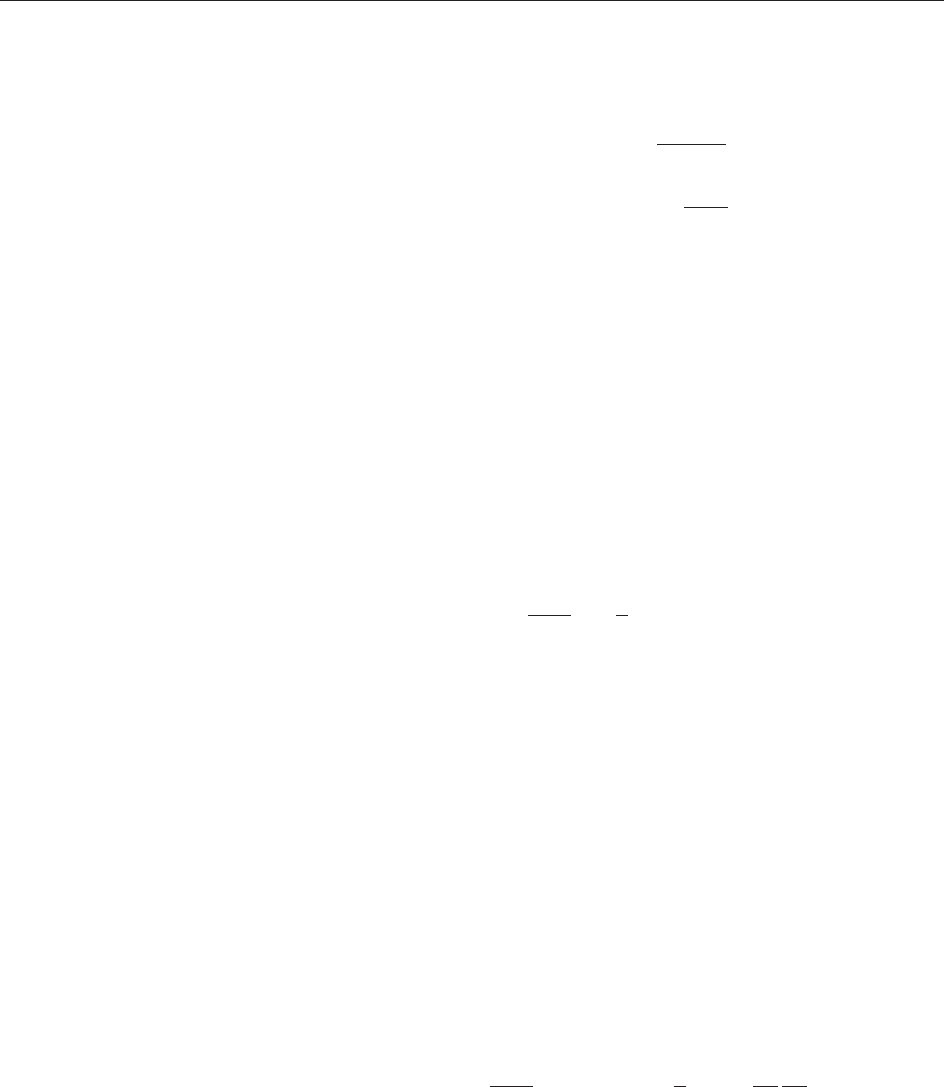
To describe collapse to a joint eigenstate of a set
of mutually commuting operators
^
A
r
, replace
(4)
1
[w(t
0
) 2
^
A]
2
in the exponent of [12] by
P
r
(4)
1
[w
r
(t
0
) 2
^
A
r
]
2
. The interaction picture
state vector in this case is [12] multiplied by
exp (i
^
Ht):
j ; ti
w
¼T exp ð4Þ
1
Z
l
0
dt
0
X
r
½w
r
ðt
0
Þ2
^
A
r
ðt
0
Þ
2
!
j ; 0i½15
where
^
A
r
(t
0
) exp (i
^
Ht
0
)
^
A
r
exp (i
^
Ht
0
). The density
matrix follows from [15],and[13]:
^
ðtÞ
Z
P
t
ðwÞDwj ; ti
ww
h ; tj=P
t
ðwÞ
¼Texp
=2
Z
t
0
dt
0
X
r
½
^
A
r
L
ðt
0
Þ
^
A
r
R
ðt
0
Þ
2
^
ð0Þ½16
where
^
A
r
L
(t
0
)(
^
A
r
R
(t
0
)) appears to the left (right) of
ˆ
(0),
and is time-ordered (time reverse-ordered). In the
example described by [14], the density matrix [16] is
^
ðtÞ¼
X
n;m
e
ðt=2Þð a
n
a
m
Þ
2
n
m
ja
n
iha
m
j
which encapsulates the ensemble’s collapse behavior.
CSL
The CSL proposal (Pearle 1989) is that collapse is
engendered by distinctions between states at each
point of space, so the index r of
^
A
r
in [15]
becomes x,
j ; ti
w
¼T exp ð4Þ
1
Z
t
0
Z
dt
0
dx
0
½wðx
0
; t
0
Þ2
^
Aðx
0
; t
0
Þ
2
j ; 0i½17
and the distinction looked at is mass density. However,
one cannot make the choice
^
A(x,0)=
^
M(x), where
^
M(x) =
P
i
m
i
ˆ
y
i
(x)
ˆ
i
(x) is the mass-density operator
(m
i
is the mass of the ith type of particle, so
m
e
, m
p
, m
n
, ... are the masses, respectively, of elec-
trons, protons, neutrons...,and
ˆ
y
i
(x) is the creation
operator for such a particle at location x), because this
entails an infinite rate of energy increase of particles
([23] with a = 0). Instead, adapting a ‘‘Gaussian
smearing’’ idea from the Ghirardi et al. (1986)
spontaneous localization (SL) model (see the
subsection‘‘Spontaneouslocalizationmodel’’),choose
^
A
x
as, essentially, proportional to the mass in a sphere
of radius a about x:
^
Aðx; tÞe
i
^
Ht
1
ða
2
Þ
3=4
Z
dz
^
MðzÞ
m
p
e
ð2a
2
Þ
1
ðxzÞ
2
e
i
^
Ht
½18
The parameter value choices of SL, 10
16
s
1
(according to [17] and [18], the collapse rate for
protons) and a 10
5
cm are, so far, consistent with
experiment (see the next subsection), and will be
adopted here.
The density matrix associated with [17] is, as
in [16],
^
ðtÞ¼Texp
ð=2Þ
Z
t
0
dt
0
dx
0
½
^
A
L
ðx
0
; t
0
Þ
^
A
R
ðx
0
; t
0
Þ
2
^
ð0Þ½19
which satisfies the differential equation
d
^
ðtÞ
dt
¼
2
Z
dx
0
½
^
Aðx
0
; tÞ; ½
^
Aðx
0
; tÞ;
^
ðtÞ ½20
of Lindblad–Kossakowski form.
Consequences of CSL
Since the state vector dynamics of CSL is different
from that of standard quantum theory, there are
phenomena for which the two make different
predictions, allowing for experimental tests. Con-
sider an N-particle system with position operators
^
X
i
(
^
X
i
jxi= x
i
jxi). Substitution of
^
A(x
0
) from [18] in
the Schro¨ dinger picture version of [20], integration
over x
0
, and utilization of
f ðzÞ
^
MðzÞjxi¼
X
N
i¼1
m
i
f ð
^
X
i
Þðz
^
X
i
Þjxi
results in
d
^
ðtÞ
dt
¼i½
^
ðtÞ ;
^
H
2
X
N
i¼1
X
N
j¼1
m
i
m
p
m
j
m
p
e
ð4a
2
Þ
1
ð
^
X
Li
^
X
Lj
Þ
2
þ e
ð4a
2
Þ
1
ð
^
X
Ri
^
X
Rj
Þ
2
h
2e
ð4a
2
Þ
1
ð
^
X
Li
^
X
Rj
Þ
2
i
^
ðtÞ½21
which is a useful form for calculations first
suggested by Pearle and Squires in 1994.
Interference Consider the collapse rate of an initial
state ji=
1
j1iþ
2
j2i,wherej1i, j2i describe a
272 Quantum Mechanics: Generalizations

clump of matter, of size a, at different locations
with separation a. Electrons may be neglected
because of their small collapse rate compared to the
much more massive nucleons, and the nucleon mass
difference may be neglected. In using [21] to calculate
dh1j
ˆ
(t)j2i=dt, since exp [(4a
2
)
1
(
^
X
i
^
X
j
)
2
] 1
when acting on state j1i or j2i,and0when
^
X
i
acts on j1i and
^
X
j
acts on j2i, [21] yields, for N
nucleons, the collapse rate N
2
:
dh1j
^
ðtÞj2i
dt
¼ih1j½
^
ðtÞ ;
^
Hj2iN
2
h1j
^
ðtÞj2i½22
If the clump undergoes a two-slit interference
experiment, where the size and separation condi-
tions above are satisfied for a time T,andifthe
result agrees with the standard quantum theory
prediction to 1%, it also agrees with CSL provided
1
> 100N
2
T. So far, interference experiments
with N as large as 10
3
have been performed, by
Nairz, Arndt, and Zeilinger in 2000. The SL value
of
1
10
16
would be testable, that is, the
quantum-predicted interference pattern would be
‘‘washed out’’ to 1% accuracy, if the clump were
an 10
6
cm radius sphere of mercury, which
contains N 10
8
nucleons, interfered for
T = 0.01 s. Currently envisioned but not yet
performed experiments (e.g., by Marshall, Simon,
Penrose, and Bouwmester in 2003) have been
analyzed (e.g., by Bassi, Ippoliti, and Adler in
2004 and by Adler in 2005), which involve a
superposition of a larger clump of matter in
slightly displaced positions, entangled with a
photon whose interference pattern is measured:
these proposed experiments are still too crude to
detect the SL value of , or the gravitationally
based collapse rate proposed by Penrose in 1996
(see the next section and papers by Christian in
1999 and 2005).
Bound state excitation Collapse narrows wave
packets, thereby imparting energy to particles. If
^
H =
P
N
i = 1
^
P
2
i
=2m
i
þ
^
V(x
1
, ..., x
N
), it is straight-
forward to calculate from [21] that
d
dt
h
^
Hi
d
dt
tr½
^
H
^
ðtÞ ¼
X
N
i¼1
3h
2
4m
i
a
2
½23
For a nucleon, the mean rate of energy increase is
quite small, 3 10
25
eV s
1
. However, deviations
from the mean can be significantly greater.
Equation [21] predicts excitation of atoms and
nuclei. Let jE
0
i be an initial bound energy
eigenstate. Expanding [21] in a power series in
(bound state size/a)
2
, the excitation rate of state
jEi is
dhEj
^
ðtÞjEi
dt
j
t¼0
¼
2a
2
*
E
X
N
i¼1
m
i
m
p
^
X
i
E
0
+*
E
0
X
N
i¼1
m
i
m
p
^
X
i
E
+
þ Oðsize=aÞ
4
½24
Since jE
0
i, jEi are eigenstates of the center-of-mass
operator
P
N
i = 1
m
i
^
X
i
=
P
N
i = 1
m
i
with eigenvalue 0, the
dipole contribution explicitly given in [24] vanishes
identically. This leaves the quadrupole contribution
as the leading term, which is too small to be
measured at present.
However, the choice of
^
A(x) as mass-density
operator was made only after experimental indica-
tion. Let g
i
replace m
i
=m
p
in [21] and [24], so that
g
2
i
is the collapse rate for the ith particle. Then,
experiments looking for the radiation expected from
‘‘spontaneously’’ excited atoms and nuclei, in large
amounts of matter for a long time, as shown by
Collett, Pearle, Avignone, and Nussinov in 1995,
Pearle, Ring, Collar, and Avignone in 1999, and
Jones, Pearle, and Ring in 2004, have placed the
following limits:
g
e
g
p
m
e
m
p
<
12m
e
m
p
;
g
n
g
p
m
n
m
p
<
3ðm
n
m
p
Þ
m
p
Random walk According to [17] and [13], the
center-of-mass wave packet, of a piece of matter of
size a or smaller, containing N nucleons, achieves
equilibrium size s in a characteristic time
s
, and
undergoes a random walk through a root-mean-
square distance Q:
s
a
2
h
m
p
N
3
1=4
;
s
Nm
p
s
2
h
Q
h
1=2
t
3=2
m
p
a
½25
The results in [25] were obtained by Collett and
Pearle in 2003. These quantitative results can be
qualitatively understood as follows.
In time t, the usual Schro¨ dinger equation
expands a wave packet of size s to s þ
(h=Nm
p
s)t. CSL collapse, by itself, narrows the
wave packet to s[1 N
2
(s=a)
2
t]. The condition
of no change in s is the result quoted above.
s
is the
time it takes the Schro¨ dinger evolution to expand a
wave packet near size s to size s:(h=Nm
p
s)
s
s.
Quantum Mechanics: Generalizations 273

The t
3=2
dependence of Q arises because this is a
random walk without damping (unlike Brownian
motion, where Q t
1=2
). The mean energy
increase Nh
2
m
1
p
a
2
t of [23] implies the root-
mean-square velocity increase [h
2
m
2
p
a
2
t]
1=2
,
whose product with t is Q.
For example, a sphere of density 1 cm
3
and
radius 10
5
cm has s 4 10
7
cm,
s
0.6 s and
Q 5[t in days]
3=2
cm. At the low pressure of
5 10
17
torr at 4.2 K reported by Gabrielse’s
group in 1990, the mean collision time with gas
molecules is 80 min, over which Q 0.7 mm.
Thus, observation of this effect should be feasible.
Further Remarks
It is possible to define energy for the w(x, t) field so
that total energy is conserved: as the particles gain
energy, the w-field loses energy, as shown by Pearle
in 2005.
Attempts to construct a special-relativistic CSL-
type model have not yet succeeded, although
Pearle in 1990, 1992, and 1999, Ghirardi, Grassi,
and Pearle in 1990, and Nicrosini and Rimini in
2003 have made valiant attempts. The problem is
that the white noise field w(x, t) contains all
wavelengths and frequencies, exciting the vacuum
in lowest order in to produce particles at the
unacceptable rate of infinite energy/per second per
cubic centimeter. Collapse models which utilize a
colored noise field w have a similar problem in
higher orders. In 2005, Pearle suggested a quasir-
elativistic model which reduces to CSL in the low-
speed limit.
CSL is a phenomenological model which describes
dynamical collapse so as to achieve S. Besides
needing decisive experimental verification, it needs
identification of the w(x, t) field with a physical
entity.
Other collapse models which have been investi-
gated are briefly described below.
Spontaneous Localization Model
The SL model of Ghirardi et al. (1986), although
superseded by CSL, is historically important and
conceptually valuable. Let
^
H = 0 for simplicity, and
consider a single particle whose wave function at
time t is (x, t ). Over the next interval dt,with
probability 1 dt, it does not change. With prob-
ability dt it does change, by being ‘‘spontaneously
localized’’ or ‘‘hit.’’ A hit means that the new
(unnormalized) wave function suddenly becomes
ðx; t þ dtÞ¼ ðx; tÞða
2
Þ
3=4
e
ð2a
2
Þ
1
ðxzÞ
2
with probability
dt dz
Z
dxj ðx; t þ dtÞj
2
Thus z, the ‘‘center’’ of the hit, is most likely to be
located where the wave function is large. For a single
particle in the superposition described in the subsec-
tion‘‘Interference,’’asinglehitisoverwhelmingly
likely to reduce the wave function to one or the other
location, with total probability j
i
j
2
, at the rate .
For an N-particle clump, it is considered that each
particle has the same independent probability, dt,
of being hit. But, for the example in the subsection
‘‘Interference,’’asinglehitonanyparticleinone
location of the clump has the effect of multiplying
the wave function part describing the clump in the
other location by the tail of the Gaussian, thereby
collapsing the wave function at the rate N.
By use of the Gaussian hit rather than a delta-
function hit, SL solves the problem of giving too
much energy to particles as mentioned in the
subsection‘‘CSL.’’Bythehypothesisofindependent
particle hits, SL also solves the problem of achieving
a slow collapse rate for a superposition of small
objects and a fast collapse rate for a superposition of
large objects. However, the hits on individual
particles destroys the (anti-) symmetry of wave
functions. The CSL collapse toward mass density
eigenstates removes that problem. Also, while SL
modifies the Schro¨ dinger evolution of a wave
function, it involves discontinuous dynamics and so
is not described by a modified Schro¨ dinger equation
as is CSL.
Other Models
For a single (low-energy) particle, the polar decom-
position =Re
(i=h)S
of the Schro¨ dinger equation
implies two real equations,
@R
2
@t
þ = R
2
=S
m
¼ 0 ½26
(the continuity equation for R
2
= jj
2
) and
@S
@t
þ
ð=SÞ
2
2m
þ V þ Q ¼ 0 ½27
where Q (h
2
=2m)r
2
R=R is the ‘‘quantum
potential.’’ (These equations have an obvious gen-
eralisation to higher-dimensional configuration
space.) In 1926, Madelung proposed that one should
start from [26] and [27] – regarded as hydrodyna-
mical equations for a classical charged fluid with
mass density mR
2
and fluid velocity =S=m – and
construct =Re
(i=h)S
from the solutions.
274 Quantum Mechanics: Generalizations

This ‘‘hydrodynamical’’ interpretation suffers from
many difficulties, especially for many-body systems.
In any case, a criticism by Wallstrom (1994) seems
decisive: [26] and [27] (and their higher-dimensional
analogs) are not, in fact, equivalent to the Schro¨ din-
ger equation. For, as usually understood, the quan-
tum wave function is a single-valued and
continuous complex field, which typically possesses
nodes (=0), in the neighborhood of which the
phase S is multivalued, with values differing by
integral multiples of 2h. If one allows S in [26],
[27] to be multivalued, there is no reason why the
allowed values should differ by integral multiples of
2h, and in general will not be single-valued. On
the other hand, if one restricts S in [26], [27] to be
single-valued, one will exclude wave functions – such
as those of nonzero angular momentum – with a
multivalued phase. (This problem does not exist in
pilot-wave theory as we have presented it here, where
is regarded as a basic entity.)
Stochastic mechanics, introduced by Fe´nyes in 1952
and Nelson (1966), has particle trajectories x(t)
obeying a ‘‘forward’’ stochastic differential equation
dx(t) = b(x(t), t)dt þ dw(t), where b is a drift (equal to
the mean forward velocity) and w a Wiener process,
and also a similar ‘‘backward’’ equation. Defining
the ‘‘current velocity’’ v = (1=2)(b þ b
), where b
is
the mean backward velocity, and using an appropriate
time-symmetric definition of mean acceleration, one
may impose a stochastic version of Newton’s second
law. If one assumes, in addition, that v is a gradient
(v = rS=m for some S), then one obtains [26], [27]
with R
ffiffiffi
p
,where is the particle density.
Defining
ffiffiffi
p
e
(i=h)S
, it appears that one recovers
the Schro¨ dinger equation for the derived quantity .
However, again, there is no reason why S should
have the specific multivalued structure required for
the phase of a single-valued complex field. It then
seems that, despite appearances, quantum theory
cannot in fact be recovered from stochastic
mechanics (Wallstrom 1994). The same problem
occurs in models that use stochastic mechanics as an
intermediate step (e.g., Markopoulou and Smolin in
2004): the Schro¨ dinger equation is obtained only for
exceptional, nodeless wave functions.
Bohm and Bub (1966) first proposed dynamical
wave-function collapse through deterministic evolu-
tion. Their collapse outcome is determined by the
value of a Wiener–Siegel hidden variable (a variable
distributed uniformly over the unit hypersphere in a
Hilbert space identical to that of the state vector). In
1976, Pearle proposed dynamical wave-function col-
lapse equations where the collapse outcome is deter-
mined by a random variable, and suggested (Pearle
1979) that the modified Schro¨ dinger equation be
formulated as an Itoˆ stochastic differential equation,
a suggestion which has been widely followed. (The
equation for the state vector given here, which is
physically more transparent, has its time derivative
equivalent to a Stratonovich stochastic differential
equation, which is readily converted to the Itoˆform.)
The importance of requiring that the density matrix
describing collapse be of the Lindblad–Kossakowski
form was emphasized by Gisin in 1984 and Diosi in
1988. The stochastic differential Schro¨ dinger equation
that achieves this was found independently by Diosi in
1988 and by Belavkin, Gisin, and Pearle in separate
papers in 1989 (see Ghirardi et al. 1990).
A gravitationally motivated stochastic collapse
dynamics was proposed by Diosi in 1989 (and some-
what corrected by Ghirardi et al. in 1990). Penrose
emphasized in 1996 that a quantum state, such as that
describing a mass in a superposition of two places, puts
the associated spacetime geometry also in a super-
position, and has argued that this should lead to wave-
function collapse. He suggests that the collapse time
should be h=E,whereE is the gravitational
potential energy change obtained by actually displa-
cing two such masses: for example, the collapse time
h=(Gm
2
=R), where the mass is m, its size is R,and
the displacement is R or larger. No specific dynamics
is offered, just the vision that this will be a property of
a correct future quantum theory of gravity.
Collapse to energy eigenstates was first proposed
by Bedford and Wang in 1975 and 1977 and, in the
context of stochastic collapse (e.g., [11] with
^
A =
^
H),
by Milburn in 1991 and Hughston in 1996, but it has
been argued by Finkelstein in 1993 and Pearle in
2004 that such energy-driven collapse cannot give a
satisfactory picture of the macroscopic world.
Percival in 1995 and in a 1998 book, and Fivel in
1997 have discussed energy-driven collapse for
microscopic situations.
Adler (2004) has presented a classical theory
(a hidden-variables theory) from which it is argued
that quantum theory ‘‘emerges’’ at the ensemble level.
The classical variables are N N matrix field ampli-
tudes at points of space. They obey appropriate
classical Hamiltonian dynamical equations which he
calls ‘‘trace dynamics,’’ since the expressions for
Hamiltonian, Lagrangian, Poisson bracket, etc., have
the form of the trace of products of matrices and their
sums with constant coefficients. Using classical statis-
tical mechanics, canonical ensemble averages of
(suitably projected) products of fields are analyzed
and it is argued that they obey all the properties
associated with Wightman functions, from which
quantum field theory, and its nonrelativistic-limit
quantum mechanics, may be derived. As well as
obtaining the algebra of quantum theory in this way,
Quantum Mechanics: Generalizations 275

it is argued that statistical fluctuations around the
canonical ensemble can give rise to the behavior of
wave-function collapse, of the kind discussed here,
both energy-driven and CSL-type mass-density-driven
collapse so that, with the latter, comes the Born
probability interpretation of the algebra. The Hamil-
tonian needed for this theory to work is not provided
but, as the argument progresses, its necessary features
are delimited.
See also: Quantum Mechanics: Foundations.
Further Reading
Adler SL (2004) Quantum Theory as an Emergent Phenomenon.
Cambridge: Cambridge University Press.
Bassi A and Ghirardi GC (2003) Dynamical reduction models.
Physics Reports 379: 257–426 (ArXiv: quant-ph/0302164).
Bell JS (1987) Speakable and Unspeakable in Quantum
Mechanics. Cambridge: Cambridge University Press.
Bohm D (1952) A suggested interpretation of the quantum theory
in terms of ‘hidden’ variables. I and II. Physical Review
85: 166–179 and 180–193.
Bohm D and Bub J (1966) A proposed solution of the
measurement problem in quantum mechanics by a hidden
variable theory. Reviews of Modern Physics 38: 453–469.
Du¨ rr D, Goldstein S, and Zanghı` N (2003) Quantum equilibrium
and the role of operators as observables in quantum theory,
ArXiv: quant-ph/0308038.
Ghirardi G, Rimini A, and Weber T (1986) Unified dynamics for
microscopic and macroscopic systems. Physical Review D
34: 470–491.
Ghirardi G, Pearle P, and Rimini A (1990) Markov processes in
Hilbert space and continuous spontaneous localization of
systems of identical particles. Physical Review A 42: 78–89.
Holland PR (1993) The Quantum Theory of Motion: An Account
of the de Broglie–Bohm Causal Interpretation of Quantum
Mechanics. Cambridge: Cambridge University Press.
Nelson E (1966) Derivation of the Schro¨ dinger equation from
Newtonian mechanics. Physical Review 150: 1079–1085.
Pearle P (1979) Toward explaining why events occur. Interna-
tional Journal of Theoretical Physics 18: 489–518.
Pearle P (1989) Combining stochastic dynamical state-vector
reduction with spontaneous localization. Physical Review A
39: 2277–2289.
Pearle P (1999) Collapse models. In: Petruccione F and Breuer HP
(eds.) Open Systems and Measurement in Relativistic Quan-
tum Theory, pp. 195–234. Heidelberg: Springer. (ArXiv:
quant-ph/9901077).
Valentini A (1991) Signal-locality, uncertainty, and the subquan-
tum H-theorem. I and II. Physics Letters A 156: 5–11 and
158: 1–8.
Valentini A (2002a) Signal-locality in hidden-variables theories.
Physics Letters A 297: 273–278.
Valentini A (2002b) Subquantum information and computation.
Pramana – Journal of Physics 59: 269–277 (ArXiv: quant-ph/
0203049).
Valentini A (2004a) Black holes, information loss, and hidden
variables, ArXiv: hep-th/0407032.
Valentini A (2004b) Universal signature of non-quantum systems.
Physics Letters A 332: 187–193 (ArXiv: quant-ph/0309107).
Valentini A and Westman H (2005) Dynamical origin of quantum
probabilities. Proceedings of the Royal Society of London
Series A 461: 253–272.
Wallstrom TC (1994) Inequivalence between the Schro¨ dinger
equation and the Madelung hydrodynamic equations. Physical
Review A 49: 1613–1617.
Quantum Mechanics: Weak Measurements
L Dio´si, Research Institute for Particle and Nuclear
Physics, Budapest, Hungary
ª 2006 Elsevier Ltd. All rights reserved.
Introduction
In quantum theory, the mean value of a certain
observable
^
A in a (pure) quantum state jii is defined
by the quadratic form:
h
^
Ai
i
¼: hij
^
Ajii½1
Here
^
A is Hermitian operator on the Hilbert space
H of states. We use Dirac formalism. The above
mean is interpreted statistically. No other forms had
been known to possess a statistical interpretation in
standard quantum theory. One can, nonetheless, try
to extend the notion of mean for normalized bilinear
expressions (Aharonov et al. 1988):
A
w
¼:
hf j
^
Ajii
hf jii
½2
However unusual is this structure, standard quan-
tum theory provides a plausible statistical interpre-
tation for it, too. The two pure states jii, jf i play the
roles of the prepared initial and the postselected
final states, respectively. The statistical interpreta-
tion relies upon the concept of weak measurement.
In a single weak measurement, the notorious
decoherence is chosen asymptotically small. In
physical terms, the coupling between the measured
state and the meter is assumed asymptotically weak.
The novel mean value [2] is called the (complex)
weak value.
The concept of quantum weak measurement
(Aharonov et al. 1988) provides particular
276 Quantum Mechanics: Weak Measurements

conclusions on postselected ensembles. Weak mea-
surements have been instrumental in the interpreta-
tion of time-continuous quantum measurements on
single states as well. Yet, weak measurement itself
can properly be illuminated in the context of
classical statistics. Classical weak measurement as
well as postselection and time-continuous measure-
ment are straightforward concepts leading to con-
clusions that are natural in classical statistics. In
quantum context, the case is radically different and
certain paradoxical conclusions follow from weak
measurements. Therefore, we first introduce the
classical notion of weak measurement on postse-
lected ensembles and, alternatively, in time-contin-
uous measurement on a single state. Certain idioms
from statistical physics will be borrowed and certain
not genuinely quantum notions from quantum
theory will be anticipated. The quantum counterpart
of weak measurement, postselection, and continuous
measurement will be presented afterwards. The
apparent redundancy of the parallel presentations
is of reason: the reader can separate what is
common in classical and quantum weak measure-
ments from what is genuinely quantum.
Classical Weak Measurement
Given a normalized probability density (X) over
the phase space {X}, which we call the state, the
mean value of a real function A(X) is defined as
hAi
¼:
Z
dXA ½3
Let the outcome of an (unbiased) measurement of A
be denoted by a. Its stochastic expectation value
E[a] coincides with the mean [3]:
E½a¼hAi
½4
Performing a large number N of independent
measurements of A on the elements of the ensemble
of identically prepared states, the arithmetic mean
a
of the outcomes yields a reliable estimate of E[a]
and, this way, of the theoretical mean hAi
.
Suppose, for concreteness, the measurement
outcome a is subject to a Gaussian stochastic
error of standard dispersion >0. The probability
distribution of a and the update of the state
corresponding to the Bayesian inference are
described as
pðaÞ¼ G
ða AÞ
hi
½5
!
1
pðaÞ
G
ða AÞ ½6
respectively. Here G
is the central Gaussian
distribution of variance . Note that, as expected,
eqn [5] implies eqn [4]. Nonzero means that the
measurement is nonideal, yet the expectation value
E[a] remains calculable reliably if the statistics N is
suitably large.
Suppose the spread of A in state is finite:
2
A ¼: hA
2
i
hAi
2
< 1½7
Weak measurement will be defined in the asympto-
tic limit (eqns [8] and [9]) where both the stochastic
error of the measurement and the measurement
statistics go to infinity. It is crucial that their rate is
kept constant:
; N !1 ½8
2
¼:
2
N
¼ const: ½9
Obviously for asymptotically large , the precision
of individual measurements becomes extremely
weak. This incapacity is fully compensated by the
asymptotically large statistics N. In the weak
measurement limit (eqns [8] and [9]), the probability
distribution p
w
of the arithmetic mean
a of the N
independent outcomes converges to a Gaussian
distribution:
p
w
ð
aÞ!G
a hAi
½10
The Gaussian is centered at the mean hAi
, and the
variance of the Gaussian is given by the constant
rate [9]. Consequently, the mean [3] is reliably
calculable on a statistics N growing like
2
.
With an eye on quantum theory, we consider two
situations – postselection and time-continuous
measurement – of weak measurement in classical
statistics.
Postselection
For the preselected state , we introduce postselec-
tion via the real function (X), where 0 1.
The postselected mean value of a certain real
function A(X) is defined by
hAi
¼:
hAi
hi
½11
where hi
is the rate of postselection. Postselection
means that after having obtained the outcome a
regarding the measurement of A, we measure the
function , too, in ideal measurement with random
outcome upon which we base the following
random decision. With probability , we include
the current a into the statistics and we discard it
Quantum Mechanics: Weak Measurements 277

with probability 1 . Then the coincidence of E[a]
and
hAi
,asineqn [4], remains valid:
E½a¼
hAi
½12
Therefore, a large ensemble of postselected states
allows one to estimate the postselected mean
hAi
.
Classical postselection allows introducing the
effective postselected state:
¼:
hi
½13
Then the postselected mean [11] of A in state can,
by eqn [14], be expressed as the common mean of A
in the effective postselected state
:
hAi
¼hAi
½14
As we shall see later, quantum postselection is
more subtle and cannot be reduced to common
statistics, that is, to that without postselection. The
quantum counterpart of postselected mean does not
exist unless we combine postselection and weak
measurement.
Time-Continuous Measurement
For time-continuous measurement, one abandons the
ensemble of identical states. One supposes that a single
time-dependent state
t
is undergoing an infinite
sequence of measurements (eqns [5] and [6])ofA
employed at times t = t, t = 2t, t = 3t, ... . The rate
=:1=t goes to infinity together with the mean
squared error
2
. Their rate is kept constant:
; !1 ½15
g
2
¼:
2
¼ const: ½16
In the weak measurement limit (eqns [15] and [16]),
the infinite frequent weak measurements of A
constitute the model of time-continuous measure-
ment. Even the weak measurements will signifi-
cantly influence the original state
0
, due to the
accumulated effect of the infinitely many Bayesian
updates [6]. The resulting theory of time-continuous
measurement is described by coupled Gaussian
processes [17] and [18] for the primitive function
t
of the time-dependent measurement outcome
and, respectively, for the time-dependent Bayesian
conditional state
t
:
d
t
¼hAi
t
dt þ g dW
t
½17
d
t
¼ g
1
A hA i
t
t
dW
t
½18
Here dW
t
is the Itoˆ differential of the Wiener
process.
Equations [17] and [18] are the special case of the
Kushner–Stratonovich equations of time-continuous
Bayesian inference conditioned on the continuous
measurement of A yielding the time-dependent
outcome value a
t
. Formal time derivatives of both
sides of eqn [17] yield the heuristic equation
a
t
¼hAi
t
þ g
t
½19
Accordingly, the current measurement outcome is
always equal to the current mean plus a term
proportional to standard white noise
t
. This
plausible feature of the model survives in the
quantum context as well. As for the other equation
[18], it describes the gradual concentration of the
distribution
t
in such a way that the variance
t
A
tends to zero while hAi
t
tends to a random
asymptotic value. The details of the convergence
depend on the character of the continuously mea-
sured function A(X). Consider a stepwise A(X):
AðXÞ¼
X
a
P
ðXÞ½20
The real values a
are step heights all differing from
each other. The indicator functions P
take values
0 or 1 and form a complete set of pairwise disjoint
functions on the phase space:
X
P
1 ½21
P
P
¼
P
½22
In a single ideal measurement of A, the outcome a is
one of the a
’s singled out at random. The
probability distribution of the measurement out-
come and the corresponding Bayesian update of the
state are given by
p
¼hP
i
0
½23
0
!
1
p
P
0
¼:
½24
respectively. Equations [17] and [18] of time-
continuous measurement are a connatural time-
continuous resolution of the ‘‘sudden’’ ideal
measurement (eqns [23] and [24]) in a sense that
they reproduce it in the limit t !1. The states
are trivial stationary states of the eqn [18]. It can be
shown that they are indeed approached with
probability p
for t !1.
Quantum Weak Measurement
In quantum theory, states in a given complex
Hilbert space H are represented by non-negative
density operators
ˆ
, normalized by tr
ˆ
= 1. Like the
278 Quantum Mechanics: Weak Measurements

classical states , the quantum state
ˆ
is interpreted
statistically, referring to an ensemble of states with
the same
ˆ
. Given a Hermitian operator
^
A, called
observable, its theoretical mean value in state
ˆ
is
defined by
h
^
Ai
^
¼ trð
^
A
^
Þ½25
Let the outcome of an (unbiased) quantum measure-
ment of
^
A be denoted by a. Its stochastic expectation
value E[a] coincides with the mean [25]:
E½a¼h
^
Ai
^
½26
Performing a large number N of independent
measurements of
^
A on the elements of the ensemble
of identically prepared states, the arithmetic mean
a
of the outcomes yields a reliable estimate of E[a]
and, this way, of the theoretical mean h
^
Ai
ˆ
. If the
measurement outcome a contains a Gaussian sto-
chastic error of standard dispersion , then the
probability distribution of a and the update, called
collapse in quantum theory, of the state are
described by eqns [27] and [28], respectively. (We
adopt the notational convenience of physics litera-
ture to omit the unit operator
^
I from trivial
expressions like a
^
I.)
pðaÞ¼ G
ða
^
AÞ
DE
^
½27
^
!
1
pðaÞ
G
1=2
ða
^
AÞ
^
G
1=2
ða
^
AÞ½28
Nonzero means that the measurement is nonideal,
but the expectation value E[a] remains calculable
reliably if N is suitably large.
Weak quantum measurement, like its classical
counterpart, requires finite spread of the observable
^
A on state
ˆ
:
2
^
^
A ¼: h
^
A
2
i
^
h
^
Ai
2
^
< 1½29
Weak quantum measurement, too, will be defined in
the asymptotic limit [8] introduced for classical weak
measurement. Single quantum measurements can no
more distinguish between the eigenvalues of
^
A. Yet,
the expectation value E[a]oftheoutcomea remains
calculable on a statistics N growing like
2
.
Both in quantum theory and classical statistics,
the emergence of nonideal measurements from ideal
ones is guaranteed by general theorems. For com-
pleteness of this article, we prove the emergence of
the nonideal quantum measurement (eqns [27] and
[28]) from the standard von Neumann theory of
ideal quantum measurements (von Neumann 1955).
The source of the statistical error of dispersion
is associated with the state
ˆ
M
in the complex
Hilbert space L
2
of a hypothetic meter. Suppose
R 2 (1, 1) is the position of the ‘‘pointer.’’ Let its
initial state
ˆ
M
be a pure central Gaussian state of
width ; then the density operator
ˆ
M
in Dirac
position basis takes the form
^
M
¼
Z
dR
Z
dR
0
G
1=2
ðRÞG
1=2
ðR
0
ÞjRihR
0
j½30
We are looking for a certain dynamical interaction
to transmit the ‘‘value’’ of the observable
^
A onto the
pointer position
^
R. To model the interaction, we
define the unitary transformation [31] to act on the
tensor space HL
2
:
^
U ¼ expði
^
A
^
KÞ½31
Here
^
K is the canonical momentum operator
conjugated to
^
R:
expðia
^
KÞjRi¼jR þ ai½32
The unitary operator
^
U transforms the initial
uncorrelated quantum state into the desired corre-
lated composite state:
^
¼:
^
U
^
^
M
^
U
y
½33
Equations [30]–[33] yield the expression [34] for the
state
ˆ
:
^
¼
Z
dR
Z
dR
0
G
1=2
ðR
^
AÞ
^
G
1=2
ðR
0
^
AÞjRihR
0
j½34
Let us write the pointer’s coordinate operator
^
R into
the standard form [35] in Dirac position basis:
^
R ¼
Z
dajaihaj½35
The notation anticipates that, when pointer
^
R is
measured ideally, the outcome a plays the role of the
nonideally measured value of the observable
^
A.
Indeed, let us consider the ideal von Neumann
measurement of the pointer position on the corre-
lated composite state
ˆ
. The probability of the
outcome a and the collapse of the composite state
are given by the following standard equations:
pðaÞ¼tr ð
^
I jaihajÞ
^
hi
½36
^
!
1
pðaÞ
ð
^
I ja ihajÞ
^
ð
^
I jaihajÞ
hi
½37
respectively. We insert eqn [34] into eqns [36] and
[37]. Furthermore, we take the trace over L
2
of both
sides of eqn [37]. In such a way, as expected, eqns
[36] and [37] of ideal measurement of
^
R yield the
Quantum Mechanics: Weak Measurements 279

earlier postulated eqns [27] and [28] of nonideal
measurement of
^
A.
Quantum Postselection
A quantum postselection is defined by a Hermitian
operator satisfying
^
0
ˆ
^
I. The corresponding
postselected mean value of a certain observable
^
A is
defined by
^
h
^
Ai
^
¼: Re
h
^
^
Ai
^
h
^
i
^
½38
The denominator h
ˆ
i
ˆ
is the rate of quantum
postselection. Quantum postselection means that
after the measurement of
^
A, we measure the
observable
ˆ
in ideal quantum measurement and
we make a statistical decision on the basis of the
outcome . With probability , we include the case
in question into the statistics while we discard it
with probability 1 . By analogy with the classical
case [12], one may ask whether the stochastic
expectation value E[a] of the postselected measure-
ment outcome does coincide with
E½a¼
?
^
h
^
Ai
^
½39
Contrary to the classical case, the quantum equation
[39] does not hold. The quantum counterparts of
classical equations [12]–[14] do not exist at all.
Nonetheless, the quantum postselected mean
ˆ
h
^
Ai
ˆ
possesses statistical interpretation although
restricted to the context of weak quantum measure-
ments. In the weak measurement limit (eqns [8] and
[9]), a postselected analog of classical equation [10]
holds for the arithmetic mean
a of postselected weak
quantum measurements:
p
w
ð
aÞ!G
a
^
h
^
Ai
^
½40
The Gaussian is centered at the postselected mean
ˆ
h
^
Ai
ˆ
, and the variance of the Gaussian is given by the
constant rate [9]. Consequently, the mean [38]
becomes calculable on a statistics N growing like
2
.
Since the statistical interpretation of the postse-
lected quantum mean [38] is only possible for weak
measurements, therefore
ˆ
h
^
Ai
ˆ
is called the (real)
weak value of
^
A. Consider the special case when
both the state
ˆ
= jiihij and the postselected operator
ˆ
=jf ihf j are pure states. Then the weak value
ˆ
h
^
Ai
ˆ
takes, in usual notations, a particular form
[41] yielding the real part of the complex weak
value A
w
[1]:
f
h
^
Ai
i
¼: Re
hf j
^
Ajii
hf jii
½41
The interpretation of postselection itself reduces to a
simple procedure. One performs the von Neumann
ideal measurement of the Hermitian projector jfihf j,
then includes the case if the outcome is 1 and
discards it if the outcome is 0. The rate of
postselection is jhf jiij
2
. We note that a certain
statistical interpretation of Im A
w
, too, exists
although it relies upon the details of the ‘‘meter.’’
We outline a heuristic proof of the central
equation [40]. One considers the nonideal measure-
ment (eqns [27] and [28])of
^
A followed by the ideal
measurement of
ˆ
. Then the joint distribution of the
corresponding outcomes is given by eqn [42]. The
probability distribution of the postselected outcomes
a is defined by eqn [43], and takes the concrete form
[44]. The constant N assures normalization:
pð;aÞ¼tr ð
^
ÞG
1=2
ða
^
AÞ
^
G
1=2
ða
^
AÞ
½42
pðaÞ¼:
1
N
Z
pð; aÞd ½ 43
pðaÞ¼:
1
N
G
1=2
ða
^
AÞ
^
G
1=2
ða
^
AÞ
DE
^
½44
Suppose, for simplicity, that
^
A is bounded. When
!1, eqn [44] yields the first two moments of
the outcome a:
E½a!
^
h
^
Ai
^
½45
E½a
2
2
½46
Hence, by virtue of the central limit theorem, the
probability distribution [40] follows for the average
a of postselected outcomes in the weak measurement
limit (eqns [8] and [9]).
Quantum Weak-Value Anomaly
Unlike in classical postselection, effective postse-
lected quantum states cannot be introduced. We can
ask whether eqn [47] defines a correct postselected
quantum state:
^
?
^
¼: Herm
^
^
h
^
i
^
½47
This pseudo-state satisfies the quantum counterpart
of the classical equation [14]:
^
h
^
Ai
^
¼ tr
^
A
^
?
^
½48
In general, however, the operator
ˆ
?
ˆ
is not a density
operator since it may be indefinite. Therefore, eqn
[47] does not define a quantum state. Equation [48]
does not guarantee that the quantum weak value
280 Quantum Mechanics: Weak Measurements

ˆ
h
^
Ai
ˆ
lies within the range of the eigenvalues of the
observable
^
A.
Let us see a simple example for such anomalous
weak values in the two-dimensional Hilbert space.
Consider the pure initial state given by eqn [49] and
the postselected pure state by eqn [50], where
2 [0, ] is a certain angular parameter.
jii¼
1
ffiffiffi
2
p
e
i=2
e
i=2
½49
jf i¼
1
ffiffiffi
2
p
e
i=2
e
i=2
½50
The probability of successful postselection is cos
2
.
If 6¼ =2, then the postselected pseudo-state
follows from eqn [47]:
^
?
^
¼
1
2
1 cos
1
cos
1
1
½51
This matrix is indefinite unless = 0, its two
eigenvalues are 1 cos
1
. The smaller the post-
selection rate cos
2
, the larger is the violation of the
positivity of the pseudo-density operator. Let the
weakly measured observable take the form
^
A ¼
01
10
½52
Its eigenvalues are 1. We express its weak value
from eqns [41], [49], and [50] or, equivalently, from
eqns [48] and [51]:
f
h
^
Ai
i
¼
1
cos
½53
This weak value of
^
A lies outside the range of the
eigenvalues of
^
A. The anomaly can be arbitrarily
large if the rate cos
2
of postselection decreases.
Striking consequences follow from this anomaly
if we turn to the statistical interpretation. For
concreteness, suppose = 2=3 so that
f
h
^
Ai
i
= 2.
On average, 75% of the statistics N will be lost
in postselection. We learnt from eqn [40] that
the arithmetic mean
a of the postselected outcomes
of independent weak measurements converges
stochastically to the weak value upto the Gaussian
fluctuation , as expressed symbolically by
a ¼ 2 ½54
Let us approximate the asymptotically large error
of our weak measurements by = 10 which is
already well beyond the scale of the eigenvalues 1
of the observable
^
A. The Gaussian error derives
from eqn [9] after replacing N by the size of the
postselected statistics which is approximately N=4:
2
¼ 400=N ½55
Accordingly, if N = 3600 independent quantum
measurements of precision = 10 are performed
regarding the observable
^
A, then the arithmetic
mean
a of the 900 postselected outcomes a will be
2 0.33. This exceeds significantly the largest
eigenvalue of the measured observable
^
A. Quantum
postselection appears to bias the otherwise unbiased
nonideal weak measurements.
Quantum Time-Continuous Measurement
The mathematical construction of time-continuous
quantum measurement is similar to the classical one.
We consider the weak measurement limit (eqns [15]
and [16]) of an infinite sequence of nonideal
quantum measurements of the observable
^
A at
t = t,2t, ..., on the time-dependent state
ˆ
t
. The
resulting theory of time-continuous quantum mea-
surement is incorporated in the coupled stochastic
equations [56] and [57] for the primitive function
t
of the time-dependent outcome and the conditional
time-dependent state
ˆ
t
, respectively (Dio´si 1988):
d
t
¼h
^
Ai
^
t
dt þ g dW
t
½56
d
^
t
¼
1
8
g
2
½
^
A; ½
^
A;
^
t
dt
þ g
1
Herm
^
A h
^
Ai
^
t
^
t
dW
t
½57
Equation [56] and its classical counterpart [17] are
perfectly similar. There is a remarkable difference
between eqn [57] and its classical counterpart [18].
In the latter, the stochastic average of the state is
constant: E[d
t
] = 0, expressing the fact that classi-
cal measurements do not alter the original ensemble
if we ‘‘ignore’’ the outcomes of the measurements.
On the contrary, quantum measurements introduce
irreversible changes to the original ensemble, a
phenomenon called decoherence in the physics
literature. Equation [57] implies the closed linear
first-order differential equation [58] for the stochas-
tic average of the quantum state
ˆ
t
under time-
continuous measurement of the observable
^
A:
dE½
^
t
dt
¼
1
8
g
2
½
^
A; ½
^
A; E½
^
t
½58
This is the basic irreversible equation to model the
gradual loss of quantum coherence (decoherence)
under time-continuous measurement. In fact, the
very equation models decoherence under the influ-
ence of a large class of interactions, for example,
with thermal reservoirs or complex environments. In
Quantum Mechanics: Weak Measurements 281