
Francoise J.-P., Naber G.L., Tsun T.S. (editors) Encyclopedia of Mathematical Physics
Подождите немного. Документ загружается.

. When dim Fix is even, there are examples
where equilibria exist and examples where no
equilibria exist. For complex or quaternionic,
there exist branches of rotating waves with isotropy
. In the quaternionic case, the rotating waves
foliate the SU(2) group orbits according to the Hopf
fibration.
Submaximal Isotropy Subgroups
It has been conjectured falsel y that steady-state
bifurcation leads generically to equilibria only with
maximal isotropy. The simplest counterexample is
the 24-element group =Z
3
Z
3
2
generated by
¼
010
001
100
0
@
1
A
;¼
10 0
01 0
001
0
@
1
A
(Alternatively, =T Z
2
(I
3
), where T SO(3) is
the tetrahedral group.)
The isotropy subgroup =Z
2
() has two-
dimensional fixed-point subspace Fix ={(x, y, 0)}.
The only one-dimensional fixed-point spaces con-
tained in Fix are the x-andy-axes. The general
-equivariant vector field is
_
x ¼ gðx
2
; y
2
; z
2
;Þx
_
y ¼ gðy
2
; z
2
; x
2
;Þy
_
z ¼ gðz
2
; x
2
; y
2
;Þz
After scaling,
gðx
2
; y
2
; z
2
;Þ
¼ x
2
ay
2
bz
2
þ oðx
2
; y
2
; z
2
;Þ½6
Restricting to Fix and dividing out the axial
solutions x = 0 and y = 0 yields at low est order the
equations = x
2
þ ay
2
= y
2
þ bx
2
. Submaximal
solutions exist provided sgn(a 1) = sgn(b 1).
In general, the existence of equilibria with
submaximal isotropy must be treated on a case-
by-case basis (for each absolutely irreducib le repre-
sentation of and isotropy subgroup ).
Asymptotic Stability
Subcritical and axial transcritical branches are
automatically unstable. Moreover, the existence of
a quadratic -equi variant mapping q : R
n
!R
n
and
x 2 Fix such that (dq)
x
has eigenvalues with
nonzero real part guarantees that branches of
equilibria with axial isotropy are generically
unstable (even when qj
Fix
0).
There are no general results for asymptotic
stability, and calculations must be done on a case-
by-case basis. (The remarks in the subsection
‘‘Equi libria ’’ are useful here.)
Branching Patterns and Finite Determinacy
The following notion of finite determinacy is based
on equivariant transversality theory. Assume acts
absolutely irreducibly. Consider the set F of
-equivariant vector fields f : R
n
R !R
n
satisfy-
ing (df )
0, 0
= 0. For an open dense subset of F,
branches of relative equilibria near (0, 0) are
normally hyperbolic. The collection of branches of
relative equilibria, together with their isotropy type,
direction of branching, and stability properties, is
called a branching pattern. The se persist under small
perturbations and are finitely determined: there exist
q = q
2 and an open dense subset U(q) Fsuch
that the branching patterns of f and f þ g are
identical for f 2U(q), g 2F, provided g(x, ) =
o(kxk
q
).
Furthermore, branching patterns are strongly
finitely determined: there exist d 2 and an open
dense subset S(d) F such that the branching
patterns of f and f þ g are identical for f 2S(d)
and all (not necessarily equivariant) g satisfying
g(x, ) = o(kxk
d
).
For example, consider the hyp eroctahedral group
S
n
Z
n
2
, n 1. Here S
n
acts by permutations of the
coordinates (x
1
, ..., x
n
) and Z
n
2
consists of diagonal
matrices w ith entries 1. Let =T Z
n
2
,whereT S
n
is a transitive subgroup. Then acts absolutely
irreducibly on R
n
and is strongly 3-determined.
Submaximal branches of equilibria exist except when
T = S
n
, T = A
n
and, if n = 6, T = PGL
2
(F
5
).
Dynamics
Absolutely irreducible representations have arbitra-
rily high dimension, so steady-state bifurcation
leads to rich dynamics. The group =Z
3
Z
3
2
with
sgn(a 1) 6¼ sgn(b 1) and a þb > 2in[6] yields
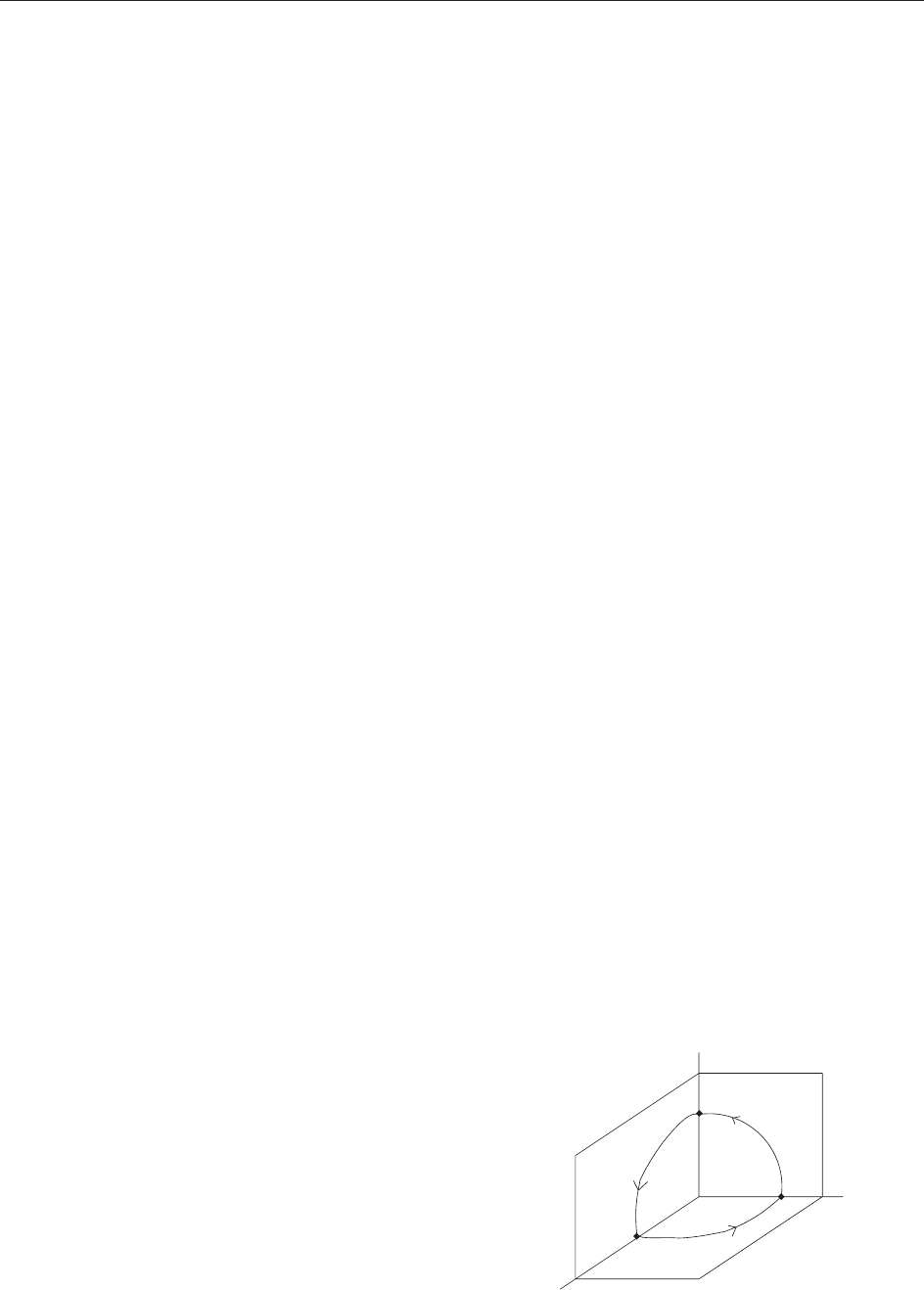
asymptotically stable heteroclinic cycles with planar
connections connecting equilibria in the x-, y- and
z-axes (see Figure 2). In R
4
, there is the possibility of
instant chaos where chaotic dynamics bifurcates
directly from the equilibrium 0.
Figure 2 Robust heteroclinic cycle for the group =Z
3
n Z
3
2
.
188 Symmetry and Symmetry Breaking in Dynamical Systems

In the absence of quadratic equivariants, the
invariant-sphere theorem gives an open set of
equivariant vector fields for which an attracting
normally hyperbolic flow-invariant (n 1)-dimen-
sional sphere bifurcates supercritically. This simpli-
fies computations of nontrivial dynamics.
Hopf Bifurcation and Mode Interactions
Equivariant Hopf Bifurcation
The setting is the same as in the last section, except
that L = (df )
0, 0
has imaginary eigenvalues i! of
algebraic and geometric multiplicity n=2. Generic-
ally, R
n
= E
c
is -simple: either the direct sum of
two isomorphic absolutely irreducible subspaces, or
nonabsolutely irreducible.
By Birkhoff normal-form theory (see below), for
any k 1 there is a -equivariant change of
coordinates after which f (x, ) = f
k
(x, ) þ o(kxk
k
),
where f
k
is ( S
1
)-equivariant. Here S
1
=
{exp(tL): t 2 R} acts freely on R
n
and S
1
acts
complex irreducibly (D= C). Hence, dim Fix J is
even for each isotropy subgroup J S
1
, and
N(J)=J ffi S
1
when J is maximal. The equivariant
Hopf theorem guarantees, generically, branches of
rotating waves with absolute period approximately
2=! for each maximal isotropy subgroup J.
The notions of finite and strong finite determinacy
extend to complex irreducible representations and the
rotating waves persist as periodic solutions for the
original -equivariant vector field f.Definethe
spatial and spatiotemporal symmetry groups
as in the subsection ‘‘Periodic solutions.’’ Then
J = {(, ()): 2 } is a twisted subgroup, with
: !S
1
ahomomorphismand=J \ = ker .
In the non-symmetry-breaking case, where acts
trivially on R
2
, phase–am plitude reduction leads to
Z
2
-equivariant amplitude equations on R and
higher-order degeneracies are amenable to Z
2
-
equivariant singularity theory . Similar comments
apply to O(2)-equivariant Hopf bifurcation where
the amplitude equations are D
4
-equivariant. The
technique fails for general groups .
Mode Interactions and Birkhoff Normal Form
Steady-state and Hopf bifurcations are codimen-
sion 1 and occur generically in one-parameter
families of -equivariant vector fields. Multipara-
meter families may undergo higher-codimension
bifurcations called mode interactions. Suppressing
parameters, steady-state/steady-state bifurcation
occurs when R
n
= E
c
= V
1
V
2
,whereV
1
and V
2
are absolutely irreducible and L = (df )
0
has zero
eigenvalues. If V
1
and V
2
are nonisomorphic then
L = 0, otherwise L is nilpotent and there is an
equivariant Takens–Bogdanov bifurcation. Similarly,
there are codimension-2 steady-state/Hopf and Hopf/
Hopf bifurcations.
Write L = S þ N (uniquely), where S is semisimple,
N is nilpotent, and SN = NS.Then
{exp tS: t 2 R}is
atorusT
p
,wherep 0 is the number of rationally
independent eigenvalues for L.
For each k 1, there is a -equivariant degree-k
polynomial change of coordinates P : R
n
!R
n
satis-
fying P(0) = 0, (dP)
0
= I trans forming f to Birkho ff
normal form f
k
þ o(kxk
k
), where f
k
is ( T
p
)-
equivariant.
If N 6¼ 0, then
{exp tN
T
: t 2 R} ffi R and f
k
can be
chosen so that the nonlinear terms are ( T
p
R)-
equivariant. The linear terms are not R-equivariant.
The study of mode interactions proceeds by first
analyzing ( T
p
)-equivariant normal forms, then
considering exponentially small effects of the
-equivariant tail. Versions of the equivariant branch-
ing lemma and equivariant Hopf theorem establish
existence of certain solutions. There are numerous
examples of robust heteroclinic cycles connecting
(relative) equilibria and periodic solutions, symmetric
chaos, and symmetry-increasing bifurcations.
Bifurcations from Relative Equilibria
and Periodic Solutions
Using the skew product [4], bifurcations from
a relative equilibrium with isotropy for a
-equivariant vector field reduce to bifurcations
from a fully symmetric equilibrium for a
-equivariant vector field h coupled wi th drifts.
If h possesses (relative) equilibria or periodic
solutions, then the drift is determined generically as
in the subsec tions ‘‘R elative equ ilibria and sk ew
produ cts’’ and ‘‘Relative peri odic solut ions.’’ Never-
theless, solving the drift equation can be useful for
understanding behavior in physical space. This is
facilitated by making equivariant polynomial
changes of coordinates (Q(x), P(x)) putting h into
Birkhoff normal form and simplifying .
Bifurcations from (relative) periodic solutions also
reduce, mainly, to bifurcations from equilibria (with
enlarged symmetry group). Based on the discussion
in the sub section ‘‘Relativ e peri odic solut ions,’’ it
suffices to consider bifurcations from isolated
periodic solut ions P = {x(t)} with spatial symmetry
and spatiotemporal symmetry . Write x(T) =
x(0), where T is the relative period and is chosen
so that the automorphism 7!
1
, 2 , has
finite order k. Form the semidirect product
o Z
2k
by adjoining to an element of order
Symmetry and Symmetry Breaking in Dynamical Systems 189

2k such that
1
=
1
, for 2 . Codimension-
1 bifurcations from P are in one-to-one correspon-
dence (modulo tail terms) with bifurcations from
fully symmetric equilibria for a ( o Z
2k
)-equivariant
vector field. In particular, period-preserving and
period-doubling bifurcations from P reduce to
steady-state bifurcations, and Naimar k–Sacker
bifurcations reduce to Hopf bifurcations. This
framework incorporates issues such as suppression
of period doubling. Similar results hold for higher-
codimension bifurcations.
The skew products [4] and [5] are valid for proper
actions of certain noncompact Lie groups pro-
vided the spatial symm etries are compact, leading to
explanations of spiral and scroll wave phenomena in
excitable media.
When the spatial symmetry group is noncompact,
E
c
may be infinite-dimensional and center manifold
reduction may break down due to continuous-
spectrum issues. For Euclidean symmetry, there
is a theory of modulation or Ginzburg–Landau
equations.
See also: Bifurcation Theory; Bifurcations in Fluid
Dynamics; Bifurcations of Periodic Orbits; Central
Manifolds, Normal Forms; Chaos and Attractors;
Electroweak Theory; Finite Group Symmetry Breaking;
Hyperbolic Dynamical Systems; Quantum Spin Systems;
Quasiperiodic Systems; Singularity and Bifurcation
Theory.
Further Reading
Chossat P and Lauterbach R (2000) Methods in Equivariant
Bifurcations and Dynamical Systems. Advanced Series in
Nonlinear Dynamics, vol. 15. Singapore: World Scientific.
Crawford JD and Knobloch E (1991) Symmetry and symmetry-
breaking in fluid dynamics. In: Lumley JL, Van Dyke M, and
Reed HL (eds.) Annual Review of Fluid Mechanics, vol. 23,
pp. 341–387. Palo Alto, CA: Annual Reviews.
Fiedler B and Scheel A (2003) Spatio-temporal dynamics of
reaction-diffusion patterns. In: Kirkilionis M, Kro¨ mker S,
Rannacher R, and Tomi F (eds.) Trends in Nonlinear Analysis,
pp. 23–152. Berlin: Springer.
Field M (1996a) Lectures on Bifurcations, Dynamics and
Symmetry. Pitman Research Notes in Mathematics Series,
vol. 356. Harlow: Addison Wesley Longman.
Field M (1996b) Symmetry Breaking for Compact Lie Groups.
Memoirs of the American Mathematical Society, vol. 574.
Providence, RI: American Mathematical Society.
Golubitsky M and Stewart IN (2002) The Symmetry Perspective.
Progress in Mathematics, vol. 200. Basel: Birkha¨user.
Golubitsky M, Stewart IN, and Schaeffer D (1988) Singularities
and Groups in Bifurcation Theory, Vol. II, Applied Mathe-
matical Sciences, vol. 69. New York: Springer.
Lamb JSW and Melbourne I (1999) Bifurcation from periodic
solutions with spatiotemporal symmetry. In: Golubitsky M, Luss
D, and Strogatz SH (eds.) Pattern Formation in Continuous and
Coupled Systems, IMA Volumes in Mathematics and its
Applications, vol. 115, pp. 175–191. New York: Springer.
Lamb JSW, Melbourne I, and Wulff C (2003) Bifurcation from
periodic solutions with spatiotemporal symmetry, including
resonances and mode interactions. Journal Differential Equa-
tions 191: 377–407.
Melbourne I (2000) Ginzburg–Landau theory and symmetry. In:
Debnath L and Riahi DN (eds.) Nonlinear Instability, Chaos
and Turbulence, Vol 2, Advances in Fluid Mechanics, vol. 25,
pp. 79–109. Southampton: WIT Press.
Michel L (1980) Symmetry defects and broken symmetry.
Configurations. Hidden symmetry. Reviews of Modern Phy-
sics 52: 617–651.
Sandstede B, Scheel A, and Wulff C (1999) Dynamical behavior of
patterns with Euclidean symmetry. In: Golubitsky M, Luss D,
and Strogatz SH (eds.) Pattern Formation in Continuous and
Coupled Systems, IMA Volumes in Mathematics and its
Applications, vol. 115, pp. 249–264. New York: Springer.
Symmetry and Symplectic Reduction
J-P Ortega, Universite
´
de Franche-Comte
´
,
Besanc¸ on, France
T S Ratiu, Ecole Polytechnique Fe
´
de
´
rale de
Lausanne, Lausanne, Switzerland
ª 2006 Elsevier Ltd. All rights reserved.
Introduction
The use of symmetries in the quantitative and
qualitative study of dynamical systems has a long
history that goes back to the founders of mechanics.
In most cases, the symmetries of a system are used to
implement a procedure generically known under the
name of ‘‘reduction’’ that restricts the study of its
dynamics to a system of smaller dimension. This
procedure is also used in a pur ely geometric context
to construct new nontrivial manifolds having var-
ious additional structures.
Most of the reduction methods can be seen as
constructions that systematize the techniques of
elimination of variables found in classical
mechanics. These procedures consist basically of
two steps. First, one restricts the dynamics to flow-
invariant submanifolds of the system in question
and, second, one projects the restricted dynamics
onto the symmetry orbit quotients of the spaces
constructed in the first step. Sometimes, the
190 Symmetry and Symplectic Reduction

flow-invariant manifolds appear as the level sets of a
momentum map induced by the symmetry of the
system.
Symmetry Reduction
The Symmetries of a System
The standard mathematical fashion to describe the
symmetries of a dynamical system (see Dynamical
Systems in Mathematical Physics: An Illustration
from Water Waves) X 2 X(M) defined on a mani-
fold M(X(M) denotes the Lie algebra of smooth
vector fields on M endowed with the Jacobi–Lie
bracket [ , ]) consists in studying its invariance
properties with respect to a smooth Lie group
: G M !M (continuous symmetries) or Lie
algebra : g !X(M) (infinitesimal symmetry)
action. Recall that is a (left) action if the map
g 2 G 7!(g, ) 2 Diff(M) is a group homomorph-
ism, where Diff(M) denotes the group of smooth
diffeomorphisms of the manifold M. The map is a
(left) Lie algebra action if the map 2 g 7!() 2
X(M) is a Lie algebra antihomomorphism and the
map (m, ) 2 M g 7!()(m) 2 TM is smooth. The
vector field X is said to be G-symmetric whenever it
is equivariant with respect to the G-action ,thatis,
X
g
= T
g
X, for any g 2 G. The space of
G-symmetric vector fields on M is denoted by
X(M)
G
.TheflowF
t
of a G-symmetric vector
field X 2 X(M)
G
is G-equivariant, that is,
F
t
g
=
g
F
t
, for any g 2 G. The vector field X is
said to be g-symmetric if [(), X] = 0, for any 2 g.
If g is the Lie algebra of the Lie group G (see Lie
Groups: General Theory) then the infinitesimal gen-
erators
M
2 X(M)ofasmoothG-group action
defined by
M
ðmÞ:¼
d
dt
t¼0
ðexp t; mÞ;2 g; m 2 M
constitute a smooth Lie algebra g-action and we
denote in this case () =
M
.
If m 2 M, the closed Lie subgroup G
m
:= {g 2 Gj
(g, m) = m} is called the isotropy or symmetry
subgroup of m. Similarly, the Lie subalgebra
g
m
:= { 2 g j()(m) = 0} is called the isotropy or
symmetry subalgebra of m.Ifg is the Lie algebra of
G and the Lie algebra action is given by the
infinitesimal generators, then g
m
is the Lie algebra
of G
m
. The action is called free if G
m
= {e} for every
m 2 M and locally free if g
m
= {0} for every m 2 M.
We will write interchangeably (g, m) =
g
(m) =
m
(g) = g m, for m 2 M and g 2 G.
In this article we will focus mainly on continuous
symmetries induced by proper Lie group actions.
The action is called proper whenever for any
two convergent sequences {m
n
}
n2N
and {g
n
m
n
:=
(g
n
, m
n
)}
n2N
in M, there exists a convergent
subsequence {g
n
k
}
k2N
in G. Compact group actions
are obviously proper.
Symmetry Reduction of Vector Fields
Let M be a smooth manifold and G a Lie group
acting properly on M. Let X 2 X(M)
G
and F
t
be its
(necessarily equivariant) flow. For any isotropy
subgroup H of the G-action on M, the H-isotropy
type submanifold M
H
:= {m 2 M jG
m
= H} is pre-
served by the flow F
t
. This property is known as the
law of conservation of isotropy. The properness of
the action guarantees that G
m
is compact and that
the (connected components of) M
H
are embedded
submanifolds of M for any closed subgroup H of G.
The manifolds M
H
are, in general, not closed in M.
Moreover, the quotient group N(H)=H (where N(H)
denotes the normalizer of H in G)actsfreelyand
properly on M
H
. Hence, if
H
: M
H
!M
H
=(N(H)=H)
denotes the projection onto orbit space and
i
H
: M
H
,!M is the injection, the vector field X
induces a unique vector field X
H
on the quotient
M
H
=(N(H)=H) defined by X
H
H
= T
H
X i
H
,
whose flow F
H
t
is given by F
H
t
H
=
H
F
t
i
H
.We
will refer to X
H
2 X(M
H
=(N(H)=H)) as the H-isotropy
type reduced vector field induced by X.
This reduction technique has been widely
exploited in handling specific dynamical systems.
When the symmetry group G is compact and we are
dealing with a linear action, the construction of the
quotient M
H
=(N(H)=H) can be implemented in a
very explicit and convenient manner by using the
invariant polynomials of the action and the theo-
rems of Hilbert and Schwarz–Mather.
Symplectic Reduction
Symplectic or Marsden–Weinstein reduction is a
procedure that implements symmetry reduction for
the symmetric Hamiltonian systems defined on a
symplectic manifold (M, !). The particular case in
which the symplectic manifold is a cotangent bundle
is dealt with separately (see Cotangent Bundle
Reduction). We recall that the Hamiltonian vector
field X
h
2 X(M) associated to the Hamiltonian
function h 2 C
1
(M) is uniquely determined by the
equality !(X
h
, ) = dh. In this context, the symme-
tries : G M !M of interest are given by sym-
plectic or canonical transformations, that is,
g
! = !, for any g 2 G. For canonical actions each
G-invariant function h 2 C
1
(M)
G
has an associated
G-symmetric Hamiltonian vector field X
h
. A Lie
Symmetry and Symplectic Reduction 191

algebra action ’ is called symplectic or canonical if
£
()
! = 0 for all 2 g, where £ denotes the Lie
derivative operator. If the Lie algebra action is
induced from a canonical Lie group action by taking
its infinitesimal generators, then it is also canonical.
Momentum Maps
The symmetry reduction described in the previous
section for general vector fields does not produce a
well-adapted answer for symplectic manifolds (M, !)
in the sense that the reduced spaces M
H
=(N(H)=H)
are, in general, not symplectic. To solve this
problem one has to use the conservation laws
associated to the canonical action, which often
appear as momentum maps.
Let G be a Lie group acting canonically on the
symplectic manifold (M, !). Suppose that for any 2 g,
the vector field
M
is Hamiltonian, with Hamiltonian
function J
2 C
1
(M)andthat 2 g 7!J
2 C
1
(M)is
linear. The map J : M !g
defined by the relation
hJ(z), i= J
(z), for all 2 g and z 2 M, is called
a momentum map of the G-action (see Hamiltonian
Group Actions). Momentum maps, if they exist, are
determined up to a constant in g
for any connected
component of M.
Examples 1
(i) (Linear momentum) The phase space of an
N-particle system is the cotangent space T
R
3N
endowed with its canonical symplectic struc-
ture. The additive group R
3
, whose Lie algebra
is abelian and is also equal to R
3
, acts
canonically on it by spatial translation on each
factor: v (q
i
, p
i
) = (q
i
þ v, p
i
), with i = 1, ..., N.
This action has an associated momentum map
J : T
R
3N
!R
3
, where we identified the dual of
R
3
with itself using the Euclidean inner pro-
duct, which coincides with the classical linear
momentum J(q
i
, p
i
) =
P
N
i = 1
p
i
.
(ii) (Angular momentum) Let SO(3) act on R
3
and then, by lift, on T
R
3
, that is, A (q, p) =
(Aq, Ap). This action is canonical and has as
associated momentum map J : T
R
3
!so(3)
ffi
R
3
, the classical angular momentum J(q, p) =
q p.
(iii) (Lifted actions on cotangent bundles) The
previous two examples are particular cases of
the following situation. Let : G M !M be a
smooth Lie group action. The (left) cotangent
lifted action of G on T
Q is given by g
q
: =
T
gq
g
1
(
q
) for g 2 G and
q
2 T
Q. Cotan-
gent lifted actions preserve the canonical 1-form
on T
Q and hence are canonical. They admit
an associated momentum map J : T
Q !g
given by hJ(
q
), i=
q
(
Q
(q)), for any
q
2
T
Q and any 2 g.
(iv) (Symplectic linear actions) Let (V, !)bea
symplectic linear space and let G be a subgroup
of the linear symplectic group, acting naturally
on V. By the choice of G this action is canonical
and has a momentum map given by
hJ(v), i= (1=2)!(
V
(v), v), for 2 g and v 2 V
arbitrary.
Properties of the Momentum Map
The main feature of the momentum map that makes it of
interest for use in reduction is that it encodes conserva-
tion laws for G-symmetric Hamiltonian systems.
Noether’s theorem states that the momentum map is a
constant of the motion for the Hamiltonian vector field
X
h
associated to any G-invariant function h 2 C
1
(M)
G
(se e Symmetries and Conservation Laws).
The derivative TJ of the momentum map satisfies
the following two properties: range (T
m
J) = (g
m
)
and
ker T
m
J = (gm)
!
, for any m 2 M,where(g
m
)
denotes the annihilator in g
of the isotropy subalgebra
g
m
of m, gm := T
m
(Gm) = {
M
(m)j 2 g}isthe
tangent space at m to the G-orbit that contains this
point, and (gm)
!
is the symplectic orthogonal space
to gm in the symplectic vector space (T
m
M, !(m)).
The first relation is sometimes called the bifurcation
lemma since it establishes a link between the symmetry
of a point and the rank of the momentum map at
that point.
The existence of the momentum map for a given
canonical action is not guaranteed. A momentum
map exists if and only if the linear map :[] 2
g=[g, g] 7![!(
M
, )] 2 H
1
(M, R) is identically zero.
Thus, if H
1
(M, R) = 0org=[g, g] = H
1
(g, R) = 0
then 0. In particular, if g is semisimple, the
‘‘first Whitehead lemma’’ states that H
1
(g, R) = 0
and therefore a momentum map always exists for
canonical semisimple Lie algebra actions.
A natural question to ask is when the map
(g,[ , ]) !(C
1
(M), { , }) defined by 7!J
, 2 g,
is a Lie algebra homomorphism, that is,
J
[,]
= { J
, J
}, , 2 g. Here { , }:C
1
(M)
C
1
(M) !C
1
(M) denotes the Poisson bracket asso-
ciated to the symplectic form ! of M defined by
{f , h}:= !(X
f
, X
h
), f , h 2 C
1
(M). This is the case if
and only if T
z
J(
M
(z)) = ad
J(z), for any 2 g,
z 2M, where ad
is the dual of the adjoint
representation ad : (, ) 2 g g 7![, ] 2 g of g on
itself. A momentum map that satisfies this relation
in called infinitesimally equivariant. The reason
behind this terminology is that this is the infinitesi-
mal version of global or coadjoint equivariance: J is
G-equivariant if Ad
g
1
J = J
g
or, equivalently,
192 Symmetry and Symplectic Reduction

J
Ad
g
(g z) = J
(z), for all g 2 G, 2 g, and z 2 M;
Ad
denotes the dual of the adjoint representation
Ad of G on g. Actions admitting infinitesimally
equivariant momentum maps are called Hamilto-
nian actions and Lie group actions with coadjoint
equivariant momentum maps are called globally
Hamiltonian actions. If the symmetry group G is
connected then global and infinitesimal equivariance
of the momentum map are equivalent concepts. If g
acts canonically on (M , !)andH
1
(g, R) = {0} then
this action admits at most one infinitesimally
equivariant momentum map.
Since momentum maps are not uniquely defined,
one may ask whether one can choose them to be
equivariant. It turns out that if the momentum map is
associated to the action of a compact Lie group, this
can always be done. Momentum maps of cotangent
lifted actions are also equivariant as are momentum
maps defined by symplectic linear actions. Canonical
actions of semisimple Lie algebras on symplectic
manifolds admit infinitesimally equivariant momen-
tum maps, since the ‘‘second Whitehead lemma’’
states that H
2
(g, R) = 0ifg is semisimple. We shall
identify below a specific element of H
2
(g, R) which is
the obstruction to the equivariance of a momentum
map (assuming it exists).
Even though, in general, it is not possible to
choose a coadjoint equivariant momentum map, it
turns out that when the symplectic manifold is
connected there is an affine action on the dual of the
Lie algebra with respect to which the momentum
map is equivariant. Define the nonequivariance
1-cocycle associated to J as the map : G ! g
given by g 7!J(
g
(z))Ad
g
1
( J(z)). The connectivity
of M implies that the right-hand side of this equality
is independent of the point z 2 M. In addition, is a
(left) g
-valued 1-cocycle on G with respect to the
coadjoint representation of G on g
, that is,
(gh) = (g) þ Ad
g
1
(h) for all g, h 2 G. Relative to
the affine action : G g
!g
given by
(g, ) 7! Ad
g
1
þ (g), the momentum map J is
equivariant. The ‘‘reduction lemma,’’ the main
technical ingredient in the proof of the reduction
theorem, states that for any m 2 M we have
g
JðmÞ
m ¼ gm \ ker T
m
J ¼ gm \ðgmÞ
!
where g
J(m)
is the Lie algebra of the isotropy group
G
J(m)
of J(m) 2 g
with respect to the affine action
of G on g
induced by the nonequivariance
1-cocycle of J.
The Symplectic Reduction Theorem
The symplectic reduction procedure that we now
present consists of constructing a new symplectic
manifold out of a given symmetric one in which the
conservation laws encoded in the form of a
momentum map and the degeneracies associated to
the symmetry have been eliminated. This strategy
allows the reduction of a symmetric Hamiltonian
dynamical system to a dimensionally smaller one.
This reduction procedure preserves the symplectic
category, that is, if we start with a Hamiltonian
system on a symplectic manifold, the reduced system
is also a Hamiltonian system on a symplectic
manifold. The reduced symplectic manifold is
usually referred to as the symplectic or Marsden–
Weinstein reduced space.
Theorem 2 Let : G M !M be a free proper
canonical action of the Lie group G on the connected
symplectic manifold (M, !). Suppose that this action
has an associated momentum map J : M !g
, with
nonequivariance 1-cocycle : G !g
. Let 2 g
be
a value of J and denote by G
the isotropy of under
the affine action of G on g
. Then:
(i) The space M
:= J
1
()=G
is a regular quotient
manifold an d, moreover, it is a symplectic
manifold with symplectic form !
uniquely
characterized by the relation
!
¼ i
!
The maps i
: J
1
() ,!M and
: J
1
() !
J
1
()=G
denote the inclusion and the projec-
tion, respectively. The pair (M
, !
) is called the
symplectic point reduced space.
(ii) Let h 2 C
1
(M)
G
be a G-invariant Hamiltonian.
The flow F
t
of the Hamiltonian vector field X
h
leaves the connected compo nents of J
1
()
invariant and commutes with the G-action, so
it induces a flow F
t
on M
defined by
F
t
i
= F
t
.
(iii) The vector field generated by the flow F
t
on
(M
, !
) is Hamiltonian with associated
reduced Hamiltonian function h
2 C
1
(M
)
defined by h
= h i
. The vector fields
X
h
and X
h
are
-related. The triple
(M
, !
, h
) is called the reduced Hamiltonian
system.
(iv) Let k 2 C
1
(M)
G
be another G-invariant func-
tion. Then {h, k} is also G-invariant and
{h, k}
= {h
, k
}
M
, where { , }
M
denotes the
Poisson bracket associated to the symplectic
form !
on M
.
Reconstruction of Dynamics
We pose now the question converse to the reduction
of a Hamiltonian system. Assume that an integral
curve c
(t) of the reduced Hamiltonian system X
h
Symmetry and Symplectic Reduction 193

on (M
, !
) is known. Let m
0
2 J
1
() be given. One
can determine from this data the integral curve of
the Hamiltonian system X
h
with initial condition
m
0
. In other words, one can reconstruct the solution
of the given system knowing the corresponding
reduced solution. The general method of reconstruc-
tion is the following. Pick a smooth curve d(t)in
J
1
() such that d(0) = m
0
and
(d(t)) = c
(t). Then,
if c(t) denotes the integral curve of X
h
with
c(0) = m
0
, we can write c(t) = g(t)d(t) for some
smooth curve g(t)inG
that is obtained in two
steps. First, one finds a smooth curve (t)ing
such that (t)
M
(d (t)) = X
h
(d(t)) d(t ). With the
(t) 2 g
just obtained, one solves the nonautono-
mous differential equation
_
g(t) = T
e
L
g(t)
(t)onG
with g(0) = e.
The Orbit Formulation of the Symplectic
Reduction Theorem
There is an alternative approach to the reduction
theorem which consists of choosing as numerator of
the symplectic reduced space the group invariant
saturation of the level sets of the momentum map.
This option produces as a result a space that is
symplectomorphic to the Marsden–Weinstein quo-
tient but presents the advantage of being more
appropriate in the context of quantization problems.
Additionally, this approach makes easier the com-
parison of the symplectic reduced spaces corres-
ponding to different values of the momentum map
which is important in the context of Poisson
reduction (see Poisson Reduction). In carrying out
this construction, one needs to use the natural
symplectic structures that one can define on the
orbits of the affine action of a group on the dual of
its Lie algebra and that we now quickly review.
Let G be a Lie group, : G !g
a coadjoint
1-cocycle, and 2 g
.LetO
be the orbit through
of the affine G-action on g
associated to .If
: g g !R defined by
X
ð; Þ:¼
d
dt
t¼0
hðexpðtÞ;i
is a real-valued Lie algebra 2-cocycle (which is
always the case if is the derivative of a smooth
real-valued group 2-cocycle or if is the non-
equivariance 1-cocycle of a momentum map), that
is, : g g !R is skew-symmetric and ([, ], ) þ
([, ], ) þ ([, ], ) = 0 for all , , 2 g, then
the affine orbit O
is a symplectic manifold with
G-invariant symplectic structure !
O
given by
!
O
ðÞð
g
ðÞ;
g
ðÞÞ ¼ h;½; i ð; Þ½1
for arbitrary 2O
, and , 2 g. The symbol
g
():= ad
þ (, ) denotes the infinitesimal
generator of the affine action on g
associated to
2 g. The symplectic structures !
O
on O
are
called the ()-orbit or Kostant–Kirillov–Souriau
(KKS) symplectic forms.
This symplectic form can be obtained from
Theorem 2 by considering the symplectic reduction
of the cotangent bundle T
G endowed with the
magnetic symplectic structure
!
:= !
can
B
,
where !
can
is the canonical symplectic form on
T
G, : T
G !G is the projection onto the base,
and B
2
2
(G)
G
is a left-invariant 2-form on G
whose value at the identity is the Lie algebra
2-cocycle : g g !R. Since is a cocycle, it
follows that B
is closed and hence !
is a
symplectic form. Moreover, the lifting of the left
translations on G provides a canonical G-action on
T
G that has a momentum map given by
J(g, ) =(g, ), (g, ) 2 G g
’ T
G, where the
trivialization G g
’ T
G is obtained via left
translations. Symplectic reduction using these ingre-
dients yields symplectic reduced spaces that are
naturally symplectically diffeomorphic to the affine
orbits O
with the symplectic form [1].
Theorem 3 (Symplectic orbit reduction). Let : G
M !M be a free proper canonical action of the Lie
group G on the connected symplectic manifold (M, !).
Suppose that this action has an associated momentum
map J : M !g
, with nonequivariance 1-cocycle
: G !g
. Let O
:= G g
be the G-orbit of the
point 2 g
with respect to the affine action of G on
g
associated to . Then the set M
O
:= J
1
(O
)=G
is a regular quotient symplectic manifold with
the symplectic form !
O
uniquely characterized by
the relation i
O
! =
O
!
O
þ J
O
!
þ
O
, where J
O
is
the restriction of J to J
1
(O
) and !
þ
O
is the (þ)–
symplectic structure on the affine orbit O
. The maps
i
O
: J
1
(O
) ,!Mand
O
: J
1
(O
) !M
O
are nat-
ural injection and the projection, respectively. The pair
(M
O
, !
O
) is called the symplectic orbit reduced space.
Statements similar to (ii)–(iv) in Theorem 2 can be
formulated for the orbit reduced spaces (M
O
, !
O
).
We emphasize that given a momentum value 2 g
,
the reduced spaces M
and M
O
are symplectically
diffeomorphic via the projection to the quotients of the
inclusion J
1
() ,!J
1
(O
).
Reduction at a general point can be replaced by
reduction at zero at the expense of enlarging the
manifold by the affine orbit. Consider the canonical
diagonal action of G on the symplectic difference
M O
þ
, which is the manifold M O
with the
symplectic form
1
!
2
!
O
þ
, where
1
: M
O
!M and
2
: M O
!O
are the projections.
194 Symmetry and Symplectic Reduction

A momentum map for this action is given by J
1
2
: M O
þ
! g
. Let (M O
þ
)
0
:= (( J
1
2
)
1
(0)=G,(! !
þ
O
)
0
) be the symplectic point
reduced space at zero.
Theorem 4 (Shifting theorem). Under the hypoth-
eses of the symplectic orbit reduction theorem
(Theorem 3), the symplectic orbit reduced space
M
O
, the point reduced spaces M
, and (M O
þ
)
0
are symplectically diffeomorphic.
Singular Reduction
In the previous section we carried out symplectic
reduction for free and proper actions. The freeness
guarantees via the bifurcation lemma that the
momentum map J is a submersion and hence the
level sets J
1
() are smooth manifolds. Freeness and
properness ensure that the orbit spaces
M
:= J
1
()=G
are regular quotient manifolds.
The theory of singular reduction studies the proper-
ties of the orbit space M
when the hypothesis on
the freeness of the action is dropped. The main
result in this situation shows that these quotients are
symplectic Whitney stratified spaces, in the sense
that the strata are symplectic manifolds in a very
natural way; moreover, the local properties of this
Whitney stratification make it into what is called a
cone space. This statement is referred to as the
‘‘symplectic stratification theorem’’ and adapts to
the symplectic symmetric context the stratification
theorem of the orbit space of a proper Lie group
action by using its orbit type manifolds. In order to
present this result, we review the necessary defini-
tions and results on stratified spaces (see Singularity
and Bifurcation Theory for more information on
singularity theory).
Stratified Spaces
Let Z be a locally finite partition of the topological
space P into smooth manifolds S
i
P, i 2 I.We
assume that the manifolds S
i
P, i 2 I, with their
manifold topology are locally closed topological sub-
spaces of P. The pair (P, Z) is a decomposition of P with
pieces in Z when the following condition is satisfied:
Condition (DS) If R, S 2Zare such that R \
S 6¼;,
then R
S. In this case we write R S. If, in
addition, R 6¼ S we say that R is incident to S or that
it is a boundary piece of S and write R S.
The above condition is called the frontier condition
and the pair (P, Z) is called a decomposed space. The
dimension of P is defined as dim P = sup{dim S
i
j S
i
2
Z}. If k 2 N,thek-skeleton P
k
of P is the union of all
the pieces of dimension smaller than or equal to k;its
topology is the relative topology induced by P.The
depth dp(z)ofanyz 2 (P, Z) is defined as
dpðzÞ:¼ sup k 2 N j9S
0
; S
1
; ...; S
k
2Zf
with z 2 S
0
S
1
S
k
g
Since for any two elements x, y 2Sin the same piece
S2P we have dp(x) = dp(y), the depth dp(S) of the
piece S is well defined by dp(S):= dp(x), x 2S.
Finally, the depth dp(P)of(P, Z) is defined by
dp(P):= sup{dp(S) j S 2Z}.
A continuous mapping f : P !Q between the
decomposed spaces (P, Z) and (Q, Y) is a morphism
of decomposed spaces if, for every piece S 2Z, there
is a piece T 2Y such that f (S) T and the
restriction f j
S
: S !T is smooth. If (P, Z) and (P, T )
are two decompositions of the same topological
space we say that Z is coarser than T or that T is
finer than Z if the identity mapping (P, T ) !(P, Z)
is a morphism of decomposed spaces. A topological
subspace Q P is a decomposed subspace of (P, Z)
if, for all pieces S 2Z, the intersection S \ Q is a
submanifold of S and the corresponding partition
Z\Q forms a decomposition of Q.
Let P be a topological space and z 2 P. Two subsets
A and B of P are said to be equivalent at z if there is an
open neighborhood U of z such that A \ U = B \ U.
This relation constitutes an equivalence relation on the
power set of P. The class of all sets equivalent to a
given subset A at z will be denoted by [A]
z
and called
the set germ of A at z.IfA B P,wesaythat[A]
z
is
a subgerm of [B]
z
, and denote [A]
z
[B]
z
.
A stratification of the topological space P is a map
S that associates to any z 2 P the set germ S(z)ofa
closed subset of P such that the following condition
is satisfied:
Condition (ST) For every z 2 P there is a neighbor-
hood U of z and a decomposition Z of U such that
for all y 2 U the germ S(y) coincides with the set
germ of the piece of Z that contains y.
The pair (P, S) is called a stratified space. Any
decomposition of P defines a stratification of P by
associating to each of its points the set germ of the
piece in which it is contained. The converse is, by
definition, locally true.
The Strata
Two decompositions Z
1
and Z
2
of P are said to be
equivalent if they induce the same stratification of P.
If Z
1
and Z
2
are equivalent decompositions of P
then, for all z 2 P, we have that dp
Z
1
(z) = dp
Z
2
(z).
Any stratified space (P, S) has a unique decomposi-
tion Z
S
associated with the following maximality
property: for any open subset U P and any
Symmetry and Symplectic Reduction 195

decomposition Z of P inducing S over U, the
restriction of Z
S
to U is coarser than the restriction
of Z to U. The decomposition Z
S
is called the
canonical decomposition associated to the stratifica-
tion (P, S). It is often denoted by S and its pieces are
called the strata of P. The local finiteness of the
decomposition Z
S
implies that for any stratum S
of (P, S) there are only finitely many strata R with
S R. Henceforth, the symbol S in the stratification
(P, S) will denote both the map that associates to
each point a set germ and the set of pieces associated
to the canonical decomposition induced by the
stratification of P.
Stratified Spaces with Smooth Structure
Let (P, S) be a stratified space. A singular or
stratified chart of P is a homeomorphism
: U !(U) R
n
from an open set U P to a
subset of R
n
such that for every stratum S 2S
the image (U \ S) is a submanifold of R
n
and
the restriction j
U\S
: U \ S !(U \ S) is a diffeo-
morphism. Two singular charts : U !(U) R
n
and ’ : V !’(V) R
m
are compatible if for any
z 2U \ V there exist an open neighborhood
W U \V of z, a natural number N max {n, m},
open neighborhoods O, O
0
R
N
of (U) {0} and
’(V) {0}, respectively, and a diffeomorphism
: O !O
0
such that i
m
’j
W
= i
n
j
W
, where
i
n
and i
m
denote the natural embeddings of R
n
and
R
m
into R
N
by using the first n and m coordinates,
respectively. The notion of singular or stratified
atlas is the natural generalization for stratifications
of the concept of atlas existing for smooth mani-
folds. Analogously, we can talk of compatible and
maximal stratified atlases. If the stratified space
(P, S) has a well-defined maximal atlas, then we say
that this atlas determines a smooth or differentiable
structure on P . We will refer to (P, S) as a smooth
stratified space.
The Whitney Conditions
Let M be a manifold and R, S M two submani-
folds. We say that the pair (R, S) satisfies the
Whitney condition (A) at the point z 2 R if the
following condition is satisfied:
Condition (A) For any sequence of points {z
n
}
n2N
in S converging to z 2 R for which the sequence of
tangent spaces {T
z
n
S}
n2N
converges in the Grass-
mann bundle of dim S–dimensional subspaces of TM
to T
z
M, we have that T
z
R .
Let : U !R
n
be a smooth chart of M around
the point z. The Whitney condition (B) at the point
z 2 R with respect to the chart (U, ) is given by the
following statement:
Condition (B) Let {x
n
}
n2N
R \ U and {y
n
}
n2N
S \ U be two sequences with the same limit
z ¼ lim
n!1
x
n
¼ lim
n!1
y
n
and such that x
n
6¼ y
n
, for all n 2 N. Suppose that
the set of connecting lines
(x
n
)(y
n
) R
n
con-
verges in projective space to a line L and that the
sequence of tangent spaces {T
y
n
S}
n2N
converges in
the Grassmann bundle of ( dim S)-dimensional sub-
spaces of TM to T
z
M. Then, (T
z
)
1
(L) .
If the condition (A) (respectively (B)) is verified
for every point z 2 R, the pair (R, S) is said to satisfy
the Whitney condition (A) (respectively (B)). It can
be verified that Whitney’s condition (B) does not
depend on the chart used to formulate it. A stratified
space with smooth structure such that, for every pair
of strata, Whitney’s condition (B) is satisfied is
called a Whitney space.
Cone Spaces and Local Triviality
Let P be a topological space. Consider the equiva-
lence relation in the product P [0, 1) given by
(z, a) (z
0
, a
0
) if and only if a = a
0
= 0. We define the
cone CP on P as the quotient topological space P
[0, 1)= .IfP is a smooth manifold then the cone
CP is a decomposed space with two pieces, namely,
P (0, 1) and the vertex which is the class
corresponding to any element of the form (z, 0),
z 2P, that is, P {0}. Analogously, if (P, Z)isa
decomposed (stratified) space then the associated
cone CP is also a decomposed (stratified) space
whose pieces (strata) are the vertex and the sets of
the form S (0, 1), with S 2Z. This implies, in
particular, that dim CP = dim P þ 1 and dp(CP) =
dp(P) þ 1.
A stratified space (P, S) is said to be locally trivial
if for any z 2 P there exist a neighborhood U of z,a
stratified space (F, S
F
), a distinguished point 0 2 F,
and an isomorphism of stratified spaces
: U !ðS \ UÞF
where S is the stratum that contains z and satisfies
1
(y, 0) = y, for all y 2 S \ U.WhenF is given by a
cone CL over a compact stratified space L then L is
called the link of z.
An important corollary of ‘‘Thom’s first isotopy
lemma’’ guarantees that every Whitney stratified
space is locally trivial. A converse to this implication
needs the introduction of cone spaces. Their defini-
tion is given by recursion on the depth of the space.
196 Symmetry and Symplectic Reduction

Definition 5 Let m 2 N [ {1 , !}. A cone space of
class C
m
and depth 0 is the union of countably many
C
m
manifolds together with the stratification whose
strata are the unions of the connected components
of equal dimension. A cone space of class C
m
and
depth d þ 1, d 2 N, is a stratified space (P, S) with a
C
m
differentiable structure such that for any z 2 P
there exists a connected neighborhood U of z,a
compact cone space L of class C
m
and depth d called
the link, and a stratified isomorphism
: U !ðS \ UÞCL
where S is the stratum that contains the point z, the
map satisfies
1
(y, 0) = y, for all y 2 S \ U, and 0
is the vertex of the cone CL.
If m 6¼ 0 then L is required to be embedded into a
sphere via a fixed smooth global singular chart
’ : L !S
l
that determines the smooth structure
of CL. More specifically, the smooth structure of
CL is generated by the global chart :[z, t] 2
CL 7! t’(z) 2 R
lþ1
. The maps : U ! (S \ U)
CL and ’ : L !S
l
are referred to as a cone chart
and a link chart, respectively. Moreover, if m 6¼ 0
then and
1
are required to be differentiable of
class C
m
as maps between stratified spaces with a
smooth structure.
The Symplectic Stratification Theorem
Let (M, !) be a connected symplectic manifold acted
canonically and properly upon by a Lie group G.
Suppose that this action has an associated momen-
tum map J : M !g
with nonequivariance 1–cocycle
: G !g
. Let 2 g
be a value of J, G
the
isotropy subgroup of with respect to the affine
action : G g
!g
determined by , and let
H G be an isotropy subgroup of the G-action on
M. Let M
z
H
be the connected component of the
H-isotropy type manifold that contains a given
element z 2 M such that J(z) = and let G
M
z
H
be
its G
-saturation. Then the following hold:
1. The set J
1
() \G
M
z
H
is a submanifold of M.
2. The set M
(H)
:= [ J
1
() \ G
M
z
H
]=G
has a unique
quotient differentiable structure such that the
canonical projection
(H)
: J
1
() \ G
M
z
H
!
M
(H)
is a surjective submersion.
3. There is a unique symplectic structure !
(H)
on
M
(H)
characterized by
i
ðHÞ
! ¼
ðHÞ
!
ðHÞ
where i
(H)
: J
1
() \ G
M
z
H
,!M is the natural
inclusion. The pairs (M
(H)
, !
(H)
) will be called
singular symplectic point strata.
4. Let h 2 C
1
(M)
G
be a G-invariant Hamiltonian.
Then the flow F
t
of X
h
leaves the connected
components of J
1
() \ G
M
z
H
invariant and com-
mutes with the G
-action, so it induces a flow F
t
on
M
(H)
that is characterized by
(H)
F
t
i
(H)
=
F
t
(H)
.
5. The flow F
t
is Hamiltonian on M
(H)
, with
reduced Hamiltonian function h
(H)
: M
(H)
!R
defined by h
(H)
(H)
= h i
(H)
. The vector fields
X
h
and X
h
(H)
are
(H)
-related.
6. Let k : M !R be another G-invariant function.
Then {h, k}isalsoG-invariant and {h, k}
(H)
= {h
(H)
,
k
(H)
}
M
(H)
,where{,}
M
(H)
denotes the Poisson bracket
induced by the symplectic structure on M
(H)
.
Theorem 6 (Symplectic stratification theorem). The
quotient M
:= J
1
()=G
is a cone space when
considered as a stratified space with strata M
(H)
.
As was the case for regular reduction, this theorem
can also be formulated from the orbit reduction point
of view. Using that approach one can conclude
that the orbit reduced spaces M
O
are cone
spaces symplectically stratified by the manifolds
M
(H)
O
:=G (J
1
() \M
z
H
)=G that have symplectic
structure uniquely determined by the expression
i
ðHÞ
O
! ¼
ðHÞ
O
!
ðHÞ
O
þ J
ðHÞ
O
!
þ
O
where i
(H)
O
: G ( J
1
() \ M
z
H
) ,!M is the inclusion,
J
(H)
O
: G ( J
1
() \ M
z
H
) !O
is obtained by restric-
tion of the momentum map J,and!
þ
O
is the
(þ)–symplectic form on O
. Analogous statements
to (7)–(6) above with obvious modifications are valid.
See also: Cotangent Bundle Reduction; Dynamical
Systems in Mathematical Physics: An Illustration
from Water Waves; Graded Poisson Algebras;
Hamiltonian Group Actions; Lie Groups: General Theory;
Poisson Reduction; Singularity and Bifurcation Theory;
Symmetries and Conservation Laws.
Further Reading
Abraham R and Marsden JE (1978) Foundations of Mechanics,
2nd edn. Reading, MA: Addison-Wesley.
Arms JM, Cushman R, and Gotay MJ (1991) A universal
reduction procedure for Hamiltonian group actions. In:
Ratiu TS (ed.) The Geometry of Hamiltonian Systems,
pp. 33–51. New York: Springer.
Cendra H, Marsden JE, and Ratiu TS (2001) Lagrangian
reduction by stages. Memoirs of the American Mathematical
Society, Volume 152, No. 722.
Huebschmann J (2001) Singularities and Poisson geometry of
certain representation spaces. In: Landsman NP, Pflaum M,
and Schlichenmaier M (eds.) Quantization of Singular
Symplectic Quotients, Progr. Math., vol. 198, pp. 119–135.
Boston, MA: Birkha¨user.
Symmetry and Symplectic Reduction 197