
Francoise J.-P., Naber G.L., Tsun T.S. (editors) Encyclopedia of Mathematical Physics
Подождите немного. Документ загружается.


complex Hermitian N N matrices. By putting a
U
N
-invariant Gaussian probability measure
exp trH
2
=2
2
dH ð 2 RÞ
on that space, one gets what is called the GUE – the
Gaussian unitary ensemble – which defines the
Wigner–Dyson universality class of unitary symmetry.
Classes AI and AII
Consider next the case G
1
6¼;, with antiunitary
generator T. Let V
= TV
be any G
0
-isotypic
component of V invariant under T (the type-I
situation). The mapping U 7!TUT
1
= (U) then is
an automorphism of the groups U(V
), G
0
and
K = Z
ffi U
m
.IfK
is the subgroup of fixed points
of in K, the space of good time evolutions can be
identified with the symmetric space K=K
by the
Cartan embedding. Our task is to determine K
.
To simplify the notation let us write V
V, R
R, and L
L. We now ask what happens with
T : V !V in the process of transfer to L R ffi V.
The answer, so we claim, is that T transfers to a
pure tensor made from antiunitary maps : L !L
and : R !R,
T ¼
To prove this claim, let C be the antilinear map
from V to the dual vector space V
by v 7!hv,i.
Because the elements of G
0
are represented by
unitaries, the C-linear operator CT : V !V
inter-
twines G
0
-actions:
CT aðgÞ¼g
1
CT ðg 2 G
0
Þ
where a is the automorphism a(g) = T
1
gT. From
the irreducibility of R it follows that the space of
intertwiners R !R
is one dimensional here (Schur’s
lemma). Therefore, CT : L R !L
R
must be a
pure tensor (as opposed to a sum of such tensors),
and since C is clearly a pure tensor, so is T . This
completes the proof.
By the involutive property T
2
= "
T
Id
V
("
T
= 1),
the two antiunitary factors of T = cannot
but square to
2
= "
Id
L
and
2
= "
Id
R
where
"
, "
= 1 are related by "
"
= "
T
. The factor
determines a nondegenerate complex bilinear form
Q : L L !C by
Qðl
1
; l
2
Þ¼ l
1
; l
2
hi
L
ðl
1
; l
2
2 LÞ
Since is antiunitary one has the exchange
symmetry
Qðl
1
; l
2
Þ¼
2
l
1
;l
2
hi
L
¼ "
Qðl
2
; l
1
Þ
Thus, the complex bilinear form (or pairing) Q is
symmetric for "
= þ1 and alternating for "
= 1.
Knowing the sign of "
= 1 we know the group
K
. Indeed, an element k 2 K
commutes with T and
after transfer from V to L still commutes with . But
since K
is a subgroup of K = U
m
, this means that
k 2 K
preserves Q. In the case of "
= þ1, what is
preserved is a symmetric pairing, and therefore K
ffi
O
m
. For "
= 1, the multiplicity m
must be even
and K
preserves an alternating pairing (or symplec-
tic structure); in that case K
ffi USp
m
, the unitary
symplectic group.
Thus, there is a dichotomy for the sets of good
time evolutions M ffi K=K
:
Class AI : K=K
ffi U
N
=O
N
ðN ¼ m
Þ
Class AII : K=K
ffi U
2N
=USp
2N
ð2N ¼ m
Þ
Again we are referring to symmetric spaces by the
names they – or rather their simple parts SU
N
=SO
N
and SU
2N
=USp
2N
– have in the Cartan classi fication.
In general, there is no immediate means of
predicting the parity "
, and one has no choice but
to go through the steps of constructing .If
: R !R ha ppens to be G
0
-invariant, however, the
situation simplifies. In that case determines a
G
0
-invariant pairing R R !C (in the same way as
determines Q : L L !C above). On general
grounds, an irreducible G
0
-representation space
admits at most one such pairing. If that pairing is
symmetric, then, as we have seen, "
= 1; if it is
alternating, then "
= 1. The parity "
is given by
"
"
= "
T
.
Example Consider any physical system with spin-
rotation symmetry (G
0
= SU
2
) and time-reversal
symmetry. The physical operation of time reversal,
T, commutes with spin rotations and, hence, here
is a case where the factor in T = is
G
0
-invariant. On fundamental physics grounds one
has T
2
= (1)
2S
on states with spin S. The spin-S
representation of SU
2
is known to carry an invariant
pairing which is symmetric or skew depending on
whether the integer 2S is even or odd. Therefore,
"
T
= "
and "
= þ1 in all cases.
Thus, T-invariant systems with no symmetries
other than energy and spin invariably are class AI.
By breaking spin-rotation symmetry (G
0
= {Id},
"
= þ1) while maintaining T-symmetry for states
with half-integer spin (say single electrons, which
carry spin S = 1=2), one gets "
= 1, thereby
realizing class AII.
The Hamiltonians By passing to the tangent space
of K=K
at unity one obtains Hermitian matrices
with entries that are real numbers (class AI) or real
quaternions (class AII). When K
-invariant Gaussian
208 Symmetry Classes in Random Matrix Theory

probability measures (called GOE resp., GSE) are
put on these spaces, one gets the Wigner–D yson
universality classes of orthogonal resp., symplectic
symmetry. In mesoscopic physics, these are realized
in disordered metals with time-reve rsal invariance
(absence of magnetic fields and magnetic impuri-
ties). Spin-rotation symmetry is broken by strong
spin–orbit scatterers such as gold impurities.
Warning
The word ‘‘symmetry class’’ is not synonymous with
‘‘universality class.’’ Indeed, inside a symmetry class
many different types of physical behavior are
possible. For example, random matrix models for
disordered metallic grains with time-reversal sym-
metry belong to the symmetry class of the example
above (class AI), and so do Ander son tight-binding
models with real hopping. The former are known to
exhibit energy level statistics of universal GOE type,
whereas the lat ter have localized eigenfunctions and
hence level statistics which is expected to approach
the Poisson limit when the system size goes to
infinity.
Disordered Superconductors
When Dirac first wrote down his famous equation in
1928, he assumed that he was writing an equation
for the wave function of the electron. Later, because
of the instability caused by negative-energy solu-
tions, the Dirac equation was reinterpreted (via
second quantization) as an equation for the ferm-
ionic field operators of a quantum field theory. A
similar change of viewpoint is carried out in reverse
in the Hartree–Fock–Bogoliubov mean-field descrip-
tion of quasiparticle excitations in superconductors.
There, one starts from the equations of moti on for
linear superpositions of the electro n creation and
annihilation operators, and reinterprets them as a
unitary quantum dynamics for what might be called
the quasiparticle ‘‘wave function.’’
In both cases – the Dirac equation and the
quasiparticle dynamics of a superconductor – there
enters a structure not present in the standard
quantum mechanics underlying Dyson’s classifica-
tion: the field operators for fermionic particles are
subject to a set of relations called the ‘‘canonical
anticommutation relations,’’ and these are preserved
by the quantum dynamics. Therefore, whenever
second quantization is undone (assuming it can be
undone) to return from field operators to wave
functions, the wave-function dynamics is required to
preserve some extra structure. This puts a linear
constraint on the good Hamiltonians H. For our
purposes, the best viewpoint to take is to attribute
the extra invariant structure to the Hilbert space V,
thereby turning it into a Nambu space.
Nambu Space
Adopting the standard physics conventions of
second quantization, consider some set of single-
particle creation and annihilation operators c
y
i
and
c
i
, where i = 1, 2, ... labels an orthon ormal system
of single-particle states. Such operators are subject
to the canonical anticommutation relations (CARs)
c
y
i
c
j
þ c
j
c
y
i
¼
ij
c
y
i
c
y
j
þ c
y
j
c
y
i
¼ 0 ¼ c
i
c
j
þ c
j
c
i
½1
When written in terms of c
j
þ c
y
j
and i(c
j
c
y
j
), these
become the standard defining relations of a Clifford
algebra over R. Field operators are linear combina-
tions y =
P
i
(u
i
c
i
þ f
i
c
y
i
) with complex coefficients u
i
and f
i
.
Now take H to be some Hamiltonian which is
quadratic in the creation and annihilation operators:
H ¼
X
i;j
W
ij
c
y
i
c
j
þ
1
2
X
i;j
Z
ij
c
y
i
c
y
j
þ
Z
ij
c
j
c
i
and let H act on field operators y by the
commutator: H y [H, y ]. The time evolution of
y is then determined by the Heisenberg equation of
motion
ih
dy
dt
¼ H y ½2
which integrat es to y (t ) = e
itH=h
y (0), and is easily
verified to preserve the CARs [1].
The dynamical equation [2] is equivalent to a
system of linear differential equations for the
amplitudes u
i
and f
i
. If these are assembled into
vectors, and the W
ij
and Z
ij
into matrices, eqn [2]
becomes
ih
d
dt
f
u
¼
WZ
Z
y
W
f
u
The Hamiltonian matrix on the right-hand side has
some special properties due to Z
ij
= Z
ji
(from
c
i
c
j
= c
j
c
i
)andW
ij
=
W
ji
(from H being self-
adjoint as an operator in Fock space). To keep
track of these properties while imposing some
unitary and antiunitary symmetries, it is best to put
everything in invariant form.
So, let U be the unitary vector space of annihila-
tion operators u =
P
i
u
i
c
i
, and view the creation
operators f =
P
i
f
i
c
y
i
as lying in the dual vector space
U
. The field operators y = u þ f then are elements
of the direct sum U U
=: V, called ‘‘Nambu
Symmetry Classes in Random Matrix Theory 209

space.’’ On V there exists a canonical unitary
structure expressed by
y ;
~
y
hi
¼
X
i
ð
u
i
~
u
i
þ
f
i
~
f
i
Þ
A second canonical structure on V = U U
is given
by the symmetric complex bilinear form
fy ;
~
y g¼
X
i
ð
~
f
i
u
i
þ f
i
~
u
i
Þ¼
~
f ðuÞþf ð
~
uÞ
where the last expression uses the meaning of f as a
linear function f : U !C. Note that {y ,
˜
y } agrees
with the anticommutator of the field operators,
y
˜
y þ
˜
yy.
Now recall that the quantum dynamics is deter-
mined by a Ham iltonian H that acts on y by the
commutator H y = [H, y ]. The one-parameter
groups t 7!e
itH= h
generated by this action (the time
evolutions) preserve the symmetric pairing:
fy ;
~
y g¼fe
itH=h
y ; e
itH=h
~
y g
since the anticommutation relations [1] do not
change with time. They also preserve the unitary
structure,
y ;
~
y
hi
¼ e
itH= h
y ; e
itH= h
~
y
DE
because probability in Nambu space is conserved.
(Physically speaking, this holds true as long as H is
quadratic, i.e., many-body interactions are negligible.)
One can now pose Dyson’s question again: given
Nambu space V and a symmetry group G acting on
it, what is the set of time evolution operators that
preserve the structure of V and are compatible with
G ? From the section ‘‘The framew ork,’’ we know
the answer to be some symmetric space, but which
are the symmetric spaces that occur?
Class D
Consider a superconductor with no symmetries in its
quasiparticle dynami cs, so G = {Id}. (A concrete
example would be a disordered spin-triplet super-
conductor in the vortex phase.) The time evolutions
U
t
= e
itH= h
are then constrained only by invariance
of the unitary structure and the symmetric pairing
{ , } of Nambu space. These two structures are
consistent; they are related by particle–hole con-
jugation C:
fy ;
~
y g¼ Cy ;
~
y
hi
which is an antiunitary operator with square C
2
= þId.
Let V
R
V denote the real vector space of fixed
points of C. (The field operators in V
R
are called of
‘‘Majorana’’ type in physics.) The condition
{y ,
˜
y } = {U
t
y , U
t
˜
y } selects a complex orthogonal
group SO(V), and imposing unitarity yields a real
orthogonal subgroup SO(V
R
) with dim V
R
2 2N –
a symmetric space of the D family.
When expressed in some basis of Majorana
fermions (meaning a basis of V
R
), the matrix of
the time evolution generator iH 2 so(V
R
) is real
skew, and that of H imaginary skew. The simplest
random matrix model for class D, the SO-invariant
Gaussian ensemble of imaginary skew matrices, is
analyzed in the second edition of Mehta’s (1991)
book. From the expressions given by Mehta it is
seen that the level correlation functions at high
energy coincide with those of the Wigner–Dyson
universality class of unitary symmetry. The level
correlations at low energy, however, show different
behavior defining a separate universality class.
This universal behavior at low energies has immedi-
ate physical relevance, as it is precisely the low-
energy quasiparticles that determine the thermal
transport properties of the superconductor at low
temperatures.
Class DIII
Let now magnetic fields and magnetic impurities
be absent, so that time reversal T is a symmetry of
the quasiparticle system: G = {Id, T}. Following the
section ‘‘The framew ork,’’ the set of goo d time
evolutions is M ffi K=K
with K = SO(V
R
)andK
the set of fixed points of U 7!(U) = TUT
1
in K.
What is K
?
The square of the time-reversal operator is T
2
= Id
(for particles with spin 1/2), and commutes with
particle–hole conjugation C, which makes P := iCT a
useful operator to consider. Since C by definition
commutes with the action of K,andhencealsowith
that of K
, the subgroup K
has an equivalent
description as
K
¼fk 2 UðVÞjk ¼ PkP
1
¼ ðkÞg
The operator P is easily seen to have the following
properties: (1) P is unitary, (2) P
2
= Id, and (3) tr
V
P = 0. Consequently, P possesses two eigenspaces
V
of equal dimension, and the condition k = PkP
1
fixes a subgroup U(V
þ
) U(V
)ofU(V). Since P
contains a factor i =
ffiffiffiffiffiffi
1
p
in its definition, it antic-
ommutes with the antilinear operator T. Therefore,
the au tomorphism exchanges U(V
þ
) with U(V
),
and the fixed-point set K
is the same as U(V
þ
) ffi
U
2N
. Thus,
M ¼ K=K
ffi SO
4N
=U
2N
ðdim V
þ
¼ 2NÞ
a symmetric space in the DIII family. Note that
for particles with spin 1/2 the dimension of V
þ
has
to be even.
210 Symmetry Classes in Random Matrix Theory

By realizing the algebra of involutions C, T as
Cy = (1
2N
i
x
)
y and Ty = (1
2N
i
y
)
y , the
Hamiltonians H in class DIII are brought into the
standard form
H ¼
0 Z
Z 0
where the 2N 2N matrix Z is complex and skew.
Class C
Next let the spin of the quasiparticles be
conserved, as is the case for a spin-singlet super-
conductor with no spin–orbit scatterers present, and
let time-reversal invariance be broken by a magnetic
field. The symmetry group of the quasiparticle
system then is the spin-rotation group: G = G
0
=
Spin
3
= SU
2
.
Nambu space V can be arranged to be a tensor
product V = L R so that G
0
acts trivially on L and
by the spinor representation on the spinor space R
C
2
. Since two spinors combine to give a scalar, the
latter comes with an alternating bilinear form a : R
R !C. In a suitable basis, the anticommutation
relations [1] factor on particle–hole and spin indices.
The symmetric bilinear form {,} of V correspondingly
factors under the tensor product decomposition
V = L R as
fl
1
r
1
; l
2
r
2
g¼½l
1
; l
2
aðr
1
; r
2
Þ
where [ , ] is an alternating form on L, giving L the
structure of a complex symplec tic vector space.
The good set M now consists of the time
evolutions that, in addition to preserving the
structure of Nambu space, commute with the spin-
rotation group SU
2
:
M ¼fU 2 UðVÞjUC ¼ CU; 8g 2 SU
2
: gU ¼ Ugg
By the last condition, all time evolutions act trivially
on the factor R. The condition UC = CU, which
expresses invariance of the symmetric form of V,
then implies that time evolut ions preserve the
alternating form of L. Time evolutions therefore
are unitary symplectic transformations of L, hence
M = USp(L) ffi USp
2N
– a symmetric space of the C
family. The Hamiltonian matrices in class C have
the standard form
H ¼
WZ
Z
y
W
with W being Hermitian and Z complex and
symmetric.
Class CI
The next class is obtained by taking the time
reversal T as well as the spin rotations g 2 SU
2
to
be symmetries of the quasiparticle system.
By arguments that should be familiar by now, the
set of good time evolutions is a symmetric space
M ffi K=K
with K = USp(L) and K
the set of fixed
points of in K. Once again, the question to be
answered is: what is K
? The situation here is very
similar to the one for class DIII, with L and USp(L)
taking the roles of V and SO(V
R
). By adapting the
previous argument to the present case, one shows
that K
is the same as U(L
þ
) ffi U
N
, where L
þ
is the
positive eigenspace of P = iCT viewed as a unitary
operator on L. Thus,
M ¼ K=K
ffi USp
2N
=U
N
Dirac Fermions: The Chiral Classes
Three large families of symmetric spaces remain to
be implemented. Although these, too, occur in
mesoscopic physics, their most natural realization
is by 4D Dirac fermions in a random gauge field
background.
Consider the Lagrangian L for the Euclidean
spacetime version of QCD with N
c
3 colors of
quarks coupled to an SU
N
c
gauge field A
:
L ¼ i
y
ð@
A
Þy þ im
yy
The massless Dirac operator D = i
(@
A
) anti-
commutes with
5
=
0
1
2
3
. Therefore, in a basis
of eigenstates of
5
the matrix of D takes the form
D ¼
0 Z
Z
y
0
½3
If the gauge field carries topological charge 2 Z,
the Dirac operator D has at least jj zero modes by the
index theorem. To make a simple model of the
challenging situation where A
is distributed according
to Yang–Mills measure, one takes the matrices Z to be
complex rectangular, of size p q with p q = ,and
puts a Gaussian probability measure on that space.
This random matrix model for D captures the
universal features of the QCD Dirac spectrum in the
massless limit.
The exponential of the trunca ted Dirac operator,
e
itD
(where t is not the time), lies in a space
equivalent to U
pþq
=U
p
U
q
– a symmetric space of
the AIII family. We therefore say that the universal
behavior of the QCD Dirac spectrum is that of
symmetry class AIII.
But hold on! Why are we entitled to speak of a
symmetry class here? By definition, symmetries
Symmetry Classes in Random Matrix Theory 211

always commute with the Hamiltonian, never do
they anticomm ute! (The relation D =
5
D
5
is not
a symmetry in the sense of Dyson, nor is it a
symmetry in our sense.)
Class AIII
To incorporate the massless QCD Dirac operator
into the present classification scheme, we adapt it
to the Nambu space setting. This is done by
reorganizing the four-component Dirac spinor
y ,
y as an eight-component Majorana spinor ,
to write
L
m¼0
¼
i
2
ð@
A
Þ
The 8 8 matrices
are real symmetric besides
satisfying the Clifford relations
þ
= 2
.
A possible tensor product realization is
0
¼ 1
z
1;
1
¼
x
y
y
2
¼
y
y
1;
3
¼
z
y
y
The gauge field in this Majorana representation
is A
= 1 1 (A
()
A
(þ)
y
) where A
()
= (1=2)
(A
A
t
) are the symmetric and skew parts of
A
2 su (N
c
).
The operator H = i
(@
A
) is imaginary
skew, therefore e
itH
is real orthogonal. This means
that there exists a Nambu space V with unitary
structure h, i and symmetric pairing { , }, both of
which are preserved by the action of e
itH
. No change
of physical meaning or interpre tation is implied by
the identic al rewriting from Dirac D to Majorana H.
The fact that Dirac fermions are not truly Majorana
is encoded in a U
1
-symmetry He
iQ
= e
iQ
H gener-
ated by Q = 1 1
y
.
Now comes the essential point: since H obeys
H = H, the chiral ‘‘symmetry’’ H =
5
H
5
with
5
= 1
x
1 can be recast as a true symmetry:
H ¼þ
5
H
5
¼ THT
1
with antilinear T : 7!
5
. Thus, the massless
QCD Dirac operator is indeed associated with a
symmetry class in the present, post-Dyson sense:
that is class AIII, realized by self-adjoint operators
on Nambu space with Dirac U
1
-symmetry and an
antiunitary symmetry T.
Classes BDI and CII
Consider Hamiltonians D still of the form [3] but
now with matrix entries taken from either the real
numbers or the real quaternions. Their one-parameter
groups e
itD
belong to two further families of
symmetric spaces, namely the classes BDIandCII
of Table 1. These large families are known to be
realized as symmetry classes by the massless Dirac
operator with gauge group SU
2
(for BDI), or with
fermions in the adjoint representation (for CII). For
the details we must refer to Verbaarschot’s (1994)
paper and the recent article by Heinzner et al. (2005).
See also: Classical Groups and Homogeneous Spaces;
Compact Groups and Their Representations;
Determinantal Random Fields; Dirac Fields in Gravitation
and Nonabelian Gauge Theory; Dirac Operator and Dirac
Field; High T
c
Superconductor Theory; Integrable
Systems in Random Matrix Theory; Lie Groups: General
Theory; Random Matrix Theory in Physics; Random
Partitions; Supersymmetry Methods in Random Matrix
Theory; Symmetries and Conservation Laws.
Further Reading
Altland A, Simons BD, and Zirnbauer MR (2002) Theories of
low-energy quasi-particle states in disordered d-wave super-
conductors. Physics Reports 359: 283–354.
Altland A and Zirnbauer MR (1997) Non-standard symmetry
classes in mesoscopic normal-/superconducting hybrid systems.
Physical Review B 55: 1142–1161.
Dyson FJ (1962) The threefold way: algebraic structure of
symmetry groups and ensembles in quantum mechanics.
Journal of Mathematical Physics 3: 1199–1215.
Heinzner P, Huckleberry A, and Zirnbauer MR (2005) Symmetry
classes of disordered fermions. Communications in Mathe-
matical Physics 257: 725–771.
Helgason S (1978) Differential Geometry, Lie Groups and
Symmetric Spaces. New York: Academic Press.
Mehta ML (1991) Random Matrices. New York: Academic Press.
Weyl H (1939) The Classical Groups: Their Invariants and
Representations. Princeton: Princeton University Press.
Verbaarschot JJM (1994) The spectrum of the QCD Dirac
operator and chiral random matrix theory: the threefold
way. Physical Review Letters 72: 2531–2533.
212 Symmetry Classes in Random Matrix Theory

Synchronization of Chaos
M A Aziz-Alaoui, Universite
´
du Havre, Le Havre,
France
ª 2006 Elsevier Ltd. All rights reserved.
Introduction: Chaotic Systems Can
Synchronize
Synchronization is a ubiquitous phenomenon char-
acteristic of many processes in natural systems and
(nonlinear) science. It has permanently remained an
objective of intensive research and is today consid-
ered as one of the basic nonlinear phenomena
studied in mathematics, physics, engineering, or life
science. This word has a Greek root, syn = common
and chronos = time, which means to share the
common time or to occur at the same time, that is,
correlation or agreement in time of different
processes (Boccaletti et al. 2002). Thus, synchroni-
zation of two dynamical systems generally means
that one system somehow traces the motion of
another. Indeed, it is well known that many coupled
oscillators have the ability to adjust some common
relation that they have between them due to weak
interaction, which yields to a situation in which a
synchronization-like phenomenon takes place.
The original work on synchronization involved
periodic oscillators. Indeed, observations of (peri-
odic) synchronization phenomena in physics go back
at least as far as C Huygens (1673), who, during his
experiments on the development of improved pen-
dulum clocks, discovered that two very weakly
coupled pendulum clocks become synchronized in
phase: two clocks hanging from a common support
(on the same beam of his room) were found to
oscillate with exactly the same frequency and
opposite phase due to the (weak) coupling in terms
of the almost imperceptible oscillations of the beam
generated by the clocks.
Since this discovery, periodic synchronization has
found numerous applications in various domains,
for instance, in biological systems and living nature
where synchronization is encountered on different
levels. Examples range from the modeling of the
heart to the investigation of the circadian rhythm,
phase locking of respiration with a mechanical
ventilator, synchronization of oscillations of human
insulin secretion and glucose infusion, neuronal
information processing within a brain area and
communication between different brain areas. Also,
synchronization plays an important role in several
neurological diseases such as epilepsies and patho-
logical tremors, or in different forms of cooperative
behavior of insects, animals, or humans (Pikovsky
et al. 2001).
This process may also be encountered in celestial
mechanics, where it explains the locking of revolu-
tion period of planets and satellites.
Its view was strongly broadened with the devel-
opments in radio engineering and acoustics, due to
the work of Eccles and Vincent, 1920, who found
synchronization of a triode generator. Appleton,
Van der Pol, and Van der Mark, 1922–27, ha ve,
experimentally and theoretically, extended it and
worked on radio tube oscillators, where they
observed entrainment when driving such oscillators
sinusoidally, that is, the frequency of a generator
can be synchronized by a weak external signal of a
slightly different frequency.
But, even though original notion and theory of
synchronization implies periodicity of oscillators,
during the last decades, the notion of synchroniza-
tion has been generalized to the case of interacting
chaotic oscillator s. Indeed, the disco very of determi-
nistic chaos introduced new types of oscillating
systems, namely the chaotic generators.
Chaotic oscillators are found in many dynamical
systems of various origins; the behavior of such
systems is characterized by instability and, as a
result, limited predictabi lity in time.
Roughly speaking, a system is chaotic if it is
deterministic, has a long-term aperiodic behavior,
and exhibits sensitive dependence on initial condi-
tions on a closed invariant set (the chaos theory is
discussed in more detail elsewhere in this encyclo-
pedia) (see Chaos and Attractors).
Consequently, for a chaotic system, trajectories
starting arbitrarily close to each other diverge
exponentially with time, and quickly become uncor-
related. It follows that two identical chaotic syst ems
cannot synchronize. This means that they cannot
produce identic al chaotic signals, unless they are
initialized at exactly the same point, which is in
general physically impossible. Thus, at first sight,
synchronization of chaotic systems seems to be
rather surprising because one may intuitively (and
naively) expect that the sensitive dependence on
initial conditions would lead to an immediate
breakdown of any synchronization of coupled
chaotic systems . This scenario in fact led to the
belief that chaos is uncontrollable and thus unusa-
ble. Despite this, in the last decades, the search for
synchronization has moved to chaotic syst ems.
Significant research has been done and, as a result,
Yamada and Fujisaka (1983), Afraimovich et al.
(1986),andPecora and Carroll (1990) showed that
Synchronization of Chaos 213

two chaotic systems could be synchronized by
coupling them: synchronization of chaos is actual
and chaos could then be exploitable. Ever since,
many rese archers have discussed the theory and the
design or applications of synchronized motion in
coupled chaotic systems. A broad variety of applica-
tions has emerged, for example, to increase the
power of lasers, to synchronize the output of
electronic circuit s, to control oscillation s in chemical
reactions, or to encode electronic messages for
secure communications.
The publication of the seminal paper of Pecora
and Caroll (1990) had a very strong impact in the
domain of chaos theory and chaos synchronization,
and their applications. It had stimulated very intense
research activities and the related studies continue to
attract great attention. Many authors have contrib-
uted to developing this domain, theoretically or
experimentally (Boccaletti et al. 2002, Pecorra et al.
1997, references therein).
However, the special features of chaotic systems
make it impossible to directly apply the methods
developed for synchronization of periodic oscilla-
tors. Moreover, in the topics of coupled chaotic
systems, many different phenomena, which are
usually referred to as synchronization, exist and
have been studied now for over a decade. Thus,
more precise descriptions of such systems are indeed
desirable.
Several different regimes of synchronization have
been investigated. In the following, the focus will be
on explaining the essentials on this large topic,
subdivided into four basic types of synchronization
of coupled or forced chaotic systems which have
been found and have received much attention, while
emphasizing on the first three:
identical (or complete) synchronization (IS),
which is defined as the coincidence of states of
interacting systems;
generalized synchronization (GS), which extends
the IS phenomenon and implies the presence of
some functional relation between two coupled
systems; if this relationship is the identity, we
recover the IS;
phase synchronization (PS), which means entrain-
ment of phases of chaotic oscillators, whereas
their amplitudes remain uncorrelated; and
lag synch ronization (LS), which appears as a
coincidence of time-shifted states of two systems.
Other regimes exis t, some of them will be briefly
pointed out at the end of this articl e; we also will
briefly discuss the very relevant issue of the stability
of synchronous motions.
Our discussion and examples given here are based
on unidirectionally continuous systems, most of the
exposed ideas can be easily extended to discrete
systems.
Let us also emphasize that the same year, 1990,
saw the publication of another seminal paper, by
Ott, Grebogi, and Yorke (OGY) on the control of
chaos (Ott et al. 1990). Recently, it has been
realized that synchronization and control of chaos
share a common root in nonlinear control theory.
Both topics were presented by many authors in a
unified framework. However, synchronization of
chaos has evolved in its own right, even if it is
nowadays known as a part of the nonlinear control
theory.
Synchronization and Stability
For the basic master–slave configuration, where an
autonomous chaotic system (the master)
dX
dt
¼ FðXÞ; X 2 R
n
½1
drives another system (the slave),
dY
dt
¼ GðX; YÞ; Y 2 R
m
½2
synchronization takes place when Y asymptotically
copies, in a certain manner, a subset X
p
of X. That
is, there exists a relation between the two coupled
systems, which could be a smooth invertible func-
tion , which transforms the trajectories on the
attractor of a first system into those on the attractor
of a second system. In other words, if we know,
after a transient regime, the state of the first system,
it allows us to predict the state of the second:
Y(t) = (X(t)). Generally, it is assumed that n m;
however, for the sake of easy readability (even if this
is not a necessary restriction) the case n = m will
only be considered; thus, X
p
= X. Henceforth, if we
denote the difference Y (X)byX
?
, in order to
arrive at a synchronized motion, it is expected that
jjX
?
jj!0; as t ! þ 1 ½ 3
If is the identity function, the process is called IS.
Definition of IS System [2] synchronizes with
system [1], if the set M = {(X, Y) 2 R
n
R
n
, Y = X}
is an attracting set with a basin of attraction B(M B)
such that lim
t!1
kX(t) Y(t)k= 0, for all
(X(0), Y(0)) 2 B.
Thus, this regime corresponds to the situation
where all the variables of two (or more) coupled
chaotic systems converge.
214 Synchronization of Chaos

If is not the identity function, the phenomenon
is more general and is referred to as GS.
Definition of GS System [2] synchronizes with
system [1], in the generalized sense, if there exists a
transformation : R
n
!R
m
, a manifold M =
{(X, Y) 2 R
nþm
, Y = (X)} and a subset B (M B),
such that for all (X
0
, Y
0
) 2 B, the trajectory based
on the initial conditions (X
0
, Y
0
) approaches M as
time goes to infinity. This is explained further in the
following.
Henceforth, in the case of IS, eqn [3] above means
that a certain hyperplane M, called synchronization
manifold, within R
2n
, is asymptotically stable.
Consequently, for the sake of synchrony motion,
we have to prove that the origin of the transverse
system X
?
= Y X is asymptotically stable. That is,
to prove that the motion transversal to the synchro-
nization manifold dies out.
However, significant progress has been made by
mathematicians and physicists in studyi ng the
stability of synchronous motions. Two main tools
are used in the literature for this aim: conditional
Lyapunov exp onents and asymptotic stability. In the
examples given below, we will essentially formulate
conditions for synchronization in terms of Lyapunov
exponents, which play a central role in chaos theory.
These quantities measure the sensitive dependence
on initial conditions for a dynamical system and also
quantify synchronization of ch aos.
The Lyapunov exponents associated with the
variational equation corresponding to the transverse
system X
?
:
dX
?
dt
¼ DFðXÞX
?
½4
where DF(X) is the Jacobian of the vector field
evaluated onto the driving traject ory X, are referred
to as transverse or conditional Lyapunov exponents
(CLEs).
In the case of IS, it appears that the condition L
?
max
<
0 is sufficient to insure synchronization, where L
?
max
is
the largest CLE. Indeed, eqn [4] gives the dynamics of
the motion transverse to the synchronization manifold;
therefore, CLEs indicate if this motion dies out or not,
and hence, whether the synchronization state is stable
or not. Consequently, if L
?
max
is negative, it insures the
stability of the synchronized state. This will be best
explained using two examples below.
Even if there exist other approaches for studying
synchronization, one may ask if this condition on
L
?
max
is true in general. To answer this question,
mathematicians have recently formulated it in terms
of properties of manifolds (or synchronization
hyperplanes). Some rigorous results on (generalized)
synchronization, when the system is smooth, are
given by Josic (2000). This approach relies on the
Fenichel theory of normally hyperbolic invariant
manifolds and quantities that resemble Lyapunov
exponents, and is referred to as differentiable GS.
However, many situations correspond to the case
where, in some region of values of parameters
coupling, the function is only continuous but not
smooth, that is, the graph of is a compl icated
geometrical object. This kind of synchronization
is called nonsmooth GS (Afraimov ich et al. 2001).
Furthermore, the mathematical theory of IS often
assumes the coupled oscillators to be identical, even
if, in practice, no two oscillators are exact copies of
each other. This leads to small differences in system
parameters and then to synchronization errors.
These errors have been studied by many authors
(see, e.g., Illing (2002), and references therein).
Identical Synchronization
Perhaps the best way to explain synchronization of
chaos is through IS, also referred to as conventional
or complet e synchroni zation (Boccaletti et al. 2002).
It is the simplest form of chaos synchronization and
generalizes to the complete replacement which is
explained below. It is also the most typical form of
chaotic synchronization often observable in two
identical systems.
There are various processes leadi ng to synchroni-
zation; depending on the particular coupling config-
uration used these processes could be very different.
So, one has to distinguish between the following two
main situations, even if they are, in some sense,
similar: the unidirectional and the bidirectional
coupling. Indeed, synchronization of chaotic systems
is often studied for schemes of the form
dX
dt
¼ FðXÞþkNðX YÞ
dY
dt
¼ GðYÞþkMðX YÞ
½5
where F and G act in R
n
,(X, Y) 2 (R
n
)
2
, is a scalar,
and M and N are coupling matrices belonging to
R
nn
.IfF = G the two subsystems X and Y are
identical. Moreover, when both matrices are non-
zero then the coupling is called bidirectional, while
it is referred to as unidirectional if one is the zero
matrix, and the other nonzero.
Constructing Pairs of Synchronized Systems:
Complete Replacement
Pecora and Carroll (1990) proposed the use of
stable subsystems of given chaotic systems to
Synchronization of Chaos 215
construct pairs of unidirectionally c oupled synchro-
nizing systems. Since then generalizations of this
approach have been developed and various meth-
ods now exist to synchronize systems (Wu 2002,
Hasler 1998).
One way to build a couple of synchronized
systems is then to use the basic construction method
introduced by Pecora and Carroll, who made an
important observation. They found that, when they
make a replica of part of a chaotic system and send
a system variable from the original system (trans-
mitter) to drive this replica (receiver), sometimes the
replica subsystem and the original chaotic one lock
in their steps and evolve together chaotically in
synchrony. This method can be described as follows.
Consider the autonomous n-dimensional dynamical
system,
du
dt
¼ FðuÞ½6
divide this system into two subsystems (u = (v, w)),
dv
dt
¼ Gðv; wÞ
dw
dt
¼ Hðv; wÞ
½7
where v = (u
1
, ..., u
m
), w = (u
mþ1
, ..., u
n
), G =(F
1
, ...,
F
m
), and H = (F
mþ1
, ..., F
n
). Next , create a new
subsystem w
0
identical to the w-subsystem. This
yields a (2n m)-dimensional system:
dv
dt
¼ Gðv; wÞ
dw
dt
¼ Hðv; wÞ
dw
0
dt
¼ Hðv; w
0
Þ
½8
The first state-variable component v(t) of the (v, w)
system is then used as the input to the w
0
-system.
The coupling is unidirectional and the (v, w)
subsystem is referred to as the driving (or master)
system, the w
0
-subsystem as the respons e (or slave)
system. In this context, the following notions and
results are useful.
Definition If lim
t !þ1
kw
0
(t) w(t) k= 0andw
0
(t)
continues to remain in step with w(t) in the course
of the time, the two subsystems are said to be
synchronized.
Definition The Lyapunov exponents of the
response subsyst em (w
0
) for a particular driven
trajectory v(t) are called CLEs.
Let w(t) be a chaotic trajectory with initial
condition w(0), and w
0
(t) be a trajectory started at
a nearly point w
0
(0). The basic idea of the Pecora–
Carroll approach is to establish the asymptotic
stability of the solutions of w
0
-subsystem by means
of CLEs. They have shown the following result
(Pecora and Carroll 1990):
Theorem A necessary and sufficient condition for
the two subsystems, w andw
0
, to be synchronized is
that all of the CLEs be negative.
Note that only a finite number of possible
decompositions (or couplings) v–w exist; this is
bounded by the number of different possible
subsystems, namely N(N 1)=2. (For a description
and mathematical analysis of various coupling
schemes see Wu (2002).) Furthermore, by splitting
the main system [6] in a different way, (complete)
synchronization could not exist. Indeed, in general,
only a few of the possible response subsystems
possess negative CLEs, and may thus be used to
implement synchronizing systems using the Pecora–
Caroll method. In fact, it has been pointed out in the
literature that in some cases, the CLE criterion is not
as practical as some other criteria.
For simplicity, the idea will now be developed on
the following three-dimensional simple autonomous
system, which belongs to the class of dynamical
systems called generalized Lorenz systems (see
Derivie` re and Aziz-Alaoui (2003), and references
therein):
_
x ¼9x 9y
_
y ¼17x y xz
_
z ¼z þ xy
½9
(This should be compared with the well-known
Lorenz system:
_
x ¼10x þ 10y
_
y ¼ 28x y xz
_
z ¼
8
3
z þ xy
which differs in the signs of various terms and the
values of coefficients.) From previous observations,
it was shown that system [9] oscillates chaotically;
its Lyapunov exponents are þ0.601, 0.000, and
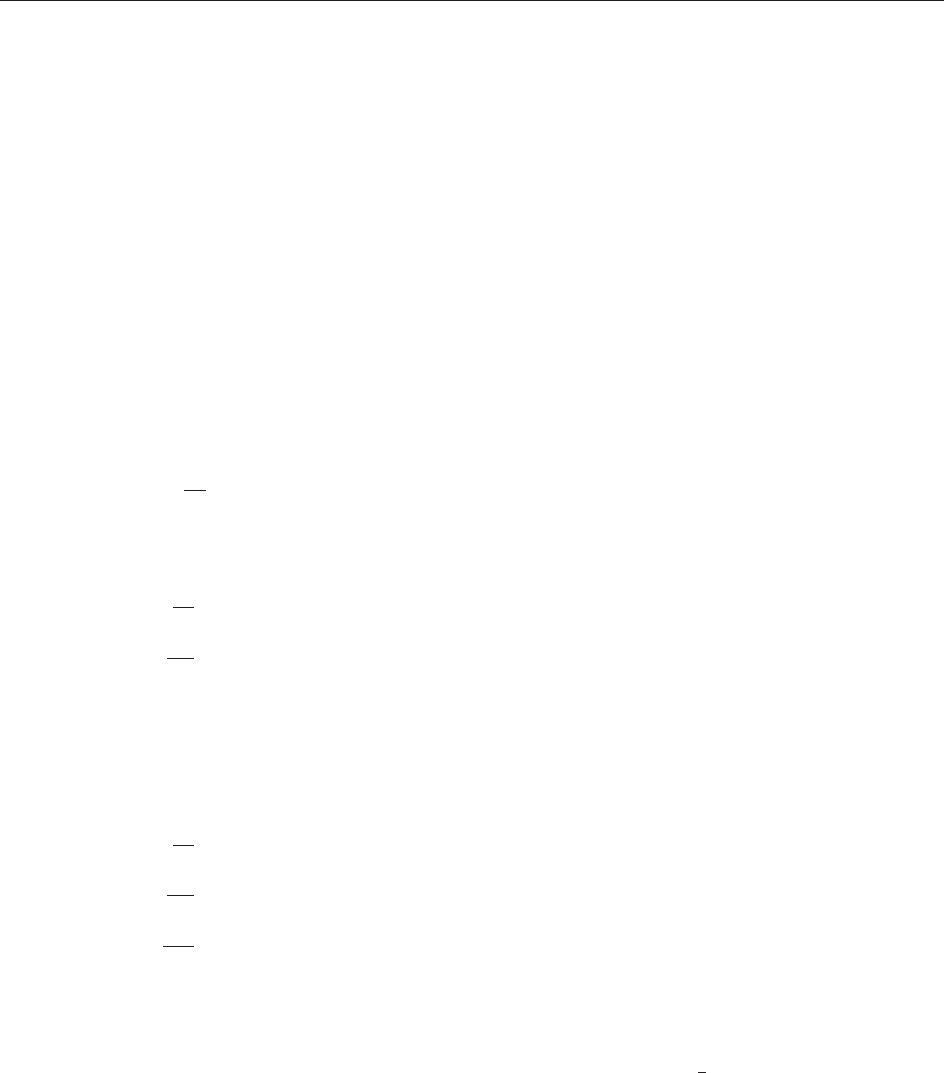
16.470; it exhibits the chaotic attractor of Figure 1,
with a three-dimensional feature very similar to that
of Lorenz attractor (in fact, it satisfies the condition
z < 0, but in our context it does not matter).
Let us divide system [9] into two subsystems
v = x
1
and w = (y
1
, z
1
). By creating a copy
216 Synchronization of Chaos
w
0
= (y
2
, z
2
)ofthew-subsystem, we obtain the
following five-dimensional dynamical system:
_
x
1
¼9x
1
9y
1
_
y
1
¼17x
1
y
1
x
1
z
1
_
z
1
¼z
1
þ x
1
y
1
_
y
2
¼17x
1
y
2
x
1
z
2
_
z
2
¼z
2
þ x
1
y
2
½10
In numerical experiments, it was observed that the
motion quickly results in the two equalities,
lim
t !þ1
jy
2
y
1
j= 0 and lim
t !þ1
jz
2
z
1
j= 0, to
be satisfied, that is, lim
t !þ1
kw
0
wk= 0. These
equalities persist as the system evolves. Hence, the
two subsystem s w and w
0
are synchronized. Figure 2
illustrates this phenomenon.
It is also easy to verify that the synchronization
persists even if a slight change in the parameters of
the system is made. The CLEs of the linearization of
the system around the synchronous state, the
negativity of which determines the stability of the
synchronized solution, are also computed easily.
Pecora–Carroll similarly built the system [10] by
using the following steps. Starting with two copies
of system [9], a signal x(t) is transmitted from the
first to the second: in the second system all x-
components are replaced with the signal from the
first system, that is, x
2
is replaced by x
1
in the
second system. Finally, the dx
2
=dt equation is
eliminated, since it is exactly the same as dx
1
=dt
equation, and is superfluous. This then results in
system [10]. For this reason, Pecora–Carroll called
this construction a complete replacement. Thus, it is
natural to think of the x
1
variable as driving the
second system, but also to label the first system the
drive and the second system the response. In fact,
this method is a particular case of the unidirectional
coupling method explained below. Note also that
this method could be modifi ed by using a partial
substitution approach, in which a response variable
is replaced with the drive counterpart only in certain
locations (Pecora et al. 1997).
Unidirectional IS
The IS synchronization has also been called as one-
way diffusive coupling, drive–response coupling,
master–slave coupling, or negative feedback control.
System [5], F = G and N = 0, becomes unidirec-
tionally coupled, and reads
dX
dt
¼ FðXÞ
dY
dt
¼ FðYÞþkMðX YÞ
½11
M is then a matrix that determines the linear
combination of X components that will be used
in the difference, and k determines the strength of
the coupling (see, for an interesting review on
this subject, Pecora et al. (1997)). In unidirectional
synchronization, the evolution of the first system
(the drive) is unaltered by the coupling, the second
system (the response) is then constrained to copy the
dynamics of the first. Let us consider an example
with two copies of system [9], and for
M¼
100
000
000
0
@
1
A
½12
that is, by adding a damping term to the first equation
of the response system, we get a following unidir-
ectionally coupled system, coupled through a linear
term k > 0 according to variables x
1, 2
:
_
x
1
¼9x
1
9y
1
_
y
1
¼17x
1
y
1
x
1
z
1
_
z
1
¼z
1
þ x
1
y
1
_
x
2
¼9x
2
9y
2
kðx
2
x
1
Þ
_
y
2
¼17x
2
y
2
x
2
z
2
_
z
2
¼z
2
þ x
2
y
2
½13
–30
–25
–20
–15
–10
–5
0
–15 –10 –5 0 5 10 15
–15
–10
–5
0
5
10
15
–15 –10 –5 0 5 10 15
Figure 1 The chaotic attractor of system [9]: x–y and x–z plane projections.
Synchronization of Chaos 217