
Francoise J.-P., Naber G.L., Tsun T.S. (editors) Encyclopedia of Mathematical Physics
Подождите немного. Документ загружается.

For k = 0, the two subsystems are uncoupled; for
k > 0 both subsystems are unidirectionally coupled;
and for k ! þ 1 , we recover the complete replace-
ment coupling scheme explained above. Our numer-
ical computations yield the optimal value
˜
k for the
synchronization; we found that for k
˜
k = 4.999,
both subsystems of [13] synchronize. That is,
starting from random initial conditions, and after
some transient time, system [13] generates the same
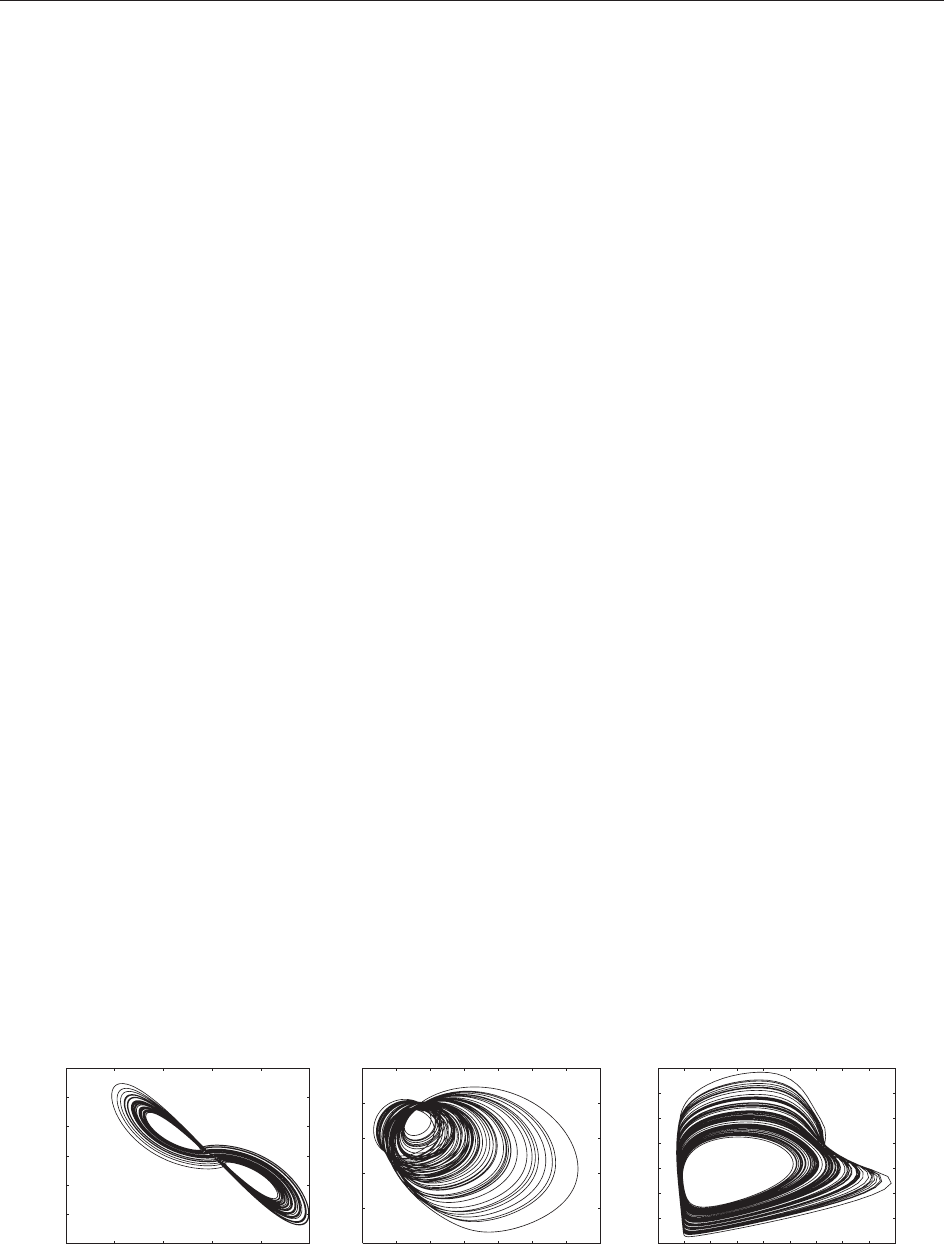
attractor as for system [9] (see Figure 1). Conse-
quently, all the variables of the coupled chaotic
subsystems converge: x
2
converges to x
1
, y
2
to y
1
,
and z
2
to z
1
(see Figure 3). Thus, the second system
(the response) is locked to the first one (the drive).
Alternatively, observation of diagonal lines in
correlation diagrams, which plot the amplitudes x
1
against x
2
, y
1
against y
2
, and z
1
against z
2
, can also
indicate the occurrence of system synchronization.
IS was the first for which examples of unidir-
ectionally coupled chaotic systems were prese nted. It
is important for potential applications of chaos
synchronization in communication systems, or for
time-series analysis, where the information flow is
also unidirectional.
Bidirectional IS
A second brief example uses a bidirectional (also
called mutual or two-way) coupling. In this situa-
tion, in contrast to the unidirectional coupling, both
drive and response systems are connected in such a
way that they influence each other’s behavior. Many
–10
–5
0
5
10
15
20
0 1 2 3 4 5
(a)
(b)
–35
–30
–25
–20
–15
–10
–5
0
5
0 1 2 3 4 5
–15
–10
–5
0
5
10
15
–15 –10 –5 0 5 10 15
(c)
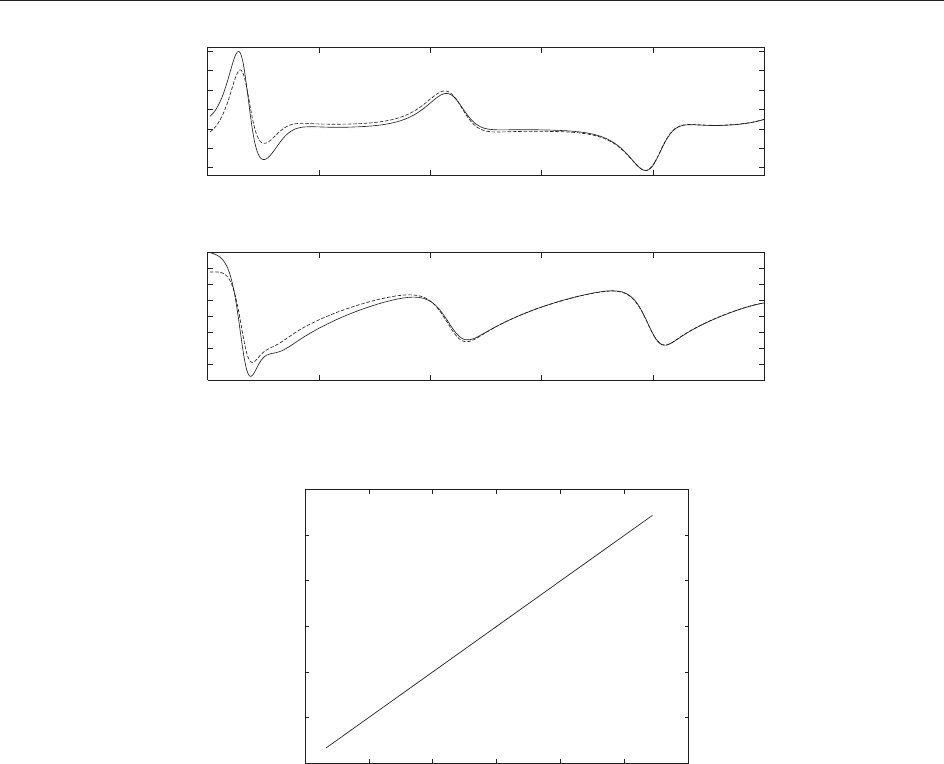
Figure 2 Complete replacement synchronization. Time series for (a) y
i
(t) and (b) z
i
(t), i = 1, 2, in system [10]. The difference
between the variable of the transmitter and the variable of the receiver asymptotes tends to zero as time progresses, that is,
synchronization occurs after transients die down. (c) The plot of amplitudes y
1
against y
2
, after transients die down, shows a diagonal
line, which also indicates that the receiver and the transmitter are maintaining synchronization. The plot of z
1
against z
2
shows a
similar behavior.
218 Synchronization of Chaos
biological or physical systems consist of bidirection-
ally interacting elements or components; examples
range from cardiac and respiratory systems to
coupled lasers with feedback. Let us then take two
copies of the same system [9] as given above, but
two-way coupled through a lin ear constant term k >
0 according to variables x
1, 2
:
_
x
1
¼9x
1
9y
1
kðx
1
x
2
Þ
_
y
1
¼17x
1
y
1
x
1
z
1
_
z
1
¼z
1
þ x
1
y
1
_
x
2
¼9x
2
9y
2
kðx
2
x
1
Þ
_
y
2
¼17x
2
y
2
x
2
z
2
_
z
2
¼z
2
þ x
2
y
2
½14
We can get an idea of the onset of synchronization
by plotting, for example, x
1
against x
2
for various
values of the coupling-strength parameter k. Our
numerical computations yield the optimal value
˜
k
for the synchronization:
˜
k ’ 2.50 (Figure 4), both
(x
i
, y
i
, z
i
) subsystems synchronize and system [14]
also generates the attractor of Figure 1.
Synchronization manifold and stability Geometri-
Geometrically, the fact that systems [13] and [14],
beyond synchronization, generate the same attractor
as system [9], implies that the attractors of these
combined drive–response six-dimensional systems
are confined to a three -dimensional hyperplane (the
synchronization manifold) defined by Y = X. After
the synchronization is reached, this manifold is a
stable submanifold in the full phase space R
6
.
Figure 5 gives an idea of what the geometry of the
synchronous attractor of system [13] or [14] looks
like, by exhibiting the projection of the phase space
R
6
onto (x
1
, y
1
, y
2
) subspace. But, one can simi-
larly plot any combination of variable x
i
, y
i
, and
z
i
(i = 1, 2), and get the same result, since the
motion, in case of synchronization, is confined to
the hyperplane defined in R
6
by the equalities
x
1
= x
2
, y
1
= y
2
,andz
1
= z
2
.
This hyperplane is stabl e since small perturbations
which take the trajectory off the synchronizati on
manifold decay in time. Indeed, as stated earlier,
CLEs of the linearization of the system around the
synchronous state could determine the stability of
the synchroni zed solution. This leads to requiring
that the origin of the transverse system, X
?
,is
asymptotically stable. To see this, for both systems
[13] and [14], we then switch to the new set of
coordinates, X
?
= Y X, that is, x
?
= x
2
x
1
,
y
?
= y
2
y
1
, and z
?
= z
2
z
1
. The origin (0, 0, 0)
is obviously a fixed point for this transverse system,
2164 2166 2168 2170 2172 2174 2176 2178 2180
–10
–5
0
5
10
2162
–10
–5
0
5
10
2162 2164 2166 2168 2170 2172 2174 2176 2178 2180
–25
–20
–15
–10
–5
1525 1530 1535 1540 1545 1550
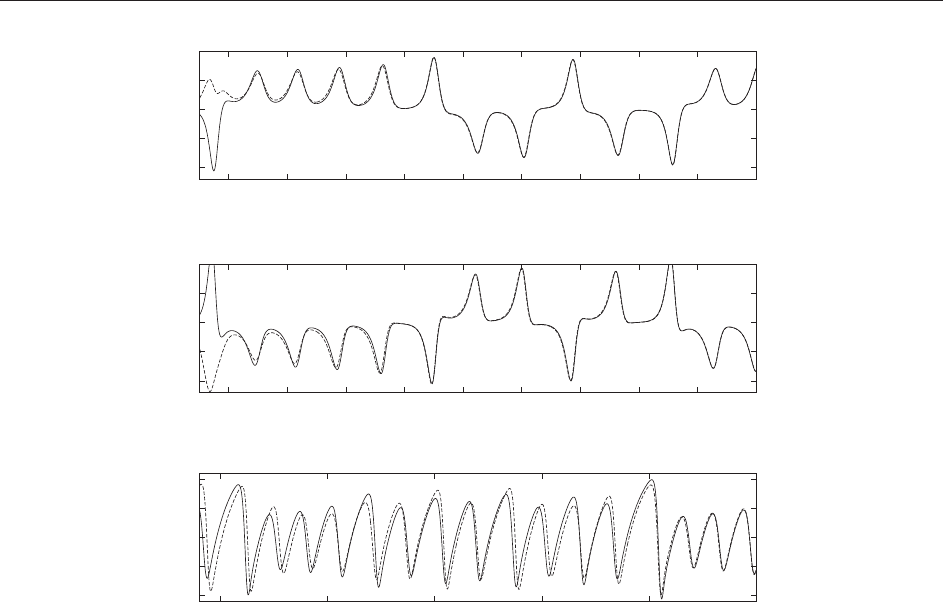
Figure 3 Time series for x
i
(t), y
i
(t), and z
i
(t)(i = 1, 2) in system [13] for the coupling constant k = 5:0, that is, beyond the threshold
necessary for synchronization. After transients die down, the two subsystems synchronize perfectly.
Synchronization of Chaos 219
within the synchronization manifold. Therefore, for
small deviations from the synchronization manifold,
this system reduces to a typical variational equation:
dX
?
dt
¼ DFðXÞX
?
½15
where DF(X) is the Jacobian of the vector field
evaluated onto the driving trajectory X, that is,
dx
?
dt
dy
?
dt
dz
?
dt
0
B
B
B
B
B
B
B
@
1
C
C
C
C
C
C
C
A
¼ V
x
?
y
?
z
?
0
B
B
B
B
B
B
B
@
1
C
C
C
C
C
C
C
A
½16
For systems [13] and [14], we obtain
V ¼ V
i
¼
9 k
i
90
17 z 1 x
yx1
0
@
1
A
½17
with k
i
= k for system [13] an d k
i
= 2k for system
[14]. Let us remark that the only difference between
both matrices V
i
is the coupling k which has a factor
–10
–5
0
5
10
–10 –5 0
5
10
(a)
–10
–5
0
5
10
–10
–5 0 510
(b)
–10
–5
0
5
10
–10 –5 0 5 10
(c)
0
5
10
15
20
25
30
35
40
1200 1220 1240 1260 1280 1300
(d)
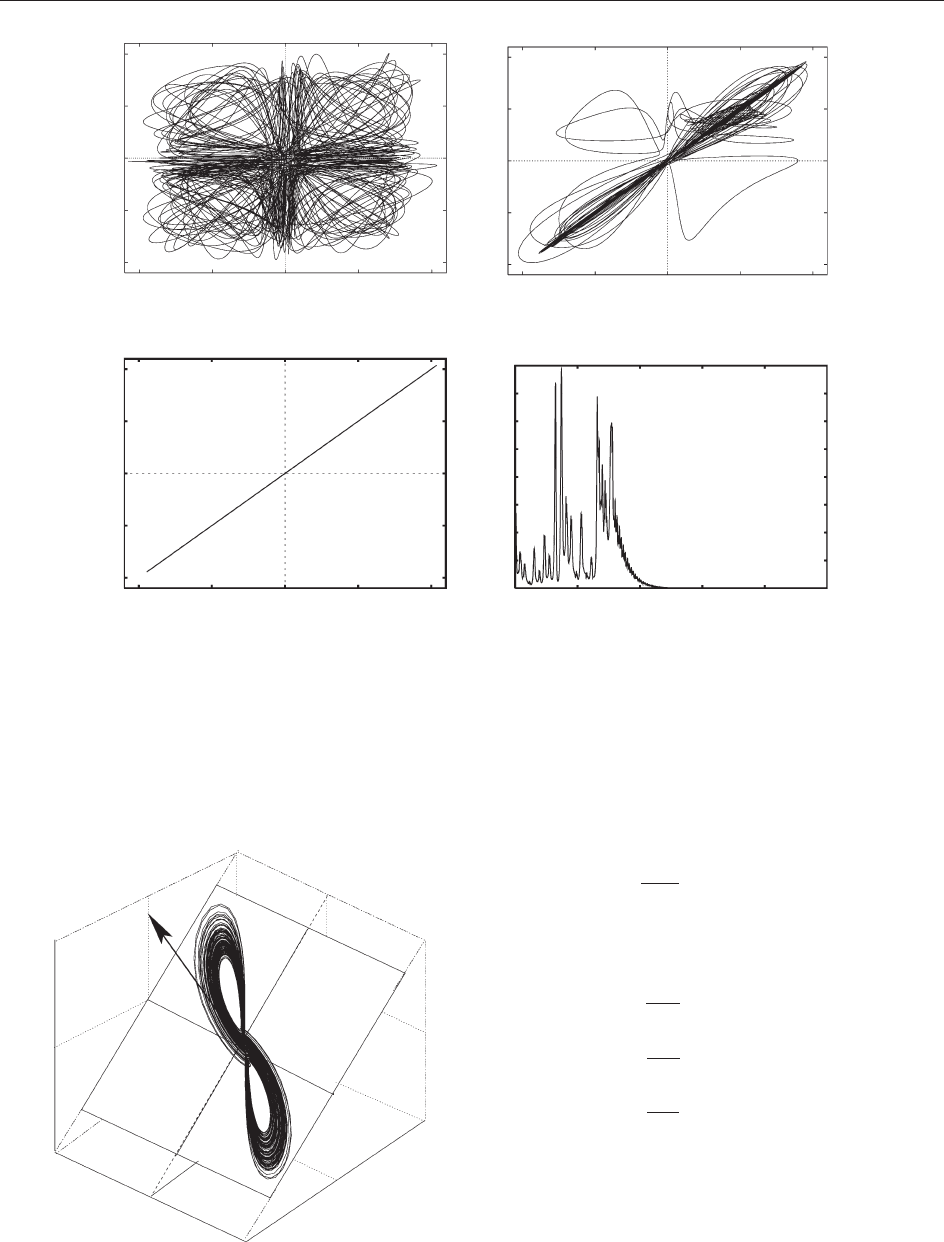
Figure 4 Illustration of the onset of synchronization of system [14]. (a)–(c) Plots of amplitudes x
1
against x
2
for values of the coupling
parameter k = 0:5, 1:5, 2:8, respectively. The system synchronizes for k 2:5. (d) Plot, for k = 2:8, of the norm N(X ) = kx
1
x
2
kþ
ky
1
y
2
kþkz
1
z
2
k versus t, which shows that the system synchronizes very quickly.
y
1
= y
2
y
2
x
1
y
1
Transverse
direction
–12
12
15
–15
0
0
0
15
–15
Hyperplane
:
synchronization
manifold
Figure 5 The motion of synchronized system [13] or [14] takes
place on a chaotic attractor which is embedded in the
synchronization manifold, that is, the hyperplane defined by
x
1
= x
2
, y
1
= y
2
, and z
1
= z
2
:
220 Synchronization of Chaos
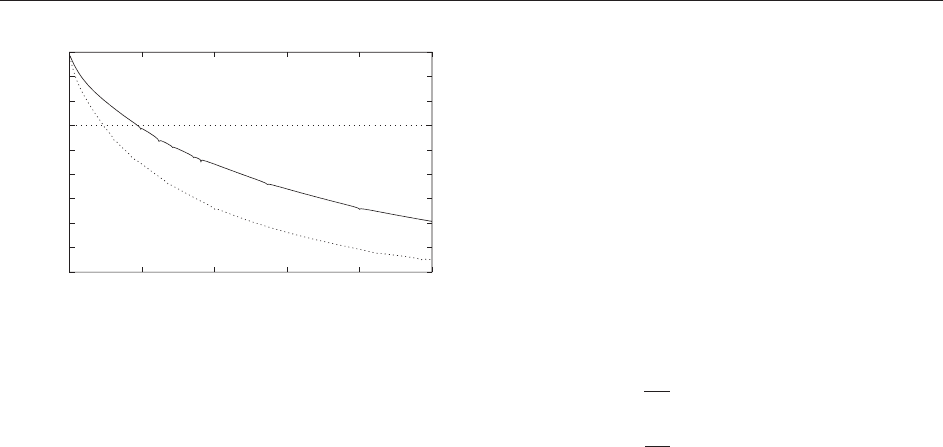
2 in the bidirectional case. Figure 6 shows the
dependence of L
?
max
on k, for both examples of
unidirectionally and bidirectionally coupling sys-
tems. L
?
max
becomes negative as k increases, which
insures the stability of the synchronized state for
systems [13] and [14].
Let us note that this can also be proved
analytically as done by Derivie` re and Aziz-Alaoui
(2003) by using a suitable Lyapunov function, and
using some new extended version of LaSalle invar-
iance principle.
Desynchronization motion Synchronization depends
not only on the coupling strength, but also on the
vector field and the coupling function. For some
choice of these quantities, synchronization may
occur only within a finite range [k
1
, k
2
] of coup ling
strength; in such a case a desynchronization phe-
nomenon occurs. Thus, increasing k beyond the
critical value k
2
yields loss of the synchronized
motion (L
?
max
becomes positive).
Generalized Synchronization
Identical chaotic systems synchronize by following the
same chaotic trajectory. However, real systems are in
general not identical. For instance, when the para-
meters of two coupled identical systems do not match,
or when these coupled systems belong to different
classes, complete IS may not be expected, because
there does not exist such an invariant manifold Y = X,
as for IS. For non-identical systems, the possibility of
some type of synchronization has been investigated
(Afraimovich et al. 1986).Itwasshownthatwhentwo
different systems are coupled with sufficiently strong
coupling strength, a general synchronous relation
between their states could exist and it could be
expressed by a smooth invertible function,
Y(t) = (X(t)). This phenomenon, called GS, is thus a
relaxed and extended form of IS in non-identical
systems.
However, it may also occur for pairs of identical
systems, for example, for systems having reflection
symmetry, F(X) = F(X). Besides these examples
of GS, others also exist that exploit symmetries of
the underlying systems (Parlitz and Kocarev 1999).
GS was introduced for unidirectionally coupled
systems by Rulkov et al. (1995). For simplicity, we
also focus on unidirectionally coupled continuous
time systems:
dX
dt
¼ FðXÞ
dY
dt
¼ GðY; uðtÞÞ
½18
where X 2 R
n
, Y 2 R
m
, F : R
n
! R
n
, G : R
m
R
k
! R
m
,andu(t) = (u
1
(t), ..., u
k
(t)) with
u
i
(t) = h
i
(X(t, X
o
)). Two (non-identical ) dynamical
systems are said to be synchronized in a generalized
sense if there is a continuous function from the
phase space of the first to the phase space of the
second, taking orbits of the first system to orbits of
the second.
The main problem is to know when and under
what conditions system [18] undergoes GS. Many
authors have addressed this question, and it has been
shown that asymptotic stability is equally significant
for this more universal concept (for some theoretical
results, see Rulkov et al. (1995) and Parlitz and
Kocarev (1999)). For unidirectionally coupled con-
tinuous time systems, the following results hold:
Theorem A necessary and sufficient condition for
system [18] to be synchronized in the generalized
sense is that for each u(t) = u(X(t, X
o
)) the system-
is asymptotically stable.
When it is not possible to find a Lyapunov function
in order to use this theorem, one can numerically
compute the CLEs of the response system, and use the
following result:
Theorem The drive and response subsystems of
system [18] synchronize in the generalized sense iff
all of the CLEs of the response subsystem are
negative.
The definition of has the advantage that it allows
the discussion of synchronization of non-identical
systems and, at the same time, to consider synchroni-
zation in terms of the property of synchronization
manifold. Therefore, it is important to study the
existence of the transformation and its nature
Coupling strength, k
⊥
Lyapunov exponents, L
max
–1.2
–1
–0.8
–0.6
–0.4
–0.2
0
0.2
0.4
0.6
0 5 10 15 20 25
U
n
i
d
i
r
e
c
t
i
o
n
a
l
c
o
u
p
l
i
n
g
B
i
d
i
r
e
c
t
i
o
n
a
l
c
o
u
p
l
i
n
g
Figure 6 The largest transverse Lyapunov exponents L
?
max
as
a function of coupling strength k, in the unidirectional system [13]
(solid) and the bidirectional system [14] (dotted).
Synchronization of Chaos 221
(continuity, smoothness, ...). Unfortunately, except in
special cases (Afraimovich et al. 1986), rarely will one
be able to produce formulas exhibiting the mapping .
An example of two unidirectionally coupled
chaotic syst ems which synchronize in the generalized
sense is given below. Consider the following Ro¨ ssler
system driven by system [9]:
_
x
1
¼9x
1
9y
1
_
y
1
¼17x
1
y
1
x
1
z
1
_
z
1
¼z
1
þ x
1
y
1
_
x
2
¼y
2
z
2
kðx
2
ðx
2
1
þ y
2
1
ÞÞ
_
y
2
¼ x
2
þ 0:2y
2
kðy
2
ðy
2
1
þ z
2
1
ÞÞ
_
z
2
¼ 0:2 þ z
2
ðx
2
9:0Þkð z
2
ðx
2
1
þ z
2
1
ÞÞ
½19
As shown in Figure 7, it appears impossible to tell
what the relation is between the transmitter sub-
system (x
1
, y
1
, z
1
) in eqn [19] and the two Ro¨ ssler
response subsystems (x
2
, y
2
, z
2
)atk = 1 and k = 100.
However, GS occurs for large values of the
coupling-strength parameter k. Therefore, for such
values we expect that orbits of [19] will lie in the
vicinity of a certain synchronization manifold.
Indeed, let us define the set
S ¼fðx
1
; y
1
; z
1
; x
2
; y
2
; z
2
Þ2R
6
: x
2
¼ x
2
1
þ y
2
1
;
y
2
¼ y
2
1
þ z
2
1
; z
2
¼ x
2
1
þ z
2
1
g
Since the projections of S onto the coordinates
(x
1
, y
1
, x
2
), (y
1
, z
1
, y
2
), and (x
1
, z
1
, z
2
) are parabo-
loids, we can see how the synchronization manifold
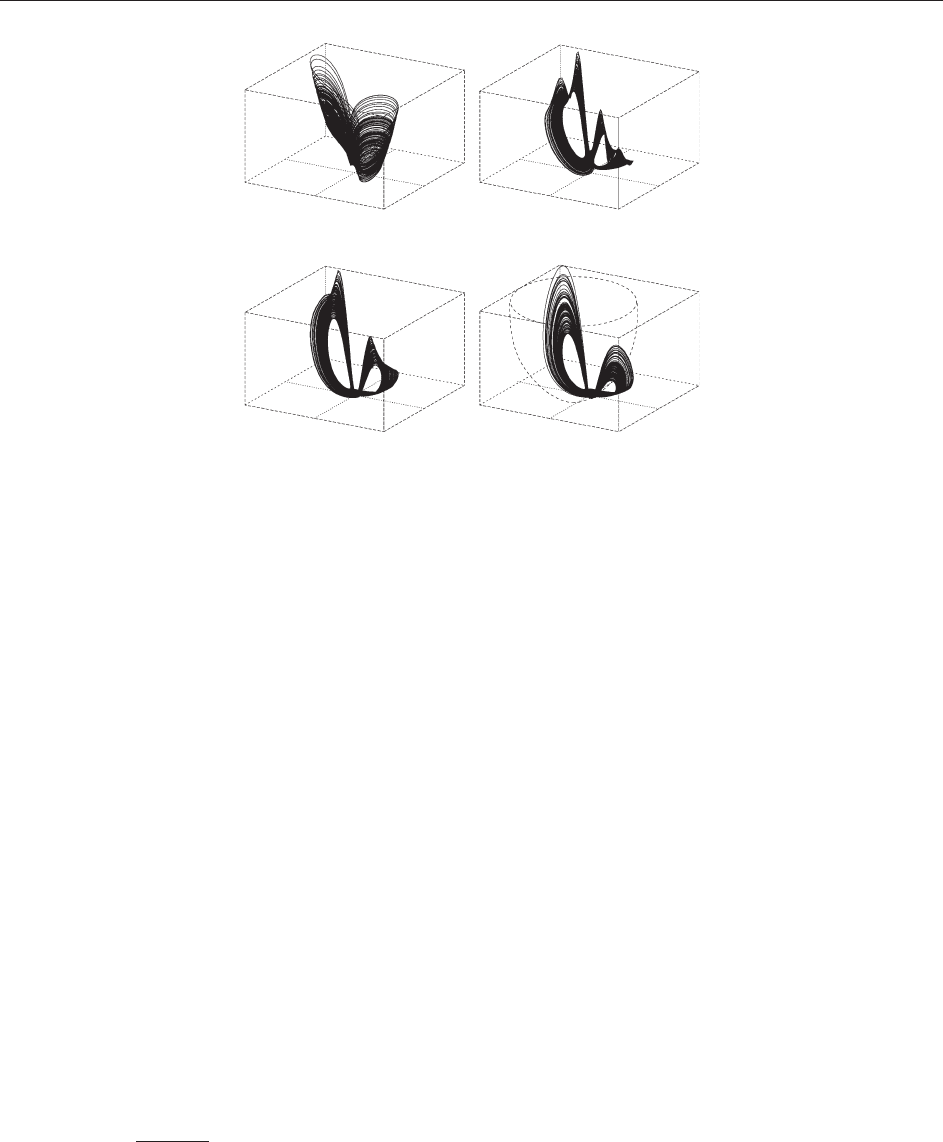
is approached. This is illustrated in Figure 8, where
the (x
1
, y
1
, x
2
) projections of typical trajectories are
shown at four different coupling values. (See Josic
(2000) for other examples and further develop-
ments; see also Pecora et al. (1997), where the
authors summarize a method in order to get an idea
on the functional relation occurring in case of GS,
between two coupled systems.)
Phase Synchronization
For coupled non-identical chao tic systems, other
types of synchronizations exist. Recently, a rather
weak degree of synchronization, the PS, of chaotic
systems has been described (Pikovsky et al. 2001).
The Greek meaning of the word synchronization,
mentioned in the introduction, is closely related to
this type of processes. The synchronous motion is
actually not visible. Indeed, in PS the phases of
chaotic systems with PS are locked, that is, there
exists a certain relation between them, whereas the
amplitudes vary chaotically and are practically
uncorrelated. Thus, it is mostly close to synchroni-
zation of periodic oscillators.
Definition PS of two coupled chaotic oscillators
occurs if, for arbitrary integers n and m, the phase
locking condition between the corresponding
phases, jn
1
(t) m
2
(t) jconstant, holds and the
amplitudes of both systems remain uncorrelated.
Let us note that such a phenomenon occurs when
a zero Lyapunov exponent of the response system
becomes negative, while, as explained above, iden-
tical chaoti c systems synchronize by following the
same chaotic trajectory, when their largest trans-
verse Lyapunov exponent of the synchronized
manifold decreases from positive to negative values.
Moreover, following the definition above, this
phenomenon is best observed when a well-defined
phase variable can be identified in both coupled
systems. This can be done for strange attractors that
spiral around a ‘ ‘hole,’’ or a particular (fixed) point
in a two-dimensional projection of the attractor. The
typical example is given by the Ro¨ ssler system, which,
for some range of parameters, exhibits a Mo¨bius-
15
10
5
0
–5
–
10
–
15
–15 –10 –5 0 5 10
(a)
250
200
150
100
50
0
–160
–140 –120 –100 –80 –60 –40 –20
(b)
100
0
200
300
400
500
600
700
–20 0 20 40 60 80 100 120 140 160
(c)
Figure 7 Projections onto the (x–y) plane of typical trajectories of system [19]. (a) (x
1
, y
1
) projection, that is, a typical trajectory of
system [9]; (b) and (c) (x
2
, y
2
) projections at, respectively, k = 1 and k = 100:
222 Synchronization of Chaos
strip-like chaotic attractor with a central hole. In such
acase,aphaseangle( t) can be defined that decreases
or increases monotonically. For an illustration, we
take the following two coupled Ro¨ ssler oscillators:
_
x
1
¼
1
y
1
z
1
þ kðx
2
x
1
Þ
_
y
1
¼
1
x
1
þ 0:17y
1
_
z
1
¼ 0:2 þ z
1
ðx
1
9:0Þ
_
x
2
¼
2
y
2
z
2
þ kðx
1
x
2
Þ
_
y
2
¼
2
x
2
þ 0:17y
2
_
z
2
¼ 0:2 þ z
2
ðx
2
9:0Þ
½20
with a small parameter mismatch
1, 2
=
0.95 0.04,k governs the strength of coupling.
If we can define a Poincare´ section surface for
the system, then, for each piece of a trajectory
between two cross sections with this surface, we
define the phase, as done in Pikovsky et al. (2001),
as a piecewise linear function of time, so that the
phase increment is 2 at each rotation:
ðtÞ¼2
t t
n
t
nþ1
t
n
þ 2n; t
n
t t
nþ1
where t
n
is the time of the nth crossing of the secant
surface.
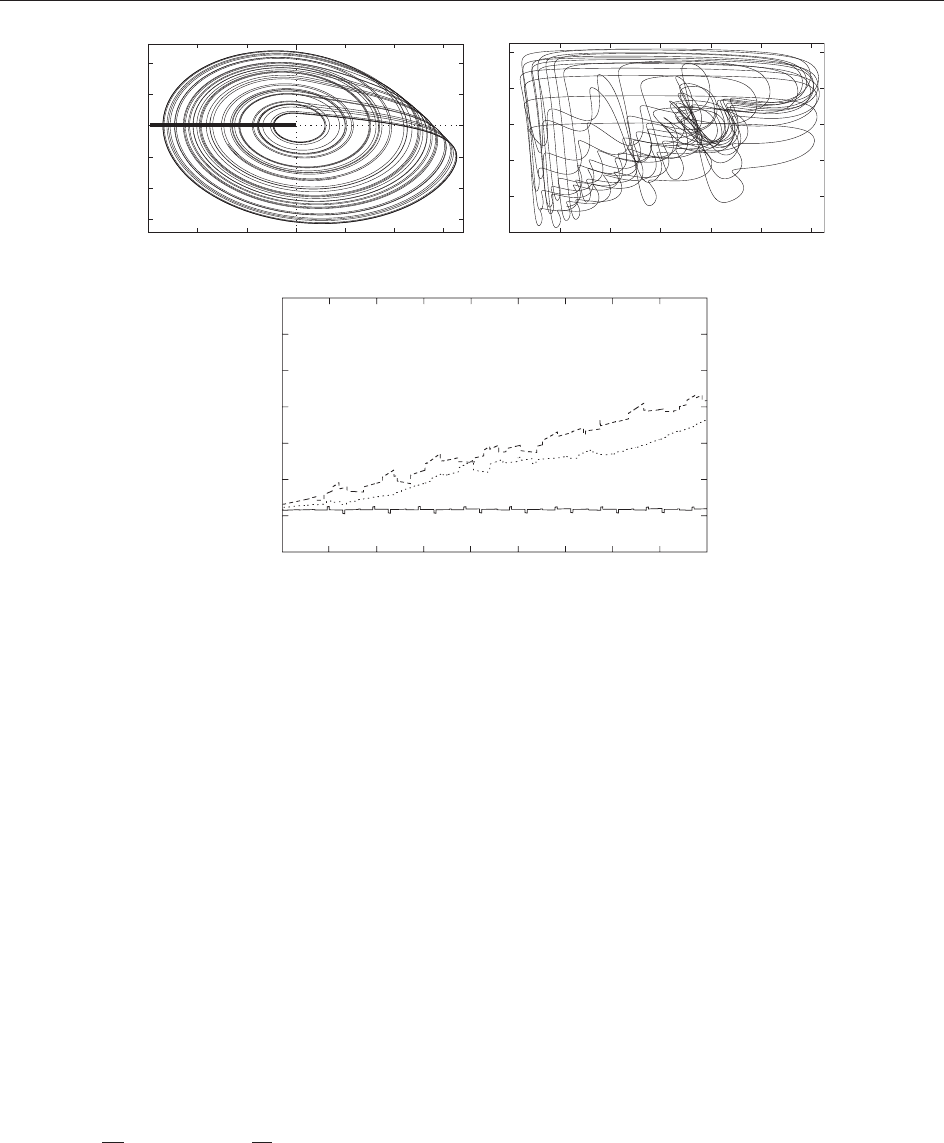
In our example, the last has been chosen as the
negative x-axis and represented by the wide segment
in Figure 9a. This definition of phases is clearly
ambiguous since it depends on the choice of the
Poincare´ section; nevertheless, defined in this way,
the phase has a physically important property, it
does correspond to the directio n with the zero
Lyapunov exponent in the phase space, its perturba-
tions neither grow nor decay in time. Figure 9c
shows that there is a transition from the nonsyn-
chronous phase regime, where the phase difference
increases almost linearly with time (k = 0.01 and
k = 0.05), to a synchronous state, where the relation
j
1
(t)
2
(t)j < constant holds (k = 0.1), that is,
the phase difference does not grow with time.
However, the amplitudes are obviously uncorrelated
as seen in Figure 9b. This example shows that
PS could takes place for weaker degree of synchro-
nization in chaotic systems. Readers can find more
rigorous mathematical discussion on this subject,
and on the definition of phases of chaotic oscillators,
in Pikovsky et al. (2001), see also Boccaletti et al.
(2002) and references therein.
Other Treatments and Types
of Synchronization
Lag Synchronization
PS synchronization occurs when non-identical chao-
tic oscillators are weakly coupled: the phases are
locked, while the amplitudes remain uncorrelated.
When the coupling strength becomes larger, some
relationships between amplitudes may be estab-
lished. Indeed, it has been shown (Rosenblum et al.
1997), in symmetrically coupled non-identical oscil-
lators and in time-d elayed systems, that there exists
(a) (b)
(c) (d)
Figure 8 Generalized synchronization. (x
1
, y
1
, x
2
) projections of typical trajectories of system [19] after transients die out, with
(a) k = 1, (b) k = 20, (c) k = 100, and (d) k = 200. For the last value, the attractor lies in the set S, three-dimensional projections of
which are paraboloı
¨
ds.
Synchronization of Chaos 223
a regime of LS. This process appears as a co in-
cidence of time-shifted stat es of two systems:
lim
t!þ1
jjYðtÞXðt Þjj ¼ 0
where is a positive delay.
Projective Synchronization
In coupled partially linear systems, it was reported
by Mainier i and Rehacek (1999) that two identical
systems could be synchronized up to a scaling factor.
This type of chaotic synchronization is referred to as
projective synchronization. Consider, for example, a
three-dimensional chaotic system
˙
X = F(X), where
X = (x, y, z). Decompose X into a vector v = (x, y)
and a scalar z; the system can then be rewritten as
du
dt
¼ gðv; zÞ;
dz
dt
¼ hðv; zÞ
In projective synchronization, two identical sys-
tems X
1
= (x
1
, y
1
, z
1
) (drive) and X
2
= (x
2
, y
2
, z
2
)
(response) are coupled through the scalar variable z.
It occurs if the state vectors v
1
and v
2
synchronize up
to a constant ratio, that is, lim
t !þ1
jjv
1
(t)
v
2
(t)jj= 0, where is called a scaling factor. For
partially linear systems, it may automatically occur
provided that the systems satisfy some stability
conditions.
However, this process could not be classified as
GS, even if there exists a linear relation between the
coupled systems, because the response system of
projective synchronization is not asymptotically
stable. For more information about this subject,
the reader is referred to Mainieri and Rehacek
(1999).
Anticipating Synchronization
It is interesting to mention that a new form of
synchronization has recently appeared, the so-called
anticipating synchronization (Boccaletti et al. 2002).
It shows that some coupled chaotic systems might
synchronize such that their response anticipates the
drivers by synchronizing with their future states.
It is also interesting to mention the nonlinear H
1
synchronization method for nonautonomous
schemes introduced by Suykens et al. (1997).
Spatio-Temporal Synchronization
Low-dimensional systems have rather limited useful-
ness in modeling real-wo rld applications. This is
why the synchronization of chaos has been carried
k = 0.01
k
= 0.1
k
= 0.05
φ
1
− φ
2
Time
–5
0
5
10
15
20
25
30
20 40 60 80 100 120 140 160 180 200
(c)
–15
–10
–5
0
5
10
–15 –10 –5 0 5 10 15
4
6
8
10
12
14
4 6 8 10121416
(b)(a)
Figure 9 (a) Ro
¨
ssler chaotic attractor projection onto x–y plane. (b) Amplitudes A
1
versus A
2
for the phase synchronized case at
k = 0:1. (c) Time serie of phase difference for different coupling strengths k; for k = 0:01 PS is not achieved, while for k = 0:1 PS takes
place. Although the phases are locked, for k = 0:1, the amplitudes remain chaotic and uncorrelated.
224 Synchronization of Chaos

out in high dimensions (see Kocarev et al. (1997) for
a review). See also Chen and Dong (2001) for a
discussion of special high-dimensional systems,
namely large arrays of coupled chaotic systems.
Application to Transmission Systems
and Secure Communication
Synchronization principles are useful in practical
applications. Use of chaotic signals to transmit
information has been a very active research topic
in the last decade. Thus, it has been established that
chaotic circuits may be used to transmit information
by synchronization. As a result, several proposals
for secure-communication schemes have been
advanced (see, e.g., Cuomo et al. (1993), Hasler
(1998), and Parlitz et al. (1999)). The first labora-
tory demonstration of a secure-communication
system, which uses a chaotic signal for masking
purposes, and which exploits the chaotic synchroni-
zation techniques to recover the signal, was reported
by Kocarev et al. (1992).
It is difficult, within the scope of this article, to
give a complete or detailed discussion, and it should
be noted that there exist many competing and tested
methods that are well established.
The main idea of the communication schemes is
to encode a message by means of a chaotic
dynamical system (the transmitter), and to decode
it using a second dynamical system (the receiver)
that synchronizes with the first. In general, secure-
communication applicat ions assume additionally
that the coupled systems used are identical.
Different methods can be used to hide the useful
information, for example, chaotic masking, chaotic
switching, or direct chaotic modulation (Hasler
1998). For instance, in the chaotic masking method,
an analog information carrying the signal s(t)is
added to the output y(t) of the chaotic system in the
transmitter. The receiver tries to synchronize with
component y(t) of the transmitted signal s(t) þ y(t).
If synchronization takes place, the information
signal can be retrieved by subtraction (Figure 10).
It is interesting to note that, in all proposed
schemes for secure communications using the idea of
synchronization (experimental realization or com-
puter simulation), there is an inevitable noise
degrading the fidelity of the original message.
Robustness to parameter misma tch was address ed
by many authors (Illing et al. 2002). Lozi et al.
(1993) showed that, by connecting two identical
receivers in cascade, a significant amount of the
noise can be reduced, thereby allowing the recovery
of a much higher quality signal.
Furthermore, different implementations of chaotic
secure communication have been proposed during
the last decades, as well as methods for cracking this
encoding. The methods used to crack such a chaotic
encoding make use of the low dimensionality of the
chaotic attractors. Indeed, since the properties of
low-dimensional chaotic systems with one positive
Lyapunov exponent can be reconstructed by analyz-
ing the signal, such as through the delay-time
reconstruction methods, it seems unlikely that these
systems might provide a secure encryption method.
The hidden message can often be retrieved easily by
an eavesdropper without using the receiver. But,
chaotic masking and encoding are difficult to break,
using the state-of-the-art analysis tools, if suffi-
ciently high dimensional chaos generators with
multiple posit ive Lyapunov exponents (i.e., hyperch-
aotic systems) are used (see Pecora et al. (1997), and
references therein).
Conclusion
In spite of the essential progress in theoretical and
experimental studies, synchronization of chaotic
systems continues to be a topic of active investiga-
tions and will certainly continue to have a broad
impact in the future. Theory of synchronization
remains a challenging problem of nonlinear
science.
See also: Bifurcations of Periodic Orbits; Chaos and
Attractors; Fractal Dimensions in Dynamics; Generic
Properties of Dynamical Systems; Isochronous Systems;
Lyapunov Exponents and Strange Attractors; Singularity
and Bifurcation Theory; Stability Theory and KAM;
Weakly Coupled Oscillators.
Further Reading
Afraimovich V, Chazottes JR, and Cordonet A (2001) Synchroni-
zation in directionally coupled systems some rigourous results.
Discrete and Continuous Dynamical Systems B 1(4): 421–442.
Afraimovich V, Verichev N, and Rabinovich MI (1986) Stochastic
synchronization of oscillations in dissipative systems. Radio-
physics and Quantum Electron 29: 795–803.
Boccaletti S, Kurths J, Osipov G, Valladares D, and Zhou C
(2002) The synchronization of chaotic systems. Physics
Reports 366: 1–101.
Chen G and Dong X (1998) From Chaos to Order. Singapore:
World Scientific.
Information
signal
^
s(t )
Retrieved
information
signal
s(t ) y(t )
Receiver
Transmitter
(chaotic)
Transmitted
signal
(chaotic)
Figure 10 A typical communication setup.
Synchronization of Chaos 225

Cuomo K, Oppenheim A, and Strogatz S (1993) Synchroniza-
tion of Lorenz-based chaotic c ircuits with applications to
communications. IEEE Transactions on Circuits and Sys-
tems – II: Analog and Digital Signal Processing 40(10):
626–633.
Derivie` re S and Aziz-Alaoui MA (2003) Estimation of attractors
and synchronization of generalized Lorenz systems. Dynamics
of Continuous, Discrete and Impulsive Systems Series B:
Applications and Algorithms 10(6): 833–852.
Hasler M (1998) Synchronization of chaotic systems and
transmission of information. International Journal of Bifurca-
tion and Chaos 8(4): 647–659.
Huygens Ch (Hugenii) (1673) Horologium Oscillatorium (English
translation: 1986 The Pendulum Clock. Ames: Iowa State
University Press). Parisiis, France: Apud F. Muguet.
Illing L (2002) Chaos Synchronization and Communications in
Semiconductor Lasers. Ph.D. dissertation,. San Diego: Uni-
versity of California.
Illing L, Brocker J, Kocarev L, Parlitz U, and Abarbanel H (2002)
When are synchronization errors small? Physical Review E 66:
036229.
Josic K (2000) Synchronization of chaotic systems and invariants
manifolds. Nonlinearity 13: 1321–1336.
Kocarev Lj, Halle K, Eckert K, and Chua LO (1992) Experi-
mental demonstration of secure communication via chaotic
synchronization. International Journal of Bifurcation and
Chaos 2(3): 709–713.
Kocarev Lj, Tasev Z, Stojanovski T, and CParlitz U (1997)
Synchronizing spatiotemporel chaos. Chaos 7(4): 635–643.
Lozi R and Chua LO (1993) Secure communications via chaotic
synchronization II: noise reduction by cascading two identical
receivers. International Journal of Bifurcation and Chaos 3(5):
1319–1325.
Mainieri R and Rehacek J (1999) Projective synchronization in
three-dimensional chaotic systems. Physical Review Letters
82: 3042–3045.
Ott E, Grebogi C, and Yorke JA (1990) Controlling chaos.
Physical Review Letters 64: 1196–1199.
Parlitz U and Kocarev L (1999) Synchronization of chaotic
systems. In: Schuster HG (ed.) Handbooks of Chaos Control,
pp. 271–303. Germany: Wiley-VCH.
Pecora L and Carroll T (1990) Synchronization in chaotic
systems. Physical Review Letters 64: 821–824.
Pecora L and Carroll T (1991) Driving systems with chaotic
signals. Physical Review A 44: 2374–2383.
Pecora L, Carroll T, Johnson G, and Mar D (1997) Fundamentals
of synchronization in chaotic systems, concepts and applica-
tions. Chaos 7(4): 520–543.
Pikovsky A, Rosenblum M, and Kurths J (2001) Synchronization,
A Universal Concept in Nonlinear Science. Cambridge: Cam-
bridge University Press.
Rosenblum M, Pikovsky A, and Kurths J (1997) From phase to
lag synchronization in coupled chaotic oscillators. Physical
Review Letters 78: 4193–4196.
Rulkov N, Sushchik M, Tsimring L, and Abarbanel H (1995)
Generalized synchronization of chaos in directionally coupled
chaotic systems. Physical Review E 51(2): 980–994.
Suykens J, Vandewalle J, and Chua LO (1997) Nonlinear H
1
synchronization of chaotic Lure systems. International Journal
of Bifurcation and Chaos 7(6): 1323–1335.
Wu CW (2002) Synchronization in Coupled Chaotic Circuits and
Systems. Series on Nonlinear Science, Series A, vol. 41.
Singapore: World Scientific.
Yamada T and Fujisaka H (1983) Stability theory of synchronized
motion in coupled-oscillator systems. Progress of Theoretical
Physics 70: 1240–1248.
226 Synchronization of Chaos

T
t Hooft–Polyakov Monopoles see Solitons and Other Extended Field Configurations
Thermal Quantum Field Theory
CDJa¨ kel, Ludwig-Maximilians-Universita
¨
tMu
¨
nchen,
Mu
¨
nchen, Germany
ª 2006 Elsevier Ltd. All rights reserved.
Introduction
Quantum field theory was initially invented in order
to describe high-energy elementary particles, thereby
unifying quantum mechanics and special relativity.
In other words, quantum field theory was addressed
to the so-called vacuum sector, that is, roughly
speaking physics at zero temperature and zero
particle density.
The same applies to the various mathematically
rigorous versions of quantum field theory that have
been developed since the mid-1950s. Indeed, in
Wightman’s axiom atic setting, quantum field theory
is describes in terms of a set of the so-called vacuum
expectation values. The ‘‘algebraic approach’’ to
quantum field theory developed by Araki, Haag,
Kastler, and their collaborators is more flexible in
nature. In fact, right from the beginning, the new
algebraic tools were successfully applied to lattice
models and other nonrelativistic systems with
infinitely many degrees of freedom (see Operator
algebras and quantum statistical mechanics by
O Bratteli and D W Robinson). But the need to
treat large systems of relativistic particles was
apparently not felt. Even in Haag’s recent mono-
graph, Local Quantum Physics, the subjects of
algebraic quantum field theory and algebraic quan-
tum statistical mechanics are treated separately.
It is remarkable that constructive field theory
was ahead of its time in this respect. The famous
P()
2
model (first constructed by Glimm and Jaffe)
was adapted to thermal states by Høegh-Krohn
as early a s 1974 (see Høegh-Krohn (1974)).
His paper was properly named ‘‘Relativistic quan-
tum statistical mechanics in two-dimensional
space-time,’’ but only recently has it received
proper attention.
At the same time, around 1974, cosmology and
heavy-ion collisions drew the interest of phyiscists
towards the quantum statistical mechanics of hot
relativistic quantum systems. Well-known papers
from this early stage include those by Weinberg,
Bernard, and Dolan and Jackiw. While most of the
papers used Euclidean path integrals, Umezawa and his
school developed a real-time framework called
‘‘thermo-field dynamics,’’ which involved a doubling
of the degrees of freedom. The excellent review by
Landsman and van Weert (1987) covers these early
attempts; it also explains the basic connection to the
algebraic approach.
In the following years, it became evident that
statistical mechanics (in its standard formulation) is
barely sufficient to derive the properties of bulk
matter from the underlying microscopic description
provided by quantum field theory. Thus, various
people began to establish mathematically rigorous
foundations for the description of thermal field
theory. The most successful approach was launched
by D Buchholz (with various collaborators), who,
from about 1985 onwards, started applying the
KMS condition (which describes a thermal equili-
brium state in the operator-algebraic framework of
local quantum physics) to relativistic quantum field
theory. In 1994, Buchholz and Bros managed to
integrate the holomorphic structure of Wightman
field theory into Haag’s operator-algebraic frame-
work, which led them to the notion of a relativistic
KMS condition.
The advanced mathematical concepts involved in
the formulation of entropy densities for thermal
quantum fields (see Narnhofer (1994)) do not allow
us to present this topic. The reader is referred to the
excellent book Quantum Entropy and Its Use by
M Ohya and D Petz for an introduction to the
subject. A discussion of the so-called thermalization