
Francoise J.-P., Naber G.L., Tsun T.S. (editors) Encyclopedia of Mathematical Physics
Подождите немного. Документ загружается.


namely there is no unique state–field relation, that
is, no R eeh–Schlieder p roperty (a field A
whose
source projection P
does not coalesce with the
vacuum projection annihilates the vacuum); in
operator-algebraic terms, the local algebras a re
not factors. This poses the question of how to
manufacture from the set of all sectors natural
(not necessarily local) extensions with these
desired properties. It was found that this problem
can be characterized in operator-algebraic terms
by the existence of the s o-called DHR triples
(Schroer). In case of rational theories, the number
of such extensions is finite and in the aforemen-
tioned ‘‘classical’’ current algebra and minimal
models they all have been constructed by this
method (thus confirming existing results complet-
ing the minimal family by adding some missing
models). T he same method adapted to the chiral
tensor product structure of d = 1 þ 1conformal
observables classifies and constructs all two-dimen-
sional local (bosonic/ fermionic) conformal QFT B
2
which can be associated with the observable chiral
input. It turns out that this approach leads to
another of those pivotal numerical matrices which
encode structural properties of QFT: the coupling
matrix Z,
AAB
2
X
Z
;
ðAÞ ðAÞ A A
½18
where the second line is an inclusion solely
expressed in terms of obs ervable algebras from
which the desired (isomorphic) inclusion in the first
line follows by a canonical construction, the so-
called Jones basic construction. The numerical
matrix Z is an invariant closely related to the so-
called ‘‘statistics character matrix’’ (Schroer 2005)
and in case of rational models it is even a modular
invariant with respect to the modular SL(2, Z) group
transformations (which are closely related to the
matrix S in the final section).
Integrability, the Bootstrap
Form-Factor Program
Integrability in QFT and the closely associated
bootstrap form-factor construction of a very rich
class of massive two-dimensional QFTs can be
traced back to two observations made during the
1960s and 1970s ideas. On the one hand, there was
the time-honored idea to bypass the ‘‘off-shell’’ field-
theoretic approach to particle physics in favor of a
pure on-shell S-matrix setting which (in particular
recommended for strong interactions), as a result of
the eliminat ion of short distances via the mass-shell
restriction, would be free of ultraviolet divergencies.
This idea was enriched in the 1960s by the crossing
property which in turn led to the bootstrap idea, a
highly nonlinear seemingly self-consistent propo sal
for the determination of the S-matrix. However, the
protagonists of this S-matrix bootstrap program
placed themselves into a totally antagonistic fruitless
position with respect to QFT so that the strong
return of QFT in the form of gauge theory under-
mined their credibility. On the other hand, there
were rather convincing quasiclassical calculations in
certain two-dimensional massive QFTs as, for
example, the sine-Gordon model which indicated
that the obtained quasiclassical mass spectrum is
exact and hence suggested that th e ass ociated
QFTsareintegrable(Dashen et al. 1975)and
have no real particle creation. These provocative
observations asked for a structural e xplanatio n
beyond quasiclassical approximations, a nd it soon
became clear that the natural setting for obtain-
ing such mass formulas was that of the ‘‘fusion’’
of boundstate poles of unitary crossing-symmetric
purely elastic S-matrices; first in the special
context of the sine-Gordon model (Schroer et al.
1976) and later as a classification program from
which factorizing S-matrices can be determined
by solving well-defined equations for the elastic
two-particle S-matrix (Karowski et al. 1977).
(It was incorrectly believed t hat the ‘‘nontrivial
elastic scattering implies particle creation’’
statement of Aks (Aks, 1963) is also valid for
low-dimensional QFTs.) Some equations in this
bootstrap approach resembled mathematical
structures which appeared in C N Yang’s work
on nonrelativistic -function particle interactions
as well as relations for Boltzmann weights in
Baxter’s work on solvable lattice models; hence,
they were referred to as Yang–Baxter relations.
These results suggest ed that the old bootstrap
idea, once liberated from its ideological dead
freight (in particular from the claim that the
bootstrap leads to a unique ‘‘theory of
everything’’ (minus gr avity)), gener ates a use ful
setting f or the classific ation and construction
of factorizing two-dim ensional relativistic
S-matrice s. Adapting certain k nown relations
between two-particle form factors of field opera-
tors and the S-matrixtothecaseathand
(Karowski and Weisz 1978), and extending this
with hindsight to generalized (multiparticle) form
factors, one arrived at the axiomatized recipes of
the bootstrap form-factor program of d = 1 þ 1
factorizable models (Smirnov 1992). Although
this approach can be formulated within the
338 Two-Dimensional Models

setting of the LSZ scattering formalism, the use of
a certain algebraic structure (Zamolodchikov and
Zamolodchikov 1979) which in the simplest
version reads
ZðÞZ
ð
0
Þ¼S
ð2Þ
ð
0
ÞZ
ð
0
ÞZðÞþð
0
Þ
ZðÞZð
0
Þ¼S
ð2Þ
ð
0
Þ Zð
0
ÞZðÞ
½19
(the -term Faddeev is due to Faddeev) brought
significant simplifications. In the general case, the
Z
0
s are vector valued and the S
(2)
-structure function
is matrix valued. (The identification of the Z–F
structure coefficients with the elastic two-particle
S-matrix S
(2)
(which is prenempted by our notation)
can be shown to follow from the physical inter-
pretation of the Z-F structure in terms of localiza-
tion.) In that case the associativity of the Z–F
algebra is equivalent to the Yang– Baxter equations.
Recently, it became clear that this algebraic relation
has a deep physical interpretation; it is the simplest
algebraic structure which can be associated with
generators of nontrivial wedge-localized operator
algebras (see the next section).
Conceptually as well as computationally it is much
simpler to identify the intrinsic meaning of integr-
ability in QFT with the factorization of its S-matrix
or a certain property of wedge-localized algebras
(see next section) than to establish integrability (see
Integrability and Quantum Field Theory).
The first step of the bootstrap form-factor
program namely the classification and construction
of model S-matrices follows a combination of two
patterns: prescribing particle multiplets transforming
according to group symmetries and/or specifying
structural properties of the particle spectrum. The
simplest illustration for the latter strategy is supplied
by the Z
N
model. In terms of particle content, Z
N
demands the identification of the Nth bound state
with the antiparticle. Since the fusion condition for
the bound mass m
2
b
= (p
1
þ p
2
)
2
= m
2
1
þ m
2
2
þ 2m
1
m
2
ch(
1
2
) is only possible for a pure imaginary
rapidity difference
12
=
1
2
= i (‘‘binding
angle’’). Hence, the binding of two ‘‘elementary’’
particles of mass m gives
m
2
¼ m
sin 2
sin
and more generally of k particles with
m
k
¼ m
sin k
sin
so that the antiparticle mass condition m
N
=
m = m
fixes the binding angle to = 2=N. (The quotation
mark is meant to indicate that in contrast to the
Schro¨ dinger QM there is ‘‘nuclear democracy’’ on
the level of particles. The inexorable presence of
interaction-caused vacuum polarization limits a
fundamental/fused hierarchy to the fusion of
charges.) The minimal (no additional physical
poles) two-particle S-matrix in terms of which the
n-particle S-matrix factorizes is therefore
S
ð2Þ
min
¼
sinð1=2Þð þð2iÞ=NÞ
sinð1=2Þð ð2iÞ=NÞ
½20
(minimal = withou t so-called CDD poles) The
SU(N) model as compared with the U(N) model
requires a similar identification of bound states of
N 1 particles with an antiparticle. This S-matrix
enters as in the equation for the vacuum to
n-particle meromorphic form factor of local opera-
tors; together with the crossing and the so-called
‘‘kinematical pole equation,’’ one obtains a recursive
infinite system linking a certain residue with a form
factor involving a lower number of particles. The
solutions of this infinite system form a linear space
from which the form factors of specific tensor fields
can be selected by a process which is analogous but
more involved than the specification of a Wick basis
of composite free fields. Although the statistics
property of two-dimensional massive fields is not
intrinsic but a matter of choice, it would be natural
to realize, for example, the Z
N
fields as Z
N
-anyons.
Another rich class of factorizing models are
the Toda theories of which the sine-G ordon and
sinh–Gordon are the simplest cases. For their
descriptions, the quasiclassical use of Lagrangians
(supported by integrability) turns out to be of some
help in setting up their more involved bootstrap
form-factor construction.
The unexpected appearance of objec ts with new
fundamental (solitonic) charges (e.g., the Thirring
field as the carrier of a solitonic sine-Gordon charge)
and the unexpected confinement of charges (e.g., the
CP(1) model as a confined SU(2) model) turn out to
be opposite sides of the same coin and both cases
have realizati ons in the setting of factorizing models
(Schroer 2005).
Recent Developments
There are two ongoing developments which place
the two-dimensional bootstrap form-factor program
into a more general setting which permits to under-
stand its position in the general context of local
quantum physics.
One of these starts from the observation that the
smallest spacetime localization region in which it is
possible to find vacuum-polarization-free generators
(PFG) in the presence of interactions is the wedge
Two-Dimensional Models 339

region. If one demands in addition that these
generators (necessarily unbounded operators) have
the standard domain properties of QFT (which
include stability of the domain under translations),
then one finds that this leads precisely to the two-
dimensional Z–F algebraic structure which in turn in
this way a spacetime interpretation for the first time
acquires. In these investigations (Schroer 2005),
modular localization theory plays a prominent role
and there are strong indications that with these
methods one can show the nontriviality of intersec-
tions of wedge algebras which is the algebraic
criterion for the existence of a model within local
quantum physics.
There is a second constructive idea based on light-
front holography which uses the radical reorganiza-
tion of spacetime properties of the algebraic structure
while maintaining the physical content including the
Hilbert space. Since spacetime localization aspects
(apart from the remark about wedge algebras and
their PFG generators made before) are traditionally
related to the concept of fields, holographic methods
tend to de-emphasize the particle structure in favor of
‘‘field properties.’’ Indeed, the transversely extended
chiral theories which arise as the holographic image
lead to simplification of many interesting properties
with very similar aims to the old ‘‘light-cone
quantization’’ except that light-front holography is
another way of looking at the original local ambient
theory without subjecting it to another quantization.
(The price for this simplification is that as a result of
the nonuniqueness of the holographic inversion
certain problems cannot be formulated.)
Actually, as a result of the absence of a trans verse
direction in the two-dimensional setting, the family
of factorizing models provides an excellent theore-
tical laboratory to study their rigorous ‘‘chiral
encoding’’ which is conceptually very different
from Zamolodchikov’s perturbative relation (which
is based on identifying a factorizing model in terms
of a perturbation on a chiral theory).
It turns out that the issue of statistics of particles
loses its physical relevance for two-dimensional
massive models since they can be changed without
affecting the physical content. Instead such notions
as order/disorder fields and soliton take their place
(Schroer 2005).
In accordance with its historical origin, the theory
of two-dimensional factorizing models may also be
viewed as an outgrowth of the quantization of
classical integrable systems (Integrability and Quan-
tum Field Theory). But in comparison with the
rather involved structure of integrabilty (verifying
the existence of sufficiently many commuting con-
servation laws), the conceptual setting of factorizing
models within the scattering framework (factoriza-
tion follows from existence of wedge-localized
tempered PFGs) is rather simple and intrinsic
(Schroer 2005).
Among the additional ongoing investigations
in which the conceptual relation with higher-
dimensional QFT is achieved via modular localiza-
tion theory, we will select three whi ch have caught
our, active attention. One is motivated by the recent
discovery of the adaptation of Einsteins classical
principle of local covariance to QFT in curved
spacetime. The central question raised by this work
(see Algebraic Approach to Quantum Field Theory)
is if all models of Minkowski spacetime QFTs
permit a local covariant extension to curved space-
time and if not which models do? In the realm of
chiral QFT, this would amount to ask if all
Moebius-invariant models are also Diff(S
1
)-covar-
iant. It has been known for sometime that a QFT
with all its rich physical content can be uniquely
defined in terms of a carefully chosen relative
position of a finite number of copies of one unique
von Neumann operator algebra within one comm on
Hilbert space. This is a perfect quantum field-
theoretical illustration for Leibnitz’s philosophical
proposal that reality results from the relative
position of ‘‘monades’’ (As opposed to the more
common (Newtonian) view that the materi al reality
originates from a material content being placed into
a spacetime vessel) if one takes the step of identify-
ing the hyperfinite typ III
1
Murray von Neumann
factor algebra with an abstract monade from which
the different copies result from different ways of
positioning in a shared Hilbert space (Schroer 2005).
In particular, Moebius-covariant chiral QFTs arise
from two monades with a joint intersection defining
a third monade in such a way that the relative
positions are specified in terms of natural modular
concepts (withou t reference to geometry). This begs
the question whether one can extend these modular-
based algebraic ideas to pass from the global
vacuum preserving Moebius invariance to local
Diff(S) covariance Moeb ! Diff(S
1
). This would
be precisely the two-dimensional adaptation of the
crucial problem raised by the recent successful
generalization of the local covariance principle
underlying Einstein’s classical theory of gravity to
QFT in curved spacetime: does every Poincare´
covariant Minkowski spacetime QFT allow a unique
correspondence with one curved spacetim e (having
the same abstract algebraic substrate but with a
totally different spacetime encoding)? In the chiral
context, one is led to the notion of ‘‘partially
geometric modular groups’’ which only act geome-
trically if restricted to specific subalgebras (Schroer
340 Two-Dimensional Models

2005). It is hard to im agine how one can combine
quantum theory and gravity without understanding
first the still mysterious links between spacetime
geometry, thermal properties, and relative position-
ing of monades in a joint Hilbert space.
A second important umbilical cord with higher-
dimensional theories is the issue of ‘‘Euclideaniza-
tion’’ in particular the chiral counterpart of
Osterwalder–Schrader localization and the closely
related Nelson–Symanzik duality. In concrete chiral
model s (e.g., the model s in the section ‘‘Chir al fields
and two-di mensional conform al models’’), it has
been noted as a result of explicit calculations that
the analytic continuation in the angular parametri-
zation for thermal correlation functions leads to
a duality relation in
Að’
1
; ...;’
n
Þ
hi
;2
t
¼
i
t
a
X
S
A
i
t
’
1
; ...;
i
t
’
n
;ð2=
t
Þ
½21
where the thermal correlation function is defined as
Að’
1
; ...;’
n
Þ
hi
;2
t
:¼ tr
H
e
2
t
L
0
ðc=24Þ
ðÞ
ðAð’
1
; ...;’
n
ÞÞ
Að’
1
; ...;’
n
Þ¼
Y
n
i¼1
A
i
ð’
i
Þ
½22
Compared with the thermally extended Nelson–
Symanzik relation for two-dimensional QFT one
notices that in addition to the expected behavior of
real coordinates becoming imaginary and the
2-periodicity changing role with the (suitably
normalized) KMS inverse temperature, there is a
rotation in the space of superselected charges in
terms of a unitary matrix S whose origin lies in the
braid group statistics (the statistics character
matrix). The deeper structural explanation which
shows that this relation is not just a property of
special models, but rather a generic property of
chiral QFT, comes from a very deep angular
Euclideanization which is based on modular theory
(Schroer). Specializing A = identity, one obtains a
relation for the partition function, the famous
Verlinde ident ity which is part of the transformation
law of the thermal an gular correlation functions
under the SL(2, R) modular group.
There are many add itional im portant observations
on factorizing models whose relation to the physical
principles of QFT, unli ke the bootstrap form-factor
program, is not yet settled. The meaning of the
c-parameter outside the chiral setting and ideas on
its renormalization group flow as well as the vari ous
formulations of the thermodynamic Bethe ansatz
belong to a series of interesting observations whose
final relation to the principles of QFT still needs
clarification.
See also: Algebraic Approach to Quantum Field Theory;
Axiomatic Quantum Field Theory; Bosons and Fermions
in External Fields; Euclidean Field Theory; Integrablility
and Quantum Field Theory; Operator Product Expansion
in Quantum Field Theory; Sine-Gordon Equation;
Symmetries in Quantum Field Theory: Algebraic Aspects;
Symmetries in Quantum Field Theory of Lower
Spacetime Dimensions; Tomita–Takesaki Modular
Theory.
Further Reading
Abdalla E, Abdalla MCB, and Rothe K (1991) Non-Perturbative
Methods in 2-Dimensional Quantum Field Theory. Singapore:
World Scientific.
Belavin AA, Polyakov AM, and Zamolodchikov AB (1984)
Infinite conformal symmetry in two-dimensional quantum
field theory. Nuclear Physics B 241: 333.
Bisognano JJ and Wichmann EH (1975) Journal of Mathematical
Physics 16: 985.
Dashen F, Hasslacher B, and Neveu A (1975) Physics Reviews D
11: 3424.
Di Francesco P, Mathieu P, and Se´ne´chal D (1996) Conformal
Field Theory. Berlin: Springer.
Doplicher S, Haag R, and Roberts JE (1971/1974) Communica-
tions in Mathematical Physics 23: 199; 35: 49.
Fredenhagen K, Rehren KH, and Schroer B (1992) Superselection
sector with braid group statistics and exchange algebras II:
Geometric aspects and conformal invariance. Reviews of
Mathematical Physics 1 (special issue): 113.
Furlan P, Sotkov G, and Todorov I (1989) Two-dimensional
conformal quantum field theory. Rivista del Nuovo Cimento
12: 1–203.
Gabbiani F and Froehlich J (1993) Operator algebras and
conformal field theory. Communications in Mathematical
Physics 155: 569.
Glimm J and Jaffe A (1987) Quantum Physics. A Functional
Integral Point of View. Berlin: Springer.
Ginsparg P (1990) Applied conformal field theory. In: Brezin E
and Zinn-Justin J (eds.) Fields, Strings and Critical Phenom-
ena, Les Houches 1988. Amsterdam: North-Holland.
Goddard P, Kent A, and Olive D (1985) Virasoro algebras and
coset space models. Physics Letters B 152: 88.
Haag R (1992) Local Quantum Physics. Berlin: Springer.
Ising E (1925) Zeitschrift fu¨r physik 31: 253.
Jordan P (1937) Beitra¨ge zur Neutrinotheorie des Lichts. Zeitschrift
fu¨r Physik 114: 229 and earlier papers quoted therein.
Karowski M, Thun H-J, Truoung TT, and Weisz P (1977) Physics
Letters B 67: 321.
Karowski M and Weisz P (1978) Physics Reviews B 139: 445.
Kawahigashi Y, Longo R, and Mueger M (2001) Multi-interval
subfactors and modularity in representations of conformal field
theory. Communications in Mathematical Physics 219: 631.
Lenz W (1920) Physikalische Zeitschrift 21: 613.
Lu¨ escher M and Mack G (1975) Global conformal invariance in
quantum field theory. Communications in Mathematical
Physics 41: 203.
Rehren K-H and Schroer B (1987) Exchange algebra and Ising
n-point functions. Physics Letters B 198: 84.
Two-Dimensional Models 341

Rehren KH and Schroer B (1989) Einstein causality and Artin
braids. Nuclear Physics B 312: 715.
Schroer B (2005) Two-dimensional models, a testing ground for
principles and concepts of QFT, Annals of Physics (in print)
(hep-th/0504206).
Schroer B and Swieca JA (1974) Conformational transformations
for quantized fields. Physics Reviews D 10: 480.
Schroer B, Swieca JA, and Voelkel AH (1975) Global operator
expansions in conformally invariant relativistic quantum field
theory. Physics Reviews D 11: 11.
Schroer B, Truong TT, and Weisz P (1976) Towards an explicit
construction of the Sine-Gordon field theory. Annals of
Physics (New York) 102: 156.
Schwinger J (1962) Physical Review 128: 2425.
Schwinger J (1963) Gauge theory of vector particles. In:
Theoretical Physics Trieste Lectures 1962. Wien: IAEA.
Smirnov FA (1992) Advanced Series in Mathematical Physics 14.
Singapore: World Scientific.
Streater RF and Wightman AS (1964) PCT, Spin and Statistics
and All That. New York: Benjamin.
Zamolodchikov AB and Zamolodchikov AB (1979) Annals of
Physics (New York) 120: 253.
342 Two-Dimensional Models

U
Universality and Renormalization
M Lyubich, University of Toronto, Toronto, ON,
Canada and Stony Brook University, Stony Brook,
NY, USA
ª 2006 Elsevier Ltd. All rights reserved.
Introduction
Discovery of the universality phenomenon and the
underlying renormalization mechanism by Feigen-
baum and independently by Coullet and Tresser in
late 1970s was one of the most influential events
in the dynamical systems theory in t he last quarter
of the twentieth century. It was numerically
observed that the cascades of doubling bifurca-
tions leading to chaotic regimes in one-parameter
families of interval maps, as well as the dynamical
attractors that appear in the limits, exhibit the
universal small-scale geometry. To explain this
surprising observation, a ‘‘Renormalization Con-
jecture’’ was formulated which asserted that a
natural renormalization operator acting in the
space of dynamical systems has a unique hyper-
bolic fixed point.
It took about two decades to prove this conjecture
rigorously (and without the help of computers). The
proof revealed rich mathematical structures behind
the universality phenomenon that linked it tightly to
holomorphic dynamics and conformal and hyp er-
bolic geometry.
Besides the universality per se, the renormaliza-
tion t heory led t o many other important results.
It includes the proof of the regular or stochastic
dichotomy that gives us a complete under-
standing of the real quadratic family (and more
general families of one-dimensional maps) from
measure-theoretic point of view, as well as deep
advances in several key problems of holomorphic
dynamics.
Since the original discovery, many other manifes-
tations of the universality have been observed,
experimentally, numerically, and theoretically, in
various classes of dynamical systems. However, in
this article we will focus on mathematical aspects of
the original phenomenon.
General Terminology and Notations
We will use general notations and terminology from
Holomorphic Dynamics.
Unimodal Maps
Definitions and Conventions
Let us consider a smooth interval map f : I !I .Itis
called unimodal if it has a single critical point c and
this point is an extremum. We assume that the critical
point is nondegenerate, unless otherwise it is expli-
citly stated. A unimodal map is called S-unimodal if it
has a negative Schwarzian derivative:
Sf ¼
f
000
f
0
3
2
f
00
f
0
2
< 0
For simplicity, we also assume that the map f is
even, and normalize it so that c = 0 and one of the
endpoints of I is a fixed point.
Topological Dynamics
Let J 3 0 be a 0-symmetric periodic interval, that is,
f
p
(J) J for some p 2 N, such that the intervals
J
k
= f
k
(J), k = 0, 1, ..., p 1, have disjoint interiors.
Then we refer to [J
k
as a cycle of intervals of period p.
According to their topological dynamics, S-
unimodal maps can be divided into three possible
types (Sharkovskii, Singe r, Guckenheimer, Misiur-
ewicz, van Strien, Blokh, etc.):
Regular maps. Such a map has an attracting or
parabolic cycle a. In this case, almost all trajec-
tories of f converge to a.Incasea is attracting, the
map f is also called hyperbolic (see Holomorphic
Dynamics).
Topologically chaotic maps. For such a map,
there is a cycle of intervals [J
k
such that the
restriction f j[J
k
is topologically transitive (i.e., it
has a dense orbit). Moreover, for almost all z 2 I,
orb z eventually lands in this cycle.
Infinitely renormalizable maps. For su ch a map,
there is a nested sequence of periodic intervals
J
1
J
2
30 of periods p
n
!1. Then the
intersection of the corresponding cycles of
intervals,
A ¼ A
f
¼
\
1
n¼0
[
p
n
1
k¼0
f
k
ðJ
n
Þ½1
is a Cantor set endowed with a natural gro up
structure (inverse limit of cycl ic groups Z=p
n
Z)
such that f jA becomes a group translation.
Moreover, f
n
z !A for a.e. z 2 I. This Cantor set
is also called the Feigenbaum attract or of f.
Kneading Theory
Kneading theory (Milnor and Thurston, mid-1970s)
gives a complete topological classification of S-unimodal
maps (and more general one-dimensional maps). Let I
þ
and I
stand for the components of In{0}, where I
þ
3
f (0). To any point x 2 I, let us associate its itinerary
("
n
)
N
n = 0
,where"
n
2 {þ, , 0}, N 2 Z
þ
[1,inthe
following way. If x is precritical then N 2 Z
þ
is the
smallest number such that f
N
x = 0, and we let "
N
= 0.
Otherwise, N = 1.Forn < N, "
n
= þ if f
n
x 2 I
þ
,and
"
n
= if f
n
x 2 I
.
The kneading sequence of f is the itinerary of the
critical value f (0). It essentially classifies S-unimodal
maps: two nonregular S-unimodal maps are topolo-
gically conjugate if and only if they have the same
kneading sequence. (In the regular case, one should
state if the map is hyperbolic or parabolic and
specify the sign of the multiplier of the corre spond-
ing cycle.)
The kneading theory completely describes admis-
sible kneading sequences (realizable by some unim-
odal maps), and order them linearly in such a way
that a bigger sequence corresponds to a more
‘‘complicated’’ map. The minimal admissible knead-
ing sequence, þþþ, is realized by the parabolic map
x 7!x
2
þ 1=4, while the maximal one, þ,
is realized by the Chebyshev map x 7!x
2
2.
A central result of the kneading theory is the
Intermediate Value Theorem asserting that a smooth
one-parameter family of S-unimodal maps f
t
con-
taining two kneading sequ ences also contains all
intermediate kneading sequences. In particular, a
family that contains the above maximal and the
minimal kneading sequences, contains all admissible
kneading sequences. Such a family is called full.We
see that the real quadratic family P
c
, c 2 [2, 1=4],
is full: any S-unimodal map is topologically equiva-
lent to some quadratic polynomial. This indicates
dynamical significance of the quadratic family.
We say that a one-parameter family of unimodal
maps f
t
is almost full if it contains all admissible
kneading sequences except possibly the minimal one.
Universality Phenomenon
Universal Geometry of Doubling Bifurcations
and the Feigenbaum Attractor
Let us consider the real quadratic family P
c
: x 7!x
2
þ c,
c 2 [2, 1=4]. As the parameter c moves down from
1/4, we observe a sequence of doubling bifurcations
c
n
where the attracting cycle of period 2
n
gives birth
to an attracting cycle of period 2
nþ1
, n = 0, 1, ...
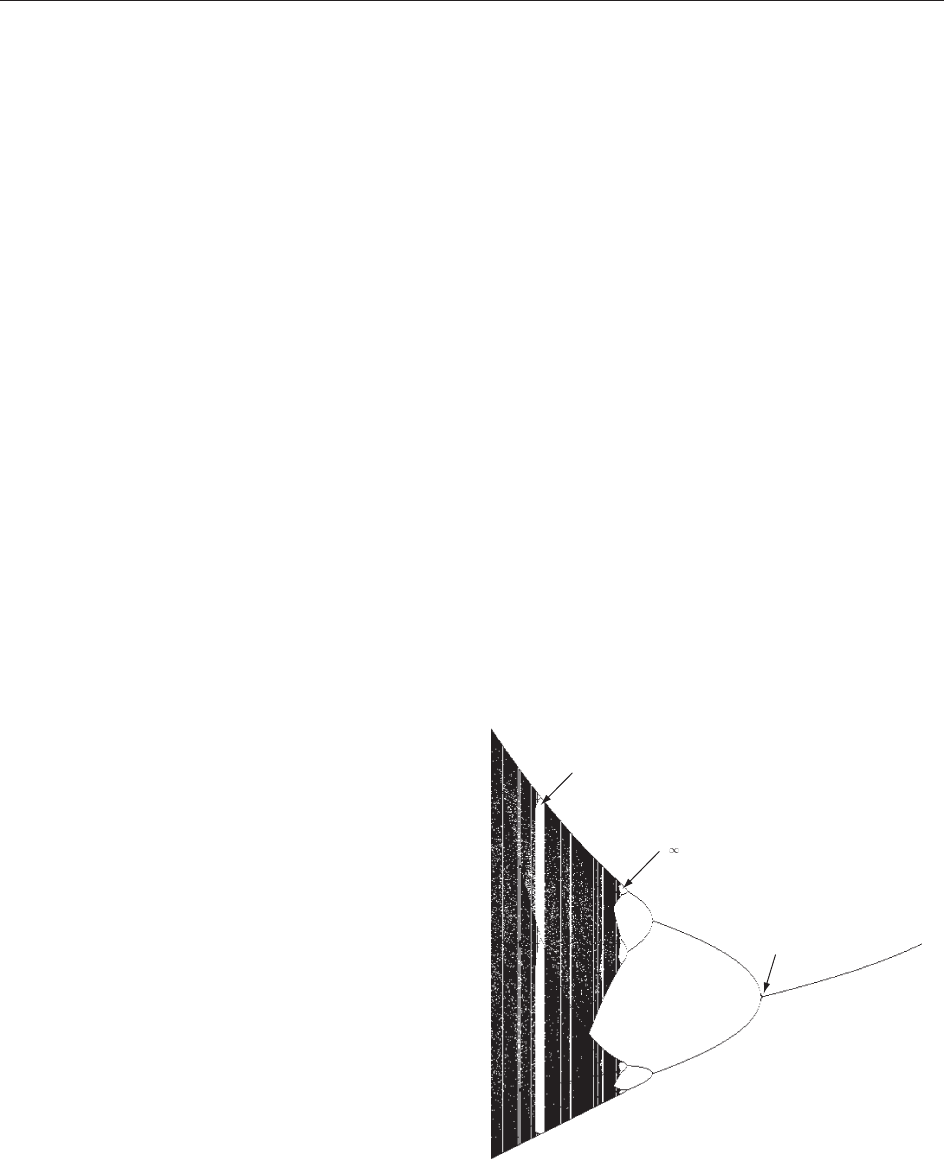
(see Holomorphic Dynamics and Figure 1). This
sequence converges to the Feigenbaum parameter
c
1
at exponential rate: c
n
c
1
n
,where
4.6. It turns out that if we consider a similar one-
parameter family of unimodal maps, say x 7!a sin x,
we observe a similar sequence of doubling bifurca-
tions converging to the limit exponentially at the
same rate
n
, independently of the family under
consideration.
In the dynamical space, let us consider the
Feigenbaum attractor A
f
[1] of an infinitely renor-
malizable S-unimodal map f that appear in the limit
of doubling bifurcations (so that the periods of
periodic intervals J
n
are equal to 2
n
). Let us consider
the scaling factors
n
= jJ
n
j=jJ
n1
j.Then
n
!
1
,
where the limiting scaling factor
1
2.6 is
c = –2
c
= –1.77
c
= –1.38
c
1
= –3/4
c
= 1/4
Figure 1 Real quadratic family P
c
: x 7!x
2
þ c. This picture
presents how the limit set of the orbit fP
n
c
(0)g
1
n = 0
bifurcates as
the parameter c changes from 1/4 on the right to 2 on the left.
Three topological types of regimes are intertwined in an intricate
way. The gaps correspond to the regular regimes. The black
regions correspond to the chaotic regimes (though, of course,
there are many narrow invisible gaps therein). In the beginning
(on the right) one can see the cascade of doubling bifurcations.
This picture became symbolic for one-dimensional dynamics.
344 Universality and Renormalization

independent of the particular map f under considera-
tion. Thus, the small-scale geometry of A
f
is
universal.
This was historically the first observe d manifesta-
tion of the quantitative universality of dynamical
and parameter structures.
Feigenbaum–Coullet–Tresser Renormalization
Conjecture
To explain the above universality phenomenon,
Feigenbaum and independently Coullet and Tresser,
formulated the following Renormalization Conjec-
ture. Let us consider the space U of S-unimodal
maps f :[1, 1] ![1, 1]. A map f 2U is called
(doubling) renormalizable if it has a cycle
of intervals J !J
1
!J of period 2. Then, for any
n 2 Z
þ
[ {1}, we can naturally define n-times
renormalizable maps, where n = 0 corresponds to
the non-renormalizable case, while n = 1 corres-
ponds to the infinitely renormalizable case.
Let U
0
U be the space of doubling renormaliz-
able maps. If f 2U
0
then f
2
: J !J is an S-unimodal
map as well, and we define the (doubling) renorma-
lization operator R : U
0
!U as the rescaling of this
map:
Rf ðxÞ¼
1
f
2
ðxÞ
where = jJj=2.
The Renormalization Conjecture asserted that:
The renormalization operator R has a unique
fixed point f
, and this point is hyperbolic;
the stable manifold W
s
(f
) consists of infinitely
renormalizable unimodal maps;
the unstable manifold W
u
(f
) is one dimensional
and represents an almost full family of unimodal
maps (see the sect ion ‘‘Knead ing theory ’’); and
the quadratic family {P
c
} transversally interse cts
W
s
(f
) (see Figure 2).
Assuming this conjecture, one can see that for any
curve t 7!g
t
in U that transversally intersects the
stable manifold W
s
(f
) at some moment t
, the
doubling bifurcations parameters t
n
converge to t
at
exponential rate
n
, where is the unstable
eigenvalue of the differential DR(f
). This explains
the universal geometry of doubling bifurcations.
One can also show that the Feigenbaum attractor
A
f
of any map f 2 W
s
(f
)issmoothly equivalent to
A
f
, which explains the universal small-scale geome-
try of these attractors.
Full Renormalization Horseshoe
Along with period doublings, one can consider
period triplings, quadruplings, etc. A unimodal
map f 2Uis said to be renormalizable with period
p if it has a cycle of intervals J !J
1
! !J
p1
!J
of period p. The corresponding renormalization
operator is defined as Rf (x) =
1
f
p
(x), where
= jJj=2.
The combinatorics or type of the renormalization
operator is the order of the intervals J
k
, k =
0, 1, ..., p 1, on the real line (up to reversal). (For
instance, there are three admissible combinatorics of
period 5.) If we want to specify combinatorics of the
renormalization operator under consideration, we use
notation R
. This operator is defined on the ‘‘renor-
malization strip’’ U
of unimodal maps f 2Uthat are
renormalizable with combinatorics .
The Renormalization Conjecture admits a
straightforward generalization to any renormaliza-
tion operator R
. More interestingly, one can
formulate a stronger version of it by putting all the
admissible renormalization types together. Let T
stand for the set of all minimal renormalization
types, that is, the types that cannot be factored
through other types. Then the renormalization strips
U
, 2T, are pairwise disjoint, and we can define
the full renormalization operator
R :
[
2T
U
!U ½2
by letting RjU
= R
. Then the strong version of the
renormalization conjecture asserted that:
there is an R-invariant hyperbolic subset AU
called the full renormalization horseshoe such
that the restriction RjA is topologically con-
jugate to the full shift on the space of bi-
infinite sequences (...,
1
,
0
,
1
, ...) of s ymbols
n
2T;
for any f
2A, the stable manifold W
s
(f
) consists
of infinitely renormalizable maps f 2U with the
same combinatorics as f
;
for any f
2A, the unstable manifold W
u
(f
)is
one-dimensional and represents an almost full
family of unimodal maps; and
the real quadratic family {P
c
} transversally inter-
sects all stable manifolds W
s
(f
).
°
f
*
W
s
°
Quadratic family
z
2
+
c
*
W
u
Figure 2 Renormalization fixed point.
Universality and Renormalization 345

Complex Renormalization
Polynomial-Like Maps
A polynomial-like map is a holomorphic branched
covering of finite degree f : U !U
0
,whereUYU
0
C are topological disks (In other words, the maps f is
proper, that is, full preimages f
1
(K) of compact sets
K U
0
are compact). For instance, if f is a
polynomial of degree d then for a sufficiently large
radius R > 0, the map f : f
1
(D
R
) !D
R
is a poly-
nomial-like map of the same degree d.Wereferto
such polynomial-like maps as ‘‘polynomials.’’
The filled Julia set of f is the set of nonescaping
points:
Kðf Þ¼fz: f
n
z 2 U; n ¼ 0; 1; ...g
The Julia set of f is the boundary of its filled Julia
set: J(f ) = @K(f ).
A polyn omial-like map of degree d has d 1
critical points counted with multiplicities. The Julia
set (and the filled Julia set) is connected if and only
if all the critical points c
i
are nonescaping, that is,
c
i
2 K(f ).
A polynomial-like map of degree 2 is called
quadratic-like. The Julia set of a quadratic-like
map is either connected or a Cantor set, depending
on whether its critical point is nonescaping or
otherwise.
The domain of a polynomial-like map is allowed
to be slightly adjusted by taking V
0
to be a
topological disk such that U V
0
U
0
and letting
V = f
1
(V
0
). We say that two polynomial-like maps
represent the same germ if one can be obtained from
the other by a sequence of such adjustments.
We will be mostly interested in the quadratic case;
so let Q be the space of quadratic-like germs
considered up to affine conjuga cy, and let C be the
connectedness locus in Q, that is, the subset of f 2Q
with connected Julia set. The space Q has a natural
complex analytic structure such that holomorphic
curves in Q are represented by holom orphic families
f
(z) of quadratic-like maps.
Two polynomial-like maps are called hybrid
equivalent if they are conjugate by a quasiconformal
map h such that
@h = 0 a.e. on K(f ) (in particular, h
is conformal on int K(f )). By the Straightening
Theorem, any polynomial-like map is hybrid equiva-
lent (after an adjustment of its domain) to a
polynomial of the same degree (called the ‘‘straigh-
tening’’ of f ). The straightening depends only on the
germ of f.
For a quadratic-like map f with connected Julia
set, the straightening P
c
: z 7!z
2
þ c is unique,
c = (f ). Thus, we obtain the straightening map
: C!M, where M is the Mandelbrot set (see
Holomorphic Dynamics). We let H
c
=
1
(c)bethe
hybrid class passing through a point c 2 M. One can
show that H
c
is a codimension-one submanifold in Q.
Any quadratic-like map has two fixed points
counted with multiplicity. In the case of connected
Julia set, these fixed points have a different
dynamical meaning: one of them, called , is either
attracting, or neutral, or repelling separating, that is,
J(f )n{} is disconnected. Another one, called ,is
either parabolic with multiplier 1 (and then it
coincides with ) of repelling nonseparating.
In what follows, we normalize quadratic-like
maps so that 0 is their critical point.
Complex Renormalization and Little
Mandelbrot Sets
A quadratic-like map f : U !U
0
with connected
Julia set is called renormalizable if there is a
topological disk V 3 0 and a natural number p 2
called the renormalization period such that:
letting g = f
p
jV and V
0
= g(V), the map g : V !V
0
is quadratic-like;
the little Julia set K(g) is connected; an d
the sets g
n
(K(g)), n = 1, ..., p 1, can intersect
K(g) only at the -fixed point of g.
Under these circumstances, the quadratic-like germ g
considered up to affine conjugacy is called the renorma-
lization of the quadratic-like germ f ; g = Rf .Moreover,
one says that f is primitively renormalizable if the
little Julia sets g
n
(K(g)), n = 1, ..., p 1, are pairwise
disjoint. Otherwise, f is satellite renormalizable.
As in the unimodal case, one can define combina-
torics or type of the complex renormalization.
Roughly speaking, renormalizable maps with the same
combinatorics have the same renormalization period
and the ‘ ‘same position’ ’ of the little Julia sets f
k
(K(g))
in
^
C (the rigorous definition is based on the notion of
Thurston’s equivalence from Holomorphic Dynamics).
Theorem 1 (Douady and Hubbard 1986). The set
of parameters c for which a quadratic map
P
c
: z 7!z
2
þ c is renormalizable with a given combi-
natorics assemble a homeomorphic copy M
of the
Mandelbrot set M.
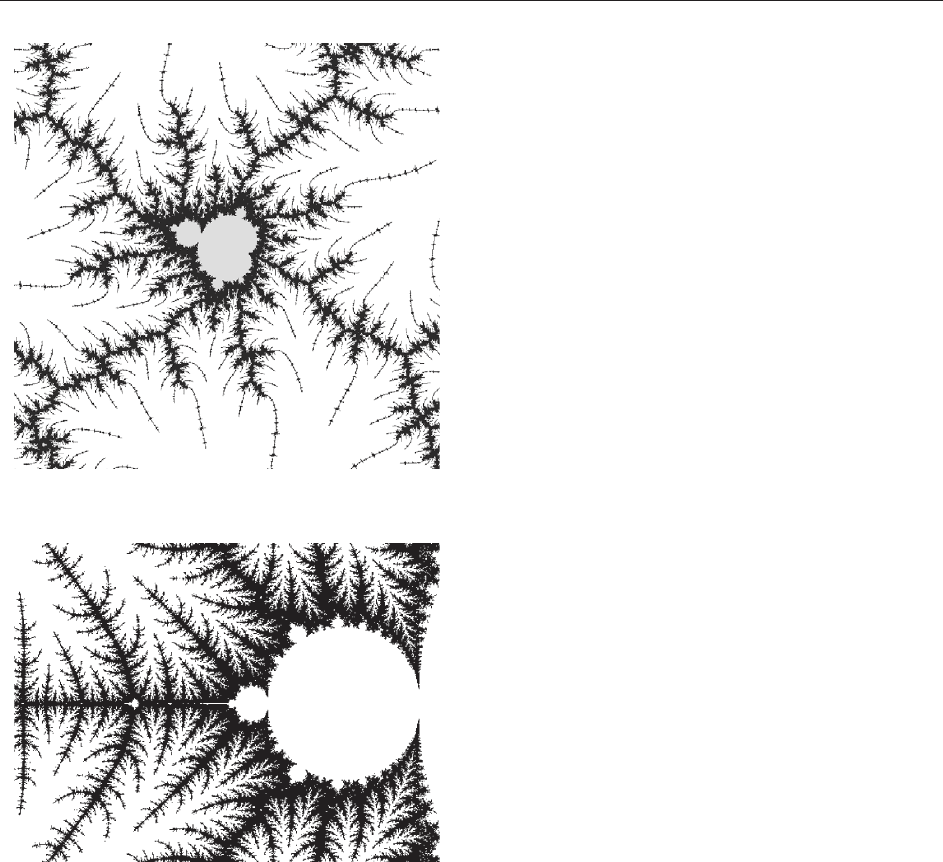
This theorem explains the presence of many little
Mandelbrot sets that are observable on the compu-
ter pictures of M (see Figures 3 and 4 ). Moreover,
the copies corresponding to the primitive renorma-
lization originate at primitive hyperbolic compo-
nents (see Holomorphic Dynamics), while the copies
obtained by a satellite renormalization originate at
satellite hyperbolic components attached to some
346 Universality and Renormalization
‘‘mother’’ hyperbolic component. (Satellite copies
attached to the main cardioid are particularly
prominent on the pictures of M.)
Given a combinatorial type , the set Q
of
quadratic-like germs f 2Qthat are renormalizable
with combin atorics (the complex renormalization
strip) is the union of hybrid classes passing through
the little copy M
. As in the real case, let us consider
the set T
C
of all minimal combinatorial types. Then
the corresponding renormalizat ion strips Q
are
pairwise disjoint, and we can define the full complex
renormalization operator R :
S
2T
C
Q
!Q.
Renormalization Theorem
The first proof of the Renor malization Conjecture in
the period-doubling case was based on rigorous
computer estimates (Lanford 1982). It follow ed, in
the 1980s, by works of Epstein, Eckmann, Khanin,
Sinai, among others, which gave a better conceptual
understanding and provided proofs of many ingre-
dients of the picture (without computer assistance).
The turning point in this development occurred
when methods of holomorphic dy namics and con-
formal geometry were introduced into the subject
(Douady and Hubbard 1985, Sullivan 1986). This
led to the proof of the renormalization conjecture in
the space of quadratic-like germs:
Theorem 2 (Sullivan–McMullen–Lyubich, the
1990s). For any real combinatorics 2T, the
operator R
has a unique fixed point f
in the space
Q. Moreover, f
is hyperbolic, its stable manifold
W
s
(f
) coincides with the hybrid class H
c
, c = (f
),
while the real slice of the unstable manifold
represents an almost full family of unimodal maps.
This result was further extended to the smooth
category by de Faria, de Melo, and Pinto.
MLC, Density of Hyperbolicity, and
Geometry of Feigenbaum Julia Sets
The ‘‘Mandelbrot set is locally connected’’ (MLC)
conjecture (see Holomorphic Dynamics) is intimately
related to the renormalization phenomenon. This
connection was first revealed by the following result:
Theorem 3 (Yoccoz 1990, unpublished). Let us
consider a nonrenormalizable quad ratic polynomial
P
c
: z 7!z
2
þ c with connected Julia set and both
fixed points repelling. Then the Julia set J(P
c
) is
locally connected and the Mandelbrot set is locally
connected at c.
This result was recently extended to higher-degree
unicritical polynomials z 7!z
d
þ c (Kahn–Lyubich,
preprint 2005).
The MLC Conjecture is still open for general infinitely
renormalizable parameters. However, the similar pro-
blem for the real quadratic family has been resolved.
It implies the real version of the Fatou conjecture in
the quadratic case (see Holomorphic Dynamics):
Theorem 4 (Lyubich 1997). Hyperbolic maps are
dense in the real quadratic family.
This result was recently extended to higher-degree
polynomials by Kozlovskii, Shen, and van Strien
(preprint 2003).
Infinitely renormalizable quadratic maps of
bounded combinatorial type (i.e., with bounded
relative periods p
nþ1
=p
n
) supply us with a rich class
of fractals with very interesting geometry. These
Figure 4 The satellite copy of the Mandelbrot set attached to
the main cardioid at the point of doubling bifurcation.
Figure 3 A primitive copy of the Mandelbrot set.
Universality and Renormalization 347