
Francoise J.-P., Naber G.L., Tsun T.S. (editors) Encyclopedia of Mathematical Physics
Подождите немного. Документ загружается.


Julia sets are ‘‘hairy’’ at the origin, that is, their
blow-ups fill in densely the whole plane (this
phenomenon is related to the universal geometry of
the Feigenbaum attractors; McMullen (1996)).
However, some of them have zero Lebesgue measure
(Yarrington, thesis 1995) and Hausdorff dimension
smaller than 2 (Avila–Lyubich, preprint 2004). It is
unknown whether this happens for all of them or
not (in particular, the answer is unknown for the
Feigenbaum map born in the cascade of doubling
bifurcations).
Regular or Stochastic Dichotomy
Stochastic Maps
An S-unimodal map f is called stochastic if it has an
absolutely continuous invariant measure . In this
case, f is topologically chaotic (see the section
‘‘Topo logical dyn amics’’) and is supporte d on the
transitive cycle of intervals [J
k
. Moreover, has a
positive characteristic exponent,
¼
Z
log jDf jd>0
and Lebesgue almost all orbits are equidistributed
with respect to , that is, for Lebesgue a.e. x 2 I,
1
n
X
ðf
n
xÞ!
Z
d
for any continuous function . The map f
p
jJ is mixing
with respect to , and in fact, is weakly Bernoulli.
Here are two important criteria for stochasticity:
Collet–Eckmann condition (see Holomorphic
Dynamics). These maps have extra strong sto-
chastic properties, notably, the exponential decay
of correlations.
Martens–Nowicki condition.Tostateit,weneedto
define the principal nest of intervals, I
0
I
1
3
0. Here I
0
= [, ], where is the fixed point with
negative multiplier, and I
nþ1
is inductively defined
as the component of f
l
n
(I
n
) containing 0, where l
n
is the moment of first return of the orbit of 0 to I
n
.
Let us consider the scaling factors
n
= jI
n
j=jI
n1
j.If
P
ffiffiffiffiffi
n
p
< 1 then f is stochastic.
Let N[2, 1=4] be the set of parameters c for
which the quadratic map P
c
is topologically chaotic.
Not every such map is stochastic. However, the set
of stochastic parameters has positive Lebesgue
measure (Jakobson 1981), and in fact,
Theorem 5 (Lyubich 2000). For a.e. c 2N, the
map P
c
satisfies the Martens–Nowicki condition,
and thus, is stochastic.
Avila and Moreira (2005) went on to prove that
for a.e. c 2N, the map P
c
is Collet–Eckmann.
Renormalization Horseshoe
Let us consider the complexification of the renor-
malization operator [2],
R :
[
2T
Q
!Q ½3
acting in the space of quadratic-like maps.
Theorem 6 (Lyubich 2002). The ‘‘Strong Renor-
malization Conjecture’’ is valid for the operator [3].
Let I[2, 1=4] be the set of parameters for
which the quadratic map P
c
is infinitely renormaliz-
able. The above theorem implies that this set has
zero Lebesgue measure. (Avila and Moreira went on
to prove that HD(I) < 1.)
Regular or Stochastic Dichotomy
Putting together Theorems 5 and 6, we obtain:
Theorem 7 For a.e. c 2 [2, 1=4], the quadratic
map P
c
is either regular or stochastic.
This result gives a complete probabilistic picture
of dynamics in the real quadratic family. It has been
later transferred to any nondegenerate real analytic
family of S-unimodal maps (Avila–Lyubich–de
Melo), and further to a generic smooth family of S-
unimodal maps (Avila–Moreira).
Palis has formulated a strong general conjecture
(in all dimensions) asserting that a typical (from
the probabilistic point of view) smooth dynamical
system f has finitely many attractors supporting
SRB measures (see Lyapunov Exponents and
Strange Attractors) that govern the behavior of
Lebesgue a.e. trajectories of f. The above results
confirm the Palis Conjecture in the s etting of S-
unimodal maps.
Other Universality Classes
From a more general point of view, renormalization
is an appropriately rescaled return map to a relevant
piece of the phase space, viewed as an operator in
some class of dynamical systems. From this point of
view, most dynamical systems are ‘‘renormalizable,’’
and the renormalization approach often provides a
deep insight into the nature of the systems in
question.
Here is a partial list of classes of nonlinear
systems that exhibit universality with an underlying
renormalization mechanism (we provide a few
348 Universality and Renormalization

relevant names, but there are many more people
who contributed to the corresponding theories):
Holomorphic germs near indifferent equilibria
(Yoccoz, Shishikura, McMullen);
critical circle maps (Kadanoff, Feigenbaum, Rand,
Lanford, Swiatek, de Faria, Yampolsky);
non-renormalizable quadratic-like maps of
Fibonacci type (Lyubich–Milnor);
conservative two-dimensional diffeomorphisms
near the point of breaking of KAM tori (MacKay,
Koch); and
dissipative He´non-like maps (Collet–Eckmann–
Koch, de Carvalho–Lyubich–M artens).
See also: Fractal Dimensions in Dynamics; Holomorphic
Dynamics; Lyapunov Exponents and Strange Attractors;
Multiscale Approaches.
Further Reading
Collet P and Eckmann J-P (1980) Iterated Maps of the Interval as
Dynamical Systems. Boston: Birkha¨user.
Cvitanovic
´
P (1984) Universality in Chaos. Bristol: Adam Hilger.
Douady A and Hubbard JH (198 5) On the dynamics of
polynomial-like maps. Annales Scientifiques de l’E
´
cole
Normale Supe´rieure 18: 287–343.
Lyubich M (1999) Feigenbaum–Coullet–Tresser universality and
Milnor’s hairiness conjecture. Annals of Mathematics 149:
319–420.
Lyubich M (2000) Quadratic family as a qualitatively solvable
model of dynamics. Notices of the American Mathematical
Society 47(9): 1042–1052.
McMullen C (1996) Renormalization and 3-Manifolds Which
Fiber Over the Circle, Annals of Math. Studies, vol. 135.
Princeton: Princeton University Press.
de Melo W and van Strien S (1993) One-Dimensional Dynamics.,
Berlin: Springer.
Sullivan D (1993) Linking the universalities of Milnor–Thurston,
Feigenbaum and Ahlfors–Bers. In: Topological Methods
in Modern Mathematics, The Proceedings of Symposium
held in honor of John Milnor’s 60th Birthday, SUNY at
Stony Brook, 1991, pp. 543–564. Houston, TX: Publish or
Perish.
Vul EB, Sinai YaG, and Khanin KM (1984) Feigenbaum
universality and the thermodynamical formalism. Russian
Mathematical Surveys 39: 1–40.
Universality and Renormalization 349

V
Variational Methods in Turbulence
F H Busse, Universita
¨
t Bayreuth, Bayreuth, Germany
ª 2006 Elsevier Ltd. All rights reserved.
Introduction
The problem of fluid turbulence is commonly
regarded as one of the most challenging problems of
theoretical physics and mathematics. There is general
agreement that the Navier–Stokes equations (NSEs)
provide a satisfactory basis for the description of
turbulent motions of homogeneous Newtonian fluids
such as gases and most liquids. But the difficulty of
generating solutions of these equations for high-
Reynolds-number flows has prevented accurate
answers to simple questions such as the question of
the discharge of turbulent pipe flow as a function of
the pressure head or the question of the heat transport
by turbulent convection in a fluid layer heated from
below. In view of this difficulty, it has become an
attractive idea to obtain rigorous bounds on turbulent
transports. Variational methods have played an
important role in the derivation of such bounds.
There is another motivation for the use of varia-
tional methods for the understanding of turbulent
fluid systems. Experimenters have sometimes noted
the tendency of turbulent flows to maximize trans-
ports under given external conditions. In his pioneer-
ing paper, Howard (1963) mentions that the Malkus
hypothesis of a maximum heat transport by thermal
convection had motivated him to derive upper bounds
through the use of variational methods. The techni-
ques developed by Howard have later been applied to
other kinds of turbulent transports by Busse. While
relatively simple ordinary differential equations are
obtained when the equation of continuity is not
imposed as a constraint, the Euler–Lagrange equa-
tions for a stationary value of the variational
functional lead to nonlinear partial differential equa-
tions when solenoidal extremalizing vector fields are
required. Nevertheless, using boundary layer methods
one can derive approximate analytical solutions even
in the limit of asymptotically large Rayleigh and
Reynolds numbers (Busse 1969, 1978).
In the following, we shall first discuss the energy
method which provides necessary conditions for the
existence of turbulent solutions of the underlying
equations and then turn to the problem of upper
bounds for the turbulent momentum transport in the
plane Couette flow configuration as a particular
example. The properties and physical relevance of
the extremalizing vector fields will be discussed in a
final section.
Energy Method
For simplicity, we consider the NSEs for a homo-
geneous incompressible fluid with a constant kine-
matic viscosity in an arbitrary fixed domain D.
Using the diameter d of the domain as length scale
and d
2
= as timescale, we can write the NSEs of
motion in dimensionless form,
@
@t
v þ v rv ¼rp þ f þr
2
v ½ 1a
rv ¼ 0 ½1b
where f denotes some given steady distribution of a
force density. On the boundary @D of the domain D,
steady velocities parallel to the boundary may be
specified. We assume that the basic steady solution
of the problem is given by v
s
= Re
^
v where the
average of (
^
v)
2
=2 over the domain D (indicated by
angular brackets) is unity, hj
^
vj
2
i= 2. Any velocity
field v
t
different from v
s
, that is, with u v
t
v
s
60, must obey the equations
@
@t
u þv
s
ru þurv
s
þuru ¼r
~
p þr
2
u
½2a
ru ¼ 0 ½2b
together with the homogeneous boundary conditions
for u on @D. By multiplying eqn [2a] by u and
averaging the result over the domain D we obtain
the relationship
1
2
d
dt
hu ui ¼ hjruj
2
iRehu ðu rÞ
^
vi½3
where the vanishing of u on @D and equations such
as
hu ðv
s
rÞu i¼
1
2
hv
s
ru ui
¼
1
2
hrðv
s
u uÞi ¼ 0
have been used to prove that the terms
v
s
ru, u ru and r
~
p do not enter the balance [3].
This balance is called the Reynolds–Orr energy
equation and is the basis for the appli cation of the
energy method. The lowest value Re for which the
right-hand side of [3] is non-negative is called the
energy Reynolds number Re
E
. For Re < Re
E
the
steady solution v
s
is absolutely stable and the energy
of any disturbance u must decay exponentially in
time. Re > Re
E
is a necessary condition for the
existence of a persistent turbulent state of fluid flow.
Re
E
is determined as the solution of the variational
problem:
For a given flow
^
v in D find the minimum Re
E
of the
functional
R
E
hjr
uj
2
i
h
u ð
u rÞ
^
vi
½4
among all vector fields
u which satisfy the conditions
r
u = 0 in D,
u = 0 on @D, and h
u (
u r)
^
vi < 0.
For Re Re
E
there will exist at least one vector
field u, namely the minimizing solution
u of the
variational problem [4], the energy of which does
not decay, at least not initially. In the derivation of
the Euler–Lagrange equations as necessary condi-
tions for stationary values of the variational func-
tional [4],
1
2
Gð
u
@
^
v
i
þ
u
@
i
^
v
Þ¼ @
i
þ @
@
u
i
½5a
@
u
¼ 0 ½5b
the constraint r
u = 0 has been taken into account
through the Lagrange multiplying function
ˇ
. G is a
stationary value of the functional [4] andingeneral
there exist many of those which are determined as
eigenvalues of the linear boundary value problem [5]
together with its boundary condition
u
i
= 0on@D.
Only the infinum of all G provides the energy
Reynolds number Re
E
. Many details on the energy
method can be found in Joseph’s book (1976). Here
we just wish to remark that the Reynolds–Orr balance
[3] remains valid when the problem is considered in a
system rotating with a constant angular velocity
D
since the Coriolis force does not contribute to the
energy balance [3]. The values of Re
E
are usually
much smaller than the critical values Re
c
for the onset
of infinitesimal disturbances as can be seen from
Table 1. Here the experimentally determined values
Re
G
for the instability of the basic flow state have also
been listed. A unique situation occurs in the small gap
limit of the Taylor–Couette system where Re
E
and Re
c
coincide for a special value of the dimensionless mean
rotation rate
D
(Busse 2002).
Variational Problem for Turbulent
Momentum Transport
In order to introduce the variational method for
bounds on turbulent transports we consider the
simplest configu ration for which a nontrivial solu-
tion of the NSEs of motion exists: the configuration
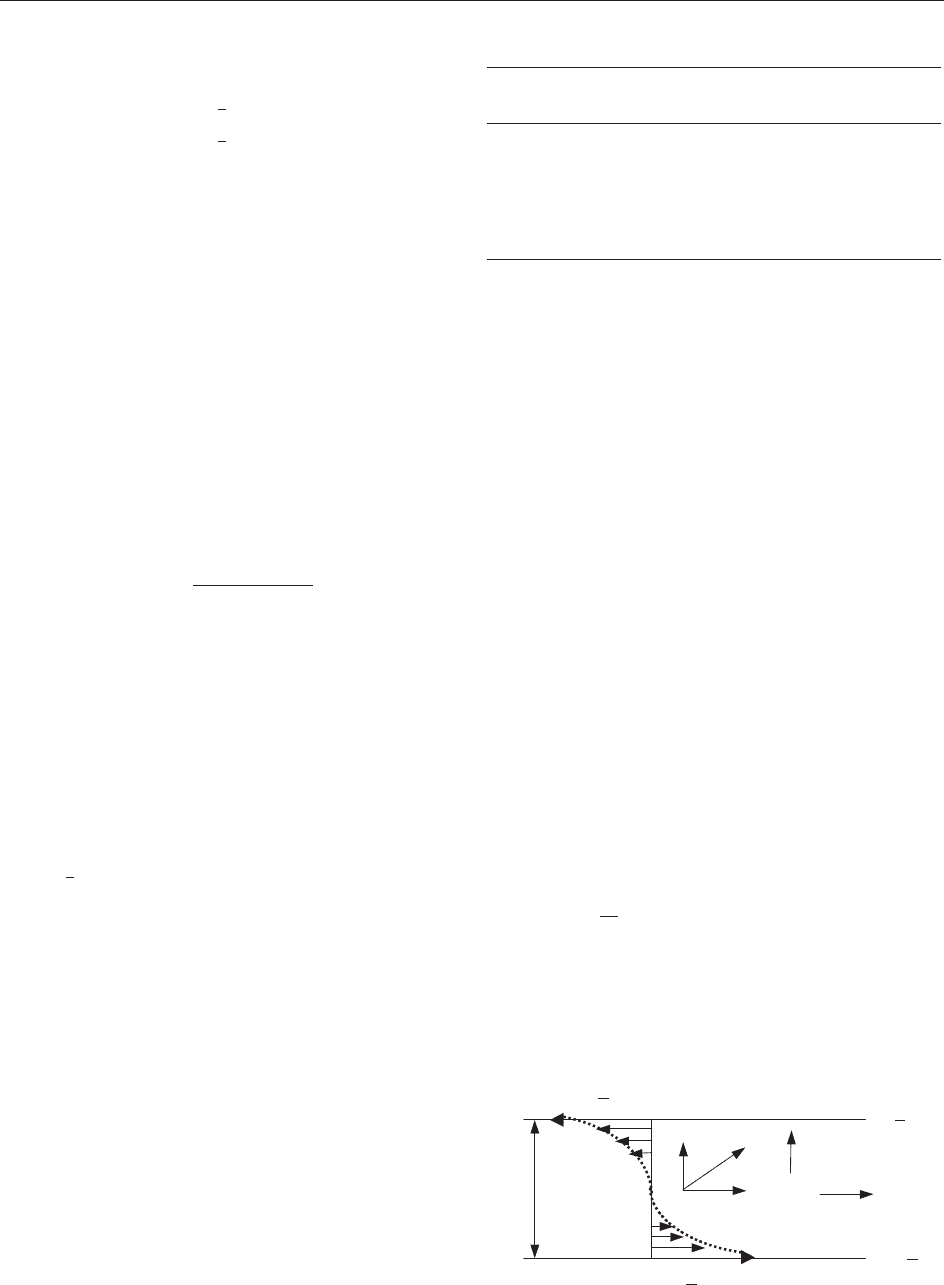
of plane Couette flow (Figure 1). The Reynolds
number is defined in this case in terms of the
constant relative motion U
0
i between the plat es,
Re = U
0
d=, where i is the unit vector parallel to the
plates and is the kinematic viscosity of the fluid.
Using the distance d between the plates as length
scale and d
2
= as timescale, the basic equations can
be written in the form
@
@t
v þ v rv ¼rp þr
2
v ½6
rv ¼ 0 ½7
We use a Cartesian system of coordinates with the
x, z-coordinates in the directions of i and k,
Table 1 Reynolds numbers for shear flows
Re
E
Re
G
(from exp.)
Re
c
Plane Couette flow 82.6 1300 1
Poiseuille flow (channel flow) 99.2
a
2000
a
5772
a
Hagen–Poiseuille flow
(pipe flow)
81.5
a
2100
a
1
Circular Couette flow with
D
= Re
E
=2
82.6 82:6 82.6
a
The maximum velocity and the channel width d (radius d in the
case of pipe flow) have been used in definition of Re.
Re
1
2
Re
1
2
–
d
z
y
x
k
i
1
2
–
z
=
1
2
z =
Figure 1 Geometrical configuration of the plane Couette flow
problem.
352 Variational Methods in Turbulence

respectively, where k is the unit vector normal to the
plates such that the boundary conditions are given by
v ¼
1
2
Re i at z ¼
1
2
½8
After separating the velocity field v into its mean
and fluctuating parts, v = U þ
v with
v = U,
v = 0,
where the bar denotes the average over planes
z = const., we obtain by multiplying eqn [6] by
v
and averaging it over the entire fluid layer (indicated
by angular brackets)
1
2
d
dt
hj
vj
2
i¼
uw
@
@z
U
hjr
vj
2
i½9
Here u denotes the component of
v perpendicular to
k and w is its z-component. We define fluid
turbulence under stationary conditions by the prop-
erty that quantities averaged over planes z = const.
are time independent. Accordingly, the equation for
the mean flow U can be integrated to yield
d
dz
U ¼
wu hwuiRe i ½10
where the boundary condition [8] has been
employed. With this relationship, U can be elimi-
nated from the problem and the energy ba lance
hjruj
2
iþhju w huwij
2
i¼Rehu
x
wi½11
is obtained where the identity h
uw
2
ihuwi
2
=
hjuw huwij
2
i has been used.
Since the momentum transport in the x-direction
between the moving rigid plates is described by
M = dU
x
=dz j
z = 1 =2
= hu
x
wiþRe, we can con-
clude immediately that the momentum transport
by turbulent flow always exceeds the corresponding
laminar value because h u
x
wi is positive according
to the relationship [11]. Since a lower bound on M
thus exists, an upper bound on hu
x
wi as a
function of Re is of primary interest. Following
Howard (1963), it c an be shown that (Re)isa
monotonous function and it is therefor equivalent
to ask for a lower bound R of Re at a given value
of hu
x
wi. We are thus led to the following
formulation of the variational problem:
Find the minimum R() of the functional
Rð
~
v;Þ
hjr
~
vj
2
i
h
~
u
x
wi
þ
hj
~
u
~
w h
~
u
~
wij
2
i
h
~
u
x
~
wi
2
½12
among all solenoidal vector fields
~
v
~
u þ k
~
w (with
~
u k = 0) that satisfy the boundary condition
~
v = 0at
z = 1=2 and the condition h
~
u
x
~
wi > 0.
The Euler–Lagrange equations as necessary con-
ditions for an extremal value of the functional are
given by
~
w
d
dz
U
þ k
~
u
d
dz
U
¼r þr
2
~
v ½13
r
~
v ¼ 0 ½14
where dU
=dz is defined by
d
dz
U
¼
~
u
~
w h
~
u
~
wii
R
hjr
~
vj
2
i
2h
~
v
x
~
wi
½15
and where = h
~
u
x
~
wi has been set. When eqns
[13]–[15] are compared with the equations for
v
and for U, a strong similarity can be noticed. The
variational problem does not exhibit any time
dependence, but the Euler–Lagrange equations may
still be regarded as the symmetric analogue of the
NSEs for steady flow.
Upper Bounds on the Turbulent
Momentum Transport
A simple analytical solution of the variational
problem can be obtained when the constraint
r
~
v = 0 is dropped. In that case it is evident that
the minimum of the functional [12] is reached
when
~
v is independent of x , y,andwhen
~
u
x
=
~
w = f (z) holds. The Euler–Lagrange equations
then assume the form of an ordinary differential
equation,
f
00
¼½ðf
2
=hf
2
i1ÞR þhf
02
i=hf
2
if ½16
Since the variational functional [12] is homogeneous
in
~
v, we are free to use a normalization condition for
which we choose max [f (z)] = 1. Multiplication of
eqn [16] by f
0
and integration yield
f
02
¼
2k
2
hf
2
i
ð1 k
2
f
2
Þð1 f
2
Þ
with k
2
¼ =½2ð R þ Þhf
2
i2hf
02
i½17
This equation can be solved in terms of elliptical
integrals. The minimum R() is determined by the
relationships
R ¼
8
3
½K
2
ð1 þ k
2
ÞþK
3
=D 3k
2
KDÞ
¼ 8k
2
KD
½18
where D(k )andK(k) are the complete elliptical
integrals usually labeled by these letters. For
details, see the analysis by Howard (1963) of an
analogous problem. In the asymptotic case of large
Variational Methods in Turbulence 353
Reynolds numbers, relationships [18] yield the
upper bound
ðReÞ¼
8
128
Re
2
½19
In solving the full eqns [13]–[15], it is convenient
to eliminate eqn [14] throug h the general represen-
tation of the solenoidal vector field
~
v,
~
v ¼rðr kÞþr k ½20
We assume that the minimizing vector field
~
v does
not depend on x, although a rigorous proof for this
property can be given only for small values of .
Introducing the notations @ =@y and w
@
2
=@y
2
we are thus led to the general ansatz
w ¼ w
ðNÞ
X
N
n¼1
2
n
w
n
ðzÞ
n
ðyÞ½21a
¼
ðNÞ
X
N
n¼1
n
ðzÞ
n
ðyÞ½21b
where N may tend to infinity and the functions
n
(y)
satisfy the equation
@
2
@y
2
n
¼
2
n
n
½22
In the following, it will be assumed that the positive
wavenumbers
n
are ordered according to their siz e,
n1
<
n
<
nþ1
. The solutions of the form [21] of
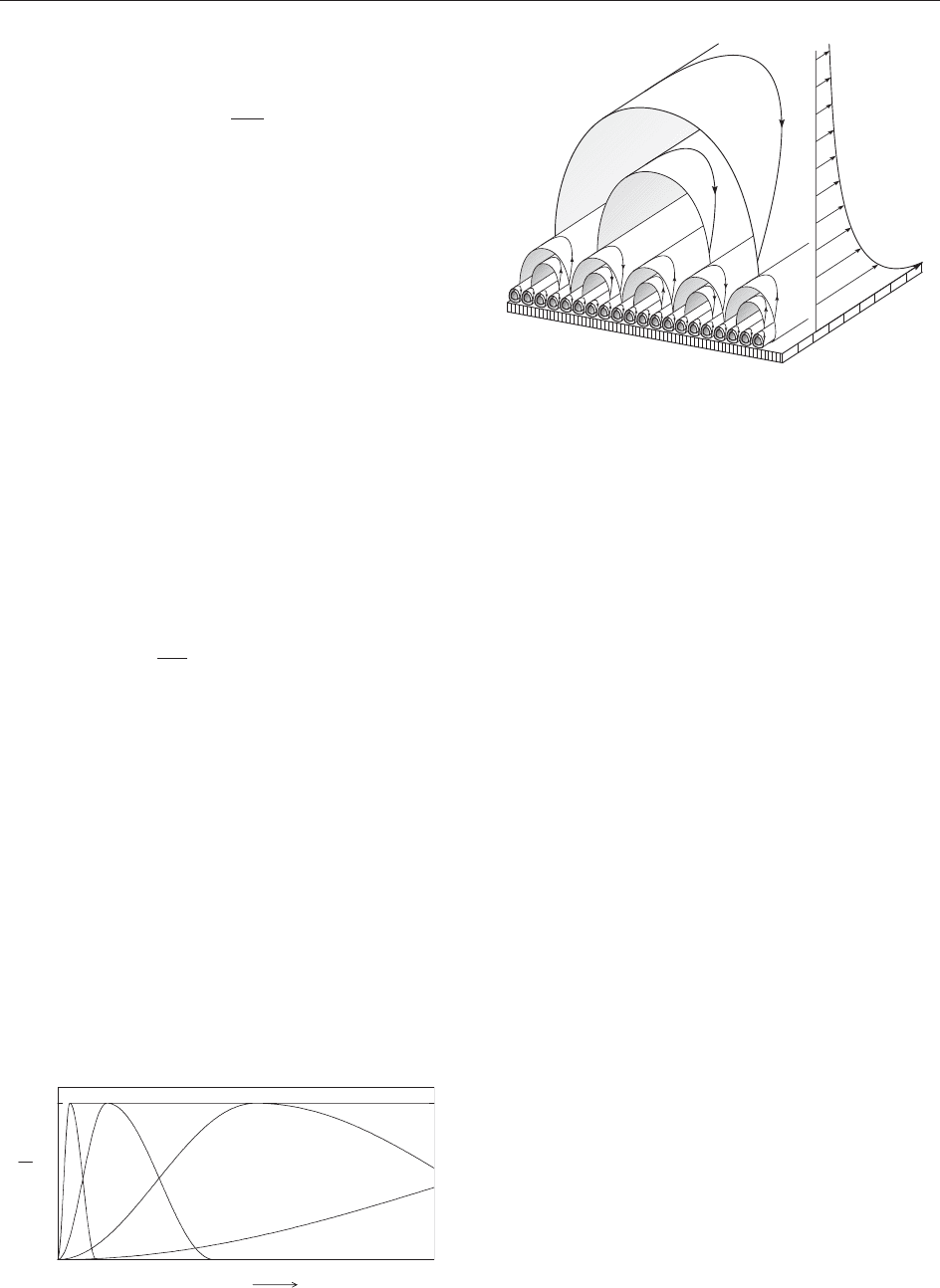
the Euler–Lagrange equations exhibit a boundary
layer structure for large as sketched in Figure 2.
Accordingly, the N– solutions are characterized by a
hierarchy of N boundary layers at each plate and
provide the upper bound sequentially with increasing
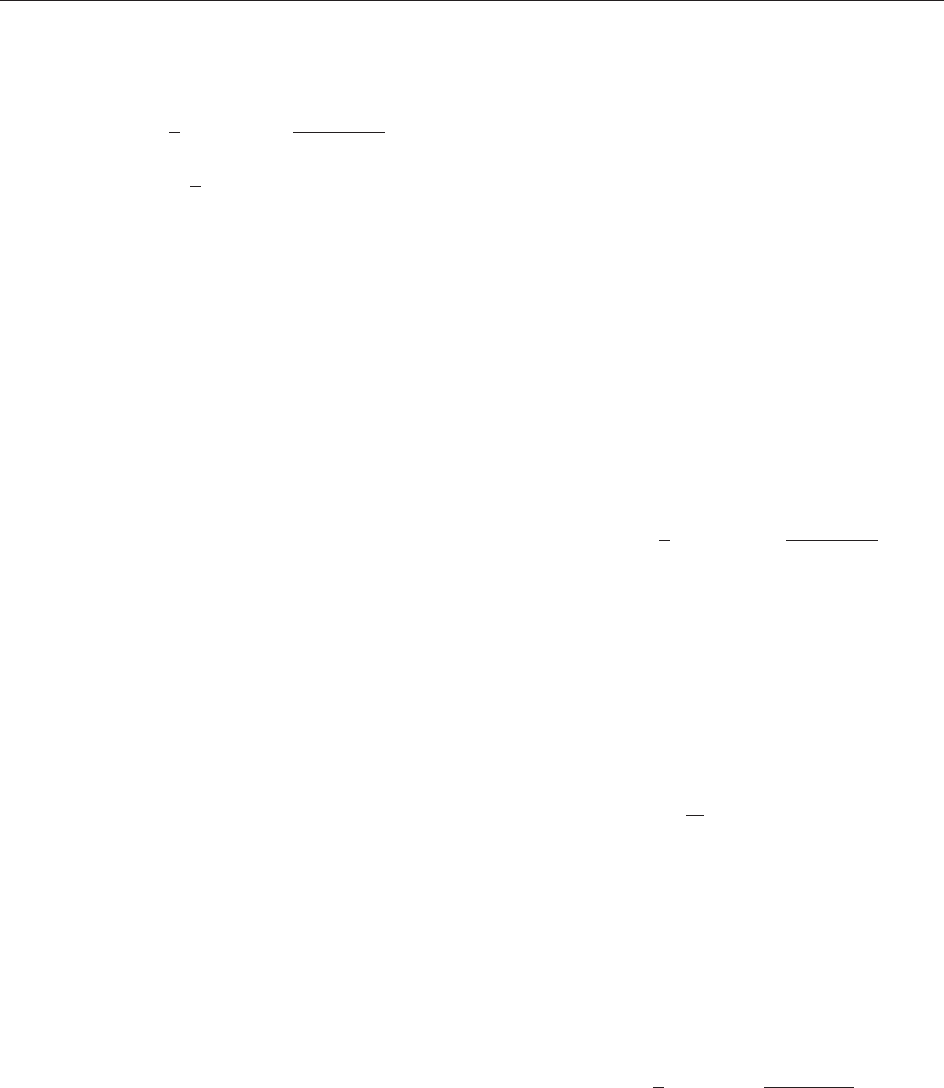
starting with N = 1. The extremalizing vector fields
thus exhibit a bifurcation structure similar to that
found in many cases of the transition to turbulence.
The thicknesses of the boundary layers decrease with
increasing and their ratio from one layer to the next
approaches the factor 4 as indicated in Figure 3. The
typical scale of motion increases linearly with
distance from the wall as assumed in Prandtl’s
mixing-length theory. But the disc reteness of the
scales reflects the fact that effective transports require
preferred scales. Asymptotically, the upper bound for
the momentum transport approaches
ðReÞ¼0:010 Re
2
½23
which represent s a significant improvement over the
relationship [19]. Nevertheless, the upper bound still
exceeds the measured values of the momentum
transport by more than a factor 10.
Discussion
Bounds like those for the momentum transport have
been obtained for many other kinds of turbulent
transports. For details we refer to the review articles
listed below. Usually, the form ulation of the upper
bound problem requires that the external conditions
are homogeneous in two spatial dimensions such
that a separa tion of the turbulent velocity, tempera-
ture, or magnetic fields into mean and fluctuating
parts is possible. In this respect, the variational
methods for upper bounds are more restricted than
those used for determination of the energy Reynolds
number Re
E
. The latter problem, incidentally,
corresponds to the limit !0 of variational
problems of the type [12] as can be seen from a
comparison with expression [4].
In recent years, the background field method has
been introduced by Doering and Constantin (1994) as
an alternative way for obtaining bounds on properties
of turbulent flows. When optimized, it becomes
equivalent to the variational method discussed in this
article as has been demonstrated by Kerswell (1998).
The fact that not optimized bounds can be obtained
–1/2
μ
w θ
w
N
θ
N
w
N – 1
θ
N – 1
w
N – 3
θ
N – 3
w
N – 2
θ
N – 2
z
Figure 2 Qualitative sketch of the boundary layer structure of
the extremalizing N– solution.
Figure 3 Qualitative sketch of the nested boundary layers that
characterize the vector field of maximum transport. The profile of
the mean shear is shown on the right side.
354 Variational Methods in Turbulence

relatively easily emphasizes the point that the extre-
malizing vector fields are the most interesting aspect of
the variational problems. They often exhibit simila-
rities with the observed turbulent velocity fields, in
particular as far as the mean flows are concerned. In
the case of convection in a layer heated from below,
the transition of the bound from the 1 – solution to
the 2 – solution corresponds closely to the experi-
mentally observed transition from convection rolls to
bimodal convection (Busse 1969).
The close similarities between variational functionals
for rather different physical systems suggest corre-
sponding similarities between the respective turbulent
fields. For example, the analogy between the fluctuat-
ing component of the temperature in turbulent convec-
tion and the streamwise component of the fluctuating
velocity field in shear flow turbulence has been
demonstratedandemployedinatheoryoftheatmo-
spheric boundary layer (Busse 1978). Better bounds
and more physically realistic properties of the extre-
malizing vector fields can be expected when additional
constraints are imposed. For example, the energy
balances for poloidal and toroidal components of the
velocity field can be applied separately. But these
developments are still in their initial stages.
See also: Bifurcations in Fluid Dynamics; Fluid
Mechanics: Numerical Methods; Turbulence Theories.
Further Reading
Busse FH (1969) On Howard’s upper bound for heat transport by
turbulent convection. Journal of Fluid Mechanics 37:
457–477.
Busse FH (1978) The optimum theory of turbulence. Advances in
Applied Mechanics 18: 77–121.
Busse FH (2002) The problem of turbulence and the manifold of
asymptotic solutions of the Navier–Stokes equations. In:
Oberlack M and Busse FH (eds.) Theories of Turbulence,
pp. 77–121. Wien: Springer.
Doering CR and Constantin P (1994) Variational bounds on
energy dissipation in incompressible flows: shear flow.
Physical Review E 49: 4087–4099.
Howard LN (1963) Heat transport by turbulent convection.
Journal of Fluid Mechanics 17: 405–432.
Howard LN (1972) Bounds on flow quantities. Annual Review of
Fluid Mechanics 4: 473–494.
Joseph DD (1976) Stability of fluid motions. vol. 1. Berlin:
Springer.
Kerswell RR (1998) Unification of variational principles for
turbulent shear flows: the background method of Doering–
Constantin and Howard–Busse’s mean-fluctuation formula-
tion. Physica D 121: 175–192.
Variational Techniques for Ginzburg–Landau Energies
S Serfaty, New York University, New York, NY, USA
ª 2006 Elsevier Ltd. All rights reserved.
Ginzburg–Landau-type problems are variational
problems which consider a Dirichlet-type energy
posed on complex-valued functions, penalized by a
potential term which has a well in the unit circle of
the complex plane. The denomination comes from
the physical model of superconductivity of Ginzburg
and Landau. They are phase-transition-type models
in the sense that they describe the state of the
material according to different ‘‘phases’’ which can
coexist in a sample and be separated by various
types of interfaces. We start by presenting the
physical model (readers familiar with it may wish
to skip the next two sections and go straight to the
section ‘‘The simplified model’’).
Introduction to the Ginzburg–Landau Model
The Ginzburg–Landau model was introduced by
Ginzburg and Landau in the 1950s as a pheno-
menological model to describe superconductivity,
and was later justified as a limit of the quantum
BCS theory of Bardeen–Cooper–Schrieffer. It is a
model of great importance and recognition in phy sics
(with several Nobel prizes awarded for it: Landau,
Ginzburg, Abrikosov). In addition to its importance
in the modeling of superconductivity, the Ginzburg–
Landau model turns out to be mathematically
extremely close to the Gross–Pitaevskii model for
superfluidity, and models for rotating Bose–Einstein
condensates, which all have in common the appear-
ance of topological defects called ‘‘vortices.’’
Superconductivity, which was discovered in 1911
by Kammerling Ohnes, consists in the complete loss
of resistivity of certain metals and alloys at very low
temperatures: the two most striking consequences of
it being the possibility of permanent superconduct-
ing currents and the particular behavior that an
external magnetic field applied to the sample gets
expelled from the material and can generate
vortices, through which it penetrates the sample.
The Energy Functional
After a series of dimension reductions, the Ginzburg–
Landau model describes the state of the
superconducting sample occupying a region
and submi tted to the external magnetic field h
ex
,
Variational Techniques for Ginzburg–Landau Energies 355
below the critical temperature, through its Gibbs
energy:
G
"
ð ; AÞ¼
1
2
Z
jr
A
j
2
þ
ð1 j j
2
Þ
2
2"
2
þ
1
2
Z
R
3
jcurl A h
ex
j
2
½1
In this expression, the first unknown is the
‘‘order parameter’’ in physics. It is a complex-valued
condensed wave function, indicating the local state
of the material, or the phase (in the Landau theory
approach of phase transitions): j j
2
is the density of
the ‘‘Cooper pairs’’ of superconducting electrons
explaining superc onductivity in the BCS approach.
With our normalization j j1 and where j j1
the material is in the superconducting phase, while
where j j0, it is in the normal phase (i.e., behaves
like a normal conductor), the two phases being able
to coexist in the sample.
The second unknown A is the electromagnetic
vector potential of the magnetic field, a function
from to R
3
. The induced magnetic field in the
sample is deduced by h = curl A. The notation r
A
denotes the covariant derivative riA. The super-
conducting current is the vector j of components
j
k
¼hi ; ðr
A
Þ
k
i½2
where h.,.i denotes the scalar product in C
identified with R
2
.
Finally, the parameter " is the inverse of the
‘‘Ginzburg–Landau parameter’’ , a dimensionless
parameter (ratio of the penetration depth and
the coherence length) depending on the material only.
Most variational studies of Ginzburg–Landau
focus on the regime of large or small ",
corresponding to ‘‘extreme type-II’’ superconduc-
tors, also called the London limit. In this limit, the
potential term acts as a singular perturbation, and
the characteristic size of the vortices is " ! 0;
vortices become line-like top ological singularities,
which makes it easier to extract and describe them.
This model is a U(1)-gauge theory, that is, it is
invariant under the gauge transformations:
7! e
i
A 7!A þr
½3
where is a smooth real-valued function. The
physically relevant quantities are those that are
gauge invariant, such as the energy G
"
, j j, h, and
the superconducting current j.
For more on the model, we refer to the physics
literature (e.g., DeGennes (1966) and Tinkham
(1996)).
Reductions of the Model
The goal of variational studies of the Ginzburg–
Landau model is to relate the energy to the vortices
and the applied field. In three dimensions (3D),
vortices are filaments, or lines of zeros of the order
parameter , around which has a nonzero
winding number. These are quite delicate to describe
in 3D (we will mention some results below), so a
simplification that is commonly made consists in
reducing to a two-dimensional model.
When reducing to 2D, one assumes that every-
thing is independent of the vertical direction, and
that the applied magnetic field is also vertical. The
domain is then a two-dimensional, bounded and
(for simplicity) s imply connected open set, which is
the horizontal section of an infinite vertical
cylinder. One can also imagine it represents a thin
film.
In 2D, the energy is written the same way:
G
"
ð ; AÞ¼
1
2
Z
jr
A
j
2
þ
ð1 j j
2
Þ
2
2"
2
þjcurl A h
ex
j
2
½4
where this time A is R
2
-valued, and the induced
magnetic field h = curl A = @
1
A
2
@
2
A
1
is now a
real-valued function, which can be taken to be equal
to h
ex
(now a real positive number) in R
2
n.
The stationary states of the system are the critical
points of G
"
, or the solutions of the Ginzburg–
Landau equations:
ðr
A
Þ
2
¼
1
"
2
ð1 j j
2
Þ in
r
?
h ¼hi ; r
A
i in
h ¼ h
ex
on @
r
A
¼ 0on@
½5
where r
?
denotes (@
x
2
, @
x
1
).
A common simplification consists in suppressing
the magnetic field, and thus in studying the
simplified energy
E
"
ðuÞ¼
1
2
Z
jruj
2
þ
ð1 juj
2
Þ
2
2"
2
½6
where the order parameter is commonly denoted by
u, and is still complex valued. This energy, which
can be seen as a complex analog of the real-valued
Allen–Cahn model of phase transitions, has been
extensively studied, especially since the work of
Bethuel–Brezis–He´lein, where the domain is
assumed to be two dimensional and simply con-
nected. The higher-dimensional case has also been
considered.
356 Variational Techniques for Ginzburg–Landau Energies

Vortices and Critical Fields
We now need to explain more precisely what a
vortex is. In two dimensions, a vortex is an object
centered at an isolated zero of u (or ), around
which the phase of u has a nonzero winding number
called the ‘‘degree of the vortex.’’ It is the simplest
example of a topological defect. If the zero is located
at x
0
, the winding number or degree is the integer
that can be computed by
1
2
Z
@Bðx
0
;rÞ
@’
@
¼ d 2 Z ½7
where r is small enough, and ’ is the phase of u,that
is, u can be written u = juje
i’
. For example, the phase
’ = d,where is the polar angle centered at x
0
, yields
avortexofdegreed. Observe that the phase ’ is not a
well-defined function, it is multivalued (and defined up
to 2); however, we have the important relation
curl r’ ¼ 2
X
i
d
i
a
i
½8
where the a
i
’s are the zeros of u, d
i
’s the associated
degrees, and
x
denotes the Dirac mass at x.
When " is small, it is clear from [4] or [6] that juj
prefers to be close to 1, and a scaling argument hints
that juj is different from 1 in regions of characteristic
size ". Of course this is an intuitive picture and several
mathematical notions are used to describe the vortices.
Vortices appear due to the applied field h
ex
. For
type-II superconductors there are essentially three
critical fields, H
c
1
, H
c
2
, H
c
3
, critical values of h
ex
for
which phase transitions occur. For h
ex
H
c
1
= O(jlog "j), there are no vortices and the
superconductor is in the superconducting phase
j j’1 everywhere. At H
c
1
the first vortices appear,
and their number increases as h
ex
is raised. When
they become numerous they tend to arrange in
triangular lattices called Abrikosov lattices, as
observed in experiments and predicted by Abrikosov
from the Ginzburg–Landau model, in a very
influential work. At the second critical field
H
c
1
= O(1="
2
) bulk superconductivity is destroyed,
and surface superconductivity remains until
H
c
3
= O(1="
2
), the third critical field, above which
0 and the material is normal.
Issues and Methods
The variational approach to Ginzburg–Landau con-
sists in expressing the energy in terms of reduced
quantities or objects, in particular in terms of the
vortices. This requires to develop mathematical tools
to describe and characterize the vortices (in particular
give some suitable definitions of a ‘‘vortex structure’ ’
for a given u or ), and estimate precisely the energetic
cost of each vortex and of their interaction. This
allows us to obtain results of variational convergence
of the energy G
"
, E
"
(or their variants), that is, to
derive -limits, or ‘‘reduced problems’ ’ posed in terms
of the vortices, which are easier to minimize than the
original ones. These limits depend on the regime of
applied field, and allow to characterization of, in turn,
the critical fields, and the optimal repartition and
number of the vortices, if any.
Variational methods also serve to solve some
inverse problems, that is, to prove the existence of
solutions of the equation which have some given
properties, such as a given repartition of vortices,
through local minimization procedures, or the use of
topological methods based on investigating the
topology of the energy levels.
Nonvariational approaches of Ginzburg–Landau
are also very useful, in particular to identify the
profiles of the solutions, to describe vortices of
nonminimizing critical points, or to perform a bifurca-
tion analysis around the normal solution at H
c
3
.
The Simplified Model
We first prese nt the variational study of E
"
[6] in
dimension 2, toget her with the mathematical tools
used for both [6] and [4]. We will restrict to the
asymptotics " ! 0, since this is the situation where
the most results are known.
Let us present informally the essential ingredients
of the analysis.
Tracing the Vortices
The easiest way to trace the vortices is to use the
current hiu, rui (or the ‘‘superconducting current’’
j = hi , r
A
i for the case with magnetic field). Here
we recall h.,.i denotes the scalar product in C as
identified with R
2
, that is, hiu, rui= (u @
1
u, u
@
2
u) with the vector product in R
2
.
The curl of the current is the vorticity of the map u,
exactly like in fluid mechanics. Writing u = e
i’
we
have (at least formally) hiu, rui=
2
r’ and since
= juj is close to 1 (other than in the small vortex
regions), we have the approximation
curl hiu; rui¼curl ð
2
r’Þ’curl r’
¼2
X
i
d
i
a
i
½9
where the a
i
’s are the zeros of u (or its vortices) and
the d
i
’s their degrees, or
curl hi ; r
A
iþcurl A ’ curl r’
Variational Techniques for Ginzburg–Landau Energies 357