
Francoise J.-P., Naber G.L., Tsun T.S. (editors) Encyclopedia of Mathematical Physics
Подождите немного. Документ загружается.

N and N
a
. The conjugate momenta and
a
of these
quantities are therefore the primary constraints and
the pairs (, N) and (
a
, N
a
) can be taken out of the
phase space as for the pair (E
0
, A
0
) in the Maxwell
example. We can therefore take the 3-metric q
ab
(x)
and its conjugate momentum p
ab
(x) as the canonical
variables of GR. The momentum is related to the
‘‘velocity’’ @
t
q
ab
,by
p
ab
¼
ffiffiffi
q
p
ðk
ab
kq
ab
Þ
where k = k
ab
q
ab
.
The secondary constraints [4] and [5] turn out to be
C
a
¼
ffiffiffi
q
p
D
b
1
ffiffiffi
q
p
p
b
a
¼ 0 ½7
and
C ¼
1
ffiffiffi
q
p
p
ab
p
ab
1
2
p
2
ffiffiffi
q
p
R ¼ 0 ½8
where p = p
ab
q
ab
If the two fields q
ab
(x, t) and p
ab
(x, t) satisfy the
Hamilton equations
@q
ab
ðx; tÞ
@t
¼fq
ab
ðx; tÞ; HðtÞg ½9
@p
ab
ðx; tÞ
@t
¼fp
ab
ðx; tÞ; HðtÞg ½10
where
HðtÞ¼
Z
d
3
xNðx; tÞC½q
ab
ðx; tÞ; p
ab
ðx; tÞ
þ N
a
ðx; tÞC
a
½q
ab
ðx; tÞ; p
ab
ðx; tÞ
with arbitrary functions N(x, t), N
a
(x, t), then the
metric g
(x, t), defined from q
ab
, N, N
a
by eqn [6], is
the general solution of the vacuum Einstein equation
Ricci[g] = 0. Therefore, these equations provide a
Hamiltonian form of the Einstein field equation.
Tetrad Formalism
The tetrad formalism, developed by Cartan, Weyl,
and Schwinger, has definite advantages with respect
to the metric formalism. It a llows the coupling of
fermion fields to GR and is, therefore, needed to
couple the standard model to GR. In the tetrad
formalism, the gravitational field is represented by
four covariant fields e
I
(x), where I, J, ...=0, 1, 2, 3
are flat Lorentz indices raised and lowered with the
Minkowski metric
IJ
= diag[1, þ1, þ1, þ1]. The
relation with the metric formalism is given by
g
¼
IJ
e
I
e
J
In this formulation, GR has an additional local
SO(3,1) gauge invariance, given by local Lorentz
transformations on the I indices. The corresponding
canonical formalism is usually defined in a gauge
in which e
i
0
= 0, where i, j, ... =1, 2, 3 are flat
three-dimensional indices raised and lowered with
the
ij
= diag[þ1, þ1, þ1]. In this gauge, the
Lorentz group is reduced to the local SO(3) group
of spatial transformations, and the ADM variable
are defined by
e
I
¼
NN
i
0 e
i
a
½11
where N
i
= e
i
a
N
a
. This is equivalent to writing the
invariant interval in the form
ds
2
¼N
2
dt
2
þðe
ai
dx
a
þ N
i
dt Þ e
i
b
dx
b
þ N
i
dt
The reduced canonical variables can be taken to be
the field e
i
a
(x) that represents the ‘‘triad’’ of the
ADM surfa ce, and its conjugate momentum p
a
i
(x).
Their relation with the three-dimensional metric
variables is given by transforming internal indices
into tangent indices with the triad field e
i
a
and its
inverse e
a
i
. In particular,
q
ab
¼
ij
e
i
a
e
j
b
½12
p
ab
¼ e
bi
p
a
i
½13
Also, for later reference,
k
i
a
e
ib
k
ab
¼
2
det e
p
i
a
1
2
e
i
a
p
½14
where p = e
i
a
p
a
i
.
The momentum and Hamiltonian constraints are
the same as in the ADM formulation, with q
ab
and
p
ab
expressed in terms of the triad variables. The
additional constraint that generates the internal
rotations is
G
i
¼
ijk
e
j
a
p
ak
¼ 0 ½15
t + dt
t
N
N
a
dt
(x, t)
(x, t
+ dt)
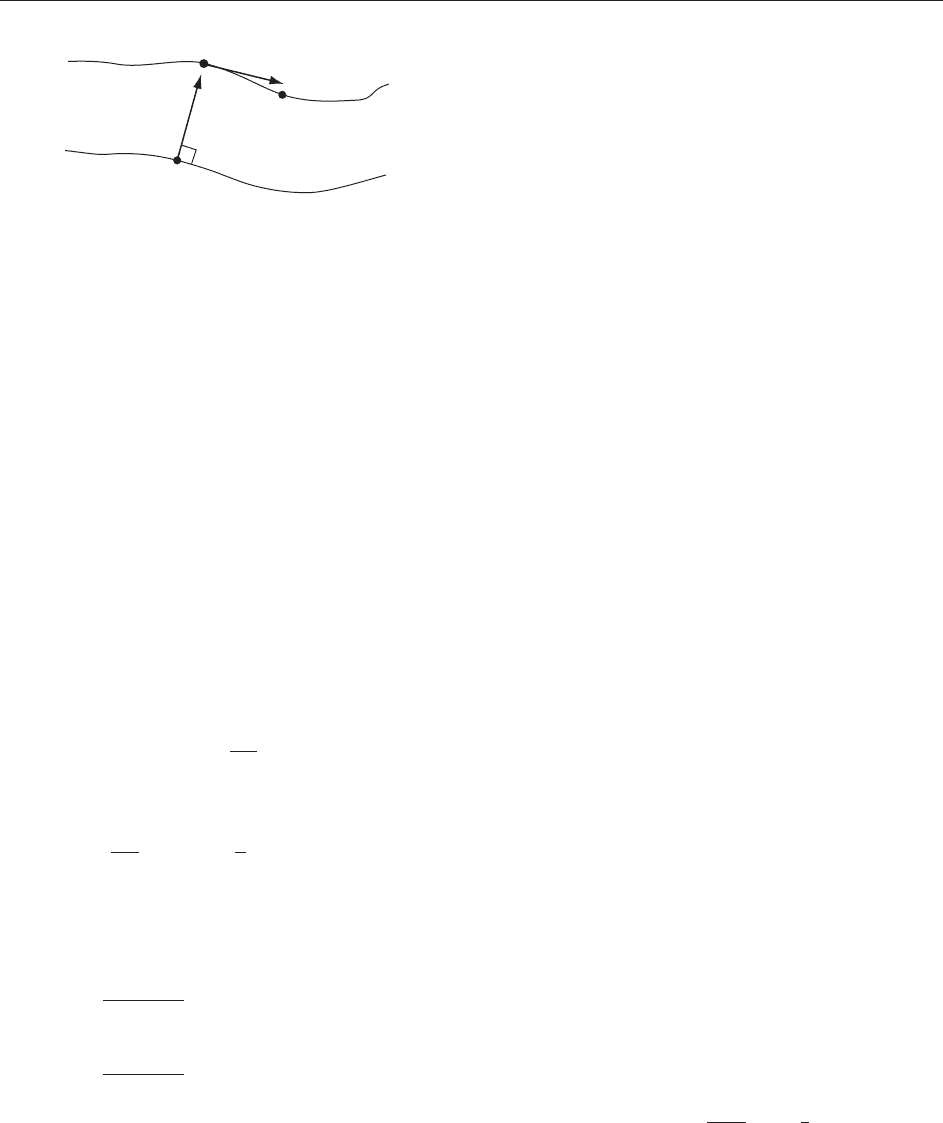
Figure 2 The geometrical interpretation of the lapse N(x , t)
and shift N
a
(x, t ) fields. Two ADM surfaces, defined by the
values t and t þ dt, are displayed. N(x , t)dt is the proper length
of the vector joining the two surfaces, normal to the first surface
at (x , t). This is the proper time lapsed between the two surfaces
for an observer at rest on the first surface at (x , t). The quantity
dx
a
= N
a
(x, t)dt is the shift (the displacement) between the
endpoint of this vector and the point (x, t þ dt) having the same
spacial coordinates as (x , t).
Canonical General Relativity 415

Ashtekar Formalism
The Ashtekar formalism simplifies the form of the
constraints and casts GR in a form having the same
kinematics as Yang–Mills theory. With its variants, it
is widely used in nonperturbative quantum gravity, in
particular in the loop formulation (see Loop Quan-
tum Gravity). It can be obtained from the tetrad
canonical formalism by the canonical transformation
A
i
a
¼
1
2
i
jk
!
jk
a
þ ik
i
a
½16
E
a
i
¼ det ee
a
i
½17
where !
ij
= !
ij
a
dx
a
is the (torsion-fr ee) spin connec-
tion of the triad 1-form field e
i
= e
i
a
dx
a
, determi ned
by the Cartan equation
de
i
þ !
j
k
^ e
k
¼ 0
The ‘‘electric’’ field E is real, while the Sen–Ashtekar
connection A
i
= A
i
a
dx
a
is complex and satisfies the
reality condition
A
i
þ A
i
¼ 2
i
½e½18
The connection A
i
has a simple geometrical inter-
pretation. It is the pullback A
ai
= !
(þ)
a0i
on the t = 0
ADM surface of the self-dual part
!
ðþÞ
IJ
¼
1
2
!
IJ
i
2
IJ
KL
!
KL
of the four-dimensional torsion free spin connection
!
IJ
determined by the tetrad field e
I
.
In terms of these fields, the constraint equations
can be written in the form
G
i
¼ D
a
E
a
i
¼ 0 ½19
C
a
¼ F
i
ab
E
a
i
¼ 0 ½ 20
C ¼
ijk
F
i
ab
E
ja
E
kb
¼ 0 ½21
where D
a
is the covariant derivative and F
ab
is the
curvature defined by the connection A. The first of these
constraints is the nonabelian version of the Gauss law
[3]: it is the gauge constraint of Yang–Mills theory. The
constraints are polynomial in the canonical variables.
These equations are often written using a basis
i
in the su(2) Lie algebra, and defining the su(2)
connection A = A
i
i
and the su(2)-valued vector
field E
a
= E
ai
i
. In terms of these fields the con-
straints can be written in the form
G ¼ D
a
E
a
¼ 0
C
a
¼ tr½F
ab
E
a
¼0
C ¼ tr½F
ab
E
a
E
b
¼0
where the trace is on su(2).
A variant of this formalism commonly used in
quantum gravity is obtained by replacing [16] with
the Barbero connection
A
i
a
¼
1
2
i
jk
!
jk
a
þ k
i
a
½22
where is an arb itrary complex number, called the
Immirzi parameter. In terms of this connection, [21]
is replaced by
C ¼
ijk
F
i
ab
E
ja
E
kb
þ
1 þ
2
4
det eðk
ab
k
ab
k
2
Þ¼0
where e
i
a
and k
ab
are given as function of E and A by
[22] and [17]. The choice = 1, with the constraint
[19]–[21], gives the canonical formulation of Eucli-
dean GR.
All the formulations described extend readily to
matter couplings. The structure of the constraints
remains the same – with additional constraints corre-
sponding to matter gauge invariances, if any. The GR
constraints are modified by the addition of matter terms.
In particular, the Hamiltonian constraint C and the
momentum constraint C
a
are modified by the addition
of terms determined by the energy density and the
momentum density of the matter, respectively. In the
Ashtekar formulation, a fermion field modifies the
Gauss law constraint by the addition of a torsion term.
Evolution
In the gauge-invariant canonical structure of GR, there
is no explicit time flow generated by a Hamiltonian. If
the formalism is utilized just in order to express the
Einstein equation in first-order canonical form, this is
not a difficulty, because evolution in the coordinate
time is generated by the constraints. On the other
hand, if we are interested in understanding the
structure of states, observables, and evolution of GR,
the situation appears to be puzzling. An additional
complication arises from the fact that virtually no
gauge-invariant observable A
ph
is known explicitly as
a function on the phase space. These issues become
especially relevant when the canonical formalism is
taken as a starting point for quantization. How is
physical evolution represented in canonical GR?
The first relevant observation is that the gauge-
invariant phase space
ph
is better understood as a
phase space in the sense of Lagrange : namely as the
space of the solutions of the equations of motion
modulo gauges, rather than a space of instantaneous
states. Recall that in GR the notion of ‘‘instanta-
neous state’’ is rather unnatural.
In the ADM formulation, for instance, an orbit on
the constraint surface of GR can be understood as
the ensemble of all pos sible values that the variables
416 Canonical General Relativity

(q
ab
(x), p
ab
(x)) can take on arbitrary spacelike ADM
surfaces embedded in a given solut ion of the
Einstein equation. Motion along the orbit (which
has dimension 4 1
3
) corresponds to arbitrary
deformations of the surface.
Physical applications of classical GR deal with
relations between ‘‘partial observables.’’ A partial
observable is any variable physical quantity that can
be measured, even if its value cannot be determined
from the knowledge of the physical state. An example
of partial observable in nonrelativistic mechanics is
given precisely by the nonrelativistic time t. Partial
observables are represented in GR as functions on
0
.
A physical state in
ph
determines an orbit in C,and
therefore a set of relations between partial observables
(see Figure 1). That is, it determines the possible values
that the partial observables can take ‘‘when’’ and
‘‘where’’ other partial observables have given values.
All physical predictions of classical GR can be
expressed in this form.
One of the partial observables can be selected to
play the role of a physical clock time, and evolution
can be expressed in terms of such clock time. In
general, it is difficult – if not impossible – to find a
clock time observable in terms of which evolution is
a proper conventional Hamiltonian evolution. Mat-
ter couplings partially simplify the task. For
instance, if the motion of planet Earth is coupled
to GR, then proper time along this motion from a
significative event on Earth, which is a partial
observable, can be a convenient clock time. In pure
gravity, the ‘‘York time’’ defined as the trace of the
extrinsic curvature T
Y
= k, on ADM surfaces where
k is spatially constant, has been extensively and
effectively used as a clock time in formal analysis of
the theory. A Hamiltonian that generates evolution
in a given clock time T can be formally obtained by
solving the Hamiltonian constraint with respect to a
momentum P
T
conjugate to T. Such ‘‘reparametriza-
tions’’ of the relative evolution of the partial
observables can be useful to analyze equations and
to help intuition, but they are by no means necessary
to have a well-defined interpretation of the theory.
Another possibility to introduce a preferred time
flow is to consider asymptotically flat solutions of
the field equations. In this case, one can define a
nonvanishing Hamiltonian, given by a boundary
integral at spacial infinity. This Hamiltonian gen-
erates evolution in an asymptotic Minkowski time.
This choice is convenient for describing observations
performed from a large distance on isolated gravita-
tional systems. Many general-relativistic physical
observations do not belong to this category.
Various other techniques to define a fully gen-
erally covariant canonical formalism have been
explored. Among these: definitions of the physical
symplectic structure directly on the space of the
solutions of the field equations; generalization of the
initial and final surfaces to boundaries of compact
spacetime regions; construction of ‘‘evolving con-
stants of motion,’’ namely families of gauge-invar-
iant observables depending on a clock time
parameter; multisymplec tic formalisms that treats
space and time derivatives on a more equal footing;
and others. Many of these techniques are attempts
to overcome the unequal way in which time and
space dependence are treated in the conventional
Hamiltonian formalism.
GR has deepl y modified our understanding of
space and time. An extension of the canonical
formalism of mechanics, compatible with such a
modification, is needed, but consensus on the way
(or even the possibility) of formulating a fully
satisfactory general-relativistic extension of Hamil-
tonian mechanics is still lacking.
See also: Asymptotic Structure and Conformal Infinity;
Constrained Systems; General Relativity: Overview;
Loop Quantum Gravity; Quantum Cosmology; Quantum
Geometry and its Applications; Spin Foams;
Wheeler–De Witt Theory.
Further Reading
Arnowitt R, Deser S, and Misner CW (1962) The dynamics of
general relativity. In: Witten L (ed.) Gravitation: An Introduc-
tion to Current Research, p. 227. New York: Wiley.
Ashtekar A (1991) Non-Perturbative Canonical Gravity. Singapore:
World Scientific.
Bergmann P (1989) The canonical formulation of general
relativistic theories: the early years, 1930–1959. In: Howard D
and Stachel J (eds.) Einstein and the History of General
Relativity. Boston: Birkha¨user.
Dirac PAM (1950) Generalized Hamiltonian dynamics. Canadian
Journal of Mathematical Physics 2: 129–148.
Dirac PAM (1958) The theory of gravitation in Hamiltonian form.
Proceedings of the Royal Society of London, Series A 246: 333.
Dirac PAM (1964) Lectures on Quantum Mechanics. New York:
Belfer Graduate School of Science, Yeshiva University.
Gotay MJ, Isenberg J, Marsden JE, and Montgomery R (1998)
Momentum maps and classical relativistic fields. Part 1:
Covariant field theory. Archives: physics/9801019.
Hanson A, Regge T, and Teitelboim C (1976) Constrained
Hamiltonian Systems. Rome: Academia Nazionale dei Lincei.
Henneaux M and Teitelboim C (1972) Quantization of Gauge
Systems. Princeton: Princeton University Press.
Isham CJ (1993) Canonical quantum gravity and the problem of
time. In: Ibort LA and Rodriguez MA (eds.) Recent Problems in
Mathematical Physics, Salamanca, Dordrecht: Kluwer Academic.
Lagrange JL (1808) Me´mories de la premie`re classe des sciences
mathematiques et physiques. Paris: Institute de France.
Rovelli C (2004) Quantum Gravity. Cambridge: Cambridge
University Press.
Souriau JM (1969) Structure des Systemes Dynamics. Paris:
Dunod.
Canonical General Relativity 417

Capacities Enhanced by Entanglement
P Hayden, McGill University, Montreal, QC, Canada
ª 2006 Elsevier Ltd. All rights reserved.
Introduction
Shared entanglement between a sender and receiver
can significantly improve the usefulness of a
quantum channel for the communication of either
classical or quantum data. Superdense coding and
teleportation provide the most well-known examples
of this improvement; free entanglement doubles the
classical capacity of a noiseless quantum channel
and makes it possible for a noiseless classical channel
to send quantum data. In fact, the entanglement-
assisted classical and quantum capacities of a
quantum chann el are in many senses simpler and
better behaved than their unassisted counterparts
(Holevo 1998, Schuma cher and Westmoreland
1997, Devetak 2005). Most importantly, these
capacities can be calculated using simple formulas
and finite optimization procedures ( Bennett et al.
1999, 2002). No such finite procedure is known for
either of the unassisted capacities. Moreover, the
entanglement-assisted classical and quantum capa-
cities are related by a simple factor of 2. The
unassisted capacities, in contrast, have completely
different formulas . In fact, the simple factor of 2
generalizes to a statement known as the quantum
reverse Shannon theorem, which governs the rate at
which one quantum channel can simulate another
(Bennett et al. 2005). The answer is given by the
ratio of the entanglement-assisted capacities.
Notation
Quantum systems will be denoted by A, B, and so
on as well as their variants such as A
0
and
^
A. The
choice of letter will generally indicate which party
holds a given syst em, with A reserved for the sender,
Alice, and B for the receiver, Bob. Given a quantum
system C, C
n
will often be written as C
n
. These
symbols will be used to denote both the Hilbert
space of the quantum system and the set of density
operators on that system. Thus, a quantum channel
N : A
0
!B refers to a trace-preserving, completely
positive (TPCP) map from the operators on the
Hilbert space of A
0
to those of B.id
C
refers to the
identity channel on C. The map Nid
C
will
frequently be ab breviated to N in order to simplify
long expressions. Likewise, the density operator
j’ih’j of a pure quantum state j’i will be
abbreviated to ’.
C
will refer to the maximally
mixed state on C and
d
to the maximally mixed
state on a specified d-dimensional quantum system.
For a given quantum state ’
AB
on the composite
system AB, ’
A
= tr
B
’
AB
and
HðAÞ
’
¼ Hð’
A
Þ¼trð’
A
log
2
’
A
Þ½1
is the von Neumann entropy of ’
A
, while
HðAjBÞ
’
¼I
c
ðAiBÞ¼HðABÞ
’
HðBÞ
’
½2
is its conditional entropy and
IðA ; BÞ
’
¼ HðAÞ
’
þ HðBÞ
’
HðABÞ
’
½3
its mutual information.
Entanglement-Assisted Classical
and Quantum Capacities
The entangl ement-assisted classical capacity of a
quantum channel N : A
0
!B is the optimal rate at
which classical information can be communicated
through the channel while in addition making use of
an unlimited number of maximally entangled states.
The formal definition proceeds as follows. Alice
and Bob are assumed to share nS ebits in the form of
a maximally entangled state ji
~
A
~
B
of Schmidt rank
2
nS
. Conditioned on her message m 2 {1, 2, ...,2
nR
},
Alice will apply an encoding operation E
m
:
~
A !A
0n
.
Bob’s decoding is given by a POVM {
m
}
2
nR
m = 1
on the
composite system
~
BB
n
. The procedure is said to have
maximum probability of error if
max
m
tr
m
ðN
n
E
m
ÞðÞ
1 ½4
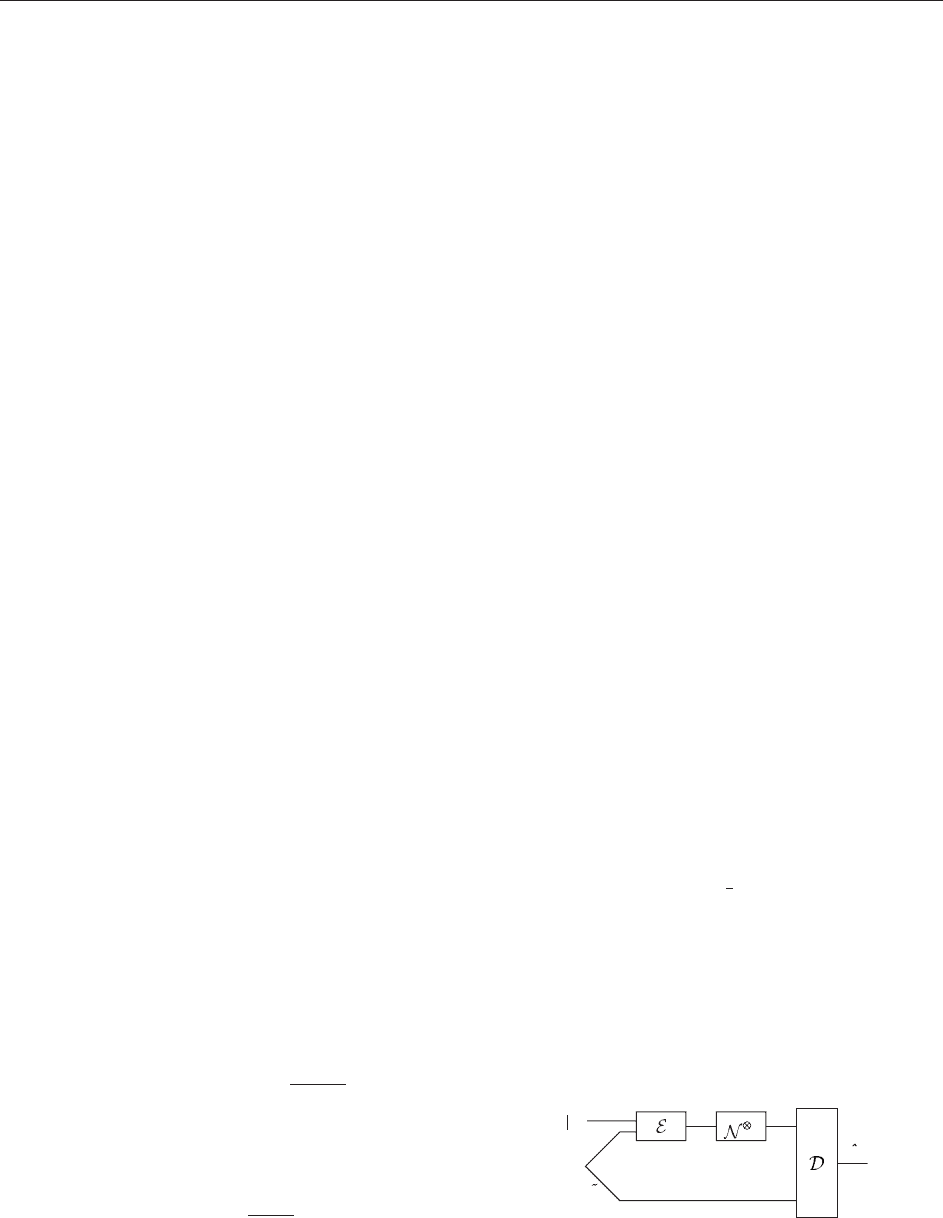
These elements, illustrated in Figure 1, consisting of
the shared entanglement, as well as the encoding and
decoding operations meeting the criterion of eqn [4],
are called a (2
nR
,2
nS
, n, ) entanglement-assisted clas-
sical code for the channel N. A rate R is said to be
achievable if there exists a choice of S 0anda
sequence of entanglement-assisted classical codes
(2
nR
,2
nS
, n,
n
)with
n
!0. The entanglement-assisted
Ã
A
′n
n
B
n
B
M
m
′ = 1
Λ
m ′
m
{}
Figure 1 Circuit representation of the elements of an
entanglement-assisted classical code for the channel N. Alice
encodes message m by applying the operation E
m
to her half
of the shared entanglement. Bob decodes by applying the
POVM f
m
0
g on the output of the channel and his half of the
shared entanglement.
418 Capacities Enhanced by Entanglement
classical capacity C
E
(N)ofN is defined to be the
supremum over all achievable rates.
Theorem 1 (Bennett et al. 1999, 2002). The
entanglement-assisted classical capacity C
E
of a
quantum channel N : A
0
!B is given by
C
E
ðNÞ ¼ max
IðA; BÞ
½5
where the maximization is over states
AB
= N(’
AA
0
)
arising from the channel by acting on the A
0
half of
any pure state j’i
AA
0
.
The theorem bears a strong formal resemblance to
Shannon’s noisy coding theorem for the classical
capacity of a classical noisy channel. There the
capacity formula is also given by an optimization of
the mutual information, but over joint distributions
between the input an d output alphabets arising from
the action of the channel. Such a joint distribution
cannot exist in general for a quantum channel
because the no-cloning theorem excludes the possi-
bility of the input and output existing simulta-
neously. Equation [5] instead refers to a na tural
substitute for the joint input–output distribution: a
quantum state arising from the quantum channel
acting on half of an entangled pure state.
Another point worth stressing is that, unlike the
known formulas for the unassisted classical and
quantum capacities of a quantum channel, eqn [5]
refers to only a single use of N instead of the limit
of many uses, N
n
. The formula can therefore
readily be used to evaluate C
E
for any channel of
interest.
Consider, for example, the d-dimensional depo-
larizing channel
D
p
ðÞ¼ð1 pÞ þ p
d
½6
that with probability p completely randomizes the
input but otherwise leaves the input invariant. For
such channels, the maximum is achieved by choos-
ing a maximally entangled state for j’i
AA
0
, yielding
C
E
ðD
p
Þ¼2 log
2
d
h
d
2
1 p
d
2
1
d
2
½7
where for any 0 q 1 and integer r 1,
h
r
ðqÞ¼q log
2
q ð1 qÞ
log
2
1 q
r 1
½8
is the Shannon entropy of the distribution
(q,(1 q)=(r 1), ...,(1 q)=(r 1)).
Entanglement assistance also simplifies the rela-
tionship between the classical and quantum
capacities of a channel. Proceeding as before to
formally define the quantum capacity, Alice and Bob
are again assumed to share a maximally entangled
state ji
~
A
~
B
of Schmidt rank 2
nS
. Alice’s encoding
operation will be a TPCP map E :
^
A
~
A !A
0n
acting
on an input system
^
A and her half of the shared
entanglement,
~
A. Bob’s decoding will likewise be a
TPCP map D:
~
BB
n
!
^
B acting on the output of the
channel, B
n
, and his half of the shared entangle-
ment,
~
B.
^
A and
^
B are assumed to be isomorphic
quantum systems of some fixed dimension 2
nQ
. The
procedure is said to have subspace fidelity 1 if
^
B
h’j
DN
n
E
~
A
~
B
’
^
A
j’i
^
B
1 ½9
for all j’i
^
A
2
^
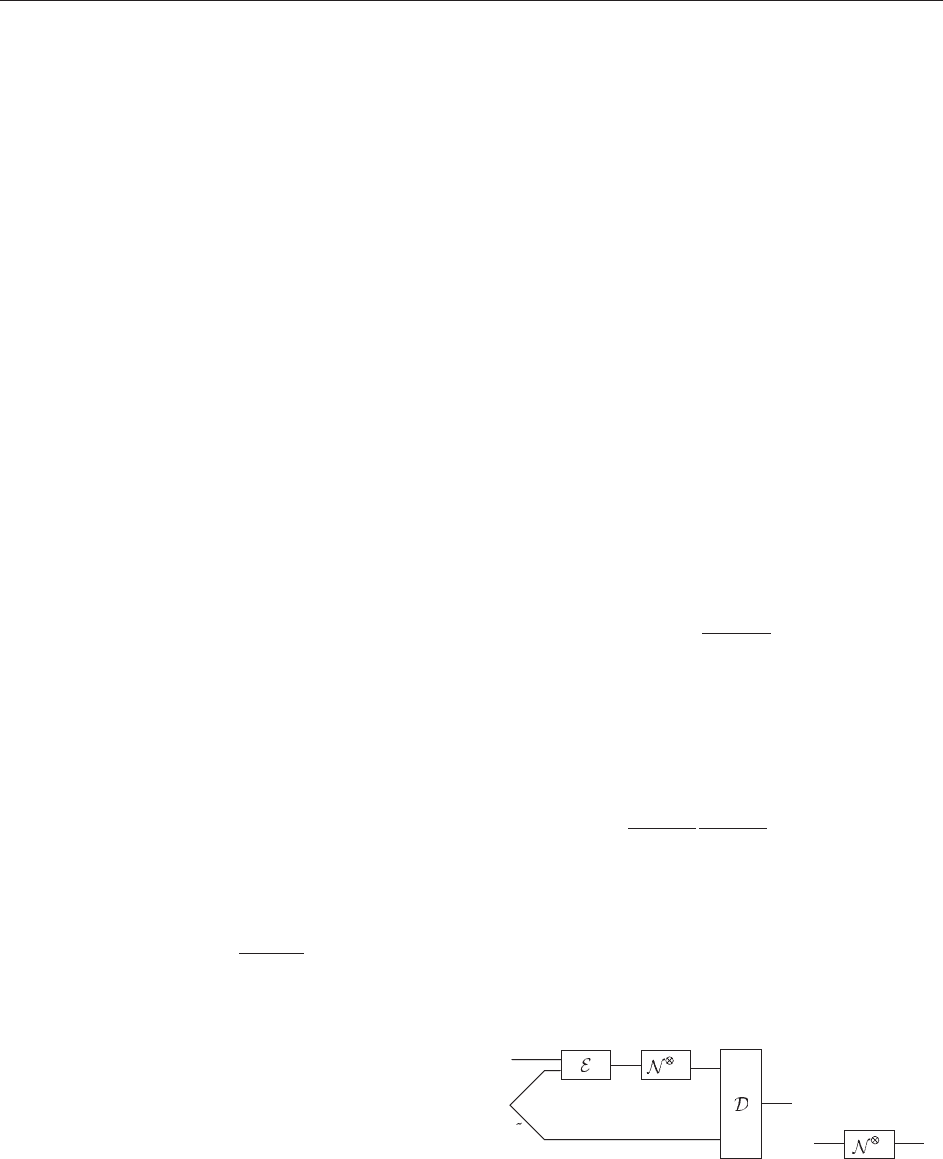
A. These elements, illustrated in
Figure 2, are together called a (2
nQ
,2
nS
, n, )
entanglement-assisted quantum code for the channel
N. A rate Q is said to be achievable if there exists a
choice of S 0 and a sequence of entanglement-
assisted quantum codes (2
nR
,2
nS
, n,
n
) with
n
!0.
The entanglement-assisted quantum capacity Q
E
(N)
of N is defined to be the supremum over all
achievable rates.
There is considerable freedom in the definition of
the entanglement-assisted quantum capacity. It
could, for example, be defined as the largest amount
of maximal entanglement that can be generated
using the channel, minus the entanglement con-
sumed during the protocol itself. Alternatively, the
fidelity criterion eqn [9] could be strengthened to
require that DN
n
E preserve not only pure
states on
^
A but any entanglement between
^
A and a
reference system. All of these vari ants yield the same
capacity formula:
Q
E
ðNÞ ¼
1
2
C
E
ðNÞ ½10
This equivalence is a direct consequence of the
existence of the teleportation and superdense coding
protocols. When maximal entanglement is available,
teleportation converts the ability to send classical
data into the ability to send quantum data at half
the classical rate. Conversely, by consuming
Ã
Â
B
ϕ〉
A
′n
B
n
B
n
Figure 2 Circuit representation of the elements of an
entanglement-assisted quantum code for the channel N. E is
Alice’s encoding operation, which acts on both her input state
and her half of the shared entanglement. Bob decodes using a
quantum operation D acting on the output of the channel and his
half of the shared entanglement.
Capacities Enhanced by Entanglement 419

maximal entanglement, superdense coding converts
the ability to send quantum data into the ability to
send classical data at double the quantum rate.
Sketch of Proof
The proof of a capacity theorem can usually be
broken into two parts, achievability and optim ality.
The achievability part demonstrates the existence of
a sequence of codes reaching the prescribed rate
while the optimality part shows that it is impossible
to do better.
The main idea in the achievability proof can be
understood by studying the special case where
’
A
0
=
A
0
. Let d
A
0
= dim A
0
and {U
j
}
d
2n
A
0
j = 1
be a set of
Weyl operato rs for A
0n
. The relevant property of
these operators is that averaging over them imple-
ments the constant map: for all density operators ,
1
d
2n
A
0
X
d
2n
A
0
j¼1
U
j
U
y
j
¼
A
0n
½11
Consider the state
j
that arises if Alice acts with U
j
on the A
0n
half of a rank-d
n
A
0
maximally entangled
state j’i
AA
0n
and then sends the A
0n
half of the
resulting state through N. (Note that here A
0n
also
plays the role of
~
A.) The entropy of the resulting
state is
Hð
j
Þ¼H NððU
j
I
~
B
Þ’ðU
y
j
I
~
B
ÞÞ
½12
¼ H Nð’ÞðÞ ½13
since U
j
does not change the local density operator
on A
0n
.
On the other hand, if Alice selects a value of j
from the uniform distribution, then the resulting
average input state to the channel will be
A
0n
A
¼ ’
A
0n
’
A
½14
and the corresponding average output state will be
N(’
A
0n
) ’
A
, which has entropy
HðNð’
A
0n
ÞÞ þ Hð’
A
Þ½15
Therefore, the Holevo quantity of the ensemble of
output states, defined as the entropy of the average
state minus the average of the entropies of the
individual output states, will be equal to
Hð’
A
ÞþH Nð’
A
0n
Þ
H Nð’
AA
0n
Þ
½16
This is precisely the quantity I(A; B)
for the state
N(’
AA
0n
) since the channel N transforms the A
0n
system into B. Moreover, if Bob is given the A part of
the maximally entangled state, then this is the Holevo
quantity of an ensemble of states that can be produced
by Alice acting on half of a shared entangled state and
then sending her half through the channel. Invok-
ing the Holevo–Schumacher–Westmoreland (HSW)
theorem for the classical capacity (Holevo 1998,
Schumacher and Westmoreland 1997) therefore com-
pletes the proof; using coding, the Holevo quantity is
an achievable communication rate.
The proof that eqn [5] is optimal involves a series
of entropy manipulat ions similar to the optimality
proofs for the unassisted classical and quantum
capacities. From the point of view of quantum
information, the truly unusual part of the proof is
the demonstration that it is unnecessary to consider
multiple copies of N (Cerf and Adami 1997).
Specifically, let
f ðNÞ ¼ max
IðA ; BÞ
½17
where the maximization is defined as in Theorem 1.
Techniques analogous to those used for the unas-
sisted capacities yield the upper bound
C
E
ðNÞ lim
n!1
1
n
f ðN
n
Þ½18
Unlike the unassisted case, however, a relatively easy
argument shows that
f ðN
1
N
2
Þ¼f ðN
1
Þþf ðN
2
Þ½19
(The analogous statement is an important conjecture
for the classical capacity and is known to be false for
the quantum capacity (DiVincenzo et al. 1998).) As
a result, C
E
(N) f (N), which is the optimality part
of Theorem 1.
To see the origin of eqn [19], it will be helpful to
invoke Stinespring’s theorem to write N
j
= tr
E
j
U
B
j
E
j
j
,
where U
j
: A
0
j
!B
j
E
j
is an isometry. Fix a state
j’i
AA
0
1
A
0
2
and let = (U
1
U
2
)(’). Equation [19]
follows from the fact that
IðA; B
1
B
2
Þ
IðAB
2
E
2
; B
1
Þ
þ IðAB
1
E
1
; B
2
Þ
½20
Simply redefining A to be AB
2
E
2
shows that the first
term of the right-hand side is upper bounded by
f (N
1
). The second term, likewise, is upper bounded
by f (N
2
). Equation [20] is itself equivalent to the
inequality
HðB
1
B
2
jE
1
E
2
Þ
þ HðB
1
B
2
Þ
HðB
1
jE
1
Þ
þ HðB
2
jE
2
Þ
þ HðB
1
Þ
þ HðB
2
Þ
½21
The inequality H(B
1
B
2
)
H(B
1
)
þ H(B
2
)
holds
by the subadditivity of the von Neumann entropy.
420 Capacities Enhanced by Entanglement
Repeated applications of the strong sub additivity
inequality, moreover, lead to the inequality
HðB
1
B
2
jE
1
E
2
Þ
HðB
1
jE
1
Þ
þ HðB
2
jE
2
Þ
½22
Together, they prove eqn [20] and, thence, eqn [19].
The intuitive meaning of this ‘‘single-letterization’’ is
unclear, but regardless, it is interesting to note that
the pro of involved invoking a pair of purifying
environment systems, E
1
and E
2
, and studying the
entropy relationships between the true outputs of
the channel and the environment’s share.
The Quantum Reverse Shannon Theorem
A strong argument can be made that the entanglement-
assisted capacity of a quantum channel is the most
important capacity of that channel and that all the
othercapacitiesare,insomesense,oflesssignificance.
The fact that it is unnecessary to distinguish between
the classical and quantum entanglement-assisted capa-
cities because they are related by a factor of 2 is a hint
in that direction, as is the simple, single-letter formula
for C
E
(N).
A more general argument can be made by
considering the problem of having one channel
simulate another. Indeed, the quantum capacity of
a quantum channel is simply the optimal rate at
which that channel can simulate the noiseless
channel id
2
on a single qubit. Likewise, the classical
capacity of a quantum channel is its optimal rate for
simulation of a qubit dephasing channel
7!j0ih0jj0ih0jþj1ih1jj1ih1j½23
In this spirit, the fact that C
E
(N) = 2Q
E
(N) can be
re-expressed in the form
Q
E
ðNÞ ¼
C
E
ðNÞ
C
E
ðid
2
Þ
½24
Equivalently, when entanglement is free, the optimal
rate at which N can simulate a noiseless qubit channel
is given by the ratio between the entanglement-
assisted classical capacities of N and id
2
.The
quantum reverse Shannon theorem generalizes this
statement to the simulation of arbitrary channels in
the presence of free entanglement.
Suppose that Alice and Bob would like to use
N
1
: A
0
!B to simulate another channel N
2
: A
0
!B.
Fix an input state ’
A
0
and let j’i
AA
0n
be a purification
of (’
A
0
)
n
. As always, assume that Alice and Bob share
a maximally entangled state ji
~
A
~
B
of Schmidt rank
2
nS
. Alice’s encoding operation will be a TPCP map
E :
~
AA
0n
!A
0m
acting on n copies of the input system
A
0
and her half of the shared entanglement,
~
A. Bob’s
decoding will likewise be a TPCP map D: B
m
~
B !B
n
acting on m copies of the output of the channel, and his
half of the shared entanglement,
~
B. This procedure is
said to -simulate N
n
2
on (’
A
0
)
n
if
F N
n
2
’
AA
0n
;
DN
m
1
E
~
A
~
B
’
AA
0n
1 ½25
where F is the mixed state fidelity F(, ) =
(tr
ffiffiffiffiffiffiffiffiffiffiffiffiffiffiffiffiffiffiffi
1=2
1=2
p
)
2
. The entire procedure, illustrated in
Figure 3,issaidtobea(2
nS
, m, n, ) entanglement-
assisted simulation of N
2
by N
1
. A rate R,measured
in copies of N
2
per copy of N
1
,issaidtobe
achievable for ’
A
0
if there exists a choice of S 0and
a sequence of (2
nS
, m
n
, n,
n
) entanglement-assisted
simulations with n=m
n
!R while
n
!0.
The quantum reverse Shannon theorem states
that the entanglement-assisted capacity completely
governs the achievable simulation rates.
Theorem 2 (Winter 2004, Bennett et al.). Given
two channel s N
1
: A
0
!BandN
2
: A
0
!B, Risan
achievable simulation rate for N
2
by N
1
and all
input states ’
A
0
if and only if
R
C
E
ðN
1
Þ
C
E
ðN
2
Þ
½26
Note that the form of eqn [26] ensures that the
simulation is asymptotically reversible: if a channel
N
1
is used to simulate N
2
and the simulation is then
used to simulate N
1
again, then the overall rate
becomes
C
E
ðN
1
Þ
C
E
ðN
2
Þ
C
E
ðN
2
Þ
C
E
ðN
1
Þ
¼ 1 ½27
Thus, in the presence of free entanglement and for a
known input density operator of the form (’
A
0
)
n
,a
single parameter, the entanglement-assisted classical
capacity, suffices to completely characterize the
asymptotic properties of a quantum channel.
Ã
A
′n
B
A
′m
B
n
(a)
A
′n
B
n
(b)
1
m
2
n
B
n
Figure 3 Circuit representation of an entanglement-assisted
simulation of N
2
by N
1
. (a) The simulation circuit, with Alice’s
encoding operation E acting on n copies of A
0
and Bob’s
decoding operation producing n copies of B. (b) The circuit that
the protocol is intended to simulate. As stated, the quantum
reverse Shannon theorem allows the simulation circuit to depend
on the density operator of the input state restricted to A
0n
.
Capacities Enhanced by Entanglement 421

Moreover, since two channels that are asymptoti-
cally equivalent without free entanglement will
surely remain equivalent if free entanglement is
permitted, eqn [26] gives essentially the only
possible nontriv ial, single-parameter asymptotic
characterization of quantum channels. This is the
sense in which the entanglement-assisted capacity
should be regarded as the most important capacity
of a quantum channel.
The proof of the quantum reverse Shannon
theorem is quite involved, but some of its features
can be understood without much work. First, note
that by the optimality statement of the entanglement-
assisted classical capacity, the desired simulation can
exist only if eqn [26] holds. Otherwise, composing
the simulation of N
2
by N
1
with a sequence of codes
achieving C
E
(N
2
) would result in a sequence of codes
beating the capacity formula for N
1
.
Similarly, note that one method to simulate a
channel N
1
using N
2
is to first use N
2
to simulate
the noiseless channel and then use the simulated
noiseless channel to simulate N
1
. Since the achiev-
able rates for the first step are characterized by the
entanglement-assisted capacity theorem, proving the
achievability part of Theo rem 2 reduces to finding
protocols for simulating a general noisy quantum
channel N
2
by a noiseless one. That perhaps sounds
like a strange goal, but nonetheless is the difficult
part of the quantum reverse Shannon theorem.
It is likely that the quantum reverse Shannon
theorem can be extended to cover other types of
inputs than the known tensor power states (’
A
0
)
n
.
The most desirable form of the theorem would be
one valid for all possible input density operators on
A
0n
, providing a single simulation procedure
dependent only on the channels and not the input
state. It is known that without modifying the form
of the free entanglement, this most ambitious form
of the theorem fails, but it is conjectured that the
full-strength theorem does hold provided very large
amounts of entanglement are supplied in the form of
the so-called embezzling states (van Dam and
Hayden 2003).
Relationships between Protocols
There is another sense in which the entanglement-
assisted capacity can be viewed as the fundamental
capacity of a quan tum channel: an efficient protocol
for achieving the entanglement-assisted capacity can
be converted into protocols achieving the unassisted
quantum and classical capacities, or at least very
close variants thereof.
An efficient protocol in this case refers to one that
does not waste entanglement. Suppose that N : A
0
!B
can be written tr
E
U
BE
for some isometry U
BE
.Let
j’i
AA
0
be a pure state and ji
ABE
= U
BE
j’i
AA
0
the
corresponding purified channel output state. Careful
analysis of the entanglement-assisted classical commu-
nication protocol achieving the rate I(A; B)
leads to
an entanglement-assisted quantum communication
protocol consuming entanglement at the rate
(1=2)I (A; E)
ebits per use of N and yielding commu-
nication at the rate of (1=2)I(A; B)
qubits per use N.
The protocol achieving this goal is known as the
‘‘father’’ (Devetak et al. 2004).
If the entanglement consumed in the father were
actually supplied by quantum communication from
Alice to Bob, then the net rate of quantum
communication produced by the resulting protocol
would be (1=2)I(A; B)
(1=2)I(A; E)
qubits from
Alice to Bob, that is, the total produced minus the
total consumed.
This quantity, how much more information B has
about A than E does, can be simplified using an
interesting identity. Since ji
ABE
is pure,
IðA; EÞ
¼ HðAÞ
þ HðEÞ
HðAEÞ
½28
¼ HðAÞ
þ HðABÞ
HðBÞ
½29
Expanding I(A; B)
and canceling terms then reveals
that
1
2
IðA; BÞ
1
2
IðA ; EÞ¼HðAjBÞ
¼ I
c
ðAiBÞ
½30
where the function I
c
is known as the coherent
information. After optimizing over input states and
multiple channel uses, this is precisely the formula for
the unassisted quantum capacity of a quantum channel
(Devetak 2005). Thus, the net rate of qubit commu-
nication for the protocol derived from the father
exactly matches the rates necessary to achieve the
unassisted quantum capacity. The only caveat is that
the protocol derived from the father uses quantum
communication catalytically, meaning that some com-
munication needs to be invested in order to get a gain
of I
c
(AiB). For the unassisted quantum capacity, no
investment is necessary. Nonetheless, detailed analysis
of the situation reveals that the amount of catalytic
communication required can be reduced to an amount
sublinear in the number of channel uses, meaning the
rate of required investment can be made arbitrarily
small. In this sense, the father protocol essentially
generates the optimal protocols for the unassisted
quantum capacity.
Protocols achieving the unassisted classical capa-
city can be constructed in a similar way. In this case,
one starts from an ensemble E = {p
j
, N(
A
0
j
)} of
states generated by the channel. Achievability of
422 Capacities Enhanced by Entanglement

the unassisted classical capacity formula follo ws
from achievability of rates of the form
ðEÞ¼H
X
j
p
j
Nð
A
0
j
Þ
X
j
p
j
H Nð
A
0
j
Þ
½31
for arbitrary ensembles of output states. Consider
the channel
e
NðÞ¼
X
j
hjjjjiNð
j
Þ½32
and input state j ’i
AA
0
=
P
j
ffiffiffiffi
p
j
p
jji
A
jji
A
0
.If =
e
N(’),
then I(A; B)
is equal to (E). Thus, there are protocols
consuming entanglement that achieve the classical
communications rate (E) for the modified channel
e
N. Because the channel
e
N includes an orthonormal
measurement which destroys all entanglement between
A and B, however, it can be argued that any
entanglement used in such a protocol could be replaced
by shared randomn ess, which could then in turn be
eliminated by a standard derandomization argument.
The net result is a procedure for choosing rate (E)
codes for the channel N consisting of states of the form
j
1
j
n
, which is the essence of the achievability
proof for the unassisted classical capacity.
This may seem like an unnecessarily cumbersome
and even circular approach to the unassisted
classical capacity given that the proof sketched
above for the entanglemen t-assisted classical capa-
city itself invokes the unassisted result in the form of
the HSW theorem. The approach becomes more
satisfying when one learns that simple and direct
proofs of the father protocol exist that completely
bypass the HSW theorem (Abeyesinghe et al. 2005).
Thus, the entanglement-assisted communication
protocols can be easily transformed into their
unassisted analogs , confirming the central place of
entanglement-assisted communication in quantum
information theory.
Acknowledgmnts
The author is grateful to the inventors of the
quantum reverse Shannon theorem for letting him
discuss their results prior to their publication and
to Jon Yard for a careful reading of the manu-
script. This work has been supported by the
Canadian Institute for Advanced Research, the
Canada Research Chairs program, and Canada’s
NSERC.
See also: Capacity for Quantum Information; Channels in
Quantum Information Theory; Entanglement; Finite Weyl
Systems; Quantum Channels: Classical Capacity;
Quantum Entropy.
Further Reading
Abeyesinghe A, Devetak I, Hayden P, and Winter A (2005) Fully
quantum Slepian–Wolf (in preparation).
Bennett CH, Devetak I, Harrow AW, Shor PW, and Winter A (2005)
The quantum Reverse Shannon Theorem (in preparation).
Bennett CH, Shor PW, Smolin JA, and Thapliyal AV (1999)
Entanglement-assisted classical capacity of noisy quantum
channels. Physical Review Letters 83: 3081 (arXiv.org:quant-
ph/9904023).
Bennett CH, Shor PW, Smolin JA, and Thapliyal AV (2002)
Entanglement-assisted capacity of a quantum channel and
the reverse Shannon theorem. IEEE Transactions on Informa-
tion Theory 48(10): 2637 (arXiv.org:quant-ph/0106052).
Cerf N and Adami C (1997) Von Neumann capacity of noisy
quantum channels. Physical Review A 56: 3470 (arXiv.org:
quant-ph/9609024).
Devetak I (2005) The private classical capacity and quantum
capacity of a quantum channel. IEEE Transactions on
Information Theory 51(1): 44 (arXiv.org/0304127).
Devetak I, Harrow AW, and Winter A (2004) A family of
quantum protocols. Physical Review Letters 93: 230504
(arXiv.org:quant-ph/0308044).
DiVincenzo DP, Smolin JA, and Shor PW (1998) Quantum
channel capacity of very noisy channels. Physical Review A
57: 830 (arXiv.org:quantph/9706061).
Holevo AS (1998) The capacity of the quantum channel with
general signal states. IEEE Transactions on Information
Theory 44: 269–273.
Schumacher B and Westmoreland MD (1997) Sending classical
information via noisy quantum channels. Physical Review A
56: 131–138.
van Dam W and Hayden P (2003) Universal entanglement
transformation without communication. Physical Review A
67: 060302 (arXiv.org:quant-ph/0201041).
Winter A (2004) Extrinsic and instrinsic data in quantum
measurements: asymptotic convex decomposition of
positive operator valued measures. Communications in
Mathematical Physics 244(1): 157 (arXiv.org:quantph/
0109050).
Capacities Enhanced by Entanglement 423
Capacity for Quantum Information
D Kretschmann, Technische Universita
¨
t
Braunschweig, Braunschweig, Germany
ª 2006 Elsevier Ltd. All rights reserved.
Introduction
Any proces sing of quantum information, be it
storage or transfer, can be represented as a quantum
channel: a completely positive and trace-preserving
map that transforms states (density matrices) on the
sender’s end of the channel into states on the
receiver’s end. Very often, the channel S that sender
and receiver (conventionally called Alice and Bob,
respectively) would like to implement is not readily
available, typically due to detrimental noise effects,
limited technology, or insufficient funding. They
may then try to simulate S with some other channel
T, which they happen to have at their disposal. The
quantum channel capaci ty Q(T, S)ofT with respect
to S quantifies how well this simulation can be
performed, in the limit of long input strings, so that
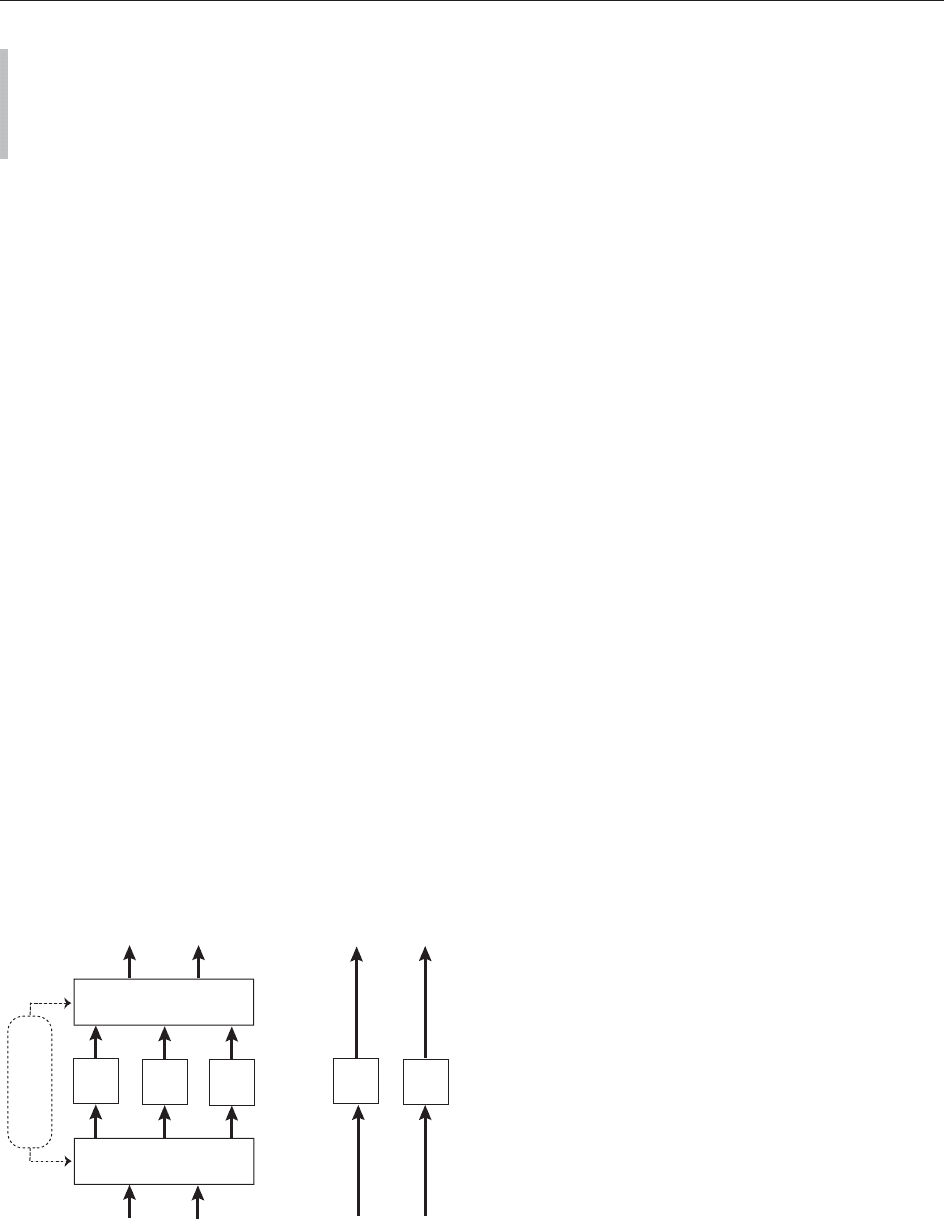
Alice and Bob can take advantage of collective pre-
and post-processing (cf. Figure 1). Higher capacities
may result if Alice and Bob are allowed to use
additional resources in the process, such as classical
side channels or a bunch of maximally entangled
pairs shared between them.
Quantum capacity thus gives the ultimate bench-
marks for the simulation of one quantum channel by
another and for the optimal use of auxiliary
resources. Together with the compression rate of a
quantum source (see Source Coding in Quantum
Information Theory), it lies at the heart of quantum
information theory.
In a very typical scenario, Alice and Bob would
like to implement the ideal (noiseless) quantum
channel S = id: they are interested in sending
quantum states undistorted over some distance, or
want to store them safely for some period of time, so
that all the precious quantum correlations are
preserved. The capacity Q(T) Q(T, id) is then the
maximal number of qubit transmissions per use of
the channel, taken in the limit of long messages and
using collective encoding and decoding schemes
asymptotically eliminating all transmission errors.
This is what is generally called the quantum capacity
of the channel T, and it is our mai n focus in this
article. Little is known so far about the quantum
capacity for the simulation of other (nonideal)
channels (cf. the section ‘‘Related capacities’’).
In remarkable contrast to the classical setting,
quantum channel capacities are very much affected
by additional resources. This leads to unexpected
and fascinating applications such as teleportation
and dense coding. But it also results in a bewildering
variety of inequivalent channel capacities, which still
hold many challenges for future research.
Notation
A quantum chan nel which transforms input systems
on a Hilbert space H
A
into output systems on a
(possibly different) Hilbert space H
B
is represented
(in Schro¨ dinger picture) by a completely positive and
trace-preserving lin ear map T : B
(H
A
) !B
(H
B
),
where B
(H) denotes the space of trace class
operators on the Hilbert space H (see Channels in
Quantum Informat ion Theory). We write A instead
of B
(H
A
) to streamline the presentation, and A
n
for
the n-fold tensor product B
(H
A
)
n
.
It is evident that the definition of channel capacity
requires the comparison of different quantum
channels. A suitable distance measure is the norm
of complete boundedness (or cb-norm, for short),
denoted by kk
cb
. For two channels T and S , the
distance (1=2)kT Sk
cb
can be defined as the largest
difference between the overall probabilities in two
statistical quantum experiments differing only by
exchanging one use of S by one use of T. These
experiments may involve entangling the systems on
which the channels act with arbitrary further
systems; hence the cb-norm remains a valid distance-
measure if the given channel is only part of a larger
system. Equivalently, we may set kTk
cb
:¼
sup
n
kT id
n
k, where kRk:= sup
k%k
1
1
kR(%)k
1
Decoding
Resources
T
T
T
S
≈
S
Encoding
Figure 1 Equipped with collective encoding and decoding
operations (and perhaps some auxiliary resources), n = 3
instances of the channel T simulate m = 2 instances of the
channel S. The transmission rate of the above scheme is 2/3.
Capacity is the largest such rate, in the limit of long messages
and optimal encoding and decoding.
424 Capacity for Quantum Information