
Francoise J.-P., Naber G.L., Tsun T.S. (editors) Encyclopedia of Mathematical Physics
Подождите немного. Документ загружается.


denotes the norm of linear operators, and
k%k
1
:= tr
ffiffiffiffiffiffiffi
%
%
p
is the trace norm on the space of
trace-class operators B
(H).
We use base two logarithms throughout, and we
write ld x := log
2
x and exp
2
x := 2
x
.
Quantum Channel Capacity
The intuitive concept underlying quantum channel
capacity is made rigorous in the following
definition:
Definition 1 A positive number R is called achiev-
able rate for the quantum channel T : A!B with
respect to the quantum channel S : A
0
!B
0
iff for any
pair of integer sequences (n
)
2N
and (m
)
2N
with
lim
!1
n
= 1 and lim
!1
m
n
R we have
lim
!1
inf
D;E
kDT
n
E S
m
k
cb
¼ 0 ½1
the infimum taken over all encoding channels E and
decoding channels D with suitable domain and
range. The channel capacity Q(T, S)ofT with
respect to S is defined to be the supremum of all
achievable rates. The quantum capacity is the special
case Q(T):= Q(T,id
2
), with id
2
being the ideal
qubit channel.
In this article, we mainly concentrate on
channels between finite-dimensional systems. This
is enough to bring out the basic ideas. Many of the
concepts and results discussed here can be general-
ized to Gaussian channels, which play a central
role as building blocks for quantum optical
communication lines (Holevo and Werner 2001,
Eisert and Wolf).
There is considerable freedom in the definition
of quantum channel capacity, at least for ideal
reference channels (Kretschmann and Werner
2004). In particular, the encoding channels E in
eqn [1] may always be restricte d to isometric
embeddings.
In addition, it is not necessary to check an infinite
number of pairs of sequences (n
)
2N
and (m
)
2N
when testing a given rate R,asDefinition 1 would
suggest. Instead, it is enough to find one such pair
which achieves the rate R infini tely often,
lim
!1
m
=n
= R.
Without affecting the capacity, the cb-norm kTk
cb
may be replaced by the unstabilized operator norm
kTk or by fidelity measures, which are in general
much easier to compute. In particular, one might
choose the minimum fidelity,
FðTÞ:¼ min
k k¼1
h jTðj ih jÞj i½2
or even the average fidelity,
FðTÞ:¼
Z
h jTðj ih jÞj id ½3
Unfortunately, this equivalence is restricted to
capacities with noiseless reference channel S = id.
In the vicinity of other (nonideal) channels, equiva-
lence of the stabilized and unstabilized error criteria
may be lost. Of course, the comparison of channels
is ultimately based on the comparison of a state to
its image, and here the pure states are the worst
case. Hence, the remarkable insensitivity of the
quantum capacity to the choice of the error criterion
stems from the observation that the compar ison
between an arbitrary state and a pure state is rather
insensitive to the criterion used.
Instead of requiring the error quantity in eqn [1] to
approach zero in the large block limit !1, one
might feel tempted to impose that the errors vanish
completely for some sufficiently large block length,
since this is the standard setup in the theory of
quantum error correction (see Quantum Error Correc-
tion and Fault Tolerance). While it is true that errors
can always be assumed to vanish exponentially in eqn
[1], requiring perfect correction may completely change
the picture: if a channel has some small positive
probability for depolarization, the same also holds for
its tensor powers, and no such channel allows the
perfect transmission of even one qubit. Hence, the
capacity for perfect correction will vanish for such
channels, while the standard capacity (in accordance
with Definition 1) will be close to maximal, Q(T) 1.
The existence of perfect error-correcting codes thus
gives lower bounds on the channel capacity, but is not
required for a positive transfer rate.
In the other extreme, one might sometimes feel
inclined to tolerate (small) finite errors in the
transmission. For some ">0, we define Q
"
(T)
exactly like the quantum capacity in Definition 1,
but require only that the error quantity in eqn [1]
falls below " for some sufficiently large .
Obviously, Q
"
(T) Q(T) for any quantum
channel T. We also have lim
" !0
Q
"
(T) = Q(T)
(Kretschmann and Werner 2004). In the classical
setting, even a strong converse is known: if ">0is
small enough, one cannot achieve bigger rates by
allowing small errors, that is, C
"
(T) = C(T). It is still
undecided whether an analogous prop erty holds for
the quantum capacity Q(T).
Related Capacities
This article is chiefly concerned with the quantum
capacity of a quantum channel. A variety of other
Capacity for Quantum Information 425

capacities have been derived from Definition 1 by
either amending the channel S to be simulated, or
allowing Alice and Bob to make use of additional
resources. Their interrelations are reviewed in Bennett
et al. (2004)
Much interest has been devoted to the hybrid
problem of transmitting classical information undis-
torted over noisy quantum channels. The classical
capacity C(T)ofaquantumchannelT is discussed in
the article Quantum Channels: Classical Capacity of
this Encyclopedia. It is obtained by choosing the ideal
one-bit channel rather than the one-qubit channel as
the standard of reference in Definition 1.Encoding
channels E and decoding channels D are then
restricted to preparations and measurements, respec-
tively. Since a quantum channel can also be employed
to send classical information, we have C(T) Q( T).
There are, obviously, examples in which this
inequality is strict: the entanglement-breaking channel
T(%) =
P
j
hjj%jjijjihjj is composed of a measurement
in the orthonormal basis {jji}
j
, followed by a prepara-
tion of the corresponding basis states. It destroys all
the entanglement between the sender and a reference
system, implying Q(T) = 0. Yet all the basis states jji
are transmitted undistorted, which is enough to
guarantee that C(T) = 1.
Definition 1 also applies to purely classi cal
channels, and thus to the setting of Shannon’s
information theory. A classical channel T between
two d-level systems is completely specified by the
d d matrix (T
xy
)
d
x, y = 1
of transition probabilities.
For these channels the cb-norm difference is just
(twice) the maximal error prob ability:
kid Tk
cb
= 2 sup
x
{1 T
xx
}
which is the standard error criterium for classical
information transfer.
Dense coding and teleportation suggest that
entanglement is a powerful resource for information
transfer. It doubles the classical channel capacity of
a noiseless channel, and it allows to send quantum
information over purely classical channels. Surpris-
ingly, the entanglement-assisted capacities are often
simpler and better behaved than their unassisted
counterparts. Unlike the classical and quantum
capacities proper, they are relatively easy to calcu-
late using finite optimization procedures, and there
has recently been significant progress in under-
standing the simulation rates for nonideal channels
in this scenario (see Capacities Enhanced by
Entanglement).
The quantum channel capacity is unaffected by
entanglement-breaking side channels. In particular,
classical forward communication alone cannot
enhance it. However, unlike in the purely classical
case, both the quantum and classical channel
capacity (but not the entanglement-assisted capacity)
may increase under classical feedback.
Elementary Properties
The capacity of a composite channel T
1
T
2
cannot
be bigger than the capacity of the channel with the
smallest bandwidth. This in turn suggests that
simulating a concatenated channel is in general easier
than simulating any of the individual channels. These
relations are known as bottleneck inequalities:
QðT
1
T
2
; SÞ minfQðT
1
; SÞ; QðT
2
; SÞg ½4
QðT; S
1
S
2
ÞmaxfQðT; S
1
Þ; QðT; S
2
Þg ½5
Instead of running T
1
and T
2
in succession, we may
also run them in parallel. In this case, the capacity
can be shown to be superadditive,
QðT
1
T
2
; SÞQðT
1
; SÞþQðT
2
; SÞ½6
For the standard ideal channels, we even have
additivity. The same holds true if both S and one
of the channels T
1
, T
2
are noiseless, the third
channel being arbitrary. However, results on the
activation of bound-entangled states seem to suggest
that the inequality in eqn [6] may be strict for some
channels (see Entanglement).
Finally, the two-step coding inequality tells us that
by using an intermediate channel in the coding
process we cannot increase the transmission rate:
QðT
1
; T
2
ÞQðT
1
; T
3
ÞQðT
3
; T
2
Þ½7
Applying eqn [7] twice with T
2
= id and T
3
= id
immediately yields upper and lower bounds on the
channel capacity with nonideal reference channel,
QðT
1
Þ
QðT
2
Þ
QðT
1
; T
2
ÞQðT
1
ÞQðid; T
2
Þ½8
The evaluation of the lower bound in eqn [8] then
requires efficient protocols for simulating a noisy
channel T
2
with a noiseless resource.
There are special cases in which the quantum
channel capacity can be evaluated relatively easily,
the most relevant one being the noiseless channel id
n
,
where by the subscript n we denote the dimension of
the underlying Hilbert space. In this case, we have
Qðid
n
; id
m
Þ¼
ld n
ld m
½9
The lower bound Q(id
n
,id
m
) ldn=ldm is immedi-
ate from counting dimensions. To establish the
upper bound, we use the fact that a noiseless
quantum channel cannot simulate itsel f with a rate
426 Capacity for Quantum Information

exceeding unity: Q(id
m
,id
m
) 1. This is just the
upper bound we want to prove for the special case
n = m, and it can be extended to the general case
with the help of the two-step coding inequality [7]:
Q(id
m
,id
n
) Q(id
n
,id
m
) Q(id
m
,id
m
) 1, implying
Q(id
n
,id
m
) 1=Q(id
m
,id
n
) ld n=ld m, where in the
last step we have applied the lower bound with the
roles of n and m interchanged.
Combining eqn [9] with the two-step coding
inequality [7], we see that for any channel T
QðT; id
n
Þ¼
ld m
ld n
QðT; id
m
Þ½10
which shows that quantum channel capacities relative
to noiseless channels of different dimensionality only
differ by a constant factor. Fixing the dimensionality
of the reference channel then only corresponds to a
choice of units. Conventionally, the ideal qubit
channel id
2
is chosen as a standard of reference, as
in Definition 1 above, thereby fixing the unit ‘‘bit.’’
The upper bound on the capacity of ideal channels
can also be obtai ned from a general upper bound on
quantum capacities (Holevo and Werner 2001),
which has the virtue of being easily calculated in
many situations. It involves the transposition map,
which we denote by , defined as matrix transposi-
tion with respect to some fixed orthonormal basis.
The transposition is positive but not completely
positive, and thus does not describe a physical
channel (see Channels in Quantum Information
Theory). We have kk
cb
= d for a d-level system.
For any channel T and small ">0,
QðTÞQ
"
ðTÞld k Tk
cb
¼: Q
ðTÞ½11
where Q
"
is the finite error capacity introduced in
the section ‘‘Quantum channel capacity.’’
The upper bound Q
(T) has some remarkable
properties, which make it a capacity-like quantity in
its own right. For example, it is exactly additive,
Q
ðS TÞ¼Q
ðSÞþQ
ðTÞ½12
for any pair S, T of channels, and it satisfies
the bottleneck inequality:
Q
ðSTÞ min{Q
ðSÞ; Q
ðTÞ}
Moreover, it coincides with the quantum capacity on
ideal channels, Q
(id
n
) = Q(id
n
) = ld n, and it vanishes
whenever T is completely positive. In particular, if
id T maps any entangled state to a state with positive
partial transpose, we have Q
(T) = 0.
State–Channel Duality
Quantum capacity is closely related to the distillable
entanglement, which is the optimal rate m/n at
which n copies of a given bipartite quantum state %
shared betw een Alice and Bob can be asymptotically
converted into m maximally entangled qubit pairs
(see Entanglement). Similar to the quantum capa-
city, the definition involves the large block limit
n, m !1 and an optimization over all conceivable
distillation protocols. These may consist of several
rounds of local quantum operations and (forward or
two-way) classical communication. The one-way
and two-way distillable entanglement of % will be
denoted by D
1
(%) and D
2
(%), respectively.
Suppose that Alice and Bob are connected by a
quantum channel T and run such a one-way distilla-
tion protocol on (many copies of) the state
%
T
:= (T id)jihj,whereji:= (1=
ffiffiffiffiffiffi
d
A
p
)
P
i
ji, ii
is maximally entangled on H
A
H
A
0
.Ifthedistillation
yields maximally entangled qubits at positive rate R,
Alice may apply the standard teleportation scheme to
send arbitrary quantum states to Bob undistorted at
that same rate R. Like the distillation protocol itself,
teleportation requires classical forward communica-
tion, which however does not affect the channel
capacity (cf. the section ‘‘Related capacities’’). Thus,
Q(T) D
1
(%
T
). If two-way distillation is allowed, we
have Q
2
(T) D
2
(%
T
) for the capacity Q
2
(T)assisted
by two-way classical side communication.
Conversely, if Alice and Bob use a bipartite
quantum state % shared between them as a substitute
for the maximally entangled state ji in the
standard teleportation protocol, they will implement
some noisy quantum channel T
%
. If this channel
allows to transfer quantum information at nonvan-
ishing rate R, Alice may share maximall y entangled
states with Bob at that same rate R. Consequently,
D
1
(%) Q(T
%
) and D
2
(%) Q
2
(T
%
).
These relations (Bennett et al. 1996) allow to
bound channel capacities in terms of distillable
entanglement and vice versa. If the two maps
T 7!%
T
and % 7!T
%
are mutually inverse, we even
have D
1
(%) = Q(T
%
) and D
2
(%) = Q
2
(T
%
). In this
case, the duality % ÐT
%
is the physical implementa-
tion of Jamiolkowski’s isomorphism between bipar-
tite states and channels (see Channels in Quantum
Information Theory). This has been shown
(Horodecki et al. 1999) to hold for isotropic states,
which are invariant under the group of all
U U
transformations, where
U is the complex conjugate
of the unitary U. The corresponding channels are
partly depolarizing.
In general, T
%
T
6¼T. However, the so-called con-
clusive teleportation allows us to implement T at
least probabilistically, resulting in the relation
1
d
2
A
QðTÞD
1
ð%
T
ÞQðTÞ½13
Capacity for Quantum Information 427

The duality [13] can be applied to show that both
the unassisted and the two-way quantum capacities
are continuous in any open set of channels
having nonvanishing capacities (Horodecki and
Nowakowski 2005).
Coding Theorems
Computing channel capa cities straight from Defini-
tion 1 is a tricky business. It involves optimization in
systems of asymptotically many tensor factors, and
can only be performed in special cases, like the
noiseless channels in the section ‘‘Elementary prop-
erties.’’ Coding theorems aspire to reduce this
problem to an optimization over a low-di mensional
space. They usually come in two parts: the converse
provides an upper bound on the channel capacity
(typically in terms of some entropic expression),
while the direct part consists of a coding scheme
that attains this bound. By Shannon’s celebrated
coding theorem, the classical capacity of a classical
noisy channel can be obtained from a maximization
of the mutual information over all joint input–
output distributions.
For the quantum channel capacity, the relevant
entropic quantity is the coherent information,
I
c
ðT;%Þ :¼ HTð%ÞðÞHTidðj
%
ih
%
jÞ
½14
where H denotes the von Neum ann entropy:
H(%) = tr% ld%, and
%
2H
A
H
A
0
is a purifica-
tion of the density operator % 2A. The coherent
information does not increase under quantum
operations, I
c
(S T, %) I
c
(T, %) for any quantum
channel S and state % 2A. This is the data
processing inequality (Barnum et al. 1998), which
shows that the regularized coherent information
provides an upper bound on the quantum channel
capacity: if Alic e and Bob have a coding scheme for
the channel T with capacity Q(T), n channel uses
allow them to share a maximally entangled state of
size exp
2
nQ(T). The coherent information of this
state equals nQ(T), and was no larger prior to
Bob’s decoding.
Recently, Devetak (2005) developed a coding
scheme to show that this bound is in fact attainable.
Different proofs were outlined by Lloyd and Shor.
Theorem 1 For every quantum channel T,
QðTÞ¼lim
n!1
1
n
max
%
I
c
T
n
;%ðÞ ½15
Unlike the classical or quantum mutual information,
coherent information is strictly superadditive for
some channels (DiVincenzo et al. 1998). Hence,
taking the limit n !1 in eqn [15] is indeed required,
and in general the evaluation of the capacity formula
[15] still demands the solution of asymptotically large
variational problems. This should be contrasted with
the entanglement-assisted capacities C
E
(T) = 2Q
E
(T)
(where a simple nonregularized coding theorem is
known to hold, see Capacities Enhanced by Entan-
glement) and the capacity for classical information
C(T) (where additivity is conjectured but not proved,
see Quantum Channels: Classical Capacity). Even a
maximization of the single-shot coherent information
I
c
(T, %) appears to be a difficult optimization
problem, since this quantity is neither convex nor
concave and may have multiple local maxima (Shor
2003). Thus, even for simple-looking systems like the
qubit depolarizing channel, so far we only have upper
and lower bounds on the quantum channel capacity,
but do not yet know how to compute its exact value.
We now sketch Devetak’s proof of Theorem 1,
assuming only some familiarity with Holevo–
Schumacher–Westmoreland (HSW) random codes
for the classical channel capacity (see Quantum
Channels: Classical Capacity). It is easily seen from
Stinespring’s dilation theore m (see Channels in
Quantum Information Theory) that a noiseless
quantum channel provides perfect security against
eavesdropping. This is one of the characteristic traits
of quantum mechanics and lies at the heart of
quantum cryptography. In his proo f, Devetak
showed a way to turn this around and upgrade
coding schemes for private classical information to
quantum channel codes.
The relation between quantum information trans-
fer over a channel T : A!B and privacy against
eavesdropping is best understood in terms of the
companion channel T
E
: A!E. T
E
arises from a
given Stinespring isometry V : H
A
!H
B
H
E
of
T T
B
by interchanging the roles of the output
system B and the environment E:
T
B
ð%Þ¼tr
E
V%V
Ð T
E
ð%Þ¼tr
B
V%V
½16
The channel T
E
describes the information flow into
the environment E, a system we assume to be under
complete control of a potential eavesdropper, Eve
say. The setup for private classical information
transfer (including the definition of rates and capa-
city) is then exactly the same as for the classical
channel capacity (see Quantum Channels: Classical
Capacity), but the protocols now have to satisfy the
additional requirement that T
E
releases (almost) no
information to the environment. This can be achieved
by randomizing over
E
exp
2
n (T
E
,{p
i
, %
i
}) code
words of a standard HSW code of total size
exp
2
n (T
B
,{p
i
, %
i
}), where { p
i
, %
i
} is the quantum
ensemble from which a set of random code words
428 Capacity for Quantum Information

{
k, l
}
B
,
E
k = 1, l = 1
is generated. The appearance of
the Holevo bound
ðT;fp
i
;%
i
gÞ:¼H
X
i
p
i
Tð%
i
Þ
!
X
i
p
i
H
Tð%
i
Þ
½17
in the dimension of both these code spaces can be
understood from the size of the relevant typical
subspaces (Devetak and Winter 2004).
The randomization guarantees that the remaini ng
B
exp
2
n((T
B
) (T
E
)) code words are almost
indistinguishable to Eve:
1
E
X
E
l¼1
T
n
E
kl
jl
1
"; 8j; k ¼ 1; ...;
B
½18
The net transfer rate for private classical informa-
tion is then R (T
B
) (T
E
), whi ch is just the total
transfer rate for the channel Alice ! Bob reduced by
the transfer rate Alice ! Eve.
Remarkably, if % =
P
i
p
i
j
i
ih
i
j is a decomposi-
tion of % 2Ainto pure states, the private transfer
rate exactly equals the coherent information,
I
c
ðT
B
;%Þ¼HT
B
ð%ÞðÞHT
E
ð%ÞðÞ
¼ ðT
B
ÞðT
E
Þ½19
The so-called entropy exchange
HT
E
ð%ÞðÞ= HT
B
idðj
%
ih
%
Þ
quantifies the extent to which a formerly pure
ancilla state becomes mixed via interaction with
the signal states. Equation[19] then nicely reflects
the intuition that for high-rate quantum information
transfer the signal states should not entangle too
much with the environment. In fact, for an almost
noiseless channel the entropy exchange nearly
vanishes, and the optimized coherent information
almost attains the maximal value 1, while for nearly
depolarizing channels we have I
c
(T
B
, %) H(%) 0.
So far, we have sketched a protocol for private
classical information transfer. Devetak’s coherenti-
fication allows to pass from the transmission of
classical messages to the transmission of coherent
superpositions. This technique has also been ap plied
to obtain entanglement distillation protocols from
secret key distillation, and offers a unified view on
the secret classical resources and their quantum
counterparts (Devetak and Winter 2004, Devetak
et al. 2004).
In order to transfer quantum information, Alice
will only need to send one half of a maximally
entangled state of dimensionality exp
2
nI
c
(T
B
, %).
As described in the previou s section, teleportation
then allows her to transfer arbitrary quantum states
from a subspace of that size.
Given a set of pure state code words
{j’
kl
i}
B
,
E
k = 1, l = 1
of a private classical information
protocol, for entanglement transfer Alice prepares
the input state
ji
A
0
A
¼
1
ffiffiffiffiffi
B
p
X
B
k¼1
jki
A
0
1
ffiffiffiffiffi
E
p
X
E
l¼1
j’
kl
i
A
½20
where A
0
denotes a reference system that Alice keeps
in her lab. On his share of the resulting output state
j
0
i
A
0
BE
Bob will then employ the corresponding
measurement operators {M
kl
}
B
,
E
k, l = 1
to implement the
coherent measurement
V
M
j’i
B
:=
X
kl
ffiffiffiffiffiffiffiffi
M
kl
p
j’i
B
jkli
B
1
B
2
which places the measurement outcomes into some
reference system B
1
B
2
. Any measurement which
identifies the output with high probability only
slightly disturbs the output state, and thus Bob’s
coherent measurement leaves the total system in an
approximation of the state
j
00
i¼
1
ffiffiffiffiffiffiffiffiffiffi
B
E
p
X
B
;
E
k¼1;l¼1
jki
A
0
jki
B
1
jli
B
2
j’
0
kl
i
BE
½21
in which Eve and Bob are still entangled. A
completely depolarizing channel T
E
would directly
yield a factorized output state BE here. Although
the randomization in eqn [18] does not necessarily
result in complete depolarization, there is a controlled
unitary operation which Bob may apply to effectively
decouple Eve’s system, resulting in the output state
(1=
ffiffiffiffiffi
B
p
)
P
k
jkki
A
0
B
1
E, which is the maximally
entangled state of size
B
exp
2
nI
c
(T
B
, %) required
for teleportation. The direct part of the capacity
theorem then follows by applying the above coding
scheme to large blocks and maximizing over (pure)
input ensembles, concluding the proof.
Devetak’s proof of the coding theorem seems to
indicate that the private classi cal capacity C
p
(T)
equals the quantum capacity Q(T) for every
quantum channel T. However, for the coherentifica-
tion protocol, we have restricted the private coding
schemes to pure state input ensembles, and thus we
can only conclude that Q(T) C
p
(T). The exis tence
of bound-entangled states with positive one-way
distillable secret key rate (Horodecki et al. 2005)
implies that this inequality can be strict. A general
procedure does exist to retrieve (almost) all the
information from the output of a noisy quantum
channel that releases (almost) no information to the
environment. But this requires a stronger form of
privacy than eqn [18].
Capacity for Quantum Information 429
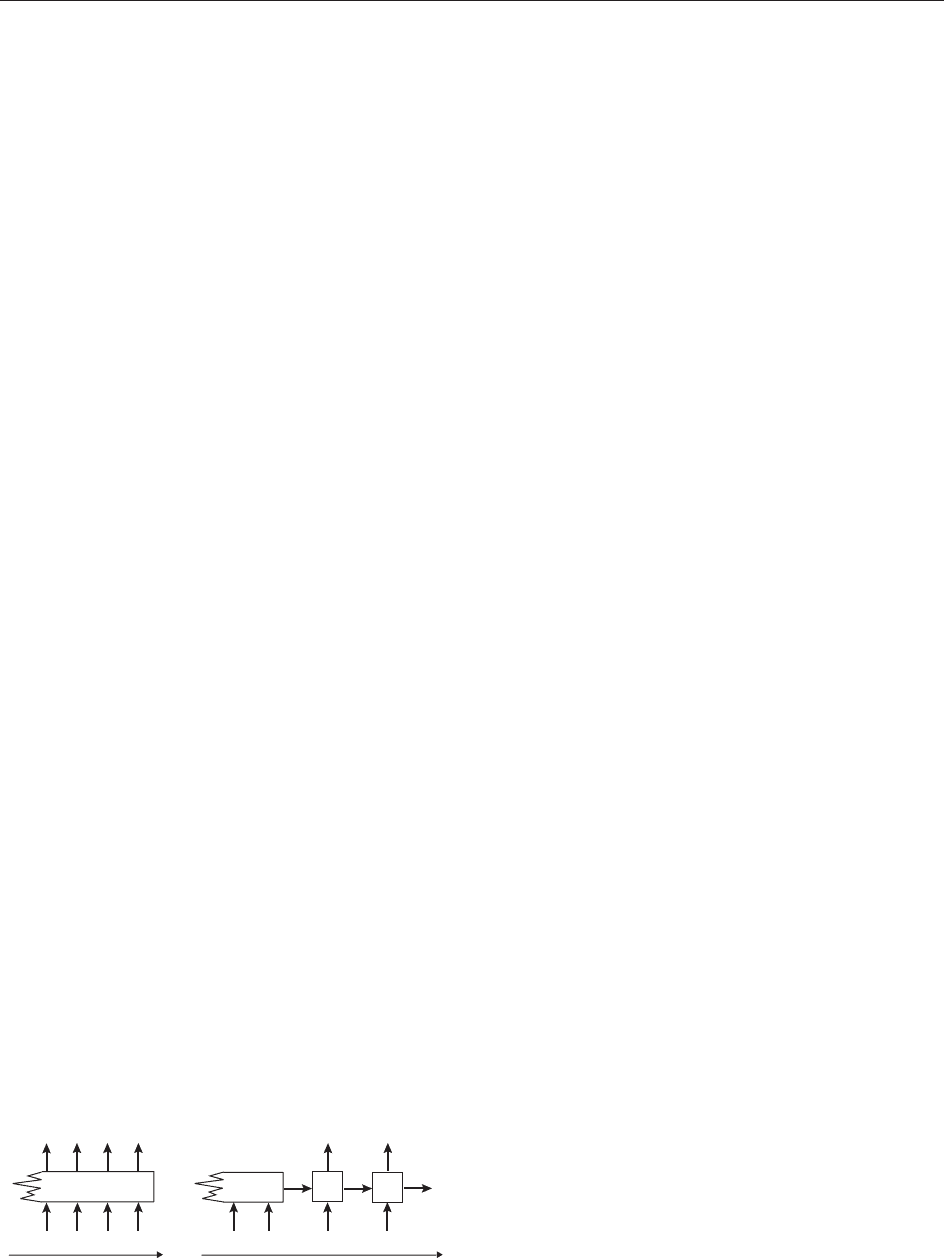
Quantum Channels with Memory
This article has so far been restricted to memory-
less quantum channels, i n which successive chan-
nel inputs are acted on i ndependently. Messages of
n symbols are then processed by the tensor
product channel T
n
,asinDe finition 1 and
illustrated in Figure 1. In many real-world applica-
tions, the assumption of having uncorrelated noise
cannot be justified, and memory e ffects need to be
taken into account. For a quantum channel T with
register input A and register output B, such effects
are conveniently modeled (Bowen and Mancini
2004) by introducing an additional memory
system M, so t hat now T : MA!BM is a
completely positive and trace-pre serving map with
two input systems and two output systems. Long
messages with n signal states will then be
processed by the concatenated channel
T
n
: MA
n
!B
n
M. In such a concatenation,
the memory system is passed on from one channel
application to the next, and thus introduces
(classical or quantum) correlations between con-
secutive register inputs.
Remarkably, this relatively simple model can be
shown (Kretschmann and Werner 2005) to encom-
pass every reasonable physical process: every sta-
tionary channel S : A
1
!B
1
which turns an infinite
string of input states (on the quasilocal algebra A
1
)
into an infinite string of output states on B
1
and
satisfies the causality constraint is in fact a con-
catenated memory channel. Causality here means
that the outputs of the stationary channel S at given
time t
0
do not depend on inputs at times t > t
0
.
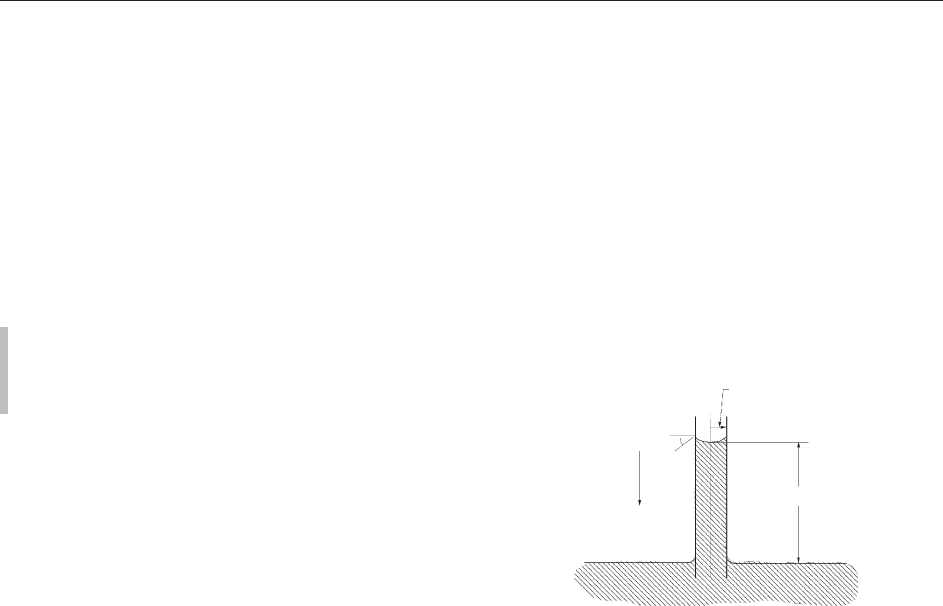
Figure 2 illustrates the structure theorem for causal
stationary qua ntum channels. In general, it produces
not only the memory channel T with memory
algebra M, but also a map R describing the
influence of input states in the remote past.
Intuitively, such a map is often not needed, because
memory effects decrease in time: the memory
channel T is called forgetful if outputs at a large
time t depend only weakly on the memory initializa-
tion at time zero. In fact, memory effects can be
shown to die out even exponentially. The set of
these channels is open and dense in the set of
quantum memory channels. Hence, generic memory
channels are forgetful.
The capacity of memory channels is defined in
complete analogy to the memoryless case, replacing
the n-fold tensor product T
n
in Definition 1 by
the n-fold concatenation T
n
. The coding theorems
for (private) classical and quantum information
can then be extended from the memoryless case
to the very important clas s of forgetful channels
(Kretschmann and Werner 2005).
Nonforgetful channels call for universal coding
schemes, which apply irrespec tive of the initializa-
tion of the input memory. Such schemes are
presently known only for very special cases.
Acknowledgmnts
The author thanks the members of the quantum
information group at TU Braunschweig for their
careful reading of the manuscript and many helpful
suggestions. He also gratefully acknowledges the
funding from Deutsche Forschung sgemeinschaft
(DFG).
See also: Capacities Enhanced by Entanglement;
Channels in Quantum Information Theory; Entanglement;
Positive Maps on C
-Algebras; Quantum Channels:
Classical Capacity; Quantum Error Correction and Fault
Tolerance; Source Coding in Quantum Information Theory.
Further Reading
Barnum H, Nielsen MA, and Schumacher B (1998) Information
transmission through a noisy quantum channel. Physical
Review A 57: 4153 (quant-ph/9702049).
Bennett CH, Devetak I, Shor PW, and Smolin JA (2004)
Inequalities and separations among assisted capacities of
quantum channels, quant-ph/0406086.
Bennett CH, DiVincenzo DP, Smolin JA, and Wootters WK
(1996) Mixed-state entanglement and quantum error correc-
tion. Physical Review A 54: 3824 (quant-ph/9604024).
Bowen G and Mancini S (2004) Quantum channels with a finite
memory. Physical Review A 69: 012306 (quant-ph/0305010).
Devetak I (2005) The private classical information capacity and
quantum information capacity of a quantum channel. IEEE
Transactions on Information Theory 51: 44 (quant-ph/0304127).
Devetak I, Harrow AW, and Winter A (2004) A family of
quantum protocols. Physical Review Letters 93: 230504
(quant-ph/0308044).
Devetak I and Winter A (2004) Relating quantum privacy and
quantum coherence: an operational approach. Physical
Review Letters 93: 080501 (quant-ph/0307053).
DiVincenzo DP, Shor PW, and Smolin JA (1998) Quantum
channel capacities of very noisy channels. Physical Review A
57: 830 (quant-ph/9706061).
Eisert J and Wolf MM Gaussian quantum channels. In Cerf N,
Leuchs G, and Polzik E (eds.) Quantum Information with
SR=
T
T
tr tr
tr
Time Time
Figure 2 By the structure theorem, a causal automaton S can
be decomposed into a chain of concatenated memory channels
T plus some input initializer R. Evaluation with the partial trace tr
means that the corresponding output is ignored.
430 Capacity for Quantum Information
Continuous Variables of Atoms and Light. London: Imperial
College Press (in preparation)(quant-ph/0505151).
Holevo AS and Werner RF (2001) Evaluating capacities of
bosonic Gaussian channels. Physical Review A 63: 032312
(quant-ph/9912067).
Horodecki M, Horodecki P, and Horodecki R (1999) General
teleportation channel, singlet fraction, and quasidistillation.
Physical Review A 60: 1888 (quant-ph/9807091).
Horodecki P and Nowakowski ML (2005) Simple test for
quantum channel capacity, quant-ph/0503070.
Horodecki K, Pankowski L, Horodecki M, and Horodecki P
(2005) Low dimensional bound entanglement with one-way
distillable cryptographic key, quant-ph/0506203.
Kretschmann D and Werner RF (2004) Tema con variazioni:
quantum channel capacity. New Journal of Physics 6: 26
(quant-ph/0311037).
Kretschmann D and Werner RF (2005) Quantum channels with
memory. Physical Review A 72: 062323 (quant-ph/0502106).
Shor PW (2003) Capacities of quantum channels and how to find
them. Mathematical Programming 97: 311 (quant-ph/0304102).
Capillary Surfaces
R Finn, Stanford University, Stanford, CA, USA
ª 2006 Elsevier Ltd. All rights reserved.
Historical and Conceptual Background
A capillary surface is the interface separating two
fluids that lie adjacent to each other and do not mix.
Examples of such surfaces are the upper surface of
liquid pa rtially filling a vertical cylinder (capillary
tube), the surface of a liquid drop resting in
equilibrium on a tabletop (sessile drop) and the
surface of a liquid drop hanging from a ceiling
(pendent drop); further instances are the surface of a
falling raindrop, the bounding surface of the liquid
in the fuel tank of a spaceship, and the interface
formed by a fluid mass rotating within another fluid.
This last example extends to the problem of rotating
stars.
Interfaces separating fluids and solids share some
of the physical attributes of capillary surfaces, and
the study of wetted portions of rigid ‘‘support
surfaces’’ becomes essential for describing global
behavior of capillary configurations. However, some
significant distinctions appear that change the
formal structure of the problems, and must be
accounted for in the theory.
Phenomena governed by capillarity pervade all of
daily life, and most are so familiar as to escape
special notice. By contrast, throughout the eigh-
teenth century and presumably earlier, great atten-
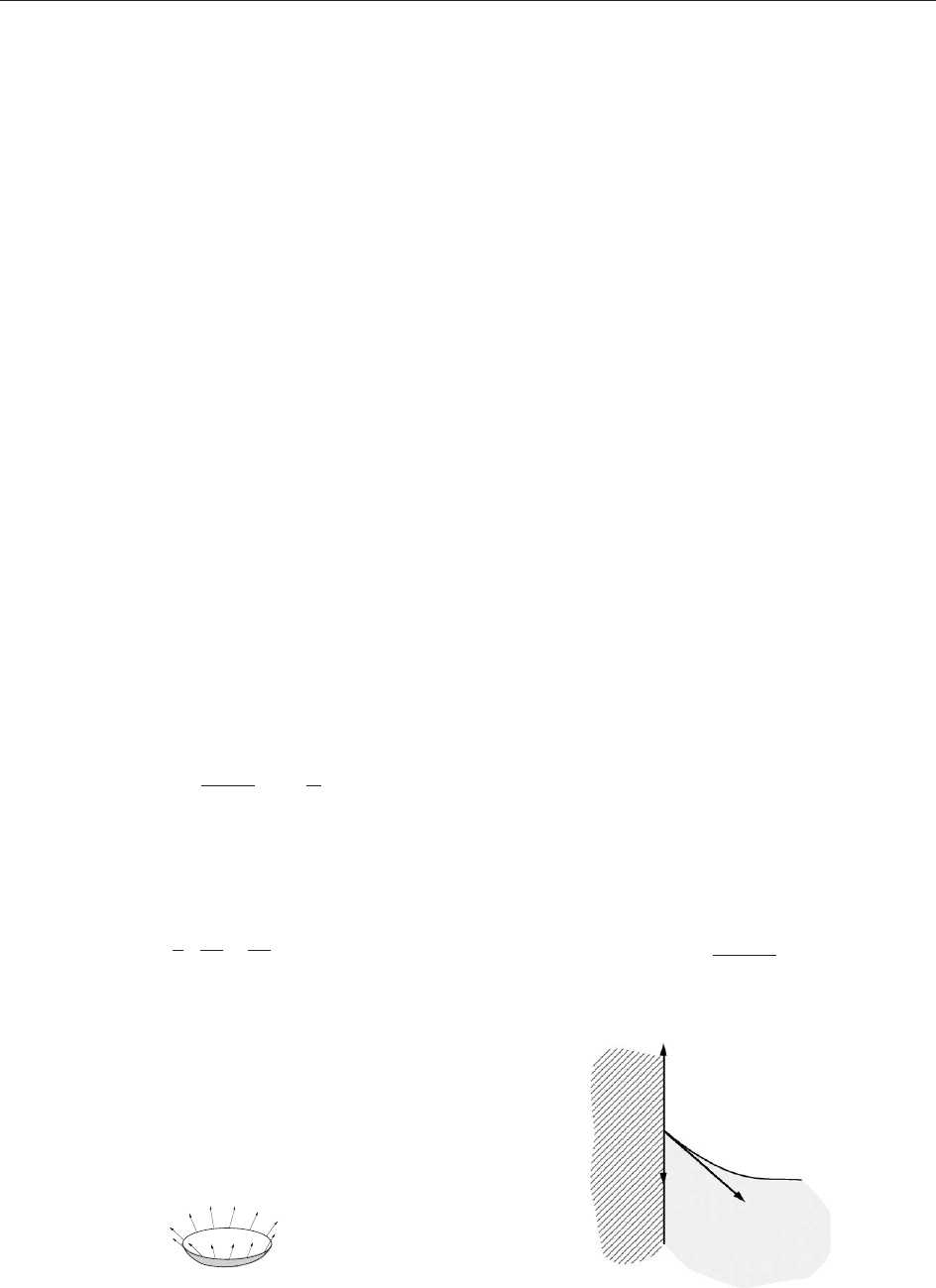
tion centered on the rise of liquid in a narrow glass
circular-cylindrical tube dipped vertically into a
liquid reservoir (Figure 1); this striking event had a
dramatic impact that confounded intuition. Clarifi-
cation of the behavior became one of the major
problems challenging the scientific world of the
time, and was not achie ved during that period. The
term ‘‘capillary,’’ adapted from the Latin ‘‘capillus’’
for hair, was applied to the phenomenon since it was
observed only for tubes with very fine openings; the
more general usage adopted in the definition above
derives from the recognition of a class of phenomena
with a common physical basis.
The first recorded observations concerning
capillarity seem due to Aristoteles c. 350
BC.He
wrote that ‘‘a broad flat body, even of heavy
material, w ill float on water, however a narrow
thin one such as a needle will always sink.’’ Any
reader with access to a needle and a glass of water
will have little difficulty refuting the assertion.
Remarkably, the error in reasoning seems not to
have been pointed out for almost 2000 years,
when Galileo addressed the problem in his
Discorsi, about 1600. The only substantive studies
till that time are apparently those of Leonardo da
Vinci a hundred years earlier. Leonardo intro-
duced reasoning close in spirit to that of current
literature; however, the Calculus was not available
to him, and he was not in a position t o develop his
ideas in quantitative ways.
Young’s Contribution
The later discovery of the Calculus pr ovided a
driving impetus guiding many new studies during
the eighteenth century. But despite the enormity of
that wea pon, it did not on its own suffice, and initial
quantitative success had to await two initiatives
g
a
u
0
γ
Figure 1 Capillary tube in infinite reservoir, in downward
gravity field.
Capillary Surfaces 431
taken by Thomas Young in 1805. Young based his
studies on the concept of surface tension that had
been introduced by von Segner half a century earlier.
Segner hypothesized that every curve on a fluid/fluid
interface S experiences on both its sides an orthogo-
nal force per unit length, which (for given
temperature) depends only on the materials and is
directed into the tangent planes on the respective
sides. The presence of such forces can be indicated
by simple experiments. They become clearly evident
in the case of thin (soap) films spanning a frame, in
which case there is an easily observed orthogonal
pull on the frame, see the section ‘‘Du al inte rpreta-
tion of : distincti on be tween fluids and solids.’’
Young made two basic conceptual contributions
(Y1, Y2):
Y1. Relation of pressure jump across a free interface
to mean curvature and surface tensi on.
Consider a piec e of surface S in the shape of a
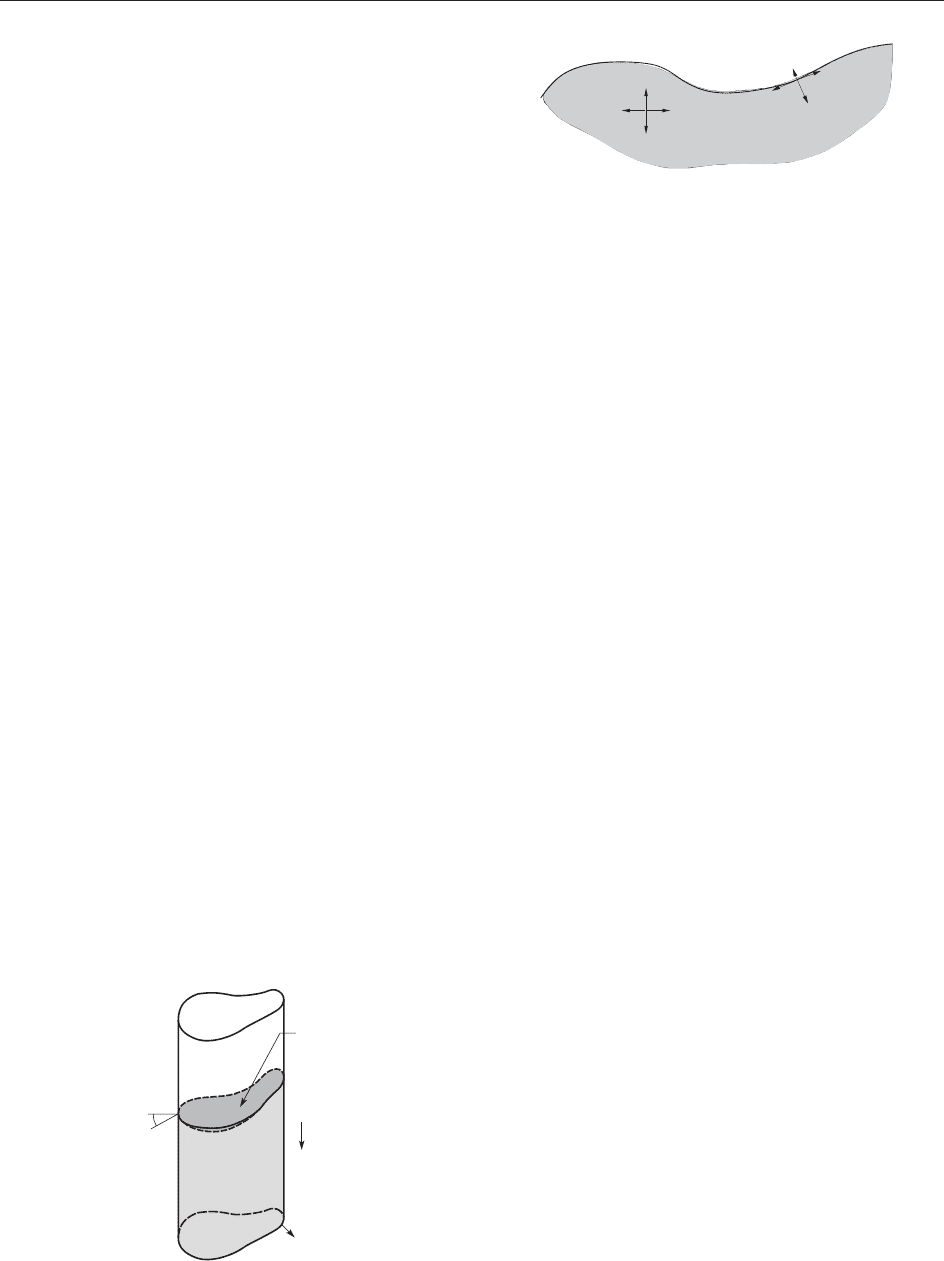
spherical bowl of radius R, separating two immisci-
ble fluid media, as in Figure 2. In equilibrium, any
pressure difference p across S must be balanced by
a tension on its rim .IfS projects to a disk of
(small) radius r on the plane tangent to S at the
symmetry point, we are led to
r
2
p ’ 2r sin # ½1
where # is inclination of S at the rim, relative to the
plane. We thus find at the base point
p ¼ 2
d sin #
dr
¼ 2
1
R
½2
Young then went on to consider a general S, without
symmetry hypothesis. Letting 1=R
1
,1=R
2
denote the
planar curvatures at a point in S of two normal
sections in orthogonal directions, he asserted that
p ¼ 2
1
2
1
R
1
þ
1
R
2
2H ½3
where H is the mean curvature of S at the point.
Although Young provided no formal justification for
this step, we can establish it with the aid of a general
formula from differential geometry that was not
known in his lifetime:
Z
S
2HN dS ¼
I
r
n ds ½4
where N is a unit normal on S, and n is unit
conormal (as indicated in Figure 2)on. Multi-
plying both sides of [4] by , the right-hand side
becomes the net surface tension force on S. Since
that must equal the net balancing pressure force, we
obtain
Z
S
p 2HðÞN dS ¼ 0 ½5
Letting the diameter of S tend to zero, the assertion
follows.
We emphasize here the im plicit assumption above,
that is a constant depending only on the particular
materials, and not on the shape of S. This author
knows of no source in which that is clearly
established, although experiments and experience
provide some a posteriori justification. See the
further comments under Y2, and later in sections
‘‘Gauss’ contribu tion: the energy method ’’ an d
‘‘Dual interpre tation of : distinc tion between fluids
and solids. ’’
Y2. The capillary contact angle .
Young asserted that there are surface t ensions for
solid/fluid interfaces analogous to those just intro-
duced, and again depending only on the materials.
This assertion is erroneous, as was s uggested in
writings of Bikerman and of others, and more
recently established in a definitive example by Finn.
Using his premise, Young attempted to characterize
the contact angle made by the fluid surface with a
rigid boundary, by requiring that the net tangential
component of the three surface tension vectors
vanish at the triple interface; this leads to t he often
employed but incorrect ‘‘Young diagram,’’ see
Figure 3,andtherelation
cos ¼
1
2
0
½6
p
1
p
2
σ
n
Figure 2 Pressure change across fluid element, balanced by
surface tension.
Liquid
Gas
Solid
σ
0
σ
1
σ
2
γ
Figure 3 Young diagram; balance of tangential forces.
Residual normal force remains.
432 Capillary Surfaces

for cos in terms of the magnitudes of the three
‘‘surface tensions.’ ’ Young concluded that the
contact angle depends only on the materials, and
in no other way on the conditions of the problem.
This basic assertion is by a fortuitous acciden t
correct, as follows from the contribution by
Gauss described below; it underlies all modern
theory.
Using Y1 and Y2, Young produced the first
verifiable prediction for the rise height u
0
in
the circular capillary tube of Figure 1.He
assumed the interface to be spherical, so that H
is constant and a = cos =H. He assumed vanish-
ing outside pressure. According to classic laws of
hydrostatics, p = gu
0
= 2H by Y1, where is
fluid density; there follows the c elebrated re la-
tion, presented entirely in words in his 1805
article:
u
0
2 cos
a
;¼
g
½7
Young scorned the mathematical method, and
made a point of deriving and publishing his
results on capillarity without use of any mathe-
matical symbols. This personal idiosyncrasy
causes his publications to be something of a
challenge to read.
The Laplace Contribution
In 1806, Laplace published the first analytical expres-
sion for the mean curvature of a surface u(x, y), and
showed that the expression can be written as a
divergence. He obtained the equation
div Tu 2H; Tu
ru
ffiffiffiffiffiffiffiffiffiffiffiffiffiffiffiffiffiffiffiffi
1 þru
jj
2
q
½8
Thus, if H is known from geometrical or physical
considerations, as it is for the capillary tube in
the example just considered, one finds a second-
order (nonlinear) equation for the surface height
of any solution as a graph. The equation is
elliptic for any function u(x, y)insertedintothe
coefficients, however not uniformly so; the parti-
cular nonuniformity leads to some striking and
unusual behavior of its solutions, as we shall see.
With the aid of [8], Laplace improved the Young
estimate [7] to
u
0
2 cos
a
1
cos
2
3
1 sin
3
cos
3
!"#
a ½9
Both Young and Laplace proposed their for-
mulas for ‘‘narrow tubes’’, but neither gave any
quantitative indication of what ‘‘narrow’’ should
signify. No te that whenever 0 <=2, [9]
becomes negative when the nondimensional Bond
Number B = a
2
exceeds 8; since u is known to be
positive in the indicated r ange for , [9] provides
no information in that case, whereas [7] is still of
some value. Nevertheless, [9] is asymptotically
exact a nd consists of the first two terms of the
formal expansion in powers of a;thatwasfirst
proved by D Siegel in 1980, almost 200 years
following the discovery of the formulas. In 1968,
P Concus extended the formal expansion for the
height to the entire traverse 0 < r < a. F Brulois
(1981) and independently E Miersemann (1994)
proved the expansion to be a symptotic to every
order. Explicit bounds for the rise height above
and below, making quantitative the notion of
‘‘narrow,’’ were obtained by Finn.
Laplace supplied the first detailed mathematical
investigations into the behavi or of capillary surfaces,
applying his ideas to many specific exampl es. His
underlying motivation apparently derived at least
partly from astronomical problems, and he pub-
lished his contributions in two ‘‘Supple´ments’’ to the
tenth volume of his Me´canique Ce´leste.
Gauss’ Contribution: The Energy Method
Young and Laplace both based their reasonings
on force-balance arguments, which at best were
unclear and at worst conceptually wrong. In
1830, Gauss took up the problem anew from a
variational point of view, using the Johann
Bernoulli principle of virtual work. To do so, he
attempted to characterize both surface energies
and bulk fluid energies in terms of postulated
particle attrac tions a nd repul sions. In an aston-
ishing 30 pages, he essentially introduced founda-
tions of modern potential theory, of measure
theory, and of thermodynamics. He ended up
with elaborate e xpressions that could not readily
be applied, and which at least to some extent he
did not use. He asserted, for example, that the
bulk internal energy would be propor tional to
volume, which for an incompressible fluid is
constant under admissible deforma tions, and o n
that basis he ignored the bulk energy term
completely. His procedures then led him, in an
independent and more convincing way, to the
identical equation and boundary condition that
had been produced by his predecessors. It must,
of course, be remarked that his justification for
ignoring the bulk energy term would not b e
correct for a compressible liquid (see the section
‘‘Com pressibility’’), a nd it is open to some
Capillary Surfaces 433
question for the central m otivating problem of a
capillary tube dipped into an infinite liquid bath,
in which eve nt there is no volume cons traint.
The material that follows is guided by the ideas of
Gauss; however, I have found it advantageous to
replace his elaborate hypotheses on particle attrac-
tions and repulsions by a simpler phenomenological
reasoning as to the nature of the energy terms to be
expected.
To fix ideas, we consider a semi-infinite cylinder
of general section and of homogeneous material,
closed at the bottom, situated vertically in a down-
ward gravity field g per unit mass, and partly filled
with an incompressible liquid of density covering
the bottom (a more exact discussion, taking account
of compressibility, is indicated below in the section
‘‘Compr essib ility’’). We assume an equilibr ium fluid
configuration with the liquid bounded abov e by an
ideally thin interfa ce S : u(x, y) (see Figure 4). We
distinguish the energy terms that occur:
1. Surface energy. This is the energy required to
create the surface interface S. We can characterize it
by noting that fluid particles within or exterior to the
liquid are attracted equally to neighboring particles in
all directions; however, at the surface S there is a
differential attraction, to particles of the exterior
medium (such as air) above, or to the liquid below
(see Figure 5). Thus, particles in the interface are
pulled orthogonally to S. In general, for a liquid–gas
interface, significant work will be done only on the
liquid and those particles will be pulled toward the
liquid; otherwise, the liquid would evaporate across
the interface and disappear. The work done in that
(infinitesimal) motion is proportional to the area of S,
so that for the surface energy E
S
we obtain
E
S
¼
Z
ffiffiffiffiffiffiffiffiffiffiffiffiffiffiffiffiffiffiffiffi
1 þru
jj
2
q
dx ½10
The constant has the dimensions of force per unit
length, and turns out to be the surface tension of the
interface. We note from [10] its dual interpretation
as areal energy density on S, arising from formation
of that surface. This alternative interpretation lends
conceptual support to the supposition that is
consta nt on S. See the sect ion ‘‘Dual interpre tation
of : dist inction be tween fluids and solids.’’
Implicit in the above discussion are deep
premises about the nature of the forces acting
within the fluid. Essentially these forces must be
perceptible only at infinitesimal distances, and
grow rapidly with decreasing distance. Forces
both of attraction and of repulsion must be
present. The recognition of the need for such
forces can be traced back to Newton. Quantita-
tive postulates as to their precise nature were
introduced by van der Waals in the late nine-
teenth century, and the topic remains stil l in
active study. Since these forces appear at mole-
cular distance levels, their introduction leads
inevitably to questions of statistical mechanics.
Additionally, our discussion of work done in
forming the surface implicitly assumes a compres-
sible transition layer there, in conflict with our
treatment of S as an ideally thin interface
bounding an incompressible fluid. In these senses,
it is striking that [10] – which is in accord w ith
classical constructi ons – could be obtained via
global qualitative postulates concerning a con-
tinuum in static equilibrium, in which the specific
nature of the forces is not introduced.
Rayleigh me asured the thic kness of the surface
interface between water and air t o be of mole-
cular size, thus providing experimental justifica-
tion for the procedure adopted.
2. Wetting energy. A similar discussion applies at
the interface separa ting the liquid and solid at the
cylinder walls; however, this time the net attraction
can be in either direction, as particles from neither
medium can migrate significantly into the other. For
the wetting energy E
W
, we write, with the
boundary of ,
E
W
¼
I
u ds ½11
γ
Σ
ν
Ω
g
S
Figure 4 Liquid in cylindrical capillary tube, of general section .
Reproduced with permission from the American Institute of
Aeronautics and Astronautics.
.
.
1
2
S
Figure 5 Attractions on a fluid element: (1) interior to the fluid;
(2) on the surface interface.
434 Capillary Surfaces