
Francoise J.-P., Naber G.L., Tsun T.S. (editors) Encyclopedia of Mathematical Physics
Подождите немного. Документ загружается.


We designate as the relative adhesion coefficient of
the liquid–gas–solid configuration. We assume that
the cylinder walls are of homogeneous material, so
that will be constant. In general, is a difference of
factors that apply on the walls at the two interfaces,
with the liquid and with the external medium.
3. Gravitational energy. The work done in
lifting an amount of liquid h against the
gravity field from the base level to a height h in a
vertical tube of small section is ghh . Thus,
the work done in filling that tube up to the
surface height u is (gu
2
=2),andthetotal
gravitational energy is
E
G
¼
g
2
Z
u
2
dx ½12
4. Volume constraint. In the configuration con-
sidered the volume is to be unvaried during
admissible deformations; we take account of the
constraint by introducing a Lagrange parameter ,
and an additional ‘‘energy’’ term
E
V
¼
Z
u dx ½13
According to the principle of virtual work, the
sum E of the above energies must remain unvaried
in any deformation that respects all mechanical
constraints other than the volume constraint. We
choose a deformation u !u þ ", with smooth in
the closure of , which determines a functional E(").
From E
0
(0) = 0 follows
Z
r
ru
ffiffiffiffiffiffiffiffiffiffiffiffiffiffiffiffiffiffiffiffi
1 þru
jj
2
q
þ u þ ðÞ
8
>
<
>
:
9
>
=
>
;
dx
I
ds ¼ 0 ½14
from which
Z
div Tu þ u þ ðÞ
dx
þ
I
Tu ðÞds ¼ 0 ½15
with Tu ru=
ffiffiffiffiffiffiffiffiffiffiffiffiffiffiffiffiffiffiffiffi
1 þru
jj
2
q
, and with the unit
exterior normal on . Choosing first to have
compact support in , the boundary term vanishes,
and the ‘‘fundamental lemma’’ of the calculus of
variations yields
div Tu ¼ u þ ; ¼ g= ½16
throughout . Thus, the area integral in [15]
vanishes for any . We are therefore free to choose
as we wish on the boundary, and the fundamental
lemma now yields Tu = on . We now note
that for any liquid surface u(x, y) there holds
Tu ¼ cos ½17
on , where is the angle between the cylinder wall
and the surface S, measured within the liquid. Since
is assumed to be constant, that is so also for .Itis
a physical constant: the contact angle, that must be
measured in an independent experiment, and cannot
be prescribed in advance or calculated within the
scope of the theory.
The constant , original ly introduced as a general
proportionality constant, is now characterized as
= cos . We thus see that a physical surface of the
form envisaged is possible only if 1 1.
Physically, one expects that if <1 the liquid
will separate from the walls, while, if >1, the
liquid will spread over the walls as a thin film.
Equation [16]
and boundary condition [17]
provide a nonlinear second-order equation that is
elliptic for any function u(x, y), and also a non-
linear transversality condition on the boundary, for
determining the surface interface S. The expression
div Tu is exactly twice the mean curvature of the
surface S.If 6¼ 0then can be eliminated by
addition of a constant to u. The problem [16]–[17]
for the fluid in a vertical cylindrical capillary tube
of general section becomes thus a geometrical one:
to find a surface whose mean curvature is a
prescribed function of position in space, and
which meets the cylindrical boundary walls in a
prescribed angle .
In the absence of gravity, [16] takes the form
div Tu ¼ 2H ½18
for a surface of constant mean curvature H. The
constant H is determined by integrating [18] over ,
and using [17]:
2H ¼
jj
cos
jj
½19
where
jj
and
jj
denote the respective perimeter
and area, and thus H is independent of volume.
From the known uniqueness up to an additive
constant of the solutions of [18], [17] it fol lows
that the shape of the solution surface is indepen-
dent of volume. That result holds also for [16], [17]
in view of the possibility to eli minate from the
equation by addition of a constant, and the
uniqueness of the solutions of the resulting
equation.
Equations [16]–[17] or [18]–[17] are appropriate
for determining capillary surfaces that are graphs
Capillary Surfaces 435
u(x, y) over a base domain . More generally, any
surface S in 3-space satisfies the equation
x ¼ 2HN ½20
where H is its scalar mean curvature and N is a unit
normal vector on S. Here is the ‘‘intrinsic
Laplacian’’ in the metric of S. This is the appropriate
relation to be applied in situations for which the
physical surface folds over itself and cannot be
expressed globally as a graph. The formal simplicity
of [20] is deceptive; the challenges arising from the
nonlinearity in the equation can be formidable, and
very little general theory is as yet availab le.
Dual Interpretation of : Distinction between
Fluids and Solids
We have already remarked the duality in connection
with eqn [10] above. It can be made explicit with a
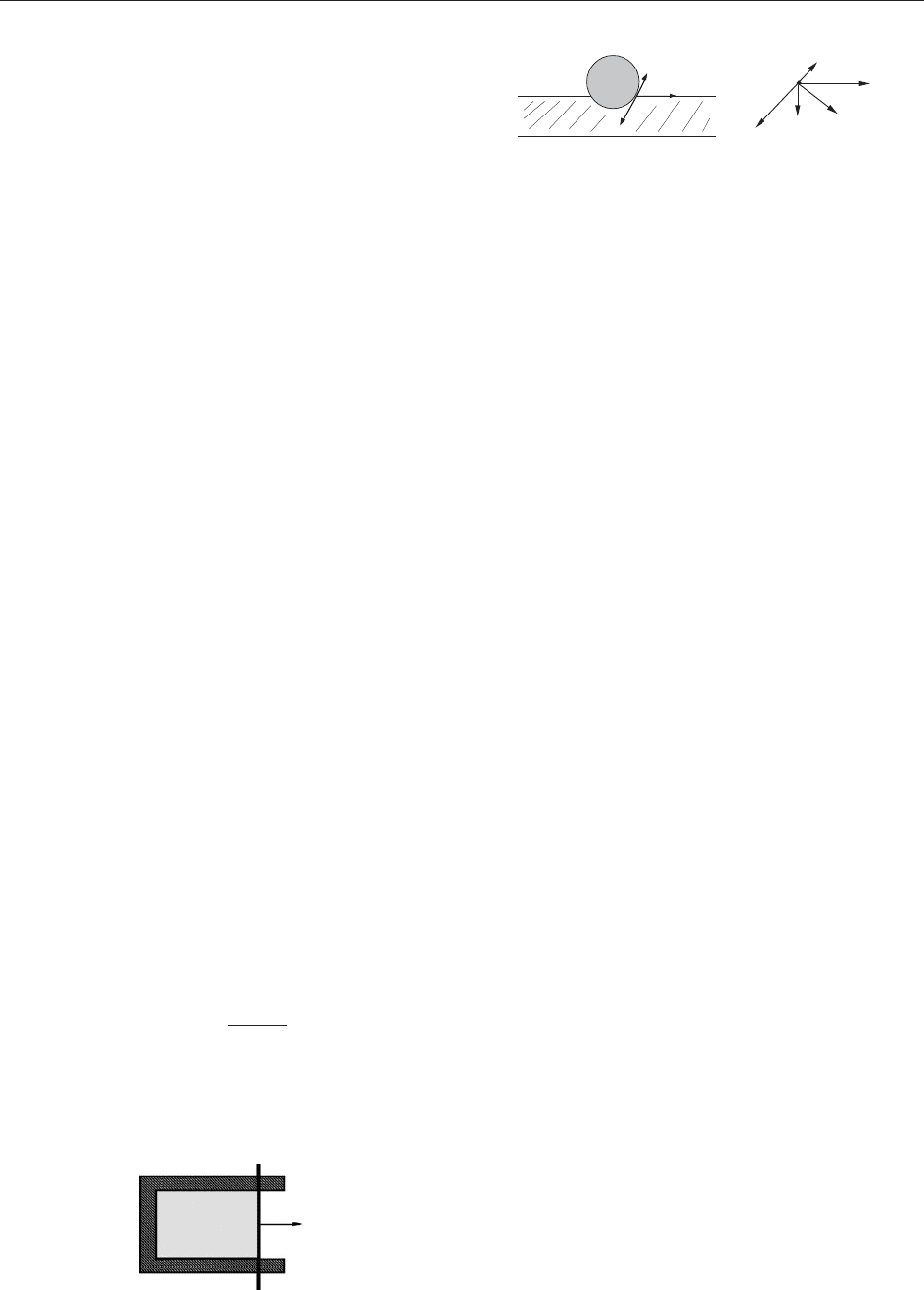
simple experiment proposed by Dupre´. One makes a
rigid frame with a sliding bar of length l,asin
Figure 6, and dips the frame into soap solution. On
lifting the frame from the solution the opening will
be filled with a soap film, and one finds a force
F = 2l on the bar, directed orthogonal to the bar
(the factor 2 appears since the film has two sides).
The work done in sliding the bar a distance x is
F = 2lx, which can also be written F = 2A
with A an element of area. In this sense, the two
interpretations of are formally equivalent, for
fluid/fluid interfaces.
The equivalence cannot be extended to solid/fluid
interfaces. Consider a rigid spherical ball of generic
material and radius R, freely floating in an infinite
liquid bath in a gravity-free environment, see
Figure 7a. It can be shown that the unique
symmetric solution to the problem is a horizontal
surface, as in the figure. A variational procedure as
above shows that if e
0
, e
1
, e
2
are the interfacial
energy densities associated with the three interfaces,
then
cos ¼
e
1
e
2
e
0
½21
in formal analogy with the Young relation [6]. But
e
1
, e
2
cannot be interpreted as interfacia l forces
whose net tangential component cancels that of e
0
.
To do so would lead to a net downward force
v
on
the ball (see Figure 7b), contradicting the supposed
equilibrium state.
Mathematical and Physical Predictions:
Experiments
In the following sections, we study the kinds of
behavior imposed on a surface S by the requirement
that it appear as solution of one of the indicated
equations and boundary conditions. Some of these
properties are quite surprising in the context of
classically expected behavior of solutions of equa-
tions of mathematical physics. The mathematical
predictions were, however, corroborated in certain
cases experimentally, as we disc uss below.
Uniqueness and Nonuniqueness
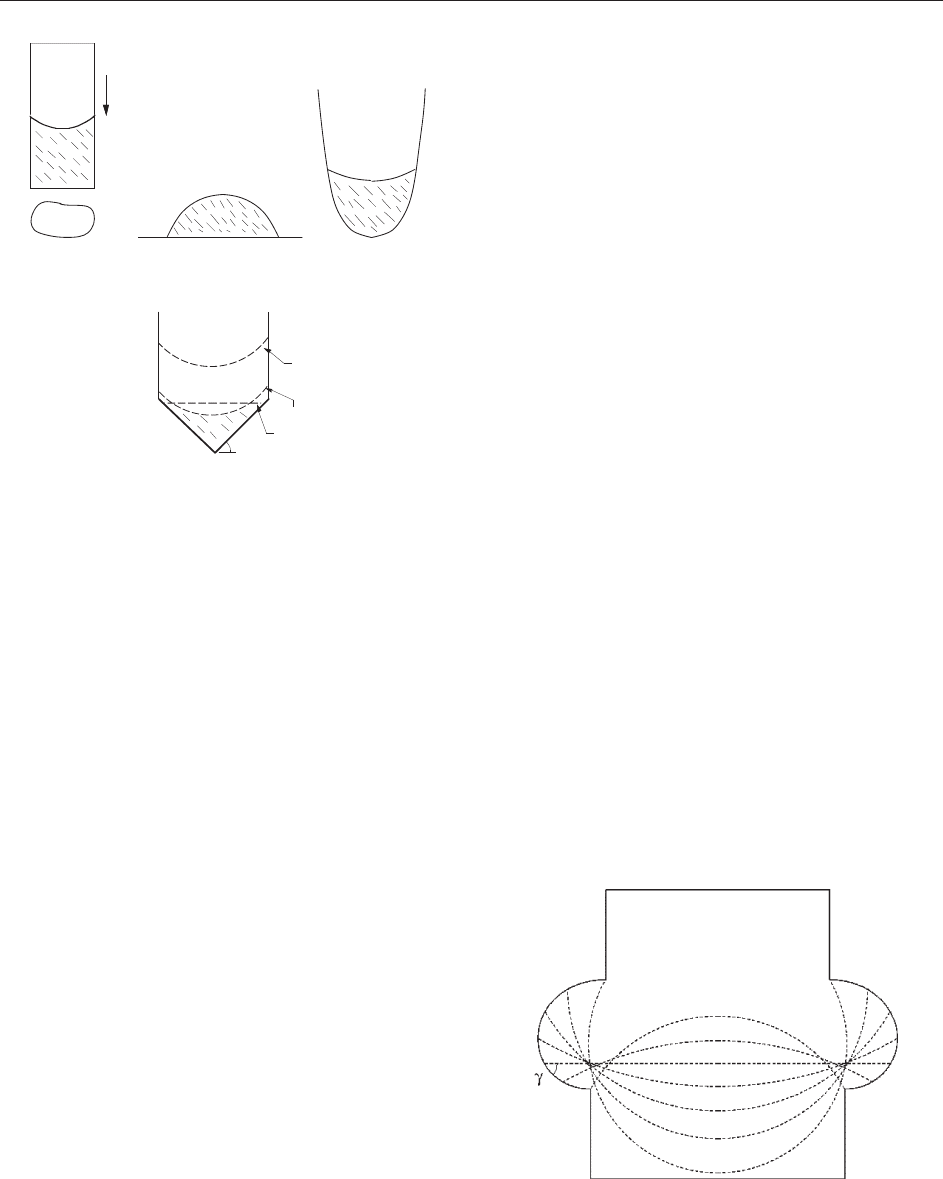
We begin by considering uniqueness questions. We
start with a semi-infini te capillary tube, closed at the
bottom, to be partially filled with a prescribe d
volume of (incompressible) liquid making contact
angle on the container walls (Figure 8a). If 0,
any solution is uniquely determined. That is a quite
general theorem, valid for a wide class of domains
including all piecewise smooth domains (at the
corners of which data of the form [17] cannot be
prescribed); formally, data can be omitted on any
boundary set of linear Hausdorff measure zero. In
this resul t, no growth conditions need be imposed
near the boundary (note that such a statement
would be false for solutions of the Laplace equation
under Dirichlet boundary conditions).
Next we consider a sessile liquid drop on a
horizontal plat e (Figure 8b). Again the solution is
uniquely determined by the volume and by ,
although the known proof differs greatly from that
of the other case.
We now consider a smooth deformation of the
base plane, depending on a parameter t, which
carries it into the cylinder; that can be done in such
a way that the supporting surface is at all times
‘‘bowl-shaped,’’ as in Figure 8c. Since the bowl
formation tends to restrict the possible deformations
F
Figure 6 Dupre
´
apparatus for exhibiting surface tension.
γ
σ
0
σ
2
σ
1
(a)
σ
0
σ
1
σ
2
σ
N
σ
V
(b)
Figure 7 (a) Floating spherical ball; presumed ‘‘Young’’ forces.
(b) Normal and vertical components of Young forces; contra-
diction to presumed equilibrium.
436 Capillary Surfaces
of the fluid consistent with smooth contact with the
supporting rigid surface, one might expect that
the corresponding capillary surface S(t), arising
from the identical fluid mass, will for each t be
uniquely determined.
That is however not true, even for symmetric
configurations. We can see that from the configuration
of Figure 8d, consisting of a vertical circular cylinder
whose base is a 45
cone. We assume a contact angle
= 45
and adjust the radius so that a horizontal
surface lying just below the cylinder/cone juncture
provides the prescribed volume. This is a formal
solution surface. Now fill the configuration with a
larger volume, so that the contact line will lie above the
juncture. The upper surface will no longer be flat, in
view of the 45
contact angle, and takes an appearance
as indicated in the figure. Finally, we decrease the fluid
volume, keeping all other parameters unchanged. As
noted above, the upper surface moves rigidly down-
ward, and it is clear that if the original surface is close
enough to the juncture line, then the prescribed volume
will be attained before the contact line reaches the
juncture. Thus, uniqueness fails.
In this construction as just described, the bounding
surface is not smooth; however, one sees easily that
the procedure continues to work if the edge and
vertex are smoothed locally. In fact, one can carry the
procedure to a striking conclusion; by appropriate
smoothing, one can construct a bounding surface
admitting an entire continuum of distinct solution
interfaces, all with the same contact angle and
enclosing the same fluid volume (Gulliver and
Hildebrandt; Finn). This can be done for any gravity
field. Figure 9 illustrates seven members of the family
of interfaces, in the particular case = 0.
The question immediately arises as to which if
any of the continuum of surfaces will be seen in
an experiment. In fact, it can be proved that none
of the indicated surfaces is mechanically stable
(Finn, Concus and Finn, Wente). Since the indicated
family includes all symmetric surfaces that are
stationary for the energy functional, we find that
any stable stationary c onfiguration must be asym-
metric. Thus, we have obtained an example of
symmetry breaking, in which all conditions of the
problem are symmetric, but for which all physically
acceptable solution s are asym metric.
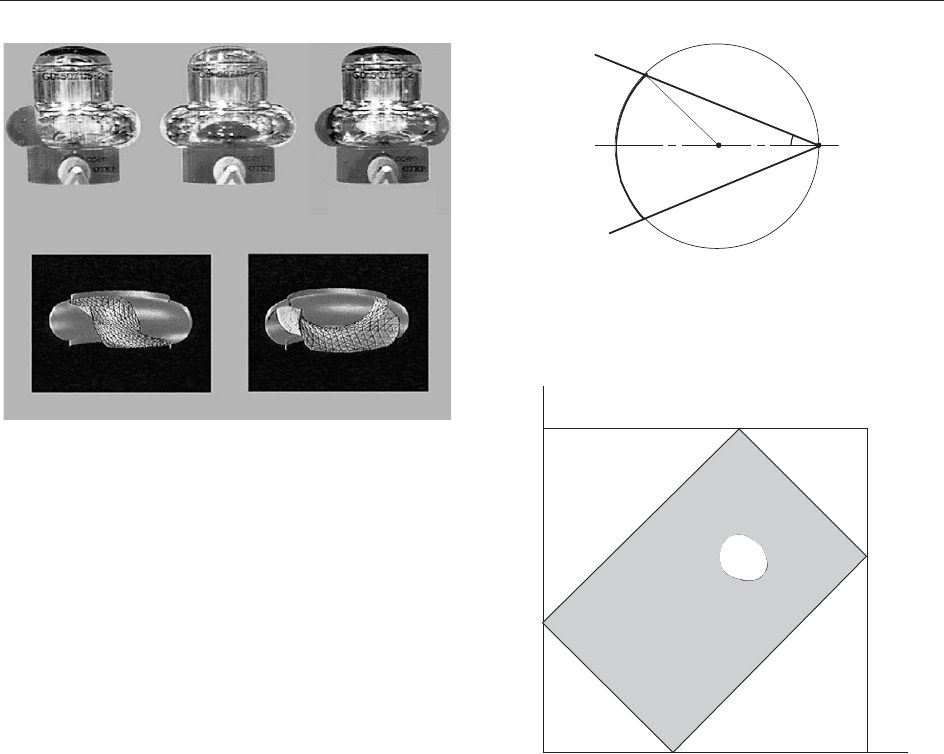
These results were subjected to computational test
by M Callahan using the Surface Evolver software,
to experimental test by M Weislogel in a drop
tower, and to experimental test by S Lucid in the
Mir Space Station. The results of the latter experi-
ment are compared in Figure 10 with the computer
calculations. In both cases, both a local minimizer
(potato chip) and a presumed global minimizer
(spoon) were observed.
The seven surface interfaces indicated in Figure 9
all provide the same sum of surface and wetting
energy, and bound the same volume of fluid. They
all satisfy an eqn [18] with constant H,in
accordance with hypotheses of incompressibility
and vanishing gravity. Thus, formally, all configura-
tions have ident ical mechanical energy. The surfaces
Figure 9 Seven spherical capillary interfaces in an ‘‘exotic’’
container of homogeneous material in zero gravity. All interfaces
bound the same volume and have the same sum of free surface
and wetting energies. If all pressures above the interfaces are the
same, then the pressures below them successively increase as the
curvature vectors of the vertical sections change from upwardly to
downwardly directed. Reproduced from Mathematics Intelligences
24(3) 2002 21–33 with permission from Springer-Verlag Heidelberg.
45°
45°
45°
(d)
45°
(a)
g
Ω
(b) (c)
Figure 8 Support configurations: (a) capillary tube, general
section; (b) horizontal plate; (c) convex surface appearing during
deformation of horizontal plate to capillary tube; and (d)
Nonuniqueness of configuration appearing during convex defor-
mation. Reproduced from Mathematics Intelligencer 24(3) 2002
21–33 with permission from Springer-Verlag Heidelberg.
Capillary Surfaces 437
are all spherical caps; however, the radii R of the
caps vary considerably. According to Y1 above, the
pressure change across each interface is p = 2=R.
Since one may assume the outer region to be a
vacuum with zero pressure for all caps, we find that
the pressures within the fluids vary greatly among
the configurations. One would thus expect that
work is done within the fluid in passing from one
configuration to another, a circumstance we have
excluded by hypothesis when determining the
family. From this point of view, the (customary)
hypothesis of incompressibility that was used in
determining the family is put into significant ques-
tion; we examine this point in some detail in the
section ‘‘Compr essibili ty.’’
Discontinuous Dependence I
Capillary surfaces can exh ibit striking discontinuous
dependence on the defining data. As initial example,
we consider the behavior of a solution of [18]–[17]
at a protruding corner point P of the domain of
definition. For simplicity, we assume the corner
bounded locally by straight segments , meeting in an
opening angle 2<, thus forming locally a wedge
domain. In anticipation of material to follow, we
assume contact angles
1
and
2
on the respective
sides, 0
1
,
2
. One can show that a necessary
condition for a solution surface over a domain
as
in Figure 11 to have a continuous normal vector up
to P is that the data point (
1
,
2
) lie in the closure of
the rectangle R of Figure 12. (This figure includes
also additional material anticipating the section
‘‘Drop s in wedg es’’).
For data points interior to R, this criterion also
suffices for the existence of at least one such solution
surface, for any prescribed H; such surfaces can in
fact be produced explicitly as spherical caps (planes
if H = 0). It remains to discuss what can occur with
data arising from the remaining four subregions of
the square.
If (
1
,
2
) 2 D
1
, then there is no solution to
[18]–[17] in any neighborhood of the corner point
P. On the other hand, an explicit solution for any
H > 0canbefoundasalowersphericalcapon
the segment
1
þ
2
= 2 that se parates D
þ
1
from R (see Figure 13, which indicates the
equatorial circle). Correspondingly, if H < 0then
an explicit solution can be found on the separation
line between D
1
and R.Thus,thereisa
Spoon (left)
Spoon (left)
Potato chip
Potato chip
Rotationally
symmetric
Figure 10 Symmetry breaking in exotic container, g = 0. Below:
calculated presumed global minimizer (spoon) and local minimizer
(potato chip). Above: experiment on Mir: symmetric insertion of fluid
(center); spoon (left); potato chip (right). This is a grayscale version
of a color figure reproduced from Journal of Fluid Mechanics,224:
383–94, (1991) with permission of Cambridge University Press.
P
α
Γ
Ω
δ
δ
Figure 11 Wedge domain. Reproduced from Finn R ‘‘Capillary
Surface Interfaces’’ in Notices of AMS 46 No.7 (1999) with
permission of the American Mathematical Society.
R
D
2
+
D
1
+
D
1
–
D
2
–
2α
0
0
(D)
γ
2
γ
1
π
π
(I
)
(No graph)
(No graph)
(Continuous)
Figure 12 Domain R of data yielding continuous normal to
capillary surface in wedge of opening 2a < p. The symbols D
and I are clarified in the section ‘‘Behavior at a corner point.’’
Reproduced from ‘‘Capillary Wedges Revisited’’ in SIAM J. Math.
Anal. 27 No.1 (1996) 56–69 with permission from SIAM.
438 Capillary Surfaces
discontinuous change in behavior in crossing from
R to eit her of the D
1
regions.
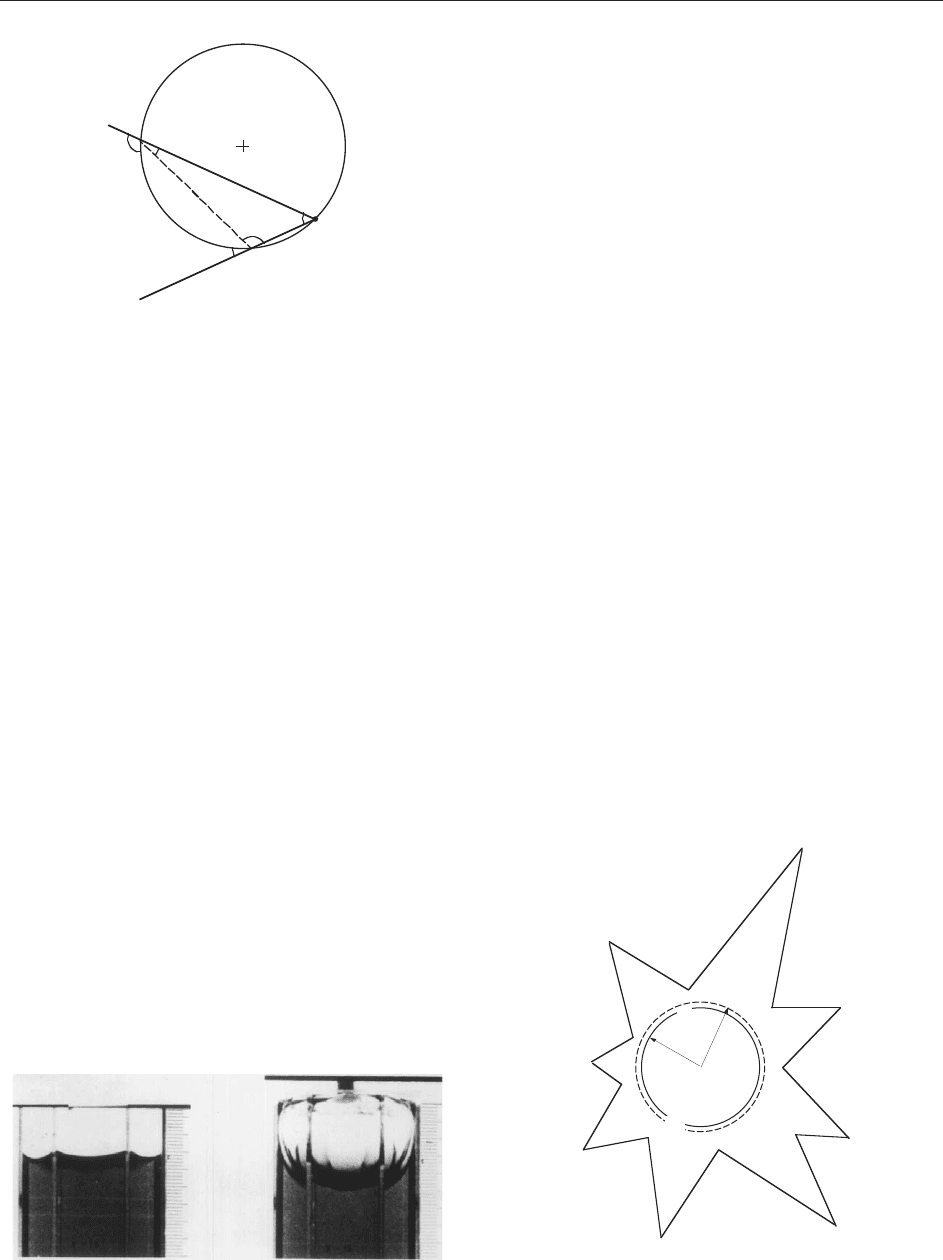
This behavior was put to experimental test by
W Masica, who considered the case 0 <
1
=
2
=
<=2 near the crossing point =
cr
with D
þ
1
, for
which þ
cr
= =2. He partially filled a regular
hexagonal cylinder of acrylic plastic, successively
with two different liq uids, making respective contact
angles greater or less than
cr
with the plastic. For
each liquid, Masica then allowed the cylinder to fall
in a 132 m drop tower. Figure 14 compares the two
configurations after about 5 s of free fall. In the case
>
cr
he obtained the spherical-cap solution,
which in this case covers the entire base domain
and appears as an explicit solution of [18]–[17].
When <
cr
, the liquid rose to the top of the
cylinder near the edges, filling out the edges over the
corner points. The surface interface S does not cover
, but instead folds back over itself, doubly covering
a portion of . Thus, a physical surface appears as it
must, but it is not a solution of [18] over .
Discontinuous Dependence II
About 1970, M Miranda raised informally the
question, whether a capillary tube Z
0
, whose section
0
lies strictly interior to a section
1
of a tube Z
1
,
will raise liquid from an infinite reservoir in a
downward directed gravity field to a higher level
over
0
than will Z
1
over that subdomain of its
section. That is true if both cylinders are circular,
and in the intervening years its correctness was
established in a number of other cases of particular
interest.
Finn and Kosmodem’yanskii, Jr. showed, how-
ever, by example that the assertion fails in a large
range of cases, and in fact can fail with arbitrarily
large height differences, uniformly over
0
. Beyond
that, the con struction exhibits a strikingly discontin-
uous change of behavior, under perturbations of a
disk as inner domain. Perhaps more remarkably, the
assertion can hold with the inner domain a disk, but
with discontinuous reversal of behavior as the disk is
perturbed to neighboring disks. That was shown in a
form of the example given later by Finn, and
illustrated in Figure 15. Here the outer domain
1
is polygonal , with sides that extend to be tangent to
a unit disk
0
, as indicated. The angle is to be
chosen so that 0 =2
min
, where
min
is the
smallest of the interior vertex half-angles of
1
.In
view of the assumed infinite fluid reservoir, there is
no volume constraint, and the governing equation
[16] takes the form
div Tu ¼ u;¼ g= > 0 ½22
Taking at first the inner domain to be
0
,itcan
be shown that for the corresponding solutions u
0
and u
1
of [22], the re hol ds u
0
> u
1
over
0
for
P
.
2α
γ
2
γ
1
γ
1
γ
2
Figure 13 Construction of solution as lower hemisphere; g
1
þ
g
2
= p 2a, H > 0. Reproduced from ‘‘Capillary Wedges Revis-
ited’’ in SIAM J. Math. Anal. 27 No.1 (1996) 56–69 with
permission from SIAM.
(a) (b)
Figure 14 Liquid in hexagonal cylinder, during free fall in drop
tower: (a) a þ g > p=2; (b) a þ g < p=2.
·
1 + ε
1
Ω
0
Ω
ε
Ω
1
Figure 15 Discontinuous reversal of limiting height behavior. All
sides of the polygonal domain
1
are tangent to the unit disk
0
.
For the corresponding solution heights u
0
in
0
, u
"
in the disk
"
of radius 1 þ e,andu
1
in
1
, there holds u
1
u
0
< 0, for any
downward gravity. But lim
!0
(u
1
u
"
) = þ1, for any e > 0.
Capillary Surfaces 439

any >0, and thus the Miranda question has a
positive answer for that configuration. But if we
replace
0
by a concentric disk
"
1
of radius
1 þ ",wefind
inf
"
u
1
x; ðÞsup
"
u
"
x;ðÞ
()
2"
1 þ "
cos
<
1 sin !
cos
þ 1 þ "ðÞ
1 sin
cos
½23
where ! = arccos(cos = sin ), and u
"
is the solution
of [22], [17] in
"
. Since does not appear on the
right side of [23], there follows in particular that for
any ">0, there holds
lim
!0
inf
"
u
1
x;ðÞsup
"
u
"
x;ðÞ
()
¼1 ½24
In particular, a negative answer to Miranda’s
question appears for all gravity sufficiently small.
But as observed above, a positive answer occurs in
0
, for any positive gravity. Thus, the limiting
behavior as !0 changes discon tinuously, as " !0.
We find that the two limiting procedures cannot be
interchanged: for any x 2
0
, we obtain
lim
"!0
lim
!0
u
1
x;ðÞu
"
x;ðÞ
¼þ1:
lim
!0
lim
"!0
u
1
x;ðÞu
"
x;ðÞ
const:<0
½25
Existence Questions I
For the general equation [20] there is an established
literature on existence of surfaces containing a
prescribed space curve. There is very little literature
relating to the capillarity boundary condition that
the solution surface S meet a prescribed ‘‘support’’
surface W in a prescribed an gle . The existence of
at least one such surface interior to a prescribed
sufficiently smooth closed space domain was proved
by Almgren, and then Taylor proved smoothness at
the contact curve. These are abstract theorems that
are basic for the theory but in general do not
provide specific information in particular cases of
interest.
Special interest atta ches to the nonparametric
cases [16] or [18] with boundary condition [17],
especially in view of the discontinuous behavior
properties described above. These cases were studied
in depth by a number of authors, with results that
put the above examples into some perspective.
M Emmer proved the existence of a unique
solution of [16]–[17] for any compact having
Lipschitz boundary with Lipschitz constant L such
that
ffiffiffiffiffiffiffiffiffiffiffiffiffiffi
1 þ L
2
p
cos <1 " for some ">0. Finn and
Gerhardt (F and G) extended this condition, and
showed in particular that solutions exist in general
in piecewise smooth . This result contrasts with the
zero-gravity case [18] discussed in the section
‘‘Exi stence questions II,’’ for which solutions fail to
exist when
ffiffiffiffiffiffiffiffiffiffiffiffiffiffi
1 þ L
2
p
cos >1 at a protruding corner
(see the section ‘‘Discon tinuous dep endence I’’).
However, in the cases
ffiffiffiffiffiffiffiffiffiffiffiffiffiffi
1 þ L
2
p
cos >1 studied
by F and G the solution u(x) is necessarily
unbounded in the corner. This condition is equiva-
lent to < =2jjat the corner. Concus and Finn
showed that if =2
jj
in a neighborhood
of a corner with rectilinear sides, as indicated in
Figure 11, then the solution u(x)satisfies
ux;ðÞ
jj
<
2
þ ½26
independent of , in the range considered. Here it
is assumed that [16] is normalized so that = 0;
when 6¼ 0 this can always be achieved by adding a
constant to u. On the other hand, if < =2
jj
,
then
ux;ðÞ
cos #
ffiffiffiffiffiffiffiffiffiffiffiffiffiffiffiffiffiffiffiffiffiffiffi
k
2
sin
2
#
p
kr
½27
where k = sin = cos and # is polar angle relative
to a bisector at the vertex; hence u becomes
unbounded as O(1=r). Thus, the behavior changes
discontinuously as the configuration for which
= =2
jj
is crossed.
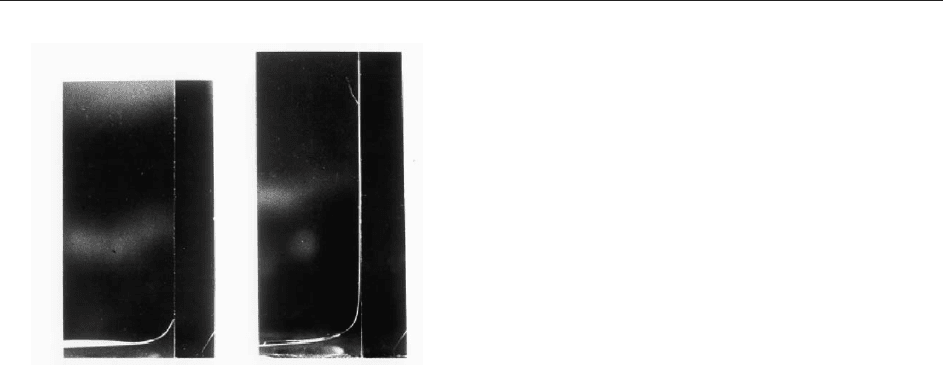
This prediction was corroborated by T Coburn in
a ‘‘kitchen sink’’ experiment in the Medical School
at Stanford University. Coburn formed a wedge
using two sheets of acrylic plastic, resting on a glass
plate, and inserted a drop of distilled water at the
base of the wedge. Initially, the wedge was opened
sufficiently that þ =2, and he obtained the
configuration of Figure 16a, with the maximum
height slightly lower than that indicated by [26].By
closing down the angle slightly, the liquid rose to
over ten times that height, as shown in Figure 16b.
This experiment was later repeated by Weislogel
under laboratory conditions; it incidentally estab-
lishes the contact angle of water and acrylic plastic
in the Earth’s atmosphere as 80
2
.
The indicated procedure provides in general a
very accurate way to measure contact angles, when
the angle is not far from =2. For near zero or in
the Earth’s gravity field, the disco ntinuity is con-
fined to a microscopic neighborhood of the vertex,
and can be difficult to observe. This technical
difficulty was addressed by Fischer and Finn, who
introduced ‘‘canonical proboscis’’ domains, the
theory of which was further developed by Finn and
440 Capillary Surfaces
Leise and by Finn and Marek. For such domains the
change in behavior is not strictly discontinuous, but
it is nearly so, and it extends over large portions of
the cylinder section, so that it is easily observable.
Concus, Finn, and Weislogel conducted space
experiments, demonstrating the feasibility of the
method as a means for measuring contact angles in
general ranges.
In [26]–[27] no growth conditions at the corner
are imposed; the estim ates hold for every solution
defined in
and assuming the prescribed data on
the side walls, with no data prescribed at the vertex.
The formula [27] is the initial term of a formal
asymptotic expansion of the solution, in powers of r.
Miersemann obtained the complete expansion,
asymptotic to every order, when < =2
jj
.He
obtained somewhat less complete information in the
bounded case [26].
Chen, Finn, and Miersemann provided a form of
[27] that is applicable for any data (
1
,
2
) on the
respective sides of the wedge, that arise from the D
1
regions of Figure 12. Lancaster and Siegel and
independently Chen, Finn, and Miersemann showed
that if 2
1
þ
2
2, then every solution
is bounded at the vertex. This result holds also for
the zero gravity eqn [18].
In the case of [18], Concus and Finn showed that
in the D
1
regions no solution exists, regardless of H.
Again, this result holds without growth conditions.
From these considerations and from remarks in
the section ‘‘Disconti nuous depend ence I’’ follo ws
that for data in D
2
, all solutions eith er of [18] or of
[16] are bounded but have discontinuous derivatives
at the vertex P. Extrapolating from the behavior of
particular computed solutions, Concus and Finn
conjectured that all solutions of [18] or of [16] that
arise from data in D
2
are discontinuous at P.A
number of attempts to prove or to disprove this
conjecture have till now been unsu ccessful.
An existence theorem for [16]–[17] alternative to
that of Emmer was obtained independently by
Ural’tseva, using a very different approach. This
procedure yielded smoothness estimates up to the
boundary, but required a hypothesis of boundary
smoothness, so that the result does not mesh with the
discontinuous dependence behavior as does that of
Emmer. Later versions of the existence result, again
under boundary smoothness requirements, were given
by Gerhardt, Spruck, and Simon and Spruck. In the
procedure introduced by Emmer, the boundary trace is
shown to exist only in a very weak sense (which,
however, suffices for a uniqueness proof). The later
work can be adapted to show that the Emmer
solutions are smooth on the smooth parts of @.
None of the above procedures provides existence for
the zero gravity case [18]. As we shall see in the
following section, that is not an accident of the
methods, but reflects subtle properties of the equations.
Existence Questions II
We consider here the zero-gravity case [18] , over a
domain bounded by a piecewise smooth curve ,
under the boundary condition [17]. Integrating [18]
over and using [17], we find 2H
jj
=
jj
cos . Let
,
=\ @
, =\ @
. The same proce-
dure over
, using that Tu
jj
< 1 for any u(x, y),
leads to the bound
;½> 0 ½28
where is defined by
;½
jj
jj
cos þ 2H
jj
½29
The inequality [28] must hold for any choice of
. This provides a necessary condition for
existence of a solution to [18]–[17] in . E Giusti
showed that when
is interpreted in a generalized
sense as a Caccioppoli set, the condition [28]
becomes also sufficient for existence.
It is easy to give specific examples of convex
analytic domains , in which subdomains
can be
found such that [28] fails. Thus, the general
existence results for [16] do not carry over to [18],
regardless of local domain smoothness. Neverthe-
less, in many cases of interest (e.g., a circular disk or
an ellipse that is not too eccentric), solutions of
[18]–[17] do exist for any and are well behaved.
Finn investigated the condition [28] in general by
showing the existence of a system of arcs {}
(a) (b)
Figure 16 Distilled water in wedges formed by acrylic plastic
plates; g > 0. (a) a þ g > p=2; (b) a þ g < p=2. Reproduced
from P Concus and R Finn, ‘‘On Capillary Free Surfaces in a
Gravitational Field’’ in Acta Math 132 (1974) 207–223 with
permission of Institut Mittag-Loeffler.
Capillary Surfaces 441
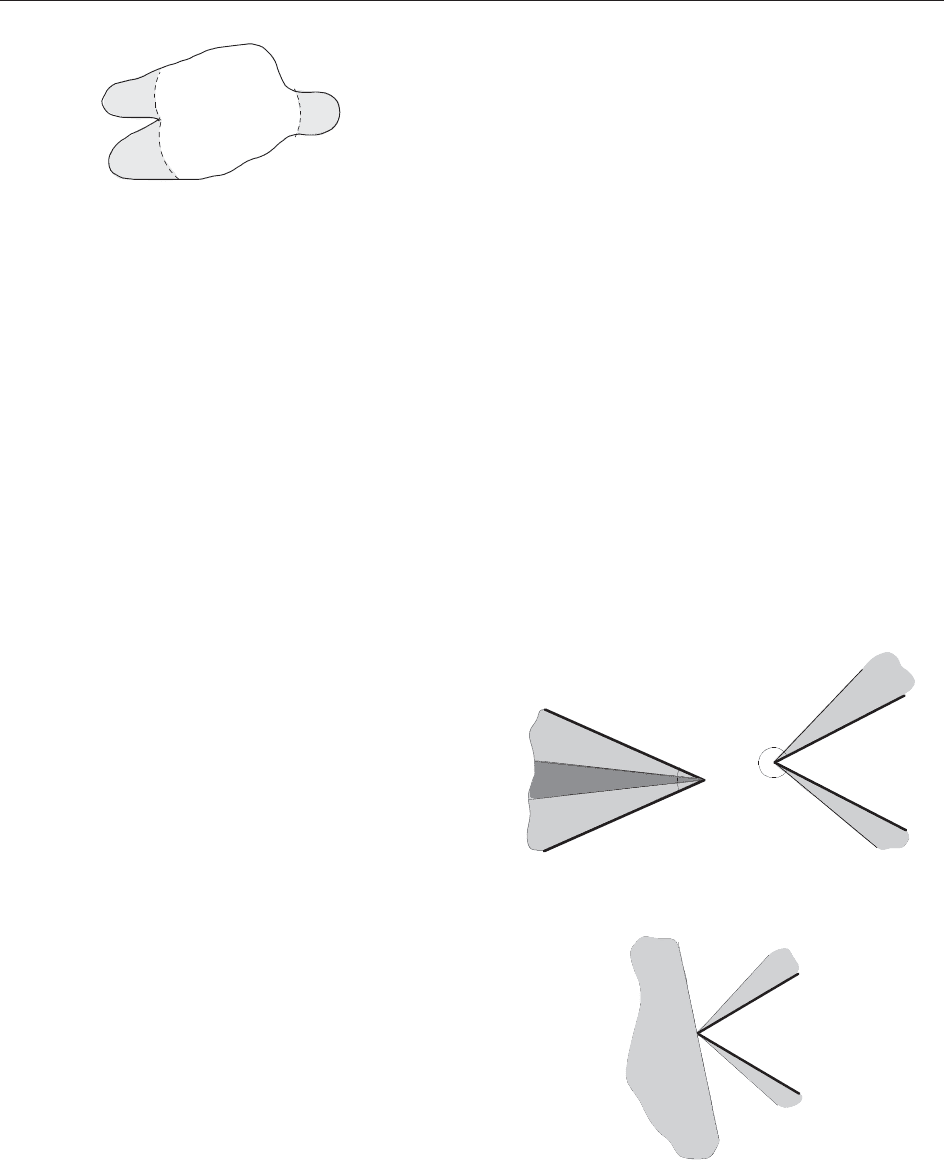
that minimize . All such arcs are circular of radius
1/2H, and meet either at smooth points in an
angle , or else at a reentrant corner point in an
angle
, measured on the side of opposite to
that into which the curvature vector points
(Figure 17). All minimizing configuration s are
bounded by arcs of that form, although not all
such configurations minimize. In a typical situation
one will encounter only a finite number of such arcs,
in which case only a finite number of cases need be
examined. If > 0 in each such case, then a
solution of [18]–[17] exists for the given and .
It may occur that no such arcs exist; we then observe
that since [;; ] =[; ] = 0, cannot become
nonpositive for any
unless a minimizing
can be found in , contradicting the assumed
nonexistence of minimizers. Thus, the criterion is
then vacuously satisf ied, and we conclude that a
solution of [18]–[17] exists.
One has, of course, to ask what happens
physically in cases for which [; ] 0 for some
as above. The possible modes of behavior were
studied in particular cases by Tam and later by
deLazzer, Langbein, Dreyer, and Rath; Finn and
Neel characterized the general case. Formally, the
fluid rises to infinity throughout domains
of the
form indicated, but with H replaced by a value
H
< H; on the opposite side of the circular arcs ,
the fluid is asymptotic to the vertical cylinders over
. In a physical situation, the fluid will rise to the
top of the container in a nearly cylindrical region
adjacent to a portion of the container walls,
approximating the indicated beh avior and partially
wetting the top of the container. One sees that
behavior in Figure 14b, in which the fluid fills out
regions adjacent to the corners. An analogous
configuration would still be observed if the corners
were smoothed locally. If insufficient fluid is
available, a portion of the base could become
unwetted.
Behavior at a Corner Point
Lancaster and Siegel (L and S) studied the behavior of
the limits (which they designate by Ru) of bounded
solutions of [16] or of [18] along radial segments
tending to a corner point P of a domain . These limits
can exhibit remarkable idiosyncratic behavior. For
simplicity of exposition, we restrict ourselves here to
rectilinear boundary segments at P, and assume
constant boundary angles
1
,
2
6¼ 0, on the two
sides. L and S prove first that the limits Ru exist and
vary continuously with direction of approach; then
they show the existence of ‘‘fan’’ regions of directions
adjacent to those of the sides, in which the limits are
constant independent of direction, see Figure 18. They
obtain that if the opening angle 2 at P satisfies 2<
, then for data in the rectangle R of Figure 12 the fans
overlap (see Figure 18a), so that the solution is
necessarily continuous at P. For data in D
þ
2
,the
solution decreases from the
1
side
1
to the
2
side
2
(‘‘D’’ behavior), subject to the Concus–Finn conjecture
(see the section ‘‘Existence questions I’’), with the
reverse behavior (‘‘I’’) in D
2
. Concus and Finn showed
that if 2<then in D
1
there is no bounded solution
of [16]–[17] or [18]–[17] as a graph. For [16]–[17],
unbounded solutions do however exist for such data
(see the section ‘‘Existence questions I’’).
Ω
∗
Ω
∗
Ω
∗
Σ
∗
Σ
∗
≥γ
≥γ
Γ
Γ
Ω
Σ
Γ
γ
γ
γ
γ
Figure 17 Extremal configuration for the functional .
(a)
A
A
′
B
B
′
2α
P
A
A′
B ′
B
2α
P
(b)
(c)
Figure 18 (a) Fan domains APA
0
and BPB
0
of constant limiting
values; 2a < p so that the fans overlap when data are in R. (b)
2a > p; case 1. Fans APA
0
and BPB
0
of constant radial limits
appear. Limiting value changes strictly monotonically as
approach direction changes from A
0
P to B
0
P.(c)2a > p; case 2.
In addition to the two fans adjacent to the sides of the
wedge, a half plane of constant radial limits appears.
442 Capillary Surfaces
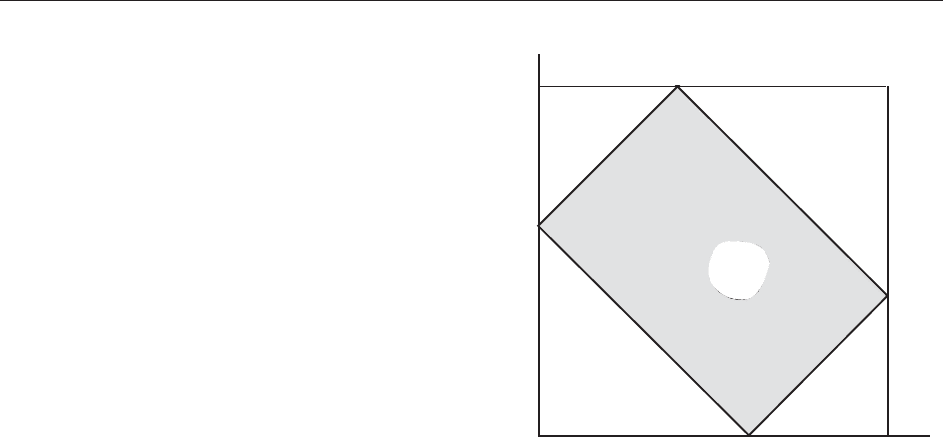
If 2>, then the fans do not overlap, and
in fact continuity at P cannot in general be
expected. Outside the indicated fan regions adja-
cent to the wedge sides, the limit values e ither
change strictly monotonically with angle of
approach, as in Figure 18b,orelsetheydoso
except for approaches within a third, central fan,
which covers a full half-space, and interior to
which the limiting values again remain constant,
see Figure 18c. L and S give an example under
which t hat behavior actually occurs. Remarkably,
intheexampletheprescribeddataarethesameon
both boundary segments. The solution is never-
theless discontinuous at P,withanintervalin
which the radial limit increases, another interval in
which it decreases, two fans of constant limit
adjacent to the sides, and a f an of breadth in-
between.
General conditions for continuity at a reentrant
corner (2>) have not yet been established. L and
S give a sufficient condition, depending on a
hypothesis of symmetry. Since no such hypothesis
is needed when 2<, one might at first expect it
to be superfluous. However, Shi and Finn showed
that by introducing an asymmetric domain perturba-
tion that in an asymptotic sense can be arbitrarily
small, the solution can be made discontinuous at P.
That can be done without affecting any other
hypotheses of the L and S theorem.
In as yet unpublished work, D Shi characterized
all possible behaviors at a reentrant corner, subject
to the validity of the Concus–Finn conjecture at a
protruding corner. If 0 then all solutions of [16]
or of [18] in a neighborhood of P in are bounded
at P. The further behavior depends on the particular
data, and is indicated in Figure 19. Note the analogy
with Figure 12, although the interpretations in the
figures differ in detail. Here the symbol I denotes
strictly increasing from the side
1
to
2
, except on
the fan regions of constant limits; ID denotes
constancy on a fan adjacent to
1
, then strictly
increasing, then constancy on a fan of opening ,
then strictly decreasing, then constancy on a fan
adjacent to
2
. D and DI are defined analogously.
All cases can be realized in particular configurations.
Drops in Wedges
Closely related to the material just discussed is the
question of the possible configurations of a con-
nected drop of liquid placed into a wedge formed by
intersecting plates of possibly differing materials, in
the absence of gravity. Thus, one has distinct
contact angles
1
,
2
on the two plates. Finn and
McCuan showed that if (
1
,
2
) 2 R then the only
possibility is that the drop surface S is part of a
sphere. For data in D
1
, no such drop can exist,
barring exotically singular behavior at the vertex
points where the edge of the wedge mee ts S.
For data in D
2
the situation is less clear. Concus,
Finn, and McCuan (CFM) showed that local
behavior exhibiting such data is indeed possible;
however, they conjectured that such behavior
cannot occur for simple drops. In conjunction with
the above results, they were led to the conjecture
that the free surface S of any liquid drop in a planar
wedge, that meets the wedge in exactly two vertices
and the wedge faces in constant contact angles
1
,
2
, is necessarily spherical. Here it is supposed
only that 0
1
,
2
.
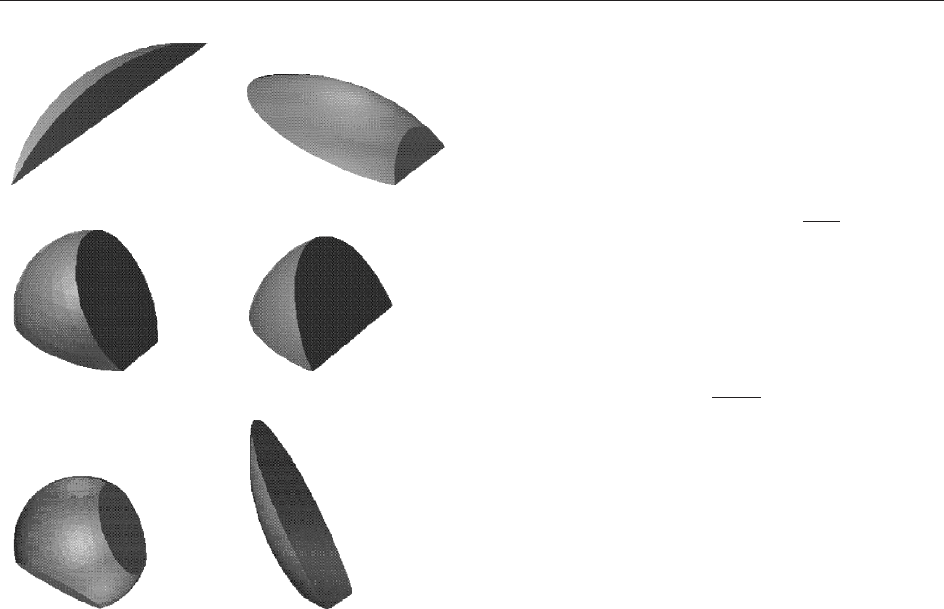
The behavior of a drop of prescribed volume, as
the data move from the midpoint of R to the D
regions along parallels to the sides of R, is displayed
in Figure 20. As one moves into the D
2
regions, the
drop detaches from one side of the wedge and
becomes a spherical cap resting on a single planar
surface, in accord with the above conjecture. As D
1
is approached, the liquid becomes a drop of very
large radius that fills out a long thin region in the
wedge, and disappears to infinity as the boundary of
R is crossed. However, as D
þ
1
is entered, the
configuration transforms smoothly into a spherical
liquid bridge, connecting the two faces of the wedge
without contacting the wedge line.
Stability Questions
A number of authors, for example, Langbein, Vogel,
Finn and Vogel, Steen, and Zhou, have studied the
Continuous, (I), (D)
+
(D)
D
2
+
D
1
–
D
1
–
D
2
(I )
(DI
), (D), (I )
(ID), (D), (I
)
2(π – α)
2(π
– α)
γ
1
π
0
2α – π
γ
2
π
0
2α
– π
R
Figure 19 p < 2a < 2p. Possible modes of behavior. Repro-
duced with permission from the Pacific Journal of Mathematics.
Capillary Surfaces 443
stability of liquid drops trapped between parallel
plates, forming an annular liquid bridge joining the
plates under the capillarity boundary condition of
prescribed contact angles
1
,
2
on the respective
plates. These studies consi der the effects of dis-
turbances within the fluid, assuming the plates are
rigid and perfectly parallel. CFM show that from the
point of view of physical prediction, the results of
these studies may be open to some question.
Specifically, they show that unless the drop is
initially of spherical form, then infinitesimal tilting
of one of the plates always results in a discontinuous
transition of the drop form. Depending on the
particular data, the transition can be to a spherical
drop; however, it can also occur that the tilting
causes the entire fluid to disappear to infinity in the
wedge.
CFM proved that if a connected liquid mass with
spherical outer surface S cuts off areas W
1
jj
, W
2
jj
from plates
1
,
2
which it meets in angles
1
,
2
,as
in Figure 20, then
X
2
1
W
j
cos
j
þ S
jj
¼
3 V
jj
R
½30
where Sjjdenotes area of the spherical free surface
interface, V
jj
the enclosed volume, and R the radius.
An immediate consequence is that the mechanical
energy E of the configuration is
E ¼
3 Vjj
R
½31
where is surface tension. Using this result, they
show that if a spherical liquid mass meets two
wedge faces in angles
1
,
2
in the absence of
gravity, then the configuration has smaller mechan-
ical energy than does any connected liquid mass of
the same volume that meets only one of the faces in
the contac t angle for that face. In turn, the drop on a
single face has smaller energy than does a spherical
ball of the same volume that meets no face. Note
that in all zero-gravity cases for which stability
relative to plate tilting can be expected, the liquid
mass must be spherical.
Compressibility
Until very recently, all literature on capillarity was
based on a hypothesis that the body of the fluid
is incompressible. Indeed, from the point of view
of macroscopic mechanical measurements, most
liquids are nearly incompressible. But all liquids are
also to some extent compressible, and this property
was even conceptually essential in our characteriza-
tion in the section ‘‘Gauss’ contribution: the energy
method’’ of the surface energy, even for the nomin-
ally incompressible case. It is as yet unclear to what
extent the compressibility properties of the bulk
liquid will influence the physical predictions of the
theory. In this connection, see the remarks at the end
of the section ‘ ‘Uniqueness and nonuniqueness.’ ’
The Equations I
Finn derived two possible equations extending [16]
and [17], arising from different modelings. Both
characterize equilibrium points as stationary points
for the mechanical energy, and both are based on a
hypothesized pressure–dens ity relation =
0
þ
(p p
0
). The first equation takes account of
the change in density with height, arising from
(b) Center point
(b) In R, near D
1
–
(a) In R, near D
1
+
(a) In R, near D
2
+
(c) In D
1
–
(c) In R, near D
2
–
(A) (B)
Figure 20 (A) Drop configurations in wedge with opening
angle 2a = 50
, for three data positions on the line g
1
= g
2
= g
(a) g = 70
(in R, near D
þ
1
); (b) g = 90
(in R, near D
1
); (c)
g = 110
(in D
1
). The first two cases yield edge blobs, the third a
spherical tube that does not contact the edge line. (B) Drop
configurations in a wedge of opening angle 2a = 50
, for three
data choices in R, on the line g
1
= p g
2
= g ; (a) g = 70
(near
D
þ
2
); (b) g = 90
(center of R); (c) g = 35
(near D
2
). As D
2
is
entered, original boundary conditions can no longer be satisfied
by spherical drop, but configuration changes smoothly into drop
on single plane, with prescribed data for that plane. Reproduced
with permission from Concus P, Finn R and McCuan J (2001)
Liquid bridges, edge blobs, and Scherk-type capilliary surfaces.
Indiana University Mathematics Journal 50: 411–441.
444 Capillary Surfaces