
Francoise J.-P., Naber G.L., Tsun T.S. (editors) Encyclopedia of Mathematical Physics
Подождите немного. Документ загружается.


where i, j = 1, ..., ‘. Let
E ¼
01
10
denote the 2‘ 2‘ matrix formed by four ‘ ‘
blocks, equal to the 0 matrix or, as indicated, to the
(identity matrix); then, if a superscript T denotes
matrix trans position, the condition that the map be
canonical is that
L
1
¼ EL
T
E
T
or L
1
¼
D
T
B
T
C
T
A
T
½16
which immediately implies that det L = 1. In fact,
it is possible to show that [16] implies det L = 1.
Equation [16] is equivalent to the four relations AD
T
BC
T
= 1, AB
T
þ BA
T
= 0, CD
T
DC
T
= 0, and
CB
T
þ DA
T
= 1. More explicitly, since the first and
the fourth relations coincide, these can be expressed as
f
0
i
;
0
j
g¼
ij
; f
0
i
;
0
j
g¼0; f
0
i
;
0
j
g¼0 ½17
where, for any two functions F(p, k), G(p, k), the
Poisson bracket is
fF; Ggðp; kÞ¼
def
X
‘
k¼1
@
k
Fðp; kÞ@
k
Gðp; kÞ
@
k
Fðp; kÞ@
k
Gðp; kÞ
½18
The latter satisfies Jacobi’s identity:{{F, G}, Q} þ
{{G, Q}, F} þ {{Q, F}, G} = 0, for any three functions
F, G, Q on the phase space. It is quite useful to
remark that if t !(p(t), q(t)) = S
t
(p, q) is a solution
to Hamilton equations with Hamiltonian H then,
given any observable F(p, q), it ‘‘evolves’’ as
F(t) =
def
F(p(t), q(t)) satisfying
@
t
FðpðtÞ; qðtÞÞ= {H; F}ðpðtÞ; qðtÞÞ
Requiring the latter identity to hold for all observables
F is equivalent to requiring that the t !(p(t), q(t)) be a
solution of Hamilton’s equations for H.
Let C: U ! U
0
be a smooth, smoothly invertible
transformation between two open 2‘-dimensional
sets: C(p, k) = (p
0
, k
0
). Suppose that there is a function
(p
0
, k) defined on a suitable domain W such that
Cðp; kÞ¼ðp
0
; k
0
Þ)
p ¼ @
k
ðp
0
; kÞ
k
0
¼ @
p
0
ðp
0
; kÞ
½19
then C is canonical. This is because [19] implies that
if k, p
0
are varied and if p, k
0
, p
0
, k are related by
C(p, k) = (p
0
, k
0
), then p dk þ k
0
dp
0
= d( p
0
, k),
which implies that
p dk Hðp; kÞdt p
0
dk
0
HðC
1
ðp
0
; k
0
ÞÞdt
þ dðp
0
; kÞdðp
0
k
0
Þ½20
It means that the Hamiltonians H(p, q)and
H
0
(p
0
, q
0
)) =
def
H(C
1
(p
0
, q
0
)) have Hamilton actions
A
H
and A
H
0
differing by a constant, if evaluated
on corresponding motions (p(t), q(t)) and
(p
0
(t), q
0
(t)) = C(p(t), q(t)).
The constant depends only on the initial and final
values (p(t
1
), q(t
1
)) and (p(t
2
), q(t
2
)) and, respec-
tively, (p
0
(t
1
), q
0
(t
1
)) and (p
0
(t
2
), q
0
(t
2
)) so that if
(p(t), q(t)) makes A
H
extreme, then (p
0
(t), q
0
(t)) =
C(p( t), q(t)) also makes A
H
0
extreme.
Hence, if t !(p(t), q(t)) solves the Hamilton equa-
tions with Hamiltonian H(p, q) then the motion
t !(p
0
(t), q
0
(t)) = C(p( t), q(t)) solves the Hamilton
equations with Hamiltonian H
0
(p
0
, q
0
) = H(C
1
(p
0
, q
0
))
no matter which it is: therefore, the transformation is
canonical. The function is called its generating
function.
Equation [19] provides a way to construct
canonical maps. Suppose that a function (p
0
, k)is
given and defined on some domain W; then setting
p ¼ @
k
ðp
0
; kÞ
k
0
¼ @
p
0
ðp
0
; kÞ
and inverting the first equation in the form
p
0
= X(p, k) and substituting the value for p
0
thus
obtained, in the second equation, a map
C(p, k) = (p
0
, k
0
) is defined on some domain (where
the mentioned operations can be performed) and if
such domain is open and not empty then C is a
canonical map.
For similar reasons, if (k, k
0
) is a function
defined on some domain then setting p = @
k
(k, k
0
), p
0
= @
k
0
(k, k
0
) and solving the first rela-
tion to express k
0
= D(p, k) and substituting in the
second relation a map (p
0
, k
0
) = C(p, k) is defined on
some domain (where the mentioned operations can
be performed) and if such domain is open and not
empty then C is a canonical map.
Likewise, canonical transformations can be con-
structed starting from a priori given functions
F(p, k
0
)orG(p, p
0
). And the most general canonical
map can be generated locall y (i.e., near a given point
in phase space) by a single one of the above four
ways, possibly composed with a few ‘‘trivial’’
canonical maps in which one pair of coordinates
(
i
,
i
) is transformed into (
i
,
i
). The necessity of
also including the trivial maps can be traced to the
existence of homogeneous canonical maps, that is,
maps such that p dk = p
0
dk
0
(e.g., the identity
map, see below or [49] for nontrivial examples)
which are action preserving hence canonical, but
which evidently cannot be generated by a function
(k, k
0
) although they can be generated by a
function depending on p
0
, k.
Introductory Article: Classical Mechanics 5

Simple examples of homogeneous canonical maps
are maps in which the coordinates q are changed
into q
0
= R(q) and, correspondingly, the p’s are
transformed as p
0
= (@
q
R(q))
1T
p, linearly: indeed,
this map is generated by the function F(p
0
, q) =
def
p
0
R(q).
For instance, consider the map ‘‘Cartesian–polar’’
coordinates (q
1
, q
2
) ! (, ) with (, ) the polar
coordinates of q (namely =
ffiffiffiffiffiffiffiffiffiffiffiffiffiffiffiffi
q
2
1
þ q
2
2
q
, = arctan
(q
2
=q
1
)) and let n=
def
q=jqj=(n
1
,n
2
) and t =(n
2
, n
1
).
Setting p
=
def
p n, p
=
def
p t, the map (p
1
, p
2
,
q
1
, q
2
) ! (p
, p
, , ) is homogeneous canonical
(because p dq=p nd þp td=p
d þp
d).
As a further example, any area-preserving map
(p, q) ! (p
0
, q
0
) defined on an open region of the
plane R
2
is canonical: because in this case the
matrices A, B, C, D are just numbers, which satisfy
AD BC = 1 and, therefore, [16] holds.
For more details, the reader is referred to Landau
and Lifshitz (1976) and Gallavotti (1983) .
Quadratures
The simplest mechanical systems are integrable by
quadratures. For instance, the Hamiltonian on R
2
,
Hðp; qÞ¼
1
2m
p
2
þ VðqÞ½21
generates a motion t !q(t) with initial data q
0
,
_
q
0
such that H(p
0
, q
0
) = E, i.e.,
1
2
m
_
q
2
0
þ V(q
0
) = E,
satisfying
_
qðtÞ¼
ffiffiffiffiffiffiffiffiffiffiffiffiffiffiffiffiffiffiffiffiffiffiffiffiffiffiffiffiffiffiffiffiffiffi
2
m
ðE VðqðtÞÞÞ
r
If the equation E = V(q) has only two solutions
q
(E) < q
þ
(E) and j@
q
V(q
(E))j > 0, the motion is
periodic with period
TðEÞ¼2
Z
q
þ
ðEÞ
q
ðEÞ
dx
ffiffiffiffiffiffiffiffiffiffiffiffiffiffiffiffiffiffiffiffiffiffiffiffiffiffiffiffiffiffiffiffiffiffiffiffi
ð2=mÞðE VðxÞÞ
p
½22
The special solution with initial data q
0
=
q
(E),
_
q
0
= 0 will be denoted Q(t), and it is an
analytic function (by the general regularity theorem
on ordinary differential equations). For 0 t T=2
or for T=2 t T it is given, respe ctively, by
t ¼
Z
QðtÞ
q
ðEÞ
dx
ffiffiffiffiffiffiffiffiffiffiffiffiffiffiffiffiffiffiffiffiffiffiffiffiffiffiffiffiffiffiffiffiffiffiffiffi
ð2=mÞðE VðxÞÞ
p
½23a
or
t ¼
T
2
Z
QðtÞ
q
þ
ðEÞ
dx
ffiffiffiffiffiffiffiffiffiffiffiffiffiffiffiffiffiffiffiffiffiffiffiffiffiffiffiffiffiffiffiffiffiffiffiffi
ð2=mÞðE VðxÞÞ
p
½23b
The most general solution with energy E has the
form q(t) = Q(t
0
þ t), where t
0
is defined by
q
0
= Q(t
0
),
_
q
0
=
_
Q(t
0
), i.e., it is the time needed for
the ‘‘standard solution’’ Q(t) to reach the initial data
for the new motion.
If the derivative of V vanishes in one of the
extremes or if at least one of the two solutions q
(E)
does not exist, the motion is not perio dic and it may
be unbounded: nevertheless, it is still expressible via
integrals of the type [22]. If the potential V is
periodic in q and the variable q is considered to be
varying on a circle then essentially all solutions are
periodic: exceptions can occur if the energy E has a
value such that V(q) = E admits a solution where V
has zero derivative.
Typical examples are the harmonic oscillator, the
pendulum, and the Kepler oscillator: whose Hamil-
tonians, if m, !, g, h, G, k are positive constants, are,
respectively,
p
2
2m
þ
1
2
m!
2
q
2
p
2
2m
þ mg 1 cos
q
h
p
2
2m
mk
1
jqj
þ m
G
2
2q
2
½24
the Kepler oscillator Hamiltonian has a potential
which is singular at q = 0 but if G 6¼ 0 the energy
conservation forbid s too close an approach to q = 0
and the singularity becomes irrelevant.
The integral in [23] is called a quadrature and the
systems in [21] are therefore integrable by quad-
ratures. Such systems, at least when the motion is
periodic, are best described in new coordinates in
which periodicity is more manifest. Namely when
V(q) = E has only two roots q
(E)andV
0
(q
(E)) > 0
the energy–time coordinates can be used by replac-
ing q,
_
q or p, q by E, , where is the time needed
for the standard solution t !Q(t)toreachthegiven
data, that is, Q() = q,
_
Q() =
_
q. In such coordi-
nates, the motion is simply (E, ) !(E, þ t) and,
of course, the variable has to be regarded as
varying on a circle of radius T=2. The E,
variables are a kind of polar coordinates, as can
be checked by drawing the curves of constant E,
‘‘energy levels,’’ in the plane p, q in the cases in
[24]; see Figure 1.
In the harmonic oscillator case, all trajectories are
periodic. In the pendulum case, all motions are
periodic except the ones which separate the oscilla-
tory motions (the closed curves in the second
drawing) from the rotatory motions (the apparently
open curves) which, in fact, are on clos ed curves as
well if the q coordinate, that is, the vertical
6 Introductory Article: Classical Mechanics
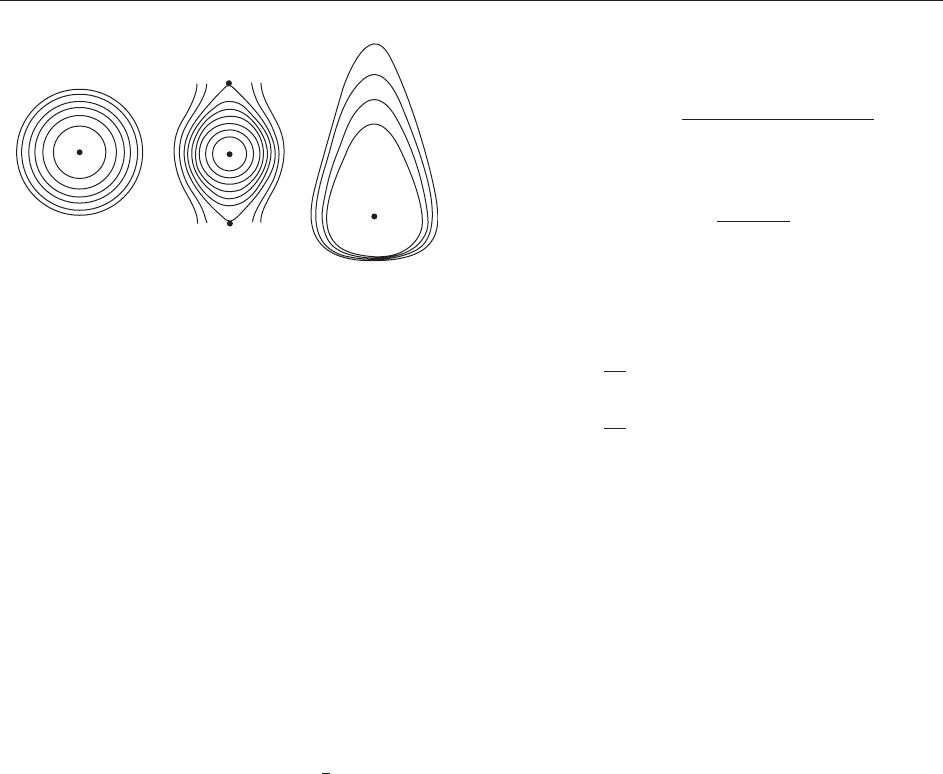
coordinate in Figure 1, is regarded as ‘‘periodic’’
with period 2h. In the Kepler case, only the
negative-energy trajectories are periodic and a few
of them are drawn in Figure 1. The single dots
represent the equilibrium points in phase space.
The r egion of phase space where motions are
periodic i s a set of points (p, q)withthe
topological structure of [
u2U
({u} C
u
), where u is
a coordinate varying in a n open interval U (e.g.,
the set of values of the e nergy), and C
u
is a closed
curve whose points (p, q) are id entifi ed by a
coordinate (e.g., by the time necessary for an
arbitrarily fixed datum with the same energy to
evolve into (p, q)).
In the above cases, [24], if the ‘‘radial’’ coordinate
is chosen to be the energy the set U is the interval
(0, þ1) for the harmonic oscillator, (0, 2mg)or
(2mg, þ1) for the pendulum, and (
1
2
mk
2
=G
2
,0)in
the Kepler case. The fixed datum for the reference
motion can be taken, in all cases, to be of the form
(0, q
0
) with the time coordinate t
0
given by [23].
It is remarkable that the energy–time coordinates
are canonical coordinates: for instance, in the vicinity
of (p
0
, q
0
)andifp
0
> 0, this can be seen by setting
Sðq; EÞ¼
Z
q
q
0
ffiffiffiffiffiffiffiffiffiffiffiffiffiffiffiffiffiffiffiffiffiffiffiffiffiffiffiffiffiffi
2mðE VðxÞÞ
p
dx ½25
and checking that p = @
q
S(q, E), t = @
E
S(q, E) are
identities if (p, q) and (E, t) are coordinates for the
same point so that the criterion expressed by [20]
applies.
It is conven ient to standardize the coordinates
by replacing the time variable by an angle =
(2=T(E))t; and instead of the energy any invertible
function of it can be used.
It is na tural to look for a coordinate A = A( E)
such that the map (p, q) ! (A, ) is a canonical
map: this is easily done as the function
^
Sðq; AÞ¼
Z
q
q
0
ffiffiffiffiffiffiffiffiffiffiffiffiffiffiffiffiffiffiffiffiffiffiffiffiffiffiffiffiffiffiffiffiffiffiffiffiffi
2mðEðAÞVðxÞÞ
p
dx ½26
generates (locally) the correspondence between
p =
ffiffiffiffiffiffiffiffiffiffiffiffiffiffiffiffiffiffiffiffiffiffiffiffiffiffiffiffiffiffiffiffiffiffiffiffi
2m(E(A) V(q))
p
and
¼ E
0
ðAÞ
Z
q
0
dx
ffiffiffiffiffiffiffiffiffiffiffiffiffiffiffiffiffiffiffiffiffiffiffiffiffiffiffiffiffiffiffiffiffiffiffiffiffiffiffiffiffiffi
2m
1
ðEðAÞVðxÞÞ
p
Therefore, by the criterion [20],if
E
0
ðAÞ¼
2
TðEðAÞÞ
i.e., if A
0
(E) = T(E)=2, the coordinates (A, ) will
be canonical coordinates. Hence, by [22], A(E) can
be taken as
A ¼
1
2
2
Z
q
þ
ðEÞ
q
ðEÞ
ffiffiffiffiffiffiffiffiffiffiffiffiffiffiffiffiffiffiffiffiffiffiffiffiffiffiffiffiffiffi
2mðE VðqÞÞ
p
dq
1
2
I
p dq ½27
where the last integral is extended to the closed curve
of energy E;seeFigure 1.Theaction–angle coordi-
nates (A, ) are defined in open regions of phase
space covered by periodic motions: in action–angle
coordinates such regions have the form W = J T of
a product of an open interval J and a one-
dimensional ‘‘torus’’ T = [0, 2] (i.e., a unit circle).
For details, the reader is again referred to Landau and
Lifshitz (1976), Arnol’d (1989),andGallavotti (1983).
Quasiperiodicity and Integrability
A Hamiltonian is called integrable in an open region
W T
(M) of phase space if
1. there is an analytic and nonsingular (i.e., with
nonzero Jacobian) change of coordinates (p, q) !
(I, j) mapping W into a set of the form IT
‘
with IR
‘
(open); and furthermore
2. the flow t !S
t
(p, q) on phase space is trans-
formed into (I, j) !(I, j þ w(I)t) where w(I)isa
smooth function on I:
This means that, in suitable coordinates, which
can be called ‘‘integrating coordinates,’’ the system
appears as a set of ‘ points with coo rdinates
j = (’
1
, ..., ’
‘
) moving on a unit circle at angular
velocities w( I) = (!
1
(I), ..., !
‘
(I)) depending on the
actions of the initial data.
A system integrable in a region W which, in
integrating coordinates I, j, has the form IT
‘
is
said to be anisochronous if det @
I
w(I) 6¼ 0. It is said
to be isochronous if w(I) w is independent of I.
The motions of integrable systems are called
quasiperiodic with frequency spectrum w( I), or
with frequencies w( I)=2, in the coordinates (I, j).
Clearly, an integrable system admits ‘ independent
constants of motion, the I = (I
1
, ..., I
‘
), and, for each
Figure 1 The energy levels of the harmonic oscillator, the
pendulum, and the Kepler motion.
Introductory Article: Classical Mechanics 7

choice of I, the other coordinates vary on a ‘‘standard’’
‘-dimensional torus T
‘
: hence, it is possible to say that
a phase space region of integrability is foliated into
‘-dimensional invariant tori T (I) parametrized by the
values of the constants of motion I 2I.
If an integrable system is anisochronous then it is
canonically integrable: that is, it is possible to define
on W a canonical change of coordinates (p, q) =
C(A, a) mapping W onto J T
‘
and such that
H(C( A, a)) = h(A) for a suitable h. Then, if
w(A) =
def
@
A
h(A), the equations of motion become
_
A ¼ 0;
_
a ¼ wðAÞ½28
Given a system (I, j) of coordinates integrating an
anisochronous system the construction of action–
angle coordinates can be performed, in principle, via
a classical procedure (under a few extra
assumptions).
Let
1
, ...,
‘
be ‘ topologically independent circles
on T
‘
, for definiteness let
i
(I) = {j j’
1
= ’
2
= =
’
i1
= ’
iþ1
= = 0, ’
i
2 [0, 2]}, and set
A
i
ðIÞ¼
1
2
I
i
ðIÞ
p dq ½29
If the map I ! A(I) is analytically invertible as
I = I(A), the function
SðA; jÞ¼ðÞ
Z
j
0
p dq ½30
is well defined if the integral is over any path
joining the points (p(I(A), 0), q(I(A), 0)) and
(p(I(A), j)), q(I(A), j) and lying on the torus para-
metrized by I(A).
The key remark in the proof that [30] really
defines a function of the only variables A, j is that
anisochrony implies the vanishing of the Poisson
brackets (cf. [18]): {I
i
, I
j
} = 0 (hence also {A
i
, A
j
}
P
h, k
@
I
k
A
i
@
I
h
A
j
{I
k
, I
h
} = 0). And the property
{I
i
, I
j
} = 0 can be checke d to be precisely the
integrability condition for the differential form p dq
restricted to the surface obtained by varying q while p is
constrained so that (p, q) stays on the surface
I = constant, i.e., on the invariant torus of the points
with fixed I.
The latter property is necessary and sufficient in
order that the function S(A, j) be well defined (i.e.,
be independent on the integration path )uptoan
additive quantity of the form
P
i
2n
i
A
i
with
n = (n
1
, ..., n
‘
) integers.
Then the action–angle variables are defined by the
canonical change of coordinates with S(A, j)as
generating function, i.e., by setting
i
¼ @
A
i
SðA; jÞ; I
i
¼ @
j
i
SðA; jÞ½31
and, since the computation of S(A, j) is ‘‘reduced to
integrations’’ which can be regarded as a natural
extension of the quadratures discussed in the one-
dimensional cases, such systems are also called
integrable by quadratures. The just-described con-
struction is a version of the more general Arnol’d–
Liouville theorem.
In practice, howev er, the actual evaluation of the
integrals in [29], [30] can be difficult: its analysis in
various cases (even as ‘‘elementary’’ as the pendu-
lum) has in fact led to key progress in various
domains, for example, in the theory of special
functions and in group theory.
In general, any surface on phase space on which
the rest riction of the differential form p dq is locally
integrable is called a Lagrangian manifold: hence the
invariant tori of an anisochronous integrable system
are Lagrangian manifolds.
If an integrable system is anisochronous, it cannot
admit more than ‘ independent constants of motion;
furthermore, it does not admit invariant tori of
dimension >‘. Hence ‘-dimensional invariant tori
are called maximal.
Of course, invariant tori of dimension <‘ can also
exist: this happens when the variables I are such that
the frequencies w(I) admit nontrivial rational rela-
tions; i.e., there is an integer components vector
n 2 Z
‘
, n = (
1
, ...,
‘
) 6¼ 0 such that
wðIÞn ¼
X
i
!
i
ðIÞ
i
¼ 0 ½32
in this case, the invariant torus T (I) is called
resonant. If the system is anisochronous then
det @
I
w(I) 6¼ 0 and, therefore, the resonant tori are
associated with values of the constants of motion
I which form a set of measure zero in the space
I but which is not empty and dense.
Examples of isochronous systems are the systems of
harmonic oscillators, i.e., systems with Hamiltonian
X
‘
i¼1
1
2m
i
p
2
i
þ
1
2
X
1;‘
i; j
c
ij
q
i
q
j
where the matrix v is a positive-definite matrix.
This is an isochronous system with frequencies
w = (!
1
, ..., !
‘
) whose squares are the eigenvalues of
the matrix m
1=2
i
c
ij
m
1=2
j
. It is integrable in the region
W of the data x = ( p, q) 2 R
2‘
such that, setting
A
¼
1
2!
X
‘
i¼1
v
; i
p
i
ffiffiffiffiffiffi
m
i
p
!
2
þ!
2
X
‘
i¼1
v
;i
q
i
ffiffiffiffiffiffiffiffiffi
m
1
i
q
!
2
0
B
@
1
C
A
for all eigenvectors v
, = 1, ..., ‘, of the above
matrix, the vectors A have all components >0.
8 Introductory Article: Classical Mechanics

Even though this system is isochronous, it never-
theless admits a system of canonical action–angle
coordinates in which the Hamiltonian takes the
simplest form
hðAÞ¼
X
‘
¼1
!
A
w A ½33
with
¼arctan
P
‘
i¼1
v
; i
p
i
ffiffiffiffi
m
i
p
P
‘
i¼1
ffiffiffiffiffiffi
m
i
p
!
v
; i
q
i
0
B
B
B
@
1
C
C
C
A
as conjugate angles.
An example of anisochronous system is the free
rotators or free wheels: i.e., ‘ noninteracting points
on a circle of radius R or ‘ noninteracting homo-
geneous coaxial wheels of radius R.IfJ
i
= m
i
R
2
or,
respectively, J
i
= (1=2)m
i
R
2
are the inertia moments
and if the positions are determined by ‘ angles a =
(
1
, ...,
‘
), the angular velocities are constants
related to the angular momenta A = (A
1
, ..., A
‘
)by
!
i
= A
i
=J
i
. The Hamiltonian and the spectrum are
hðAÞ¼
X
‘
i¼1
1
2J
i
A
2
i
; wðAÞ¼
1
J
i
A
i
i¼1;...;‘
½34
For further details see Landau and Lifshitz (1976),
Gallavotti (1983), Arnol’d (1989), and Fasso` (1998).
Multidimensional Quadratures:
Central Motion
Several important mechanical systems with more
than one degree of freedom are integrable by
canonical quadratures in vast regions of phase
space. This is checked by showing that there is a
foliation into invariant tori T (I) of dimension equal
to the number of degrees of freedom (‘) parame-
trized by ‘ constants of motion I in involution, i.e.,
such that {I
i
, I
j
} = 0. One then performs, if possible,
the construction of the action–angle variables by
the quadratures discussed in the previous section.
The above procedure is well illustrated by the
theory of the planar motion of a unit mass attracted
by a coplanar center of force: the Lagrangian is, in
polar coordinates (, ),
L¼
m
2
ð
_
2
þ
2
_
2
ÞVðÞ
The planarity of the motion is not a strong restriction
as central motion always takes place on a plane.
Hence, the equations of motion are
d
dt
m
2
_
¼ 0
i.e., m
2
˙
= G is a constant of motion (it is the
angular momentum), and
€
¼@
VðÞþ@
m
2
2
_
2
¼@
VðÞþ
G
2
m
3
¼
def
@
V
G
ðÞ
Then the energy conservation yields a second
constant of motion E,
m
2
_
2
þ
1
2
G
2
m
2
þ VðÞ¼E
¼
1
2m
p
2
þ
1
2m
p
2
2
þ VðÞ½35
The right-hand side (rhs) is the Hamiltonian for the
system, derived from L,ifp
, p
denote conjugate
momenta of , : p
= m
˙
and p
= m
2
˙
(note that
p
= G).
Suppose
2
V()
!
!0
0: then the singularity at the
origin cannot be reached by any motion starting
with >0ifG > 0. Assume also that the function
V
G
ðÞ¼
def
1
2
G
2
m
2
þ VðÞ
has only one minimum E
0
(G), no maximum and no
horizontal inflection, and tends to a limit E
1
(G) 1
when !1. Then the system is integrable in the
domain W = {(p, q) jE
0
(G) < E < E
1
(G), G 6¼ 0}.
This is checked by introducing a ‘‘standard’’ periodic
solution t !R(t)ofm
¨
= @
V
G
() with energy
E
0
(G) < E < E
1
(G) and initial data =
E,
(G),
˙
= 0attimet= 0, where
E,
(G )arethetwo
solutions of V
G
() =E , see the section ‘‘Quadratures’’:
this is a periodic analytic function of t with period
TðE; GÞ¼2
Z
E;þ
ðGÞ
E;
ðGÞ
dx
ffiffiffiffiffiffiffiffiffiffiffiffiffiffiffiffiffiffiffiffiffiffiffiffiffiffiffiffiffiffiffiffiffiffiffiffiffiffiffi
ð2=mÞðE V
G
ðxÞÞ
p
The function R(t) is given, for 0 t
1
2
T(E, G)
or for
1
2
T(E, G) t T(E, G), by the quadratures
t ¼
Z
RðtÞ
E;
ðGÞ
dx
ffiffiffiffiffiffiffiffiffiffiffiffiffiffiffiffiffiffiffiffiffiffiffiffiffiffiffiffiffiffiffiffiffiffiffiffiffiffiffi
ð2=mÞðE V
G
ðxÞÞ
p
½36a
or
t ¼
TðE; GÞ
2
Z
RðtÞ
E;þ
ðGÞ
dx
ffiffiffiffiffiffiffiffiffiffiffiffiffiffiffiffiffiffiffiffiffiffiffiffiffiffiffiffiffiffiffiffiffiffiffiffiffiffiffi
ð2=mÞðE V
G
ðxÞÞ
p
½36b
Introductory Article: Classical Mechanics 9

respectively. The analytic regularity of R(t)follows
from the general existence, uniqueness, and regularity
theorems applied to the differential equation for
¨
.
Given an initia l datum
_
0
,
0
,
_
0
,
0
with energy E
and angular momentum G, define t
0
to be the time
such that R(t
0
) =
0
,
_
R(t
0
) =
_
0
: then (t) R(t þt
0
)
and (t) can be computed as
ðtÞ¼
0
þ
Z
t
0
G
mRðt
0
þ t
0
Þ
2
dt
0
a second quadrature. Therefore, we can use as
coordinates for the motion E, G, t
0
, which determine
_
0
,
0
,
_
0
and a fourth coordinate that determines
0
which could be
0
itself but which is conveniently
determined, via the second qua drature, as follows.
The function Gm
1
R(t)
2
is periodic with period
T(E, G); hen ce it can be expressed in a Fourier series
0
ðE; GÞþ
X
k6¼0
k
ðE; GÞexp
2
TðE; GÞ
itk
the quadrature for (t) can be performed by
integrating the series terms. Setting
ðt
0
Þ¼
def
TðE; GÞ
2
X
k6¼0
k
ðE; GÞ
k
exp
2
TðE; GÞ
it
0
k
and ’
1
(0) =
0
(t
0
), the expression
ðtÞ¼
0
þ
Z
t
0
G
mRðt
0
þ t
0
Þ
2
dt
0
becomes
’
1
ðtÞ¼’
1
ð0Þþ
0
ðE; GÞt ½37
Hence the system is integrable and the spectrum is
w(E, G) = (!
0
(E, G), !
1
(E, G)) (!
0
, !
1
) with
!
0
¼
def
2
TðE; GÞ
and !
1
¼
def
0
ðE; GÞ
while I = (E, G) are constants of motion and the
angles j = (’
0
, ’
1
) can be taken as
’
0
¼
def
!
0
t
0
;’
1
¼
def
0
ðt
0
Þ
At E, G fixed, the motion takes place on a two-
dimensional torus T (E, G) with ’
0
, ’
1
as angles.
In the anisochronous cases, i.e., when
det @
E, G
w(E, G) 6¼ 0, canonical action–angle vari-
ables conjugated to (p
, , p
, ) can be constructed
via [29], [30] by using two cycles
1
,
2
on the torus
T (E, G). It is convenient to choose
1.
1
as the cycle consisting of the points = x, = 0
whose first half (where p
0) consists in the
set
E,
(G) x
E, þ
(G), p
=
ffiffiffiffiffiffiffiffiffiffiffiffiffiffiffiffiffiffiffiffiffiffiffiffiffiffiffiffiffiffiffiffi
2m(E V
G
(x))
p
and d = 0; and
2.
2
as the cycle = const, 2 [0, 2] on which
d = 0 and p
= G obtaining
A
1
¼
2
2
Z
E; þ
ðGÞ
E;
ðGÞ
ffiffiffiffiffiffiffiffiffiffiffiffiffiffiffiffiffiffiffiffiffiffiffiffiffiffiffiffiffiffiffiffiffi
2mðE V
G
ðxÞÞ
p
dx;
A
2
¼ G
½38
According to the general theory (cf. the previous
section) a generating function for the canonical
change of coordinates from (p
, , p
, ) to action–
angle variables is (if, to fix ideas, p
> 0)
SðA
1
; A
2
;;Þ¼G þ
Z
E;
ffiffiffiffiffiffiffiffiffiffiffiffiffiffiffiffiffiffiffiffiffiffiffiffiffiffiffiffiffiffiffiffiffi
2mðE V
G
ðxÞÞ
p
dx ½39
In terms of the above !
0
,
0
the Jacobian matrix
@(E, G)=@(A
1
, A
2
) is computed from [38], [39] to be
!
0
0
01
. It follows that @
E
S = t, @
G
S =
(t)
0
t
so that, see [31],
1
¼
def
@
A
1
S ¼ !
0
t;
2
¼
def
@
A
2
S ¼ ðtÞ½40
and (A
1
,
1
), (A
2
,
2
) are the action–angle pairs.
For more details, see Landau and Lifshitz (1976)
and Gallavotti (1983).
Newtonian Potential and Kepler’s Laws
The anisochrony property, that is, det @(!
0
,
0
)=
@(A
1
, A
2
) 6¼ 0 or, equivalently, det @(!
0
,
0
)=
@(E, G) 6¼0, is not satisfied in the important cases
of the harmonic potential and the Newtonian
potential. Anisochrony being only a sufficient con-
dition for canonical integrability it is still possible
(and true) that, nevertheless, in both cases the
canonical transformation generated by [39] inte-
grates the system. This is expected since the two
potentials are limiting cases of anisochronous ones
(e.g., jqj
2þ"
and jqj
1"
with " !0).
The Newtonian potential
Hðp; qÞ¼
1
2m
p
2
km
jqj
is integrable in the region G 6¼ 0, E
0
(G) =
k
2
m
3
=2G
2
< E < 0, jGj <
ffiffiffiffiffiffiffiffiffiffiffiffiffiffiffiffiffiffiffiffiffiffiffiffiffiffi
k
2
m
3
=(2E)
p
. Pro-
ceeding as in the last section, one finds integrating
coordinates and that the integrable motions develop
on ellipses with one focus on the center of attraction
S so that motions are periodic, hence not anisochro-
nous: nevertheless, the construction of the canonical
coordinates via [29]–[31] (hence [39]) works and
leads to canonical coordinates (L
0
,
0
, G
0
,
0
). To
obtain action–angle variables with a simple
10 Introductory Article: Classical Mechanics
interpretation, it is convenient to perform on the
variables (L
0
,
0
, G
0
,
0
) (constructed by following the
procedure just indicated) a further trivial canonical
transformation by setting L = L
0
þ G
0
, G = G
0
,
=
0
, =
0
0
; then
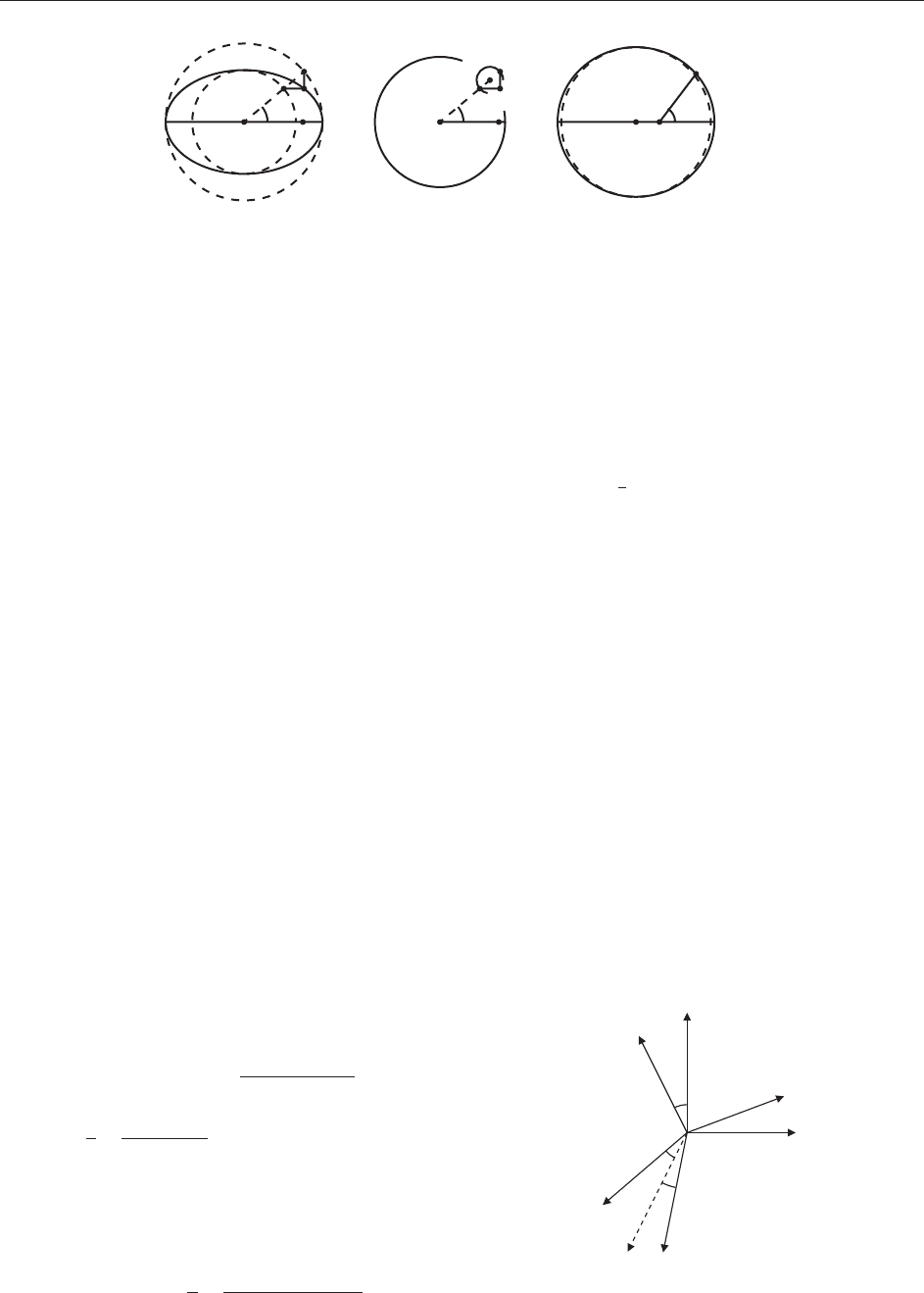
1. (average anomaly) is the time necessary for the
point P to move from the pericenter to its actual
position, in units of the period, times 2;
2. L (action) is essentially the energy E = k
2
m
3
=2L
2
;
3. G (angular momentum);
4. (axis longitude), is the angle between a fixed
axis and the major axis of the ellipse oriented
from the center of the ellipse O to the center of
attraction S.
The eccentricity of the ellipse is e such that G =
L
ffiffiffiffiffiffiffiffiffiffiffiffiffi
1 e
2
p
. The ellipse equation is = a(1
e cos ), where is the eccentric anomaly (see
Figure 2), a = L
2
=km
2
is the major semiaxis, and
is the distance to the center of attraction S.
Finally, the relations between eccentric anomaly ,
average anomaly , true anomaly (the latter is the
polar angle), and SP distance are given by the
Kepler equations
¼ e sin
ð1 e cos Þð1 þ e cos Þ¼1 e
2
¼ð1 e
2
Þ
3=2
Z
0
d
0
ð1 þ e cos
0
Þ
2
a
¼
1 e
2
1 þ e cos
½41
and the relation between true anomaly and average
anomaly can be inverted in the form
¼ þ g
¼ þ f
)
a
¼
1 e
2
1 þ e cosð þ f
Þ
½42
where g
= g(e sin , e cos ), f
= f(e sin , e cos ),
and g(x, y), f (x, y) are suitable functions analytic
for jxj, jyj < 1. Furthermore, g(x, y) = x(1 þ y þ),
f (x, y) = 2x(1 þ
5
4
y þ) and the ellipses denote
terms of degree 2 or higher in x, y, containing only
even powers of x.
For more details, the reader is referred to Landau
and Lifshitz (1976) and Gallavotti (1983) .
Rigid Body
Another fundamental integrable system is the rigid
body in the absence of gravity and with a fixed point
O. It can be naturally described in terms of the Euler
angles
0
, ’
0
,
0
(see Figure 3) and their derivatives
_
0
,
_
’
0
,
_
0
.
Let I
1
, I
2
, I
3
be the three principal inertia moments
of the body along the three principal axes with unit
vectors i
1
, i
2
, i
3
. The inertia moments and the
principal axes are the eigenvalues and the associated
unit eigenvectors of the 3 3 inertia matrix I,
which is defined by I
hk
=
P
n
i = 1
m
i
(x
i
)
h
(x
i
)
k
, where
h, k = 1, 2, 3 and x
i
is the position of the ith particle
in a reference frame with origin at O and in which
ξ
O
P
e = 0.75
D
E
O
P
e
= 0.75
c
ξ
O
P
e
= 0.3
θ
SS
S
Figure 2 Eccentric and true anomalies of P, which moves on a small circle E centered at a point c moving on the circle D located
half-way between the two concentric circles containing the Keplerian ellipse: the anomaly of c with respect to the axis OS is . The
circle D is eccentric with respect to S and therefore is, even today, called eccentric anomaly, whereas the circle D is, in ancient
terminology, the deferent circle (eccentric circles were introduced in astronomy by Ptolemy). The small circle E on which the point P
moves is, in ancient terminology, an epicycle. The deferent and the epicyclical motions are synchronous (i.e., they have the same
period); Kepler discovered that his key a priori hypothesis of inverse proportionality between angular velocity on the deferent and
distance between P and S (i.e.,
_
= constant) implied both synchrony and elliptical shape of the orbit, with focus in S. The latter law is
equivalent to
2
_
= constant (because of the identity a
_
=
_
). Small eccentricity ellipses can hardly be distinguished from circles.
i
1
i
2
i
3
x
n
y
O
z
ϕ
0
ψ
0
θ
0
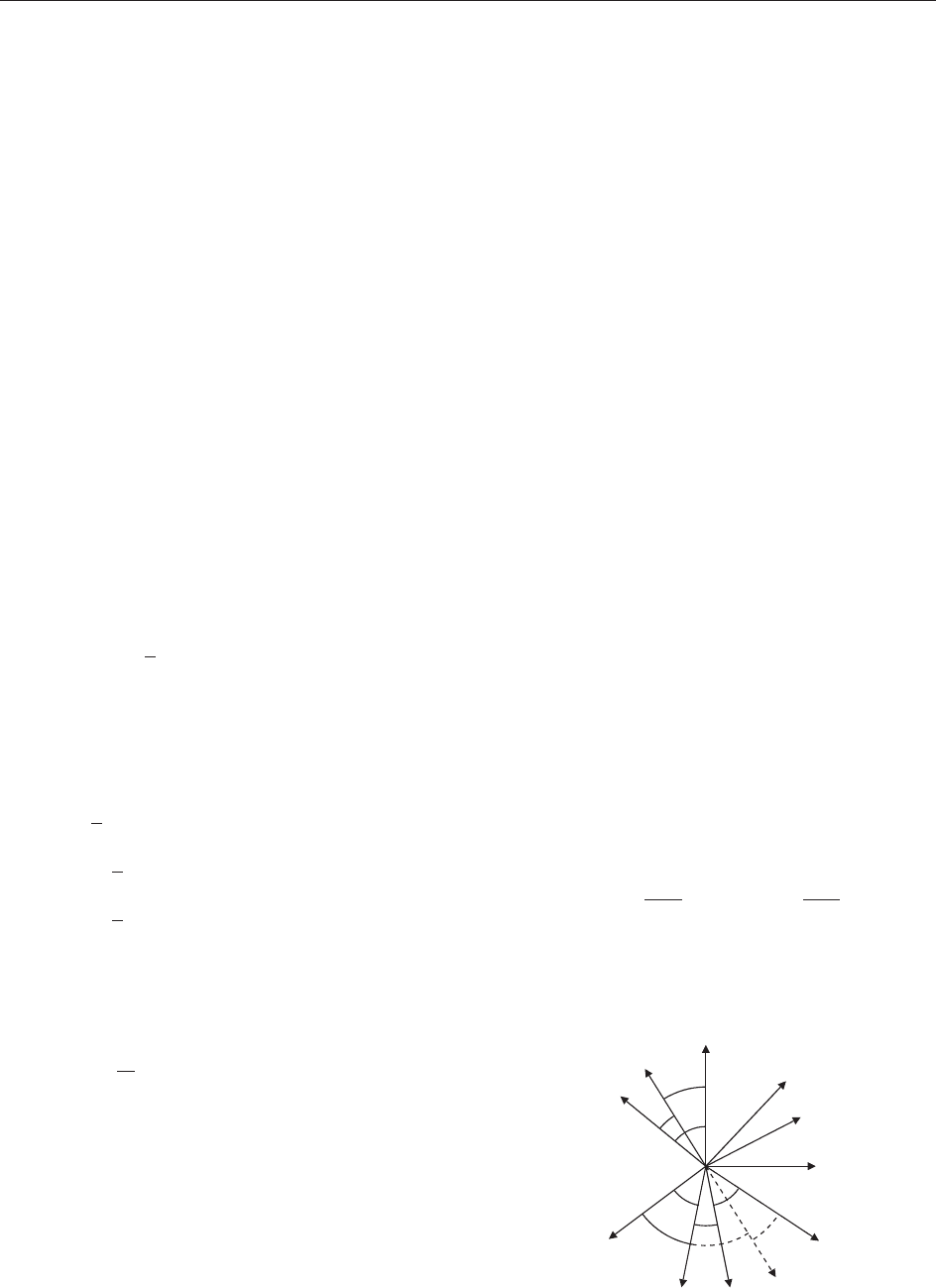
Figure 3 The Euler angles of the comoving frame i
1
, i
2
, i
3
with
respect to a fixed frame x , y , z. The direction n is the ‘‘node line,
intersection between the planes x, y and i
1
, i
2
.
Introductory Article: Classical Mechanics 11
all particles are at rest: this comoving frame exists as
a consequence of the rigidi ty constraint. The
principal axes form a coordinate system which is
comoving as well: that is, in the frame (O; i
1
, i
2
, i
3
)
as well, the particles are at rest.
The Lagrangian is simply the kinetic energy: we
imagine the rigidity constraint to be ideal (e.g., as
realized by internal central forces in the limit of
inf inite rigidity, as m entioned in the se ction ‘‘ Lag range
and Hamilton forms of equations of motion’’). The
angular velocity of the rigid motion is defined by
w ¼
_
0
n þ
_
’
0
z þ
_
0
i
3
½43
expressing that a generic infinitesimal motion
must consist of a variation of the three Euler
angles and, therefore, it has to be a rotation of
speeds
_
0
,
_
’
0
,
_
0
around the axes n, z, i
3
as shown
in Figure 3.
Let (!
1
, !
2
, !
3
) be the components of w along the
principal axes i
1
, i
2
, i
3
: for brevity, the latter axes
will often be called 1, 2, 3. Then the angular
momentum M, with respect to the pivot point O,
and the kinetic energy K can be checked to be
M ¼I
1
!
1
i
1
þ I
2
!
2
i
2
þ I
3
!
3
i
3
K ¼
1
2
ðI
1
!
2
1
þ I
2
!
2
2
þ I
2
!
2
3
Þ
½44
and are constants of motion. From Figure 3 it follows
that !
1
=
_
0
cos
0
þ
_
’
0
sin
0
sin
0
, !
2
=
_
0
sin
0
þ
_
’
0
sin
0
cos
0
and !
3
=
_
’
0
cos
0
þ
_
0
, so that the
Lagrangian, uninspiring at first, is
L
¼
def
1
2
I
1
ð
_
0
cos
0
þ
_
’
0
sin
0
sin
0
Þ
2
þ
1
2
I
2
ð
_
0
sin
0
þ
_
’
0
sin
0
cos
0
Þ
2
þ
1
2
I
3
ð
_
’
0
cos
0
þ
_
0
Þ
2
½45
Angular momentum conservation does not imply
that the components !
j
are constants because
i
1
, i
2
, i
3
also change with time according to
d
dt
i
j
¼ w ^ i
j
; j ¼ 1; 2; 3
Hence,
_
M = 0 becomes, by the first of [44] and
denoting Iw = (I
1
!
1
, I
2
!
2
, I
3
!
3
), the Euler equations
I
˙
w þ w ^ Iw = 0,or
I
1
_
!
1
¼ðI
2
I
3
Þ!
2
!
3
I
2
_
!
2
¼ðI
3
I
1
Þ!
3
!
1
I
3
_
!
3
¼ðI
1
I
2
Þ!
1
!
2
½46
which can be considered together with the conserved
quantities [44].
Since angular momentum is conserved, it is con-
venient to introduce the laboratory frame (O; x
0
,
y
0
, z
0
) with fixed axes x
0
, y
0
, z
0
and (see Figure 4):
1. (O; x, y, z), the momentum frame with fixed axes,
but with z-axis oriented as M, and x-axis
coinciding with the node (i.e., the intersection)
of the x
0
–y
0
plane and the x–y plane (orthogonal
to M). Therefore, x, y, z is determined by the two
Euler angles , of (O; x, y, z)in(O; x
0
, y
0
, z
0
);
2. (O; 1, 2, 3), the comoving frame, that is, the
frame fixed with the body, and with unit vectors
i
1
, i
2
, i
3
parallel to the principal axes of the body.
The frame is determined by three Euler angles
0
, ’
0
,
0
;
3. the Euler angles of (O; 1, 2, 3) with respect to
(O; x, y, z), which are denoted , ’, ;
4. G, the total angular momentum: G
2
=
P
j
I
2
j
!
2
j
;
5. M
3
, the angular momentum along the z
0
axis;
M
3
= G cos ; and
6. L, the projection of M on the axis 3, L = G cos .
The quantities G, M
3
, L, ’, , determine
0
, ’
0
,
0
and
_
0
,
_
’
0
,
_
0
, or the p
0
, p
’
0
, p
0
variables
conjugated to
0
, ’
0
,
0
as shown by the following
comment.
Considering Figure 4, the angle s , determine
location, in the fixed frame (O; x
0
, y
0
, z
0
) of the
direction of M and the node line m, which are,
respectively, the z-axis and the x-axis of the fixed
frame associated with the angular momentum ; the
angles , ’, then determine the position of the
comoving frame with respect to the fixed frame
(O; x, y, z), hence its position with respect to
(O; x
0
, y
0
, z
0
), that is, (
0
, ’
0
,
0
). From this and
G, it is possible to determine w because
cos ¼
I
3
!
3
G
; tan ¼
I
2
!
2
I
1
!
1
!
2
2
¼I
2
2
ðG
2
I
2
1
!
2
1
I
2
3
!
2
3
Þ
½47
and, from [43],
_
0
,
_
’
0
,
_
0
are determined.
x
0
y
0
z
0
x =m
n
n
0
1
O
y
3
M
||z
2
γ
ϕ
0
ϕ
ψ
ψ
0
θ
0
ζ
θ
Figure 4 The laboratory frame, the angular momentum frame,
and the comoving frame (and the Deprit angles).
12 Introductory Article: Classical Mechanics

The Lagrangian [45] gives immediately (after
expressing w, i.e., n, z, i
3
, in terms of the Euler
angles
0
, ’
0
,
0
) an expression for the variables
p
0
, p
’
0
, p
0
conjugated to
0
, ’
0
,
0
:
p
0
¼ M n
0
; p
’
0
¼ M z
0
; p
0
¼ M i
3
½48
and, in principle, we could proceed to compute the
Hamiltonian.
However, the computation can be avoided
because of the very remarkable property (D
EPRIT),
which can be checked with some patience, making
use of [48] and of elementary spherical trigonometry
identities,
M
3
d þ G d’ þ L d
¼ p
’
0
d’
0
þ p
0
d
0
þ p
0
d
0
½49
which means that the map ((M
3
, ), (L, ),
(G, ’)) ! ((p
0
,
0
), (p
’
0
, ’
0
), (p
0
,
0
)) is a canoni-
cal map. And in the new coordinates, the kinetic
energy, hence the Hamiltonian, takes the form
K ¼
1
2
L
2
I
3
þðG
2
L
2
Þ
sin
2
I
1
þ
cos
2
I
2
!"#
½50
This again shows that G, M
3
are constants of
motion, and the L, variables are determined by a
quadrature, because the Hamilton equation for
combined with the energy conservation yields
_
¼
1
I
3
sin
2
I
1
cos
2
I
2
!
ffiffiffiffiffiffiffiffiffiffiffiffiffiffiffiffiffiffiffiffiffiffiffiffiffiffiffiffiffiffiffiffiffiffiffiffiffiffiffiffiffiffiffiffiffiffiffi
2E G
2
sin
2
I
1
þ
cos
2
I
2
1
I
3
sin
2
I
1
cos
2
I
2
v
u
u
u
t
½51
In the integrability region, this motion is periodic
with some period T
L
(E, G). Once (t) is determined,
the Hamilton equation for ’ leads to the further
quadrature
_
’ ¼
sin
2
ðtÞ
I
1
þ
cos
2
ðtÞ
I
2
!
G ½52
which determines a second periodic motion with
period T
G
(E, G). The , M
3
are constants and,
therefore, the motion takes place on three-
dimensional invariant tori T
E, G, M
3
in phase space,
each of which is ‘‘always’’ foliated into two-
dimensional invariant tori parametrized by the
angle which is constant (by [50], because K is
M
3
-independent): the latter are in turn foliated by
one-dimensional invariant tori, that is, by periodic
orbits, with E, G such that the value of
T
L
(E, G)=T
G
(E, G) is rational.
Note that if I
1
= I
2
= I, the above analysis is
extremely simplified. Furthermore, if gravity g acts
on the system the Hamiltonian will simply change by
the addition of a potential mgz if z is the height of
the center of mass. Then (see Figure 4), if the center
of mass of the body is on the axis i
3
and z = h cos
0
,
and h is the distance of the center of mass from O,
since cos
0
= cos cos sin sin cos ’, the Hamil-
tonian will become H= K mgh cos
0
or
H¼
G
2
2I
3
þ
G
2
L
2
2I
mgh
M
3
L
G
2
1
M
2
3
G
2
1=2
1
L
2
G
2
1=2
cos ’
!
½53
so that, again, the system is integrable by quadratures
(with the roles of and ’ ‘‘interchanged’’ with respect
to the previous case) in suitable regions of phase space.
This is called the Lagrange’sgyroscope.
A less elementary integrable case is when the
inertia moments are related as I
1
= I
2
= 2I
3
and the
center of mass is in the i
1
–i
2
plane (rather than on
the i
3
-axis) and only gravity acts, besides the
constraint force on the pivot point O; this is called
Kowalevskaia’s gyroscope.
For more details, see Gallavotti (1983).
Other Quadratures
An interesting classical integrable motion is that of a
point mass attracted by two equal-mass centers of
gravitational attraction, or a point ideally constrained
to move on the surface of a general ellipsoid.
New integrable systems have been discovered
quite recently and have genera ted a wealth of new
developments ranging from group theory (as integ-
rable systems are closely related to symmetries) to
partial differential equations.
It is convenient to extend the notion of integ-
rability by stating that a system is integrable in a
region W of phase space if
1. there is a change of coordinates (p, q) 2
W ! {A, a, Y, y} 2 (U T
‘
) (V R
m
)where
U R
‘
, V R
m
,with‘ þ m 1, are open sets; and
2. the A, Y are constants of motion while the other
coordinates vary ‘‘linearly’’:
ða; yÞ!ða þ wðA; YÞt; y þ vðA; YÞtÞ½54
where w(A, Y), v(A, Y) are smooth functions.
In the new sense, the systems studied in the previous
sections are integrable in much wider regions (essen-
tially on the entire phase space with the exception of a
set of data which lie on lower-dimensional surfaces
Introductory Article: Classical Mechanics 13

forming sets of zero volume). The notion is con-
venient also because it allows us to say that even the
systems of free particles are integrable.
Two very remarkable systems integrable in the
new sense are the Hamiltonian systems, respectively
called Toda lattice (K
RUSKAL,ZABUSKY), and
Calogero lattice (C
ALOGERO,MOSER); if (p
i
, q
i
) 2 R
2
,
they are
H
T
ðp; qÞ¼
1
2m
X
n
i¼1
p
2
i
þ
X
n1
i¼1
g e
ðq
iþ1
q
i
Þ
H
C
ðp; qÞ¼
1
2m
X
n
i¼1
p
2
i
þ
X
n
i<j
g
ðq
i
q
j
Þ
2
þ
1
2
X
n
i¼1
m!
2
q
2
i
½55
where m > 0 and , !, g 0. They describe the
motion of n interacting particles on a line.
The integration method for the above systems is
again to find first the constants of motion and later
to look for quadratures, when appropriate. The
constants of motion can be found with the method
of the Lax pairs. One shows that there is a pair of
self-adjoint n n matrices M(p, q), N(p, q) such that
the equations of motion become
d
dt
Mðp; qÞ¼i Mðp; qÞ; Nðp; qÞ½; i ¼
ffiffiffiffiffiffiffi
1
p
½56
which imply that M(t) = U( t)M(0)U(t)
1
,withU(t)a
unitary matrix. When the equations can be written in
the above form, it is clear that the n eigenvalues of the
matrix M(0) = M(p
0
, q
0
) are constants of motion.
When appropriate (e.g., in the Calogero lattice case
with !>0), it is possible to proceed to find canonical
action–angle coordinates: a task that is quite difficult
due to the arbitrariness of n, but which is possible.
The Lax pairs for the Calogero lattice (with
! = 0, g = m = 1) are
M
hh
¼p
h
; N
hh
¼ 0
M
hk
¼
i
ðq
h
q
k
Þ
; N
hk
¼
1
ðq
h
q
k
Þ
2
h 6¼ k
½57
while for the Toda lattice (with m = g =
1
2
= 1) the
nonzero matrix elements of M, N are
M
hh
¼ p
h
; M
h; hþ1
¼ M
hþ1; h
¼ e
ðq
h
q
hþ1
Þ
N
h; hþ1
¼N
hþ1; h
¼ ie
ðq
h
q
hþ1
Þ
½58
which are checked by first trying the case n = 2.
Another integrable system (S
UTHERLAND)is
H
S
ðp; qÞ¼
1
2m
X
n
i¼k
p
2
k
þ
X
n
h<k
g
sinh
2
ðq
h
q
k
Þ
½59
whose Lax pair is related to that of the Calogero
lattice.
By taking suitable limits as n !1 and as the
other parameters tend to 0 or 1 at suitable rates,
integrability of a few differe ntial equations, among
which the Korteweg–deVries equation or the non-
linear Schro¨dinger equation, can be derived.
As mentioned in the introductory section, sym-
metry properties under continuous groups imply
existence of constants of motion. Hence, it is natural
to think that integrability of a mechanical system
reflects enough symmetry to imply the existence of
as many constants of motion, independent and in
involution, as the number of degree s of freedom, n.
This is in fact always true, and in some respects it
is a tautological statement in the anisochronous
cases. Integrability in a region W implies existence
of canonical action–angle coordinates (A, a) (see the
section ‘‘Quasi period icity and integrabi lity’’) an d the
Hamiltonian depends solely on the A’s: therefore, its
restriction to W is invariant with respect to the
action of the conti nuous commutative group T
n
of
the translations of the angle variables. The actions
can be seen as constants of motion whose existence
follows from Noether’s theorem, at least in the
anisochronous cases in which the Hamiltonian
formulation is equivalent to a Lagrangian one.
What is nontrivial is to recognize, prior to
realizing integrability, that a system admits this
kind of symmetry: in most of the interesting cases,
the systems either do not exhibit obvious symmetries
or they exhibit symmetries apparently unrelated to
the group T
n
, which nevertheless imply existence of
sufficiently many independent constants of motion
as required for integrability. Hence, nontrivial
integrable systems possess a ‘‘hidden’’ symmetry
under T
n
: the rigid body is an example.
However, very often the symmetries of a Hamiltonian
H which imply integrability also imply partial
isochrony, that is, they imply that the number of
independent frequencies is smaller than n (see the
section ‘‘Q uasiperi odicity and integrabi lity’’). Even
in such cases, often a map exists from the original
coordinates (p, q) to the integrating variables (A, a)
in whi ch A are constants of motion and the a are
uniformly rotating angles (some of which are also
constant) with spectrum w(A), whi ch is the gradient

A
h(A) for some function h(A) depending only on a
few of the A coordinates. However, the map might
fail to be canonical. The system is then said to be
bi-Hamiltonian: in the sense that one can represent
motions in two systems of canonical coordinates,
not related by a canonical transformation, and by
two Hamiltoni an functions H and H
0
h which
generate the same motions in the respe ctive
14 Introductory Article: Classical Mechanics