
Francoise J.-P., Naber G.L., Tsun T.S. (editors) Encyclopedia of Mathematical Physics
Подождите немного. Документ загружается.


coordinates (the latter changes of variab les are
sometimes called ‘‘canonical with respect to the
pair H, H
0
’’ while the transformations considered in
the section ‘‘Canon ical trans form ations of phase
space co ordination’’ a re called co mpletely
canonical).
For more details, we refer the reader to Calogero
and Degasperis (1982).
Generic Nonintegrability
It is natural to try to prove that a system ‘‘close’’ to
an integrable one has motions with propert ies very
close to quasiperiodic. This is indeed the case, but in
a rather subtle way. That there is a problem is easily
seen in the case of a perturbation of an anisochro-
nous integrable system.
Assume that a system is integrable in a region W
of phase space which, in the integrating action–angle
variables (A, a), has the standard form U T
‘
with
a Hamiltonian h(A) with gradient w(A) = @
A
h(A). If
the forces are pertur bed by a potential which is
smooth then the new system will be described, in the
same coordinates, by a Hamiltonian like
H
"
ðA; aÞ¼hðAÞþ"f ðA; aÞ½60
with h, f analytic in the variables A, a.
If the system really behaved like the unperturbed
one, it ought to have ‘ constants of motion of the
form F
"
(A, a) analytic in " near " = 0 and unifor m,
that is, single valued (which is the same as periodic)
in the variables a. However, the following theorem
(P
OINCARE
´
) shows that this is a somewhat unlikely
possibility.
Theorem 1 If the matrix 
2
AA
h(A) has rank 2, the
Hamiltonian [60] ‘‘generically’’ (an intuitive notion
precised below) cannot be integrated by a canonical
transformation C
"
(A, a) which
(i) reduces to the identity as " !0; and
(ii) is analytic in " near " = 0 and in (A, a) 2
U
0
T
‘
, with U
0
U open.
Furthermore, no uniform constants of motion F
"
(A, a),
defined for " near 0 and (A, a) in an open domain U
0
T
‘
, exist other than the functions of H
"
itself.
Integrability in the sense (i), (ii) can be called
analytic integrability and it is the strongest (and
most naive) sense that can be given to the attribute.
The first part of the theorem, that is, (i), (ii), holds
simply because, if integrability was assumed, a
generating function of the integrating map would
have the form A
0
a þ
"
(A
0
, a) with admitting a
power series expansion in " as
"
= "
1
þ "
2
2
þ.
Hence,
1
would have to satisfy
wðA
0
Þ
a
1
ðA
0
; aÞþf ðA
0
; aÞ¼f ðA
0
Þ½61
where
f (A
0
) depends only on A
0
(hence integrating
both sides with respect to a, it appears that
f (A
0
)
must coincide with the average of f (A
0
, a) over a).
This implies that the Fourier transform f
n
(A),
n 2 Z
‘
, should satisfy
f
n
ðA
0
Þ¼0ifwðA
0
Þn ¼ 0; n 6¼ 0 ½62
which is equivalent to the existence of
e
f
n
(A
0
) such that
f
n
(A) = w(A
0
) n
e
f
n
(A)forn 6¼ 0. But since there is no
relation between w(A)andf (A, a), this property
‘ ‘generically’’ will not hold in the sense that as close
as wished to an f which satisfies the property [62] there
will be another f which does not satisfy it essentially no
matter how ‘ ‘closeness’’ is defined, (e.g., with respect to
the metric jjf gjj=
P
n
jf
n
(A) g
n
(A)jj). This is so
because the rank of 
2
AA
h(A) is higher than 1 and w(A)
varies at least on a two-dimensional surface, so that
w n = 0 becomes certainly possible for some n 6¼ 0
while f
n
(A) in general will not vanish, so that
1
,
hence
"
, does not exist.
This means that close to a function f there is a
function f
0
which violates [62] for some n. Of course,
this depends on what is meant by ‘‘close’’: however,
here essentially any topology introduced on the
space of the functions f will make the statement
correct. For instance, if the distance between two
functions is defined by
P
n
sup
A2U
jf
n
(A) g
n
(A)j or
by sup
A, a
jf (A, a) g(A, a)j.
The idea behind the last statement of the theorem
is in essence the same: consider, for simplicity, the
anisochronous case in which the mat rix 
2
AA
h(A)
has maximal rank ‘, that is, the determinant
det 
2
AA
h(A) does not vanish. Anisochrony implies
that w(A)n 6¼ 0 for all n 6¼ 0 and A on a dense set,
and this property will be used repeatedly in the
following analysis.
Let B(", A, a) be a ‘‘uniform’’ constant of motion,
meaning that it is single valued and analytic in the
non-simply-connected region U T
‘
and, for " small,
Bð"; A; aÞ¼B
0
ðA; aÞþ"B
1
ðA; aÞ
þ "
2
B
2
ðA; aÞþ ½63
The condition that B is a constant of motion can be
written order by order in its expansion in ": the first
two orders are
wðAÞ@
a
B
0
ðA; aÞ¼0
@
A
f ðA; aÞ@
a
B
0
ðA; aÞ@
a
f ðA; aÞ@
A
B
0
ðA; aÞ
þwðAÞ@
a
B
1
ðA; aÞ¼0
½64
Introductory Article: Classical Mechanics 15

Then the above two relations and anisochrony imply
(1) that B
0
must be a function of A only and (2) that
w(A) n and @
A
B
0
(A) n vanish simultaneously for all
n. Hence, the gradient of B
0
must be proportional to
w(A), that is, to the gradient of h(A):
A
B
0
(A) =
(A)
A
h(A). Therefore, generically (because of the
anisochrony) it must be that B
0
depends on A
through h(A):B
0
(A) = F(h(A)) for some F.
Looking again, with the new information, at the
second of [64] it follows that at fixed A the
a-derivative in the direction w(A)ofB
1
equals
F
0
(h(A)) times the a-derivative of f,thatis,
B
1
(A, a) = f (A, a)F
0
(h(A)) þ C
1
(A).
Summarizing: the constant of motion B has been
written as B(A, a) = F(h(A)) þ "F
0
(h(A))f (A, a) þ
"C
1
(A) þ "
2
B
2
þ which is equivalent to
B(A, a) = F(H
"
) þ "(B
0
0
þ "B
0
1
þ) and therefore
B
0
0
þ "B
0
1
þ is another analytic constant of
motion. Repeating the argument also B
0
0
þ "B
0
1
þ
must have the form F
1
(H
"
) þ "(B
00
0
þ "B
00
1
þ);
conclusion
B ¼FðH
"
Þþ"F
1
ðH
"
Þþ"
2
F
2
ðH
"
Þþ
þ "
n
F
n
ðH
"
ÞþOð"
nþ1
Þ½65
By analyticity, B = F
"
(H
"
(A, a)) for some F
"
: hence
generically all constants of motion are trivial.
Therefore, a system close to integrable cannot
behave as it would naively be expected. The
problem, however, was not manifest until P
OIN-
CARE
´
’s proof of the above results: because in most
applications the function f has only finitely many
Fourier components, or at least is replaced by an
approximation with this property, so that at least
[62] and even a few of the higher-order constraints
like [64] become possible in open regions of action
space. In fact, it may happen that the values of A of
interest are restricted so that w(A) n = 0 only for
‘‘large’’ values of n for which f
n
= 0. Nevertheless,
the property that f
n
(A) = (w(A) n)
e
f
n
(A) (or the
analogous higher-order conditions, e.g., [64]),
which we have seen to be necessary for analytic
integrability of the perturbed system, can be
checked to fail in important problems, if no
approximation is made on f. Hence a conceptual
problem arises.
For more details see Poincare´ (1987).
Perturbing Functions
To check, in a given problem, the nonexistence of
nontrivial constants of motion along the lines
indicated in the previous section, it is necessary to
express the potential, usually given in Cartesian
coordinates as "V(x), in terms of the action–angle
variables of the unperturbed, integrable, system.
In particular, the problem arises when trying to
check nonexistence of nontrivial constants of
motion when the anisochrony assumption (cf. the
previous section) is not satisfied. Usually it
becomes satisfied ‘‘to second order’’ (or h igher):
but to show this, a more detailed information on
the structure of the p erturbing function expressed
in action–angle variables is needed. For instance,
this is often necessary even when the perturbation
is approximated by a trigonometric polynomial, as
it is essentially always the case in celestial
mechanics.
Finding explicit expressions for the action–angle
variables is in itself a rather nontrivial task which
leads to many problems of intrinsic interest even in
seemingly simple cases. For instance, in the case of
the planar gravitational central motion, the Kepler
equation = " sin (see the first of [41]) must be
solved exp ressing in terms of (see the first of
[42]). It is obvious that for small ", the variable
can be expressed as an analytic function of ":
nevertheless, the actual construction of this expres-
sion leads to several problems. For small ",an
interesting algorithm is the follow ing.
Let h( ) = , so that the equation to solve (i.e.,
the first of [41])is
hðÞ¼" sinð þ hðÞÞ
"
@c
@
ð þ hðÞÞ ½66
where c() = cos ; the function ! h() should be
periodic in , with period 2, and analyt ic in ", for
" small and real. If h() = "h
(1)
þ "
2
h
(2)
þ, the
Fourier transform of h
(k)
() satisfies the recursion
relation
h
ðkÞ
¼
X
1
p¼1
1
p!
X
k
1
þþk
p
¼k1
0
þ
1
þþ
p
¼
ði
0
Þc
0
ði
0
Þ
p
Y
h
ðk
j
Þ
j
; k > 1 ½67
with c
the Fourier transform of the cosine (c
1
=
1
2
,
c
= 0if 6¼1), and (of course) h
(1)
= ic
.
Equation [67] is obtained by expanding the RHS
of [66] in powers of h an d then taking the Fourier
transform of both sides retaining only terms of order
k in ".
Iterating the above relation, imagine drawing all
trees with k ‘‘branches,’’ or ‘‘lines,’’ distinguished
by a label taking k values, and k nodes and attach to
each node v a harmonic label
v
= 1asinFigure 5.
The trees will be assumed to start with a root line vr
linking a point r and the ‘‘first node’’ v (see Figure 5)
16 Introductory Article: Classical Mechanics
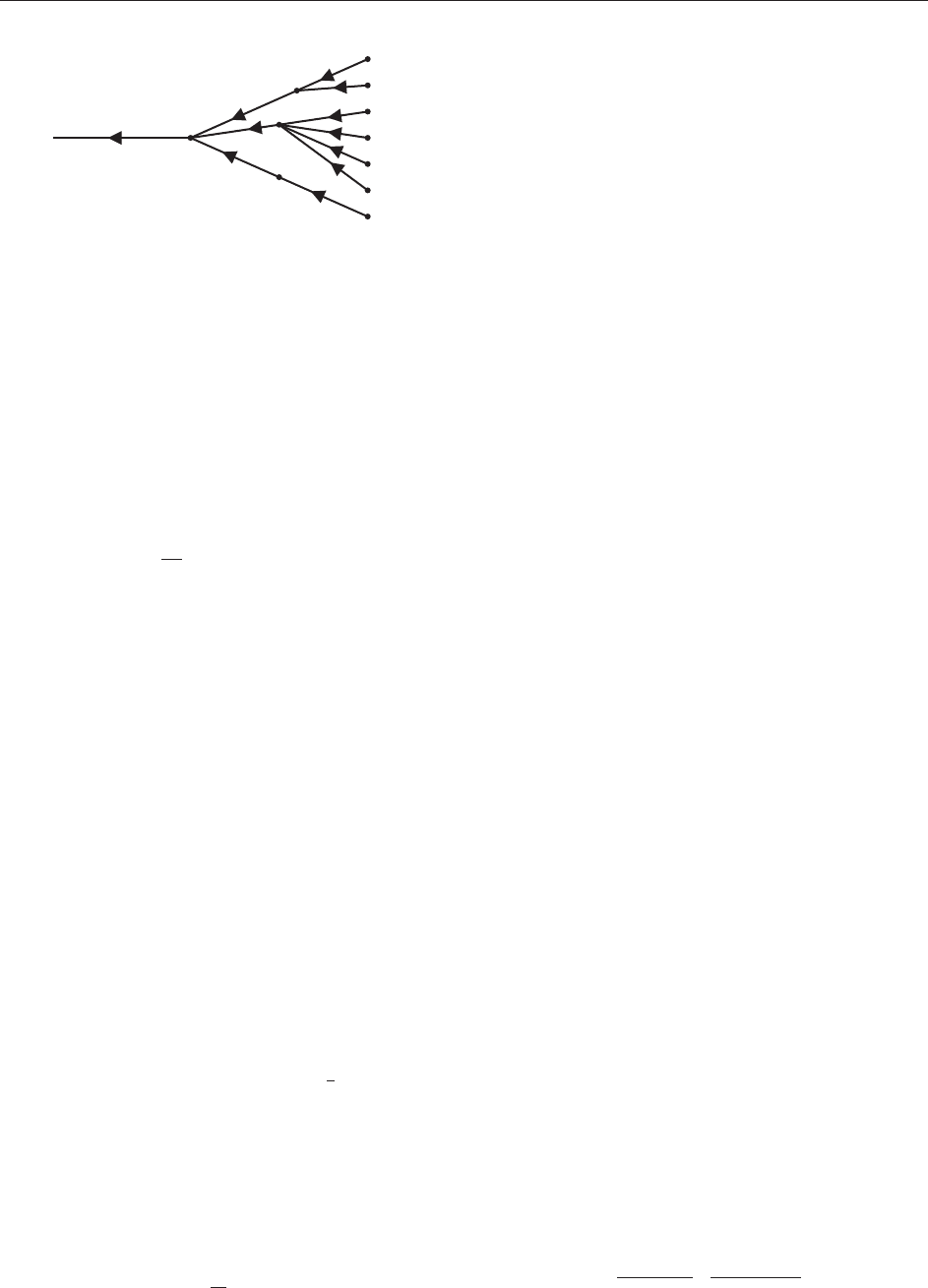
and then bifurcate arbitrarily (such trees are some-
times called ‘‘rooted trees’’).
Imagine the tree oriented from the endpoints
towards the root r (not to be considered a node)
and given a node v call v
0
the node immediately
following it. If v is the first node before the root r,
let v
0
= r and
v
0
= 1. For each such decorated tree
define its numerical value
ValðÞ¼
i
k!
Y
lines l¼v
0
v
ð
v
0
v
Þ
Y
nodes
c
v
½68
and define a current (l) on a line l = v
0
v to be the
sum of the harmonics of the nodes preceding
v
0
: (l) =
P
wv
v
. Call () the current flowing in
the root branch and call order of the number of
nodes (or branches). Then
h
ðkÞ
¼
X
;ðÞ¼
orderðÞ¼k
ValðÞ½69
provided trees are considered identical if they can be
overlapped (labels included) after suitably scaling
the lengths of their branches and pivoting them
around the nodes out of which they emerge (the root
is always imagined to be fixed at the origin).
If the trees are stripped of the harmonic labels,
their number is finite and it can be estimated to be
k!4
k
(because the labels which distinguish the lines
can be attached to an unlabeled tree in many ways).
The harmonic labels (i.e.,
v
= 1) can be laid
down in 2
k
ways, and the value of each tree can be
bounded by (1=k!)2
k
(because c
1
=
1
2
).
Hence
P
jh
(k)
j4
k
, which gives a (rough)
estimate of the radius of convergence of the
expansion of h in powers of ": namely 0.25 (easily
improvable to 0.3678 if 4
k
k! is replaced by k
k1
using Cayley’s formula for the enumeration of
rooted trees). A simple expression for h
(k)
( )
(L
AGRANGE)is
h
ðkÞ
ð Þ=
1
k!
@
k1
sin
k
(also readabl e from the tree representation): the
actual radius of convergence, first determined by
Laplace, of the series for h can also be determined
from the latter expression for h (R
OUCHE
´
) or directly
from the tree representation: it is 0.6627.
One can find better estimates or at least more
efficient methods for evaluating the sums in [69]:
in fact, in performing the sum in [69] important
cancellations occur. For instance, the harmonic
labels can be subject to the further strong constraint
that no line carries zero current because the
sum of the values of the trees of fixed order and
with at least one line carrying zero current
vanishes.
The above expansion can also be simplified by
partial resummations. For the purpose of an
example, let the nodes with one entering and one
exiting line (see Figure 5) be called as ‘‘simple’’
nodes. Then all tree graphs which, on any line
between two nonsimple nodes, contain any number
of simple nodes can be eliminated. This is done by
replacing, in evaluating the (remaining) tree values,
the factors
v
0
v
in [68] by
v
0
v
=(1 " cos ): then
the value of (denoted Val()
) for a tree becomes a
function of and " and [69] is replaced by
hð Þ¼
X
1
k¼1
X
; ðÞ¼
orderðÞ¼k
"
k
e
i
ValðÞ
½70
where the means that the trees are subject to the
further restriction of not containing any simple
node. It should be noted that the above graphical
representation of the solution of the Kepler equation
is strongly reminiscent of the representations of
quantities in terms of graphs that occur often in
quantum field theory. Here the trees correspond to
Feynman graphs, the factors associated with the
nodes are the couplings, the factors associated with
the lines are the propagators, and the resummations
are analogous to the self-energy resummations,
while the cancellations mentioned above can be
related to the class of identities called Ward
identities. Not only the analogy can be shown not
to be superficial, but it also turns out to be very
helpful in key mechanical problems: see Appendix 1.
The existence of a vast number of identities
relating the tree values is shown already by the
simple form of the Lagrange series and by the
even more remarkable resummation (L
EVI-CIVITA)
leading to
hð Þ¼
X
1
k¼1
ð" sin Þ
k
k!
1
1 " cos
@
k
½71
ν
ν
0
ν
1
ν
4
ν
5
ν
6
ν
7
ν
8
ν
9
ν
10
ν
3
ν
2
Figure 5 An example of a tree graph and its labels. It contains
only one simple node (3). Harmonics are indicated next to their
nodes. Labels distinguishing lines are not marked.
Introductory Article: Classical Mechanics 17

It is even possible to further collect the series
terms to express it as a series with much better
convergence properties; for instance, its terms can be
reorganized and collected (resummed) so that h is
expressed as a power series in the parameter
¼
" e
ffiffiffiffiffiffiffiffiffi
1 "
2
p
1 þ
ffiffiffiffiffiffiffiffiffiffiffiffiffi
1 "
2
p
½72
with radius of convergence 1, which corresponds to
" = 1 (via a simple argument by Levi-Civita). The
analyticity domain for the Lagrange series is jj < 1.
This also determines the value of Laplace radius,
which is the point closest to the origin of the
complex curve j(")j= 1: it is imaginary so that it is
the root of the equation
"e
ffiffiffiffiffiffiffiffiffi
1 þ"
2
p
=ð1 þ
ffiffiffiffiffiffiffiffiffiffiffiffiffi
1 þ "
2
p
Þ¼1
The analysis provides an example, in a simple
case of great interest in applications, of the kind of
computations actually ne cessar y to represent the
perturbing function in terms of a ction–angle
variables. The property that the function c()in
[66] is the cosine has been used only to limit the
range of the label to be 1; hence the same
method, with similar r esults, can be applied to
study the inversion of the relation between the
average anomaly and the true anomaly and to
efficiently obtain, for instance, the properties of
f, g in [42].
For more details, the reader is referred to Levi-
Civita (1956).
Lindstedt and Birkhoff Series:
Divergences
Nonexistence of constants of motion, rather than
being the end of the attempts to study motions close
to inte grable ones by perturbation methods, marks
the beginning of renewed efforts to understand their
nature.
Let (A, a) 2 U T
‘
be action–angle variables
defined in the integrability region for an analytic
Hamiltonian and let h(A) be its value in the action–
angle coordinates. Suppose that h(A
0
) is anisochro-
nous and let f (A, a) be an analytic perturbing
function. Consider, for " small, the Hamiltonian
H
"
(A, a) = H
0
(A) þ "f (A, a).
Let w
0
=w (A
0
)
A
H
0
(A ) be the freque ncy sp ec-
trum (see the section ‘‘Quasi periodicity and integ-
rabili ty’’) of one of the invar iant tori of the
unpertur bed system corre sponding to an action A
0
.
Short of inte grability, the questio n to ask at this
point is whether the perturbed system admits an
analytic invariant torus on which the motion is
quasiperiodic and
1. has the same spectrum w
0
,
2. depends analytically on " at least for " small,
3. reduces to the ‘‘unperturbed torus’’ {A
0
} T
‘
as
" !0.
More concretely, the question is:
Are there functions H
"
(y ), h
"
(y ) analytic in y 2 T
‘
and in " near 0, vanishing as " !0 and such that the
torus with parametric equations
A ¼ A
0
þ H
"
ðy Þ; a ¼ y þ h
"
ðy Þ; y 2 T
‘
½73
is invariant and, if w
0
=
def
w(A
0
), the motion on it is
simply y !y þw
0
t, i.e., it is quasiperiodic with
spectrum w
0
?
In this context, Poincare´’s theorem (in the section
‘‘Gener ic noninteg rability’’) had followed another
key result, earlier developed in particular cases and
completed by him, which provides a parti al answer
to the question.
Suppose that w
0
= w(A
0
) 2 R
‘
satisfies a Diophan-
tine property, namely suppose that there exist
constants C, >0 such that
jw
0
nj
1
Cjnj
; for all 0 6¼ n 2 Z
‘
½74
which, for each >‘ 1 fixed, is a property
enjoyed by all w 2 R
‘
but for a set of zero measure.
Then the motions on the unperturbed torus run over
trajectories that fill the torus densely because of the
‘‘irrationality’’ of w
0
implied by [74]. Writing
Hamilton’s equations,
_
a ¼ @
A
H
0
ðAÞþ" 
A
f ðA; aÞ;
_
A ¼" 
a
f ðA; aÞ
with A, a given by [73] with y replaced by y þ wt,
and using the density of the unperturbed trajectories
implied by [74], the condition that [73] are
equations for an invariant torus on which the
motion is y !y þ w
0
t are
w
0
þðw
0

y
Þh
"
ðy Þ¼
A
H
0
ðA
0
þH
"
ðy ÞÞ
þ"
A
f ðA
0
þH
"
ðy Þ; y þh
"
ðy ÞÞðw
0

y
ÞH
"
ðy Þ
¼" 
a
f ðA
0
þH
"
ðy Þ; y þh
"
ðy ÞÞ ½75
The theorem referred to above (P
OINCARE
´
) is that
Theorem 2 If the unperturbed system is anisochro-
nous and w
0
= w(A
0
) satisfies [74] for some C, >0
there exist two well defined power series h
"
(y ) =
P
1
k = 1
"
k
h
(k)
(y ) and H
"
(y ) =
P
1
k = 1
"
k
H
(k)
(y ) which
18 Introductory Article: Classical Mechanics

solve [75] to all orders in ". The series for H
"
is
uniquely determined, and such is also the series for
h
"
up to the addition of an arbitrary constant at each
order, so that it is unique if h
"
is required, as
henceforth done with no loss of generality, to have
zero average over y .
The algorithm for the construction is illustrated in
a simple case in the next section (see eqns [83],
[84]). Convergence of the above series, called
Lindstedt series, even for small " has been a problem
for rather a long time. Poincare´ proved the existence
of the formal solution; but his other result, discussed
in the sect ion ‘‘Gener ic noninte grabi lity,’’ casts
doubts on convergence although it does not exclude
it, as was im mediately stressed by several authors
(including Poincare´ himself). The result in that
section shows the impossibility of solving [75] for
all w
0
’s near a given spectrum, analytically and
uniformly, but it does not exclude the possibility of
solving it for a single w
0
.
The theorem admits several extensions or analogs:
an interesting one is to the case of isochronous
unperturbed systems:
Given the Hamiltonian H
"
(A, a) = w
0
A þ "f (A, a),
with w
0
satisfying [74] and f analytic, there exist
power series C
"
(A
0
, a
0
), u
"
(A
0
) such that H
"
(C
"
(A
0
, a
0
)) =
w
0
A
0
þ u
"
(A
0
) holds as an equality between formal
power series (i.e., order by order in ") and at the
same time the C
"
, regarded as a map, satisfies order by
order the condition (i.e., (4.3)) that it is a canonical map.
This means that there is a generating function
A
0
a þ F
"
(A
0
, a) also defined by a formal power
series F
"
(A
0
, a) =
P
1
k = 1
"
k
F
(k)
(A
0
, a), that is, such
that if C
"
(A
0
, a
0
) = (A, a) then it is true, order by
order in powers of ", that A = A
0
þ 
a
F
"
(A
0
, a) and
a
0
= a þ 
A
0
F
"
(A
0
, a). The series for F
"
, u
"
are called
Birkhoff series.
In this isochronous case, if Birkhoff series were
convergent for small " and (A
0
, a) in a region of the
form U T
‘,
with U R
‘
open and bounded, it
would follow that, for small ", H
"
would be inte-
grable in a large region of phase space (i.e., where the
generating function can be used to build a canonical
map: this would essentially be U T
‘
deprived of a
small layer of points near the boundary of U).
However, convergence for small " is false (in general),
as shown by the simple two-dimensional example
H
"
ðA; aÞ¼w
0
A þ " ðA
2
þ f ðaÞÞ
ðA; aÞ2R
2
T
2
½76
with f (a) an arbitrary analytic function with all
Fourier coefficients f
n
positive for n 6¼ 0 and f
o
= 0.
In the latter case, the solution is
u
"
ðA
0
Þ¼"A
2
F
"
ðA
0
; aÞ¼
X
1
k¼1
"
k
X
06¼n2Z
2
f
n
e
ian
ði
2
Þ
k
ðið!
01
1
þ !
02
2
ÞÞ
kþ1
½77
The series does not converge: in fact, its convergence
would imply integrability and, consequently,
bounded trajectories in phase space: however, the
equations of motio n for [76] can be easily solved
explicitly and in any open region near given initial
data there are other data which have unbounded
trajectories if !
01
=(!
02
þ ") is rational.
Nevertheless, even in this elementary case a
formal sum of the series yields
uðA
0
Þ¼"A
0
2
F
"
ðA
0
; aÞ¼"
X
06¼n2Z
2
f
n
e
ian
ið!
01
1
þð!
20
þ "Þ
2
Þ
½78
and the series in [78] (no longer a power series in ")
is really convergent if w = (!
01
, !
02
þ ") is a Dio-
phantine vector (by [74], because analyticity implies
exponential decay of jf
n
j). Remarkably, for such
values of " the Hamiltonian H
"
is integrable and it is
integrated by the canonical map generated by [78],
in spite of the fact that [78] is obtained, from [77],
via the nonrigorous sum rule
X
1
k¼0
z
k
¼
1
1 z
for z 6¼ 1 ½79
(applied to cases with jzj1, which are certainly
realized for a dense set of "’s even if w is Diophantine
because the z’s have values z =
2
=w
0
n). In other
words, the integration of the equations is elementary
and once performed it becomes apparent that, if w is
diophantine, the solutions can be rigorously found
from [78]. Note that, for instance, this means that
relations like
P
1
k = 0
2
k
= 1 are really used to obtain
[78] from [77].
Another extension of Lindst edt series arises in a
perturbation of an anisochronous system when
asking the question as to what happens to the
unperturbed invariant tori T
w
0
on which the spec-
trum is resonant, that is, w
0
n = 0 for some n 6¼ 0,
n 2 Z
‘
. The result is that even in such a case there is a
formal power series solution showing that at least
a few of the (infinitely many) invariant tori into
which T
w
0
is in turn foliated in the unperturbed case
can be formally continued at "6¼ 0 (see the section
‘‘Resonan ces an d their stabi lity’’).
For more details, we refer the reader to Poincare´
(1987).
Introductory Article: Classical Mechanics 19

Quasiperiodicity and KAM Stability
To discuss more advanced results, it is convenient
to restrict attention to a special (nontrivial) para-
digmatic case
H
"
ðA; aÞ¼
1
2
A
2
þ "f ðaÞ½80
In this simple case (called Thirring model: represent-
ing ‘ particles on a circle interacting via a potential
"f (a)) the equations for the maximal tori [75]
reduce to equations for the only funct ions h
"
:
ðw 
y
Þ
2
h
"
ðy Þ¼"
a
f ðy þh
"
ðy ÞÞ; y 2 T
‘
½81
as the second of [75] simply becomes the defi nition
of H
"
because the RHS does not involve H
"
.
The real problem is therefore whether the formal
series considered in the last section converge at least
for small ": and the example [76] on the Birkhoff
series shows that sometimes sum rules might be
needed in order to give a meaning to the series. In
fact, whenever a problem (of physical interest)
admits a formal power series solution which is not
convergent, or which is such that it is not known
whether it is convergent, then one should look for
sum rules for it.
The modern theory of perturbations starts with
the proof of the convergence for " small enough of
the Lindstedt series (K
OLMOGOROV). The general
‘‘KAM’’ result is:
Theorem 3 (KAM) Consider the Hamiltonian
H
"
(A, a) = h(A) þ "f (A, a), defined in U = V T
‘
with V R
‘
open and bounded and with f (A, a),
h(A) analytic in the closure
V T
‘
where h(A) is also
anisochronous; let w
0
=
def
w(A
0
) = @
A
h(A
0
) and assume
that w
0
satisfies [74]. Then
(i) there is "
C,
> 0 such that the Lindstedt series
converges for j"j <"
C,
;
(ii) its sum yields two function H
"
(y ), h
"
(y ) on T
‘
which parametrize an invariant torus
T
C,
(A
0
, ");
(iii) on T
C,
(A
0
, ") the motion is y ! y þ w
0
t, see
[73]; and
(iv) the set of data in U which belong to invariant
tori T
C,
(A
0
, ") with w (A
0
) satisfying [74]
with prefixed C, has complement with volume
<const C
a
for a suitable a > 0 and with area
also <const C
a
on each nontrivial surface of
constant energy H
"
= E.
In other words, for small " the spectra of most
unperturbed quasiperiodic motions can still be found
as spectra of perturbed quasiperiodic motions devel-
oping on tori which are close to the corresponding
unperturbed ones (i.e., with the same spectrum).
This is a stability result: for instance, in systems
with two degrees of freedom the invariant tori of
dimension two which lie on a given three-dimensional
energy surface, will separate the points on the energy
surface into the set which is ‘‘inside’’ the torus and the
set which is ‘‘outside.’’ Hence, an initial datum
starting (say) inside cannot reach the outside. Like-
wise, a point starting between two tori has to stay in
between forever. Further, if the two tori are close, this
means that motion will stay very localized in action
space, with a trajectory accessing only points close to
the tori and coming close to all such points, within a
distance of the order of the distance between the
confining tori. The case of three or more degrees of
freedom is quite different (see sections ‘‘Diffusion in
pha se s pa ce’’ a nd ‘‘ The t hr ee -body p rob le m’’ ).
In the simple case of the rotators syst em [80] the
equations for the parametric representation of the
tori are given by [81]. The latter bear some analogy
with the easier problem in [66]: but [81] are ‘
equations instead of one and they are differential
equations rather than ordinary equations. Further-
more, the function f (a) which plays here the role of
c()in[66] has Fourier coefficient f
n
with no
restrictions on n, while the Fourier coefficients c
for c in [66] do not vanish only for = 1.
The above differences are, to some extent,
‘‘minor’’ and the power series solution to [81] can
be constructed by the same algorithm as used in the
case of [66]: namely one forms trees as in Figure 5
with the harmonic labels
v
2 Z replaced by n
v
2 Z
‘
(still to be thought of as possible harmonic indices in
the Fourier expansion of the perturbing funct ion f).
All other labels affixed to the trees in the section
‘‘Gener ic nonin tegrability ’’ will be the same . In
particular, the current flowing on a branch l = v
0
v
will be defined as the sum of the harmonics of the
nodes w v preceding v:
nðlÞ¼
def
X
wv
n
w
½82
and we call n() the current flowing in the root
branch.
Here the value Val() of a tree has to be defined
differently because the equation to be solved ([81])
contains the differential operator (w
0

y
)
2
which,
when Fourier transformed, becomes multiplication
of the Fourier component with harmonic n by
(iw n)
2
.
The variation due to the presence of the operator
(w
0

y
)
2
and the necessity of its inversion in the
evaluation of u h
(k)
n
, that is, of the component of
h
(k)
n
along an arbitrar y unit vector u, is nevertheless
quite simple: the value of a tree graph of order k
20 Introductory Article: Classical Mechanics
(i.e., with k nodes and k branches) has to be defined
by (cf. [68])
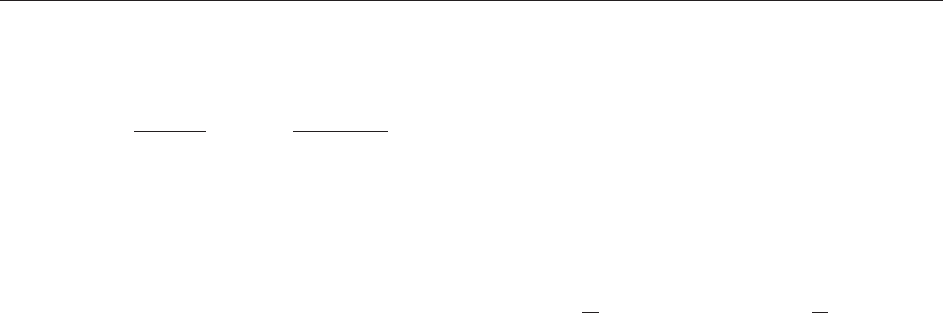
ValðÞ¼
def
ið1Þ
k
k!
Y
lines l¼v
0
v
n
v
0
n
v
ðw
0
nðlÞÞ
2
!
Y
nodes v
f
n
v
!
½83
where the n
v
0
appearing in the factor relative to the
root line rv from the first node v to the root r (see
Figure 5) is interpreted as a unit vector u (it was
interpreted as 1 in the one-dimensional case [66] ).
Equation [83] makes sense only for trees in which
no line carries zero current. Then the component
along u (the harmonic label attached to the root of a
tree) of h
(k)
is given (see also [69])by
u h
ðkÞ
n
¼
X
; nðÞ¼n
orderðÞ¼k
ValðÞ½84
where the means that the sum is only over trees in
which a nonzero current n(l) flows on the lines l 2 .
The quantity u h
(k)
0
will be defined to be 0 (see the
previous section).
In the case of [66] zero-current lines could appear:
but the con tributions from tree graphs containing at
least one zero current line woul d cancel. In the
present case, the statement that the above algorithm
actually gives h
(k)
n
by simply ignoring trees with lines
with zero current is nontrivial. It was Poincare´’s
contribution to the theory of Lindstedt series to show
that even in the general case (cf. [75]) the equations
for the invariant tori can be solved by a formal power
series. Equation [84] is proved by induction on k after
checking it for the first few orders.
The algorithm just described leading to [83] can
be extended to the case of the general Hamiltonian
considered in the KAM theorem.
The convergence proof is more delicate than the
(elementary) one for eqn [66]. In fact, the values of
trees of order k can give large contributions to h
(k)
n
:
because the ‘ ‘new’’ factors (w
0
n(l))
2
, although not
zero, can be quite small and their small size can
overwhelm the smallness of the factors f
n
and ".In
fact, even if f is a trigonometric polynomial (so that f
n
vanishes identically for jnj large enough) the currents
flowing in the branches can be very large, of the
order of the number k of nodes in the tree; see [82].
This is called the small-divisors problem. The key
to its solution goes back to a related work (S
IEGEL)
which shows that
Theorem 4 Consider the contribution to the sum
in [82] from graphs in which no pairs of lines
which lie on the same path to the root carry the
same current and, furthermore, the node harmonics
are bounded by jnjN for some N. Then the
number of lines ‘ in with divisor w
0
n
‘
satisfying
2
n
< Cjw
0
n
‘
j2
nþ1
does not exceed 4Nk2
n=
.
Hence, setting
F ¼
def
C
2
max
jnjN
jf
n
j
the corresponding Val() can be bounded by
1
k!
F
k
N
2k
Y
1
n¼0
2
2nð4Nk2
n=
Þ
¼
def
1
k!
B
k
B ¼ FN
2
2
X
n
8n2
n=
½85
since the product is convergent. In the case in which
f is a trigonometric polynomial of degree N, the
above restricted con tributions to u h
(k)
n
would
generate a convergent series for " small enough. In
fact, the number of trees is bounde d (as in the
section ‘‘Per turbing funct ions’’) by k! 4
k
(2Nþ 1)
‘k
so
that the series
P
n
j"j
k
ju h
(k)
n
j would converge for
small " (i.e., j"j < (B 4(2N þ 1)
‘
)
1
).
Given this comment, the analysis of the ‘‘remain-
ing contributions’’ becomes the real problem, and it
requires new ideas because among the excluded trees
there are some simple kth order trees whose value
alone, if considered separately from the other
contributions, would generate a factorially divergent
power series in ".
However, the contributions of all large-valued
trees of order k can be shown to cancel: although
not exactly (unlike the case of the elementary
proble m in the sect ion ‘‘Perturbi ng funct ions,’’
where the cancellation is not necessary for the
proof, in spite of its exact occurrence), but enough
so that in spite of the existence of exceedingly large
values of individual tree graphs their total sum can
still be bounded by a constant to the power k so that
the power series actually converges for " small
enough. The idea is discussed in Appendix 1.
For more details, the reader is referred to Poincare´
(1987), Kolmogorov (1954), Moser (1962),andArnol’d
(1989).
Resonances and their Stability
A quasiperiodic motion with r rationally indepen-
dent frequencies is called resonant if r is strictly less
than the number of degrees of freedom, ‘. The
difference s = ‘ r is the degree of the resonance.
Of particular interest are the cases of a perturba-
tion of an inte grable system in which resonant
motions take place.
Introductory Article: Classical Mechanics 21

A typical example is the n-body problem which
studies the mutual perturbations of the motions of
n 1 particles gravitating around a more massive
particle. If the particle masses can be considered to
be negligible, the system will consist of n 1 central
Keplerian motions: it will therefore have ‘ = 3(n 1)
degrees of freedom. In general, only one frequency
per body occurs in the absence of the perturbations
(the period of the Keplerian orbit). Hence, r n 1
and s 2(n 1) (or in the planar case s (n 1))
with equality holding when the periods are ration-
ally independent.
Another example is the rigid body with a fixed
point perturbed by a conservative force: in this case,
the unperturbed syst em has three degrees of freedom
but, in general, only two frequencies (see the
discussion following [52]).
Furthermore, in the above exampl es there is the
possibility that the independent frequencies assume,
for special initial data, values which are rationally
related, giving rise to resonances of even higher
order (i.e., with smaller values of r).
In an integrable anisochronous system, resonant
motions will be dense in phase space because the
frequencies w(A) will vary as much as the actions
and therefore resonances of any order (i.e., any
r <‘) will be dense in phase spa ce: in particular, the
periodic motions (i.e., the highest-order resonances)
will be dense.
Resonances, in integrable systems, can arise in
a priori stable integrable systems and in a priori
unstable systems: the former are systems whose
Hamiltonian admits canonical action–angle coordi-
nates (A, a) 2U T
‘
with U R
‘
open, while the
latter are systems whose Hamiltoni an has, in
suitable local canonical coordi nates, the form
H
0
ðAÞþ
X
s
1
i¼1
1
2
ðp
2
i
2
i
q
2
i
Þþ
X
s
2
j¼1
1
2
ð
2
j
þ
2
j
2
j
Þ;
i
;
j
> 0
½86
where (A, a) 2U T
r
, U 2R
r
,(p, q) 2V R
2s
1
,
(p, k )2V
0
R
2s
2
with V,V
0
neighborhoods of the
origin and ‘ = r þs
1
þs
2
, s
i
0, s
1
þs
2
> 0 and
ffiffiffiffi
j
p
,
ffiffiffiffiffi
j
p
are called Lyapunov coefficients of
the resonance. The perturbations considered are
supposed to have the form "f (A, a, p, q, p, k). The
denomination of a priori stable or unstable refers to
the properties of the ‘‘a priori given unperturbed
Hamiltonian.’’ The label ‘‘a priori unstable’’ is
certainly appropriate if s
1
> 0: here also s
1
= 0is
allowed for notational convenience implying that the
Lyapunov coefficients in a priori unstable cases are all
of order 1 (whether real
j
or imaginary i
ffiffiffiffiffi
j
p
). In
other words, the a priori stable case, s
1
= s
2
= 0in
[86], is the only excluded case. Of course, the stability
properties of the motions when a perturbation acts
will depend on the perturbation in both cases.
The a priori stable systems usually have a great
variety of resonances (e.g., in the anisochronous
case, resonances of any dimension are dense). The
a priori unstable systems have (among possible other
resonances) some very special r-dimensional
resonances occurring when the unstable coordinates
(p, q)and(p, k) are zero and the frequencies of the r
action–angle coordinates are rationally independent.
In the first case (a priori stable), the general
question is whether the resonant motions, which
form invariant tori of dimension r arranged into
families that fill ‘-dimensional invariant tori, con-
tinue to exist, in presence of small enough perturba-
tions "f (A, a), on slightly deformed invariant tori.
Similar questions can be asked in the a priori
unstable cases. To examine the matter more closely
consider the formulation of the simplest problems.
A priori stable resonances: more precisely, suppose
H
0
=
1
2
A
2
and let {A
0
} T
‘
be the unperturbed
invariant torus T
A
0
with spectrum w
0
= w(A
0
) =
@
A
H
0
(A
0
) with only r rationally independent compo-
nents. For simplicity, suppose that w
0
= (!
1
, ...,
!
r
,0,...,0) =
def
(w, 0)withw 2 R
r
. The more general
case in which w has only r rationally independent
components can be reduced to the special case above
by a canonical linear change of coordinates at the price
of changing the H
0
to a new one, still quadratic in the
actions but containing mixed products A
i
B
j
:theproofs
of the results that are discussed here would not be
really affected by such more general form of H.
It is convenient to distinguish between the ‘‘fast’’
angles
1
, ...,
r
and the ‘‘resonant’’ angles
rþ1
, ...,
‘
(also called ‘‘slow’’ or ‘‘secular’’) and
call a = (a
0
, b) with a
0
2 T
r
and b 2 T
s
. Likewi se,
we distinguish the fast actions A
0
= (A
1
, ..., A
r
) and
the resonant ones A
rþ1
, ..., A
‘
and set A = (A
0
, B)
with A
0
2 R
r
and B 2 R
s
.
Therefore, the torus T
A
0
, A
0
= (A
0
0
, B
0
), is in turn a
continuum of invariant tori T
A
0
, b
with trivial
parametric equations: b fixed, a
0
= y , y 2 T
r
, and
A
0
= A
0
0
, B = B
0
. On each of them the motion is:
A
0
, B, b constant and a
0
!a
0
þ wt, with rationally
independent w 2 R
r
.
Then the natural question is whether there exist
functions h
"
, k
"
, H
"
, K
"
smooth in " near " = 0andin
y 2 T
r
, vanishing for " = 0, and such that the torus
T
A
0
, b
0
, "
with parametric equations
A
0
¼A
0
0
þH
"
ðy Þ;
B ¼B
0
þK
"
ðy Þ;
a
0
¼y þh
"
ðy Þ;
b ¼ b
0
þk
"
ðy Þ
y 2T
r
½87
22 Introductory Article: Classical Mechanics

is invariant for the motions with Hamiltonian
H
"
ðA; aÞ¼
1
2
A
0
2
þ
1
2
B
2
þ "f ða
0
; bÞ
and the motions on it are y !y þ wt. The above
property, when satisfied, is summarized by saying
that the unperturbed resonant motions
A = (A
0
0
, B
0
), a = (a
0
0
þ w
0
t, b
0
) can be continued in
presence of perturbation "f , for small ", to quasiper-
iodic motions with the same spectrum and on a
slightly deformed torus T
A
0
0
, b
0
, "
.
A priori unstable resonances: here the question is
whether the special invariant tori continue to exist
in presence of small enough perturbations, of
course slightly deformed. This means asking
whether, given A
0
such that w(A
0
) = @
A
H
0
(A
0
) has
rationally independent components, there are func-
tions (H
"
(y ), h
"
(y )), (P
"
(y ), Q
"
(y )) and (P
"
(y ),
K
"
(y )) smooth in " near " = 0, vanishing for " = 0,
analytic in y 2 T
r
and such that the r-dimensional
surface
A ¼ A
0
þ H
"
ðy Þ;
p ¼ P
"
ðy Þ;
p ¼ P
"
ðy Þ;
a ¼ y þ h
"
ðy Þ
q ¼ Q
"
ðy Þ
k ¼ K
"
ðy Þ
y 2 T
r
½88
is an invariant torus T
A
0, "
on which the motion is
y !y þ w(A
0
)t. Again, the above property is
summarized by saying that the unperturbed special
resonant motions can be continued in presence of
perturbation "f for small " to quasiperiodic motions
with the same spectrum and on a slightly deformed
torus T
A
0
, "
.
Some answers to the above questions are pre-
sented in the following section. For more details, the
reader is referred to Gallavotti et al. (2004).
Resonances and Lindstedt Series
We discuss eqns [87] in the paradigmatic case in
which the Hamiltonian H
0
(A)is
1
2
A
2
(cf. [80]). It
will be w(A
0
) A
0
so that A
0
= w, B
0
= 0 and the
perturbation f (a) can be considered as a function
of a = (a
0
, b): let f ( b) be defined as its average over
a
0
. The determination of the invariant torus of
dimension r which can be continued in the sense
discussed in the last section is easily understood in
this case.
A resonant invariant torus which, among the tori
T
A
0
, b
, has parametric equations that can be con-
tinued as a formal power series in " is the torus
T
A
0
, b
0
with b
0
a stationarity point for f ( b), that is,
an equilibrium point for the average perturbation:
@
b
f ( b
0
) = 0. In fact, the following theorem holds:
Theorem 5 If w 2 R
r
satisfies a Diophantine
property and if b
0
is a nondegenerate stationarity
point for the ‘‘fast angle average’’
f ( b) (i.e., such
that det @
2
bb
f ( b
0
) 6¼ 0), then the following equations
for the functions h
"
, k
"
,
ðw @
y
Þ
2
h
"
ðy Þ¼"@
a
0
f ðy þh
"
ðy Þ; b
0
þk
"
ðy ÞÞ
ðw @
y
Þ
2
k
"
ðy Þ¼"@
b
f ðy þh
"
ðy Þþk
"
ðy ÞÞ
½89
can be formally solved in powers of ".
Given the simplicity of the Hamiltonian [80] that
we are considering, it is not necessary to discuss the
functions H
"
, K
"
because the equations that they
should obey reduce to their definitions as in the
section ‘‘Quasip eriodicity and KAM stability ,’’ and
for the same reason.
In other words, also the resonant tori admit a
Lindstedt series representation . It is however very
unlikely that the series are, in general, convergent.
Physically, this new aspect is due to the fact that
the linearization of the motion near the torus T
A
0
, b
0
introduces oscillatory motions around T
A
0
0
, b
0
with
frequencies proportional to the square roots of the
positive eigenvalues of the matrix "@
2
bb
f ( b
0
): there-
fore, it is naively expected that it has to be necessary
that a Diophantine property be required on the
vector (w,
ffiffiffiffiffiffiffiffi
"
1
p
, ...), where "
j
are the positive
eigenvalues. Hence, some values of ", namely those
for which (w,
ffiffiffiffiffiffiffiffi
"
1
p
, ...) is not a Diophantine vector
or is too close to a non-Diophantine vector, should
be excluded or at least should be expected to
generate difficulties. Note that the problem arises
irrespective of the assumptions about the nonde-
generate matrix @
2
bb
f ( b
0
) (since " can have either
sign), and no matter how small j"j is supposed to be.
But we can expect that if the matrix @
2
bb
f ( b
0
)is
(say) positive definite (i.e., b
0
is a minimum point
for
f ( b)) then the problem should be easier for "<0
and vice versa, if b
0
is a maximum, it should be
easier for ">0 (i.e., in the cases in which the
eigenvalues of "@
2
bb
f ( b
0
) are negative and their roots
do not have the interpretation of frequencies).
Technically, the sums of the formal series can be
given (so far) a meaning only via summation rules
involving divergent series: typically, one has to
identify in the formal expressions (denumerably
many) geometric series which, although divergent,
can be given a meaning by applying the rule [79].
Since the rule can only be applied if z 6¼ 1, this leads
to conditions on the parameter ", in order to exclude
that the various z that have to be considered are very
close to 1. Hence, this stability result turns out to be
rather different from the KAM result for the
maximal tori. Namely the series can be given a
Introductory Article: Classical Mechanics 23

meaning via summation rules provided f and b
0
satisfy certain additional conditions and provided
certain values of " are excluded. An example of a
theorem is the following:
Theorem 6 Given the Hamiltonian [80] and a
resonant torus T
A
0
0
, b
0
with w = A
0
0
2 R
r
satisfying a
Diophantine property let b
0
be a nondegenerate
maximum point for the average potential
f ( b) =
def
(2)
r
R
T
r
f (a
0
, b)d
r
a
0
. Consider the Lindstedt series
solution for eqns [89] of the perturbed resonant
torus with spectrum (w, 0). It is possible to express
the single nth-order term of the series as a sum of
many terms and then rearrange the series thus
obtained so that the resummed series converges for
" in a domain E which contains a segment [0, "
0
] and
also a subset of ["
0
,0] which, although with open
dense complement, is so large that it has 0 as a
Lebesgue density point. Furthermore, the resummed
series for h
"
, k
"
define an invariant r-dimensional
analytic torus with spectrum w.
More generally, if b
0
is only a nondegenerate
stationarity point for
f ( b), the domain of definition
of the resummed series is a set E["
0
, "
0
] which
on both sides of the origin has an open dense
complement although it has 0 as a Lebesgue density
point.
Theorem 6 can be naturally extended to the
general case in which the Hamiltonian is the most
general perturbation of an anisochronous integrable
system H
"
(A, a) = h(A) þ "f(A, a)if@
2
AA
h is a non-
singular matrix and the resonance arises from a
spectrum w(A
0
) which has r independent compo-
nents (while the remaining are not necessarily zero).
We see that the convergence is a delicate problem
for the Lindstedt series for nearly integrable reso-
nant motions. They might even be divergent
(mathematically, a proof of divergence is an open
problem but it is a very reasonable conjecture in
view of the above physical interpretation); never-
theless, Theorem 6 shows that sum rules can be
given that sometimes (i.e., for " in a large set near
" = 0) yield a true solution to the problem.
This is reminiscent of the phenomenon met in
discussing perturbations of isochronous systems in
[76], but it is a much more complex situation. It
leaves many open problems: foremost among them
is the question of uniqueness. The sum rules of
divergent series always contain some arbitrary
choices, which lead to doubts about the uniqueness
of the functions parametrizing the invariant tori
constructed in this way. It might even be that the
convergence set E may depend upon the arbitrary
choices, and that considering several of them no "
with j"j <"
0
is left out.
The case of a priori unstable systems has also
been widely studied. In this case too resonances
with Diophantine r-dimensional spectrum w are
considered. However, in the case s
2
= 0 (called a
priori unstable hyperbolic resonance) the Lindstedt
series can be shown to be convergent, while in the
case s
1
= 0 (called a priori unstable elliptic reso-
nance) or in the mixed cases s
1
, s
2
> 0 extra
conditions are needed. They involve w and
m = (
1
, ...,
s
2
) (cf. [86]) and properties of the
perturbations as well. It is also possible to study a
slightly different problem: namely to look for
conditions on w, m, f which imply that, for small
", invariant tori with spectrum "-dependent but
close, in a suitable sense, to w exist.
The literature is vast, but it seems fair to say that,
given the above comments, particularly those con-
cerning uniqueness and analyticity, the situation is still
quite unsatisfactory. We refer the reader to Gallavotti
et al. (2004) for more details.
Diffusion in Phase Space
The KAM theorem implies that a perturbation of an
analytic anisochronous inte grable system, i.e., with
an analytic Hamiltonian H
"
(A, a) = H
0
(A) þ
"f (A, a) and nondegenerate Hessian matrix
@
2
AA
h(A), generates large families of maximal invar-
iant tori. Such tori lie on the energy surfaces but do
not have codimension 1 on them, i.e., they do not
split the (2‘ 1)–dimensional energy surfaces into
disconnected regions except, of course, in the case of
systems with two degrees of freedo m (see the section
‘‘Qu asiperio dicity and KAM stability ’’).
The refore, there might exist trajectories with
initial data close to A
i
in action space which reach
phase space points close to A
f
6¼ A
i
in action space
for " 6¼ 0, no matter how small. Such diffusion
phenomenon would occur in spite of the fact that
the corresponding trajectory has to move in a space
in which very close to each {A} T
‘
there is an
invariant surface on which points move keeping
A constant within O("), which for " small can be
jA
f
A
i
j.
In a priori unstable systems (cf. the section
‘‘Resonan ces and thei r stabi lity’’) wi th s
1
= 1,
s
2
= 0, it is not difficult to see that the correspond-
ing phenomenon can actually occur: the pa radig-
matic example (A
RNOL’D) is the a priori unstable
system
H
"
¼
A
2
1
2
þ A
2
þ
p
2
2
þ gðcos q 1Þ
þ "ðcos
1
þ sin
2
Þðcos q 1Þ½90
24 Introductory Article: Classical Mechanics