
Francoise J.-P., Naber G.L., Tsun T.S. (editors) Encyclopedia of Mathematical Physics
Подождите немного. Документ загружается.


corresponding to the two classical observables f and
g, which have the Poisson bracket {f , g}, defined via
the 2-form !. We then check if the quantization
condition
d
ff; gg¼
2
ih
½
b
f ;
b
g½60
where h is Planck’s constant, is satisfied. Generally
this will be the case for a certain number of classical
observables. This method of quantization has been
most successfully used for manifolds X which have a
(complex) Ka¨hler structure. Over such a manifold,
one can define a Hilbert space of analytic functions,
which has a reproducing kernel and hence a
naturally associated set of coherent states. As a
specific example, we take the case of canonical
coherent states [11]. We can identify the complex
plane C with the phase space R
2
of a free classical
particle having a single degree of freedom. The
measure d! in this case is just (1=2)dq dp.Ifwe
now quantize the classical observables f (q, p) = q
and f (q, p) = p, of position and momentum, respec-
tively, using the canonical coherent states, we obtain
the two operators
Q ¼
Z
R
2
qjq; pihq; pj
dq dp
2
P ¼
Z
R
2
pjq; pihq; pj
dq dp
2
½61
It can be verified that these two operators satisfy the
canonical commutation relations [Q, P] = iI
H
,as
required.
See also: Solitons and Kac–Moody Lie Algebras;
Wavelets: Mathematical Theory.
Further Reading
Ali ST, Antoine J-P, and Gazeau J-P (2000) Coherent States,
Wavelets and Their Generalizations. New York: Springer.
Ali ST and Englisˇ M (2005) Quantization methods – a guide for
physicists and analysts. Reviews in Mathematical Physics
17: 391–490.
Brif C (1997) SU(2) and SU(1,1) algebra eigenstates: a unified
analytic approach to coherent and intelligent states. Interna-
tional Journal of Theoretical Physics 36: 1651–1682.
Klauder JR and Sudarshan ECG (1968) Fundamentals of
Quantum Optics. New York: Benjamin.
Klauder JR and Skagerstam BS (1985) Coherent States –
Applications in Physics and Mathematical Physics. Singapore:
World Scientific.
Perelomov AM (1986) Generalized Coherent States and their
Applications. Berlin: Springer.
Schro¨ dinger E (1926) Der stetige U
¨
bergang von der Mikro- zur
Makromechanik. Naturwissenschaften 14: 664–666.
Sivakumar S (2000) Studies on nonlinear coherent states. Journal
of Optics B: Quantum Semiclass. Opt. 2: R61–R75.
Zhang W-M, Feng DH, and Gilmore RG (1990) Coherent states:
theory and some applications. Reviews of Modern Physics
62: 867–927.
Cohomology Theories
U Tillmann, University of Oxford, Oxford, UK
ª 2006 Elsevier Ltd. All rights reserved.
Introduction
The origins of cohomology theory are found in
topology and algebra at the beginning of the last
century but since then it has become a tool of nearly
every branch of mathematics. It’s a way of life!
Naturally, this article can only give a glimpse at the
rich subject. We take here the point of view of
algebraic topology and discuss only the cohomology
of spaces.
Cohomology reflects the global properties of a
manifold, or more generally of a topological space.
It has two crucial properties: it only depends on the
homotopy type of the space and is determined by
local data. The latter property makes it in general
computable.
To illustrate the interplay between the local and
global structure, consider the Euler characteristic of
a compact manifold; as will be explained below,
cohomology is a refinement of the Euler character-
istic. For simplicity, assume that the manifold M is a
surface and that we have chosen a way of dividing
the surface into triangles. The Euler characteristic is
then defined to be
ðMÞ¼F E þ V
where F denotes the number of faces, E the number
of edges, and V the number of vertices in the
triangulation. Remarkably, this number does not
depend on the triangulation. Yet, this simple, easy to
compute number can already distinguish the differ-
ent types of closed, oriented surfaces: for the sphere
we have = 2, the torus = 0, and in general for
any surface M
g
of genus g
ðM
g
Þ¼2 2g
Cohomology Theories 545

The Euler characteristic also tells us something
about the geometry and analysis of the manifold. For
example, the total curvature of a surface is equal to its
Euler characteristic. This is the Gauss–Bonnet theo-
rem and an analogous result holds in higher dimen-
sions. Another striking result is the Poincare´–Hopf
theorem which equates the Euler characteristic with
the total index of a vector field and thus gives strong
restrictions on what kind of vector fields can exist on
a manifold. This interplay between global analysis
and topology has been one of the most exciting and
fruitful research areas and is most powerfully
expressed in the celebrated Atiyah–Singer index
theorem, which determines the analytic index of an
elliptic operator, such as the Dirac operator on a spin
manifold, in terms of cohomology classes.
Chain Complexes and Homology
There are several different geometric definitions of
the cohomology of a topological space. All share
some basic algebraic structure which we will explain
first.
A ‘‘chain complex’’ (C
, @
)
C
iþ1
!
@
iþ1
C
i
!
@
i
C
i1
!
@
1
C
0
½1
is a collection of vector spaces (or R-modules more
generally) C
i
, i 0, and linear maps (R-module
maps) @
i
: C
i
!C
i1
with the property that for all i
@
i
@
iþ1
¼ 0 ½2
The scalar fields one tends to consider are the
rationals Q, reals R, complex numbers C,ora
primary field Z
p
, while the most important ring R is
the ring of integers Z though we will also consider
localizations such as Z[1=p], which has the effect of
suppressing any p-primary torsion information.
Of particular interest are the elements in C
i
that are
mapped to zero by @
i
,thei-dimensional ‘‘cycles,’’ and
those that are in the image of @
iþ1
,thei-dimensional
‘‘boundaries.’’ Because of [2], every boundary is a
cycle, and we may define the quotient vector space
(R-module), the ith-dimensional homology,
H
i
ðC
; @
Þ :¼
ker@
i
im@
iþ1
½3
(C
, @
) is ‘‘exact’’ if all its cycles are boundaries.
Homology thus measures to what extent the
sequence [1] fails to be exact.
Simplicial Homology
A triangulation of a surface gives rise to its
‘‘simplicial’’ chain complex: Taking coefficients in
Z, C
2
, C
1
, C
0
are the free abelian groups generated
by the set of faces, edges, and vertices, respectively;
C
i
= {0} for i 3. The map @
2
assigns to a triangle
the sum of its edges; @
1
maps an edge to the sum of
its endpoints. If we are working with Z
2
coeffi-
cients, this defines for us a chain complex as [2] is
clearly satisfied; in general, one needs to keep track
of the orientations of the triangles and edges and
take sums with appropriate signs (cf. [6] below). An
easy calculation shows that for an oriented, closed
surface M
g
of genus g, we have
H
0
ðM
g
; ZÞ¼Z
H
1
ðM
g
; ZÞ¼Z
2g
H
2
ðM
g
; ZÞ¼Z
H
i
ðM
g
; ZÞ¼0 for i 3
½4
Note that the Euler characteristic can be recov-
ered as the alternating sum of the rank of the
homology groups:
ðMÞ¼
X
dim M
i¼0
ð1Þ
i
rk H
i
ðM; ZÞ½5
Every smooth manifold M has a triangulation, so
that its simplicial homology can be defined just as
above. More generally, simplicial homology can be
defined for any simplicial space, that is, a space that
is built up out of points, edges, triangles, tetrahedra,
etc. Formula [5] remains valid for any compact
manifold or simplicial space.
Singular Homology
Let X be any topological space, and let 4
n
be the
oriented n-simplex [v
0
, ..., v
n
] spanned by the
standard basis vectors v
i
in R
nþ1
. The set of singular
n-chains S
n
(X) is the free abelian group on the set of
continuous maps : 4
n
!X. The boundary of is
defined by the alternating sum of the restriction of
to the faces of 4
n
:
@
n
ðÞ:¼
X
n
i¼0
ð1Þ
i
j
½v
0
;...;
^
v
i
;...;v
n
½6
One easily checks that the boundary of a boundary is
zero, and hence (S
(X), @
) defines a chain complex.
Its homology is by definition the singular homology
H
(X; Z)ofX. For any simplicial space, the inclusion
of the simplicial chains into the singular chains
induces an isomorphism of homology groups. In
particular, this implies that the simplicial homology
of a manifold, and hence its Euler characteristic do
not depend on its triangulation.
If in the definition of simplicial and singular
homology we take free R-modules (where R may
546 Cohomology Theories

also be a field) instead of free abelian groups, we get
the homology H
(X; R)ofX with coefficients in R.
The ‘‘universal-coefficient theorem’’ describes the
homology with arbitrary coefficients in terms of the
homology with integer coefficients. In particular, if R
is a field of characteristic zero,
dim H
n
ðX; RÞ¼rk H
n
ðX; ZÞ
Basic Properties of Singular Homology
While simplicial homology (and the more efficient
cellular homology which we will not discuss) is
easier to compute and easier to understand geome-
trically, singular homology lends itself more easily to
theoretical treatment.
1. Homotopy invariance. Any continuous map
f : X !Y induces a map on homology
f
: H
(X; R) !H
(Y; R) which only depends on
the homotopy class of f.
In particular, a homotopy equivalence f : X !Y
induces an isomorphism in homology. So, for exam-
ple, the inclusion of the circle S
1
into the punctured
plane Cn {0} is a homotopy equivalence, and thus
H
i
ðCnf0g; RÞ’H
i
ðS
1
; RÞ
¼
Z for i ¼ 0; 1
0 for i 2
For the one point space we have H
0
(pt; R) = R. Define
reduced homology by
~
H
(X; R):= ker(H
(X; R) !
H
(pt; R)).
2. Dimension axiom.
~
H
i
(pt; R) = 0 for all i.
More generally, it follows immediately from the
definition of simplicial homology that the homology
of any n-dimensional manifold is zero in dimensions
larger than n.
We mentioned in the introduction that homology
depends only on local data. This is made precise
by the
3. Mayer–Vietoris theorem. Let X = A [ B be the
union of two open subspaces. Then the following
sequence is exact:
!H
n
ðA \ B; RÞ!H
n
ðA; RÞH
n
ðB; RÞ
!H
n
ðX; RÞ!
@
H
n1
ðA \ B; RÞ
! !H
0
ðX; RÞ!0
On the level of chains, the first map is induced by the
diagonal inclusion, while the second map takes the
difference between the first and second summands.
Finally, @ takes a cycle c = a þ b in the chains of X
that can be expressed as the sum of a chain a in A
and b in B to @c := @
n
a = @
n
b. For example,
consider two cones, A and B, on a space X and
identify them at the base X to define the suspension
X of X.ThenX = A [ B with A, B ’ pt and A \
B ’ X. The boundary map @ is then an isomorphism:
~
H
n
ðX; RÞ’H
nþ1
ðX; RÞ for all n 0
½7
From this one can easily compute the homology of a
sphere. First note that
~
H
0
ðX; ZÞ¼Z
k1
where k is the number of connected components in
X. Also, S
n
’ S
n1
’’
n
S
0
. Thus, by [7],
H
n
ðS
n
; ZÞ’Z and
~
H
ðS
n
; ZÞ¼0 for 6¼ n ½8
If Y is a subspace of X, relative homology groups
H
(X, Y; R) can be defined as the homology of the
quotient complex S
(X)=S
(Y). When Y has a good
neighborhood in X (i.e., it is a neighborhood
deformation retract in X), then, by the ‘‘excision
theorem,’’
H
ðX; Y; RÞ’
~
H
ðX=Y; RÞ
where X=Y denotes the quotient space of X with Y
identified to a point. There is a long exact sequence
!H
n
ðY; RÞ!H
n
ðX; RÞ!H
n
ðX; Y; RÞ
!
@
H
n1
ðY; RÞ! !H
0
ðX; Y; RÞ!0
This and the Mayer–Vietoris sequence give two ways of
breaking up the problem of computing the homology of
a space into computing the homology of related spaces.
An iteration of this process leads to the powerful tool of
spectral sequences (see Spectral Sequences).
Relation to Homotopy Groups
Let
1
(X, x
0
) denote the fundamental group of X
relative to the base point x
0
. These are the based
homotopy classes of based maps from a circle to X.
If X is connected; then H
1
ðX; ZÞis
the abelianization of
1
ðX; x
0
Þ
½9
Indeed, every map from a (triangulated) sphere to
X defines a cycle and hence gives rise to a homology
class. This defines the Hurewicz map h :
(X; x
0
) !
H
(X; Z). In general there is no good description of
its image. However, if X is k-connected with k 1,
then h induces an isomorphism in dimension k þ 1
and an epimorphism in dimension k þ 2.
Though [9] indicates that homology cannot distin-
guish between all homotopy types, the fundamental
group is in a sense the only obstruction to this.
A simple form of the ‘‘Whitehead theorem’’ states:
Cohomology Theories 547

Theorem If a map f : X !Y between two simpli-
cial complexes with trivial fundamental groups
induces an isomorphism on all homology groups,
then it is a homotopy equivalence.
Warning: This does not imply that two simply
connected spaces with isomorphic homology groups
are homotopic! The existence of the map f inducing
this isomorphism is crucial and counterexamples can
easily be constructed.
Dual Chain Complexes and Cohomology
The process of dualizing itself cannot be expected to
yield any new information. Nevertheless, the coho-
mology of a space, which is obtained by dualizing its
simplicial chain complex, carries important addi-
tional structure: it possesses a product, and more-
over, when the coefficients are a primary field, it is
an algebra over the rich Steenrod algebra. As with
homology we start with the algebraic setup.
Every chain complex (C
, @
) gives rise to a dual
chain complex (C
, @
) where C
i
= hom
R
(C
i
, R)is
the dual R-module of C
i
; because of [2], the
composition of two dual boundary morphisms
@
iþ1
: C
i
!C
iþ1
is trivial. Hence we may define the
ith dimensional cohomology group as
H
i
ðC
;@
Þ :¼
ker @
iþ1
im @
i
½10
Evaluation (, ) 7!() descends to a dual pairing
H
n
ðC
;@
Þ
R
H
n
ðC
;@
Þ!R
and when R is a field, this identifies the cohomology
groups as the duals of the homology groups. More
generally, the universal-coefficient theorem relates
the two. A simple version states: let (C
, @
)bea
chain complex of free abelian groups (such as the
simplicial or singular chain complexes) with finitely
generated homology groups. Then,
H
i
ðC
;@
Þ’H
free
i
ðC
;@
ÞH
tor
i1
ðC
;@Þ½11
where H
tor
denotes the torsion subgroup of H
and
H
free
denotes the quotient group H
=H
tor
.
Singular Cohomology
The dual S
(X) of the singular chain complex of a
space X carries a natural pairing, the cup product,
[: S
p
(X) S
q
(X) !S
pþq
(X) defined by
ð
1
[
2
ÞðÞ
:¼
1
ðj
½v
0
;...;v
p
Þ
2
ðj
½v
p
;...;v
pþq
Þ
This descends to a multiplication on cohomology
groups and makes H
(X; R):=
L
n0
H
n
(X; R) into
an associative, graded commutative ring: u [ v =
(1)
deg u deg v
v [ u.
The ‘‘Ku¨ nneth theorem’’ gives some geometric
intuition for the cup product. A simple version
states: for spaces X and Y with H
(Y; R) a finitely
generated free R-module, the cup product defines an
isomorphism of graded rings
H
ðX; RÞ
R
H
ðY; RÞ!H
ðX Y; RÞ
For example, for a sphere, all products are trivial for
dimension reasons. Hence,
H
ðS
n
; ZÞ¼
^
ðxÞ½12
is an exterior algebra on one generator x of degree
n. On the other hand, the cohomology of the
n-dimensional torus T
n
is an exterior algebra on
n degree-1 generators,
H
ðT
n
; ZÞ¼
^
ðx
1
; ...; x
n
Þ½13
The dual pairing can be generalized to the slant or
cap product
\ : H
n
ðX; RÞ
R
H
i
ðX; RÞ!H
ni
ðX; RÞ
defined on the chain level by the formula
(, ) 7!(j
[v
0
,..., v
i
]
)j
[v
i
,..., v
n
]
.
Steenrod Algebra
The cup product on the chain level is homotopy
commutative, but not commutative. Steenrod used
this defect to define operations
Sq
i
: H
n
ðX; Z
2
Þ!H
nþi
ðX; Z
2
Þ
for all i 0 which refine the cup-squaring opera-
tion: when n = i, then Sq
n
(x) = x [ x. These are
natural group homomorphisms which commute
with suspension. Furthermore, they satisfy the
Cartan and Adem Relations
Sq
n
ðx [ yÞ¼
X
iþj¼n
Sq
i
ðxÞ[Sq
j
ðyÞ
Sq
i
Sq
j
¼
X
½i=2
k¼0
j k 1
i 2k
!
Sq
iþjk
Sq
k
for i 2j
The mod-2 Steenrod algebra A is then the free
Z
2
-algebra generated by the Steenrod squares
Sq
i
, i 0, subject only to the Adem relations. With
the help of Adem’s relations, Serre and Cartan found
a Z
2
-basis for A:
fSq
I
:¼ Sq
i
1
Sq
i
n
ji
j
2i
jþ1
for all jg
548 Cohomology Theories

The Steenrod algebra is also a Hopf algebra with
a commutative comultiplication : A!AA
induced by
ðSq
n
Þ:¼
X
iþj¼n
Sq
i
Sq
j
The Cartan relation implies that the mod-2
cohomology of a space is compatible with the
comultiplication, that is, H
(X; Z
2
) is an algebra
over the Hopf algebra A. There are odd primary
analogs of the Steenrod algebra based on the
reduced pth power operations
P
i
: H
n
ðX; Z
p
Þ!H
nþ2iðp1Þ
ðX; Z
p
Þ
with similar properties to A.
One of the most striking applications of the
Steenrod algebra can be found in the work of
Adams on the ‘‘vector fields on spheres problem’’:
for each n, find the greatest number k, denoted K(n),
such that there is a k-field on the (n 1)-sphere S
n1
.
Recall that a k-field is an ordered set of k pointwise
linear independent tangent vector fields. If we write n
in the form n = 2
4aþb
(2s þ 1) with 0 b < 4, Adams
proved that K(n) = 2
b
þ 8a 1. In particular, when n
is odd, K(n) = 0. We give an outline of the proof for
this special case in the next section.
The failure of associativity of the cup product at
the chain level gives rise to secondary operations,
the so-called ‘‘Massey products.’’
Cohomology of Smooth Manifolds
A smooth manifold M of dimension n can be
triangulated by smooth simplices :
n
!M.IfM
is compact, oriented, without boundary, the sum of
these simplices define a homology cycle [M], the
fundamental class of M. The most remarkable
property of the cohomology of manifolds is that
they satisfy ‘‘Poincare´ duality’’: taking cap product
with [M] defines an isomorphism:
D:¼½M\ : H
k
ðM;ZÞ!
’
H
nk
ðM; ZÞ for all k ½14
In particular, for connected manifolds, H
n
(M; Z) ’Z;
and every map f : M
0
!M between oriented, compact
closed manifolds of the same dimension has a degree:
f
:H
(M;Z)!H
(M
0
;Z) is multiplication by an
integer deg(f ), the degree of f. For smooth maps, the
degree is the number of points in the inverse image of
a generic point p 2 M counted with signs:
degðf Þ¼
X
p
0
2f
1
ðpÞ
signðp
0
Þ
where sign(p
0
)isþ1or1 depending on whether f is
orientation preserving or reversing in a neighbor-
hood of p
0
. For example, a complex polynomial of
degree d defines a map of the two-dimensional
sphere to itself of degree d: a generic point has n
points in its inverse image and the map is locally
orientation preserving. On the other hand, a map of
S
n1
induced by a reflection of R
n
reverses orienta-
tion and has degree 1. Thus, as degrees multiply on
composing maps, the antipodal map x 7!x has
degree (1)
n
. As an application we prove:
Every tangent vector field on an even-dimensional
sphere S
n1
has a zero.
Proof Assume v(x) is a vector field which is nonzero
for all x 2 S
n1
. Then x is perpendicular to v(x), and
after rescaling, we may assume that v(x)haslength1.
The function F(x, t) = cos (t)x þ sin (t) v(x) is a well-
defined homotopy from the identity map (t = 0) to
the antipodal map (t = ). But this is impossible as
homotopic maps induce the same map in (co)homo-
logy and we have already seen that the degree of the
identity map is 1 while the degree of the antipodal
map is (1)
n
= 1whenn is odd.
It is well known that two self-maps of a sphere of
any dimension are homotopic if and only if they
have the same degree, that is,
n
(S
n
) ’ Z for n 1.
When M is not orientable, [M] still defines a cycle
in homology with Z
2
-coefficients, and [M]\
defines an isomorphism between the cohomology
and homology with Z
2
coefficients.
As [M] represents a homology class, so does every
other closed (orientable) submanifold of M.Itis
however not the case that every homology class
can be represented by a submanifold or linear
combinations of such.
Cohomology is a contravariant functor. Poincare´
duality however allows us to define, for any f : M
0
!M
between oriented, compact, closed manifolds of arbi-
trary dimensions, a ‘‘transfer’’ or ‘‘Umkehr map,’’
f
!
:¼ D
1
f
D
0
: H
ðM
0
; ZÞ!H
c
ðM; ZÞ
which lowers the degree by c = dim M
0
dim M.It
satisfies the formula
f
!
ðf
ðxÞ[yÞ¼x [ f
!
ðyÞ
for all x 2 H
(M; Z) and y 2 H
(M
0
; Z). When f is a
covering map then f
!
can be defined on the chain
level by
f
!
ðxÞðÞ :¼ x
X
f ð~Þ¼
~
where x 2 C
(M
0
) and 2 C
(M).
Cohomology Theories 549

de Rham Cohomology
If x
1
, ..., x
n
are the local coordinates of R
n
,definean
algebra
to be the algebra generated by symbols
dx
1
, ...,dx
n
subject to the relations dx
i
dx
j
= dx
j
dx
i
for all i, j.Wesaydx
i
1
dx
i
q
has degree q.The
differential forms on R
n
are the algebra
ðR
n
Þ :¼fC
1
functions on R
n
g
R
The algebra
(R
n
) =
L
n
q = 0
q
(R
n
) is naturally
graded by degree. There is a differential operator
d :
q
(R
n
) !
qþ1
(R
n
) defined by
1. if f 2
0
(R
n
), then df =
P
(@f =@x
i
)dx
i
2. if ! =
P
f
I
dx
I
, then d! =
P
df
I
dx
I
I stands here for a multi-index. For example, in R
3
the differential assigns to 0-forms ( = functions) the
gradient, to 1-forms the curl, and to 2-forms the
divergence. An easy exercise shows that d
2
= 0and
the qth de Rham cohomology of R
n
is the vector space
H
q
de R
ðR
n
Þ¼
ker d :
q
ðR
n
Þ!
qþ1
ðR
n
Þ
im d :
q1
ðR
n
Þ!
q
ðR
n
Þ
More generally, the de Rham complex
(M) and
its cohomology H
de R
(M) can be defined for any
smooth manifold M.
Let be a smooth, singular, real (q þ 1)-chain on
M, and let ! 2
q
(M). Stokes theorem then says
Z
@
! ¼
Z
d!
and therefore integration defines a pairing between
the qth singular homology and the qth de Rahm
cohomology of M. This pairing is exact and thus de
Rahm cohomology is isomorphic to singular coho-
mology with real coefficients:
H
de R
ðMÞ’ðH
ðM; RÞÞ
’ H
ðM; RÞ
Let
c
(M) denote the subcomplex of compactly
supported forms and H
c
(M) its cohomology. Integra-
tion with respect to the first i coordinates defines a map
c
ðR
n
Þ!
i
c
ðR
ni
Þ
which induces an isomorphism in cohomology; note in
particular H
n
c
(R
n
) = R. More generally, when E !M
is an i-dimensional orientable, real vector bundle over
a compact, orientable manifold M, integration over
the fiber gives the ‘‘Thom isomorphism’’:
H
c
ðEÞ’H
i
c
ðMÞ’H
i
de R
ðMÞ
For orientable fiber bundles F !M
0
!
f
M with
compact, orientable fiber F, integration over the
fiber provides another definition of the transfer map
f
!
: H
de R
ðM
0
Þ!H
i
de R
ðMÞ
Hodge Decomposition
Let M be a compact oriented Riemannian manifold of
dimension n. The Hodge star operator, ,associatesto
every q-form an (n q)-form. For R
n
and any
orthonormal basis {e
1
, ..., e
n
}, it is defined by setting
ðe
1
^^e
q
Þ :¼e
pþ1
^^e
n
where one takes þ if the orientation defined by
{e
1
, ..., e
n
} is the same as the given one, and
otherwise. Using local coordinate charts this defini-
tion can be extended to M. Clearly, depends on the
chosen metric and orientation of M.IfM is
compact, we may define an inner product on the
q-forms by
ð!; !
0
Þ :¼
Z
M
! ^!
0
With respect to this inner product is an isometry.
Define the codifferential via
:¼ð1Þ
npþnþ1
d :
q
ðMÞ!
q1
ðMÞ
and the Laplace–Beltrami operator via
:¼ d þ d
The codifferential satisfies
2
= 0 and is the adjoint
of the differential. Indeed, for q-forms ! and (q þ 1)-
forms !
0
:
ðd!; !
0
Þ¼ð!; !
0
Þ½15
It follows easily that is self-adjoint, and
furthermore,
! ¼ 0 if and only if d! ¼ 0 and ! ¼ 0 ½16
Aform! satisfying ! = 0 is called ‘‘harmonic.’’ Let
H
q
denote the subspace of all harmonic q-forms. It is
not hard to prove the ‘‘Hodge decomposition theorem’’:
q
¼H
q
im d im
Furthermore, by adjointness [15], a form ! is closed
only if it is orthogonal to im . On calculating the
de Rham cohomology we can also ignore the
summand im d and find that:
Each de Rham cohomology class on a compact
oriented Riemannian manifold M contains a unique
harmonic representative, that is, H
q
de R
(M) ’H
q
.
Warning: This is an isomorphism of vector spaces
and in general does not extend to an isomorphism of
algebras.
Examples
We list the cohomology of some important
examples.
550 Cohomology Theories

Projective Spaces
Let RP
n
be real projective space of dimension n. Then,
H
ðRP
n
; Z
2
Þ¼Z
2
½x=ðx
nþ1
Þ
is a stunted polynomial ring on a generator x of
degree 1.
Similarly, let CP
n
and HP
n
denote complex and
quaternionic projective space of real dimensions 2n
and 4n, respectively. Then,
H
ðCP
n
; ZÞ¼Z½y=ðy
nþ1
Þ
H
ðHP
n
; ZÞ¼Z½z=ðz
nþ1
Þ
are stunted polynomial rings with deg(y) = 2 and
deg(z) = 4.
Lie Groups
Let G be a compact, connected Lie group of rank l,
that is, the dimension of the maximal torus of G is l.
Then,
H
ðG; QÞ
’
^
Q
½a
2d
1
1
; a
2d
2
1
; ...; a
2d
l
1
where j a
i
j= i and d
1
, ..., d
l
are the fundamental
degrees of G which are known for all G. Often this
structure lifts to the integral cohomology. In
particular we have:
H
free
ðSOð2k þ 1Þ; ZÞÞ
’
^
Z
½a
3
; a
7
; ...; a
4k1
H
free
ðSOð2kÞ; Z ÞÞ
’
^
Z
½a
1
; a
7
; ...; a
4k5
; a
2k1
H
ðUð kÞ; ZÞ’
^
Z
½a
1
; a
3
; ...; a
2k1
Classifying Spaces
For any group G there exists a classifying space BG,
well defined up to homotopy. Classifying spaces
are of central interest to geometers and topologists
for the set of isomorphism classes of principal
G-bundles over a space X is in one-to-one corre-
spondence with the set of homotopy classes of maps
from X to BG. In particular, every cohomology class
c 2 H
(BG; R) defines a characteristic class of
principle G-bundles E over X:ifE corresponds to
the map f
E
: X !BG, then c(E):= f
E
(c).
BG can be constructed as the space of G-orbits of
a contractible space EG on which G acts freely.
Thus, for example,
BZ ¼ R=Z ’ S
1
BZ
2
¼ðlim
n!1
S
n
Þ=Z
2
’ RP
1
BS
1
¼ðlim
n!1
S
2nþ1
Þ=S
1
’ CP
1
and more generally, infinite Grassmannian mani-
folds are classifying spaces for linear groups. When
G is a compact connected Lie group,
H
ðBG; QÞ’Q½x
2d
1
;...; x
2d
l
with d
i
as above and jx
i
j= i. In particular,
H
ðBSOð2k þ 1Þ; Z½1=2Þ
’ Z½1=2½p
1
; p
2
; ...; p
k
H
ðBSOð2kÞ; Z½1=2Þ
’ Z½1=2½p
1
; p
2
; ...; p
k1
; e
k
H
ðBUð kÞ; ZÞ’Z½c
1
; c
2
; ...; c
k
where the Pontryagin, Euler, and Chern classes have
degree jp
i
j= 4i, je
k
j= 2k, and jc
i
j= 2i, respectively.
Moduli Spaces
Let M
n
g
be the space of Riemann surfaces of genus g
with n ordered, marked points. There are naturally
defined classes
i
and e
1
, ..., e
n
of degree 2i and 2,
respectively. By Harer–Ivanov stability and the
recent proof of the Mumford conjecture (Madsen–
Weiss, preprint 2004), there is an isomorphism up to
degree < 3g=2 of the rational cohomology of M
n
g
with
Q½
1
;
2
; ...Q½e
1
; ...; e
n
The rational cohomology vanishes in degrees >
4g 5ifn = 0, and > 4g 4 þ n if n > 0. Though
the stable part of the cohomology is now well under-
stood, the structure of the unstable part, as proposed by
Faber (Viehweg 1999), remains conjectural.
Generalized Cohomology Theories
The three basic properties of singular homology
appropriately dualized, hold of course also for
cohomology. Furthermore, they (essentially) deter-
mine (co)homology uniquely as a functor from the
category of simplicial spaces and continuous func-
tions to the category of abelian groups. If we drop
the dimension axiom (2), we are left with homotopy
invariance (1), and the Mayer–Vietoris sequence (3).
Abelian group valued functors satisfying (1) and (3)
are so called ‘‘generalized (co)homology theories.’’
Cohomology Theories 551

K-theory and cobordism theory are two well-known
examples but there are many more.
K-Theory
The geometric objects representing elements in com-
plex K-theory K
0
(X) are isomorphism classes of finite
dimensional complex vector bundles E over X.Vector
bundles E, E
0
can be added to form a new bundle
E E
0
over X,andK
0
(X) is just the group completion
of the arising monoid. Thus, for example, for the point
space we have K
0
(pt) = Z. Tensor product of vector
bundles E E
0
induces a multiplication on K-theory
making K
(X) into a graded commutative ring.
In many ways K-theory is easier than cohomol-
ogy. In particular, the groups are 2-periodic: all even
degree groups are isomorphic to the reduced
K-theory group
~
K
0
(X):= coker(K
0
(pt) = Z !K
0
(X)),
and all odd degree groups are isomorphic to
K
1
(X):=
~
K
0
(X).
The theory of characteristic classes gives a close
relation between the two cohomology theories. The
Chern character map, a rational polynomial in the
Chern classes, defines
ch : K
0
ðXÞ
Z
Q !H
even
ðX; QÞ
:¼
k0
H
2k
ðX; QÞ
an isomorphism of rings. Thus, the K-theory and
cohomology of a space carry the same rational
information. But they may have different torsion
parts. This became an issue in string theory when
D-brane charges which had formerly been thought
of as differential forms (and hence cohomology
classes) were later reinterpreted more naturally as
K-theory classes by Witten 1998)
There are real and quaternionic K-theory groups
which are 8-periodic.
Cobordism Theory
The geometric objects representing an element in the
oriented cobordism group
n
SO
(X) are pairs (M, f )
where M is a smooth, orientable n-dimensional
manifold and f : M !X is a continuous map. Two
pairs (M, f) and (M
0
, f
0
) represent the same cobord-
ism class if there exists a pair (W, F) where W is an
(n þ 1)-dimensional, smooth, oriented manifold
with boundary @W = M [M
0
such that F: W !X
restricts to f and f
0
on the boundary @W. Disjoint
union and Cartesian product of manifolds define an
addition and multiplication so that
SO
(X)isa
graded, commutative ring.
Similarly, unoriented, complex, or spin cobordism
groups can be defined.
Elliptic Cohomology
Quillen proved that complex cobordism theory is
universal for all complex oriented cohomology
theories, that is, those cohomology theories that
allow a theory of Chern classes. In a complex
oriented theory, the first Chern class of the tensor
product of two line bundles can be expressed in
terms of the first Chern class of each of them via a
two-variable power series: c
1
(E E
0
) = F(c
1
(E),
c
1
(E
0
)). F defines a formal group law and Quillen’s
theorem asserts that the one arising from complex
cobordism theory is the universal one.
Vice versa, given a formal group law, one may try to
construct a complex oriented cohomology theory from
it. In particular, an elliptic curve gives rise to a formal
group law and an elliptic cohomology theory. Hopkins
et al. have described and studied an inverse limit of
these elliptic theories, which they call the theory of
topological modular forms, tmf, as the theory is closely
related to modular forms. In particular, there is a
natural map from the groups tmf
2n
(pt) to the group of
modular forms of weight n over Z. After inverting a
certain element (related to the discriminant), the
theory becomes periodic with period 24
2
= 576.
Witten (1998) showed that the purely theoreti-
cally constructed elliptic cohomology theories
should play an important role in string theory: the
index of the Dirac operator on the free loop space of
certain manifolds should be interpreted as an
element of it. But unlike for ordinary cohomology,
K-theory, and cobordism theory we do not (yet)
know a good geometric object representing elements
in this theory without which its use for geometry
and analysis remains limited. Segal speculated some
20 years ago that conformal field theories should
define such geometric objects. Though progress has
been made, the search for a good geometric
interpretation of elliptic cohomology (and tmf)
remains an active and important research area.
Infinite Loop Spaces
Brown’s representability theorem implies that for
each (reduced) generalized cohomology theory h
we
can find a sequence of spaces E
such that h
n
(X)is
the set of homotopy classes [X, E
n
] from the space X
to E
n
for all n. Recall that the Mayer–Vietoris
sequence implies that h
n
(X) ’ h
nþ1
(X). The sus-
pension functor is adjoint to the based loop space
functor which takes a space X to the space of
based maps from the circle to X. Hence,
h
n
ðXÞ¼½X; E
n
¼½X; E
nþ1
¼½X; E
nþ1
552 Cohomology Theories

and it follows that every generalized cohomology
theory is represented by an infinite loop space
E
0
’ E
1
’’
n
E
n
’
Vice versa, any such infinite loop space gives rise to
a generalized cohomology theory.
One may think of infinite loop spaces as the
abelian groups up to homotopy in the strongest
sense. Indeed, ordinary cohomology with integer
coefficients is represented by
Z ’ S
1
’
2
CP
1
’’
n
Kðn; ZÞ’
where by definition the Eilenberg–MacLane space
K(n, Z) has trivial homotopy groups for all dimen-
sions not equal to n and
n
K(n, Z) = Z. Complex
K-theory is represented by
Z BU ’ ðUÞ’
2
ðBUÞ’
3
ðUÞ’
This is Bott’s celebrated ‘‘periodicity theorem.’’
Finally, oriented cobordism theory is represented by
1
MSO :¼ lim
n!1
n
Thð
n
Þ
where
n
!BSO
n
is the universal n-dimensional
vector space over the Grassmannian manifold of
oriented n-planes in R
1
, and Th(
n
) denotes its
Thom space.
A good source of infinite loop spaces are
symmetric monoidal categories. Indeed every infinite
loop space can be constructed from such a category:
the symmetric monoidal structure gives the corre-
sponding homotopy abelian group structure. For
example, the category of finite-dimensional,
complex vector spaces and their isomorphisms
gives rise to Z BU. To give another example, in
quantum field theory, one considers the (d þ 1)-
dimensional cobordism category with objects the
compact, oriented d-dimensional manifolds, and
their (d þ 1)-dimensional cobordisms as morphisms.
Disjoint union of manifolds makes this category
into a symmetric monoidal category. The associated
infinite loop space and hence generalized cohomol-
ogy theory has recently been identified as a (d þ 1)-
dimensional slice of oriented cobordism theory
(Galatius et al. preprint 2005).
See also: Characteristic Classes; Equivariant
Cohomology and the Cartan Model; Functional Equations
and Integrable Systems; Index Theorems; Intersection
Theory; K-Theory; Moduli Spaces: An Introduction;
Riemann Surfaces; Spectral Sequences.
Further Reading
Adams F (1978) Infinite Loop spaces. Annals of Mathematical
Studies 90: PUP.
Bott R and Tu L (1982) Differential Forms in Algebraic
Topology. Springer.
Galatius, Madsen, Tillmann, Weiss (2005).
Hatcher A (2002) Algebraic Topology, (http://www.math.cornell.
edu). Cambridge: Cambridge University Press.
Madsen, Weiss (2004).
Mosher R and Tangora M (1968) Cohomology Operations and
Applications in Homotopy Theory. Harper and Row.
Viehweg (1999) Aspects of Mathematics E33.
Witten (1998) Journal of Higher Energy Physics 12.
Witten (1998) Springer Lecture Notes in Mathematics, vol. 1326.
Combinatorics: Overview
C Krattenthaler, Universita
¨
t Wien, Vienna, Austria
ª 2006 Elsevier Ltd. All rights reserved.
Introduction
Combinatorics is a vast field which enters particularly
in a crucial way in statistical physics. There, it is
particularly the enumerative problems that are of
importance. Therefore, in this article, we shall mainly
concentrate on the enumerative aspects of combina-
torics. We first recall the basic terminology, in
particular the basic combinatorial objects and num-
bers, together with the simplest facts about them. We
then provide introductions into the most important
techniques of enumeration: the generating function
technique, Redfield–Po´lya theory, methods of solving
functional equations of combinatorial origin, meth-
ods of asymptotic enumeration, the theory of heaps,
and the transfer matrix method. The subsequent
sections then discuss specific problem circles with
relation to statistical physics more closely. We discuss
lattice path problems, explain Kasteleyn’s method of
enumerating perfect matchings and tilings, present
the fundamental theorems on nonintersecting paths,
and provide an introduction into the research field
involving vicious walkers, plane partitions, rhombus
tilings, alternating sign matrices, six-vertex config-
urations, and fully packed loop configurations.
Finally, we explain how one should treat binomial
and hypergeometric series, which frequently arise in
enumeration problems.
Combinatorics: Overview 553
Basic Combinatorial Terminology
In this section we review basic combinatorial
notions and facts. The reader can find a more
detailed treatment and further results, for example,
in chapter 1 of Stanley (1986).
The basic combinatorial choice problems and
their solutions are: there are 2
n
subsets of an
n-element set. There are
n
k
k-element subsets of an
n-element set. Given an alphabet A= {a
1
, a
2
, ...}, a
word is a (finite or infinite) sequence of elements of
A. Usually, a finite word is written in the form
w
1
w
2
...w
n
(with w
i
2A). Out of the letters
{1, 2, ..., k}, one can build k
n
words of length n.
Out of the letters {1, 2, ..., k}, one can build (
nþk1
n
)
increasing sequences of length n. The number of
permutations of an n-element set is n!. The set of
permutations of {1, 2, ..., n} is denoted by S
n
. The
number of permutations of an n-element set with
exactly k cycles is the Stirling number of the first
kind, s(n, k). These numbers are given as the
expansion coefficients of falling factorials,
xðx 1Þðx n þ 1Þ¼
X
n
k¼0
ð1Þ
nk
sðn; kÞx
k
or in form of the double (formal) power series
X
n;k0
sðn; kÞx
k
y
n
n!
¼ð1 þ yÞ
x
A partition of a set is a collection of pairwise
disjoint subsets the union of which is the complete
set. The subsets in the collection are called the
blocks of the partition. The total number of
partitions of an n-element set is the Bell number
B
n
. These numbers are given by
X
n0
B
n
x
n
n!
¼ e
e
x
1
The number of partitions of an n-element set into
exactly k blocks is the Stirling number of the second
kind, S(n, k). These numbers are given by
X
n;k0
Sðn; kÞx
k
y
n
n!
¼ e
xðe
y
1Þ
or, explicitly, by
Sðn; kÞ¼
1
k!
X
k
j¼0
ð1Þ
kj
k
j
j
n
A composition of a positive integer n is a represen-
tation of n as a sum n = s
1
þ s
2
þþs
k
of other
positive integers s
i
, where the order of the sum-
mands matters. The total number of compositions of
n is 2
n1
. The number of compositions of n with
exactly k summands is
n1
k1.
A partition of a
positive integer n is a representation of n as a sum
n =
1
þ
2
þþ
k
of other positive integers
i
,
where the order of the summands does matter. Thus,
we may assume that the summands are ordered,
1
2
k
> 0. This is the motivation
to write partitions most often in the form of
tuples (
1
,
2
, ...,
k
) the entries of which are
weakly decreasing. The summands of a partition
are called the parts of the partition. Let p(n) denote
the number of partitions of n. These numbers are
given by
X
1
n¼0
pðnÞx
n
¼
1
Q
1
i¼1
ð1 x
i
Þ
If p(n, k) denotes the number of partitions of n into
at most k parts, then we have
X
1
n¼0
pðn; k Þx
n
¼
1
Q
k
i¼1
ð1 x
i
Þ
Finally, if p(n, k, m) denotes the number of parti-
tions of n into at most k parts, all of which are at
most m, then
X
n0
pðn; k; mÞx
n
¼
ð1 x
kþm
Þð1 x
kþm1
Þð1 x
mþ1
Þ
ð1 x
k
Þð1 x
k1
Þð1 xÞ
The expression on the right-hand side is called
q-binomial coefficient, and is denoted by
[
k þ m
k
]
x
.
Partitions are frequently encoded in terms of their
Ferrers diagrams. The Ferrers diagram of a partition
= (
1
,
2
, ...,
‘
) is an array of cells with ‘ left-
justified rows and
i
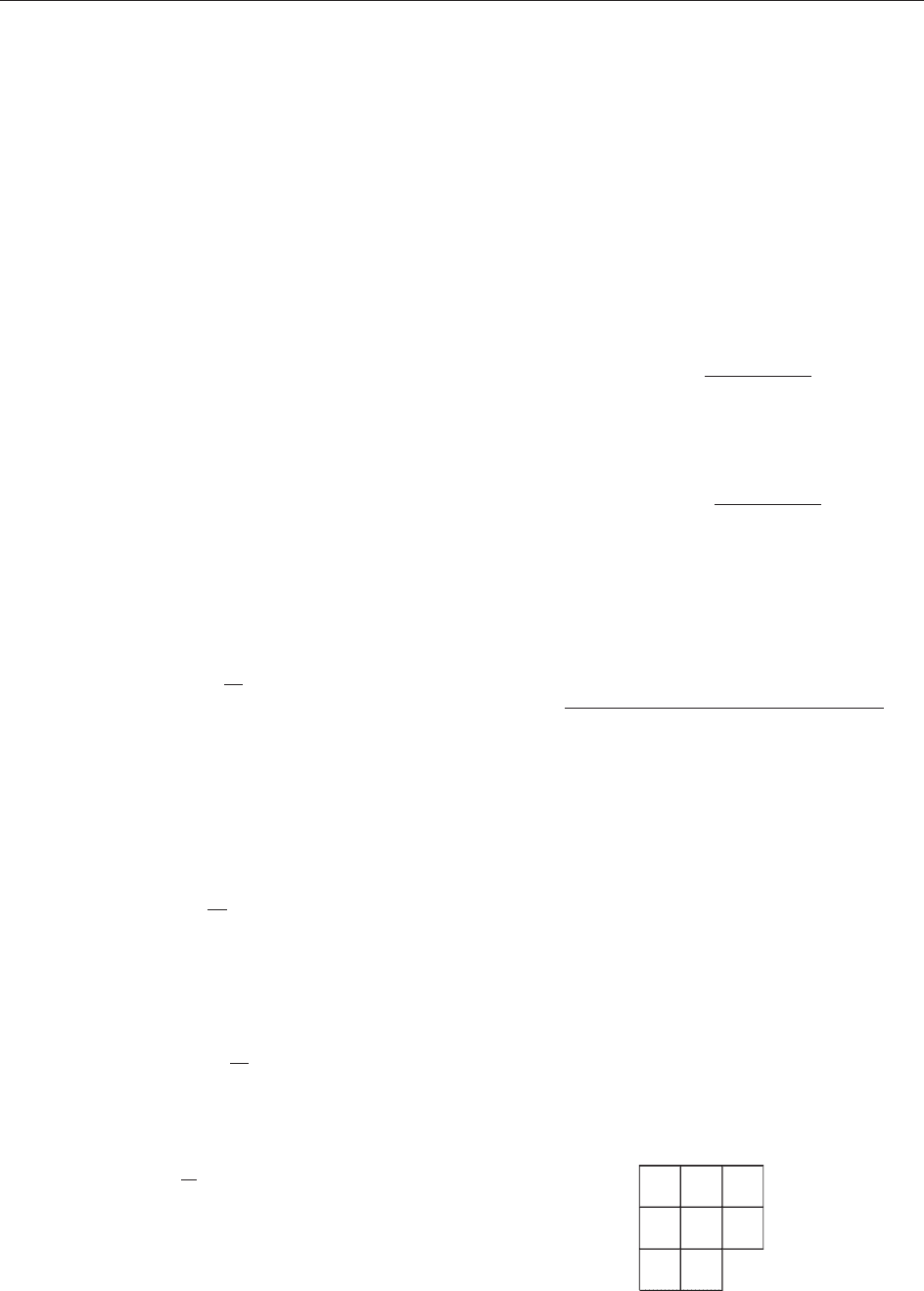
cells in row i. For example, the
diagram in Figure 1 is the Ferrers diagram of the
partition (3, 3, 2).
A lattice path P in Z
d
(where Z denotes the set of
integers) is a path in the d-dimensional integer
lattice Z
d
which uses only points of the lattice, that
is, it is a sequence (P
0
, P
1
, ..., P
l
), where P
i
2 Z
d
for
all i. The vectors
!
P
0
P
1
,
!
P
1
P
2
, ...,
!
P
l1
P
l
are called
the steps of P. The number of steps, l, is called the
length of P. Figure 2 shows a lattice path in Z
2
of
length 11.
Figure 1 A Ferrers diagram.
554 Combinatorics: Overview