
Francoise J.-P., Naber G.L., Tsun T.S. (editors) Encyclopedia of Mathematical Physics
Подождите немного. Документ загружается.

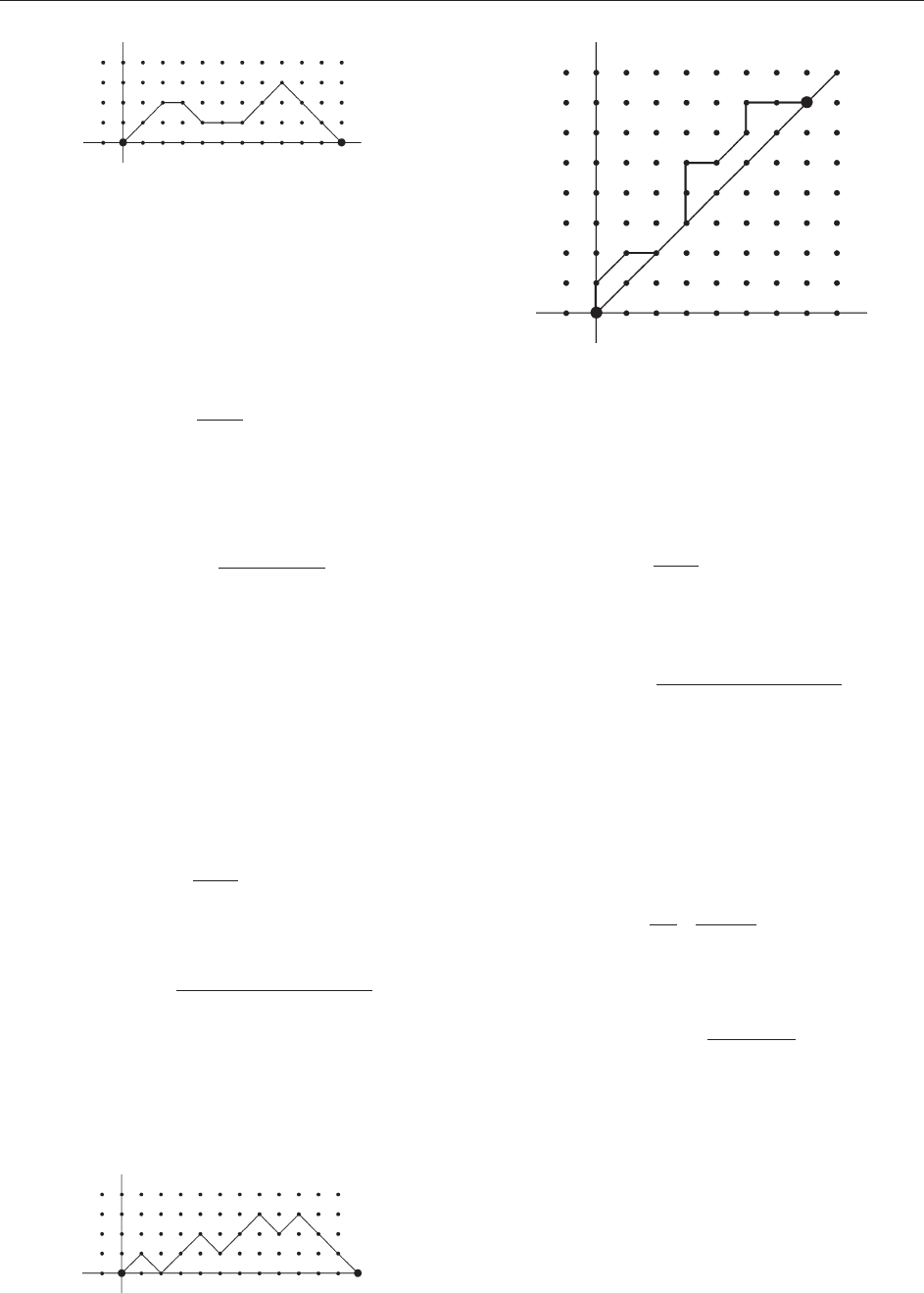
A Dyck path is a lattice path in the integer
plane Z
2
consisting of up-steps (1, 1) and down-steps
(1, 1), which starts at the origin, never passes below
the x-axis, and ends on the x-axis. See Figure 3 for an
example.
The number of Dyck paths of length 2n is the
Catalan number
C
n
¼
1
n þ 1
2n
n
The generating function (see the next section for an
introductiontothetheoryofgeneratingfunctions)
for these numbers is
X
1
n¼0
C
n
x
n
¼
1
ffiffiffiffiffiffiffiffiffiffiffiffiffiffi
1 4x
p
2x
½1
The reader is referred to exercise 6.19 in Stanley
(1999) for countless occurrences of the Catalan
numbers.
A Motzkin path is a lattice path in the integer
plane Z
2
consisting of up-steps (1, 1), level steps
(1, 0), and down-steps (1,1), which starts at the
origin, never passes below the x-axis, and ends on
the x-axis. The path in Figure 2 is in fact a Motzkin
path. The number of Motzkin paths of length n is
the Motzkin number
M
n
¼
X
k0
1
k þ 1
2k
k
n
2k
The generating function for these numbers is
X
1
n¼0
M
n
x
n
¼
1 x
ffiffiffiffiffiffiffiffiffiffiffiffiffiffiffiffiffiffiffiffiffiffiffiffiffiffiffiffi
1 2x 3x
2
p
2x
2
½2
The reader is referred to exercise 6.38 in Stanley (1999)
for numerous occurrences of the Motzkin numbers.
A Schro¨ der path is a lattice path in the integer
plane Z
2
consisting of horizontal steps (1, 0) and
vertical steps (0, 1), which starts at the origin, never
passes below the diagonal x = y, and ends on the
diagonal x = y. See Figure 4 for an example.
The number of Schro¨ der paths of length n is the
(large) Schro¨ der number
S
n
¼
X
k0
1
k þ 1
2k
k
n þ k
2k
The generating function for these numbers is
X
1
n¼0
S
n
x
n
¼
1 x
ffiffiffiffiffiffiffiffiffiffiffiffiffiffiffiffiffiffiffiffiffiffiffiffiffi
1 6x þ x
2
p
2x
½3
The reader is referred to exercise 6.39 in Stanley
(1999) for numerous occurrences of the Schro¨ der
numbers.
There is another famous sequence of numbers
which we did not touch yet, the Fibonacci numbers
F
n
. They are given by
F
n
¼
1
ffiffiffi
5
p
1 þ
ffiffiffi
5
p
2
!
nþ1
with generating function
X
1
n¼0
F
n
x
n
¼
1
1 x x
2
½4
They also occur in numerous places. For example,
the number F
n
counts all paths on the integers Z
from 0 to n with steps (1, 0) and (2, 0).
An undirected graph G consists of vertices and
edges. An edge is a two-element subset of the
vertices, which, however, is thought of as a line or
curve connecting the two vertices. See Figure 5a
for an example. The usual notation for a graph G
is G = (V, E), where V is the set of vertices and E
is the set of edges of G.Agraphisplanarifitis
Figure 2 A Motzkin path.
Figure 3 A Dyck path.
Figure 4 A Schro
¨
der path.
Combinatorics: Overview 555
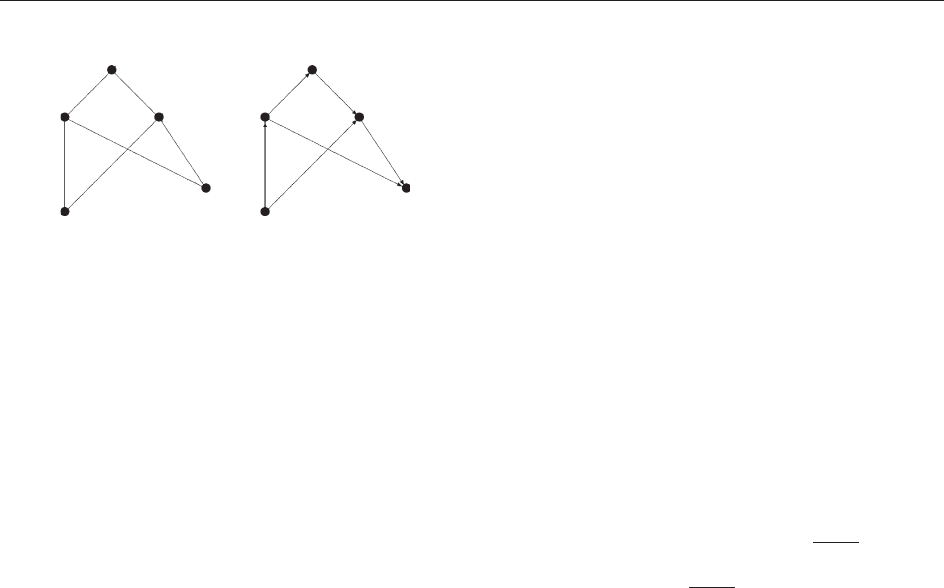
embedded in the plane (sphere) in such a way that
the curves which mark the edges do not intersect
in their interiors. There can be several different
ways to embed the same graph in the plane (or in
another surface). When we speak of a planar
graph then we assume the graph already to be
embedded in a given way. For example, the graph
in Figure 5 is not a planar graph, by its drawing.
However, there is a different embedding which is
planar (namely, all embeddings which put the
vertex v
3
above the vertex v
5
and leave the other
vertices as they are). A tree is a graph without any
cycles.
A directed graph (or digraph) G consists of
vertices and arcs (which are sometimes also called
directed edges). An arc is a pair of vertices, which,
however, is thought of an arrow pointing from the
first vertex of the pair to the second. See Figure 5b
for an example. The usual notation for a directed
graph G is again G = (V, E), where V is the set of
vertices and E is the set of arcs of G. All other
notions explained for undirected graphs have analo-
gous meanings for directed graphs.
Graphs can be labeled, in which case each vertex
is assigned a label, or unlabeled. The (undirected)
graph in Figure 5a is labeled, whereas the (directed)
graph in Figure 5b is unlabeled.
Generating Functions
Generating functions are the very basic tools of
enumeration. For introductions to this technique,
from different points of view, the reader is referred
to Bergeron et al. (1998), Flajolet and Sedgewick
(chapter1inthereferencelistedin‘‘Furtherread-
ing’’section),andStanley(1998,chapter1;1999,
chapter 4).
Let A be a set of (unlabeled) objects. Each object
a in A has a certain size, jaj, which is a non-negative
integer. Let us also assume that there is only a finite
number of objects from A of a given size. Let a
n
be
the number of objects from A of size n. The
(ordinary) generating function for A is the formal
power series
F
A
ðxÞ¼
X
a2A
x
jaj
¼
X
1
n¼0
a
n
x
n
(‘‘formal’’ means that x is just an indeterminate, not
a real or complex number. One can compute with
formal power series in the same way as with analytic
series, only that convergence issues do not arise,
respectively that ‘‘convergence’’ has a different
meaning; cf. Stanley (1998, section 1.1)) Typical
examples are Sets (the collection containing all
‘‘unlabeled sets,’’ that is, all objects of the form
{•, •, ..., •}, including the empty set, where the size
of {•, •, ..., •} is the number of •’s), Sequences
(the collection containing all ‘‘unlabeled sequences,’’
that is, all objects of the form (•, •, ..., •), including
the empty sequence), Cycles (unlabeled cycles),
with respective generating function
F
Sets
ðxÞ¼F
Sequences
ðxÞ¼
1
1 x
F
Cycles
ðxÞ¼
x
1 x
½5
or Trees (unlabeled trees).
If A and B are two sets of objects, one can define
several other sets of objects using them. The union
of A and B, written A[B, has as a groundset the
disjoint union of A and B, and the size of an element
from A is its size in A, while the size of an element
from B is its size in B.Wehave
F
A[B
ðxÞ¼F
A
ðxÞþF
B
ðxÞ½6
The product of A and B, written AB, has as a
groundset the set of pairs AB, and the size of an
element (a, b) from ABis the sum of the sizes of a
(in A) and of b (in B). We have
F
AB
ðxÞ¼F
A
ðxÞF
B
ðxÞ½7
The substitution of two sets A and B of objects
can only be defined in certain circumstances, and
only in certain more restrictive circumstances the
generating function for the substitution can be
computed by substituting the generating functions
for A and B. Let us assume that any object a from
A of size n, by its structure, has n atoms (nodes). For
example, if A is a certain set of trees, where the size
of a tree is the number of leaves in the tree, then we
may take, as the atoms, the leaves of the tree. In this
situation, the substitution of B in A, denoted by
A(B), is the set of objects which arises by replacing
the atoms of objects from A by objects from B in all
possible ways. The size of an object from A(B) is the
sum of the sizes of the objects from B that it
υ
5
υ
2
υ
4
υ
3
υ
1
(a) (b)
Figure 5 (a) An undirected graph. (b) A directed graph.
556 Combinatorics: Overview

contains. In order that A(B) contains only a finite
number of objects of a given size, we must assume
that B contains no elements of size 0. If, in addition,
the atoms of any element a from A inherit an order
(e.g., if A is a set of binary trees, then the leaves of a
binary tree are ordered in a natural way from ‘‘left’’
to ‘‘right’’), then we have
F
AðBÞ
ðxÞ¼F
A
ðF
B
ðxÞÞ ½ 8
However, this equation is not true in general. The
general formula comes out of Redfield–Po´lya theory
(see [21] and [24]) and requires the notion of cycle
index series. For example, if B is the set of connected
(unlabeled) graphs, A is Sets, so that A(B) is the
set of all (connected and disconnected) graphs, then
[8] is not true, but what is true is
F
SetsðBÞ
¼ exp F
B
ðxÞþ
1
2
F
B
ðx
2
Þþ
1
3
F
B
ðx
3
Þþ
½9
This holds, in fact, for any set B of unlabeled objects.
(This is seen by combining [24], [17], and [21].)
Next we deal with the enumeration of labeled
objects. Let A be a set of labeled objects, again, each
object a with a certain size jaj which is a non-
negative integer. ‘‘Labeled’’ means that each object
of size n, by its structure, comes with n atoms
(nodes) which are labeled 1, 2, ..., n. For example,
A may be the set of all labeled graphs, where the
size of a graph is the number of its vertices, and
where the vertices are labeled 1, 2, ..., n. Again, we
assume that there is only a finite number of objects
from A of a given size. Let a
n
be the number of
objects from A of size n. The exponential generating
function for A is the formal power series
E
A
ðxÞ¼
X
a2A
x
jaj
jaj!
¼
X
1
n¼0
a
n
x
n
n!
Typical examples are Sets (the collection containing
all ‘‘labeled sets,’’ that is all objects of the form
{1, 2, ..., n}, including the empty set), Permuta-
tions, Cycles (labeled cycles), with respective
generating functions
E
Sets
ðxÞ¼expðxÞ½10
E
Permutations
ðxÞ¼
1
1 x
½11
E
Cycles
ðxÞ¼log
1
1 x
½12
or Trees (labeled trees). The explicit form of the
generating function for Trees is discussed in the
section‘‘Solvingequationsforgeneratingfunctions:
theLagrangeinversionformulaandthekernel
method.’’
If A and B are two sets of objects, one defines
again several other sets of objects using them. The
union of A and B, written A[B, has as a groundset
the disjoint union of A and B, and the size of an
element from A is its size in A, while the size of an
element from B is its size in B. We have
E
A[B
ðxÞ¼E
A
ðxÞþE
B
ðxÞ½13
To define the product of A and B, written AB,
we cannot simply take AB as a groundset, we
must also say something about the labeling of the
objects. So, as a groundset we take all pairs (a, b)
with a 2A and b 2B, but labeled in all possible
ways by 1, 2, ..., ja jþjbj such that the order of
labels assigned to a respects the original order of
labels of a, and the same for b. The size of such an
element (a,b) is again the sum of the sizes of a (in A)
and of b (in B). We have
E
AB
ðxÞ¼E
A
ðxÞE
B
ðxÞ½14
Since, in the labeled world, objects come automati-
cally with atoms, the substitution of two sets A and
B of objects can now always be defined. The
substitution of B in A, denoted by A(B), is the set
of objects which arises by replacing the atoms of
objects from A by objects from B in all possible
ways, and labeling the substituted objects in all
possible ways by 1, 2, ...,
P
b
jbj (the sum being
over the objects from B which were put in the places
of the atoms) that are consistent with the original
labelings of the objects from B. The size of an object
from A(B) is the sum of the sizes of the objects from
B that it contains. In order that A(B) contains only a
finite number of objects of a given size, we must
assume that B contains no elements of size 0. Then
we have
E
AðBÞ
ðxÞ¼E
A
ðE
B
ðxÞÞ ½15
An example of a composition is
Permutations ¼ SetsðCyclesÞ
Thus, from [15] we have
E
Permutations
ðxÞ¼E
Sets
ðE
Cycles
ðxÞÞ
corresponding to the identity
1
1 x
¼ exp log 1=ð1 xÞðÞ
Another manifestation of the composition rule is, for
example, the fact (which is sometimes called the
‘‘exponential principle’’) that, if one takes the log of
the partition function for some maps, the result is
the partition function for the connected maps among
them.
Combinatorics: Overview 557
All of the above can be generalized to a weighted
setting. Namely, if A is a set of objects (labeled or
unlabeled), and if w : A!R is a weight function
from A into some ring R, then all of the above
remains true, if we replace the definitions of F
A
(x)
and E
A
(x) above by the weighted sums
F
A
ðxÞ¼
X
a2A
wðaÞx
jaj
and
E
A
ðxÞ¼
X
a2A
wðaÞ
x
jaj
jaj!
respectively, if in the definition of the union of A
and B we define the weight of an object to be its
weight in A, respectively B, if in the definition of the
product of A and B we define the weight of an
object (a, b) to be the product of the weights of a
and b, and if in the definition of the substitution we
define the weight of an object in A(B) as the product
of the weights of the objects from B that were put in
place of the atoms.
Redfield–Po´ lya Theory of Colored
Enumeration
The natural and uniform environment for the
separate treatment of generating functions for
unlabeled and labeled objects in the last section is
the theory for counting colored objects founded by
Redfield and Po´lya, in the modern treatment
through cycle index series due to Joyal. We refer
the reader to Bergeron et al. (1998, appendix 1),
de Bruijn (1981), and Stanley (1999, chapter 7) for
furtherreading.
Let A be a set of labeled objects with the
constraint that there is only a finite number of
objects of a given size. The cycle index series for A is
the formal multivariable series
Z
A
ðx
1
; x
2
; ...Þ
¼
X
1
n¼0
1
n!
X
2S
n
fix
ðAÞx
c
1
ðÞ
1
x
c
2
ðÞ
2
x
c
3
ðÞ
3
...
½16
where fix
(A) is the number of objects a from A that
remain invariant when the labels are permuted
according to the permutation (in particular, if 2
S
n
, the size of a must be n in order that can be
applied to the labels), and where c
i
() denotes the
number of cycles of length i of .
In most cases, it is difficult to obtain compact
expressions for the cycle index series. However, for
our familiar families of objects, compact expressions
are available:
Z
Sets
ðx
1
; x
2
; ...Þ¼exp x
1
þ
x
2
2
þ
x
3
3
þ
½17
Z
Permutations
ðx
1
; x
2
; ...Þ¼
Y
1
i¼1
1
1 x
i
½18
Z
Cycles
ðx
1
; x
2
; ...Þ¼
X
1
i¼1
ðiÞ
i
log
1
1 x
i
½19
where (i) is the Euler totient function (the number
of positive integers j i relatively prime to i).
What makes the cycle index series so fundamental
is the fact that the generating functions from the last
section are specializations of it. Namely, the
exponential generating function for A is equal to
E
A
ðxÞ¼Z
A
ðx; 0; 0; ...Þ½20
If, given the set of labeled objects A, we produce a
set of unlabeled objects
~
A by taking all the objects
from A but forgetting the labels, then the ordinary
generating function for
~
A is another specialization
of the cycle index series,
F
~
A
ðxÞ¼Z
A
ðx; x
2
; x
3
; ...Þ½21
The cycle index series satisfies the following
properties with respect to union, product and
composition of sets of objects:
Z
A[B
ðx
1
; x
2
; ...Þ¼Z
A
ðx
1
; x
2
; ...Þ
þ Z
B
ðx
1
; x
2
; ...Þ½22
Z
AB
ðx
1
; x
2
; ...Þ¼Z
A
ðx
1
; x
2
; ...Þ
Z
B
ðx
1
; x
2
; ...Þ½23
Z
AðBÞ
ðx
1
; x
2
; ...Þ¼Z
A
ðZ
B
ðx
1
; x
2
; x
3
; ...Þ;
Z
B
ðx
2
; x
4
; x
6
...Þ;
Z
B
ðx
3
; x
6
; x
9
; ...Þ; ...Þ½24
Similar to the theory of generating functions
surveyed in the last section, one can also develop a
weighted version of the cycle index series. Given a set
of labeled objects A, where each object a is assigned a
weight w(a), one changes the definition [16] insofar as
fix
(A) gets replaced by the weighted sum
P
(a) = a
w(a), where (a) means the object arising
from a by permuting the labels according to .Thenall
the above formulas remain true in this weighted setting.
Cycle index series are instrumental in the enu-
meration of colored objects. The basic situation is
that we have given a set
~
A of unlabeled objects so
that every object of size n comes with n atoms
(nodes). For example, we may think of
~
A as the set
of cycles. We are now going to color each atom by a
558 Combinatorics: Overview

color from the set of colors C. The question that we
pose is: how many different colored objects of a
given size are there? In our example, if C consists of
the two colors ‘‘black’’ and ‘‘white,’’ then we are
asking the question of how many necklaces one can
make out of n pearls that can be black or white. In
terms of generating functions, we want to compute
~
A
ðxÞ¼
X
c
x
jcj
where the sum is over all colored objects c that one
can obtain by coloring the objects from
~
A.
The central result of Redfield–Po´lya theory is that,
if A is the set of labeled objects that one obtains
from
~
A by labeling the objects of
~
A in all possible
ways, then
~
A
ðxÞ¼Z
A
ðjCjx; jCjx
2
; jCjx
3
; ...Þ
There is again a weighted version. One allows the
objects a from
~
A to have weight w(a) 2 R. More-
over, one assumes a weight function f : C !R on
the colors with values in the ring R. One defines the
weight of a colored object obtained by coloring
the atoms of a to be w(a) multiplied by the product
of all f (), where ranges over all the colors of the
atoms (including repetitions of colors). Let
~
A
(w, f )
denote the sum of all the weights of all colored
objects obtained from
~
A. Then
~
A
ðw; f Þ¼Z
A
X
c2C
f ðcÞ;
X
c2C
f ðcÞ
2
;
X
c2C
f ðcÞ
3
; ...
!
We remark that these results cover also the case of
enumeration of objects under a group action. This
includes the enumeration of objects on which we
impose certain symmetries. See Bergeron et al.
(1998, appendix 1), de Bruijn (1981), and Stanley
(1999, chapter 7) for more details. The enumeration
of asymmetric objects is the subject of an ongoing
research program (cf. Labelle and Lamathe (2004)).
Solving Equations for Generating
Functions: The Lagrange Inversion
Formula and the Kernel Method
In this section, we describe two methods to solve
functional equations for generating functions. The
Lagrange inversion makes it possible (in some situa-
tions) to find explicit expressions for the coefficients of
an implicitly given series. The kernel method (and its
extensions), on the other hand, is a powerful method
to obtain an explicit expression for an implicitly given
function. We refer the reader to Flajolet and
Sedgewick,(sectionVII.5ofthereferencein‘‘Further
reading’’section)forfurtherreading.
In many situations it will happen that, when we
apply the methods from the last section, we end up
with a functional equation for the generating function
f (x) =
P
1
n = 0
f
n
x
n
that we wanted to compute. For
example, if t
n
denotes the number of labeled rooted
trees with n nodes, and if we write T(x) =
P
1
n = 1
t
n
x
n
=n!, then, by applying a straightforward
decomposition of a tree into its root and its set of
subtrees attached to the root, we obtain the equation
TðzÞ¼z expðTðzÞÞ ½25
How does one solve such an equation? As a matter
of fact, for T(z), there is no expression in terms of
known functions. However, the Lagrange inversion
formula enables one to find the coefficients t
n
=n! of
T(z) explicitly. The theorem reads as follows.
Theorem Let g(x) be a formal Laurent series
containing only a finite number of negative powers
of x, and let f (x) be a formal power series without
constant term. If we expand g(x) in powers of f (x),
gðxÞ¼
X
k
c
k
f
k
ðxÞ½26
then the coefficients c
n
are given by
c
n
¼
1
n
½x
1
g
0
ðxÞf
n
ðxÞ for n 6¼ 0 ½27
or, alternatively, by
c
n
¼½x
1
gðxÞf
0
ðxÞf
n1
ðxÞ½28
Here,[x
n
]h(x) denotes the coefficient of x
n
in the
power series h(x).
With this theorem in hand, eqn [25] is easy to
solve. We write it in the form
TðxÞexpðTðxÞÞ ¼ x ½29
We want to know the coefficients in the expansion
T(x) =
P
1
n = 0
t
n
x
n
=n!. Since, by [29], T(x) is the
compositional inverse of x exp (x), substitution of
x exp (x) instead of x gives
x ¼
X
1
n¼0
t
n
n!
ðx expðxÞÞ
n
This equation is in the form [26] with f (x) =
x exp (x) and g(x) = x. Hence, by [27], we obtain
t
n
n!
¼
1
n
½x
1
ðx expðxÞÞ
n
¼
1
n
½x
n1
expðnxÞ¼
n
n1
n!
and, thus, t
n
= n
n1
.
Combinatorics: Overview 559

The second method to solve functional equations
which we explain in this section is the kernel
method. We illustrate the method by an example.
Let us consider the problem of counting Dyck paths
oflength2 n (seethesection‘‘Basiccombinatorial
terminology’’).Ratherthanattemptingtoarriveata
solution of the problem directly, we consider the
more general problem of counting the number a
n, k
of paths consisting of steps (1, 1) and (1, 1), which
start at the origin, never drop below y = 0, have
length n, and end at height k. We then form the
bivariate generating function F(u, x) =
P
n, k0
a
n, k
x
n
u
k
. We then have the functional equation
Fðu; xÞ¼1 þ xuFðu; xÞþ
x
u
ðFðu; xÞFð0; xÞÞ ½30
since a path can be empty (this explains the term 1),
it can end by a step (1,1) (this explains the term
xuF(u)), or it can end by a step (1,1). The latter
can only happen if the path before that last step did
not end at height 0. The generating function for
these paths is F(u, x) F(0, x), and this explains the
third term in the eqn [30]. In fact, we may replace
[30] by
Fðu; xÞ¼1 þ xuFðu; xÞþ
x
u
ðFðu; xÞF
1
ðxÞÞ ½31
because [31] implies that F
1
(x) = F(0, x).
The idea of the kernel method is to get rid of the
unknown series F(u, x). This is possible because F(u, x)
occurs linearly in [31], which can be rewritten as
Fðu; xÞ 1 xu
x
u
¼ 1
x
u
F
1
ðxÞ½32
We simply equate the coefficient of F(u, x) in this
equation to zero,
1 xu
x
u
¼ 0
solve this for u,
u ¼
1
ffiffiffiffiffiffiffiffiffiffiffiffiffiffiffiffi
1 4x
2
p
2x
(the other solution for u makes no sense in [31]),
and substitute this back in [32], to obtain
F
1
ðxÞ¼
1
ffiffiffiffiffiffiffiffiffiffiffiffiffiffiffiffi
1 4x
2
p
2x
2
the familiar generating function [2] for the Catalan
numbers. Now, by substituting this result in [31],we
can even compute the full series F(u, x).
While this was certainly a complicated, and
unusual, way to compute the Catalan numbers,
this approach generalizes when one considers
paths with different step sets (see section VII.5 of
theFlajoletandSedgewickreferencein‘‘Further
reading’’section).Inamoregeneralsituation,one
has a functional equation
PðF ðu; xÞ; F
1
ðxÞ; ...; F
k
ðxÞ; x; uÞ¼0 ½33
where F(u, x) appears linearly, as well as the
unknown series F
1
(x), ..., F
k
(x), whereas x and u
appear rationally. It is clear that one can apply the
same technique, namely collecting all the terms
involving F(u, x), equating the coefficient of F(u, x)
to zero, solving for u and substituting back in [33].If
there is more than one function F
i
(x), then this will
only give one equation for F
i
(x). However, when
equating the coefficient of F(u, x), which was a
polynomial equation, there can be more solutions.
(That was actually also the case in our example,
although only one solution could be used.) All these
solutions can be substituted in [33] to give many
more equations for F
i
(x). The kernel method will
work if we have enough equations to determine the
unknown functions F
i
(x) (see the Flajolet and
Sedgewick reference, section VII.5 for further details).
In the variant of the ‘‘obstinate kernel method,’’
more equations are produced in more sophisticated
ways. The method has been largely extended by
Bousquet–Me´lou and co-workers to cover equations
of the form [33],whereP is a polynomial such that
eqn [33] determines all involved series uniquely. This
extension covers in particular the so-called quadratic
method due to Brown, which is of great significance
in the work of Tutte on the enumeration of maps.
We refer the reader to Bousquet–Me´lou and Jehanne
(2005) and the references given there for these
extensions.
Extracting Asymptotic Information
from Generating Functions
There is powerful machinery available to extract the
asymptotic behavior of the coefficients of a power
series out of analytic properties of the power series.
We describe the corresponding methods, singularity
analysis and the saddle point method in this section.
The survey by Odlyzko (1995) and the Flajolet and
Sedgewickreferencein‘‘Furtherreading’’areexcel-
lentsourcesforfurtherreading,which,inparticular,
contain several other methods which we cannot
cover here for reasons of limited space.
Let us suppose that we are interested in the
asymptotic behavior of the sequence (f
n
)
n0
of real
(or complex) numbers as n tends to infinity. Let us
suppose that the power series f (z) =
P
1
n = 0
f
n
z
n
converges in some neighborhood of the origin. (If
this series converges only at z = 0, then either one
has to try to scale, that is, for example, look at the
560 Combinatorics: Overview
power series f (z ) =
P
1
n = 0
f
n
z
n
=n! instead, or one
must apply methods other than singularity analysis
or the saddle point method. In the latter case,
depending on the nature of the coefficients f
n
, this
may be the Euler–Maclaurin or the Poisson summa-
tion formulas, the Mellin transform technique, or
other direct methods. The reader is referred to
Odlyzko (1995) and the Flajolet and Sedgewick
reference.) The idea is then to consider f (z)asa
complex function in z (and extend the range of f
beyond the disk of convergence about the origin),
and to study the singularities of f (z). (The point at
infinity can also be a singularity.) The upshot is that
the singularities of f(z) with smallest modulus
dictate the asymptotic behavior of the coefficients
f
n
. These singularities of smallest modulus are called
the dominating singularities.
If there is an infinite number of dominant
singularities, then one has to try the circle method.
We refer the reader to Andrews (1976) and Ayoub
(1963) for details of this method.
If there is a finite number of dominant singula-
rities, then there can be again two different situa-
tions, depending on whether these are ‘‘small’’ or
‘‘large’’ singularities. Roughly speaking, a singularity
is small if the function f (z) grows at most
polynomially when z approaches the singularity,
otherwise it is ‘‘large.’’ A typical example of a small
singularity is z = 1=4in(1 4z)
1=2
, whereas a
typical example of a large singularity is z = 1 in
exp (x)orz = 1 in exp (1=(1 z)).
The method to apply for small singularities is the
method of singularity analysis as developed by
Flajolet and Odlyzko. (Singularity analysis implies
Darboux’s method, which occurs frequently in the
literature, and, thus, supersedes it.) For the sake of
simplicity, we consider first only the case of a
unique dominant singularity. We shall address the
issue of several dominant singularities shortly.
Furthermore, we assume the singularity to be
z = 1, again for the sake of simplicity of presenta-
tion. The general result can then be obtained by
rescaling z.
The basic idea is the transfer principle:
If f ðzÞ¼
z!1
ðzÞþOððzÞÞ then
f
n
¼
n!1
n
þ Oð
n
Þ½34
where (z) =
P
1
n = 0
n
z
n
is a linear combination of
standard functions of the form (1 z)
, or loga-
rithmic variants, and (z) =
P
1
n = 0
n
z
n
also lies in
the scale (see sections VI.3,4 of the Flajolet and
Sedgewick reference for the exact statement). The
expansion for f (z)in[34] is called the singular
expansion of f (z). For the above-mentioned stan-
dard functions, we have
½z
n
ð1 zÞ
1
z
log
1
1 z
n
1
ðÞ
ðlog nÞ
1 þ
C
1
1!
log n
þ
C
2
2!
ð 1Þ
ðlog nÞ
2
þ
!
½35
where [z
n
]g(z) denotes the coefficient of z
n
in g(z),
and where
C
k
¼ ðÞ
d
k
ds
k
1
ðsÞ
s¼
If is a nonpositive integer, then this expansion has
to be taken with care (cf. section VI.2 of the Flajolet
and Sedgewick reference).
To see how this works, consider the example
f
n
=
P
n
k = 0
2k
k
. We have
X
1
n¼0
f
n
z
n
¼
1
ð1 zÞ
ffiffiffiffiffiffiffiffiffiffiffiffiffiffi
1 4z
p
The function on the right-hand side is meromorphic
in all of C (where C denotes the complex numbers),
with singularities at z = 1andz = 1=4. The domi-
nant singularity is z = 1=4. We determine the
singular expansion of f(z) about z = 1=4,
f ðzÞ¼
4
3
ð1 4zÞ
1=2
4
9
ð1 4zÞ
1=2
þ
4
27
ð1 4zÞ
3=2
þ O ð1 4zÞ
5=2
(We stopped the expansion after three terms. The
farther we go, the more terms can we compute
of the asymptotic expansion for f
n
.) Hence, we
obtain
f
n
¼ 4
n
4
3
n
1=2
ð1=2Þ
1
1
8n
þ
1
128n
2
4
9
n
3=2
ð1=2Þ
1 þ
3
8n
þ
4
27
n
5=2
ð3=2Þ
þ On
7=2
¼
4
n
ffiffiffiffiffiffi
n
p
4
3
þ
1
18n
þ
11
288n
2
þ O
1
n
3
If there are several small dominant singularities
(but only a finite number of them), then one simply
applies the above procedure for all of them and, to
obtain the desired asymptotic expansion, one adds
up the corresponding contributions.
Combinatorics: Overview 561
The method to apply for large singularities is the
saddle point method. For the following considera-
tions, we assume that f (z) is analytic in jzj < R 1.
At the heart of the saddle point method lies
Cauchy’s formula
f
n
¼½z
n
f ðzÞ¼
1
2 i
Z
C
f ðzÞ
z
nþ1
dz ½36
for writing the nth coefficient in the power series
expansion of f(z). Here, C is some simple closed
contour around the origin that stays in the range
jzj < R. The idea is to exploit the fact that we are
free to deform the contour. The aim is to choose a
contour such that the main contribution to the
integral in [36] comes from a very tiny part of the
contour, whereas the contribution of the rest is
negligible. This will be possible if we put the
contour through a saddle point of the integrand
f (z)=z
nþ1
. Under suitable conditions, the main
contribution will then come from the small passage
of the path through the saddle point, and the
contribution of the rest will be negligible.
In practice, the saddle point method is not always
straightforward to apply, but has to be adapted to the
specific properties of the function f(z) that we are
encountering. We refer the reader to the correspond-
ing chapters in the Flajolet and Sedgewick reference
and Odlyzko (1995) for more details. There is one
important exception though, namely the Hayman
admissible functions. We will not reproduce the
definition of Hayman admissibility because it is
cumbersome (cf. section VIII.5 in the Flajolet and
Sedgewick reference and definition 12.4 of Odlyzko
(1995)). However, in many applications, it is not
even necessary to go back to it because of the closure
properties of Hayman admissible functions. Namely,
it is known (cf. Odlyzko (1995), theorem 12.8) that
exp (p(z)) is Hayman admissible in jzj< 1 for any
polynomial p(z) with real coefficients as long as the
coefficients a
n
of the Taylor series of exp (p(z)) are
positive for all sufficiently large n (thus, e.g., exp (z)
is Hayman admissible), and it is known that, if f(z)
and g(z) are Hayman admissible in jzj < R 1,then
exp (f (z)) and f(z)g(z) are also (thus, e.g.,
exp ( exp (z) 1) is Hayman admissible).
The central result of Hayman’s theory is the
following: if f(z) =
P
n0
f
n
z
n
is Hayman admissible
in jzj < R, then
f
n
f ðr
n
Þ
r
n
n
ffiffiffiffiffiffiffiffiffiffiffiffiffiffiffiffi
2bðr
n
Þ
p
as n !1 ½37
where r
n
is the unique solution for large n of the
equation a (r) = n in (R
0
, R), with a(r) = rf
0
(r)=f (r),
b(r) = ra
0
(r), and a suitably chosen constant R
0
> 0.
This result covers only the first term in the
asymptotic expansion. There is an even more
sophisticated theory due to Harris and Schoenfeld,
which allows one to also find a complete asymptotic
expansion. We refer the reader to section VIII.5 of
the Flajolet and Sedgewick reference and Odlyzko
(1995) for more details.
Methodsfortheasymptoticanalysisofmulti-
variable generating functions are also available
(see the corresponding chapters in Flajolet and
Sedgewick, Odlyzko (1995) and the recent impor-
tant development surveyed in the Pemantle and
Wilsonreferencelistedin‘‘Furtherreading’’).We
add that both the method of singularity analysis and
Hayman’s theory of admissible functions have been
made largely automatic, and that this has been
implemented in the Maple program gdev (see
‘‘Furtherreading’’).
The Theory of Heaps
The theory of heaps, developed by Viennot, is a
geometric rendering of the theory of the partial
commutation monoid of Cartier and Foata, which
is now most often called the Cartier–Foata monoid.
Its importance stems from the fact that several
objects which appear in statistical physics, such as
Motzkin paths, animals, respectively polyominoes,
or Lorentzian triangulations (see the Viennot and
Jamesreferencein‘‘Furtherreading’’andthe
references therein), are in bijection with heaps.
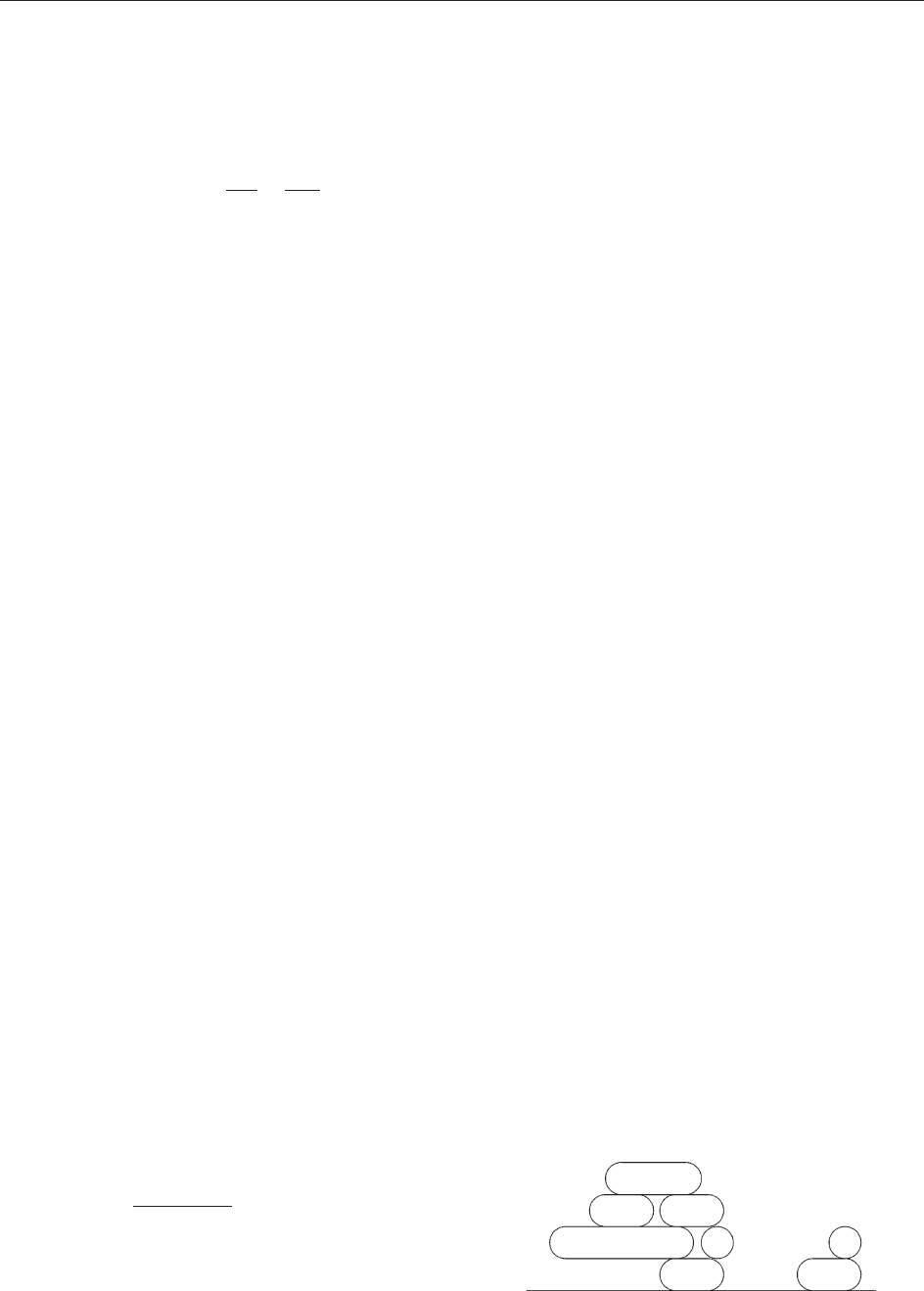
Informally, a heap is what we would imagine. We
take a collection of ‘‘pieces,’’ say B
1
, B
2
, ..., and put
them one upon the other, sometimes also sideways,
to form a ‘‘heap,’’ see Figure 6.
There, we imagine that pieces can only move
vertically, so that the heap in Figure 6 would indeed
form a stable arrangement. Note that we allow
several copies of a piece to appear in a heap. (This
means that they differ only by a vertical translation.)
For example, in Figure 6 there appear two copies of
B
2
. Under these assumptions, there are pieces which
can move past each other, and others which cannot.
For example, in Figure 6, we can move the piece B
6
higher up, thus moving it higher than B
1
if we wish.
However, we cannot move B
7
higher than B
6
,
B
1
B
3
B
4
B
2
B
5
B
6
B
7
B
2
Figure 6 A heap of pieces.
562 Combinatorics: Overview
because B
6
blocks the way. On the other hand, we
can move B
7
past B
1
(thus taking B
6
with us). Thus,
a rigorous way to introduce heaps is by beginning
with a set B of pieces (in our example, B=
{B
1
, B
2
, ..., B
7
}), and we declare which pieces can
be moved past another and which cannot. We
indicate this by a symmetric relation R: we write
aRb to indicate that a cannot move past b (and vice
versa). When we consider a word a
1
a
2
...a
n
of
pieces, a
i
2B, we think of it as putting first a
1
, then
putting a
2
on top of it (and, possibly, moving it past
a
1
), then putting a
3
on top of what we already have,
etc. We declare two words to be equivalent if one
arises from the other by commuting adjacent letters
which are not in relation. A heap is then an
equivalence class of words under this equivalence
relation. What we have described just now is indeed
the original definition of Cartier and Foata.
The class of heaps which occurs most frequently
in applications is the class of heaps of monomers
and dimers, which we now introduce. Let B= M [ D,
where M= {m
0
, m
1
, ...} is the set of monomers and
D= {d
1
, d
2
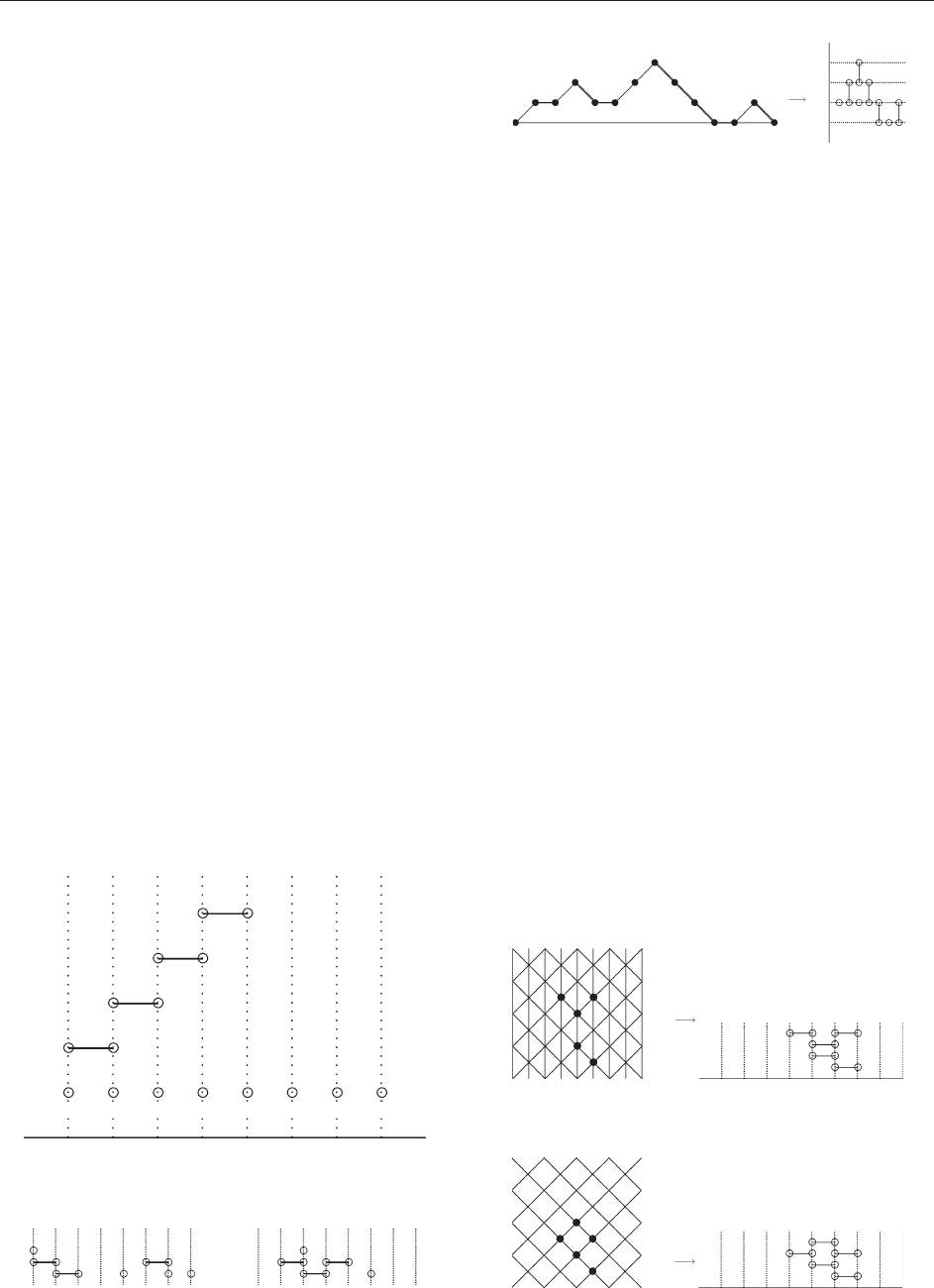
, ...} is the set of dimers. We think of a
monomer m
i
as a point, symbolized by a circle,
with x-coordinate i,seeFigure 7.Wethink
of a dimer d
i
as two points, symbolized by circles,
with x-coordinates i 1andi which are connected
by an edge, see Figure 7. We impose the relations
m
i
Rm
i
, m
i
Rd
i
, m
i
Rd
iþ1
, i = 0, 1, ..., d
i
Rd
j
, i 1
j i, and extend R to a symmetric relation. Figure 8
shows two heaps of momomers and dimers.
For example, Motzkin paths are in bijection with
heaps of monomers and dimers. To see this, given a
Motzkin path, we read the steps of the path from
the beginning to the end. Whenever we read a level-
step at height h, we make it into a monomer with
x-coordinate h, whenever we read a down-step from
height h to height h 1, we make it into a dimer
whose endpoints have x-coordinates h 1 and h.
Up-steps are ignored. Figure 9 shows an example. In
the figure, the heap is not in ‘‘standard’’ fashion, in
the sense that the x-axis is not shown as a horizontal
line but as a vertical line (cf. Figure 7). But it could
be easily transformed into ‘‘standard’’ fashion by a
simple reflection with respect to a line of slope 1.
Lattice animals on the triangular lattice and on the
quadratic lattice are also in bijection with heaps, this
time with heaps consisting entirely out of dimers.
Given an animal, one simply replaces each vertex of
the animal by a dimer, see Figures 10 and 11.While
in the case of animals on the triangular lattice this
gives a constraintless bijection (see Figure 10), in the
case of the quadratic lattice this sets up a bijection
with heaps of dimers in which two dimers of the
same type can never be placed directly one over the
other (see Figure 11). For example, two dimers d
5
,
one placed directly over the other (as they occur in
Figure 10), are forbidden under this rule.
Next we make heaps into a monoid by introdu-
cing a composition of heaps. (A monoid is a set with
a binary operation which is associative.) Intuitively,
given two heaps H
1
and H
2
, the composition of H
1
and H
2
, the heap H
1
H
2
, is the heap which results
01234567
m
0
d
1
d
2
d
3
d
4
m
1
m
2
m
3
m
4
m
5
m
6
m
7
Figure 7 Monomers and dimers.
01234567 01234567
Figure 8 Two heaps of monomers and dimers.
3
2
1
0
Figure 9 Bijection between Motzkin paths and heaps of
monomers and dimers.
012345678
Figure 10 Bijection between animals and heaps of dimers.
012345678
Figure 11 Bijection between animals and heaps of dimers.
Combinatorics: Overview 563
by putting H
2
on top of H
1
. In terms of words, the
composition of two heaps is the equivalence class of
the concatenation uw, where u is a word from the
equivalence class of H
1
, and w is a word from the
equivalence class of H
2
.
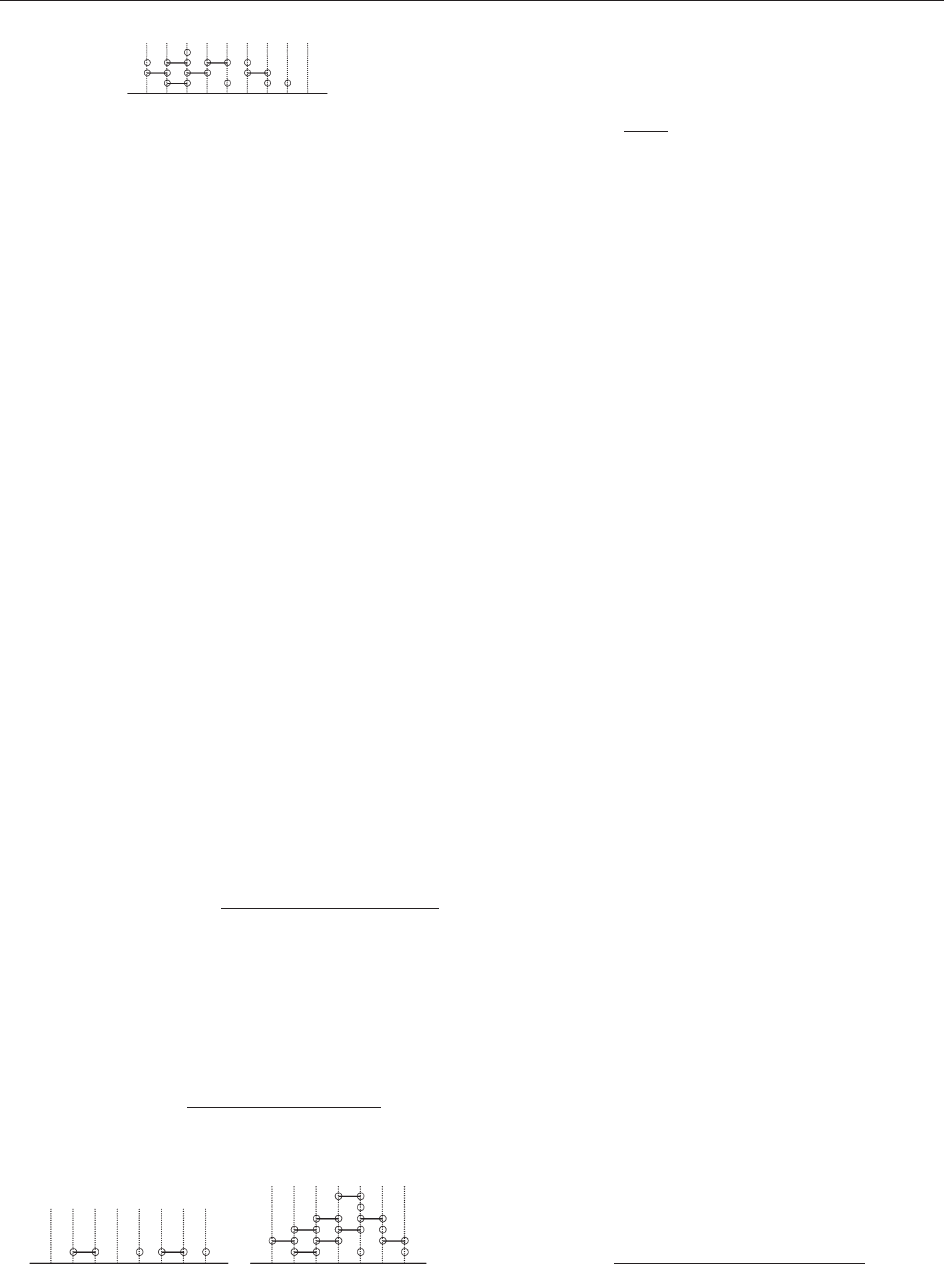
The composition of the two heaps in Figure 8 is
shown in Figure 12.
Given pieces B with relation R, let H(B, R) be the
set of all heaps consisting of pieces from B,
including the empty heap, the latter denoted by ;.
It is easy to see that the composition makes
(H(B , R), ) into a monoid with unit ;.
For the statement of the main theorem in the
theory of heaps, we need two more terms. A trivial
heap is a heap consisting of pieces all of which are
pairwise unrelated. Figure 13a shows a trivial heap
consisting of monomers and dimers. A pyramid is a
heap with exactly one maximal ( = topmost) ele-
ment. Figure 13a shows a pyramid consisting of
monomers and dimers. Finally, if H is a heap, then
we write jHj for the number of pieces in H.
In applications, heaps will have weights, which are
defined by introducing a weight w(B) for each piece B
in B, and by extending the weight w to all heaps H by
letting w(H) denote the product of all weights of the
pieces in H (multiplicities of pieces included).
Let M be a subset of the pieces B. Then, the
generating function for all heaps with maximal
pieces contained in M is given by
X
H2HðB;RÞ
maximal pieces M
wðHÞ¼
P
T2T ðBnM;RÞ
ð1Þ
jTj
wðTÞ
P
T2T ðB;RÞ
ð1Þ
jTj
wðTÞ
½38
where T (B, R) denotes the set of all trivial heaps
with pieces from B. In particular, the generating
function for all heaps is given by
X
H2HðB;RÞ
wðHÞ¼
1
P
T2T ðB;RÞ
ð1Þ
jTj
wðTÞ
½39
Furthermore, if P(B , R) denotes the set of all
pyramids with pieces from B, then
X
P2PðB;RÞ
wðPÞ
jPj
¼ log
X
H2HðB;RÞ
wðHÞ
0
@
1
A
½40
where jPj is the number of pieces of P. (As the
reader will have guessed, this is a consequence of the
‘‘exponential principle’’ mentioned in the section
‘‘generatingfunctions.’’)
The Transfer Matrix Method
The transfer matrix method (cf. Stanley (1986),
chapter4forfurtherreading)applieswheneverwe
are able to build the combinatorial objects that we
are interested in by moving on a finite number of
states in a step-by-step fashion, where the current
step does not depend on the previous ones. (In
statistical language, we are considering a finite-state
Markov chain.) For example, Motzkin paths which
are constrained to stay between two parallel lines,
say between y = 0 and y = K, can be described in
such a way: the states are the heights 0, 1, ..., K,
and, if we are in state h, then in the next step we are
allowed to move to states h þ 1, h,orh 1, except
that from state 0 we cannot move to 1 (there is no
state 1), and when we are in state K we cannot
move to K þ 1 (there is no state K þ 1).
For describing the general situation, let G = (V, E)
be a directed graph with vertex set V and edge set E.Let
w
n
(u, v) denote the number of walks from vertex u to
vertex v along edges of G. To compute these numbers,
we consider the adjacency matrix of G, A(G). By
definition, using our notation, A(G) = (w
1
(u, v))
u, v2V
.
Obviously, (w
n
(u, v))
u, v2V
= (A(G))
n
.Thus,
X
1
n¼0
w
n
ðu; vÞx
n
!
u;v2V
¼
X
1
n¼0
ðAðGÞÞ
n
x
n
¼ I
n
AðGÞx
ðÞ
1
where I
n
is the n n identity matrix. In other words,
the generating functions
P
1
n = 0
w
n
(u, v)x
n
for the
walk numbers between u and v form the entries of a
matrix which is the inverse matrix of I
n
A(G)x.By
elementary linear algebra,
X
1
n¼0
w
n
ðu; vÞx
n
¼
ð1Þ
#uþ#v
detðI
n
Að GÞxÞ
v;u
detðI
n
AðGÞ xÞ
½41
where det (I
n
A(G)x)
v, u
is the minor of I
n
A(G)x
with the row indexed by v and the column indexed
012345678
Figure 12 The composition of the heaps in Figure 8.
01234567 0123456
(a) (b)
Figure 13 (a) A trivial heap. (b) A pyramid.
564 Combinatorics: Overview