
Francoise J.-P., Naber G.L., Tsun T.S. (editors) Encyclopedia of Mathematical Physics
Подождите немного. Документ загружается.


by u omitted, and where #u denotes the row
number of u and similarly for #v. A weighted
version could also be developed in the same way,
where we put a weight w(e) on each edge, and the
weight of a walk is the product of the weights of all
its edges.
In particular, the expression [41] is a rational
function in x. Then, by the basic theorem on
rational generating functions (cf. Stanley (1986),
section 4.1), the number w
n
(u, v) can be expressed as
a sum
P
d
i = 1
P
i
(n)
n
i
, where the
i
’s are the different
roots of the polynomial det (xI
n
A(G)), and P
i
(n)
is a polynomial of degree less than the multiplicity
of the root
i
. (The P
i
(n)’s depend on u and v,
whereas the
i
’s do not.) If there exists a unique root
j
with maximal modulus, then this implies that,
asymptotically as n !1, w
n
(u, v) P
j
(n)
n
j
.
Lattice Paths
Recallfromthesectionon basiccombinatorial
terminologythata lattice path P in Z
d
is a path in
the d-dimensional integer lattice Z
d
which uses only
points of the lattice, that is, it is a sequence
(P
0
, P
1
, ..., P
l
), where P
i
2 Z
d
for all i. The vectors
P
0
P
1
!
, P
1
P
2
!
, ..., P
l1
P
l
!
are called the steps of P. The
number of steps, l, is called the length of P.
The enumeration of lattice paths has always
been an intensively studied topic in statistics,
because of their importance in the study of
random walks, of rank order statistics for non-
parametric testing, and of queueing processes. The
reader is referred to Feller (1957) and particularly
Mohanty’s (1979) book, which is a rich source for
enumerative results on lattice paths, albeit in a
statistical language. We review the most important
results in this section. Most of these concern two-
dimensional lattice paths, that is, the case d = 2.
To begin with, we consider paths in the integer
plane Z
2
consisting of horizontal and vertical unit
steps in the positive direction. Clearly, the number
of all (unrestricted) paths from the origin to (n, m)is
the binomial coefficient
nþm
n
. By the reflection
principle, which is commonly attributed to D Andre´
(see, e.g., Comtet (1974) p. 22), it follows that the
number of paths from the origin to (n, m) which do
not pass above the line y = x þ t, where m n þ t,is
given by
n þ m
n
n þ m
n þ t þ 1
½42
Roughly, the reflection principle sets up a bijec-
tion between the paths from the origin to (n, m)
which do pass above theline y = x þ t and all paths
from( t 1, t þ 1) to (n, m), by reflecting the path
portion between the origin and the last touching
point on y = x þ t þ 1 in this latter line. Thus, the
result of the enumeration problem is the number of
all paths from (0, 0) to (n, m), which is given by the
binomial coefficient
nþm
n
, minus the number of all
paths from (t 1, t þ 1) to (n, m), which is given
by the binomial coefficient
nþm
nþtþ1
, whence the
formula [42].
If one considers more generally paths bounded by
the line my = nx þ t, no compact formula is known.
It seems that the most conceptual way to approach
this problem is through the so-called kernel method
(seethesectiononsolvingequationsforgenerating
functions),which,incombinationwiththesaddle
point method, allows one also to obtain strong
asymptotic results. There is one special instance,
however, which has a ‘‘nice’’ formula. The number
of all lattice paths from the origin to (n, m) which
never pass above x = y, where is a positive
integer, is given by
n m þ 1
n þ m þ 1
n þ m þ 1
m
½43
The most elegant way to prove this formula is by
means of the cycle lemma of Dvoretzky and
Motzkin (see Mohanty (1979), p. 9 where the cycle
lemma occurs under the name of ‘‘penetrating
analysis’’).
Iteration of the reflection principle shows that the
number of paths from the origin to (n, m) which stay
between the lines y = x þ t and y = x þ s (being
allowed to touch them), where t 0 s and n þ t
m n þ s, is given by the finite (!) sum (see, e.g.,
Mohanty (1979),p.6)
X
k2Z
n þ m
n kðt s þ 2Þ
n þ m
n kðt s þ 2Þþt þ 1
½44
The enumeration of lattice paths restricted to
regions bounded by hyperplanes has also been
considered for other regions, such as quadrants,
octants, and rectangles, as well as in higher dimen-
sions. A general result due to Gessel and Zeilberger,
and Biane, independently, on the number of lattice
paths in a chamber (alcove) of an (affine) reflection
group (see Krattenthaler (2003) for the correspond-
ing references and pointers to further results) shows
how far one can go when one uses the reflection
principle. In particular, this result covers [42] and
[44], the enumeration of lattice paths in quadrants,
octants, rectangles, and many other results that have
Combinatorics: Overview 565

appeared (before and after) in the literature. We
present a particularly elegant (and frequently occur-
ring) special case. (In reflection group language, it
corresponds to the reflection group of ‘‘type A
n1
.’’
See Humphreys (1990) for terminology and infor-
mation on reflection groups.)
Let A = (a
1
, a
2
, ..., a
d
) and E = (e
1
, e
2
, ..., e
d
)be
points in Z
d
with a
1
a
2
a
d
and e
1
e
2
e
d
. The number of all paths from A to E in
the integer lattice Z
d
, which consist of positive unit
steps and which stay in the region x
1
x
2
x
d
,
equals
X
d
i¼1
ðe
i
a
i
Þ
!
! det
1i;jd
1
ðe
i
a
j
i þ j Þ!
½45
The counting problem of the theorem is equiva-
lent to numerous other counting problems. It has
been originally formulated as an n-candidate ballot
problem, but it is as well equivalent to counting the
number of standard Young tableaux of a given
shape. In the case that all a
j
’s are equal, the
determinant does in fact evaluate into a closed-
form product. In Young tableaux theory, a parti-
cular way to write the result is known as the
hook-length formula (see, e.g., Stanley (1999),
corollary 7.21.6).
We return to lattice paths in the plane, mention-
ing some more closely related results. The first is a
result of Mohanty (1979, section 4.2), which
expresses the number of all lattice paths from the
origin to (n, m) which touch the line y = x þ t
exactly r times, never crossing it, as the difference
n þ m r
n þ t 1
n þ m r
n þ t
; r 1 ½46
Not forbidding that the paths cross the bounding
line, we arrive at the problem of counting the lattice
paths from the origin to (n, m), which cross the main
diagonal y = x exactly r times, the answer being
m n þ 2r þ 1
m þ n þ 1
m þ n þ 1
n r
if m > n
2r þ 2
n
2n
n r 1
if m = n
8
>
>
>
<
>
>
>
:
½47
Next, we give the number of lattice paths from the
origin to (n, n) which have 2r steps on one side of
the line y = x,as
2r
r
2n 2r
n r
½48
a result due to Sparre Andersen. We refer the reader
to Mohanty (1979, chapter 3) for further results in
this direction.
Enumerating lattice paths with a fixed number
of maximal straight pieces (which correspond to
runs), is intimately connected to another basic
enumeration problem concerning lattice paths: the
enumeration of lattice paths having a fixed number
of turns. An effective way to attack the latter problem
is by means of two-rowed arrays (see the survey
article by Krattenthaler (1997), where in particular
analogs of the reflection principle for two-rowed
arrays are developed. These imply formulas for the
number of lattice paths with fixed starting points and
endpoints and a fixed number of north-east (respec-
tively east–north) turns, for unrestricted paths, as
well as for paths bounded by lines. (A north–east turn
in a lattice path is a point where the direction changes
from ‘‘north’’ to ‘‘east.’’ An east–north turn is defined
analogously.) In particular, analogs of [42]–[44] are
known when the number of north–east (respectively
east–north) turns is fixed.
These formulas imply for example (see again
Krattenthaler (1997, section 3.5)) that the number
of lattice paths from the origin to (n, n)which
never pass above the line y = x þ t and have
exactly 2r maximal straight pieces is given by
2
n 1
r 1
2
n þ t 1
r 2
n t 1
r
n þ t 1
r 1
n t 1
r 1
½49
with a similar result for the case of 2r þ 1 maximal
straight pieces. (If t = 0, the numbers in [49] become
1
n
n
r
n
r 1
and they are known as the Narayana numbers.)
Furthermore, they imply that the number of lattice
paths from the origin to (n, n) which never pass
above the line y = x þ t and never below the line
y = x t and have exactly 2r maximal straight
pieces is given by
X
1
k¼1
2
n 2kt 1
r þ k 1
n þ 2kt 1
r k 1
n 2kt þ t 1
r þ k 2
n þ 2kt t 1
r k
n 2kt þ t 1
r þ k 1
n þ 2kt t 1
r k 1
½50
with a similar result for the case of 2r þ 1 maximal
straight pieces.
The most general boundary for lattice paths that
one can imagine is the restriction that it stays
566 Combinatorics: Overview
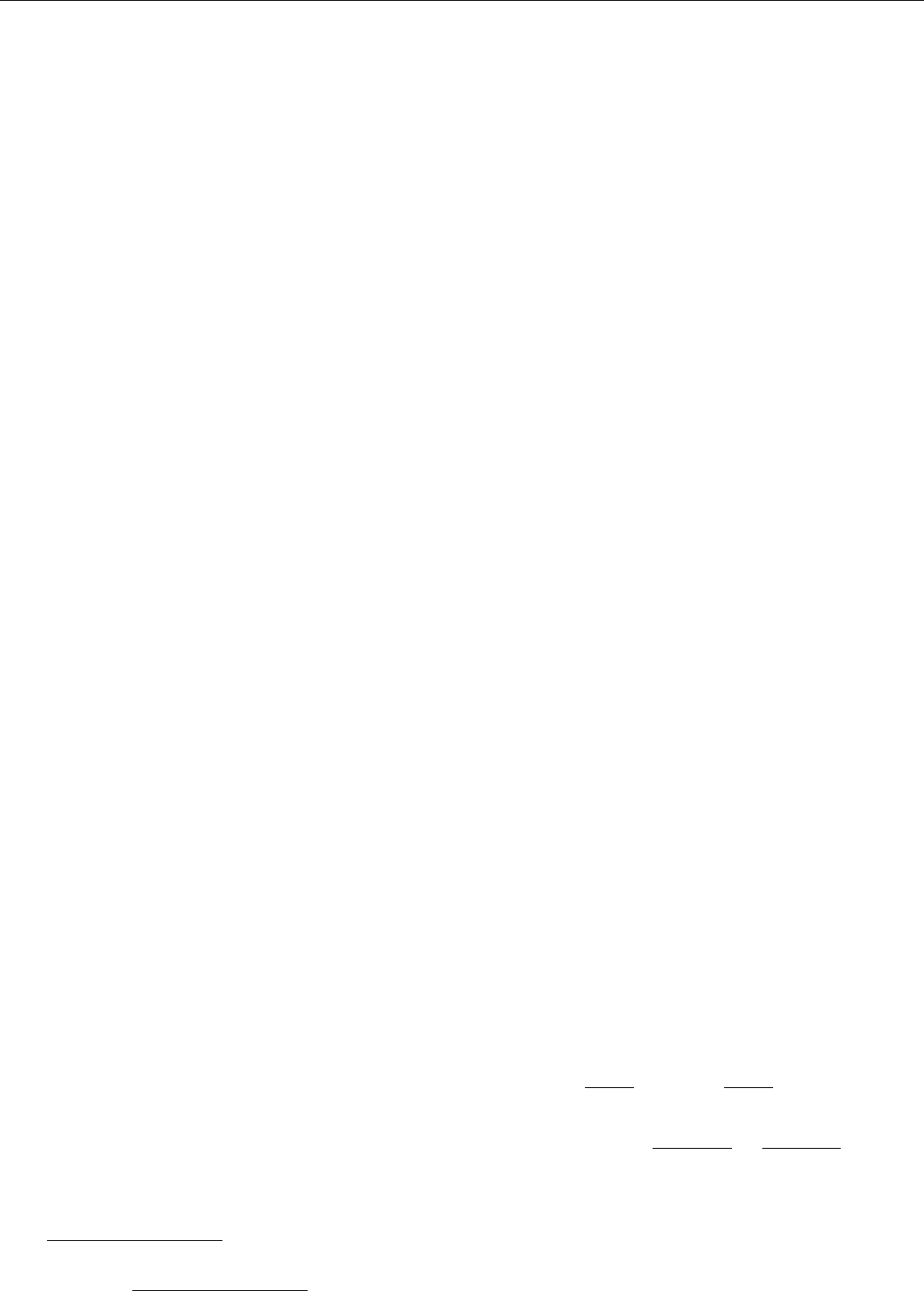
between two given (fixed) paths. Let us assume that
the horizontal steps of the upper (fixed) path are at
heights a
1
a
2
a
n
, whereas the horizontal
steps of the lower (fixed) path are at heights b
1
b
2
b
n
, a
i
b
i
, i = 1, 2, ..., n. Then the num-
ber of all paths from (0, b
1
)to(n, a
n
) satisfying the
property that for all i = 1, 2, ..., n the height of the
ith horizontal step is between b
i
and a
i
is given by
the determinant
det
1i;jn
a
i
b
j
þ 1
j i þ 1
½51
In the statistical literature, this formula is often
known as ‘‘Steck’s formula,’’ but it is actually a
special case of a much more general theorem due
to Kreweras. A generalization of [51] to higher-
dimensional paths was given by Handa and
Mohanty (see Mohanty (1979, section 2.4)).
Next, we consider three-step lattice paths in the
integer plane Z
2
, that is, paths consisting of up-steps
(1, 1), level steps (1, 0), and down-steps (1, 1). The
particular problem that we are interested in is to
count such three-step paths starting at (0, r) and
ending at (‘, s), which do not pass below the x-axis
and do not pass above the horizontal line y = K.
Furthermore, we assign the weight 1 to an up-step,
the weight b
h
to a level-step at height h, and the
weight
h
to a down-step from height h to h 1.
The weight w (P) of a path P is defined as the
product of the weights of all its steps. Then we have
the following result, which can be obtained by the
transfer matrix method described in the last section.
Define the sequence (p
n
(x))
n0
of polynomials by
xp
n
ðxÞ¼p
nþ1
ðxÞþb
n
p
n
ðxÞþ
n
p
n1
ðxÞ
for n 1
½52
with initial conditions p
0
(x) = 1andp
1
(x) = x b
0
.
Furthermore, define (Sp
n
(x))
n0
to be the sequence of
polynomials which arises from the sequence (p
n
(x))
by replacing
i
by
iþ1
and b
i
by b
iþ1
, i = 0, 1, 2, ...,
everywhere in the three-term recurrence [52] and in
the initial conditions. Finally, given a polynomial p(x)
of degree n, we denote the corresponding reciprocal
polynomial x
n
p(1=x)byp
(x).
With the weight w defined as before, the generat-
ing function
P
P
w(P)x
‘(P)
, where the sum is over all
three-step paths which start at (0, r), terminate at
height s, do not pass below the x-axis, and do not
pass above the line y = K, is given by
x
sr
p
r
ðxÞS
sþ1
p
Ks
ðxÞ
p
Kþ1
ðxÞ
; r s
r
sþ1
x
rs
p
s
ðxÞS
rþ1
p
Kr
ðxÞ
p
Kþ1
ðxÞ
; r s
8
>
>
<
>
>
:
½53
The sequence of polynomials (p
n
(x))
n0
is in fact a
sequence of orthogonal polynomials (cf. Koekoek
and Swarttouw (1998) and Szego
"
(1959)).
We remark that in the case that r = s = 0 there is
also an elegant expression for the generating func-
tion due to Flajolet (see section V.2 of the Flajolet
andSedgewickreferencein‘‘Furtherreading’’)in
terms of a continued fraction.
In order to solve our problem, we just have to
extract the coefficient of x
‘
in [53]. By a partial
fraction expansion, a formula of the type
X
m
c
m
‘
m
½54
results, where the
m
’s are the zeroes of p
Kþ1
(x), and
the c
m
’s are some coefficients, only a finite number
of them being nonzero.
It should be noted that, because of the many
available parameters (the b
n
’s and
n
’s), by appro-
priate specializations one can also obtain numerous
results about enumerating three-step paths accord-
ing to various statistics, such as the number of
touchings on the bounding lines, etc.
There are two important special cases in which a
completely explicit solution in terms of elementary
functions can be given.
The first case occurs for b
i
= 0 and
i
= 1 for all i.
In this case, the polynomials p
n
(x) defined by
the three-term recurrence [52] are Chebyshev poly-
nomials of the second kind, p
n
(x) = U
n
(x=2).
(The Chebyshev polynomial of the second kind
U
n
(x) is defined by U
n
( cos t) = sin ((n þ 1)t)= sin t
(see Koekoek and Swarttouw (1998) for almost
exhaustive information on these polynomials and,
more generally, on hypergeometric orthogonal poly-
nomials)). The result which is then obtained from the
general theorem (clearly, the zeros of U
n
(x) are
x = cos (2k= (n þ 1)), k = 1, 2, ..., n , and therefore
the partial fraction expansion of [53] is easily
determined) is that the number of lattice paths from
(0, r)to(‘, s) with only up- and down-steps, which
always stay between the x-axis and the line y = K,is
given by (see also Feller (1957, chapter XIV, eqn [5.7])
2
K þ 2
X
Kþ1
k¼1
2 cos
k
K þ 2
‘
sin
kðr þ 1Þ
K þ 2
sin
kðs þ 1Þ
K þ 2
½55
a formula which goes back to Lagrange.
The second case occurs for b
i
= 1 and
i
= 1 for
all i. In this case, the polynomials p
n
(x) defined
by the three-term recurrence [52] are again
Chebyshev polynomials of the second kind,
p
n
(x) = U
n
((x 1)=2). The result which is then
Combinatorics: Overview 567

obtained from the general theorem is that the
number of three-step lattice paths from (0, r)to
(‘, s), which always stay between the x-axis and the
line y = K, is given by
2
K þ 2
X
Kþ1
k¼1
2 cos
k
K þ 2
þ 1
‘
sin
kðr þ 1Þ
K þ 2
sin
kðs þ 1Þ
K þ 2
½56
Perfect Matchings and Tilings
In this section we consider the problem of counting
the perfect matchings of a graph. For an introduc-
tion into the problem, and into methods to solve it,
as well as for a report on recent developments, we
refer the reader to Propp (1999).
Let G = (V, E) be a finite loopless graph with
vertex set V and edge set E. A matching (also called
1-factor in graph theory) is a subset of the edges
with the property that no two edges share a vertex.
A matching is perfect if it covers all the edges.
Let M(G) denote the number of perfect matchings of
the graph G . More generally, we could assign a
weight w(e)toeachedgee ofthegraphanddefinethe
weight of a matching to be the product of
the weights of all its edges. Let M
w
(G)denote
the sum of all weights of all matchings of the
graph G.
Kasteleyn’s method for determining M(G), respec-
tively M
w
(G), makes use of determinants and
Pfaffians. Recall that the Pfaffian Pf(A)ofa
triangular array A = (a
i, j
)
1i<j2n
is defined by
PfðAÞ¼
X
m
ðsgn mÞ
Y
fi;jg2m
i;j
½57
where the sum is over all perfect matchings of the
complete graph on vertices {1, 2, ...,2n}, and where
the product is over all edges {i, j}, i < j,ofm. The
sign sgn m of m is (1)
#crossings of m
, where a crossing
is a pair ({i, j}, {k, l}) of edges such that i < k < j < l.
Usually, one extends the triangular array A to a
matrix by setting a
j, i
= a
i, j
, i < j,anda
i, i
= 0 for
all i. Then, abusing notation, we identify the
triangular array with the skew-symmetric matrix
A = (a
i, j
)
1i, j2n
. The Pfaffian satisfies the following
useful properties:
PfðB
t
ABÞ¼detðBÞPfðAÞ
and
PfðAÞ
2
¼ detðAÞ½58
The latter equality shows in particular that Pfaffians
are very close to determinants. They do, in fact,
generalize determinants since
Pf
0 B
B 0
¼ det B ½59
for any square matrix B.
Thus, given a graph with vertices v
1
, v
2
, ..., v
2n
,
specializing a
i, j
to the weight of the edge between v
i
and v
j
, if it exists, and setting a
i, j
= 0 otherwise in
the definition of the Pfaffian, we obtain almost
M
w
(G), the only difference is that there could be
signs in front of the individual terms of the sum,
whereas in M
w
(G) the sign in front of each term
must be þ. (The object obtained by omitting the sign
in [57] is called Hafnian. Unfortunately, in contrast
to the Pfaffian, it does not have any nice properties
and it is therefore extremely difficult to compute.)
Kasteleyn’s idea is to circumvent this problem by
orienting the edges of the graph, defining signed
weights of the edges, in such a way that the Pfaffian
of the array with signed weights produces exactly
M
w
(G).
More precisely, given a (weighted) graph G with
vertices v
1
, v
2
, ..., v
2n
, we make it into an oriented
(weighted) graph G
!
. That is, if there is an edge
between v
i
and v
j
, e
i, j
say, we orient it either from v
i
to v
j
or the other way. Now we define the signed
adjacency matrix A(G
!
)ofG
!
by letting its (i, j)-entry
to be þw(e
i, j
) if there is an edge from v
i
to v
j
oriented that way, w(e
i, j
) if there is an edge from
v
j
to v
i
oriented that way, and 0 if there is no edge
between v
i
and v
j
. Such an orientation is called
Pfaffian if
PfðAðG
!
ÞÞ ¼ M
w
ðGÞ
Clearly, the question remains whether a Pfaffian
orientation can be found for a given graph. In
general, this is an open question. However, Kaste-
leyn shows that for planar graphs such a Pfaffian
orientation can always be found. Moreover, he
shows that any orientation of a planar graph
which has the property that around any face
bounded by 4k edges an odd number of edges is
oriented in either direction and that around any face
bounded by 4k þ 2 edges an even number of edges is
oriented in either direction is Pfaffian.
For bipartite graphs (i.e., for graphs in which the set
of vertices can be split into two disjoint sets such that
all the edges connect the vertex of one of these sets to a
vertex of the other), the situation is even nicer. This is
because for a bipartite graph G in which both parts of
the bipartition of the vertices are of the same size
(otherwise, there is no perfect matching), any signed
568 Combinatorics: Overview

adjacency matrix A(G
!
) has the block form of the
matrix on the left-hand side of [59] and, hence, the
Pfaffian reduces to a determinant. More precisely, let
G be a bipartite graph with vertex set V = U [ W,
U = {u
1
, u
2
, ..., u
n
}andW = {w
1
, w
2
, ..., w
n
}, with
edges connecting some u
i
to some w
j
.Givena
Pfaffian orientation G
!
, we build the signed bipartite
adjacency matrix B(G
!
) = (b
i, j
)
1i, jn
of G
!
by setting
b
i, j
= þw(e
i, j
) if there is an edge from u
i
to w
j
oriented
that way, w(e
i, j
) if there is an edge from u
j
to w
i
oriented that way, and 0 if there is no edge between u
i
and w
j
. Then we have
detðBðG
!
ÞÞ ¼ M
w
ðGÞ
In particular, this holds for any bipartite planar
graph. See Robertson et al. (1999) for a structural
description about which (not necessarily planar)
bipartite graphs admit a Pfaffian orientation.
Kasteleyn’s construction in the planar case has
been generalized to graphs on surfaces of any genus
g in Dolbilin et al. (1996), Galluccio and Loebl
(1999),andTesler (2000), independently. As pre-
dicted by Kasteleyn, the solution is in terms of a
linear combination of 4
g
Pfaffians.
With the help of his method, Kasteleyn computed
the number of dimer coverings of an m n
rectangle. (A dimer is a 2 1 rectangle. Thus, this
is equivalent to counting the number of perfect
matchings on the m n grid graph. The formula
was independently found by Temperley and Fisher.)
The result is
Y
m
i¼1
Y
n
j¼1
2 cos
i
m þ 1
þ 2
ffiffiffiffiffiffiffi
1
p
cos
j
n þ 1
For even m and n, the formula can be rewritten as
Y
m=2
i¼1
Y
n=2
j¼1
4 cos
2
i
m þ 1
þ 4 cos
2
j
n þ 1
There is a similar rewriting if one of m or n is odd.
(If both m and n are odd, there is no dimer
covering.)
Forfurtherreadingandreferences see Dimer
Problems and Kuperberg (1998).
Nonintersecting Paths
Let G = (V, E) be a directed acyclic graph with
vertices V and directed edges E. Furthermore, we are
given a function w which assigns a weight w(x)to
every vertex or edge x. Let us define the weight w(P)
of a walk P in the graph by
Q
e
w(e)
Q
v
w(v), where
the first product is over all edges e of the walk P and
the second product is over all vertices v of P.We
denote the set of all walks in G from u to v by
P(u !v), and the set of all families (P
1
, P
2
, ..., P
n
)
of walks, where P
i
runs from u
i
to v
i
, i = 1, 2, ..., n,
by P(u !v), with u = (u
1
, u
2
, ..., u
n
) and v = (v
1
,
v
2
, ..., v
n
). The symbol P
þ
(u !v) stands for the set
of all families (P
1
, P
2
, ..., P
n
)inP(u !v) with the
additional property that no two walks share a
vertex. We call such families of walk(er)s ‘‘vicious
walkers’’ or, alternatively, ‘‘nonintersecting paths.’’
The weight w(P) of a family P = (P
1
, P
2
, ..., P
n
)of
walks is defined as the product
Q
n
i = 1
w(P
i
) of all the
weights of the walks in the family. Finally, given a
set M with weight function w , we write GF(M; w)
for the generating function
P
x2M
w(x).
We need two further notations before we are able
to state the Lindstro¨ m–Gessel–Viennot theorem.
(For references and historical remarks, we refer the
reader to footnote 5 in Krattenthaler (2005a).) As
earlier, the symbol S
n
denotes the symmetric group
of order n. Given a permutation 2 S
n
, we write u
for (u
(1)
, u
(2)
, ..., u
(n)
). Then
X
2S
n
ðsgn ÞGFðP
þ
ðu
! vÞ; wÞ
¼ det
1i;jn
GFðPðu
j
! v
i
Þ; wÞ
½60
Most often, this theorem is applied in the case
where the only permutation for which vicious
walks exist is the identity permutation, so that the
sum on the left-hand side reduces to a single term
that counts all families (P
1
, P
2
, ..., P
n
) of vicious
walks, the ith walk P
i
running from A
i
to
E
i
, i = 1, 2, ..., n. This case occurs, for example, if
for any pair of walks (P, Q) with P running from u
a
to v
d
and Q running from u
b
to v
c
, a < b and c < d,
it is true that P and Q must have a common vertex.
Explicitly, in that case we have
GFðP
þ
ðu !vÞ;wÞ¼ det
1i;jn
GFðPðu
j
!v
i
Þ;wÞ
½61
If the starting points or/and the endpoints are not
fixed, then the corresponding number is given by a
Pfaffian, a result obtained by Okada and Stembridge
(see Bressoud (1999) for references). For a set A of
starting points, let P
þ
(A!v) denote the set of all
families (P
1
,P
2
,...,P
2n
) of nonintersecting lattice
paths, where P
i
runs from some point of A to
v
i
,i=1,2,...,2n. Furthermore, let us suppose that
the elements of A= {u
1
,u
2
,...} are ordered in such a
way that for any pair of walks (P,Q) with P running
from u
a
to v
d
and Q running from u
b
to v
c
, a < b and
c < d, it is true that P and Q must have a common
vertex. (This is the same condition as the one which
makes [61] valid, with the only difference that, here,
Combinatorics: Overview 569
the number of u
i
’s could be larger than the number of
v
i
’s.) Then,
GFðP
þ
ðA!vÞ;wÞ
¼ Pf
1i;j2n
X
a<b
GFðPðu
a
!v
i
Þ;wÞGFðPðu
b
!v
j
Þ;wÞ
GFðPðu
b
!v
i
Þ;wÞGFðPðu
a
!v
j
Þ;wÞ
½62
If the number of paths is odd, then one can use the
same formula by adding an artificial point to the
endpoints and to the set of starting points A. There
is also a theorem by Okada and Stembridge which
covers the case that starting points and endpoints
vary. Refinements when the number of turns is fixed
can be found in Krattenthaler (1997).
Vicious Walkers, Plane Partitions,
Rhombus Tilings, and Fully Packed
Loop Configurations
In this section we describe the interrelations between
four frequently appearing objects in statistical
mechanics and combinatorics: vicious walkers,
plane partitions, rhombus tilings, and fully packed
loop configurations.
Given a lattice, vicious walkers, as introduced by
Fisher (1984), are particles which move on lattice
sites in such a way that two particles never occupy
the same lattice site. Models of vicious walkers have
been the object of numerous studies from various
points of view. Rather than accomplishing the
impossible task of providing a complete overview
of references, the reader is referred to the basic
reference Fisher (1984) and to Krattenthaler (2005a)
for further pointers to the literature.
Most of the known results apply for vicious
walkers on the line. There are in fact two different
models: in the random turns vicious walker model, n
walkers move on the integral points of the real line
in such a way that at each tick of the clock exactly
one walker moves to the right or to the left, whereas
in the lock step vicious walker model n walkers
move on the integral points of the real line in such a
way that at each tick of the clock each walker moves
to the right or to the left.
The first model is equivalent to a model of one
walker in Z
n
(Z denoting the set of integers) which
at each tick of the clock moves a positive or negative
unit step in the direction of one of the coordinate
axes, always staying in the wedge x
1
> x
2
> >
x
n
. This point of view was already put forward by
Fisher (1984). However, this problem belongs to the
problem of counting paths in chambers of reflection
groupsdiscussedinthesection‘‘Latticepaths.’’
The second model could also be realized as a
single walker model (cf. Krattenthaler (2003)).
However, most often it is realized as a model of n
paths in the plane consisting of steps (1, 1) and
(1, 1) with the property that no two paths have a
point in common. In this picture, the x-axis becomes
the time line, the kth path doing an up-step (1, 1)
from (t 1, y)to(t, y þ 1) meaning that the kth
particle moves to the left at time t, whereas the kth
path doing a down-step (1, 1) from (t 1, y)to
(t, y 1) meaning that the kth particle moves to the
right at time t.
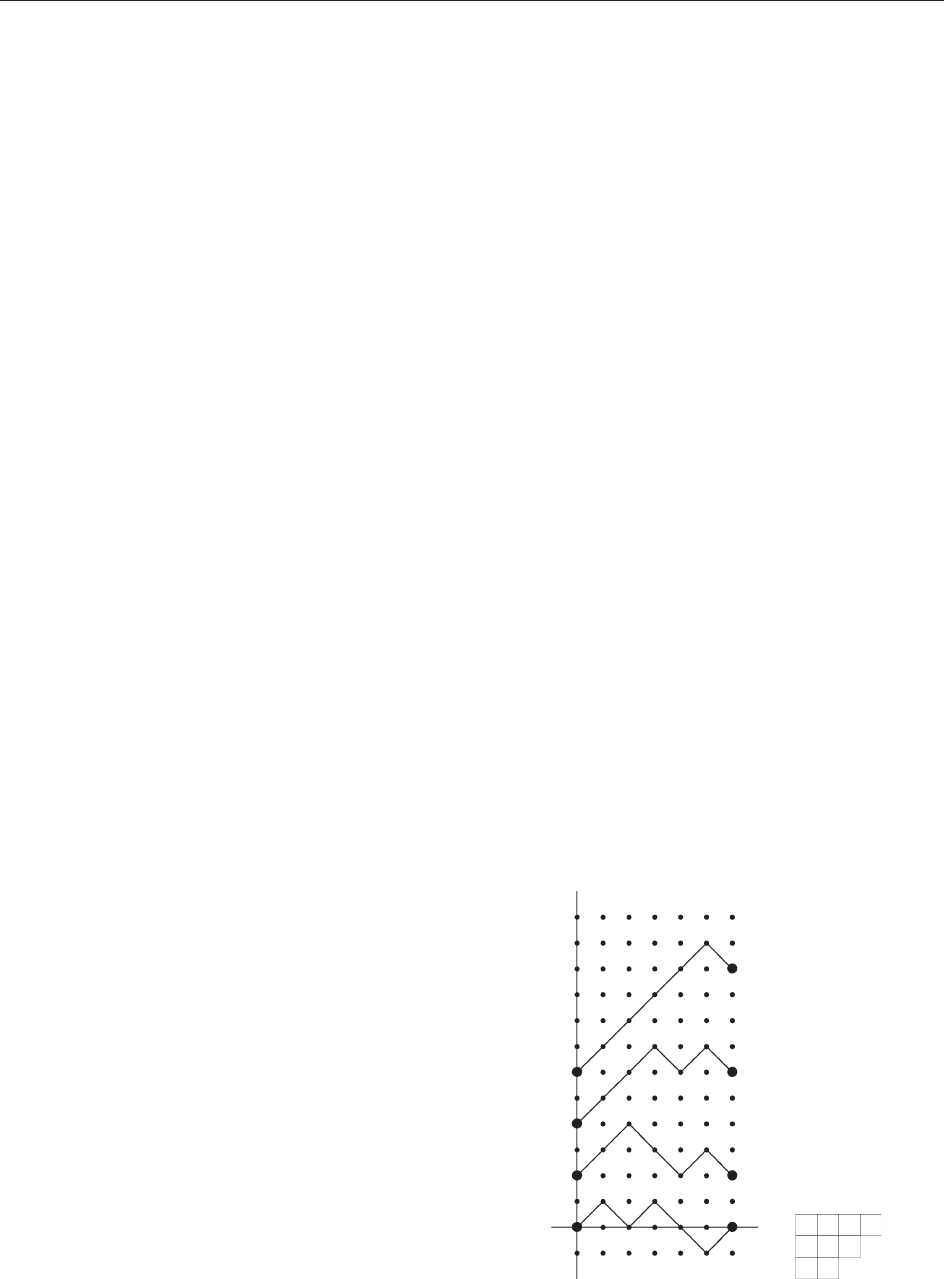
The reader should consult Figure 14a for an
example. (The labelings should be ignored at this
point.) Clearly, what we encounter here is a
particular instance of the nonintersecting paths of
the last section. Therefore, for fixed starting points
and endpoints, formula [61] applies, whereas if the
starting points vary and the endpoints are fixed, it is
formula [62] that applies.
At this point, the links to the other objects,
semistandard tableaux and plane partitions
(cf. Bressoud (1999)), emerge. A filling of the cells
of the Ferrers diagram of with elements of the set
{1, 2, ...}, which is weakly increasing along rows
and strictly increasing along columns is called a
(semistandard) tableau of shape . Figure 14b shows
such a semistandard tableau of shape (4, 3, 2). In
fact, vicious walkers and semistandard tableaux are
equivalent objects. To see this, first label down-steps
by the x-coordinate of their endpoint, so that a step
from (a 1, b)to(a, b 1) is labeled by a, see
Figure 14a. Then, out of the labels of the j
th path,
form the jth column of the corresponding tableau,
A
4
A
3
A
2
A
1
E
1
E
2
E
3
E
4
6
6
6
3
24
5
4
4
2346
446
56
(b)(a)
Figure 14 (a) Vicious walkers. (b) A tableau.
570 Combinatorics: Overview
see Figure 14b. The resulting array of numbers is
indeed a semistandard tableau. This can be readily
seen, since the entries are trivially strictly increasing
along columns, and they are weakly increasing along
rows because the paths do not touch each other.
Thus, problems of enumerating vicious walkers can
be translated into tableau enumeration problems,
and vice versa.
The significance of semistandard tableaux lies
particularly in the representation theory for classical
groups, see Classical Groups and Homogenous
Spaces and Compact Groups and Their Representa-
tions. Namely, the irreducible characters for
GL(n, C) and SL(n, C), the Schur functions, are
generating functions for semistandard tableaux of
a given shape. If the entries of the ith row of
a semistandard tableau are required to be at least
2i 1, then one speaks of symplectic tableaux, and
the irreducible characters for Sp(2n, C ) are generat-
ing functions for symplectic tableaux of a given
shape. We refer the reader to Krattenthaler et al.
(2000) for more information on these topics.
Objects which are very close to semistandard
tableaux are plane partitions. According to MacMa-
hon, a plane partition of shape is a filling of the
Ferrers diagram of with non-negative integers which
is weakly decreasing along rows and columns. See
Figure 15b for an example of a plane partition of shape
(3, 3, 3). In particular, semistandard tableaux and
plane partitions of rectangular shape are actually
equivalent. For, let T be a semistandard tableau of
rectangular shape. Then, from each element of the ith
row we subtract i. Finally, the obtained array is rotated
by 180
. As a result, we obtain a plane partition. See
Figure 15 for a semistandard tableau and a plane
partition which correspond to each other under these
transformations.
On the other hand, plane partitions can also be
realized as three-dimensional objects, by interpreting
each entry in the array as a pile of unit cubes of the
size of the entry. For example, the plane partition in
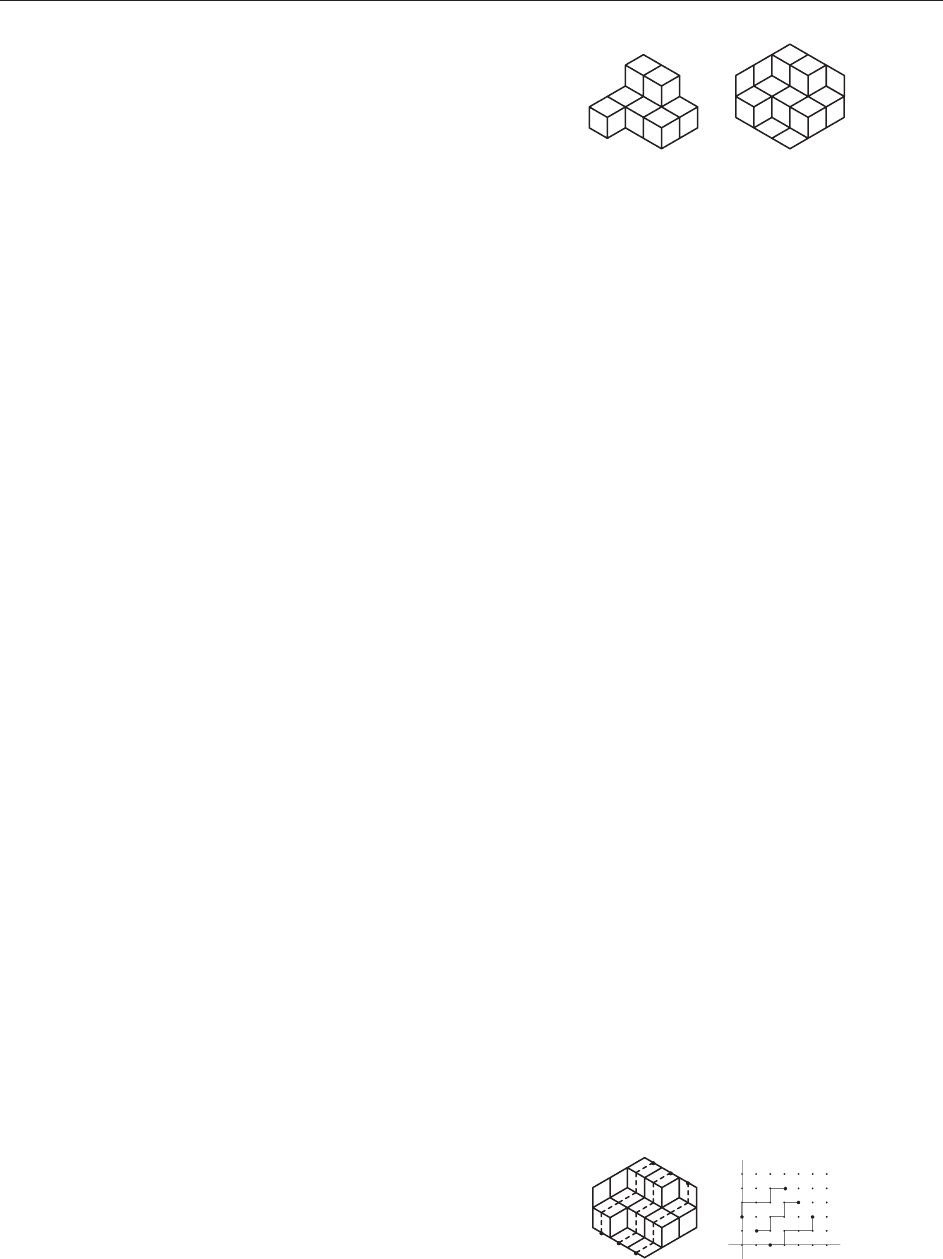
Figure 15 corresponds to the pile of cubes in
Figure 16a. But then, forgetting the three-dimensional
view, by embedding the picture in a minimally
bounding hexagon, and by filling the emerging empty
regions by rhombi of unit length in the unique way this
is possible, we obtain a rhombus tiling of a hexagon in
which opposite sides have the same length, see
Figure 16b.
From the rhombus tiling, there is then again an
elegant way to go to nonintersecting paths: we mark
the mid-points of the edges along two opposite sides,
see Figure 17a. Now we draw lattice paths which
connect points on different sides, by ‘‘following’’
along the other lozenges, as indicated in Figure 17a
by the dashed lines. Clearly, the resulting paths are
nonintersecting, that is, no two paths have a
common vertex. If we slightly distort the underlying
lattice, we get orthogonal paths with horizontal and
vertical steps in the positive direction, see
Figure 17b.
Rhombus tilings, on their part, are equivalent to
perfect matchings of hexagonal graphs. To see this,
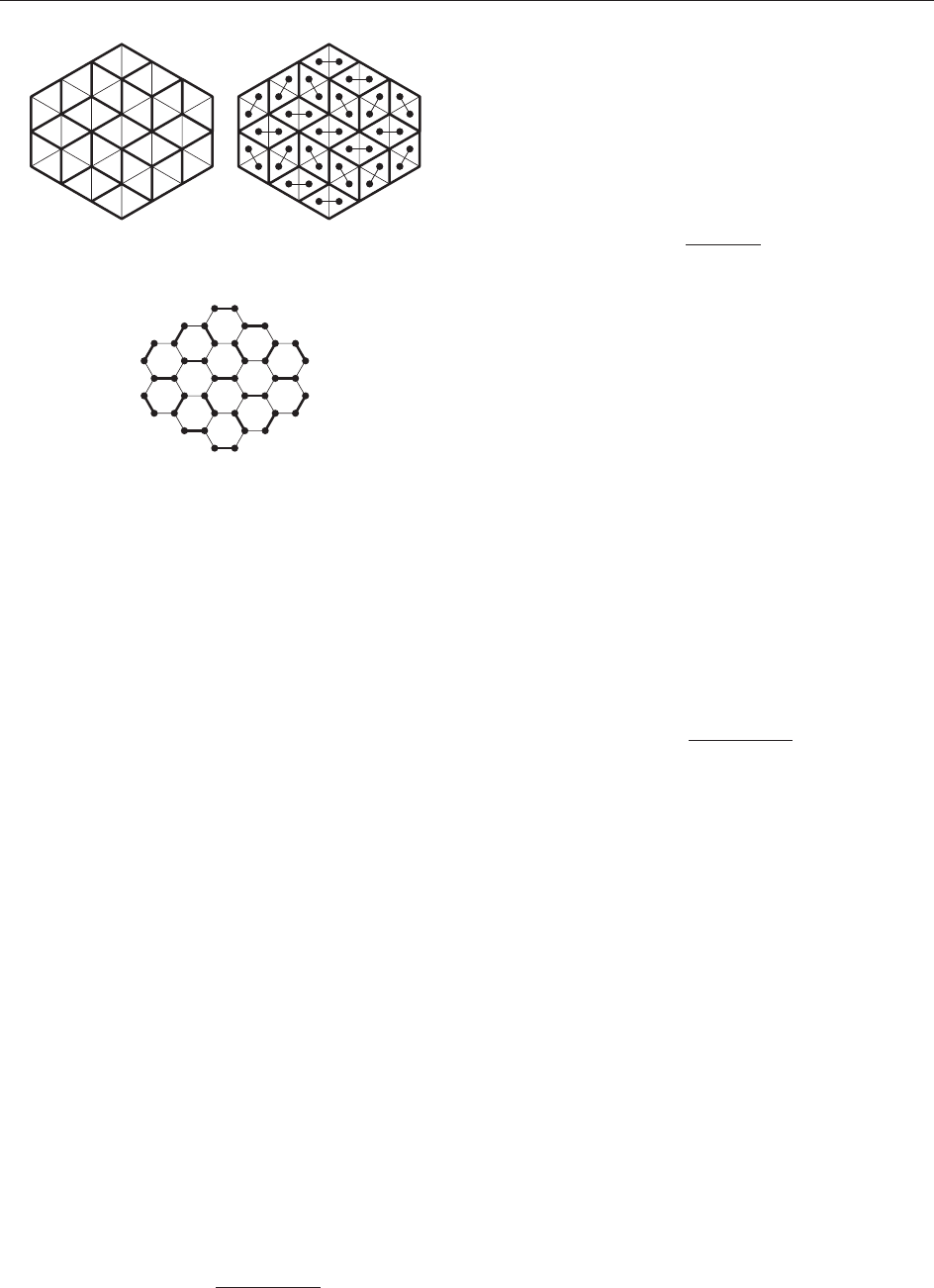
one places the tiling on the underlying triangular
grid, see Figure 18a. Then one places a bond into
each rhombus, so that it connects the mid-points of
the two triangles out of which the rhombus is
composed, see Figure 18b. Finally, one forgets the
contour of the tiling, but instead one introduces all
the other edges which connect mid-points of
adjacent triangles of the triangular grid, see
Figure 18c. Thus, one arrives at a perfect matching
of the hexagonal graph consisting of the edges
connecting mid-points of triangles.
Because of these various connections, enumera-
tion problems for vicious walkers, plane partitions,
tableaux, rhombus tilings can be approached by
the different methods which are available for the
various objects: the determinant theorem from
thesection‘‘Nonintersectingpaths,’’together
with determinant evaluation techniques (cf. the
survey Krattenthaler (2005b)), apply, as well as the
‘‘Kasteleynmethod’’fromthesection‘‘Perfect
112
333
455
221
111
100
(a) (b)
Figure 15 (a) A semistandard tableau. (b) A plane partition.
(a) (b)
Figure 16 (a) A plane partition; three-dimensional view.
(b) A rhombus tiling.
(a) (b)
Figure 17 (a) A rhombus tiling. (b) A family of nonintersecting
paths.
Combinatorics: Overview 571
matchingsandtilings,’’andalsomethodsfrom
character theory for the classical groups. All
of these methods have been applied extensively (see
the surveys by Kenyon (2003), Propp (1999), and
Krattenthaler et al. (2000)), the first and third more
frequently for exact enumeration, while the second
particularly for asymptotic studies. It should be
noted that methods from random matrix theory also
apply in certain situations, see Johansson (2002). See
Growth Processes in Random Matrix Theory and
Random Matrix Theory in Physics.
In fact, we missed mentioning a further object, from
statistical physics, which in some cases is equivalent to
vicious walkers, etc.: fully packed loop configurations.
(Fully packed loop configurations are in bijection with
six-vertex configurations, see the next section.) If one
imposes certain ‘‘connectivity constraints’’ on fully
packed loop configurations, then one can construct
bijections with rhombus tilings and, hence, with
nonintersecting paths and with the other objects
discussed in this section. The reader is referred to
Di Francesco et al. (2004) and references therein.
Having explained the various connections, we cite
some fundamental results in the area. (We refer the
reader to Bressoud (1999) and Stanley (1999,
chapter 7).) MacMahon proved that the number of
all plane partitions contained in an a b c box
(when viewed in three dimensions) is equal to
Y
a
i¼1
Y
b
j¼1
Y
c
k¼1
i þ j þ k 1
i þ j þ k 2
½63
Thus, the number of rhombus tilings of a hexagon
with side lengths a,b,c,a,b,c is given by the same
number, as well as the number of all vicious walkers
(P
1
, P
2
, ..., P
a
), where P
i
runs from (0, 2i)to(b þ c,
b c þ 2i), i = 1, 2, ..., a. More generally, the num-
ber of semistandard tableaux of shape with entries
at most m is given by the hook-content formula
Y
u2
cðuÞþm
hðuÞ
½64
where u ranges over all the cells of the Ferrers
diagram of , with c(u) being the content of u,
defined as the difference of the column number and
the row number of u, and with h(u) being the hook
length of u, defined as the number of cells in the
hook of u, the latter consisting of the cells to the
right of u in the same row and below u in the
same column, including u. Thus, this also gives a
formula for the number of all vicious walkers
(P
1
, P
2
, ..., P
a
), where P
i
runs from (0, 2i)to
(N, h
i
). See Krattenthaler et al. (2000, section 2)
for details. There it is also explained that a Schur
function summation formula, together with an
analog of the hook-content formula for special
orthogonal characters, proves that the number of
all vicious walkers (P
1
, P
2
, ..., P
a
), where P
i
runs
from (0, 2i) for N steps is given by
Y
1ijN
a þ i þ j 1
i þ j 1
½65
The reader is referred to the references given in
this section for many more results, in particular, on
the enumeration of plane partitions with symmetry,
the enumeration of rhombus tilings of regions other
than hexagons, and the enumeration of vicious
walkers with various starting points and endpoints,
under various constraints.
Six-Vertex Model and Alternating-Sign
Matrices
An alternating-sign matrix is a square matrix of 0’s,
1’s and 1’s for which the sum of entries in each
row and in each column is 1 and the nonzero entries
of each row and of each column alternate in sign.
For instance,
00 1 00
10110
01 011
00 1 00
00 0 10
0
B
B
B
B
@
1
C
C
C
C
A
(a) (b)
(c)
Figure 18 (a) A rhombus tiling. (b) Bonds in rhombi.
(c) A perfect matching of a hexagonal graph.
572 Combinatorics: Overview
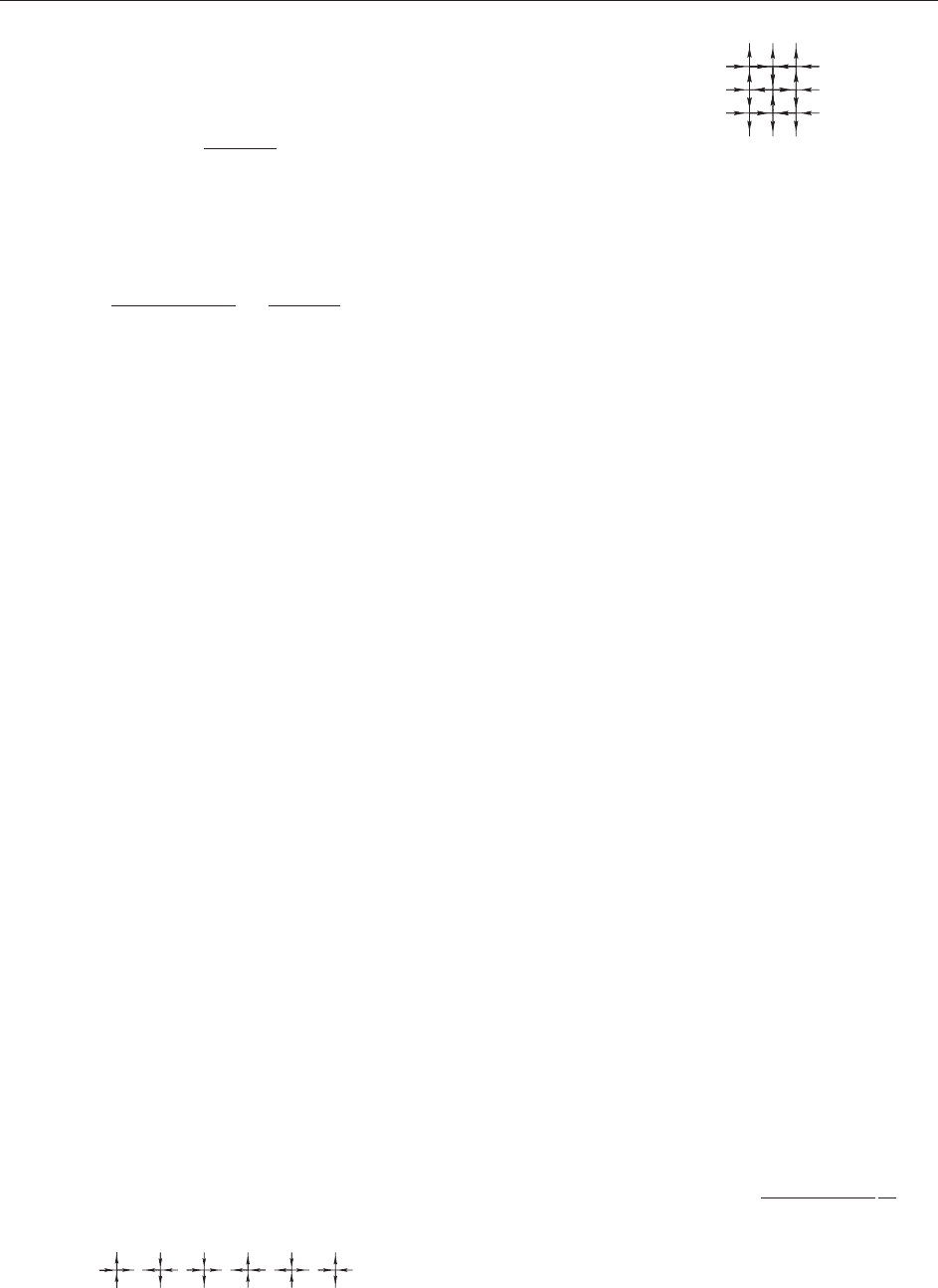
is a 5 5 alternating-sign matrix. Zeilberger proved
that the number of n n alternating-sign matrices is
given by
Y
n1
i¼0
ð3i þ 1Þ!
ðn þ iÞ!
½66
and he went on to prove the finer version that the
number of n n alternating-sign matrices with the
(unique) 1 in the first row in position j is given by
nþj2
n1
2nj1
n1
3n2
n1
Y
n1
i¼0
ð3i þ 1Þ!
ðn þ iÞ!
½67
The first number is also equal to the number of
totally symmetric self-complementary plane parti-
tions contained in the (2n) (2n) (2n) box, but
there is no intrinsic explanation why this is so. We
refer the reader to Bressoud (1999) for an exposi-
tion of these results, and for pointers to the
literature containing further unexplained connec-
tions between alternating-sign matrices and plane
partitions.
While the first result was achieved by a brute-force
constant-term approach, the second result is based on
the observation that alternating-sign matrices are in
bijection with configurations in the six-vertex model
on the square grid under domain-wall boundary
conditions. This then allowed one to use a formula
due to Izergin for the partition function for these six-
vertex configurations. Similar formulas for variations
of the model have been found by Kuperberg, and by
Razumov and Stroganov (see Razumov and Stroga-
nov (2005) and references therein).
A configuration in the six-vertex model is an
orientation of edges of a 4-regular graph (i.e., at
each vertex there meet exactly four edges) such that
at each vertex two edges are oriented towards the
vertex and two are oriented away from the vertex.
Thus, there are six possible vertex configurations,
giving the name of the model, see Figure 19.Togo
from one object to the other, one uses the transla-
tion between local configurations at a vertex and
entries in alternating-sign matrices indicated in the
figure. An example of the correspondence can be
found in Figure 20.
Another manifestation of alternating-sign matrices
and six-vertex configurations are fully packed loop
configurations. A fully packed loop configuration on a
graph is a collection of edges such that each vertex is
incident to exactly two edges. One obtains a fully
packed loop configuration out of a six-vertex config-
uration by dividing the square lattice into its even and
odd sublattice denoted by A and B, respectively.
Instead of arrows, only those edges are drawn that,
on sublattice A, point inward and, on sublattice B,
point outward. The reader is referred to de Gier
(2005)andDiFrancesco et al. (2004)forfurther
reading.
The story of alternating-sign matrices and their
connection to the six-vertex model is given a vivid
account in Bressoud (1999), with further important
results by Kuperberg, Okada, Razumov and
Stroganov, referenced in Razumov and Stroganov
(2005).
Fully packed loop configurations seem to play an
important role in the explicit form of the ground-
state vectors of certain Hamiltonians in the dense
O(1) loop model. The corresponding conjectures are
surveyed in de Gier (2005). There is important
progress on these conjectures by Di Francesco and
Zinn–Justin (2005, and references therein).
Binomial Sums and Hypergeometric Series
When dealing with enumerative problems, it is
inevitable to deal with binomial sums, that is, sums
in which the summands are products/quotients of
binomial coefficients and factorials, such as, for
example,
X
n
k¼0
2k
k
2n 2k
n k
In most cases, the right environment in which one
should work is the theory of (generalized) hypergeo-
metric series. These are defined as follows:
r
F
s
a
1
; ...; a
r
; z
b
1
; ...; b
s
2
4
3
5
¼
X
1
k¼0
ða
1
Þ
k
ða
r
Þ
k
ðb
1
Þ
k
ðb
s
Þ
k
z
k
k!
where ()
k
= ( þ 1)( þ 2) ( þ k 1) for k >
0, and ()
0
= 1. The symbol ( )
k
is called the
Pochhammer symbol or shifted factorial. For in-
depth treatments of the subject, we refer the reader
0000–11
Figure 19 The six vertex configurations.
(a) (b)
00
1
1
001
–1 1
⎛
⎝
⎜
⎜
⎜
⎜
⎛
⎝
⎜
⎜
⎜
⎜
Figure 20 (a) An alternating-sign matrix. (b) A six-vertex
configuration.
Combinatorics: Overview 573
to Andrews et al. (1999), Gasper and Rahman
(2004), and Slater (1966).
Hypergeometric series can be characterized as
series in which the quotient of the (k þ 1)st by the
kth summand is a rational function in k. This is also
the way to convert binomial sums into their
hypergeometric form (respectively to see if this is
possible; in most cases it is): form the quotient of the
(k þ 1)st by the kth summand and read off the
parameters a
1
, ..., a
r
, b
1
, ..., b
s
, and the argument z
from the factorization of the numerator and the
denominator polynomials of the rational function,
out of these form the corresponding hypergeometric
series, and multiply the series by the summand for
k = 0. This is, in fact, a completely routine task, and,
indeed, computer algebra programs such as Maple
and Mathematica do this automatically.
The reason why hypergeometric series are much
more fundamental than the binomial sums them-
selves is that there are hundreds of ways to write the
same sum using binomial coefficients and factorials,
whereas there is just one hypergeometric form, that
is, hypergeometric series are a kind of normal form
for binomial sums. In particular, given a specific
binomial sum, it is a hopeless enterprise to scan
through all the identities available in the literature
for this sum. There may be an identity for it, but
perhaps written differently. On the contrary, given a
specific hypergeometric series, the list of available
identities which apply to this series is usually not
large, and tables of such identities can be set up in
a systematic way. This has been done (cf. Slater
(1966); the most comprehensive table available to
this date is contained in the manual of
theMathematicapackageHYP–see‘‘Further
reading’’),andscanningthroughthesetablesis
largely facilitated by the use of the Mathematica
package HYP.
We give here some of the most important
identities for hypergeometric series. Aside from the
binomial theorem, the most important summation
formulas are: the Gauß
2
F
1
-summation formula
2
F
1
a; b
; 1
c
2
4
3
5
¼
ðcÞðc a bÞ
ðc aÞðc bÞ
provided <(c a b) > 0,
the Pfaff–Saalschu¨ tz summation formula
3
F
2
a; b; n
; 1
c; 1 þ a þ b c n
2
4
3
5
¼
ðc aÞ
n
ðc bÞ
n
ðcÞ
n
ðc a bÞ
n
provided n is a non-negative integer, and
the Dougall summation formula
7
F
6
a;a=2 þ1;b;c;d;1 þ2a b c d þn;n
;1
a=2;1 þa b;1 þa c;1 þa d;
a þb þc þd n;a þ1 þn
2
6
6
6
6
6
6
4
3
7
7
7
7
7
7
5
¼
ð1 þaÞ
n
ð1 þa b cÞ
n
ð1 þa b d Þ
n
ð1 þa c dÞ
n
ð1 þa bÞ
n
ð1 þa cÞ
n
ð1 þa dÞ
n
ð1 þa b c dÞ
n
provided n is a non-negative integer.
Some of the most important transformation
formulas are
the Euler transformation formula
2
F
1
a;b
;z
c
2
4
3
5
¼ð1 zÞ
cab
2
F
1
c a;c b
;z
c
2
4
3
5
provided jzj< 1,
the Kummer transformation formula
3
F
2
a; b; c
; 1
d; e
2
6
4
3
7
5
¼
ðeÞðd þ e a b cÞ
ðe aÞðd þ e b cÞ
3
F
2
a; d b; d c
; 1
d; d þ e b c
2
6
4
3
7
5
provided both series converge,
and the Whipple transformation formulas
4
F
3
a;b;c;n
;1
e;f ;1 þa þbþc e f n
2
6
6
4
3
7
7
5
¼
ðeaÞ
n
ðf aÞ
n
ðeÞ
n
ðf Þ
n
4
F
3
n;a;1 þa þce f n;1 þa þb e f n
;1
1þa þb þc ef n;1 þa e n;1 þa f n
2
6
6
4
3
7
7
5
½68
where n is a non-negative integer, and
7
F
6
a;1 þ
a
2
;b; c; d;e; n
;1
a
2
;1 þa b;1 þa c; 1 þa d;1 þa e;1 þa þn
2
6
6
4
3
7
7
5
¼
ð1 þaÞ
n
ð1 þa d eÞ
n
ð1 þa dÞ
n
ð1 þa eÞ
n
4
F
3
1 þa b c;d;e; n
;1
1 þa b; 1 þa c;a þd þe n
2
6
6
4
3
7
7
5
½69
provided n is a non-negative integer.
574 Combinatorics: Overview