
Francoise J.-P., Naber G.L., Tsun T.S. (editors) Encyclopedia of Mathematical Physics
Подождите немного. Документ загружается.


energy rather ap peared to remain confined within a
packet of low-frequency modes having a certain
width, as if being in a state of apparent equilibrium
of a nonstandard type. This fact can be called ‘‘the
FPU paradox.’’ In the words of Ulam, written as a
comment in Fermi’s Collected Papers, this is
described as follows: ‘‘The results of the computa-
tions were interesting and quite su rprising to Fermi.
He exp ressed the opinion that they really constituted
a little discovery in providin g intimations that the
prevalent beliefs in the universality of mixing and
thermalization in nonlinear systems may not be
always justified.’’
The FPU paper immediately had a very strong
impact on the theory of dynamical systems, because
it motivat ed all the modern theory of infinite-
dimensional integrable systems and solitons (KdV
equation), starting from the works of
bi
Zabusky and
Kruskal (1965). But in this way the FPU paradox
was somehow enhanced, because the FPU system
turned out to be associated to the class of
integrable systems, namely the systems having a
number of integrals of motion equal to the number
of degrees of freedom, which are in a sense the
most antithermodynamic systems. The merit of
establishing a bridge towards ergodicity goes to
Izrailev and Chirikov (1966). Making reference to
the most advanced results then available in the
perturbation theory for nearly integrable systems
(KAM theory), these authors pointed out that
ergodicity, and thus equipartition, would be recov-
ered if one took initial data with a sufficiently large
energy. And this was actually found to be the case.
Moreover, it turned out that their work, and its
subsequent completion by Shepelyanski, was often
interpreted as supporting the conjecture that the
FPU paradox would disappear in the thermody-
namic limit (infinitely many particles, with finite
density and energy density). The opposite conjec-
ture was advanced in the year 1970 by Bocchieri,
Scotti, Bearzi, and Loinger, and its relevance for the
relations between classical and quantum mechanics
was immediately pointed out by Cercignani,
Galgani, and Scotti. A long debate then followed.
Possibly, some misunderstandings occurred, because
in the discussions concerning the dynamical aspects
of the problem reference was generally made to
notions involving infinite times. In fact, it had not
yet been conceived that the FPU equilibrium might
actually be an apparent one, corre sponding to some
type of intermediate metaequilibrium state. This
was for the first time suggested by researchers in
Parisi’s group in the year 1982. The analogy of
such a situation with that occurring in glasses was
pointed out more recently.
In the present article, the state of the art of the
FPU problem is discussed. The thesis of the present
authors is that the FPU phenomenon survives in the
thermodynamic limit, in the last mentioned sense,
namely that at sufficiently low temperatures there
exists a kind of metaequilibrium state surviving for
extremely long times. The corresponding thermo-
dynamics turns out to be different from the standard
one pr edicted by the equilibrium ensembles, inas-
much as it presents qualitatively some quantum-like
features (typically, specific heats in agreement with
Nernst’s third principle). The key point, with respect
to equilibrium statistical mechanics, is that the
internal thermodynamic energy should be identified
not with the whole mechanical energy, but only with
a suitable fraction of it, to be identified through its
dynamical properties, as was suggested more than a
century ago by Boltzmann himself, and later by
Nernst.
Here, it is first discussed why nearly integrable
systems can be expected to present the FPU phenom-
enon. Then the latter is illustrated. Finally, some hints
are given for the corresponding thermodynamics.
Nearly Integrable versus Hyperbolic
Systems, and the Question of the Rates
of Thermalization
As mentioned above, it is usually assumed that the
problem of providing a dynamical foundation to
classical statistical mechanics is reduced to the
mathematical problem of ascertaining whether the
Hamiltonian systems of physical interest are ergodic
or not. However, there remains open a subtler
problem. Indeed, the notion of ergodicity involves
the limit of an infinite time (time averages should
converge to ensemble averages as t !1), while
intermediate times might be relevant. In this
connection it is convenient to distinguish between
two classes of dynamical systems, namely the
hyperbolic and the nearly integrable ones.
The first class, in a sense the prototype of chaotic
systems, should include the systems of hard spheres
(extensively studied after the classical works of
Sinai), or more generally the systems of mass points
with mutual repulsive interactions. For such systems
it can be expected that the time averages of the
relevant dynamical quantities in an extremely short
time converge to the corre sponding ensemble
averages, so that the classical equilibrium ensembles
could be safely used.
A completely different situation occurs for the
dynamical systems such as the FPU systems, which
are nearly integrable, that is, are perturbations of
126 Dynamical Systems and Thermodynamics
systems having a number of integrals of motion
equal to the number of degrees of freedom. Indeed,
in such a case ergodicity means that the addition of
an interaction, no matter how small, makes an
integrable system lose all of its integrals of motion,
apart from the Hamiltonian itself. And, in fact, this
quite remarkable property was already proved to be
generic by Poincare´, through a set of considerations
which had a fundamental impact on the theory of
dynamical systems itself. In view of its importance
for the foundations of statistical mechanics, the
proof given by Poincare´ was reconsidered by Fermi,
who add ed a subtle contribution concerning the role
of single invariant surfaces. It is just to such a paper
that Ulam makes reference in his comment to the
FPU work mentioned above, when he says: ‘‘Fermi’s
earlier interest in the ergodic theory is one motive’’
for the FPU work.
The point is that the picture which looks at the
ergodicity induced on an integrable system by the
addition of a perturbation, no matter how small,
somehow lacks continuity. One might expect that,
in situations in which the nonlinear interaction
which destroys the integrals of motion is very small
(i.e., at low temperatures), the underlying integrable
structure should somehow be still appreciable, in
some continuous way. In fact, continuity should be
recovered by making a question of times, namely by
considering the rate s of thermalization (to use the
very FPU phrase), or equivalently the relaxation
times, namely the times needed for the time averages
of the relevant dynamical quantities to converge to
the corresponding ensemble averages. By continuity,
one clearly expects that the relaxation times diverge
as the perturbation tends to zero. But more
complicated situations might occur, as, for example,
the existence of two (or more) relevant timescales.
The point of view that timescales of different orders
of magnitude might occur in dynamical systems
(with the exhibition of an interesting example) and
that this might be relevant for statistical mechanics,
was discussed by Poin care´ himself in the year 1906.
Indeed, he denotes as ‘‘first-order very large time’’ a
time which is sufficient for a system to reach a
‘‘provisional equilibrium,’’ whereas he denotes as
‘‘second-order very large time’’ a time which is
necessary for the system to reach its ‘‘definitive
equilibrium.’’
The FPU Phenomenon: Historical and
Conceptual Developments
We now illustrate the FPU phenomenon, following
essentially its historical development. We will make
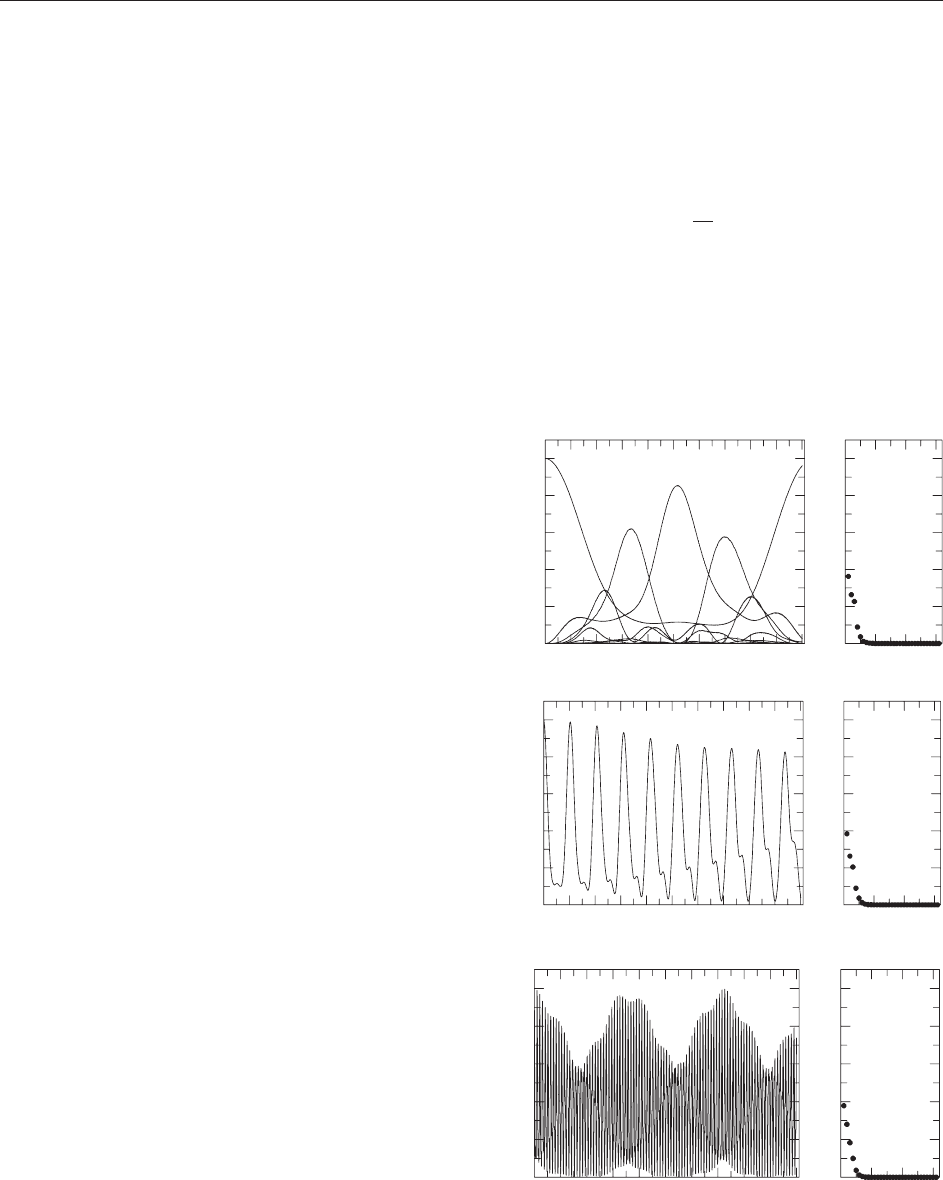
reference to Figures 1–8, which are the results of
numerical integrations of the FPU dynamical system.
If x
1
, ..., x
N
denote the posit ions of the particles (of
unitary mass), or more precisely the displacements
from their equilibrium positions, and p
i
the corre-
sponding momenta, the Hamiltonian is
H ¼
X
N
i¼1
p
2
i
2
þ
X
Nþ1
i¼1
Vðr
i
Þ
where r
i
= x
i
x
i1
and one has taken a potential
V(r) = r
2
=2 þ r
3
=3 þ r
4
=4 depending on two
positive parameters and . Boundary conditions
with fixed ends, namely x
0
= x
Nþ1
= 0, are consid-
ered. We recall that the angular frequencies
Time (K-units)
020
0.0 0.04
0.02
0
2
4
6
8
10
0.0 0.04
0.02
Mode
E
1
, . . . ,E
8
Time (K-units)
020
0.0 0.04
0.02
0
200
400
600
800
1000
0.0 0.04
0.02
Mode
E
1
Time (K-units)
020
0.0 0.04
0.02
20
40
60
80
0
100
0.0 0.04
0.02
Mode
E
1
Figure 1 The FPU paradox: normal-mode energies E
j
versus
time (left) and energy spectrum, namely time average of E
j
versus j (right) for three different timescales. The energy, initially
given to the lowest-frequency mode, does not flow to the high-
frequency modes within the accessible observation time. Here,
N = 32 and E = 0:05.
Dynamical Systems and Thermodynamics 127
of the c orresponding normal modes are !
j
= 2sin
[ j=2(N þ 1)], with j = 1, ..., N; it is thus conve-
nient to take as time unit the value ,whichis
essentially, for any N, the period of the fastest
normal mode.
The original FPU result is illustrated in Figures 1
and 2. Here N = 32, = = 1= 4, and the total
energy is E = 0.05; the energy was given initially to
the first normal mode (with vanishing potential
energy). Three timescales (increasing from top to
bottom) are considered, the top one corresponding
to the timescale of the original FPU paper. In the
boxes on the left the energies E
j
(t) of modes j are
reported versus time (j = 1, ..., 8 at top, j = 1at
center and bottom). In the boxes on the right we
report the corresponding spectra, namely the time
average (up to the respective final times) of the
energy of mode j versus j, for 1 j N.InFigure 2
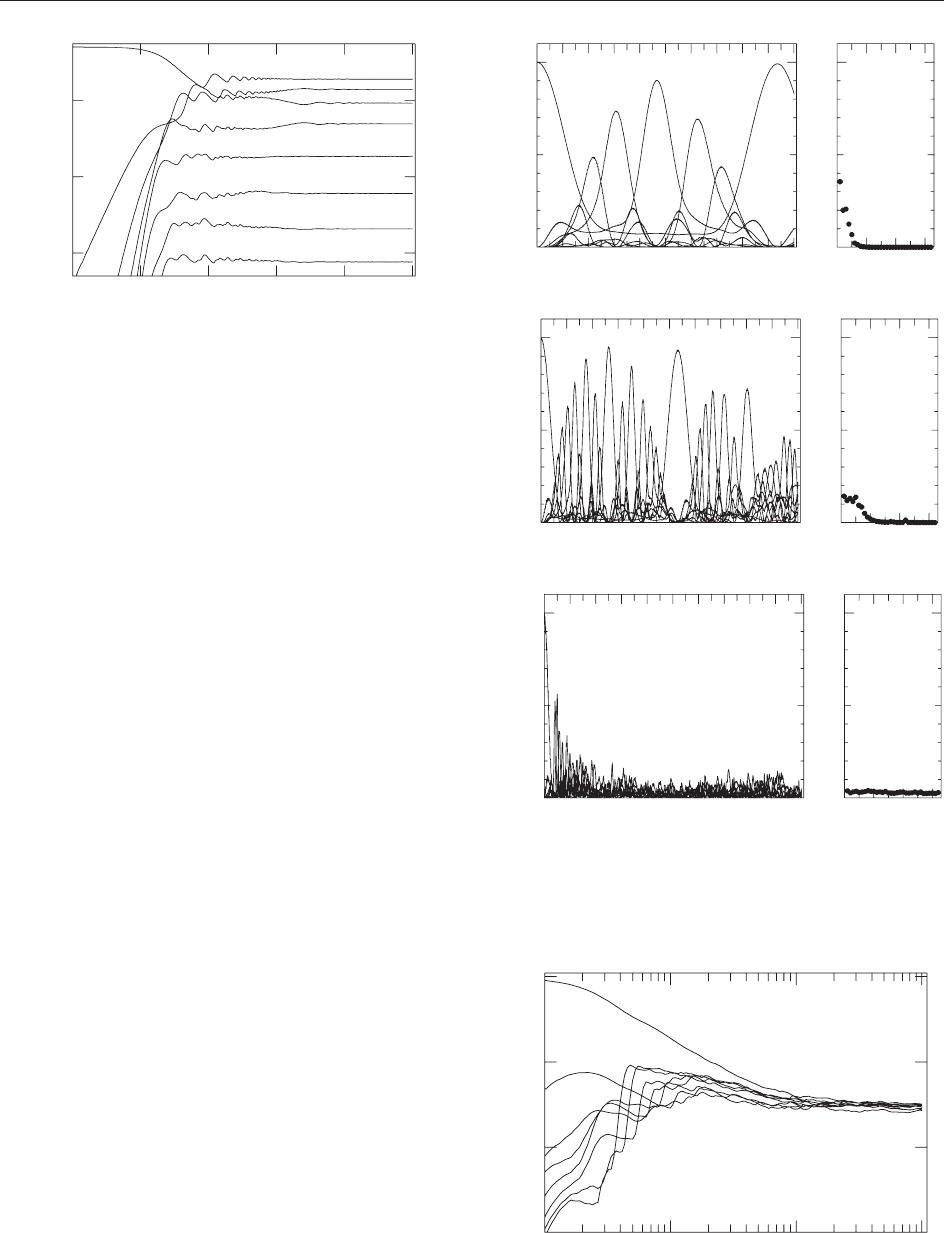
we report, for the same run of Figure 1, the time
averages of the energies of the various modes versus
time; this figure corresponds to the last one of the
original FPU work. The facts to be noticed in
connection with these two figures are the following:
(1) the spectrum (namely the distribution of energy
among the modes, in time average) appears to have
relaxed very quickly to some form, which remains
essentially unchanged up to the maximum observed
time; (2) there is no global equipartition, but only a
partial one, because the energy remains confined
within a group of low-frequency modes, which form
a small packet of a certain definite width; and (3)
the time evolutions of the mode energies appear to
be of quasiperiodic type, since longer and longer
quasiperiods can be observed as the total time
increases.
Time (K-units)
020
010
5
0
2
4
6
8
10
0
10
5
Mode
E
1
, . . . ,E
8
E
1
, . . . ,E
8
Time (K-units)
020
0.0 1.00.5
0246810
0 1.00.5
Mode
Time (K-units)
020
0.0 0.100.05
0246810
0.0 0.100.05
Mode
E
1
, . . . ,E
8
Figure 3 The Izrailev–Chirikov contribution: for a fixed obser-
vation time, equipartition is attained if the initial energy E is high
enough. Here, from top to bottom, E = 0:1, 1, 10.
Time (K-units)
10
0
10
2
10
–2
10
–3
10
–4
10
4
Time-averaged energies
Figure 2 The FPU paradox: time averages of the energies of
the modes 1, 2, ..., 8 (from top to bottom) versus time for the
same run as Figure 1. The spectrum has reached an apparent
equilibrium, different from that of equipartition predicted by
classical equilibrium statistical mechanics. An exponential
decay of the tail is clearly exhibited.
Time (K-units)
10
–1
10
0
10
1
10
2
10
–2
Time-averaged energies
10
–1
10
0
10
1
24 24 24
Figure 4 The Izrailev–Chirikov contribution: time averages of
the mode energies versus time for the same run as at bottom of
Figure 3.
128 Dynamical Systems and Thermodynamics

After the works of Zabusky and Kruskal, by
which the FPU system was somehow assimilated to
an integrable system, the bridge toward ergodicity
was made by
bi
Izrailev and Chirikov (1966), through
the idea that there should exist a stochasticity
threshold. Making reference to KAM theory, which
had just been formulated in the framework of
perturbation theory for nearly integrable systems,
their main remark was as follows. It is known that
KAM theory, which essentially guarantees a beha-
vior similar to that of an integrable system, applies
only if the perturbation is smaller than a certain
threshold; on the other hand, in the FPU model the
natural perturbation parameter is the energy E of
the syst em. Thus, the FPU phenomenon can be
expected to disappear above a certain threshold
energy E
c
. This is indeed the case, as illustrated in
Figures 3 and 4. The parameters , and the class of
initial data are as in Figure 1.InFigure 3 the total
time is kept fixed (at 10 000 units), whereas the
energy E is increased in passing from top to bottom,
actually from E = 0.1 to E = 1andE = 10. One sees
that at E = 10 equipartition is attained within the
given observation time; correspondingly, the motion
of the modes visually appears to be nonregular. The
approach to equipartition at E = 10 is clearly
exhibited in Figure 4, where the time averages of
the energies are reported versus time.
There naturally arose the problem of the depen-
dence of the threshold E
c
on the number N of degrees
of freedom (and also on the class of initial data).
Certain semianalytical considerations of Izrailev and
Chirikov were generally interpreted as suggesting
that the threshold should vanish in the thermody-
namic limit for initia l excitations of high-frequency
modes. Recently, Shepelyanski completed the analy-
sis by showing that the threshold should vanish also
for initial excitations of the low-frequency modes, as
in the original FPU work (see, however, the
subsequent paper by Ponno mentioned below). If
this were true, the FPU phenomenon would dis-
appear in the thermodynamic limit. In particular,
the equipartition principle would be dynamically
justified at all temperatures.
The opposite conjecture was advanced by
bi
Bocchieri et al. (1970). This was based on numerical
calculations, which indicated that the energy thresh-
old should be proportional to N, namely that the FPU
phenomenon persists in the thermodynamic limit
provided the specific energy = E=N is below a
critical value
c
, which should be definitely nonvan-
ishing. Actually, the computations were performed
on a slightly different model, in which nearby
particles were interacting through a more physical
Lennard-Jones potential. By taking concrete values
having a physical significance, namely the values
commonly assumed for argon, for the threshold of
the specific energy they found the value
c
’ 0.04V
0
,
where V
0
is the depth of the Lennard-Jones potential
well. This corresponds to a critical temperature of the
order of a few kelvin. The relevance of such a
conjecture (persistence of the FPU phenomenon in the
thermodynamic limit) was soon strongly emphasized
by Cercignani, Galgani, and Scotti, who also tried to
establish a connection between the FPU spectrum and
Planck’s distribution.
Up to this point, the discussion was concerned
with the alternative whether the FPU system is
ergodic or not, and thus reference was made to
properties holding in the limit t !1. Correspond-
ingly, one was making reference to KAM theory,
namely to the possible existence of surfaces ( N-
dimensional tori) which should be dynamically
invariant (for all times). The first paper in which
attention was drawn to the problem of estimating
the relaxation times to equilibrium was by
bi
Fucito
et al. (1982). The model considered was actually a
different one (the so-called
4
model), but the results
can also be extended to the FPU model. Analytical
and numerical indications were given for the
existence of two timescal es. In a short time the
system was found to relax to a state characterized by
an FPU-like spectrum, with a plateau at the low
frequencies, followed by an exponential tail. This,
however, appeared as being a sort of metastable
state. In their words: ‘‘The nonequilibrium spectrum
may persist for extremely long times, and may be
mistaken for a stationary state if the observation
time is not sufficiently long.’’ Indeed, on a second
much larger timescale the slope of the exponential
tail was found to increase logarithmically with time,
with a rate which decre ases to zero with the energy.
This is an indication that the time for equipartition
should increase as an exponential wi th the inverse of
the energy.
This is indeed the picture that the present authors
consider to be essentially correct, being supported
by very recent numerical computations, and by
analytical considerations. Curiously enough, how-
ever, such a picture was not fully appreciated until
quite recently. Possibly, the reason is that the
scientific community had to wait until becoming
acquainted with two relevant aspects of the theory
of dynamical systems, namely Nekhoroshev theory
and the relations between KdV equation and
resonant normal-form theory.
The first step was the passage from KAM theory
to Nekhoroshev theory. Let us recall that, whereas
in KAM theory one looks for surfaces which are
invariant (for all times), in Nekhoroshev theory one
Dynamical Systems and Thermodynamics 129
looks instead for a kind of weak stability involving
finite times, albeit ‘‘extremely long’’ ones, as they
are found to increase as stretched exponentials with
the inverse of the perturbative parameter. Thus, one
meets with situations in which one can have
instability over infinite times, while having a kind
of practical stability up to exponentially long times.
Notice that Nekhoroshev’s theory was formulated
only in the year 1974, and that it started to be
known in the West only in the early 1980s, just
because of its interest for the FPU problem. Another
interesting point is that just in those years one
started to become acquainted with a related histor-
ical fact. Indeed, the idea that equipartition might
require extremely long times, so that one would be
confronted with situations of a practical lack of
equipartition, has in fact a long tradition in
statistical mechanics, going back to Boltzmann and
Jeans, and later (in connection with sound disper-
sion in gases of polyatomic molecules) to Landau
and Teller.
In this way the idea of the existence of extremely
long relaxation times to equipartition came to be
accepted. The ingredient that was still lacking is the
idea of a quick relaxation to a metastable state. The
importance of this should not be overlooked.
Indeed, without it one cannot at all have a
thermodynamics different from the standard equili-
brium one corresponding to equipartition. This was
repeatedly emphasized, against Jeans, by Poincare´
on general grounds and by Nernst on empirical
grounds. The full appreciation of this latter ingre-
dient was obtained quite recently (although it had
been clearly stated by
bi
Fucito et al. (1982)). A first
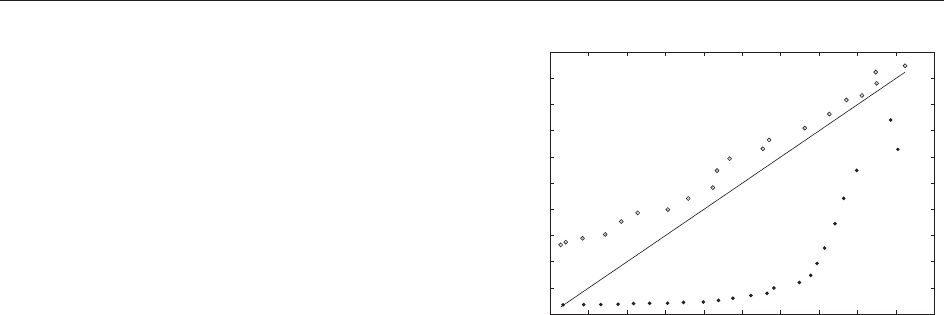
hint in this direction came from the realization
(see Figure 5) of a deep analogy between the FPU
phenomenon and the phenomenology of glasses.
Then there came a strong numerical indication by
Berchialla, Galgani, and Giorgilli. Finally, from the
analytical point of view, there was a suitable
revisitation (by Ponno) of the traditional connection
between the FPU syst em and the KdV equation
with its solitons. The relevant points are the
following: (1) the KdV equation describes well the
solutions of the FPU problem (for initial data of FPU
type) only on a ‘‘short’’ timescale, which increases as
a power of 1=, and so describes only a first process
of quick relaxation; (2) the corresponding spectrum
has a very definite analytical form, the energy being
spread up to a maximal frequency
!() ’
1=4
and
then decaying expon entially; and (3) the relevant
formulas contain the energy only through the
specific energy , and thus can be expected to hold
also in the thermodynamic limit. It should be
mentioned, however, that all the results of an
analytic type mentioned above have a purely formal
character, because up to now none of them was
proved, in the thermodynamic li mit, in the sense of
rigorous perturbation theory. This requires a suita-
ble readaptation of the known techniques, which is
currently being obtained both in connection with
Nekhoroshev’s theorem (in order to explain the
extreme slowness of a possible final approach to
equilibrium) and in connection with the normal-
form theory for partial differential equations (in
order to explain the fast relaxation to the metaequi-
librium state).
In conclusion, for the case of initial conditions of
the FPU type (excitation of a few low-frequency
modes) the situation seems to be as follows. The first
phenomenon that occurs in a ‘‘short’’ time (of the
order of (1=)
3=4
is a quick relaxation to the
formation of what can be called a ‘‘natural packet’’
of low-frequency modes extending up to a certain
maximal frequency
! ’
1=4
. This is a phenomenon
which has nothing to do with any diffusion in phase
space. In fact, it shows up also for an integrable
system such as a Toda lattice (as will be illustrated
below), and should be described by a suitable
resonant normal form related to the KdV equation.
One has then to take into account the fact that the
domain of the frequencies in the FPU model is
bounded (!<2 in the chosen units). Now, as the
function
!() is monotonic, this fact leads to the
existence of a critical value
c
of the specific energy
, defined by
!(
c
) = 2. Indeed, for >
c
the quick
relaxation process leads altogethe r to equipartition.
Below the threshold, instead, the same quick process
leads to the formation of an FPU-like spectrum,
0
0.2
0.4
0.6
0.8
1
1.2
1.4
1.6
1.8
2
0 0.2 0.4 0.6 0.8 1 1.2 1.4 1.6 1.8 2
Specific energy u (× 10
–3
)
Temperature T (× 10
–3
)
Figure 5 Analogy with glasses: the specific energy u of an
FPU system is plotted versus temperature T for a cooling
process (upper curve) and a heating process (lower curve).
The FPU system is kept in contact with a heat reservoir, whose
temperature is changed at a given rate. At low temperatures the
system does not have time to reach the equilibrium curve u = T
(with k
B
= 1).
130 Dynamical Systems and Thermodynamics
involving only modes of sufficiently low frequency.
This should, however, be a metast able state (which
might be mistaken for a stationary one), which
should be followed, on a second timescale, by a
relaxation to the final equilibrium, through a sort
of Arnol’d diffusion requiring extremely long
Nekhoroshev-like times. This is actually the way in
which the old idea of a thres hold, originally
conceived in terms of KAM tori, is now recovered
even for ergodic systems, in terms of timescales.
The existence of a process of quick relaxation,
and of a threshold in the above-mentioned sense, is
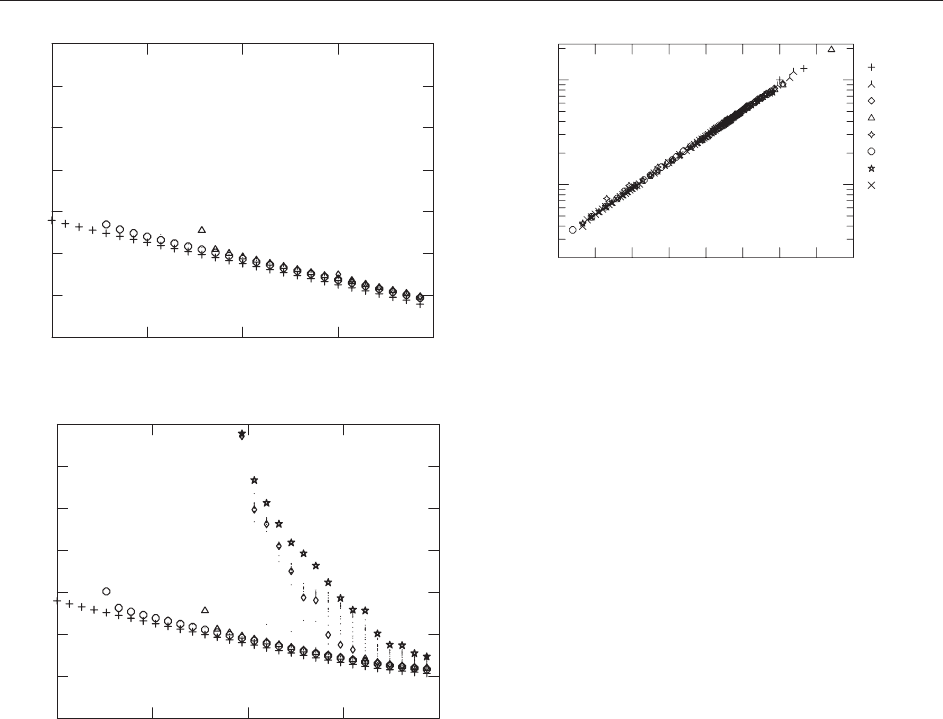
illustrated in Figures 6 and 7.InFigure 6 the lower
part refers to the FPU model, while the upper one
refers to a corresponding Toda model. The latter is
in a sense the prototype of an integrable nonlinear
system; with respect to the FPU case, the difference
is that the potential V(r) is now exponential. The
parameters of the exponential were chosen so that
the two models coincide up to cubic terms in the
potential. With the energy given to the lowest-
frequency mode, the figure shows the time needed in
order that energy spreads up to a mode
k, for several
values of
k, as a function of . It is seen that in the
Toda model (top) there is formed a packet extending
up to rather well-define d width, and that this occurs
within a relaxation time increasing as a power of
1=. An analogous phenomenon occurs for the FPU
model (bottom). The only difference is that, below a
critical specific energy
c
’ 0.1, there exists a
subsequent relaxation time to equipartition, which
involves a time growing faster than any inverse
power of . Such a second phenomenon is due to the
nonintegrable character of the FPU model. In
Figure 7 the width of the natural packet for the
FPU model is exhibited, by reporting the frequency
! of its highest mode as a function of . As one sees,
the numerical results clearly indicate the existence of
a relation
! ’
1=4
, which holds for a number of
degrees of freedom N ranging from 8 to 1023. This
is actually the law which is predicted by resonant
normal-form theory.
Boltzmann and Nernst Revisited
All the results illustrated above refer to initial data
of FPU type, namely with an excitation of a few
low-frequency modes. However, from the point of
view of statistical mec hanics, such initial data are
exceptional, and one should rather consider initial
data extracted from the Gibbs distribution at a
certain temperature. One can then couple the FPU
system to a heat bath at a slightly different
temperature, and look at the spectrum of the FPU
system after a certain time. The result, for the case
of a heat bath at a higher temperature, is shown in
10
–4
10
–3
10
3
10
6
10
–2
10
–1
10
0
Specific ener
g
y
Time
10
–4
10
–3
10
3
10
6
10
–2
10
–1
10
0
Specific energy
Time
Figure 6 Time needed to form a packet versus specific energy
for the FPU model (bottom) and the corresponding Toda model
(top). Different symbols refer to packets of different width. The
existence of two timescales below a critical specific energy in the
FPU model is exhibited.
Specific energy
10
0
10
–3
10
–6
10
–1
10
0
Frequency
22424
8
16
32
63
127
255
511
1023
Figure 7 Width of the natural packet versus specific energy,
for N ranging from 8 to 1023. Reproduced from Berchialla L,
Galgani L, and Giorgilli A (2004) Localization of energy in FPU
chains, Discr. Cont. Dyn. Systems B 11: 855–866, with
permission from American Institute of Mathematical Sciences.
Dynamical Systems and Thermodynamics 131
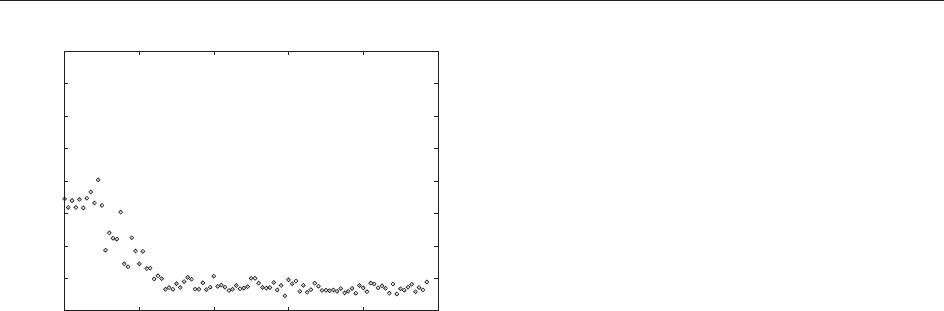
Figure 8. Clearly, here one has a situation similar to that
occurring for initial data of FPU type, because only a
packet of low-frequency modes exhibits a reaction, each
of its modes actually adapting itself to the temperature
of the bath, whereas the high-frequency modes do not
react at all, that is, remain essentially frozen.
This capability of reacting to external disturbances
(which seems to pertain only to a fraction of the
mechanical energy initially inserted into the system)
can be characterized in a quantitative way through an
estimate of the fluctuations of the total energy of the
FPU system. This is indeed the sense of the fluctuation–
dissipation theorem, the precursor of which is perhaps
the contribution of Einstein to the first Solvay
conference (1911). Through such a method, the
specific heat of the FPU system is estimated (apart
from a numerical factor) by the time average of [E(t)
E(0)]
2
,whereE(t) is the energy, at time t, of the FPU
system in dynamical contact with a heat bath (at the
same temperature from which the initial data are
extracted). Usually, in the spirit of ergodic theory, one
looks at the infinite-time limit of such a quantity. But
in the spirit of the metastable picture described above,
one can check whether the time average presents a
previous stabilization to some value smaller than the
one predicted at equilibrium. Such a result, which is in
qualitative agreement with the third principle, has
indeed been obtained (by Carati and Galgani) recently.
In conclusion, in situations of metaequilibrium such
as those existing in the FPU model at low tempera-
tures, a thermodynamics can still be formulated.
Indeed, by virtue of the quick relaxation process
described above, the time averages of the relevant
quantities are found to stabilize in rather short times.
In this way, one overcomes the critique of Poincare´to
Jeans, namely that one cannot have a thermodynamics
at all if reference is made only to the existence of
extremely long relaxation times to the final equili-
brium. A relaxation to a ‘‘provisional equilibrium’’
within a ‘‘first-order very large time’’ (to quote
Poincare´ ) is required . The difference with respect to
the standard equilibrium thermodynamics relies now
in the mechanical interpretation of the first principle.
Indeed, the internal thermodynamic energy is identi-
fied not with the whole mechanical energy, but just
with that fraction of it which is capable of reacting in
short times to the external perturbations.
This is the way in which the old idea of Boltzmann
(and Jeans) might perhaps be presently implemented.
For what concerns the fraction of the mechanical energy
which is not included in the thermodynamic internal
energy, as not being able to react in relatively short
times, this should somehow play the role of a zero-point
energy. This was suggested in the year 1971 by C
Cercignani. But in fact, such a concept was put forward
by Nernst himself in an extremely speculative work in
1916, where he also advanced the concept that, for a
system of oscillators of a given frequency, there should
exist both dynamically ordered (geordnete) and dyna-
mically chaotic (ungeordnete) motions, the latter being
prevalent above a certain energy threshold. According to
him, this fact should be relevant for a dynamical
understanding of the third principle and of Planck’s law.
It is well known that the modern theory of
dynamical systems has led to familiarity with the
(sometimes abused) notions of order and chaos and of
a transition between them. One might say that the FPU
work just forced the scientific community to take into
account such notions in connection with the principle
of equipartition of energy. It is really fascinating to see
that the same notions, with the same terminology, had
already been introduced much earlier on purely
thermodynamic grounds, in connection with the
relations between classical and quantum mechanics.
See also: Boundary Control Method and Inverse Problems
of Wave Propagation; Central Manifolds, Normal Forms;
Ergodic Theory; Fourier Law; Gravitational N-body
Problem (Classical); Newtonian Fluids and
Thermohydraulics; Nonequilibrium Statistical Mechanics:
Interaction between Theory and Numerical Simulations;
Quantum Statistical Mechanics: Overview; Regularization
for Dynamical Zeta Functions; Stability Theory and KAM;
Toda Lattices; Weakly Coupled Oscillators.
Further Reading
Benettin G, Galgani L, and Giorgilli A (1984) Boltzmann’s
ultraviolet cutoff and Nekhoroshev’s theorem on Arnol’d
diffusion. Nature 311: 444–445.
Bocchieri P, Scotti A, Bearzi B, and Loinger A (1970) Anharmonic
chain with Lennard-Jones interaction. Physical Review A 2:
2013–2019.
0
0.05
0.1
0.15
0.2
0.25
0.3
0.35
0.4
0 20 40 60 80 100
Time-averaged mode energy
Mode number
Figure 8 A case of an FPU system initially at equilibrium and
thus in equipartition. Spectrum of the FPU system after it was
kept in contact with a heat reservoir at a higher temperature.
132 Dynamical Systems and Thermodynamics

Boltzmann L (1966) Lectures on Gas Theory (translated by
Brush SG, Vol. II, Sects. 43–45), Berkeley: The University of
California Press.
Fermi E (1923) Beweiss das ein mechanisches Normalsystem
im al lgemeinen quasi-ergodisch ist. In: Fermi E (ed.)
(1965) Note e Memorie (Collected Papers), no. 11,
vol. I, pp. 79–87. Roma: Accademia Nazionale dei Lincei.
Fermi E, Pasta J, and Ulam S (1955) Studies of nonlinear
problems. In: Fermi E (ed.) (1965) Note e Memorie (Collected
Papers), no. 266, vol. II, pp. 977–988. Roma: Accademia
Nazionale dei Lincei.
Fucito E, Marchesoni F, Marinari E, Parisi G, Peliti L et al. (1982)
Approach to equilibrium in a chain of nonlinear oscillators.
Journal de Physique 43: 707–713.
Galgani L and Scotti A (1972) Recent progress in classical
nonlinear dynamics. Rivista del Nuovo Cimento 2: 189–209.
Izrailev FM and Chirikov BV (1966) Statistical properties of a
nonlinear string. Soviet Physics Doklady X 11: 30–32.
Nernst W (1916) U
¨
ber einen Versuch, von quantentheoretischen
Betrachtungen zur Annahme stetiger Energiea¨nderungen
zuru¨ ckzukehren. Verhandlungen der Deutschen Physikalischen
Gesellschaft 18: 83.
Poincare´ H (1996) Reflexions sur la the´orie cine´tique des gas.
Journal de Physique Theoretical Application. 5: 369–403 (in
(1954) Oeuvres de Henry Poincare´, Tome IX: 597–619. Paris:
Gauthier-Villars).
Ponno A (2003) Soliton theory and the Fermi–Pasta–Ulam
problem in the thermodynamic limit. Europhysics Letters 64:
606–612.
Shepelyansky DI (1997) Low-energy chaos in the Fermi–Pasta–Ulam
problem. Nonlinearity 10: 1331–1338.
Zabusky NJ and Kruskal MD (1965) Interaction of ‘‘solitons’’ in
a collisionless plasma and the recurrence of initial states.
Physical Review Letters 15: 240–243.
Dynamical Systems in Mathematical Physics: An Illustration
from Water Waves
O Goubet, Universite
´
de Picardie Jules Verne,
Amiens, France
ª 2006 Elsevier Ltd. All rights reserved.
Introduction
The purpose of this article is to describe some basic
problems related to the interplay between dynamical
systems and mathematical physics. Since it is
impossible to be exhaustive in these topics, the
focus here is on water-wave models. These mathe-
matical models are described by partial differe ntial
equations that can be understood as dynamical
systems in a suitable infinite-dimensional phase
space.
We will not address the original equations for
two-dimensional (2D) surface water waves, even if
we know that dynamical-system methods can help
to exhibit some solitary waves for the equations.
The reader is referred to relevant articles in this
encyclopedia for details. Another approach is to
seek these 2D surface water waves as saddle points
for some Hamiltonians, which too is discussed
elsewhere in this work.
This articl e presents these arguments on some
asymptotical models for the propagation of surface
water waves.
Asymptotical Models in Hydrodynamics
To begin with, consider an irrotational fluid in a
canal that is governed by the Euler equations and
that is subject to gravitational forces. For a canal of
finite depth, Boussinesq (1877) and Korteweg–de
Vries (KdV) (1890) obtained the following model
for unidirectional long waves:
u
t
þ u
x
þ u
xxx
þ uu
x
¼ 0 ½1
Sometimes we drop the u
x
term on the left-hand side
of [1], thanks to a suitable change of coordinates.
Alternatively, we can also deal with the so-called
generalized KdV equation, which reads
u
t
þ u
xxx
þ u
k
u
x
¼ 0 ½2
where k is a positive integer. There are also other
models designed to represent long waves in shallow
water. Let us introduce the regularized long-wave
equation (also refe rred to as the Benjamin–Bona–
Mahony equation) that reads
u
t
u
txx
þ u
x
þ uu
x
¼ 0 ½3
or the Camassa–Holm equation
u
t
u
txx
þ 3uu
x
¼ 2u
x
u
xx
þ uu
xxx
½4
For deep water, a well-known model was intro-
duced by Zakharov (1968)
iu
t
þ u
xx
þ "juj
2
u ¼ 0 ½5
which describes the s low modulations of wave
packets. Here the unknown u(x, t) takes values in
C, and this nonlinear Schro¨ d inger e quation is in
fact a system. In these equations, " is either 1 or
1; throughout this article, we shall refer to the
former case as the focusing case and to the latter
Dynamical Systems in Mathematical Physics: An Illustration from Water Waves 133
as the defocusing case. We may also substitute
juj
2p
u in the nonlinear term in [5] to obtain
alternate models.
The variable t represents the time and the space
variable x belongs either to R or to a finite interval
when we are dealing with periodic flows.
The above models are intended to describe the
propagation of unidirectional waves. For two-way
waves, see
bi
Bona et al. (2002).
Actually, these equations feature particular solu-
tions, the so-called traveling waves. Let us recall, for
instance, that for generalized KdV equation [2] these
solutions are
uðt; xÞ¼Q
c
ðx ctÞ½6
Q
c
ðxÞ¼c
1=p
Qð
ffiffiffi
c
p
xÞ½7
QðxÞ¼ð3ch
2
ðpxÞÞ
1=p
½8
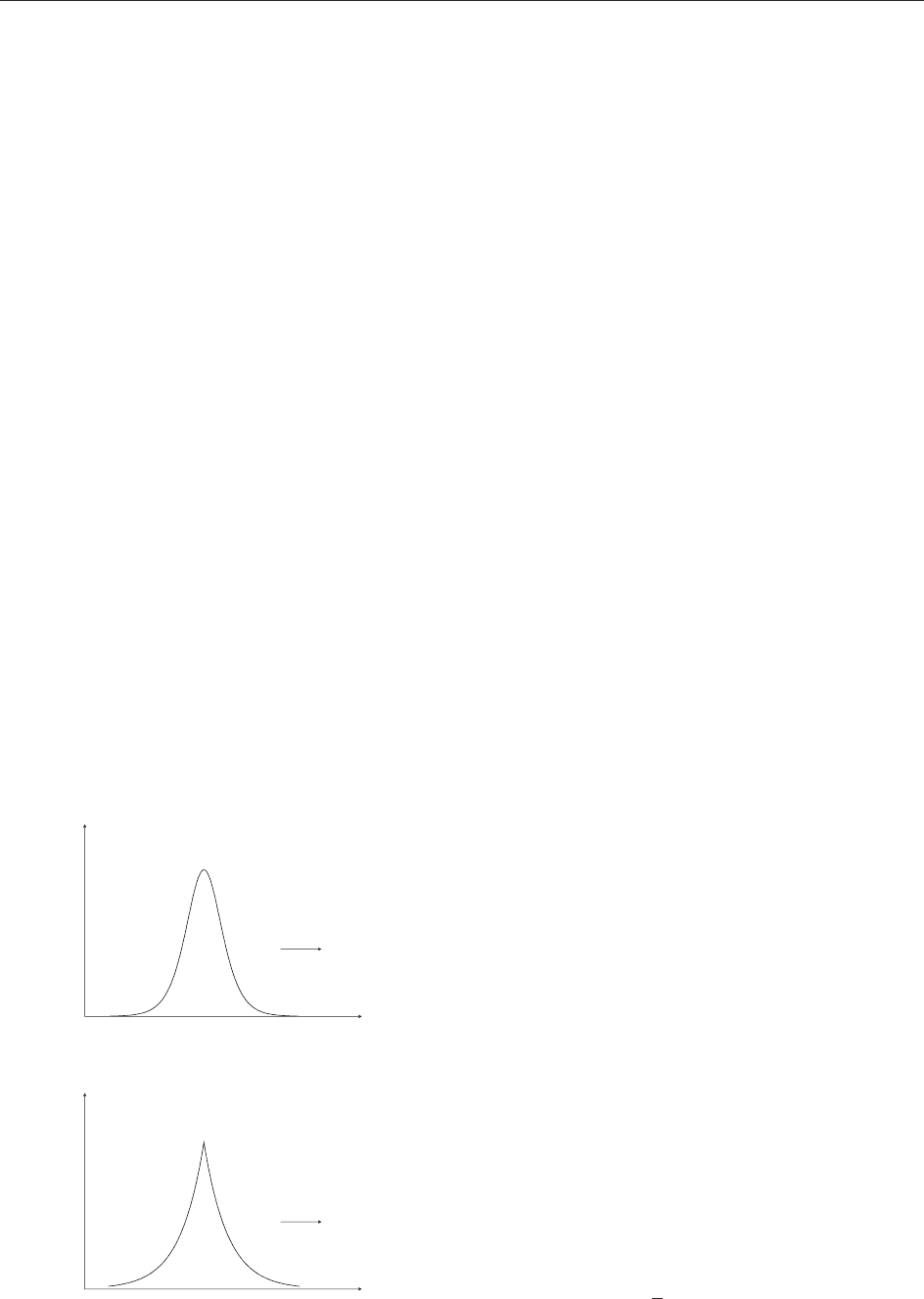
These so-ca lled solitons (Figure 1) move to the right
without changing their shape; c is the speed of
propagation. In real life, this phenomenon was
observed by Russel (1834). Riding his horse, he
was able to follow for miles the propagation of such
a wave on the canal from Edinburgh to Glasgow.
On the other hand, Camassa–Holm equations are
designed to describe the propagation of peaked
solitons as shown in Figure 2.
Focusing nonlinear Schro¨ dinger equations also
feature solitary waves that read u
!
(t, x) =
exp(i!t)Q(x), where Q is solution to
Q
xx
!Q þ Q
2pþ1
¼ 0 ½9
There are numerous examples of equations or
systems of equations that model 2D surface water
waves. Among all these models, a first issue is to
identify the relevant models insofar as the dynami cal
properties are concerned. Indeed, we address here
the question of stability of solitary waves (up to the
symmetries of the equation). For instance, the
orbital stability for cubic Schro¨ dinger reads: for
any ">0, there exists a neighborhood of u
!
(x,0)
such that any trajectory starting from satisfies
sup
t
inf
inf
y
jjuðtÞexpðiÞu
!
ðt;: y Þjj
H
1
" ½ 10
Another issue consists in the interaction of N
solitons.
bi
Schneider and Wayne (2000) have
addressed the issue of the validity of water-wave
models when this interaction is concerned.
Assume now that the validity of these models is
granted. To consider [1] or [5] as a dynamical
system, the next issue is then to consider the initial-
value problem.
The Initial-Value Problem
Let us supplement these equations with initial
data u
0
in some Sobolev space. We shall consider
either
H
s
ðRÞ¼ u;
Z
R
ð1 þjj
2
Þ
s
j
^
uðÞj
2
d<þ1
½11
in the case where x belongs to the whole line, or the
corresponding Sobolev space with periodic bound-
ary conditions. It should be examined whether these
equations provide a continuous flow S(t):u
0
! u(t)
in these functional spaces (at least locally in time).
We would like to point out that for each Sobolev
space under consideration, we may have a different
flow. This fact is at the heart of infinite-dimensional
dynamical systems.
The initial-value proble m was a challenge for
decades for low norms, that is for small s. The last
breakthrough was performed by Bourgain (1993).
Let us present the method for KdV equation.
Consider U(t)u
0
the solution of the Airy equation
u
t
þ u
xxx
¼ 0; uð0Þ¼u
0
½12
Without going into further details, the idea is to
perform a fixed-point argument to the Duhamel’s
form of the equation,
uðtÞ¼UðtÞu
0
1
2
Z
t
0
Uðt sÞ@
x
ðu
2
ðsÞÞds ½13
Figure 1 A soliton.
Figure 2 Peaked soliton.
134 Dynamical Systems in Mathematical Physics: An Illustration from Water Waves

in a suitable mixed-spacetime Banach space whose
norm reads kU(t)u(t, x)k
H
b
t
H
x
. This relies on fine
properties in harmonic analysis. Thanks to this
method, we know that the Schro¨ dinger equation
[5] and the KdV equation [1] are well-posed in,
respectively, H
s
(R), s 0 and H
s
(R), s > 3/4,
locally in time. For the periodic case, the results
are slightly different. We would like to point out
that both KdV and nonlinear Schro¨ dinger equations
provide semigroups S(t) that do not feature smooth-
ing effect. A trajectory that starts from H
s
remains
in H
s
; indeed, we can also solve these partial
differential equations backward in time.
The next issue is to determine if these flows are
defined for all times. Loosely speaking, the follow-
ing alternative holds true: either the local flow in H
s
extends to a global one, or some blow-up phenom-
enon occurs, that is, jjS(t)u
0
jj
H
s
collapses in finite
time.
To this end, let us observe that, for instance, the
mass
R
R
ju(x)j
2
dx is conserved for both KdV and
nonlinear Schro¨ dinger flows. Therefore, one can
prove that the solutions in L
2
are global in time. It is
worthwhile to observe that the Bourgain method
also provides some global existence results below
the energy norm.
Consider now the flow of the solutions in H
1
. The
second invariant for nonlinear Schro¨ dinger equa-
tions reads
Z
R
ju
x
ðxÞj
2
dx
"
p þ 1
juðxÞj
2pþ2
dx ½14
Therefore, the local solutions in H
1
extend to global
ones in the defocusing case (" = 1). In the focusing
case, the situation is more contrasted. The solution
is global if the nonlinearity is less than an H
1
-critical
value (p = 2 for Schro¨ dinger, and k = 4 for general-
ized KdV equation). This critical value depends on
some Sobolev embeddings as
Z
R
juðxÞj
2pþ2
dx C
p
kuk
pþ1
L
2
ku
x
k
p
L
2
½15
Therefore, since the mass is consta nt, the second
invariant controls the H
1
norm of the solution if
p < 2. Note that the critical power of the nonlinear-
ity depends also on the dimension of the space; it is
the cubic Schro¨ dinger that is critical in H
1
(R
2
). It is
well known that, for some initial data, blow-up
phenomena can occur for 2D cubic Schro¨ dinger
equations. Moreover, the behavior of blow-up
solutions is more or less understood. This analysis
was performed using the conformal invariance of
the equation. For quintic Schro¨ dinger equation,
which is critical in 1D, this conformal invariance
states that if u(t, x) is solution, then
vðt; xÞ¼jtj
1=2
exp
ix
2
4t
u
1
t
;
x
t
½16
is also solution.
On the other hand , for the generalized KdV
equation, there is no conformal invariance and the
blow-up issue had been open for years. There was
some numer ical evidence that blow-up can occur for
k = 4. Recently,
bi
Martel and Merle (2002) have given
a complet e description of the blow-up profile for
this equation. Their methods are quite complex and
rely on an ejection of mass at infinity in a suitable
coordinate system.
In the discussion so far we have presented some
quantities that are invariant by the flow of the
solutions. This is related to the Hamiltonian
structure of the dynamical systems under
consideration.
Hamiltonian Systems in Hydrodynamics
The study of Hamiltonian systems has developed
beyond celestial mechanics (the famous n-body
problems) to other fields in mathematical physics.
We focus here on dynamical systems that read
u
t
¼ J
@
@u
HðuÞ½17
where H is the Hamiltonian and J some skew-
symmetric operator. For instance, [1] is a Hamiltonian
system with J = @
x
(i.e., an unbounded skew-
symmetric operator) and
HðuÞ¼
1
2
Z
u
2
u
2
x
dx þ
1
6
Z
u
3
dx ½18
There is a subclass of Hamiltonian systems that
are integrable by inverse-scattering methods. For
instance, [1] belongs to this class. Indeed, these
methods give a complete description of the asymp-
totics when t !1. It is well known (Deift and
Zhou 1993) that, asymptotically, any solution to
KdV equation consists of a wave train moving to the
right in the physical space up to a dispersive part
moving to the left.
On the other hand, a generic Hamiltonian system
is not integrable. The study of the asymptotics and
of the dynamical properties of such a system
deserves another analysis. We say that a system
features asymptotic completeness if there exist u
þ
Dynamical Systems in Mathematical Physics: An Illustration from Water Waves 135