
Freiling G., Yurko V. Lectures on Differential Equations of Mathematical Physics: A First Course
Подождите немного. Документ загружается.

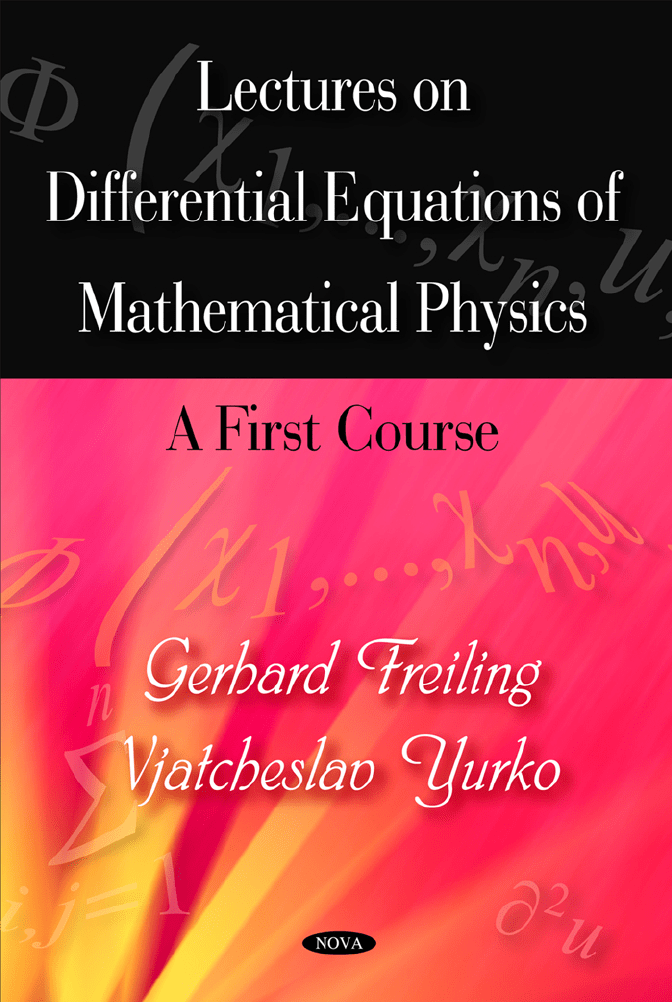
LE
C
TURES ON DIFFERENTIAL EQUATIONS
OF MATHEMATICAL PHYSICS:
A FIRST COURSE
No part of this digital document may be reproduced, stored in a retrieval system or transmitted in any form or
by any means. The publisher has taken reasonable care in the preparation of this digital document, but makes no
expressed or implied warranty of any kind and assumes no responsibility for any errors or omissions. No
liability is assumed for incidental or consequential damages in connection with or arising out of information
contained herein. This digital document is sold with the clear understanding that the publisher is not engaged in
rendering legal, medical or any other professional services.
LE
C
TURES ON DIFFERENTIAL EQUATIONS
OF MATHEMATICAL PHYSICS:
A FIRST COURSE
G. FREILING
AND
V. YURKO
Nova Science Publishers, Inc.
New York
©2008 by Nova Science Publishers, Inc.
All rights reserved. No part of this book may be reproduced, stored in a retrieval system or
transmitted in any form or by any means: electronic, electrostatic, magnetic, tape, mechanical
photocopying, recording or otherwise without the written permission of the Publisher.
For permission to use material from this book please contact us: Telephone 631-231-7269; Fax
631-231-8175 Web Site: http://www.novapublishers.com
NOTICE TO THE READER
The Publisher has taken reasonable care in the preparation of this book, but makes no expressed or
implied warranty of any kind and assumes no responsibility for any errors or omissions. No liability is
assumed for incidental or consequential damages in connection with or arising out of information
contained in this book. The Publisher shall not be liable for any special, consequential, or exemplary
damages resulting, in whole or in part, from the readers’ use of, or reliance upon, this material.
Independent verification should be sought for any data, advice or recommendations contained in this
book. In addition, no responsibility is assumed by the publisher for any injury and/or damage to
persons or property arising from any methods, products, instructions, ideas or otherwise contained in
this publication.
This publication is designed to provide accurate and authoritative information with regard to the
subject matter cover herein. It is sold with the clear understanding that the Publisher is not engaged in
rendering legal or any other professional services. If legal, medical or any other expert assistance is
required, the services of a competent person should be sought. FROM A DECLARATION OF
PARTICIPANTS JOINTLY ADOPTED BY A COMMITTEE OF THE AMERICAN BAR
ASSOCIATION AND A COMMITTEE OF PUBLISHERS.
Library of Congress Cataloging-in-Publication Data
Freiling, Gerhard, 1950
Lectures on the differential equations of mathematical physics : a first course / Gerhard
Freiling and Vjatcheslav Yurko. p. cm.
ISBN 978-1-60741-907-5 (E-Book)
1. Differential equations. 2. Mathematical physics. I. Yurko, V. A. II. Title. QC20.7.D5F74 2008
530.15’535–dc22
2008030492
Published by Nova Science Publishers, Inc. ╬ New York
Contents
Pr
eface vii
1.
Introduction 1
2. Hyperbolic Partial Differential Equations 15
3. Parabolic Partial Differential Equations 155
4. Elliptic Partial Differential Equations 165
5. The Cauchy-Kowalevsky Theorem 219
6. Exercises 225
v
Pr
eface
The
theory of partial differential equations of mathematical physics has been one of the
most important fields of study in applied mathematics. This is essentially due to the fre-
quent occurrence of partial differential equations in many branches of natural sciences and
engineering.
With much interest and great demand for applications in diverse areas of sciences, sev-
eral excellent books on differential equations of mathematical physics have been published
(see, for example, [1]-[6] and the references therein). The present lecture notes have been
written for the purpose of presenting an approach based mainly on the mathematical prob-
lems and their related solutions. The primary concern, therefore, is not with the general
theory, but to provide students with the fundamental concepts, the underlying principles,
and the techniques and methods of solution of partial differential equations of mathematical
physics. One of our main goal is to present a fairly elementary and complete introduction to
this subject which is suitable for the “first reading” and accessible for students of different
specialities.
The material in these lecture notes has been developed and extended from a set of lec-
tures given at Saratov State University and reflects partially the research interests of the
authors. It is intended for graduate and advanced undergraduate students in applied math-
ematics, computer sciences, physics, engineering, and other specialities. The prerequisites
for its study are a standard basic course in mathematical analysis or advanced calculus,
including elementary ordinary differential equations.
Although various differential equations and problems considered in these lecture notes
are physically motivated, a knowledge of the physics involved is not necessary for under-
standing the mathematical aspects of the solution of these problems.
The book is organized as follows. In Chapter 1 we present the most important examples
of equations of mathematical physics, give their classification and discuss formulations of
problems of mathematical physics. Chapter 2 is devoted to hyperbolic partial differential
equations which usually describe oscillation processes and give a mathematical descrip-
tion of wave propagation. The prototype of the class of hyperbolic equations and one of
the most important differential equations of mathematical physics is the wave equation.
Hyperbolic equations occur in such diverse fields of study as electromagnetic theory, hy-
drodynamics, acoustics, elasticity and quantum theory. In this chapter we study hyperbolic
equations in one-, two- and three-dimensions, and present methods for their solutions. In
Sections 2.1-2.5 we study the main classical problems for hyperbolic equations, namely,
the Cauchy problem, the Goursat problem and the mixed problems. We present the main
methods for their solutions including the method of travelling waves, the method of sep-

viii G.
Freiling and V. Yurko
aration of
variables, the method of successive approximations, the Riemann method, the
Kirchhoff method. Thus, Sections 2.1-2.5 contain the basic classical theory for hyperbolic
partial differential equations in the form which is suitable for the “first reading”. Sections
2.6-2.9 are devoted to more specific modern problems for differential equations, and can be
ommited for the “first reading”. In Sections 2.6-2.8 we provide an elementary introduction
to the theory of inverse problems. These inverse problems consist in recovering coefficients
of differential equations from characteristics which can be measured. Such problems often
appear in various areas of natural sciences and engineering. Inverse problems also play
an important role in solving nonlinear evolution equations in mathematical physics such as
the Korteweg-de Vries equation. Interest in this subject has been increasing permanently
because of the appearance of new important applications, and nowadays the inverse prob-
lem theory develops intensively all over the world. In Sections 2.6-2.8 we present the main
results and methods on inverse problems and show connections between spectral inverse
problems and inverse problems for the wave equation. In Section 2.9 we provide the solu-
tion of the Cauchy problem for the nonlinear Korteweg-de Vries equation, for this purpose
we use the ideas and results from Sections 2.6-2.8 on the inverse problem theory.
In Chapter 3 we study parabolic partial differential equations which usually describe
various diffusion processes. The most important equation of parabolic type is the heat
equation or diffusion equation. The properties of the solutions of parabolic equations do
not depend essentially on the dimension of the space, and therefore we confine ourselves
to considerations concerning the case of one spatial variable. Chapter 4 is devoted to el-
liptic equations which usually describe stationary fields, for example, gravitational, electro-
statical and temperature fields. The most important equations of elliptic type are the Laplace
and the Poisson equations. In this chapter we study boundary value problems for elliptic
partial differential equations and present methods for their solutions such that the Green’s
function method, the method of upper and lower functions, the method of integral equa-
tions, the variational method. In Chapter 5 we prove the general Cauchy-Kowalevsky theo-
rem which is a fundamental theorem on the existence of the solution of the Cauchy problem
for a wide class of systems of partial differential equations. Chapter 6 contains exercises
for the material covered in Chapters 1-4. The material here reflects all main types of equa-
tions of mathematical physics and represents the main methods for the solution of these
equations.
G. FREILING AND V. YURKO

Chapter
1.
Intr
oduction
1.1. Some Examples of Equations of Mathematical Physics
The theory of partial differential equations arose from investigations of some important
problems in physics and mechanics. Most of the problems lead to second-order differential
equations which will be (mainly) under our consideration.
The relation
Φ
µ
x
1
,. .. ,x
n
,u,
∂u
∂x
1
,
.
.. ,
∂u
∂x
n
,
∂
2
u
∂x
i
∂x
j
(i, j =
1,n)

= 0, (1.1.1)
which
connects
the real variables x
1
,x
2
,. .. ,x
n
, an unknown function
u(x
1
,. .. ,x
n
) and its partial derivatives up to the second order, is called a partial differential
equation of the second order.
Equation (1.1.1) is called linear with respect to the second derivatives (or quasi-linear)
if it has the form
n
∑
i, j=1
a
i j
(x
1
,. .. ,x
n
)
∂
2
u
∂x
i
∂x
j
+ F
µ
x
1
,
.
.. ,x
n
,u,
∂u
∂x
1
,
.
.. ,
∂u
∂x
n

= 0. (1.1.2)
Equation
(1.1.2)
is called linear if it has the form
n
∑
i, j=1
a
i j
(x
1
,. .. ,x
n
)
∂
2
u
∂x
i
∂x
j
+
n
∑
i=1
b
i
(x
1
,
.
.. ,x
n
)
∂u
∂x
i
+ b
0
(x
1
,
.
.. ,x
n
)u
= f (x
1
,. .. ,x
n
). (1.1.3)
Let us give several examples of problems of mathematical physics which lead to partial
differential equations.