
Freiling G., Yurko V. Lectures on Differential Equations of Mathematical Physics: A First Course
Подождите немного. Документ загружается.


152 G.
Freiling and V. Yurko
Lemma 2.9.2. The
following relation holds
˙e
+
= Ae
+
−4iρ
3
e
+
. (2.9.5)
Proof. By Lemma 2.9.1, the function ˙e
+
−Ae
+
is a solution of (2.9.3). Since the
functions {e
+
,e
−
} form a fundamental system of solutions of (2.9.3), we have
˙e
+
−Ae
+
= β
1
e
+
+ β
2
e
−
,
where β
k
= β
k
(t, ρ) , k = 1,2 do not depend on x. As x → +∞,
e
±
∼ exp(±iρx), ˙e
+
∼ 0, Ae
+
∼ 4iρ
3
exp(iρx),
consequently β
1
= −4iρ
3
, β
2
= 0, and (2.9.5) is proved. 2
Lemma 2.9.3. The following relations hold
˙a = 0,
˙
b = −8iρ
3
b, ˙s
+
= 8iρ
3
s
+
, (2.9.6)
˙
λ
j
= 0,
˙
α
+
j
= 8κ
3
j
α
+
j
. (2.9.7)
Proof. According to (2.8.18),
e
+
= ag
+
+ bg
−
. (2.9.8)
Differentiating (2.9.8) with respect to t, we get ˙e
+
= ( ˙ag
+
+
˙
bg
−
) + (a ˙g
+
+ b ˙g
−
). Using
(2.9.5) and (2.9.8) we calculate
a(Ag
+
−4iρ
3
g
+
) + b(Ag
−
−4iρ
3
g
−
) = ( ˙ag
+
+
˙
bg
−
) + (a ˙g
+
+ b ˙g
−
). (2.9.9)
Since g
±
∼ exp(±iρx), ˙g
±
∼ 0, Ag
±
∼ ±4iρ
3
exp(±iρx) as x → −∞, then (2.9.9) yields
−8iρ
3
exp(−iρx) ∼ ˙a exp(iρx)+
˙
bexp(−iρx), i.e. ˙a = 0,
˙
b = −8iρ
3
b. Consequently, ˙s
+
=
8iρ
3
s
+
, and (2.9.6) is proved.
The eigenvalues λ
j
= ρ
2
j
= −κ
2
j
, κ
j
> 0, j =
1,N are
the
zeros of the function a =
a(ρ,t). Hence, according to ˙a = 0, we have
˙
λ
j
= 0. Denote
e
j
= e(x,t, iκ
j
), g
j
= g(x,t, iκ
j
), j =
1,N.
By
Theorem
2.8.3, g
j
= d
j
e
j
, where d
j
= d
j
(t) do not depend on x. Differentiating the
relation g
j
= d
j
e
j
with respect to t and using (2.9.5), we infer
˙g
j
=
˙
d
j
e
j
+ d
j
˙e
j
=
˙
d
j
e
j
+ d
j
Ae
j
−4κ
3
j
d
j
e
j
or
˙g
j
=
˙
d
j
d
j
g
j
+ Ag
j
−4κ
3
j
g
j
.
As x →
−∞
, g
j
∼ exp(κ
j
x), ˙g
j
∼ 0, Ag
j
∼ −4κ
3
j
exp(κ
j
x), and consequently
˙
d
j
=
8κ
3
j
d
j
, or, in view of (2.8.32),
˙
α
+
j
= 8κ
3
j
α
+
j
. 2

Hyperbolic P
artial Differential Equations 153
Thus, it
follows from Lemma 2.9.3 that we have proved the following theorem.
Theorem 2.9.2. Let q(x,t) be the solution of the Cauchy problem (2.9.1) −(2.9.2) ,
and let
J
+
(
t
) =
{
s
+
(
t
,
ρ
)
,
λ
j
(
t
)
,
α
+
j
(
t
)
,
j
=
1
,
N
}
be
the
scattering data for
q
(
x
,
t
)
.
Then
s
+
(t, ρ) = s
+
(0,ρ)exp(8iρ
3
t),
λ
j
(t) = λ
j
(0), α
+
j
(t) = α
+
j
(0)exp(8κ
3
j
t), j =
1,N (λ
j
= −κ
2
j
).
)
(2.9.10)
The
formulae
(2.9.10) give us the evolution of the scattering data with respect to t, and
we obtain the following algorithm for the solution of the Cauchy problem (2.9.1)-(2.9.2).
Algorithm 2.9.1. Let the function q(x,0) = q
0
(x) be given. Then
1) construct the scattering data {s
+
(0,ρ), λ
j
(0), α
+
j
(0), j =
1,N};
2) calculate {s
+
(t, ρ), λ
j
(t), α
+
j
(t), j =
1,N} by (2.9.10) ;
3) find
the
function q(x,t) by solving the inverse scattering problem ( see Section
2.8) .
We notice once more the main points for the solution of the Cauchy problem (2.9.1)-
(2.9.2) by the inverse problem method:
(1) The presence of the Lax representation (2.9.4).
(2) The evolution of the scattering data with respect to t.
(3) The solution of the inverse problem.
Among the solutions of the KdV equation (2.9.1) there are very important particular
solutions of the form q(x,t) = f (x −ct). Such solutions are called solitons. Substituting
q(x,t) = f (x −ct) into (2.9.1), we get f
000
+ 6 f f
0
+ c f
0
= 0, or ( f
00
+ 3 f
2
+ c f )
0
= 0.
Clearly, the function
f (x) = −
c
2
cosh
2
³
√
cx
2
´
satisfies
this
equation. Hence, the function
q(x,t) = −
c
2
cosh
2
³
√
c(x−c
t)
2
´
(2.9.11)
is
a
soliton (see fig. 2.9.1).
6
-
q
x
-
Figure
2.9.1.

154 G.
Freiling and V. Yurko
It is
interesting to note that solitons correspond to reflectionless potentials (see Section
2.8). Consider the Cauchy problem (2.9.1)-(2.9.2) in the case when q
0
(x) is a reflectionless
potential, i.e. s
+
(0,ρ) = 0. Then, by virtue of (2.9.10), s
+
(t, ρ) = 0 for all t, i.e. the
solution q(x,t) of the Cauchy problem (2.9.1)-(2.9.2) is a reflectionless potential for all t.
Using (2.9.10) and (2.8.79), we derive
q(x,t) = −2
d
2
d
x
2
∆
(x,t),
∆(x,t) = det
·
δ
kl
+ α
+
k
(0)exp(8κ
3
k
t)
exp(−(κ
k+
κ
l
)x)
κ
k+
κ
l
¸
k,l=
1,N
.
In
particular
, if N = 1, then α
+
1
(0) = 2κ
1
, and
q(x,t) = −
2κ
2
1
cosh
2
(κ
1
(x −4κ
2
1
t)
)
.
T
aking c = 4κ
2
1
, we get (2.9.11).

Chapter
3.
P
arabolic Partial Differential
Equations
Parabolic partial differential equations usually describe various diffusion processes. The
most important equation of parabolic type is the heat equation or diffusion equation (see
Section 1.1). The properties of the solutions of parabolic equations do not depend essen-
tially on the dimension of the space, and therefore we confine ourselves to considerations
concerning the case of one spatial variable. In Section 3.1 we study the mixed problem for
the heat equation on a finite interval. Section 3.2 deals with the Cauchy problem on the line
for the heat equation. We note that in Chapter 6, Section 6.3 one can find exercises and
illustrative example for problems related to parabolic partial differential equations.
3.1. The Mixed Problem for the Heat Equation
We consider the following mixed problem
u
t
= u
xx
, 0 < x < l, t > 0, (3.1.1)
u
|x=0
= u
|x=l
= 0, (3.1.2)
u
|t=0
= ϕ(x). (3.1.3)
This problem describes the one-dimensional propagation of heat in a finite slender homo-
geneous rod which lies along the x -axis, provided that the ends of the rod x = 0 and x = l
have zero temperature, and the initial temperature ϕ(x) is known.
Denote by D = {(x,t) : 0 < x < l, t > 0}, Γ = ∂D the boundary of the domain D.
Definition 3.1.1. A function u(x,t) is called a solution of problem (3.1.1)-(3.1.3) if
u(x,t) ∈C(
D) , u(x,t) ∈C
2
(D), and u(x,t) satisfies
(3.1.1)-(3.1.3).
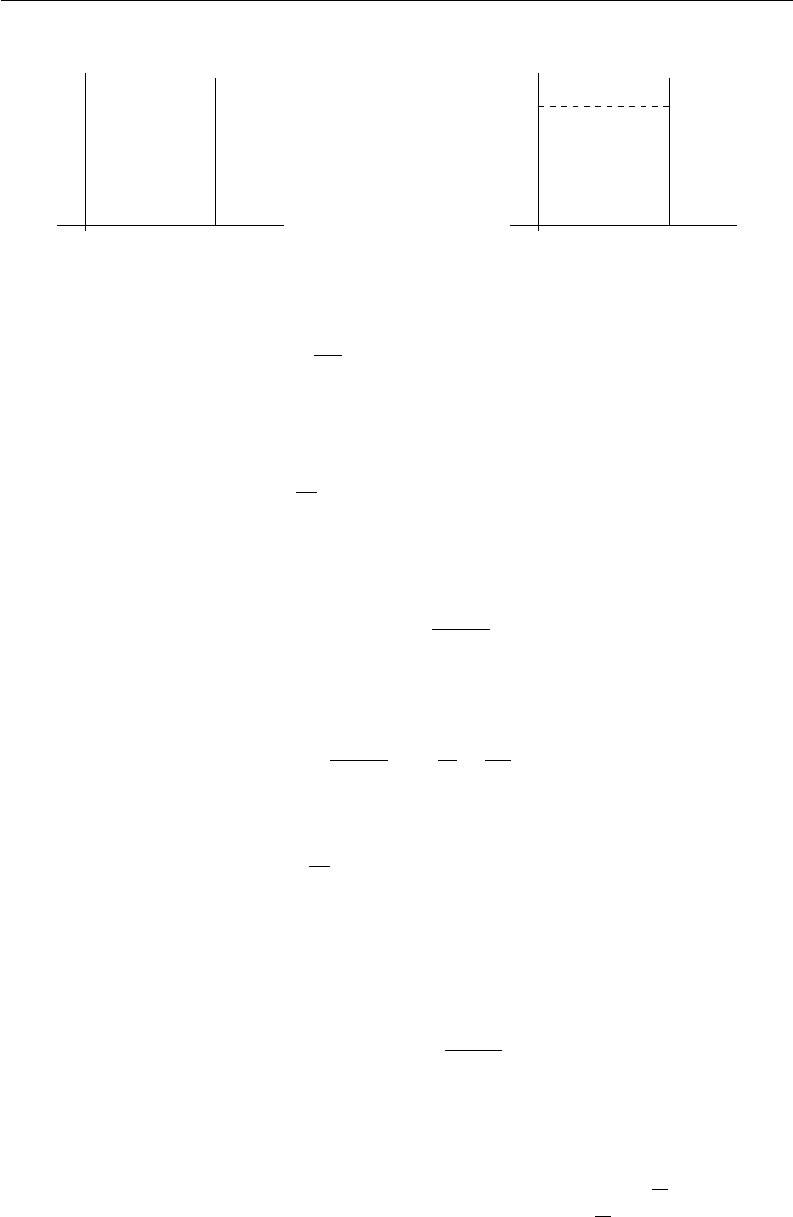
First
we will prove the maximum (and minimum) principle for the heat conduction
equation. Denote D
T
= {(x,t) : 0 < x < l, 0 < t ≤ T }, Γ
T
= Γ ∩
D
T
(i.e. Γ
T
is
the
part
of the boundary of D
T
without the upper cap (see fig. 3.1.1).
156 G.
Freiling and V. Yurko
6
-
t
x
0 l
D
6
-
t
T
x
0 l
D
T
Figure
3.1.1.
Theor
em 3.1.1. Let u(x,t) ∈C(
D
T
) , u(x,t) ∈C
2
(D
T
), and
let
u(x,t) satisfy equation
(3.1.1) in D
T
. Then u(x,t) attains its maximum and minimum on Γ
T
.
Proof. For definiteness, we give the proof for the maximum. Denote
M = max
D
T
u(x,t), m = max
Γ
T
u(x,t).
Clearly
, M ≥ m. W
e have to prove that M = m. Suppose that M > m. Let M = u(x
0
,t
0
),
i.e. the maximum is attained at the point (x
0
,t
0
). Consider the function
v(x,t) = u(x,t) +
M −m
4l
2
x
2
.
Then
v(x
0
,t
0
) ≥ M,
v
|Γ
T
≤ m +
M −m
4l
2
l
2
=
M
4
+
3m
4
< M,
and
consequently
, the maximum of the functions v(x,t) is not attained on Γ
T
. Let
max
D
T
v(x,t)
= v
(x
1
,t
1
),
and (x
1
,t
1
) /∈ Γ
T
. According to the necessary conditions for an maximum we have
v
t
(x
1
,t
1
) ≥ 0, v
x
(x
1
,t
1
) = 0, v
xx
(x
1
,t
1
) ≤ 0.
On the other hand,
v
t
−v
xx
= (u
t
−u
xx
) −
M −m
2l
2
< 0.
This
contradiction
proves the theorem. 2
As an immediate consequence of the maximum (and minimum) principle we get the
following interesting corollaries.
Corollary 3.1.1 (the comparison principle). Let u
1
(x,t),u
2
(x,t) ∈C(
D)∩C
2
(D) sat-
isfy (3.1.1) .
If
u
1
(x,t) ≤ u
2
(x,t) on Γ, then u
1
(x,t) ≤ u
2
(x,t) in
D.

Parabolic
Partial Differential Equations 157
Corollary
3.1.2 (the uniqueness theorem). If the solution of the problem (3.1.1) −
(3.1.3) exists, then it is unique.
Indeed, let u
1
(x,t) and u
2
(x,t) be solutions of (3.1.1)-(3.1.3). Then u
1
(x,t) = u
2
(x,t)
on Γ, and consequently, u
1
(x,t) = u
2
(x,t) in
D.
Cor
ollary
3.1.3 (the stability theorem). Let u(x,t) and ˜u(x,t) be solutions of
(3.1.1) −(3.1.3) under the initial conditions ϕ and
˜
ϕ, respectively. If |ϕ(x) −
˜
ϕ(x)| ≤ ε ,
0 ≤ x ≤l, then |u(x,t) − ˜u(x,t)| ≤ ε in
D.
Indeed,
denote v
(x,t) = u(x,t)− ˜u(x,t). Then v(x,t) ∈C(
¯
D), satisfies equation (3.1.1),
and |v(x,t)| ≤ ε on Γ. Hence |v(x,t)| ≤ ε in
D.
W
e
will solve the mixed problem (3.1.1)-(3.1.3) by the method of separation of vari-
ables. First we consider the following auxiliary problem. We will seek non-trivial (i.e. not
identically equal to zero) solutions of equation (3.1.1) satisfying the boundary condition
(3.1.2) and having the form
u(x,t) = Y (x)T (t).
Acting in the same way as in Section 2.2, we obtain
Y
00
(x)
Y (x)
=
˙
T (t)
T (t)
= −λ,
where λ is
a
complex parameter. Hence
˙
T (t) + λT (t) = 0, (3.1.4)
Y
00
(x) + λY (x) = 0, Y (0) = Y (l) = 0. (3.1.5)
In Section 2.2 we found the eigenvalues
λ
n
=
³
πn
l
´
2
, n ≥1,
and
the
eigenfunctions
Y
n
(x) = sin
πn
l
x, n ≥1,
of
the
Sturm-Liouville problem (3.1.5). Equation (3.1.4) for λ = λ
n
has the general solution
T
n
(t) = A
n
exp(−λ
n
t),
where A
n
are arbitrary constants. Thus, the solutions of the auxiliary problem have the
form
u
n
(x,t) = A
n
exp
µ
−
³
πn
l
´
2
t

sin
πn
l
x, n ≥1. (3.1.6)
W
e
will seek the solution of the mixed problem (3.1.1)-(3.1.3) by superposition of functions
of the form (3.1.6):
u(x,t) =
∞
∑
n=1
A
n
exp
µ
−
³
πn
l
´
2
t

sin
πn
l
x. (3.1.7)

158 G.
Freiling and V. Yurko
Formally
, by construction, the function u(x,t) satisfies equation (3.1.1) and the boundary
conditions (3.1.2) for any A
n
. Choose A
n
such that u(x,t) satisfies the initial condition
(3.1.3). Substituting (3.1.7) into (3.1.3) we get
ϕ(x) =
∞
∑
n=1
A
n
sin
πn
l
x.
Using
the
formulas for the Fourier coefficients we calculate (formally)
A
n
=
2
l
l
0
ϕ(x)sin
πn
l
x
d
x, n ≥1. (3.1.8)
Theorem 3.1.2. Let ϕ(x) ∈C[0,l], ϕ(0) = ϕ(l) = 0. Then the solution of the mixed
problem (3.1.1) −(3.1.3) exists, is unique and is given by the formulae (3.1.7)−(3.1.8) .
Proof. It is sufficient to prove that the function u(x,t), defined by (3.1.7)-(3.1.8), is a
solution of problem (3.1.1)-(3.1.3). Fix δ > 0 and consider the domains Ω
δ
= {(x,t) : 0 ≤
x ≤ l, t ≥ δ} and Ω = {(x,t) : 0 ≤x ≤l, t > 0}. Since |A
n
| ≤C, we have
∞
∑
n=1
|A
n
|n
s
exp
µ
−
³
πn
l
´
2
δ

< ∞ for
all s ≥ 0
. (3.1.9)
It follows from (3.1.9) that the function u(x,t), defined by (3.1.7)-(3.1.8), is infinitely
differentiable in Ω
δ
, i.e. it has in Ω
δ
continuous partial derivatives of all orders, and these
derivatives can be obtained by termwise differentiation of the series (3.1.7). By virtue of
the arbitrariness of δ we deduce that u(x,t) ∈C
∞
(Ω). Clearly, u(x,t) satisfies (3.1.1) and
(3.1.2). It is more complicated to deal with the initial condition (1.3.3), since in the general
case the series (3.1.7) for t = 0 can be divergent.
1) First we consider the particular case when ϕ(x) ∈C
1
[0,l] , ϕ(0) = ϕ(l) = 0. Then,
using in (3.1.8) integration by parts (as in Section 2.2), we obtain
∞
∑
n=1
|A
n
| < ∞.
Consequently, the series (3.1.7) converges absolutely and uniformly in
D, and u(x,t) ∈
C(
D). F
or t = 0
we have
u(x,0) =
∞
∑
n=1
A
n
sin
πn
l
x,
hence
A
n
=
2
l
l
0
u(x,0) sin
πn
l
x
d
x.
Comparing this relation with (3.1.8) we get
l
0
(u(x,0) −ϕ(x))sin
πn
l
x
d
x = 0, n ≥1.
On account of the completeness of the system {sin
πn
l
x}
n≥1
, we
deduce
that
u(x,0) = ϕ(x). Thus, for the case ϕ(x) ∈C
1
[0,l] Theorem 3.1.2 is proved.

Parabolic
Partial Differential Equations 159
2) Consider
now the general case when ϕ(x) ∈C[0,l] , ϕ(0) = ϕ(l) = 0. Construct a
sequence of the functions ϕ
m
(x) ∈C
1
[0,l] , ϕ
m
(0) = ϕ
m
(l) = 0 such that
lim
m→∞
max
0≤x≤l
|ϕ
m
(x) −ϕ(x)|= 0.
Let u
m
(x,t) be the solution of problem (3.1.1)-(3.1.3) with the initial data ϕ
m
(x). Using
Corollary 3.1.3 we obtain that in
D the
sequence u
m
(x,t) con
verges uniformly to some
function ˜u(x,t) :
lim
m→∞
max
D
|u
m
(x,t) − ˜u(x,t)| = 0,
and ˜u(x,t) ∈C(
D). Moreo
v
er,
˜u(x,0) = ϕ(x),
since
ϕ(x) = lim
m→∞
ϕ
m
(x) = lim
m→∞
u
m
(x,0) = ˜u(x,0).
In the domain Ω
δ
we rewrite (3.1.7) for u(x,t) as follows:
u(x,t) =
∞
∑
n=1
µ
2
l
l
0
ϕ(ξ)sin
πn
l
ξdξ

e
xp
µ
−
³
π
n
l
´
2
t

sin
πn
l
x,
and
consequently
,
u(x,t) =
l
0
G(x,ξ,t)ϕ(ξ)dξ,
where
G(x,ξ,t) =
2
l
∞
∑
n=1
e
xp
µ
−
³
π
n
l
´
2
t

sin
πn
l
ξsin
πn
l
x.
The
function G
(x,ξ,t) is called the Green’s function. Furthermore, in Ω
δ
we have
˜u(x,t) = lim
m→∞
u
m
(x,t) = lim
m→∞
l
0
G(x,ξ,t)ϕ
m
(ξ)dξ
=
l
0
G(x,ξ,t) lim
m→∞
ϕ
m
(ξ)dξ =
l
0
G(x,ξ,t)ϕ(ξ)dξ = u(x,t).
By virtue of the arbitrariness of δ > 0, we get ˜u(x,t) ≡ u(x,t) in Ω, hence (after defining
u(x,t) continuously for t = 0 ) u(x,t) ∈C(
D) , u(x,0)
= ϕ
(x). Theorem 3.1.2 is proved.
2
Definition 3.1.2. The solution of the mixed problem (3.1.1)-(3.1.3) is called stable
if for each ε > 0 there exists δ > 0 such that if |ϕ(x) −
˜
ϕ(x)| ≤ δ , 0 ≤ x ≤ l, then
|u(x,t) − ˜u(x,t)| ≤ ε in
D. Here ˜u(x,t) is
the
solution of the mixed problem with the
initial condition ˜u(x,0) =
˜
ϕ(x).
It follows from Corollary 3.1.3 that the solution of the mixed problem (3.1.1)-(3.1.3) is
stable (one can take δ = ε ). Thus, the mixed problem (3.1.1)-(3.1.3) is well-posed.

160 G.
Freiling and V. Yurko
3.2. The
Cauchy Problem for the Heat Equation
We consider the following Cauchy problem
u
t
= u
xx
, −∞ < x < ∞, t > 0, (3.2.1)
u
|t=0
= ϕ(x). (3.2.2)
This problem describes the one-dimensional propagation of heat in a infinite slender ho-
mogeneous rod which lies along the x -axis, provided that the initial temperature ϕ(x) is
known.
Denote Q = {(x,t) : −∞ < x < ∞, t > 0}.
Definition 3.2.1. A function u(x,t) is called a solution of the Cauchy problem (3.2.1)-
(3.2.2), if u(x,t) is continuous and bounded in
Q , u(x,t) ∈ C
2
(Q), and u(x,t) satisfies
(3.2.1)-(3.2.2).
Theor
em
3.2.1. If a solution of problem (3.2.1) −(3.2.2) exists, then it is unique.
Proof. Let u
1
(x,t) and u
2
(x,t) be solutions of (3.2.1)-(3.2.2). Denote v(x,t) =
u
1
(x,t) − u
2
(x,t). Then v(x,t) is continuous and bounded in
Q , v
t
= v
x
x
in Q
, and
v(x,0) = 0. Denote M = sup
Q
v(x,t). Fix L > 0. Let Q
0
= {(x,t) : |x| < L, t > 0},
Γ
0
= ∂Q
0
is
the
boundary of Q
0
. Consider the function
w(x,t) =
M
L
2
(x
2
+ 2t).
W
e
have
|v(x,0)| = 0 ≤w(x,0),
|v(±L,t)| ≤ M ≤ w(±L,t).
)
(3.2.3)
The function w(x,t) satisfies equation (3.2.1), and by virtue of (3.2.3),
−w(x,t) ≤ v(x,t) ≤ w(x,t)
on Γ
0
. According to Corollary 3.1.1, the last inequality is also valid in
Q
0
. Thus,
−
M
L
2
(x
2
+ 2t) ≤ v(x,t) ≤
M
L
2
(x
2
+ 2t), |x|
≤ L, t ≥0
.
As L →∞ we obtain v(x,t) ≡ 0, and Theorem 3.2.1 is proved. 2
Derivation of the Poisson formula. We will seek bounded particular solutions of equa-
tion (3.2.1) which have the form u(x,t) = Y (x)T (t). Then
Y (x)
˙
T (t) = Y
00
(x)T (t)
or
Y
00
(x)
Y (x)
=
˙
T (t)
T (t)
= −λ
2
.
Parabolic
Partial Differential Equations 161
Thus, for
the functions Y (x) and T (t) we get the ordinary differential equations:
˙
T (t) + λ
2
T (t) = 0,
Y
00
(x) + λ
2
Y (x) = 0.
The general solutions of these equations have the form
Y (x) = A
1
(λ)e
iλx
+ A
2
(λ)e
−iλx
,
T (t) = A
3
(λ)e
−λ
2
t
.
Therefore, the functions
u(x,t,λ) = A(λ)e
−λ
2
t+iλx
are the desired bounded particular solutions of (3.2.1) admitting separation of variables.
We will seek the solution of the Cauchy problem (3.2.1)-(3.2.2) in the form
u(x,t) =
∞
−∞
A(λ)e
−λ
2
t+iλx
dλ.
We determine A(λ) from the initial condition (3.2.2). For t = 0 we have
ϕ(x) =
∞
−∞
A(λ)e
iλx
dλ.
Using the formulae for the Fourier transform (see [11]) we obtain (formally)
A(λ) =
1
2π
∞
−∞
ϕ(ξ)e
−iλξ
dξ,
and
consequently
,
u(x,t) =
1
2π
∞
−∞
µ
∞
−∞
ϕ(ξ)e
−iλξ
dξ

e
−λ
2
t+iλx
dλ
=
1
2π
∞
−∞
ϕ(ξ)
µ
∞
−∞
e
−λ
2
t+iλ(x−ξ)
dλ

dξ.
Let
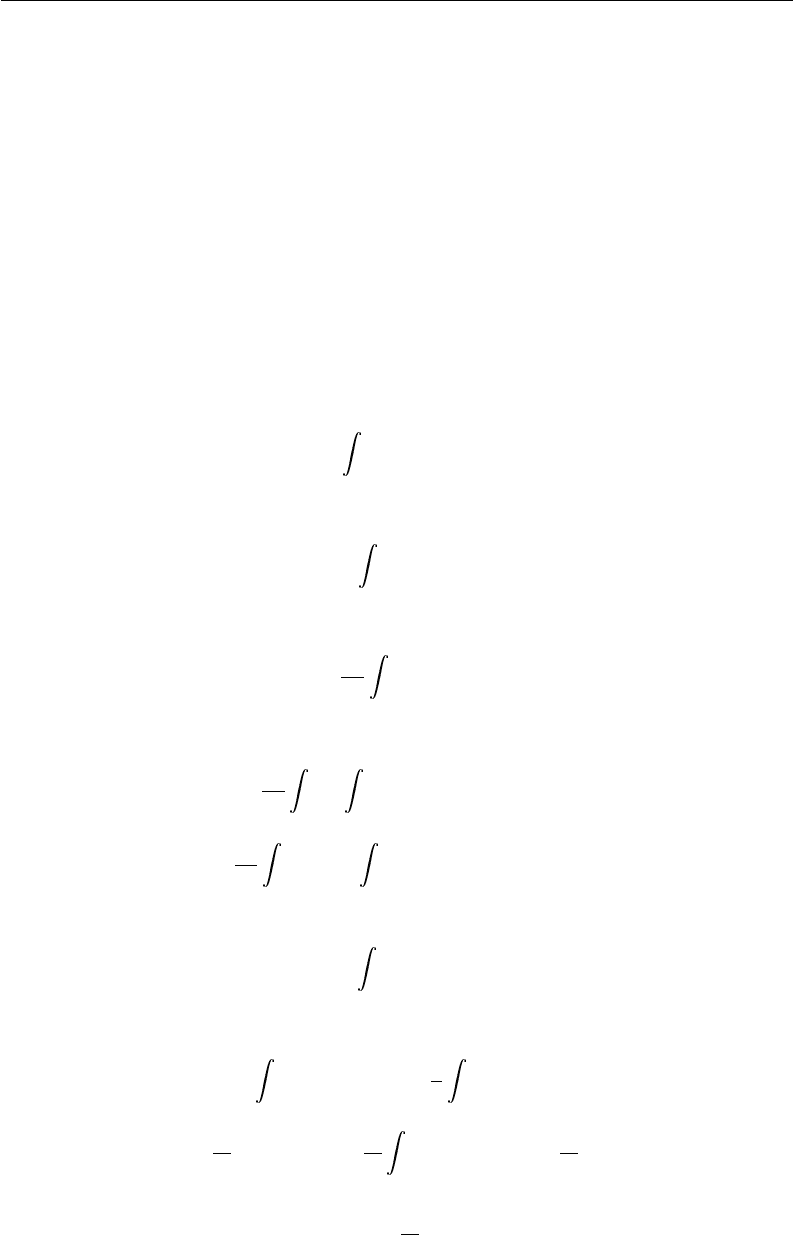
us
calculate the inner integral. For this purpose we consider for a fixed t the function
g(y) =
∞
−∞
e
−λ
2
t+λy
dλ. (3.2.4)
Differentiating (3.2.4) and using integration by parts we deduce
g
0
(y) =
∞
−∞
λe
−λ
2
t
e
λy
dλ =
1
2
∞
−∞
e
λy
e
−λ
2
t
d(λ
2
)
= −
1
2t
¯
¯
¯
¯
∞
−∞
e
λy
e
−λ
2
t
+
1
2t
∞
−∞
ye
λy
e
−λ
2
t
dλ =
y
2t
g(y).
Therefore,
g
0
(y)
=
y
2t
g(y),