
Freiling G., Yurko V. Lectures on Differential Equations of Mathematical Physics: A First Course
Подождите немного. Документ загружается.


172 G.
Freiling and V. Yurko
Theorem 4.2.3
is an obvious corollary of Theorem 4.1.2, since, if u(x) is a solution of
problem (4.2.2), then
Σ
ψ(ξ)ds =
Σ
∂u
∂n
d
s = 0
.
The Dirichlet and Neumann problems can be considered also in unbounded domains.
In this case we need the additional condition u(∞) = 0 (for n = 2 the additional condition
has the form u(x) = O(1), |x| → ∞ ). For example, let D ⊂ R
3
be a bounded set, and
D
1
:= R
3
\
D. The
Dirichlet
and Neumann problems in the domain D
1
are called exterior
problems.
Exterior Dirichlet problem
∆u = 0 (x ∈ D
1
),
u
|Σ
= ϕ(x), u(∞) = 0.
)
(4.2.3)
A function u(x) is called a solution of problem (4.2.3) if u(x) is harmonic in D
1
, u(x) ∈
C(
D
1
) , u
|Σ
= ϕ(x) and u(∞)
= 0
, i.e.
lim
R→∞
max
kxk=R
|u(x)| = 0.
Exterior Neumann problem
∆u = 0 (x ∈ D
1
),
∂u
∂n
¯
¯
¯
Σ
= ψ(x), u(∞)
= 0
.
(4.2.4)
A function u(x) is called a solution of problem (4.2.4) if u(x) is harmonic in D
1
, u(x) ∈
C
1
−
(
D
1
) ,
∂u
∂n
|Σ
= ψ(x) and u(∞)
= 0
.
One can consider the Dirichlet and Neumann problems also in other unbounded regions
(a sector, a strip, a half-strip, a half-plane, etc.).
Let us formulate the uniqueness theorem for the exterior Dirichlet problem (4.2.3).
Theorem 4.2.4. If a solution of problem (4.2.3) exists, then it is unique.
Proof. Let u
1
(x) and u
2
(x) be solutions of (4.2.3). Denote u(x) = u
1
(x) −u
2
(x).
Then ∆u = 0 in D
1
, u(x) ∈C(
D
1
) , u
|Σ
= 0 and u(∞)
= 0
. Let K
R
(0) be a ball of radius
R around the origin such that D ⊂K
R
(0). Applying the maximum principle for the region
K
R
(0) \D, we obtain
a
R
:= min
ξ∈S
R
(0)∪Σ
u(ξ) ≤ u(x) ≤ max
ξ∈S
R
(0)∪Σ
u(ξ) := A
R
for all x ∈ K
R
(0) \D, where S
R
(0) = ∂K
R
(0) . Since u(∞) = 0 and u
|Σ
= 0, we have
a
R
→ 0 and A
R
→ 0 as R →∞. Therefore, u(x) ≡ 0, and Theorem 4.2.4 is proved. 2

Elliptic P
artial Differential Equations 173
In order
to prove the uniqueness theorem for the exterior Neumann problem we need
several assertions which also are of independent interest.
Theorem 4.2.5 (Theorem on a removable singularity). Let 0 ∈ D, and let the func-
tion u(x) be harmonic in D \{0} and lim
kxk→0
kxku(x) = 0 (i.e. u(x) = o(
1
kxk
), x → 0 ).
Then
the
point x = 0 is a removable singularity for u(x), i.e. the function u(x) can be
defined at the point 0 such that u(x) becomes harmonic in D.
Remark 4.2.1. 1) The condition 0 ∈ D is not important and is taken for definiteness;
a singularity can be removed similarly at any point.
2) The function
1
kxk
is
harmonic
everywhere except at the point 0 (see Lemma 2.5.1) and
it has at 0 an unremovable singularity. This function does not satisfy the last condition of
the theorem.
Proof. Let K
R
(0) be a ball around the origin such that
K
R
(0) ⊂ D. W
e
take the
function v(x) such that v(x) is harmonic in K
R
(0), continuous in
K
R
(0) and v
|S
R
=
u
|S
R
, where S
R
= ∂K
R
(0) is
a
sphere. In other words, the function v(x) is the solution
of the Dirichlet problem for the ball. Below, in Section 4.3 we will prove independently
the existence of the solution of the Dirichlet problem for a ball. Therefore, a function v(x)
with the above mentioned properties exists and is unique. Denote w(x) = v(x)−u(x). Then
w(x) is harmonic in K
R
(0) \{0} and w
|S
R
= 0. Moreover, since
lim
kxk→0
kxku(x) = 0
and v(x) is continuous, it follows that
lim
kxk→0
kxkw(x) = 0.
Fix α > 0 and consider the function
Q
α
(x) = α
µ
1
kxk
−
1
R

.
Clearly
, Q
α
(x) is
harmonic in K
R
(0) \{0} and Q
α|S
R
= 0. We have
kxk(Q
α
±w(x)) = α −
µ
αkxk
R
±
k
xkw(x)

.
There exists r
α
> 0 such that
¯
¯
¯
¯
αkxk
R
±
k
xkw(x)
¯
¯
¯
¯
≤ α
for all kxk≤r
α
. Consider the ring G
α
= {x : r
α
≤x ≤R}. The functions w(x) and Q
α
(x)
are harmonic in G
α
and on the boundary |w(x)| ≤ Q
α
(x). By the maximum principle this
inequality holds also in G
α
, i.e.
|w(x)| ≤ α
µ
1
kxk
−
1
R

, x ∈G
α
.

174 G.
Freiling and V. Yurko
Fix x ∈ G
α
. As α →0 we get w(x)
= 0. By virtue of the arbitrariness of x we conclude
that w(x) = 0 for all x 6= 0, i.e. u(x) = v(x) for all x 6= 0. Defining u(0) := v(0), we
arrive at the assertion of Theorem 4.2.5. 2
The Kelvin transform
Consider the function u(x) and make the substitution
ξ =
x
kxk
2
. (4.2.5)
The
in
verse transform is symmetric:
x =
ξ
kξk
2
.
Denote
v(ξ)
=
1
kξk
u
µ
ξ
kξk
2

= kxku(x). (4.2.6)
The
function v
(ξ) is called the Kelvin transform for u(x). This transform is symmetric
since
u(x) =
1
kxk
v
µ
x
kxk
2

.
Consider
a
bounded domain D ∈R
3
with the boundary Σ , D
1
= R
3
\
D, and
suppose
that
0 ∈D. Let D
∗
be the image of the domain D
1
with respect to the replacement (4.2.5).
Then D
∗
1
= R
3
\
D
∗
and Σ
∗
= ∂D
∗
are
the
images of D and Σ, respectively. For example,
if D = K
R
(0), then D
∗
= K
1/R
(0).
Theorem 4.2.6 (Kelvin). Let 0 ∈ D. If the function u(x) is harmonic in D
1
, then
its Kelvin transform v(ξ) is harmonic in D
∗
\{0}. If the function u(x) is harmonic in
D \{0}, then v(ξ) is harmonic in D
∗
1
.
Proof. Denote
∆
x
u(x) =
3
∑
k=1
∂
2
u
∂x
2
k
, ∆
ξ
v(ξ)
=
3
∑
k=1
∂
2
v
∂ξ
2
k
.
Using
(4.2.5)-(4.2.6)
we calculate by differentiation
∆
x
u(x) =
1
kxk
5
∆
ξ
v(ξ). (4.2.7)
All
assertions
of Theorem 4.2.6 follow from (4.2.7). 2
Theorem 4.2.7. Let the function u(x) be harmonic outside the ball K
R
(0) and u(∞) =
0 ( i.e. lim
R→∞
max
kxk=R
|u(x)| = 0) . Then
u(x) = O
µ
1
kxk

,
∂u
∂x
k
= O
µ
1
kxk
2

, x →∞.
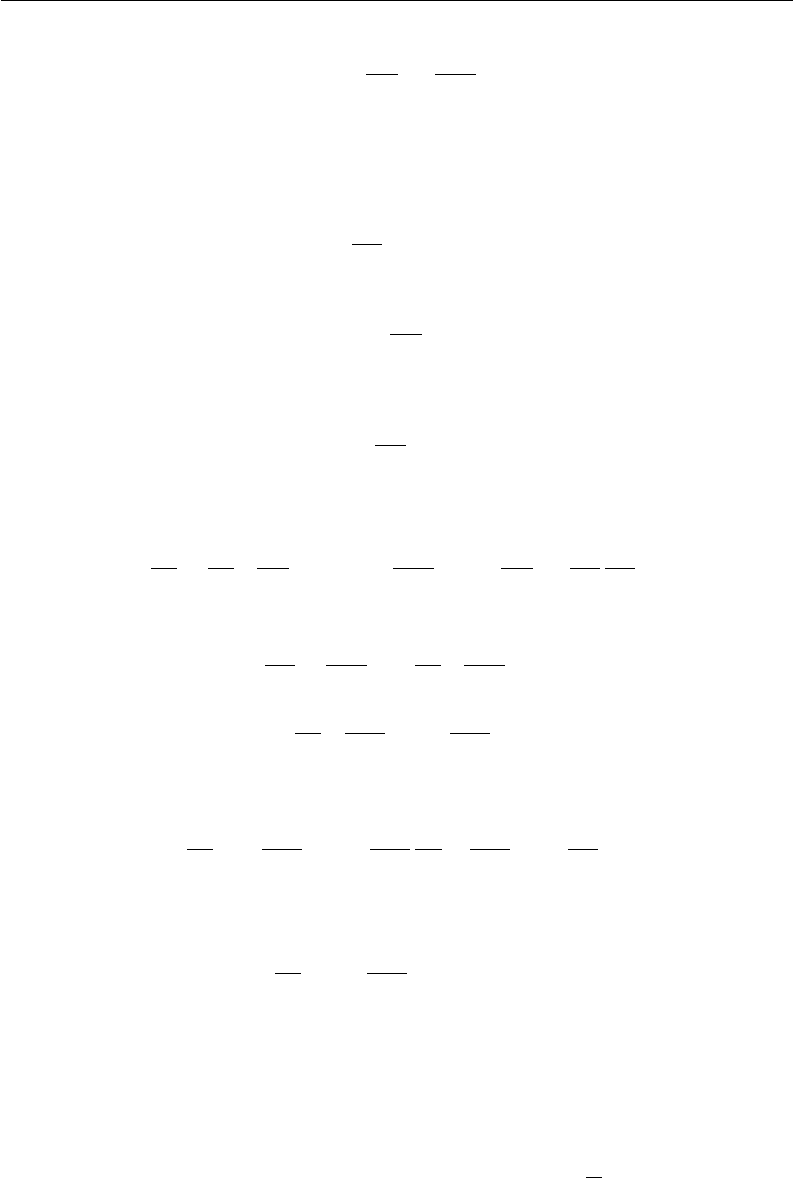
Elliptic P
artial Differential Equations 175
Proof
. Let
v(ξ) =
1
kξk
u
µ
ξ
kξk
2

be
the
Kelvin transform for u(x). By Theorem 4.2.6, the function v(ξ) is harmonic in
the domain K
1/R
(0) \{0}. Since u(∞) = 0, we have kξkv(ξ) → 0 as ξ → 0. Then, by
Theorem 4.2.5, the function v(ξ) is harmonic in K
1/R
(0). In particular, this yields
v(ξ) = O(1),
∂v
∂ξ
k
= O(1) for ξ → 0. (4.2.8)
Since
u(x)
=
1
kxk
v(ξ),
we
ha
ve, by virtue of (4.2.8), that
u(x) = O
µ
1
kxk

, x →∞.
Furthermore,
∂u
∂x
i
=
∂
∂x
i
µ
1
kxk
v(ξ)

= −
x
i
kxk
3
v(ξ)
+
1
kxk
3
∑
k=1
∂v
∂ξ
k
∂ξ
k
∂x
i
.
Since
∂ξ
k
∂x
i
=
δ
k
i
kxk
2
+ x
k
∂
∂x
i
µ
1
kxk
2

,
∂
∂x
i
µ
1
kxk
2

= −
2x
i
kxk
4
,
where δ
k
i
is
the Kronecker delta, one gets
∂u
∂x
i
= −
x
i
kxk
3
v(ξ)
+
1
kxk
3
∂v
∂ξ
i
−
2x
i
kxk
5
3
∑
k=1
x
k
∂v
∂ξ
k
.
In
vie
w of (4.2.8) this yields
∂u
∂x
i
= O
µ
1
kxk
2

, x →∞.
Theorem
4.2.7
is proved. 2
Let us now prove the uniqueness theorem for the exterior Neumann problem (4.2.4).
Theorem 4.2.8. If the solution of problem (4.2.4) exists, then it is unique.
Proof. Let u
1
(x) and u
2
(x) be solutions of problem (4.2.4). Denote u(x) = u
1
(x) −
u
2
(x). Then the function u(x) is harmonic in D
1
, u(∞) = 0 and
∂u
∂n
|Σ
= 0. Let K
R
(0) be
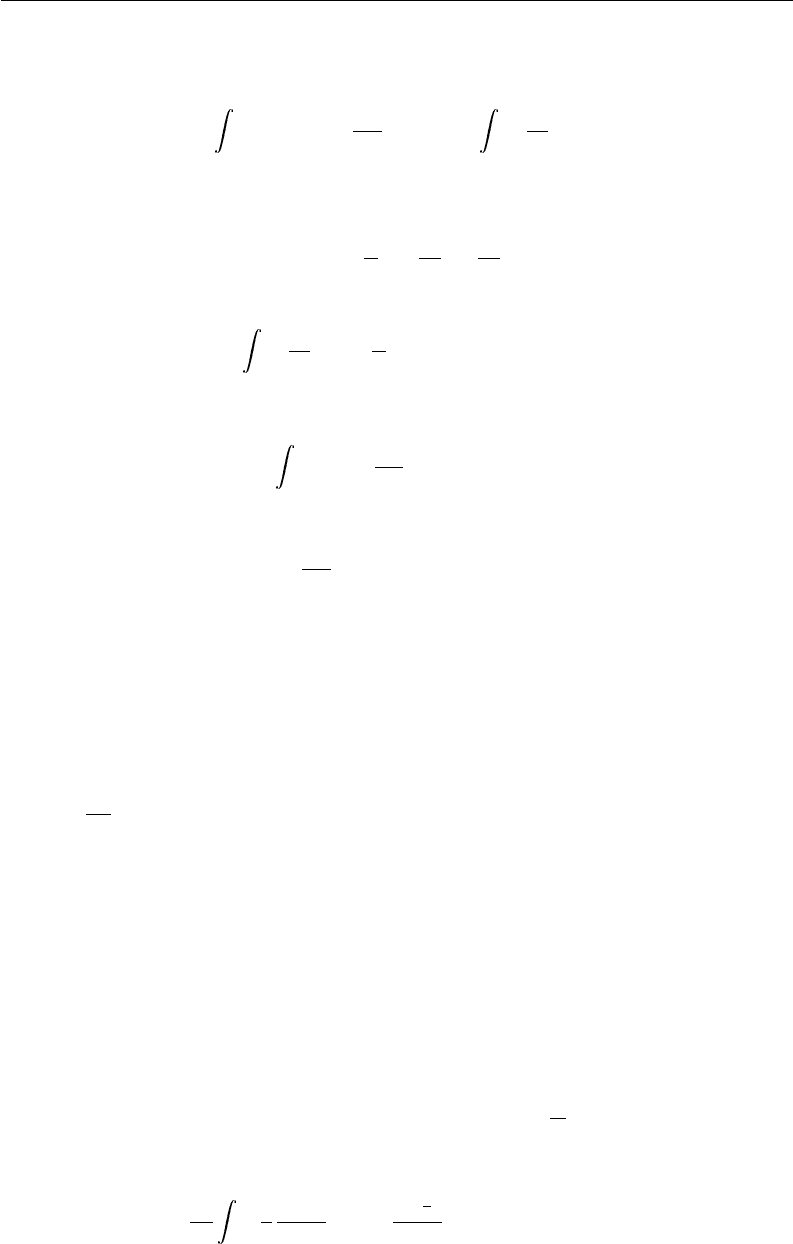
176 G.
Freiling and V. Yurko
the ball
of radius R around the origin such that D ⊂K
R
(0). We apply the Dirichlet identity
to the domain K
R
(0) \D :
K
R
(0)\D
Ã
3
∑
k=1
µ
∂u
∂x
k

2
!
d
x =
S
R
u
∂
u
∂n
d
s, (4
.2.9)
where S
R
= ∂K
R
(0) . By Theorem 4.2.7, on S
R
we have
|u(x)| ≤
C
R
, |
∂u
∂n
|
≤
C
R
2
,
and
consequently
,
¯
¯
¯
¯
S
R
u
∂u
∂n
d
s
¯
¯
¯
¯
≤
C
R
→ 0 as R → ∞.
Then
from
(4.2.9) as R → ∞ we obtain
D
1
Ã
3
∑
k=1
µ
∂u
∂x
k

2
!
d
x = 0
.
Therefore,
∂u
∂x
k
≡ 0, k = 1, 2,3,
i.e. u(x) ≡ cons
t. .
Since u(∞) = 0, we conclude that u(x) ≡ 0, and Theorem 4.2.8 is
proved. 2
Reduction of the exterior Dirichlet problem to the interior one
Let 0 ∈D. Let u(x) be the solution of problem (4.2.3) and let v(ξ) be the Kelvin transform
for u(x). Then, by Theorems 4.2.5-4.2.6, the function v(ξ) is harmonic in D
∗
. Moreover,
v(ξ) ∈C(
D
∗
) and v
|Σ
∗
= ϕ
∗
, where ϕ
∗
is
the
Kelvin transform for ϕ. Thus, v(ξ) is the
solution of the Dirichlet problem for the bounded domain D
∗
.
4.3. The Green’s Function Method
1. Let D ⊂ R
3
be a bounded domain with the boundary Σ ∈ PC
1
. We consider the
Dirichlet problem
∆u = 0 (x ∈ D),
u
|Σ
= ϕ(x),
)
(4.3.1)
where ϕ(x) ∈ C(Σ). Let u(x) be the solution of problem (4.3.1), and let v(x) be a har-
monic function in D. Moreover, suppose that u(x), v(x) ∈C
1
−
(
D). Then,
by
virtue of The-
orem 4.1.1 and 4.1.5, we obtain
u(x) =
1
4π
Σ
Ã
1
r
∂u(ξ)
∂n
ξ
−u(ξ)
∂
ξ
(
1
r
)
∂n
ξ
!
d
s, x ∈D, r = k
x −ξk,
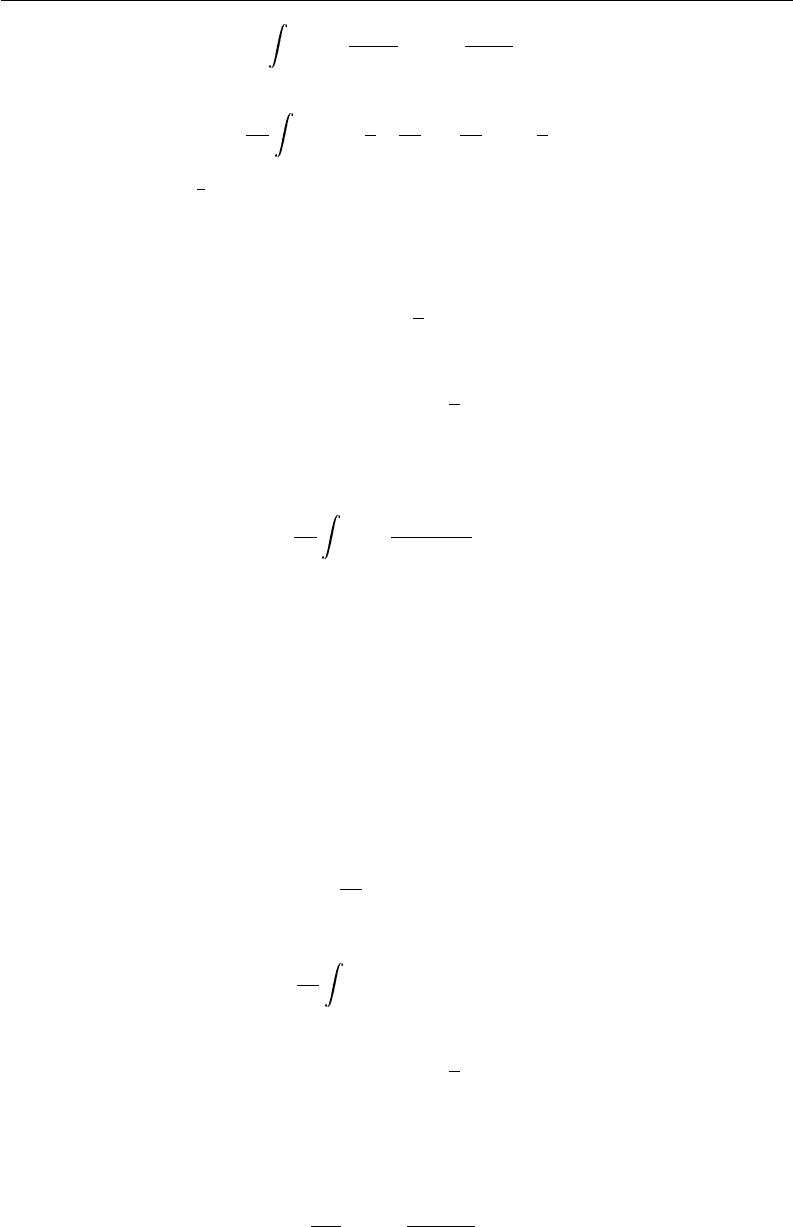
Elliptic P
artial Differential Equations 177
0 =
Σ
µ
v(ξ)
∂u(ξ)
∂n
ξ
−u(ξ)
∂v(ξ)
∂n
ξ

d
s
.
Therefore,
u(x) =
1
4π
Σ
µµ
v +
1
r

∂u
∂n
−u
∂
∂n
µ
v +
1
r
¶¶
d
s
. (4.3.2)
We require that (v +
1
r
)
|Σ
= 0. Then
for finding the function v = v(ξ,x) we obtain the
following Dirichlet problem with respect to ξ for a fixed x ∈ D :
∆
ξ
v = 0 (ξ ∈D),
v
|Σ
= −
1
r
.
(4.3.3)
Consider
the
function
G(x,ξ) = v +
1
r
,
where v is
the
solution of problem (4.3.3). The function G(x,ξ) is called the Green’s
function. Formula (4.3.2) takes the form
u(x) = −
1
4π
Σ
ϕ(ξ)
∂
ξ
G(x,ξ)
∂n
ξ
d
s, x ∈D. (4
.3.4)
Thus, if the solutions of the problems (4.3.1) and (4.3.3) exist (and have on Σ normal
derivatives), then formula (4.3.4) is valid.
Remark 4.3.1. In order to construct the solution of the Dirichlet problem (4.3.1) by
(4.3.4) we first need to solve the Dirichlet problem (4.3.3). For some domains the Dirichlet
problem (4.3.3) can be solved explicitly. Below, using the Green’s function method we will
construct the solution of the Dirichlet problem for a ball.
By similar arguments one can solve also the Neumann problem
∆u = 0 (x ∈ D),
∂u
∂n
¯
¯
¯
Σ
= ψ(x).
The
solution
has the form
u(x) =
1
4π
Σ
ψ(ξ)
˜
G(x,ξ) d
s
, x ∈D,
where
˜
G(x,ξ) = ˜v +
1
r
,
and
the
function ˜v(ξ,x) is the solution of the following Neumann problem with respect to
ξ :
∆
ξ
˜v = 0,
∂
ξ
˜v
∂n
ξ
¯
¯
¯
Σ
= −
∂
ξ
(1/r)
∂n
ξ
.

178 G.
Freiling and V. Yurko
Below
we will need the following auxiliary assertion.
Lemma 4.3.1. Let l be a vector and r = kξ −xk. Then
∂
ξ
r
∂l
= cos(l, ¯r),
wher
e ¯r =
(ξ
1
−x
1
,ξ
2
−x
2
,ξ
3
−x
3
). Symmetrically,
∂
x
r
∂l
= −cos(l, ¯r).
Indeed,
∂
ξ
r
∂l
=
3
∑
k=1
∂r
∂ξ
k
cos(l, ξ
k
)
=
3
∑
k=1
ξ
k
−x
k
r
cos(l,
¯
ξ
k
)
=
3
∑
k=1
cos(¯r,ξ
k
)cos(l,ξ
k
)
=
(l
0
, ¯r
0
)
= kl
0
k·k¯r
0
kcos(l, ¯r) = cos(l, ¯r),
where
l
0
= (cos(l,ξ
1
),cos(l,ξ
2
),cos(l,ξ
3
)),
¯r
0
= (cos(¯r,ξ
1
),cos(¯r, ξ
2
),cos(¯r, ξ
3
))
are unit vectors for l and ¯r, respectively, and (l
0
, ¯r
0
) is the scalar product of the vectors
l
0
and ¯r
0
.
2. Solution of the Dirichlet problem for a ball
Let K
R
be a ball of radius R around the point x
0
, and let S
R
= ∂K
R
be the sphere. We
consider the Dirichlet problem
∆u = 0 (x ∈ K
R
),
u
|S
R
= ϕ(x), ϕ(x) ∈C(S
R
).
)
(4.3.5)
Let x ∈K
R
. On the ray x
0
x choose the point x
1
such that
kx
0
−xk·kx
0
−x
1
k = R
2
.
Let ξ ∈S
R
. Denote
r = kξ −xk, ρ = kx
0
−xk, r
1
= kξ −x
1
k, ρ
1
= kx
0
−x
1
k
(see fig. 4.3.1).
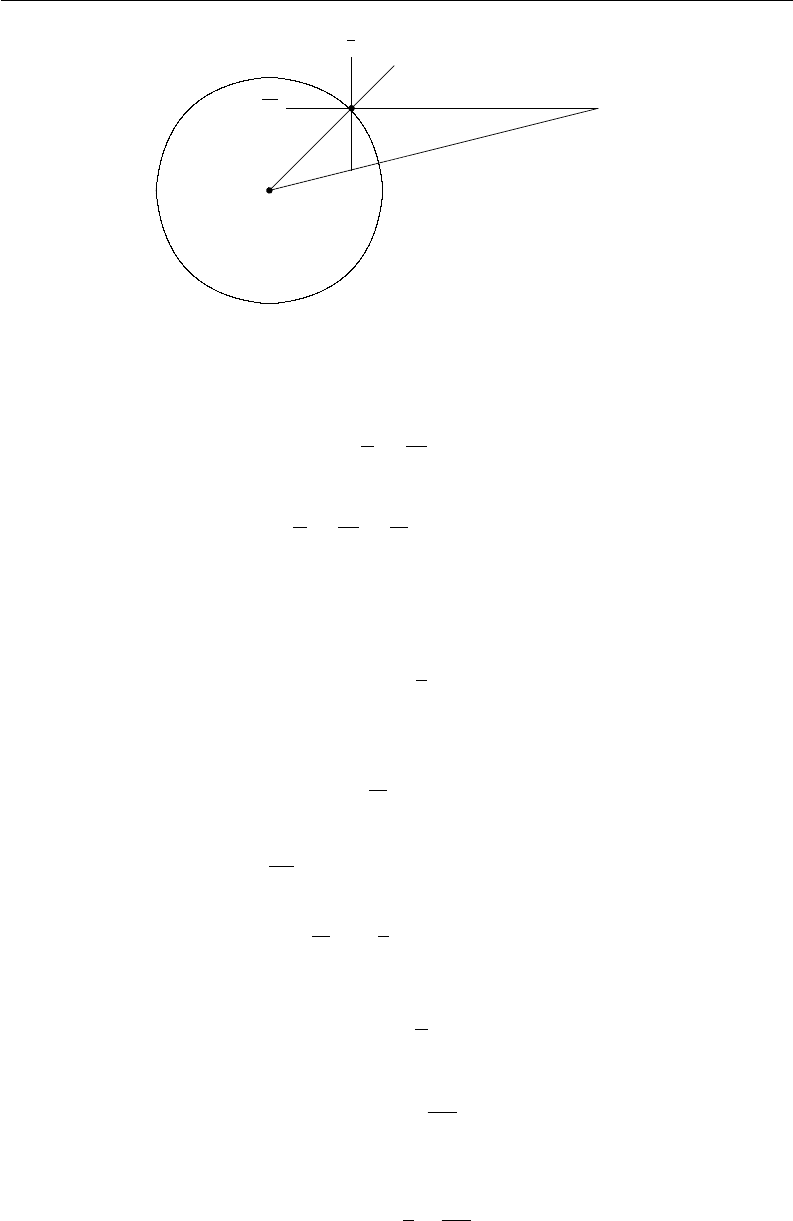
Elliptic P
artial Differential Equations 179
x
1
x
0
R
ρ
x
r
r
1
r
ξ
n
ξ
r
1
µ
¾
6
Figure
4.3.1.
W
e note that the triangles ∆
x
0
ξx
and ∆
x
0
x
1
ξ
are similar since they have a common angle
and
ρ
R
=
R
ρ
1
.
Hence
ρ
R
=
R
ρ
1
=
r
r
1
,
ξ
∈
S
R
.
(
4
.
3
.
6
)
In
our
case the Dirichlet problem (4.3.3) has the form
∆
ξ
v = 0 (ξ ∈K
R
),
v
|S
R
= −
1
r
.
(4.3.7)
Let
us
show that the solution of problem (4.3.7) has the form
v(ξ,x) =
α
r
1
, α −cons
t.
The
function v(ξ,x) is harmonic with respect to ξ everywhere except at the point x
1
, and
in particular, it is harmonic in
K
R
. The
boundary
condition yields
α
r
1
= −
1
r
, ξ ∈S
R
.
Using
(4.3.6)
we calculate
α = −
R
ρ
.
Thus,
v(ξ,x)
= −
R
ρr
1
,
and
consequently
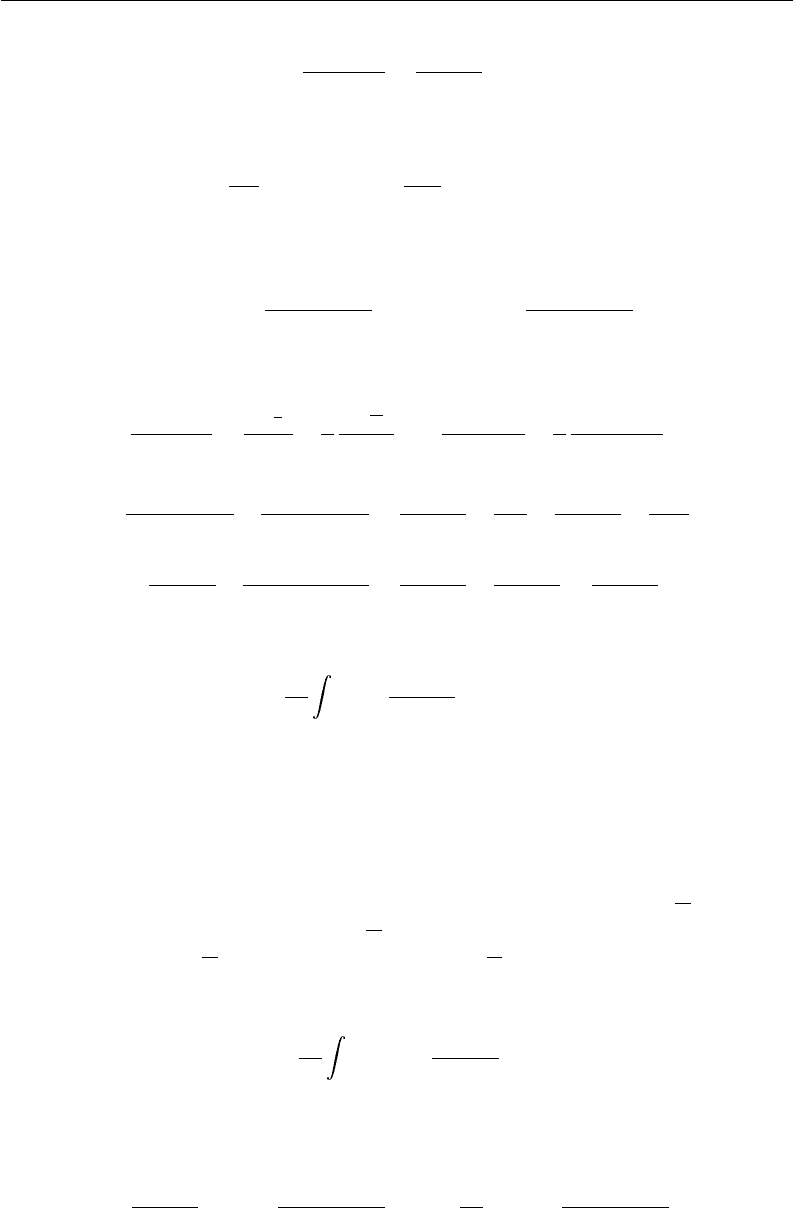
, the Green’s function has the form
G(x,ξ) =
1
r
−
R
ρr
1
. (4.3.8)
180 G.
Freiling and V. Yurko
Let us
show that
∂
ξ
G(x,ξ)
∂n
ξ
=
ρ
2
−R
2
Rr
3
. (4.3.9)
Indeed,
by
virtue of Lemma 4.3.1,
∂
ξ
r
∂n
ξ
= cos(n
ξ
, ¯r),
∂
ξ
r
1
∂n
ξ
= cos(n
ξ
, ¯r
1
). (4.3.10)
Using
the
cosine theorem we calculate
cos(n
ξ
, ¯r) =
R
2
+ r
2
−ρ
2
2Rr
, cos(n
ξ
, ¯r
1
)
=
R
2
+ r
2
1
−ρ
2
1
2Rr
1
. (4.3.11)
Dif
f
erentiating (4.3.8) and using (4.3.6), (4.3.10) and (4.3.11) we get
∂
ξ
G(x,ξ)
∂n
ξ
=
∂
ξ
(
1
r
)
∂n
ξ
−
R
ρ
∂
ξ
(
1
r
1
)
∂n
ξ
= −
cos( ¯n
ξ
, ¯r)
r
2
+
R
ρ
cos( ¯n
ξ
, ¯r
1
)
r
2
1
=
ρ
2
−R
2
−r
2
2Rr
3
+
R
2
+ r
2
1
−ρ
2
1
2ρr
3
1
=
ρ
2
−R
2
2Rr
3
−
1
2Rr
+
R
2
−ρ
2
1
2ρr
3
1
+
1
2ρr
1
=
ρ
2
−R
2
2Rr
3
+
R
2
ρ
2
−(ρ
1
ρ)
2
2(ρr
1
)
3
=
ρ
2
−R
2
2Rr
3
+
ρ
2
−R
2
2Rr
3
=
ρ
2
−R
2
Rr
3
,
i.e.
(4.3.9)
is valid. Substituting now (4.3.9) into (4.3.4) we arrive at the formula
u(x) =
1
4π
S
R
ϕ(ξ)
R
2
−ρ
2
Rr
3
d
s
, x ∈K
R
, (4.3.12)
which is called the Poisson formula. Thus, we have proved that if the solution of problem
(4.3.5) exists, then it is given by (4.3.12).
Theorem 4.3.1. For each continuous function ϕ on S
R
the solution of the Dirichlet
problem (4.3.5) for the ball exists, is unique and is represented by formula (4.3.12) .
Proof. It is sufficient to prove that the function u(x), defined by (4.3.12), is a solution
of problem (4.3.5). First we will prove that u(x) is harmonic in K
R
. Let
G ⊂ K
R
be
a
bounded
closed domain. Then for all x ∈
G , ξ ∈ S
R
we
ha
ve r = kx −ξk≥ d > 0, where
d is the distance from
G to S
R
. Therefore, u(x) ∈C
∞
(G), and
all
derivatives of u(x) can
be obtained by differentiation under the integral sign. In particular,
∆u =
1
4π
S
R
ϕ(ξ)∆
µ
R
2
−ρ
2
Rr
3

d
s.
Using
(4.3.10)-(4.3.11) we calculate
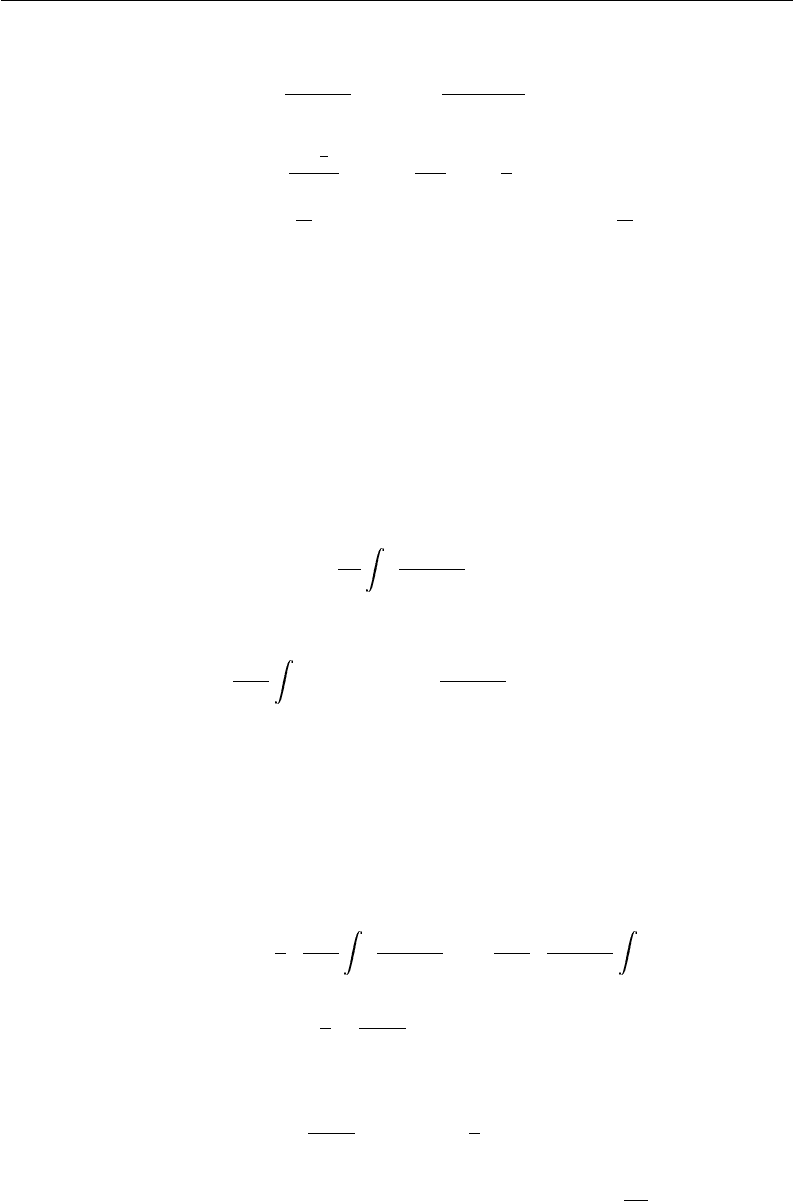
Clearly,
∆
µ
R
2
−ρ
2
Rr
3

= ∆
µ
R
2
−ρ
2
+ r
2
Rr
3

−∆
µ
1
Rr

= ∆
µ
R
2
−ρ
2
+ r
2
Rr
3

.
Elliptic P
artial Differential Equations 181
Using (4.3.10)-(4.3.11)
we calculate
∆
µ
R
2
−ρ
2
Rr
3

= 2∆
µ
cos(n
ξ
, ¯r)
r
2

= −2∆
Ã
∂
ξ
(
1
r
)
∂n
ξ
!
= −2
∂
ξ
∂n
ξ
µ
∆
µ
1
r
¶¶
= 0,
and
consequently
, ∆u(x) = 0 in
G. By
virtue
of the arbitrariness of
G we
conclude
that
u(x) ∈C
∞
(K
R
) and u(x) is harmonic in K
R
.
Fix x
∗
∈ Σ. Let us show that
lim
x→x
∗
,x∈K
R
u(x) = ϕ(x
∗
). (4.3.13)
For this purpose we consider the auxiliary Dirichlet problem
∆w = 0 (x ∈ K
R
),
w
|S
R
= 1.
)
(4.3.14)
Obviously, problem (4.3.14) has the unique solution w(x) ≡ 1. Hence, in view of (4.3.12),
1 =
1
4π
S
R
R
2
−ρ
2
Rr
3
d
s, (
4.3.15)
and consequently,
u(x) −ϕ(x
∗
) =
1
4πR
S
R
³
ϕ(ξ) −ϕ(x
∗
´
R
2
−ρ
2
r
3
d
s
, x ∈K
R
. (4.3.16)
Fix ε > 0. Since the function ϕ is continuous, there exists δ > 0 such that for kξ−x
∗
k≤δ
one has |ϕ(ξ) −ϕ(x
∗
)| ≤ ε/2. Let x ∈ K
R
, kx −x
∗
k ≤ δ/2. Denote
S
1
R
= {ξ ∈ S
R
: kξ −x
∗
k ≤ δ}, S
2
R
= S
R
\S
1
R
.
Clearly, r ≥ δ/2 on S
2
R
. Let C = max
ξ
|ϕ(ξ)|. Then it follows from (4.3.15)-(4.3.16) that
for x ∈K
R
, kx −x
∗
k ≤ δ/2,
|u(x) −ϕ(x
∗
)| ≤
ε
2
·
1
4πR
S
1
R
R
2
−ρ
2
r
3
d
s +
2C
4πR
·
R
2
−ρ
2
(δ/2)
3
S
2
R
d
s
≤
ε
2
+
2
4
C
R
δ
3
(R
2
−ρ
2
).
Let
no
w x →x
∗
. Then ρ
2
→ R
2
, i.e. there exists δ
1
such that for kx −x
∗
k ≤ δ
1
one has
2
4
CR
δ
3
(R
2
−ρ
2
) ≤
ε
2
.
Thus,
we
have proved that for each ε > 0 there exists δ
1
> 0 such that if kx −x
∗
k ≤ δ
1
,
then |u(x) −ϕ(x
∗
)| ≤ ε, i.e. (4.3.15) is valid. Therefore, u(x) ∈ C(
K
R
) and u
|S
R
= ϕ.
Theorem
4.3.1
is proved. 2