
Freiling G., Yurko V. Lectures on Differential Equations of Mathematical Physics: A First Course
Подождите немного. Документ загружается.

182 G.
Freiling and V. Yurko
3. T
wo-dimensional case. Solution of the Dirichlet problem for a disc
In the case n = 2 , x = (x
1
,x
2
) ∈ R
2
, there are similar results to those provided above. Let
us briefly formulate them. The solution of the Dirichlet problem (4.3.1) for n = 2 is given
by the formula
u(x) = −
1
2π
Σ
ϕ(ξ)
∂
ξ
G(x,ξ)
∂n
ξ
d
s, x ∈D, (
4.3.17)
where
G(x,ξ) = v + ln
1
r
is
Green’
s function, and v = v(ξ,x) is the solution of the following Dirichlet problem with
respect to ξ :
∆
ξ
v = 0 (ξ ∈D),
v
|Σ
= −ln
1
r
.
(4.3.18)
In
the
case of a disc (i.e. when D = K
R
), Green’s function has the form
G(x,ξ) = ln
1
r
−ln
R
ρr
1
and
∂
ξ
G(x,ξ)
∂n
ξ
=
ρ
2
−R
2
Rr
2
.
The
solution
of the Dirichlet problem (4.3.5) for n = 2 exists, is unique and is given by the
formula
u(x) =
1
2π
S
R
ϕ(ξ)
R
2
−ρ
2
Rr
2
d
s, x ∈K
R
, S
R
= ∂
K
R
, (4.3.19)
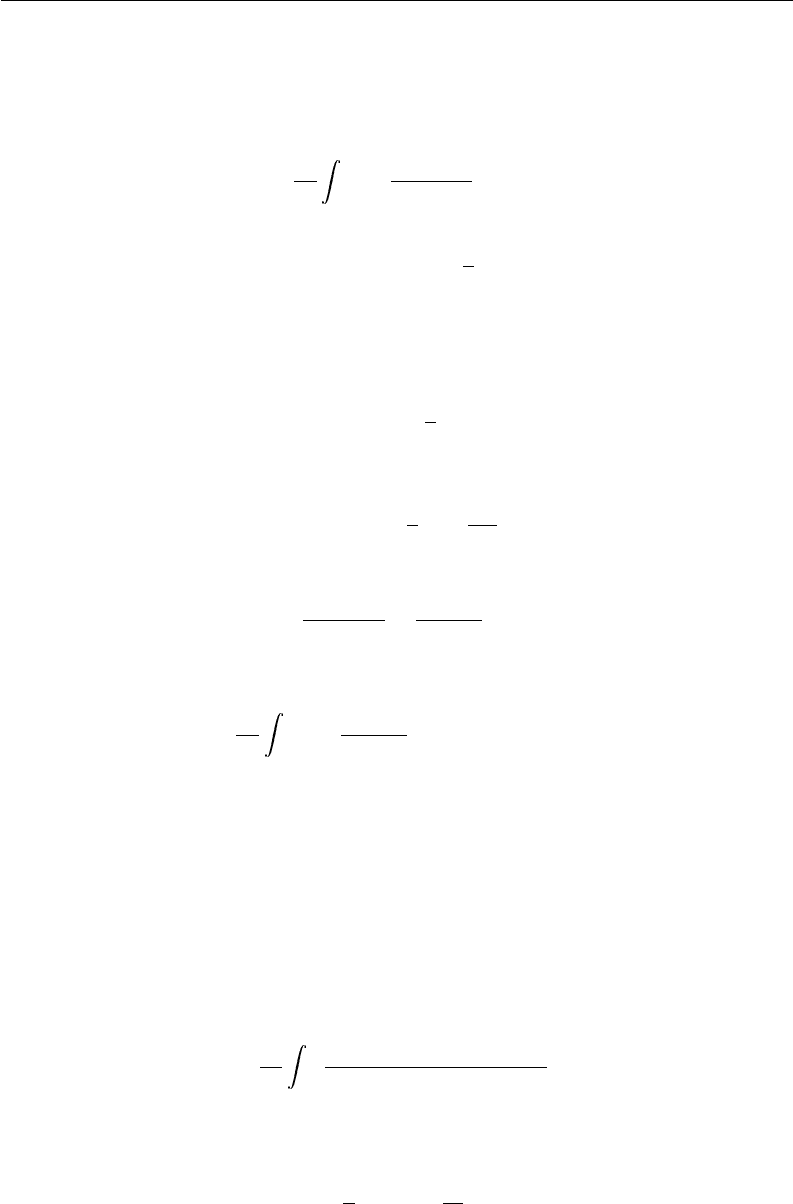
which is called the Poisson formula for a disc. We transform (4.3.19) with the help of polar
coordinates. We introduce the polar coordinate system with the pole at the point x
0
and
with an arbitrary axis. Let arg x = α , arg ξ = θ, i.e. (ρ,α) are the polar coordinates of x,
and (R,θ) are the polar coordinates of ξ ∈ S
R
. Then
ϕ(ξ) = ϕ(R cosθ, Rsin θ) :=
˜
ϕ(θ),
u(x) = u(ρ cosα, ρsin α) := ˜u(ρ,α),
and by the cosine theorem, r
2
= R
2
+ ρ
2
−2Rρcos(α −θ). Therefore, (4.3.19) takes the
form
˜u(ρ,α) =
1
2π
π
−π
R
2
−ρ
2
R
2
+ ρ
2
−2Rρcos(α −θ)
˜
ϕ(θ)dθ. (4.3.20)
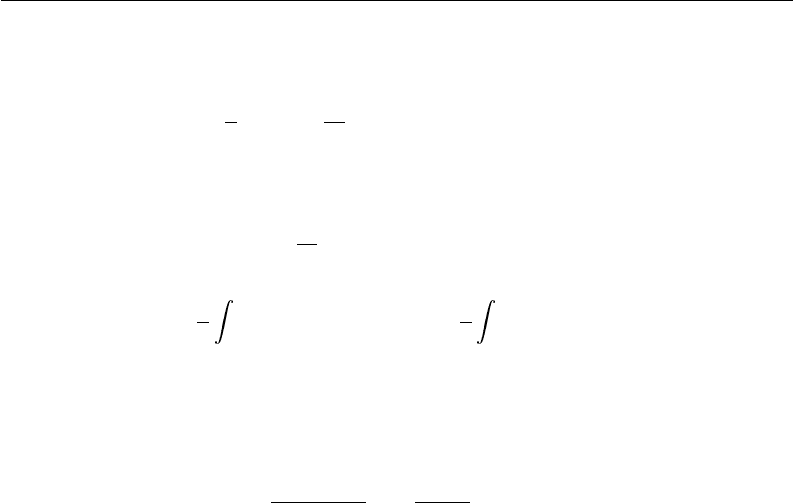
Let
us
show that formula (4.3.20) can be also obtained by the method of separation of
variables. Let for simplicity, x
0
= 0. The Laplace operator in polar coordinates has the
form
∆u =
1
ρ
(ρu
ρ
)
ρ
+
1
ρ
2
u
αα
,
Elliptic P
artial Differential Equations 183
where x
1
= ρ cos α , x
2
= ρ sin α (see [1,
Chapter 4]). Thus, we obtain the following
Dirichlet problem for a disc with respect to the function u(ρ,α) :
1
ρ
(ρu
ρ
)
ρ
+
1
ρ
2
u
αα
= 0, u
|ρ=R
= ϕ(α), (4.3.21)
where ϕ(α) is
continuous
and ϕ(α) = ϕ(2π + α). We expand ϕ(α) into a Fourier series:
ϕ(α) =
a
0
2
+
∞
∑
n=1
(a
n
cosnα + b
n
sinnα), (4.3.22)
a
n
=
1
π
π
−π
ϕ(α)cos nαdα, b
n
=
1
π
π
−π
ϕ(α)sin nαdα.
W
e
seek particular solutions of equation (4.3.21) of the form
u(ρ,α) = V (ρ)w(α).
Then
ρ(ρV
0
(ρ))
0
V (ρ)
= −
w
00
(α)
w(α)
= λ
2
,
and
consequently
,
ρ(ρV
0
(ρ))
0
= λ
2
V (ρ),
w
00
(α) + λ
2
w(α) = 0, w(α + 2π) = w(α).
)
(4.3.23)
The general solutions of the equations (4.3.23) are:
w(α) = A cosλα + B sin λα,
V (ρ) = Cρ
λ
+ Dρ
−λ
.
For λ = n we take
w
n
(α) = A
n
cosnα + B
n
sinnα,
V
n
(ρ) = ρ
n
,
hence
u
n
(ρ,α) = ρ
n
(A
n
cosnα + B
n
sinnα), n ≥0.
We seek the solution of problem (4.3.21) in the form
u(ρ,α) =
∞
∑
n=0
ρ
n
(A
n
cosnα + B
n
sinnα). (4.3.24)
The boundary condition for ρ = R yields
ϕ(α) =
∞
∑
n=0
R
n
(A
n
cosnα + B
n
sinnα).
184 G.
Freiling and V. Yurko
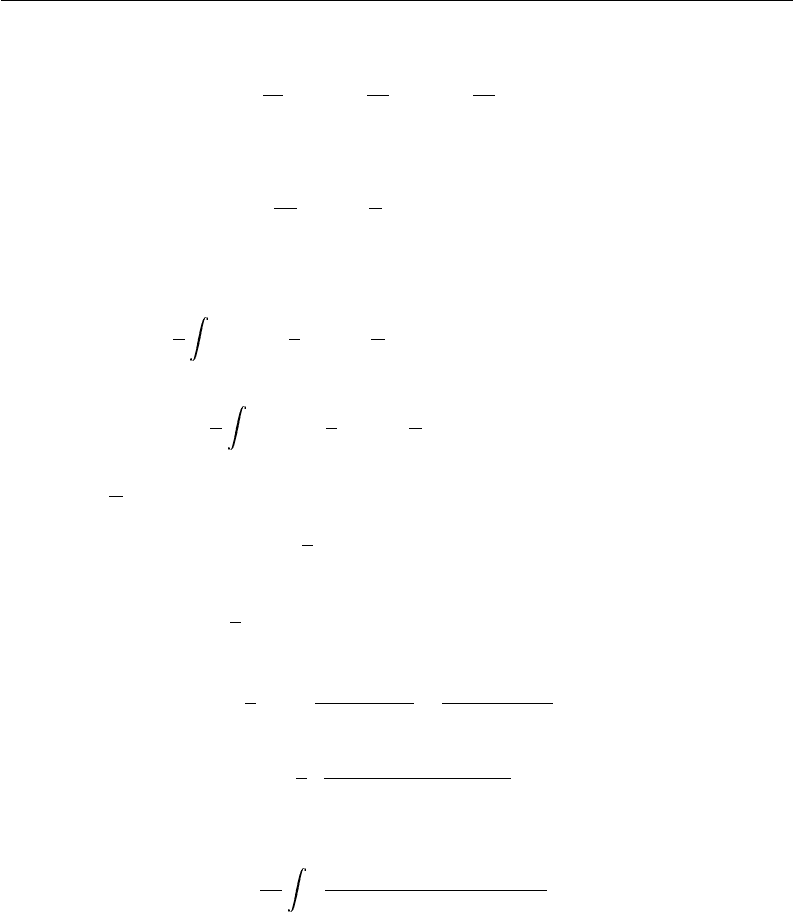
Comparing this
relation with (4.3.22) we calculate
A
0
=
a
0
2
, A
n
=
a
n
R
n
, B
n
=
b
n
R
n
, n ≥1.
Thus,
formula
(4.3.24) takes the form
u(ρ,α) =
α
0
2
+
∞
∑
n=1
³
ρ
R
´
n
(a
n
cosnα + b
n
sinnα) . (4.3.25)
W
e
substitute the expressions for a
n
and b
n
into (4.3.25):
u(ρ,α) =
1
π
π
−π
ϕ(θ)
Ã
1
2
+
∞
∑
n=1
³
ρ
R
´
n
(cosnθ cosnα + sin nθ sin nα)
!
dθ
=
1
π
π
−π
ϕ(θ)
Ã
1
2
+
∞
∑
n=1
³
ρ
R
´
n
cosn(θ −α)
!
dθ.
Denote t =
ρ
R
< 1. W
e
have
1
2
+
∞
∑
n=1
t
n
cosn(α −θ)
=
1
2
Ã
1 +
∞
∑
n=1
³
(t
e
i(
α−θ)
)
n
+ (te
−i(α−θ)
)
n
´
!
=
1
2
Ã
1 +
t
e
i(α
−θ)
1 −t
e
i(α
−θ)
+
te
−i(α−θ)
1 −t
e
−i(α
−θ)
!
=
1
2
·
1 −t
2
1 −2t cos(α −θ)
+t
2
.
Thus,
(4.3.25) takes the form
u(ρ,α) =
1
2π
π
−π
R
2
−ρ
2
R
2
+ ρ
2
−2Rρcos(α −θ)
ϕ(θ)dθ,
which
coincides
with (4.3.20).
4.4. The Method of Upper and Lower Functions
Let for definiteness n = 3, and let D ⊂ R
3
be a bounded domain with the boundary Σ ∈
PC
1
. In this section we consider a method for the solution of the Dirichlet problem:
∆u = 0 (x ∈ D),
u
|Σ
= ϕ, ϕ ∈C(Σ).
)
(4.4.1)
First we prove several assertions which are also of independent interest.
Elliptic P
artial Differential Equations 185
Harnack’
s inequality. Let the function u(x) be harmonic in the ball K
R
= {x : kx −
x
0
k < R}, continuous in
K
R
and u(x) ≥ 0. Then
R(R −ρ)
(R + ρ)
2
u(x
0
) ≤ u(x) ≤
R(R + ρ)
(R −ρ)
2
u(x
0
), x ∈K
R
, (4.4.2)
wher
e ρ = k
x −x
0
k.
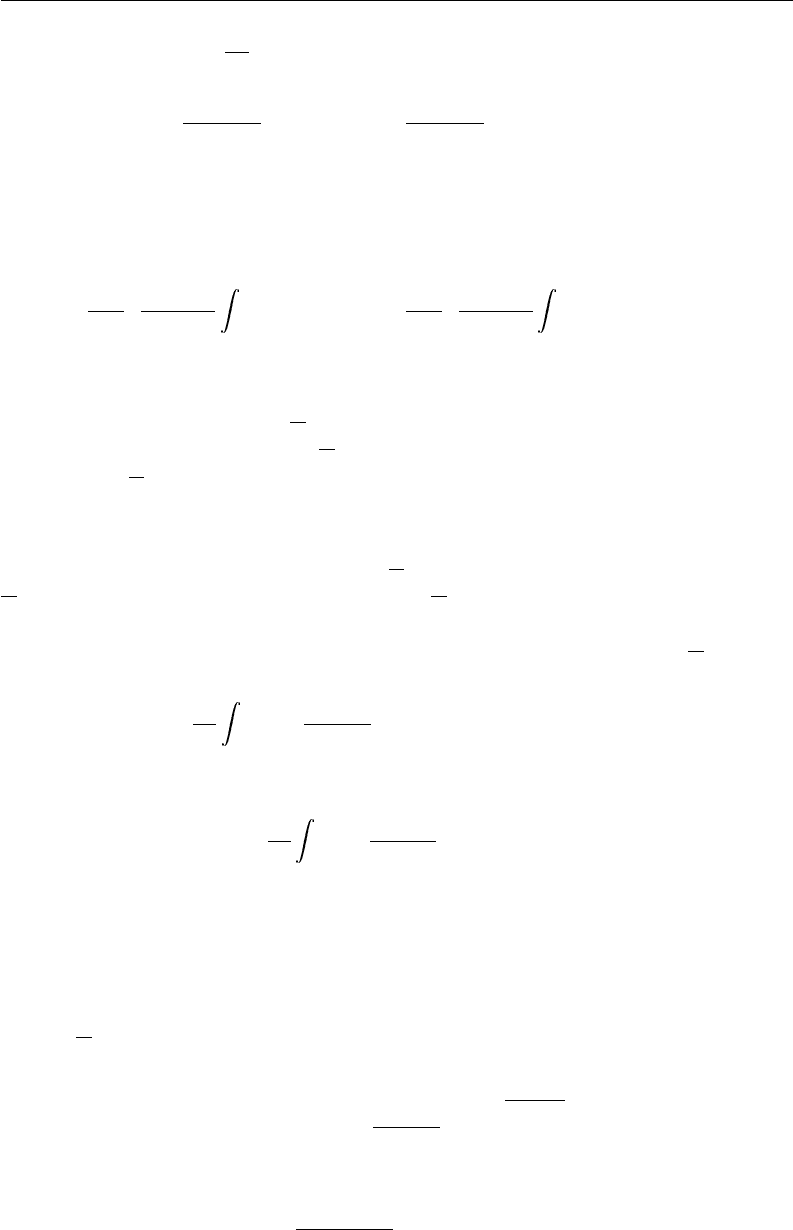
Proof. We will use the Poisson formula (4.3.12) for a ball. Since R −ρ ≤ r ≤ R + ρ
(see fig. 4.3.1), we have
1
4πR
·
R
2
−ρ
2
(R + ρ)
3
S
R
u(ξ)d
s ≤ u
(x) ≤
1
4πR
·
R
2
−ρ
2
(R −ρ)
3
S
R
u(ξ)d
s
, x ∈K
R
.
Applying the mean-value theorem we arrive at (4.4.2). 2
Theorem 4.4.1 (The first Harnack theorem). Let the functions u
n
(x) , n ≥ 1 be
harmonic in D, continuous in
D and
let {
u
n
(x)}
n≥1
converge uniformly on Σ. Then
{u
n
(x)}
n≥1
converges uniformly in
D, and
the
limit function u(x) is harmonic in D and
continuous in
D.
Pr
oof
. Since {u
n
(x)}
n≥1
converges uniformly on Σ, for each ε > 0 there exists N
such that |u
n+p
(x) −u
n
(x)| ≤ ε for all n ≥ N, p ≥ 0, x ∈ Σ. By the maximum principle,
this inequality remains valid also for all x ∈
D. Hence {u
n
(x)}
n≥1
con
v
erges uniformly in
D, and
the
limit function u(x) is continuous in
D. Let
us
show that u(x) is harmonic in
D. For this purpose it is sufficient to prove that the function u(x) is harmonic in each ball
K
R
(x
0
) ⊂ D. Since the functions u
n
(x) are harmonic in D and continuous in
D, we
ha
ve
u
n
(x) =
1
4π
S
R
u
n
(ξ)
R
2
−ρ
2
Rr
3
d
s, x ∈K
R
(x
0
), S
R
= ∂
K
R
(x
0
).
As n → ∞ we get
u(x) =
1
4π
S
R
u(ξ)
R
2
−ρ
2
Rr
3
d
s
, x ∈K
R
(x
0
),
and consequently, the function u(x) is harmonic in K
R
(x
0
). Theorem 4.4.1 is proved. 2
Theorem 4.4.2 (The second Harnack theorem). Let the functions u
n
(x) , n ≥ 1 be
harmonic in D, and let the sequence {u
n
(x)}
n≥1
be monotone in D and convergent at
least in one point x
0
∈ D. Then {u
n
(x)}
n≥1
converges in D to a harmonic function u(x) ,
and the convergence is locally uniform inside D (i.e. it is uniform in each bounded closed
domain
G ⊂ D ).
Pr
oof
. 1) Let for definiteness, the sequence be non-increasing: u
n+1
(x) ≤ u
n
(x). Let
us show that {u
n
(x)}
n≥1
converges uniformly in the ball
K
R
(x
0
) ⊂D. F
or
this purpose we
take the ball K
R
1
(x
0
) , R
1
> R such that
K
R
1
(x
0
) ⊂ D. Using
the
Harnack inequality for
the ball K
R
1
(x
0
) and for the function u
n
(x) −u
n+p
(x), we obtain
0 ≤ u
n
(x) −u
n+p
(x) ≤
R
1
(R
1
+ ρ)
(R
1
−ρ)
2
³
u
n
(x
0
) −u
n+p
(x
0
)
´
, x ∈K
R
1
(x
0
).

186 G.
Freiling and V. Yurko
Let no
w x ∈
K
R
(x
0
). Then ρ ≤R, and consequently
,
0 ≤ u
n
(x) −u
n+p
(x) ≤
R
1
(R
1
+ R)
(R
1
−R)
2
³
u
n
(x
0
) −u
n+p
(x
0
)
´
, x ∈K
R
(x
0
). (4.4.3)
Since {u
n
(x
0
)} con
v
erges, we have that for each ε > 0 there exists N such that
0 ≤ u
n
(x
0
) −u
n+p
(x
0
) ≤ ε
for all n ≥ N , p ≥ 0. Then we infer from (4.4.3) that
0 ≤ u
n
(x) −u
n+p
(x) ≤
R
1
(R
1
+ R)
(R
1
−R)
2
ε := ε
1
.
Therefore,
the
sequence {u
n
(x)} converges uniformly in
K
R
(x
0
). By
Theorem
4.4.1, the
limit function u(x) is harmonic in K
R
(x
0
) and continuous in
K
R
(x
0
).
2)
Let
us show that the sequence {u
n
(x)} converges uniformly in each closed ball
K
R
∗
(x
∗
) ⊂ D. W
e
connect the points x
0
and x
∗
by a curve lying in D. One can construct
a finite number of balls K
j
= K
R
j
(x
j
) , j =
0,m such
that
K
j
⊂ D , K
0
= K
R
(x
0
) , K
m
=
K
R
∗
(x
∗
) and x
j
∈ K
j−1
(i.e.
the
center of the next ball lies in the previous one). Using
the first part of the proof we get by induction that {u
n
(x)} converges uniformly in
K
j
for
j =
0,m, and
in
particular, in
K
R
∗
(x
∗
).
3)
By
the Heine-Borel lemma, for each bounded closed domain
G ⊂ D, there
e
xists a
finite number of balls covering
G. In
each
of these balls the sequence {u
n
(x)} converges
uniformly; hence {u
n
(x)} converges uniformly in
G. 2
Definition
4.4.1. Let v
(x) ∈C(
D), and
let K = K
R
(x
0
) be
a ball such that K ⊂ D.
The function
(v)
K
(x) =
v(x), x /∈ K,
1
4πR
S
R
v(ξ)
R
2
−ρ
2
r
3
d
s
, x ∈K,
is called the cut-off function of v(x) with respect to the ball K. Here, as in Section 4.3,
r = kx −ξk, ρ = kx −x
0
k and S
R
= ∂K is a sphere. In other words, the cut-off function
(v)
K
changes the function v in the ball K into the harmonic function (the solution of the
Dirichlet problem for the ball), and leaves v fixed outside K. Therefore, (v)
K
is harmonic
in K and continuous in
D.
Definition
4.4.2. 1)
The function v(x) is called superharmonic in D, if v(x) ∈C(
D)
and (v)
K
(x) ≤ v(x) for
each
ball K ⊂ D.
2) The function v(x) is called subharmonic in D, if v(x) ∈C(
D) and (v)
K
(x) ≥ v(x) for
each
ball K ⊂ D.
Definition
4.4.3. Let on Σ a continuous function ϕ(x) be given.
1) The function v(x) is called an upper function (for ϕ ), if v(x) is superharmonic in D
and v
|Σ
≥ ϕ.
2) The function v(x) is called a lower function (for ϕ ), if v(x) is subharmonic in D and
v
|Σ
≤ ϕ.

Elliptic P
artial Differential Equations 187
All statements
concerning upper and lower functions in this section are related to the
same function ϕ – therefore we omit below the appendix “for ϕ ”.
The idea of the method of upper and lower functions is to obtain the solution of the
Dirichlet problem (4.4.1) as the infimum of the upper functions (or as the supremum of the
lower functions). In order to realize this idea we need to study the properties of the upper
and lower functions.
Theorem 4.4.3. Let u(x) be harmonic in D and continuous in
D. Then u(x) is
superharmonic
and
subharmonic in D simultaneously.
Indeed, since u(x) is harmonic in D, we have (u)
K
= u for each ball K ⊂ D. There-
fore the next assertion is obvious.
Theorem 4.4.4. 1) Let the function v be superharmonic ( subharmonic ) . Then the
function (−v) is subharmonic (superharmonic).
2) Let the functions v
1
and v
2
be superharmonic (subharmonic). Then v
1
+ v
2
is super-
harmonic (subharmonic).
Theorem 4.4.5. Let u(x),v(x) ∈C(
D) and u(x) ≤ v(x). Then (u)
K
≤ (v)
K
for
eac
h
ball K ⊂ D.
Proof. Denote w = v −u . The function (w)
K
is harmonic in K and (w)
K
≥ 0 on the
boundary ∂K. By the maximum principle, (w)
K
≥ 0 in K, i.e. (u)
K
≤ (v)
K
in K. 2
Theorem 4.4.6. Let v(x) be superharmonic in D. Then v(x) attains its minimum on
Σ. Moreover, if v 6≡ const, then
min
ξ∈Σ
v(ξ) < v(x)
for all x ∈D.
Proof. Let v 6≡ const, and let its minimum be attained at a point x
0
∈ D, i.e.
v(x
0
) = min
x∈
D
v(x) := m.
Let K = K
R
(x
0
) ⊂D be
a
ball around the point x
0
such that there exists ˜x ∈ S
R
:= ∂K
R
for
which v( ˜x) > v(x
0
). Such a choice is possible since v 6≡ const. . Denote w = (v)
K
. Since
v(x) is superharmonic one has w(x) ≤ v(x) and w 6≡const. . On the other hand, v(x) ≥ m,
and by Theorem 4.4.5, w(x) ≥ m. Thus,
m ≤ w(x) ≤ v(x).
In particular, w(x
0
) = m, i.e. the function w(x) (which is harmonic in K ) attains its
minimum inside the ball. This contradiction proves the theorem. 2
Theorem 4.4.7. Let v(x) be an upper function, and let w(x) be a lower function. Then
v(x) ≥ w(x) for all x ∈
D.
Pr
oof
. By virtue of Theorem 4.4.4, the function v −w is superharmonic. Moreover,
(v −w)
|Σ
≥ 0. Then, by Theorem 4.4.6, v −w ≥ 0 in
D. 2
Theor
em
4.4.8. Let v
1
(x),. .. ,v
n
(x) be upper functions. Then
v(x) := min
1≤l≤n
v
l
(x)

188 G.
Freiling and V. Yurko
is an
upper function.
Proof. Let us show that v(x) ∈C(
D). T
ak
e x
0
∈
D. Since v
l
(x) ∈C(D), then
for
each
ε > 0 there exists δ > 0 such that for kx −x
0
k≤δ one has v
l
(x
0
)−ε ≤v
l
(x) ≤v
l
(x
0
)+ ε.
Therefore,
v
l
(x
0
) −ε ≤ v
l
(x) → v(x
0
) −ε ≤ v
l
(x) → v(x
0
) −ε ≤ v(x),
v
l
(x) ≤ v
l
(x
0
) + ε → v(x) ≤ v
l
(x
0
) + ε → v(x) ≤ v(x
0
) + ε.
Thus, the function v(x) is continuous at the point x
0
. By virtue of the arbitrariness of x
0
,
we conclude that v(x) ∈C(
D).
Furthermore, (v
l
)
K
≤v
l
for
each
ball K ⊂D. Since v ≤v
l
, we have by Theorem 4.4.5:
(v)
K
≤ (v
l
)
K
. Thus, (v)
K
≤ v
l
, and consequently, (v)
K
≤ v, i.e. v(x) is superharmonic in
D. At last, since v
l|Σ
≥ ϕ, we have v
|Σ
≥ ϕ, i.e. v(x) is an upper function. 2
Theorem 4.4.9. The cut-off function of an upper function is an upper function.
Proof. Let v(x) be an upper function, and let K ⊂ D be a ball. Denote z = (v)
K
.
Clearly, z ∈C(
D) and z
|Σ
≥ ϕ. It
remains
to show that (z)
K
1
≤ z for each ball K
1
⊂ D.
Since z = (v)
K
≤ v, we have by Theorem 4.4.5, (z)
K
1
≤ (v)
K
1
≤ v. But v(x) = z(x) for
x /∈ K. Therefore,
(z)
K
1
(x) ≤ z(x) for x /∈ K. (4.4.4)
Let us now derive the same inequality for x ∈ K. For this purpose we consider 4 cases of
the mutual location of the balls K and K
1
.
1) Let K ∩K
1
=
/
0. If x ∈K, then x /∈ K
1
, and consequently, (z)
K
1
(x) = z(x).
2) Let K
1
⊂ K. Since the function z(x) is harmonic in K, it follows that
(z)
K
1
(x) = z(x)
for x ∈K
1
. Outside K
1
we have: (z)
K
1
(x) ≡ z(x). Thus, (z)
K
1
(x) ≡ z(x) for all x ∈
D.
3)
Let K ⊂ K
1
. The
functions z and (z)
K
1
are harmonic in K and on the boundary
(4.4.4) is valid. By the maximum principle, (z)
K
1
(x) ≤ z(x) for all x ∈K.
4) Let the balls K and K
1
not contain each other and let Q := K ∩K
1
6=
/
0. The
functions z and (z)
K
1
are harmonic in Q. Outside Q (and consequently, on the bound-
ary ∂Q ) the inequality (z)
K
1
(x) ≤ z(x) is obvious. By the maximum principle, we have
(z)
K
1
(x) ≤ z(x) in Q. Theorem 4.4.9 is proved. 2
We now consider the Dirichlet problem (4.4.1). Denote by E the set of upper functions.
We note that E 6=
/
0, since
v
∗
(x) := max
ξ∈Σ
ϕ(ξ) ∈ E.
Moreover, the set E is bounded from below, since if v(x) ∈ E, then
v(x) ≥ min
ξ∈Σ
ϕ(ξ).
Consider the function
u(x) = inf
v∈E
v(x). (4.4.5)

Elliptic P
artial Differential Equations 189
Clearly,
the function u(x) exists and is finite in
D.
Theorem
4.4.10 (The main theorem). The function u(x), defined by (4.4.5) , is har-
monic in D.
Proof. It is sufficient to prove that u is harmonic in each ball K ⊂ D.
1) Let K = K
R
(x
0
) ⊂D. Fix ε > 0. Let us construct a sequence of functions {v
n
(x)}
n≥1
such that
v
n
∈ E, v
n
(x) is harmonic in K,
v
n
(x) ≤ v
n−1
(x) in
D, v
n
(x
0
) < u(x
0
)
+
ε
n
.
(4.4.6)
F
or
this purpose we choose ˜v
1
∈ E such that ˜v
1
(x
0
) < u(x
0
) + ε, and put v
1
= ( ˜v
1
)
K
. By
construction, v
1
is harmonic in K , v
1
≤ ˜v
1
in
D, and
by
Theorem 4.4.9, v
1
∈E. Clearly,
v
1
(x
0
) < u(x
0
) + ε.
Suppose now that the functions v
1
,. .. ,v
n−1
with properties (4.4.6) are already con-
structed. We choose ˜v
n
∈ E such that ˜v
n
(x
0
) < u(x
0
) + ε/n, and put
v
n
=
³
min(v
1
,. .. ,v
n−1
, ˜v
n
)
´
K
.
By construction, v
n
is harmonic in K, and by Theorems 4.4.8 and 4.4.9, v
n
∈ E. Further-
more, v
n
≤ v
n−1
and v
n
≤ ˜v
n
, and consequently, the function v
n
(x) satisfies (4.4.6).
In particular, it follows from (4.4.6) that
lim
n→∞
v
n
(x
0
) = u(x
0
).
By Theorem 4.4.2, the sequence {v
n
(x)} converges in K :
lim
n→∞
v
n
(x) = v(x), x ∈K
, v(x) is harmonic in K, and the convergence is uniform in each closed domain
G ⊂ K.
Since v(x) is
the
limit of upper functions, we have u(x) ≤ v(x) in
D .
Moreo
ver,
v(x
0
) = u(x
0
). (4.4.7)
2) Let us show that u(x) ≡v(x), x ∈K. Suppose on the contrary, that there exists x
1
∈K
such that u(x
1
) < v(x
1
). Then there exists a function z ∈ E such that
z(x
1
) < v(x
1
). (4.4.8)
Denote
R
1
= kx
0
−x
1
k, K
1
= {x : kx −x
0
k < R
1
}.
Then K
1
⊂ K and x
1
∈ ∂K
1
. Consider the functions
˜w = min(z, v), w = ( ˜w)
K
1
.
Since ˜w ≤ v, we infer from Theorem 4.4.5 that ( ˜w)
K
1
≤ (v)
K
1
= v, and consequently,
w(x) ≤ v(x) , x ∈
K
1
. Moreo
v
er, by virtue of (4.4.8), w(x
1
) < v(x
1
). By the maximum

190 G.
Freiling and V. Yurko
principle for
harmonic functions, w(x) < v(x) for all x ∈ K
1
. In particular, this yields, in
view of (4.4.7),
w(x
0
) < u(x
0
). (4.4.9)
Consider now the functions
w
n
=
³
min(z,v
n
)
´
K
1
.
By virtue of Theorems 4.4.8-4.4.9, w
n
∈ E. Let us show that
lim
n→∞
w
n
(x) = w(x) uniformly in
K
1
. (4.4.10)
Indeed,
since {
v
n
(x)} converges to v(x) uniformly in
K
1
, we
ha
ve that for each ε > 0
there exists N such that
v(x) −ε ≤ v
n
(x) ≤ v(x) + ε
for all n > N , x ∈
K
1
. Therefore,
min(z,v −ε) ≤ min(z, v
n
) ≤ min(z,v + ε)
or
min(z,v) −ε ≤ min(z, v
n
) ≤ min(z,v)
+ ε
.
By virtue of Theorem 4.4.5,
³
min(z,v)
´
K
1
−ε ≤
³
min(z,v
n
)
´
K
1
≤
³
min(z,v)
´
K
1
+ ε
or
w(x) −ε ≤ w
n
(x) ≤ w(x) + ε,
i.e. (4.4.10) is proved. It follows from (4.4.9)-(4.4.10) that w
n
(x
0
) < u(x
0
) for sufficiently
large n, which is impossible in view of (4.4.5). Thus, u(x) ≡ v(x) , x ∈ K, and conse-
quently, u(x) is harmonic in K. 2
Theorem 4.4.11. Let the function u(x) be defined by (4.4.5) . The Dirichlet problem
(4.4.1) has a solution if and only if u(x) ∈C(
D) and u
|Σ
= ϕ.
Pr
oof
. Clearly, if u(x) ∈C(
D) and u
|Σ
= ϕ, then u(x) is
the
solution of the problem
(4.4.1). Conversely, suppose that the solution of problem (4.4.1) exists; denote it by ˜u(x).
Then ˜u(x) is harmonic in D , ˜u(x) ∈C(
D) and ˜u
|Σ
= ϕ, hence
the
function ˜u(x) is upper
and lower simultaneously. Since ˜u(x) is an lower function, we have ˜u(x) ≤ u(x). Since
˜u(x) is an upper function, we have ˜u(x) ≥u(x). Therefore, ˜u(x) = u(x), and consequently,
u(x) ∈C(
D) , u
|Σ
= ϕ. 2
Thus,
it
remains to find out when the function u(x), defined by (4.4.5), is continuous in
D and u
|Σ
= ϕ. The
answer
on this question depends on the properties of ϕ(x) and of Σ.
For example, if ϕ(x) ≡ 1, then for each Σ the problem (4.4.1) has the solution u(x) ≡ 1.
However, we are interested in another question:
When does the solution of problem (4.4.1) exist for each ϕ(x) ∈C(Σ) ?
In this case the answer will depend only on the properties of Σ, i.e. on the configuration of
the domain.

Elliptic P
artial Differential Equations 191
Definition 4.4.4. A
point x
0
∈ Σ is called regular, if for each ϕ ∈C(Σ) :
lim
x→x
0
,x∈D
u(x) = ϕ(x
0
),
where the function u(x) is defined by (4.4.5).
The next theorem is obvious.
Theorem 4.4.12. The Dirichlet problem (4.4.1) has a solution for each ϕ(x) ∈C(Σ)
if and only if all points of Σ are regular.
Remark 4.4.1. If on Σ there are non-regular points, then for some ϕ the Dirich-
let problem has no solutions, and for some ϕ (for example, for ϕ(x) ≡ 1 ) the Dirichlet
problem has a solution. We provide sufficient conditions for the regularity of a point.
Definition 4.4.5. Let x
0
∈ Σ. The function ω(x) is called barrier for x
0
, if ω(x) is
superharmonic in
D , ω(x
0
)
= 0
and ω(x) > 0 for x ∈
D, x 6= x
0
.
Theor
em
4.4.13. If for a point x
0
∈ Σ there exists a barrier, then x
0
is regular.
Proof. For δ > 0 we denote Q
δ
=
D ∩K
δ
(x
0
) , Σ
δ
= Q
δ
∩Σ. Fix ε > 0. Since
ϕ(x) ∈C(Σ), there
e
xists δ > 0 such that for x ∈Σ
δ
we have
ϕ(x
0
) −ε ≤ ϕ(x) ≤ ϕ(x
0
) + ε. (4.4.11)
Moreover,
ω(x) ≥ h > 0 for x ∈
D \Q
δ
. (4.4.12)
Consider
the
functions
f (x) = ϕ(x
0
) + ε +Cω(x)
and
g(x) = ϕ(x
0
) −ε −Cω(x),
with C > 0. Let us show that one can choose C > 0 such that f (x) is an upper function,
and g(x) is a lower one. For definiteness, we confine ourselves only to the consideration
of f (x), since for g(x) arguments are similar. Clearly, f (x) is superharmonic in
D. It
follo
ws
from (4.4.11) that f (x) ≥ϕ(x) , x ∈ Σ
δ
for all C > 0. For x ∈Σ \Σ
δ
, by virtue of
(4.4.12), we have f (x) ≥ ϕ(x
0
) + ε +C. Choose C > 0 such that
f (x) ≥ min
ξ∈Σ
ϕ(ξ).
Then f (x) is an upper function.
Since f (x) is upper, and g(x) is lower, we have
ϕ(x
0
) −ε −Cω(x) ≤ u(x) ≤ ϕ(x
0
) + ε +Cω(x) for all x ∈
D.
As x →x
0
this
yields
ϕ
(x
0
) −ε ≤ lim
x→x
0
u(x) ≤
lim
x→x
0
u(x) ≤ ϕ(x
0
)
+ ε
.