
Freiling G., Yurko V. Lectures on Differential Equations of Mathematical Physics: A First Course
Подождите немного. Документ загружается.


162 G.
Freiling and V. Yurko
hence
g(y) = g
(0)e
y
2
4t
. (3.2.5)
By
virtue
of (3.2.4),
g(0) =
∞
−∞
e
−λ
2
t
dλ =
1
√
t
∞
−∞
e
−ξ
2
dξ =
r
π
t
.
Thus,
we
conclude that
u(x,t) =
1
2
√
πt
∞
−∞
ϕ(ξ)e
−
(x−ξ)
2
4t
dξ. (3.2.6)
F
ormula
(3.2.6) is called the Poisson formula, and the integral in (3.2.6) is called the Poisson
integral.
Theorem 3.2.2. Let the function ϕ(x) be continuous and bounded. Then the solution
of the Cauchy problem (3.2.1) −(3.2.2) exists, is unique and is given by (3.2.6) .
Proof. It is sufficient to prove that the function u(x,t), defined by (3.2.6), is a solution
of problem (3.2.1)-(3.2.2).
1) Since |ϕ(ξ)| ≤ M, we have
|u(x,t)| ≤
M
2
√
πt
∞
−∞
e
−
(x−ξ)
2
4t
dξ =
M
√
π
∞
−∞
e
−α
2
dα = M,
where
α =
ξ −x
2
√
t
.
Therefore,
the
Poisson integral converges absolutely and uniformly in
Q, and
the
function
u(x,t) is continuous and bounded in
Q.
2)
The
replacement α =
ξ −x
2
√
t
in
(3.2.6)
yields
u(x,t) =
1
√
π
∞
−∞
ϕ(x + 2α
√
t)e
−α
2
dα. (3.2.7)
F
or t = 0
we get
u(x,0) = ϕ(x) ·
1
√
π
∞
−∞
e
−α
2
dα = ϕ(x),
i.e.
the
function u(x,t) satisfies the initial condition (3.2.2).
3) Fix δ > 0 and consider the domain G
δ
= {(x,t) : −∞ < x < ∞, t ≥ δ}. In G
δ
the
function u(x,t), defined by (3.2.6), is infinitely differentiable, i.e. it has in G
δ
continuous
partial derivatives of all orders, and these derivatives can be obtained by differentiation
under the sign of integration. In particular,
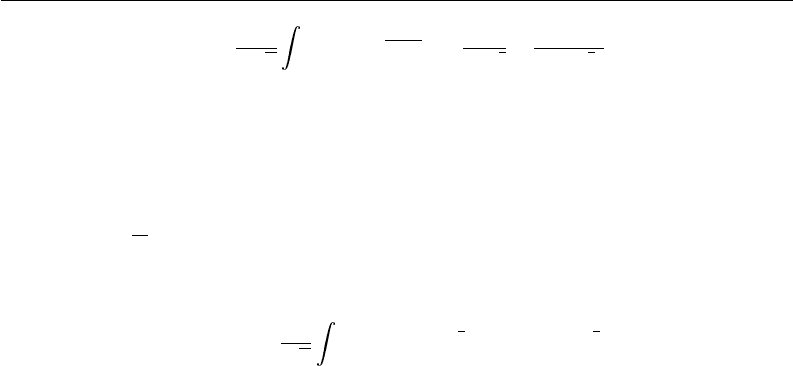
u
t
(x,t) =
1
2
√
π
∞
−∞
ϕ(ξ)e
−
(x−ξ)
2
4t
µ
−
1
2t
√
t
+
(x −ξ)
2
4t
2
√
t

dξ,
u
x
(x,t)
=
1
2
√
πt
∞
−∞
ϕ(ξ)e
−
(x−ξ)
2
4t
µ
−
x −ξ
2t

dξ,
Parabolic
Partial Differential Equations 163
u
x
x
(x,t)
=
1
2
√
π
∞
−∞
ϕ(ξ)e
−
(x−ξ)
2
4t
µ
−
1
2t
√
t
+
(x −ξ)
2
4t
2
√
t

dξ.
Consequently
,
the function u(x,t) satisfies equation (3.2.1) in G
δ
.
By virtue of the arbitrariness of δ > 0 we conclude that u(x,t) satisfies (3.2.1) in Q.
Theorem 3.2.2 is proved. 2
Definition 3.2.2. The solution of the Cauchy problem (3.2.1)-(3.2.2) is called stable if
for each ε > 0 there exists δ > 0 such that if |ϕ(x) −
˜
ϕ(x)| ≤ δ for all x, then |u(x,t) −
˜u(x,t)| ≤ ε in
Q.
It
follo
ws from (3.2.7) that
|u(x,t) − ˜u(x,t)| ≤
1
√
π
∞
−∞
|ϕ(x + 2α
√
t) −
˜
ϕ(x + 2α
√
t)|e
−α
2
dα
≤ sup
x
|ϕ(x) −
˜
ϕ(x)|,
and
consequently
, the solution of the Cauchy problem (3.2.1)-(3.2.2) is stable (one can take
δ = ε ). Thus, the Cauchy problem (3.2.1)-(3.2.2) is well-posed.

Chapter
4.
Elliptic
Partial Differential
Equations
Elliptic equations usually describe stationary fields, for example, gravitational, electro-
statical and temperature fields. The most important equations of elliptic type are the Laplace
equation ∆u = 0 and the Poisson equation ∆u = f (x), where x = (x
1
,. .. ,x
n
) are spatial
variables, u(x) is an unknown function,
∆u :=
n
∑
k=1
∂
2
u
∂x
2
k
is
the
Laplace operator (or Laplacian), and f (x) is a given function. In this chapter we study
boundary value problems for elliptic partial differential equations and present methods for
their solutions.
4.1. Harmonic Functions and Their Properties
1. Basic notions
Let D ⊂ R
n
be a bounded domain with the boundary Σ.
Definition 4.1.1. A surface Σ is called piecewise-smooth ( Σ ∈PC
1
), if it consists of a
finite number of pieces with continuous tangent planes on each of them, and if each straight
line intersects Σ at no more than a finite number of points and/or segments.
Examples of surfaces of the class PC
1
are a ball, a parallelepiped, an ellipsoid, etc..
Everywhere below we assume that Σ ∈ PC
1
. As before, in the sequel the notation u(x) ∈
C
m
(D) means that the function u(x) has in D continuous partial derivatives up to the order
m.
Definition 4.1.2. Let u ∈C
1
(D), x ∈Σ, n
x
be the outer normal to Σ at the point x. If
uniformly on Σ there exists a finite limit
lim
y→x
y=x−αn
x
,α>0
∂u(y)
∂n
x
:=
∂u(x)
∂n
x
,

166 G.
Freiling and V. Yurko
we
shall
say that the function u(x) has on Σ the normal derivative
∂u(x)
∂n
x
(notation: u(x) ∈
C
1
−
(
D) ).
Remark
4.1.1. 1)
Clearly, if u(x) ∈C
1
(
D), then u(x) ∈C
1
−
(D) .
2)
If u
(x) ∈C
1
−
(
D), then u(x) ∈C(D) (after
defining u on ∂D by
continuity if necessary).
Definition 4.1.3. A function u(x) is called harmonic in the domain D, if u(x) ∈
C
2
(D) and ∆u = 0 in D.
Examples. 1) Let n = 1. Then ∆u = u
00
(x), and consequently, the harmonic functions
are the linear ones: u(x) = ax + b.
2) Let n = 2, i.e. x = (x
1
,x
2
), and let z = x
1
+ ix
2
. If the function f (z) = u(x
1
,x
2
) +
iv(x
1
,x
2
) is analytic in D, then by virtue of the Cauchy-Riemann conditions
∂u
∂x
1
=
∂v
∂x
2
,
∂u
∂x
2
= −
∂v
∂x
1
,
the
functions u and v are
harmonic in D (and they are called conjugate harmonic func-
tions). Conversely, if u(x
1
,x
2
) is harmonic in D, then there exists a conjugate harmonic
function v(x
1
,x
2
) such that the function f = u + iv is analytic in D, and
v(x
1
,x
2
) =
(x
1
,x
2
)
(x
0
1
,x
0
2
)
µ
−
∂u
∂x
2
d
x
1
+
∂
u
∂x
1
d
x
2

+C
(the
integral does not depend on the way of the integration since under the integral we have
the total differential of v ).
Fix x
0
= (x
0
1
,x
0
2
) and denote
r = kx −x
0
k =
q
(x
1
−x
0
1
)
2
+
(x
2
−x
0
2
)
2
.
It
is easy to check that the function u(x) = ln
1
r
is
harmonic
everywhere except at the point
x
0
. This function is called the fundamental solution of the Laplace equation on the plane.
3) Let n = 3, i.e. x = (x
1
,x
2
,x
3
). Fix x
0
= (x
0
1
,x
0
2
,x
0
3
) and denote
r = kx −x
0
k =
s
3
∑
k=1
(x
k
−x
0
k
)
2
.
Then
the
function u(x) =
1
r
is
harmonic
everywhere except at the point x
0
(see Lemma
2.5.1). This function is called the fundamental solution of the Laplace equation in the space
R
3
.
Remark 4.1.2. The importance of the fundamental solution connects with the isotropy
of the space when the physical picture depends only on the distance from the source of
energy but not on the direction. For example, the function u(x) =
1
r
represents
the
potential
of the gravitational (electro-statical) field created by a point unit mass (point unit charge).
Similar sense has the fundamental solution of the Laplace equation on the plane: this is
the potential of the field produced by a charge of constant linear density q = 1, distributed
uniformly along the line x
1
= x
0
1
, x
2
= x
0
2
.

Elliptic P
artial Differential Equations 167
2. Pr
operties of harmonic functions
Let for definiteness n = 3.
Theorem 4.1.1. Let u(x),v(x) ∈C
2
(D) ∩C
1
−
(
D). Then
D
(u∆v −v∆u) d
x =
Σ
µ
u
∂v
∂n
−v
∂u
∂n

d
s
, (4.1.1)
where n is the outer normal to the surface Σ . Formula (4.1.1) is called Green’s formula.
Proof. Let D
α
be the domain that is obtained from D by removing the balls K
α
(x) ,
x ∈ Σ of radius α around the point x. Let Σ
α
be the boundary of D
α
. Applying the
Gauß-Ostrogradskii formula for the domain D
α
, we get
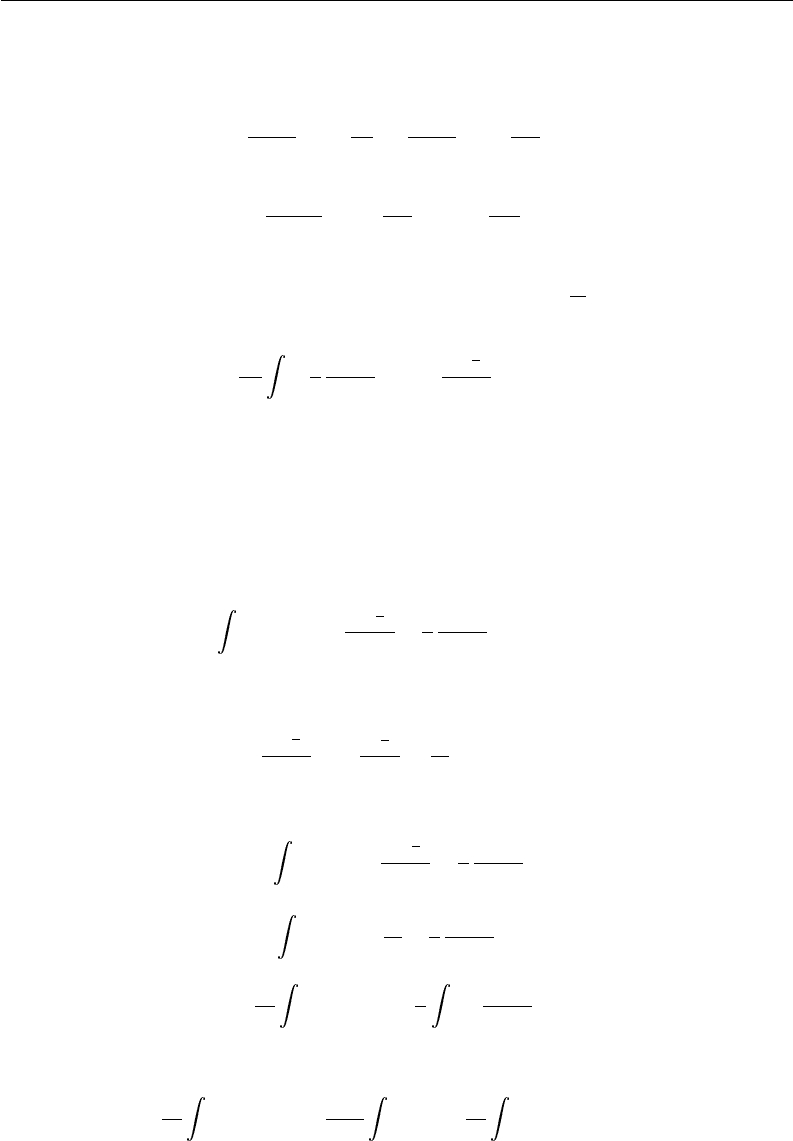
D
α
(u∆v −v∆u) dx =
D
α
Ã
3
∑
k=1
∂
∂x
k
(uv
x
k
−vu
x
k
)
!
d
x
=
Σ
α
Ã
3
∑
k=1
(uv
x
k
−vu
x
k
)cos
(n,x
k
)
!
ds
=
Σ
α
Ã
u
3
∑
k=1
v
x
k
cos(n,x
k
) −v
3
∑
k=1
u
x
k
cos(n,x
k
)
!
ds
=
Σ
α
µ
u
∂v
∂n
−v
∂u
∂n

d
s
.
As α → ∞ this yields (4.1.1). 2
Theorem 4.1.2. Let u(x) be harmonic in D and u(x) ∈C
1
−
(
D). Then
Σ
∂u
∂n
d
s = 0
. (4.1.2)
Indeed, (4.1.2) follows from (4.1.1) for v ≡ 1.
Theorem 4.1.3. Let u(x) ∈ C
2
(D) and assume that for any closed surface S ∈ PC
1
from D one has
S
∂u
∂n
d
s = 0
.
Then u(x) is a harmonic function in D.
Proof. It follows from (4.1.1) for v ≡ 1, Σ = S that
G
∆udx = 0,
where G := int S. By virtue of the arbitrariness of G this yields ∆u = 0 in D. 2
Theorem 4.1.4. Let u(x) be harmonic in D and u(x) ∈C
1
−
(
D). Then
D
Ã
3
∑
k=1
µ
∂u
∂x
k

2
!
d
x =
Σ
u
∂
u
∂n
d
s
. (4.1.3)
168 G.
Freiling and V. Yurko
Relation (4.1.3)
is called the Dirichlet identity.
Proof. We apply (4.1.1) for the functions v ≡1 and u
2
. Since
∂(u
2
)
∂n
= 2u
∂u
∂n
,
∂(u
2
)
∂x
k
= 2u
∂u
∂x
k
,
∂
2
(u
2
)
∂x
2
k
= 2
µ
∂u
∂x
k

2
+ 2u
∂
2
u
∂x
2
k
,
we
arri
ve at (4.1.3). 2
Theorem 4.1.5. Let u(x) be harmonic in D and u(x) ∈C
1
−
(
D). Then
u(x)
=
1
4π
Σ
Ã
1
r
∂u(ξ)
∂n
ξ
−u(ξ)
∂
ξ
(
1
r
)
∂n
ξ
!
d
s
, x ∈D, (4.1.4)
where ξ is the variable of integration, r = kx −ξk, n
ξ
is the outer normal to Σ at the
point ξ, and ∂
ξ
means that the differentiation is performed with respect to ξ ( for a fixed
x) . Formula (4.1.4) is called the basic formula for harmonic functions.
Proof. Fix x ∈ D and consider the ball K
δ
(x) of radius δ > 0 around the point x. In
the domain D \K
δ
(x) we apply Green’s formula (4.1.1) for v = 1/r. Since ∆u = ∆v = 0,
we have
Σ∪S
δ
(x)
Ã
u(ξ)
∂
ξ
(
1
r
)
∂n
ξ
−
1
r
∂u(ξ)
∂n
ξ
!
d
s = 0
,
where S
δ
(x) = ∂K
δ
(x) is the sphere. On S
δ
(x) :
∂
ξ
(
1
r
)
∂n
ξ
= −
∂(
1
r
)
∂r
=
1
r
2
, r = δ,
and
consequently
,
I
δ
:=
S
δ
(x)
Ã
u(ξ)
∂
ξ
(
1
r
)
∂n
ξ
−
1
r
∂u(ξ)
∂n
ξ
!
d
s
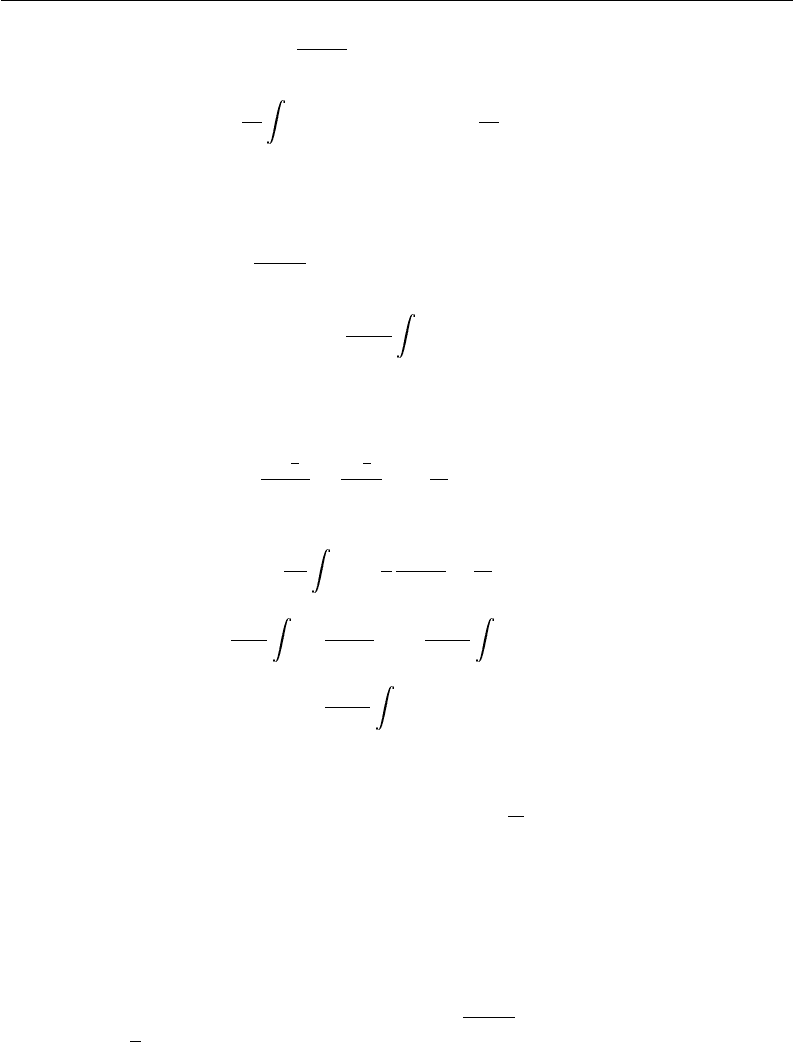
=
S
δ
(
x)
µ
u(ξ)
1
r
2
−
1
r
∂u(ξ)
∂n
ξ

d
s
=
1
δ
2
S
δ
(x)
u(ξ)d
s −
1
δ
S
δ
(x)
∂u(ξ)
∂n
ξ
d
s
.
By Theorem 4.1.2 the second integral is equal to zero, and we obtain
I
δ
=
1
δ
2
S
δ
(x)
u(ξ)d
s =
u
(x)
δ
2
S
δ
(x)
d
s +
1
δ
2
S
δ
(x)
(u(ξ) −u(x)
)d
s
= 4πu(x) + J
δ
.
Elliptic P
artial Differential Equations 169
Since the
function u(x) is continuous, we have that for each ε > 0 there exists δ > 0 such
that |u(x) −u(ξ)|≤ ε for all ξ ∈
K
δ
(x). Therefore,
|J
δ
|
≤
1
δ
2
S
δ
(x)
|u(ξ) −u(x)|d
s ≤
ε
δ
2
4πδ
2
= 4πε.
Thus, I
δ
→ 4πu(x) as δ →0, and
we
arrive at (4.1.4). 2
Theorem 4.1.6. (Mean-Value Theorem). Let K
R
(x) be a ball of radius R around the
point x, and let S
R
(x) = ∂K
R
(x) be the sphere. Suppose that the function u(ξ) is harmonic
in K
R
(x) and continuous in
K
R
(x). Then
u(x)
=
1
4πR
2
S
R
(x)
u(ξ)d
s
. (4.1.5)
Proof. We apply the basic formula for harmonic functions (4.1.4) for the ball K
˜
R
(x)
for
˜
R < R. On S
˜
R
:
∂
ξ
(
1
r
)
∂n
ξ
=
∂(
1
r
)
∂r
= −
1
r
2
, r =
˜
R,
and
consequently
,
u(x) =
1
4π
S
˜
R
(x)
µ
1
r
∂u(ξ)
∂n
ξ
+
1
r
2
u(ξ)

d
s
=
1
4π
˜
R
S
˜
R
(x)
∂u(ξ)
∂n
ξ
d
s +
1
4π
˜
R
2
S
˜
R
(x)
u(ξ)d
s
=
1
4π
˜
R
2
S
˜
R
(x)
u(ξ)d
s
,
since the first integral here is equal to zero by Theorem 4.1.2. As
˜
R → R we arrive at
(4.1.5). 2
Theorem 4.1.7 (Maximum Principle). Let u(x) ∈C(
D) and
let
u be harmonic in D.
Then u(x) attains its maximum and minimum on Σ. Moreover, if u(x) 6≡ const, then
min
ξ∈Σ
u(ξ) < u(x) < max
ξ∈Σ
u(ξ)
for all x ∈D, i.e. maximum and minimum cannot be attained in D.
Proof. Let u(x) 6≡ const, and let the maximum be attained at some point x ∈ D,
i.e. u(x) = max
ξ∈
D
u(ξ). T
ak
e a ball K
R
(x) such that
K
R
(x) ⊂ D and
such
that there exists
˜x ∈ S
R
(x), for which u( ˜x) < u(x). Such choice is possible because u(ξ) 6≡ const. . Since
u(x) > u( ˜x), there exists d > 0 such that u(x) −u(˜x) > d > 0. By virtue of the continuity
of the function u(ξ), the inequality also holds in some neighbourhood of ˜x. Denote
S
1
R
(x) = {ξ ∈S
R
(x) : u(x) −u(ξ) ≥ d > 0},
S
2
R
(x) = S
R
(x) \S
1
R
(x).
170 G.
Freiling and V. Yurko
By the
mean-value theorem,
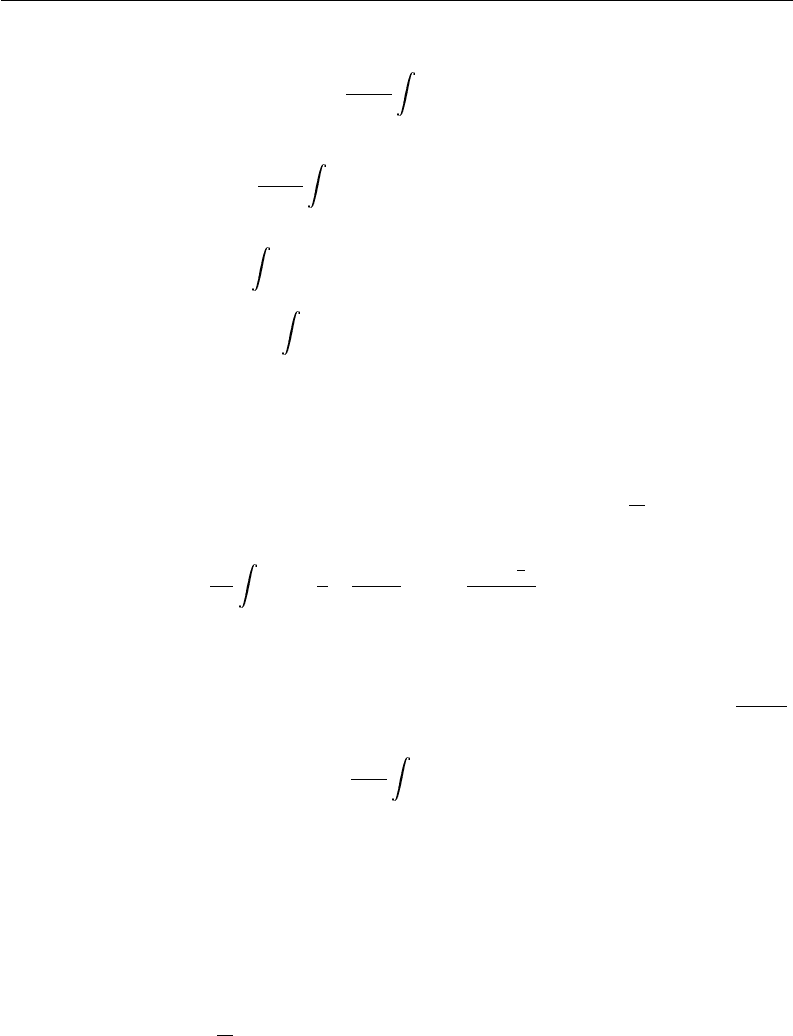
u(x) =
1
4πR
2
S
R
(x)
u(ξ)d
s
,
hence
1
4πR
2
S
R
(x)
(u(x) −u(ξ))d
s = 0
.
On the other hand,
S
1
R
(x)
(u(x) −u(ξ))ds ≥ dC
0
> 0,
S
2
R
(x)
(u(x) −u(ξ))ds ≥ 0.
This contradiction proves the theorem. 2
Remark 4.1.3. Let n = 2, i.e. x = (x
1
,x
2
) ∈R
2
. In this case Theorems 4.1.1-4.1.4 and
4.1.7 remain valid (as for any n ), and Theorems 4.1.5-4.1.6 require small modifications,
namely:
Theorem 4.1.5’. Let u(x) be harmonic in D ⊂ R
2
and u(x) ∈C
1
−
(
D). Then
u(x)
=
1
2π
Σ
Ã
µ
ln
1
r

∂u(ξ)
∂n
ξ
−u(ξ)
∂
ξ
(ln
1
r
)
∂n
ξ
!
d
s
, x ∈D, (4.1.6)
where r = kx −ξk, n
ξ
is the outer normal to Σ at the point ξ.
Theorem 4.1.6’. Let K
R
(x) be the disc of radius R around the point x, and let S
R
(x) =
∂K
R
(x) be the circle. Suppose that u(ξ) is harmonic in K
R
(x) and continuous in
K
R
(x).
Then
u(x)
=
1
2πR
S
R
(x)
u(ξ)d
s
. (4.1.7)
4.2. Dirichlet and Neumann Problems
Let D ⊂ R
3
be a bounded domain with the boundary Σ ∈ PC
1
.
Dirichlet problem
Let a continuous function ϕ(x) be given on Σ. Find a a function u(x) which is harmonic
in D and continuous in
D and
has
on Σ an assigned value ϕ(x) :
∆u = 0 (x ∈ D),
u
|Σ
= ϕ(x).
)
(4.2.1)
Theorem 4.2.1. If a solution of the Dirichlet problem (4.2.1) exists, then it is unique.

Elliptic P
artial Differential Equations 171
Proof
. Let u
1
(x) and u
2
(x) be solutions of problem (4.2.1). Denote u(x) = u
1
(x) −
u
2
(x). Then u(x) ∈C(
D) , ∆u = 0 in D, and u
|Σ
= 0. By
the
maximum principle, u(x) ≡0
in
D. 2
Definition
4.2.1. The
solution of the Dirichlet problem is called stable if for each ε > 0
there exists δ > 0 such that if |ϕ(x) −
˜
ϕ(x)| ≤ δ for all x ∈ Σ, then |u(x) − ˜u(x)| ≤ ε for
all x ∈
D. Here u and ˜u are
solutions
of the Dirichlet problems with the data ϕ and
˜
ϕ,
respectively.
It follows from the maximum principle that the solution of the Dirichlet problem (4.2.1)
is stable (one can take δ = ε ). The question of the existence of the solution of the Dirichlet
problem is much more difficult. This question will be studied later by various methods in
Sections 4.3-4.6.
Neumann problem
Let a continuous function ψ(x) be given on Σ. Find a function u(x) which is harmonic in
D and u(x) ∈C
1
−
(
D) ,
∂u
∂n
|Σ
= ψ :
∆u = 0 (x ∈ D),
∂u
∂n
¯
¯
¯
Σ
= ψ(x).
(4.2.2)
Theor
em
4.2.2. If a solution of problem (4.2.2) exists, then it is unique up to an
additive constant.
Proof. Obviously, if the function u(x) is a solution of problem (4.2.2), then the
function u(x) +C is also a solution of (4.2.2). Furthermore, if u
1
(x) and u
2
(x) are solu-
tions of (4.2.2), then the function u(x) = u
1
(x) −u
2
(x) has the properties: ∆u = 0 in D ,
u(x) ∈C
1
−
(
D) and
∂u
∂n
|Σ
= 0. Applying
the
Dirichlet identity (see Theorem 4.1.4) we obtain
D
Ã
3
∑
k=1
µ
∂u
∂x
k

2
!
d
x = 0
,
and consequently,
∂u
∂x
k
≡ 0, k = 1, 2,3,
i.e. u(x) ≡ cons
t. .
Theorem 4.2.2 is proved. 2
Theorem 4.2.3 (Necessary condition for the solvability of the Neumann problem).
If problem (4.2.2) has a solution, then
Σ
ψ(ξ)ds = 0.