
Freiling G., Yurko V. Lectures on Differential Equations of Mathematical Physics: A First Course
Подождите немного. Документ загружается.


192 G.
Freiling and V. Yurko
As ε →0 we deduce
that there exists lim
x→x
0
u(x), and
lim
x→x
0
u(x) = ϕ(x
0
).
Theorem 4.4.13 is proved. 2
Theorem 4.4.14. Let x
0
∈ Σ, and let there exist a closed ball
K
R
(x
1
) with
its
center
outside
D suc
h
that
K
R
(x
1
) ∩D = {x
0
} ( in
this
case we shall say that the point x
0
can
be ”reached” by a ball ) . Then for the point x
0
there exist a barrier.
Proof. We consider the function
ω(x) =
1
R
−
1
r
,
where r = kx −x
1
k. Clearly
, ω
(x) ∈ C(
D) and ω(x) is
harmonic
in D, hence ω(x)
is superharmonic. Furthermore, ω(x
0
) = 0 and ω(x) > 0 for x ∈
D, x 6= x
0
. Thus,
the
function ω
(x) is a barrier for the point x
0
. 2
Conclusion. Assume that each point of Σ can be ”reached” by a ball. Then for each
ϕ(x) ∈C(Σ) the solution of the Dirichlet problem (4.4.1) exists, is unique and it is given
by (4.4.5).
Thus, we have established the solvability of the Dirichlet problem (4.4.1) for a wide
class of domains (for example, for all convex domains). We note that one can obtain weaker
sufficient conditions of regularity of a point. For example, if the point x
0
∈ Σ can be
”reached” by a non-degenerate cyclic cone, then the point x
0
is regular [4, Chapter 3].
4.5. The Dirichlet Problem for the Poisson Equation
Let D ⊂ R
3
be a bounded domain with the boundary Σ ∈ PC
1
. We consider the following
problem
∆u = f (x) (x ∈ D), (4.5.1)
u
|Σ
= ϕ(x). (4.5.2)
Suppose that we know a particular solution v(x) of equation (4.5.1). Then the solution of
problem (4.5.1)-(4.5.2) has the form u(x) = v(x) + w(x), where w(x) is the solution of the
Dirichlet problem
∆w = 0 (x ∈ D),
w
|Σ
= ϕ
1
,
)
(4.5.3)
where
ϕ
1
:= ϕ −v
|Σ
.
The Dirichlet problem (4.5.3) for the Laplace equation was studied in Sections 4.3-4.4.
Thus, in order to solve the Dirichlet problem (4.5.1)-(4.5.2) for the Poisson equation it is
sufficient to find a particular solution of equation (4.5.1). We consider the function
u(x) = −
1
4π
D
f (ξ)
r
dξ, r = kx −ξk. (4.5.4)

Elliptic P
artial Differential Equations 193
Let us
show that ∆u = f , i.e (4.5.4) gives us the desired particular solution of (4.5.1).
The integral in (4.5.4) is called the volume potential, since it describes the potential of
gravitational field created by the body D with the density f (ξ). Denote as usual by K
δ
(x)
the ball of radius δ around the point x , S
δ
(x) = ∂K
δ
(x) is the sphere. We have
K
δ
(x)
dξ
r
=
δ
0
d
r
r
S
r
(x)
d
s =
δ
0
4
πr dr = 2πδ
2
,
K
δ
(x)
dξ
r
2
=
δ
0
d
r
r
2
S
r
(x)
d
s = 4
πδ.
(4.5.5)
Theorem 4.5.1. Let f (x) ∈C
1
(
D). Then
the
function u(x), defined by (4.5.4) , is a
particular solution of the Poisson equation (4.5.1) .
Proof. 1) Since |f (ξ)|≤ M in
D, it
follo
ws from (4.5.4)-(4.5.5) that for any x ∈
D,
|u(x)|
≤
M
4π
K
δ
(x)
dξ
r
+
M
4πδ
D\K
δ
(x)
dξ ≤
Mδ
2
2
+
M
V
4πδ
,
where V is
the
volume of D. Therefore, the integral in (4.5.4) converges absolutely and
uniformly in
D, and
the
function u(x) exists and is bounded in
D.
Let
us
show that u(x) ∈C(
D). Let y ∈K
δ/2
(x). By
virtue
of (4.5.4),
|u(y) −u(x)| ≤
M
4π
K
δ/2
(x)
¯
¯
¯
¯
1
r
1
−
1
r
¯
¯
¯
¯
dξ +
M
4π
D\K
δ/2
(x)
¯
¯
¯
¯
1
r
1
−
1
r
¯
¯
¯
¯
dξ
=: I
δ
+ J
δ
,
where r = kx −ξk, r
1
= ky −ξk. Using
(4.5.5)
we calculate
I
δ
≤
M
4π
K
δ/2
(x)
dξ
r
1
+
M
4π
K
δ/2
(x)
dξ
r
≤
M
4π
K
δ
(y)
dξ
r
1
+
M
4π
K
δ/2
(x)
dξ
r
≤
3Mδ
2
4
.
T
ak
e ε > 0. Let δ =
p
2ε/(3M). Then I
δ
≤ ε/2. In
the
domain D \K
δ
(x) the function
1/r is continuous, and consequently, there exists δ
1
(δ
1
< δ/2) such that
¯
¯
¯
¯
1
r
1
−
1
r
¯
¯
¯
¯
≤
2πε
M
V
for
all y ∈K
δ
1
(x); hence J
δ
≤ ε/2. Thus,
∀ε > 0 ∃δ
1
> 0 y ∈ K
δ
1
(x) → |u(y) −u(x)| ≤ ε.
By virtue of the arbitrariness of x ∈
D we
conclude
that u(x) ∈C(
D).
2)
Denote
v
k
(x) :
=
∂u
∂x
k
, k =
1,3.

194 G.
Freiling and V. Yurko
Diff
erentiating (4.5.4) formally, we obtain
v
k
(x) = −
1
4π
D
f (ξ)
∂
∂x
k
µ
1
r

dξ, x ∈
D, r = kx −ξk. (4.5.6)
Since
∂
∂x
k
µ
1
r

=
ξ
k
−x
k
r
3
,
|ξ
k
−x
k
|
r
≤ 1, |f (ξ)|
≤ M,
it
follows from (4.5.6) and (4.5.5) that
|v
k
(x)| ≤
M
4π
K
δ
(x)
dξ
r
2
+
M
4πδ
2
D\K
δ
(x)
dξ ≤ Mδ +
M
V
4πδ
2
.
Therefore,
the
integral in (4.5.6) converges absolutely and uniformly in
D, and
the
func-
tions v
k
(x) =
∂u
∂x
k
e
xist
and are finite in
D.
Let
us
show that v
k
(x) ∈C(
D) , k = 1,3. Let y ∈K
δ/2
(x). By
virtue
of (4.5.6),
|v
k
(y) −v
k
(x)| ≤
M
4π
K
δ/2
(x)
¯
¯
¯
¯
ξ
k
−y
k
r
3
1
−
ξ
k
−x
k
r
3
¯
¯
¯
¯
dξ
+
M
4π
D\K
δ/2
(x)
¯
¯
¯
¯
ξ
k
−y
k
r
3
1
−
ξ
k
−x
k
r
3
¯
¯
¯
¯
dξ
= I
1
δ
+ J
1
δ
,
where r = kx −ξk, r
1
= ky −ξk. Using
(4.5.5)
we calculate
I
1
δ
≤
M
4π
K
δ/2
(x)
dξ
r
2
1
+
M
4π
K
δ/2
(x)
dξ
r
2
≤
M
4π
K
δ
(y)
dξ
r
2
1
+
M
4π
K
δ/2
(x)
dξ
r
2
≤
3Mδ
2
.
T
ak
e ε > 0. Let δ = ε/(3M). Then I
1
δ
≤ ε/2. In the domain D \K
δ/2
(x) the function
∂
∂x
k
(
1
r
) is
continuous, and consequently, there exists δ
1
(δ
1
< δ/2) such that J
1
δ
≤ ε/2 for
y ∈ K
δ
1
(x). Thus,
∀ε > 0 ∃δ
1
> 0 y ∈ K
δ
1
(x) → |v
k
(y) −v
k
(x)| ≤ ε.
Since x ∈
D is
arbitrary
, we conclude that v
k
(x) ∈C(
D), i.e. u(x) ∈C
1
(D).
3)
Denote
w
k
(x) :=
∂
2
u
∂x
2
k
, k =
1,3.
Dif
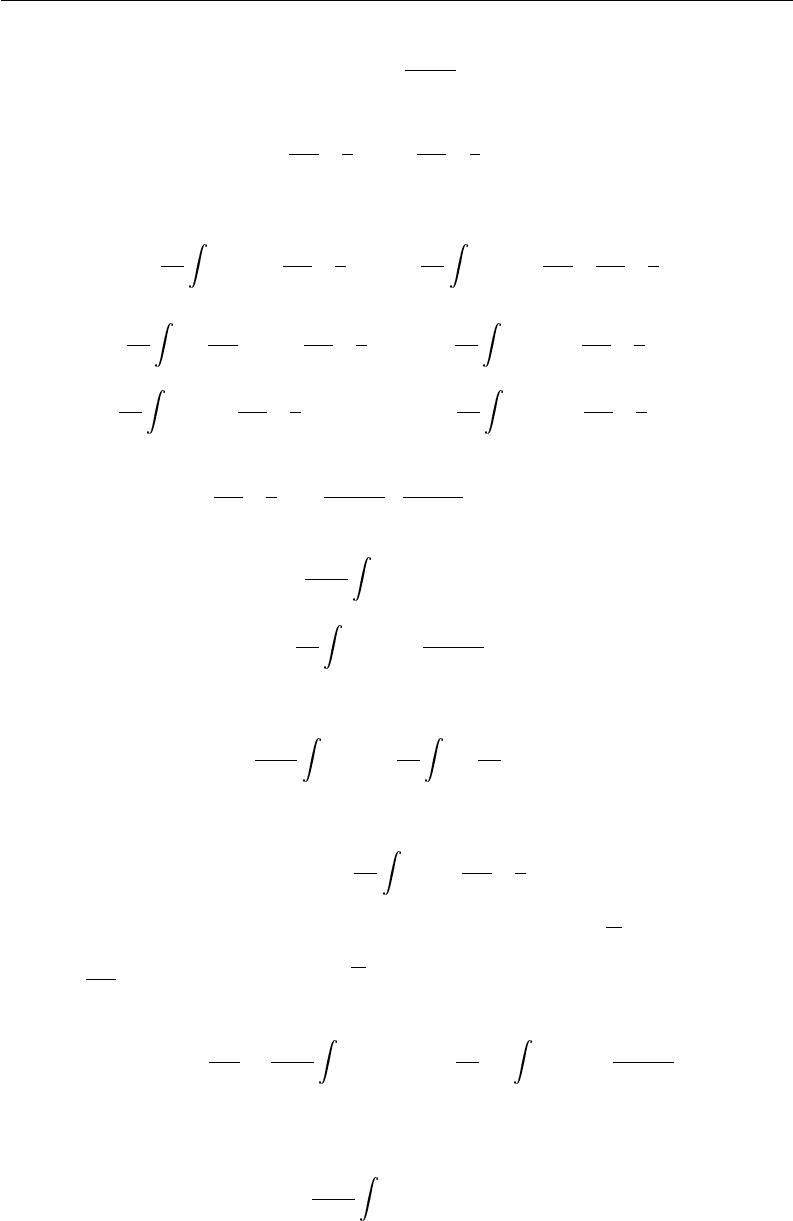
f
erentiating (4.5.4) formally, we obtain
w
k
(x) = −
1
4π
D
f (ξ)
∂
2
∂x
2
k
µ
1
r

dξ, x ∈
D. (4.5.7)
Elliptic P
artial Differential Equations 195
Denote
f
k
(ξ) =
∂ f (
ξ)
∂ξ
k
.
Since
∂
∂ξ
k
µ
1
r

= −
∂
∂x
k
µ
1
r

,
then
using
the Gauß-Ostrogradskii formula we calculate
Q
δ,k
:= −
1
4π
K
δ
(x)
f (ξ)
∂
2
∂x
2
k
µ
1
r

dξ =
1
4π
K
δ
(x)
f (ξ)
∂
∂ξ
k
µ
∂
∂x
k
µ
1
r
¶¶
dξ
=
1
4π
K
δ
(x)
∂
∂ξ
k
µ
f (ξ)
∂
∂x
k
µ
1
r
¶¶
dξ −
1
4π
K
δ
(x)
f
k
(ξ)
∂
∂x
k
µ
1
r

dξ
=
1
4π
S
δ
(x)
f (ξ)
∂
∂x
k
µ
1
r

cos(n,ξ
k
)d
s −
1
4π
K
δ
(x)
f
k
(ξ)
∂
∂x
k
µ
1
r

dξ.
Since
∂
∂x
k
µ
1
r

=
ξ
k
−x
k
r
3
,
ξ
k
−x
k
r
= cos(n, ξ
k
),
we
ha
ve
Q
δ,k
:=
1
4πδ
2
S
δ
(x)
f (ξ) cos
2
(n,ξ
k
)d
s
−
1
4π
K
δ
(x)
f
k
(ξ)
ξ
k
−x
k
r
3
dξ. (4.5.8)
There
e
xists a constant M > 0 such that |f (ξ)|≤ M, |f
k
(ξ)|≤M. Then, in view of (4.5.5),
we have
|Q
δ,k
| ≤
M
4πδ
2
S
δ
(x)
d
s +
M
4π
K
δ
(x)
dξ
r
2
≤ (1 + δ)M,
and
consequently
,
|w
k
(x)| ≤ (1 + δ)M +
M
4π
D\K
δ
(x)
¯
¯
¯
¯
∂
2
∂x
2
k
µ
1
r

¯
¯
¯
¯
dξ ≤C
δ
.
Thus,
the
integral in (4.5.7) converges absolutely and uniformly in
D, and
the
functions
w
k
(x) :=
∂
2
u
∂x
2
k
e
xist
and are bounded in
D. Using
(4.5.7)
and (4.5.8) we calculate
∆u(x) :=
3
∑
k=1
∂
2
u
∂x
2
k
=
1
4πδ
2
S
δ
(x)
f (ξ) d
s −
1
4π
3
∑
k=1
K
δ
(x)
f
k
(ξ)
ξ
k
−x
k
r
3
dξ
= f (x)
+ Ω
δ,1
+ Ω
δ
,2
,
where
Ω
δ,1
:=
1
4πδ
2
S
δ
(x)
( f (ξ) − f (x))d
s
,

196 G.
Freiling and V. Yurko
Ω
δ,2
:= −
1
4π
3
∑
k=1
K
δ
(x)
f
k
(ξ)
ξ
k
−x
k
r
3
dξ.
By
virtue
of (4.5.5),
|Ω
δ,2
| ≤
3M
4π
K
δ
(x)
dξ
r
2
≤ 3Mδ.
T
ak
e ε > 0. Since f (ξ) ∈C(
D), there
e
xists δ > 0 such that |f (ξ) − f (x)| ≤ ε for ξ ∈
S
δ
(x). Then |Ω
δ,1
| ≤ ε. Thus, |∆u(x) − f (x)| ≤ 3Mδ + ε, and consequently, ∆u = f .
Theorem 4.5.1 is proved. 2
4.6. The Method of Integral Equations
1. Let for definiteness n = 3, and let D ⊂ R
3
be a bounded domain with the boundary
Σ ∈ PC
1
, D
1
= R
3
\
D. W
e
consider the functions
Q(x) =
Σ
q(ξ)
r
d
s, F(x)
=
Σ
f (ξ)
∂
ξ
(
1
r
)
∂n
ξ
d
s
, (4.6.1)
where q(ξ), f (ξ) ∈C(Σ), r = kξ−xk and n
ξ
is the outer normal to Σ at the point ξ. The
function Q(x) is called the single-layer potential with the density q(ξ). The function F(x)
is called the double-layer potential with the density f (ξ).
Physical sense: Q(x) is the potential of the field created by charges distributed on Σ
with the density q(ξ), and F(x) is the potential of the field created by the dipole distribu-
tion on Σ with the density f (ξ).
Idea of the method: The basic integral formula for harmonic functions (see Section 4.1)
contains terms of the form (4.6.1). We will seek solutions of the Dirichlet and Neumann
problems in the form (4.6.1). As a result we will obtain some integral equations for finding
q and f . Beforehand we will study properties of the functions defined by (4.6.1).
2. Auxiliary assertions
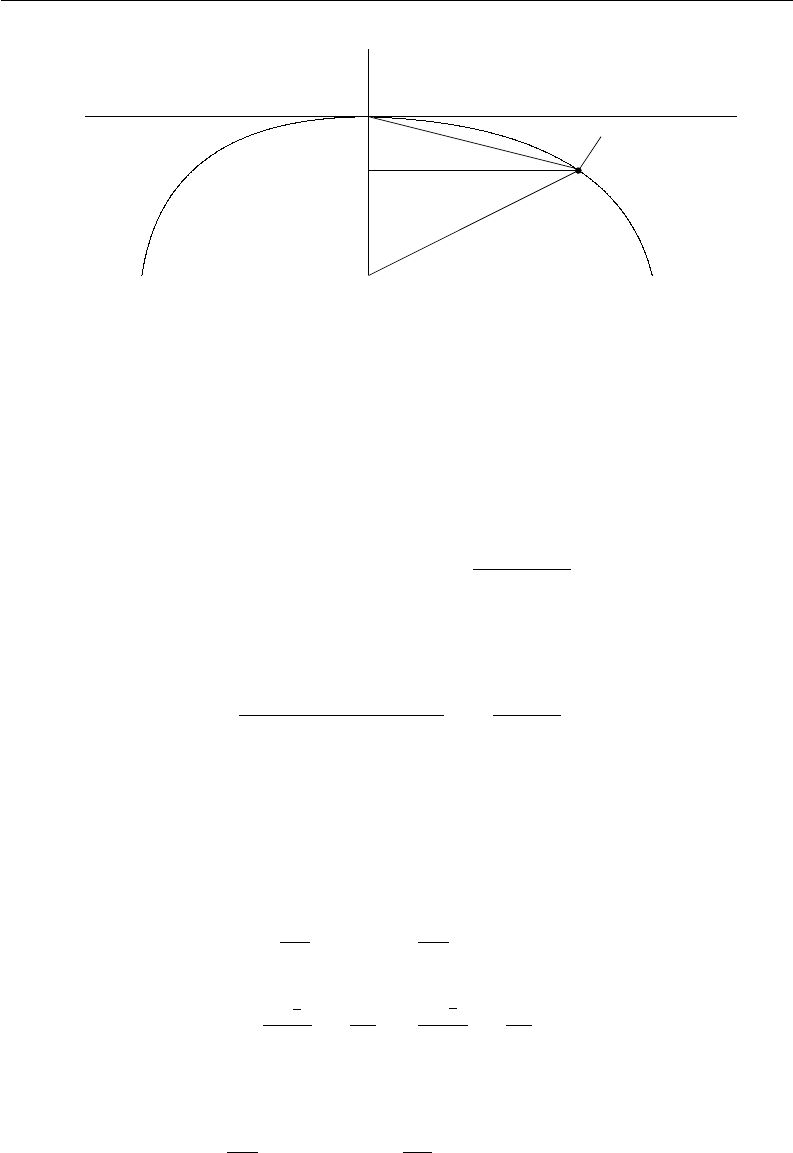
Everywhere in Section 4.6 we will assume that Σ ∈ C
2
, i.e. Σ has a continuous and
bounded curvature. This means that for each fixed x ∈ Σ one can choose a local coordinate
system (α
1
,α
2
,α
3
) such that the origin coincides with the point x, the plane (α
1
,α
2
) co-
incides with the tangent plane to Σ at the point x, and the axis α
3
coincides with the outer
normal ¯n
x
to Σ at the point x (see fig. 4.6.1). Moreover, there exists δ
0
> 0 (independent
of x ) such that the part of the surface Σ
δ
0
(x) := Σ ∩K
δ
0
(x) is represented by a single-
valued function α
3
= Φ(α
1
,α
2
) , Φ ∈C
2
and
¯
¯
¯
∂
2
Φ
∂α
k
∂α
j
¯
¯
¯
≤ Φ
0
for ρ :=
q
α
2
1
+ α
2
2
≤ δ
0
,
where Φ
0
does
not
depend on x (it is the maximal curvature). In the sequel, we assume
that δ
0
< 1/(8Φ
0
). Since Φ(0,0) = Φ
α
1
(0,0) = Φ
α
2
(0,0) = 0, we have by virtue of the
Taylor formula:
|Φ(α
1
,α
2
)| ≤ Φ
0
ρ
2
, |Φ
α
k
(α
1
,α
2
)| ≤ 2Φ
0
ρ for ρ :=
q
α
2
1
+ α
2
2
≤ δ
0
. (4.6.2)
Elliptic P
artial Differential Equations 197
6
-
6
α
3
n
x
x
(α
1
,α
2
)
r
1
ρ
yΣ
α
3
= Φ(α
1
,α
2
)
r
ξ
n
ξ
Á
Figure
4.6.1.
Lemma
4.6.1. Let x ∈ Σ, ξ ∈Σ
δ
0
, r = kx −ξk. Then
|sin(n
x
,n
ξ
)| ≤ 4Φ
0
r, |cos(n
x
,n
ξ
)| ≥ 1/2. (4.6.3)
Proof. Let ¯r = (α
1
,α
2
,Φ(α
1
,α
2
)) be the local coordinates of the point ξ. Then, using
(4.6.2), we calculate
|sin(n
x
,n
ξ
)| ≤ |tg(n
x
,n
ξ
)| =
¯
¯
¯
¯
∂Φ(α
1
,α
2
)
∂¯r
¯
¯
¯
¯
|Φ
α
1
(α
1
,α
2
)cos(α
1
, ¯r)
+ Φ
α
2
(α
1
,α
2
)cos
(α
2
, ¯r)|
≤ |Φ
α
1
(α
1
,α
2
)|+ |Φ
α
2
(α
1
,α
2
)| ≤ 4Φ
0
ρ.
Since
r =
q
α
2
1
+ α
2
2
+
(Φ
(α
1
,α
2
))
2
≥
q
α
2
1
+ α
2
2
:= ρ,
we
obtain
|sin
(n
x
,n
ξ
)| ≤ 4Φ
0
r.
From 4Φ
0
r ≤ 4Φ
0
δ
0
≤ 1/2, we infer |cos(n
x
,n
ξ
)| ≥ 1/2. 2
Lemma 4.6.2. Let x ∈ Σ, ξ ∈Σ
δ
0
, r = kx −ξk. Then
¯
¯
¯
¯
∂
x
r
∂n
x
¯
¯
¯
¯
≤ Φ
0
r,
¯
¯
¯
¯
∂
ξ
r
∂n
ξ
¯
¯
¯
¯
≤ Φ
0
r, (4.6.4)
¯
¯
¯
¯
¯
∂
x
(
1
r
)
∂n
x
¯
¯
¯
¯
¯
≤
Φ
0
r
,
¯
¯
¯
¯
¯
∂
ξ
(
1
r
)
∂n
ξ
¯
¯
¯
¯
¯
≤
Φ
0
r
. (4.6.5)
Pr
oof
. By Lemma 4.3.1,
∂
ξ
r
∂n
ξ
= cos(n
ξ
, ¯r),
∂
x
r
∂n
x
= −cos(n
x
, ¯r),
where
¯r =
(ξ
1
−x
1
,ξ
2
−x
2
,ξ
3
−x
3
)

198 G.
Freiling and V. Yurko
. Let (α
1
,α
2
,Φ
(α
1
,α
2
)) be the local coordinates of the point ξ. Then
|cos(n
x
, ¯r)| =
|Φ(α
1
,α
2
)|
r
(see
fig.
4.6.1). Using (4.6.2) and the inequality ρ ≤r, we obtain
¯
¯
¯
¯
∂
x
r
∂n
x
¯
¯
¯
¯
= |cos(n
x
, ¯r)| =
|Φ(α
1
,α
2
)|
r
≤
Φ
0
ρ
2
r
≤ Φ
0
r.
By
symmetry
, the second formula in (4.6.4) follows from the first one. Formulae (4.6.5) are
evident corollaries of (4.6.4). 2
Lemma 4.6.3. Let x ∈ Σ, δ ≤ δ
0
. Then
Σ
δ
(x)
ds
r
≤ 4πδ, r := kx −ξk, Σ
δ
(x) := Σ ∩K
δ
(x), ξ ∈Σ
δ
(x). (4.6.6)
Mor
eo
ver, if y ∈K
δ/2
(x), ξ ∈Σ
δ/2
(x), r
1
:= ky −ξk, then
Σ
δ/2
(x)
ds
r
1
≤ 4πδ.
Pr
oof
. Let (α
1
,α
2
,Φ(α
1
,α
2
)) be the local coordinates of the point ξ and ρ :=
q
α
2
1
+ α
2
2
. Denote
by σ
δ
= {
(α
1
,α
2
) : ρ ≤ δ} the disc of radius δ. Using (4.6.3) and the
inequality ρ ≤ r, we obtain
Σ
δ
(x)
ds
r
≤
Σ
δ
(x)
d
s
ρ
=
σ
δ
dα
1
dα
2
ρcos(n
x
,n
ξ
)
≤ 2
σ
δ
dα
1
dα
2
ρ
= 2
δ
0
dρ
ρ
2πρ = 4πδ.
Furthermore,
let (β
1
,β
2
,β
3
) be
the local coordinates of the point y. Then
r
1
=
q
(α
1
−β
1
)
2
+
(α
2
−β
2
)
2
+
(Φ(α
1
,α
2
) −β
3
)
2
≥
q
(α
1
−β
1
)
2
+
(α
2
−β
2
)
2
:
=
˜
ρ,
and consequently,
Σ
δ/2
(x)
ds
r
1
≤
Σ
δ/2
(x)
d
s
˜
ρ
≤ 2
σ
δ/2
dα
1
dα
2
˜
ρ
≤ 2
σ
δ
(β)
dα
1
dα
2
˜
ρ
≤ 2
σ
δ
dα
1
dα
2
ρ
= 4πδ,
where σ
δ
(β)
= {
(α
1
,α
2
) :
˜
ρ ≤ δ)} is the disc of radius δ around the point (β
1
,β
2
).
Lemma 4.6.3 is proved. 2

Elliptic P
artial Differential Equations 199
Lemma 4.6.4. Let
x ∈ Σ, δ ≤ δ
0
, ξ ∈Σ
δ
(x). Then
Σ
δ
(x)
¯
¯
¯
¯
¯
∂
ξ
(
1
r
)
∂n
ξ
¯
¯
¯
¯
¯
d
s ≤ 4
πΦ
0
δ,
Σ
δ
(x)
¯
¯
¯
¯
¯
∂
x
(
1
r
)
∂n
x
¯
¯
¯
¯
¯
d
s ≤ 4
πΦ
0
δ, r := kx −ξk. (4.6.7)
Formulae (4.6.7) are obvious consequences of the formulae (4.6.5) and (4.6.6).
Lemma 4.6.5. Let x ∈ Σ, δ ≤δ
0
, y ∈K
δ
(x), y = x + αn
x
, α ∈R, r
1
= ky −ξk. Then
Σ
δ
(x)
¯
¯
¯
¯
¯
∂
ξ
(
1
r
1
)
∂n
ξ
+
∂
y
(
1
r
1
)
∂n
x
¯
¯
¯
¯
¯
d
s ≤ 64
πΦ
0
δ. (4.6.8)
Proof. Let ξ ∈ Σ
δ
(x). Then, by Lemma 4.3.1,
∂
ξ
(r
1
)
∂n
ξ
+
∂y(r
1
)
∂n
x
= cos(n
ξ
, ¯r
1
) −cos(n
x
, ¯r
1
),
where
¯r
1
=
(ξ
1
−y
1
,ξ
2
−y
2
,ξ
3
−y
3
).
T
ogether with Lemma 4.6.1 this yields
¯
¯
¯
¯
∂
ξ
(r
1
)
∂n
ξ
+
∂y(r
1
)
∂n
x
¯
¯
¯
¯
≤ 2|sin(n
x
,n
ξ
)|
≤ 8
Φ
0
r, where r = kx −ξk. (4.6.9)
Let (α
1
,α
2
,Φ(α
1
,α
2
)) be the local coordinates of the point ξ. Since y = x + αn
x
, we
have ρ ≤r
1
(see fig. 4.6.1). Using (4.6.2) we calculate
r =
q
α
2
1
+ α
2
2
+
(Φ
(α
1
,α
2
))
2
≤
q
ρ
2
+ Φ
2
0
ρ
4
≤ ρ
q
1 + Φ
2
0
δ
2
0
≤ 2ρ ≤ 2r
1
.
T
ogether
with (4.6.9) this yields
¯
¯
¯
¯
∂
ξ
(r
1
)
∂n
ξ
+
∂y(r
1
)
∂n
x
¯
¯
¯
¯
≤ 16Φ
0
r
1
.
Therefore
Σ
δ
(x)
¯
¯
¯
¯
¯
∂
ξ
(
1
r
1
)
∂n
ξ
+
∂
y
(
1
r
1
)
∂n
x
¯
¯
¯
¯
¯
d
s ≤ 16
Φ
0
Σ
δ
(x)
ds
r
1
≤ 16Φ
0
Σ
δ
(x)
d
s
ρ
= 16Φ
0
σ
δ
dα
1
dα
2
ρcos(n
x
,n
ξ
)
≤ 32Φ
0
σ
δ
dα
1
dα
2
ρ
= 64πΦ
0
δ,
i.e.
(4.6.8)
is valid. Lemma 4.6.5 is proved. 2
Lemma 4.6.6. Let x ∈ Σ, δ ≤δ
0
, y ∈K
δ
(x), y /∈ Σ. Then
Σ
δ
(x)
¯
¯
¯
¯
¯
∂
ξ
(
1
r
1
)
∂n
ξ
¯
¯
¯
¯
¯
d
s ≤C
∗
, r
1
:
= ky −ξk, ξ ∈Σ
δ
(x), (4.6.10)
200 G.
Freiling and V. Yurko
where
C
∗
depends on Σ and does not depend on x,y,δ.
Proof. Let Ω be a simply connected part of Σ
δ
, on which the function
∂
ξ
(
1
r
1
)
∂n
ξ
preserv
es
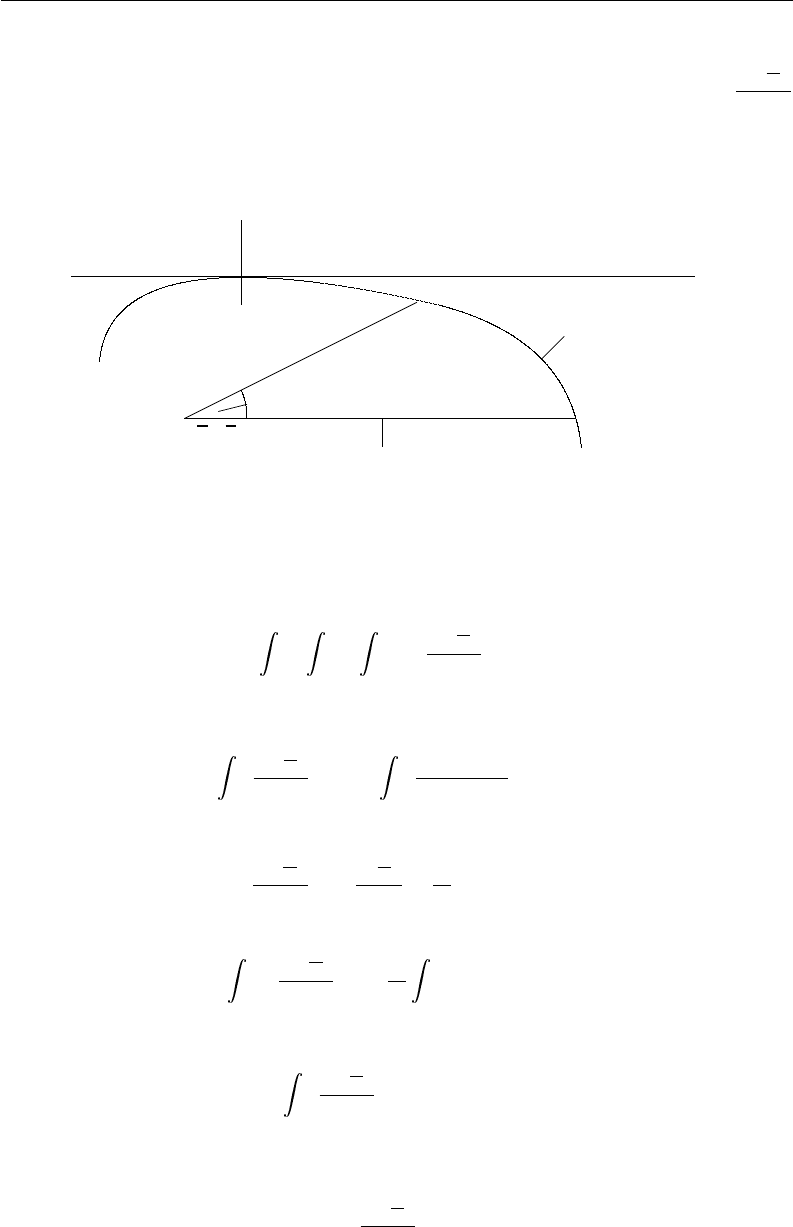
the sign. Let B be the cone with vertex at the point y and with the basis Ω. Fix
ε > 0 and consider the domain B
ε
= {ξ ∈ B : r
1
≥ ε} (see fig. 4.6.2).
6
-
x
y
|
{z }
ε
B
ε
n
ξ
Ω
n
ξ
?
9
µ
Figure
4.6.2.
Clearly
, ∂B
ε
= Ω∪Ω
0
∪S
0
ε
(y), where Ω
0
is the lateral surface of B
ε
, S
0
ε
(y) = S
ε
(y)∩B
is the part of the sphere r
1
= ε, lying in B. In B
ε
the function 1/r
1
is harmonic with
respect to ξ. Hence, by Theorem 4.1.2,
µ
Ω
+
Ω
0
+
S
0
ε
(y)

∂
ξ
(
1
r
1
)
∂n
ξ
d
s = 0
.
Since n
ξ
⊥ ¯r
1
on Ω
0
, we have
Ω
0
∂
ξ
(
1
r
1
)
∂n
ξ
d
s = −
Ω
0
cos
(n
ξ
, ¯r
1
)
r
2
1
d
s = 0
.
On S
0
ε
(y) we have
∂
ξ
(
1
r
1
)
∂n
ξ
= −
∂(
1
r
1
)
∂r
1
=
1
r
2
1
, r
1
= ε,
and
consequently
,
S
0
ε
(y)
∂
ξ
(
1
r
1
)
∂n
ξ
d
s =
1
ε
2
S
0
ε
(y)
d
s = ω
y
(Ω)
is
the solid angle under which one can see Ω from the point y. Thus,
Ω
¯
¯
¯
¯
¯
∂
ξ
(
1
r
1
)
∂n
ξ
¯
¯
¯
¯
¯
d
s = |
ω
y
(Ω)|.
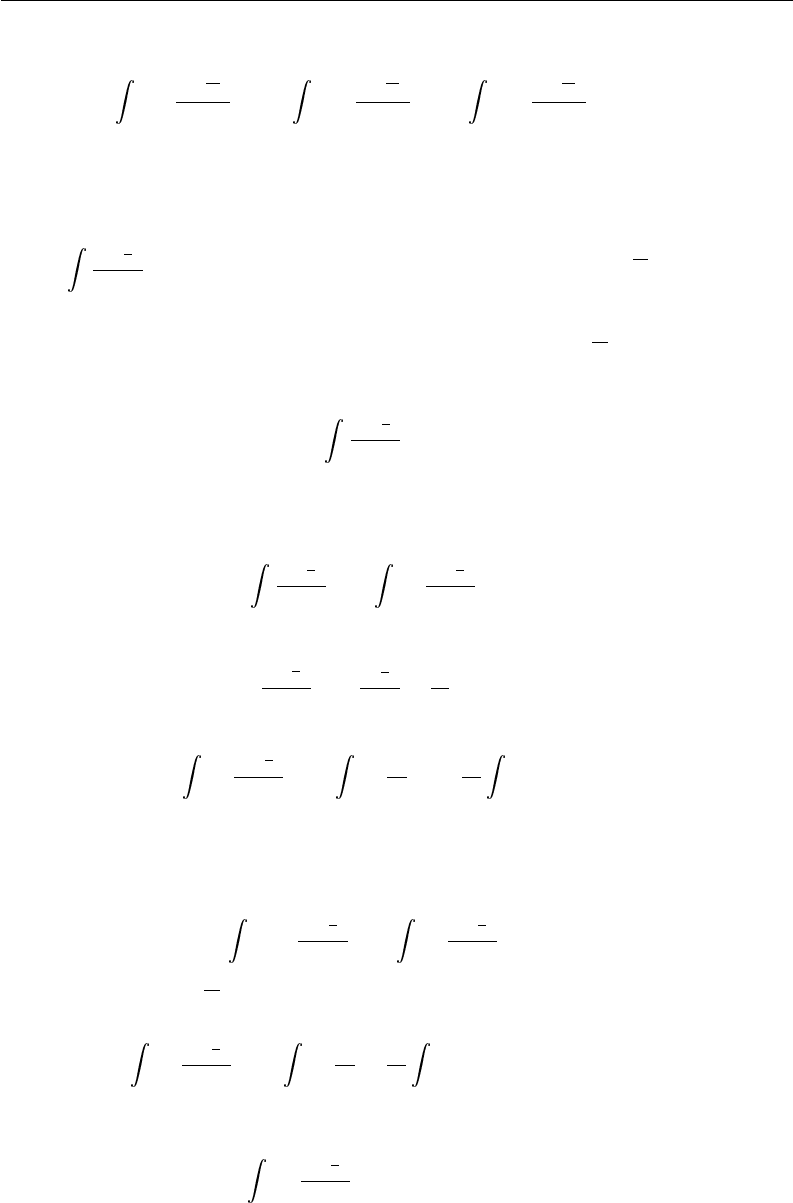
Let now Σ
δ
(x) = Σ
+
δ
(x) ∪Σ
−
δ
(x), and
±
∂
ξ
(
1
r
1
)
∂n
ξ
≥ 0
Elliptic P
artial Differential Equations 201
on Σ
±
δ
(x). Then it
can be shown that
Σ
δ
(x)
¯
¯
¯
¯
¯
∂
ξ
(
1
r
1
)
∂n
ξ
¯
¯
¯
¯
¯
d
s ≤
Σ
+
δ
(x)
¯
¯
¯
¯
¯
∂
ξ
(
1
r
1
)
∂n
ξ
¯
¯
¯
¯
¯
d
s +
Σ
−
δ
(x)
¯
¯
¯
¯
¯
∂
ξ
(
1
r
1
)
∂n
ξ
¯
¯
¯
¯
¯
d
s ≤C
∗
.
Lemma
4.6.6 is proved. 2
Lemma 4.6.7. The following relations are valid
Σ
∂
ξ
(
1
r
)
∂n
ξ
d
s =
−4
π, x ∈ D,
−2π, x ∈ Σ,
0, x ∈D
1
,
r := kx −ξk, D
1
:= R
3
\
D. (4.6.11)
Pr
oof
. 1) Let x ∈ D
1
. Then the function 1/r is harmonic in
D (with
respect
to ξ ),
and consequently, by Theorem 4.1.2,
Σ
∂
ξ
(
1
r
)
∂n
ξ
d
s = 0
.
2) Let x ∈ D. In the domain D \K
δ
(x) the function 1/r is harmonic (with respect to
ξ ), and consequently, by Theorem 4.1.2,
Σ
∂
ξ
(
1
r
)
∂n
ξ
d
s +
S
δ
(x)
∂
ξ
(
1
r
)
∂n
ξ
d
s = 0
.
On S
δ
(x) :
∂
ξ
(
1
r
)
∂n
ξ
= −
∂(
1
r
)
∂r
=
1
r
2
, r = δ,
hence
S
δ
(x)
∂
ξ
(
1
r
)
∂n
ξ
d
s =
S
δ
(x)
d
s
r
2
d
s =
1
δ
2
S
δ
(x)
d
s = 4
π,
and (4.6.11) is proved.
3) Let x ∈ Σ. In the domain D \K
δ
(x) the function 1/r is harmonic with respect to ξ,
and consequently, by Theorem 4.1.2,
Σ\Σ
δ
(x)
∂
ξ
(
1
r
)
∂n
ξ
d
s +
S
0
δ
(
x)
∂
ξ
(
1
r
)
∂n
ξ
d
s = 0
,
where S
0
δ
(x) = S
δ
(x) ∩
D. Since
S
0
δ
(x)
∂
ξ
(
1
r
)
∂n
ξ
d
s =
S
0
δ
(x)
d
s
r
2
=
1
δ
2
S
0
δ
(x)
d
s → 2
π for δ → 0,
we have, in view of (4.6.7),
Σ
δ
(x)
∂
ξ
(
1
r
)
∂n
ξ
d
s → 0
for δ → 0,
and therefore we arrive at (4.6.11). Lemma 4.6.7 is proved. 2