
Gates A.E., Ritchie D. Encyclopedia of Earthquakes and Volcanoes
Подождите немного. Документ загружается.

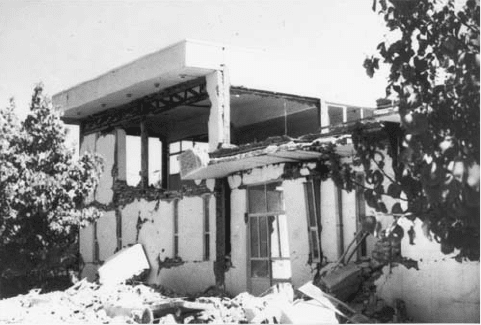
table mountain This curious tabular formation in Iceland
represents a volcano that erupted under cover of glacial ice,
forming a mountain topped with lava flows that exhibit
gentle slopes. Table mountains exhibit some of the same fea-
tures as submarine eruptions, such as pillow lava formed
when molten rock encounters cold water or ice. Herdubreid
in Iceland is a good example of a table mountain.
Tabriz earthquake, Iran The first report of an earthquake
destroying Tabriz is from a.d. 858 but offers little infor-
mation. The first well-documented earthquake in Tabriz
occurred on November 11, 1042. It had an estimated Rich-
ter magnitude of 7.6 and was felt as far away as Africa.
Buildings and city walls were demolished, and there were
reports of surface rupturing and fissures. In all, between
40,000 and 50,000 people were said to have lost their lives,
making this event one of the worst in Iran’s history. There
were apparently strong foreshocks for months prior to the
main shock and strong aftershocks for months afterward,
making this a very seismically unstable period in Tabriz. An
interesting anecdote involves a local astronomer, Abu Taher,
who was apparently monitoring the foreshock activity. He
must have noticed a change and warned the people of Tabriz
about the impending doom the day before. Many people,
including the governor, evacuated the city and were spared.
The next major earthquake disaster to strike Tabriz
occurred on April 26, 1721. Even though it was more recent
than the 1042 event, reports are equally vague. There are
reports of devastating landslides and rockfalls during this
event as well as volcanic emissions of poison gas that killed
livestock. The number of casualties is even more debatable.
At least 8,000 people were killed in this event, but some esti-
mates place the number as high as 250,000. The most careful
work places the death toll at about 80,000.
Just six years later, on November 18, 1727, Tabriz was
again impacted by a major earthquake. The U.S. Geological
Survey lists this earthquake as among the top 15 most deadly
of all time, with a reported death toll of 77,000, though there
is little additional information available. It is possible that the
1721 and 1727 are the same event. Tabriz is again mentioned
in reports of the earthquake of June 7, 1755, as is Kashan.
The reported death toll from this event was 40,000, but there
is some doubt as to the location. Kashan and Tabriz are some
420 miles (700 km) apart, making a single earthquake an
unlikely culprit for destroying both cities. Furthermore, it was
reported by European rather than Iranian sources.
Another major earthquake struck Tabriz on February
28, 1780, one hour after sunset. After the main shock, there
were 40 strong aftershocks in one day. fissures six miles (10
km) long and 6.7 feet (2 m) wide, and some 21 miles (35 km)
long, opened near the mountains, and surface ruptures were
also reported. Whole villages were reported to have been
swallowed. The main damage zone extended 36 miles (60
km) from Tabriz in which virtually everything was leveled.
The death toll is again a subject of controversy. Some sources
place it at 50,000–60,000, while others claim up to 200,000
deaths from this event.
There have been numerous additional earthquakes at
Tabriz over the years that included loss of life, but none has
been as devastating as those described.
Tai-Ching earthquake, Taiwan On September 20, 1999,
a devastating earthquake of magnitude 7.6 occurred. More
than 2,400 people were killed, and 8,700 were injured;
some 82,000 housing units were damaged or destroyed,
and 600,000 people were left homeless; damage was esti-
mated at more than $14 billion. The earthquake was gener-
ated by movement along 47 miles (75 km) of the Chelongpu
Fault. Many strong aftershocks with magnitudes up to 6.5
occurred for weeks after the main shock.
talus When a rockfall or rockslide occurs, a mass of
rock breaks free from the bedrock and slides or falls to the
Earth either as a coherent mass or in pieces. When it strikes
the ground, in most cases it breaks into a pile of rubble. This
pile of rubble at the foot of a hill or cliff is called talus. With
repeated events, this talus will build up into a talus slope, a
cone-shaped deposit with a rough, barren surface. Talus
slopes are common in areas of immature topography or
repeated earthquake activity.
Tambora volcano, near Java, Indonesia The eruption in
1815 of the 13,000-foot (3,960-m) volcano Tambora (also
known as Tomboro) near Java was remarkable in three
respects. It emitted an unusually large volume of ash and
other solid material, the eruption was recorded in detail by
European observers in the vicinity, and Tambora’s ash cloud
was invoked later to account for a history-making change in
global climate. Tambora was believed to be extinct during
the early years of European settlement, but the volcano began
to emit small showers of ash in 1814. A strong earthquake
on the night of April 5, 1815, was followed by a series of
explosions and an eruption of ash and smoke that darkened
the sky for some 300 miles (483 km) distance. Ash fell as far
away as 800 miles (1,287 km) from the volcano. The VEI of
this eruption is 7.
Sir Stamford Raffles, founder of the British Colony of
Singapore, served as military governor of Java when Tam-
Damage to a building in Tabas, Iran, from an earthquake on September 16,
1978. (Courtesy of the USGS)
252 table mountain
bora erupted on this occasion and reported that on Java the
sky was darkened at noonday with ash clouds. An ashfall
covered the land, while explosions like the sound of artillery
or faraway thunder could be heard from the eruption. The
sound of some explosions was heard in Sumatra, more than
900 miles (1,448 km) away. Tambora’s eruption was most
violent on April 11–12 but did not end until July, Raffles
wrote. He reported that glowing lava appeared to cover
the volcano, and stones the size of a person’s head fell in the
vicinity of Tambora. Twelve thousand natives perished in this
eruption, Raffles wrote.
In all, more than 92,000 people died as the result of the
eruption of Tambora. Some 80,000 of these were the result of
starvation and disease caused by the destruction of the area.
Considerable subsidence was reported; for example, the
site of the village of Tomboro was said to be covered by 18
feet (5.5 m) of water following the eruption. This eruption
produced a deep caldera at the summit of the volcano. The
collapse of this caldera may have been at least partly respon-
sible for earthquakes that were felt up to approximately 300
miles (483 km) away. Between 1847 and 1913, a small cone
and lava flow developed in the caldera, possibly in coinci-
dence with a powerful earthquake, centered near the volcano,
that occurred on January 3, 1909.
Tambora after the eruption of 1815 stood almost a
mile shorter than before. Much of the estimated 36 cubic
miles (150 km
3
) of solid material cast out from the volcano
remained airborne in the form of very fine ash that formed
a cloud in the upper atmosphere. This high-altitude cloud
intercepted incoming sunlight. The resulting drop in insola-
tion, or solar radiation reaching Earth’s surface, was impli-
cated in a dramatic change in climate and weather patterns
in the Northern Hemisphere during the following year. The
year 1816 is known as the year without a summer because
there was no warm season over much of the Northern Hemi-
sphere. Although the winter of 1815–16 apparently was not
unusually bitter, the cold season lasted well into the summer
of 1816, with subfreezing temperatures and several inches
of snowfall recorded in New England in June. Nonetheless,
New England’s harvest appears to have been adequate for
that summer, partly because much of the harvest consisted
of crops that can endure, and even thrive in, cool and moist
weather.
Other parts of the Northern Hemisphere, however, expe-
rienced such poor harvests that starvation became a major
cause of death among poor families in Canada, and in some
corners of Europe, the human population was reduced to eat-
ing rats. The economic effects of poor harvests were devastat-
ing. Grain prices reportedly rose fourfold in Switzerland, and
when hungry Europeans and Canadians turned to the rela-
tively well-off United States for help, the foreigners bought
up so much American grain that the price of everything con-
nected with grain rose sharply and increased inflation in the
United States. The year without a summer was accompanied
by political turmoil in France, where an incipient famine,
coming just after the devastation of the Napoleonic Wars,
strained the social fabric to the point of rupture. Many farm-
ers were afraid to take their produce to market for fear of
being robbed and murdered by famished mobs along the way.
Farmers who dared take their crops to market required gov-
ernment troops in some instances to protect them from half-
starved hordes who fought to reach the food.
Tambora’s eruption has not been identified conclu-
sively as the cause of the year without a summer because
the unusual cold spell of 1816 is believed to be within the
range of normal fluctuations in weather and climate, mean-
ing that a summerless year such as that one may happen even
in the absence of a major volcanic eruption the year before.
This potential fluctuation is because volcanoes are not the
only known influence on weather and climate. Many other
factors have been identified or at least implicated in weather
and climatic change, from sunspots to irregularities in Earth’s
motion. Yet, a U.S. Weather Bureau historical study of tem-
perature as a function of solar radiation reportedly indicated
that lesser eruptions than that of Tambora in 1815 have pre-
ceded significant drops in insolation and surface temperature.
For example, total measured heat received from sunlight fell
to about 88% of the normal figure, a reduction of 12% from
that value and more than 16% from the previous year, imme-
diately after the eruption of Krakatoa in 1883. Insolation
diminished 4% following the eruption of Alaska’s Bogoslof
volcano and several other volcanoes in 1889. Insolation fell
about 13%, from 101% to 88% of normal, after the erup-
tions of Mount Pelée and Soufrière in 1902. A similar drop
in incoming solar radiation, from 101% of normal to 84%,
was recorded after the Mount Katmai eruption in Alaska in
1912. There is strong reason to suspect, then, that the erup-
tion of Tambora in 1815 was a factor in bringing about a
memorable year in both world climate and human history,
long after the eruption itself was over.
Tanaga volcano, Aleutian Islands, Alaska, United States
Tanaga volcano is located at the northern tip of Tanaga
Island in a structure that has been interpreted as a caldera.
Activity was reported on the island in 1763–70, possibly in
1791, and again in 1829 and 1914. In the 1914 activity, a
lava flow reportedly formed.
Tancheng earthquake, China A massive earthquake
occurred in the Shandong region of northeastern China on
July 25, 1668. It destroyed a 19.3-square-mile (50-km
2
) area,
including the city of Tancheng, and damaged a 310-square-
mile (800-km
2
) area. The magnitude was estimated at 8.5
on the Richter scale. Significant aftershocks were said to
have lasted 100 days. The earthquake triggered numerous
landslides, waterspouts, mud volcanoes, and fissures.
More than 50,000 people were estimated to have been killed
in this event. There were so many bodies that relief workers
buried them in mass graves, but even then, the pace was slow.
Rain followed by scorching sun in subsequent days caused
the bodies to decay, and the area was soon overwhelmed with
plague.
Tangkubanparahu See Sunda.
Tango earthquake, Japan On March 7, 1927, the town
of Tango, Japan (now North Kyoto), was struck by a major
earthquake. This event registered 7.3 on the Richter scale
Tango 253
and caused great damage. The epicenter was estimated
to have been in the shallow area of the Sea of Japan on the
Yamada and Gomura Faults. The surface rupture on the
Gomura Fault and was 11 miles (17.5 km) long, with a
strike-slip offset of up to nine feet (3 m) and a maximum
dip-slip offset of 27 inches (68.5 cm). A tsunami was pro-
duced during this event with a maximum run-up height of
five feet (1.5 m). Abundant aftershocks continued for about
a month after the main shock, including the largest on April
1, with a magnitude of 6.5. In all, 2,900 people lost their lives
in this event, and some 16,025 houses were destroyed.
Tangshan China The Tangshan earthquake of July 28,
1976, is perhaps the most destructive earthquake in history,
whether destruction is measured in terms of lives lost or prop-
erty damaged. Estimates put fatalities from the earthquake at
about 655,000, with some 800,000 people injured, although
official estimates list 250,000 fatalities. The city of Tangshan,
approximately 85 miles (137 km) southeast of Beijing, was
simply demolished. The physical damage at Tangshan has
been compared to the destruction of Hiroshima. Two major
earthquakes struck Tangshan on this occasion. The first,
reported as magnitude 8.2 on the Richter scale, took place
at 3:45 a.m. and lasted some two minutes. An aftershock
of magnitude 7.9 occurred several hours later. Each shock
was roughly equivalent in magnitude to the earthquake that
destroyed San Francisco in 1906. Reports of the disaster
told of widespread subsidence caused by the collapse of mine
tunnels underground. The subsidence is said to have done
particularly great damage to railway facilities. The Tang-
shan disaster occurred so close to Beijing that officials in the
capital ordered the public to move outdoors in case an earth-
quake struck the city. Some 6 million people are believed
to have slept outdoors in temporary shelters for more than
two weeks. One intriguing aspect of this earthquake was
the reported occurrence of earthquake light. The red and
white light is said to have been seen up to 200 miles (322 km)
from the epicenter of the quake and, as viewed from Beijing,
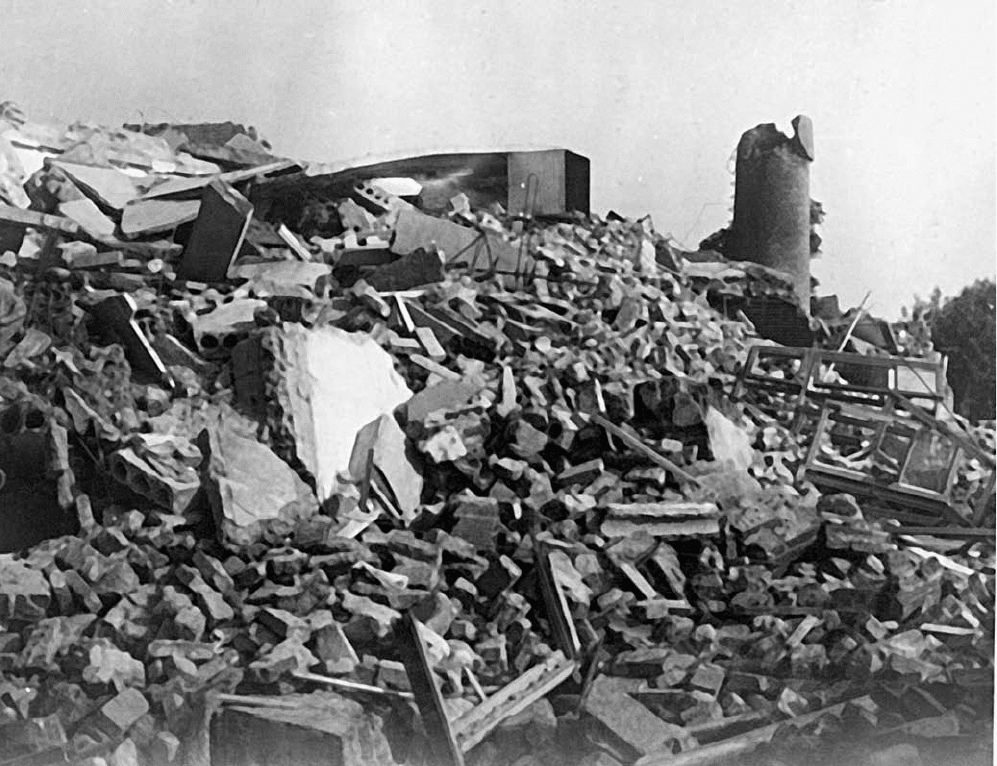
This four-story concrete and brick building of the Tangshan People’s Bank completely collapsed into a pile of rubble during the 1976 Tangshan, China,
earthquake. (Courtesy of the USGS)
254 Tangshan
allegedly lit up the sky as brightly as daylight in the direction
of Tangshan.
Another thing that made the Tangshan earthquake sig-
nificant is that it dispelled claims by the Chinese govern-
ment that they could accurately predict earthquakes. In the
previous year, Chinese scientists accurately predicted a major
earthquake and evacuated the residents before it struck. The
earthquake caused significant property damage but few fatal-
ities. Ever since the Tangshan disaster, no such claims have
been made.
Tao-Rusyr caldera, Kuril Islands, Russia The Tao-Rusyr
caldera is located on Onekotan Island in the Kuril chain
and has an intracaldera cone, Krenitzyn Peak. Surrounding
the cone is a crater lake that does not freeze in winter. The
Tao-Rusyr caldera formed in 5550 b.c. in a very powerful
explosive eruption (VEI = 6). In 1846 and 1879, solfata-
ras were observed in the caldera, although it is not known
whether this activity was merely ordinary or remarkable. An
eruption occurred in 1952 (VEI = 3) at Krenitzyn Peak fol-
lowing and possibly the result of a powerful tectonic earth-
quake that took place several days earlier. Three days before
the volcano erupted, there were reportedly disturbances in the
magnetic field in the vicinity of the caldera. A magnetic com-
pass is said to have behaved in a strange fashion, decelerating
slowly and unevenly in one direction.
Tarawera volcano, North Island, New Zealand Tarawera
is composed of 11 rhyolite domes that formed in three epi-
sodes at 12700 b.c., 9250 b.c., and a.d. 1070. The eruption
of Tarawera along a fissure in 1886 was the first in historic
times. It reportedly killed more than 150 people. An eruption
on the night of June 9 of that year destroyed two native com-
munities near the volcano. Early in the morning of the follow-
ing day, strong earthquakes preceded a series of explosions
from Wahanga, one of the peaks of Tarawera, that generated
a huge cloud of ash and vapor. Apparently incandescent
material then burst from the crater, creating an appearance
of flame leaping from the volcano’s throat. In quick succes-
sion, other volcanoes nearby erupted, until a chain of moun-
tains some nine miles (14.5 km) long was in eruption. Blasts
of steam are also said to have occurred from Lake Rotomah-
ana, which the eruptions caused to merge with adjacent Lake
Rotomakiriri. These eruptions destroyed the beautiful lake-
side geyserite formations known as Pink Terrace and White
Terrace. A great fissure called Tarawera Chasm, more than
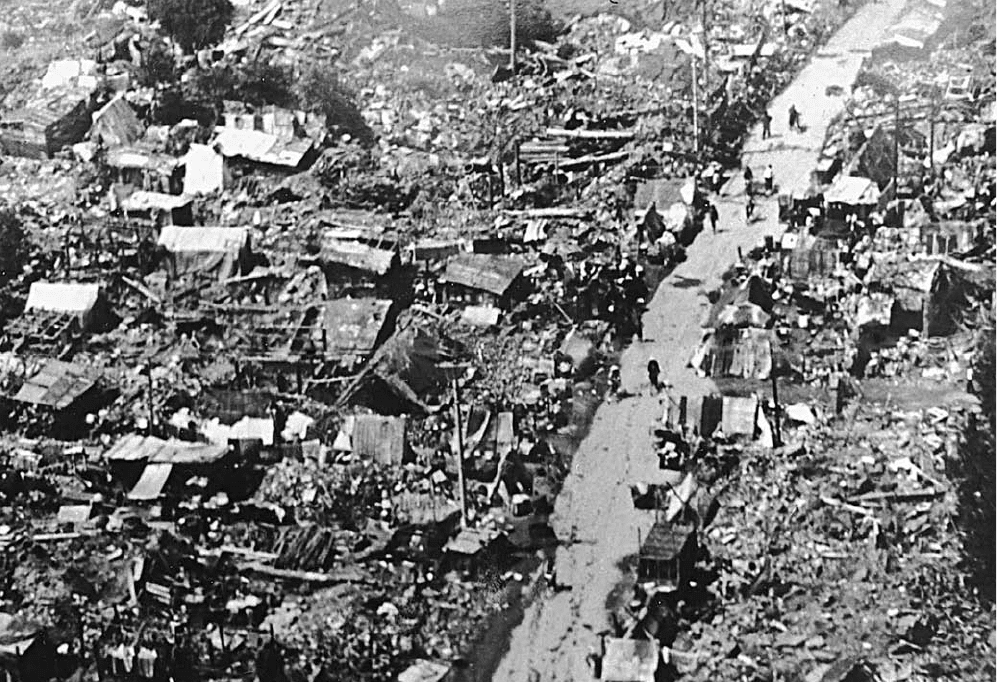
Complete destruction of all buildings (only tents for refugees are visible) by the great 1976 Tangshan earthquake. (Courtesy of the USGS)
Tarawera 255
a mile long and about 1,000 feet (305 m) deep, opened dur-
ing Tarawera’s 1886 eruption. The violent eruptions of June
10 lasted only about two hours, although lesser activity was
observed for days afterward. During that time, some 0.5
cubic miles (2 km
3
) of lava were ejected. Vigorous geyser
activity has been recorded along the fissure involved in that
eruption.
Tarumai volcano, Japan The stratovolcano Tarumai
has undergone explosive eruptions on more than 30 occa-
sions since the mid-17th century. An especially large eruption
in 1909 released great quantities of ash and bombs.
Taupo caldera, North Island, New Zealand The Taupo
caldera is located in the Taupo Volcanic Zone near
Wairakei and is partly occupied by Lake Taupo. The bound-
aries of the caldera are poorly defined, but it is thought to
be about 24 miles (39 km) wide. Roughly 2,000 years ago,
during a series of violent eruptions that occurred here, a set
of fissures opened and then filled with ignimbrites. Slightly
more than a mile outside the caldera is Tauhara volcano, a
complex of domes of undetermined age. Tauhara is also the
site of a geothermal field. In 1895, a powerful earthquake
occurred that caused landslides and fissures in the vicin-
ity of Wairakei. Earthquake activity was frequent in 1922
and involved displacement of approximately 10 feet (3 m)
in places along fault lines. Subsidence of more than six feet
(1.8 m) occurred along the northern shores of Lake Taupo.
Several years later, further subsidence was reported, this time
more than 10 feet (3 m). Fissures developed along the Kaiapo
Fault, along the northeast rim of the caldera at the edge of
the Wairakei field, and numerous fountains of water were
reported seen along the fault.
A moderately strong earthquake occurred immediately
west of Lake Taupo in 1953 and was followed by after-
shocks. Earthquakes occurred again to the west and south-
west of Lake Taupo in 1956–57.
Late in 1964, a swarm of more than 1,000 earthquakes
greater than magnitude 2.5 started under Lake Taupo and
continued through January 1965. This swarm is thought to
have accompanied several inches of uplift along the east shore
of the lake. In 1974 and 1981, hydrothermal explosions
took place in the Tauhara geothermal field. An earthquake
occurred several days before the 1981 explosion, but there is
no proof that the earthquake was the cause of events leading
to the explosion.
Very slight subsidence was noticed on the north shore
of Lake Taupo in the early 1980s, and in 1983 earth-
quake swarms occurred to the north of the lake, followed
by several inches of uplift along the north shore. Earthquake
activity intensified in mid-1983, followed by fast subsidence
northwest of the Kaiapo Fault and uplift southeast of the
fault. Slight subsidence preceded an earthquake swarm at the
south side of the lake in 1984, but an equivalent amount of
rebound occurred over the following months. The northeast
shore was uplifted slightly in the latter part of 1984 and then
subsided after a series of minor earthquakes in 1985.
In 1986, it appeared that an eruption might be imminent,
because pumice was seen in the lake and gas bubbles were
reported rising to the surface. Fears of eruption, however,
proved to be groundless. The pumice was thought to have
fallen into a stream that carried the material to the lake, and
the gas bubbles evidently were no different from others that
occur often in the lake. It is hard to predict eruptive activity
at the Taupo caldera because of difficulty in separating mag-
matic from tectonic unrest.
Taupo Fault Zone North Island, New Zealand The
Taupo Fault Zone on North Island has been the site of inten-
sive volcanic activity both before and after European settle-
ment of the islands in the late 18th century. Great quantities
of volcanic material emerged from fissures in the Taupo
Fault Zone in prehistoric times and were deposited as ignim-
brites. Similar conditions gave rise to the Valley of Ten
Thousand Smokes in Alaska, although the New Zealand
deposits are far more voluminous than those in Alaska. There
are some 50,000 square miles (129,499 km
2
) in area and
thousands of feet deep (estimated at almost 200 cubic miles
[820 km
3
] total) in the Taupo Fault Zone, compared to only
about 50 square miles (130 km
2
) and several hundred feet
deep (some seven cubic miles [28.7 km
3
] total) at the Valley
of Ten Thousand Smokes. Eventually, eruptive activity was
confined to a few locations but became more explosive. The
Taupo Fault Zone was the site of the famous eruption of
Tarawera in 1886.
tectonic escape See extrusion tectonics.
tectonics The study of the large-scale belts and terranes
of rock and their relations and processes of formation. Tec-
tonics may involve structural, stratigraphic, and petrologic
relations. Typically a geologist studies a sequence of rocks in
terms of their origin as well as the processes that have taken
place since then. With this information, a model for the plate
tectonic history of those rocks is proposed. Tectonics differs
from other subdisciplines of geology in that it deals with the
large scale processes of Earth by example or model.
teleseismic The arrival of seismic waves or indication of an
earthquake that occurred a long distance away, commonly
across a large ocean basin.
teletsunami In contrast to a local tsunami, a teletsunami
can cross an entire ocean basin and still have enough energy
to be recognized. Tsunamis are generated with a certain
amount of energy. They travel at high velocity and only grow
into large waves as they come into a coast. Most tsunamis
attenuate so fast that they are only recognizable near their
source. It takes a tsunami of remarkable power to cross an
entire ocean basin and still be a threat. The Banda Aceh
event was the most recent true teletsunami, but the 1964
Good Friday earthquake and Chilean
1960 earthquake
both produced teletsunamis, as have numerous others.
Tengger caldera, Java, Indonesia The Tengger caldera
played an important part in debate during the early 20th cen-
tury about how calderas originate. It was determined that the
caldera formed after an eruption of vast amounts of tuff and
256 Tarumai
formed during two separate episodes of collapse. The first
episode formed the Ngadisari depression immediately to the
northeast of Tengger, and the second episode of collapse cre-
ated the Tengger caldera itself. Tengger is occupied partly by
a lake, and a small cone called Bromo is located in the center
of the caldera. Bromo undergoes frequent eruptions of the
Strombolian type and has erupted at least 53 times since
1804. After Bromo erupted in 1835, a small lake formed in
the crater. The lake grew in size following another eruption
in 1838 and then began to change color from blue to green
between 1838 and 1841. Sometime in the early 1840s, the
floor of the crater appears to have bulged upward and given
off gases. Several weeks later, the swelling subsided, and the
crater floor collapsed. This swelling and subsequent collapse
evidently were confined to the crater at Bromo.
In March 1858, Bromo became active again. This erup-
tion was preceded by loud underground noises. Such noises
also occurred before another eruption in 1858; before this
eruption, earthquakes were felt up to a distance of about a
mile (1.6 km) from the volcano. Bromo was blamed for a
very strong earthquake that shook the island of Java in May
1865. Although the volcano was active for part of that year,
there is no proof that the eruption and the earthquake were
related, but some connection between the seismic and vol-
canic activity is possible. In 1888, Bromo emitted steam and
sulfur gas. Several days before an eruption in 1980, fuma-
roles became more active. The latest eruption was in 1984.
Tennessee United States Tennessee has an extensive his-
tory of strong seismic activity, partly because of its proxim-
ity to the New Madrid Fault Zone, which was responsible
for a series of extremely powerful earthquakes during the
winter of 1811–12. Another severe earthquake occurred in
western Tennessee on January 4, 1843, and affected a wide
area including portions of Kentucky, Missouri, Alabama,
Indiana, Iowa, South Carolina, and Georgia. Western
Tennessee could undergo severe damage in the event of any
future earthquakes comparable in intensity to the 1811–12
events because the area is settled much more heavily now
than it was at the time of the great earthquakes of the early
19th century.
tension Tension is a type of stress that pull objects apart.
Forces are directed in opposite directions (away from each
other) in tension.
tephra Geologists define tephra as all solid particles emit-
ted by a volcano during an eruption. Tephra particles range
in size from extremely fine ash with approximately the con-
sistency of confectioners’ sugar to large pieces several feet in
diameter (bombs). Tephra forms when magma containing
dissolved gases nears the surface; the gases bubble out of solu-
tion, forming cavities in the magma or lava as it solidifies.
The resulting fragmented solid material is cast out of the vol-
cano’s throat and, under the right conditions, may travel for
thousands of miles before settling to the surface. Almost all
volcanoes release tephra when erupting, although some erup-
tions produce far more tephra than others. Tephra comes in
various forms, including bombs, masses of fluid magma that
solidify in flight, and lapilli, gravellike bits of lava. Tephra
may mix with extremely hot gases and flow downslope from
the volcano as a
NUÉE ARDENTE (fiery cloud), a phenom-
enon that can destroy a landscape as effectively as a nuclear
explosion. A nuée ardente caused much of the destruction at
Mount Pelée in 1902. A high-altitude cloud of fine tephra
from Krakatoa appears to have altered global climate by
intercepting incoming sunlight and lowering surface tempera-
tures. A similar cloud from the 1815 eruption of Tambora
has been implicated in the dramatic drop in temperatures the
following year, the “year without a summer.”
Tephras constituents are known collectively as pyro-
clastics. Pyroclastic deposits may occur either as pyroclastic
flows (that is, as nuée ardentes) or as airfall deposits, which
accumulate as tephra settles out of the atmosphere. Each kind
of pyroclastic deposit shows a characteristic pattern when
exposed vertically. In a pyroclastic flow, particles of many
different sizes, large and small, are mixed together with little
or no evidence of sorting or layering. Airfall deposits, by con-
trast, exhibit distinct layering and sorting into fine and coarse
layers. mudflow deposits consist of gravel of various sizes
deposited amid fine silt. These deposits occur when large
quantities of water flow down a volcano’s flanks, picking up
tephra along the way and finally depositing the mudflows in
nearby stream valleys. Mudflows may occur when an erup-
tion melts ice and snow on a volcano summit or casts water
out of a lake in the crater. Heavy rains may also generate
mudflows. A mudflow may overwhelm an entire community
without any advance warning.
terrane A piece or belt of rock in Earth’s crust that differs
greatly in history and composition from those in adjacent areas.
A terrane may represent a piece of land that was added to the
continent through a collision. The terrane may represent a sepa-
rate continent or island arc and could have come from thou-
sands of miles away. There are certain characteristics that the
geologist searches out to prove the exotic nature of the terrane.
Ophiolites, old pieces of oceanic crust, commonly lie along
the boundaries between exotic terranes. There may also be
highly deformed deep-sea sediments that formed in the trench
of a subduction zone but have been shoved onto land dur-
ing collision. Exotic terranes are commonplace in the western
United States because of the collision of several large tectonic
plates and numerous smaller plates there. The phrase collage
tectonics was coined for this area because geologic maps look
like a collage of belts of unrelated sequences of rock. Terranes
are interpreted by geologists who study tectonics.
See also plate tectonics.
Terror See Erebus, Mount.
Texas United States Earthquake activity in Texas has
provided interesting discoveries for geologists on occasion.
For example, the July 30, 1925, earthquake in the panhan-
dle region was a strong earthquake, felt 225 miles (362 km)
away in Roswell, New Mexico, and Leavenworth, Kansas,
400 miles (644 km) distant. The area was not thought to be
given to earthquakes (the only previous recorded earthquake
in the Texas panhandle occurred in 1917), and for a while,
Texas 257
oil drilling was suspected as a reason for the earthquake. The
earthquake affected such a wide area, however, that drilling
was eliminated as a possible cause. Another earthquake, at
Mount Livermore in west Texas on August 16, 1931, caused
heavy damage at Valentine and would have been extremely
destructive if the event had occurred in a heavily settled area.
There are ancient volcanic deposits in west Texas related
to volcanic activity on the Rio Grande Rift. These deposits
even spread into the sedimentary rocks of the Gulf of Mexico,
where they decrease the oil and gas content of the strata.
Thera See Thira.
thermal gradient The rate at which Earth’s temperature
increases with depth. Although an average figure of 30°C per
kilometer is given for the thermal gradient, the rate of increase
actually varies from one level of Earth’s internal structure to
another. The increase is believed to be rapid within the crust,
where high concentrations of radionuclides in granitic rock
generate large amounts of heat by their decay. The thermal
gradient is thought to diminish as the crust gives way to the
outer layer of the mantle. In this layer, some about 36 to 60
miles (60 to 100 km) beneath the surface, temperatures are
estimated at approximately 800 to 1200°C.
Thermal gradient also varies by location on Earth. In
geothermal areas such as Iceland, Yellowstone, or The
Geysers, in California, the thermal gradient can be very
high, up to several hundred degrees per kilometer. Any area
with significant igneous activity will have an elevated thermal
gradient. In sedimentary basins that are high in radioactive ele-
ments and that insulate well, the thermal gradient can also be
elevated but to a lesser extent. In basins with thick sequences
of rocks that are low in radioactive elements, the thermal gra-
dient might be depressed. In subduction zones, the thermal
gradient is also reduced because the oceanic crust is driven
down into the mantle faster than it can heat up.
See also Earth, internal structure of.
Thira volcano, Mediterranean basin, circa 1470 b.c. The
island of Thira (also known as either Santorini or formerly
Thera), between Greece and Turkey, is believed to have been
almost totally destroyed in a volcanic explosion that wiped
out the Minoan civilization. Thira became active after long
dormancy around 1500 b.c. and appears to have erupted at
intervals over some 30 years before a final, explosive eruption
destroyed much of the island. Archaeological evidence indi-
cates that powerful 200-foot (61-m)-high tsunamis generated
by the explosion caused widespread destruction on shores in
the eastern Mediterranean. Apparently Minoan civilization
never recovered from the natural disasters associated with
this eruption of Thira. The destruction of Thira is believed
to have given rise to the legend of Atlantis, the ancient civi-
lization supposedly destroyed in a single day when the island
of Atlantis sank in a great natural cataclysm. Initially, the
legend placed the demolished island accurately in the vicin-
ity of Crete, but the Greeks later imagined that Atlantis had
been located farther west, in the great ocean beyond what
we know as the Straits of Gibraltar. The Atlantic Ocean was
named for the fictional island.
The explosion of Thira shifted the course of history in
the Mediterranean. The dominant Minoan civilization was
crippled by the tsunami. Previously, the Minoans had kept
the “hill people” in Greece and Mycenae at bay with their
technical superiority. Because the tsunami wiped out the
coastal communities but left the hills intact, the Golden Age
of Greece and empire of Alexander the Great were ushered
in. The explosion also roughly corresponds to the flight
of the Jews from Egypt. ash in the atmosphere could have
accounted for the bloodred skies. Could the parting of the
Red Sea and drowning of the pharaoh’s troops really been
the tsunami from Thira?
Deep-sea coring in the Mediterranean has revealed a
layer of thoroughly contorted and mixed-up sediment that
researchers refer to as “homogenite.” It is interpreted that
this layer resulted from the scraping up and mixing (homog-
enizing) of existing sedimentary layers on the seafloor. This
homogenite has been radiometrically dated at 1500 b.c. It
occurs throughout the Mediterranean basin in thickness up
to nine feet (3 m). Rough estimates indicate a VEI of 6 for
this explosion.
Thira’s eruption is sometimes compared to that of
Krakatoa. As in the case of Krakatoa, the explosion of the
volcanic island left behind a caldera that filled with water.
A group of small volcanic islands arose from the caldera and
erupted intermittently from 1938 to 1941.
tholeiite The most common basalt type. Based on a
characteristic bulk chemistry, tholeiitic trends and ranges
are the common type to the ocean floor. They are produced
in the middle stages of rifting and most hot spots as well
as the mid-ocean ridge. flood basalts are typically tho-
leiites as well.
Three Rivers earthquake, Quebec, Canada An earthquake
on the order of that in New Madrid appears to have occurred
in Quebec in 1663. The area is along a trend of earthquakes in
the midcontinent that includes New Madrid. There is almost
no information available except for the accounts given in Jesuit
Relations:
New lakes are seen where none was before. Some
mountains were engulfed and disappeared. Many a
waterfall is leveled and many a river is no more. The
ground cracked in many places and opened crevices
of unmeasured depth. And there has resulted such a
disorder of fallen and splintered trees that one sees
today fields of more than a thousand argents all
leveled as if they had been recently tilled, in many
places where there was nothing but forests.
Three Sisters volcano, Oregon, United States A cluster of
volcanic peaks in western Oregon, the Three Sisters are part
of the Cascade Mountains located near Mount Hood and
Crater Lake. The most recent eruption was about 1,900
years ago.
thrust fault A low-angle reverse fault.
258 Thera
tidal wave A misnomer for tsunami.
Tien-Chi caldera, China Located on the border between
China and Korea, the Tien-Chi caldera has a spectacular
crater lake some three miles (4.8 km) wide and more than
1,000 feet (308 m) deep. The caldera is thought to have
formed less than 1,000 years ago, during or after an eruption
that deposited a huge volume of pumice over an area some
24 miles (39 km) wide around the caldera. Eruptions were
reported at the caldera in 1597 and 1702, but these reports
have not been confirmed. Tien-Chi is located near the vol-
cano Paektusan, which is either a stratovolcano or a dome
surmounting a vast lava shield.
See also Baitoushan.
Toba caldera, Sumatra, Indonesia The Toba caldera is
a volcano-tectonic depression. Although it has been argued
that the depression is tectonic in origin, the vast quantities
of tuff expelled from eruptions here indicate to many geolo-
gists that volcanic activity was involved in the caldera’s origin.
The Young Toba Tuff was formed 74,000 years ago in likely
the largest volcanic eruption in the last 2 million years (VEI =
8). The estimated volume of this eruption is 700 cubic miles
(2,800 km
3
), which is even larger than the Yellowstone
eruption of 2.2 million years ago. pyroclastic flows from
this eruption covered some 7,722 square miles (20,000 km
2
).
The Toba caldera marks the point where a chain of
andesitic volcanoes undergoes a change in relation to Suma-
tra’s Semangko Fault Zone, a large strike-slip fault. To
the south of the Toba caldera, active volcanoes are located
very close to the fault zone, but north of Toba the volca-
noes are situated more to the east of the fault zone and are
distributed over a broader area. Toba is thought to occupy
a north-to-south boundary characterized by high seismicity,
between two subducted plates of Earth’s crust. Volcanism at
Toba may be the result of increased production of magma
along this boundary zone.
The caldera has not experienced any eruptions within his-
torical times, but earthquake activity is frequent in the vicinity
of Toba. Powerful earthquakes have occurred at Toba on sev-
eral occasions since the late 19th century. A very strong earth-
quake on May 17, 1892, centered about 75 miles (121 km)
south of Toba, demolished numerous buildings and accompa-
nied several feet of displacement along the dextral strike-slip
Semangko Fault. A slump took place around the year 1914
at the upper end of the Asahan Valley on the southeast side
of the caldera and made Lake Toba rise several feet, although
no particular importance is attached to this event in terms of
earthquake or volcanic activity. An earthquake occurred in
November 1920 and was followed by earthquake swarms
in 1922. Damage occurred along the south shore of Lake
Toba, where subsidence took place at several locations. fuma-
roles to the south and west of Lake Toba became more active
after powerful earthquakes. A moderately strong earthquake
in 1987, centered on the south shore of the lake near the com-
munity of Muara, caused significant damage.
Tofua volcanic island, Tonga Tofua Island is the site of
Tofua caldera and has a history of eruptions and other unrest
dating back to the late 18th century. One eruption in 1958–
59 was severe enough to require the evacuation of the islands
population for several months.
Tokachi volcano, Hokkaido¯, Japan It is composed of over-
lapping stratovolcanoes that have produced 17 historical
eruptions. The eruptions are clustered into periods 1857,
1887, 1889, 1925–31, 1952–62, 1985, and 1989. Most erup-
tions are phreatic and small (VEI = 1–2). In the 1926 erup-
tion, lahars swept down the volcano covering 12.4 miles (20
km) in 26 minutes. It destroyed more than 5,080 homes and
killed at least 146 people. In the 1962 eruption, falling blocks
killed five people.
See also Daisetsu-Tokachi.
Tokai See Kanto.
Tokaido earthquake and tsunami, Japan On October
28, 1707, one of the greatest earthquakes in the history of
Japan struck the Tokaido area. The earthquake was power-
ful enough to cause damage to houses and public buildings in
26 provinces. As is common in Japan, this submarine earth-
quake produce a massive tsunami. This huge wave swept the
coast from Kwanto to Kyu¯shu¯ Island. In southern Shikoku
near Koti, the wave reached a breathtaking height of 91 feet
(27.5 m). The wave continued into the Inland Sea between
the islands of Shikoku and Honshu¯. It rushed into Osaka Bay
and up the two rivers that empty into it. More than 1,000
boats were swamped and sunk and several were carried
upriver, where they damaged bridges. In all, it was reported
that more than 4,900 people lost their lives, but the number
is suspected as being much higher. It was also reported that
over 29,000 houses were destroyed in the event.
Tokyo Japan The capital of Japan is known for its his-
tory of frequent and highly destructive earthquakes. The 1923
Kanto earthquake and subsequent fire destroyed much of
Tokyo and nearby Yokohama. The earthquake was estimated
at a magnitude of up to 8.3 on the Richter scale. A similar
earthquake today would have a much more devastating effect
than the 1923 earthquake for various reasons. The city is
larger than in 1923, and therefore opportunities for damage
are greater. Also, Tokyo now has numerous hazardous mate-
rials stored in it in large quantities, and those materials might
pose serious dangers in the event of a major earthquake. The
economic effects of a major earthquake in Tokyo would reach
to numerous nations other than Japan, notably the United
States, and might cause serious hardship on an international
scale because of Tokyo’s importance as a financial center.
Tokyo is regularly struck by strong events. The last con-
firmed earthquake prior to Kanto was the November 11,
1855, event. The epicenter was within the city. Many char-
coal braziers were upset and overturned by the shaking, and
many fires broke out but were quickly contained. In all, some
50,000 houses were destroyed, and the death toll was
6,757. There are reports of another earthquake on March 21,
1857, in Tokyo in which 107,000 were said to have perished
largely as the result of fires, but this event could not be con-
firmed.
Tokyo 259
Tokyo is located near the volcano Mount Fuji, which
has become a symbol of Japan. It is also near the volcano
Hakone. If either of these volcanoes reawakened, or if a new
volcano formed in the area, the effects could be devastating
on this densely populated area.
See also economic effects of earthquakes and
volcanoes.
Tolbachik volcano, Kamchatka, Russia Although the
stratovolcano Tolbachick has erupted often since the
mid-18th century, it is most famous for a major eruption in
1975 that was predicted so accurately that television crews
were able to film its onset. Earthquake activity just before the
eruption made the prediction possible. The eruption resulted
in the formation of four new cinder cones and was accom-
panied by an eruption column of eight miles (13 km) height.
The resulting lava sheets are 260 feet (79 m) thick and cover
15 square miles (39 km
2
). The previous eruption was from
1967 to 1970.
Toledo caldera, New Mexico, United States The Toledo
caldera is thought to have produced an estimated 50 cubic
miles (205 km
3
) of tephra in an eruption some 1.3 million
years ago. The Toledo caldera lies buried under a heavy ash-
fall from the nearby Valles caldera.
Toliman See Atitlán.
Tomboro See Tambora.
tomography Seismic tomography is the equivalent of
a CAT scan of the Earth. By studying small changes in the
velocity of seismic waves received by seismographs on the
surface, detailed images of the internal structure of the Earth
may be constructed. These images have led to new under-
standing of the plate tectonic interactions and resulting
thermal structure.
Tompaluan See Tondano.
Tondano caldera, (Celebes) Sulawesi, Indonesia The Ton-
dano caldera occupies the northern portion of Sulawesi and
has a record of activity within historical times dating back to
the early 19th century. Eruptions have been explosive, with
some phreatic eruptions. Several andesitic stratovolca-
noes have formed along the rim of the caldera. A new cra-
ter called Tompaluan appeared in 1829 and started to smoke
in 1893. A fissure some 300 feet (91 m) long that emitted
smoke is thought to have formed in the caldera around 1898.
Earthquakes in 1901 were ascribed to increased activity at
the Soputan volcano on the south rim of the caldera; two
mud pots formed at the foot of the volcano, and there was
a report of ash ejection and steaming from Soputan at this
time. About a month later, a new solfatara had appeared
near the warm spring at Rumerega and was casting up boil-
ing mud to a height of more than 700 feet (213 m), but the
crater of Soputan reportedly showed no increase in activity.
In 1906, the new crater Aeseput formed at Soputan. That
same year, earthquake activity increased, accompanied by
fumes from the volcano and a glow at night. Soputan erupted
on June 17, 1906, the same day an earthquake shook Tomo-
hon, some 18 miles north-northeast of the volcano. Soputan
continued erupting at intervals through 1913. A powerful
tectonic earthquake occurred in 1932 but apparently did
not affect the volcanoes. In 1958 and 1959, minor eruptions
of ash occurred, and another series of minor eruptions took
place from 1961 to 1962. Small explosions were reported
between 1963 and 1968, and lava flows and pyroclastic
flows occurred at Soputan between 1966 and 1968. Small
explosions occurred again in 1969–71. Gray gas, possibly
containing ash, emerged from Soputan in 1970, and fuma-
rolic activity increased through a lava flow that had been laid
down in 1966.
There was an increase in seismic activity at tile caldera
in 1976, and the temperature of the crater lake increased
sharply in early 1978. A strong explosive eruption occurred
in August 1982 without any premonitory signs, but earth-
quakes did precede another eruption in November of that
year. In April 1984, minor eruptions of gas through the lake
killed plants as far as two miles (3.2 km) downwind, possi-
bly from the action of acid rain or acid gases. An eruption in
May 1984 showed no premonitory activity, but earthquake
activity increased before an eruption in August 1984. Tec-
tonic earthquake activity appears to have increased dramati-
cally at the caldera in early 1985. In May 1985, the steam
plume that normally rose from the volcano increased in
height, and by May 19 the plume, now containing ash as well
as steam, rose to an altitude of about three miles (4.8 km).
In March 1986, the Tompulan crater sent up puffs of steam
to an altitude of more than 1,000 feet (305 m), and phre-
atic explosions produced lahars. In the second half of
1986, dozens of explosions occurred daily. Explosions con-
tinued, though less frequently, through May 1987. Between
April and May 1987, light-colored fumes emerged from the
Magawu (Mahawu) crater, where the crater lake rose in tem-
perature and increased in volume.
Tongariro volcano, North Island, New Zealand Tongariro
is a stratovolcano within the Tongariro volcanic com-
plex that also includes Ruapeho, Pihanga, and Kakaramea.
Ngauruhoe sits in the middle of the Tongariro massif and is
the most active volcano in New Zealand.
topographic monitoring Detailed altitude monitoring
of the surface of volcanoes. When magma moves into the
magma chamber underneath a volcano before an erup-
tion, it causes the volcano to inflate. This inflation will
cause changes in elevations on the volcano. The monitoring
involves the use of lasers and satellite altimetry and is very
accurate. Even small changes can be detected. The inflation is
accompanied by earthquake swarms. Positive results from
the topographic monitoring and earthquake swarms lead sci-
entists to issue alerts because they usually herald an eruption.
Torfajökull volcano, Iceland Located in southeastern
Iceland, the Torfajökull volcano is associated with a cal-
dera and is in an area of frequent earthquake activity. The
volcano erupted around the year a.d. 900 and emitted both
260 Tolbachik
lava and tephra. Another eruption occurred about 1480,
again involving both tephra and lava. Both these eruptions
occurred during episodes of rifting on the Veidivötn fissure
swarm, which lies northeast to southwest through the middle
of Iceland. Tephra and lava in these eruptions were rhyo-
litic. Earthquakes have occurred at the caldera in recent
years, sometimes at a rate of several dozen per day, but there
have been no further eruptions since the 15th century.
Toribio earthquake, Colombia On June 6, 1994, an
earthquake of magnitude 6.7 occurred. At least 295 people
were killed with more than 500 missing. Severe damage to
houses, highways, and bridges by both the earthquake and
landslides it triggered left some 13,000 homeless. One ava-
lanche blocked the Paez River, causing severe flooding.
Towada caldera, Japan The Towada caldera is located
in the northern portion of the island of Honshu¯. The caldera
contains a lake and is thought to have formed from the col-
lapse of several small stratovolcanoes. Towada had three
very large (VEI = 5) prehistorical eruptions in 7550 b.c.,
6650 b.c., and 3440 b.c. It has been quiet for approximately
the last 1,000 years, but an eruption in approximately a.d.
915 is thought to have deposited airfall tephra and pyro-
clastic flows over the surrounding area.
Tower Peak See Ambrim.
Toya caldera, Japan Located on the island of Hokkaido¯,
the Toya caldera lies immediately north of Usu volcano
and contains a lake, Lake Toya, in the middle of which a
group of lava domes has formed an island. The historical
record of activity at the caldera dates back to 1626 since
which Usu has erupted nine times. Eruptions were recorded
in 1663, 1769, 1822, 1853, 1910, 1944–45, 1977–82,
and 2000. The most destructive of Mount Usu’s eruptions
occurred in 1822 when 59 people were killed. The eruption
in 1910 was preceded by several days of earthquake activ-
ity, which was accompanied by the appearance of cracks
and faults aligned mostly east to west along the northwest
foot of Usu volcano. Small craters formed at the north foot
of Usu, and numerous small mud cones formed along the
seashore nearby. The explosive phase of the eruption was
largely finished by early August.
In May 1932, an area of subsidence some 200 feet
(61 m) wide was noticed off the north shore of Lake Toya;
although this area subsided by more than 30 feet (9 m) in
places, no eruption followed, although lake temperature rose
considerably. Earthquakes started late in December 1943. An
explosive eruption began in June 1944 and lasted through late
October. Earthquake activity again showed a sharp increase
in August 1977, followed by an explosive eruption of pum-
ice. Magmatic explosions continued through August 14 on
an intermittent basis. phreatic eruptions occurred on occa-
sion in 1977 and 1978. Activity at Usu volcano has produced
new hot springs, which in turn have generated opportunities
for tourism because hot springs are popular attractions in
Japan. In late March 2000, Mount Usu began to erupt. This
was the first eruption in 22 years. During that eruption, two
people were killed, and 200 homes were destroyed. In this
eruption, 16,000 people were evacuated of the 51,000 that
live in the area.
T-phase A type of tsunami with a short period that travels
through the ocean at the speed of sound. They are typically
only identified traveling in very deep ocean basins.
trachyte A volcanic rock of intermediate composition
that is typically porphyritic and has k-feldspar and minor
mafic minerals (biotite, hornblende, or pyroxene) as the
chief components. With more quartz, the trachyte would be
a rhyolite, and with less K-feldspar, it would be a latite.
trajectory The direct line path of seismic wave travel-
ing from its focus (source) to the seismograph, where it is
recorded.
transcurrent fault See strike-slip fault.
transform fault A tectonic plate margin characterized
by strike-slip movement. About 99% of transform faults
offset mid-ocean ridges, which results in the steplike pat-
terns observed there. The few good examples of transform
faults on land are highly seismically active. They include
the San Andreas Fault of California, the Motagua
Fault of Guatemala, and the South Alpine Fault of New
Zealand.
See also plate tectonics.
transition zone A region where the upper and lower parts
of the mantle meet. It is at 255–621 miles (410–1,000 km)
depth and is characterized by an increase in density of rock
by about 20% and a corresponding increase in seismic wave
velocity. It is also called the C layer. It is speculated that the
pressure is so great that the molecules in minerals in the rocks
crush down to form a tighter, denser structure just as graph-
ite crushes down to diamond with pressure. There is also a
transition zone from the inner to the outer core. This tran-
sition is also recorded by seismic waves and density, but it is
the result of a phase change from solid (inner core) to liquid
(outer core).
Transverse Ranges California, United States These moun-
tains form an east-west ridge through southern California
and include the San Bernardino, San Gabriel, Santa Susana,
Santa Monica, and Santa Ynez Mountains. The Channel
Islands off Santa Barbara are also seen as an extension of the
Transverse Ranges. The Transverse Ranges appear to mark
the zone where the Los Angeles basin is being driven to its
northwest. Compression is evident in the Transverse Ranges
and is thought to originate in this case from the movement of
the Pacific crustal plate to the northwest. Uplift along the
Transverse Ranges is thought to have been responsible for the
highly destructive San Fernando earthquake of 1971. Spec-
tacular displays of exposed sedimentary rock may be seen
along highway U.S. 101 in the Santa Ynez Mountains near
Santa Barbara and Buellton.
See also plate tectonics.
Transverse Ranges 261