
Gates A.E., Ritchie D. Encyclopedia of Earthquakes and Volcanoes
Подождите немного. Документ загружается.

in contrast to plutons that cut across strata and are discon-
formable. dikes are disconformable but otherwise appear
similar to sills. A popular example of a sill is the Palisades Sill
of New Jersey and New York.
Sinano earthquake, Japan On May 8, 1847, a strong
earthquake struck the Sinano area of Japan. The Sinano area
is relatively rugged, and the earthquake shook loose literally
thousands of landslides that crushed and buried the villages
located in the valleys below. The largest of the landslides
blocked and dammed the Saikawa River, producing an earth-
quake lake 17 miles (27.2 km) long by 2.5 miles (4 km) at its
widest point. The lake filled for 19 days and then the land-
slide dam gave way, producing a huge flood that swept away
all settlements along the banks downstream, including 4,800
houses. In all, 34,000 houses were lost in this earthquake,
and the death toll was in excess of 12,000 people.
Sissano earthquake, New Guinea On July 17, 1998, an
earthquake of magnitude 7.1 occurred near the north coast
of New Guinea. At least 2,183 people were killed, but at
least 500 were reported missing. Thousands were injured and
many thousands were left homeless. Much of the damage was
caused by tsunamis which reached maximum heights of 32
feet (10 m).
Skaptarjökull volcano, Iceland The eruption of Skaptar-
jökull (also known as Lakagigar or Laki) in 1783 was one of
the most powerful eruptions in history. The eruption started
on June 11 and followed a long series of earthquakes that
became very violent just before the eruption. lava issued from
fissures in the mountain at numerous locations (although
volcanic gases had been vented starting several days earlier),
and the separate streams of lava united to form a stream of
molten rock that blocked the gorge of a nearby river, which
was some 200 feet (61 m) wide and 400 to 600 feet (122
to 183 m) deep. The lava not only filled this gorge but also
overflowed it on either side. The lava also filled the bed of a
lake along the river. Continuing on its way, the lava flow
encountered an area of ancient volcanic rocks honeycombed
with caverns. The lava flowed into these caverns and sent
fragments of old lava flying some 150 feet (46 m) into the air.
On June 18, another flow of lava advanced rapidly
over the hardened surface of the first flow. On August 3,
more lava flowed from the mountain. The fresh lava moved
southeastward and spread out over the plain. Eruptions of
lava continued intermittently for two years and, by one esti-
mate, amounted to a mass as great as that of Mont Blanc in
France. Individual flows averaged some 100 feet (30 m) deep,
but in some places depths of 600 feet (183 m) were attained.
A total of 3,600 cubic miles (14,731 km
3
) of basalt were
erupted making it the second-largest basalt emission in his-
tory (Eldgja, a.d. 935 is the largest). At peak flow fire
fountains reached heights of 800 to 1,400 feet (244 to 427
m) and discharge rates reached 303,706 cubic feet (8,600 m
3
)
per second (the Amazon River discharge is 353,147 cubic
feet [10,000 m
3
] per second, and it is the largest river in
the world). Vapors were still rising from these lavas as late
as 1794. Partly because of melting snow and ice and partly
because of blocked rivers, great floods of water occurred and
caused extensive damage. Lava overwhelmed 20 villages.
Ashes covered the entire island and the waters offshore.
Winds carried ashes from the eruption over the European
continent on several occasions, creating effects similar to
those following the eruption of Krakatoa. Of the 50,000
people inhabiting Iceland at this time, more than 9,000 are
thought to have been killed, along with more than 11,000
head of cattle, some 28,000 horses and more than 190,000
sheep. This loss of life resulted from streams of lava, from
vapors, from floods of water, from destruction of plants by
volcanic fluorine contamination and acid rainfall, and from
a shortage of fish, which disappeared from the coastal waters
during the eruption. Previously, fish had supplied much of the
food of the people.
In 1784, Benjamin Franklin noted that the year 1783
had been unusually cool and that sunlight reaching the
ground seemed diffused. He observed that when the rays of
the Sun “were collected in the focus of a burning glass, they
would scarcely kindle brown paper.” He also reported that a
strange “dry fog” hung over the land in the summer of 1783
and that this fog appeared to cut off some incoming sun-
light. Franklin suggested that the “vast quantity of smoke”
from Skaptarjökull’s eruption in 1783 had created the cloud,
blocked part of the incoming solar radiation and thus given
the northern latitudes a colder than usual year. The eruption
of the volcano Asamayama in Japan that same year also may
have contributed to the effects observed by Franklin.
Skopje earthquake, Macedonia Two strong shocks rocked
the city of Skopje, Macedonia (Yugoslavia), on Friday, July
26, 1963. The first earthquake struck at 5:14 a.m. and the sec-
ond just three minutes later at 5:17 a.m. The magnitude was
6.0 on the Richter scale, and the epicenter was right in the
town of Skopje, with the focus at 7.8 miles (13 km) in depth.
The damage at the epicenter registered X on the modified
Mercalli scale. The source of the earthquake was the Vardar
Zone, the most seismically active structure in the region.
The death toll from this earthquake was 1,066 people.
More than 3,300 people were injured and 170,000 people, or
75% of the population of Skopje, were left homeless. About
77% of the buildings were damaged or destroyed. Direct eco-
nomic losses were estimated at $1 billion, which was 15%
of the entire Yugoslavian economy. The Yugoslavian army
carried out the rescue and relief operations, and 80 countries
sent aid for the survivors.
slip model This is a modeled description of the kinematics
that portrays the amount, distribution, and timing of slip on
a fault plane associated with a particular earthquake.
slump The process of slumping is the downhill slipping of
a mass of rock or unconsolidated soil and/or rocky material
along a concave-upward plane of failure, similar to a listric
normal fault and usually involving a backward rotation of the
material during movement. Slump is one type of mass wast-
ing that occurs when a slope exceeds the angle of repose.
It may happen for any number of reasons, including heavy
rain, melting of snow and ice, removal of vegetation by fire,
242 Sinano
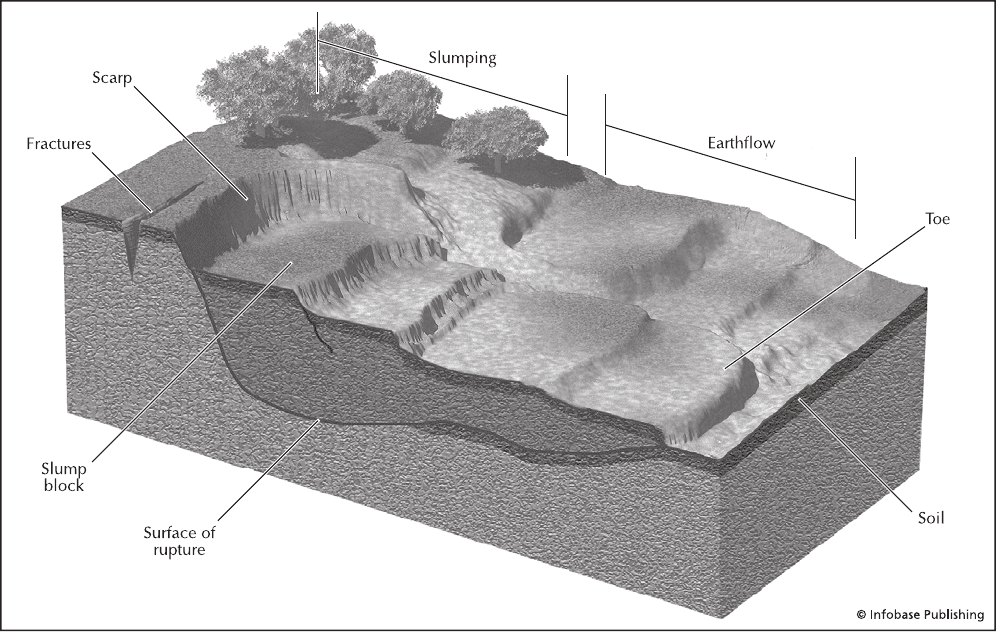
disease or human activity, or by shaking and/or liquefac-
tion associated with seismic activity. Slumping typically pro-
duces a scarp along the top margin and fissures along the
upper part of the slumped material. Most fissures produced
in earthquakes are from slumping.
Smyrna See Izmir.
Snake River Plain Idaho, United States The Snake River
Plain in southern Idaho is part of the Columbia–Snake River
Plateau, an expanse of lava flows overlying great rhyo-
lite ash deposits extending through much of the states of
Idaho, Washington, and Oregon, with portions in Utah,
Nevada, California, and Wyoming. The Snake River Plain
stands about 3,000 feet (914 m) high at the west and rises to
about one mile (1.6 km) in elevation in the east. The plain
exhibits many volcanic cones, particularly at Craters of the
Moon Monument, about 50 miles (80 km) north of Ameri-
can Falls. Two impressive volcanic cones, Menan Buttes, may
be seen near Idaho Falls. The plain is not noted for frequent
or strong earthquakes but borders on areas of considerable
seismic activity. Earthquakes around the edges of the Snake
River Plain indicate the plain is descending with respect to
the areas around it. The rate of descent is believed to be a few
inches per century on the average.
The formation of the Snake River Plain and the Colum-
bia Plateau both had their origin as flood basalts, begin-
ning with the Columbia Plateau. The rhyolitic ash deposits
underlying the basalts of the Snake River Plain are believed
to have been formed when granitic continental crust moving
over the hot spot melted and generated vapor-rich magma.
The magma emerged in explosive eruptions, creating a series
of calderas that became a series of basins stretching through
the plain. The overlying basalts presumably did not form dur-
ing these explosive eruptions but instead were deposited later
from fissures. The postulated hot spot now lies beneath
Yellowstone National Park. It has been suggested that
this hot spot is also responsible for the rifting that gave rise
to the northern Basin and Range Province of the western
United States. Dramatic evidence of rifting activity may be
seen at Great Rift National Landmark near American Falls.
See also plate tectonics.
Socorro caldera, New Mexico, United States The Socorro
caldera is associated with the Rio Grande Rift and has
been the site of considerable unrest, although no actual
eruptions, since the mid-1800s. Earthquake swarms were
reported at the caldera in 1849–50, 1904, and 1906–07
and from the early 1960s on. Earthquakes at Socorro
occur within several miles of the surface. Uplift also has
Block diagram of slump, a type of landslide and mass wasting
Socorro 243
been noticed at Socorro. The uplift and seismic activity
are thought to be linked to a large body of magma that is
located at a depth of perhaps 10 miles (16 km) and causing
uplift in an oscillating or episodic pattern.
soil Soil is a naturally occurring layer of unconsolidated
mineral and/or organic matter that mantles the surface of the
bedrock of the Earth. Soils are formed through processes
that give them a distinct physical, chemical, mineralogical,
and morphological character. They may be formed in place
through the weathering and alteration of underlying bedrock,
or they may be transported into place from another area.
These exotic soils may be glacial in origin but do not reflect
the underlying bedrock. Soils are one of our most valuable
resources in that most of our food comes from them. On the
other hand, seismic waves are usually much more destructive
in soil than in bedrock.
soil amplification Seismic waves grow in strength and
intensity as they pass from rigid bedrock into much less rigid
soil in virtually all cases. This soil amplification of seismic
waves is a danger. As a result, an earthquake which appears
to be causing little damage can suddenly cause great damage
in an area through this process.
solfatara A volcanic fissure or vent that emits only
vapor, notably sulfurous gases. Named for a volcano in the
Phlegraean Fields, Italy, thick yellow sulfurous rinds coat
the surficial rocks in these areas. Mining operations typically
follow. These mines create a dangerous situation. When the
volcano erupts, many sulfur miners can be killed.
solifluction By definition, solifluction is the slow flow-
ing of water-saturated soil and entrained debris down hill.
It is a wet version of creep and another of the processes of
mass wasting. Flow rates are imperceptibly slow, typically
on the order of one or two centimeters per week. Solifluction
is common in cold climates, where the top few centimeters
of soil mantling hills can be thawed and saturated with melt-
water. The soil mass moves like a viscous fluid (consistency
of cement) but faster toward its center, forming lobes and
tongues on the hillslopes.
Sonoran earthquake On May 3, 1887, the Pitaycachi
Fault, Mexico, ruptured and produced the great Sonoran
earthquake with magnitude 7.2. It was the largest historic
earthquake in the Basin and Range Province. The recur-
rence interval for such large earthquakes on the Pitaycachi
fault is 100,000 years.
Soputan See Tondano.
Soufrière 1 volcano, Saint Vincent A volcano on the island
of Saint Vincent in the Caribbean Sea, south of Jamaica.
The volcano’s name means “sulfur” or “brimstone.” The vol-
cano erupted in 1718 and again in 1812, but its most famous
eruption took place in 1902. Earthquakes began to shake
the island in April 1902, and in May the peak began to emit
steam. The crater lake started bubbling on May 5, and large
amounts of steam rose from it. On the afternoon of May
7, the volcano released a
NUÉE ARDENTE, a mixture of ash
and superheated gases. The cloud was heavier than air and
spilled downslope, killing some 1,650 people on the island.
Some escapes from death were remarkable: About a hundred
people, for example, are said to have avoided destruction by
hiding in a rum cellar.
The eruption laid waste about a third of the island and
removed more than 700 feet (213 m) from the summit of the
volcano. The earlier eruption in 1718 is said to have released
lava, and the violent eruption in 1812 reportedly lasted three
days and caused extensive loss of life. A new crater about a
half-mile (0.8 km) wide and 500 feet (152 m) deep formed
in the 1812 eruption, northeast of the original crater (which
was about the same size). Barbados, some 95 miles (153 km)
distant, received an ashfall of several inches.
Before the 1812 eruption, a conical hill stood in the
middle of the crater, beside which were two lakes, one sulfu-
rous and the other taste-free. Vegetation made the site beauti-
ful, and white smoke, with an occasional touch of light blue
flame, emanated from fissures on the cone. The eruption of
April 27, 1812, began with a strong earthquake, accompa-
nied by what one historian describes as a “tremulous” noise
as well as by a column of dense black smoke. The first signs
of the eruption were almost comical. A boy who was herd-
ing cattle on the mountainside noticed a stone fall near him,
then another. He supposed that some other boys were toss-
ing rocks at him from the cliff above, and he began to throw
stones upward in reply. He soon saw that an eruption was
starting, however, and he ran for his life. The eruption con-
tinued for three days and nights. Then, on the 30th, lava
flowed from the crater’s rim downward to the sea before the
eruption stopped. This eruption appeared to be the culmina-
tion of almost two years of earthquake activity, especially in
the vicinity of Caracas, Venezuela. On March 26, 1812,
a great earthquake struck Caracas as large numbers of resi-
dents were gathered in churches. The earthquake killed some
10,000 people in the collapse of churches and homes and
was felt up to 180 miles (290 km) away. Just more than one
month later, the 1812 eruption of Soufrière occurred. On
April 30, just as the eruption was ending, a loud underground
noise resembling cannon fire was heard at Caracas and other
locations, although no shock was reported. The noise was
said to be as loud along the shore as it was hundreds of miles
inland, and at Caracas preparations were made to defend the
city against what sounded like invading troops with heavy
guns.
In the 1902 eruption, Soufrière erupted simultaneously
with Mount Pelée. Soufrière’s eruption occurred at the north
end of the island of Saint Vincent and reportedly wiped out
most of the native Caribbean population of the island.
In April, unrest was noted at Soufrière, and on May 5, the
crater lake started to bubble and to release great clouds of
steam. Earthquakes followed, some of them very strong. At
noon on Wednesday, May 7, 1902, Soufrière suddenly sent
six separate streams of lava down its sides. On the night of
May 7, Soufrière’s eruption was visible from Saint Lucia. The
eruption lasted all night, and the day and night afterward.
On Thursday morning, a tremendous black column rose to
244 soil
an estimated height of eight miles (12.8 km). Ashes and rock
fell from the column for miles around. On Thursday night, a
steamship on the way to Kingstown encountered a floating
mass of ashes and was beset for three hours by a cloud of sul-
furous gas. When the ship reached Kingstown at dawn, the
streets were covered to a depth of two inches (5 cm) with ash
and rock. Lava flowed down the side of Soufrière.
The eruption abated slightly on Friday. Showers of rocks
ceased falling, although lava continued to flow from the
volcano. Corpses of humans and livestock added to the pol-
lution generated by the eruption; hundreds of bodies tragi-
cally remained buried. In one ravine, 87 bodies were found
together. Nearby lay the carcasses of hundreds of cattle.
The bodies were destroyed by quicklime, and the cattle were
burned.
Soufrière was active in 1971–72, and again in 1979. The
1979 eruption was Vulcanian and sent an eruption column
12 miles (19 km) high. Timely evacuations prevented the loss
of human life.
Soufrière 2 volcano, Guadeloupe The first historical
eruption of a volcano in the Caribbean was of Soufrière on
Guadeloupe Island in 1660. The volcano has erupted eight
times since then, half of which were explosive. The last erup-
tion was phreatic and in 1976–77. There were 26 separate
explosions and significant seismic activity. The eruption led
to the evacuation of thousands of people.
Soufrière Hills volcano, Montserrat, West Indies This
stratovolcano began to erupt on July 18, 1995, for the first
time in historic times. The volcano grew continuously thereaf-
ter. By August 1997, the pyroclastic flows and ashfalls
had consumed much of the island. The flows reached the
capital city of Plymouth and began to engulf it in flames. The
British government began action to evacuate all residents of
the island permanently. By August 25, 4,000 of the original
11,000 inhabitants remained on the island under the threat
of a “massive and cataclysmic” eruption. They were offered
$4,000 per adult and $1,700 per child to compensate for
their losses if they evacuated. By September 9, all remaining
residents were crowded to the northern tip of the island where
the British government was considering a five-year rebuild-
ing plan. On September 23, a large benefit concert was held
in London in hopes of raising $1.6 million for relocation and
new housing; such notables as Elton John, Paul McCartney,
Eric Clapton, Sting, and Phil Collins were in performance.
There was much media attention on Montserrat at this time.
The eruption remained intense and continues today. The few
residents who remain are under constant threat of not only the
pyroclastic flows and ashfalls but also intense seismic activity,
noxious gas accumulations, and regular rockfalls. This one
time island paradise is now a wasteland.
South America A continent of the Southern Hemisphere
that is noted for its volcanic and seismic activity. Very old
continental crust of interior South America has been
overlain by the huge and active Andes Mountains. The
Andes form a magmatic arc over a subduction zone that
bounds the entire west coast of South America. This subduc-
tion zone consumes oceanic crust of the Nazca crustal
plate under the Pacific Ocean. Volcanic activity is discon-
tinuous because an old ridge is currently being subducted at
the center of the range. Nonetheless, the highest (elevation)
volcanoes on Earth occur in the Andes. Most of the current
seismic and volcanic activity is concentrated to Colombia,
Peru, and Chile, although Bolivia, Venezuela, and Ecua-
dor also see periodic activity. The South American plate is
also bounded to the east by the mid-Atlantic ridge and to the
south by the Scotia arc.
Some of the most devastating disasters have occurred
in South America. The city of Concepción, Chile has been
ravaged by earthquakes on several occasions as early as 1835
and notably in 1939 when some 50,000 people were killed.
The Chilean 1960 earthquake was the largest earthquake ever
recorded and sent devastating tsunamis all over the Earth.
An earthquake in Yungay, Peru, killed some 66,000 peo-
ple in 1970. This earthquake shook loose an avalanche in
Nevados Huascarán in which house-sized blocks attained
speeds of more than 200 miles (322 km) per hour and cut a
22-mile (35-km) path of destruction. More than 18,000 peo-
ple were killed. In 1985, a lahar generated by the eruption
of the volcano Nevado del Ruiz, Chile, killed some 23,000
people.
South Carolina United States South Carolina’s reputation
as a high-intensity earthquake area is due largely to the great
Charleston earthquake of 1886. This is not, however, the
only strong earthquake in the history of South Carolina. A
powerful earthquake accompanied by a loud roar occurred in
Pickens County on October 20, 1924, for example. Coastal
areas of South Carolina are highly susceptible to liquefac-
tion and resultant damage in the event of future strong
earthquakes.
South Dakota United States South Dakota does not have
an outstanding history of strong earthquakes, but some such
events have occurred since the state was settled by Americans
of European descent. The James River Valley earthquake of
June 2, 1911, for example, was felt in Iowa and Nebraska
as well as in South Dakota.
South Sandwich Islands southern Atlantic Ocean These
islands are the island arc above the Scotia Arc subduction
zone. The plate tectonic geometry is complex. The arc is
formed as the South American plate is driven beneath the tiny
Sandwich plate on its east side. A small mid-ocean ridge
separates the Sandwich plate from the Scotia plate to the
west. East-west trending transform faults separate these
small plates from the South American plate on the north and
the Antarctic plate on the south.
These islands were first discovered in 1775 but not
explored until 1818. The islands include Thule, Bristol, Mon-
tagu, Saunders, Candlemass and Vindication, Leskov, Viso-
koi, Zavodovski, and Protector Shoal. Because these islands
are uninhabited, shrouded in clouds most of the time, and
very cold, little is known about them. Protector Shoal is a
submarine volcano that had a spectacular eruption in
1962. A rhyolitic pumice raft was formed that covered at
South Sandwich Islands 245
least 2,000 square miles (5,180 km
2
). Bristol Island is made
of several overlapping stratovolcanoes that last erupted
in 1956. Other confirmed eruptions occurred in 1823, 1935,
1936, and 1950. Candlemass is an active andesite-dacite
stratovolcano. It was active in 1775 and had an eruption in
1953–54. geysers and fumaroles are in constant activity.
Sparta earthquake, Greece An earthquake that changed
the course of ancient Greek history took place in 464 b.c.
The estimated Richter magnitude of this event was 7.2,
and the destruction was estimated at X on the modified
Mercalli scale as the result of studying historical records.
Using satellite images and field work, geologists identified
the probable fault for the event. It forms a 12-mile (20-
km)-long normal fault scarp that lies a few kilometer east
of Sparta with a north-south orientation. The earthquake
was estimated to have killed some 20,000 people in Sparta.
The Spartans had recently established themselves as the most
formidable army in the region by defeating a massive invad-
ing Persian force. The earthquake so weakened the Spartans
that they agreed to allow Athens to send troops to help with
the rescue and relief operations. When the Athenians learned
that the Spartans had at least partially enslaved the Helots
(forced them into an agrarian existence to supply the Spar-
tans), they protested based on an agreement that all Greeks
should be free and were immediately invited out of Sparta.
Removing the Athenians did not end their troubles. The
Messenians aided the Helots in a revolt against the weak-
ened Spartans that lasted for many years. Resentment from
the events associated with this earthquake eventually led to
the Peloponnesian War.
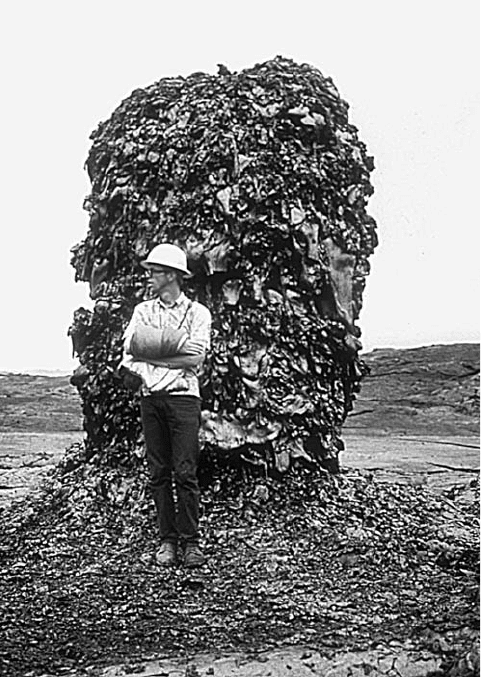
spatter cone A spatter cone is a volcanic structure resem-
bling a giant anthill, standing several feet high, and formed
by eruptions of highly fluid lava. The eruptions must be
relatively nonenergetic and of small volume. Regular spat-
ters of lava are emitted a few feet high into the air and land
right around the vent. They slowly form a small mound that
resembles a volcanic cone. If the activity continues a long
time, the cone shape will be lost to more of a chimney shape
and the features are then called hornitos, which means “lit-
tle oven.”
spectral acceleration In contrast to peak acceleration,
which models the movement of a particle in the ground dur-
ing an earthquake, spectral acceleration approximates the
response of a building during an earthquake. The building is
modeled as a particle on a massless vertical rod with a natu-
ral period of vibration (natural frequency) of a building.
spectrum A spectrum shows how much of each type of
shaking there is from a particular earthquake. Technically, it
is an analysis of the vibrations on a seismogram that shows
the amplitude and phase of the waves as a function of fre-
quency or period.
splay A fault splits or branches so that part of the offset is
taken up on the branch or splay of the fault. A splay is there-
fore a small fault that connects to a larger fault. Splay faults
develop because the larger fault can’t easily move through a
certain rock. The motion must be taken up on both faults.
Srinagar earthquake, India A major earthquake struck
the city of Srinagar and its surroundings in northern India
on May 30, 1885, at 2:45 a.m. The quake had an estimated
Richter magnitude of 7.0, and the intense damage covered
some 750–1,000 square miles (1,945–2,600 km
2
). Large fis-
sures were reported to have formed, and liquefaction pro-
duced sand blows some 24–60 inches (60–150 cm) across.
A huge landslide at Larridar was reported to have caused
many deaths. In all, the death toll was reported as 3,200
people, but there is debate on the exact number.
station A station is simply the geographic location of a geo-
physical instrument to analyze earthquakes.
stick-slip A description for that way rocks deform in a
fault that produces regular earthquakes. stress builds up in
the fault as the tectonic plates or other large-scale pressure
affects an area. Nothing happens until the stress exceeds the
strength of the rock. Then an earthquake occurs and relieves
A hornito on Kilauea volcano, Hawaii in 1970. A hornito is a tall spatter
cone. The texture on the hornito is caused by blobs of lava landing and
cooling on the outside of the spatter cone. (Courtesy of the USGS)
246 Sparta
much of the stress on the fault rocks. With time, the pres-
sure builds up again until once again there is an earthquake
to relieve the stress. The sticking of the fault while the stress
builds up and the slip of the fault during the earthquake
describes the process.
stock A small, approximately circular igneous intrusion.
These plutons are spherical to an inverted teardrop shape;
however, the view from the surface makes them look circu-
lar. They must be less than 100 square miles (259 km
2
) in
that surface view. Plutons greater than 100 square miles (259
km
2
) in the surface view are called batholiths.
strain Quantitative strain is a ratio of an initial size to
a final size, so it is either unitless or expressed as a percent.
Strain can be compressional, tensional, extensional, or the
result of shear. It takes stress to make strain.
See also deformation.
strain rate The rate at which a material takes on strain
when subjected to a given stress. Strain is a ratio of an ini-
tial size to a final size, so it is either unitless or expressed as a
percent. The unit of strain rate is therefore no unit over time,
or sec
-1
. Typical geological strain rates (plate tectonic) are
10
-14
sec
-1
, which is so slow that it cannot be modeled in a
laboratory. On the other hand, strain rates related to mass
wasting, volcanoes, or earthquakes can be very fast.
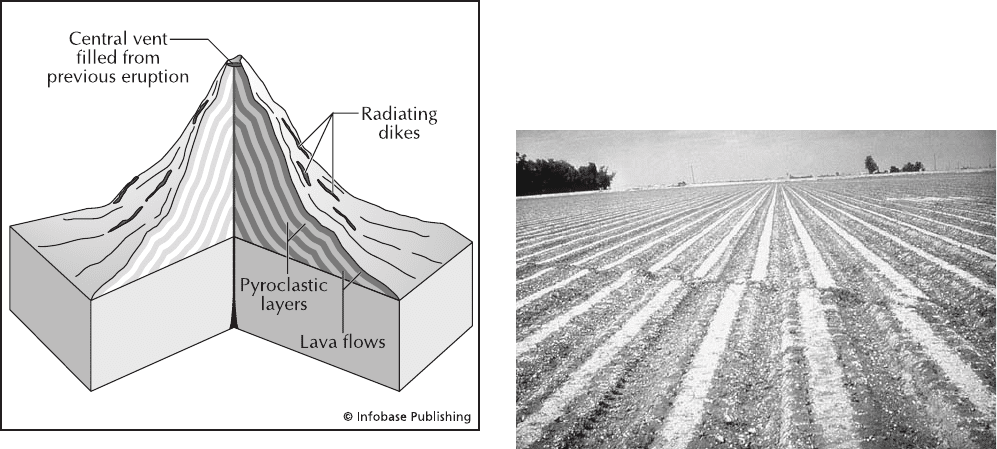
stratovolcano A steep-sided volcanic cone formed by
repeated eruptions of lava and pyroclastic material. As
summit eruptions occur one after another, layer upon layer
of pyroclastic debris is dropped around the vent from ash-
falls and ash flows. These ash layers are thin near the sum-
mit and thicken downslope toward the base of the volcano.
lava flows are sporadically interlayered with the ash, but it
is volumetrically minor in comparison. These volcanoes are
therefore almost exclusively rhyolite, dacite, and andes-
ite. Because of the great ash content, these cones are highly
susceptible to weathering and are removed relatively quickly.
All that remains is the volcanic neck after several million
years depending upon the climate.
See also volcano.
stress Stress is the action that causes strain or deforma-
tion. It is an applied force per unit area of a material. If stress
is equal on all sides of a material, it is called pressure, like air
pressure or water pressure. In all but a few cases, to cause
strain in rocks, stress must be different in at least two direc-
tions, which is termed differential stress. There is a maximum
stress direction in response to which objects are shortened and
a minimum stress direction in which objects may extend.
stress drop stress may build up in a material if it is resis-
tant to strain. If and when the stress overcomes the strength
of the material, it will break abruptly, and the stress of the
material will drop. This is the idea behind an earthquake.
Stress builds up in a fault for a period of time until it over-
comes the frictional forces preventing the fault from slip-
ping. The earthquake releases the built-up stress, and there
is a stress drop in the fault, before to after. The stress drop of
the fault is the energy released as seismic waves in the earth-
quake.
strike-slip fault A fault with purely lateral motion and no
vertical motion. The motion on these faults must be viewed in
a map sense. The land on one side of the fault slides sideways
without producing a topographic expression. The way to
determine the type of strike-slip fault is to stand on one side
Model of a composite stratovolcano cone. It is composed of interlayered
pyroclastic deposits and lava flows. The pyroclastic deposits are mainly
ash-flow tuff with lesser amounts of ash-fall tuff. The central vent emits
the ejecta through a summit caldera, but the radiating dikes can also feed
a lateral vent as well.
Offset rows of lettuce from movement on a strike-slip fault in El Centro,
California. The shift of the rows is to the left, making this a left-lateral or
sinistral strike-slip fault. The earthquake occurred on October 15, 1979,
and had a magnitude of 6.9. (Courtesy of NOAA)
strike-slip fault 247
of the fault and look across to the other. If the land moved to
the left, it is a left-lateral or sinistral fault. If it moved to
the right, then it is a right-lateral or dextral fault.
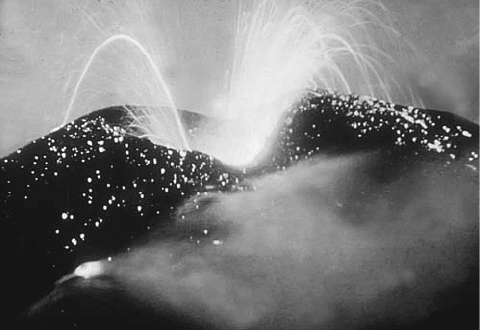
Stromboli volcano, Tyrrhenian Sea, near Sicily Known as
the Lighthouse of the Mediterranean, the volcanic island of
Stromboli rises slightly more than 3,000 feet (914 m) above
sea level. It is one of the most active volcanoes on Earth, hav-
ing been in near constant eruption for 2,000 years (some say
5,000 years). The modern volcano developed about 15,000
years ago. Stromboli’s eruptions have varied in output and
intensity from mild activity of fumaroles to violent out-
bursts. In those of 1907, explosions shattered windows in
villages on the island, and incandescent material was cast
out of the crater. The 1919 eruption killed four people and
destroyed 12 homes. In 1930, two strong explosions on Sep-
tember 11 followed an earthquake that produced a minor
tsunami. Three people were killed in an avalanche during
the 1930 eruption. In 1986, a biologist was killed on the cra-
ter rim. Most of the eruptions, however, consist of small gas
explosions that shoot incandescent bombs of lava in a fire-
workslike display. This type of eruption is the basis for the
Strombolian eruption.
Strombolian eruption See eruption.
sturzstrom If a large rock mass slips down a steep slope,
the rough terrain may shatter the mass into large numbers
of fragments moving at enormous speeds. These flows can
move at speeds greater than 335 feet (100 m) per second,
making them the fastest form of mass wasting. They are
super debris avalanches. They may contain water, but the
mode of transportation is more commonly the result of the
debris particles colliding internal to the mass. These inter-
nal collisions cause the mass to move as a nearly friction-
less cloud. It has been found that they hit the substrate of
the chute so that they can cause it to melt locally, forming a
glassy rock informally called frictionite because it is gener-
ated by friction. The impacts can also produce shatter cones
and even shocked quartz, which is universally accepted as
evidence for a meteorite impact. Clearly, the force of impact
generated by a sturzstrom is remarkable and the damage
truly devastating.
subduction zone An area where the oceanic crust of
a plate is being overridden by another plate and is moving
downward into the asthenosphere. The overriding plate
can be either continental crust as is the case in the Andes
or oceanic crust as is the case in the Aleutian Islands. Sub-
duction zones are characterized by deep ocean trenches with
curved or “arcuate” shapes, as well as by volcanic activity
and earthquakes. The descending plate is marked by earth-
quakes that originate ever deeper into the subduction zone
(see Benioff zone). Eventually the downgoing crust melts
and forms magma of intermediate composition that rises
back toward the surface to source the large batholiths and
voluminous volcanoes that characterize island arcs and
magmatic arcs.
submarine earthquake Also known as a seaquake, sub-
marine earthquakes are common. If there is ground surface
movement during the earthquake, a tsunami will be pro-
duced. Otherwise, they are typically less dangerous than a
land-based earthquake.
submarine eruption Eruptions that occur beneath the
sea may be modest in scale, but in some cases they are much
more powerful and have provided some of the most spec-
tacular events in the history of volcanology. The eruption
of Surtsey near Iceland and Myozin-Syo near Japan are
recent examples of such eruptions. Iceland has a vivid history
of submarine eruptions. Located on a mid-ocean ridge,
volcanic activity is abundant. The name Reykjanes means
“smoky cape,” a reference to submarine eruptions near
that Icelandic cape. Several islets were formed here during
an eruption in 1240; most of them vanished later, but oth-
ers reappeared to take their places. In 1783, about a month
before the volcano Skaptarjökull erupted, a volcanic island
appeared, but it too was soon reduced to a mere reef by wave
action. Yet another submarine eruption in 1830 produced an
island. (This eruption was notable for apparently destroying
the skerries known as the Geirfuglaska and with them the
great auks that had bred on them up to that time.) Another
island emerged from the sea approximately 10 miles (16 km)
off Reykjanes in July of 1884.
The Aleutian Islands of Alaska are monuments to
submarine volcanism, having arisen from the ocean floor in
island arc eruptions that continue into the present. These
eruptions have been observed frequently since Americans
of European descent began to explore and settle Alaska. In
1856, for example, one Captain Newell of the whaling bark
Alice Fraser, together with men from several other vessels,
watched a spectacular submarine eruption in the Aleutians.
No island appeared during this eruption, but huge jets of
water rose up from the sea, and the waters were strongly
agitated. Volcanic ash and stones soon emanated from the
eruption site, and pumice was strewn over the sea for great
The stratovolcano Stromboli, in Italy, has been in almost continuous
incandescent eruption for nearly 2,000 years. It has been named the
“Lighthouse of the Mediterranean” as a result. (Courtesy of NOAA)
248 Stromboli
distances. Loud noises accompanied the eruption, as did
shocks like those of earthquakes.
An eruption that produces large amounts of pyroclas-
tic materials may build up an island in time, but as described
above, wave action quickly reduces such an island to sea
level unless lava flows occur to give the new island greater
resistance to erosion. When magma is relatively gas-poor and
flows freely, as in the case of the great shield volcanoes
of the Hawaiian Islands, lava flows occurring over many
years can build up a huge island. These submarine eruptions
are produced by hot-spot volcanism and are almost exclu-
sively basalt.
Volcanoes that exhibit more explosive eruptions may
also emit enough lava to produce large islands, but the explo-
sive character of their eruptions may destroy those islands
soon after they are formed; the island may simply blow itself
to pieces, as in the famous case of Krakatoa. Much of the
explosive character is produced by interaction with seawa-
ter. The flash boiling of water increases its volume more than
22.4 times instantaneously. These explosions produce a huge
amount of steam and are called phreatic explosions.
An undersea volcano that produces a mountain whose
top has not yet reached the surface is called a seamount. A
seamount with a flattened top, indicative of wave action and
subsequent submergence, is known as a guyot. Submarine
eruptions occur frequently, though not always with spec-
tacular results, along mid-ocean ridges, where magma rises
from Earth’s interior to the surface. This process creates new
crustal rock, which moves outward on either side, away from
the ridge, in somewhat the same manner as goods on a con-
veyer belt. Not all undersea volcanism, however, occurs along
such ridges.
Sukaria caldera, Flores Island, Indonesia The boundaries
of the Sukaria caldera are uncertain, but it may be as much
as 11 miles (17.5 km) in diameter. Likewise, the geologic
history of the caldera is largely unknown. Several lakes
are located at the caldera. The color of one or more of these
lakes changed in 1937–38 because of sulfur and sulfuric
acid in the water. A fountain of water some 300 feet (91 m)
high arose from one of the lakes in 1968. On April 27, 1986,
one crater lake showed an increase in gas bubbling, and an
earthquake occurred the following day. Evidently some phre-
atic explosive activity occurred at the caldera in the 1860s,
but details are unavailable.
sulfur A chemical element by definition but sulfur is also
mineral commonly associated with volcanic eruptions. Sulfur
in its pure, native form is a yellow mineral that may be found
in crystals or in irregular masses. Volcanoes with solfatara
are areas with thick sulfur deposits. It can even occur as a
molten liquid as on Jupiter’s moon Io. Sulfur may join with
various metals to produce sulfides, some of which are widely
mined as ores. Galena (lead sulfide) and pyrite (iron sulfide)
are familiar examples of such ores although native sulfur is
more commonly mined.
summit eruption A volcanic eruption from the top of the
volcano. The classic volcanic eruption is a summit eruption
in which lava and/or ash and gas explodes out of the top of
the volcano. In contrast, in a lateral eruption, the side of the
volcano is blown out. lateral blasts are far more danger-
ous than summit eruptions.
Sunda caldera, Java, Indonesia The Sunda caldera on the
island of Java may be only about 2,000 years old, according
to one estimate. The diameter of the crater is not known
with certainty but is thought to be between 3.5 and five miles
(5.6 and 8 km). The stratovolcano Tangkubanparahu
occupies part of the caldera. Although a stratovolcano, it is
basaltic and has a structure like that of a shield volcano.
There are several large craters—Kawah Baru, Kawah Ratu,
Kawah Upas—and a number of lesser craters on the summit
of the volcano.
Tangkubanparahu has erupted about 17 times since
1826. Within historical times, eruptions have tended to be
minor and phreatic. This mildness is fortunate because the
city of Bandung with a population of 1.6 million is a mere
18 miles (29 km) to the south. Carbon dioxide and hydro-
gen sulfide gases may gather in craters in concentrations high
enough to endanger humans and other animals. An apparent
eruption was reported in 1829 after several days of “violent”
noise. An eruption in 1846 was stronger than most at this
volcano and is thought to have involved a pyroclastic surge
that destroyed a whole forest and broke off trees several feet
above the ground. There is also a report of a flow of ash and
mud from this eruption that moved eastward from the vol-
cano and destroyed trees and shrubbery. In 1896 a renewal
of activity at Kawah Upas involved minor explosions and the
formation of a new crater, Kawah Batu. The volcano appar-
ently emitted rumbling noises on several occasions in 1908,
but no sign of activity was observed in the craters. Under-
ground noises and an ash column from Kawah Ratu were
reported in 1910, and a strong earthquake occurred on April
22, followed by a less powerful earthquake on April 30. Ash
eruptions were observed in May.
In 1913, solfataras became more active; subterranean
rumbling was reported, along with vigorous steaming from
vents involved in the 1896 and 1910 eruptions. In 1926,
phreatic eruptions produced a new crater some 150 feet (46
m) wide, Kawah Ecoima, inside Kawah Ratu. Solfataric activ-
ity intensified in 1967, and a solfatara cast out mud in May
of that year. Small eruptions of ash also occurred in 1967,
and certain solfataras showed a sharp increase in temperature
in September of the same year. Phreatic eruptions in 1969
deposited a small layer of ash on the volcano. In 1971, the
volcano emitted a small quantity of mud, and thermal activ-
ity intensified.
Seismic activity started to increase in June 1983 and
showed a dramatic increase later that year, from several
earthquakes per day in June to more than 1,000 per day on
some dates in September. Most of these earthquakes occurred
near the surface and in the vicinity of the Baru fumarole
field, although only a very slight increase in fumarole tem-
peratures was recorded. Temperatures at fumaroles at Kawah
Baru increased sharply in later 1985. Slight earthquake activ-
ity was reported in 1986. A magma reservoir approximately
one mile under Kawah Upas is thought to have increased by
Sunda 249
more than 70 million cubic feet (1,982,179 m
3
) of magma
in the 1980s, and measurements taken at Tangkubanparahu
indicate that some inflation occurred at the volcano in the
early 1980s.
Suoh depression Sumatra, Indonesia The Suoh depression
is located along the Semangko Fault Zone on the island of
Sumatra. There is disagreement about the possible origin of
the Suoh depression. It has been argued that the depression
is purely tectonic in origin and, alternatively, that it formed
by a combination of tectonic and volcanic activity. Many hot
springs occur within the depression. A strong earthquake in
1933 was followed a few hours later by increased steaming
in the Suoh depression. Two weeks later, a large phreatic
eruption took place in the depression, forming two explo-
sion craters and making a noise that was heard approxi-
mately 400 miles (643 km) away. A pyroclastic surge may
have been associated with this event, but this is not certain.
Another strong earthquake occurred in 1985, but there was
no sign of increased volcanic activity.
supervolcano Supervolcano is not a scientific term, it was
invented by producers of a British television program. It
refers to a volcano that has produced massive effects, largely
through an explosion and the ejection of immense quanti-
ties of ash and other pyroclastics. Supervolcanoes have
the potential to greatly change the climate of the Earth for a
temporary but significant period of time. Humans have been
very lucky that we have not experienced the eruption of a
real supervolcano during modern times or else we may not
have been so successful. Even relatively small eruptions from
volcanoes such as Tambora and Laki have disrupted modern
life. Volcanic eruptions such as those from Toba and Yel-
lowstone could shift the climate so strongly that worldwide
famines could completely destabilize the political systems of
the world.
surface faulting Also known as surface rupturing, surface
faulting is a slip along a fault during an earthquake that
reaches the surface of the Earth. In other words, it is fault
movement at the surface. The phenomenon is restricted to
shallow earthquakes with foci less than 12 miles (20 km) in
depth and commonly much less. It also requires significant
slip on the fault to propagate all the way to the surface. Sur-
face faulting of a dip-slip fault leaves a scarp, whereas a
strike-slip fault does not. Aseismic creep can also produce
surface faulting.
surface wave Seismic waves that move only along the sur-
face of Earth. Surface waves include two types, Rayleigh
waves and Love waves. Ocean waves are a type of surface
wave in that they move only along the top 50 feet (15 m) of
the ocean water in most cases.
Surtsey volcanic island, near Iceland The volcano Surtsey
emerged from the North Atlantic Ocean south of Iceland
in 1963. The crew of a fishing boat noticed a cloud rising
from the sea on November 14 and recognized the cloud as
coming from a volcanic eruption. Apparently the eruption
had been under way beneath the ocean surface for some time.
It went unnoticed except for a few small indications such as
minor earthquakes and venting of hydrogen sulfide gas, which
produced a characteristic odor of rotten eggs, perceptible on
the Icelandic shore nearby. Within 10 days of its discovery,
the eruption had produced an island about a half-mile (0.8
km) long, almost as wide, and about 300 feet (91 m) high at
the rim of the principal crater. Made up of fragments of vol-
canic rock, the island grew in size despite the erosive effects
of waves and measured almost a mile wide at maximum by
early February. Steam explosions sent volcanic bombs flying
out from the volcano. As steam explosions diminished, lava
outflows from the volcano, after cooling and hardening, made
the island more secure against erosion. Surtsey’s eruption con-
tinued intermittently for more than three years before finally
subsiding in 1967. Volcanoes in shallow water, of which Surt-
sey is an example, tend to erupt explosively because of lava
contact with relatively cold seawater. The eruption becomes
less explosive when the summit rises above sea level and direct
contact between sea and magma is reduced.
The eruption produced about 0.25 cubic miles (1 km
3
)
of lava and ash, but only 9% of it was above sea level.
Between 1967 and 1991, Surtsey subsided some 3.6 feet (1.1
m), likely as the result of compaction of seafloor sediments
and/or isostasy.
S-waves Seismic waves with a lateral shearing motion that
travel throughout the solid Earth from the epicenter of an
earthquake. They are S waves because they are the second
waves to arrive at the seismograph. S-waves cannot travel
through liquid and therefore do not penetrate the liquid
inner core of Earth. There is consequently a shadow zone
on the opposite side of Earth from the earthquake epicenter.
See also seismology.
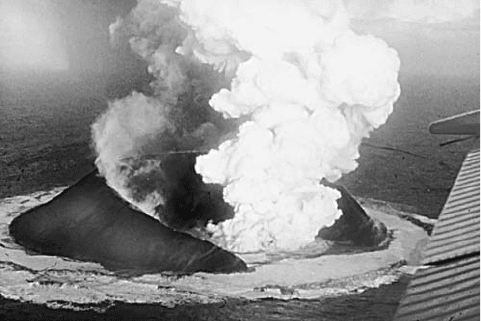
The building of the island of Surtsey, Iceland in 1963. This volcano began
400 feet (130 m) below the ocean surface and during the eruption built an
island one-half mile across. (Courtesy of NOAA)
250 Suoh depression
Taal volcano, Luzon, Philippines The volcano Taal, on an
island inside Lake Bombon, a caldera lake, has a history of
eruptions dating from 1572. It has erupted at least 34 times
since then. Records of eruptions in the 16th and 17th centu-
ries indicate that destruction was widespread. An eruption in
1707 is said to have brought about a spectacular display of
lightning but caused no damage to nearby communities. In
another eruption, in 1719, eruptive activity is said to have
progressed down the side of the volcano and into the lake;
on this occasion tsunamis appear to have occurred and
caused many fatalities, and fish reportedly were killed by
heat. Evidently, few people were killed in several subsequent
eruptions in the early 18th century. A vigorous eruption in
1754 that expelled great amounts of material and crushed a
church under the weight of the ashfall is said to have taken
only a dozen lives, although it seems likely that many other
deaths from the eruption went unreported. Eruptions con-
tinued at intervals through the 19th century, but no great
loss of life appears to have occurred. The most destructive
eruption of Taal occurred in 1911 when activity thought to
have centered around Green Lake, one of two crater lakes,
resulted in an outburst of mud that killed most inhabit-
ants of the island. The waters of Green Lake were said to
be highly acidic, and the acid content of the resulting mud
is believed to have been responsible for many of the deaths
that occurred. At other locations, asphyxiating gases appear
to have been responsible for numerous deaths. In addi-
tion, a tsunami was reported. More than 1,300 people were
reported killed in this eruption. Another, major eruption in
1965 had a VEI = 4 and killed approximately 500 people
from a
NUÉE ARDENTE. Since 1991 Taal has entered another
phase of unrest with earthquake swarms and steam vents
and as a result is being closely monitored.
Taal has been designated as one of the 15 “Decade Vol-
canoes” that present especially large potential hazards to
population centers. The densely populated city of Manila is a
mere 30 miles (48 km) north.
Tabas earthquake, Iran In contrast to the more common
earthquakes in northern and western Iran, this earthquake
was in the far eastern part of the country near Afghanistan.
On September 16, 1978, the small agricultural city of Tabas,
right on the edge of the desert, was totally demolished. Of
the 17,000 residents, a shocking 15,000 were killed in the
earthquake. In all, some 25,000 Iranians lost their lives in
this disaster. The Richter magnitude of this earthquake was
7.7, and the epicenter was right in the center of Tabas. The
40 villages within a 60-mile (100-km) radius of the epicenter
were leveled. The quake could be felt as far away as Tehran,
some 400 miles (640 km) to the northwest. It was felt through
70% of Iran.
T
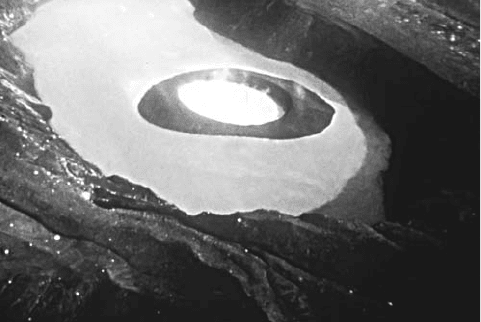
The stratovolcano Taal sits in the middle of a large caldera lake (eight by
11 miles [13 by 19 km]). This volcano is responsible for more than 1,300
deaths, mostly as a result of tsunamis it generated in the lake during
eruptions. (Courtesy of NOAA)
251