
Gates A.E., Ritchie D. Encyclopedia of Earthquakes and Volcanoes
Подождите немного. Документ загружается.

sag A sag is a long and narrow topographic depression
that lies along a strike-slip fault. May sags are filled with
water. In this case, they are called a sag pond.
sag pond Pond common on an active fault. A depres-
sion can form on an active fault by subsidence or disrupted
drainage patterns. The rock is broken up and weakened in
the faulting process. Erosion can proceed much faster in these
zones, leading to the formation of depressions. Juxtaposing
streams against other topographic features through faulting
disrupts normal drainage. The small ponds form all along the
faults. The San Andreas Fault has several good examples
of sag ponds.
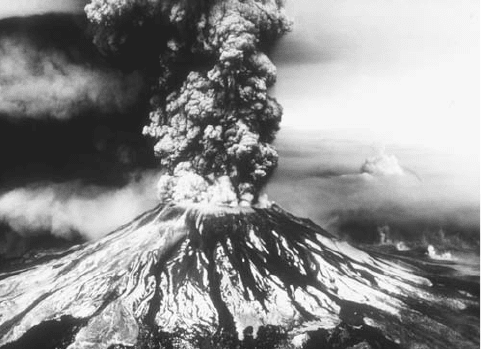
Saint Helens, Mount Washington, United States The
1980 eruption of Mount Saint Helens caused $1.5 billion or
more in total damage, destroyed more than $100 million in
crops, and demolished some 150 square miles (389 km
2
) of
timber. More than 100 people were reported dead or missing
following the eruption. The first indications of an impending
eruption that year began on March 20 when a seismograph
at the University of Washington in Seattle detected an earth-
quake approximately 20 miles (32 km) north of Mount Saint
Helens. Earthquake activity near the volcano increased over
the following several days. On March 27, the volcano emit-
ted a loud explosion along with a plume of ASH and vapor
that rose to more than 20,000 feet (6,000 m) in altitude.
This eruption left a crater some 250 feet (76 m) wide on
the summit. Another cloud of vapor and ash two days later
reached Bend, Oregon, some 150 miles (241 km) south of
Mount Saint Helens.
By April 7, tremors indicated that magma was flowing
beneath the volcano. An eruption on April 8 lasted more than
five hours. Soon afterward, the north flank of the mountain
was noticed bulging outward, in much the same manner as
a blister on an overinflated tire. The blister indicated that
magma and gas released from it were building up pressure
within the peak. Governor Dixy Lee Ray declared a state of
emergency on April 9, and the National Guard took steps to
prevent onlookers from approaching the volcano. The bulge
remained intact for more than another month, despite a
violent eruption of May 7. Eventually, the bulge grew to be
about 2,000 feet (610 m) long and 500 feet (152 m) high.
The bulge disintegrated at about 8:30 a.m. on May 18, 1980,
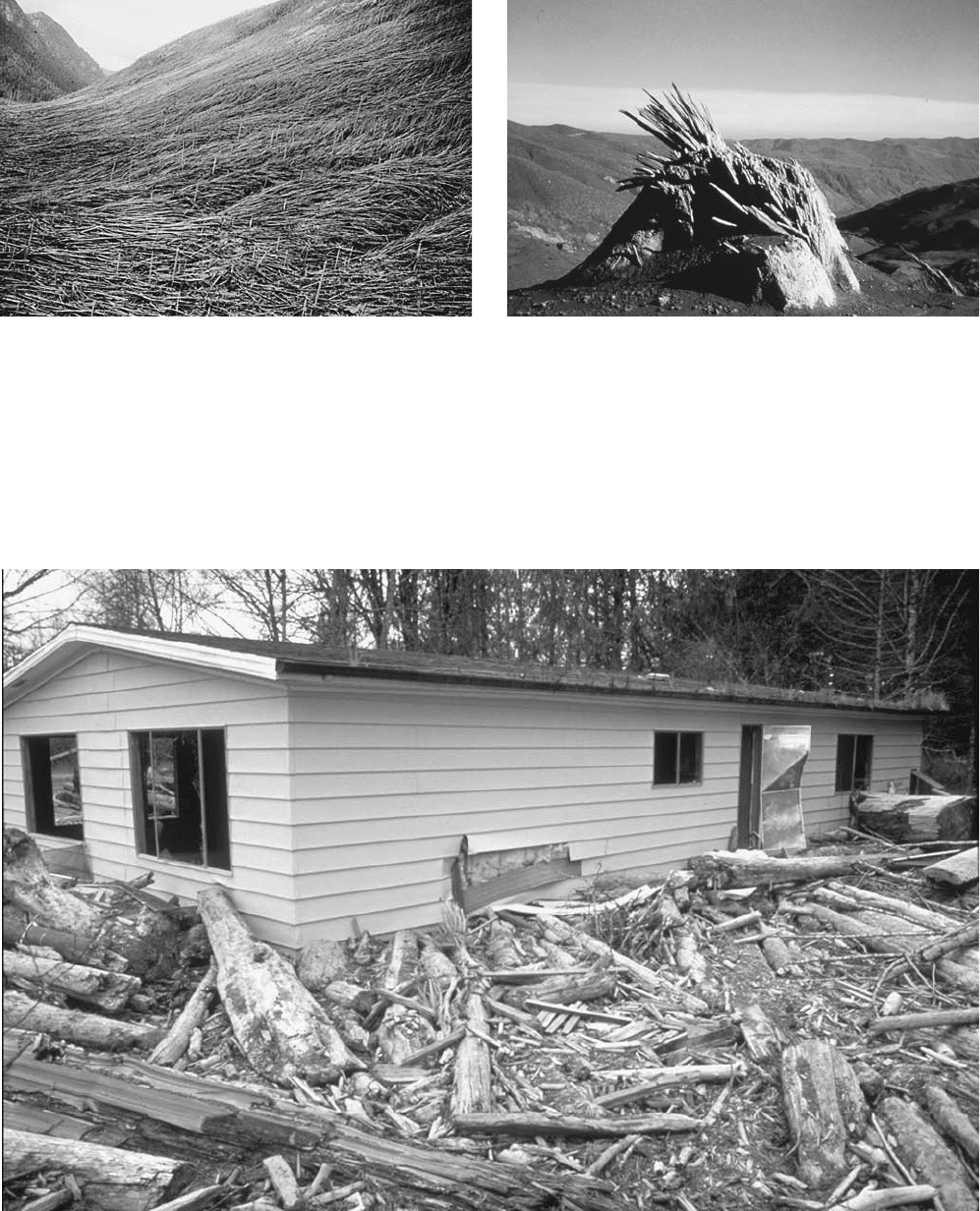
when an air-blast explosion from Mount Saint Helens cre-
ated a blast wave that moved at an estimated velocity of 200
miles (322 km) per hour and knocked down trees in “blow-
down” some 20 miles (32 km) away. A plume of ash rose
from the mountain to an altitude of about 12 miles (19 km).
The mountains north flank, which had been destroyed in the
explosion, became an avalanche that flowed into the south
fork of the nearby Toutle River and Spirit Lake, displacing
water from the lake and sending it into the north fork of the
Toutle River. The resulting flood of debris-laden water car-
ried away virtually everything in its path, including a railroad
S
The 1980 eruption of Mount Saint Helens made this volcano in Washington
one of the most intensively studied in the world. (Courtesy of the USGS)
223
bridge. Much of the fine sediment from the avalanche and
ash cloud made its way into the Columbia River, where it
interfered with navigation.
One of the personal stories associated with the erup-
tion concerned one Harry Truman, proprietor of a lodge at
Spirit Lake near the volcano. Truman refused to leave his
lodge as earthquakes and eruptions became more frequent.
He claimed the mountain “didn’t dare” harm him. Truman
and his lodge were buried under volcanic debris during the
eruption of May 18.
“Blowdown” of trees from the lateral blast of the explosion of Mount St.
Helens, 1980 (Courtesy of the USGS)
A tree trunk splintered at its base by the tremendous force generated by
the lateral eruption of Mount Saint Helens in 1980. Thousands of acres of
trees suffered the same fate. (Courtesy of the CVO-USGS)
Trees flattened by the blowdown of Mount Saint Helens carried along by the lahar are plastered against a house at the base of the mountain. (Courtesy of
the CVO-USGS)
224 Saint Helens, Mount
The 1980 eruptions of Mount Saint Helens made the
mountain one of the most intensively studied volcanoes.
Mount Saint Helens has added to the knowledge of many
phenomena of volcanology, notably air-blast explosions.
Mount Saint Helens was built about 40,000 years ago
and was widely intermittently eruptive until 2,500 years ago.
In 1855 b.c., Mount Saint Helens produced a huge (VEI = 6)
eruption, one of the largest in North America. In the new
eruptive phase, it has gone dormant for two to seven cen-
turies between eruptive intervals. The modern volcano was
built between 2,200 and 1,600 years ago. The last eruptive
phase prior to the 1980 eruption is termed the Goat Rocks
eruptive period. It lasted from about 1800 to 1857 and pro-
duced numerous minor eruptions. There are also reported
minor eruptions in 1898, 1903, and 1921.
Saint Lawrence Valley Canada and United States The
Saint Lawrence River valley forms the boundary between a
portion of New York State and eastern Canada and has
been the location of numerous earthquakes, some of them
severe, over the past several centuries. It would be impractical
in this space to provide a complete listing of earthquake
activity in the Saint Lawrence Valley since settlement of the
area by Europeans began, but descriptions of several notable
earthquakes may convey a sense of the seismic potential of
this region.
An earthquake on June 11, 1638, for example, is
believed to have occurred in the Saint Lawrence Valley. This
very strong earthquake affected Trois-Rivières (Three Riv-
ers), Quebec, and was felt so strongly in New England that
people in Massachusetts had trouble standing upright and
that portions of chimneys were shaken down in the vicinity
of Lynn, Plymouth, and Salem, Massachusetts. Connecti-
cut and Narragansett, Rhode Island were also affected
by the earthquake, as were ships off the coast. Lesser shocks
occurred for some three weeks after this earthquake.
Another powerful earthquake on September 16, 1732,
caused substantial damage in Montreal and reportedly killed
seven people. Houses in New Hampshire were damaged,
and the earthquake was perceived in Boston and as far away
as Annapolis, Maryland. On October 20, 1870, a power-
ful earthquake was felt strongly at Montreal and Quebec and
was reported over a vast area of the eastern United States,
as well in such widely separated states as Iowa, Michigan,
and Virginia. (There is some question, however, whether
certain reports, from Virginia and Iowa, are accurate.) The
shock was strong enough in Maine to break windows and
was felt along the northeast coast of the United States from
Portland, Maine, to New York. The vicinity of Lake George
in eastern New York State was also affected. The earthquake
lasted one minute and was accompanied by a rumbling sound
at Albany, New York. Clocks reportedly stopped in Cleve-
land, Ohio.
The 20th century has also seen some notable earthquakes
in the Saint Lawrence Valley. An earthquake on February
28, 1925, was centered near Laurentides Provincial Park,
between La Malbaie (Murray Bay) and Chicoutimi. The exact
epicenter was difficult to determine because instrumenta-
tion in the region at the time was inadequate for that task.
Although this was a powerful earthquake, measuring about
VIII on the Mercalli scale in the vicinity of its epicenter, and
was perceived over a great area of east Canada and the north-
east United States (it was felt as far away as Boston, Mas-
sachusetts, and New York City), it appears to have caused
little significant damage, and that was confined to a narrow
zone on either side of the Saint Lawrence River. More than
a hundred aftershocks were experienced at Chicoutimi in
the week following the earthquake. For some months, shocks
continued, including strong shocks on April 10 at La Mal-
baie and April 25 at Chicoutimi. (There also appears to have
been a foreshock on September 30, 1924, felt in Maine and
Vermont and estimated at magnitude 6.1 on the Richter
scale.) Reportedly, no one was killed directly by the earth-
quake, although several deaths from shock were attributed
to its effects. Among the intriguing effects of this earthquake
was the rotation of monuments. Statues and furniture at La
Malbaie rotated clockwise during the earthquake.
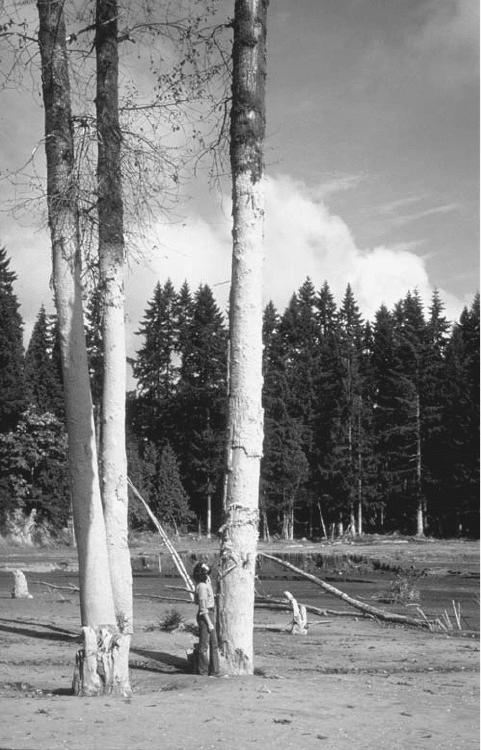
Mud line 25-feet (7.6-m) high on trees shows how deep the lahar was that
passed through this area during the eruption of Mount Saint Helens in
1980. (Courtesy of the USGS)
Saint Lawrence Valley 225
This earthquake distributed its energy in ground motion
of moderate intensity over a very wide area, with consider-
able variations in intensity at separate locations equally dis-
tant from the epicenter in different directions. The earthquake
had interesting effects on buildings in Quebec. In some cases
one structure was damaged while another standing nearby
was relatively untouched. For example, sheds and elevators
for handling grain underwent significant damage at one loca-
tion, but a nearby hotel built on rock rode out the earth-
quake so easily that there was hardly any sign an earthquake
was occurring. Near the epicenter, there was apparently little
damage to buildings because there were few structures of
any great size except for churches. A church at Saint-Urbain
underwent heavy damage, and the bells were shaken out of
place and the organ pipes were bent at another church at
Rivière-Quelle. As a rule, buildings situated atop rock came
through the earthquake well. Vertical ground motion near
the epicenter must have been considerable; at Rivière-Quelle,
a 200-pound rock was reportedly thrown off its foundation,
and a chimney was destroyed by vertical thrust from below.
Cracks formed along the south shore in a grid pattern. One
such crack near Rivière-Quelle was several inches wide and
deeper than two feet (0.61 m). In some areas, frozen Earth
near the surface appears to have moved atop the unfrozen
portion and cracked, producing fissures through which wet
sand and water made their way to the surface.
The Grand Banks earthquake of November 18, 1929,
estimated at magnitude 7.2 on the Richter scale, was felt
throughout New England and parts of Canada south of the
Saint Lawrence River and the Strait of Belle Isle. The earth-
quake and subsequent undersea landslide (turbidity cur-
rent) broke submarine communications cables that traversed
the area of the epicenter. A tsunami associated with the
earthquake was responsible for loss of life and property dam-
age at Placentia Bay, Newfoundland. In Maine, objects were
knocked from shelves, and clocks stopped. Ships at sea also
felt the shock strongly.
Saint Vincent See Soufrière.
Sakhalin earthquake, Russia Sakhalin is a large, remote
island on the south side of the Sea of Okhotsk north of Japan
in the northwest Pacific Ocean. It was literally flattened on
May 28, 1995, by a huge earthquake with a magnitude of
7.6. The fault that produced the earthquake lies northeast
across the area and ruptured several tens of miles along its
length. Huge fissures opened, and many residents fell into
them only to be crushed whey they closed. liquefaction
produced geysers of sand and water that shot up several feet
into the air. The town of Neftegorsk, with a population of
3,000, was demolished. In all, some 1,989 people were killed
in this event.
Sakurajima volcano, Japan Located on the island of
Kyu¯ shu¯ on Kagoshima Bay and on the south rim of the Aira
caldera, Sakurajima (or Sakura-zima) is one of the most
active volcanoes on Earth. Since its first documented histori-
cal eruption in a.d. 708, it has been in nearly constant erup-
tion. It is typically Strombolian in character, but it erupted
with great violence in 1476, 1779, and 1914. An account of
the 1779 event reports that strong earthquakes of varying
duration preceded the eruption, which began when the volca-
no’s summit exploded and expelled a great white cloud. Hot
rocks fell from the volcano and reportedly set houses on fire.
Some of the rocks were so large that they were compared to
birds in flight even when viewed from a distance of several
miles. Darkness covered the area around the volcano, accom-
panied by thunder and lightning. pumice reportedly covered
the waters to such a depth that one could walk on it, and
two men allegedly used this route to escape from the volcano.
Estimates placed the number of dead at approximately 150.
One group of refugees hid in a cave and perished there when
an avalanche buried the entrance. Snow-white tephra accu-
mulated up to five feet (1.5 m) deep in places. Following the
eruption, authorities ordered everyone, regardless of wealth
or social station, to work on cleanup.
The 1914 eruption was preceded by earthquake activ-
ity and several violent eruptions from Kirishima, a volcano
about 30 miles (48 km) away. Settlements around Sakurajima
were evacuated, and not one life was reported lost as a direct
consequence of the eruption. Thirty-five people were reported
killed and more than 100 injured, but as a result of earth-
quakes, not the eruption. The 1914 eruption started on the
morning of January 12. A large cloud burst from a fissure
on the volcano’s west flank shortly after 10 a.m. and rose
about five miles (8 km). A powerful earthquake in the early
evening generated a tsunami that damaged the waterfront
area. A spectacular display of gas-rich lava emerged from the
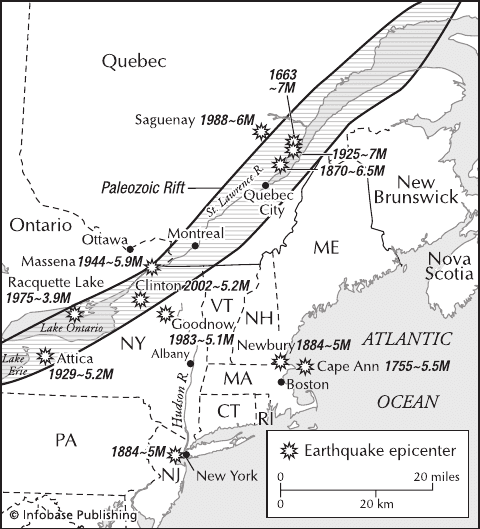
Map of the northeastern United States and southeastern Canada showing
the seismically active St. Lawrence Valley and earthquake epicenters, the
date of the earthquake, and the approximate Richter magnitude
226 Saint Vincent
volcano. lava flows from this eruption covered some 10
square miles (26 km
2
) and joined the volcanic island to the
mainland, thus converting the island into a peninsula.
The current eruptive phase of Sakurajima began in 1955.
The annual number of explosive eruptions ranged from 88 to
282 between 1991 and 1994, and ash emissions ranged from
2.9 to 16.8 million tons during the same period. About 7,000
people live at the foot of the volcano, and about one-half mil-
lion live 10 kilometers west in Kagoshima City, making the
volcano of great concern to Japan.
Sakurajima has been the subject of intensive research
into predicting volcanic eruptions. Japanese researchers
report that explosions at the crater on the summit can be
predicted, using data on tilt and strain at the summit and on
earthquake swarms occurring at shallow depths below the
crater.
San Andreas Fault California, United States Perhaps
the most famous fault in the world, the San Andreas Fault
lies along the California coast about 500 miles (805 km)
in length and marks the approximate boundary between the
North American crustal plate and the Pacific crustal
plate. The San Andreas fault is a transform margin that
exhibits right-lateral strike-slip motion. It is one of the
few transform margins on land, about 99+% are undersea.
Because San Francisco is east of the fault and on the North
American plate and Los Angeles is west of the fault and
on the Pacific plate, the two cities are actually getting closer
together all of the time. In fact, in 8 million years, they will
be twin cities.
The San Andreas Fault is not a single fault but rather a
system of faults joined together in a braidlike pattern. The
fault has different character in the north than in the south.
The northern half of the San Andreas Fault, which lies in
the San Francisco area, has reverse faults and is gener-
ally mountainous. The southern portion of the fault, which
traverses the Los Angeles area, has more normal faults and
basins associated with it (Los Angeles basin, Salton Sea).
There are many faults of various orientations that come
together to the south of Los Angeles (the Garlock Fault,
for example). The faults generally wind around the Sierra
Nevada massif. This meeting of crustal blocks, faults, and
mountain ranges has given the Los Angeles area a complex
geology. The San Andreas Fault in southern California has
numerous tributaries, including the Garlock Fault, Elsinore
Fault, White Wolf Fault, and San Jacinto Fault. The New-
port-Inglewood Fault Zone (actually a string of several
shorter faults) also extends through greater Los Angeles. The
1857 Fort Tejon earthquake occurred where the Garlock
Fault meets the San Andreas Fault. Even though many of the
earthquakes in California are not on the San Andreas Fault,
they are all the result of deformation around the fault. The
North Ridge earthquake of 1994, for example was on a
blind fault near Los Angeles. That fault was produced to
compensate for the tremendous stress exerted by the nearby
San Andreas Fault.
Despite its fearsome reputation, the San Andreas Fault
is difficult to see in many locations because development
has erased its traces on the surface. Near San Francisco, for
example, the fault is clearly visible only in a few places, such
as Lake San Andreas, which lies parallel to the fault just
south of the city, and Mussel Rock, where the fault extends
out to sea several miles away. The San Andreas Fault was
named not for a saint of the Roman Catholic Church but
rather in honor of Andrew Lawson, a geologist whose study
of the 1906 San Francisco earthquakes is considered one of
the classics in the literature of geology.
See also plate tectonics.
San Cristobal volcano, Nicaragua A stratovolcano
with a basaltic cone composed of alternating layers of lava
and tephra. It is in the San Cristobal volcanic complex,
which consists of five volcanoes. The volcano was dormant
from 1685 to 1971 when it became active. Since then, it
erupted eight times in quick succession, the last one in 1977.
That eruption lasted one day and had a VEI of 2 making it
moderate in size. A new period of activity began in 1997 and
continued through the last report in late 1999. There are also
unconfirmed eruptions in 1985 and 1987.
sand boil Produced by liquefaction, a sand boil is the
equivalent of a mud volcano. The two terms are typically
interchangeable, though sand boils supposedly contain more
sand than mud.
San Fernando earthquake, California, United States The
earthquake that struck California’s San Fernando Valley
near Los Angeles on February 9, 1971, is one of the most
famous and most intensively studied earthquakes in history.
The earthquake, also known as El Centro, registered about
6.9 on the Richter scale, killed 64 people, and injured about
2,400 others. Most of the fatalities (47) occurred at the Vet-
erans Hospital by Pacoima Canyon, much of which collapsed
completely. At another hospital, Olive View, only three
people were killed, one by falling debris and two others by
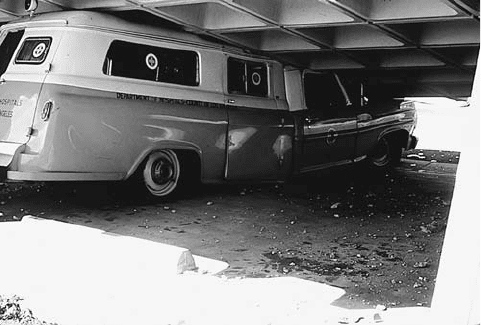
This and other ambulances, crushed by the collapse of the Olive View
Hospital, Los Angeles, were rendered useless for rescue operations after
the 1971 San Fernando earthquake in southern California. (Courtesy of the
USGS)
San Fernando 227
a power failure that cut off their life-sustaining equipment.
The Olive View facility was damaged so badly, however, that
it was almost a total loss. The extent of damage was remark-
able because the building was said to be earthquake resistant.
Because the earthquake occurred at 6:01 a.m., injuries and
fatalities were few compared to what might have happened
if the quake had struck several hours later when more people
would be expected at the hospital.
The earthquake came within a narrow margin of destroy-
ing the Lower San Fernando Dam and releasing a torrent of
water on some 80,000 residents of the valley downstream.
Part of the dam collapsed into the reservoir and reduced the
freeboard, or the distance between the reservoir level and the
top of the dam, to only a couple of feet. Had the earthquake
lasted a few seconds longer, the dam might have failed. A
curious effect of the earthquake was seen near the intersec-
tion of Rajah and Wallaby Streets in Sylmar. Here the ground
motion was so intense that it plowed grass under, so to speak,
and brought up to the surface fresh subsoil from below. After
the earthquake had done its work, only 10% of the surface
soil at this location was made up of grassy soil clods. The
other 90% consisted of fresh subsoil churned up from under-
ground. Surface ruptures occurred in a zone roughly 10 miles
(16 km) long, between San Fernando and Big Tujunga Can-
yon. Displacement involved slip of more than six feet (1.8 m)
in some places along the San Fernando Fault Zone.
San Francisco California, United States Widely known as
“Earthquake City” or “City That Waits to Die,” San Fran-
cisco sits beside the San Andreas Fault and close to other
active faults, including the Hayward Fault just across the
San Francisco Bay. Numerous earthquakes have shaken San
Francisco since its founding. Nonreinforced adobe houses
reportedly suffered heavy damage from a series of earth-
quakes that hit the city in June and July 1808. Mission Santa
Clara and Mission San Jose were damaged by a strong earth-
quake in 1822, and two powerful earthquakes struck San
Francisco in 1836 and 1838. A big quake in 1851 damaged
some buildings severely, and another earthquake the follow-
ing year is said to have cracked the ground so severely that
the waters of Lake Merced drained into the sea. An 1856
earthquake was felt as far away as Stockton and disturbed
the waters of the San Francisco Bay. In 1864, an earthquake
broke store windows in San Francisco, and another in 1865
destroyed numerous buildings and created a fissure two
blocks long in the earth along Howard Street. An earthquake
in 1868, centered near San Leandro on the east shore of the
bay, damaged every building in adjacent Hayward and was
felt more than 150 miles (241 km) away. Mark Twain expe-
rienced this earthquake while walking down a street in San
Francisco. He described the event as “terrific” and noted an
interesting detail: Many people suffered motion sickness from
the earthquake, and some remained incapacitated for hours
and even days later.
The destruction of San Francisco in 1906 by earthquake
and subsequent fire is one of the most widely known catas-
trophes in history, although earthquakes elsewhere have
caused greater loss of life. Fire consumed almost 500 blocks
(or about 2,800 acres) of the city. Roughly 30,000 buildings
were destroyed, about 3,000 of those by fire. The surface
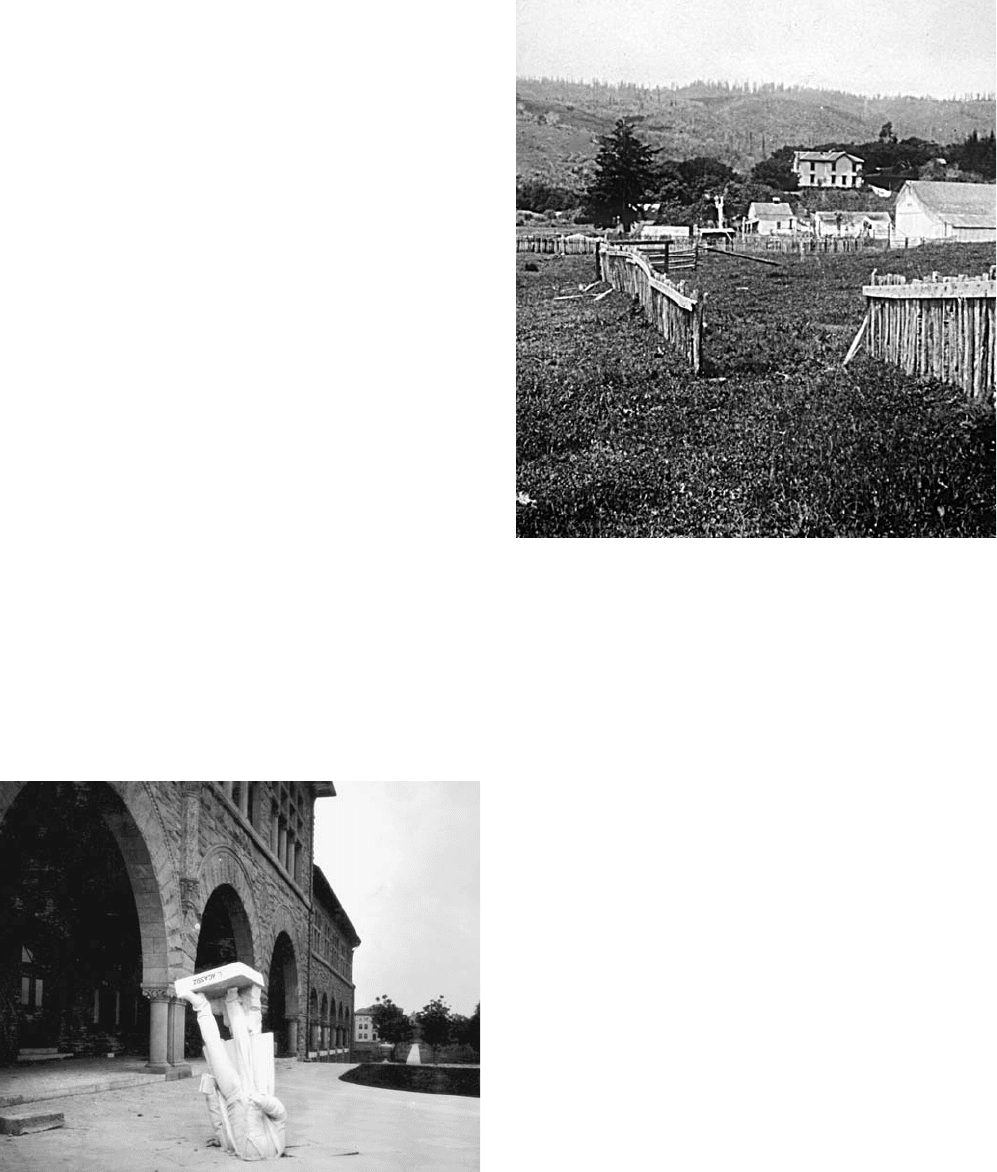
Even geologists were not safe from the 1906 San Francisco earthquake.
This photo shows the geology building at Stanford University. During the
earthquake, a statue of Louis Agassiz, a famous glacial geologist, fell
from its perch on the roof of the building and landed head first on the
plaza. (Courtesy of the USGS)
A classic picture of a picket fence offset across strike-slip fault
movement during the 1906 San Francisco earthquake, Marin County,
California. Notice that the segment of fence on the far side of the fault has
moved to the right relative to the closer fence segment. The total offset is
8.5 feet (2.6 m). (Courtesy of the USGS)
228 San Francisco
rupture from this earthquake extended almost 300 miles (483
km). Thirty schools and 80 churches and convents were listed
as destroyed, and approximately a quarter of a million men,
women, and children were left homeless. How many died in
the earthquake and subsequent fire is still uncertain. Initial
reports put the number of dead at 315, plus 352 missing and
unaccounted for, but the total of casualties has risen to more
than 2,000 as information continues to accumulate about vic-
tims of the earthquake. The earthquake, estimated at 8.2 on
the Richter scale, struck San Francisco at 5:13 a.m. on April
17, 1906. The first tremor lasted some 40 seconds and was
followed by another shock lasting a minute and a half. Fall-
ing chimneys damaged or destroyed numerous wood-frame
homes. As many as 80 guests were reported killed at one par-
ticular hotel, though not all of them by the earthquake itself;
many of them were said to have drowned when a ruptured
water main flooded the first floor. Reports indicate that a
cooking fire in the area south of Market Street burned out of
control, and the fire spread quickly through the city, which
was built without close attention to fire safety and therefore
was soon ablaze. The army tried to slow or halt the fires
spread by using dynamite to blow up buildings and create
firebreaks, but the powder they used may itself have ignited
fires and contributed to the conflagration. The army also
used artillery to generate firebreaks by shelling houses to the
ground, but this measure proved ineffective. San Francisco
was rebuilt on much the same layout as before, but this time
planners and builders incorporated into the city an extensive
system of reservoirs, secondary water mains, and cisterns to
provide an adequate water supply for fighting future fires.
Sangay volcano, Ecuador Sangay is the southernmost
stratovolcano in the northern volcanic zone of the Andes.
The first documented eruption of Sangay was in 1628. It has
been in nearly constant eruption since 1934. The eruptions
are generally Strombolian with mild explosions. In 1976,
an expeditionary team was caught in an explosion and two
people died.
San Jacinto Fault Zone California, United States The
San Jacinto Fault Zone includes a number of faults in the
greater Los Angeles area and is responsible for most of the
strong earthquakes there. The fault zone extends for some
200 miles (322 km) along the California coast and includes
the San Jacinto, Glen Helen, Lytle Creek, Claremont, Casa
Loma, Hot Springs, and Clark faults. The potential for
powerful and highly destructive earthquakes appears to be
greater, however, along the nearby San Andreas Fault
because the fault segments in the San Jacinto Fault Zone are
comparatively short (about 50 miles [80 km] long or less) and
separated from one another.
San Marcelino See Coatepeque.
San Pedro See Atitlán.
Sanriku earthquake, Japan During the late morning of
June 15, 1896, a large earthquake struck the Tuscarora Deep
in the subduction zone off the east coast of Japan. The
tremors were slow and undulating and felt from the Hok-
kaido to the Kwanto region but with no real damage. The
disaster came about 20 minutes later when a tsunami struck
the coast. In most areas, this wall of water was 10–20 feet (3–
6 m) high. In several others, it was 75 feet (22.5 m) high and
even 100 feet (30 m) high in one location. In Sanikru, people
were celebrating the Boys Festival; thousands of people gath-
ered along the seashore were subsequently swept out to sea.
The death toll was a staggering 27,122, making the event
one of the worst disasters in Japanese history. There were
106,170 houses destroyed. Deepwater fisherman returned at
the end of the day to find the harbors strewn with bodies and
the wreckage of houses. The tsunami was recorded on tidal
gauges at Sausalito, California, the next day.
Santa Ana volcano, El Salvador The first recorded erup-
tion of this stratovolcano was in 1520. Since then, it has
erupted at least 12 times. The most recent eruption was in
1920, but there are few details available on it. There is still
fumarolic activity in the crater.
See also Coatepeque; fumarole.
Santa Barbara See California.
Santa María volcano, Guatemala The andesitic strato-
volcano Santa María (“The Naked Volcano”) has a crater
that contains a small active lava dome called Santiaguito
that began to form in 1922. Santa María is famous for its
first historic eruption in 1902. It was the second-largest vol-
canic eruption of the 20th century (VEI = 6). The eruption
lasted 19 days and produced 1.3 cubic miles (5.3 km
3
) of
pyroclastic emissions. One Plinian eruption produced
an eruption column that was 16 miles (25.6 km) high. More
than 5,000 people were killed during this event, and ash
reached as far away as San Francisco. The activity contin-
ued in the crater until 1913. The lava dome Santiaguito has
been nearly continuously active since 1922 but with six main
periods of rapid extrusion to date. In 1929, the most damag-
ing eruption produced a large pyroclastic flow in a partial
collapse of the dome. From several hundred to perhaps as
many as 5,000 people were killed as the flow traveled more
than six miles (10 km). From 1972 to 1975, a particularly
vigorous phase of activity was recorded. The volcano is cur-
rently active.
Santorini caldera, Greece Located on the island of Thira
(formerly known as Thera), Santorini was the site of the cata-
strophic explosion that destroyed the Minoan civilization and
much of the island around 1470 b.c. and is thought to have
given rise to the myth of Atlantis. During some 2,000 years
following that eruption, a dome complex emerged in the cen-
ter of the underwater caldera and became the Kameni Islands,
Micra Kameni and Palaea Kameni. Palaea Kameni may have
appeared in 197 b.c. and was enlarged in a.d. 46 and 726, and
the dome of Micra Kameni appeared between 1570 and 1573.
Although there were reports of an eruption in 1457, it appears
that a cliff on Palaea Kameni merely collapsed.
Seismic activity in 1649 required residents of Santorini to
evacuate, and very powerful earthquakes occurred in 1650,
Santorini 229
followed several days later by an eruption that formed a cone.
The cone was eroded by wave action and became Colombo
Banks. Apparently, subsidence followed this eruption because
the sea reportedly moved inland in at least two locations on
Thira, the main island. In May 1707, earthquakes preceded
the emergence of a shoal some 20 feet (6 m) high, called Nea
Kameni, off the northeast shore of Micra Kameni. One account
says that mariners, curious to see what was happening, went
to examine the shoal and came back to report that a new shoal
was rising from the seafloor. The following day, more inves-
tigators set out for the shoal and managed to land on it, even
though the shoal was growing perceptibly under them. The
explorers brought back souvenirs, including some large oys-
ters that were found clinging to a rock and were said to have
an excellent flavor. In July 1708, the water grew hotter and
more turbulent at the site during the next several weeks, and
the smell of sulfur intensified. During an explosive event that
month, Nea Kameni continued rising, while Thira and Micra
Kameni reportedly subsided about six feet (1.8 m). The new
island rose to a height of about 30 feet (9 m) and a diameter
of approximately three miles (4.8 km) by November 1708 and
attained a height of almost 250 feet (76 m) by 1711. Micra
Kameni subsided during this period of Nea Kameni’s growth.
In the early 19th century, copper-bottomed ships took
advantage of the submarine volcanism at Nea Kameni to
clean their hulls. The ships simply anchored in the bay for
a while and let the sulfur-laden waters clean and polish the
metal sheathing on their hulls. Late in January 1866, fis-
sures appeared between Nea Kameni and Micra Kameni.
Earthquakes occurred, the water grew hotter, and gas rose
through the bay water south of Nea Kameni. The south side
of Nea Kameni subsided dramatically. An eruption began
around February 1, and a cone perhaps 15 feet (5 m) high
reportedly formed on the seafloor. Earthquakes continued
all through the eruption. The lava dome rose, while other
nearby areas subsided; at one place along the shore of Nea
Kameni, a pier sank almost six feet (1.8 m) between May
1866 and March 1867. Several new domes had grown on the
south side of Nea Kameni by 1870.
The temperature rose in the waters around Nea Kameni
in 1925, and local earthquakes were reported. At one point,
the heat and the turbulence were so great that navigation
ceased in the area. An explosive eruption in August 1925 led
to the formation of lava domes and lava flows. Seismic and
eruptive activity continued in the late 1920s. An eruption
occurred in 1939, and a dome formed in 1950.
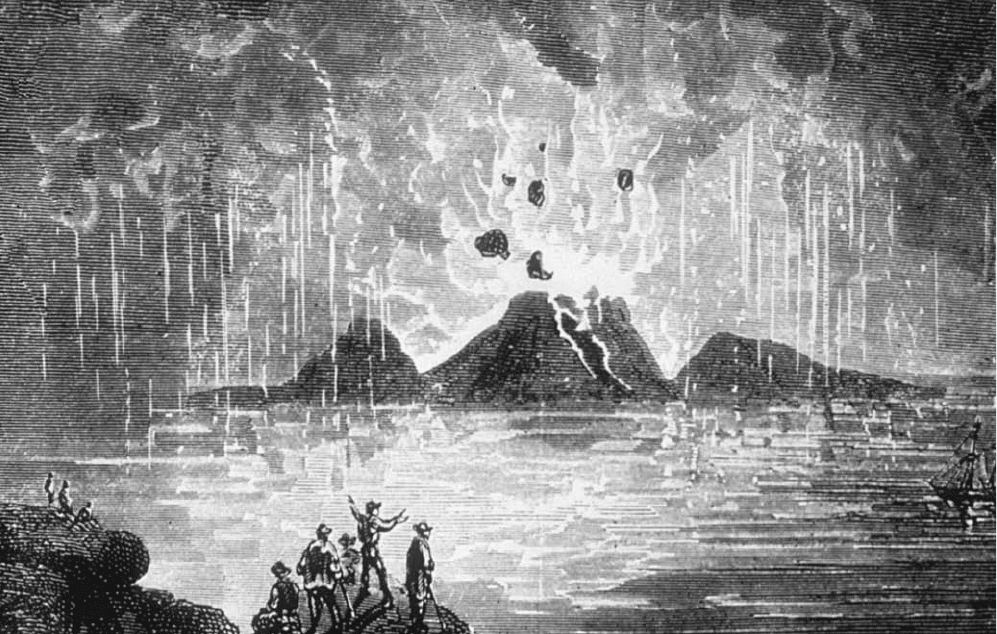
An old engraving of the 1866 eruption of Nea Kameni, Santorini. The eruption of Santorini in 1,650 B.C. was probably the largest on Earth in the past
10,000 years. It destroyed the Minoan civilization and may explain how in the Bible Moses parted the Red Sea. The Island of Thira was destroyed by the
explosion. It may have been the lost continent of Atlantis. (Courtesy of NOAA)
230 Santorini
satellite observations Earth satellites have proven to be
useful tools for monitoring volcanic eruptions. Satellites
cover large areas of the globe in a single field of view and
can provide multispectral images that can reveal images
invisible in a single band of the spectrum. A famous exam-
ple of satellite monitoring of a volcanic eruption occurred
in 1980 when the U.S. Geostationary Operational Environ-
mental Satellite (GOES) photographed the ongoing eruption
of Mount Saint Helens. In the United States, satellite
data have also been used to monitor eruptions of Augus-
tine and Redoubt volcanoes in Alaska. Weather satellites
have monitored ash clouds from other eruptions, includ-
ing those of Galung Gung in 1982, Mayon in 1984, and
Kelut in 1990. There are limits to what satellite imagery
can reveal. It can be difficult for satellites to distinguish
between the cloud from a volcanic eruption and ordinary
clouds in the surrounding atmosphere. Satellites can, how-
ever, help monitor ash clouds from major eruptions that
pose hazards to aircraft. Australia’s Bureau of Meteorol-
ogy uses images from the Japanese Geostationary Meteo-
rological Satellite to help in providing warnings to aviators
about clouds of volcanic ash over Australia and in areas
to the north, where volcanic eruptions are commonplace.
The Australians base their warnings also on reports from
aircraft and from information supplied by the country in
which the eruption occurs.
scarp See escarpment.
scoria A lightweight, basaltic volcanic rock with a dense
concentration of vesicles, scoria differs from pumice in the
density of the gas bubbles and the lack of a glassy texture.
Scoria is composed of identifiable volcanic rock. Scoria will
not float on water as will pumice. It may accumulate around
a volcano in quantities great enough to form a cone several
hundred feet high.
seamount A seamount is a volcano that rises from the
ocean floor. Some seamounts reach above the ocean surface
and form islands, of which the Hawaiian Islands are good
examples, or atolls, where the summits are covered with coral
reefs. If the seamount does not quite reach the surface and
has a flattened crown indicative of erosion by wave action
in the past, the mountain is called a guyot. Seamounts may
occur in chains or clusters, like the Emperor Seamounts
that connect to the Hawaiian chain. Seamounts spaced very
near to one another are known as aseismic ridges.
secular Secular changes are those that occur slowly, on a
long-term basis. Examples of secular changes include the slow
growth of a mountain chain or the slow buildup of stress in
a fault zone between earthquakes.
sediment See sedimentary rock; sedimentation.
sedimentary rock Rock that was deposited in the form of
particles, such as sand, silt, or clay or that was precipitated
from a solution and then transformed into rock. The material
making up sedimentary rock was originally part of another
rock, igneous, sedimentary, or metamorphic, but was
either physically removed (eroded) or chemically removed
(dissolved). The particles or solution was then transported
and finally deposited by wind, water, or glaciers. Sedimentary
rocks vary greatly in composition and texture. They are gen-
erally subdivided into either clastics (deposited as particles)
or precipitants (from solution). Examples of sedimentary rock
are sandstone, shale, and limestone.
sedimentation The process by which clastic or dissolved
material is laid down to form sedimentary rock. Sedimenta-
tion may involve deposition by air and/or water, liquid, or ice
and generally produces horizontal layers of sediment, although
sloping beds of sediment may occur in some situations.
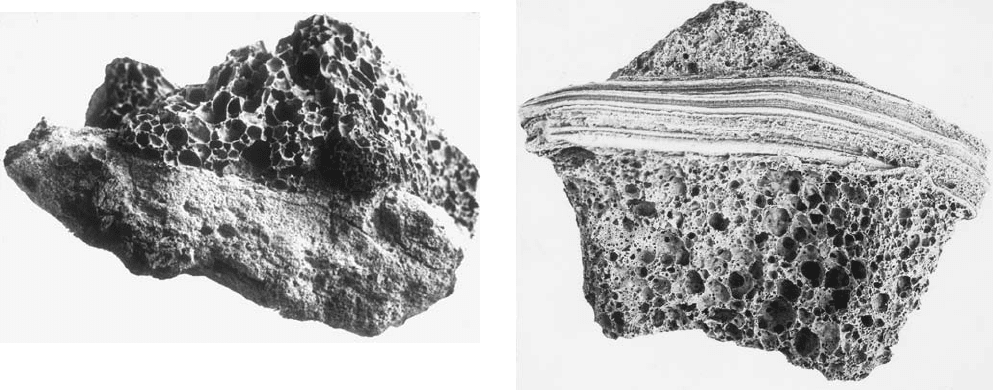
A volcanic rock that is shot full of vesicles, holes left by escaping
gas. If the volcanic rock has only a few holes, it is termed vesicular.
Foam textured rock composed completely of glass and holes is termed
pumice. (Courtesy of the USGS)
Ribbon scoria is a mixed volcanic rock showing a two-stage history of
flow and explosion. (Courtesy of the USGS)
sedimentation 231