
Graef M. Introduction to conventional transmission electron microscopy
Подождите немного. Документ загружается.


318 Dynamical electron scattering in perfect crystals
This equation describes how the amplitude in the plane z = 0 is modified in the
plane z = ; in other words, the equation describes how the electrons propagate
from one slice to the next, and hence this equation is known as the propagator
equation. The exponential of the differential operator
¯
is rather difficult to
compute analytically. However, following [CVDOdBVL97] or [Kir98], for
example, we can make use of the properties of Fourier transforms to derive a much
simpler expression. For a beam incident along the z-direction, the second term in
the definition of
¯
vanishes, and the operator is written as
¯
=
iλ
4π
xy
.
Consider the following relation (using the definition of the inverse Fourier
transform):
¯
ψ(R) =
¯
..
ψ(q)e
2πiq·R
dq,
where R is a two-dimensional direct space vector, and q is a 2D reciprocal space
vector. Since the Laplacian operator acts only on the direct space coordinates, we
can bring it inside the integral and we find:
¯
ψ(R) =
..
(−iπλq
2
)ψ(q)e
2πiq·R
dq. (5.39)
Next, we use the Taylor expansion (5.26):
e
¯
ψ =
n
n
n!
(
¯
)
n
ψ.
The higher-order derivatives of ψ can be calculated by repeated use of
equation (5.39), and we find
e
¯
ψ(R) =
..
9
n
n
n!
(−iπλq
2
)
n
ψ(q)e
2πiq·R
dq;
=
..
e
−πiλq
2
ψ(q)e
2πiq·R
dq.
Finally, we find the important result:
F
$
e
¯
ψ(R)
%
= e
−πiλq
2
ψ(q). (5.40)
The complicated exponential of a differential operator in direct space is equivalent
to multiplication by a simple phase factor in reciprocal space. We have already
seen that in reciprocal space the geometry-dependent factor is given by e
2πis
g
,

5.6 The direct space multi-beam equations 319
and this in turn means that
−πiλq
2
= 2πis
q
→ s
q
=−
λq
2
2
.
The second equality is valid for exact zone axis orientation and we leave it to the
reader to show that this relation is indeed correct.
We can gain some additional insight into the physical meaning of the propagator
term by using the convolution theorem of equation (5.40):
e
¯
ψ = F
−1
$
e
−πiλq
2
%
⊗ ψ(R). (5.41)
Propagation from one slice to the next is thus equivalent mathematically to a con-
volution operation. The first factor on the right-hand side can be rewritten as
F
−1
$
e
−πiλq
2
%
= e
iπ R
2
/λ
= e
πikR
2
/
= P
(R),
and we recognize the Fresnel propagator, which was introduced in Section 3.4.7.
5.6.3 Solving the full direct-space equation
If we subdivide the crystal into n layers or slices of thickness , then in the limit of
vanishing slice thickness we have
ψ(x, y, z
0
) = e
¯
e
iσ V
n
p
···e
¯
e
iσ V
2
p
e
¯
e
iσ V
1
p
ψ(x, y, 0), (5.42)
where the number of pairs of exponentials increases with decreasing , such that the
product n = z
0
is constant. This relation is remarkably similar to equation (5.32).
Each slice can, in principle, have a different projected potential, reflected in the use
of the superscript n. The interpretation of this relation is rather simple: the scattering
process of a fast electron is broken up into two steps per crystal slice. The first
involves multiplication with the phase grating term. The entire potential of the slice
is projected onto a plane normal to the beam direction, and, for a sufficiently thin
slice, the phase grating term changes only the phase of the electron wave function.
Then, the wave propagates to the next slice, as illustrated in Fig. 5.2. From the
starting point at (x, y, z) the electron can reach any point within a certain distance
w/2 from the point (x, y, z + ); the magnitude of this distance is determined by the
electron wavelength and the slice thickness in the form of the complex differential
operator
¯
. We will see in Chapter 7 that equations (5.32) and (5.42) form the basis
for fast numerical algorithms to compute the solution to the dynamical multi-beam
electron diffraction equations.
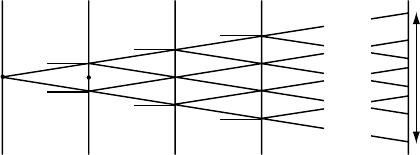
320 Dynamical electron scattering in perfect crystals
V
p
1
V
p
2
V
p
3
V
p
4
V
p
n
z = 0
ε2ε3ε
nε
x, y, 0
w
2w
3w
...
nw
x ,y,
ε
Fig. 5.2. Illustration of the propagation of an electron through consecutive slices of a crystal.
5.7 Bloch wave description
In Section 5.3, we have approached the electron scattering problem assuming that
electrons will travel only in the directions k
0
and k
0
+ g. While this is a valid
assumption for an external observer (who is interested mainly in the travel direction
of the electrons after they have left the crystal), it is not necessarily valid inside
the crystal. Let us consider a simple analogy: a sound wave – a compressive wave in
the medium “air” – enters a solid on one side and emerges from that solid on the
opposite side, ignoring reflection of the wave. We know that the only sound waves
possible inside a crystal with 3D periodicity are phonons (or quantized lattice
vibrations); thus, the sound wave will propagate through the crystal as a linear
superposition of phonons, each with its own frequency and energy. The relation
between frequency (or wave vector) and energy is called a dispersion relation.It
is possible that there are gaps in the dispersion function; this indicates that certain
frequencies are not transmitted by the crystal.
A similar situation occurs for high-energy electrons traveling through matter.
Before entering the crystal, the electron can travel with any wave vector.
†
Inside the
crystal, the allowed directions depend on the crystal structure and on the electron
energy. The problem of finding the allowed wave vectors inside a crystal is closely
related to another important solid-state problem: the band-structure of a material.
Band theory addresses the question: which electron energies are allowed for a
given wave vector (or electron momentum)? When the allowed energies are plotted
versus the wave vector, the so-called band-structure is obtained; certain energy
levels may be inaccessible to the electrons and form band-gaps. The width of a
band-gap is determined by the Fourier coefficients of the lattice potential. We will
show in this section that the problem of electron diffraction is closely related to the
band-structure of a material. We will ask the question: for a given incident energy,
what are the allowed wave vectors inside the crystal? The incident energy is several
†
Wavelength and energy are related to each other by equation (2.33) of Chapter 2, which is therefore the dispersion
relation in vacuum, and the direction of the wave is arbitrary.

5.7 Bloch wave description 321
orders of magnitude larger than the typical energies of electrons in a solid, which
will lead to some qualitative differences between the two theories.
Most of the theory presented in this section is based on two important review
articles of the Bloch wave method: Diffraction of Electrons by Perfect Crystals,
by A.J.F. Metherell [Met75], and The Scattering of Fast Electrons By Crystals,by
C.J. Humphreys [Hum79]. We have adapted slightly the notation used in those
papers to conform with the remainder of this book, and also with the notation used
in the book Electron Microdiffraction, by J.C.H. Spence and J.M. Zuo [SZ92].
We start from equation (2.37): we expand the lattice potential in a Fourier series,
V (r) =
h
V
h
e
2πih·r
.
Once again, we separate the V
0
term from the rest of the potential and we will use
the refraction-corrected wave vector k
0
(see equation 5.4) throughout this section.
We do not include absorption at this point, so that the potential above is real, not
complex. The effect of absorption will be described in Section 5.7.3.
The electron wave inside the crystal is written as the product of a wave with arbi-
trary wave vector k (to be determined later) and a function C(r) with the periodicity
of the lattice. This type of wave function is known as a Bloch wave:
(r) = C(r)e
2πik·r
=
g
C
g
e
2πi(k+g)·r
, (5.43)
where we have introduced a Fourier expansion for C(r). Bloch waves were first
introduced into quantum mechanics by Felix Bloch in 1929 [Blo29], for the elec-
tron theory of ferromagnetism. Note that, for a perfect crystal, the coefficients C
g
are independent of position; this is different from expression (5.7), where the co-
efficients ψ
g
do depend upon position. The coefficients C
g
do, however, depend
on the wave vector k. A second important difference, as mentioned above, is that
an arbitrary wave vector k is used, instead of k
0
. The solution method described
below will enable us to determine the allowed wave vector(s) k for a given incident
beam energy. The coefficients C
g
are called Bloch wave coefficients.
Substitution of (r) into equation (5.5) leads to
g
9
$
k
2
0
− (k + g)
2
%
C
g
+
h=g
U
g−h
C
h
e
2πi(k+g)·r
= 0, (5.44)
which must be valid for any position r in the crystal. Therefore, we can write
$
k
2
0
− (k + g)
2
%
C
g
+
h=g
U
g−h
C
h
= 0. (5.45)
322 Dynamical electron scattering in perfect crystals
This set of equations, one for each g,isexact, i.e. no approximations have been
used so far. They relate the wave vector k of the Bloch wave to the energy of the
incident electron (through k
0
), hence they are dispersion relations.
5.7.1 General solution method
We now proceed to solve equations (5.45) for a multi-beam situation. We note that,
as before, the scattering problem naturally separates into two contributions: the
geometry of the problem is described in the first term of (5.45), and the interaction
with the crystal potential in the second summation. The first term can again be
represented by a diagonal matrix, while the second term only gives rise to off-
diagonal matrix elements. For convenience, we select the transmitted beam to be
the first entry in the column vector of Bloch wave coefficients, and the governing
equations (5.45) can then be rewritten in matrix form as
k
2
0
− k
2
U
0−g
... U
0−h
... U
0−m
U
g−0
k
2
0
− (k + g)
2
... U
g−h
... U
g−m
.
.
.
.
.
.
.
.
.
.
.
.
.
.
.
U
h−0
U
h−g
... k
2
0
− (k + h)
2
... U
h−m
.
.
.
.
.
.
.
.
.
.
.
.
.
.
.
U
m−0
U
m−g
... U
m−h
... k
2
0
− (k + m)
2
C
0
C
g
.
.
.
C
h
.
.
.
C
m
= 0.
(5.46)
Non-trivial solutions can occur only when the determinant of this matrix is equal
to zero. It is easy to see that the leading term in this determinant is the product of
the main diagonal elements, and that this term is proportional to k
2N
, where N is
the number of beams. All other contributions to the determinant contain only lower
powers of k. The resulting characteristic equation is then a polynomial equation of
order 2N , which must have 2N roots. We thus find the important result that for an
N -beam case, the total number of allowed wave vectors inside the crystal is equal
to 2N.We will denote the different wave vectors by a superscript ( j), as in k
( j)
. The
most general wave solution inside the crystal therefore consists of a superposition
of 2N Bloch waves, each with its own amplitude α
( j)
:
(r) =
j
α
( j)
g
C
( j)
g
e
2πi(k
( j )
+g)·r
=
j
α
( j)
C
( j)
(r)e
2πik
( j )
·r
(5.47)
and the coefficient α
( j)
is the excitation amplitude of the jth Bloch wave.
It may appear that we have introduced many more unknowns than equations; in
equation (5.47) we have 2N coefficients α
( j)
,2N wave vectors k
( j)
, and 2N × N
Bloch wave coefficients C
( j)
g
, for a total of 2N
2
+ 4N (complex) unknowns. In
5.7 Bloch wave description 323
the following paragraphs, we will show that we do have enough information to
determine all the unknown parameters unambiguously.
Since the total energy of the incident electron is constant, all 2N Bloch waves
must have the same total energy; we say that the Bloch waves are degenerate. Since
the 2N wave vectors k
( j)
are, in general, different from each other, each Bloch
wave must correspond to a different kinetic energy, and therefore also a different
potential energy. This, in turn, means that different Bloch waves must travel at
different locations through the crystal. This is a very important observation, and
we will return to it in the next chapter.
The 2N wave vectors k
( j)
are ranked according to decreasing kinetic energy.
This means that the Bloch wave with the highest kinetic energy is number (1), and
that corresponding to the lowest kinetic energy is number (2N). The reader should
be warned that in some of the earlier literature on the Bloch wave theory the wave
vector with the lowest kinetic energy was taken to be k
(1)
.
We define the unit vector n as the surface normal to the sample, in the direction
opposite
†
to the incident beam, i.e. along the −z-direction. Since both the incident
wave and the wave inside the crystal are solutions to the Schr¨odinger equation,
which is a second-order equation in the spatial coordinates, both the functions and
their first-order derivatives must be continuous across the entrance plane of the
crystal. It can be shown quite generally (e.g. [Met75]) that this continuity condition
implies that the tangential component of the wave vector must be conserved across
the entrance plane. The only component of the wave vector that can change upon
entering the crystal is, therefore, the normal component. It is then convenient to
write the solution vectors k
( j)
as
k
( j)
= k
0
+ γ
( j)
n. (5.48)
This expression guarantees that all wave vectors k
( j)
have the same component
normal to the vector n. Let us use this expression to rewrite equation (5.45):
k
2
0
−
k
( j)
+ g
2
= k
2
0
−
k
0
+ γ
( j)
n + g
2
;
=−g · (2k
0
+ g) − 2n · (k
0
+ g)γ
( j)
−
γ
( j)
2
;
= 2k
0
s
g
− 2n · (k
0
+ g)γ
( j)
−
γ
( j)
2
. (5.49)
We have used the definition (2.89) of the excitation error s
g
in the last step. At this
point, we will make the assumption that the coefficients γ
( j)
are small compared
to k
0
, so that the quadratic term in γ
( j)
can be ignored. This is equivalent to the
high-energy approximation used in the previous sections, and as a result only N of
the 2N wave vectors k
( j)
remain.
‡
The N wave vectors which we chose to ignore
†
Note that some authors select the foil normal to point along the incident beam. The reader should be aware that
this leads to sign differences for the coefficients γ
( j )
.
‡
Equation (5.49) is now linear instead of quadratic in γ
( j )
.
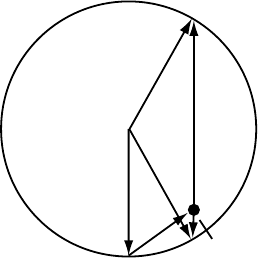
324 Dynamical electron scattering in perfect crystals
k
k
k
g
0
+
-
O
C
Ewald
sphere
e
e
g
s
g
s
+
-
z
z
Fig. 5.3. Schematic illustration of positive and negative excitation errors for a single recip-
rocal lattice point. For large acceleration voltages, the negative excitation
error is always sig-
nificantly larger than the positive one, justifying the use of the high-energy approximation.
correspond to electrons which travel in the direction opposite to the incident beam,
i.e. they correspond to reflected waves. For the acceleration voltages used in typical
TEM experiments this is a good approximation, as is shown explicitly in [KS82].
A simple geometrical argument can be used to qualitatively justify the high-
energy approximation. Consider the Ewald sphere construction in Fig. 5.3: the
reciprocal lattice point g is just inside the Ewald sphere, and if we assume that
the sample surfaces are normal to the incident beam k
0
(i.e. the corresponding
relrod is parallel to k
0
), then relation (2.89) on page 122 has two solutions for the
excitation error s
g
. The positive solution is small in magnitude and corresponds to
the excitation error used in the previous sections. The negative solution has a large
magnitude and corresponds to a beam traveling in nearly the opposite direction, i.e.
a reflected beam. The two scattered wave vectors are given by
k
+
= k
0
+ g + s
+
g
e
z
;
k
−
= k
0
+ g + s
−
g
e
z
.
The excitation error s
−
g
will increase rapidly with increasing acceleration voltage
(i.e. with increasing Ewald sphere radius), so that the probability of Bragg scattering
in the direction k
−
will decrease with decreasing wavelength. For the acceleration
voltages used in modern microscopes, it is a good approximation to consider only
electrons which were scattered in the forward direction (remember that the angle
between k
0
and k
+
is of the order of milliradians), and this is essentially the high-
energy approximation.
Elimination of half of the allowed wave vectors decreases the total number of
unknowns from 2N
2
+ 4N to N
2
+ 2N . If we denote the normal components of

5.7 Bloch wave description 325
k
0
and g by n · g = g
n
and n · k
0
= k
n
, then we find for equations (5.45):
2k
0
s
g
C
( j)
g
+
h=g
U
g−h
C
( j)
h
= 2k
n
1 +
g
n
k
n
γ
( j)
C
( j)
g
. (5.50)
If k
0
is very nearly antiparallel to n, then we also have g
n
k
n
and the equations
reduce to
2k
0
s
g
C
( j)
g
+
h=g
U
g−h
C
( j)
h
= 2k
n
γ
( j)
C
( j)
g
. (5.51)
These equations will serve as the starting point for the remainder of this section. It
is easy to see that (5.51) is an eigenvalue equation of the form
¯
AC
( j)
= 2k
n
γ
( j)
C
( j)
, (5.52)
where the column vectors C
( j)
contain the Bloch wave coefficients C
( j)
g
. For the
N -beam case, the matrix
¯
A has N × N entries, and therefore N eigenvalues and N
eigenvectors. Solution of this equation will determine all wave vectors k
( j)
and all
Bloch wave coefficients C
( j)
g
. The Bloch wave excitation amplitudes α
( j)
can then be
determined by applying the appropriate boundary conditions at the entrance plane,
as will be shown below. Since there are N eigenvalues, and N
2
components of the
N eigenvectors, and we also determine the N coefficients α
( j)
from the boundary
conditions, we have effectively determined all N
2
+ 2N unknowns, and therefore
the problem is, at least formally, solved.
It is important to consider some general properties of the eigenvalues and eigen-
vectors of
¯
A. For a non-centrosymmetric crystal we have U
g
= U
∗
−g
, and therefore
¯
A is a hermitian matrix in the absence of absorption. The diagonal of
¯
A contains
information about the orientation of the crystal, through the excitation errors s
g
,
and the off-diagonal elements contain information on the interactions between the
beams. The eigenvalues of a hermitian matrix are real, the eigenvectors are complex
and form a unitary matrix. In other words, when we consider the eigenvectors C
( j)
as columns of a matrix C, then this matrix satisfies the relation:
C
−1
=
˜
C
∗
, (5.53)
where the tilde indicates the transposition operator. If we consider the equation
CC
−1
= 1, with 1 the N × N unit matrix, then we can easily show that
g
C
(i)
g
C
( j)∗
g
= δ
ij
, (5.54)
and
j
C
( j)
g
C
( j)∗
h
= δ
gh
. (5.55)
326 Dynamical electron scattering in perfect crystals
This means that the eigenvectors of
¯
A form an orthonormal set. Standard matrix
theory then states that
¯
A can be written as
¯
A = C
˜
C, (5.56)
where is a diagonal matrix containing the eigenvalues. This decomposition of
¯
A
is known as the spectral factorization of
¯
A.
5.7.2 Determination of the Bloch wave excitation coefficients
The Bloch wave excitation coefficients α
( j)
can be determined from the boundary
conditions at the crystal entrance plane. We will rewrite the Bloch wave expansion
in the so-called Darwin representation; this is essentially the expansion (5.7), which
formed the starting point for the derivation
of the Darwin
–Howie–Whelan equations
on page 306.
Using (5.48) we have
(r) =
g
+
j
α
( j)
C
( j)
g
e
2πiγ
( j )
z
,
e
2πi(k
0
+g)·r
;
=
g
ψ
g
(z)e
2πi(k
0
+g)·r
,
with
ψ
g
(z) =
j
α
( j)
C
( j)
g
e
2πiγ
( j )
z
. (5.57)
This can be rewritten in matrix form as
ψ
0
(z)
ψ
g
(z)
.
.
.
ψ
h
(z)
=
C
(1)
0
C
(2)
0
... C
(N )
0
C
(1)
g
C
(2)
g
... C
(N )
g
.
.
.
.
.
.
.
.
.
.
.
.
C
(1)
h
C
(2)
h
... C
(N )
h
×
e
2πiγ
(1)
z
0 ... 0
0e
2πiγ
(2)
z
... 0
.
.
.
.
.
.
.
.
.
.
.
.
00... e
2πiγ
(N )
z
α
(1)
α
(2)
.
.
.
α
(N )
. (5.58)
5.7 Bloch wave description 327
At the entrance plane of the crystal we have z = 0, and the diagonal matrix reduces
to the identity matrix. The resulting equation is
ψ
0
(0)
ψ
g
(0)
.
.
.
ψ
h
(0)
=
C
(1)
0
C
(2)
0
... C
(N )
0
C
(1)
g
C
(2)
g
... C
(N )
g
.
.
.
.
.
.
.
.
.
.
.
.
C
(1)
h
C
(2)
h
... C
(N )
h
α
(1)
α
(2)
.
.
.
α
(N )
=
1
0
.
.
.
0
. (5.59)
This, in turn, means that the Bloch wave excitation coefficients α
( j)
are given by the
first column of the inverse of the eigenvector matrix. In the case of a centrosymmetric
crystal without absorption, this matrix is Hermitian, which means (using 5.53) that
α
( j)
= C
( j)∗
0
.
Note that this derivation also produces an explicit expression for the scattering
matrix S, introduced on page 312. If we denote the diagonal matrix e
2πiγ
( j )
z
δ
ij
by
E(z), then we have
(z) = CE(z)C
−1
(0) = S(0). (5.60)
The Bloch wave formalism thus enables us to compute the scattering matrix directly
for an arbitrary crystal thickness. Only the diagonal matrix E(z) depends on the
crystal thickness, in a simple exponential way. Later we will see that this results
in a fast algorithm to compute bright field and dark field images, in particular for
the N -beam case. It is clear from the relations in this and the previous section that
the Bloch wave problem is completely solved if the spectral factorization (5.56) of
¯
A is known. From the eigenvalues γ
( j)
and the eigenvector matrix C we can then
also compute the scattering matrix S. We will discuss an algorithm for spectral
factorization in Chapter 7.
5.7.3 Absorption in the Bloch wave formalism
Absorption is taken into account by adding an imaginary part to the electrostatic
lattice potential. The eigenvalues γ
( j)
then become complex, and we will denote
the new eigenvalues by !
( j)
= γ
( j)
+ iq
( j)
. Consequently, the wave vectors inside
the crystal are given by
k
( j)
= k
0
+
γ
( j)
+ iq
( j)
n.