
Graef M. Introduction to conventional transmission electron microscopy
Подождите немного. Документ загружается.

298 Getting started
n
y
x
aperture
Imaging
lens
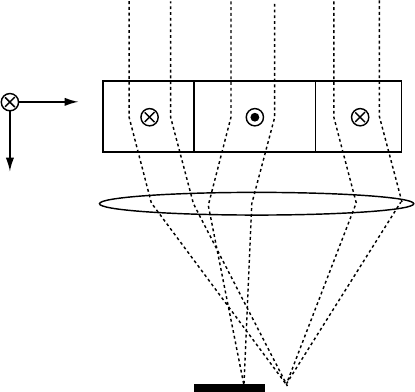
Fig. 4.30. Schematic illustration of the Foucault imaging mode.
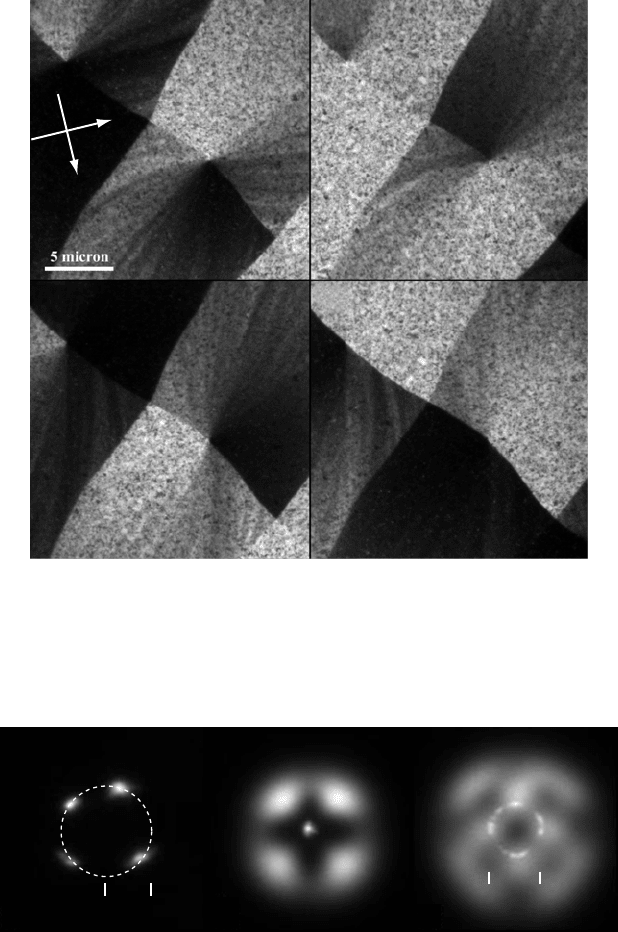
know that the direction of the Lorentz deflection is normal to the corresponding
in-plane induction direction, we can use the four images in Fig. 4.31 to obtain a
schematic (qualitative) drawing of the magnetization configuration, which is shown
in Fig. 4.28(b).
When more coherent illumination is used to obtain the Foucault images, fringes
are often observed parallel to the domain walls, inside the bright portions of the
image (e.g. [DDG97, Fig. 7]). The origin of these fringes is the same as for the
Fresnel mode and will be addressed in more detail in Section 7.5.2.
The Foucault mode is a highly qualitative observation mode, because it is no-
toriously difficult to reproducibly position the aperture. Apertures are often not
perfectly circular, or may have debris at the aperture edge. When a set of four
Foucault images is acquired, it is difficult if not impossible to manually (for me-
chanically controlled apertures) position the aperture at equal shifts from the central
beam position. This would be a prerequisite for quantitative work. It is also a non-
trivial task to determine the location of the optical axis, i.e. the position of the beam
in the absence of a magnetic sample. This position would be the “origin” for all
Foucault images, and one would have to specify the magnitude of the aperture shift
(typically in nm
−1
) with respect to this origin.
4.7.2.3 Diffraction mode
Figure 4.32(a) shows an electron diffraction pattern obtained from the divergent
part of a cross-tie wall in a 50 nm Permalloy thin film. Since the saturation induction
4.7 Lorentz microscopy: observations on magnetic thin foils 299
x
y
-y +y
-x +x
Fig. 4.31. Foucault images (zero-loss filtered with 20 eV slit width, 400 kV) for four aperture
shifts for the same sample region as Fig. 4.28 (±x and ±y directions, with respect to the
aperture directions, indicated by the white arrows). The magnitude of the aperture shift is
approximately equal for all four images.
20µrad
40µrad
(a)
(b)
(c)
Fig. 4.32. (a) Electron diffraction pattern for the beam centered on the divergent part of
a cross-tie wall; each spot corresponds to the deflection from one of the quadrants of the
magnetization pattern. (b) Image of the undersaturated filament tip (LaB
6
), for the beam
passing through a single magnetic domain; (c) same as (b), but now the beam passes through
the convergent part (vortex) of a cross-tie wall.
300 Getting started
of this film is about 1 T, the Lorentz deflection angle at 400 kV is about 20 µrad.
The pattern was acquired directly on the CCD camera of the energy filter, using
an under-saturated filament to prevent over-exposure of the camera. An exposure
time of 0.1 s was used, along with an energy selecting slit width of 20 eV. The
pattern is obtained by first focusing the second condensor lens so that the gun
cross-over is conjugate to the specimen, and then adjusting the objective minilens
current to make the viewing screen (CCD plane) conjugate to the specimen. The
lateral magnification of the diffraction pattern can be adjusted by using the free-lens
control on the microscope, or the magnification reduction options on the energy
filter.
Figure 4.32(b) shows an image of the filament tip (LaB
6
) in an under-saturated
condition, when the beam passes through a single magnetic domain. The beam is
deflected from where it would be in the absence of a magnetic sample, but that
precise location is difficult to determine experimentally. In Fig. 4.32(c) the incident
beam is focused on the vortex part of a cross-tie wall, and a nearly continuous
circular intensity distribution is obtained, along with a complex distribution from
the outer parts of the filament emission pattern. This pattern contains all the in-
formation about the momentum transfer due to the sample magnetization, but it
is complicated due to the fact that all magnetization directions around the vortex
contribute simultaneously to the image. If a fine electron probe were scanned across
the region containing the cross-tie vortex, then a synchronized measurement of both
magnitude and direction of the deflection angle would provide a direct magnetiza-
tion map of the sample (actually, a map of the product B
⊥
t). This is essentially the
so-called differential phase contrast (DPC) acquisition mode [CBWF78].
4.8 Recommended additional reading
Before proceeding with the theory of dynamical elastic scattering, we conclude
this chapter with a brief list of additional reading material that the reader may
find interesting. The following books (some of them are quite old and out-of-print
but you may find them in your library) contain information on basic microscopy
techniques and sample preparation:
r
Transmission Electron Microscopy and Diffractometry of Materials, by B. Fultz and
J.M. Howe, 2001 [FH01].
r
Transmission Electron Microscopy, a Textbook for Materials Science, by D.B. Williams
and C.B. Carter, 1996 [WC96].
r
Transmission Electron Microscopy: Physics of Image Formation and Microanalysis,by
L. Reimer, 1993 [Rei93].
r
Specimen Preparation for Transmission Electron Microscopy of Materials, by P.J.
Goodhew, 1984 [Goo84].
Exercises 301
r
Electron Microscopy of Thin Crystals, by P.B. Hirsch, A. Howie, R.B. Nicholson,
D.W. Pashley, and M.J. Whelan, 1977 [HHN
+
77].
r
Practical Electron Microscopy in Materials Science, by J.W. Edington, 1976 [Edi76].
r
Computed Electron Micrographs and Defect Identification, by A.K. Head, P. Humble,
L.M. Clarebrough, A.J. Morton, and C.T. Forwood, 1973 [HHC
+
73].
r
Introduction to Electron Microscopy, by C.E. Hall, 1953 [Hal53].
At this point we leave the experimental observations, and we set out to compute
and explain the details of the bright field and dark field images observed thus far.
This will require a fair number of mathematical calculations, but as a result we will
find that many contrast features can be explained satisfactorily in terms of only a
small number of parameters.
Exercises
4.1 Ask one of your colleagues to intentionally misalign the microscope that you plan
to use. Then, carefully restore
the alignment to what it is supposed to be. Note that
you shouldn’t do this on a machine that is heavily used by more experienced users.
4.2 Derive the scaling factor needed to convert a length in the sample to a number of
pixels on a digital image of this sample. In other words, how many pix
els of the image
correspond to a given distance on the sample? You can use this relation to create a
table which expresses the number of pixels corresponding to different sample lengths
at all commonly used microscope magnifications.
4.3 Compute the structure factor for Ti and verify that the reflections circled in
Fig. 4.18(b) are indeed forbidden reflections.
4.4 Perform a magnification and rotation calibration for the microscope that you plan
to work on for the foreseeable future. Estimate the accuracy of the magnification
calibration. Create a rotation chart similar to the one constructed in Fig. 4.17.
4.5 Perform a calibration of the camera lengths on the same microscope. Determine the
relative orientation of the diffraction pattern and corresponding image, including the
180
◦
ambiguity. Add this calibration data to the rotation chart that you constructed
in the previous exercise.
4.6 The relation between the distance measured on a diffraction pattern and the cor-
responding distance in
reciprocal space does not take into account the fact that
the Ewald sphere is curved. Derive a corrected expression and determine when the
corrections become important (e.g. when the corrections are larger than 5% of the
measured values).
4.7 Record a series of micrographs similar to that shown in Fig. 4.19. Use a small
selected area aperture to obtain systematic row diffraction patterns for different
aperture locations with respect to the bend contour
. Determine which portions of the
bend contour correspond to the so-called two-beam conditions (i.e. only two strongly
excited beams present in the systematic row).
302 Getting started
4.8 Use the
xtalinf
o.f90
program (or any equivalent program) to compute low-index zone
axis patterns for the study material Cu-15 at% Al. Then obtain a low-index zone
axis orientation in the microscope, write down the tilt angles, record both a bright
field image and a diffraction pattern. Use either bend contours or Kikuchi lines (see
Section 9.4.3) to tilt to at least two other zone axis orientations for the same area of
the sample. Record diffraction patterns and write down the tilt angles. Then, after you
develop the negatives, index the zone axis patterns using the precomputed patterns,
and transfer the information to a stereographic projection. Determine the poles of the
100 family. Determine the direction indices of the foil normal (hint: if your foil is
not too strongly bent, you may assume that at zero tilt the incident beam is parallel
to the foil normal).
4.9 Record a zone axis diffraction pattern
for any one of the four study materials. Then tilt
the sample by 1
◦
or
2
◦
around
the primary tilt axis and record the pattern. After you
develop the patterns, find a way to calculate the tilt angle between the two patterns.
(Hint: use the position of the Laue center to find an expression for the tilt angle.)
4.10 Obtain
a
g
111
systematic row CBED pattern for materials Cu-15 at% Al and GaAs.
Convince yourself that the symmetry of the g and −g disks is different for the non-
centrosymmetric structure, but identical for Cu-15 at% Al.
4.11 Use study material
Cu-15 at% Al, Ti, or BaTiO
3
to determine its average grain size
(use the calibrated magnification values). (You may wish to read about the ASTM
(American Society for Testing and Materials) standards for grain size measurements
[fTM98] before you start this exercise.)
5
Dynamical electron scattering in perfect crystals
5.1 Introduction
In the previous chapter, we have seen that electron micrographs can display a rich
variety of contrast features: thickness fringes, bend contours, intersections of bend
contours, defects, and so on. Now that we know the basic experimental techniques
to obtain the electron micrographs, we must take the next step and attempt to explain
all of these contrast features, for both images and electron diffraction patterns. We
have prepared the foundation for a theoretical description of electron scattering
through the derivation of the relevant Schr¨odinger equation in Chapter 2. Now
we must solve the equation for an arbitrary electrostatic lattice potential and an
arbitrary electron wavelength.
We know from the experiments in the preceding chapter that there are two basic
observation modes: two-beam observations, whereby only one diffracted beam has
appreciable intensity, and multi-beam observations, where the electron beam is
oriented close to a crystal zone axis, such that a plane in reciprocal space is nearly
tangent to the Ewald sphere. We will begin this series of theoretical chapters by first
solving the equations for the most general case (i.e. the multi-beam case). Then we
will describe the two-beam case as a special case. While it is possible to approach the
elastic scattering problem in the opposite way, i.e. first deal with the two-beam case
and then generalize the results to the multi-beam case, the method followed in this
and the next two chapters systematically deals with all important aspects of multi-
beam scattering, and the two-beam equations follow naturally from the results.
In this chapter, we will rephrase the governing equation (2.37) in several differ-
ent ways, and work out formal solution methods for the N -beam elastic scattering
problem. In Chapter 6, we simplify the results of this chapter and discuss the two-
beam case in great detail. Finally, in Chapter 7, we deal with the numerical solution
of the N -beam case for the systematic row and zone axis orientations. We will find
that the methods described in these three theoretical chapters can be applied to a
303

304 Dynamical electron scattering in perfect crystals
large number of different experimental situations, among others: convergent beam
electron diffraction (CBED), high-resolution TEM, dynamical diffraction patterns,
Eades patterns, defect contrast analysis, and so on. While all three chapters rely
rather heavily on the mathematical formalism, the reader is encouraged to per-
sist and work through the equations. A good theoretical understanding of contrast
mechanisms will facilitate experimental work, since there is a direct relation be-
tween the mathematical formalism and what the microscope operator actually does
during a microscope session. Throughout the next three chapters, we will attempt
to highlight this relation whenever possible.
On the
website, the reader will find a significant amount of Fortran source code
dealing with the numerical solution of the N -beam elastic electron scattering prob-
lem. Some of this code is described in the text, but space restrictions do not permit
an extensive discussion of each routine or algorithm. The reader is encouraged once
more to study the source code and carry out some of the example runs suggested
on the
website. Most multi-beam simulations are too demanding computationally
to be performed in real-time, in particular through a website. Nevertheless, several
interactive ION routines are made available for limited real-time simulations. The
software will be discussed in Chapters 6 and 7. The theoretical
derivations in the
present chapter will be limited to formal solutions of the elastic scattering problem;
actual numerical solutions will be treated in Chapter 7.
In Section 5.8, we will analyze the intrinsic symmetry of the dynamical scattering
process, through the introduction of the reciprocity theorem and the diffraction
groups. We conclude this chapter with a brief historical review of the development
of the theory of elastic electron scattering.
5.2 The Schr¨odinger equation for dynamical electron scattering
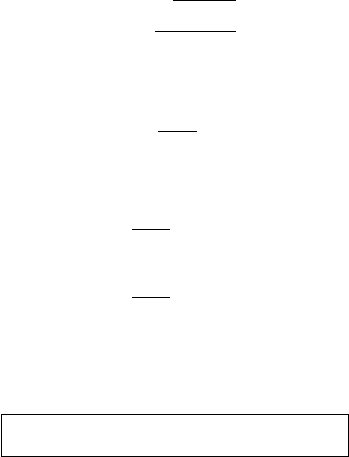
The general equation for relativistic electron scattering is given by equation (2.37)
in Chapter 2:
+ 4π
2
K
2
0
=−4π
2
U(r) =−
8π
2
me
h
2
V
c
(r). (5.1)
Note that we have replaced the electrostatic lattice potential V by the complex
potential V
c
= V + iW , introduced in Section 2.6.5. The Fourier transform of this
complex potential is given by
V
c
(r) = V
0
+ V
(r) + iW (r) = V
0
+
g=0
V
g
e
2πig·r
+ i
g
W
g
e
2πig·r
, (5.2)
where we have separated the zero-frequency component V
0
from the rest of the
Fourier series. V
0
is the positive mean inner potential, usually on the order of 5–50 V.
5.2 The Schr
¨
odinger equation for dynamical electron scattering 305
Since it is positive, this potential accelerates the electrons when they enter the
crystal, and hence the relativistic acceleration potential of the electron increases to
ˆ
c
=
ˆ
+ γ V
0
. (5.3)
This acceleration is known as refraction, and is equivalent to the change of the
velocity of light when a photon enters a transparent medium with a refractive index
different from that of vacuum.
†
We define the wave number k
0
as follows:
k
0
≡
2me
ˆ
c
h
. (5.4)
We introduce the following shorthand notation:
U (r) + iU
(r) ≡
2me
h
2
[V
(r) + iW (r)].
In other words,
U(r) =
2me
h
2
g=0
V
g
e
2πig·r
;
U
(r) =
2me
h
2
g
W
g
e
2πig·r
.
Note that U
contains the term W
0
, whereas U does not have a zero-frequency
component. This will become important later on. Using equation (5.4) we obtain:
‡
+ 4π
2
k
2
0
=−4π
2
[U + iU
], (5.5)
which is the starting equation for this chapter.
In the absence of a crystal potential other than the mean inner potential V
0
, and
ignoring absorption, we have U + iU
= 0. This is known as the empty crystal
approximation. The solution to the resulting homogeneous equation is given by
0
(r) = e
2πik
0
·r
, (5.6)
i.e. a plane wave, corrected for refraction, as is verified easily by substitution into
equation (5.5). In what follows we will choose the positive z-direction along the
electron propagation direction, i.e. k
0
=|k
0
|e
z
. We will assume that the e
x
-axis lies
along the projection of one of the reciprocal lattice vectors, say g, onto the plane
normal to the optical axis. Mathematically, this is represented by
e
x
(k
0
× g) × k
0
.
†
In the case of light, of course, the velocity decreases as light enters a medium with a refractive index larger than
unity. For electrons, the velocity increases upon entering the crystal.
‡
From here on we will no longer write the r dependence, except where confusion could arise.
306 Dynamical electron scattering in perfect crystals
Furthermore, we will assume that the crystal is planar, with parallel top and bot-
tom surfaces, and that it is defect-free. The bottom surface of the crystal, i.e. on
the opposite side of the electron source, will be known as the exit plane of the
crystal.
5.3 General derivation of the Darwin–Howie–Whelan equations
Bragg’s law (equation 2.41) tells us that electrons are diffracted in directions k
given by k
0
+ g, for all reciprocal lattice points g on the Ewald sphere. Hence,
we anticipate that the total wave function at the exit plane of the crystal will be a
superposition of plane waves, one in each of the directions predicted by the Bragg
equation. All that remains to be computed is the complex amplitude of each of these
diffracted waves. The general solution to equation (5.5) must then be of the form:
(r) =
g
ψ
g
e
2πi(k
0
+g)·r
. (5.7)
Note that this is a rather important assumption: instead of writing the total wave
function as a general superposition of momentum eigenfunctions, as we did in
Chapter 2, we limit the allowed momentum states to those satisfying the Bragg
equation. In Section 5.7, we will remove this assumption and compute the allowed
wave vectors inside the crystal, rather than imposing them from the beginning.
At this point in time we are not interested in what happens inside the crystal; we
are only interested in the behavior of the scattered waves far from the crystal.
The geometry for which all diffracted waves emanate from the back surface of
the crystal is commonly known as the Laue case; the other geometry, with scat-
tered waves on the same side of the crystal as the incident beam, is known as the
Bragg case.
After substitution of (r) above into equation (5.5) and some straightforward
computations, we find:
g
ψ
g
+ i4π (k
0
+ g) ·∇ψ
g
+ 4π
2
$
k
2
0
− (k
0
+ g)
2
%
ψ
g
e
2πi(k
0
+g)·r
=−4π
2
g
[U + iU
]ψ
g
e
2πi(k
0
+g)·r
.
It can be shown [VD76] that the first term (Laplacian derivative) in this equation is
negligible for high-energy electrons; this is the so-called high-energy approxima-
tion, or, equivalently, the forward scattering approximation. The argument for the
validity of this approximation involves the formal solution of the complete second-
order differential equation. Van Dyck [VD76] has shown that the high-energy ap-
proximation is a good approximation for crystal thicknesses up to a few hundred
5.3 General derivation of the Darwin–Howie–Whelan equations 307
nanometers, depending on the average atomic number of the crystal. First-order
correction terms
†
to the high-energy approximation can be found in [VD76].
For a perfect planar slab of material, the wave function component ψ
g
cannot
depend on the lateral coordinates x and y, so the gradient, ∇ψ
g
, contains only a
derivative with respect to z. Consequently, using the general definition of the dot
product (1.3), we can rewrite the second term as
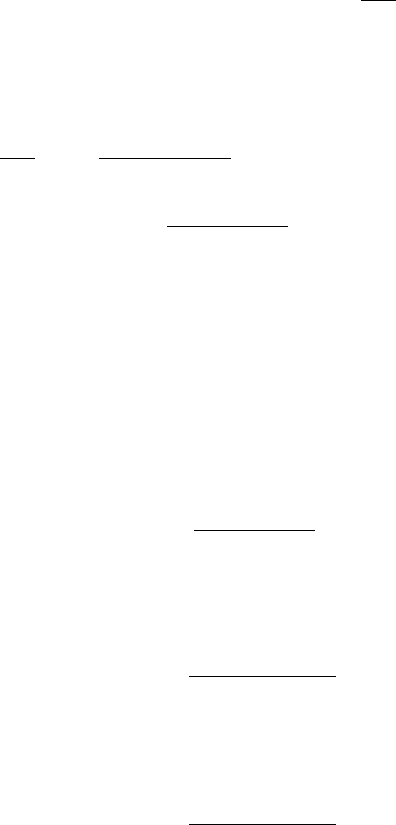
(k
0
+ g) ·∇ψ
g
=|k
0
+ g|cos α
dψ
g
dz
,
with α the angle between the vectors e
z
and k
0
+ g. Often, cos α can be approxi-
mated by 1, since the diffraction angle for high energy electrons is of the order of
a few milliradians. Rearranging terms, we find:
g
dψ
g
dz
− i2π
k
2
0
− (k
0
+ g)
2
2|k
0
+ g|cos α
ψ
g
e
2πi(k
0
+g)·r
=
g
iπ
(U + iU
)
|k
0
+ g|cos α
ψ
g
e
2πi(k
0
+g)·r
. (5.8)
At this point, we must remove the r dependence of the potential U + iU
, so that
the only r dependence remaining will be that of the plane waves. We introduce the
Fourier expansion:
U + iU
=
q
U
q
+ iU
q
e
2πiq·r
. (5.9)
Note that U
0
= 0, since V
0
was separated out earlier on. The right-hand side of
equation (5.8) can be rewritten as follows (we represent the left-hand side by LHS):
LHS = iπ
g
q
U
q
+ iU
q
|k
0
+ g|cos α
ψ
g
e
2πi(k
0
+q+g)·r
.
Since q is an arbitrary reciprocal lattice vector, we can replace it by any other
reciprocal lattice vector, say q = g
− g. This results in
LHS = iπ
g
g
U
g
−g
+ iU
g
−g
|k
0
+ g|cos α
ψ
g
e
2πi(k
0
+g
)·r
.
Finally, since both g and g
are summation variables, we can interchange them
without changing the result of the summation:
LHS = iπ
g
g
U
g−g
+ iU
g−g
|k
0
+ g
|cos α
ψ
g
e
2πi(k
0
+g)·r
.
†
The correction factor is proportional to the cube of the electron wavelength.