
Griffiths D.F., Higham D.J. Numerical Methods for Ordinary Differential Equations: Initial Value Problems
Подождите немного. Документ загружается.

126 9. Runge–Kutta Method—I: Order Conditions
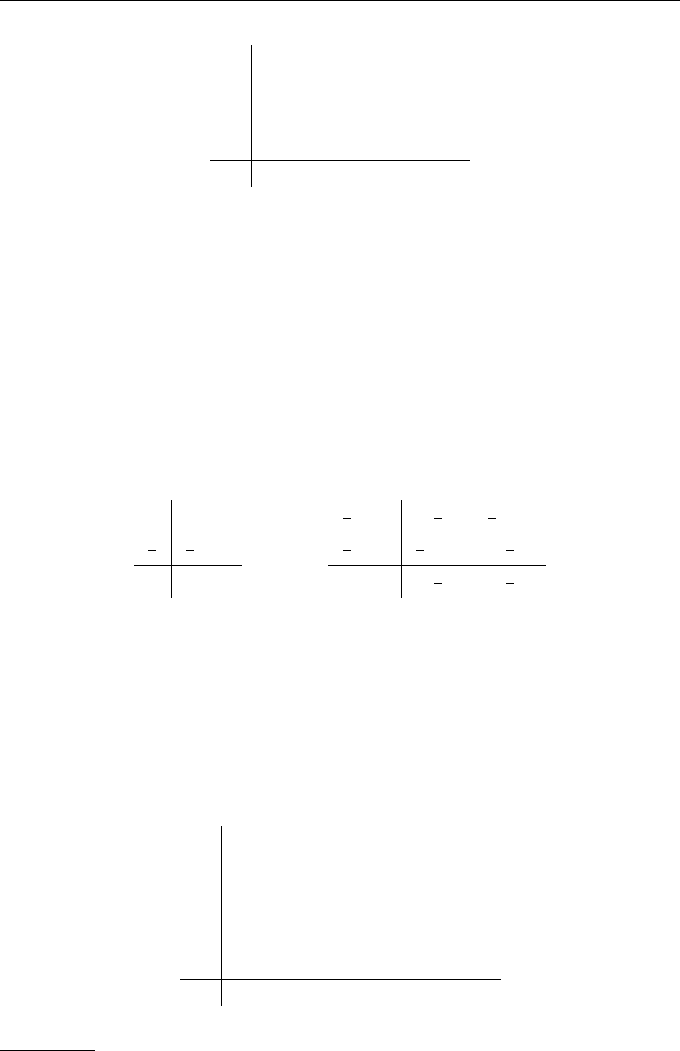
c
1
a
1,1
a
1,2
. . . a
1,s
c
2
a
2,1
a
2,2
. . . a
2,s
.
.
.
.
.
.
.
.
.
c
s
a
s,1
a
s,2
. . . a
s,s
b
1
b
2
. . . b
s
Table 9.2 The Butcher array for a full (implicit) RK method
Exercise 9.3 shows that it is natural to impose the condition
c
i
=
s
X
j=1
a
i,j
, i = 1 : s, (9.7)
so we will do this throughout. Thus, given a value of s, the method depends on
s
2
+ s parameters {a
i,j
, b
j
}. These can be conveniently displayed in a tableau
known as the Butcher array—see Table 9.2. For instance, the Butcher arrays
for Examples 9.1 and 9.2 are shown below:
0 0 0
1
2
1
2
0
0 1
1
2
− γ
1
4
1
4
− γ
1
2
+ γ
1
4
+ γ
1
4
1
2
1
2
In general, Equations (9.6) constitutes s nonlinear equations to determine {k
i
};
once found, these values are substituted into (9.5) to determine x
n+1
. Thus, a
general RK method is implicit.
However, if a
i,j
= 0 for all j ≥ i (the matrix
1
A = (a
i,j
) is strictly lower
triangular) the tableau is shown in Table 9.3 and k
1
, k
2
, . . . , k
s
may be com-
puted in turn from (9.6) without the need to solve any nonlinear equations; we
say that the method is explicit. These are the classical RK methods. We shall
0 0 0 . . . 0
c
2
a
2,1
0 . . . 0
c
3
a
3,1
a
3,2
. . .
.
.
.
.
.
.
.
.
.
.
.
.
0 0
c
s
a
s,1
a
s,2
. . . a
s,s−1
0
b
1
b
2
. . . b
s−1
b
s
Table 9.3 The Butcher array for an explicit RK method
1
We use A in calligraphic font to distinguish the coefficient matrix of an RK
metho d from the matrix A that app ears in a model linear system of ODEs: u
0
(t) =
Au(t).

9.3 One-Stage Methods 127
omit the zeros above the diagonal when writing a Butcher array for an explicit
method.
In the remainder of this chapter we look at the issue of choosing parameter
values to obtain the highest possible order. Chapter 10 then looks at absolute
stability. We will focus almost exclusively on explicit RK methods, and hence,
for brevity, “RK method” will mean “explicit RK method” by default, and we
will make it clear when im plicit methods are being considered.
Definition 9.3 (Local Truncation Error)
The LTE, T
n+1
, of an RK metho d is defined to be the difference between the
exact and the numerical solution of the IVP at time t = t
n+1
:
T
n+1
= x(t
n+1
) − x
n+1
,
under the localizing assumption that x
n
= x(t
n
), i.e. that the current numerical
solution x
n
is exact. If T
n+1
= O(h
p+1
) (p > 0), the method is said to be of
order p.
We note that this definition of order agrees with the versions used for TS
methods (Section 3.3) and LMMs (Section 5.4).
9.3 One-Stage Methods
There is no simple equivalent of the linear difference operator for RK methods
and a more direct approach is required in order to calculate the LTE.
When s = 1 we have x
n+1
= x
n
+ hb
1
k
1
and k
1
= f(t
n
+ c
1
h, x
n
+ a
1,1
k
1
).
However, since we are only considering explicit metho ds, c
1
= a
1,1
= 0 and so
k
1
= f(t
n
, x
n
) ≡ f
n
, leading to
x
n+1
= x
n
+ hb
1
f
n
.
This expansion is compared with that for x(t
n+1
):
x(t
n+1
) = x(t
n
) + hx
0
(t
n
) +
1
2!
h
2
x
00
(t
n
) + O(h
3
).
Differentiating the differential equation x
0
(t) = f (t, x(t)) with respect to t using
the chain rule gives
x
00
(t) = f
t
+ x
0
(t)f
x
= f
t
+ f f
x
and so
x(t + h) = x(t) + hf +
1
2!
h
2
f
t
+ f f
x
+ O(h
3
), (9.8)

128 9. Runge–Kutta Method—I: Order Conditions
where f and its partial derivatives are evaluated at (t, x). Applying the local-
izing assumption x
n
= x(t
n
) (so that f = f
n
, etc.) to this when t = t
n
we
obtain
T
n+1
= x(t
n+1
) − x
n+1
= h(1 − b
1
)f
n
+
1
2!
h
2
f
t
+ f f
x
t=t
n
+ O(h
3
).
The method will, therefore, b e consistent of order p = 1 on choosing b
1
= 1,
leading to Euler’s method, the only first-order one-stage explicit RK method.
Of course, we could have viewed this method as a one-step LMM and come
to the same conclusion that b
1
= 1 by applying the second of the conditions
for consistency: ρ
0
(1) = σ(1) (Theorem 4.7).
9.4 Two-Stage Methods
With two stages, s = 2, the most general form is given by (bearing in mind
(9.7))
k
1
= f(t
n
, x
n
)
k
2
= f(t
n
+ ah, x
n
+ ahk
1
)
x
n+1
= x
n
+ h(b
1
k
1
+ b
2
k
2
)
. (9.9)
We shall require the Taylor expansion of k
2
as a function of h, which, in turn,
requires the Taylor expansion of a function of two variables (see Appendix C):
f(t + αh, x + βh) = f (t, x) + h(αf
t
(t, x) + βf
x
(t, x)) + O(h
2
).
Hence, since k
1
= f
n
,
f(t
n
+ ah, x
n
+ ahk
1
) = f
n
+ ah
f
t
+ f f
x
t=t
n
+ O(h
2
). (9.10)
Substituting this into the equation for x
n+1
, we obtain
x
n+1
= x
n
+ h(b
1
k
1
+ b
2
k
2
)
= x
n
+ hb
1
f
n
+ hb
2
f
n
+ ah
f
t
+ f f
x
t=t
n
+ O(h
2
)
= x
n
+ h(b
1
+ b
2
)f
n
+ ab
2
h
2
f
t
+ f f
x
t=t
n
+ O(h
3
). (9.11)
From Definition 9.3 the LTE is obtained by subtracting (9.11) from (9.8) with
t = t
n
and assuming that x
n
= x(t
n
):
T
n+1
= h(1 − b
1
− b
2
)f
n
+ h
2
1
2
− ab
2
f
t
+ f f
x
t=t
n
+ O(h
3
). (9.12)
The terms on the right of (9.12) have a complicated structure, in contrast to the
equivalent expressions for LMMs. This means that there is no direct analogue

9.5 Three–Stage Methods 129
LTE Order conditions Order
O(h
2
) if b
1
+ b
2
= 1 for any a p = 1
O(h
3
) if b
1
+ b
2
= 1 ab
2
=
1
2
p = 2
Table 9.4 The order conditions for two-stage methods
here of the error constants of LMMs. The LTE is, in general, O(h), giving
order p = 0; the method is not consistent. Setting the coefficients of successive
leading terms in (9.12) to zero gives the order conditions listed in Table 9.4.
The general two-stage RK method has three free parameters and only two
conditions need be imposed to obtain consistency of order 2. It would appear
that the remaining free parameter might be chosen to increase the order further.
However, had we carried one further term in each expansion and applied the
order 2 conditions we would have found
T
n+1
= h
3
h
(
1
6
−b
2
a
2
)
f
tt
+2ff
xt
+f
2
f
xx
+f
x
(f
t
+ff
x
)
+
1
6
f
x
f
t
+ff
x
i
+O(h
4
).
It should be clear that there are no values of the parameters a, b
1
, b
2
for which
the method has order 3 (T
n+1
= O(h
4
)).
Defining b
2
= θ, we have the family of two-stage RK methods with Butcher
array shown in Table 9.5. All methods in the family have order 2 for θ 6= 0. The
mos
t popular methods from this family are the improved Euler method (θ =
1
2
)
and the modified Euler method (θ = 1; see Example 9.1).
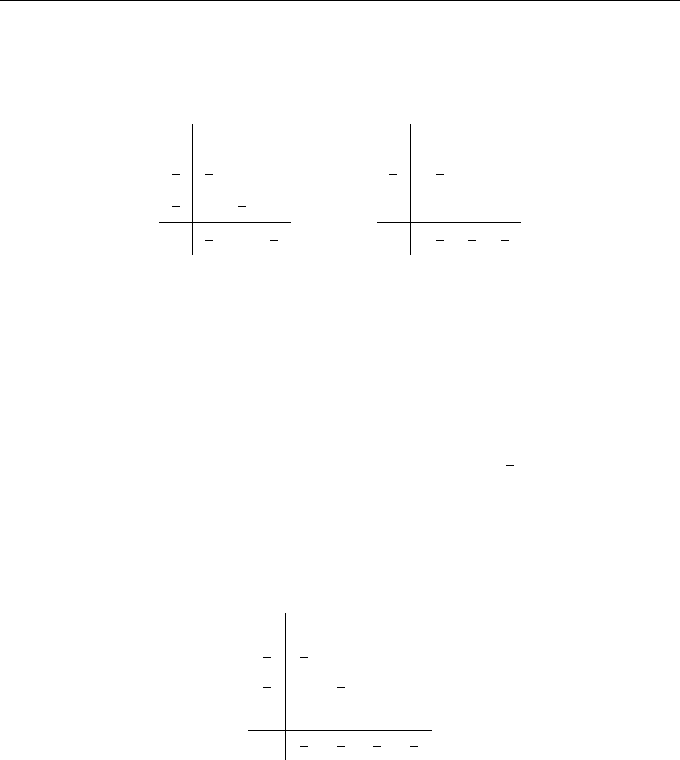
0 0
a a 0 a = 1/(2θ)
1 − θ θ
Table 9.5 The Butcher array for the family of sec ond-order, two-stage RK
methods
9.5 Three–Stage Methods
The most general three-stage RK method is given by
k
1
= f(t
n
, x
n
),
k
2
= f(t
n
+ c
2
h, x
n
+ ha
2,1
k
1
),
k
3
= f(t
n
+ c
3
h, x
n
+ ha
3,1
k
1
+ ha
3,2
k
2
),
x
n+1
= x
n
+ h
b
1
k
1
+ b
2
k
2
+ b
3
k
3
,
corresponding to the following tableau:

130 9. Runge–Kutta Method—I: Order Conditions
0 0
c
2
a
2,1
0
c
3
a
3,1
a
3,2
0
b
1
b
2
b
3
It follows from (9.7) that
a
2,1
= c
2
and a
3,1
+ a
3,2
= c
3
, (9.13)
so the method has six free parameters.
The manipulations are significantly more complicated for constructing
three-stage methods, so we shall summarize the conditions for third-order ac-
curacy without giving any details. The strategy is to expand k
1
, k
2
, and k
3
about the point (t
n
, x
n
) and to substitute these into the equation
x
n+1
= x
n
+ h
b
1
k
1
+ b
2
k
2
+ b
3
k
3
so as to obtain an expansion for x
n+1
in terms of powe rs of h.
This expansion is c ompared, term by term, with the expansion of the exact
solution (see (9.8) and Exercise 9.14):
x(t + h) = x(t) + hf +
1
2
h
2
(f
t
+ f f
x
)
+
1
6
h
3
(f
tt
+ 2f f
xt
+ f
2
f
xx
+ f
x
(f
t
+ f f
x
)) + O(h
4
),
where f and its partial derivatives are evaluated at (t, x). This process leads
to the conditions shown in Table 9.6.
There are four nonlinear equations
2
in the six unknowns c
2
, c
3
, a
3,2
, b
1
, b
2
, b
3
.
There is no choice of these parameters that will give a method of order greater
than three.
b
1
+ b
2
+ b
3
= 1 (order 1 condition)
b
2
c
2
+ b
3
c
3
=
1
2
(order 2 condition)
b
2
c
2
2
+ b
3
c
2
3
=
1
3
c
2
a
3,2
b
3
=
1
6
(order 3 conditions)
Table 9.6 Order conditions for three-stage RK methods
2
When b
3
= 0 the first two equations give the order 2 conditions for two-stage RK
metho ds.
9.6 Four-Stage Methods 131
Two commonly used methods from this family are Heun’s and Kutta’s third
order rules; see Table 9.7.
0 0
1
3
1
3
0
2
3
0
2
3
0
1
4
0
3
4
0 0
1
2
1
2
0
1 −1 2 0
1
6
4
3
1
6
Table 9.7 Heun’s third order rule & Kutta’s third order rule
9.6 Four-Stage Methods
A general four-stage RK method has 10 free parameters (
1
2
s(s + 1)) and eight
conditions are needed to obtain methods of maximum possible order—which is
p = 4 (Lambert [44, pages 178–9]). The most popular of all RK methods (of
any stage number) is the four-stage, fourth-order method shown in Table 9.8;
it is commonly referred to as the RK me thod.
0 0
1
2
1
2
0
1
2
0
1
2
0
1 0 0 1 0
1
6
1
3
1
3
1
6
Table 9.8 The classic four-stage, fourth-order method
9.7 Attainable Order of RK Methods
It may appear from the development to this point that it is always possible to
find RK methods with s stages that have order s. This is not so for s > 4. The
number of stages necessary for a given order is known up to order 8, but there
are no precise results for higher orders. To appreciate the level of complexity
involved, it is know n that between 12 and 17 stages will be required for order
9 and the coefficients must satisfy 486 nonlinear algebraic equations. Also, for

132 9. Runge–Kutta Method—I: Order Conditions
methods of order higher than 4, the order when applied to systems may be
lower than when applied to scalar ODEs. A structure to tackle such problems
was provided by Butcher in the early 1970s, and many of the results that have
flowed from this are summarized in the books of Butcher [6] and Hairer et
al. [28].
9.8 Postscript
RK methods were devised in the early years of the 20th century. This was an
era when all calculations were performed by hand and so the free parameters
remaining, after the relevant order conditions were satisfied, we re chosen to give
as many zero entries as possible in the Butcher array while trying to ensure
that the nonzero entries were fractions involving small integers. In the era of
modern digital computing, attention has shifted to minimizing the coefficients
that appear in the leading terms of the LTE.
EXERCISES
9.1.
?
Use the improved Euler RK(2) method with h = 0.2 to compute x
1
and x
2
for the IVP of Example 9.1 (this may be carried out with a
hand calculator).
9.2.
?
Prove that the RK method (9.5)–(9.6) applied to the IVP x
0
(t) = 1,
x(0) = 0, will not converge unless
s
X
i=1
b
i
= 1.
9.3.
??
As describ e d in Section 1.1, the scalar ODE x
0
(t) = f (t, x(t)), with
x(0) = η, may be written in the form of two autonomous ODEs,
u
0
(t) = f (u(t)), where
u(t) =
u(t)
v(t)
, f
u
v
=
1
f(u, v)
,
and u(0) = 0, v(0) = η. Show that the condition (9.7) arises natu-
rally when we ask for a RK method to produce the same numerical
approximation when applied to either version of the problem.

Exercises 133
9.4.
?
Show that the one-stage method in Section 9.3 is a special case of
the two-stage process (9.9) by choosing appropriate values of a, b
1
,
and b
2
. Hence show that we must have b
1
= 1 so that the method in
Section 9.3 has order one.
9.5.
??
Prove, from first principles, that the RK method
k
1
= f(t
n
, x
n
),
k
2
= f(t
n
+ h, x
n
+ hk
1
),
x
n+1
= x
n
+
1
2
h(k
1
+ k
2
),
is a consistent method (of order at least p = 1) for solving the IVP
x
0
(t) = f (t, x(t)), with x(0) = η.
9.6.
??
Prove, from first principles, that the RK method
k
1
= f(t
n
, x
n
),
k
2
= f(t
n
+
3
2
h, x
n
+
3
2
hk
1
),
x
n+1
= x
n
+
1
3
h(2k
1
+ k
2
),
is consistent of at least second order for solving the initial value
problem x
0
(t) = f (t, x(t)), t > 0 with x(0) = η.
9.7.
?
Consider the solution of the IVP x
0
(t) = (1 −2t)x(t) with x(0) = 1.
Verify the values (to six decimal places) given below for x
1
with
h = 0.1 and the metho ds shown. The digits underlined coincide
with those in the exact solution x(h) = exp[
1
4
− (
1
2
− h)
2
].
Improved Modified Heun Kutta Fourth
Euler Euler third order order
1.094 000 1.094 500 1.094 179 1.094 187 1.094 174
9.8.
??
Apply the general second-order, two-stage RK method (see Ta-
ble 9.5) to the ODE x
0
(t) = t
2
. Compare x
n+1
with the Taylor
expansion of x(t
n+1
) and comment on the order of the LTE.
9.9.
??
Apply the general second-order, two-stage RK method (see Ta-
ble 9.5) to the ODE x
0
(t) = λx(t). Compare x
n+1
with the Tay-
lor expansion of x(t
n+1
) and show that the difference is O(h
3
) if
x
n
= x(t
n
). We conclude that the order of the metho d cannot ex-
ceed two while the calculations in Section 9.4 show that the order is
at least 2; the order must therefore be exactly 2.
134 9. Runge–Kutta Method—I: Order Conditions
9.10.
???
Show that (9.4) follows from (9.3) (since x
n+1
= x
n
+
1
2
h(k
1
+k
2
)).
By matching coefficients of powers of
b
h on both sides of
1 −
1
2
b
h +
1
12
b
h
2
= (1 +
1
2
b
h +
1
12
b
h
2
)(a
0
+ a
1
b
h + a
2
b
h
3
+ ···),
or otherwise, show that the Maclaurin expansion of the right side of
(9.4) is
x
n+1
= (1 +
b
h +
1
2
b
h
2
+
1
6
b
h
3
+
1
24
b
h
4
+
1
144
b
h
5
)x
n
+ O(
b
h
6
).
Deduce that the method cannot be of order higher than four.
9.11.
??
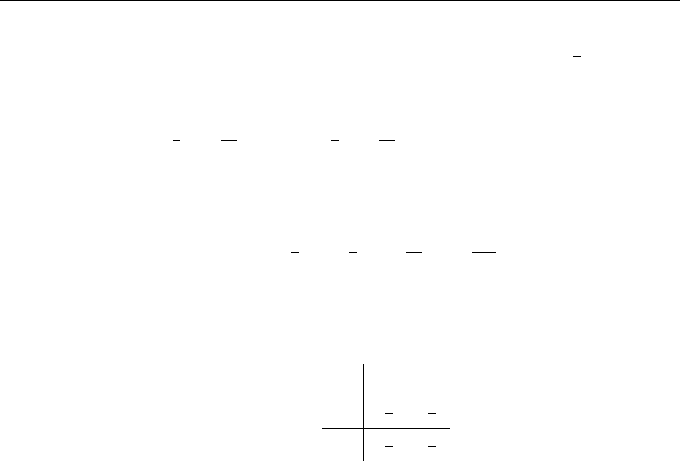
Show that the RK method with Butcher tableau
0 0 0
1
1
2
1
2
1
2
1
2
is equivalent to the trapezoidal rule (4.5).
9.12.
?
Find a solution of the third-order conditions so that c
2
= c
3
and
b
2
= b
3
(Nystr¨om’s third-order method).
9.13.
?
Show that, for any given third-order, three-stage RK m ethod, it is
possible to construct a second-order, two-stage method that uses the
same values of k
1
and k
2
.
9.14.
???
If x
0
(t) = f (t, x(t)), use the chain rule to verify that
x
000
(t) = f
tt
+ 2f f
xt
+ f
2
f
xx
+ f
x
(f
t
+ f f
x
),
where f and its partial derivatives are evaluated at (x, t).
9.15.
???
Use the result derived in the previous exercise to show, from
first principles, that Heun’s method (see Table 9.7) is a third-order
method.

10
Runge-Kutta Methods–II
Absolute Stability
10.1 Absolute Stability of RK Methods
The notion of absolute stability developed in Chapter 6 for LMMs is equally
relevant to RK methods. Applying an RK method to the linear ODE x
0
(t) =
λx(t) with <(λ) < 0, absolute stability requires that x
n
→ 0 as n → ∞.
We begin with the most general two-stage, second-order RK method dis-
cussed in Section 9.4.
Example 10.1
Investigate the absolute stability of the RK method with Butcher array
0 0
a a 0 a = 1/(2θ).
1 − θ θ
Applying this method to the solution of the ODE x
0
(t) = λx(t) and writing
Springer Undergraduate Mathematics Series, DOI 10.1007/978-0-85729-148-6_10,
© Springer-Verlag London Limited 2010
D.F. Griffiths, D.J. Higham, Numerical Methods for Ordinary Differential Equations,